
Crypto World
Nauru Appoints Dadvan Yousuf Trade Commissioner for Crypto Push

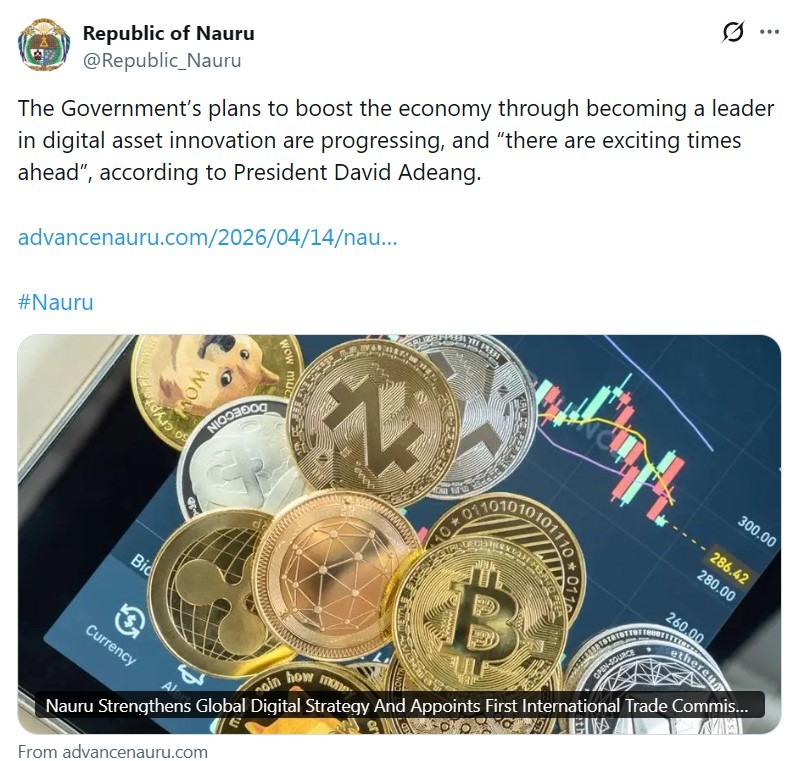
Nauru has appointed crypto entrepreneur Dadvan Yousuf as an international trade commissioner to help advance its digital asset strategy and attract global investment.
In a statement on Tuesday, President David Adeang said the appointment is part of the Pacific nation’s efforts to strengthen international partnerships and position itself as a hub for virtual asset activity. The government said Yousuf will support cross-border engagement with virtual asset service providers, financial institutions and technology firms.
The move comes less than a year after Nauru passed legislation establishing the Command Ridge Virtual Asset Authority (CRVAA), a dedicated regulator tasked with licensing and overseeing crypto firms, digital banks and other virtual asset activities.
The appointment marks a shift from establishing Nauru’s crypto regulatory framework to actively promoting itself as a jurisdiction for digital asset companies and investment, as the country says it is seeking new revenue streams and greater economic resilience.
Yousuf has previously been linked to regulatory action in Switzerland. In 2023, the Swiss Financial Market Supervisory Authority (FINMA) said a crypto project he founded sold millions of dollars in tokens without the required license and described the platform as non-operational, issuing cease-and-desist orders.

Nauru expands crypto push with trade appointment
According to the United Nations, Nauru is a Pacific island state in Micronesia, northeast of Australia, with about 21 square kilometers of land and roughly 12,500 people, making it the world’s third-smallest country and smallest island nation.
Adeang said Nauru’s digital asset push is intended to improve economic resilience and living standards while committing to international governance and compliance standards.
He previously said in August 2025 that Nauru, ranked among the most vulnerable to economic and climate shocks, is seeking to change its trajectory through new economic strategies.
Related: IMF guides Andorra to record and monitor Bitcoin transactions
The appointment adds a new outward-facing element to that strategy by pairing Nauru’s regulatory ambitions with a known figure in crypto circles.
In the announcement, Adeang said Yousuf brings “a unique combination of entrepreneurial vision, international network, and deep understanding of digital asset markets.”
Yousuf had previously attracted attention in the crypto sector after raising a Bitcoin flag atop Mount Everest in 2024. The Bitcoiner said the expedition was intended to highlight disparities in access to financial education.
Nauru surfaced in FTX-linked memo before crypto push
Nauru previously surfaced in crypto headlines in 2023 after court filings in the FTX bankruptcy revealed a memo proposing the purchase of the Pacific island nation using allegedly misappropriated funds.
The plan, linked to Gabriel Bankman-Fried, Sam Bankman-Fried’s brother, outlined building a bunker to survive a global catastrophe. However, Gabriel’s representatives denied involvement in drafting or endorsing the plan.
Magazine: Should users be allowed to bet on war and death in prediction markets?

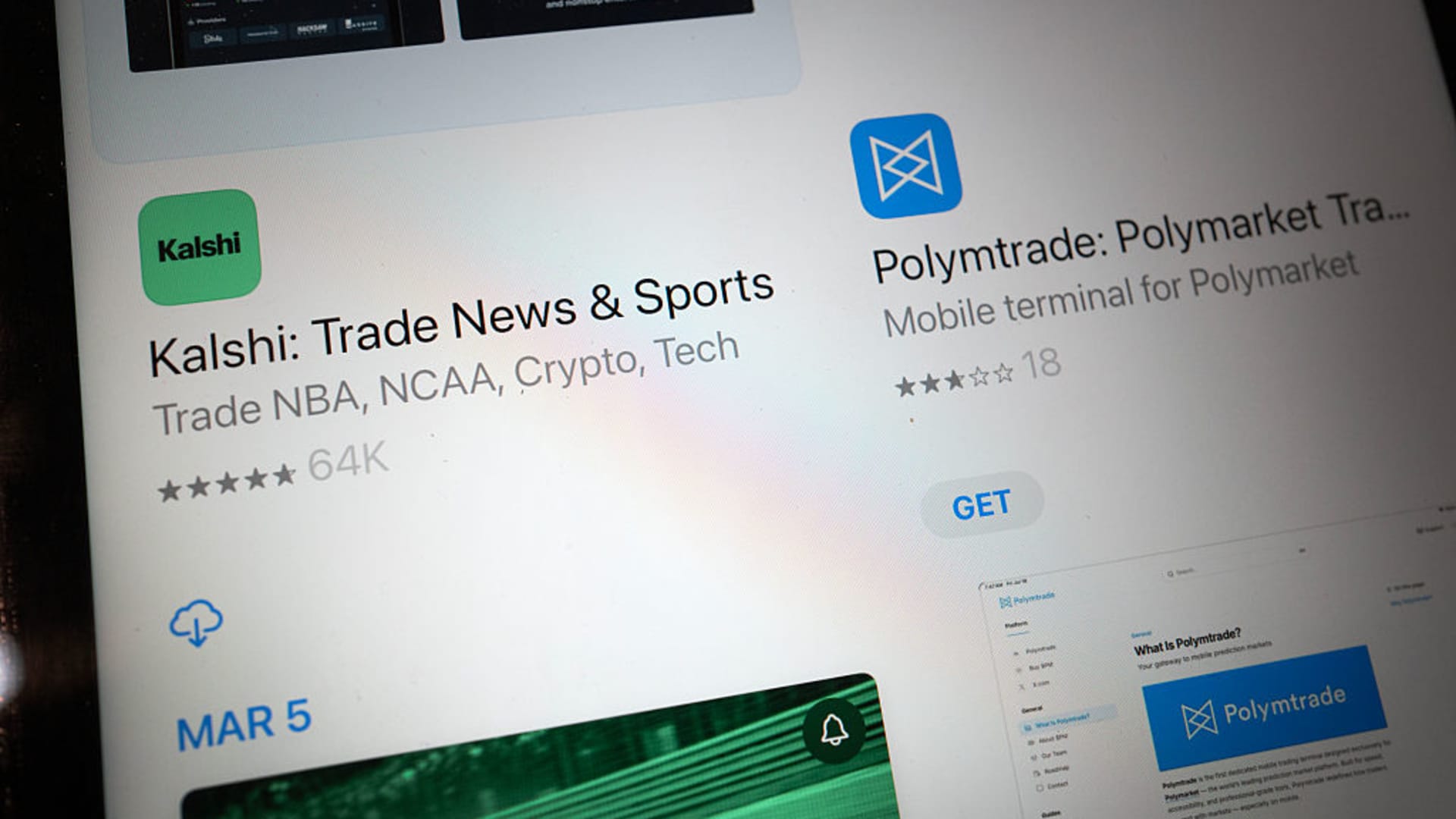
In this photo illustration, Apps for online prediction market sites are shown on an electronic device on Feb. 25, 2026 in Chicago, Illinois.
Scott Olson | Getty Images
Prediction market volumes are booming in 2026, on pace to more than quadruple this year alone and reach an estimated $1 trillion in the next four years, according to Bernstein.
Volumes have already surged in the first few months of this year, the investment bank wrote in a report Tuesday, with Kalshi and Polymarket, the two largest platforms, seeing about $60 billion in market volume year-to-date — more than the $51 billion in total prediction market volume in all of 2025.
Growth rates for the platforms rival the artificial intelligence boom, according to Bank of America. Analyst Julie Hoover in a note last week called Kalshi one of the “fastest growing non-AI companies” in the U.S. Weekly trading volume on Kalshi — which controls more than 90% of the U.S. prediction market — has surged to more than $3 billion today from about $100 million a year ago, she wrote.
While prediction market volumes initially jumped in 2024 around the U.S. presidential election, they eventually surpassed those levels in 2025 as sports, cryptocurrency and macroeconomic contracts became popular.
$1 trillion by 2030
Bernstein analyst Gautam Chhugani now estimates that total market volumes in 2026 will reach $240 billion, a 370% increase compared to last year. At a compound annual growth rate of roughly 80% between 2025 and 2030, Chhugani sees prediction market trading volume of $1 trillion a year by the start of the next decade.
Chhugani expects increased regulatory clarity at the federal level will boost the potential market, and that blockchain tokenization and integration with cryptocurrencies is enabling more liquidity. The makeup of traded contracts is also likely to change, he said.
A Polymarket advertisement in a subway station in New York, US, on Thursday, Feb. 5, 2026.
Michael Nagle | Bloomberg | Getty Images
“We expect [the] institutional market to develop around economics, business and political contracts, as investors seek more direct and discrete exposure to events,” he wrote. While sports contracts make up more than 60% of trading volume today, he sees that being cut in half by 2030. “We also expect hedging demand from corporates, [and] insurance firms exposed to specific event risks.”
While Kalshi and Polymarket dominate the space, new names are building a presence. Robinhood, DraftKings and Underdog are all starting or have already launched their own prediction market verticals, Bank of America’s Hoover said.
Public proxies
Robinhood and Coinbase Global are the key public market proxies for the private prediction market companies, Chhugani said. Robinhood’s prediction markets hub is now a year old, generating $350 million in annual recurring revenue, and accounting for some 30% of Kalshi total volume. The market is the digital finance platform’s fastest-growing business, and could encourage Robinhood to develop its own exchange, the analyst said.
While Chhugani’s long-range estimates assume the resolution of long-term regulatory risk, in the near-term state and federal regulators and the prediction markets themselves are engaged in a pitched battle. “Legal action is now pending in 14 states, plus another 4 congressional bills [are] also pending amid concerns around insider trading,” Hoover wrote.
The Commodity Futures Trading Commission headquarters in Washington, D.C.
Ting Shen | Bloomberg | Getty Images
Some states have begun legal action against prediction markets, citing their authority to regulate sports betting, while the Commodity Futures Trading Commission is fighting states, claiming it has the only authority to regulate prediction markets.
Still, Chhugani has faith that this won’t derail the multi-year outlook.
“Despite ongoing state-level legal challenges, we expect platforms like Kalshi, Polymarket, and public proxies (HOOD, COIN) to benefit from increasing regulatory clarity and growing alignment with federal regulators (SEC, CFTC) — a key driver of market legitimacy and mainstream adoption,” he wrote.
Disclosure: CNBC and Kalshi have a commercial relationship that includes a CNBC minority investment.
Markets shift and headlines fade, but the core principles of building long-term wealth remain constant. Join us for our third CNBC Pro LIVE, where investors of all backgrounds – from financial professionals to everyday individuals – come together to cut through the noise and gain actionable strategies for smarter, more disciplined investing. No matter where you’re starting from, you’ll leave with clearer thinking, stronger strategies. Enter your email here to get a discount code
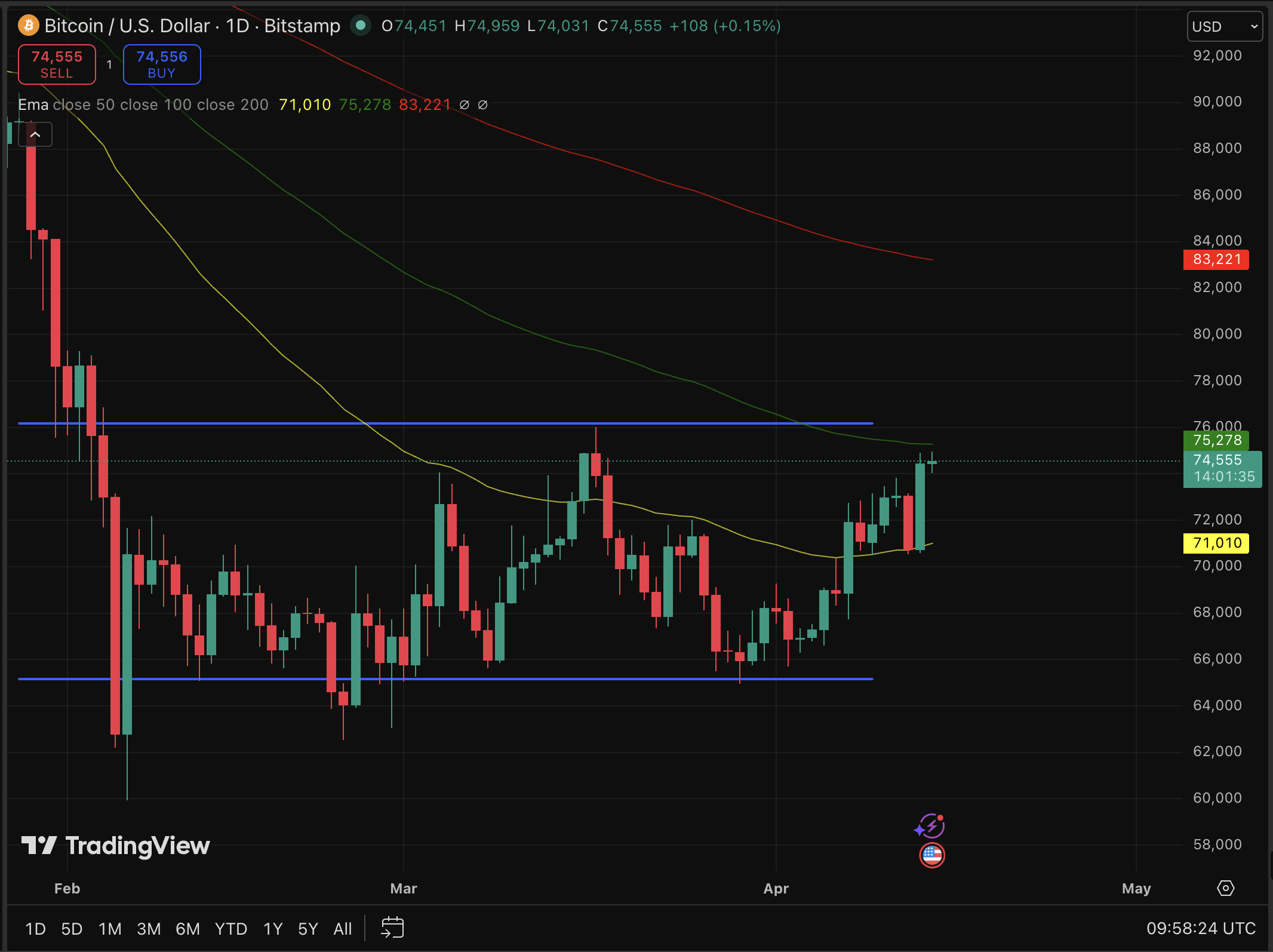
Bitcoin price is approaching $75,000 right now as the bears are running out of room, and our prediction model still says that the rally might not be over just yet. The move represents a sharp reversal from Sunday’s $70,000 capitulation low, a 6% swing in under 24 hours that caught overleveraged shorts badly offside.
The catalyst came at this AM. US President Donald Trump claims that Iran reached out for potential peace talks, even as a naval blockade of the Strait of Hormuz remained active. Risk assets rallied hard on the news, Asian equities climbed, oil expectations eased, and Bitcoin led the charge.
“Bitcoin is following the rally in broader risk assets,” said Damien Loh, chief investment officer at Ericsenz Capital, adding that BTC “continues to trade better than broader risk assets.” Ethereum joined the move, up 5.5% to over $2,370.
Bitcoin has now outperformed significantly since the US-Iran conflict began in late February, up more than 10%, while gold has shed nearly 10% and the S&P 500 sits roughly flat. The macro setup is shifting.
Discover: The best crypto to diversify your portfolio with
Bitcoin Price Prediction: $80,000 in the Picture
Bitcoin is at $74,600, still the strongest bounce in a month. The 24-hour structure shows conviction: analysts had identified roughly $6 billion in leveraged shorts clustered between $72,200 and $73,500, and the move through that band likely triggered a cascade of forced buying.
We flag $80,000 as the defining resistance test for the next major leg. Above that sits the 200-day moving average, just above $83,000. The technical line separates the downtrend from confirmed recovery.
Current price sits just 10% below the $80K level and 15% below the 200-DMA. Prior attempts at $80K have stalled under selling pressure, making a clean break structurally significant.
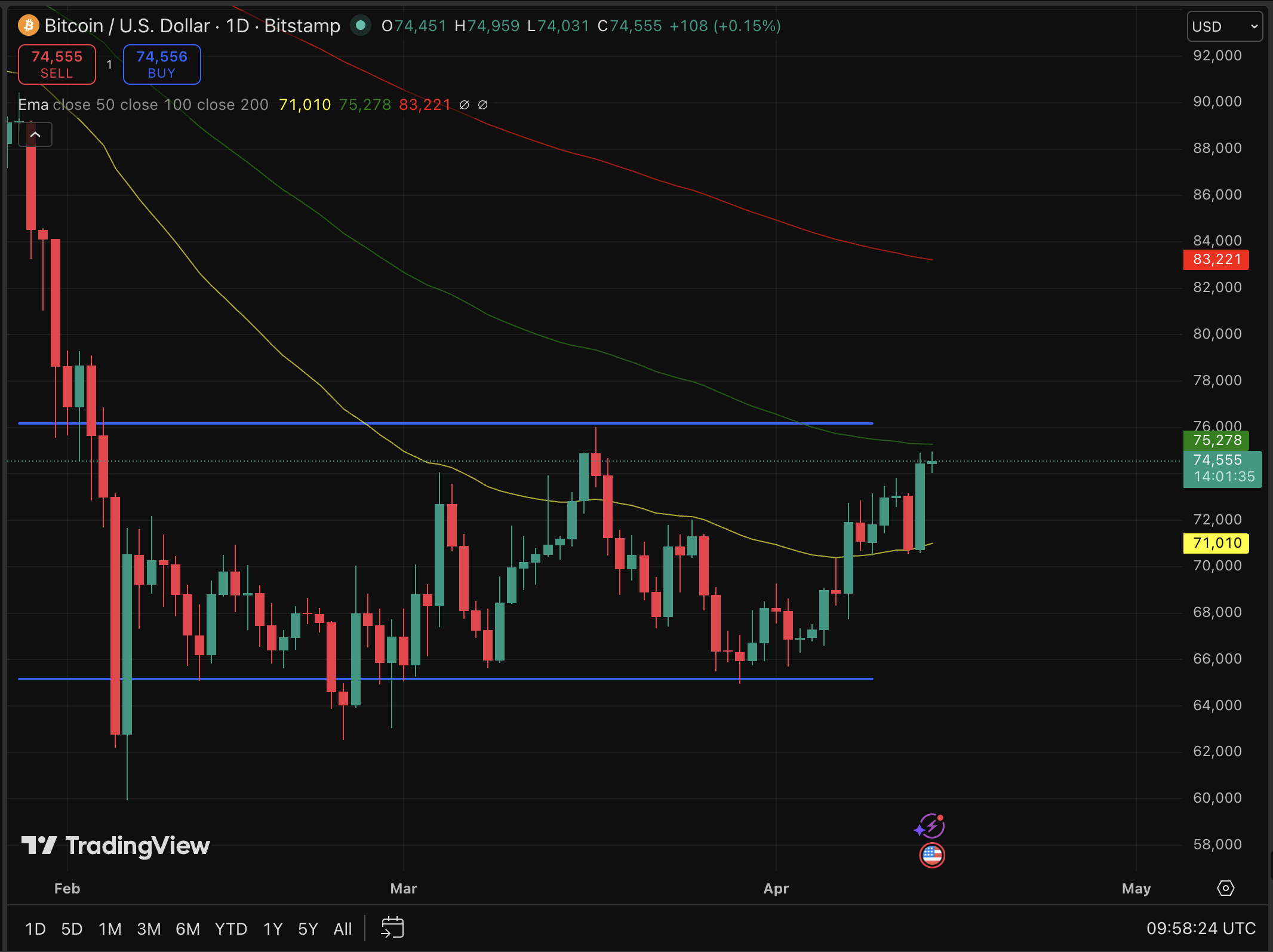
If Geopolitical de-escalation holds, shorts might continue to get squeezed, and BTC could clear $80K and target $83,000–$94,000. Standard Chartered and Bernstein both target $150,000 by year-end.
The next seven days appear decisive. Macro conditions remain fragile, and a “significant move higher” may not materialize until the US passes the Clarity Act regulatory framework. Price could move fast in either direction.
Discover: The best pre-launch token sales
Bitcoin Hyper With Early-Mover Upside Potential as BTC Breaks Resistance
Bitcoin at $74,000+ sounds bullish, until you price in the math and look at your capital size. A return to the $126K all-time high from here still requires a 69% move.
Institutional capital chasing that return at the current market cap faces diminishing leverage. Early-stage exposure to Bitcoin’s infrastructure layer is where asymmetric upside has historically lived.
Bitcoin Hyper ($HYPER) is positioning directly inside that infrastructure gap. It claims the title of the first-ever Bitcoin Layer 2 with Solana Virtual Machine (SVM) integration, targeting the core limitations that have held Bitcoin back: slow transactions, high fees, and near-zero programmability.
The pitch is sub-Solana latency on a Bitcoin-secured network, with a decentralized canonical bridge handling BTC transfers natively.
The presale numbers are concrete. $HYPER is currently priced at $0.0136, with $32 million raised to date. Staking is live with a high 36% APY bonus. The project has sustained momentum through Bitcoin’s recent volatility as a signal worth watching.
For traders monitoring Bitcoin’s $80K test, research Bitcoin Hyper here before the next price stage activates.
The post Bitcoin Price Prediction: $80K Coming to Wreck Bears appeared first on Cryptonews.
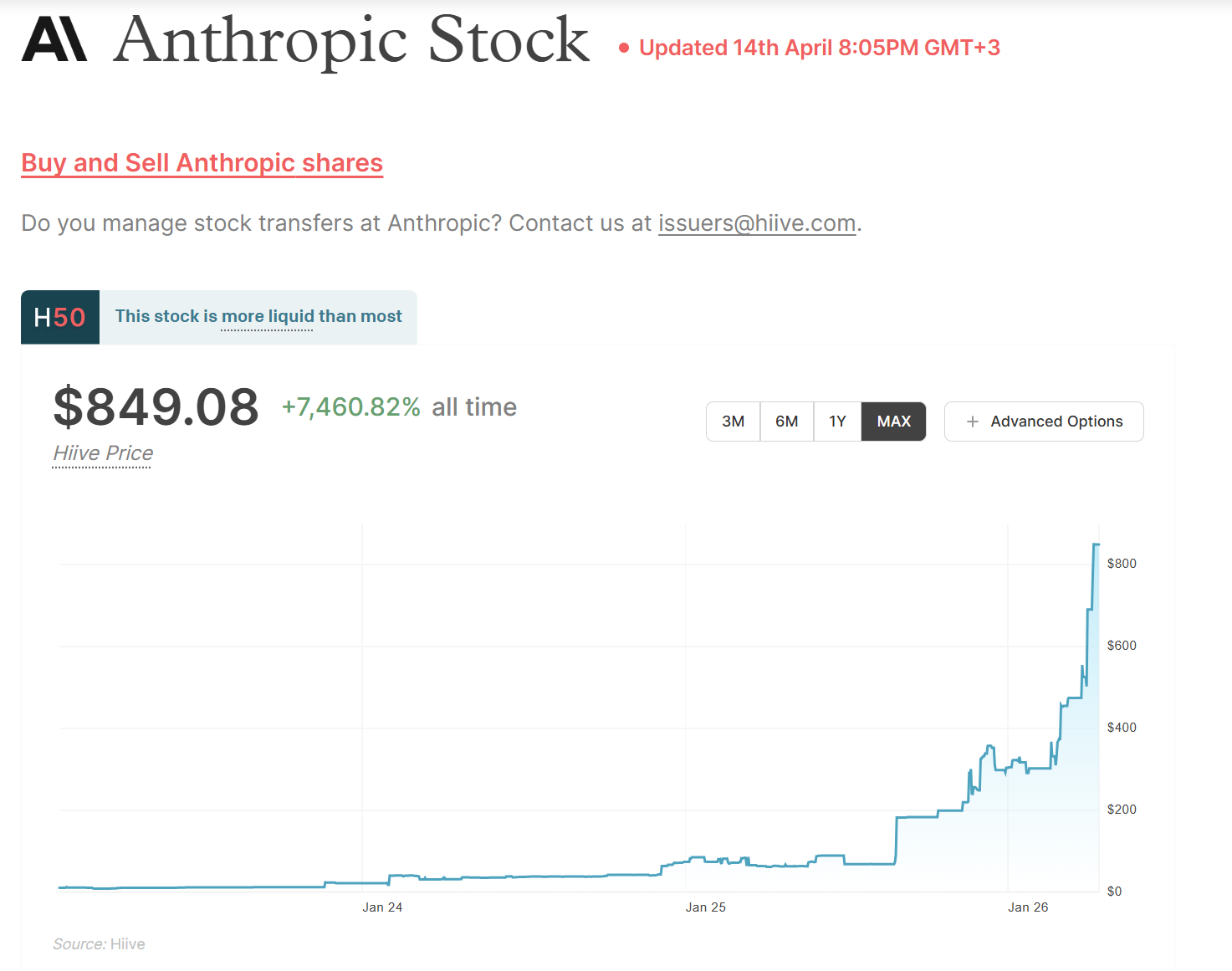
Tokenized pre-IPO Anthropic shares trading on Jupiter now imply a market capitalization of $851 billion, more than double the company’s last official funding valuation.
The synthetic tokens, launched via PreStocks on the Solana-based DEX aggregator, climbed from roughly $122 per share in October 2025 to approximately $900 by April 14, 2026.
Secondary Markets Price Anthropic Far Above Its Last Funding Round
Anthropic closed a $30 billion Series G round in February 2026 at a $380 billion post-money valuation. The gap between that figure and the $851 billion implied on Jupiter reflects aggressive investor positioning ahead of a potential IPO.
Traditional secondary platforms echo the trend. Shares on Hiive, a major pre-IPO marketplace, traded above $849 on April 14, closely matching the on-chain price.
Follow us on X to get the latest news as it happens
The PreStocks tokens are structured instruments backed 1:1 by SPV exposure to actual Anthropic shares.
Holders gain price exposure but receive no voting rights, dividends, or legal ownership in the company, much like how it happens for Bitget is doing with SpaceX pre-IPO.
AI IPO Wave Looms Over Public Markets
Anthropic is reportedly in discussions for a Q4 2026 listing that could raise over $60 billion. Goldman Sachs and JPMorgan Chase are among the banks competing for underwriting roles.
It is not the only AI giant approaching public markets. SpaceX filed confidentially with the SEC in early April, targeting a valuation above $1.7 trillion. OpenAI is also preparing a listing at roughly $1 trillion.
Combined, these three debuts could introduce more than $3 trillion in new market capitalization, a volume that would dwarf total US IPO proceeds over the past decade.
The post Anthropic’s Tokenized Shares on Jupiter Imply $850 Billion Valuation appeared first on BeInCrypto.
Crypto World
TAO Token of Bittensor Tumbles by 20% Post Governance Conflict Triggers Sell-Off in Market

Key Insights
- The TAO token of Bittensor falls over 20% post-exit of Covenant AI, citing governance issues.
- Fears of centralization impact the sentiment of the crypto market negatively.
- Currently, TAO is testing the $250-$263 support level, which requires a recovery above $280.
Price Plunge for TAO Due to Governance Issues
The native coin of Bittensor named TAO fell dramatically by more than 20% to reach approximately $273. This dramatic price plunge came as a rude shock to many traders after witnessing steady gains by the token.
The reason behind this selloff could be the unexpected departure of Covenant AI from the Bittensor network. Although departures happen all the time in blockchain projects, the reason why this departure became noteworthy was due to the substantial reputation that Covenant AI holds in the ecosystem.
Changes in Market Sentiment Happen Quickly
The news about Covenant AI being accused spread quickly throughout cryptocurrency circles, leading to a swift change in market sentiments. Investors who used to consider Bittensor a potential decentralized AI platform started rethinking the possible dangers related to governance transparency and sustainability in the long run.
Apart from damaging the reputation of the project, the departure of Covenant AI also led to negative changes in terms of finances. The organization is said to have liquidated a significant number of TAOs, putting additional pressure on the already falling price of the asset. Moreover, as soon as traders saw how Covenant AI sold its tokens, they rushed to do the same to avoid losses.
Thus, the market sentiment worsened quickly. The governance mechanism of Bittensor was accused of centralization and failing to distribute governance among many members of the network.
Liquidity Puts Downward Pressure on TAO Price
This led to massive selling by leveraged investors whose trades depended on further increases in the price. Their exits accelerated the downward trend. In other words, forced liquidations added further pressure on the TAO price as new sell orders entered the market after the positions were liquidated.
In addition, breaking below $300 was particularly important as it showed how strong bullish sentiment had been before the breakdown. Notably, just a few days earlier, the price was above $340.
Critical Support Zone Comes Into Focus
TAO is now attempting to stabilize in the mid-$260 range, an area that aligns with previous support levels and technical retracements. The immediate support zone between $250 and $263 has become crucial for short-term price action.
If this range holds, the market could enter a consolidation phase, allowing buyers to regain confidence and potentially rebuild momentum. A move back above $280 would be an early signal of recovery and renewed bullish interest.
However, risks remain elevated. If TAO fails to maintain support above $250, the next downside target could emerge around $233. This scenario would likely confirm continued bearish pressure and prolonged uncertainty.
Prognosis Is Still Unclear
Recent developments in relation to Bittensor show how the issue of governance can affect investor sentiment and confidence, particularly within decentralized networks.
Although the project may still have good prospects for success within the realm of AI-blockchain applications, investor sentiment currently remains highly volatile.
In the meantime, investors will be paying close attention to how the price develops, along with any progress within the network itself. The position taken by the Bittensor development team regarding any governance problems may become critical in determining future moves.
For the moment, however, caution appears to prevail.
Goldman Sachs filed with the SEC on April 14 to launch a Bitcoin Premium Income ETF, the bank’s first proprietary Bitcoin (BTC) fund product.
The filing adds Goldman to a growing list of Wall Street banks building dedicated BTC investment vehicles. Morgan Stanley debuted its own spot Bitcoin ETF just days ago.
How the Goldman Sachs Bitcoin ETF Works
The fund will invest at least 80% of net assets in instruments providing Bitcoin exposure. These include spot Bitcoin exchange-traded products and options on Bitcoin ETP indices.
Goldman’s core strategy relies on a dynamic options overwrite. The fund holds long positions in spot Bitcoin ETPs while selling call options against them, collecting premiums as monthly income.
The overwrite level ranges from 40% to 100% of BTC exposure, adjusted based on market conditions.
It does not hold BTC directly. A wholly owned Cayman Islands subsidiary can hold up to 25% of assets, helping the fund meet regulatory requirements for holding commodities under the Investment Company Act of 1940.
In flat or mildly volatile markets, option premiums may help the fund outperform plain spot Bitcoin ETFs. During strong rallies, the sold calls cap upside participation.
ETF analyst Eric Balchunas noted Goldman may be responding to client demand for lower-volatility BTC exposure.
“Goldman may sense opp to leap frog them and/or is prob hearing from their clients they want bitcoin but with less vol and happy to give up some upside for lower downside and income,” he wrote.
Wall Street’s Bitcoin Product Race Heats Up
Goldman has been steadily expanding its crypto footprint. Its most recent 13F filing showed roughly $1.1 billion in Bitcoin ETF holdings and more than $2.36 billion in total crypto ETF exposure.
The bank also recently acquired Innovator Capital Management, which issues Bitcoin-linked structured products.
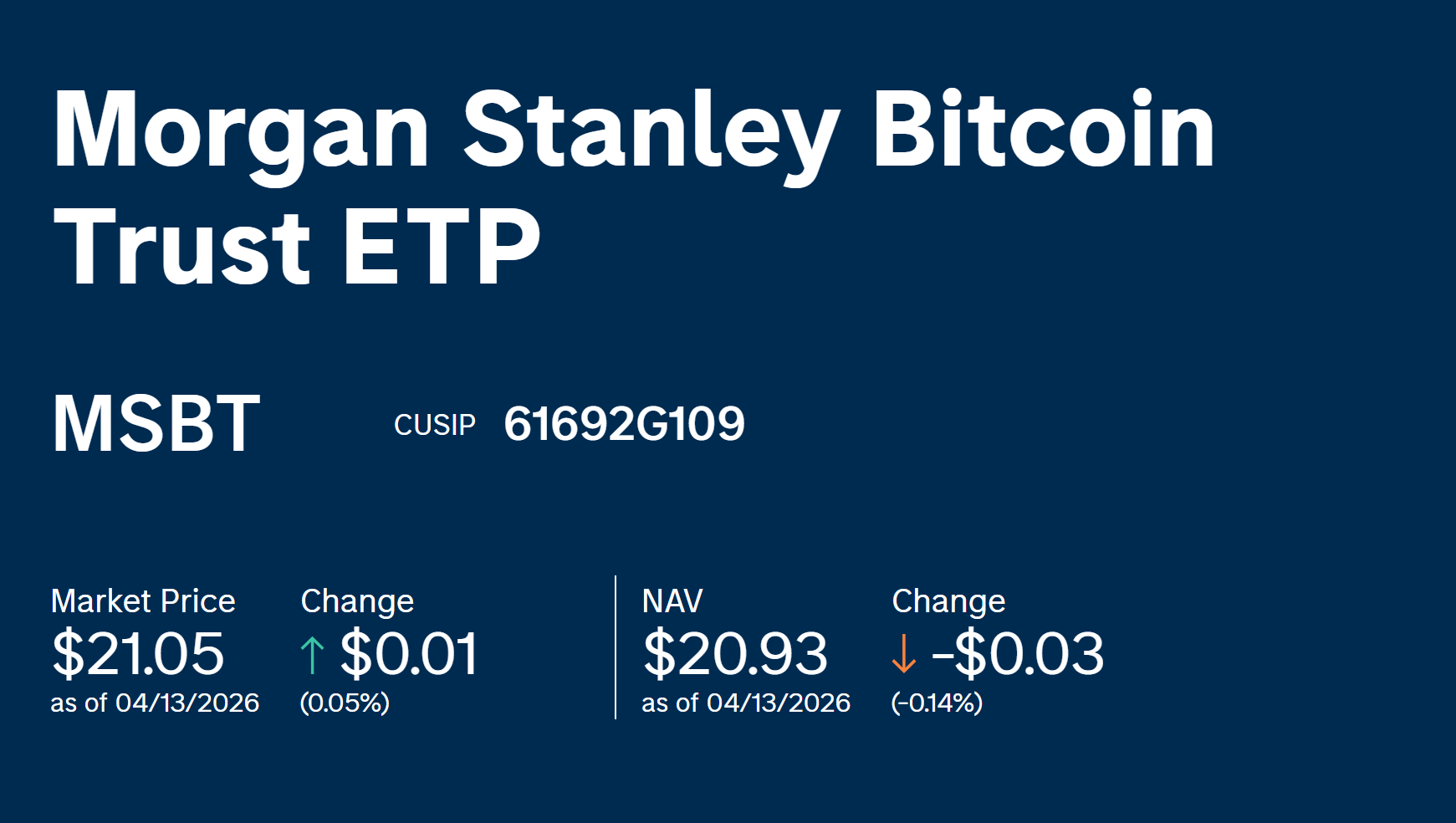
The filing comes less than a week after Morgan Stanley launched the Morgan Stanley Bitcoin Trust (MSBT) on NYSE Arca.
“Seeing a global giant like Morgan Stanley highlighting crypto on their homepage like this is such a positive sign…This is how it goes mainstream. TradFi isn’t on the sidelines of crypto anymore. It is actively prioritising and scaling it as a core asset class. Next stop: every large wealth platform in the world treating crypto like just another asset class,” commented Summit Gupta.
That fund tracks BTC’s spot price at a 0.14% expense ratio, making it the cheapest spot Bitcoin ETF on the market. It drew $30.6 million in first-day inflows.
Goldman’s product targets a different audience. While MSBT appeals to investors seeking pure price exposure at low cost, the Premium Income ETF is designed for those willing to trade upside for regular distributions.
Grayscale launched its own Bitcoin Premium Income ETF (BPI) in April 2025 with a 0.66% expense ratio. BlackRock has a similar product at an advanced stage of development. Goldman’s fees have not yet been disclosed.
The filing is a post-effective amendment. The fund could launch roughly 75 days after the April 14 filing date, pending SEC review. A ticker has not yet been assigned.
For traditional portfolio allocators, the entry of a $3.5 trillion asset manager packaging BTC volatility as yield further narrows the gap between crypto and conventional income investing.
The post Goldman Sachs Targets BTC Yield With New Bitcoin Income ETF appeared first on BeInCrypto.
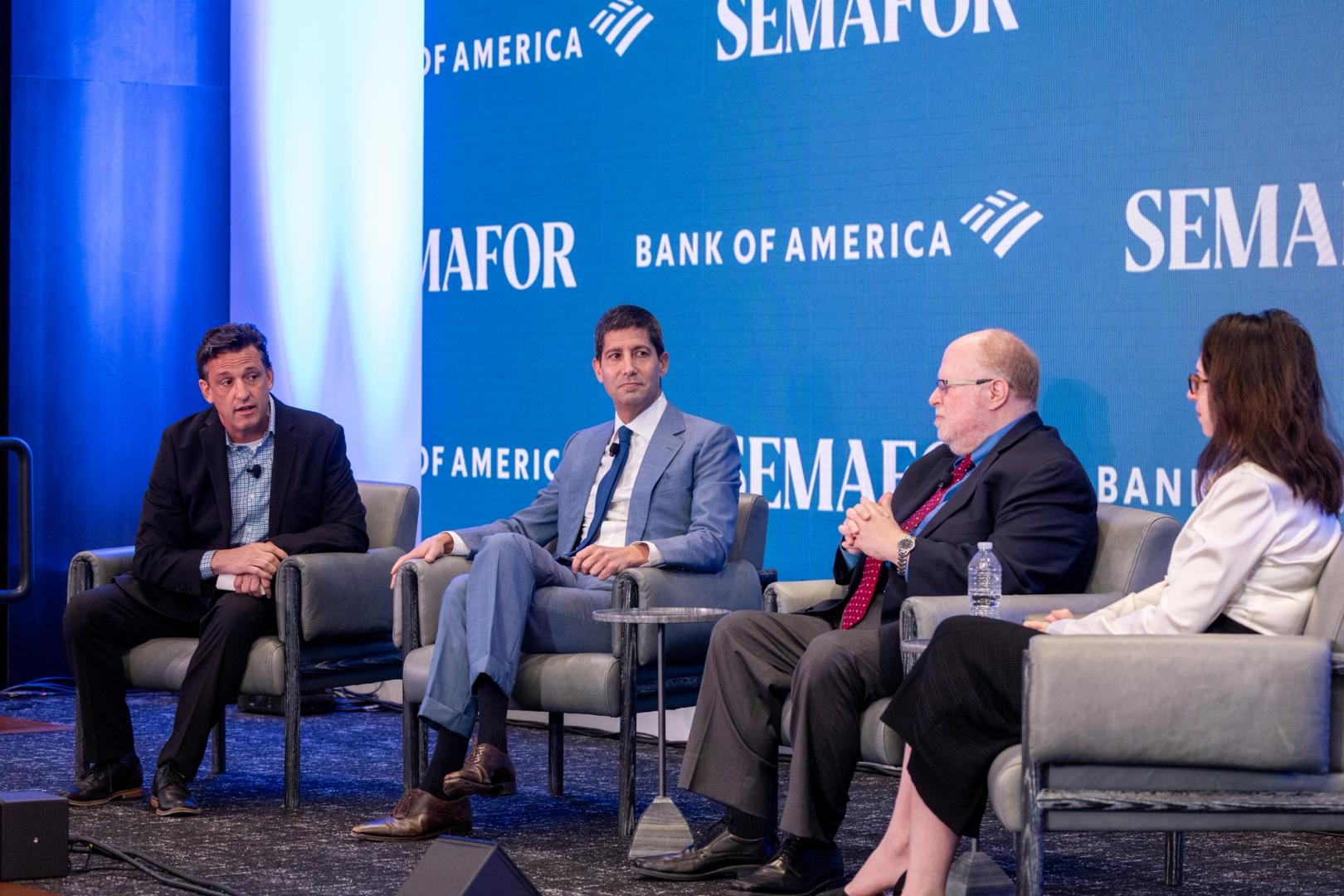
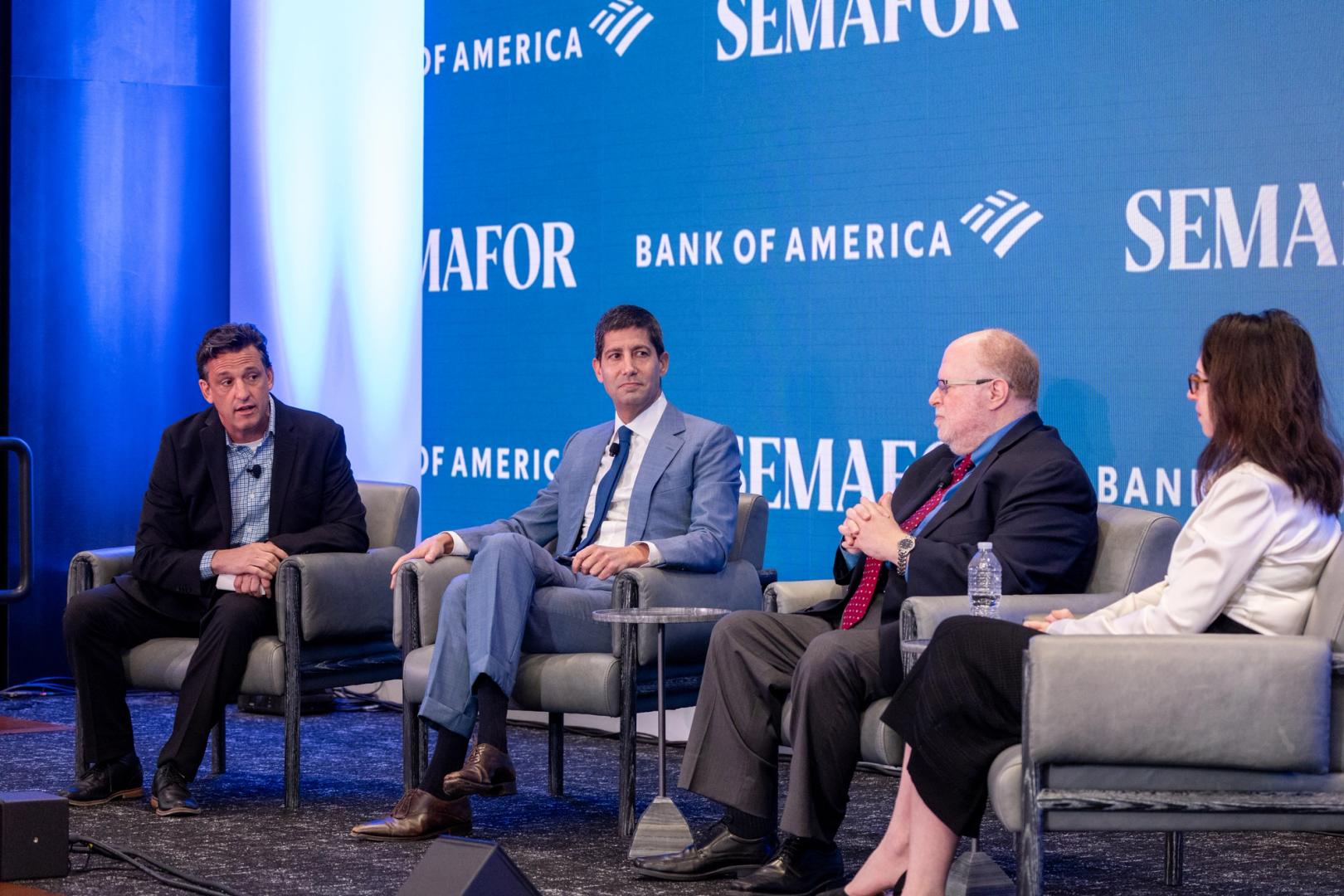
Kevin Warsh, President Trump’s nominee to chair the Federal Reserve, filed his 69-page financial disclosure with the U.S. Office of Government Ethics, clearing the last bureaucratic hurdle before his confirmation hearing, now expected next week.
The filing reveals combined assets with his wife of at least $192 million — but it’s the crypto-specific holdings buried deep in the document that should interest this industry the most.
Warsh, through a web of venture fund structures, holds equity positions in more than a dozen blockchain and digital asset companies spanning DeFi lending, decentralized derivatives, Layer 1 and Layer 2 networks, prediction markets, and Bitcoin payments infrastructure. And he has pledged to divest the majority of them.
The man who will oversee stablecoin regulation, bank crypto custody policy, and any future central bank digital currency decisions has, until now, been personally invested across the crypto ecosystem, though the size of those holdings was unclear.
The Full Crypto Portfolio
CoinDesk reviewed the complete 69-page OGE Form 278e. Warsh’s crypto and blockchain-related holdings are concentrated in two fund structures: DCM Investments 10 LLC (through a vehicle called Abstract Holdings) and a series of funds labeled AVF I, AVF II, AVF III, and AVGF I and II. Here is every identifiable crypto and blockchain position:
DeFi and trading protocols:
- Compound — Algorithmic crypto money markets, one of the foundational DeFi lending protocols
- dYdX — Decentralized derivatives trading exchange
- Lighter — Decentralized exchange protocol
- Eulith — Crypto trading platform
Layer 1 and Layer 2 networks:
- Solana — High-performance Layer 1 blockchain
- Optimism — Ethereum scaling Layer 2
- Blast — Yield-generating Ethereum Layer 2
- Zero Gravity — Layer 2 AI blockchain platform
- DeSo — Social crypto network
Bitcoin-specific:
- Flashnet — Lightning Network Bitcoin trading platform
- Lightning Network — Off-chain Bitcoin payment network (a direct holding)
Crypto investment and financial infrastructure:
- Polychain — Crypto investment firm
- Scalar Capital — Blockchain investment firm
- Polymarket — Prediction market platform
- Lemon Cash — Crypto financial services platform
- Alpaca — Financial assets API infrastructure
- OnJuno — Crypto-enabled neobank
- OneSafe — DeFi data infrastructure
- Ridian — Crypto portfolio automation
- SkyLink — DeFi portfolio management
- Caliza — Global USD banking platform
- Kinetic — Digital asset exchange platform
Web3, NFTs, and crypto-adjacent:
- Crossmint — NFT developer tools
- CreatorDAO — Creator investment platform
- Friends With Benefits — Web3 community platform
- Dapper Labs — Consumer digital assets (NBA Top Shot)
- Tenderly — Ethereum developer platform
- Vana — Incentivized data collection platform
- Structure (Zaibatsu Heavy Industries) — Blockchain retail trading
- Metatheory — Web3 gaming (held separately as a direct SPV)
In addition, Warsh previously invested in Bitwise Asset Management, the firm behind one of the spot bitcoin ETFs, though that position does not appear on the current disclosure.
What he has to sell — and what that means
Most of these crypto positions sit within fund vehicles whose individual line items are reported without dollar values, which, under OGE rules, means each is worth less than $1,000. In other words, they’re small venture bets, not concentrated positions.
But there are bigger pots that almost certainly contain crypto exposure. Warsh holds over $100 million in Juggernaut Fund LP, whose underlying assets are shielded by confidentiality agreements. He also holds dozens of positions in THSDFS LLC, some valued at $1–$5 million individually, all similarly opaque. Both will require full divestiture.
OGE certifying official Heather Jones flagged these in her review, noting that Warsh will be in compliance with the Ethics in Government Act once he completes the divestitures. The open question is how that divestiture plays out for illiquid venture stakes. Selling a position in Compound or dYdX token holdings is straightforward; unwinding LP stakes in Polychain or Bessemer Venture Associates funds is not.
The conflict question
Even after selling, Warsh will face a complicated recusal landscape. Federal ethics rules generally require a one-year cooling-off period for matters directly affecting recent financial interests. That could be relevant as the Fed weighs in on:
- Stablecoin legislation: Congress is actively debating stablecoin frameworks that would define which institutions can issue and custody stablecoins — directly impacting DeFi protocols and crypto neobanks like those in Warsh’s portfolio.
- Bank crypto custody guidance: The Fed’s supervisory stance on whether banks can custody digital assets has been one of the most contested policy questions in crypto since 2022.
- Tokenized deposits and securities: The Fed has a direct role in approving or discouraging bank experimentation with tokenized deposits, an area adjacent to several Warsh holdings.
- CBDC research: Though political support for a U.S. CBDC has cooled, the Fed’s ongoing research intersects with the payment network infrastructure represented by Lightning Network and Solana holdings.
The Bigger Picture
What’s striking is less the size of the crypto bets — most are small — but more that they exist at all. This is not a nominee who passively held bitcoin through a brokerage account. Warsh deliberately sought exposure to the specific protocols, networks, and infrastructure companies that the Fed’s regulatory and monetary policy decisions most directly affect.
His broader financial profile underscores the point. Warsh earned $10.2 million in consulting fees from Duquesne Family Office, the investment arm of Stanley Druckenmiller, one of crypto’s most prominent macro investors. He collected $1.55 million from GoldenTree Asset Management, $750,000 from Cerberus Capital Management, and another $750,000 in honoraria from Brevan Howard — all firms with significant digital asset trading operations.
His speaking fee circuit in the first half of 2025 alone totaled over $780,000 from firms including TPG, Warburg Pincus, State Street, Eli Lilly, and Centerview Partners.
Combined with spouse Jane Lauder’s estimated $1.9 billion net worth, Warsh would be among the wealthiest Fed chairs in modern history.
What comes next
Senate Banking Committee chair Tim Scott (R-S.C.) said Tuesday that a confirmation hearing will be held next week. But Sen. Thom Tillis (R-N.C.) continues to block any final vote until the Justice Department drops its criminal investigation of current Fed Chair Jerome Powell, whose term expires May 15.
The crypto holdings will almost certainly come up in questioning. Senators on both sides have grown more focused on financial conflicts at the Fed, and Warsh’s portfolio gives them specific, named companies to ask about.
For the crypto industry, the Warsh disclosure is a double-edged signal. On one hand, a Fed chair with personal venture exposure to DeFi and blockchain infrastructure may have more nuanced views on the technology than predecessors who had none. On the other hand, the mandatory divestiture and recusal obligations could constrain his ability to act on whatever sympathies those investments imply — at least in the first year.


ECB chief economist Philip Lane warned the central bank could still raise interest rates if inflation’s impact lasts longer than expected, keeping tightening risks alive even after March’s pause.
Summary
- ECB’s Philip Lane says rates could rise if inflation’s impact lasts longer.ecb.
- Comments reinforce data‑dependent stance after March decision to hold rates.ecb.
- Markets already pricing in up to three hikes this year amid energy risks.
European Central Bank chief economist Philip Lane has warned that interest rates may yet rise if inflation in the euro area proves more persistent than policymakers currently expect, keeping the door open to further tightening even after the ECB held borrowing costs steady in March.
According to Jinshi’s summary of Lane’s latest remarks, the Governing Council member said that “if the impact of inflation lasts for a longer period, the European Central Bank will consider raising interest rates,” underlining that the fight against above‑target price growth is not over.
His comments echo recent guidance from ECB President Christine Lagarde, who told the Financial Times that “if we expect inflation to deviate significantly and persistently from target, the response must be appropriately forceful or persistent,” signalling that rate hikes remain on the table if price pressures re‑accelerate.
In its March policy decision, the ECB left its three key interest rates unchanged and reiterated that it is “determined to ensure that inflation stabilises at the 2% target in the medium term,” while acknowledging that the conflict in the Middle East has created upside risks for inflation via higher energy costs.
The central bank’s latest projections see headline inflation averaging 2.6% in 2026 and hovering around 2% in 2027 and 2028, but officials including Lane have flagged that wage dynamics and firms’ price‑setting plans will be watched closely at “every meeting” to judge whether those forecasts remain credible.
Lagarde has also stressed that “self‑reinforcing mechanisms” could take hold if inflation expectations drift away from the target, warning that the risk of de‑anchoring would “become acute” without a sufficiently firm response, a stance that has kept markets wary of declaring the hiking cycle definitively over.
Traders in money markets currently price in two to three ECB rate increases by year‑end, which would lift the main policy rate toward a range of roughly 2.50% to 2.75%, with the timing seen as highly sensitive to incoming inflation prints and developments in energy markets.
For crypto investors, Lane’s signal that rates could still rise if inflation lingers adds another macro variable to watch alongside the European inflation data and central bank communications that crypto.news has tracked in previous coverage of ECB decisions and their spillover into Bitcoin and Ethereum markets.


Binance founder Changpeng Zhao (CZ) dedicated a considerable portion of his autobiography, Freedom of Money, to talking about somebody called Wei Zhou.
Indeed, Zhao is this fifth most mentioned person in the book, tied with Sam Bankman-Fried (SBF) with 23 mentions. But who is he?
Zhao joined Binance from Goldman Sachs in 2018 as its first chief financial officer (CFO).
He’d previously shepherded two companies through NYSE and NASDAQ IPOs, and in Binance’s eyes, he brought institutional credibility that the then-one-year-old crypto exchange desperately needed.
Zhou is now CEO of Coins.ph, a Philippines-based crypto wallet and exchange that he acquired from Indonesian super-app Gojek in 2022 for roughly $200 million.
He also advises Old Fashion Research, a blockchain fund run by former Binance executives, as well as serving as vice chairman of the gay dating app Grindr.
Wei Zhou : From CZ’s first CFO to his nemesis
CZ used Freedom of Money, written largely during his time in prison and published on April 8, to paint Zhao as an unreliable subordinate-turned-antagonist.
Specifically, it frames his tenure around two grievances.
The first involves Zhao’s role in Binance’s FTX investment.
FTX launched in May 2019 and within months, SBF approached Binance for investment. Zhao championed the deal, yet CZ claims that he initially declined.
However, by late 2019, FTX lowered its valuation and sweetened the offer with a Binance Coin (BNB) for FTX token (FTT) token swap. Binance agreed, taking a 20% stake in SBF’s company that would implode three years later.
Fortunately for CZ, Binance was able to sell its FTX equity, before FTX went bankrupt.
Fintech Alliance Philippines and Binance
CZ also complained about Zhao’s role in Binance’s Philippine expansion.
In September 2022, Zhao wrote to the chairman of Fintech Alliance Philippines, questioning a blockchain education partnership between the Alliance and Binance.
The letter, which a Philippine crypto publication published in full, called Binance an unregistered virtual asset service provider.
Zhao claimed that Coins.ph was “astounded” by the Binance-Alliance collaboration, an assertion that CZ frames as an underhanded attempt to block Binance from the Philippine market.
Unsurprisingly, Zhao denied the framing and told reporters, “We did not block Binance from joining. We asked to be involved in blockchain education initiatives of Fintech Alliance Philippines.”
Partial financials for his CFO
Basically, CZ’s memoir casts Zhou as a disloyal insider. However, other reports tell a different story about who kept whom in the dark.
Reuters reported in December 2022 that Zhao never had access to Binance’s full financial accounts during his tenure as CFO of nearly three years. Reuters says that two former colleagues confirmed that claim.
It also claimed the world’s largest crypto exchange ran its finances as a “black box” obscured from even its own CFO.
Zhao wasn’t the only executive to discover CZ’s centralized grip over Binance.
Binance.US, launched in 2019 while Zhao still served as global CFO, was meant to operate independently.
However, its first CEO, Catherine Coley, was replaced without explanation. Her successor, former US Comptroller of the Currency Brian Brooks, lasted less than four months.
Brooks later testified concerningly that he realized CZ ran the US entity, not him.
The SEC would eventually allege that Binance.US was a sham, controlled behind the scenes by CZ while publicly claiming independence.
Zhao left Binance in June 2021, the same summer Brooks walked out of Binance.US. Binance cited personal reasons for both departures.
Read more: How the battle between Binance and FTX went from bad to worse
Binance Avengers
After leaving, Zhao created a private group that CZ’s memoir called the “Binance Avengers.” It gathered disgruntled former employees to criticize the exchange.
CZ’s book claims some members later lost money after transferring assets to FTX.
The Binance supremo also places Zhao on an informal enemies list alongside SBF and OKX founder Star Xu. As Protos reported, the CZ-Xu grudge escalated to a $1 billion bet within days of the book’s release.
Got a tip? Send us an email securely via Protos Leaks. For more informed news, follow us on X, Bluesky, and Google News, or subscribe to our YouTube channel.

TLDR
- XRP rose to $1.37 after gaining 3.83% and ending a three-day decline.
- XRP Futures net inflows surged 294% to $46.15 million within 24 hours.
- Derivatives data showed steady inflows across 4-hour, eight-hour, and 12-hour timeframes.
- Short liquidations reached $1.59 million over 24 hours and made up 88% of total liquidations.
- Spot exchange data showed a $10.07 million net outflow as holders moved XRP off exchanges.
XRP climbed to $1.37 after posting a 3.83% intraday gain on Monday, reversing three days of declines. At the same time, derivatives data showed futures net inflows surged 294% to $46.15 million within 24 hours. The combined price recovery and leverage increase signaled renewed trader participation.
XRP Futures Record $46M Daily Inflows as Leverage Builds
XRP Futures activity accelerated as traders reopened leveraged positions across major exchanges. Data from Coinglass showed 24-hour net inflows reached $46.15 million, reflecting a 294.78% increase. Meanwhile, four-hour data recorded $71.16 million in inflows and a net increase of $753,280. Over eight hours, inflows totaled $111.03 million, while outflows hit $106.32 million, leaving a $4.71 million net gain.
In the 12-hour window, inflows reached $286.18 million against $277.18 million in outflows. This pattern confirmed steady positioning by derivatives traders. Rising participation often increases short-term volatility, and current figures showed active positioning across multiple timeframes. XRP traded at $1.37 at press time after Monday’s upward move.
Liquidations and Spot Outflows Shape Current XRP Structure
Liquidation data reflected pressure on bearish positions as prices moved higher. In the last 12 hours, total liquidations reached $328,110, including $70,870 from longs and $257,250 from shorts. Over 24 hours, total liquidations climbed to $1.79 million, with $1.59 million from short positions. Shorts accounted for 88% of total liquidations during that period.
At the same time, spot exchange flows showed net withdrawals. In the eight-hour timeframe, inflows stood at $27.34 million, while outflows reached $26.45 million, producing a $893,470 net inflow. However, in 12 hours, inflows totaled $62.99 million, and outflows climbed to $67.40 million, leaving a $4.42 million net outflow.
Across 24 hours, inflows reached $131.03 million, while outflows exceeded that at $141.10 million. This resulted in a $10.07 million net outflow and a -203.62% net change. Exchange withdrawals indicated that holders moved tokens off trading platforms during the rebound.
Market data showed that liquidations occurred alongside tightening exchange balances. The price structure shifted as short positions closed and futures inflows expanded. XRP continued to trade near $1.37 as derivatives and spot metrics reflected active market participation.



The Arbitrum-native exchange launched precious metals perpetuals as onchain commodity trading gains momentum across DeFi.
Decentralized perpetual exchange GMX has launched 24/7 gold and silver markets on Arbitrum, drawing more than $10 million in trading volume on the first day, the protocol announced on X.
The new XAU/USD and XAG/USD markets are synthetic perpetuals settled onchain using WETH-USDC liquidity. Pricing is secured through Chainlink Data Streams, the same oracle infrastructure that underpins GMX’s existing perp markets, according to a blog post from the exchange.
“We’re excited to see GMX adopt Chainlink to power its newly launched gold and silver perpetual markets,” said Johann Eid, Chief Business Officer at Chainlink Labs. “This is how we enter a new era where the world’s largest commodities are traded onchain at a massive scale.”
The launch comes at a turbulent moment for precious metals. Gold climbed above $4,800 per ounce on Tuesday, rebounding from prior losses as the U.S. and Iran signaled their willingness to resume ceasefire negotiations.
GMX said gold and silver represent the starting point for a broader push into real-world asset (RWA) derivatives, with additional commodities and asset classes under evaluation. Both pools are included in the protocol’s GLV [ETH-USDC] vault, allowing liquidity providers to earn fee revenue as demand scales. Traders on Base, BNB Chain, and Ethereum mainnet can also access the markets via GMX’s multichain infrastructure.
The move places GMX alongside a growing roster of DeFi protocols racing to bring traditional asset exposure onchain. Hyperliquid’s permissionless HIP-3 markets have seen commodity perpetuals, particularly oil, dominate trading activity in recent months.
The broader tokenized commodities sector has expanded rapidly. Tokenized gold surpassed $4 billion in market value in January and is now approaching $5 billion, led by Tether Gold and Paxos Gold. New entrants like Theo have launched yield-bearing tokenized gold products, while the World Gold Council has proposed shared infrastructure to lower barriers to entry and improve fungibility across digital gold products.
The growth underscores demand for permissionless precious metals exposure, particularly as geopolitical uncertainty continues to drive interest in safe-haven assets traded outside traditional market hours.
This article was written with the assistance of AI workflows. All our stories are curated, edited and fact-checked by a human.

Goalies are under siege as the NHL save percentage dips to its lowest point in three decades

Google app just launched on Windows, and it wants to pull a Spotlight trick from Macs

Car ploughs into JD Gym in Bury as two injured and driver arrested


-

 Politics4 days ago
US brings back mandatory military draft registration
-
 Sports4 days ago
Man United discover Nico Schlotterbeck transfer fee as defender reaches Dortmund agreement
-

 Fashion4 days ago
Weekend Open Thread: Veronica Beard
-

 Tech7 days ago
How Long Can You Drive With Expired Registration? What Florida Law Says
-

 Politics5 days ago
Malcolm In The Middle OG Turned Down ‘Buckets Of Money’ To Appear In Reboot
-

 Politics2 days ago
World Cup exit makes Italy enter crisis mode
-

 Crypto World5 days ago
Canary Capital Files SEC Registration for PEPE ETF
-

 Business4 days ago
Tesla Model Y Tops China Auto Sales in March 2026 With 39,827 Registrations, Beating Cheaper EVs and Gas Cars
-

 Crypto World1 day ago
The SEC Conditionalises DeFi Platforms to Be Avoided for Broker Registration
-

 Crypto World22 hours ago
SEC Signals Exemption for Crypto Interfaces From Broker Registration
-

 Crypto World6 days ago
Bitcoin recovers as US and Iran Agree a Ceasefire Deal
-
 NewsBeat2 days ago
Pep Guardiola and Gary Neville agree over Arsenal title problem that benefits Man City
-

 Business4 days ago
OpenAI Halts Stargate UK Data Centre Project Over Energy Costs and Copyright Row
-

 Business3 days ago
Ireland Fuel Protests Enter Day 5 as Blockades Spark Shortages and Government Prepares Support Package
-

 Politics5 days ago
LBC Presenter Mocks Trump Over Iran War Failures
-

 Crypto World4 days ago
Federal judge blocks Arizona from bringing criminal charges against Kalshi
-
 NewsBeat3 days ago
JD Vance announces ‘no agreement’ with Iran over nuclear weapons fear
-

 Tech5 days ago
A version of Windows 10 released a decade ago is now eligible for additional security patches
-

 Business4 days ago
IMF retains floor for precautionary balances at SDR 20 billion
-

 Crypto World15 hours ago
SEC Proposes Certain Crypto Interfaces Don’t Need to Register as Brokers
You must be logged in to post a comment Login