Connect with us
DAPA Banner

Business

Market may trade in a range, but FIIs seen sold on India

Published

on

ET Search
NEW DELHI: Dalal Street is expected to see range-bound trading this week in the absence of any major trigger either on the domestic or global front, say analysts.

“Though the market has been moving up it seems to be running out of steam as the indices are still moving within a strong range,” according to broking house ICICI Direct.

“In terms of valuation and from the angle of risk-return trade-off also, the domestic market is looking slightly vulnerable and is likely to see some downward correction in the short-term,” it adds.

Despite the overall rise, the domestic market has been under-performing against most of its global peers including China, which has seen a 19% rise in the same time period.

Advertisement

“Investors are cautious and the market is likely to see a side-way trading this week,” said Bonanza Portfolio assistant vice-president for research Avinash Gupta.


Analysts further say, following the negative global cues, the market may open with negative bias on Monday, however, it may bounce back later on fund inflow.
“Tracking the weak US and European markets, Dalal Street may open with a negative bias on Monday. However, FIIs are still bullish about the India growth story and a sustained inflow will help the market to bounce-back,” said Geojit BNP Paribas research head Alex Mathews.Foreign Institutional Investors are positive on the domestic market and last week itself infused a net of `5,590 crore in local stocks, taking their total investment so far in 2010 to `51,185 crore as per the data with Sebi.

“Global parameters will be important to decide the direction of the domestic markets,” added Mr Mathews .

On the domestic front, the faster progress of the monsoon remains the key factor for the market. The IIP figures for June, which are due this week, will also be important and needs to be watched.

Domestic markets recovered during the past week and both indices made their fresh 2010 highs, as FIIs continued their buying spree. On a week-on-week basis, the Sensex went up by about 276 points, or 1.5%, to close at 18,143.99.

Advertisement

On Friday, Wall Street too settled in the red on sluggish jobs market data and unimpressive July retail sales figures. The Dow Jones lost 0.20% and S&P 500 ended 0.37% lower.

Add ET Logo as a Reliable and Trusted News Source


Continue Reading
Click to comment

You must be logged in to post a comment Login

Leave a Reply

Business

Energy Collective Co Bridges the Gap Between People Insights and Business Outcomes

Published

on

Energy Collective Co

Energy Collective Co observes that businesses often recognise that people-related challenges can have significant implications for cost and performance, yet the route to resolving them is not always clearly defined. “We’ve seen organisations encounter HR solutions that appear broad in scope or disconnected from tangible outcomes,” says founder Jade Donegan. “This can create a gap between identifying an issue and implementing an effective response.” She established Energy Collective Co to help bridge this space, encouraging a closer examination of how performance is influenced across both people and systems.

The company focuses on helping improve workforce productivity by examining the psychosocial factors that influence how work is designed and experienced. Drawing on her background in culture and transformation, Jade positions the business alongside organisational decision-making, where people, systems and commercial priorities meet. “I work with leaders to understand what’s driving performance,” she explains. “I believe the path forward becomes clearer when you can distinguish between system factors and individual factors.” This viewpoint sets the foundation for how the organisation engages with its clients and informs the structure of its services.

Jade Donegan
Jade Donegan

This perspective, Jade notes, also connects to a common assumption within organisations: that increased HR investment will lead to improved outcomes. She says, “Additional spend can sometimes focus on visible symptoms instead of underlying causes, which can limit the overall impact.” Energy Collective Co introduces the idea that many organisational challenges are not immediately visible, even though their effects can be observed through productivity or engagement. By identifying and addressing one or two high-impact factors, organisations may begin to unlock meaningful improvements in performance.

Broader research provides useful context for this way of thinking. A report shows that 82% of organisations experience some level of misalignment between HR and overall business strategy, with only 18% reporting strong alignment across key areas such as strategy execution and leadership collaboration. “This indicates that even well-intentioned initiatives can fall short when they aren’t directly connected to commercial priorities,” Jade remarks. In this context, Energy Collective Co places emphasis on linking people-related insights to measurable business outcomes, helping ensure that interventions are informed by both organisational needs and strategic direction.

Jade shares an example that illustrates how this philosophy translates into action. “In one case, a company considered investing approximately $15,000 in personality profiling to improve collaboration within its procurement team,” she shares. “Through diagnostic analysis, I identified that the challenge was process inefficiency rather than interpersonal dynamics.” By refining the workflow instead of introducing a new tool, Jade notes that the organisation was able to address the issue more directly.

Advertisement

“It’s about asking whether we are solving the right problem,” she says. “Sometimes the answer sits in how the work is designed, not in who is doing it.” This example highlights the importance of examining assumptions before committing resources.

To support this level of insight, Energy Collective Co has developed a structured diagnostic process that moves beyond standard engagement surveys. The organisation uses a culture, performance and productivity survey with adaptive questioning, allowing responses to guide deeper exploration into specific areas.

This is complemented by a psychosocial diagnostic framework that examines several factors, including leadership capability, work design and organisational systems. Through this process, Jade notes that organisations may gain a clearer understanding of whether challenges originate from structural elements or individual behaviours, which in turn informs the next steps.

This distinction becomes increasingly relevant when considering wider workforce trends. Insights from an HR monitor survey indicate that 32% of employees do not yet have all the skills required for their current roles. “This tells us that performance challenges may relate to capability development, role design or system effectiveness, rather than individual effort alone,” Jade says. By incorporating these factors into its analysis, Energy Collective Co connects workforce capability with broader organisational performance, helping ensure that recommendations reflect both immediate and longer-term considerations.

Advertisement

Once key drivers have been identified, the organisation focuses on delivering targeted and scalable solutions. These may include consulting engagements, tailored training programmes or self-service tools that enable leaders to address challenges directly within their teams. Ongoing pulse checks form part of this process, providing a way to monitor progress and maintain alignment over time. “Sustainable change happens when the business takes ownership of the solution,” Jade states. “Our role is to provide tools that make that possible.” This emphasis on ownership supports continuity beyond the initial intervention.

The delivery model is designed to remain accessible, with streamlined engagement processes and a focus on timely implementation. This can allow organisations to act on insights without unnecessary delay, supporting momentum as changes are introduced. At the same time, it can provide leaders with a structured way to consider the implications of inaction, including replacement costs, legal exposure and complexities linked to workforce management.

Alongside organisational systems, Energy Collective Co also considers individual energy as a contributing factor to performance. Its frameworks explore how mental, emotional and physical energy influence decision-making, collaboration and resilience. By connecting these elements with organisational dynamics, the model presents a more integrated understanding of how performance develops across different levels of the business.

Ultimately, as organisations continue to navigate evolving workforce expectations, Energy Collective Co encourages leaders to reflect on the nature of the challenges they encounter. Questions such as whether an issue stems from people or processes, and how that distinction can be identified, offer a starting point for more informed decision-making. Jade states, “Leaders need to ask more precise questions to create the conditions for more effective decisions.”

Advertisement
Continue Reading

Business

Diageo springs a surprise, sales climb on Africa, Latin America

Published

on

Diageo springs a surprise, sales climb on Africa, Latin America
Diageo‘s sales unexpectedly rose in the latest quarter as growth in Africa and Latin America was enough to offset significant weakness in the US.

The maker of Johnnie Walker whisky and Guinness stout said Wednesday that organic net sales rose 0.3% in period, beating 2.3% slump expected by analysts surveyed by Bloomberg.

Diageo kept its guidance for this fiscal year unchanged, with organic net sales expected to decline between 2% and 3%.
Like rival drinks makers, Diageo is grappling with persistent weak demand for beer and spirits in critical markets, including the US. Consumers are moderating their alcohol intake to improve their health and in response to higher living costs from US President Donald Trump‘s trade tariffs and conflict in the Middle East.

The distiller is also trying to overcome self-inflicted errors such as poor service levels to some customers since Covid and an intense focus on premium drinks that has left the company underrepresented in growing parts of the market, like “ready-to-drink” canned cocktails.

Advertisement
Continue Reading

Business

IonQ earnings on deck: Can contract wins fuel revenue growth?

Published

on


IonQ earnings on deck: Can contract wins fuel revenue growth?

Continue Reading

Business

Western Asset GSM 7-Year Portfolios Q1 2026 Commentary

Published

on

U.S. Money Markets: Slow Calm To Steady State

Franklin Resources, Inc. [NYSE:BEN] is a global investment management organization with subsidiaries operating as Franklin Templeton and serving clients in over 150 countries. Franklin Templeton’s mission is to help clients achieve better outcomes through investment management expertise, wealth management and technology solutions. Through its specialist investment managers, the company offers specialization on a global scale, bringing extensive capabilities in fixed income, equity, alternatives and multi-asset solutions. With more than 1,300 investment professionals, and offices in major financial markets around the world, the California-based company has over 75 years of investment experience and over $1.4 trillion in assets under management as of June 30, 2023. For more information, please visit franklintempleton.com and follow us on LinkedIn, Twitter and Facebook.

Continue Reading

Business

Backblaze: AI Infrastructure Opportunity Is Becoming Clearer (Upgrade)

Published

on

Backblaze: AI Infrastructure Opportunity Is Becoming Clearer (Upgrade)

Backblaze: AI Infrastructure Opportunity Is Becoming Clearer (Upgrade)

Continue Reading

Business

EQT Raises Takeover Bid For Intertek Again

Published

on

EQT Raises Takeover Bid For Intertek Again

Swedish buyout group EQT said Tuesday that it submitted an improved takeover proposal for Intertek, valuing the provider of testing, inspection and certification services at 8.93 billion pounds ($12.08 billion).

In the new offer, the private-equity company values Intertek at 58 pounds a share in cash, or a 54% premium to its closing price on April 9, the day before the initial proposal was submitted. The proposal values the company as a whole at 8.93 billion pounds, based on share-count data provided by LSEG.

Copyright ©2026 Dow Jones & Company, Inc. All Rights Reserved. 87990cbe856818d5eddac44c7b1cdeb8

Continue Reading

Business

Meesho Q4 Results: Co narrows loss by 88% YoY to Rs 166 crore, revenue jumps 47%

Published

on

Meesho Q4 Results: Co narrows loss by 88% YoY to Rs 166 crore, revenue jumps 47%
E-commerce company Meesho narrowed its consolidated losses to Rs 166 crore in the March-ended quarter versus Rs 1,391 crore in the year-ago period, implying an 88% drop. The loss is attributable to the owners of the parent.

The company’s revenue from operations, meanwhile, rose 47% to Rs 3,531 crore versus Rs 2,400 crore posted in the corresponding quarter of the previous financial year.

The losses were lower on a sequential basis as well, falling from Rs 491 crore in Q3FY26, while the topline was flat quarter-on-quarter versus Rs 3,518 crore in the January-March quarter of FY26.

Meesho, which claims to be India’s largest e-commerce platform by Annual Transacting Users (ATUs) and orders placed, reported a net merchandise value (NMV) of Rs 11,371 crore in Q4FY26, up 43% YoY, with 717 million orders (+43% YoY), driven by continued new user onboarding and deeper engagement from existing cohorts.

Advertisement

For the full year FY26, Meesho continued to expand India’s e-commerce market, emerging as the most downloaded shopping app in India and the largest platform by Annual Transacting Users (ATUs) and placing orders. Its ATUs grew 33% YoY to 264 million, while orders increased 45% YoY to 2.67 billion.


NMV for the year stood at Rs 41,560 crores, up 39% YoY, with frequency improving to 10.1 transactions per user annually.

Management commentary

Founder & CEO Vidit Aatrey said FY2026 deepened the company’s conviction that the Indian e-commerce market has far more depth than most people assume. “In emerging markets like China, Southeast Asia, and Latin America, more than 80% of smartphone users shop online. In India, that number is around 30%, not because Indians don’t want to shop online, but because nobody has built an e-commerce that actually works for them. Every time we removed one of those barriers, the market got larger. That pattern has held for a decade,” he said.Also read: KPIT Technologies Q4 Results: Cons profit falls 33% YoY to Rs 163 crore despite 12% revenue uptick

Underscoring the importance of AI, he highlighted that more than 75% of orders on Meesho come from personalised feeds that infer what a user is looking for before they even type a query. “Vaani, our voice shopping agent, lets a user describe what they want in their own language and complete a purchase through conversation. GeoIndia decodes the landmark-based, vernacular addresses that conventional systems cannot parse. The result is that first-time buyers who had never placed an order online are now completing purchases on Meesho,” Aatrey said.

(Disclaimer: Recommendations, suggestions, views and opinions given by the experts are their own. These do not represent the views of The Economic Times)

Advertisement
Continue Reading

Business

AMD shares jump 13% as AI chip demand lifts strong results

Published

on

AMD shares jump 13% as AI chip demand lifts strong results
Shares of Advanced Micro Devices surged nearly 13% on Wednesday after the chipmaker delivered stronger-than-expected quarterly results and issued an upbeat revenue forecast, reinforcing investor confidence that it is emerging as one of the strongest challengers to Nvidia in the artificial intelligence race.

The stock, which had already gained nearly 60% this year ahead of the results, extended its rally after the company projected second-quarter revenue of $11.2 billion, plus or minus $300 million—well above Wall Street estimates of $10.52 billion.

AMD also guided for adjusted gross margins of about 56%, ahead of analyst expectations of 55.4%, signalling stronger pricing power as demand for AI chips remains robust. For the March quarter, the company reported adjusted earnings of $1.37 per share on revenue of $10.25 billion.

The biggest upside came from AMD’s data centre business, where revenue jumped 57% year-on-year to $5.8 billion as cloud computing giants continued to ramp up spending on AI infrastructure.

Advertisement

The company is benefiting not only from demand for graphics processing units (GPUs) used to train AI models, but also from central processing units (CPUs), which are becoming critical as companies scale AI applications—a process known as inference. This positioning is helping AMD tap into a broader AI hardware opportunity as enterprises move from experimentation to deployment.


Earlier this year, AMD announced a landmark deal to supply up to $60 billion worth of AI chips over five years to Meta Platforms, a transaction that also gives the Facebook parent the option to take up to a 10% stake in the chipmaker.
The company also struck a separate AI partnership with OpenAI last year. Investors increasingly view AMD as the most credible alternative to Nvidia in AI chips, especially as hyperscalers look to diversify suppliers amid tight capacity and rising costs.AMD stock has significantly outperformed Nvidia this year. While AMD is up nearly 60% year-to-date, Nvidia has gained about 6%, while the broader Philadelphia Semiconductor Index has risen around 48%.

Still, competition is intensifying. Intel last month issued a strong revenue forecast of its own as it ramps up in-house manufacturing to meet rising CPU demand. Unlike Intel, AMD outsources chip production to Taiwan Semiconductor Manufacturing Company, exposing it to tight foundry capacity as global demand for advanced chips continues to surge.

(Disclaimer: Recommendations, suggestions, views and opinions given by the experts are their own. These do not represent the views of Economic Times)

Advertisement
Continue Reading

Business

Chord Energy Corporation (CHRD) Q1 2026 Earnings Call Transcript

Published

on

OneWater Marine Inc. (ONEW) Q1 2026 Earnings Call Transcript

Q1: 2026-05-05 Earnings Summary

EPS of $4.56 beats by $1.07

 | Revenue of $1.67B (37.08% Y/Y) beats by $491.19M

Chord Energy Corporation (CHRD) Q1 2026 Earnings Call May 6, 2026 11:00 AM EDT

Company Participants

Bob Bakanauskas
Daniel Brown – President, CEO & Director
Darrin Henke – Executive VP & COO
Michael Lou – Executive VP, Chief Strategy Officer & Chief Commercial Officer

Advertisement

Conference Call Participants

John Abbott – Wolfe Research, LLC
Hsu-Lei Huang – Tudor, Pickering, Holt & Co. Securities, LLC, Research Division
Jack Kindregan – BMO Capital Markets Equity Research
Scott Hanold – RBC Capital Markets, Research Division
Neal Dingmann – William Blair & Company L.L.C., Research Division
Michael Furrow – Pickering Energy Partners LP
John Annis – Texas Capital Securities, Research Division
Phillips Johnston – Capital One Securities, Inc., Research Division
John Edelman – Jefferies LLC, Research Division

Advertisement

Presentation

Operator

Good morning, ladies and gentlemen, and welcome to the Chord Energy First Quarter 2026 Earnings Call.

[Operator Instructions]

Advertisement

This call is being recorded on Wednesday, May 6, 2026. I would now like to turn the conference over to Bob Bakanauskas, Vice President of Finance. Please go ahead.

Bob Bakanauskas

Thanks, Natasha, and good morning, everyone. This is Bob Bakanauskas, and today, we are reporting our first quarter 2026 financial and operational results. We are delighted to have you on the call. I’m joined today by Danny Brown, our CEO; and Michael Lou, our Chief Strategy Officer and Chief Commercial Officer; Darrin Henke, our COO; Richard Robuck, our CFO; as well as other members of the team.

Advertisement

Please be advised that our remarks, including the answers to your questions, include statements that we believe to be forward-looking statements within the meaning of the Private Securities Litigation Reform Act. These forward-looking statements are subject to risks and uncertainties that could cause actual results to be materially different from those currently disclosed in our earnings releases and on conference calls. Those risks include, among others, matters that we have described in our earnings
Advertisement
Continue Reading

Business

Food security ‘under threat’ if planners approve plans for farmland, councillors warn

Published

on

Business Live

‘Reduction of high-grade agricultural land’ flagged as more planning applications pour in

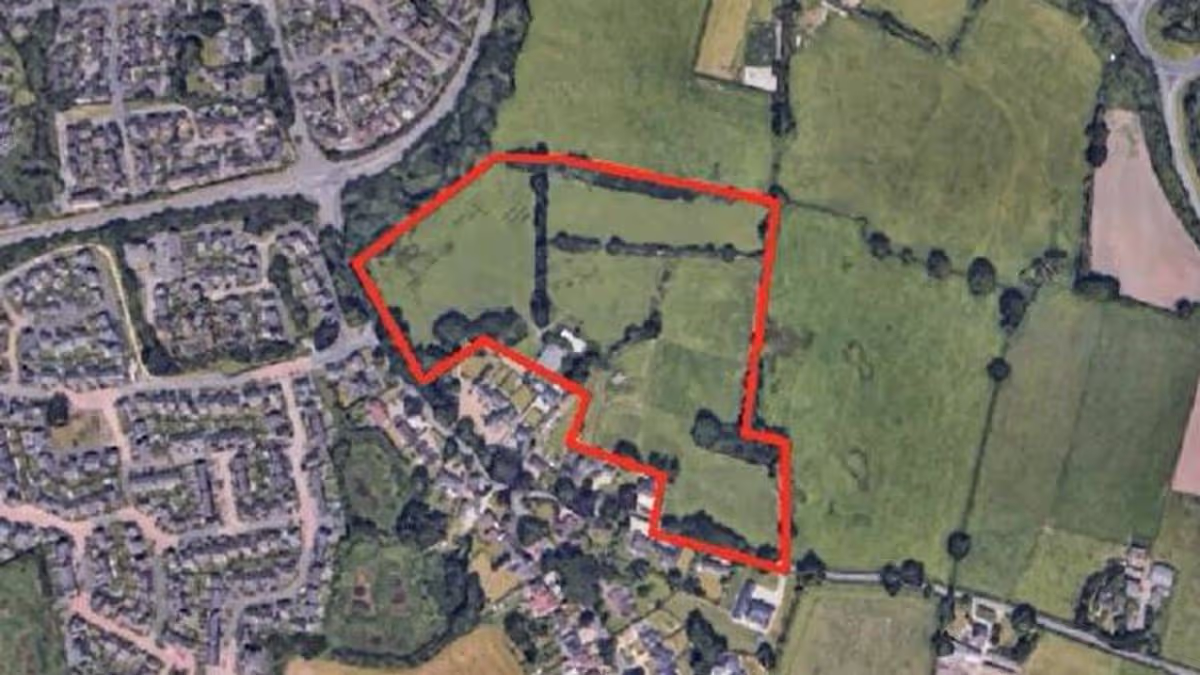
Aerial view of the agricultural land at Nantwich which forms the approved outline application site at London Road (Google)

An aerial view of the agricultural land at Nantwich which forms the approved outline application site at London Road(Image: Google)

Food security will be under threat if planners and government continue to allow developers to eat up agricultural land for housing, some Cheshire East councillors and residents have warned.

Advertisement

It’s a view which has been expressed at various meetings, as housing applications flood in across the borough for development on agricultural land.

Knutsford councillor Tony Dean (Con) was the latest to voice his concerns at last week’s meeting of the strategic planning board, when members were discussing an application for up to 85 homes on 6.39 hectares of agricultural land off London Road at Nantwich.

As councillors struggled to find a reason to refuse the outline scheme – which eventually was approved – Cllr Dean told the meeting: “One of the things which is not yet considered to have any planning weight, but I’m sure it will do within the next 20 to 30 years, is the reduction of high-grade agricultural land.”

He said that particular Nantwich site was very good agricultural land.

Advertisement

“People will say, well, that’s tiny compared to all the farming land we have in the country, but the problem is, if you keep nibbling away at it, we’re not even self-sufficient in this country as it is, and we’ll get less and less self-sufficient,” said Cllr Dean.

“At the moment, that’s not an issue, but if we have any more issues like the Strait of Hormuz and certain other possible international problems, we could end up like we were in 1939, very short of food in this country.

“I am sure that, at some stage in the government, somebody will see that eating up our agricultural land is the worst thing we could possibly do.”

He said in Cheshire East it was accepted that solar farming and tree planting is not permitted on high-grade agricultural land.

Advertisement

“But houses seem to be the exception, and the planning system has yet to accept that eating away at high-grade agricultural land is the wrong thing,” he said.

Cllr Dean’s comments come a few months after a similar argument was put forward by Knutsford councillor Stewart Gardiner (Con) regarding a proposal for housing and a care home on land off Crewe Road at Sandbach.

Cllr Tony Dean, Knutsford Conservative councillor

Cllr Tony Dean, Knutsford, Conservative(Image: Local Democracy Reporting Service)

That application was refused in October last year by councillors – with one reason being the proposed development would lead to the loss of best and most versatile agricultural land.

The applicant won the subsequent appeal after Cheshire East withdrew its objections.

Advertisement

But at the original October meeting, Cllr Gardiner had argued that that Sandbach land ‘is adding to the food security of this country which is a very significant point and officers, councillors and inspectors and even ministers of the Crown who fail to understand this, fail to understand the importance of food security’.

And at December’s full council meeting, objectors fighting the proposals for the Adlington new town – when it was still one of 12 areas being considered by government – had argued about the need for national food security.

One resident told the meeting: “What this means in practice is that nearly 2,500 acres of highly productive farmland producing 4.5 million litres of milk, more than 3,000 lambs and 115 tonnes of meat products per year, will be lost to urban sprawl.

“The loss of farming communities and the erosion of our national food security will be highly damaging in the long term and once this farmland has gone, it’s gone forever.”

Advertisement

To find all the planning applications, traffic diversions, road layout changes, alcohol licence applications and more in your community, visit the Public Notices Portal.

Continue Reading

Trending

Copyright © 2025