
Crypto World
Gibraltar Proposes Tokenized Funds Regulation to Bolster Compliance


Gibraltar is moving to codify the use of tokenized fund shares within its financial framework, authorizing certain regulated funds to issue shares on distributed ledger technology (DLT) while preserving investor rights. The Protected Cell Companies (Amendment) Bill 2026 would recognize a share token holder as a shareholder with the same rights and obligations as holders of traditional cell shares, linking ownership to asset pools within protected cell companies.
According to Cointelegraph, the proposal would require approval from the Gibraltar Financial Services Commission and targets protected cell companies operating as experienced investor funds. It contemplates blockchain-based share registers for recording ownership, with tokenized shares legally equivalent to conventional share certificates.
Source: Gibraltarlaws.gov.gi
The framework imposes strict custody and transfer controls, restricting access to verified investors and allow-listed wallet addresses, while mandating disclosures on technology risks, cybersecurity, and recovery procedures. Companies would retain control over the underlying infrastructure, keeping the system within a regulated environment rather than an open, permissionless market.
Under the proposal, tokenized shares could be issued and transferred via smart contracts and cryptographic signatures, with blockchain records recognized as valid instruments for ownership, transfer, and recordkeeping under existing company law. The bill must advance through Gibraltar’s legislative process before it can take effect.
Related developments in the digital-asset regulation space have been highlighted by industry coverage, underscoring a broader shift toward integrating tokenized assets into regulated markets.
Source: Gibraltarlaws.gov.gi
Key takeaways
- The Protected Cell Companies (Amendment) Bill 2026 would permit tokenized fund shares to be issued on distributed ledger technology, with token holders treated as shareholders under existing rights and obligations.
- Approval from the Gibraltar Financial Services Commission is required, and the measure targets PCCs operating as experienced investor funds.
- Ownership records would be maintained on blockchain-based share registers, with tokenized shares legally equivalent to traditional share certificates.
- Custody and transfer rules would restrict activity to verified investors and allow-listed wallet addresses, alongside mandatory disclosures on technology risk, cybersecurity, and recovery procedures.
Gibraltar’s tokenization framework in context
The bill envisions tokenized shares that are issued and transferred using smart contracts and cryptographic signatures, with blockchain records recognized as valid under current company law. By keeping the underlying infrastructure within a regulated environment, the approach aims to balance innovation with supervisory oversight and investor protection. The measure would not create a permissionless market; rather, it anchors tokenized equity in a governance and custody framework that aligns with established fiduciary and regulatory norms.
As the legislative process advances, the emphasis on verified investor access and technology risk disclosures points to heightened KYC/AML compliance requirements for PCCs leveraging tokenized instruments. The Gibraltar FSC’s involvement signals a tailored, risk-based approach to tokenized fund governance that could influence similar regimes in other jurisdictions contemplating regulated token markets.
Global momentum: tokenized assets in regulated markets
Gibraltar’s contemplated framework sits within a growing global trend of tokenized assets moving from pilot programs to regulated market infrastructure. Several jurisdictions have advanced tokenized securities under robust legal and supervisory regimes:
- Switzerland: The regulator (FINMA) approved a crypto fund in 2021 for qualified investors and, in 2025, licensed its first distributed ledger technology trading facility to enable tokenized securities to be traded and settled on regulated infrastructure.
- Singapore: Project Guardian, initiated in 2022, tested tokenized assets in wholesale markets as part of a broader exploration of DLT-enabled capital markets.
- Hong Kong: Tokenized government bonds have been issued and expanded since 2023, reflecting active public-sector participation in tokenized finance.
- Global settlement infrastructure: In 2024, the World Bank issued a Swiss franc digital bond on Switzerland’s SIX Digital Exchange with settlement conducted via central bank digital currency, illustrating central-bank–aligned settlement for tokenized debt instruments.
- Canada: In March, a pilot successfully issued and settled its first tokenized bond on distributed ledger infrastructure, marking a notable cross-border development in tokenized sovereign-like debt instruments.
These cases collectively illustrate a shift toward regulated environments for tokenized securities and bonds, combining governance frameworks, custody controls, and supervisory oversight to mitigate risk while expanding access to digital-asset markets. Industry observers have highlighted the importance of aligning tokenized offerings with existing corporate and securities law, AML/KYC standards, and cross-border regulatory harmonization. The European Union’s MiCA framework and parallel U.S. regulatory conversations continue to shape how tokenized assets are treated across jurisdictions, with particular emphasis on licensing, disclosure, and custody arrangements intended to preserve financial stability and investor protection.
In the broader policy context, the ongoing evolution of tokenized asset markets is being tracked for potential implications on licensing regimes, banking integration, and cross-border settlement infrastructure. As Gibraltar demonstrates, regulators appear inclined to integrate tokenized instruments within familiar legal constructs, rather than create entirely new regimes for each innovation, thereby facilitating compliance, audits, and enforcement activities for market participants.
Closing perspective: As tokenization moves deeper into regulated markets, ongoing oversight and international coordination will be critical to address unresolved issues in custody, cyber risk, and cross-border transfer of tokenized assets.

The bank’s digital assets team argues the post-Kelp coalition response and structural fixes around bridges leave DeFi stronger, not weaker, ahead of the Ethereum Economic Zone going live this summer.
Standard Chartered’s digital assets research team says the DeFi industry’s response to the April 18 Kelp DAO bridge exploit could prove to be an “antifragile moment” for the sector, arguing the crisis has accelerated structural fixes that will leave decentralized lending more resilient over the medium term.
In a note published Wednesday titled “DeFi: Bent, not broken,” Global Head of Digital Assets Research Geoff Kendrick wrote that the $292 million theft and its knock-on effects on Aave have not derailed the bank’s longer-term thesis on DeFi growth. Standard Chartered is maintaining its projection that tokenized real-world assets (RWAs) will reach a $2 trillion market cap by the end of 2028, up from roughly $35 billion in October 2025.
‘Bank Run’ Contained
Kendrick laid out the mechanics in familiar terms. Once the market realized that stolen rsETH had been supplied as collateral on Aave (76% of the stolen assets ended up on the protocol, per the report), the lender lost $17 billion in deposits, equivalent to 38% of its total, and $5.5 billion in active loans, or 31%. Yields spiked and net deposits in several stablecoin markets fell to zero in what Standard Chartered described as a classic bank run.
The response was the DeFi United coalition, which has now committed more than $300 million to restore rsETH’s backing ratio and execute controlled liquidations of the exploiter’s remaining positions. Yields on Aave have since started to come back down, and net deposits are rising again.
“This could be DeFi’s ‘antifragile moment,’” Kendrick wrote. “The more pressure that is applied to something, the stronger it gets.”
Risk Mismatch
The note flagged a structural vulnerability that amplified the damage. An analysis after the theft found that 98% of Kelp DAO’s rsETH collateral on Aave was concentrated in a single looping trade, where participants deposit an asset, borrow against it at maximum loan-to-value, and recycle the proceeds into more complex tokens to maximize yield.
Standard Chartered’s broader concern is the asset-liability mismatch on lending protocols: deposits skew more heavily toward complex tokens (wrapped, bridged, liquid-staked, liquid-restaked) than the active loan book does, and complexity tends to introduce bridge dependencies. Bridges, the report noted, have been the attack vector in most of the largest crypto hacks, including the Kelp incident.
Structural Fixes
Kendrick pointed to two specific developments that should reduce reliance on bridges. The first is Aave V4, which launched in late March with a hub-and-spoke architecture designed to share liquidity across participating Layer 2s rather than siloing it on individual chains. The second is the Ethereum Economic Zone (EEZ), unveiled at the Ethereum Community Conference in Cannes earlier this year and scheduled to go live on mainnet this summer.
The EEZ aims to make assets composable and synchronous across the Ethereum ecosystem within a single block, enabled by recent advances in real-time zero-knowledge proof technology. Once both are operational, Standard Chartered argues, Aave will be able to bypass the bridges that have historically been DeFi’s softest target.
“Despite the concerns raised by the recent cyberattack, we think the recent DeFi coalition and longer-term structural solutions both point to greater DeFi resilience going forward,” Kendrick concluded.
This article was written with the assistance of AI workflows. All our stories are curated, edited and fact-checked by a human.
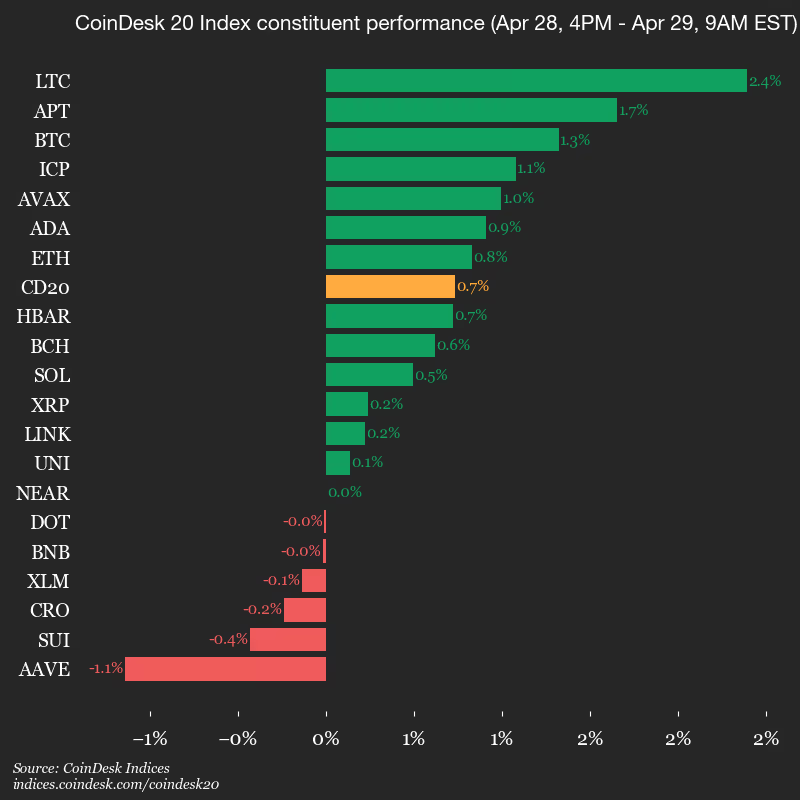
CoinDesk Indices presents its daily market update, highlighting the performance of leaders and laggards in the CoinDesk 20 Index.
The CoinDesk 20 is currently trading at 2093.01, up 0.7% (+15.25) since 4 p.m. ET on Tuesday.
Fourteen of 20 assets are trading higher.

Leaders: LTC (+2.4%) and APT (+1.7%).
Laggards: AAVE (-1.1%) and SUI (-0.4%).
The CoinDesk 20 is a broad-based index traded on multiple platforms in several regions globally.


PUMP briefly rallied today on news that the platform has burned ~36% of the token’s circulating supply from previous buybacks.
Solana memecoin launchpad pumpfun announced Monday evening on X that it has burned approximately $370 million worth of previously bought-back PUMP tokens — roughly 36% of the circulating supply — and is pivoting to a programmatic buyback-and-burn policy funded by 50% of all future revenue for one year.
PUMP briefly rallied 5% on the news today, before retracing and is now flat over the past 24 hours.
The move marks a significant structural shift for the platform. Since launching, pumpfun had been directing 100% of revenue toward PUMP buybacks, but the approach drew persistent community criticism over a lack of transparency — specifically around what would happen to repurchased tokens and whether buybacks would continue long-term.
Now, rather than accumulating bought-back tokens in a treasury, pumpfun will burn 100% of all future buyback purchases immediately upon acquisition, the company explained. The 50% buyback allocation covers net revenue from its Bonding Curve, PumpSwap, and Terminal products. The remaining 50% will fund operations, hiring, and strategic investments, pumpfun said in the X post.
In a separate post on X, co-founder Alon framed the change as essential for long-term sustainability, explaining the need to cut the buyback rate in half to 50% to leave revenue for the project to invest in growth, stating: “I am extremely confident that 50% of the business we’re building toward will dwarf 100% of the business we have today.”
Pumpfun has generated over $1 billion in gross protocol revenue since launching in early 2024 and remains one of DeFi’s top fee-generating protocols.
The platform raised $500 million in its July ICO in just 12 minutes, and another $400 million in private token sales.
This article was written with the assistance of AI workflows. All our stories are curated, edited and fact-checked by a human.
Crypto World
Stable Sea Taps WisdomTree to Bring Tokenized Treasury Yield to Business Operating Cash


The collaboration lets non-crypto-native finance teams sweep idle dollars into WisdomTree’s WTGXX alongside their stablecoin payments, with daily dividend accrual and 24/7 liquidity.
Stable Sea on Wednesday announced a strategic partnership with WisdomTree to embed access to the asset manager’s tokenized funds inside its business treasury platform, opening a new distribution channel for onchain dollar yield beyond crypto-native users.
The integration begins with the WisdomTree Treasury Money Market Digital Fund (WTGXX), which currently holds about $855 million in tokenized U.S. Treasuries and ranks as the sixth-largest tokenized money market fund tracked by RWAxyz. Eligible Stable Sea Terminal users can establish a limited-scope broker-dealer relationship with WisdomTree Securities to route orders into select WisdomTree tokenized funds directly from the Stable Sea interface.
For users, that means daily dividend accrual, continuous yield allocation based on intra-day holdings, and daily liquidity through WTGXX, plus the option to set rules that automatically sweep idle balances into the fund and unwind back to stablecoins when liquidity is needed.
“US businesses collectively hold more than $5 trillion in cash and cash equivalent accounts that earn minimal to no interest,” said Tanner Taddeo, CEO and co-founder of Stable Sea. “This collaboration with WisdomTree brings institutional-grade cash management and 24/7/365 yield exposure into a technology product built for modern operators.”
From Stablecoin Off-Ramps to Treasury Stack
Founded in 2024, San Francisco-based Stable Sea originally pitched itself as a fix for the “final mile” of stablecoin utility, building enterprise-grade off-ramps that let fintechs, payment service providers, and global businesses convert stablecoins into local fiat in single trades of up to $50 million, replacing the patchwork of OTC desks and Telegram-based dealer relationships that businesses had been stitching together.
Stable Sea Terminal launched in May 2025 as the productized version of that workflow, combining stablecoin purchasing, conversion, and global payouts in a single API and dashboard. The WisdomTree deal extends the platform further, layering tokenized money market exposure on top of payments and custody.
Tokenized MMFs Push Beyond DeFi
The deal also extends WisdomTree’s recent run of WTGXX integrations into a different distribution lane: business treasury workflows rather than DeFi protocols.
Last week, pre-launch lender Lotus tapped WTGXX for its LotusUSD vault reserves, and in March, Plume launched a payroll pilot routing employee salaries into the fund. Last November, Plume also integrated WisdomTree tokenized funds via OpenTrade into its Nest staking vaults.
“Treasury management use cases have been a leading driver of the adoption we have seen of our tokenized money market fund WTGXX in the past year,” said Will Peck, Head of Digital Assets at WisdomTree.
Tokenized U.S. Treasury and money market funds have grown from under $1 billion in early 2024 to roughly $15 billion across 76 assets today, per RWAxyz, led by Circle’s USYC, BlackRock’s BUIDL, and Ondo’s U.S. Dollar Yield funds. WTGXX itself surged more than 700% between May and August last year. WisdomTree manages approximately $160 billion across its businesses.
This article was written with the assistance of AI workflows. All our stories are curated, edited and fact-checked by a human.
Crypto World
BeInCrypto 100 Institutional Awards Nomination: Zodia Custody for Best Digital Asset Custody Provider


Institutional digital asset custody has long forced firms to choose between safety and flexibility. Cold storage protects assets but slows trading, while faster market access can add counterparty, prefunding, and operational risks.
Zodia Custody is building around that gap. The firm is nominated for Best Digital Asset Custody Provider at the BeInCrypto Institutional 100 Awards 2026.
Founded
Backed By
Offices
Jurisdictions
Employees
Regulatory Footprint
2020
5 banks
7
15+
150+
5
Zodia Custody Infrastructure Snapshot
The nomination centers on the launch of Zodia Switch, a custody-native asset swap product announced in February 2026 in partnership with LMAX Group.
Zodia Switch allows institutional clients to initiate asset-to-asset swaps directly from their secure custodial wallets.
The product supports ERC-20 assets including ETH, wrapped BTC, RLUSD, USDC, and USDT, without requiring clients to pre-fund an LMAX trading account or move assets off-platform.
That matters because portfolio rebalancing is still one of the most awkward parts of institutional crypto operations. Firms often need to move assets from custody to an external trading venue just to adjust exposure. That creates delays, additional approvals, and more points of operational risk.
Zodia Switch keeps that workflow inside the custody environment. Pricing and execution come from LMAX through infrastructure embedded into Zodia’s platform, while clients retain governance controls, permissioned AML screening, and audit trails.
Bringing Trading Closer to Custody
Zodia Custody was established in late 2020 by SC Ventures, Standard Chartered’s innovation unit, and Northern Trust. The firm was built to bring banking-grade custody standards into digital assets.
Its shareholder base now includes Standard Chartered, Northern Trust, SBI Holdings, National Australia Bank, and Emirates NBD. Emirates NBD became the fifth traditional financial institution to back the company through a strategic investment in December 2024.
The bank-backed structure is central to Zodia’s positioning. Custody is one of the few parts of digital asset infrastructure where institutions still expect familiar controls: segregation, governance, auditability, compliance, and clear legal accountability.
Zodia Switch extends that model from safekeeping into portfolio activity. The product does not turn Zodia into a trading venue. Instead, it lets institutions access liquidity from inside their custody setup.
That is a practical shift. It reduces the need to choose between keeping assets protected and making them usable.
A Wider Institutional Product Stack
Zodia Switch builds on a wider custody and settlement suite.
The firm already offers Interchange, its off-exchange settlement product with LMAX. It also offers Solutions by Zodia Custody, a white-label custody infrastructure product for banks, alongside services for government and law enforcement clients.
Zodia has also become part of Europe’s regulated digital asset product market. Its custody mandates include 21Shares’ physically backed ABTC ETP, Invesco’s European Physical Bitcoin ETP, and Bitwise, formerly ETC Group. Invesco states that each Physical Bitcoin ETP certificate is secured by Bitcoin held offline in cold storage by Zodia Custody.
The firm is also connected to new post-trade infrastructure. ClearToken’s CT Settle, a delivery-versus-payment settlement service for cryptoassets, stablecoins, and fiat currency, used Zodia Custody as the sole digital custodian in its first settlement cycle. The platform is powered by Nasdaq Eqlipse Clearing technology.
Zodia’s regulatory footprint has also expanded. In January 2026, French market regulator AMF listed Zodia Custody Europe S.A. as a MiCA-licensed CASP passporting from Luxembourg, authorized for custody and administration of crypto-assets on behalf of clients and crypto-asset transfer services.
Standard Chartered Moves Closer
Zodia’s nomination also comes as Standard Chartered appears to be bringing digital asset custody deeper into its institutional banking strategy.
On April 8, 2026, reports suggested that Standard Chartered was seeking to merge parts of majority-owned Zodia Custody with one of its digital asset operations. The report said the bank planned to integrate Zodia’s crypto custody business into a division inside its corporate and investment bank that provides similar services.
That move would underline the direction of the market. Digital asset custody is no longer a side product for financial institutions. It is becoming part of the same infrastructure stack as trading, settlement, collateral management, and tokenized asset services.
For Zodia, the timing strengthens the nomination. The firm already sits at the intersection of bank ownership, regulated custody, ETP servicing, and institutional trading workflows. Zodia Switch gives that position a sharper product story.
The BeInCrypto Institutional 100 Awards recognize firms building the systems that could define the next phase of digital finance. Zodia Custody’s nomination reflects its role in moving institutional custody from passive safekeeping toward controlled, auditable asset activity.
The post BeInCrypto 100 Institutional Awards Nomination: Zodia Custody for Best Digital Asset Custody Provider appeared first on BeInCrypto.
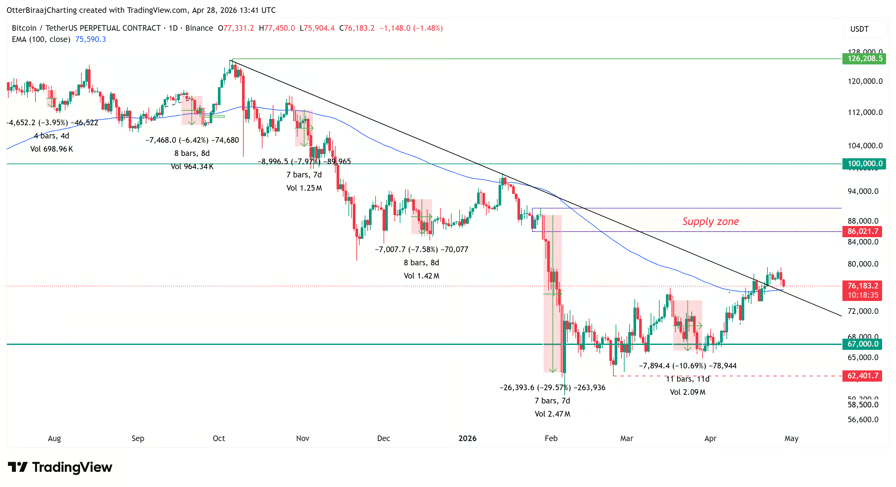
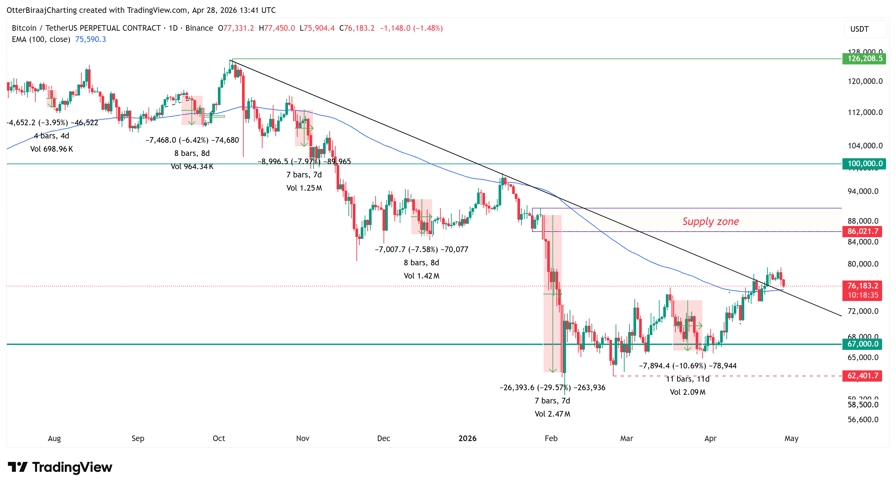
Bitcoin (BTC) fell from its local high at $79,500 as traders repositioned ahead of the Federal Open Market Committee (FOMC) meeting on Wednesday.
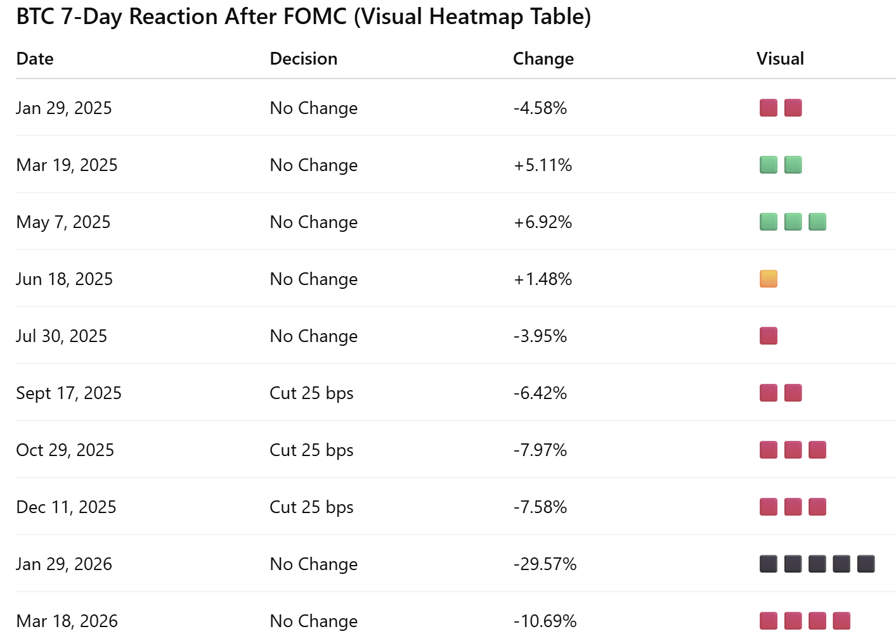
Historical data shows that since the start of 2025, BTC has corrected seven out of 10 times after an interest rate cut.
Bitcoin’s reaction to interest rate cut decisions in 2025 and 2026 shows a clear pattern. The price often moved higher in the days before the meeting, followed by negative returns afterward, as illustrated in the chart.
BTC price reaction post FOMC meet. Source: Cointelegraph/TradingView
The seven-day returns ranged from +6.92% to –29.57% across 10 FOMC meetings.
BTC 7-day reaction after FOMC (visual heatmap table). Source: Cointelegraph
Over the past two years, the post-FOMC price action has been driven less by the rate outcome and more by shifts in liquidity and leverage conditions.
During the Jan. 29–Feb 5 drawdown, when BTC fell roughly 30%, derivatives data highlighted the extent of this dynamic. Futures open interest declined sharply, falling to $49 billion from around $61 billion over the course of a week, signaling an aggressive unwind of leveraged positions.
This deleveraging phase triggered an estimated $2.5 billion in BTC-specific liquidations, with total crypto liquidations reaching $4.5 billion over the same period.
MN Capital founder Michael van de Poppe said that the setup was typical pre-FOMC behavior from the traders. The view frames the pullback as a routine correction tied to the policy uncertainty, with van de Poppe adding,
“It almost always happens prior to the event, as there’s still a lot of fear for FED policies from the markets.”
The analyst noted that as long as the price holds above $73,000, the higher range may remain intact in the near term.
Related: Three Bitcoin charts say BTC price may rally toward $82K
Strategy buying BTC offsets the weak sentiment
While short-term price action reflects caution around macro events, the broader demand picture suggests a strong structural bid beneath the market.
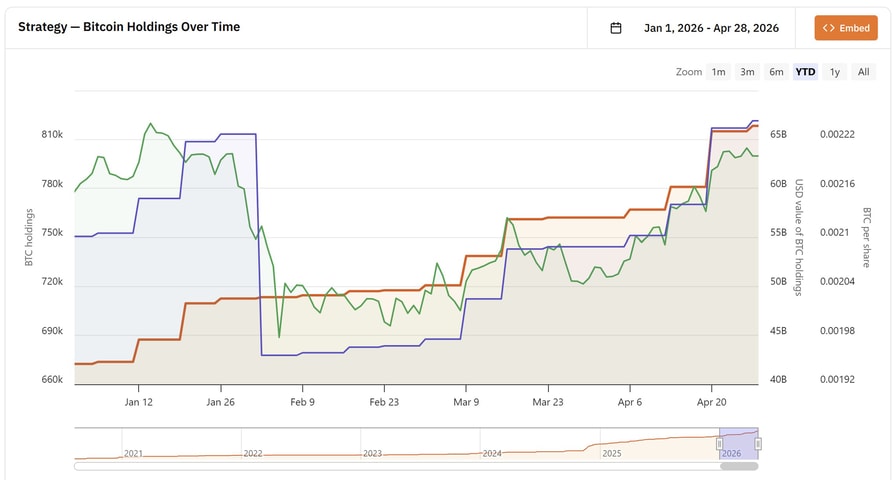
Corporate BTC accumulation continues to play a key role. Strategy has significantly expanded its Bitcoin holdings in 2026, increasing its total balance to 818,334 BTC from 672,497 on Jan. 1, adding 145,837 BTC.
The purchases are partly funded through Stretch (STRC) offerings, in which the firm raises capital via equity-linked instruments and allocates the proceeds to Bitcoin.
Strategy BTC holdings in 2026. Source: bitcointreasuries.net
Bitcoin macro researcher Ecoinometrics noted that the pace mirrors the late-2024 accumulation, though current conditions are less bullish.
At the same time, spot Bitcoin ETF flows have turned positive again, with roughly $3.5 billion in net inflows over the past two months. This resurgence signals renewed institutional participation, even as the short-term sentiment remains cautious.
BTC is finding support at key price levels. Source: Cointelegraph/TradingView
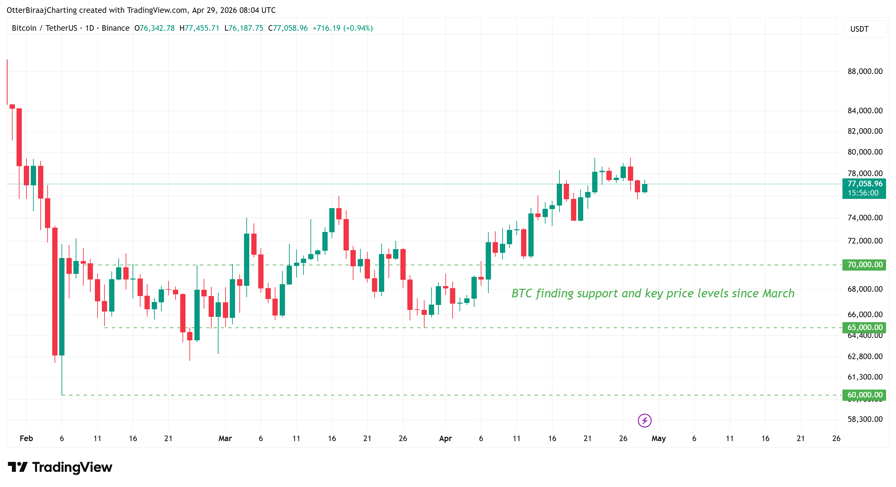
Since March, the return of institutional demand for BTC has coincided with the crypto asset forming support levels at key price ranges, such as $60,000, $65,000 and $70,000.
While macro-driven events like the FOMC continue to trigger short-term volatility and risk-off behavior, this underlying demand base is helping cushion deeper drawdowns and support a more resilient long-term market structure for Bitcoin.
Related: Bitcoin price drops below $76K as onchain data sends mixed signals
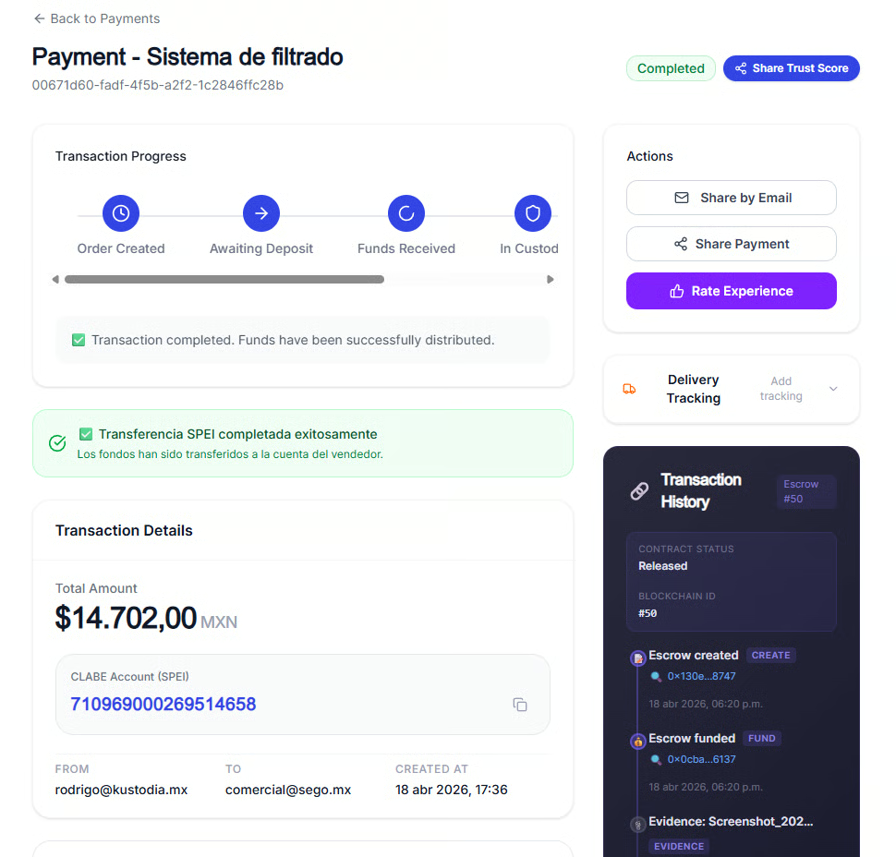
Mexico’s first peso-denominated blockchain escrow goes live on SPEI for high-value P2P transactions.
Mexico City, April 29, 2026 — Kustodia, a programmable escrow platform for Latin America’s high-value economy, today announced the public launch of its smart contract escrow service in Mexico. Buyers and sellers can now protect any transaction — from used vehicles to real estate deposits to B2B contracts — using SPEI, Mexico’s instant payment rail. Funds are held in audited smart contracts until both parties confirm delivery, with no human intermediary involved.
Payment fraud stripped $44.3 billion from the global economy in 2024, according to Juniper Research. Latin America has the world’s highest fraud rate, with 20 percent of merchant revenue lost annually. In Mexico, every dollar of fraud costs $4.08 in total economic damage — representing approximately $600 million USD in annual losses, according to data from Cloudflare and Mexico Business News.
‘I lost money to fraud in a peer-to-peer transaction in 2021,’ said Rodrigo Jimenez, Founder and CEO of Kustodia. ‘I spent three years building the infrastructure that should have existed. Mexico’s $60 billion used vehicle market runs almost entirely on stranger-to-stranger transactions with no protection for either side. We changed that.’
How it works — no app, no crypto knowledge needed
Kustodia works entirely through SPEI and WhatsApp. The buyer deposits pesos to a unique account number generated by Kustodia. Those pesos are immediately locked in a smart contract on the Arbitrum blockchain — neither party can access them. The seller delivers. Both parties confirm. The funds are released to the seller’s bank account in pesos. The blockchain operates invisibly; users interact only through WhatsApp.
The platform uses MXNB, a 1:1 Mexican peso-backed stablecoin issued by Juno and audited by a Big Four accounting firm, as its escrow settlement layer. This means users never experience cryptocurrency price volatility — they send pesos and receive pesos. Every completed transaction is publicly verifiable on Arbitrum’s blockchain explorer at no cost to anyone.
Users never pay blockchain fees. Kustodia absorbs and bundles these costs automatically, so the only fee a user sees is the escrow commission — 3 percent for standard transactions, lower for volume partners. Compared to traditional escrow agents that charge 3 to 6 percent and take 5 to 7 days to settle, Kustodia settles near-instantly.
From used cars to real estate to AI agents
Kustodia’s initial focus is the Mexican used vehicle market, where the average transaction is $15,000 USD and fraud risk is highest. The platform includes integrated vehicle history verification powered by Truora, KYC identity checks, and webhook-based notifications for marketplace integrations.
The platform also supports AI agents through its dedicated agent infrastructure at kustodia.app/ai-agents, enabling autonomous systems to create and manage escrow contracts programmatically. Web3 native escrow is available at kustodia.app/web3, supporting USDC and MXNB on Arbitrum and Injective.
Real estate rental deposits, crowdfunding, and marketplace integrations are live as additional verticals. USD Wire is supported for cross-border US-to-Mexico transactions. Brazilian real (BRL) via Pix is in development for the company’s planned 2027 Brazil expansion.
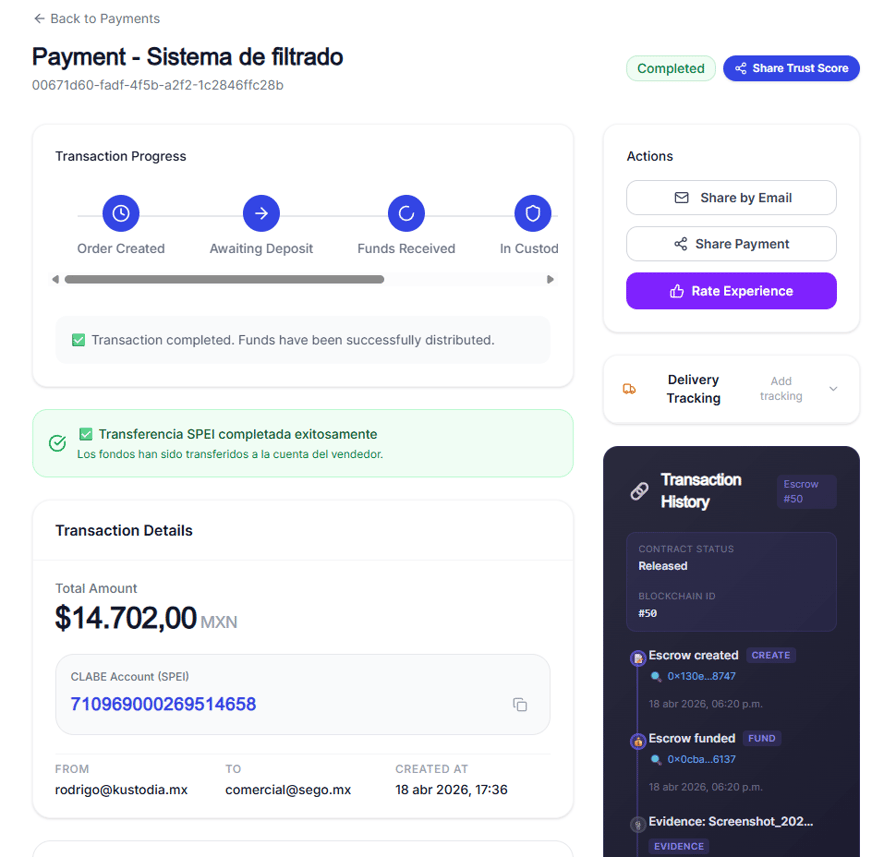
Source: Kustodia
Built for developers and platforms
Kustodia offers a full API and webhook system for marketplace integration. Developers can explore documentation and test the platform at kustodia.app/demo/marketplace. The platform currently works alongside SPEI, USD Wire, and USDC — and compares favourably to MercadoPago and Stripe Mexico, neither of which offers true escrow, blockchain verification, or integrated vehicle checks.
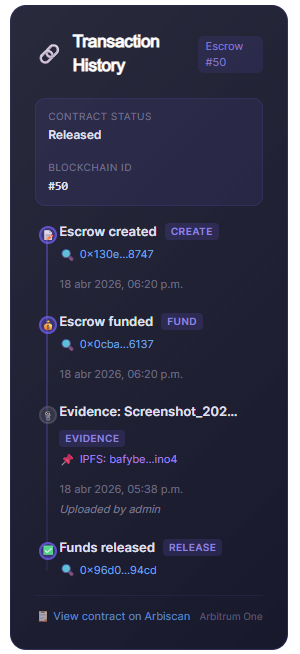
Source: Kustodia
About Kustodia
Kustodia is programmable escrow infrastructure for Latin America and emerging markets. The platform protects high-value transactions across vehicles, real estate, services, and crowdfunding using smart contracts on Arbitrum and Injective, with SPEI and USD Wire as fiat rails. Available at kustodia.app.
Media contact:
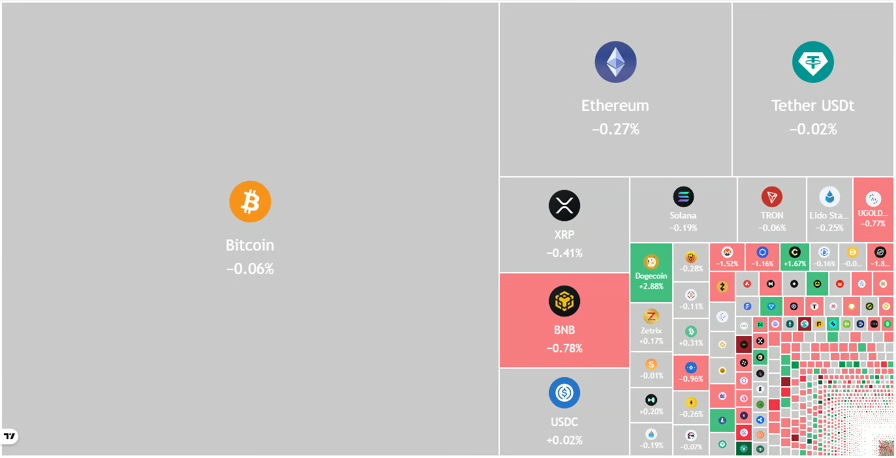
Key points:
- Buyers are struggling to sustain the BTC rebound, suggesting bears are attempting a comeback.
- Several major altcoins risk breaking below their support levels, signaling a deeper short-term pullback.
Bitcoin (BTC) rallied above $77,900 on Wednesday, but the long wick on the candlestick shows selling on rallies. On-chain analyst Willy Woo said in a post on X that BTC needs to close above the $79,000 cost basis of recent investors to strengthen the recovery. Woo gave BTC only 30% odds of rising above $79,000 in this attempt.
Another cautious view came from crypto trading account CRYPTOWZRD, who highlighted the risks of downside in June. CRYPTOWZRD said in a post on X that historically BTC has corrected for a few months after a new Federal Reserve chair takes over. With Kevin Warsh slated to take over as the Fed chair in May, could BTC “break the curse,” or will it see a final dip?
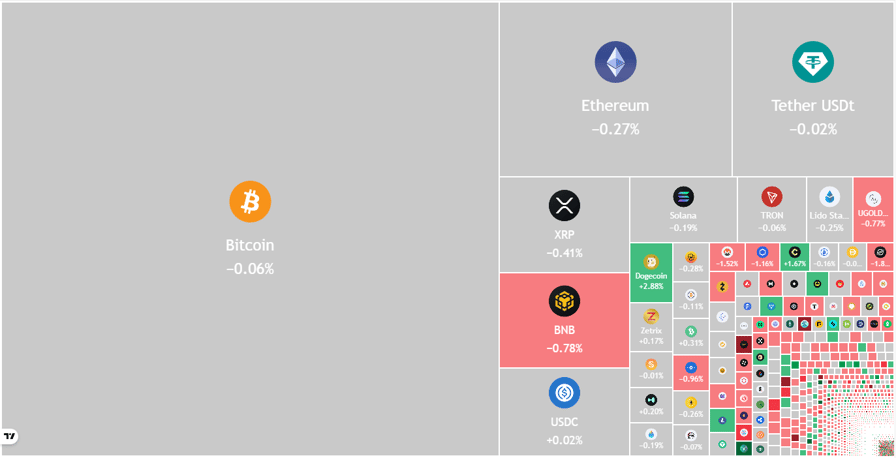
Crypto market data daily view. Source: TradingView
Analysts remain divided about BTC’s prospects in the near term. Some analysts believe BTC will breakout to a new all-time high and rally to as high as $250,000 in 2026, while others anticipate a drop below $50,000 to as low as $30,000. Although anything is possible in the cryptocurrency markets, traders should watch crucial support and resistance levels closely rather than becoming overly optimistic or pessimistic based on target projections.
Could BTC and the major altcoins stay above their immediate support levels? Let’s analyze the charts of the top 10 cryptocurrencies to find out.
Bitcoin price prediction
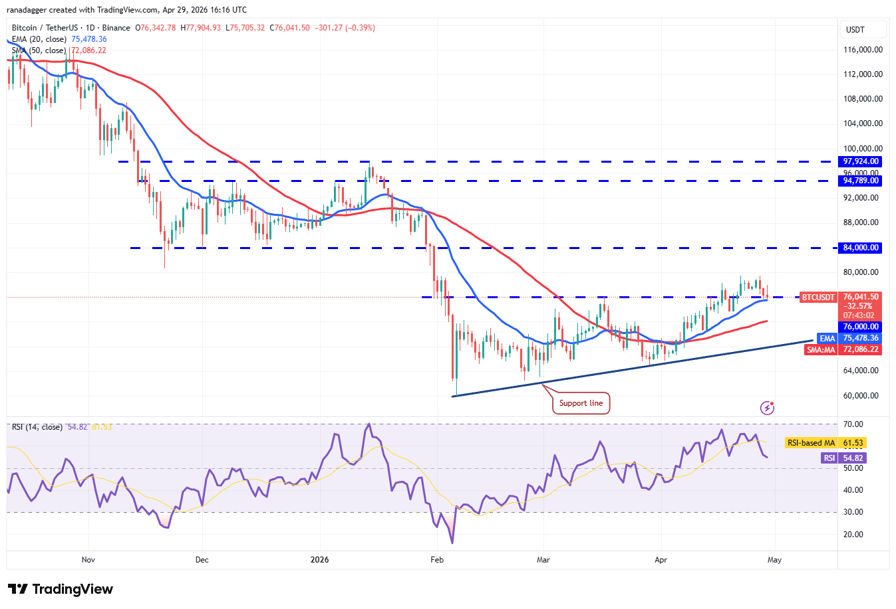
BTC bounced off the 20-day exponential moving average ($75,478) on Wednesday, but the bulls could not sustain the higher levels.
BTC/USDT daily chart. Source: Cointelegraph/TradingView
The 20-day EMA is the critical near-term support to watch out for. If the BTC price rebounds off the 20-day EMA with force and breaks above $80,000, it signals that the bulls have flipped the $76,000 level into support. The BTC/USDT pair may then rally to $84,000.
This positive view will be negated in the near term if the price continues lower and breaks below the 20-day EMA. That suggests the bears are active at higher levels. The pair may then tumble to the 50-day simple moving average ($72,086) and later to the support line.
Ether price prediction
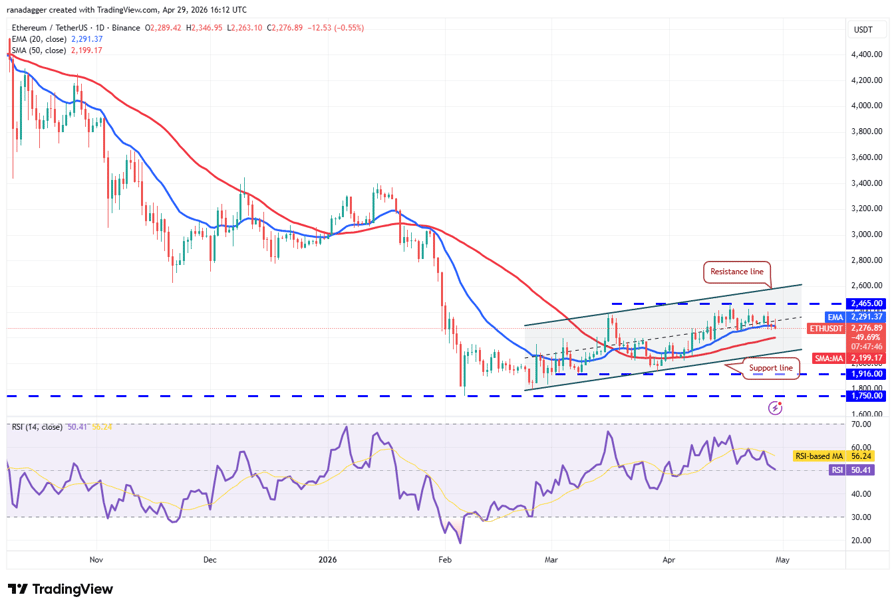
Buyers are attempting to sustain Ether (ETH) above the 20-day EMA ($2,291), but the bears continue to exert pressure.
ETH/USDT daily chart. Source: Cointelegraph/TradingView
If the ETH price continues lower and breaks below the moving averages, it suggests that the bears are on a comeback. The ETH/USDT pair may then slump to the support line, where the buyers are expected to step in.
Conversely, if the price turns up from the moving averages, it suggests that the lower levels are attracting buyers. The pair may rise to $2,465 and then to the resistance line of the ascending channel pattern.
XRP price prediction
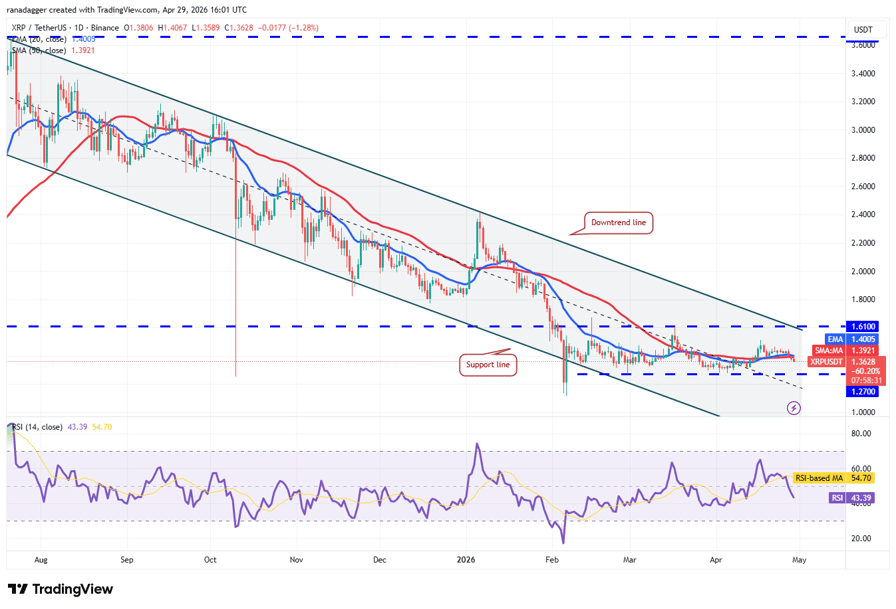
XRP (XRP) fell below the moving averages on Tuesday, indicating that the bears are attempting to take charge.
XRP/USDT daily chart. Source: Cointelegraph/TradingView
XRP price may slide to $1.27, where buyers are expected to mount a strong defense. If the price rebounds off the $1.27 support and rises above the moving averages, the recovery may reach the downtrend line. A close above the downtrend line signals a potential trend change.
Conversely, a break below the $1.27 level puts the Feb. 6 low of $1.11 at risk of a breakdown. The pair may then plummet to $1 and then to the support line.
BNB price prediction
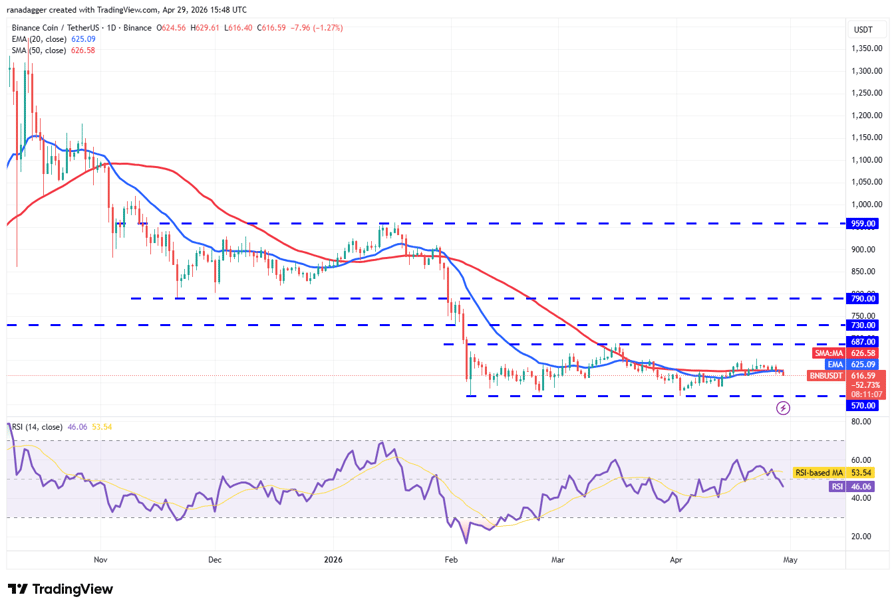
BNB (BNB) remains stuck inside the large range between $570 and $687, signaling buying on dips and selling on rallies.
BNB/USDT daily chart. Source: Cointelegraph/TradingView
The flattish moving averages and the RSI just below the midpoint suggest that the BNB/USDT pair may continue consolidating for some time.
Buyers will gain the upper hand if they push the BNB price above $687. If they manage to do that, the pair may surge to $730, then to $790. On the other hand, a break below the $570 support signals the resumption of the downtrend. The pair may then collapse to $500.
Solana price prediction
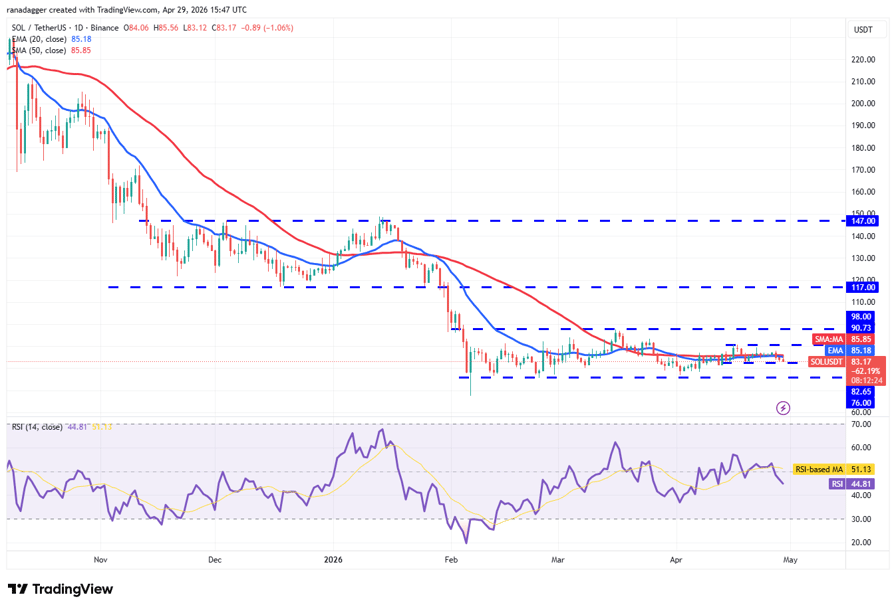
Solana (SOL) has been trading inside a tight range between $82.65 and $90.73, indicating a balance between supply and demand.
SOL/USDT daily chart. Source: Cointelegraph/TradingView
If the price breaks below $82.65, the SOL/USDT pair may decline toward the $76 support. Buyers are expected to fiercely defend the $76 level, as a close below it may sink the pair to $67.
On the upside, a break and close above the $90.73 level would indicate a slight advantage for the bulls. The SOL price may then reach the overhead resistance at $98. This is a critical level to watch out for as a break above $98 opens the doors for a rally to $117.
Dogecoin price prediction
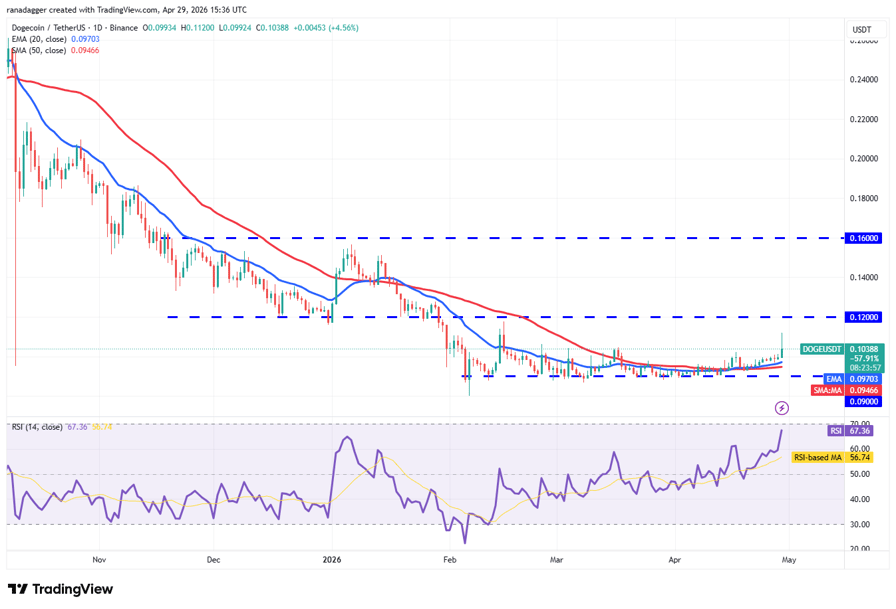
Dogecoin (DOGE) bounced off the 20-day EMA ($0.10) on Monday, indicating buying on dips.
DOGE/USDT daily chart. Source: Cointelegraph/TradingView
The bulls pushed the DOGE price above $0.11 on Wednesday, but the long wick on the candlestick indicates that bears remain active at higher levels. A break below the 20-day EMA signals that the DOGE/USDT pair may remain range-bound between $0.09 and $0.12 for a few more days.
On the other hand, if the price rebounds off the $0.10 level, it increases the possibility of a rally to $0.12. A close above the $0.12 resistance suggests that the pair may have bottomed out in the short term.
Hyperliquid price prediction
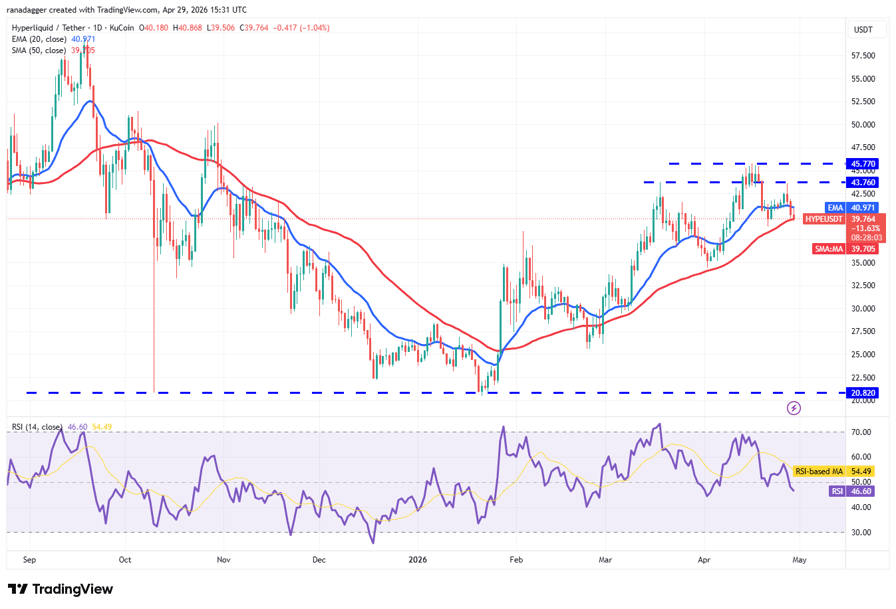
Hyperliquid (HYPE) turned down from the $43.76 overhead resistance on Monday and fell to the 50-day SMA ($39.70) on Tuesday.
HYPE/USDT daily chart. Source: Cointelegraph/TradingView
Sellers will attempt to strengthen their position by pulling the HYPE price below the 50-day SMA. If they manage to do that, the HYPE/USDT pair may initiate a deeper pullback to $37.77, then to $34.45.
On the upside, the bears will continue to pose a substantial challenge in the $43.76-$45.77 zone. However, if buyers break above the overhead zone, the pair may rally to $50 and then to $51.43.
Related: XRP set for ‘strongest’ 2026 monthly ETF inflows as bulls target $2
Cardano price prediction
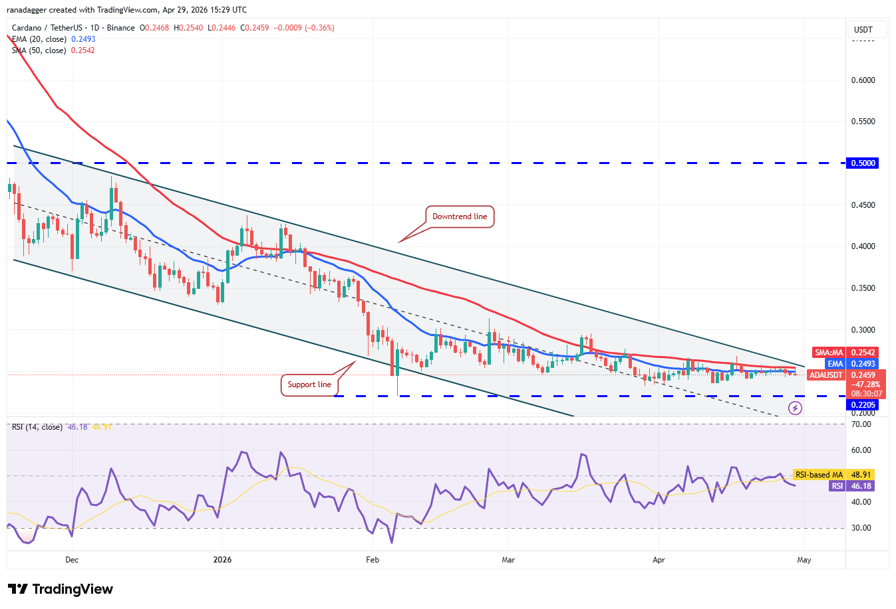
Cardano (ADA) is facing selling near the downtrend line, but a minor positive is that the bulls have not given up much ground to the bears.
ADA/USDT daily chart. Source: Cointelegraph/TradingView
That suggests the bulls will again attempt to drive the ADA price above the downtrend line. If they succeed, the ADA/USDT pair may rally to $0.32 and then to $0.37. Such a move signals a potential trend change.
Sellers are likely to have other plans. They will attempt to defend the downtrend line and pull the price to the solid support at $0.22. A close below the $0.22 level indicates the resumption of the downtrend.
Bitcoin Cash price prediction
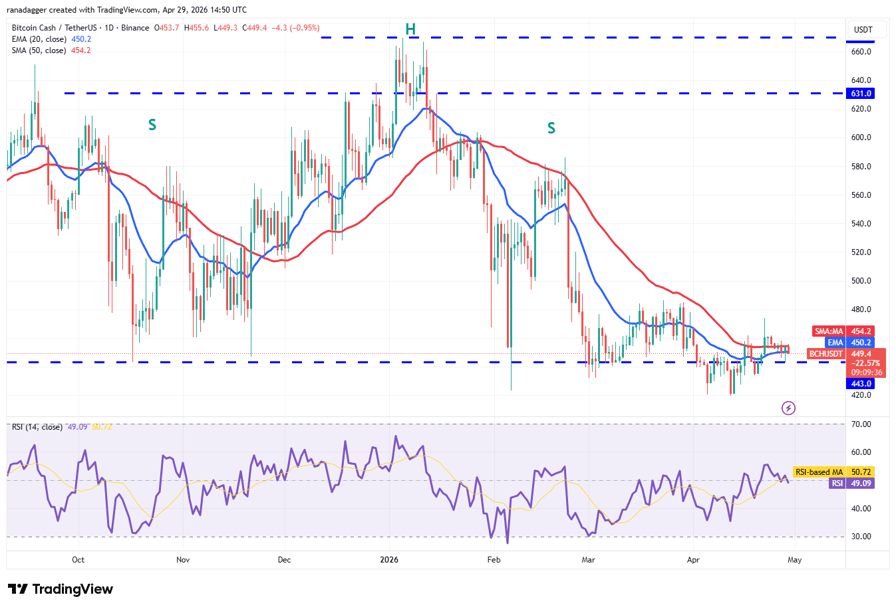
Bitcoin Cash (BCH) bounced off the $443 support on Tuesday, but bulls are struggling to push the price above the moving averages.
BCH/USDT daily chart. Source: Cointelegraph/TradingView
The flattish moving averages and the RSI near the midpoint do not give either bulls or bears a clear advantage. If the BCH price maintains above the moving averages, the possibility of a rise to the $486 level increases. Sellers are expected to aggressively defend the $486 level, as a close above it opens the door to a rally to $520.
On the downside, a close below the $443 level may sink the BCH/USDT pair to the solid support at $419.
Monero price prediction
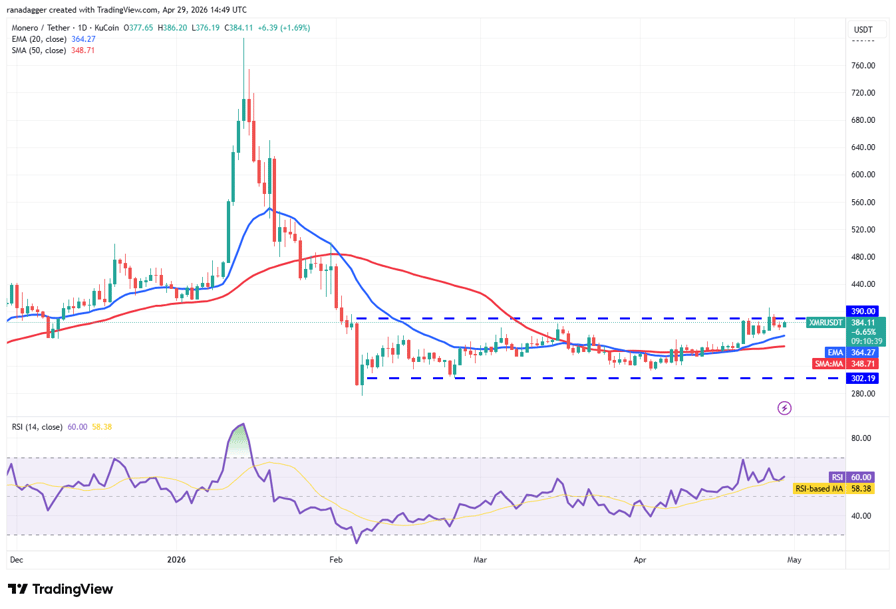
Monero (XMR) surged above the $390 resistance on Sunday, but the bulls could not sustain the breakout.
XMR/USDT daily chart. Source: Cointelegraph/TradingView
The XMR price pulled back to the 20-day EMA ($364), where the buyers stepped in. If the XMR/USDT pair continues higher and breaks above the $406 level, it signals the start of a new up move toward $500.
Contrary to this assumption, if the price turns sharply lower and breaks below the moving averages, it suggests the pair may remain within the $302 to $390 range for some time.
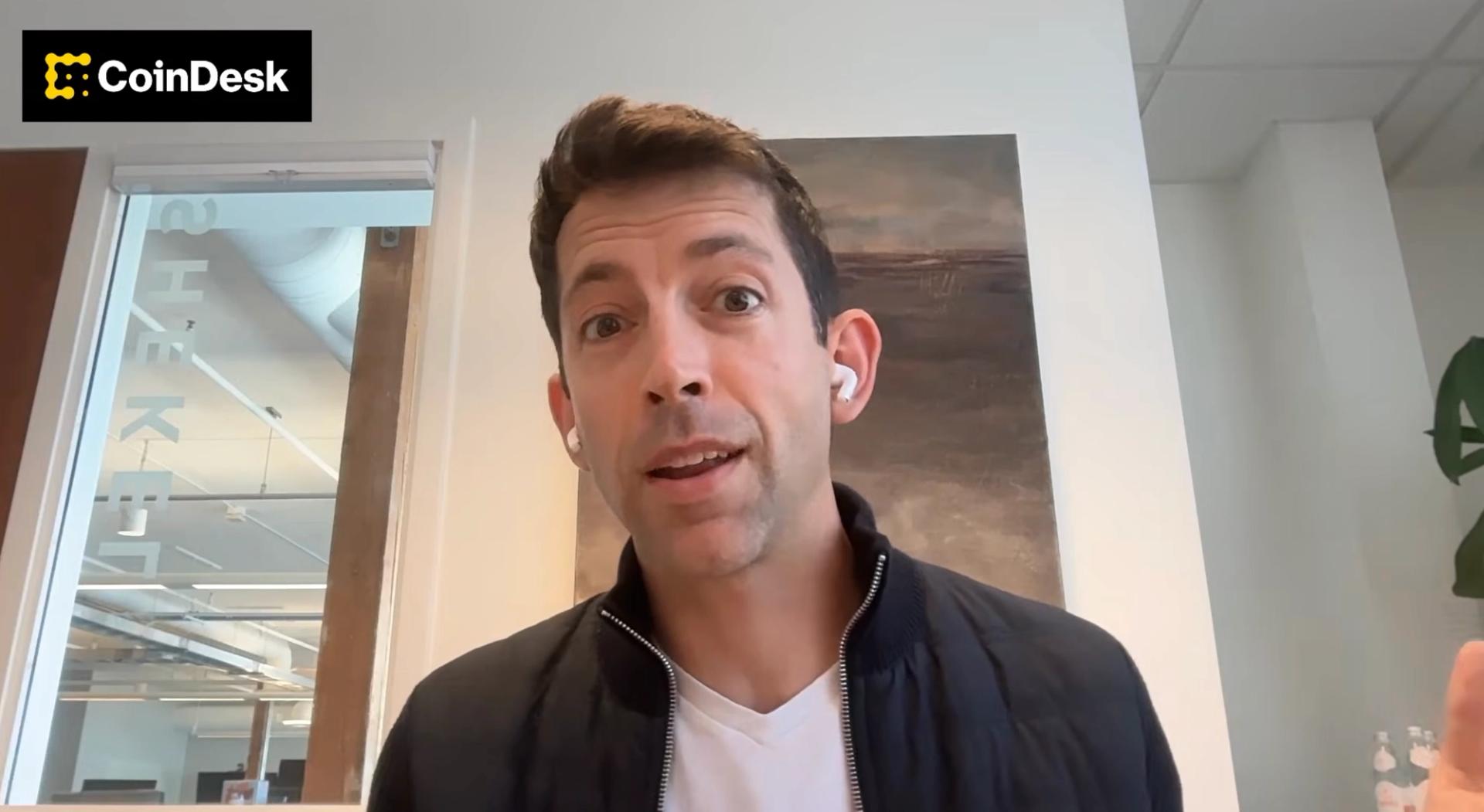
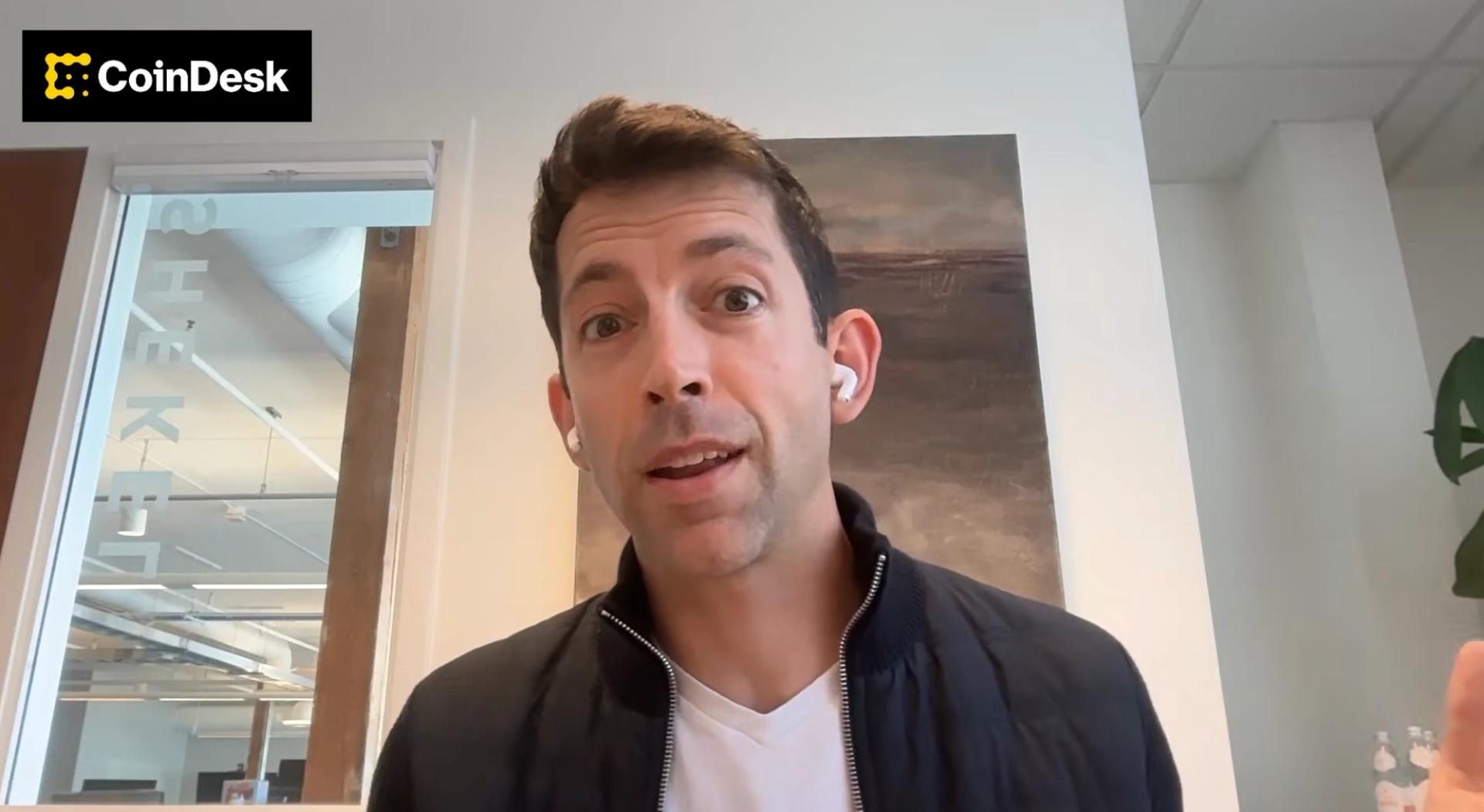
Why it matters: Crypto still suffers from a branding gap despite growing institutional adoption, according to Stellar CMO Jason Karsh.
- Karsh said the industry leans too heavily on “esoteric words and verbiage” that alienate everyday users.
- He argued crypto “peaked in public” too early due to speculative mania, distorting its real potential.
- The bigger opportunity: rebuilding global financial rails to move and store value more efficiently.
The big picture: Stellar is positioning itself at the center of tokenization and cross-border payments as institutions enter crypto.
- The network has focused on payments and real-world financial use cases since launching in 2014.
- That long-term approach is now paying off as regulators warm to stablecoins and tokenized assets.
- Karsh said the goal is to eventually move “trillions” of dollars on-chain, beyond early pilot programs.
Between the lines: Stablecoins are emerging as crypto’s gateway product, but messaging remains a hurdle.
- Karsh called stablecoins “the killer first use case” because they mirror familiar fiat currencies.
- Still, broader audiences remain skeptical or confused about how they work.
- He suggested reframing them as programmable dollars that earn yield and move instantly.
What they’re saying: Karsh is pushing a sharp break from short-term, hype-driven crypto marketing.
- “You need to try to get rich slow… create value every day,” he said.
- He criticized projects that prioritize token launches over sustainable products.
- Strong brands, he added, come from consistent execution and aligning product with messaging.
What’s next: The next wave of adoption may come from infrastructure, not speculation.
- Karsh expects growth to come from replacing legacy financial systems with blockchain rails.
- He predicts both humans and AI agents will drive transaction growth, with agents eventually dominating volume.
- But near-term success depends on onboarding “100 million humans” first.

Hong Kong’s nascent stablecoin regime faced a fresh test as scammers impersonated the two newly licensed issuers ahead of their official product launches. Warnings issued by the Hong Kong Monetary Authority (HKMA), HSBC, and Anchorpoint Financial stated that tokens bearing the tickers HKDAP and HSBC have appeared on the market but are not connected to the licensed issuers.
Hong Kong began its stablecoin licensing regime in August 2025. Last month, the HKMA granted its first stablecoin issuer licenses, approving Anchorpoint Financial and HSBC under the new framework. The episode underscores the growing pains that accompany a regulated rollout of fiat-backed digital currencies in a major financial hub.
The HKMA emphasized that, at present, neither licensed issuer has published any regulated stablecoins. The authority’s warning was echoed by HSBC and Anchorpoint, who stressed that no stablecoins have been issued by either institution under the HKMA framework.
HSBC said in a statement that it “has not yet issued any stablecoins in Hong Kong,” adding that its planned Hong Kong dollar stablecoin will be available only through PayMe and the HSBC HK Mobile App when it launches in the second half of 2026. Anchorpoint likewise clarified that since receiving its license from the HKMA on April 10, it has not issued any tokens or products under the HKDAP name, and urged the public to verify information through official channels and to use regulated avenues when acquiring or using stablecoins.
The guidelines governing fiat-backed stablecoins in Hong Kong require issuers to obtain an HKMA license and adhere to rules around reserve backing, redemption rights, governance, and anti-money-laundering controls. The HKMA maintains enforcement powers that include fines, suspensions, and license revocations to ensure compliance with the regime.
The episode arrives as banks and other traditional financial players increasingly pivot toward stablecoins. In a notable move last week, Morgan Stanley’s investment management arm launched a “Stablecoin Reserves Portfolio,” allowing stablecoin issuers to park reserve funds in one of the bank’s money market funds and earn interest. Separately, Western Union has signaled a May rollout for its USD-backed stablecoin, USDPT, which will be built on Solana and issued by Anchorage Digital Bank. These developments illustrate growing institutional interest in reserve management and settlement rails for fiat-backed digital currencies.
Key takeaways
- Fake tokens with tickers HKDAP and HSBC appeared in the market, but neither is issued by the HKMA-licensed stablecoin issuers Anchorpoint Financial or HSBC.
- The HKMA, HSBC, and Anchorpoint Financial confirm that no regulated stablecoins have been issued to date; real launches are expected later, including HSBC’s HKD stablecoin planned for H2 2026.
- Hong Kong’s licensing regime requires reserve backing, redemption rights, governance, and AML controls, with the HKMA empowered to fine, suspend, or revoke licenses for non-compliance.
- Traditional banks are increasingly engaging with stablecoins, exemplified by Morgan Stanley’s reserve portfolio product and Western Union’s USDPT rollout plans with Anchorage Digital Bank.
Regulatory framework and the road ahead
The HKMA’s stance reflects a balancing act between fostering innovation and maintaining stringent oversight. The newly licensed issuers must meet a set of governance and reserve standards designed to ensure that each stablecoin is fully backed and redeemable under orderly conditions. The enforcement toolkit—ranging from fines to license revocation—signals that regulators intend to act decisively against misrepresentation or mismanagement in the stablecoin space.
For market participants, the latest warnings serve as a reminder to rely on official channels for information and to verify any claims about regulated products. Investors and users should monitor both issuers’ adherence to the HKMA framework and the public rollouts of the actual stablecoins when they become available via licensed channels.
Beyond Hong Kong, the momentum around stablecoins continues to attract traditional finance players. Morgan Stanley’s new reserve portfolio approach provides a pathway for issuers to optimize cash management, while Western Union’s USDPT project points to a broader trend of fiat-backed digital currencies integrating with existing payment rails. As the regulatory regime matures and real products begin to surface, observers will watch how reserve strategies, custody arrangements, and redemption mechanics evolve in practice.
Readers should stay tuned for updates on when the HKD stablecoin will actually launch in Hong Kong, how the public markets will verify legitimacy, and what additional licensing actions the HKMA may take as the regime scales.
Note: This reporting reflects information available from official statements and linked industry reports. Readers are encouraged to consult the cited sources for the most current developments.
Related coverage and sources: Hong Kong’s first stablecoin licenses issued, HSBC warns against fraudulent stablecoins, Anchorpoint alert on HKDAP, Morgan Stanley launches money-market fund for stablecoin issuers, Western Union targets May for USDPT rollout.

Roadmap to Become a FP&A | Financial Planning Analyst

Cambridgeshire nature reserve will triple in size with new walking trails

Is Shopify Down Today? Shopify Experiences Outage Today as Merchants Report Admin and Login Issues

Manchester United reach agreement with Casemiro over contract clause amid transfer speculation

US brings back mandatory military draft registration

Steven Gerrard disagrees with Gary Neville over ‘shock’ Chelsea and Arsenal claim | Football


-

 Tech2 days ago
Register Renaming | Hackaday
-

 Fashion5 days ago
Weekend Open Thread – Corporette.com
-
 Crypto World4 days ago
Hyperliquid $HYPE Rally Builds Momentum as AI Sector Enters Prove-It Phase
-

 Business6 days ago
Patterson-UTI Energy, Inc. (PTEN) Q1 2026 Earnings Call Transcript
-
 Sports4 days ago
IPL 2026: Ruturaj Gaikwad registers slowest fifty of the season, enters all-time unwanted list | Cricket News
-

 Politics2 days ago
Drax board avoid their own AGM, accused of greenwashing & environmental racism
-

 NewsBeat4 days ago
LK Bennett closes all stores after entering administration
-

 Crypto World6 days ago
Michael Saylor says BTC winter is over. Market analyst disagrees, says bitcoin was in a pullback
-
 Sports7 days ago
Tim Bradley names the current best in the world: “Better than Inoue and Usyk”
-

 Fashion1 day ago
Kylie Jenner’s KHY Enters a New Era with ‘Born in LA’
-
Entertainment7 days ago
Michael B. Jordan and Austin Butler's “Miami Vice” movie will bring the action back to the '80s
-
 Entertainment4 days ago
Mariah Carey Slams Deposition Claims In Brother’s Lawsuit
-

 Tech2 days ago
Images of Samsung’s rumored smart glasses have leaked
-
Business7 days ago
Altimmune prices $225 million public offering at $3 per share
-
Entertainment7 days ago
Russell Brand Had Sex With 16 Year Old When He Was 30
-

 Business1 day ago
Most Commercial Energy Audits Miss the Real Losses
-
Crypto World6 days ago
Is Algorand One of the Few Quantum-Resistant Blockchains? Here’s What the Data Shows
-
 NewsBeat6 days ago
Trump threatens to review UK’s claim to Falkland Islands and punish Nato allies over Iran war disagreement
-

 Sports7 days ago
2026 NFL Draft tonight: Time, TV channel, where to watch, order
-

 Sports7 days ago
Bayern Munich on the brink of historic ‘double treble’
You must be logged in to post a comment Login