
Crypto World
Bermuda pushes stablecoin payments with USDC airdrop as it courts crypto firms, regulators

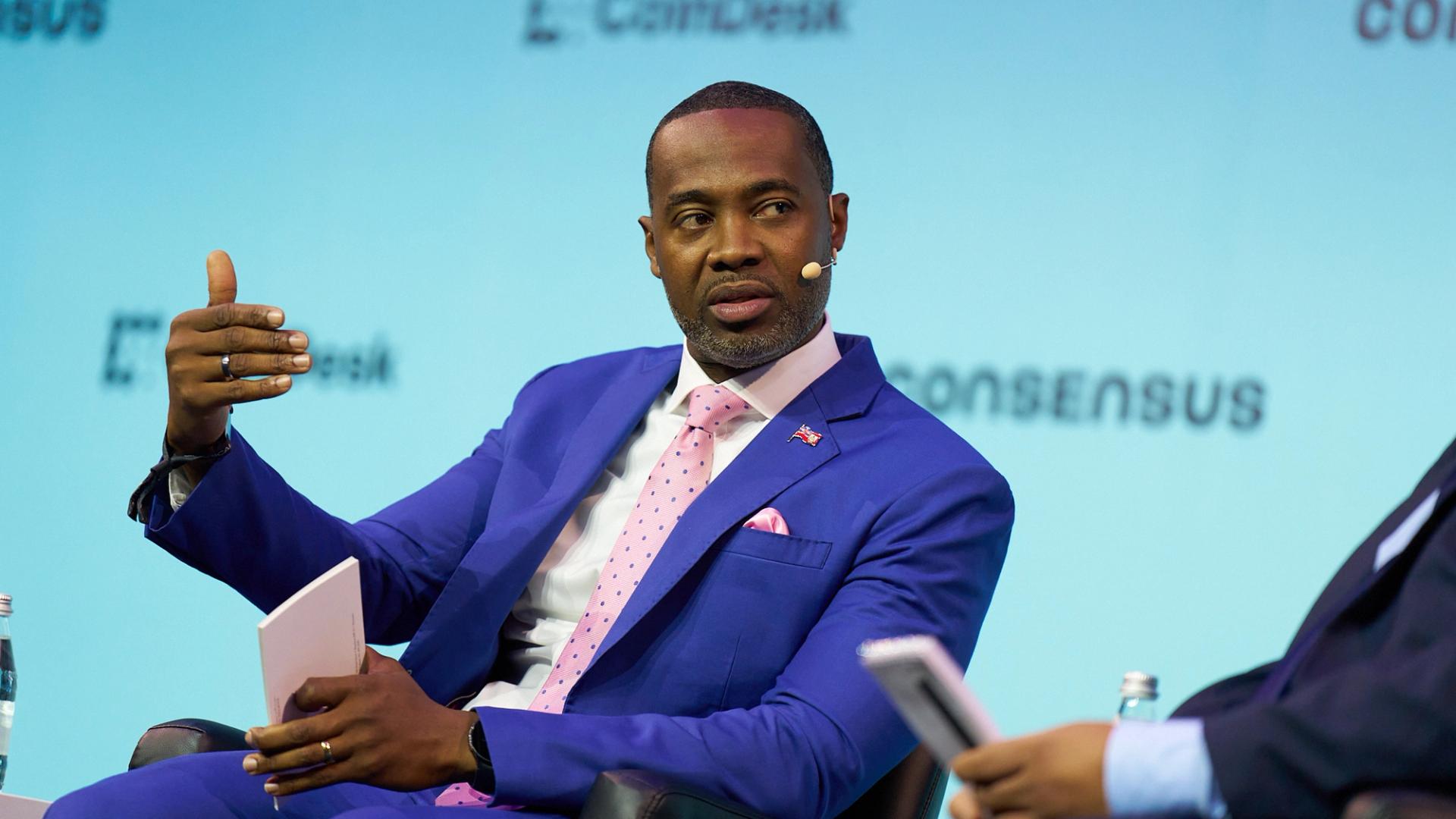
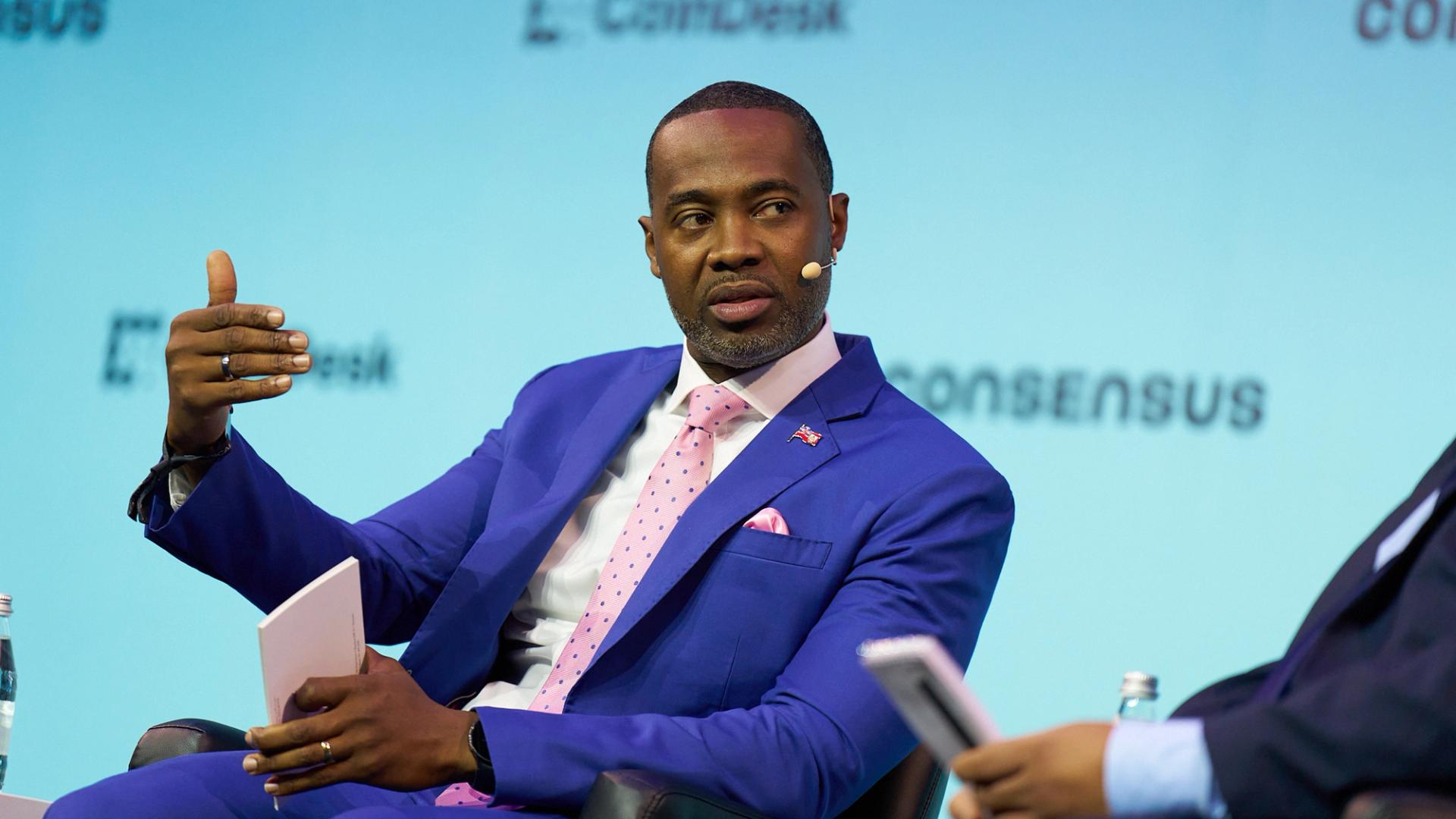
Bermuda is aiming to show an example how to move crypto into everyday commerce without breaking the financial system, Premier David Burt said onstage at Consensus Miami 2026 on Wednesday.
Burt said the tiny island on the Atlantic is expanding its “onchain economy” initiative, a push to get stablecoins into the hands of residents, merchants and local businesses. The project was first announced in January at the World Economic Forum, with stablecoin issuer Circle (CRCL) and exchange Coinbase (COIN).
The government plans another airdrop of USDC stablecoin this year, tied to next week’s Bermuda Digital Finance Forum 2026, while also onboarding merchants that can accept digital payments. Participants will receive stablecoins through wallets and can spend them with local vendors, Burt said.
“If you are a vendor and you’re accepting digital assets, but you do not have a way to use and spend those digital assets inside your economy, that presents a problem,” Burt said.
The broader goal for Bermuda is to build payment infrastructure outside traditional card networks and banking rails, he said, arguing that small businesses face high transaction fees and limited access to financial apps common in larger markets.
Coinbase Chief Legal Officer Paul Grewal, who joined Burt on stage, said Bermuda’s approach stands out because regulators and private firms are building in tandem instead of working separately.
“What’s most interesting about the Bermuda example is it is a parallel process,” Grewal said. “Government services can be accessed using payment stablecoins, while merchants and businesses are brought into the system at the same time.”
Bermuda, Burt said, has spent years building a digital asset framework through its Digital Asset Business Act. He described the island’s regulatory style as iterative and industry-facing, with the Bermuda Monetary Authority working directly with firms on issues such as staking, lending and DeFi supervision.
“You cannot regulate out failure,” Burt said. “But you can put in place the items which allow responsible innovation to happen.”
Grewal also contrasted Bermuda’s approach with the regulatory climate crypto firms faced in the U.S. over the past several years under former Securities and Exchange Commission (SEC) Chair Gary Gensler. That has changed for the better under the Trump administration, he argued.
“It is a new day here in the United States,” Grewal said, pointing to what he described as a more constructive tone from agencies under SEC Chair Paul Atkins and Commodity Futures Trading Commission (CFTC) Chair Michael Selig.
“We still have challenges, to be clear, but it’s a very different dynamic,” he said.

Ripple’s team unveiled an important update concerning the entire community.
Additionally, the company’s stablecoin, RLUSD, received support from one of the biggest crypto exchanges, the spot XRP ETFs continue to attract capital, while some analysts believe that the price of the native token could surge past $2 soon.
The Latest Big Announcements
Earlier this week, Ripple touched upon the never-ending problem in the crypto sector: the hacks and the assumption that many of the attacks are carried out by North Korea wrongdoers.
The firm said it will start sharing detailed threat intelligence with the Crypto ISAC network, helping exchanges and other entities identify malicious wallets, domains, and behavior patterns linked to these hackers. Ripple believes this development will allow the industry to block attacks faster and reduce the damage they cause.
Besides addressing the threat posed by North Korean hacking groups, Ripple also saw a notable advancement in Russia. Recent reports indicated that the country’s largest securities exchange plans to start calculating and publishing indexes tracking the performance of widely known altcoins, including XRP.
The company’s most recent update concerns Swell 2026. The team revealed that registration for the event, which will take place in New York City this October, is now open. Swell is Ripple’s annual conference where the company showcases new products, shares industry insights, and brings together developers, partners, builders, financial leaders, and members of the XRP community.
RLUSD’s Advancement
Several days ago, Ripple shook hands with one of the largest crypto exchanges, OKX. The collaboration is expected to significantly expand global access, liquidity, and trading utility for the company’s stablecoin RLUSD.
The financial product, pegged 1:1 to the American dollar, officially saw the light of day towards the end of 2024, with its market capitalization now hovering well above $1.5 billion.
Other popular exchanges that have listed RLUSD over the past months include Coinone, Binance, Kraken, Bybit, and more.
The ETF Front
The institutional interest in Ripple’s native token has been quite high lately. SoSoValue’s data shows that inflows into spot XRP ETFs have consistently surpassed outflows over the last few weeks, with the only red day being April 30. Moreover, cumulative total net inflows into these investment vehicles have exceeded $1.3 billion.

This means that more conservative investors, such as pension funds and hedge funds, have increased their exposure to the asset, requiring the companies behind the products (Bitwise, Canary Capital, Franklin Templeton, and Grayscale) to back the sold shares by purchasing real XRP.
XRP Price Outlook
As of this writing, the asset’s valuation hovers around $1.44, up 3% on a weekly basis. According to some market observers, a big move to the upside could be coming next.
X user CW claimed that XRP is forming a second bullish candle after the golden cross, predicting that “the real rally begins after the ATH breakout.”
For their part, EGRAG CRYPTO spotted the emergence of a diamond pattern on the monthly chart where “price meets time.” The analyst forecasted that a push above $1.50 could result in a surge to $2.20, while a failure to hold the structure would invalidate the bullish momentum.
The post Ripple (XRP) News Today: May 6 appeared first on CryptoPotato.
Some of the world’s largest remittance providers are accelerating their digital asset strategies as they look for faster settlement alternatives to traditional banking rails.
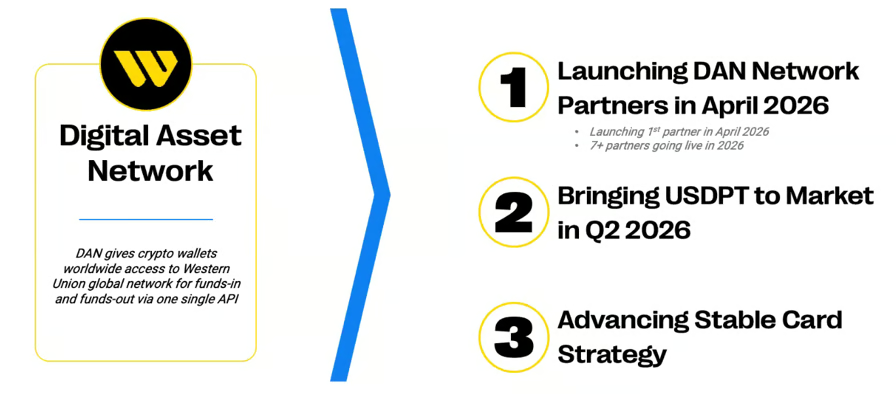
Western Union’s new stablecoin USDPT is the latest example of the growing overlap between traditional payments firms and crypto infrastructure. The money transfer company launched its Solana-based stablecoin on Monday in the Philippines and Bolivia, with plans to expand into additional markets throughout 2026.
Western Union CEO Devin McGranahan said in the company’s Q1 earnings call that the stablecoin will be used as an alternative settlement layer to the decades-old SWIFT network.
Digital assets allow transfers “to begin moving and settling between us and our agents onchain in real time at much faster speeds and again over weekends and holidays where we have capital tied up because the traditional banking system only settles Monday through Friday,” he said.
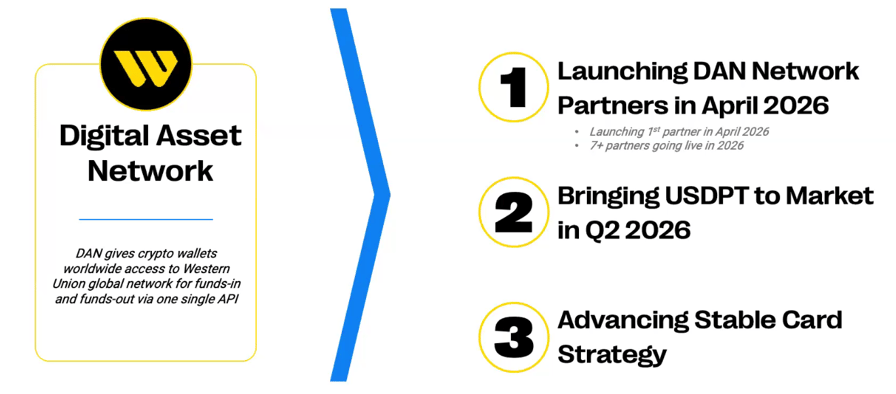
Western Union’s stablecoin follows the launch of its Digital Asset Network. Source: Western Union
Western Union is not the only remittance provider trying to move cross-border settlement away from the incumbent banking system’s weekday-only rails.
Rival MoneyGram on Tuesday announced a partnership with Kraken that allows users to convert crypto into cash for pickup, adding to a broader push among remittance firms to integrate blockchain-based payment rails.
SWIFT isn’t disappearing anytime soon
From its early years, crypto was often framed as an alternative to centralized financial systems and intermediaries.
Though Satoshi Nakamoto did not explicitly call for replacing banks in the original Bitcoin whitepaper, the network’s genesis block included the newspaper headline: “Chancellor on brink of second bailout for banks.”
As Bitcoin launched after the collapse of institutions like Lehman Brothers, the message has been interpreted as a political statement against centralized finance and bank bailouts.
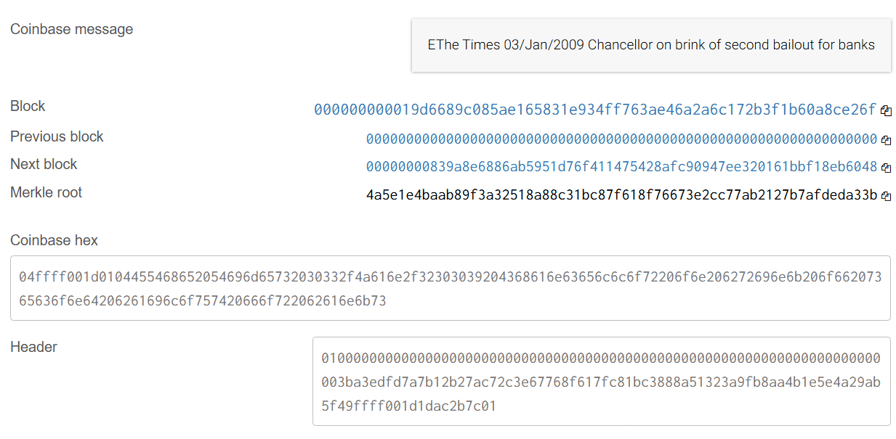
Bitcoin’s first block was mined on Jan. 3, 2009, during the Global Financial Crisis. Source: Bitaps
Related: DeFi can freeze stolen funds, but not everyone agrees it should
But today, many of those same financial institutions are embracing blockchain-based settlement systems themselves.
“It is no longer a question of if Western Union will be active in digital assets, it is now how fast can we scale,” McGranahan said.
Western Union exploring alternatives to SWIFT does not mean crypto has replaced the finance messaging network founded in 1973. SWIFT is still deeply embedded in the cross-border settlement infrastructure used by banks in more than 200 countries and territories.
In fact, SWIFT itself has also been experimenting with blockchain-related infrastructure. Last September, the organization announced work on a shared ledger initiative involving more than 30 financial institutions.
“SWIFT isn’t going to be replaced by a single announcement or a single stablecoin,” Bernardo Bilotta, CEO of stablecoin infrastructure platform Stables, told Cointelegraph.
“It’s deeply entrenched, and for many types of institutional transfers, it works well enough that the switching costs outweigh the benefits of moving to something new.”
Stablecoins unlock “dead” remittance capital
Faster remittance settlement has obvious benefits for end-users, who no longer have to be constrained to business days.
On the backend, it unlocks “dead capital” for the remittance provider and its local partners.
“A company like Western Union has capital parked across hundreds of correspondent banking relationships globally, pre-funding accounts so that when a transfer hits, the money is already sitting there waiting,” Bilotta said.
He added:
It earns nothing, it does nothing except guarantee that a payment can settle two or three days from now on a banking schedule designed in the 1970s.”
Moving settlement onto blockchain-based assets such as stablecoins compresses the payment timeline from days to minutes.
However, Bilotta argued that not all that liquidity will start flowing into useful earnings, as stablecoins also need locked reserves and partake in real-time treasury management. So in practice, not all the “dead capital” unlocked by stablecoins is expected to be immediately deployed elsewhere.
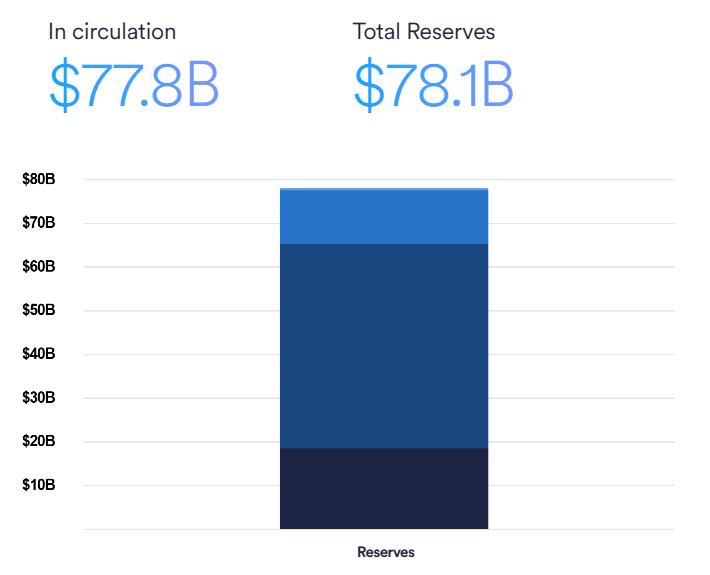
Stablecoin issuers also keep large amounts of capital locked in reserves. Source: Circle
Related: Why yen stablecoins are key to Japan’s crypto ambitions
Sota Watanabe, CEO of Startale Group, is building the JPYSC stablecoin in Japan. He said that the extra time in traditional rails also creates safeguards and buffers. Institutions batch transactions, net exposure and manage liquidity around banking hours.
“Stablecoins remove that delay. Powerful, but it means treasury systems must now operate continuously, not only during business hours,” Watanabe told Cointelegraph.
Private stablecoins risk creating new silos
While stablecoins promise faster and more efficient settlement, not all blockchain-based payment systems are built equally.
Bilotta argued that private settlement networks such as Western Union’s USDPT offer institutions tighter control over issuance, treasury management and counterparties, but risk recreating the same fragmentation blockchain originally aimed to solve.
“Every company that launches its own stablecoin creates another walled garden that the rest of the ecosystem has to bridge to or ignore,” he said.
Unlike private stablecoins operating inside closed ecosystems, public stablecoins such as Tether’s USDt (USDT) benefit from shared liquidity pools and interoperability across exchanges, wallets and payment platforms.
“A dollar moved through USDT in Thailand is the same dollar that arrives in Australia,” Bilotta said. “No bridging, no translation, no bilateral agreements between private networks.”
Watanabe shared similar concerns, warning that if every major payment company launches its own isolated settlement network, the industry could simply recreate the siloed infrastructure of correspondent banking on blockchain rails.
“Private settlement networks are efficient inside a closed ecosystem,” Watanabe said. “Their weakness is interoperability.”
He argued that the long-term advantage of public blockchain rails is not just faster settlement, but shared infrastructure where liquidity can move more naturally between applications, exchanges and financial systems.
For all the promises of faster settlement and 24/7 payments, blockchain-based remittances still risk rebuilding the same fragmented infrastructure they were meant to replace.
Magazine: North Korea denies crypto hacks, Upbit’s bank tests Ripple: Asia Express


Anthropic just made Elon Musk’s SpaceX a key supplier to its AI ambitions, and the timing is hard to miss.
The Claude maker said Wednesday it had signed a deal to tap all of the compute capacity at SpaceX’s Colossus 1 data center, locking in access to more than 220,000 NVIDIA GPUs within the month.
The agreement directly expands what Anthropic can serve to Claude Pro and Claude Max subscribers, with Claude Opus API rate limits raised significantly and Claude Code’s five-hour rate limits doubled for Pro, Max, Team and Enterprise plans, all effective Wednesday.
The Colossus 1 deal is the latest in a growing stack of Anthropic compute partnerships.
The company has previously signed an up to 5 gigawatt agreement with Amazon that includes nearly 1 gigawatt of new capacity by year-end, a 5 gigawatt deal with Google and Broadcom that comes online in 2027, a Microsoft-NVIDIA strategic partnership covering $30 billion of Azure capacity, and a $50 billion U.S. AI infrastructure investment with Fluidstack.
Anthropic also flagged interest in partnering with SpaceX on orbital AI compute capacity, expanding the relationship beyond terrestrial data centers.
The timing matters because SpaceX is weeks away from going public.
The Musk-led firm filed confidentially with the SEC on April 1 for an IPO targeting a $1.75 trillion to $2 trillion valuation, with the public S-1 expected by late May and the roadshow set for the week of June 8.
Adding Anthropic as a named compute customer ahead of the listing strengthens SpaceX’s pitch as more than a launch and Starlink business, with AI infrastructure now a disclosed revenue line.
The deal also lands as Anthropic continues international expansion to meet data residency requirements in regulated industries.


On last night’s earnings call for Strategy (formerly MicroStrategy), Michael Saylor and CEO Phong Le finally admitted that they’re considering selling the company’s bitcoin (BTC).
This sudden change undoes years of guidance and explicit assurances that Strategy would never sell.
Specifically, Saylor and Le told analysts on the company’s first-quarter earnings webinar that Strategy will probably sell some BTC to pay a dividend, framing the move as a way to “inoculate” the market as to the company’s new strategy.
Le walked through scenarios in which the company would sell BTC to fund preferred dividends while remaining a “net buyer.”
Truly, it’s a remarkable reversal of rhetoric.
In January 2022, with BTC down roughly 40%, Bloomberg asked Saylor whether Strategy would ever sell BTC.
“Never. No. We’re not sellers. We’re only acquiring and holding BTC,” Saylor swore to Bloomberg. “That’s our strategy.”
In February 2024, Saylor reiterated that promise on Bloomberg TV. “There’s just no reason to sell the winner,” Saylor affirmed. “BTC is the exit strategy.”
‘We call them poor’
In March 2024, Saylor told Yahoo Finance, “We believe that the highest, best use of capital is to buy BTC and hold the BTC.”
In that interview, Saylor delivered one of his most famous promises to never sell BTC which became the basis for a song and endless memes on social media.
Referencing a comparison of BTC to real estate, Yahoo Finance’s news anchor asked Saylor, “I don’t think that is your endgame, right? You’re not planning to sell the BTC at any point. So what is the purpose of it over time? You know, what do you do with the BTC besides it just gather value?… Most of the people who are buying assets at some point want to sell the assets at a profit.”
Saylor responded, “Let me say it a different way. People that use fiat currency as a store of value, there’s a name for them. We call them poor.”
In his Q3 2024 earnings call, Saylor called BTC a “permanent treasury reserve asset” to be acquired and held indefinitely.
Read more: STRC controversy goes mainstream
‘Never. No. We’re not sellers’
In February 2025, Saylor reiterated his policy. “Never sell your BTC.”
Later that month, he published his 21 Rules of Bitcoin. Rule 20 stated clearly, “You do not sell your BTC.”
Also that month, with BTC sliding below $80,000, Saylor escalated to organ donation. “Sell a kidney if you must, but keep the BTC.”
In March 2025, he said Strategy would “never sell” its BTC.
Four months later, he acknowledged the buying pattern that had become his persona: “I’m going to be buying the top forever.”
On CNBC’s Squawk Box TV show in February 2026, Saylor told Andrew Ross Sorkin: “We’re not going to be selling; we’re going to be buying BTC.” He added he expected the company would buy every quarter forever.
He then spent five years telling shareholders that selling was unthinkable. Last night, he told them that rhetoric was merely a marketing tool.
Got a tip? Send us an email securely via Protos Leaks. For more informed news and investigations, follow us on X, Bluesky, and Google News, or subscribe to our YouTube channel.
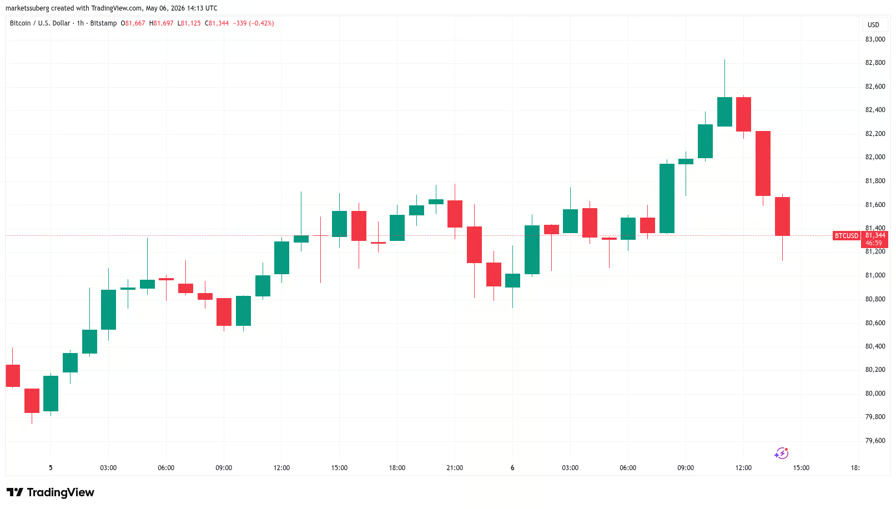
Bitcoin (BTC) cooled from new 13-week highs at Wednesday’s Wall Street open amid mixed signals over a US-Iran peace deal.
Key points:
- Bitcoin stops short of tapping $83,000 as momentum becomes guided by geopolitical developments.
- Oil sees flash volatility around rumors of the Strait of Hormuz opening.
- Bitcoin trader sees a price reset to a $78,400 trend line.
Iran deal let-down sours Bitcoin’s attack on $83,000
Data from TradingView showed a new local peak for BTC/USD of $82,833 on Bitstamp.
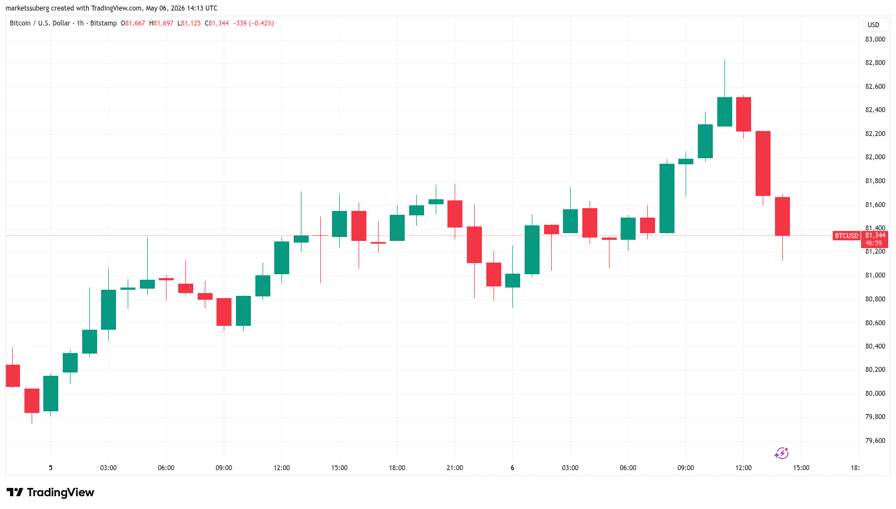
BTC/USD one-hour chart. Source: Cointelegraph/TradingView
The pair made fresh gains amid reports of a 14-point ceasefire agreement potentially coming into effect — one that would include resumption of oil traffic through the Strait of Hormuz.
Hours later, however, US President Donald Trump said that Iran’s agreement to the terms of the truce was “perhaps, a big assumption.”
“If they don’t agree, the bombing starts, and it will be, sadly, at a much higher level and intensity than it was before,” he added in a post on Truth Social.
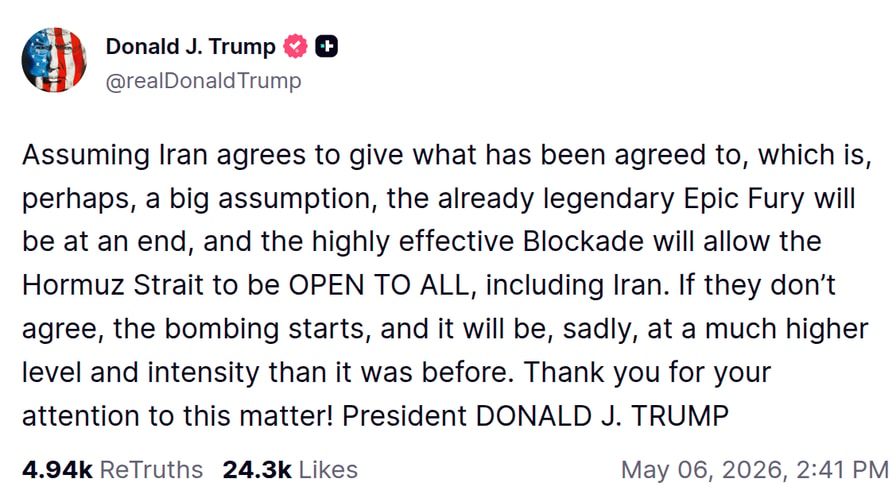
Source: Truth Social
Bitcoin reacted by erasing its upside to circle $81,500 at the time of writing, still up around 1% on the day.
Oil also saw volatility, with WTI dropping over 10% in a matter of hours before rebounding to $96 per barrel.
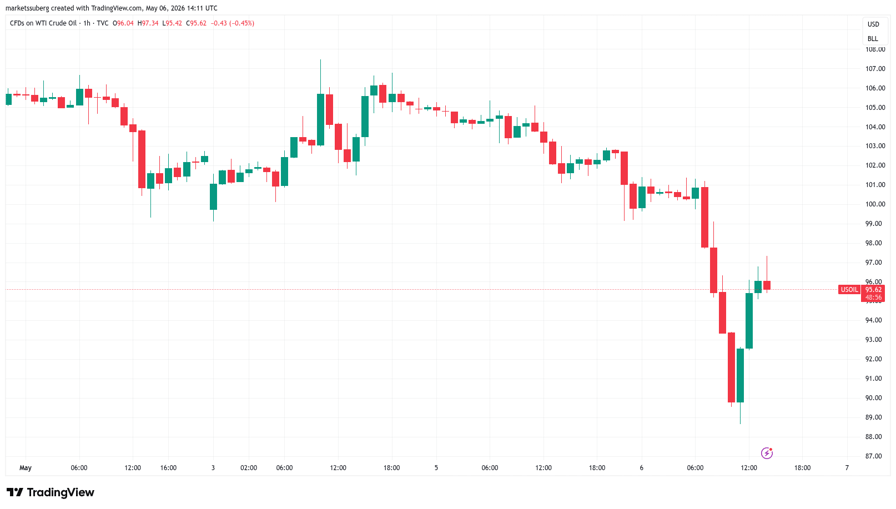
CFDs on WTI crude oil one-hour chart. Source: Cointelegraph/TradingView
Commenting on X, trading resource The Kobeissi Letter reported what it called “unusually large” short interest on WTI, which totaled nearly $1 billion, immediately before the drop.
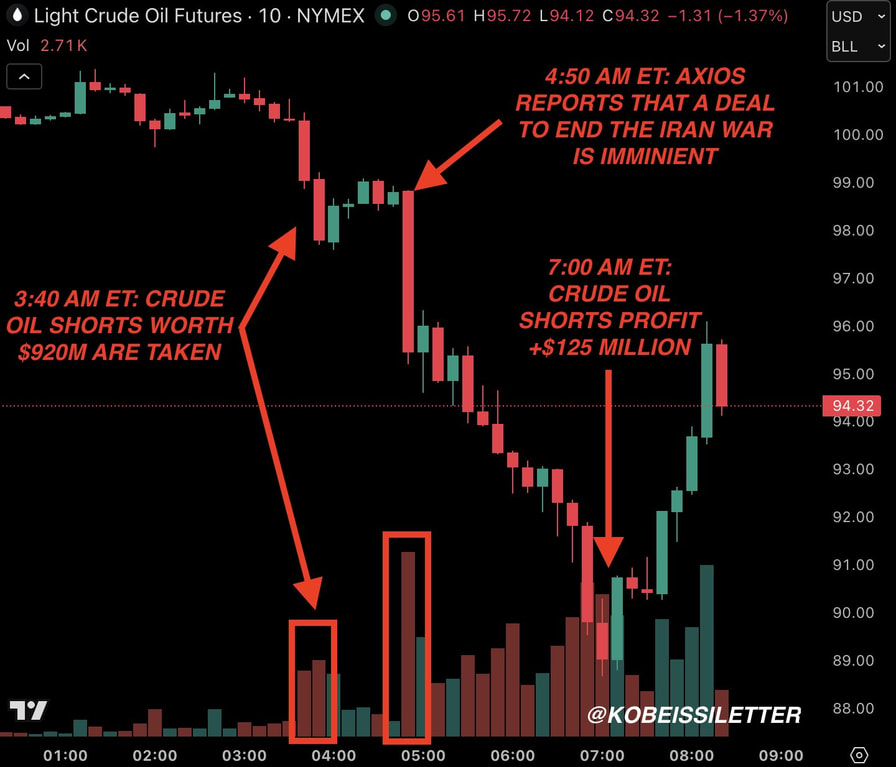
Light crude oil futures chart. Source: The Kobeissi Letter/X
BTC price focus switches to $78,000 and higher
Bitcoin traders, meanwhile, looked to patches of potential liquidations on exchange order books for clues as to where price might head next.
Related: Bitcoin can crash to $50K if ‘most critical’ bear market test fails: Analysis
“Above, the $82.4K area still has some left. But price did take out most of the local liquidity from the past day. With price at 3 month highs, we would need to zoom out to see the other major levels,” trader Daan Crypto Trades told X followers.
“Below, the $80.1K & $78.2K levels are good to watch if price were to trade into them.”
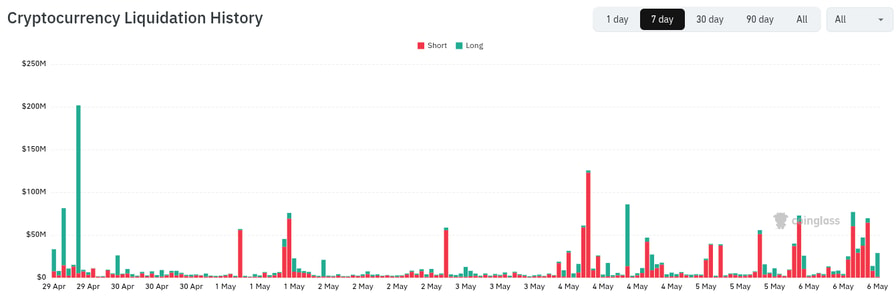
Crypto liquidation history (screenshot). Source: CoinGlass
Data from CoinGlass put total crypto liquidations over the past 24 hours at more than $550 million, with shorts accounting for $400 million of the total.
Trader CrypNuevo called BTC/USD “overextended” on short time frames, seeking a retracement to the 50-period simple moving average (SMA) on the four-hour chart. That stood at $78,432.
“Ideally it continues pushing straight higher without any exhaustion signs and it will overextend price even more so the short will be more atractive and worth it when we see those signs at higher prices,” he wrote on X.
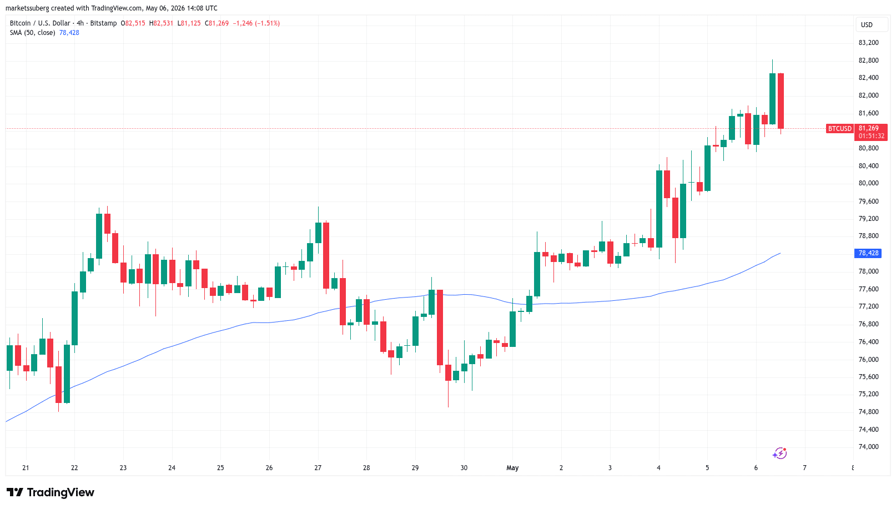
BTC/USD four-hour chart with 50SMA. Source: Cointelegraph/TradingView
Earlier, Cointelegraph reported on concerns that historical precedent called for the failure of Bitcoin’s current breakout attempt.

Key Highlights
- Walt Disney delivered Q2 fiscal 2026 revenue of $25.2 billion, representing a 7% year-over-year increase and surpassing analyst expectations of $24.9 billion
- The company’s adjusted earnings per share reached $1.57, exceeding Wall Street’s consensus forecast of $1.49
- CEO Josh D’Amaro, in his first quarterly report, projected fiscal 2026 adjusted EPS growth of roughly 12%
- Streaming entertainment (SVOD) operating profit jumped 88% compared to the prior year, with margins crossing the 10% threshold for the first time
- Shares of Disney climbed nearly 8% during morning trading hours after the earnings announcement
Shares of Walt Disney (DIS) surged nearly 8% during Wednesday’s morning session after the entertainment giant delivered a better-than-anticipated second-quarter performance for fiscal 2026, marking the debut earnings report under newly appointed CEO Josh D’Amaro.
For the quarter spanning January through March, Disney reported total revenue of $25.2 billion, reflecting a 7% year-over-year improvement. This performance exceeded Wall Street’s projection of $24.78 billion. Meanwhile, adjusted earnings per share came in at $1.57, comfortably beating the analyst consensus of $1.49.
D’Amaro, who assumed the chief executive role from Bob Iger in mid-March, outlined his strategic vision during the earnings conference call. His approach emphasizes creative excellence, streaming business expansion, capitalizing on live sports programming, and sustained capital allocation toward theme parks and cruise operations.
The entertainment behemoth plans to execute stock repurchases totaling at least $8 billion throughout the current fiscal year.
Streaming Business Reaches Key Profitability Threshold
The Entertainment division emerged as a standout performer. Subscription video on demand (SVOD) operating profit reached $582 million, marking an impressive 88% year-over-year surge. This achievement pushed streaming profitability above the 10% margin mark for the first time — a benchmark Disney had initially targeted for the entire fiscal year.
SVOD revenue climbed 13%, fueled by expanding subscriber counts and improved average revenue per user. Advertising income from Disney+ provided additional momentum. Theatrical releases including “Zootopia 2” and “Avatar: Fire and Ash” continued generating strong box-office contributions throughout the quarter.
CFO Hugh Johnston highlighted that streaming operations now produce twice the revenue of Disney’s legacy television business, which he characterized as “getting smaller and smaller every quarter.”
Experiences Division Shows Strength Amid Challenges
The Experiences segment — encompassing theme parks, cruise operations, and merchandise — achieved record-breaking Q2 performance with revenue reaching $9.5 billion and operating income hitting $2.6 billion. The division’s operating profit advanced 5% versus the comparable prior-year period.
Per-capita spending increased at domestic theme park locations, while cruise vessels experienced higher occupancy levels. Nevertheless, Johnston acknowledged headwinds, noting decreased attendance at U.S. parks attributed partially to reduced international tourism and competitive pressure from Universal’s newly launched Epic Universe attraction in Orlando.
D’Amaro characterized current domestic consumer demand as “healthy” while acknowledging the company remains “mindful of the macroeconomic uncertainty consumers are facing.” Johnston mentioned rising gasoline prices as a factor under observation.
The Sports segment represented the weakest performance area. ESPN’s division recorded a 5% decline in operating profit to $652 million, pressured by escalating content licensing fees and increased production expenditures.
Johnston framed ESPN as a comprehensive content platform rather than a conventional broadcasting network — one capable of broad distribution and multi-platform monetization. He indicated the sports business is in earlier phases of its streaming transformation compared to entertainment properties.
Forward-Looking Projections
D’Amaro elevated the fiscal 2026 adjusted EPS growth forecast to approximately 12%, improving upon the previous “double digits” guidance. Third-quarter segment operating income is anticipated to reach $5.3 billion. Management reiterated expectations for double-digit adjusted EPS expansion in fiscal 2027.
Addressing artificial intelligence, D’Amaro described the technology as presenting “meaningful long-term opportunities” for Disney, particularly regarding production workflow optimization, while stressing that human creativity remains the cornerstone of the company’s operations.
Disney shares were trading approximately 7% higher as of Wednesday afternoon.

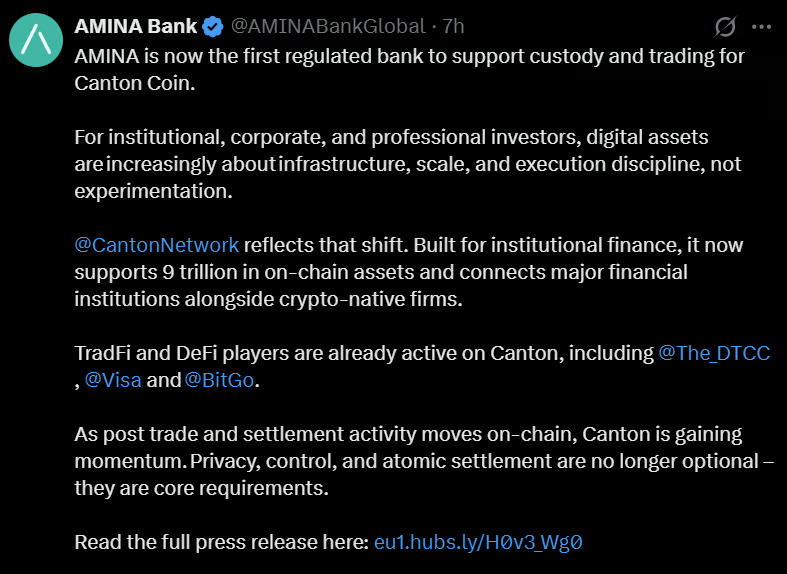
Swiss crypto bank Amina has added custody and trading support for Canton Coin, becoming the first regulated bank to offer services for the token tied to the Canton Network, an institutional-focused network.
In a Wednesday announcement, Amina said clients will gain regulated access to the Canton Network, a public blockchain designed for capital markets and tokenized finance. The network was developed by Digital Asset and is backed by the Depository Trust & Clearing Corporation, Visa, BitGo, Goldman Sachs and Citadel.
The move allows institutional clients to hold and trade Canton Coin through a banking platform regulated by the Swiss Financial Market Supervisory Authority (FINMA) rather than relying on a crypto-native exchange or custodian, potentially supporting companies that use Canton for tokenization and settlement.
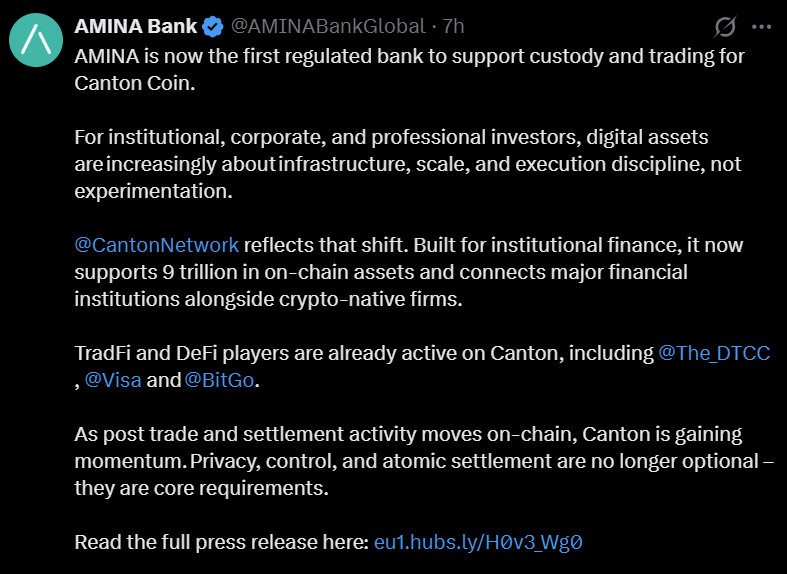
Source: AMINA Bank
The announcement builds on Amina’s broader push into tokenized finance infrastructure. In March, the Zug, Switzerland bank became the first regulated banking participant on the EU-regulated blockchain securities platform 21X, which operates under the bloc’s DLT pilot regime for tokenized securities markets.
Related: Tennessee Bankers Association names Stablecore as preferred digital asset provider
Canton expands institutional finance footprint
Canton Network is positioning itself as blockchain infrastructure for traditional financial institutions, with a focus on tokenized assets, settlement, collateral management and repo markets. Its Canton Coin token is currently valued at around $0.15, with a total market capitalization of $5.7 billion, according to CoinMarketCap data.
.png?prefix=media%2Fcontent)
Canton Coin (CC) market capitalization. Source: CoinMarketCap
In April, BitGo expanded its Canton Coin services beyond custody to include trading and onchain settlement, broadening institutional access to the network’s token and related financial activity.
Meanwhile, S&P Dow Jones Indices recently brought its US Treasury Index benchmark onto the Canton Network, allowing institutions to access fixed-income benchmark data through tokenized infrastructure.
Canton faces competition from several enterprise blockchain networks targeting institutional finance. Among them is R3’s Corda, which was designed for banks and regulated financial markets with an emphasis on privacy and permissioned transactions.
Another competitor, Hyperledger Fabric, has seen broad adoption in enterprise blockchain environments, particularly among financial institutions and large corporations.
Related: Bernstein cites $4T tokenized credit opportunity for Figure Technology stock

Toncoin (TON) has rallied significantly this week after Telegram founder Pavel Durov revealed that his company will replace the TON Foundation, assume the role of the largest validator, and reduce fees by roughly six times. The price moved from $1.30 on May 3 to around $2.50 in a span of three days. In fact, TON was up by more than 30% in the past 24 hours alone.
At the same time, the crypto asset recorded a rapid surge in social chatter.
TON Chatter Goes Vertical
On-chain analytics platform Santiment found that social activity spiked, as mentions reached 91 in a four-hour window on May 5th, about six times higher than usual, and stayed high across several windows. The major driver behind the move is Telegram assuming direct control over validation and protocol direction.
Santiment stated that while a similar centralization step by Arbitrum recently triggered governance concerns, Telegram’s move is being received positively despite following a comparable pattern.
On Monday, Durov took to X to reveal that fees on TON have been reduced by about six times and are now close to zero. He also stated that Telegram will become its largest validator. The next step includes introducing new developer tools and rolling out performance upgrades to strengthen the network.
The ton.org website now shows a simple holding page that reads,
“ton.org is now controlled by MTONGA. Expect changes soon.”
Previous Upgrades
This latest move follows through on an announcement made last month by Durov, who had said TON would soon transition toward fully fee-less transactions. He had then revealed that fees would remain fixed regardless of network load.
Previously, the network rolled out a major core consensus upgrade (Catchain 2.0) on April 10 that reduced transaction finality from around ten seconds to about one second using a revised consensus mechanism, which enabled faster confirmations. The update also increased block production, which impacted validator rewards and adjusted staking dynamics, thereby leading to a higher annual inflation rate.
The post TON Social Buzz Explodes 6x in an Hour: Centralization Suddenly Looks Bullish? appeared first on CryptoPotato.
Key points:
- Bitcoin is expected to face selling at $84,000, but a shallow pullback increases the likelihood of an upside breakout.
- Several major altcoins are showing strength at lower levels, but the bears are expected to pose substantial challenges at the resistance level.
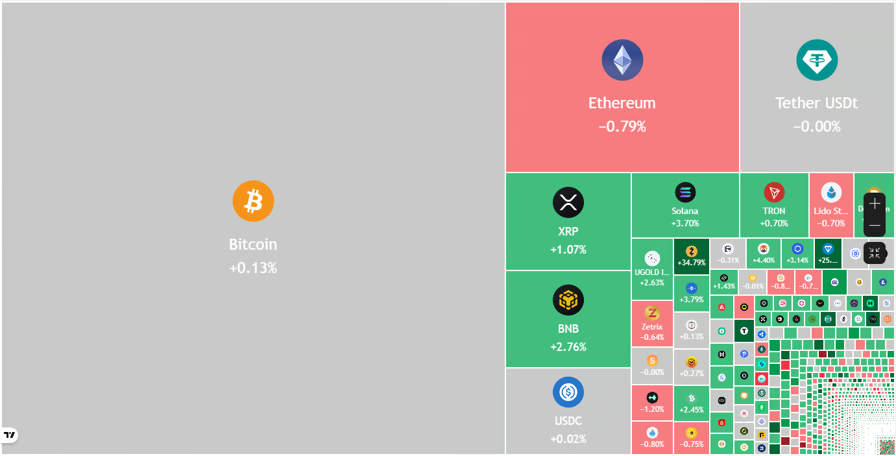
Bitcoin (BTC) rallied above $82,800 on Wednesday, but bulls were unable to hold the higher levels. However, a positive sign for the bulls is that BTC exchange-traded funds recorded $1.63 billion in net inflows in May, according to SoSoValue data. That suggests investors are building positions as they anticipate the uptrend to continue.
Analyst PlanC said in a post on X that BTC was about to enter its first supercycle, which began at the bear-market low of $16,000 in Nov. 2022. He expects BTC to rise above $250,000 in the second half of 2027 to the first half of 2028.
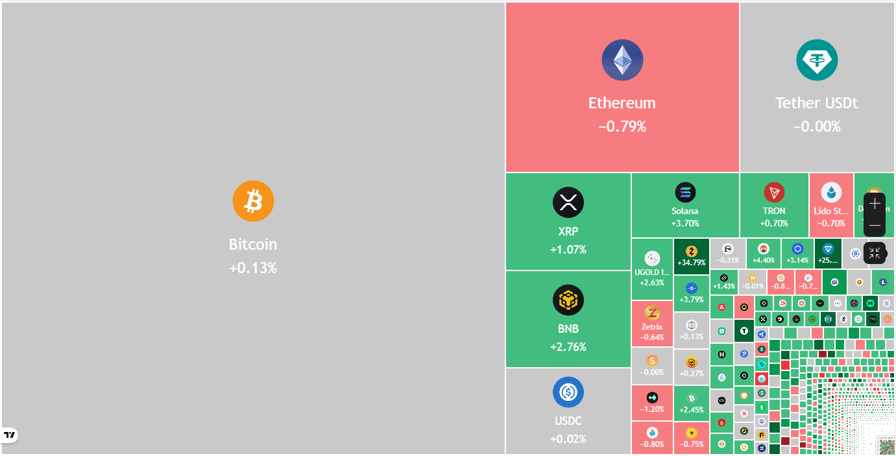
Crypto market data daily view. Source: TradingView
Not everyone is convinced that the bear market is over. Crypto investment company TradingShot said in a post on X that BTC’s rejection at the 200-day simple moving average ($83,313), which coincides with the previous low acting as target objective of $50,000.
Could BTC and the major altcoins break above their overhead resistance levels? Let’s analyze the charts of the top 10 cryptocurrencies to find out.
Bitcoin price prediction
BTC has been gradually rising toward the $84,000 level, indicating sustained buying by the bulls.
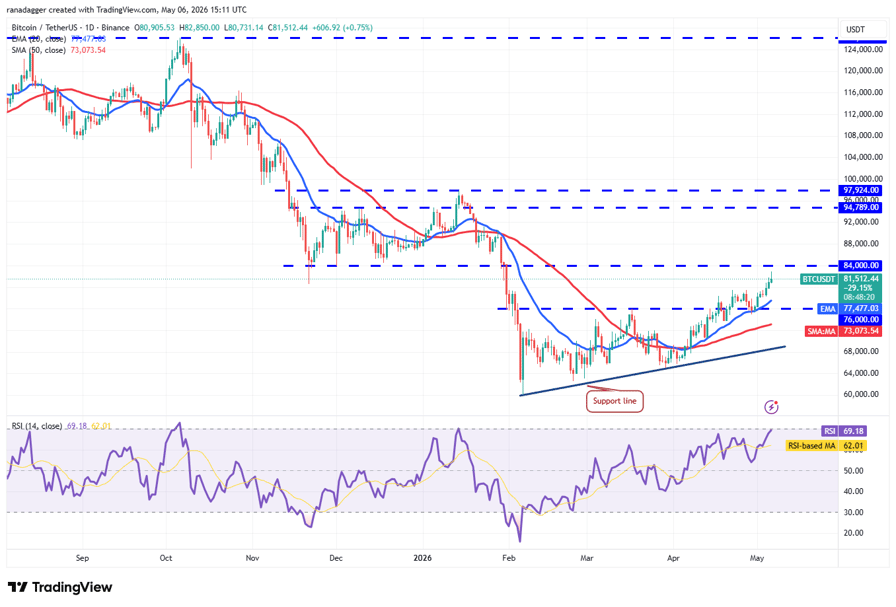
BTC/USDT daily chart. Source: Cointelegraph/TradingView
Sellers are expected to fiercely defend the $84,000 level, which could trigger a pullback toward the 20-day exponential moving average ($77,477). If the BTC price rebounds off the 20-day EMA with force, it signals a positive sentiment. That improves the prospects of a break above the $84,000 level. If that happens, the BTC/USDT pair may ascend to $92,000.
This bullish view will be invalidated in the near term if the price turns down and breaks below the $74,937 level. The pair may then decline to the 50-day SMA ($73,073) and later to the support line.
Ether price prediction
Ether (ETH) has been trading above its moving averages, but the bulls have failed to break $2,465 resistance.
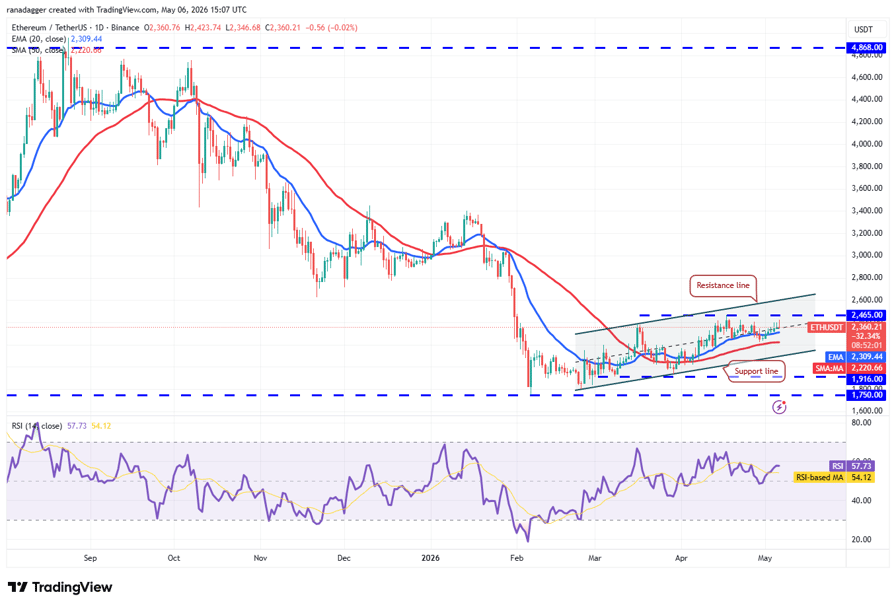
ETH/USDT daily chart. Source: Cointelegraph/TradingView
That suggests hesitation to buy aggressively at higher levels. Sellers will attempt to seize control by pulling the price below the moving averages. If they do that, the ETH/USDT pair may descend to the support line.
Buyers are likely to have other plans. They will attempt to maintain the ETH price above the 20-day EMA ($2,309) and overcome the resistance at that level. If they succeed, the pair may rally to $3,050.
XRP price prediction
XRP (XRP) closed above the moving averages on Tuesday, opening the gates for a rally to the downtrend line of the descending channel pattern.
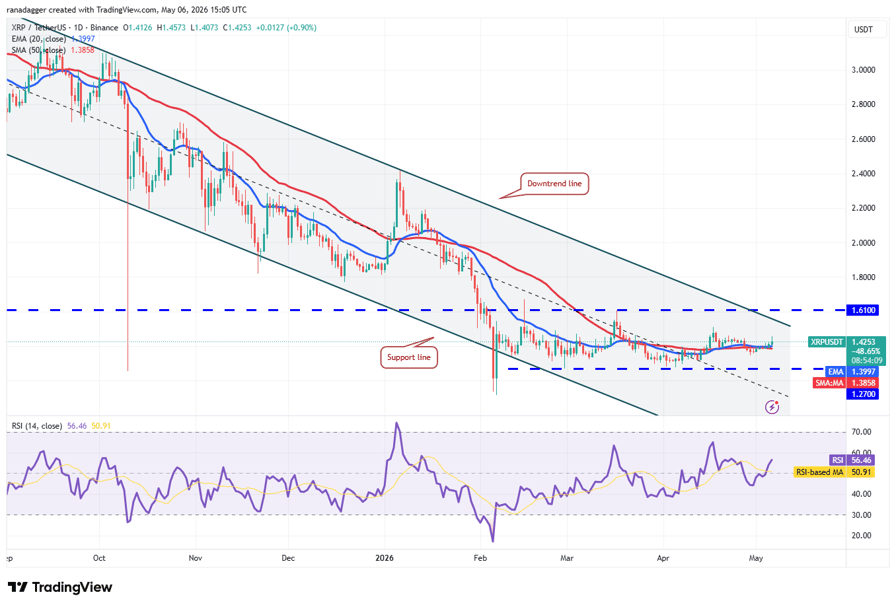
XRP/USDT daily chart. Source: Cointelegraph/TradingView
The downtrend line has acted as a stiff obstacle during previous recovery attempts and may do so again. If the price reverses from the downtrend line and breaks below the $1.27 level, it suggests the XRP/USDT pair may remain within the channel for a few more days.
On the other hand, a close above the downtrend line and the $1.61 resistance signal a potential trend change. The XRP price may then skyrocket to $2 and then to $2.40.
BNB price prediction
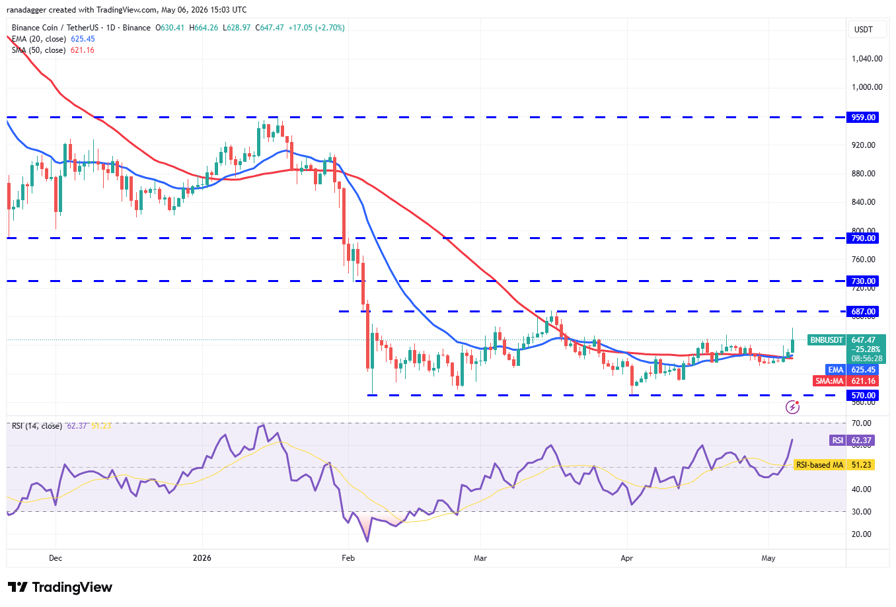
BNB (BNB) closed above the moving averages on Tuesday, indicating that the bulls are back in the game.
BNB/USDT daily chart. Source: Cointelegraph/TradingView
Buyers are attempting to overcome the minor resistance at $654. If they can pull it off, the BNB/USDT pair may reach $687. Sellers are expected to defend the $687 level with all their might, as a close above it could clear the path for a rally to $730 and, subsequently, to $790.
Conversely, if the BNB price turns sharply lower from the overhead resistance and breaks below the moving averages, it signals that the pair may continue its range-bound action between $570 and $687 for some time.
Solana price prediction
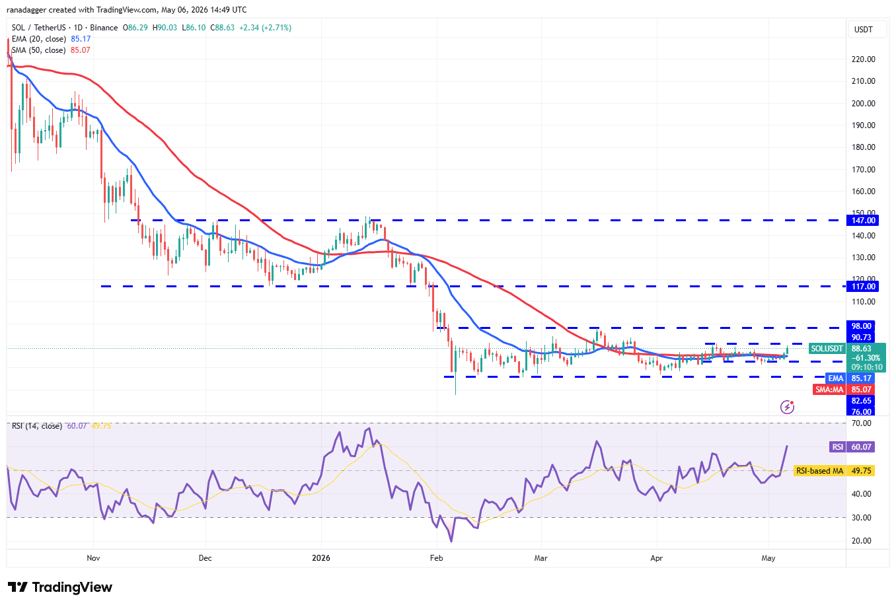
Solana (SOL) broke above the moving averages on Tuesday and rallied close to the $90.73 overhead resistance on Wednesday.
SOL/USDT daily chart. Source: Cointelegraph/TradingView
The flattish moving averages and the RSI in the positive territory indicate a slight edge to the bulls. If the $90.73 level is scaled, the SOL/USDT pair may rally to the stiff overhead resistance at $98. Sellers are expected to vigorously defend the $98 level, as a close above it may propel the SOL price to $117.
Instead, if the price turns down and breaks below the moving averages, it suggests the pair may remain within the $76 to $98 range for a few more days.
Dogecoin price prediction
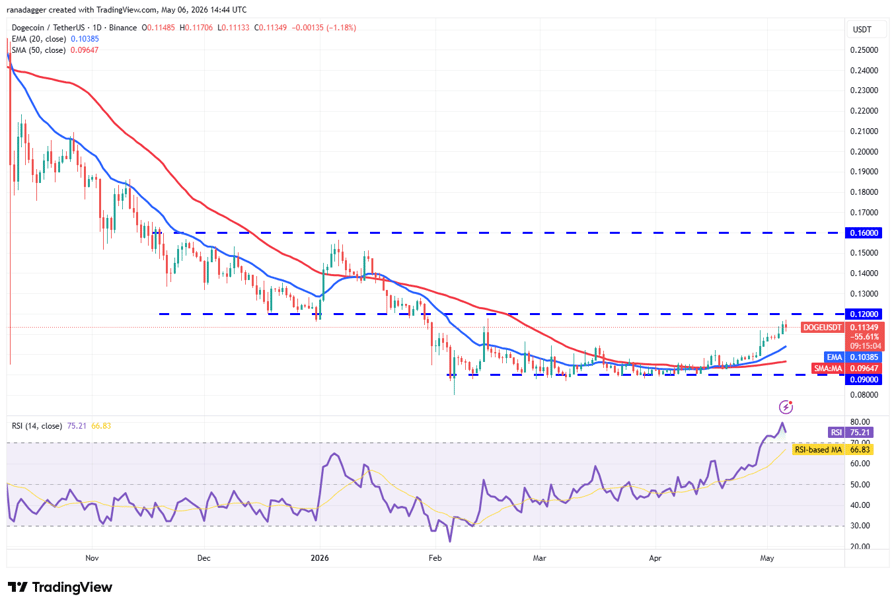
Dogecoin (DOGE) continued its march toward the $0.12 resistance level, where sellers are expected to step in.
DOGE/USDT daily chart. Source: Cointelegraph/TradingView
A shallow pullback from the $0.12 level suggests that the bulls are not hurrying to close their positions. That increases the possibility of an upside breakout. If the $0.12 resistance level is broken, the DOGE/USDT pair may jump to $0.14 and then to $0.16.
Alternatively, if the DOGE price turns sharply lower and breaks below the 20-day EMA ($0.10), it suggests that bears are aggressively defending the $0.12 level. That may retain the pair inside the $0.09 to $0.12 range for a while.
Hyperliquid price prediction
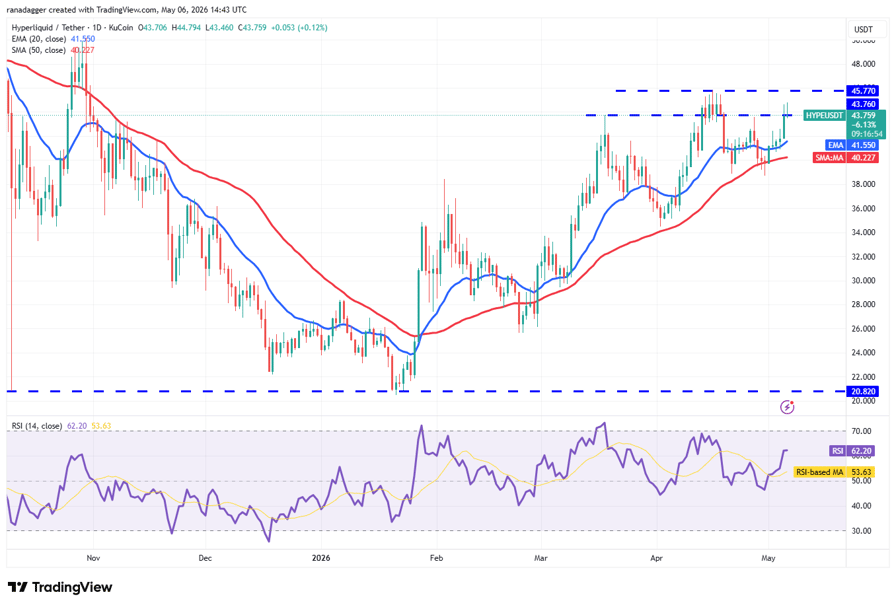
Hyperliquid (HYPE) charged higher on Tuesday, but the up move is facing resistance in the $43.76 to $45.77 zone.
HYPE/USDT daily chart. Source: Cointelegraph/TradingView
The 20-day EMA ($41.55) has started to turn higher, and the RSI is in positive territory, indicating that the path of least resistance is higher. If buyers pierce the $45.77 level, the HYPE/USDT pair may soar to $50.
The 50-day SMA ($40.22) is the critical support to watch out for on the downside. A break and close below the 50-day SMA suggests that the bulls have given up. The HYPE price may then tumble to $34.45.
Related: Zcash price may hit $800 as $2.7B hedge fund reveals ‘significant position’ in ZEC
Cardano price prediction
Cardano (ADA) cleared the 50-day SMA ($0.25) hurdle on Tuesday, indicating that the bulls are attempting a comeback.
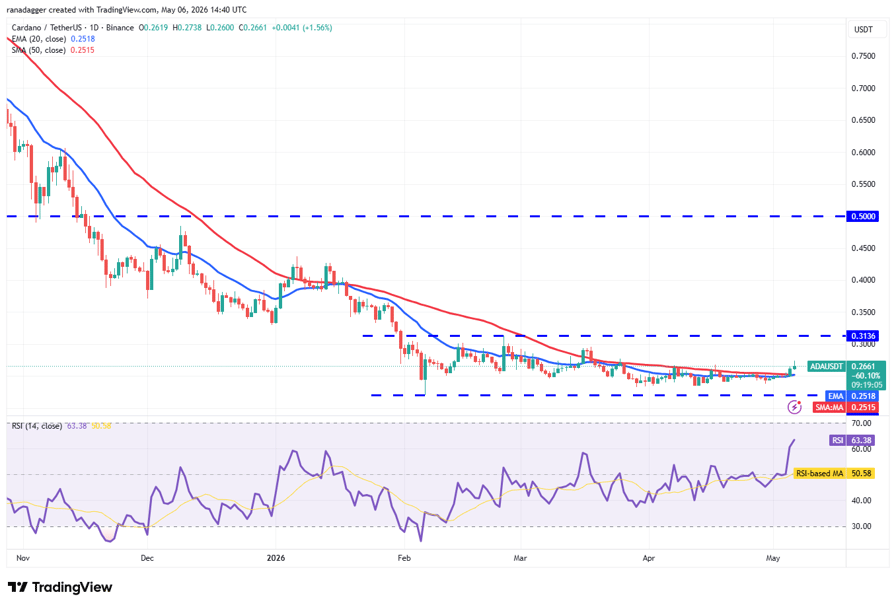
ADA/USDT daily chart. Source: Cointelegraph/TradingView
The recovery attempt is expected to face selling pressure at $0.28, then at $0.30. If both levels are breached, the next target is likely $0.31, a critical resistance to watch. A break above $0.31 signals the start of a potential new up move.
This positive view will be negated in the near term if the ADA price turns down and breaks below the moving averages. That suggests the bears continue to sell on rallies. The ADA/USDT pair may then slump to the solid support at $0.22.
Bitcoin Cash price prediction
Bitcoin Cash (BCH) turned up from the $443 support on Tuesday and broke above the moving averages.
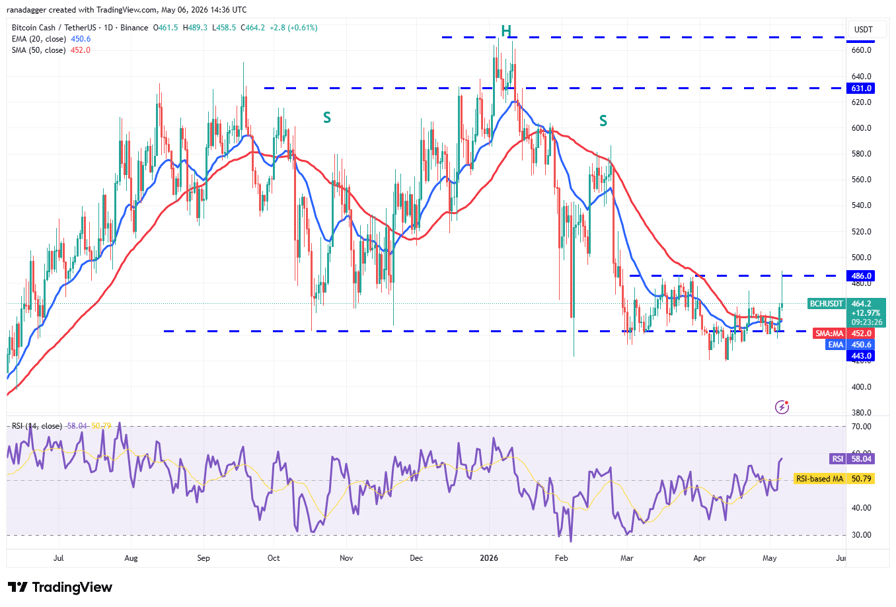
BCH/USDT daily chart. Source: Cointelegraph/TradingView
Buyers continued their buying and pushed the BCH price to $486 on Wednesday. However, the long wick on the candlestick shows that the bears are active at higher levels. That suggests the BCH/USDT pair may remain inside the large $486 to $419 range for a few more days.
Buyers will be back in the driver’s seat if they push the price above the $486 resistance and sustain it. That opens the gates for a rally to $520.
Zcash price prediction
Zcash (ZEC) turned up from the 20-day EMA ($389) on Thursday and rose above the $560 resistance on Wednesday.
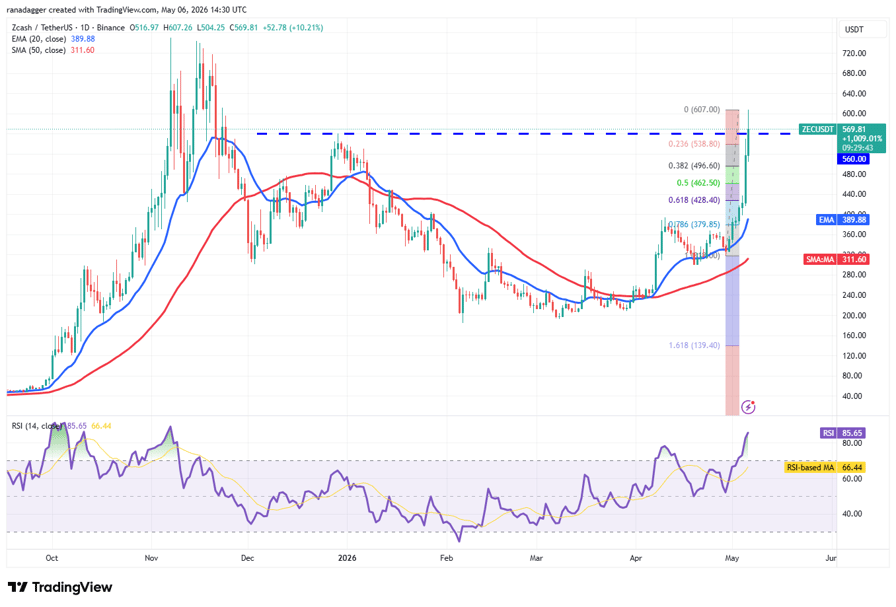
ZEC/USDT daily chart. Source: Cointelegraph/TradingView
The sharp rally over the past few days has pushed the RSI into overbought territory, signaling the possibility of a near-term consolidation or pullback. A shallow pullback from the current level suggests that the bulls are holding their positions as they anticipate the uptrend continuing. That increases the likelihood of a rally to the formidable resistance at $750.
A risk to the continuation of the up move is that sharp rallies are followed by equally sharp pullbacks. If the ZEC price maintains below $560, the ZEC/USDT pair may drop to the 38.2% Fibonacci retracement level of $496 and then to the 50% retracement level of $462.
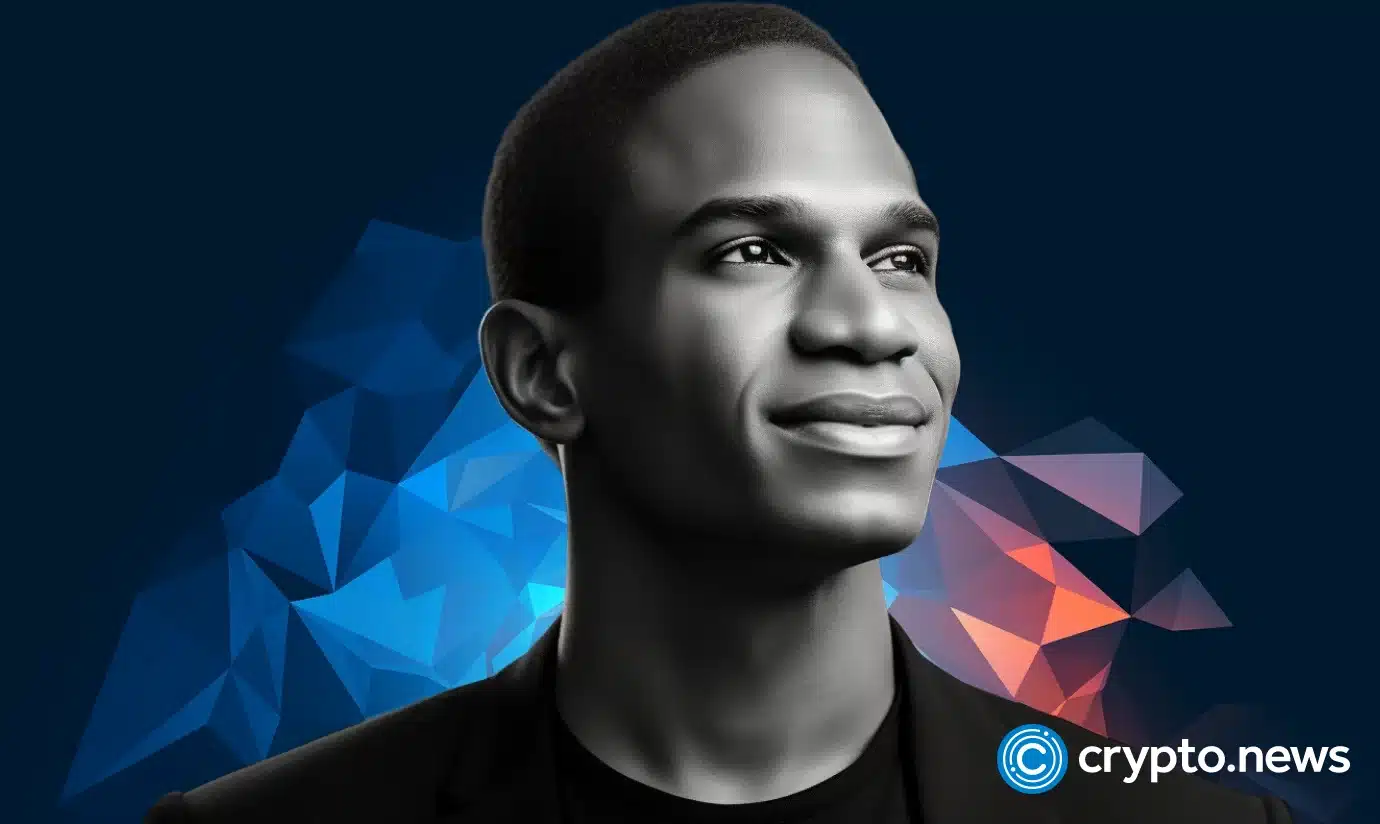
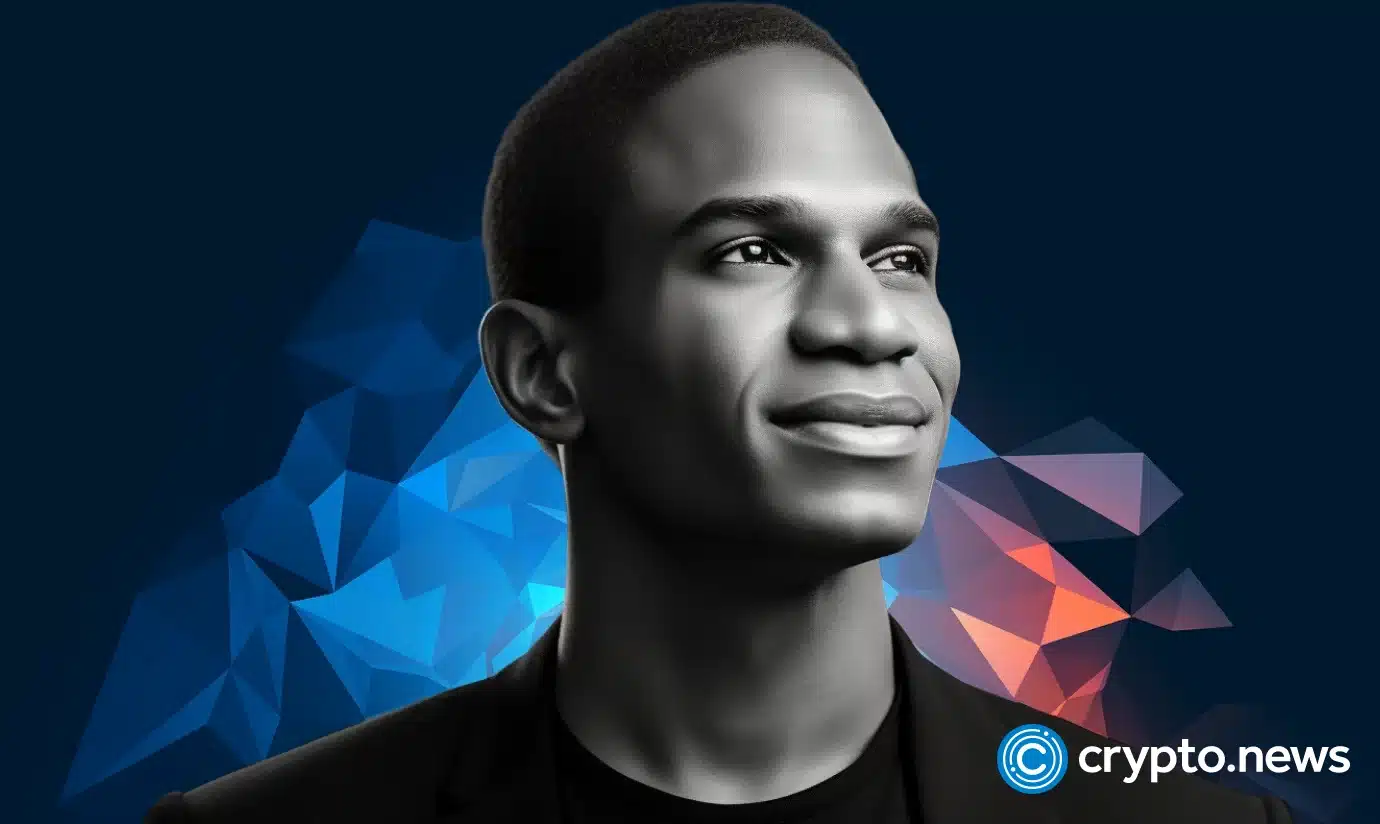
BitMEX co-founder Arthur Hayes says his target for Zcash is 10% of Bitcoin’s price, arguing ZEC’s latest rally is early innings despite mounting pressure on privacy coins.
Summary
- BitMEX co-founder Arthur Hayes said his upside target for Zcash (ZEC) is 10% of Bitcoin’s price.
- Hayes argued on X that ZEC’s current rally “still has a lot of room for growth.”
- The call comes as privacy coins remain under regulatory pressure but periodically see sharp speculative moves.
BitMEX co-founder Arthur Hayes has set an aggressive upside target for privacy coin Zcash, telling followers on X that his “target price for ZEC is 10% of the BTC price.” In the same post, Hayes added that the current uptrend “still has a lot of room for growth,” signaling he believes the recent move in ZEC is just the early phase of a larger cycle.
While Hayes did not publish a full valuation model alongside the remark, the 10% anchor implies a substantial potential upside relative to current market levels. If Bitcoin were trading at $90,000, for example, a 10% ZEC/BTC ratio would suggest a ZEC price near $9,000; at $70,000 BTC, it would point to about $7,000 per ZEC. For context, Zcash’s all‑time high in late 2016 briefly spiked above $3,000 on thin order books before settling into a range that has mostly been under $1,000 for years.
Hayes has long been known for making bold macro and altcoin calls, frequently using his personal X account and essays to lay out high‑conviction, high‑volatility trades. His latest ZEC comment fits that pattern, leaning into a narrative that privacy‑focused assets could see renewed demand if regulatory surveillance ramps up or if Bitcoin’s transparent ledger becomes a liability for certain users.
The timing is notable. Privacy coins like Zcash and Monero have faced delistings on several major centralized exchanges in recent years amid anti‑money‑laundering scrutiny, even as on‑chain usage has persisted in more niche venues. That regulatory overhang makes sustained institutional inflows into ZEC less likely in the near term, but it has not stopped sharp, speculative spikes whenever market sentiment swings back toward high‑beta plays.
Hayes’s 10% of BTC target is not a consensus view among analysts, and he did not specify a timeframe for when he expects ZEC to reach that level. But for traders who track his calls, the message is clear: in his view, the current ZEC move is far from exhausted, and the coin’s upside, relative to Bitcoin, remains significant if the right mix of narrative, liquidity, and risk appetite comes together.

Michelle Wie West is back. Here’s how she prepped her game

The Grind That Opened an Unpickable Works by Design NPX-002 Lock

Illegal POWER OF MONEY in Bollywood – Karan Johar Exposes Paid PR #shorts

Manchester United reach agreement with Casemiro over contract clause amid transfer speculation

US brings back mandatory military draft registration

Steven Gerrard disagrees with Gary Neville over ‘shock’ Chelsea and Arsenal claim | Football


-
 Business7 days ago
Tesla Officially Registers Elon Musk’s Stock: What Investors Need to Know
-

 NewsBeat3 days ago
Channel 5 – All Creatures Great and Small series 7 new post
-

 Entertainment7 days ago
Insider Claims Reason Behind Key & Peele Split
-
 Tech5 days ago
Trump’s 25% EU auto tariff breaches Turnberry Agreement that also covers semiconductors and digital trade
-
 Sports5 days ago
Paul Scholes issues Marcus Rashford reality check as agreement emerges over Man United star
-

 Entertainment5 days ago
Met Gala 2026 Rumored Guest List Is Turning Heads
-

 Entertainment7 days ago
Celebrities Who Are Attending the 2026 Met Gala Event
-

 Business5 days ago
Strait of Hormuz Blockade Persists Amid US-Iran Standoff, Sending Oil Prices Soaring
-
Entertainment5 days ago
New on Prime Video in May 2026 — Full List of Movies and Shows
-

 Sports5 days ago
Cavaliers vs. Raptors Game 6 live score, updates, highlights from 2026 NBA playoffs first-round series
-
 Sports5 days ago
David Benavidez responds to team Canelo saying the fight will never happen
-

 Crypto World7 days ago
Meta (META) starts stablecoin payout to creators in Circle’s USDC on Polygon, Solana via Stripe
-
Business7 days ago
Strait of Hormuz Remains Heavily Restricted on April 29 Amid Iran Conflict
-
 Sports5 days ago
IPL 2026: ‘Love you darling’- Hardik Pandya’s reaction to MS Dhoni steals the show |Watch | Cricket News
-

 Sports7 days ago
Saudi Arabia set to withdraw LIV Golf funding after 2026 season, per reports
-

 Entertainment5 days ago
Kylie Jenner Hit With Second Lawsuit From Ex-Housekeeper
-

 Entertainment5 days ago
Young and the Restless Next Week: Cane Arrested & Matt’s Deadly New Scheme!
-

 Tech7 days ago
Mark Zuckerberg Says Meta Is Working On AI Agents For Personal And Business Use
-

 Sports5 days ago
Plane crash in Wimberley, Texas kills 5 pickleball players at tournament
-

 Tech5 days ago
Meta ends Sama contract after Kenyan workers report seeing intimate footage from Ray-Ban smart glasses users
You must be logged in to post a comment Login