

Tech
ForkLift Download – 4.6.2 | TechSpot

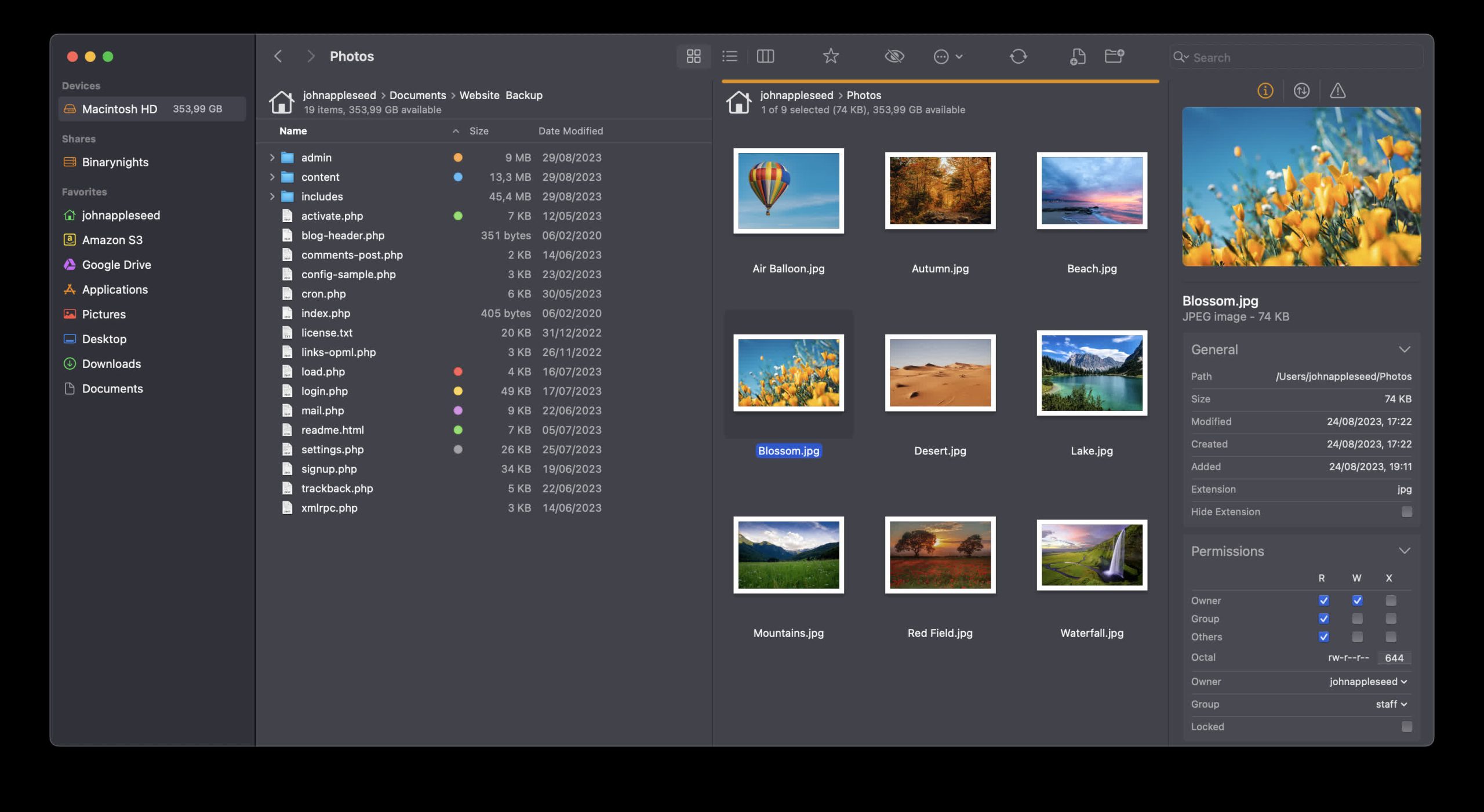
ForkLift combines the power of a robust file manager with versatile file transfer capabilities, seamlessly bridging the gap between your local and remote files. Whether you’re dealing with cloud services or more traditional FTP and SFTP servers, ForkLift streamlines your file management and transfers, making them smoother than ever.
ForkLift 4 is your all-in-one solution for efficient file management and seamless file transfers, across multiple platforms and services.
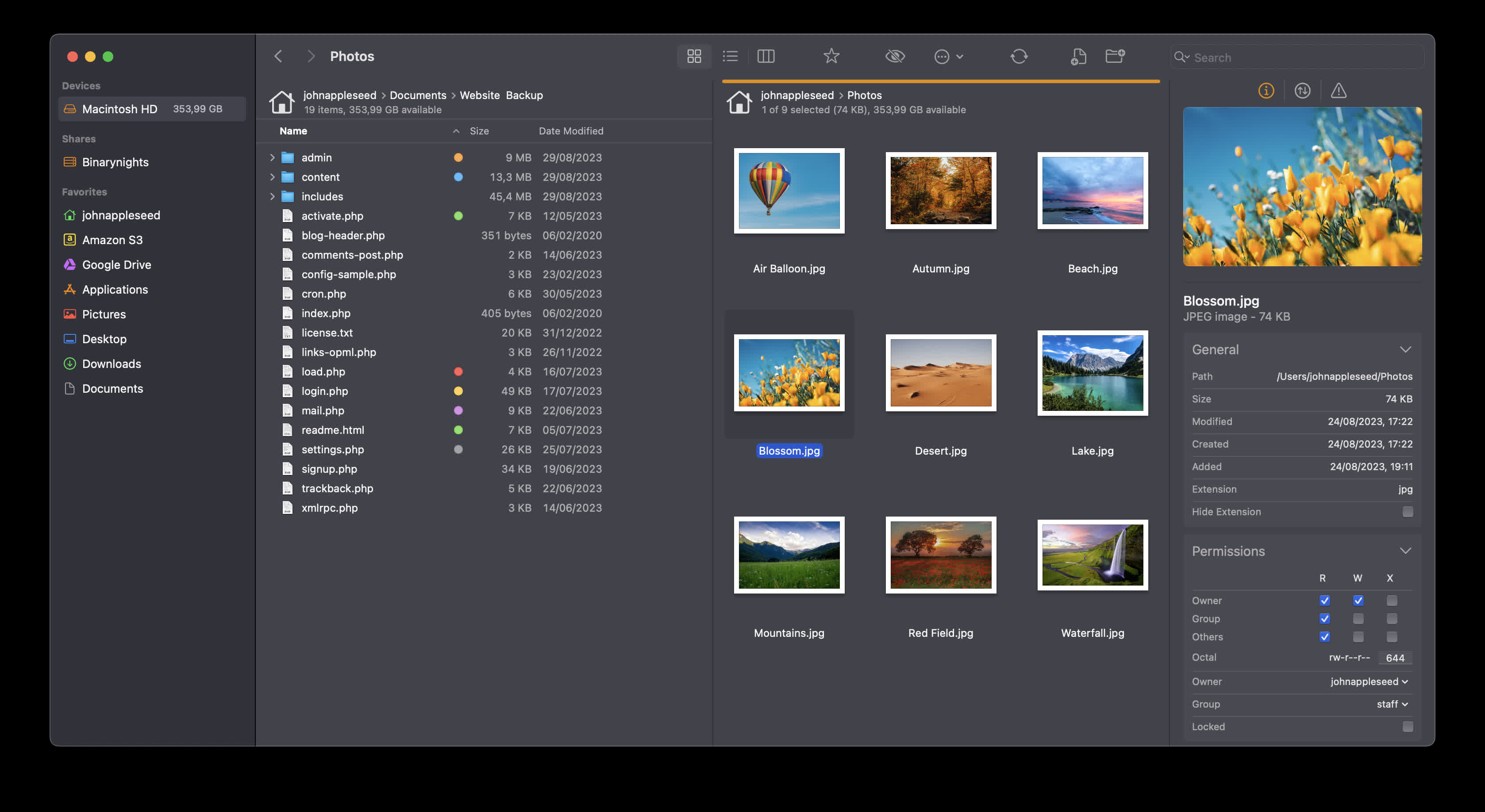
We understand that accessing, organizing, synchronizing, and sharing your files should be hassle-free, especially as the landscape of file sharing evolves with the increasing importance of cloud service providers such as Dropbox, Amazon S3, Google Drive, and OneDrive.
Is ForkLift worth it compared to alternatives like Finder or Nimble Commander?
Many users appreciate its dual-pane layout, batch operations, archives support, and advanced sync features. Compared to rivals, ForkLift offers better transfer management and preview behavior. Still, some feel the interface isn’t as lightweight or intuitive as others.
Is it easy to switch from Finder to ForkLift as the default file manager?
Yes. By running a simple defaults write -g NSFileViewer -string com.binarynights.ForkLift command in Terminal, you can set ForkLift as the system default for opening folders.
Which protocols can I connect to ForkLift?
ForkLift will connect to any remote server such as SFTP, FTP, WebDav, Amazon S3, Backblaze B2, Google Drive, OneDrive, Dropbox, Rackspace Cloudfiles, SMB, AFP, and NFS remote volumes. You can manage your files and connect to multiple servers at a time and even copy between them with drag and drop.
Is ForkLift free?
You can download a time limited trial of ForkLift, but you will need to buy a license in order to keep using it.
Features
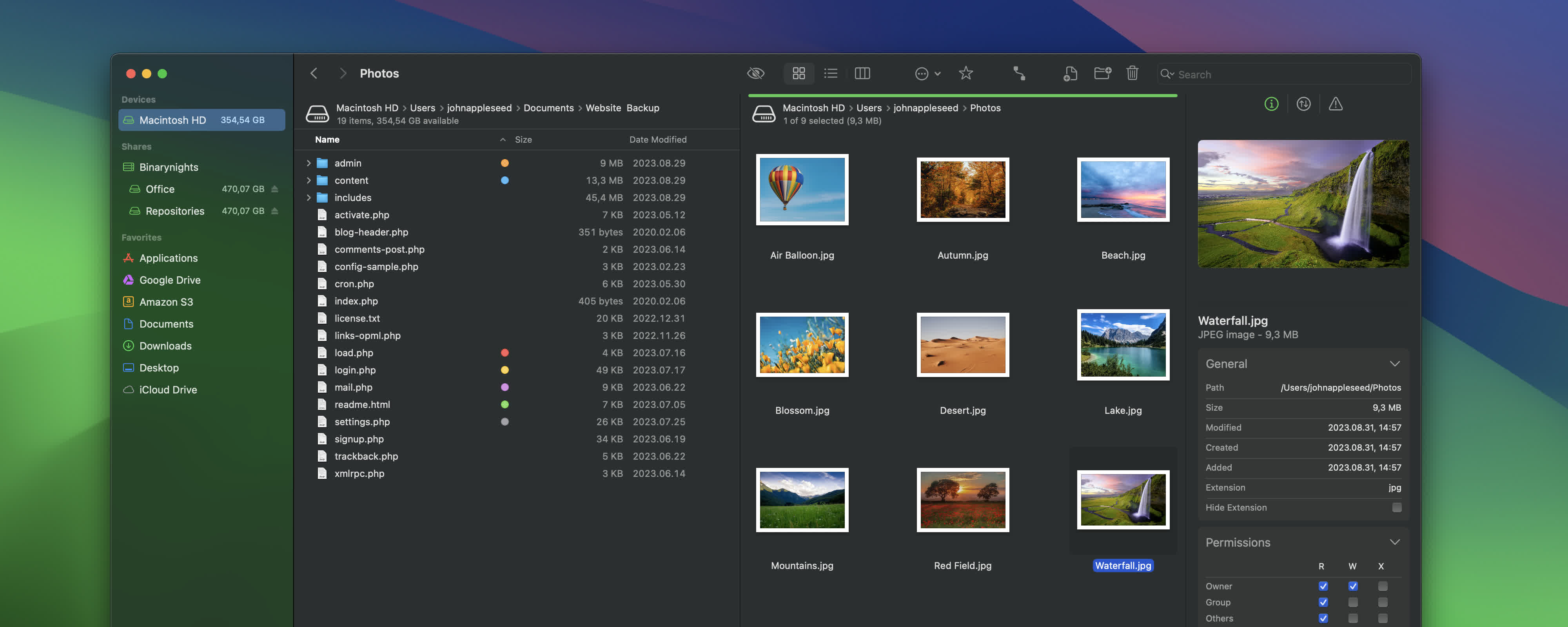
Remote Connections
Connect to SFTP, FTP, WebDav, Amazon S3, Backblaze B2, Google Drive, OneDrive, Dropbox, Rackspace Cloudfiles, SMB, AFP, and NFS remote volumes. Manage your files efficiently across networks: connect to multiple servers simultaneously and even copy between them with drag and drop.
Sync
Compare local or remote source and target folders identifying matching, modified, new and deleted files. Synchronize them one or two-way with a single mouseclick, or save it as a favorite.
Up to 20x faster analyzation than ForkLift 3.
Favorite Paths
Experience enhanced efficiency for remote destinations. Think of it like having favorites within favorites – an organized way to keep track of paths you frequently use and want quick access to.
Preview
The preview panel shows you useful information about the selected file. Playback audio and video files, inspect images, PDFs and other popular document types. Quick edit text files in place, both on local drives and remote servers.
Activity View
Whether you’re copying, renaming, deleting, compressing, or handling other tasks, this feature lets you see exactly what’s going on. No more guesswork – watch your tasks progress in real-time and stay in control of your file management action.
Quick Open
Easily access your favorites, devices, menu commands, open a selected file with a preferred application, or apply a previously saved Multi Rename preset on selected files or folders.
Log View
Get valuable insights into your file management activities and their results, all in one easy-to-access place.
Favorite Sync
ForkLift will keep all your favorites synchronized across multiple computers via iCloud.
Dropbox Support
Copying Dropbox links to files located in your Dropbox directory is just a right-click away.
Transfers
Reorder transfers, set conflict management rules, error handling, limit download and upload bandwidth.
Tags
Organize your documents and files with tags: add, edit, remove, search, or filter them within ForkLift.
Sync Browsing
Given two identical folder structures. Browse in one pane and let ForkLift do the job for you in the other pane.
Tabs
Open different folders in the same pane, instead of separate windows.
Search
Search and filter by name, extension, kind, tags or content, even on remote servers.
Quick Select
Select files by typing a filename, an extension, or a tag and add them or exclude them from the selection.
Remote Editing
Set your preferred editor in ForkLift to edit remote files and we take care of uploading your changes as you save.
Command Line Tools
Extend ForkLift’s capabilities to the max by invoking command line tools and apply them by using shortcuts.
Themes
A seamless way to personalize your interface. Choose from predefined themes that suit your taste, or let your creativity shine by crafting your very own themes.
App Deleter
ForkLift comes with an application deleter to remove the last morsels of an application you want to uninstall.
iCloud Support
Seamlessly access and manage your iCloud files through ForkLift.
Archive Management
Browse local and remote archives as if they were ordinary folders. You can even Quick Look, search and filter.
Keyboard Control
Control every operation straight from the keyboard and customize it to your preferences.
Multilingual
ForkLift speaks English, German and Hungarian. More languages are coming soon!
Workspaces
Save different layouts with opened tabs and locations and load what you need at the moment.
Git Support
ForkLift knows git and will show you the status of individual files. You can add, commit, push, and pull.
Open in Terminal
An absolute must for powerusers. Open a Terminal, iTerm, Hyper, Kitty or Warp window at your current local path.
Hidden Files
Make hidden files and folders visible easily by using a shortcut or pressing a button in the toolbar.
Share
Share gives you an easy way to share all kinds of documents and other files instantly.
Default File Viewer
Set ForkLift as the default file viewer and almost every app will point to ForkLift instead of Finder.
File Compare
Compare two text or images files with Xcode’s FileMerge, Kaleiodoscope, Beyond Compare, or Araxis Merge.
What’s New
External Drive Tags, comments, and Checksum Improvements
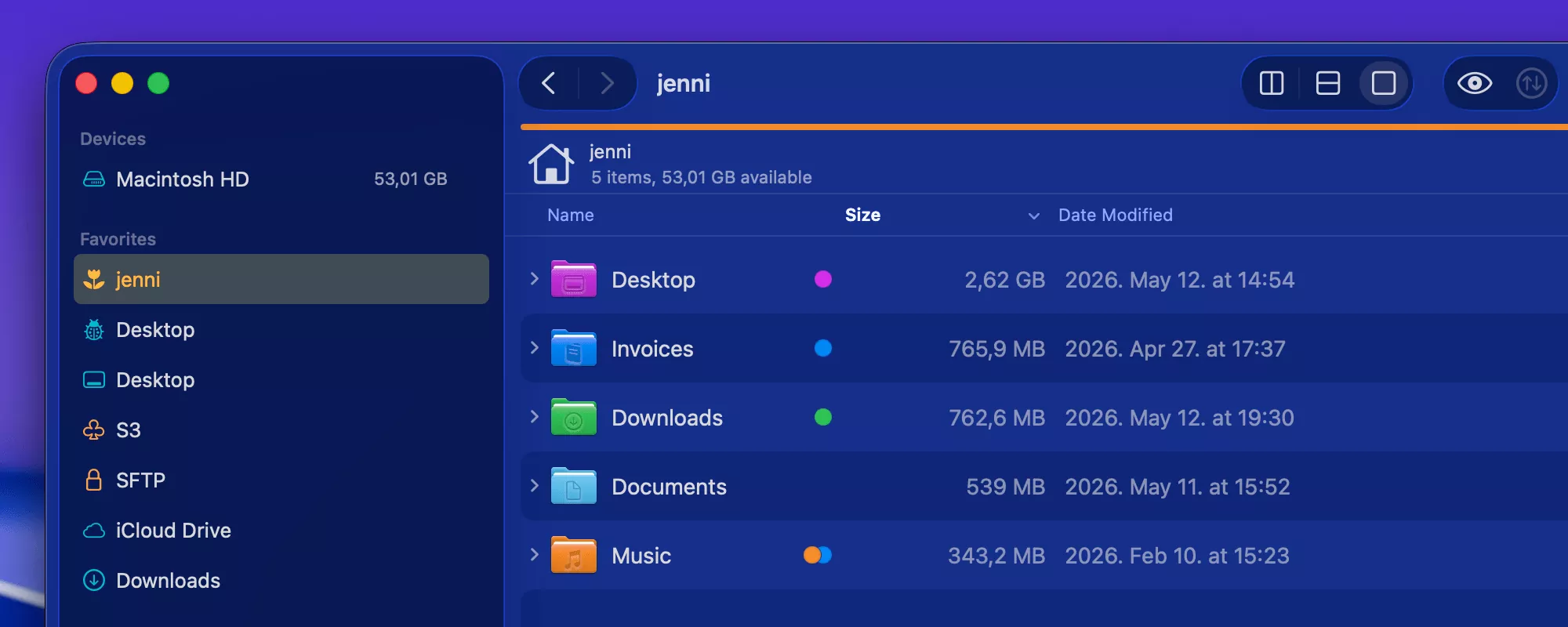
We recently introduced the ability to calculate checksums for files, making it easier to verify that files have not been altered or corrupted during transfers and that two files are truly identical. Checksums can be calculated for multiple files at the same time, with the file names and checksums displayed in a dedicated window.
In ForkLift 4.6.2, we improved the usability of the Checksum Window by adding support for selecting multiple items at once. You can now easily copy selected items or use Command-A and Command-C to copy all entries. The copied content is exported in CSV format, making it easy to paste into spreadsheet applications such as Microsoft Excel or Apple Numbers.
Changes to the Preview API on macOS Sequoia and Tahoe
In version 4.6.1, we introduced a new Preview API to support the new style of folder icon previews. Unfortunately, this API currently has several limitations that cannot be addressed by us directly. We have reported these issues to Apple and hope they will be resolved in future macOS updates.
The new style folder icons are only available on macOS Tahoe, so in ForkLift 4.6.2 we have disabled the new Preview API for users on macOS Sequoia because it caused multiple issues with icon previews on that version of macOS. As a result, users on macOS Sequoia will no longer experience the negative side effects of the new API.
Users on macOS Tahoe will continue using the new API and will still be able to see colored folders and icons added to folders in Finder. However, the API currently does not correctly handle certain folder icon customizations made in System Settings, which means some custom folder appearances may not be represented accurately in ForkLift. Unfortunately, this limitation is outside of our control.
We have also fixed a possible crash introduced in the previous version, along with several other possible crashes and hangs, and some other fixes and improvements.
Full List of changes:
Improvements
- Displays tags on external drives
- Comments added in ForkLift now show up in Finder as well
- Adds an option to select multiple items in the Checksum Window; the copied list is in CSV format, so it can be easily pasted into spreadsheet applications
- Adds “Edit” and “Hide from Sidebar” options to the context menu of Sync favorites in the Sidebar
Fixes
- Fixes an issue with the movement of favorites in the sidebar that pointed to the same server
- Fixes a possible hang caused by recent items in the sidebar
- Fixes a possible crash in List View
- Displays a folder icon on remote locations when the folder name contains a dot
- Displays the Kind of folders correctly when the folder name contains a dot
- Fixes an issue that made it impossible to delete the last remaining digit from the Time Offset Correction field in the Sync Window
- Fixes a possible hang after a tab or window was closed during an unfinished search operation
- Fixes a possible hang after a tab or window was closed during an unfinished search operation
- Removes the new Preview API on macOS Sequoia introduced in version 4.6.1 due to several issues with icon previews
Previous Release Notes:
ForkLift 4.6.1 is available – Tahoe folder colors, improved memory usage, and restored PDF preview
Folder icon support on macOS Tahoe and performance improvements
Finder on macOS Tahoe introduced a big change by allowing users to customize folder icons. The last applied color tag now determines the folder color, and it is also possible to add icons to folders to make them stand out.
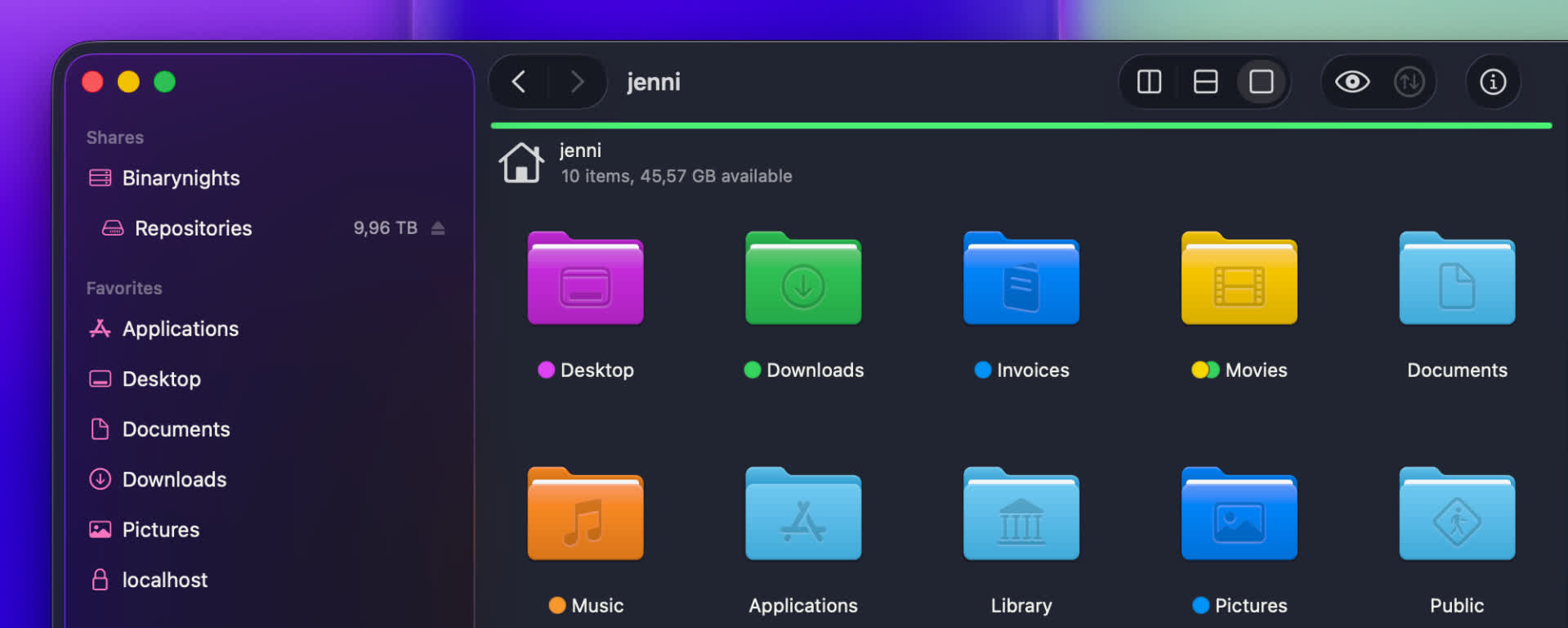
With ForkLift 4.6.1, we have updated how folder icons are handled. ForkLift now inherits folder colors from Finder, and when you assign a color tag in ForkLift, the folder color updates accordingly. ForkLift also displays custom icons that were added in Finder. However, due to missing system APIs, adding custom folder icons directly in ForkLift is not possible at this time.
We have also fixed multiple possible memory leaks and improved overall memory usage. This results in a more stable and efficient experience.
PDF preview fixes and iCloud tag improvements
In addition, this version includes several smaller improvements. You can now edit file favorites directly from the sidebar, use the Tab key to autocomplete tags more reliably, and benefit from improved information display in the Status bar and in the Preview pane.
We were also able to restore the full functionality of the PDF viewer in the Preview pane. It is now again possible to customize preview options through the right-click context menu, and text selection inside PDF previews has been re-enabled.
It is now also possible to remove the last remaining tag on iCloud Drive, and we have resolved an issue where pressing the Tab key during tag autocompletion could cause the tag to disappear.
New
- ForkLift now colorizes folder icons on macOS Tahoe the same way as Finder, inheriting and applying the assigned colors
- ForkLift displays customized folder icons set in Finder, however, customizing folder icons directly in ForkLift is not supported
Improvements
- Improves the display of aggregated date information in the Preview pane when multiple files are selected
- Adds an alert when iCloud Drive is busy and interaction is not possible, to clarify why an action cannot be executed
- Adds an option to edit file favorites from the context menu in the Sidebar
- Improves memory usage
Fixes
- Fixes an issue that made the file view jump in List View after renaming or deleting files when Group by was enabled
- Fixes multiple possible memory leaks
- Fixes an issue that didn’t show the lock icon on locked folders when icon preview is enabled (the lock icon doesn’t show up on files starting from this version)
- Fixes an issue in the Status bar, which didn’t update the displayed info correctly after folders were expanded and collapsed
- Fixes an issue of the preview of PDF file in the Preview Pane introduced in version 4.3.5, which made it impossible to select text inside the preview and to use the right-click context menu to customize the preview options. This version restores the previous functionality
- Fixes an issue that made it impossible to remove the last tag on iCloud Drive when there was only one tag remaining
- Fixes an issue where pressing the Tab key while autocompleting a tag made the tag disappear
Two powerful new features in ForkLift 4.6
Exciting news! ForkLift 4.6 introduces two major features that power users will love, especially those who rely heavily on tags and those who create custom tools.
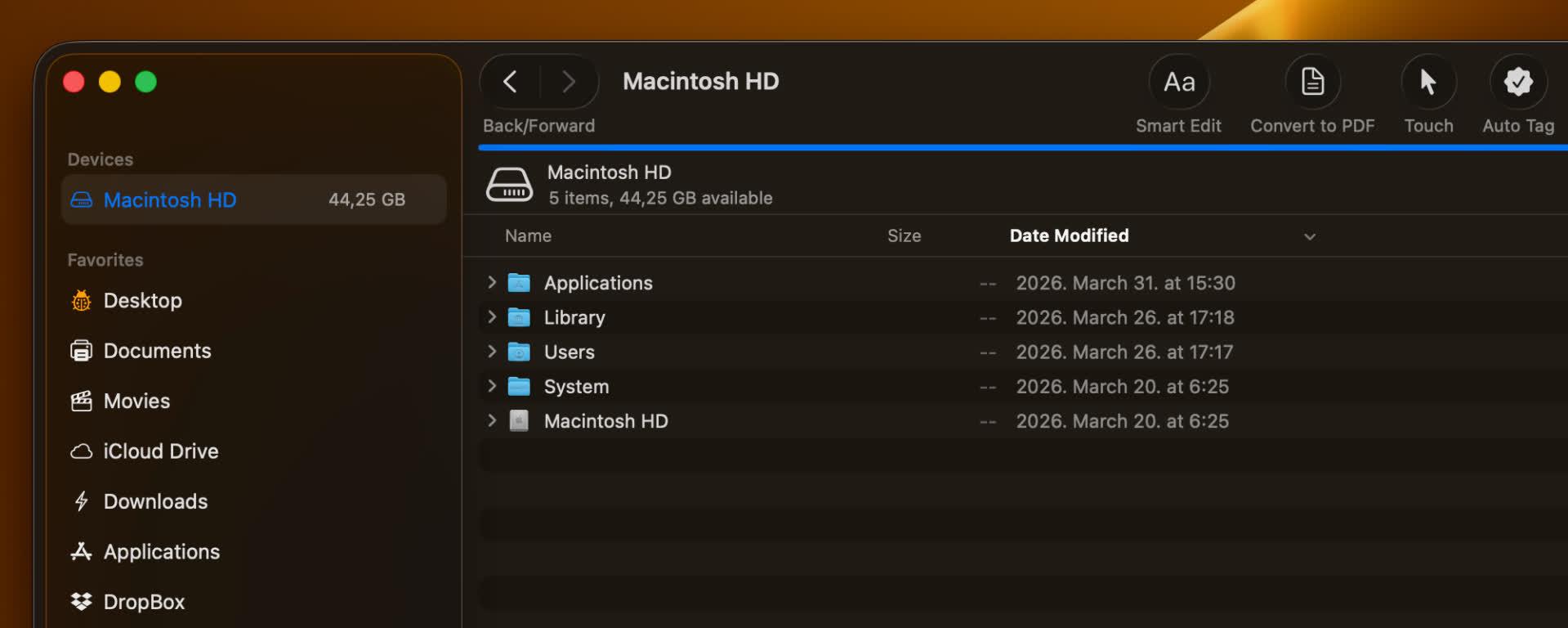
Smarter tagging and autocompletion
The first major improvement in ForkLift 4.6 focuses on tags.
Working with tags in ForkLift has traditionally not been as seamless as in Finder, mainly due to macOS limitations for third-party developers. Unlike Finder, third-party apps cannot access and edit tag data in the same way, which means features like native tag autocompletion are not directly available.
In earlier versions, we introduced the Tags section in the Settings to allow users to add their own tags to the sidebar, making them easily accessible. With ForkLift 4.6, we are expanding this feature and making it more powerful.
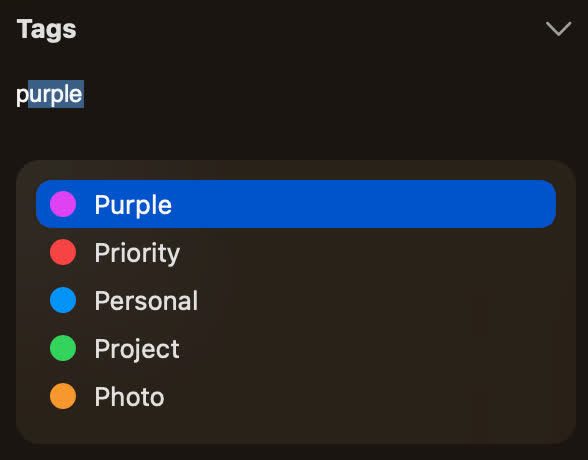
ForkLift now uses the tags listed in the Settings for autocompletion in the Tags section of the Preview Pane or in the info window. As you type, it suggests matching tags from your predefined list.
ForkLift tag autocomplete as you write
To take full advantage of this feature, you should add the tags you use most frequently to the Settings. This ensures they are always available for quick and consistent tagging.
Better control over sidebar tags
Since you may not want to display every tag in the sidebar, we have made it easier to manage their visibility. To hide a tag, right-click it in the Settings and select “Hide from Sidebar”. To show it again, right-click and select “Show in Sidebar”
If you want to manage the visibility of multiple tags at once, it is easier to use the Sidebar Editor. Add the tags you want in the Settings, then close the Settings window. From the menu, select View > Show Sidebar Editor. When the Sidebar Editor appears, you can quickly hide tags by unchecking them. Once you are done, you can close the Sidebar Editor again from the View menu.
This gives you full control over which tags are visible without affecting their availability for autocompletion.
Assign tags directly from the sidebar
The sidebar is now more than just a way to filter files. You can still click a tag to view all associated items, but now you can also assign tags directly from the sidebar:
- Select one or more files or folders
- Drag them onto a tag in the sidebar
- Drop them to assign that tag
This makes tagging faster and more intuitive, especially when working with multiple files.
Improved tag input field
We have also improved the tag input field in the sidebar. Not only does it now include a dropdown to suggest matching tags as you type, but it can also expand to display all assigned tags, making them easier to view and manage. Previously, this field had limited space and could not show all tags at once when working with a large number of tags.
Custom tools, now one click away
The second major improvement focuses on tools.
The Tools feature has always been one of the more powerful, yet somewhat hidden, features of ForkLift. It allows you to create your own tools in the settings using zsh scripts, so you can execute complex actions and workflows more easily.
Previously, these tools could only be executed from the Commands menu, and later they became available in the right-click context menu. Now, we are taking this a step further:
You can add your custom tools directly to the toolbar and execute them with a single click.
Customize your tool icons
When creating or editing a tool, you can assign an icon to represent it both in the Tools section and in the toolbar. By default, new tools use a gear icon, and existing tools are also assigned this icon automatically.
You can easily change it:
- Click the icon in the top-left corner while editing or creating a tool
- Choose a new icon from the pop-up window
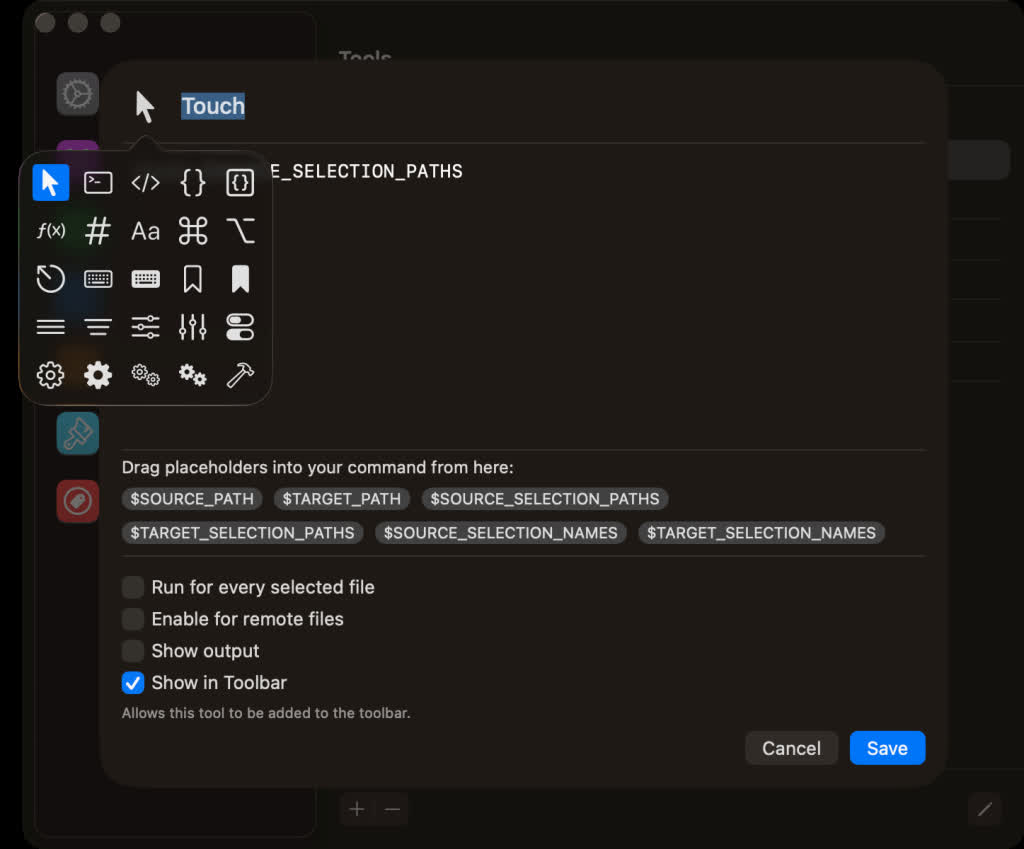
This makes it much easier to visually distinguish your tools at a glance.
How to add tools to the toolbar
Adding your tools to the toolbar is simple, but it happens in two steps:
1. Enable the option
- Go to the Tools tab in the Settings
- While creating or editing a tool, enable “Show in Toolbar”
2. Add it manually to the toolbar
- Right-click the toolbar
- Select “Customize Toolbar…”
- Find your enabled tool in the customization tray
- Drag it into the toolbar
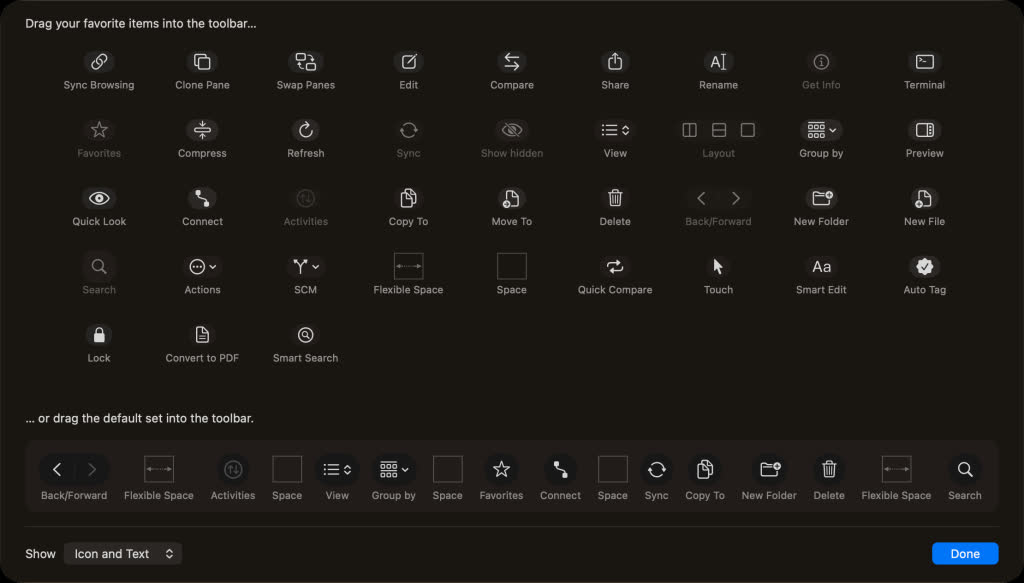
Note: Enabling “Show in Toolbar” does not automatically add the tool, it only makes it available for selection.
Full List of changes
New
- Tags autocompletion feature in the Preview Pane and Info Window based on the list of tags added under ForkLift > Settings > Tags
- Option to assign a tag to a file by dropping a file onto a tag in the sidebar
- Option to add custom tools created under ForkLift > Settings > Tools to the toolbar
- Option to hide and display tags in the sidebar under ForkLift > Settings > Tags through the right-click context menu
Improvements
- Improved expandable Tags field in the Preview Pane, now able to display all tags
- Option to exit the Tags field using the Esc key
- Option to select multiple tools in the Tools section of the Settings
Fixes
- Fixes an issue that indicated it was possible to add remote files as favorites to the sidebar by drag and drop
- Fixes an issue in Column View where, after disconnecting from a remote location, the location did not change back to the starting directory
- Fixes an issue on macOS Tahoe where hitting Esc in the tool editor while adding a new item did not cancel the operation and instead added the new item



Buying a new set of tires first means choosing the brand you want, getting the right size, then having them installed. But some drivers prefer to buy oversized tires, due to a vehicle modification, or just because they like the look. For drivers shopping at Costco, where there are perks for buying tires, they may be out of luck. That’s because Costco tire centers will only install tires that match manufacturer specifications.
Costco cites safety concerns as the reason for this policy, which recommends that customers know what they need beforehand. Not only must the tires be the right size, but they must also have the same or greater Original Equipment (OE) Speed Rating, if existing tires carry a rating. The speed rating of a tire refers to the top speed a tire can safely maintain under specific conditions. Tires also need the same or greater OE Load Index as existing tires as well, which is the maximum amount of weight a tire can support when it’s properly inflated.
Some customers may prefer to install tires themselves, but Costco’s ordering system must still be used. When selecting tires online , users enter the make, model, and trim of their vehicle. Matching sizes offered by available brands are displayed and the purchase price typically includes installation. When tires are shipped to a local Costco Tire Center, a representative will verify that the tires match the vehicle. If there is a mismatch, Costco may not move forward with installation.
The drawbacks of using oversized tires

Using oversized tires can be a stylistic choice that some drivers want, but there are a number of problems that can occur. It begins with perhaps the most important factor: driver safety. Running the wrong size tire can prevent a vehicle from performing as it’s designed to do, which can make for a dangerous situation. This includes braking distance, steering response, and the overall stability of the vehicle.
Then there’s the issue of reduced fuel efficiency, as bigger tires affect MPG. They usually add weight and increase rolling resistance, causing the engine to work harder to keep the vehicle moving. That means more trips to the gas pump, which can get very expensive.
Using oversized tires can also cost drivers more money beyond the pump. That’s because some vehicles require a lift or leveling kit to create the necessary clearance. This can lead to alignment problems, which can cost even more money later on. Larger tires may also require new rims, along with adjustments to systems like the speedometer, or the existing tire pressure monitoring system. Insurance rates can be affected, and vehicle warranty coverage may be impacted if the tires contribute to any claims due to mechanical problems.
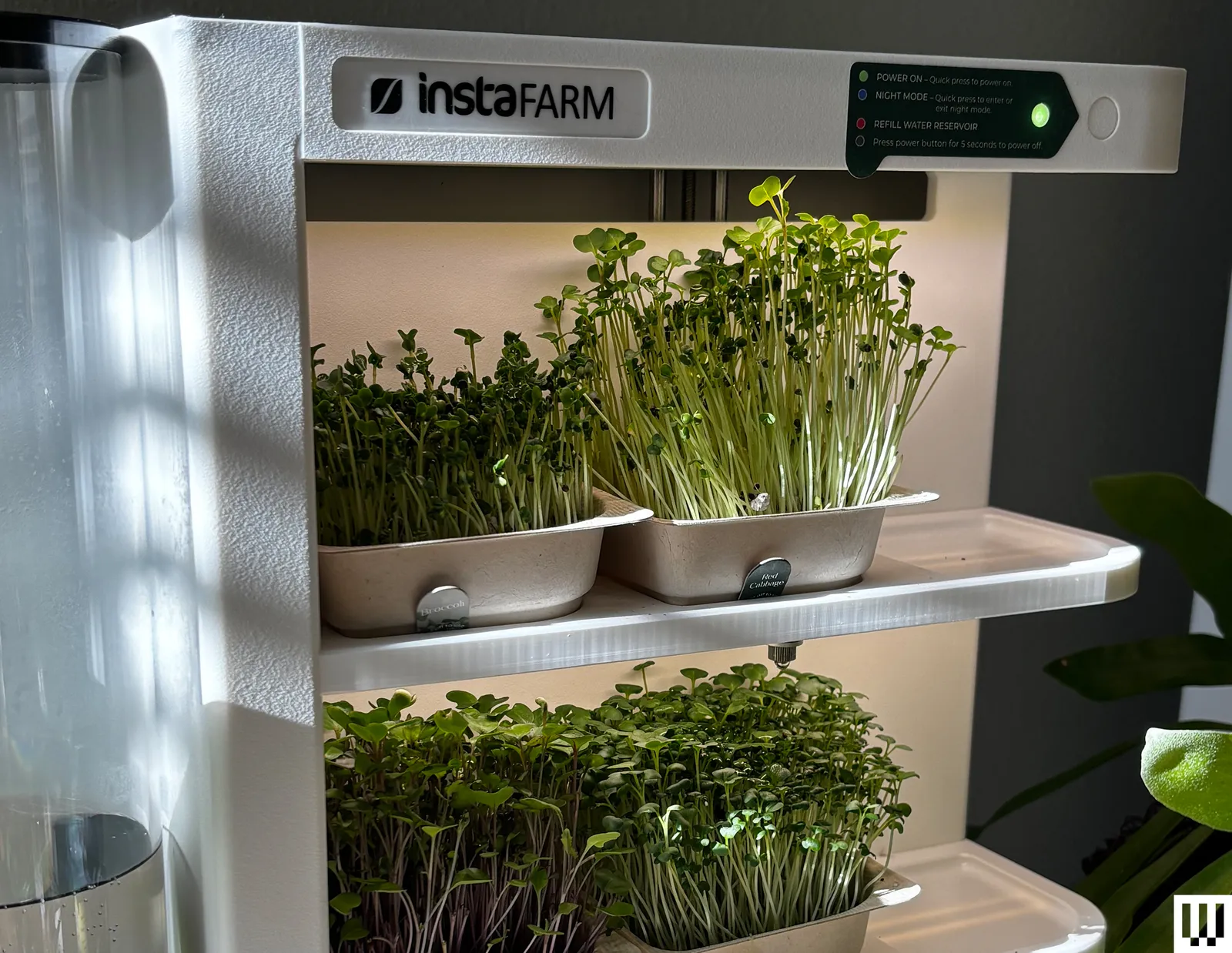
InstaFarm’s patented 4-by-4-inch compostable trays come pre-filled with about a half-inch of soil (“sourced from Amish Country in Pennsylvania,” according to InstaFarm) and organic, non-GMO seeds, with the nutritional info for the final-product microgreens listed on top. They come in over a dozen varieties of nine-packs for $23, including individual cultivars, smoothie- and salad-specific blends, and even plain trays for growing your own greens or garden starts. It is worth noting that the trays are easily saturated paperboard designed for one-time use.
For comparison, Vego’s hydroponic microgreens planter, which I used last year, is just $60 for two units, while Gardyn’s is $100. Neither produces a volume of greens anywhere close to the InstaFarm, but again, $500 can buy a lot of store-bought microgreens.
InstaFarm has an app, but it doesn’t add much to the experience, other than the ability to activate night mode (which then turns off the light for up to 10 hours). More helpful is the button on the top of the unit that comes with a sticker describing how many presses are required for any function you’d need.
Every 90 minutes, a metal nozzle arm pops out and moves along each shelf, sensing each tray and its plants’ height, humidity, and temperature. Once the nozzle is done sensing, it dispenses an appropriate blast of water, much like the spray heads in the produce section of the grocery store. If you have cats, they may be very interested the first time they hear the nozzle whirring and moving slowly over the shelves. (The first quick, unexpected spray was an entertaining event in my house.) Sometimes, this sensing was more accurate in theory than in practice—for some reason, the sensor consistently overshot the watering volume for the red beet greens (but only the beet greens), causing the tray to overflow daily.
After a few weeks, I noticed the nozzle making a slight mechanical noise once it finished its rounds, as it slowly retracted back to its resting position. It wasn’t loud—it reminded me of the sound the bullwheel makes at the top of a ski lift—but because the InstaFarm was sitting on my dining room table, it was noticeable. And I should also note it was on my dining room table because, despite the website’s claims the unit can fit under most kitchen cabinets, it was just slightly too tall for mine. This made it difficult to site, as it does take up an approximate 6-by-18-inch footprint. Given how easy it is to clip the greens off for salads, smoothies, and other meals, its most natural habitat is probably the kitchen, so you may want to measure more than once to make sure it will fit your space.
Greens Aplenty
%2520SOURCE%2520Kat%2520Merck.jpg)
Photograph: Kat Merck
Just as the directions claimed would happen, I had lush, usable microgreens in about five days. For my first growing round (I’ve now been through four), I was overly excited and placed a tray on every slot. Unless you have a large family that eats microgreens for every meal, I don’t recommend this. I tried gamely to use them all, but after the traumatic experience of putting a tray’s worth of radish microgreens in a strawberry smoothie (so spicy, so radishy), I decided to share some of my first-grown trays with friends.

OPPO has officially confirmed that the Find X9S and Find X9 Ultra will launch in India on May 21. The new flagship smartphones are designed for users who prioritize photography and video creation, featuring upgraded Hasselblad camera setups. Alongside the camera upgrades, both smartphones also include large silicon-carbon batteries and dedicated cooling systems for stable performance.
OPPO Find X9 Ultra and X9S: Specs

OPPO has designed the Find X9S with a slim 7.99mm body while still offering premium camera and video capabilities. The device includes three 50MP cameras tuned with Hasselblad technology for consistent imaging results. It also supports Dolby Vision recording and AI features to enhance photos, videos, and everyday usability.
The Hasselblad Master Camera System is a key highlight of the Find X9 series. The purpose of the system is to ensure that the photos produced have balanced colors, good detail, and a consistent photography experience across all the camera sensors on the phone. Another technology OPPO uses to make their images even better is the LUMO Image Engine, which provides high dynamic range, improved clarity, and lower noise levels.
The OPPO Find X9 Ultra features some powerful video tools that are helpful for movie-makers and content creators. The device can capture videos at 8K/30fps and 4K/120fps speeds using all of its cameras. The company also includes features such as O-Log2 and ACES support for pro editing software, as well as a dedicated LUT.
Furthermore, OPPO is focusing on battery life and thermal management with the Find X9 Ultra. The mobile has a 7050mAh battery and an advanced cooling system designed to meet the rigorous demands of creative tasks.
India Launch Date and Expected Availability
OPPO will officially launch the Find X9S and Find X9 Ultra in India on May 21. The company is expected to reveal pricing and sale details during the event itself. The launch further shows OPPO’s strategy to expand its premium flagship portfolio in the Indian smartphone market.

Elementary school is tough.
There are playground politics, multiplication tables and learning to read.
Imagine dealing with all that in a new language — or even a whole new country.
That’s the added challenge for kids who are learning English at the same time they’re learning everything else as their peers.
It’s an issue that Sarah Walters and her colleagues were determined to tackle in Troy City Schools, a public school district made up of nine campuses roughly an hour north of Cincinnati. The area is home to an automotive manufacturer that brings some employees — and their families — over from Japan.
Roughly 3 percent of 4,000 students have primary languages like Spanish, Ukrainian and Japanese, a relatively small population compared to the most recent national average of 11 percent.
But that small group is making big gains. Looking to close the literacy gaps that have plagued schools since the pandemic, the district took a big swing to increase literacy among its English learners. It trained 116 staff members — including every elementary teacher, intervention specialist, paraprofessional and principal — in the Orton-Gillingham approach.
They say it’s paying off.
Walters, a literacy instructional support specialist, says that helping multilingual students master their grasp on English is vital. Like any other student, the foundation that they lay in reading and math will affect their learning from that point on.
“We want to help the students continue to thrive, and really everything that we’re thinking about with our student services is equitable learning opportunities,” Walters says.
Moving Toward Equity
Federal data shows that English learners’ achievement scores lag far behind their peers on average, and have made little improvement over the past two decades.
Troy City Schools was eager to close widening literacy gaps that surfaced after the onset of the pandemic, Walters says, which was particularly hard on English learners like those at Concord Elementary. A big hurdle was phonics, the letter sounds that make up words.
“We were seeing a lot of student frustration and wanting to give up,” Walters recalls. “Students being very withdrawn, those social-emotional impacts.”
Back in 2020, English-language instruction was inconsistent and fragmented across classrooms.
Yet, even with the desire to boost English learner scores, the program took some time.
Following the pandemic, Troy City Schools mulled over the changes for three years before it had enough funding to deliver on it, according to Danielle Romine, director of Elementary Teaching and Learning for the district. The effort was funded through post-COVID relief grants and budget allocations made by the district’s leaders.
As a literacy specialist, Walters became certified in the Orton-Gillingham method through the Institute for Multi-Sensory Education. It’s an approach that folds movement and touch into learning reading and spelling. She’s now responsible for supporting and training staff to successfully use the techniques.

Walters says teachers and staff were trained to utilize drills that connect literacy concepts through visuals, sound and movement. Students might use flash cards as a visual element or tap their fingers to each letter as they spell out a word. Students also learn the origin and history of words to strengthen their ability to decode them. For example, a “red word” is one that does not follow phonics rules.
“Our multilingual learners love it because no longer are they being told, ‘That’s just the way it is,” Walters says.
After an initial summer training on the Orton-Gillingham approach, teachers spoke so highly of the method that requests for training grew among staff.
Initial Promise
“In a school district, if you want to get something out, just tell a teacher, because it [will] spread like wildfire,” Romine says.
And the data are showing promising results, Walter says. The district-wide third grade reading proficiency had plummeted to 56 percent in 2021-22 but had risen to 81 percent by 2023-24 — slightly higher than its pre-COVID achievement rate. The most recent state data shows Concord Elementary far surpassed its target goal for English proficiency among multilingual students.
Walters has heard from teachers who say that the approach has helped some English learner students make lightning-fast gains in reading. One educator told her that two students from Japan who joined the elementary school in the fall were conversing in English by December. Another student’s phonics diagnostic score shot up by 38 points in the same timeframe.
Now, the district is working to spread the method beyond its own campuses.
“Eventually, our goal is to support the entire community, or the entire county because Sarah having that training [enables her] to support teachers from other districts, as well,” Romine says.
But for English learners, ensuring they’re on grade level in reading goes beyond measuring their success in the classroom.
Walters says that the district is thinking about long-term learning for children who, for example, may be in the U.S. for a few years before returning to Japan.
Now, the district is working to spread the method beyond its own campuses.
“Eventually, our goal is to support the entire community, or the entire county because Sarah having that training [enables her] to support teachers from other districts, as well,” Romine says.
But for English learners, ensuring they’re on grade level in reading goes beyond measuring their success in the classroom.
Walters says that the district is thinking about long-term learning for children who, for example, may be in the U.S. for a few years before returning to Japan.
“We want students to have success across math, science, everything,” Walters says. “So it’s important that we get them up to speed as quickly as possible, because those long-term impacts could really be harmful for them. That early literacy is key.”

BrianFagioli writes: SOLAI has launched the Solode Neo, a $399 Linux-based mini PC designed for always-on AI agents, browser automation, and persistent developer workflows. The compact system ships with an Intel N150 processor, 12GB LPDDR5 memory, 128GB SSD storage, Gigabit Ethernet, WiFi, Bluetooth, and a Linux-based operating system called Solode AI OS. The company says the device supports frameworks and tools including Claude Code, OpenAI Codex, Gemini CLI, and Hermes, while emphasizing local control, automation, and privacy-focused workflows running directly from a home network.
While SOLAI markets the Solode Neo as an “AI computer,” the hardware itself appears aimed more at lightweight automation and cloud-assisted agent tasks than heavy local inference. The low-power Intel N150 should be sufficient for browser automation, scheduling, monitoring, containers, and smaller AI workloads, but the system is unlikely to compete with higher-end local AI hardware designed for running larger models offline. Even so, the idea of a dedicated low-power Linux appliance for persistent AI and automation tasks may appeal to homelab users and self-hosting enthusiasts looking for a simpler alternative to building their own always-on workflow box from scratch.
Tech
A 4-room HDB with 45-yr lease just sold for a record S$1.53M. Why so much? Because it’s a great deal.

Disclaimer: Unless otherwise stated, any opinions expressed below belong solely to the author.
Whenever record HDB resale prices hit local news headlines, the response seems to be a mix of disappointment and disbelief.
Why is public housing getting more expensive? And who in their right mind pays S$1.5 million for an old apartment with less than half of its original lease left?
Aren’t they throwing money away?
Certain loss
The beauty of the free market is that willing sellers meet willing buyers, and if we can observe a pattern in their behaviour, it likely doesn’t mean they’re insane, but that they understand something that others don’t.
Let’s look at the latest example: the four-room HDB in Bukit Merah, which has just set a record for the most expensive HDB flat of its size. It was sold for a whopping S$1.53 million, despite having just 45 years left on its lease.

Yes, it’s a jumbo flat, spanning 1615 sqft—considerably larger than what you can find among newer public apartments—in a cosy, four-storey building in Tiong Bahru.
But surely, you might think, it’s a certain loss. After all, the lease is about to reach levels so low that few people would be interested in buying it from the new owner, right? Who’s going to pay decent money when it has 30 or 20 years left?
But that’s where the point is hiding—it’s not about resale value anymore.
Still a steal
While newer homes are considered a store of value, old apartments are not fetching high prices because they are a good investment, but because, as the lease runs out, they effectively become a front-loaded rental. And while their price may seem high, it is actually a huge discount compared to regular market rates.
S$1.53 million across 45 years works out to just about S$2,800 per month. Meanwhile, alternative HDB apartments over 1500 sqft in size, available in comparably attractive locations, close to central Singapore, are currently listed for rent at S$4500 to over S$5000.
It means that the record Bukit Merah jumbo flat offers a 40 to 50% discount in comparison. Plus, let’s bear in mind that prices creep up over time, while the buyer is pre-paying the whole thing in today’s money. So, in the long run, it’s an even bigger saving.
In addition, unlike a rental, you actually own the place so you can remodel it in any way you like, bringing it up to modern standards, effectively creating condo-like conditions for half the price (an equivalent private home would likely set you back around S$3 million or more).

Buyers accept the few compromises—like having to climb a few floors up without a lift, older construction standards and fewer facilities—for the enormous, comfortable space in a central location in one of the most densely populated cities in the world.
More investment-oriented owners may try to convert the space into rental housing for several people, likely multiplying their ROI over time.
And what’s the worst that can happen? That in nearly half a century, they are going to have to vacate it. But there’s also a good chance that these properties qualify for a redevelopment scheme or receive a chance at a lease extension, especially in Tiong Bahru, given the unique character of these small buildings.
What if you needed to sell?
Of course, it’s hard to be sure if you’re going to want to live in the same place for 45 years. What if you wanted to move somewhere else? Would you be able to sell without having to accept mere pennies for it?
I don’t see why not. Now, obviously, given that Singapore itself is only 60 years old, we have no examples of flats with 10 or 20 years left on their lease. At under 30 years, prospective buyers would struggle to get financing, and below 20, not even HDB would provide a loan. You’re also unable to use CPF to finance such a purchase, so the buyer pool shrinks quickly.
On the other hand, just like right now, the value is going to be linked to the prevailing rental rates, and they tend to go up over time. So, the resale price will remain a multiple of what you could pay if you rented, with a discount. There’s no point at which the resale value falls off a cliff—it just gradually declines to $0.
By then, however, the owner will have already extracted plenty of value from his record purchase.
- Read other articles we’ve written on Singapore’s current affairs here.
Also Read: Most HDB apartments could cost over S$1M in the 2030s. It’s not only good but necessary.
Featured Image Credit: Google Street View

AI has already moved into some of the most emotionally fragile parts of life, from eulogies to dead-person chatbots that promise one more exchange with someone who’s gone. Now the same technology is being pulled into tarot card readings.
A 2026 study examined how tarot practitioners use AI when reading cards for themselves, and the shift lands far outside the usual productivity script. Tarot card readers are bringing ChatGPT into questions that are personal, symbolic, and often unresolved.
The uneasy part is the handoff. Tarot asks people to sit with uncertainty, but ChatGPT is built to turn messy inputs into a confident answer.
Why would readers ask AI
The study found two broad patterns among practitioners. Some used AI as a shortcut when a spread felt hard to untangle, especially when the cards pointed in more than one direction.

That’s where ChatGPT becomes seductive. Tarot lives in interpretation, and interpretation can be slow. A chatbot can take clashing symbols and return something that sounds clean, complete, and ready to believe.
The problem starts when clean becomes too clean. A reading often works because it leaves room for doubt, self-reflection, and competing meanings. ChatGPT doesn’t know the full emotional history behind the question, even when its answer sounds sure of itself.
How far can this spread
The same instinct already runs through grief tech, faith-adjacent AI, and private decision-making. People aren’t only asking chatbots to organize life anymore. They’re asking them to help make sense of it.
Tarot makes that shift easier to see because the work is openly symbolic. A reader pulls cards, weighs context, and looks for meaning in the tension between possible interpretations.

The study also found a more careful use case. Some readers asked AI to challenge their assumptions, compare readings, and surface blind spots. In those moments, the useful part wasn’t certainty. It was resistance.
Who gets the final say
The line to watch is control. ChatGPT can add another angle, but it shouldn’t become the authority that ends the reading.
A safer approach keeps the reader in the loop. The bot can offer a possible interpretation, but the person still has to weigh it against the cards, the spread, the question, and their lived context.
That distinction reaches beyond tarot. As AI slips deeper into grief, faith, advice, and memory, the practical rule is simple enough. Let it widen the question before you let it close one.

from the cue-the-spider-man-meme dept
Complaining about automagic enforcement of copyrights on the internet through copyright bots is so old hat at this point so as to be cliché. But there is a very good reason for that. Even in the narrower realm of PC gaming, we have seen examples of how copyright enforcement has ensnared totally innocent games, or fallen victim to clear fraud and abuse, resulting in the delisting of those games from platforms like Steam. This often happens in the all important early release windows for these games and, to be sure, it’s smaller indie studios that are hurt the most by this failed process. It’s incredibly frustrating to watch all of this in the macro and then witness the major platforms do absolutely nothing about it.
This, in fact, despite the absolutely absurd situations all of this produces. Take the demo for Wired Tokyo 2007 that was supposed to be released recently, but wasn’t, all because indie dev Daikichi dared to use intellectual property existing outside of the game. Except, of course, that said IP was the property of Daikichi itself.
As reported by VGC via GameSpark, a post to X from the developer lays out the situation, in which they explain that (via machine translation) “the motif of a board game I personally created in the past, placed within the game Wired Tokyo 2007, is getting caught by Steam’s side as third-party intellectual property.” As a result, Valve has blocked the release of the game’s promised demo which is currently listed as “Coming soon.”
The copyright-violating aspects, as claimed by Valve, include “dinosaur themed card-games shown on the environment within your app in gameplay,” which refers to a board game called Dinostone, created by one Daikichi. In Daikichi’s response, they link to the Board Game Geek page for their table-top game, which lists the same developer name.
“It’s not a third party,” says Daikichi on X. “It’s just me wanting to use my own intellectual property rights myself.” They add, “I have no idea what the meaning of this is at all.”
In an incredible response from Valve, the platform is demanding Daikichi provide some form of documented agreement to license the images used in the game, or else provide a documented letter of authorization from an attorney in order to get the demo approved for release. This is a “papers, please!” moment in video gaming, and it makes no sense.
The situation gets even more Monty-Python-esque from there. Daikichi decided their best course of action was to send a signed letter to itself, signed by itself, authorizing itself to use the assets it had created in the game it also had created.
Then over the weekend, rather wonderfully, the developer says they “created a signed document granting myself permission to use all of my created works, including board games, and resubmitted it for the demo review.”
We’ve crossed the Rubicon, folks. And now Valve is in the uncomfortable situation of having to choose between accepting this “evidence” of IP ownership when the evidence is literally a dev writing himself a letter like a crazy person, or else Valve refuses to accept it and a developer remains unable to release a game demo because they used their own property within it.
It’s a choice that only has two wrong outcomes. Sympathy is in short supply, however, as this is the result of the guilty-first process Valve has come up with for copyright takedowns on its platform.
Filed Under: automated takedowns, copyright, dinostone, steam, wired tokyo 2007
Companies: daikichi, valve


The US Commerce Department has reportedly given 10 Chinese firms, including Alibaba, Tencent, TikTok parent company ByteDance, retailer JD.com, Lenovo and Foxconn, the permission to purchase NVIDIA’s second-best H200 processors. According to Reuters, however, NVIDIA has yet to make a delivery.
In December 2025, the US government allowed NVIDIA to sell H200 processors to approved customers in China, after blocking its sales due to concerns that it would aid the development of the country’s military technologies. China agreed to import several hundred thousand H200 chips in January, Reuters reported at the time, with the first shipments being meant for three unnamed Chinese internet companies.
The H200 is one of the company’s most powerful AI chips, second only to its high-end B200 processors. While the B200 is faster, the H200 is still a lot more capable than the H20, which was cleared for the Chinese market half a year earlier than the H200. The approved companies for H200 can buy up to 75,000 chips either directly from NVIDIA or from intermediaries, but the firms reportedly pulled back from making a purchase after getting guidance from the Chinese government.
Reuters says China’s guidance was triggered by changes on the US side, but it says those changes remain unclear. It’s also worth noting that local Chinese companies have been developing their own chips after the US blocked exports to their country. China has been encouraging local firms to use them in order to stimulate the homegrown chip industry. The Chinese government is also reportedly worried that the H200 chips sold to its companies have hidden vulnerabilities. That’s because in order for the US government to legally get its 25 percent cut from H200 sales, the chips have to pass through US territory.
NVIDIA CEO Jensen Huang, who previously warned the US government that its export restrictions are making his company lose its hold on China, recently flew to Beijing with President Donald Trump to attend a summit with Chinese President Xi Jinping. It remains to be seen whether the trip would lead to China giving local companies the green light to purchase the H200.


SaaS
CAD: Cost Anomaly Detection or Create Astounding Debt?
The world of AI is exciting, but there are plenty of expensive pitfalls ready to catch out the unwary, as one Register reader found when taking Anthropic’s Claude Opus for a spin courtesy of Amazon Bedrock.
Our reader managed to run up Bedrock charges totaling $30,141.33 in April 2026, despite using AWS Cost Anomaly Detection (CAD) to avoid any nasty surprises. Thirty-three days before our reader’s first use of Bedrock, the threshold in CAD was set to “Absolute ≥ $100 AND Relative ≥ 40%” so alerts should have fired if things got too spendy.
As for which services to monitor, our reader chose “AWS Services,” which Amazon says “tracks all AWS services automatically.” Except it apparently doesn’t, at least not in the way our reader expected. The problem is that AWS Marketplace isn’t supported by CAD, so costs incurred wouldn’t trigger an alert.
And how are Anthropic Claude models billed? Through the AWS Marketplace.
After burning through our reader’s AWS Activate credits (totaling $8,026.54 in this case), Amazon started charging for model inference on the Bedrock Marketplace, racking up $30,141.33, plus another $675.07 in AWS infrastructure charges, without a peep from the CAD service.
“The credits masking made it worse,” our reader told us. “AWS Activate credits did cover the first ~$8k of charges, which meant the Marketplace billing was silently working for weeks before the credits ran out. There was no notification when credits were exhausted – the charges simply started accumulating as invoiced amounts.”
The first warning that things were mounting up came in the form of a surprisingly large invoice.
Corey Quinn, a cloud economist at the Duckbill Group and occasional contributor to this publication, told The Register: “It’s unintuitive that Bedrock model spend is Marketplace unless you’re entirely too familiar with AWS.”
Quinn told us he does most of his Claude inference directly with Anthropic to take advantage of the company’s real-time billing, alerts, cutoffs, per-key limits, and so on. The approach has avoided some potentially expensive mistakes.
As far as AWS is concerned, the lack of CAD support for AWS Marketplace charges makes it all too easy to run up a big bill without realizing it, particularly when it comes to AI usage.
This could be regarded as a cautionary tale. If one digs deeply enough into the AWS documentation on CAD, there is a line that warns that AWS Marketplace is an unsupported service. However, it isn’t clear that Claude on Bedrock is billed through the AWS Marketplace. The fact that Marketplace billing bypasses the monitoring tools compounds the issue, and could easily leave a customer getting an unpleasant surprise at invoice time.
An AWS spokesperson told The Register: “AWS offers multiple tools to help customers manage spend, including AWS Budgets, which covers Amazon Bedrock spend on AWS Marketplace and other services. As noted in our documentation, AWS Marketplace charges are not currently supported by Cost Anomaly Detection. Customers with questions should reach out to AWS Support.” ®

Wes Streeting resigns as health secretary – letter in full

Starmer latest: Streeting’s scathing resignation letter to PM fires starting gun on leadership race

Latest DNA Lead To Renewed Optimism Among Both Investigators and Community

Manchester United reach agreement with Casemiro over contract clause amid transfer speculation

US brings back mandatory military draft registration

Steven Gerrard disagrees with Gary Neville over ‘shock’ Chelsea and Arsenal claim | Football


-
 Crypto World6 days ago
HarrisX Poll Found 52% of Registered Voters Support the CLARITY Act
-

 Fashion6 days ago
Weekend Open Thread: Marianne Dress
-

 Fashion3 days ago
Coffee Break: Travel Steam Iron
-

 Fashion3 days ago
What to Know Before Buying a Curling Wand or Curling Iron
-

 Tech4 days ago
Auto Enthusiast Carves Functional Two-Stroke Engine from Solid Metal
-

 Politics3 days ago
What to expect when you’re expecting a budget
-
 Business5 days ago
Ignore market noise, India’s long-term story intact, say D-Street bulls Ramesh Damani and Sunil Singhania
-

 Politics5 days ago
Politics Home Article | Starmer Enters The Danger Zone
-

 Tech3 days ago
GM Agrees To Pay $12.75 Million To Settle California Lawsuit Over Misuse Of Customers’ Driving Data
-

 Politics7 days ago
Simon Cowell Says He Was ‘Horrible’ To Susan Boyle During BGT Audition
-

 Entertainment7 days ago
General Hospital: Ric & Ava Bombshell – Ric’s Massive Secret Exposed!
-

 Entertainment7 days ago
Why David Letterman Called CBS ‘Lying Weasels’
-

 Crypto World4 days ago
CZ says US crypto rivals tried to block Trump pardon
-

 Sports6 days ago
Bayern Munich vs PSG UEFA Champions League SF2 live match time, streaming | Football News
-

 Entertainment6 days ago
YNW Melly Denied Bond Again Ahead Of Double Murder Retrial
-

 Tech3 days ago
GM agrees to $12.75M California settlement over sale of drivers’ data
-

 Politics7 days ago
Euphoria Creator Praises Sydney Sweeney Amid Season 3 Scenes Backlash
-
Entertainment7 days ago
Hantavirus — cause of death for Gene Hackman's wife — at the center of Dutch cruise outbreak
-

 Crypto World5 days ago
PROS explodes 48% as Upbit and Bithumb listings ignite demand
-
Crypto World6 days ago
The Hantavirus Danger: Can a Potential Outbreak Spark a New Meme Coin Frenzy?
You must be logged in to post a comment Login