Connect with us
DAPA Banner
DAPA Coin
DAPA
COIN PAYMENT ASSET
PRIVACY · BLOCKDAG · HOMOMORPHIC ENCRYPTION · RUST
ElGamal Encrypted MINE DAPA
🚫 GENESIS SOLD OUT
DAPAPAY COMING

Business

Crude@$100+: The Rs 3 lakh crore power boom you might be missing

Published

on

Crude@$100+: The Rs 3 lakh crore power boom you might be missing
The global energy map is being redrawn by the US–Israel–Iran conflict, and the tremors are delivering a massive windfall to India’s power and energy stocks. As Brent crude hovers above the $100 per barrel, the combined market capitalization of Nifty Energy stocks has surged by Rs 3 lakh crore since the onset of the war.

What began as a geopolitical shock has transformed into a structural revaluation of energy security. While traditional oil marketing companies are bleeding, the power generation and transmission space is witnessing a decadal upcycle. Last month alone, NSDL data revealed that foreign institutional investors (FIIs) poured Rs 5,557 crore into power stocks, signaling an aggressive shift toward the sector as a primary macroeconomic hedge.

The winners: Adani Power and BHEL lead the surge

The market is rewarding companies that provide an alternative to imported fossil fuel dependency. Since the conflict began, the returns have been concentrated in generation and equipment manufacturing. Adani Power leads the pack at 50%, followed by BHEL at 48%, Thermax at 44%, Adani Green Energy at 38%, and Adani Energy Solutions at 27%. Hitachi Energy India is up 26%, Suzlon 21%, NTPC Green Energy 19%, and NLC India 18%.

The carnage is equally decisive on the other side. IOCL is down 27%, BPCL off 25%, HPCL down 16%, Petronet LNG down 16%, MGL off 13%, IGL down 8%, and GAIL off 5%. Reliance Industries has shed 2%.
Also Read | With 50% rally in 2026, Adani Power now most valued power company in India: What’s working in its favour

Advertisement


Vinit Bolinjkar, Head of Research at Ventura, identified three forces sustaining the rally beyond a simple geopolitical trade. “The sustained buying interest in energy stocks is not merely a short-term reaction to geopolitical tensions; it reflects a broader shift in how markets are valuing energy security,” he said.
First, elevated crude realisations are improving profitability and cash flows for upstream E&P companies. Second, energy stocks are increasingly being viewed as an inflation hedge, especially as higher crude prices hammer sectors like aviation, paints, and chemicals. Third, the sector is entering a multi-year energy-transition investment cycle, where hydrocarbon profits are being redeployed into renewables, green hydrogen, battery storage, and transmission infrastructure.Bolinjkar flagged gas infrastructure and LNG-linked businesses as likely to see sustained traction, alongside renewable and energy-transition companies where “persistently high fossil-fuel prices improve the economic attractiveness of solar, battery storage, EV charging, and green hydrogen projects.”

Also Read | 1970s-like oil crisis ahead? Here’s why today’s crude spike reminds analysts of Arab oil embargo-led 300% rally

The decadal upcycle in power equipment

Global investment houses are highlighting a multi-year visibility for power transmission and high-voltage (HV) equipment makers.

Last month, JP Morgan initiated coverage on Hitachi Energy India with an Overweight and a target price of ₹29,000, projecting revenue and PAT CAGR of approximately 35% over FY26–29. The bank notes Hitachi holds around 70% market share in commissioned and awarded HVDC projects, with a potential $15 billion HVDC ordering pipeline. It also initiated on GE Vernova T&D at Overweight with a ₹4,300 target, forecasting 30% revenue and PAT CAGR over the same period, flagging the company’s margin leadership and emerging export optionality. Both names are already in the top-quartile performers since the war began, up 26% and 11% respectively.

On Adani Energy Solutions, Jefferies maintains a “Buy” on the stock, noting it is India’s only listed private sector pure play on transmission and distribution assets, currently trading at a 68% discount to its Jan. 2023 peak.

Advertisement

The great divide: Upstream gains vs downstream pain

While the energy basket is booming, the gains are not uniform. Upstream exploration and production (E&P) firms like ONGC (+5%) and Oil India (+1%) are benefiting from elevated realizations and a recent government decision to reduce royalty payouts.

In stark contrast, downstream Oil Marketing Companies (OMCs) are witnessing meaningful corrections as retail prices fail to keep pace with crude costs:

Sunny Agrawal, Head of Fundamental Research at SBI Securities, said with crude oil prices sustaining above the $100-per-barrel mark, the clear beneficiaries remain upstream oil companies such as ONGC and Oil India. He pointed to the government’s recent decision to reduce royalty payouts for oil producers as a significant additional positive — improving cash flows and enabling more aggressive domestic exploration investment.

On downstream, Agrawal said despite the sharp rise in crude prices, retail fuel prices have not yet seen a commensurate increase, leading to pressure on marketing margins. “Any decision by the government to increase retail petrol and diesel prices could provide substantial relief — stocks like HPCL, BPCL and Indian Oil Corporation could see a strong recovery rally,” he said.

Advertisement

Jefferies has raised its price target on Adani Power to ₹255 from ₹185, rolling over to 20x FY28E earnings, citing rising power demand and healthy growth prospects for three to four years. Separately, Jefferies flags Adani Energy Solutions — India’s only listed private-sector pure play on transmission and distribution assets — as a Buy, with ₹718 billion of transmission projects on hand, up 20% year-on-year, and the stock trading at a 68% discount to its January 2023 peak EV/EBITDA.

Valuation warning

The re-rating has been sharp. PL Capital data shows the Power generation and distribution sector’s PE multiple expanded from 19 at the start of April 2026 to 23 by month end, well above the long-term average of 15, but still within the historical band of 7–28.

PL Capital notes that defence and power are currently the most expensive industries in the market. Axis Securities, which is overweight on power and energy alongside BFSI, telecom, capital goods, and healthcare, appears comfortable with that valuation given the structural tailwinds.

What should investors do?

Karthick Jonagadla, MD and CEO of Quantace Research, urged investors to resist treating the entire energy basket uniformly. “The crude spike has reminded the market that India’s energy vulnerability is structural, not cyclical,” he said. “India imports close to nine-tenths of its crude requirement, and when crude remains above the $100 mark, the transmission is immediate through the current account, rupee, inflation expectations, fertiliser costs and fiscal flexibility.”

Advertisement

But he was precise about where the durable opportunity lies: upstream and gas-linked companies for realisation and volume visibility; gas transmission and city gas distribution players as India pushes cleaner domestic fuel; and, strikingly, the emerging compressed biogas value chain — including OMC offtakers, EPC providers, sugar and distillery companies with press-mud feedstock, dairy-waste aggregators, and municipal waste-to-energy players. “The market is pricing crude as a risk event today, but the larger investment theme is India’s move from imported energy dependence to distributed domestic fuel infrastructure.”

Santosh Meena, Head of Research at Swastika Investmart, argued the upward trend is likely to sustain through at least the next quarter, citing a projected drop in global oil inventories of 8.5 million barrels per day and Brent consistently above $100. “The de facto closure of critical shipping routes like the Strait of Hormuz provides a strong floor for prices.” A cooling off may occur toward late 2026 if geopolitical tensions ease but that resolution, widely expected, keeps getting delayed.

For now, the ₹3 lakh crore that has already been created is less a ceiling than a starting point, provided investors know precisely which side of the fault line they are standing on.

(Disclaimer: Recommendations, suggestions, views and opinions given by the experts are their own. These do not represent the views of The Economic Times)

Advertisement
Continue Reading
Click to comment

You must be logged in to post a comment Login

Leave a Reply

Business

Option Care Health, Inc. (OPCH) Presents at Bank of America Global Healthcare Conference 2026 – Slideshow

Published

on

OneWater Marine Inc. (ONEW) Q1 2026 Earnings Call Transcript

Option Care Health, Inc. (OPCH) Presents at Bank of America Global Healthcare Conference 2026 – Slideshow

Continue Reading

Business

UK economy records unexpected growth in March amid Iran war

Published

on

Business Live

But economists warn of potential recession ahead as the impact of the Middle East conflict deepens

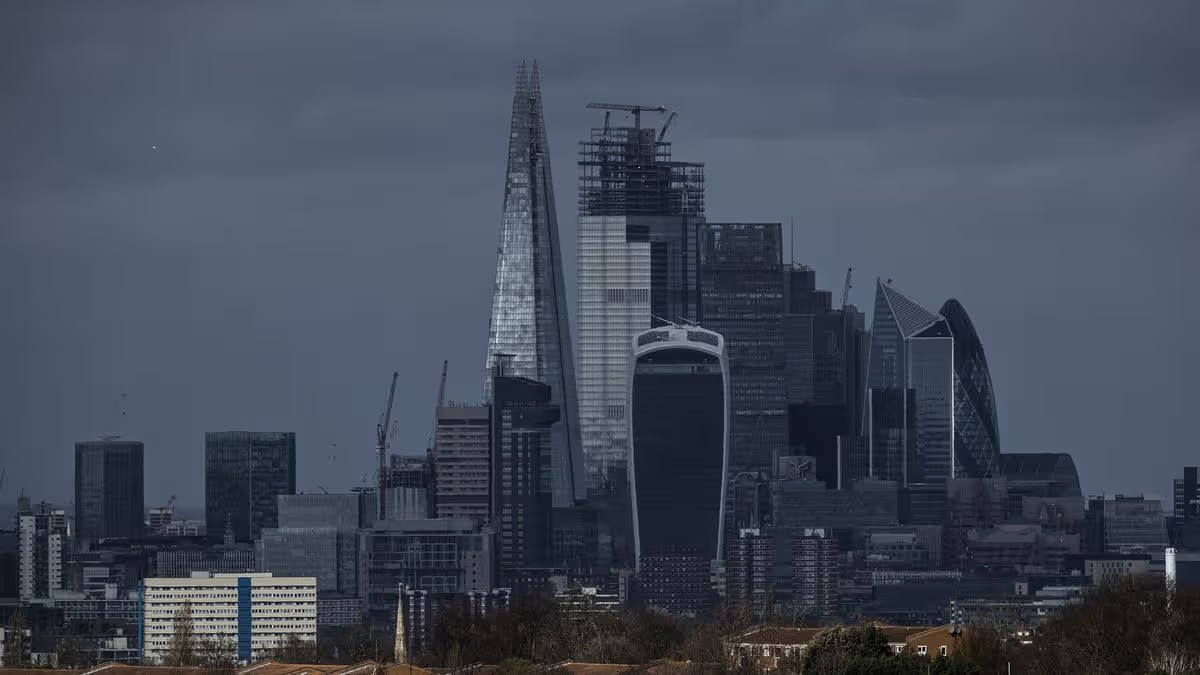
View of London

View of London(Image: Getty Images)

The UK economy maintained its upward trajectory in March, with growth surpassing expectations, according to official figures, though the data may represent the calm before the storm in the months ahead.

Advertisement

The Office for National Statistics (ONS) revealed that GDP growth stood at 0.3 per cent in March, contributing to overall growth of 0.6 per cent across the first quarter.

The services sector expanded by 0.8 per cent in the first quarter, while production edged up 0.2 per cent and construction rose by 0.4 per cent.

“Growth picked up in the first quarter of the year, led by broad-based increases across the services sector,” said Liz McKeown, director of economic statistics at the ONS.

“Within that wholesale, computer programming and advertising performed particularly well.”, as reported by City AM.

Advertisement

The latest figures cover the first month of the Iran war, with data from April onwards expected to lay bare the economic damage caused by a collapse in global trade following disruption across the Strait of Hormuz.

Chancellor Rachel Reeves said “now is not the time to put our economic stability at risk” following the release of the figures.

“Today’s figures show the government has the right economic plan,” Reeves said.

“The choices I have made as Chancellor mean our economy is in a stronger position as we deal with the costs of the war in Iran.

Advertisement

“This government is getting on with the job of building an economy that is stronger, more resilient, and prepared for the future.” Shadow chancellor Sir Mel Stride said: “The chaos surrounding the Labour leadership is destabilising Britain’s economy.”

Projections for UK economic growth in 2026 have been cut. Capital Economics deputy chief UK economist Ruth Gregory stated that “prolonged political instability” represented an “extra downside risk” to forecasts.

“We would be very surprised if growth doesn’t weaken from May as the temporary boost from stockpiling unwinds and the squeeze on households’ real incomes from higher energy prices intensifies,” Gregory said.

“In our adverse scenario, the economy suffers a mild recession. So the economy will probably give whoever is Prime Minister a rough ride.”

Advertisement

Energy markets have been in upheaval since the outbreak of war, with Brent crude jumping by around 50 per cent since March amid concerns over ongoing supply disruption.

Economists have cautioned that the UK could face more severe consequences than other advanced economies as a net energy importer.

Elevated import costs are likely to filter through to inflation while weakening global demand could impact exports and suppress growth.

The Treasury will be reviewing the data before announcing an energy support package for businesses and consumers.

Advertisement

Survey data has revealed that consumer confidence has dropped sharply since the war commenced. Business investment, which had displayed tentative signs of recovery earlier in the year, is widely anticipated to stagnate as bosses await clarity.

Chancellor Rachel Reeves is also grappling with the question of whether she could retain her role under a new Labour leader, should Sir Keir Starmer be forced out.

Bond traders are anticipating a shift to the left within the government, one that would result in fiscal rules being relaxed and Labour’s growth strategy being cast aside.

Starmer has previously pledged to remain as leader, citing geopolitical instability as a key factor weighing on the UK economy.

Advertisement

Following the King’s Speech on Tuesday, he declared he would “tear down” the status quo and pledged a “radical agenda” in a bid to reassure restless backbenchers.

Continue Reading

Business

Co-Diagnostics, Inc. (CODX) Q1 2026 Earnings Call Transcript

Published

on

OneWater Marine Inc. (ONEW) Q1 2026 Earnings Call Transcript

Operator

Thank you for standing by. At this time, I would like to welcome everyone to the Co-Diagnostics, Inc. First Quarter 2026 Earnings Webcast. [Operator Instructions]

I would now like to turn the conference over to Andrew Benson, Head of Investor Relations. The floor is yours.

Advertisement

Andrew Benson
Head of Investor Relations

Good afternoon, everyone. Thank you all for participating in today’s conference call. On the line today from Co-Diagnostics, we have Dwight Egan, Chief Executive Officer; and Brian Brown, Chief Financial Officer.

Earlier today, Co-Diagnostics released financial results from the first quarter ended March 31, 2026. A copy of the press release is available on the company’s website. We will begin with management’s prepared remarks and then open up the call to analysts for Q&A.

Before we begin, we would like to inform listeners that certain statements made by Co-Diagnostics during this call, which are not historical facts, are forward-looking statements. In addition to diagnostic test developments and timing for commencement of clinical evaluations, this includes statements concerning the company’s Co-Dx PCR testing platform, which requires regulatory approval and marketing authorization for diagnostic use and is not currently for sale. Actual outcomes and results may differ materially from what is expressed or implied in any statement.

Advertisement

Important factors which could cause actual results to differ materially from those in these forward-looking statements are detailed in Co-Diagnostics’ filings with the SEC. Co-Diagnostics assumes no obligation and expressly disclaims any duty to update any forward-looking statements to reflect events or circumstances occurring after this call

Continue Reading

Business

Global Industrial Company 2026 Q1 – Results – Earnings Call Presentation (NYSE:GIC) 2026-05-14

Published

on

OneWater Marine Inc. (ONEW) Q1 2026 Earnings Call Transcript

This article was written by

Seeking Alpha’s transcripts team is responsible for the development of all of our transcript-related projects. We currently publish thousands of quarterly earnings calls per quarter on our site and are continuing to grow and expand our coverage. The purpose of this profile is to allow us to share with our readers new transcript-related developments. Thanks, SA Transcripts Team

Continue Reading

Business

Iridium Communications Makes A Bold Move That Creates Long-Term Growth (NASDAQ:IRDM)

Published

on

Iridium Communications Makes A Bold Move That Creates Long-Term Growth (NASDAQ:IRDM)

This article was written by

Daniel is an avid and active professional investor.
He runs Crude Value Insights, a value-oriented newsletter aimed at analyzing the cash flows and assessing the value of companies in the oil and gas space. His primary focus is on finding businesses that are trading at a significant discount to their intrinsic value by employing a combination of Benjamin Graham’s investment philosophy and a contrarian approach to the market and the securities therein. Learn more.

Analyst’s Disclosure: I/we have no stock, option or similar derivative position in any of the companies mentioned, and no plans to initiate any such positions within the next 72 hours. I wrote this article myself, and it expresses my own opinions. I am not receiving compensation for it (other than from Seeking Alpha). I have no business relationship with any company whose stock is mentioned in this article.

Seeking Alpha’s Disclosure: Past performance is no guarantee of future results. No recommendation or advice is being given as to whether any investment is suitable for a particular investor. Any views or opinions expressed above may not reflect those of Seeking Alpha as a whole. Seeking Alpha is not a licensed securities dealer, broker or US investment adviser or investment bank. Our analysts are third party authors that include both professional investors and individual investors who may not be licensed or certified by any institute or regulatory body.

Advertisement
Continue Reading

Business

Form 13G Nomad Foods Ltd For: 14 May

Published

on


Form 13G Nomad Foods Ltd For: 14 May

Continue Reading

Business

Caerphilly Council sells solar farm to Fuse Energy

Published

on

Business Live

The Cwm Ifor Solar Farm is expected generating clean power at the end of the year

Site of the Cwm Ifor Solar Farm near Caerphilly. © Cloudbase Photography(Image: © Cloudbase Photography)

Caerphilly County Borough Council has sold its Cwm Ifor Solar Farm to one of UK’s fastest-growing energy suppliers Fuse Energy.

The 20 megawatt consented solar farm, which at capacity will generate enough clean energy to power approximately 6,000 homes annually, is expected to be connected to the National Grid in December. Work started last month.

Advertisement

Savills Earth Capital Advisory (SECA advised the local authority of the disposal of the scheme near Caerphilly. The value of the deal has not been disclosed.

READ MORE: Two prime Cardiff office buildings acquired in major investment dealREAD MORE: Huge investment plans revealed by Welsh steelmaker

Amanda McConnell, Caerphilly Council’s cabinet member for climate change, said:, “This agreement is an important step in tackling the climate emergency and increasing renewable energy in Caerphilly. The Cwm Ifor Solar Farm could power around 6,000 homes with clean electricity, while supporting a more flexible and resilient energy system. We’re pleased to be working with Fuse Energy to bring this project forward and deliver lasting environmental and economic benefits for our communities.”

Henry Grant, director, Savills Earth Capital Advisory, said; “We’re pleased to have supported the local authority with this transaction. Investor appetite for solar remains strong as these projects continue to play a critical role in accelerating the UK’s transition to a low carbon energy system.”

Advertisement

The acquisition expands Fuse Energy’s growing renewable portfolio with a current 1GW pipeline across solar and wind projects. It plans to develop Cwm Ifor using in-house engineering, procurement and construction. A previous solar project was recently completed by the company at a 30% lower cost per MW peak than industry average.

Continue Reading

Business

Goodyear: A Depressed Stock Is Not Always A Bargain (NASDAQ:GT)

Published

on

Goodyear: A Depressed Stock Is Not Always A Bargain (NASDAQ:GT)

This article was written by

I’m a Portfolio manager (flexible equity funds and private clients), fundamental equity research, macro and geopolitical strategy.Over 10 years across global markets, managing multi-asset strategies and equity portfolios at a European asset manager.I combine top-down macro, bottom-up stock selection and real-time positioning (Bloomberg, models, data).I focus on earnings, tech disruption, policy shifts and capital flows — to identify mispriced opportunities before the market.On Seeking Alpha I share high-conviction ideas, contrarian views and deep breakdowns of both growth and value names.For more insights: follow me on X @AgarCapital

Analyst’s Disclosure: I/we have no stock, option or similar derivative position in any of the companies mentioned, but may initiate a beneficial Long position through a purchase of the stock, or the purchase of call options or similar derivatives in GT over the next 72 hours. I wrote this article myself, and it expresses my own opinions. I am not receiving compensation for it (other than from Seeking Alpha). I have no business relationship with any company whose stock is mentioned in this article.

Seeking Alpha’s Disclosure: Past performance is no guarantee of future results. No recommendation or advice is being given as to whether any investment is suitable for a particular investor. Any views or opinions expressed above may not reflect those of Seeking Alpha as a whole. Seeking Alpha is not a licensed securities dealer, broker or US investment adviser or investment bank. Our analysts are third party authors that include both professional investors and individual investors who may not be licensed or certified by any institute or regulatory body.

Advertisement
Continue Reading

Business

World Oil Prices Hold Above $105 as Iran Tensions and Trump-Xi Summit Drive Volatility

Published

on

Oil Prices Plunge Below $95 as US-Iran Ceasefire Sparks Relief

NEW YORK — World oil prices remained elevated above $105 per barrel on Thursday, May 14, 2026, as ongoing geopolitical risks in the Middle East, particularly around the Strait of Hormuz, continued to support the market even as investors awaited outcomes from the high-stakes summit between President Donald Trump and Chinese President Xi Jinping in Beijing.

Brent crude, the global benchmark, traded near $105.50 per barrel in early European trading, while West Texas Intermediate (WTI), the U.S. benchmark, hovered around $101 per barrel. Both contracts have stayed in elevated territory throughout 2026, reflecting persistent supply concerns and strong global demand despite economic uncertainties in some regions.

The primary driver remains the effective closure of the Strait of Hormuz, a critical chokepoint through which nearly 20% of global oil supply flows. Since military actions began in late February, shipping traffic has been severely restricted, leading to significant supply disruptions and a sharp drawdown in global inventories. Analysts at S&P Global estimate that inventories have fallen by an average of 8.5 million barrels per day in the second quarter, pushing prices higher and creating a risk premium in the market.

The Trump-Xi summit has added another layer of uncertainty and potential relief. Trump is pressing China, Iran’s largest oil customer, to use its influence to help stabilize energy flows. Any positive developments from Beijing could ease pressure on prices, but analysts caution that a quick resolution to the Hormuz situation remains unlikely. “The market is pricing in prolonged disruption,” said one senior energy trader. “Even optimistic scenarios suggest it will take time for flows to normalize.”

Advertisement

U.S. production has provided some buffer. Domestic output remains near record levels, helping to offset some global tightness. However, OPEC+ members have maintained disciplined production cuts, limiting additional supply to the market. Saudi Arabia and other Gulf producers continue to prioritize price stability over volume in the current environment.

Demand remains robust despite higher prices. Strong economic activity in Asia, particularly in India and parts of Southeast Asia, has supported consumption. China’s stimulus measures have helped stabilize industrial activity, though the country’s overall economic recovery remains uneven. Global oil demand is projected to average around 103 million barrels per day in 2026, according to the International Energy Agency, with transportation fuels and petrochemicals driving growth.

For American consumers, the impact is noticeable at the pump. National average gasoline prices have climbed above $4.00 per gallon in many regions, adding pressure on household budgets ahead of the summer driving season. Refiners have warned that prolonged high crude costs could lead to further increases if inventory levels tighten further.

Energy companies have benefited from the elevated price environment. Major producers have reported strong earnings, with many using the windfall to pay down debt, increase dividends and invest in low-carbon technologies. Oilfield service companies have also seen renewed demand, though the focus remains on efficiency and capital discipline rather than aggressive expansion.

Advertisement

The Trump administration has used the situation to push for increased domestic production and streamlined permitting for energy projects. Officials argue that boosting U.S. output can help stabilize global markets and reduce reliance on foreign supplies. However, environmental groups and some Democrats in Congress have criticized the approach, calling for faster transition to renewable energy sources.

Longer-term forecasts suggest prices could remain elevated through the remainder of 2026. Standard Chartered and other banks project Brent averaging between $100 and $110 per barrel for the year, assuming the Hormuz situation persists into the third quarter. A full resolution could bring prices back toward $80-$90, but most analysts see limited downside risk in the near term.

Investors have responded with caution. Energy stocks have outperformed broader markets in 2026 but remain sensitive to any diplomatic breakthroughs or sudden supply increases. Volatility in oil futures has increased, with traders positioning for potential swings around the Trump-Xi meetings and other geopolitical developments.

The situation also highlights the interconnected nature of global energy markets. Europe, still recovering from earlier energy shocks, has increased imports of U.S. liquefied natural gas and other alternatives. Asia’s reliance on Middle Eastern crude makes it particularly vulnerable to disruptions in the region.

Advertisement

As the Trump-Xi summit continues, any signals regarding Iran or energy cooperation could move markets significantly. For now, the combination of tight supply, strong demand and geopolitical risk keeps oil prices firmly in elevated territory, affecting everything from gasoline prices to inflation expectations worldwide.

The coming days and weeks will be critical in determining whether current levels prove sustainable or if new developments bring relief to consumers and businesses. Until then, the world remains on edge, watching both the oil markets and the diplomatic efforts in Beijing for clues about the path ahead.

Continue Reading

Business

Aware director John S Stafford III buys $100,515 in stock

Published

on


Aware director John S Stafford III buys $100,515 in stock

Continue Reading

Trending

Copyright © 2025