

Crypto World
Sandisk (SNDK) Insiders Cash Out $4.4M After Stock’s 465% Surge in 2026


Key Highlights
- Michael Pokorny, Chief Accounting Officer, offloaded approximately $3.5 million in shares; Director Necip Sayiner sold roughly $870,300 on May 8.
- Shares of SNDK have skyrocketed 465% throughout 2026, propelled by robust financial performance and surging AI infrastructure demand for NAND flash storage.
- Fiscal Q3 2026 saw revenue climb 251% compared to the same period last year, with adjusted earnings per share reaching $23.41.
- The memory maker is transitioning toward long-term supply contracts, securing guaranteed revenue streams from major hyperscale cloud providers.
- Executives project approximately $8 billion in Q4 revenue alongside an 80% gross profit margin.
Two senior executives at Sandisk offloaded a total of $4.4 million worth of company shares recently, capitalizing on what has become one of 2026’s most spectacular stock rallies.
Michael Pokorny, the company’s Chief Accounting Officer, divested 2,446 shares this past Tuesday at a price of $1,426.18 per share, generating proceeds of approximately $3.5 million. Following this transaction, Pokorny maintains direct ownership of 22,375 shares, currently valued at roughly $31 million using Thursday’s closing price of $1,382.72.
Meanwhile, Board Director Necip Sayiner disposed of 579 shares on May 8 at an average selling price of $1,503.11, totaling $870,300 in proceeds. Post-sale, Sayiner retains ownership of 2,900 shares worth approximately $4 million.
Sandisk stock has climbed an extraordinary 465% during 2026, and approximately 3,640% since its spinoff from Western Digital completed in February 2025 at an initial public offering price of $38.50. Shares currently hover around the $1,400 mark.
By comparison, the Nasdaq 100 has advanced just 15% during the identical timeframe, underscoring the magnitude of Sandisk’s outperformance.
Forces Powering the Explosive Growth
The primary catalyst behind this remarkable ascent is NAND flash memory technology. Sandisk’s storage solutions have become essential components for AI-focused data centers, where requirements for high-capacity, non-volatile memory have exploded as hyperscale operators rapidly expand their computational infrastructure.
Technology giants including Amazon, Microsoft, Alphabet, and Meta have collectively allocated approximately $700 billion toward infrastructure investments in 2026. Sandisk has positioned itself as a direct beneficiary of this unprecedented capital deployment.
The company’s fiscal Q3 2026 financial results mirrored this explosive demand. Revenue surged 97% from the previous quarter and jumped 251% year-over-year. Adjusted earnings per share reached $23.41, a substantial increase from $5.15 in the preceding quarter.
Revenue generated from data center customers specifically increased 233% during the quarter. Chief Executive David Goeckeler has characterized hyperscale operators as “higher-value customers,” representing a strategic evolution from the company’s historically diverse and fragmented client portfolio.
Industry-wide memory supply constraints have additionally driven pricing upward, creating a favorable pricing environment that complements strong volume expansion.
Strategic Shift in Commercial Approach
Sandisk has been pivoting from transactional spot market sales toward structured, multiyear supply commitments. The corporation executed three such agreements during Q3, with two additional contracts already secured in Q4. This framework ensures predictable revenue for Sandisk while guaranteeing critical storage capacity for major customers.
Looking toward Q4, company leadership projects revenue of approximately $8 billion—representing a 321% increase versus the prior year—coupled with an 80% gross margin, modestly exceeding the 78.4% achieved in Q3.
Industry competitors have similarly experienced strong performance this year. Western Digital, Seagate, and Micron have all witnessed share price appreciation exceeding 100% during 2026.
At present valuations, Sandisk trades at approximately 16 times trailing-twelve-month revenue, elevated from roughly 4.5x at the beginning of the year. This expanded valuation multiple increases the stock’s vulnerability to any disappointing developments, whether company-specific execution issues or broader macroeconomic headwinds.
These recent insider transactions represent the most current SEC-disclosed sales from Sandisk leadership as the stock continues trading near record levels.




Anthropic released Claude Fable 5 on Tuesday, its most capable public model running on Mythos, as it pursues a fall listing it has already filed for confidentially alongside OpenAI, which filed Monday, and SpaceX.
Mythos is Anthropic’s most advanced tier of artificial intelligence models, and Fable is the first publicly released version of this powerful underlying architecture but it comes with strict built-in safety filters.
Bitcoin has spent the past week trading as the high-beta arm of the Nasdaq, sliding with chipmakers and Asian tech as the AI trade unwound. An Anthropic listing, after its $65 billion round at a $965 billion valuation, would hand index funds and retail traders a single AI-lab stock to pile into. Crypto already moves with the AI trade, and giving that trade its own ticker only tightens its grip.
AI-linked tokens caught a modest bid on Fable’s launch while bitcoin barely moved, because model releases are narrative for the sector’s small caps while the majors now trade on what the AI trade does to risk appetite, not on the models themselves.


Ripple has joined Water.org’s Get Blue campaign as its exclusive digital asset and payments partner.
Summary
- Ripple joins Get Blue as exclusive digital asset and payments partner supporting Water.org’s lending model.
- RLUSD will help Water.org move funds faster to microfinance partners serving families across emerging markets.
- Get Blue combines corporate donations with affordable loans for household water and sanitation improvements worldwide.
The blockchain company will provide seed funding and support fund transfers to local finance partners in emerging markets.
Water.org says more than two billion people lack safe water at home. The nonprofit, co-founded by actor Matt Damon and engineer Gary White, uses small loans to help families pay for water and sanitation systems.
Ripple brings RLUSD into the Get Blue campaign
Ripple said Water.org will use its U.S. dollar-backed RLUSD stablecoin to move funds to microfinance partners. Those organizations provide affordable financing for household pipes, pumps, toilets and other basic water systems.
The arrangement builds on Ripple’s existing support for Water.org through Ripple Payments. Water.org says the platform can reduce costs and shorten transfer times when sending capital to partners across different markets.
“We’re proud to join Water.org in support of Get Blue,” Ripple said.
Get Blue named Ripple alongside Amazon, Gap, Starbucks, Ecolab, AccuWeather and TikTok. The campaign first appeared at the World Economic Forum in January and is now moving into a wider consumer rollout.
Ripple-backed WaterCredit turns donations into affordable household loans
Get Blue directs corporate funding and consumer donations into Water.org’s WaterCredit model. Local financial institutions then provide small loans that families use to install safe water or sanitation services at home.
Water.org reports a 98% repayment rate for WaterCredit loans. Repaid funds can support more borrowers, allowing the same pool of capital to finance additional household projects over time.
“When brands join us, they invite their communities into this work,” Water.org CEO Gary White said.
The wider campaign links donations to everyday purchases and services. Gap contributes $5 from each item in its Get Blue collection. Starbucks will donate $0.25 from selected drinks between June 16 and July 7.
RLUSD expands beyond trading and settlement
Ripple launched RLUSD as a stablecoin backed by U.S. dollar deposits, short-term Treasuries and cash equivalents. It operates on the XRP Ledger and Ethereum and supports payments, settlement and other blockchain transactions.
The Water.org partnership adds another humanitarian use for the token. Ripple previously used RLUSD in a drought insurance pilot for pastoral communities in Kenya and committed $25 million to education groups in the U.S.
As crypto.news reported, the education funding supported DonorsChoose and Teach For America. Separate reporting covered RLUSD’s African expansion through Chipper Cash, VALR and Yellow Card for payments and treasury services.
The Get Blue partnership does not disclose how much RLUSD Water.org will receive or which countries will receive the first transfers. Ripple and Water.org have also not published transaction volumes or named the first microfinance recipients.
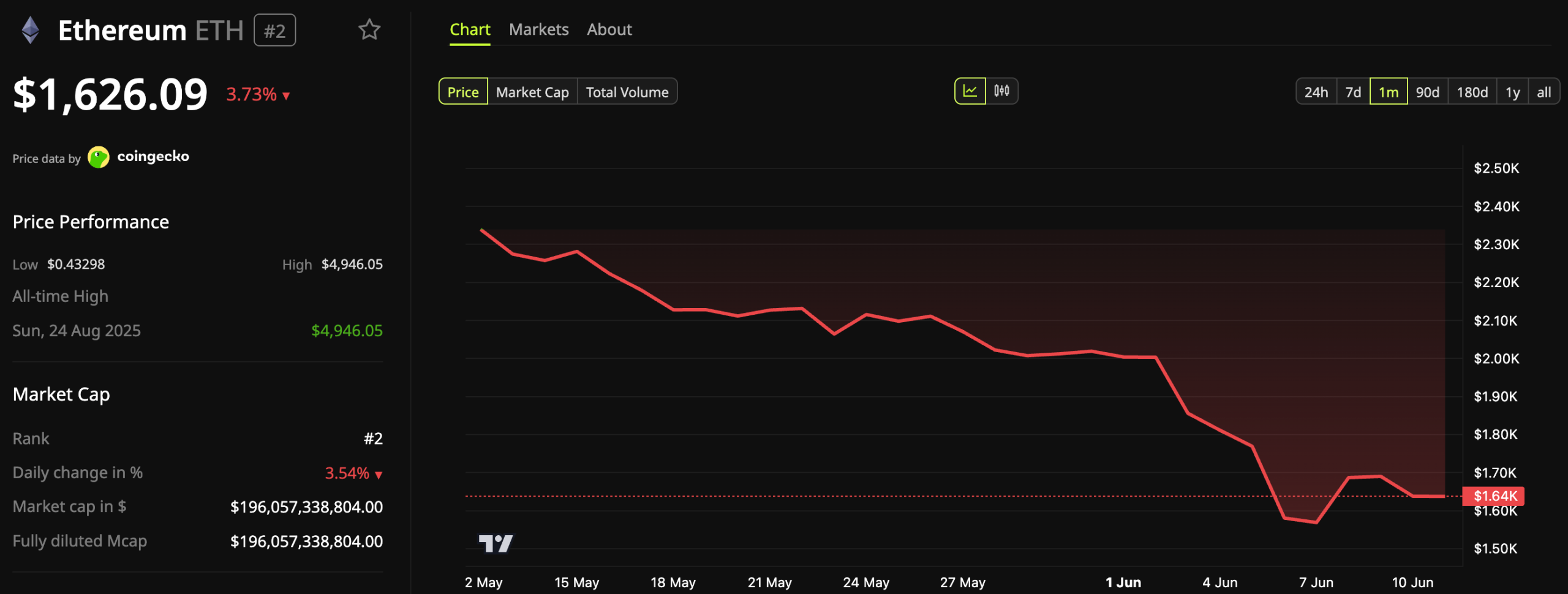
Ethereum (ETH) social sentiment has collapsed into an extreme fear zone as price continues to slip, down 12% over the past week. Bearish posts now dominate social media as the token trades near $1,626.

Santiment data shows the ratio of positive to negative commentary at one of its lowest levels this year. However, the firm suggested this is “where markets become most dangerous for bears.”
Ethereum Fear Reaches the Zone Where Bears Usually Get Trapped
Santiment reported that traders have largely written off Ethereum after months of underperformance against Bitcoin (BTC) and other large-cap assets.
The cryptocurrency re-entered the extreme fear zone on June 9, with the positive-to-negative commentary ratio near 1.09. The firm noted that this zone has historically acted as a buy signal.
Follow us on X to get the latest news as it happens

The contrast with April is stark. On April 22, the crowd flashed extreme greed with Ethereum above $2,400, which Santiment flagged as an ideal sell point. The token has since lost roughly 32% of its value.
“Historically, Ethereum has tended to rebound when social sentiment reaches extreme FUD levels because prices frequently move opposite to the crowd’s expectations. When traders become overwhelmingly convinced that an asset will continue falling, much of the selling pressure has already been exhausted,” the post read.
Sentiment is not the only flag. Trader Ash Crypto also pointed to another key signal. He compared the current breakdown to June 2022, when ETH collapsed before staging a reversal.
“Back in June 2022, ETH broke through every support level and crashed to $880. Everyone gave up on it. That turned out to be the exact bottom of the whole bear market,” he said.
He argued the current drop mirrors June 2022, sharing the same timing, breakdown, and chart structure. After peaking at $4,953 in August 2025, ETH has fallen sharply.
The price has broken below its weekly 200-day moving average at $2,471, leaving $1,500 as the next support to watch.
“Two ways this plays out: If ETH holds $1,500, this could play out exactly like June 2022. The people who bought that bottom made 5x over the next 18 months. If ETH falls below $1,500 on a weekly close, the next support is all the way down near $1,000. Nothing to stop the fall in between,” the analyst added.
ETF Outflows and Oversold Signals Cloud the Rebound Case
Despite these signals, ETH still faces real obstacles. Institutional demand remains weak. SoSoValue data shows ETH spot ETFs have logged outflows for 4 straight weeks, a sign that large investors are still pulling back.
Until those flows turn positive and hold, any rebound risks fade back into the wider downtrend.
Meanwhile, analyst Ardi warned that in prior bear markets, Ethereum bottoms formed after the weekly Relative Strength Index (RSI) broke below 30.
“Each time it spent consecutive weeks there, it marked quite literally the exact bottom of the cycle,” the analyst mentioned.
In 2018, after ETH slipped into the territory, prices dropped 63% from $205 to $75. In 2022, ETH dropped 65% from $2,200 to $750.
Ardi noted that ETH has not yet reached oversold territory, with prices below $1,700. Major macro support sits only 15% lower, leaving little cushion.
“If there is a positive to find, it’s that ETH has spent more time in the lower half of the oscillator this cycle than any prior 4-year period. So there is a small possibility that ETH bottoms without RSI deeply breaking that support in the first place,” Ardi added.
The analyst also noted that ETH never staged a true breakout this cycle. As a result, the chart may not require the same violent correction. Even so, Ardi said ETH typically bottoms only when nobody wants to own it, which, in both prior bear markets, meant oversold conditions.
Subscribe to our YouTube channel to watch leaders and journalists provide expert insights
The post Ethereum Fear Hits 2026 Extreme as History Points to a Rebound appeared first on BeInCrypto.

Kraken has been named the official crypto exchange supporter of the FIFA World Cup 2026, giving the crypto exchange a presence at one of the world’s largest sporting events.
The company said Tuesday that the partnership will include fan activations and product experiences throughout the tournament.
The 2026 World Cup is expected to be the largest in FIFA history, with an expanded field of 48 teams and 104 matches across 16 host cities in the United States, Mexico and Canada. FIFA projects the competition will attract a cumulative global audience of more than 6 billion viewers during its seven-week run.
The partnership places Kraken alongside some of FIFA’s longest-standing corporate sponsors, including Adidas, Coca-Cola, Visa and Hyundai-Kia.
The agreement also expands Kraken’s sports sponsorship efforts, which already include partnerships with Tottenham Hotspur, Atlético de Madrid, RB Leipzig and Atlassian Williams Racing.
The tournament kicks off on June 11 in Mexico City, where Mexico is scheduled to face South Africa at Estadio Azteca.

Source: Kraken
Related: Kraken offers SpaceX IPO access through xStocks
Prediction markets expand their sports presence
The partnership comes four years after the 2022 “Crypto Bowl,” when Coinbase, FTX, Crypto.com and eToro aired advertisements during Super Bowl LVI. Sports marketing activity across the crypto industry slowed following the collapse of FTX later that year and the broader market downturn.
While some digital asset companies have returned to major sporting events, their approach has been more measured. Coinbase aired its first Super Bowl commercial since 2022 during this year’s broadcast, while Crypto.com used the event to launch its AI-focused platform, ai.com.
At the same time, prediction markets, where users buy and sell contracts tied to the likelihood of specific outcomes, have expanded their presence in professional sports.
In November 2025, Polymarket became the official prediction market partner of UFC and Zuffa Boxing under a multiyear agreement that brought prediction market data into live events and broadcasts.

Source: UFC
In January, the company signed a multiyear agreement with Major League Soccer to become the league’s exclusive prediction market partner for MLS and the Leagues Cup. Major League Baseball followed in March, naming Polymarket its official prediction market exchange while signing a separate integrity agreement with the US Commodity Futures Trading Commission.
FIFA’s commercial roster also includes ADI Predict, a blockchain-based prediction market platform backed by Abu Dhabi institutions.
Magazine: Korea probes Polymarket users, crypto PACs sweep primaries: Hodler’s Digest, May 31- June 6
AI company Anthropic on Tuesday released the first public version of its powerful Claude Mythos model, called Fable 5, with some crypto users worried it could be used for malicious purposes, despite embedded guardrails.
Anthropic said last month that its Mythos model uncovered more than 10,000 high or critical-severity vulnerabilities in “systemically important software,” leading many to question if it should be publicly released.
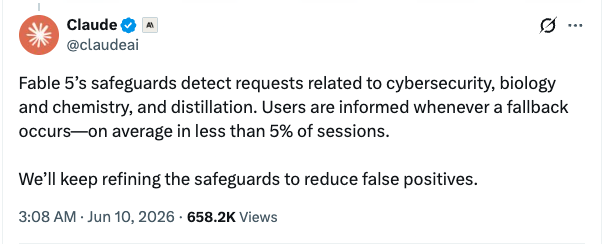
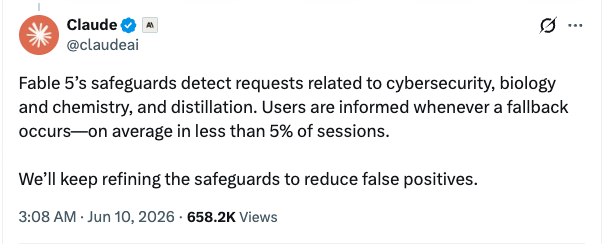
This was despite the company saying on Tuesday that Fable 5 was “made safe for general use,” and has safeguards that reroute some topics, such as cybersecurity, to a different model, Claude Opus 4.8
“Releasing a model this capable comes with risks. Without safeguards, Fable 5’s capabilities in areas like cybersecurity could be misused to cause serious damage,” it said.
Source: Claude
The guardrails have done little to reassure crypto users, with AI increasingly being used to attack crypto platforms. In April, the value of crypto stolen in hacks hit $629.7 million, the highest since February 2025, which analysts linked to the use of the technology.
Mythos release sparks warnings from crypto users
Simon Dedic, founder of the venture firm Moonrock Capital, posted to X on Tuesday that with Fable 5, the “cost and skill required to find exploitable flaws in smart contracts is about to drop to basically zero.”
“For DeFi, this should be a massive wake-up call. Unaudited protocols will become sitting ducks. Known exploits will get replayed on forks around the clock. Even small projects will get targeted simply because trying costs next to nothing now,” he added.
Related: AI agents with crypto could escape and become ‘unstoppable,’ experts warn
Dedic repeated calls online, suggesting that crypto users should protect themselves from the model, including revoking wallet approvals, removing as much value from protocols as possible and moving crypto to fresh hardware wallets.
Curve Finance co-founder Michael Egorov, however, said that the threat Claude Mythos posed to crypto was likely overblown as its success in finding bugs in other software might not translate to funding smart contract vulnerabilities in DeFi.
In May, Anthropic said Claude Mythos found thousands of critical vulnerabilities in important software through Project Glasswing. For open-source projects, which are central to how crypto protocols are managed, Mythos found around 6,200 high or critical-severity vulnerabilities in more than 1,000 projects it investigated.
Egorov argued that the software Mythos found vulnerabilities in had millions of lines of code, while smart contracts have a few thousand, “and both humans and ‘usual’ AI perfectly fit that code in context and can reason well about it.”
“I suspect we might not be having a wave of DeFi code hacks, but we may see a lot of things in OpSec [operational security] getting hacked (looking like multisig keys compromises) and supply chain attacks on frontend dependencies, and those are way less dangerous in true DeFi,” he said.
Meanwhile, Anthropic said a “small group” of cybersecurity and infrastructure providers would get access to Claude Mythos 5, the same model as Fable 5 but with safeguards lifted in some areas.
Magazine: AI-driven hacks could kill DeFi — unless projects act now


Bitcoin’s bounce off last week’s lows is rolling over, and gold is going down with it.
BTC changed hands at $61,233 on Wednesday, down 3% over 24 hours and 6.9% on the week, while gold fell 2% to below $4,200 an ounce. The market is betting on higher interest rates punishes anything that doesn’t pay one, and that is weighing on crypto and gold markets at once.
Ether fell 3.4% to $1,625 and solana dropped 4.1% to $64.24, according to CoinDesk data. XRP lost 4.3% to $1.12, while BNB and dogecoin each slid less than 3%. Hyperliquid’s HYPE was the worst of the majors again, down 10.2% on the day and 21.3% on the week to $55.52, the highest-beta name in the group as risk came off.
South Korea’s Kospi, the market most exposed to the artificial-intelligence trade through its chipmakers, tumbled 6.3%, leading a 2.5% drop in MSCI’s broad Asia-Pacific equity gauge and its fourth loss in five days. Nasdaq 100 futures pointed 0.8% lower after a volatile Wall Street session. Brent crude traded near $92 a barrel as renewed US strikes on Iran kept a bid under oil, and the 10-year Treasury yield rose to 4.54%.
Gold and bitcoin rarely fall in lockstep, as both are stores of value that pay no yield, so both lose their appeal when traders bet on higher rates, and that is what Wednesday’s US inflation report could force.
A hot reading would harden the case for new Federal Reserve Chair Kevin Warsh to keep rates higher for longer, draining liquidity from the assets that ran hardest on cheap money.
The bounce that ran into Monday was a short squeeze, not fresh buying, as over $500 million in bearish bets were liquidated in the highest such figures since April.
Some market watchers say spot demand never showed up behind it.
“Buyers have stepped in after the move lower, but spot demand has yet to return in a meaningful way,” said Diana Pires, chief business officer at sFOX, pointing to a run of US spot bitcoin ETF outflows that has kept institutional money cautious. When new demand isn’t broad enough to cover the selling, she said, rallies struggle to hold.
Watch whether bitcoin can hold a bid through the inflation print or keeps trading tick for tick with the Nasdaq. If gold steadies and bitcoin keeps falling, the case for it as a macro hedge thins further.

U.S.-based cybersecurity giant CrowdStrike warned Tuesday of increasing cyberattacks from China-based entities aimed at stealing artificial intelligence to narrow the tech gap with the U.S.
The Chinese entities accounted for more than 58% of state-sponsored targeted cyberattacks aimed at tech companies, especially their AI assets, CrowdStrike said in a report.
“China-nexus adversaries are escalating espionage against technology organizations to steal the AI capabilities and intellectual property they cannot build fast enough on their own,” CrowdStrike said in a statement.
The analysis covered events over the 12 months to March 31. U.S. restrictions on China’s access to AI training chips have restricted Beijing’s tech development, although homegrown AI models have sought to slash operating costs while offering nearly similar intelligence.
Chinese-affiliated cyberattacks targeted government communications in Southeast Asia and “maintained persistent access” to North American tech organizations by taking advantage of vulnerabilities, CrowdStrike said.
The Cyberspace Administration of China did not immediately respond to CNBC’s faxed request for comment.
Earlier this year, U.S. AI giants Anthropic and OpenAI complained that Chinese companies extracted competitive intelligence from the American tech companies. Analysts at the time cautioned that the boundaries of illicit behavior could be blurry.
Over the last several weeks, Anthropic has touted the cyber capabilities of its newest Mythos model and rolled out the tech to CrowdStrike and other companies. Anthropic on Tuesday released a public version of the model, called Claude Fable 5, which rankings firm Artificial Analysis said is “nearly 5 points ahead of any other lab’s best model.”
CrowdStrike said it also found North Korea-affiliated entities tried to infiltrate IT workforces across North America, Europe and Asia, primarily to generate revenue for the regime.


EU antitrust regulators have ordered Meta to give rival AI chatbots free access to WhatsApp during an active competition probe. The European Commission said Meta must maintain access while Brussels investigates its policy toward competing AI assistants.
Summary
- The European Commission ordered Meta to give rival AI chatbots free WhatsApp access during its antitrust probe.
- The order followed complaints from The Interaction Company, Agentik, and a Spanish AI rival.
- Meta could face fines of up to 10% of prior-year turnover if it breaches the interim order.
The interim measure follows complaints from three AI companies and targets Meta’s October 2025 access change.
EU requires WhatsApp access during Meta probe
The European Commission issued the interim measure on Tuesday against Meta Platforms. It represents the Commission’s first interim measure in an antitrust case in 17 years. The order followed complaints from The Interaction Company, French AI startup Agentik, and a Spanish rival.
The Interaction Company, based in California, develops the Poke.com AI assistant. The EU opened its investigation in December after Meta restricted rival AI providers from WhatsApp. The probe examines whether Meta abused market power by blocking competitors from the messaging app.
“Today, we require Meta to restore access to WhatsApp for competing AI assistants,” Teresa Ribera said. Ribera serves as the EU antitrust commissioner and oversees competition enforcement. The Commission said the measure will prevent serious harm to competition during the probe. It said Meta’s conduct appears to infringe EU competition rules at an early stage.
The commission rejects Meta fee proposal
The EU warned Meta in February that interim measures could follow without restored access. Meta later introduced an access fee for rival AI assistant providers. Brussels rejected that proposal in April and called it unsatisfactory. The Commission said the fee was, at first sight, equivalent to the earlier access ban.
The EU wants Meta to restore third-party access under the same conditions used before October 2025. According to the Commission, Meta’s policy change effectively barred rival AI assistants from WhatsApp. Traditional antitrust cases can take years before regulators issue final decisions.
European officials argue that late fines may fail to address damage already done. The Commission said Meta must comply with the interim measure while the investigation continues. Brussels has not set a legal deadline for the probe’s completion.
Meta faces possible fines and separate EU cases
The Commission said Meta could face fines if it breaches the interim order. The penalty could reach 10% of Meta’s total turnover from the prior business year. The fine would apply if Meta intentionally or negligently violated the decision. The Commission said it has the authority to impose penalties under EU competition rules.
Brussels described an urgent need to protect the market for general-purpose AI assistants. It said smaller players and new entrants need fair access to compete with large platforms. Meta has faced several EU enforcement actions in recent years. In April, EU regulators said Meta failed to keep under-13 users off Facebook and Instagram.
Regulators also continue to examine Meta’s protections for users’ physical and mental well-being. The same probe covers the design of Facebook and Instagram under digital content rules. Meta has appealed a 200 million euro fine issued under the Digital Markets Act. Apple also criticized the DMA on Monday over its delayed rollout of an AI-enhanced Siri.


BitGo has opened access to Aave, Spark and Tesseract for eligible institutional clients through its integration with Narval.
Summary
- BitGo lets eligible institutions access Aave, Spark and Tesseract while assets remain in qualified custody.
- Narval checks transaction details, approved contracts and policy rules before BitGo authorizes wallet signing requests.
- The launch expands regulated DeFi access as financial firms seek controlled routes into onchain markets.
The service connects approved decentralized finance protocols to wallets held within BitGo Bank & Trust’s qualified custody environment.
The setup allows institutions to use onchain markets without transferring assets to wallets. BitGo said more protocols will join the service after launch.
BitGo connects qualified custody to DeFi
Narval’s gateway links DeFi applications to BitGo’s custody and wallet systems. It uses delegated wallet connections and an embedded software kit to route approved transactions through signing and approval processes.
Before BitGo receives a signing request, Narval converts the transaction into readable details. Its verification engine checks the protocol, contract address and planned action against client policies.
“Institutions want access to DeFi,” BitGo chief executive Mike Belshe said.
Belshe said the integration combines transaction checks and whitelisting controls with BitGo’s OCC-regulated custody infrastructure. The controls aim to reduce blind signing, where a user approves a transaction without seeing its terms.
Aave, Spark and Tesseract join at launch
Aave gives clients access to lending markets. Eligible institutions can supply assets or borrow against collateral while keeping their wallet structure and approval rules inside BitGo’s custody framework.
Spark provides access to stablecoin and Ether-based savings and credit markets. The protocol uses coordinated liquidity management and layered risk controls to support lending and savings products.
Tesseract offers managed onchain earnings through segregated client vaults built on Fusion by IPOR. Tesseract Investment Oy manages each mandate under its MiCA authorization, according to the announcement.
Narval adds transaction checks before signing
Narval checks interactions before they reach BitGo’s custody approval process. The system displays transaction information in readable form and compares the request with approved applications and smart-contract addresses.
The gateway also supports policy-based execution. Institutions can set internal rules for which protocols, wallets and actions staff may use before a transaction reaches the signer.
“Our mission is to make onchain participation secure and seamless for institutions,” Narval chief executive Greg Jessner said.
The integration does not remove protocol, market or smart-contract risk. It creates a control layer between institutional wallets and the supported DeFi applications.
Institutional DeFi access continues to expand
The launch follows efforts to connect regulated or controlled custody systems with onchain markets. As crypto.news reported in May, MoonPay Trade introduced institutional access to Aave, Morpho and Maple across more than 200 networks.
Earlier reporting also covered OKX’s integration with BitGo’s off-exchange settlement service. That arrangement lets U.S. institutional clients trade on OKX while assets remain in BitGo cold custody.
BitGo’s Narval integration applies a custody-first structure to DeFi. Clients can interact with approved protocols while retaining BitGo’s governance, transaction review and wallet approval controls.


Exchange-traded fund (ETF) issuer ProShares has announced plans to launch the Ultra SpaceX ETF (SPCF) on June 12.
The product targets 2x the daily returns of SpaceX. The launch will coincide with the largest initial public offering (IPO) in history.
ProShares Bets on SpaceX With Planned Leveraged Single-Stock ETF
The firm offers more than 115 funds and has over $90 billion in assets. SPCF joins existing single-stock products. This includes funds targeting 2x daily returns on Circle, Coinbase, NVIDIA, Palantir, and Tesla.
CEO Michael Sapir said the fund gives traders “a way to magnify a bullish view on SpaceX” without borrowing on margin on IPO day.
“Investors will be able to target 2x daily returns of SpaceX with the convenience and transparency of an ETF,” Sapir said.
Meanwhile, Nate Geraci, President of NovaDius Wealth Management, called the same-day leveraged launch an early signal of how “wild SpaceX IPO could be.”
“Will be other ETF issuers jumping in here as well,” he added.
Follow us on X to get the latest news as it happens
Demand Nears 4 Times the Offering Size
Investor demand for the offering has been substantial. According to Reuters, the deal has attracted more than $250 billion in orders against a $75 billion target.
That leaves the offering oversubscribed by roughly 3.5 to 4 times the planned size. Such strong interest signals confidence in the company ahead of its market debut.
Moreover, the sale ranks as the largest IPO on record by capital raised. The timeline is now compressed. Books are scheduled to close on Wednesday, with pricing to follow on June 11. Finally, SPCX is set to begin trading on the Nasdaq on June 12.
Subscribe to our YouTube channel to watch leaders and journalists provide expert insights
The post ProShares Plans 2x SpaceX ETF Launch on Day of Record IPO appeared first on BeInCrypto.

What next for bitcoin as it faces headwinds from Fed rates to Claude’s Mythos

Kentucky football player Nic Smith dead at 20, no foul play indicated

Fingertip-Sized 1:150 Scale Matchbox Toyota ProBox You Can Actually Drive by Remote Control



-

 Fashion4 days ago
Weekend Open Thread: Evereve – Corporette.com
-
 Crypto World5 days ago
Jensen Huang Approves Samsung, SK Hynix, and Micron for NVIDIA (NVDA) HBM4 Memory Supply
-

 Crypto World2 days ago
Anatomy of the June crypto crash: Fed, Iran, Saylor
-
 Entertainment3 days ago
The Best Mystery Series of All Time Is Surging on Streaming 30 Years After It Ended
-

 NewsBeat2 days ago
Alexander Zverev wins the French Open to finally earn a 1st Grand Slam title
-
 Crypto World3 days ago
Senator Cynthia Lummis Calls CLARITY Act the Most Consequential Financial Legislation of This Generation
-

 Tech5 days ago
Microsoft launches MXC, an OS-level sandbox for AI agents, with OpenAI and Nvidia already on board
-

 Tech4 days ago
Suspicious Polyfill login prompts pop up on Toshiba, Muji websites
-

 Tech3 days ago
Microsoft unveils seven homegrown AI models in new bid for ‘long term self-sufficiency’
-
 Business3 days ago
The Pain Points Taking a Fragile Tech Rally Down a Notch
-
Crypto World5 days ago
LBank Surpasses 25 Million Users Worldwide as AFA Partnership Continues to Drive Global Growth
-

 Crypto World3 days ago
Trump’s AI Ownership Plan Could Benefit Anthropic at OpenAI’s Expense
-

 Business5 days ago
(VIDEO) Justin Bieber Delivers Surprise Happy Birthday Serenade to Diners at Los Angeles Mexican Restaurant
-
 Sports13 hours ago
Bangladesh beat Australia after 20 years in ODIs, register only their second win over six-time world champions | Cricket News
-

 Tech5 days ago
Meta steals a tactic from Tesla and builds data centers in tents
-

 Tech5 days ago
RCS Messages Between iPhone and Android Get End-to-End Encryption With iOS 26.5
-
 Crypto World2 days ago
Eli Lilly (LLY) Stock Surges 4% Following Breakthrough Sleep Apnea Trial Results
-

 Tech4 days ago
Von der Leyen’s AI envoy pick draws conflict-of-interest fire
-

 Tech4 days ago
Hackers now exploit SolarWinds Serv-U flaw to crash servers
-

 Business2 days ago
Wall Street ends sharply lower as chips stocks slide
You must be logged in to post a comment Login