


Make no mistake: Americans hate data centers.
Tech
Linux Kernel Outlines What Qualifies As A Security Bug, Responsible AI Use


The Linux 7.1 kernel has added new documentation clarifying what qualifies as a security bug and how AI-assisted vulnerability reports should be handled. Phoronix reports: Stemming from the recent influx of security bugs to the Linux kernel as well as an uptick in bug and security reports from discoveries made in full or in part with AI, additional documentation was warranted. Longtime Linux developer Willy Tarreau took to authoring the additional documentation around kernel bugs. To summarize (since the documentation is a bit too lengthy for a Slashdot story), the AI-assisted vulnerability reports should “be treated as public” because such findings “systematically surface simultaneously across multiple researchers, often on the same day.” It adds that reporters should avoid posting a reproducer openly, instead “just mention that one is available” and provide it privately if maintainers request it. The guidance also tells AI-assisted reporters to keep submissions concise and plain-text, focus on verifiable impact rather than speculative consequences, include a thoroughly tested reproducer, and, where possible, propose and test a fix.
As for what qualifies as a security bug, the documentation says the private security list is for “urgent bugs that grant an attacker a capability they are not supposed to have on a correctly configured production system” and are easy to exploit, creating an imminent threat to many users. Reporters are told to consider whether the issue “actually crosses a trust boundary,” since many bugs submitted privately are really ordinary defects that belong in the normal public reporting process.
All the new documentation can be read via this commit.
Continue Reading

A recent poll from Gallup shows 70 percent of Americans oppose a data center in their local area, including 48 percent who are strongly opposed. That 70 percent number is tied to several concerns, environmental questions and quality of life chief among them, and it’s up 18 percent (!) in just two months, when Gallup asked the same question in March.
Nonetheless, data centers keep going up at a rate that is nothing short of astonishing.
According to one estimate, more than 4,000 data centers have already been built across the country. More than 2,000 that are currently under construction.
That alone shows just how quickly artificial intelligence, workforce automation, and the data centers that power these new technologies are becoming one of the can’t-miss issues in our current political landscape. And still, President Donald Trump and the White House have seemingly chosen to stand aside on AI regulation.
On the Democratic side, it’s an open question what comes next. Politicians like Sen. Bernie Sanders (I-VT) have called for a nationwide moratorium on data centers in order to institute more consumer protections. Others, like Sen. Ruben Gallego (D-AZ), are less definitive: He told me recently that artificial intelligence is a “necessary evil” of our modern age, and building data centers is part of that equation.
With all that uncertainty, producer Kasia Broussalian and I decided to sort through the mess ourselves. We headed to Vineland, a city in southern New Jersey where a new data center is under construction.
We talked to homeowners who live near the data center and a Democrat running on an AI reform platform, and went to a town hall to hear from community members who wanted to voice their concerns. One person brought up rising electricity bills, while another said the data center has made it impossible for her to sell her home. Many had a general anxiety about the global rise of AI.
However, the most universal complaint was not technically about artificial intelligence at all. It was about a political process that residents said did not include them. At the town hall, people said they were shocked by the data center’s initial construction, and want more transparency about relationships between elected officials and these big tech companies.
They also urged politicians to act proactively, rather than waiting for a crisis before imposing regulation. It wasn’t just that they didn’t like the data center itself: They were upset at how it seemed like a physical manifestation of whose interests are prioritized in politics.
Read on for what some of those town hall attendees had to say, lightly edited for length and clarity. As always, there’s much more in the full show, so listen to America, Actually wherever you get your podcasts or watch it on Vox’s YouTube channel.
How many of you right now feel like you got information about the data center before the construction started?
Can someone raise their hand and just tell me what their biggest concern was once they started hearing about it?
Angela Bardoe, Cumberland County, New Jersey, resident: Well, when I saw it, I thought it was the ugliest thing I’ve ever seen. So, that part of East Island is beautiful farmland — was beautiful farmland — but then of course I’ve thought about a lot of my friends that live out that way and how it was going to impact their everyday life.
Most people live there because they love the farmland.
Now I know about the structure, I know about kind of energy concerns. I wanted to ask about AI generally, like how many of you would say that your concerns about this data center are tied to larger concerns about AI and kind of some anxiety around that.
Fred Barsuglia, Clayton, New Jersey, resident: The internet brought us the best of the world and the worst in the world. AI is going to do the same thing. It’s already begun. I scroll through Facebook and there’s AI all over the place. Some of it’s cute little bunnies and cats, but a lot of the other stuff, you know, is bad.
Again, our government is very slow to react. There has to be some regulations.
Where would you now put this on your scale of issues?
There’s so much happening right now, whether it be war in Iran or tariffs or just generally. I wonder where data centers and this specific local reality maps onto your importance of issues.
Angela: I would say most of the topics fall into two categories. Is it benefiting people, or is it benefiting the elite and the money that’s going into their pockets? We see people trading before the war’s announced and they’re benefiting from it. And I just find it all very disgusting.
Louise Thigpen, Cumberland County resident: They’re gambling.
Angela: Yeah. I mean, they’re gambling insider information.
I hear what you’re saying.
On one hand there’s, there’s a kind of politics way of thinking about this in one bucket or another, but you’re like, it actually feels like in general, they’re not responding to you the regular person, and that’s across a lot of issues.
Angela: Well, yes. That’s how I see it.
Fred: I feel the same way. It’s because everything relates from the top down and what we’re getting from the top has spread all the way to the local level.
Louise: And it isn’t good.
Thank you all for entertaining our questions. It’s illuminating to hear the way these issues are connected for people. And I think just this general sentiment that folks feel unheard.
Louise: And we don’t feel that way. We are that way.


The Russian hacker group Secret Blizzard has developed its long-running Kazuar backdoor into a modular peer-to-peer (P2P) botnet designed for long-term persistence, stealth, and data collection.
Secret Blizzard, whose activity overlaps that of Turla, Uroburos, and Venomous Bear, has been associated with the Russian intelligence service (FSB) and is known for targeting government and diplomatic organizations, defense-related entities, and critical systems across Europe, Asia, and Ukraine.
The Kazuar malware has been documented since 2017, and researchers found that its code lineage goes as far back as 2005. Its activity has been linked to the Turla espionage group working for the FSB.
In 2020, researchers exposed its deployment in attacks targeting European government organizations. Three years later, it was seen deployed in attacks against Ukraine.
“Leading” Kazuar
Microsoft researchers analyzed a recent variant of Kazuar and observed that the malware now operates using three distinct modules: kernel, bridge, and worker.
The Kernel module is the central coordinator that manages tasks, controls other modules, elects a leader, and orchestrates communications and data flow across the botnet.
The leader is essentially one infected system within a compromised environment or network segment, which communicates with the command-and-control (C2) server, receives tasks, and forwards them internally to the other infected systems.
Non-leader systems enter “silent” mode and don’t communicate directly with the C2. This results in better stealth and reduced detection surface.
“The Kernel leader is the one elected Kernel module that communicates with the Bridge module on behalf of the other Kernel modules, reducing visibility by avoiding large volumes of external traffic from multiple infected hosts,” explains Microsoft.
The process for selecting the leader is internal and autonomous, using uptime, reboot, and interruption counts.
The Bridge module acts as the external communications proxy that relays traffic between the elected Kernel leader and the remote C2 infrastructure using protocols like HTTP, WebSockets, or Exchange Web Services (EWS).
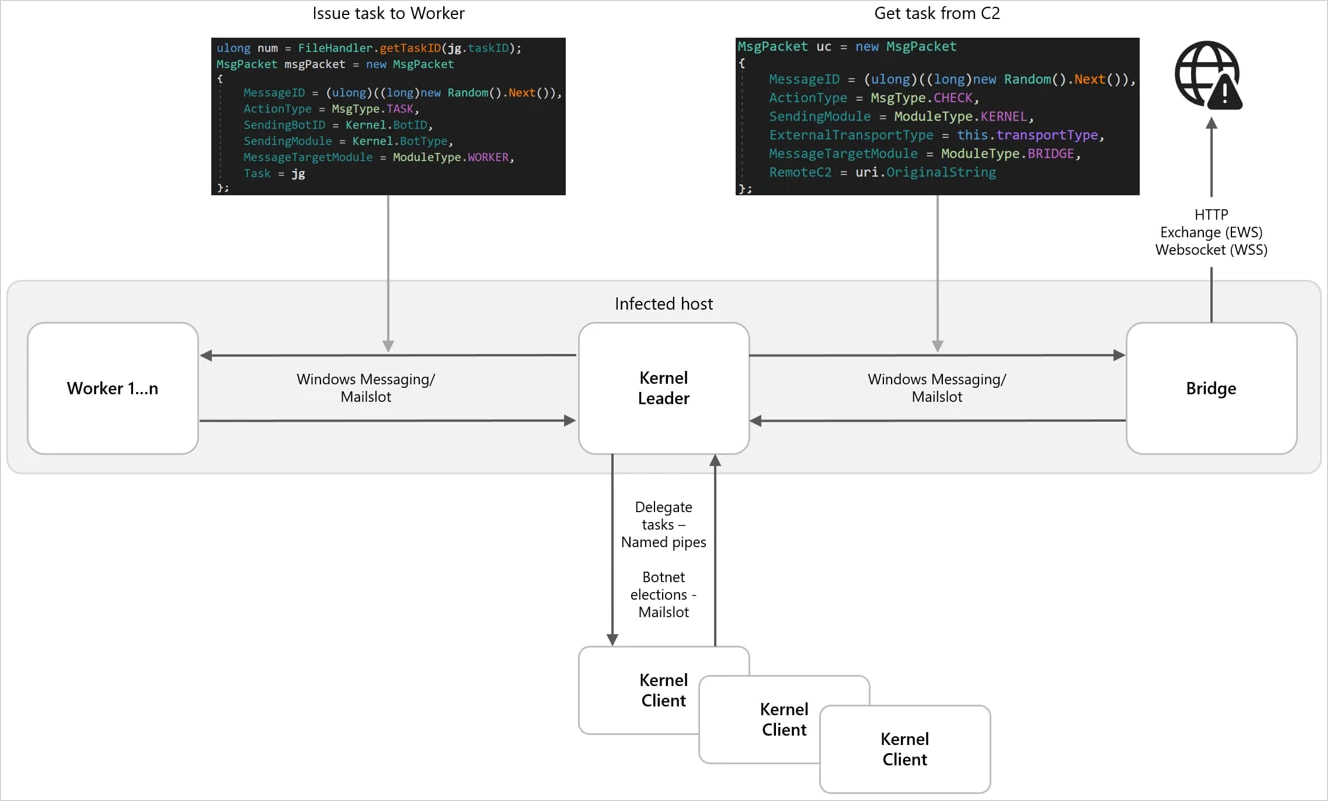
Source: Microsoft
Internal communications rely on IPC (inter-process communication), including Windows Messaging, Mailslots, and named pipes, blending well with normal operational noise. The messages are AES-encrypted and serialized with Google Protocol Buffers (Protobuf).
The Worker module performs the actual espionage operations, such as:
- keylogging
- capturing screenshots
- harvesting data from the filesystem
- performing system and network reconnaissance
- collecting email/MAPI data (including Outlook downloads)
- monitoring windows
- stealing recent files
The collected data is encrypted, staged locally, and later exfiltrated through the Bridge module.
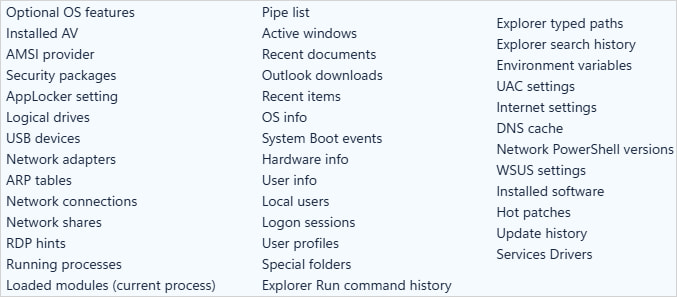
Source: Microsoft
Microsoft underlines Kazuar’s versatility, which now supports 150 configuration options allowing operators to enable/disable specific security bypasses, perform task scheduling, time the data theft and size of exfiltration chunks, perform process injection, manage tasks and command execution, and more.
Regarding the security bypass options, Kazuar now offers Antimalware Scan Interface (AMSI) bypass, Event Tracing for Windows (ETW) bypass, and Windows Lockdown Policy (WLDP) bypass.
Secret Blizzard typically seeks long-term persistence on target systems for intelligence collections. The actor exfiltrates documents and email content that has political importance.
Microsoft recommends that companies focus their defense on behavioral detection rather than static signatures, as Kazuar’s modular and highly configurable nature makes the threat particularly evasive.

Automated pentesting tools deliver real value, but they were built to answer one question: can an attacker move through the network? They were not built to test whether your controls block threats, your detection rules fire, or your cloud configs hold.
This guide covers the 6 surfaces you actually need to validate.


OpenAI has signed deals with fintech startups, tech giants and even Disney, but it’s breaking new ground by announcing a “world’s first partnership” with the country of Malta. In a post on its website, OpenAI said that it would provide ChatGPT Plus for one year to every Maltese resident or citizen.
“Malta is the first country to launch a partnership of this scale because we refuse to let our citizens stay behind in the digital age,” Silvio Schembri, Malta’s minister for Economy, Enterprise and Strategic Projects, said in a statement. “We are putting our people at the very forefront of global change.”
For the approximately 574,250 residents living in Malta, they’ll have to complete a course developed by the University of Malta before launching the ChatGPT Plus subscription, which costs $20 a month in the US. The course teaches the basics of AI, but also how to use the technology responsibly, whether it’s at home or at work. Any interested Maltese residents will also need to have an active eID account from the European Union to claim the subscription. According to OpenAI, the first phase of the program will launch this month, with the Malta Digital Innovation Authority managing the distribution to eligible participants. OpenAI added that the program will scale up once more Maltese residents or its citizens abroad complete the course.
While OpenAI kicks off a new program in Malta, it’s putting a pause to its Stargate data center plans in the UK. The project was designed to assist the UK with building out AI infrastructure, but attributed high energy costs and regulatory issues with the latest stoppage.


TL;DR
Rivian’s founder is running three companies with $12.3B raised. Mind Robotics just hit $1B at a $3.4B valuation.
RJ Scaringe has raised more than $12.3 billion across three startups, and the pace is accelerating. The Rivian founder and CEO, who holds a doctorate in mechanical engineering from MIT, is now simultaneously running an electric vehicle manufacturer, an autonomous micromobility company, and an industrial AI robotics startup, each attracting capital at a speed that would be remarkable for any single venture.
The latest data point arrived this week when Mind Robotics, Scaringe’s industrial robotics company, closed a $400 million round led by Kleiner Perkins, bringing its total funding to more than $1 billion and its valuation to $3.4 billion. The venture arms of Volkswagen and Salesforce also participated. Mind Robotics was founded in 2025, initially as an internal Rivian project called “Project Synapse,” and has raised $115 million in seed funding, $500 million in a Series A in March, and now $400 million more in under two months. The company is building AI-powered robots designed to handle the dexterous, reasoning-intensive manufacturing tasks that conventional factory automation cannot, using Rivian’s own production lines as a live training environment.
Scaringe’s second venture, Also, is an electric micromobility company spun out of Rivian in 2025. It has raised more than $300 million, including a $200 million Series C led by Greenoaks in March that valued the company at over $1 billion. DoorDash invested alongside a multi-year commercial agreement to deploy Also’s purpose-built autonomous small EVs for last-mile delivery. The company’s product lineup includes a $3,500 e-bike and a four-wheeled cargo EV designed to fit in a bike lane.
The overwhelming majority of the $12.3 billion, more than $11 billion, went into Rivian itself, most of it between 2018 and the company’s blockbuster IPO in November 2021. Rivian was founded in 2009 as Mainstream Motors and operated in near-obscurity for nearly a decade before revealing its R1T truck and R1S SUV prototypes at the 2018 Los Angeles Auto Show. The money followed quickly: Amazon led a $700 million round in early 2019, Ford invested $500 million, and by the end of that year Rivian had closed four funding rounds. A $2.5 billion raise in July 2020 and a $2.65 billion raise six months later preceded the IPO, which generated nearly $12 billion in gross proceeds at $78 per share and briefly valued the company at more than $100 billion.
Today, Rivian’s market capitalisation stands at approximately $18.2 billion, a significant decline that reflects the broader struggles of the EV sector. But the company continues to attract major partnerships. Volkswagen has overtaken Amazon as Rivian’s largest shareholder through a $5.8 billion software joint venture, and Uber struck a deal worth up to $1.25 billion for up to 50,000 autonomous Rivian R2 robotaxis across 25 cities by 2031.
What makes Scaringe unusual is not just the quantity of capital but the breadth. Supersized seed rounds have become more common in recent years, but they have generally gone to defence tech or AI startups founded by former OpenAI or Anthropic employees, not to electric micromobility or industrial robotics. Eclipse, one of Scaringe’s biggest backers and a lead investor in both Also and Mind Robotics, credits his combination of engineering depth and product instinct. Jiten Behl, partner at Eclipse and a former Rivian executive, described Scaringe’s ability to communicate a vision without overselling as “an art.”
The comparison to other serial entrepreneurs who have raised billions across multiple ventures, Elon Musk, Sam Altman, Palmer Luckey, is inevitable but imprecise. Multiple investors told TechCrunch that Scaringe’s distinguishing quality is the absence of self-promotion. “It’s not about him,” one insider said. “When you talk to him, he has enthusiasm about the product that is completely external.” Joe Fath, also at Eclipse, noted that Scaringe “has the rare combination of being a truly great engineer while also having an exceptional instinct for product design,” a pairing he described as “incredibly uncommon.”
The question that follows from $12.3 billion across three companies, all run by the same person, is whether Scaringe can sustain the pace. He travels between Palo Alto, Irvine, Rivian’s factory in Normal, Illinois, and a second factory under construction in Georgia. Mind Robotics is scaling rapidly, Also is preparing to deliver its first US products in 2026, and Rivian is ramping the R2 SUV while navigating a hostile tariff environment that has seen at least a dozen EV models cancelled or paused this year.
The industrial robotics market is attracting capital at an extraordinary rate, with companies from 1X to Unitree to Foundation Industries all raising hundreds of millions for physical AI systems. Mind Robotics’ pitch, that it has access to a live high-volume factory floor for training data, gives it a structural advantage most competitors lack. Whether that advantage translates into a durable business depends on execution at a scale that even Scaringe has not yet attempted.
Behl framed the question differently. “The big question is, how much can he do?” he said. “That’s a question that already assumes he’s reaching his limit. The thing is, he doesn’t look at it that way.“
Tech
Four OpenClaw flaws let attackers steal data, escalate privileges, and plant backdoors through the agent’s own sandbox

TL;DR
Four chainable OpenClaw flaws dubbed “Claw Chain” let attackers weaponise the agent’s own sandbox. Patches are live.
Cybersecurity researchers at Cyera have disclosed four vulnerabilities in OpenClaw that, when chained together, allow an attacker to steal sensitive data, escalate privileges, and establish persistent control over a compromised host. The flaws, collectively dubbed “Claw Chain,” affect OpenClaw’s OpenShell managed sandbox backend and its MCP loopback runtime. All four have been patched in OpenClaw version 2026.4.22.
The attack chain works in four stages. First, a malicious plugin, prompt injection, or compromised external input gains code execution inside the OpenShell sandbox. Second, two of the vulnerabilities, CVE-2026-44113 and CVE-2026-44115, are exploited to expose credentials, secrets, and sensitive files. Third, CVE-2026-44118 is used to obtain owner-level control of the agent runtime by exploiting an improperly validated ownership flag. Fourth, CVE-2026-44112, the most severe of the four with a CVSS score of 9.6, is used to plant backdoors, modify configuration, and establish persistence outside the sandbox.
The most architecturally interesting flaw is CVE-2026-44118, which stems from OpenClaw trusting a client-controlled flag called senderIsOwner without validating it against the authenticated session. Any non-owner loopback client could impersonate an owner and gain control over gateway configuration, cron scheduling, and execution environment management. The fix, according to OpenClaw’s advisory, involves issuing separate owner and non-owner bearer tokens, with senderIsOwner now derived exclusively from the authenticating token rather than from a spoofable header.
The two TOCTOU (time-of-check/time-of-use) race conditions, CVE-2026-44112 and CVE-2026-44113, allow attackers to bypass sandbox restrictions and redirect file writes or reads outside the intended mount root. CVE-2026-44115 exploits an incomplete allowlist by embedding shell expansion tokens inside a heredoc body, enabling execution of commands that would otherwise be blocked at runtime.

The 💜 of EU tech
The latest rumblings from the EU tech scene, a story from our wise ol’ founder Boris, and some questionable AI art. It’s free, every week, in your inbox. Sign up now!
What makes Claw Chain particularly concerning is that each step looks like normal agent behaviour to traditional security controls. “By weaponizing the agent’s own privileges, an adversary moves through data access, privilege escalation, and persistence, using the agent as their hands inside the environment,” Cyera said. The attack broadens blast radius while making detection significantly harder, because the malicious actions are indistinguishable from the legitimate operations the agent is designed to perform.
This is not the first time OpenClaw’s security has come under scrutiny. In January, a critical remote code execution vulnerability (CVE-2026-25253) allowed any website a user visited to silently connect to the agent’s local server through an unvalidated WebSocket, chaining a cross-site hijack into full code execution. A Koi Security audit of ClawHub, OpenClaw’s skill marketplace, found 341 malicious entries out of 2,857 available skills, with attacks designed to steal credentials, open reverse shells, and hijack agents for cryptocurrency mining.
Nvidia addressed some of these structural security concerns in March with NemoClaw, an enterprise layer that adds sandbox orchestration, privacy guardrails, and security hardening on top of OpenClaw. The product was built in partnership with Cisco, CrowdStrike, Google, and Microsoft Security. But NemoClaw operates at the infrastructure level, not the application level, and the Claw Chain vulnerabilities sit inside OpenClaw’s own sandbox implementation, meaning even NemoClaw-hardened deployments would have been affected before the patch.
The scale of the exposure is significant. OpenClaw has more than 3.2 million users, is integrated with ChatGPT subscriptions through OpenAI, and has been adopted as an enterprise platform by Nvidia (NemoClaw) and Tencent (ClawPro). A significant portion of the installed base is running older, unpatched versions, and attackers have been targeting known vulnerabilities in versions prior to 2026.1.30 since at least February.
Security researcher Vladimir Tokarev has been credited with discovering and reporting the issues. Users are advised to update to version 2026.4.22 immediately. The broader lesson is one the AI agent industry has been slow to internalise: when an autonomous agent has access to files, credentials, APIs, and network resources, compromising the agent is functionally equivalent to compromising the user. Traditional perimeter security was not designed for a world in which the most privileged entity inside the environment is software that executes instructions from external sources.
Claw Chain is unlikely to be the last vulnerability disclosure of this kind. It may, however, be the one that forces the industry to treat AI agent security with the same rigour it applies to operating systems and cloud infrastructure, rather than as an afterthought bolted onto a product that was never designed to be this important.

This week on the GeekWire Podcast: As the Musk v. OpenAI trial heads to the jury, we dig into what Microsoft’s internal board memos and executive testimony revealed about the origins of the company’s massive bet on AI, and why this case matters beyond the billionaire drama.
Plus, Howard Schultz, a former Washington governor, and the tech community weigh in on whether Seattle is squandering its edge as an innovation capital.
Finally, the GeekWire Trivia Challenge explores the modern mysteries of Microsoft’s naming conventions. And in the opening, Todd owes John and the United Kingdom an apology.
RELATED STORIES AND LINKS
- Microsoft’s CTO testifies about email at the heart of Elon Musk’s allegations
- OpenAI CEO Sam Altman’s stake in Helion Energy draws scrutiny in Musk trial
- New filing reveals who Microsoft favored — and opposed — for OpenAI’s board
- Satya Nadella was worried about Microsoft being ‘the next IBM’ in OpenAI deal
- Are we on a Road to Nowhere? Seattle’s growth masks deeper anxieties about its future
- Microsoft’s multi-agent AI system tops Anthropic’s Mythos on cybersecurity benchmark
- Seattle Turns Hostile to the Great Businesses It Made (WSJ, by Howard Schultz)
- Association of Washington Business 2026 Spring Summit (TVW, featuring former Gov. Chris Gregoire and former AG Rob McKenna)
With GeekWire co-founders Todd Bishop and John Cook
Subscribe to GeekWire in Apple Podcasts, Spotify, or wherever you listen.

AndaSeat is primarily known for its broad range of gaming chairs – and, more recently, the launch of its very first standing desk. And though it wasn’t evident at the time, it was a clear signal of intent: the company is spreading its wings from gamer-focus to home office furniture as a whole.
Ahead of this interview, a representative told me, “In terms of office furniture, we’ve been placing increasing emphasis on how products fit into more compact, multi-functional environments – where a single chair can support both focused work and more relaxed, recreational use.”
Latest Videos From

AndaSeat’s DNA is rooted in high-performance gaming chairs. How do the ergonomic principles of gaming chair design translate into professional home office use?
Professionals shift posture constantly; our chairs move with them.
At AndaSeat, we view the transition from the racing cockpit to the home office as a natural evolution of ‘intensity.’ Whether you are in a high-stakes 5v5 match or a back-to-back marathon of video calls, the physiological toll on the body is remarkably similar: static muscle strain and spinal fatigue.
Our DNA allows us to translate high-performance features into the professional space in three key ways:
Dynamic Support: Our Auto-Tracking Lumbar systems (as seen in the Phantom 4) are designed for ‘Active Sitting.’ Professionals shift posture constantly; our chairs move with them, ensuring the lower back is never left unsupported.
Structural Durability: Our 100% Seamless Steel Frames – a standard from our racing days – provide a level of long-term structural integrity that typical office chairs lack, ensuring the ergonomic ‘geometry’ of the chair doesn’t sag over years of use.
Adaptive Recovery: Gaming requires rapid movement and deep focus. We apply this to office use through high-density molded foam and multi-angle tilt mechanisms, allowing a professional to transition instantly from ‘focus mode’ at 90° to ‘recovery mode’ at 120° for a mental break.
Based on your experience and research, what are the principles of a good home office set-up?
A superior home office setup should be treated as a Performance Ecosystem rather than just a collection of furniture.
A superior home office setup should be treated as a Performance Ecosystem rather than just a collection of furniture. Based on our R&D, we follow four core principles:
The 90-90-90 Rule: Your elbows, hips, and knees should all maintain approximately a 90-degree angle. This is only possible with highly adjustable gear, such as desks with millimetric height precision and 4D/5D armrests that align perfectly with the desk surface to prevent carpal tunnel strain.
Visual Ergonomics: Eye fatigue is the ‘silent’ productivity killer. A good setup uses Mechanical Spring Monitor Arms to ensure the top third of the screen is at eye level, preventing ‘tech-neck’ from looking down.
Movement-First Design: The best posture is the next posture. We advocate for Sit-to-Stand transitions. Alternating between sitting and standing every 45–60 minutes boosts circulation and cognitive function.
Zonal Organization: A clean space equals a clean mind. Integrated cable management (like the ‘Zero Cable’ system in our Xtreme desks) removes visual clutter, which research shows directly reduces cortisol levels and increases focus.
How are you applying these principles within your own range of products – for instance, addressing long hours of sitting with your new mesh chair designs?
With our new mesh chair designs, such as the X-Air Series Pro, we are tackling the ‘thermal and pressure’ challenges of long-duration sitting. While leather offers a premium feel, mesh allows for high-performance breathability, which is critical for regulating body temperature during 8+ hour sessions.
We apply our core principles here through:
Variable Tension Zones: Not all parts of your back need the same support. Our mesh is engineered with different tension levels—firmer at the lumbar for stability and more flexible at the upper thoracic to allow for natural shoulder movement.
Pressure Distribution: Long hours of sitting lead to ‘hot spots’ on the thighs. We use a waterfall seat edge design combined with high-elasticity mesh to reduce pressure on the popliteal fossa (the area behind your knees), maintaining healthy circulation.
Mechanical Precision: We integrate our racing-grade aluminum alloy components into the mesh frame. This ensures that even though the material is flexible, the structural geometry remains rigid, preventing the ‘slouch’ effect that occurs in lower-quality mesh chairs over time.
How is the integration of living and working spaces influencing AndaSeat’s office furniture designs? And how do you see this continuing to evolve?
The home office will evolve from a workstation into a Wellness Hub.
The boundary between ‘office’ and ‘home’ has permanently blurred, and our design philosophy has shifted toward ‘Seamless Versatility.’
Aesthetic Integration: We are moving away from the aggressive ‘gamer’ aesthetic toward a more refined, minimalist industrial design. Our Kaiser 4 and Xtreme desks feature clean lines and premium textures (like sustainable leather and carbon fiber) that complement a modern living room or bedroom rather than clashing with it.
Space Efficiency: In a home environment, space is a premium. This has led us to develop modular and compact solutions, such as our L-shaped standing desks and monitor arms that reclaim desk real estate.
The Future Evolution: We see the future moving toward ‘AI-Enhanced Ergonomics.’ We are exploring furniture that doesn’t just sit there but actively monitors your health—desks that remind you to stand based on your heart rate or chairs that adjust their tension based on your fatigue levels. The home office will evolve from a workstation into a Wellness Hub.
You describe sitting as a “dynamic activity”, meaning a chair must support a wide range of natural movements. How do you achieve this while designing a chair that encourages proper posture?
The paradox of ergonomics is that ‘proper posture’ isn’t a frozen state – it’s a fluid one.
The paradox of ergonomics is that ‘proper posture’ isn’t a frozen state – it’s a fluid one. A chair that forces you into a single position, no matter how ‘correct’ that position is, will eventually cause muscle fatigue.
At AndaSeat, we achieve this balance through Reactive Support Geometry. Instead of a rigid backrest, we use systems like our 6D Armrests and Gas-Spring Pop-out Lumbar (in the Kaiser 4). These components don’t just stay in place; they have a degree of ‘give’ and adjustability that follows the micro-movements of your skeleton.
For example, when you lean forward to type, the lumbar support maintains contact, and when you pivot to look at a second monitor, the armrests sync with your elbows. By reducing the physical effort required to maintain support during movement, we naturally guide the body back to a neutral spinal alignment without the user feeling ‘locked in.
The market is flooded with ultra-cheap standing desks and hybrid gaming-office chairs. What are the issues with these models – including the invisible corners being cut that people won’t realize until six months down the line?
The ‘six-month wall’ is a real phenomenon in budget furniture. In ultra-cheap models, corners are cut in places the eye can’t see, but the body eventually feels.
The ‘Invisible’ Frames: Many cheap chairs use thin, 1.2mm plywood or stapled elastic bands for support. After six months, these materials lose their tension, causing the seat to sag and your pelvis to tilt incorrectly. We use a 2mm thick, 22mm wide seamless steel frame to ensure the chair’s ‘skeleton’ remains identical from day 1 to year 10.
Motor Longevity & Stability: In low-cost standing desks, manufacturers often use single-motor systems with high-friction plastic glides. Initially, they seem fine, but after a few hundred cycles, the ‘wobble’ becomes unbearable at standing heights, and the motor’s internal gears begin to grind. Our Xtreme Series uses industrial-grade lifting columns tested for 25,000+ cycles to ensure millimetric stability even under full load.
Foam Density: Cheap chairs use ‘recycled’ or low-density foam that feels soft at first but ‘bottoms out’ quickly. Our Re-Dense Molded Foam is designed to maintain 90%+ of its shape even after years of 8-hour daily use.
In our review of the Xtreme Series, we took your standing desk beyond its intended use, setting it up as a coffee tasting table in a busy cafe. What are the most extreme or unexpected real-world stress tests you put your chairs and desks through, and how does having your own testing facility allow you to push your products to their limits?
We perform tests that would destroy standard office furniture.
We love that you tested the Xtreme desk in a high-traffic cafe – it perfectly mirrors our philosophy that furniture should be ‘industrial strength’ for the home.
Because we own our entire supply chain and a CNAS-certified testing lab, we perform tests that would destroy standard office furniture:
The 100,000-Cycle Abrasion Test: We don’t just test our PVC leather for feel; we subject it to 100,000 friction cycles at varying temperatures to ensure no cracking or discoloration.
Uneven Load Impact: For desks, we simulate ‘accidental’ stress—like someone sitting on one corner of the desk while the motor is running. We test the sensors and structural integrity to ensure the frame doesn’t torque or bend.
The Salt Spray & Humidity Chamber: Since we ship globally, we put our steel components in high-humidity salt chambers to simulate coastal environments, ensuring our anti-corrosion coating prevents rust for years. Having our own facility means we don’t just ‘meet’ BIFMA or ISO standards; we set our own ‘AndaSeat Standard’ which is often 20-30% more rigorous, allowing us to offer industry-leading warranties with total confidence
For the home office, my team and I tested the best standing desks and the best office chairs – and for gamers, we’ve reviewed all the best gaming chairs and the best gaming desks.
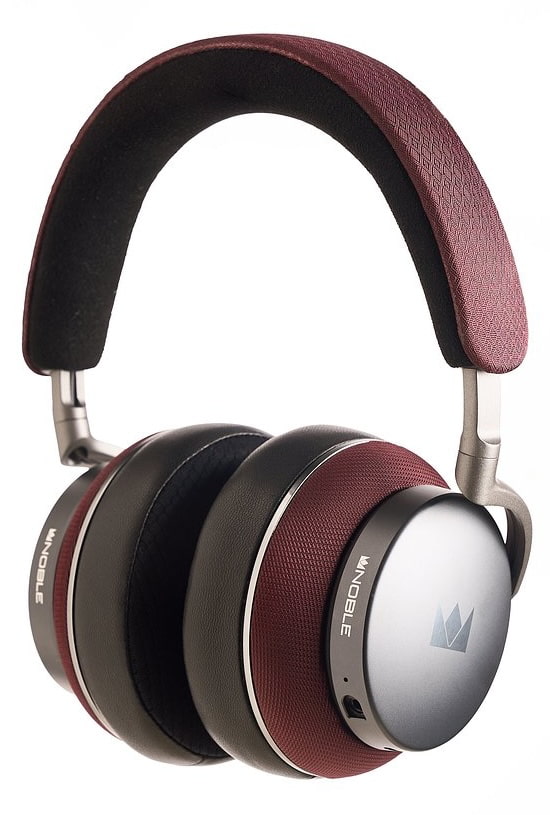
Noble Audio is using CanJam Singapore 2026 to introduce the FoKus Apollo Pro, a limited run version of its hybrid wireless headphone platform. Building on the original FoKus Apollo, the Apollo Pro adds upgraded acoustic tuning, more premium fabrics and finishes, new voice prompts, and updated ear pads with two new color choices.
However, its unique driver configuration remains the key point. Most premium wireless headphones focus on ANC, app features, battery life, and codec support, but Noble is leaning harder into acoustic design with a hybrid driver platform that combines dynamic and planar magnetic technology in a wireless over-ear portable design.
Debuting May 16th and 17th, the FoKus Apollo Pro is aimed at listeners who want a more refined version of the Apollo concept. However, its limited run release suggests Noble is testing new tuning before committing to a full production roll-out, since the original Apollo model has been quite popular and won numerous industry awards.
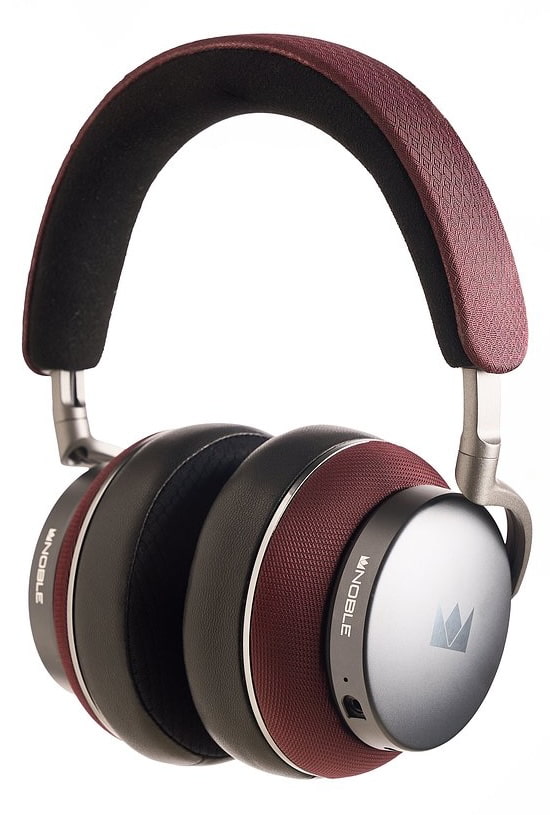
Refined Hybrid Driver Architecture
At the core of the FoKus Apollo Pro is Noble’s hybrid driver configuration, which pairs a dynamic driver with a planar magnetic driver in each earcup. The design is intended to combine the bass weight and impact typically associated with dynamic drivers with the speed, clarity, and detail retrieval often associated with planar magnetic designs.
Tuning
The Apollo Pro also introduces updated acoustic tuning intended to improve tonal balance, clarity, and overall presentation. Noble says the changes deliver deeper and tighter bass, improved detail retrieval, and a more open soundstage. Combined with Noble’s wireless platform and upgraded construction, the Apollo Pro is positioned as a more refined version of the Apollo for both home and portable listening.
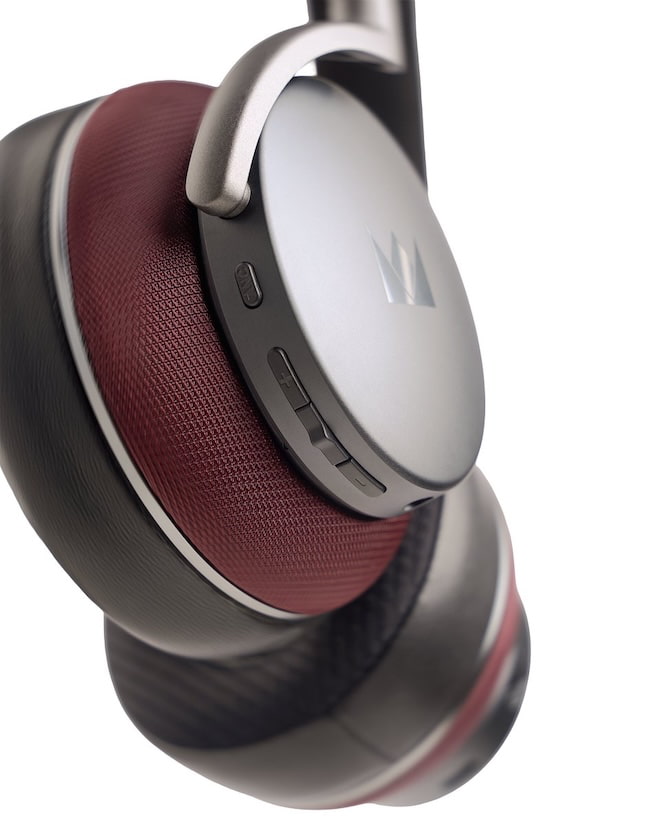
Elevated Materials & Premium Craftsmanship
Noble has also updated the Apollo Pro’s materials and finishing details, with changes focused on appearance, comfort, and portability.
The Apollo Pro uses Italian Alcantara on the headband, revised gunmetal accents, upgraded fabric cabling, and new ear pad materials. Noble says the more breathable fabric on the ear cushions is intended to reduce heat buildup during longer listening sessions.
The packaging has also been made more compact, giving the Apollo Pro a more travel friendly footprint while preserving the premium presentation expected from a limited run release.
Voice Prompt
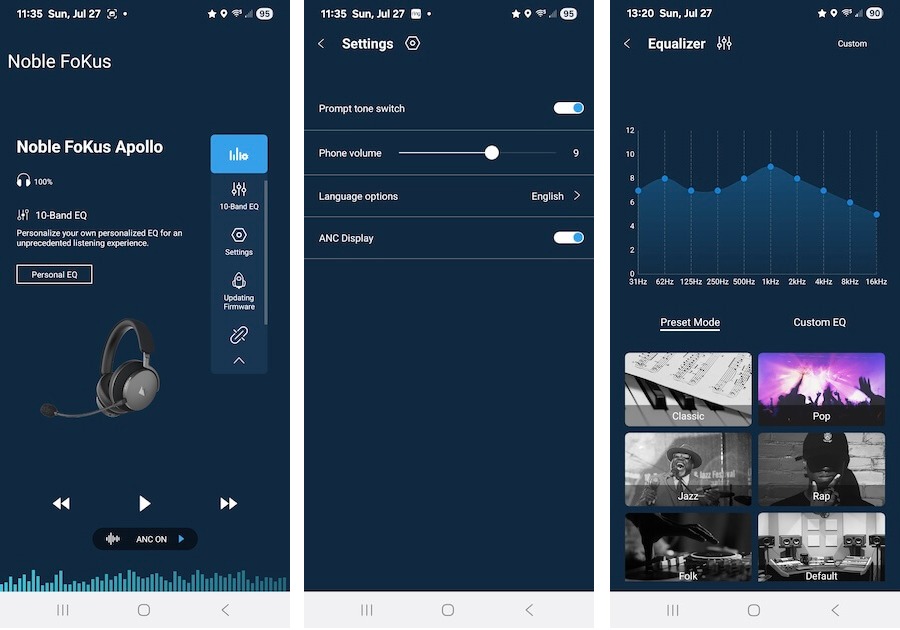
Apollo Pro also introduces Voice Prompt functionality, replacing traditional notification tones with spoken voice confirmations for key functions and mode changes, including ANC activation and other onboard controls.
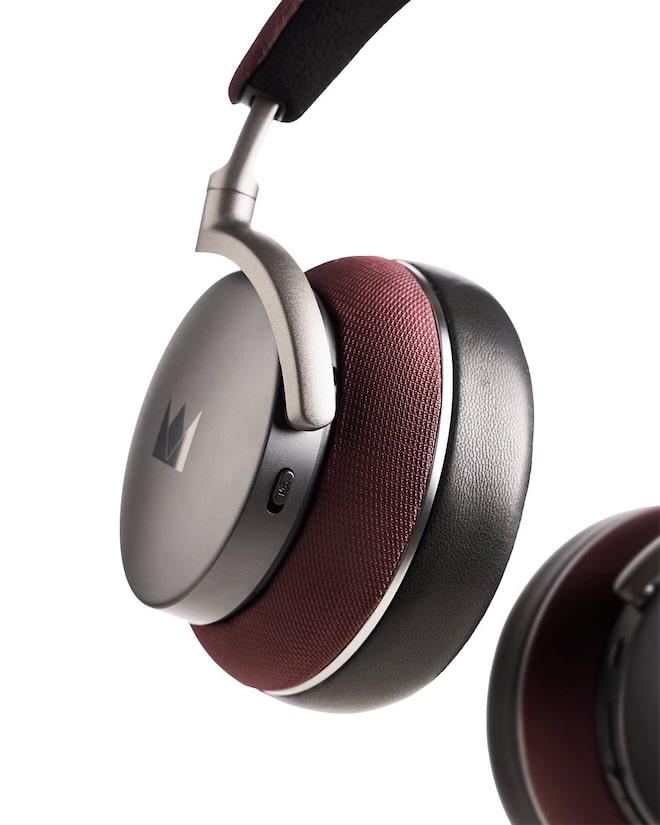
Noble’s Flagship Wireless Platform
Powered by the Qualcomm QCC3084 chipset and compatible with the Noble FoKus companion app, the Apollo Pro combines high-end wireless audio performance with everyday usability and customization. With the Noble FoKus App (iOS, Android), users can manage playback settings, EQ adjustments, and access additional headphone functionality.
Wireless support includes LDAC, AAC, aptX, aptX HD, and SBC Bluetooth codecs, giving the Apollo Pro broader compatibility across Android, iOS, and other Bluetooth sources.
Pro Tip: The Apollo Pro also provides wired connectivity via an included 3.5 mm cable with 6.3 mm and 4.4mm adapters.
Comparison
| Noble Model | FoKus Apollo Pro (2026) | FoKus Apollo (2024) |
| Product Type | Wireless Headphones | Wireless Headphones |
| Price | $699 | $649 |
| Drivers | 40mm dynamic driver (bass)
14.5mm planar magnetic driver (mids/treble) |
40mm dynamic driver (bass)
14.5mm planar magnetic driver (mids/treble) |
| Bluetooth Chipset | Qualcomm QCC3084 | Qualcomm QCC3084 |
| Bluetooth Version | 5.3 | 5.3 |
| Audio Codecs | LDAC, AAC, aptX, aptX HD, SBC | LDAC, AAC, aptX, aptX HD, SBC |
| Noise Cancellation | Hybrid ANC technology, up to -35dB. | Hybrid ANC technology -20dB to -35dB |
| Microphones | 3 microphones per side (integrated) + detachable boom microphone | 3 microphones per side (integrated) + detachable boom microphone |
| Frequency Response | 10 Hz – 40 kHz | 10 Hz – 40 kHz |
| Impedance | 32 Ohms | 32 Ohms |
| Connectivity | Bluetooth 5.3, 3.5mm wired input, USB-C | Bluetooth 5.3, 3.5mm wired input, USB-C |
| Pro-Specific Upgrade Enhancement Materials | Premium Italian Alcantara on the headband Refined, more breathable, replaceable synthetic goatskin earpads |
Frame Material: Anodized Aluminum Earpads Memory foam Korean Protein leather, replaceable |
| Design | Gunmetal Grey finish on the faceplate and frame, with a lighter, more durable anodized aluminum frame | Aluminum cups, aluminum gimbals, a steel headband, and comfortable, replaceable protein leather/memory foam ear pads |
| Tuning | Refined acoustic tuning for enhanced audio performance | Not Indicated |
| Battery Life | Up to 80 hours (ANC off) 60 hours (ANC on) at 50% volume. |
Up to 80 hours (ANC off) 60 hours (ANC on) at 50% volume. |
| Included Accessories | Compact carry case Detachable boom mic 3.5mm cable 6.3mm adapter 4.4mm adapter Airplane adapter |
EVA Carrying Case Detachable boom mic 3.5mm cable 6.3mm adapter Airline Adapter |
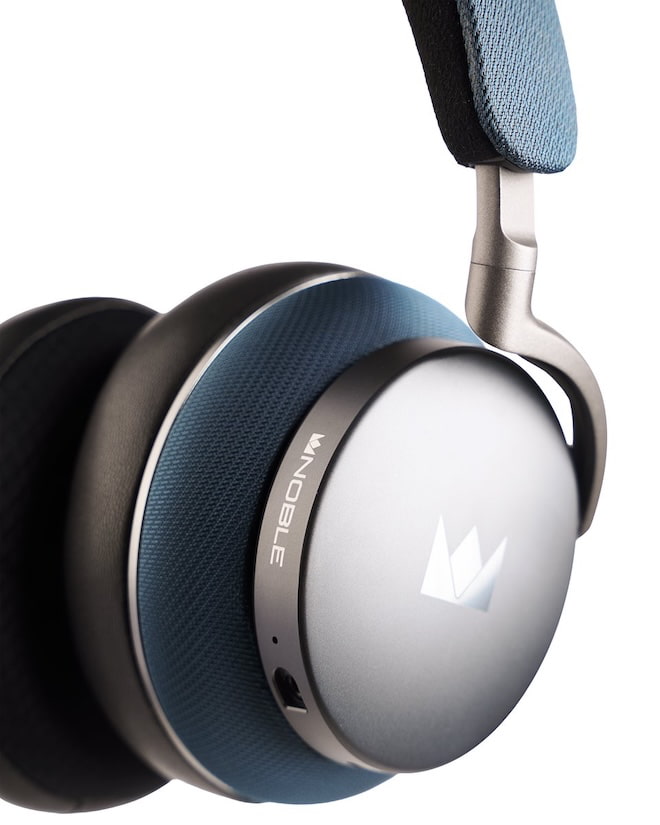
The Bottom Line
The FoKus Apollo Pro gives Noble a more serious foothold in full size wireless headphones by leaning on something most rivals are not offering: a hybrid dynamic and planar magnetic driver platform inside a Bluetooth headphone. Add LDAC, AAC, aptX, aptX HD, and SBC support, upgraded materials, revised tuning, Italian Alcantara, more breathable ear pads, and limited run positioning, and this becomes more than a cosmetic Apollo refresh.
What appears to be missing is the broader ecosystem strength of Apple, Sony, Sonos, Bowers & Wilkins, and Bose. Those brands bring deeper app integration, stronger ANC reputations, spatial audio platforms, and mainstream retail muscle. Noble’s play is different: better driver story, enthusiast credibility, premium materials, and a more focused sound-first approach.
Price & Availability
The Noble FoKus Apollo Pro is being shown at CanJam Singapore, May 16-17, 2026. Global availability is available at NobleAudio.com and selected retailers for $699 USD / £649 / €749. However, these may not stick around long as only a limited production run was announced — not a permanent addition to the lineup.
The original Noble FoKus Apollo is available for $649 at Amazon.
Related Reading:

What’s going on with the U.S. job market? “The economy is growing. Unemployment is low,” notes the Washington Post. “And yet, for millions of workers, finding a job has become harder than at almost any other point in decades,” with the hiring rate “well below pre-pandemic levels for more than a year.”
Part of the problem? “Of the net 369,000 positions added across the entire economy since the start of 2025, health care alone accounted for nearly 800,000 — meaning every other sector, taken together, shed jobs.” By the end of 2025 nearly half of college graduates ages 22 to 27 were working at jobs that didn’t require a degree, according to stats from New York’s Federal Reserve Bank.
The headline unemployment rate, at 4.2%, looks healthy. But that figure has been buoyed by a shrinking labor force: Fewer people are actively looking for work, which keeps the rate down even as hiring slows…
[Some large tech companies] are trying to recalibrate after their hiring sprees of 2021 and 2022, when many had raised pay, offered flexible schedules and signed people quickly… Higher interest rates have also made expansion more expensive, pushing many firms to invest in technology rather than headcount. Another reason hiring has slowed is uncertainty about AI. Even though the technology has not yet replaced large numbers of workers, it is already shaping how companies think about hiring. “I don’t think this is AI displacement,” said Ben Zweig, chief executive of Revelio Labs, a workforce data company. “What we’re seeing is anticipatory.” Instead of rushing to bring on new workers, some firms are waiting to see how the technology evolves and which tasks it will eventually take over.
A 39-year-old web developer tells the Post it took 453 job applications to get a handful of interviews and two offers. And a journalism school graduate said they’d sent hundreds of job applications but most led nowhere, and they’re now couch-surfing to save money.
But the problem seems even worse for young people. One 18-year-old told the Post that in a year and a half of job searching, they’d yet to even meet an employer in person.
The unemployment rate for people ages 22 to 27 who recently completed college hit 5.6% in the final months of 2025 — well above the 4.2% rate for all workers, according to national data from the Federal Reserve Bank of New York… At one point last summer, new workforce entrants made up a larger share of the unemployed than at any point since the late 1980s — higher even than during the Great Recession. When hiring slows, the door closes first on those without an existing foothold. For the class of 2026, the timing could hardly be worse.
“It is getting increasingly clear that young people are being more affected by AI than older workers,” Zweig said. Companies are not eliminating jobs at scale, but many are slow to hire junior workers. At the same time, older workers are staying in the labor force longer, leaving fewer openings for new arrivals. Even when jobs are available, the bar has shifted. Positions once considered entry level now often require several years of experience, technical expertise and familiarity with AI tools. With fewer openings and more applicants, companies are holding out for candidates who can do the job immediately and need little training… Employers are also looking for a different mix of skills. An analysis of millions of job postings by Indeed found that communication skills now appear in nearly 42% of all listings, while leadership skills feature in nearly a third — capabilities that are harder to prove on a résumé and harder still to demonstrate without an existing professional network. Christine Beck, a career coach who works with early-career job seekers, said employers are asking more of the people they do hire.
Tech
The Bear season 5: release date, likely cast, plot rumors, and everything else we know about the Hulu show’s final chapter
The Bear season 5: key information
– Releasing in late June
– Set to debut on Hulu and Disney+
– No trailer unveiled yet
– Main cast all expected to return
– Will pick up after last season’s finale
– Unclear if any spin-offs are in development
The Bear season 5 is the last course on the hit FX Networks show’s menu. Indeed, the culinary comedy-drama will bow out after serving its final meal on June 25/26, so we’ll have to savor every morsel once it’s released.
The Bear season 5 release date
The final season. FX’s #TheBear premieres June 25 on Hulu and Hulu on Disney+.For bundle subscribers. Terms apply. pic.twitter.com/8eFxuxv57uMay 6, 2026
The Bear season 5 will debut on Thursday, June 25, in North and South America, and Friday, June 26, everywhere else.
Latest Videos From
In the US, it’ll premiere on Hulu, while the rest of the world can check it out on Disney+. All eight episodes are set to drop at once, too, so you’ll be able to binge-watch them all on two of the best streaming services on launch day.
The Bear season 5 trailer: is there one?

No. However, with The Bear 5 due out in just over a month, I suspect a teaser will be released very soon.
Will we get an actual trailer ahead of launch as well? Maybe, but that’s dependent on how much footage FX wants to show before the final season airs. Regardless, once a trailer of some description is shared online, I’ll update this section.
The Bear season 5 likely cast

Here’s who I expect to see in The Bear season 5:
- Jeremy Allen White as Carmen ‘Carmy’ Berzatto
- Ebon Moss-Bachrach as Richard ‘Richie’ Jerimovich
- Ayo Edebiri as Sydney ‘Syd’ Adamu
- Lionel Boyce as Marcus Brooks
- Liza Colón-Zayas as Tina Marrero
- Abby Elliot as Natalie ‘Sugar’ Berzatto
- Matty Matheson as Neil Fak
- Edwin Lee Gibson as Ebraheim
- Oliver Platt as Jimmy ‘Cicero’ Kalinowski
- Jamie Lee Curtis as Donna Berzatto
- Molly Gordon as Claire Dunlap
- Corey Hendrix as Gary ‘Sweeps’ Woods
- Gillian Jacobs as Tiffany ‘Tiff’ Jerimovich
- Annabelle Toomey as Evie Jerimovich
- Chris Witaske as Pete Katinsky
- Ricky Staffieri as Theodore ‘Teddy’ Fak
- Will Poulter as Luca
- Rene Gube as Rene
- Sarah Ramos as Jessica
- Andrew Lopez as Garrett
- Carmen Christopher as Chester
- Robert Townsen as Robert Adamu
- Adam Shapiro as himself
Like previous seasons, there are bound to be plenty of guest stars — new and returning — who’ll show up for The Bear‘s final round, too.
Where the latter is concerned, Bob Odenkirk’s Lee, Sarah Paulson’s Michelle, John Mulaney’s Stevie, Brian Koppelman’s Nicholas, aka ‘The Computer’, Rob Reiner’s Albert, and Josh Hartnett’s Frank seem like safe bets. Depending on how its primary story and subplots play out, it’s also possible that Brie Larson’s Francie, Olivia Colman’s Andrea, John Cena’s Sammy, and Joel McHale’s David could return.
Last but by no means least, no season would be complete without Jon Bernthal’s Michael ‘Mikey’ Berzatto appearing via flashbacks, too.
Bernthal’s deceased character recently starred in a special flashback episode of The Bear, titled ‘Gary’, alongside Moss-Bachrach’s Richie. Given that season 5 will be the show’s big send-off, I highly doubt that ‘Gary’ is the last time we’ll see Mikey before The Bear‘s last-ever end credits crawl.
The Bear season 5 story rumors and predictions

Full spoilers immediately follow for The Bear season 4.
Here’s this season’s plot brief: “The Bear season 5 picks up the morning after Sydney, Richie, and Natalie discover that Carmy has quit the food industry, leaving the restaurant to them.
“With no money, the threat of a sale, and a torrential storm in their way, the new partners must band together with the rest of the team to achieve one last service, hoping they’ll finally earn a Michelin star. Ultimately, they learn that what makes a restaurant ‘perfect’ might not be the food, but the people.”
As the above synopsis lays out, chief among the biggest questions we have heading into this season is what lies in store for the titular restaurant and its former head chef.
Indeed, with Carmy quitting, it’s now up to new co-partners Sydney, Richie, and Natalie to keep The Bear’s head above water. The good times have started to flow at the eponymous eatery, but, with time running out to repay Cicero for his investment in the business, as well as the outward pressure to turn it into a success story, it’ll take everyone — Carmy notwithstanding — to not only keep The Bear afloat, but ensure it becomes an established part of the Chicago food scene.
As for the retiring chef himself, he’s set to embark on a journey to learn who he is outside of the kitchen, and hopefully make peace with his demons and trauma-filled past. Of course, that won’t be easy, but with Carmy finally putting in the legwork to become a better and more emotionally stable person in season 4, he could get the happy ending he deserves.

Other narratives and character-driven moments need to be resolved before the series ends, too.
For one, everyone involved in the titular restaurant will continue working towards earning that elusive Michelin star that they desperately crave. Key to that will be Ebraheim’s plan to expand the business’s daytime sandwich window, aka The Beef, which will help increase its revenue streams.
Meanwhile, we need to see if Sydney and Richie can truly step up and become the leaders that The Bear needs them to be. Tina’s growth into another vital cog in the restaurant’s machine, Marcus’ decision about whether to stay or leave to start his own bakery, and Natalie’s juggling of her professional and personal lives are other major character arcs that have to be explored and wrapped up.
Lastly, The Bear season 5 has to address two of the show’s biggest ‘will they, won’t they’ situations – those involving Carmy and Claire, and Richie and Jessica.
Where the former is concerned, the pair reconciled after Carmy’s apology, but their relationship, while now amicable, doesn’t seem like it can go back to the way it was in season 2. For many viewers, keeping them apart will be a relief — after all, some of the fanbase don’t like Claire as a character. Regardless, I can’t see a way for Carmy and Claire to get back together, and that might be for the best.
As for Richie and Jessica, there’s been a spark between them since season 3. And, with Richie’s ex-wife now married to Frank, Richie’s growing confidence as The Bear’s Maitre d’, and Richie and Jessica growing closer with each passing season, it would make sense for them to finally get together before the show ends.
Are there any spin-offs of The Bear in development?

Currently, there’s been no public acknowledgement that any spin-offs are in development. It’s always possible, though, that one-off specials or an offshoot could be made.
Indeed, just recently, a flashback chapter titled ‘Gary’, which starred Bernthal’s Mikey and Moss-Bachrach’s Richie, was shadow-dropped on Hulu and Disney+. Clearly, if there’s a story worth telling, showrunner Christopher Storer will tell it.
Of course, whether we’ll get a sequel show or other standalone episodes is up for debate. Maybe Storer will consider The Bear season 5 as the final piece of the puzzle once it airs and allow its eclectic cast of characters to proverbially ride off into the sunset. He could also decide that, with the passage of time, the time is right to reunite us with certain individuals post-The Bear, or even give us more prequel adventures regarding Mikey before The Bear‘s beginning.
Right now, then, nobody knows if The Bear franchise will continue after the main show’s final season — but you’ll certainly hear me and many other fans shout “Yes, chef!” if we’re ever asked if we want to see Carmy and company again down the road.

Follow TechRadar on Google News and add us as a preferred source to get our expert news, reviews, and opinion in your feeds.

Business2 minutes ago
ZOZO, Inc. 2026 Q4 – Results – Earnings Call Presentation (OTCMKTS:SRTTY) 2026-05-16

Entertainment4 minutes ago
The Most Famous Lost Film in Oscar History Still Hasn’t Been Found

NewsBeat7 minutes ago
Taiwan reaffirms independence despite Trump warning

NewsBeat2 months ago
Manchester United reach agreement with Casemiro over contract clause amid transfer speculation

Politics1 month ago
US brings back mandatory military draft registration

NewsBeat1 month ago
Steven Gerrard disagrees with Gary Neville over ‘shock’ Chelsea and Arsenal claim | Football

News Videos13 minutes ago
Your family s total depletion shows your financial weakness. What does it have to do with

News Videos32 minutes ago
Lakhimi Baruah, the Padma Shree awardee, uplifting Assamese women through financial independence!

News Videos39 minutes ago
Japan Created a Generation That Cannot Spend Money
-

 Crypto World16 hours ago
BloFin War of Whales 2026 Grand Prix opens registration for $5M trading championship
-

 Fashion5 days ago
Coffee Break: Travel Steam Iron
-

 Fashion23 hours ago
Weekend Open Thread: Theory – Corporette.com
-

 Politics5 days ago
What to expect when you’re expecting a budget
-

 Fashion6 days ago
What to Know Before Buying a Curling Wand or Curling Iron
-

 Tech6 days ago
Auto Enthusiast Carves Functional Two-Stroke Engine from Solid Metal
-

 Crypto World22 hours ago
E-Estate Announces 1 Year Live: Washington DC Summit as Real Estate Tokenization Enters Its Next Phase
-

 Tech1 day ago
Tech Moves: Microsoft AI leader jumps to OpenAI; former AI2 exec joins Meta; and more
-

 Tech5 days ago
GM Agrees To Pay $12.75 Million To Settle California Lawsuit Over Misuse Of Customers’ Driving Data
-

 Crypto World6 days ago
CZ says US crypto rivals tried to block Trump pardon
-

 Tech5 days ago
GM agrees to $12.75M California settlement over sale of drivers’ data
-
Crypto World3 days ago
Bitcoin Suisse expands with Digital Asset License and Investment Business Act Registration Approval in Bermuda
-

 Politics4 days ago
Pakistan to enter Chinese capital market as war inflation bites
-

 Crypto World2 days ago
Google’s Gemini AI Predicts Incredible Solana Price by the End of 2026
-

 Crypto World4 days ago
Bitcoin Suisse expands with Digital Asset License and Investment Business Act Registration Approval in Bermuda
-

 Politics6 days ago
Sky News Presenter Says Keir Starmer Is Not Waving But Drowning
-
Crypto World7 days ago
Hacker Drains $5.9M From Ethereum Liquidity Provider TrustedVolumes
-
 Business1 day ago
H&R Real Estate Investment Trust (HR.UN:CA) Q1 2026 Earnings Call Transcript
-

 Fashion7 days ago
Amazon Sundays: Spring Glassware & Vases
-
 Entertainment6 days ago
Prime Video’s Forgotten but Brilliant 2-Part Horror Anthology Is a Perfect Binge
You must be logged in to post a comment Login