The Paddle-Out Protest, which took place today (May 16) in York city centre attracted crowds as part of a National Day of Action by Surfers Against Sewage.
Campaigners said that the Ouse had been chosen as it was the third most polluted river in England and Wales, with over 18 thousand hours of sewage discharged each year – something that Yorkshire Water has said it is ‘determined’ to play its part in addressing.
RECOMMENDED READING:
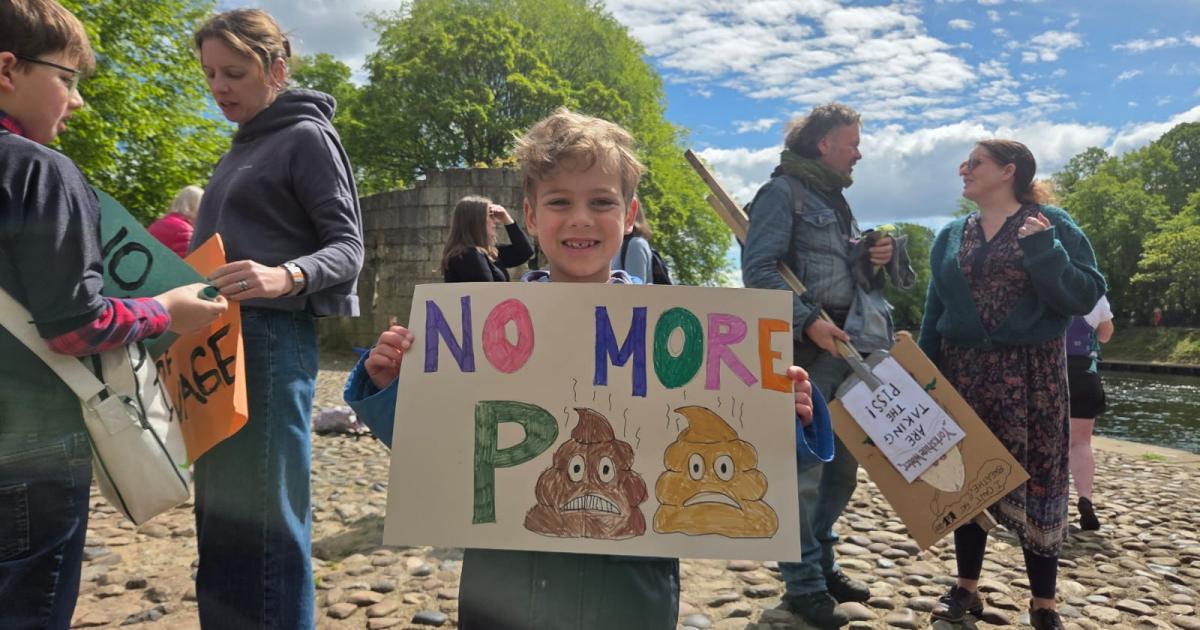
Protesters of all ages gathered on both water and land carrying homemade banners which read ‘The Grand Old Poop of York’ ‘Save Our Rivers’ ‘Stop the S**t’ and more, as they called on decision makers to clean up the river.
Among the people campaigning for clearer waters were both York MPs – Rachael Maskell and Luke Charters, alongside councillors and local environmental leaders.
Rachael, who also spoke about the issue in parliament earlier this week, opened the speeches – criticizing Yorkshire Water by calling out bonuses to top executives and increased bills.
![]() A group of friends who were visiting from Harrogate to join the protest (Image: Alice Kavanagh)
A group of friends who were visiting from Harrogate to join the protest (Image: Alice Kavanagh)
She said: “If we look at this fantastic river of ours, we know that last year there was 18 and a half thousand hours of sewage dumping into our river. The Poos in the Ouse must stop.
“The Foss has an average of 4.4 sewage dumps every week, but this river – the Ouse – has 10.4 dumps every day. That equates to 1.59 years each year across the 49 sites.”
This sentiment was echoed by Luke Charters who added that the Foss, despite being clearer than the Ouse, is the river with the most pharmaceutical pollutants in Europe and called on Yorkshire Water bosses to return their bonuses.
![]() Protestors with their stop the sh** signs (Image: Alice Kavanagh)
Protestors with their stop the sh** signs (Image: Alice Kavanagh)
The river protest – made up of kayakers, paddle boarders, and rowers – led the group on the water whilst the others travelled up from Scarborough Bridge to the Blue Bridge on the Foss – stopping at bridges to spread their message.
As they walked through the city centre, the group chanted: “What’s in the water? There’s poo in the water. What’s the solution? End sewage pollution.”
Organiser Robin Norton said that, as a rower, people who use the river for water sports were more aware of what was happening and were keen to raise awareness.
![]() The group as they passed by North Street Gardens (Image: Alice Kavanagh)
The group as they passed by North Street Gardens (Image: Alice Kavanagh)
He said “It’s not obvious as you walk past, but the infrastructure around our river has been underinvested for 30 years.
“It’s not good for us on the water, but it’s not good for nature either. The life has been stripped out of this river and it makes it unsustainable for fish and other creatures to be in there.
“Somethings got to change and we need to start it here. There are 56 other protests going on today, but lots of them are on the coast; Surfers Against Sewage have been great protecting our coastline, and we need to start protecting our rivers now.”
![]() Some of the signs (Image: Alice Kavanagh)
Some of the signs (Image: Alice Kavanagh)
In response to the protest, a Yorkshire Water spokesperson that the company are currently investing £1.5 billion into storm overflows across the region and that this follows a £180m programme that made improvements at 118 overflows.
The organisation said that, following this project, they reduced the number of discharges into watercourses by 24.5% in 2025, following on from a 12% reduction in 2024.
It also added that they were ‘picking up the pace’ by investing over £250m in coastal schemes, including one in Scarborough.
![]() A boat protest (Image: Alice Kavanagh)
A boat protest (Image: Alice Kavanagh)
The spokesperson said: “We understand the strength of feeling around discharges to watercourses and coastal areas and are investing heavily to bring the number of discharges down.
“In York specifically, later this year we will be investing in 3 storm overflows, with further schemes planned over the next few years. The first of these, at Landing Lane, is due to begin in June.
![]() A paddleboarder ‘disinfecting’ the river ahead of the protest (Image: Alice Kavanagh)
A paddleboarder ‘disinfecting’ the river ahead of the protest (Image: Alice Kavanagh)
“It is important to note that water quality can be impacted by many factors beyond storm overflow operation, but we’re working with local stakeholders and community groups to identify and tackle these to do everything that we can to improve the health of our rivers.
“We are determined to play our part to improve water quality in the region’s watercourses, including the Ouse”.

























































You must be logged in to post a comment Login