The artificial intelligence boom is leading to fights in some states over growing utility profits, as governors, attorneys general and others protesting rising electricity bills say cash-strapped residents are stuck in a broken system.
Officials and lawmakers in at least six states — including Arizona, Indiana, Maryland, New Jersey, New York and Pennsylvania — are going to new lengths to try to block rate increases proposed by utilities. Some are pressing utilities to completely change their model for financing major system upgrades.
The push comes during a midterm election year in which affordability is the leading theme in Democrats’ attempts to loosen Republicans‘ control of Washington.
Arizona Attorney General Kris Mayes, a Democrat who is seeking reelection this year, is challenging two utility rate increase requests in front of the state’s utility regulatory board.
Advertisement
“I felt like it’s never been more important to stand up against the blatant corporate greed of our monopoly utilities in Arizona,” Mayes said in an interview.
The fights are getting noticed on Wall Street
The voracious energy demands of AI data centers have driven up electric prices in some regions and launched a moneymaking energy-sector construction boom.
For years, consumer advocates have tried to challenge the size of a utility’s investment return in front of regulators. But maybe not like this, consumer advocates say.
Advertisement
“We’ve entered into this era of expensive energy and (demand) growth, and we’re seeing utility profits at record highs and rising utility bills,” said Matt Kasper of the Energy and Policy Institute, which pushes utilities to keep rates low and use renewable energy sources.
Utilities were long viewed as a stable haven for investors, with a reliable source of income and predictable demand. Because of that lower risk, the utility’s sector investment returns are typically on the low end compared to other sectors, analysts say.
However, utilities — many of which are owned by multibillion-dollar, for-profit parent companies — have seen share prices perform particularly well during the data center expansion.
The investment returns that utilities get from regulators aren’t the sole reason consumers’ bills are rising, but researchers suggest they are a contributing factor. In March, the Energy and Policy Institute issued a report that said the profits of 110 for-profit utilities rose from just under $39 billion in 2021 to over $52 billion in 2024.
Advertisement
Mark Ellis, a former utility executive-turned-consumer advocate, said about 10% of the typical customer bill is what he called a for-profit utility’s “excess profit,” above what might be considered reasonable under long-standing Supreme Court precedent.
Instead of regulators setting returns above what the market might require, utilities should instead shop for the lowest-cost investor cash, much like someone might shop for the lowest interest rate on a loan, Ellis said.
Paul Ferraro, an economics professor at Johns Hopkins University, said that targeting utility investment returns is a political action, not an economic action.
“That’s an action that’s aiming to address the deep social disagreements we have about who should benefit from essential infrastructure,” Ferraro said. “But it’s not going to address the key challenges that the electricity sector is facing.”
Advertisement
That includes investment in modernization, expansion, renewable energies and distributed sources of power, Ferraro said.
‘Affordability’ has reached corporate earnings calls
Travis Miller, an energy and utilities analyst for Morningstar, said utility executives on earnings calls are emphasizing efforts to cut costs or protect residential customers from the cost to supply electricity to data centers.
“Affordability is probably the number one issue that executives and investors are thinking about right now in the utility sector,” Miller said.
Advertisement
If rates aren’t affordable currently, there’s no way that utilities can get the rate increases they need to boost earnings and dividends for investors, Miller said.
Utilities point to federal data showing that home electricity bills as a proportion of household income have fallen in the past couple decades. They defend the investment returns they are granted by state regulators as critical to raising the cash they need to appropriately maintain electric grids and ensure reliability for millions of people.
They also warn that investors will simply send their cash to utilities in other states that promise higher returns.
Critics call that fearmongering.
Advertisement
Earlier this month, the New Jersey Board of Public Utilities launched what its president, Christine Guhl Sadovy, called one of the most consequential regulatory reviews in a generation, to question how utilities “should earn revenue in a modern energy system.”
In recent weeks, Pennsylvania Gov. Josh Shapiro pressured PECO, the Philadelphia-area utility subsidiary of Exelon Corp., to withdraw a 12.5% rate increase, or $20 per month extra for the average residential customer. Shapiro, a Democrat running for reelection this year, then issued a letter to utility executives, taking a whack at utility profits and saying that the “20th century utility model is broken.”
“We can no longer simply prioritize corporate profitability to drive infrastructure development,” Shapiro wrote.
In a note to investors, one analyst called it “Quaker State Sticker Shock,” and the share prices of companies that own Pennsylvania-based utilities lagged their peers in the following days.
Advertisement
For its part, Exelon — the Chicago-based parent of Commonwealth Edison, PECO, Baltimore Gas and Electric and several other utilities — emphasized that it recognizes the importance of affordability.
Calvin Butler, Exelon’s president and CEO, told analysts on its first-quarter earnings call May 6 that it was committed to justifying what it spends and keeping energy bills as low as possible. Its decision to withdraw its rate increase request came after conversations with “stakeholders” who said, “Hey, if you could partner with us to address the affordability issue and lean in, timing is not the best right now,” Butler said.
In Indiana, Republican Gov. Mike Braun appointed a new slate of utility commissioners with a mission to face down rate increases.
Their first big test is a request by AES Indiana for a 10.1% increase, or $193 million a year more from ratepayers, said Ben Inskeep, program director for the Indianapolis-based consumer advocate Citizens Action Coalition.
Advertisement
As part of it, AES Indiana — whose parent company is being taken private in a $33.4 billion deal led by private investment giant BlackRock — sought a 10.7% return on its cash.
Inskeep said an 8% return — instead of 10.7% — would slash the proposed rate increase nearly in half.
In Arizona, Mayes is challenging a pair of 14% proposed increases that she said could be dramatically reduced if the companies are simply paid the cost to maintain reliable service.
“It’s becoming unbearable for the people in Arizona,” Mayes said. “And I think we have to fight back.”
Advertisement
___
Follow Marc Levy at http://twitter.com/timelywriter
TfL said on its site that no service is expected on the:
Circle line,
Piccadilly line,
Metropolitan line between Baker Street and Aldgate, and
the Central line between White City and Liverpool Street
Though “Service is expected on all other lines,” this will be reduced. The TfL added that “disruption to journeys” is expected; disruptions may continue later into the week.
What other transport links are open?
Services including buses, the Elizabeth line, the DLR, and the London Overground aren’t going to be on strike during these days. They are, however, predicted to be incredibly busy.
Why are these strikes happening?
Advertisement
It started with a four-day work week.
The Associated Society of Locomotive Engineers and Firemen (ASLEF), a train drivers’ union which represents thousands of Tube drivers, previously campaigned for a four-day work week, which the TfL recently began trialling on an optional basis in their Bakerloo line.
But RMT, a trade union covering the public transport sector more broadly, has said that they’re not on board with the “compressed” work week, claiming it packs five days’ work into four in a manner which could impact the safety of drivers and passengers.
RMT members are the ones striking in these upcoming cases.
Advertisement
The union also claimed it could mean drivers only get 24 hours’ notice before their shifts are announced and that TfL “U-turned” on negotiations.
In response, TfL pointed out that the four-day offering is completely optional and said it could help to make services more reliable and flexible.
Sally re-opened the Ebor Inn at Bishopthorpe on Wednesday, which had been closed since last year.
Until his sad death of Covid in 2021, the popular pub had been run by her late father Gordon Watlins for 39 years.
The pub’s owner, Tadcaster-based Sam Smith’s Brewery, recently gave the pub a new look with an exterior restoration of its brickwork. Further renovations have taken place inside, with more planned.
Sally posted on social media at the weekend that she is ‘astounded’ at the support received.
She said: “I sat down at around 3pm with my friend who had never been to the Ebor Inn before. I was thinking I’ll have an hour catch up as I’d not seen her for a while and then one by one you lovely people started coming in…
“Before I knew it it was 7.30pm!!! And still you kept coming in….
The pub exterior (Image: Apple Photos Clean Up)
“What an afternoon/evening!! I am totally overwhelmed by the numbers that have come through the door not just today (although today was insane) but every single day we’ve been open!!!
Advertisement
“I have loved every minute… the support is just amazing! I’m so hoarse from talking so much!!! But every moment is so heartwarming and to hear you all speak so highly of my late father. I love it!”
Sally added: “We know it’s not just a job for me and I can confirm that I am eternally grateful and flattered by everyone’s support. I hope you all keep coming in and we can keep the pub going with this wonderful sentiment.”
Among the dozens who have commented underneath on Facebook, one said: “I am so glad that everything has gone well for you and the team at the Ebor. It is such a lovely pub and you deserve every success for taking the challenge on, Gordon would be so proud of you. Well done and keep up the good work.”
As the Press previously reported, initially, the Ebor Inn will be a ‘wet’ pub, meaning drinks only, before it starts serving food from June.
Advertisement
Press advert (Image: NQ)
The re-opening comes amid others, including the Blacksmith Arms at Skelton, near York, which is also owned by Sam Smith’s Brewery.
The Punch Bowl at Marton-Cum-Grafton, now owned by Boroughbridge hospitality entrepreneur Simon Wade, also reopened this month after a major refurbishment.
However, as reported earlier today, the tenants of the community-owned village pub, the Black Lion at Skelton on Ouse will be leaving venue this Saturday, blaming an ‘unsustainable’ business model.
One person who was seriously injured was in the house at the time of the crash
10:54, 18 May 2026Updated 11:00, 18 May 2026
Two people have been seriously injured after a car crashed into a house. Cambridgeshire Police and paramedics were called to the crash in Paston Ridings, Peterborough at around 6pm on Sunday (May 17).
A blue Ford Mondeo was driving along the road when it crashed into a house and stationery vehicles. The driver of the car, a 40-year-old man from Peterborough, was taken to hospital with serious injuries.
A 70-year-old woman, who was in the house at the time, was also taken to hospital with serious injuries. Cambridgeshire Police is appealing for information after the incident.
Advertisement
Anyone with information or dashcam footage should call police on 101 and quote Operation Perranwell. Alternatively, they can report it online.
The 16-year-old daughter of Tyson and Paris Fury and her new husband were spotted at Manchester Airport days after tying the knot on the Isle of Man
Venezuela Fury has been spotted at Manchester Airport as she heads off on her honeymoon after marrying her fiancé, Noah Price, over the weekend.
Advertisement
The eldest child of Tyson and Paris Fury tied the knot in a grand affair on the Isle of Man on Saturday (May 16), The extravagant ceremony at the Royal Chapel of St John the Baptist on the Isle of Man, where the Fury family recently relocated after giving up on life in Morecambe, Lancashire.
Wythenshawe-born boxer Tyson arrived at the church with the bride in a vintage wedding car, while his wife Paris helped make sure everything was in place ahead of the ceremony, spotted outside where the church was decorated with an archway of blue hydrangeas and yellow roses, and a long blue carpet had been rolled out to the entrance.
Click here to get the biggest stories straight to your inbox in our Daily Newsletter
Venezuela wore a stunning white lace fishtail dress with a 50-foot-long train for her big day, and there was even a glimpse of the infamous white Crocs the bride said she would wear, despite her mum’s uncertainty that it was the right look for the wedding. Her now-husband, meanwhile, was sporting a smart white suit, while his new father-in-law looked dapper in a black ensemble.
Advertisement
After the teens tied the knot, it is believed that the wedding reception took place at the nearby four-star Comis Hotel and Golf Club, which is where, according to reports, police were called after an incident occurred just moments after nineties popstar Peter Andre performed a string of chart-topping hits at the lavish wedding reception.
Now, the new Mr and Mrs Price have been seen at Manchester Airport on Monday (May 18) morning as they prepared to fly off on their honeymoon. A newly-married Venezuela was seen sporting a bright yellow co-ord, and kept her oversized black glasses from her big day, covering her eyes.
The couple were seen stopping for a spot of breakfast as they waited for their flight, and were also pictured browsing duty-free as they wandered the airport.
Advertisement
It comes after Tyson took to social media and reflected on his daughter’s big day. Late on Sunday (May 17), he shared a video on Instagram of the moment Venezuela made her entrance into the church, with him proudly walking alongside her. It also revealed that the choice of entrance song was The Notorious B.I.G track, Juicy.
Alongside the sweet clip, he wrote: “A beautiful day of celebrating my daughter’s wedding day, @venezuelaprice1, she was amazing & I’m very proud of her! We both were crying like babies,” (sic).
Advertisement
It came after Paris shared some snaps of Venezuela posing in a white less dress, which she wore as she prepared for the nuptials. Alongside the photos, the mum-of-seven gushed: “My beautiful girl, so proud I was of you today. You looked beautiful, @venezuelaprice1”.
In the lead-up to this year’s event, five countries’ national broadcasters announced they would not be competing at Eurovision in 2026 in protest over the decision to allow Israel to return.
On Saturday evening, the Belgian broadcaster VRT said it was not looking likely that it would be taking part in the contest next year if the situation remains as it currently is.
In a statement posted on VRT’s website, spokesperson Yasmin Van der Borcht said: “Today, the chances are slim that VRT will send an artist next year.
Advertisement
“We expect a strong message from the [European Broadcasting Union, the group of broadcasters which organises Eurovision every year] against war and violence and in favour of respect for human rights. These are the values that should unite the festival, and at the moment they are being overshadowed far too much.”
She continued: “We are asking for a clear framework for participation, an open debate, and a direct vote among EBU members. So far, we have received an insufficient response to this. Even during the semi-finals this week, we received no signal that the EBU is hearing our concerns.
“Naturally, we want to discuss this with other broadcasters. But if the EBU’s position does not change, the chances are slim that VRT will send an artist next year.”
HuffPost UK has contacted Eurovision for comment.
Advertisement
Israeli performer Noam Bettan pictured during the Eurovision 2026 final
It should be noted that Belgium has two national broadcasters – the Francophone RTBF and the Flemish-speaking VRT – which alternate organising Eurovision each year.
This year, it was RTBF’s turn, with VRT having said last year that it “shares and supports the position of the countries that have withdrawn from participating in the Eurovision Song Contest”.
Saturday’s live final saw Israel finishing in second place for the second year in a row.
However, it was Bulgaria’s Dara who wound up lifting the Eurovision trophy, marking the country’s first ever win at the contest.
And having a sense of purpose “appears to widely buffer against mortality risk across the adult years,” a 2015 paper found.
Yet another paper, this time looking at data from 22,000 participants, found that “Personality nuances were associated with mortality risk in four samples”.
Which personality traits might help you live longer?
1) Being active
Advertisement
This self-descriptor was most linked to a longer life in the 2025 paper (27% lower mortality risk).
Study author, psychologist Professor René Mõttus, told The Guardian: “The word ‘active’ was the most striking.
“Participants who described themselves this way were significantly less likely to die during the study period – with a 21% lower risk, even when age, gender and medical conditions were taken into account.”
2) Being lively
Advertisement
The trait, tied in this study to outgoingness, seemed te be another helpful self-description (12% lower risk) for those hoping to live long.
“The extraversion items active and lively were related to a lower mortality risk,” the paper reads.
Separate 2017 research linked higher levels of extraversion to a 14% reduction in mortality.
3) Being organised
Advertisement
The study also found that higher levels of conscientiousness, including describing yourself as organised, were linked to a longer life (14% lower mortality risk).
“Being ‘organised’ might help people stick to routines that improve health, but it may also reflect underlying psychological resilience or social habits that contribute to a longer life,” study author Professor Páraic O’Súilleabháin told The Guardian.
The UK’s fastest growing disco show, AHH…FREAK OUT!, is bringing its unstoppable groove and feel-good party atmosphere back to The Point on Friday 3rd July. Disco isn’t just making a comeback, it’s roaring into the spotlight. As audiences continue to crave uplifting live entertainment, AHH…FREAK OUT! has cemented itself as the UK’s fastest-growing disco show, delivering packed houses and standing ovations night after night.
Arsenal, Man City, Manchester United and Aston Villa have all secured their seats at Europe’s top table next season, with Liverpool firm favourites to round out the top five.
EPS awards extra places in the Champions League to the two leagues with the best overall record across their three European competitions each season.
But sixth place will also earn a backdoor route to the Champions League – though only on one condition.
Europe’s top prize: The Champions League
AFP via Getty Images
Advertisement
Chelsea have dropped to tenth, six points off the Cherries and are significant outsiders to leapfrog four other teams in the final week of the Premier League campaign.
But hope remains, albeit faint, and it’s all down to Aston Villa winning the Europa League… and finishing fifth.
Villa face Freiburg Europa League final on Wednesday night in Istanbul, and the winners of that competition automatically qualify for the Champions League.
If Villa finish fourth in the Premier League and win the Europa League, then there is no change to the qualification spots. Villa would qualify for the Champions League as Europa League winners and via their Premier League finish.
Advertisement
However, if Villa finish in the fifth EPS-awarded spot and win the Europa League, they would qualify for the Champions League as Europa League winners while the EPS spot would move to the team below them in sixth.
Europa League finalists: Aston Villa
Getty
Villa will finish fifth if they lose to Man City on the final day and Liverpool beat Brentford. This is because Unai Emery’s side, despite beating the Reds 4-2 last Friday, have an inferior goal difference and would therefore drop a place if the two teams finish level on points.
If Villa live up to their end of the bargain, there is still plenty of work for Chelsea to do in order to finish sixth.
Advertisement
How Chelsea can qualify for Champions League
Chelsea will qualify for the Champions League if the following scenarios play out:
Aston Villa win the Europa League AND lose to Man City
Liverpool beat Brentford
Brighton fail to beat Man United
Bournemouth LOSE to Man City and Nottingham Forest
Chelsea have not won a Premier League match since beating Villa on March 4, so they are by no means guaranteed to record back-to-back wins over Spurs and Sunderland to keep their faint hopes of Champions League qualification alive.
The fund from the UK Government pioneers a new way of deciding how to spend public money on tackling deprivation and improving infrastructure.
Pamela Nash MP, for Motherwell, Wishaw and Carluke, is calling on local residents to consider joining the new Pride in Place Neighbourhood Board.
Advertisement
Nash was successful in securing a funding package of £20 million for Forgewood, North Motherwell and Motherwell town centre over the next 10 years from the Pride in Place programme.
The fund from the Labour UK Government pioneers a new way of deciding how to spend public money on tackling deprivation and improving infrastructure.
A new Neighbourhood Board is being established to take forward the project in the Motherwell area.
Nash explained: “I was delighted to secure this long-term investment for Forgewood, North Motherwell and Motherwell town centre that will empower local people to improve their communities.
Advertisement
“The Pride in Place programme puts local people at the heart of the decision-making process, and I can’t wait to see what ideas the Neighbourhood Board will have!
“It’s important that we have range of local voices on the board. If you have the drive, determination and passion for your local area to help it succeed, we’d love to hear from you.”
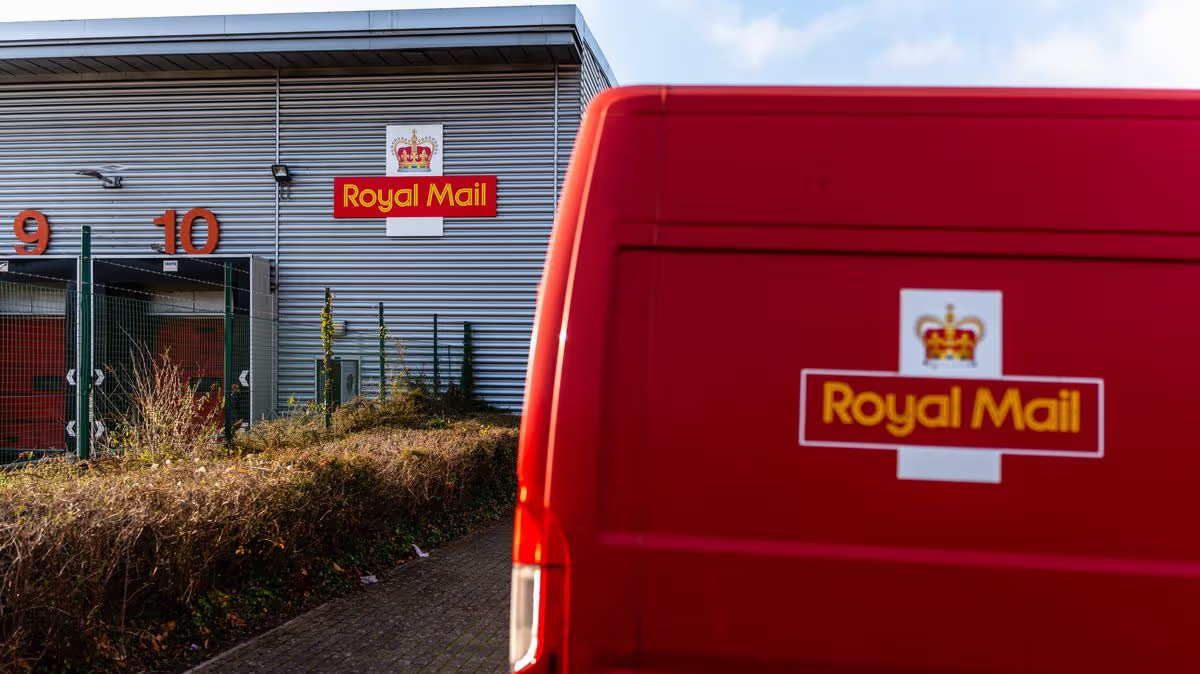
Royal Mail has issued a delivery disruption warning for a number of postcode areas throughout Scotland. The postal service has confirmed that homes and businesses in the affected areas should not expect to receive their mail on time.
Advertisement
As of Monday, May 18, alerts have been issued for 23 postcode areas, Perth and Tweedale. Royal Mail said: “We aim to deliver to all addresses we have mail for, six days a week.
“In a small number of local offices, this may temporarily not be possible due to local issues such as high levels of sick absence, resourcing, or other local factors. In those cases, we will rotate deliveries to minimise the delay to individual customers.
“We also provide targeted support to those offices to address their challenges and restore our service to the high standard our customers would normally receive.”
It added: “We’re sorry for any inconvenience and thank you for your understanding.”
Advertisement
Over the past 24 hours, Royal Mail’s air and road network has operated on schedule, reports the Mirror.
However, further delays have been reported at Norwich Mail Centre. It said: “Some mail posted in the NR postcode area for delivery today in other parts of the UK.”
Additional delays to mail services across the UK are expected next week owing to the Spring Bank Holiday, during which Royal Mail will make no collections or deliveries, with the exception of Ayr (KA6-KA8).
Advertisement
The delays come as Royal Mail pledged to meet its letter delivery targets by May 2027 as part of a £500million recovery plan. The company has faced mounting criticism over late deliveries, and was even handed a fine as a result.
Royal Mail was fined £21million by Ofcom in October for falling short of targets after it delivered just 77% of First Class post and 92.5% of Second Class post on time in 2024-25.
In a bid to meet those targets, Royal Mail is planning to scrap its Saturday Second Class deliveries and switch to alternate weekdays — three days one week and two the next.
Royal Mail said it will improve First Class Next Day delivery to around 85% within nine months, before reaching the 90% target set by regulator Ofcom within a year.
Advertisement
The firm also pledged to deliver 93% of Second Class letters within three days over the course of nine months, and to hit the 95% target by May next year.


























































You must be logged in to post a comment Login