

Crypto World
Preferred Perpetual Stockholders Misprice Risk


Investors may be underpricing the risk embedded in perpetual preferred stocks tied to crypto treasury strategies, according to Matt Dines, chief investment officer of Build Markets. Strategy’s Variable Rate Series A Perpetual Stretch Preferred Stock, known as STRC, exemplifies this class: it pays dividends indefinitely and carries no obligation to return principal.
Perpetuals differ from traditional bonds in that issuers never repay the initial investment. If holders want liquidity, they must sell on the secondary market, exposing them to liquidity constraints and ongoing interest-rate risk tied to an instrument with no maturity date. “If spreads start to rise and the market demands higher yields from corporate borrowers, you also have to attach that to the infinite duration of the perpetual,” Dines told TFTC. “So, if this dislocation comes in liquidity, it will come from the fiat side.”
STRC has drawn fresh attention as Strategy leans into preferred stock issuance to fund ongoing Bitcoin purchases. In recent days, liquidity for STRC spiked, with daily trading volume reaching a record level of about $1.5 billion, underscoring robust demand for the instrument even as the capital structure remains subject to the perpetual-dynamics Dines outlined.
For context, Strategy’s STRC is designed as a variable-rate preferred security that supplements its Bitcoin treasury strategy. The instrument’s price, yield, and liquidity profile play a central role in how aggressively the company can grow its Bitcoin stack while maintaining an equity-backed financing layer. The STO has attracted coverage and analysis from crypto researchers and market commentators as it becomes a visible mechanism for funding large-scale BTC purchases.
STRC’s fundamentals are clearly displayed in the market metrics. The instrument has an authorized issuance cap of about $28 billion, a ceiling that Delphi Digital notes could constrain Strategy if not raised in a timely fashion. At the moment, the total notional face value of outstanding STRC shares sits near $8.5 billion, with the overall market value of all outstanding shares around $8.4 billion. When last observed, STRC traded near $99 per share and carried a dividend rate of about 11.5%, according to Strategy’s own disclosures. The dividend is variable, adjusting on a monthly basis, and Strategy has also opened voting for semi-monthly dividend approvals by holders of the common equity and STRC.
Perpetuals as a funding tool—and what that implies for Bitcoin accumulation
The core appeal of STRC lies in how it supports a treasury strategy built around Bitcoin accumulation. By offering a high, variable yield with an equity-backed claim, the instrument provides Strategy with a funding channel that can scale alongside its Bitcoin purchases. But the same features that enable rapid capital deployment also impose structural risks: no principal repayment means investors bear liquidity and rate risk indefinitely, and any tightening in liquidity or rising yields can disproportionately affect holders who must navigate an illiquid exit window in a market without a maturity date.
In this context, market observers watch not only the level of STRC’s yield but also the evolution of the secondary-market for these perpetuals. A higher cost of capital or a decline in liquidity could slow Strategy’s ability to fund further Bitcoin acquisitions purely through STRC financing, even as the instrument remains attractive relative to other perpetual-structured vehicles. The situation illustrates a broader dynamic in crypto-based funding: instruments that fund digital-asset purchases can themselves become sensitive to traditional credit-market cycles and fiat liquidity conditions.
Ceiling effects: what the cap means for Strategy’s growth trajectory
Delphi Digital’s assessment highlights a critical constraint: the ~ $28 billion issuance cap could throttle STRC-driven BTC buying if not adjusted. With $8.5 billion of notional outstanding and roughly $8.4 billion in market value, STRC is far from the cap but not inexhaustible. The balance between active issuance and the cap will shape Strategy’s pace of Bitcoin accumulation in the coming months, particularly if market conditions drive higher required yields or tighter liquidity in the broader credit market.
Price-wise, STRC has traded around $99 per share as of the latest round of reporting, with a dividend yield that stands at roughly 11.5% and remains subject to monthly recalibration. This dynamic makes STRC a barometer for both Strategy’s funding appetite and investors’ appetite for crypto-linked perpetual securities. The instrument’s governance features—letting STRC holders vote on semi-monthly dividend payments—add another layer of complexity, intertwining corporate financing with ongoing crypto-treasury decisions.
Strategy has also signaled a broader financing program, including plans to repurchase $1.5 billion of 2029 convertible notes. This behavior underscores a broader strategy of using a mix of preferred-stock issuance and debt management to support ongoing Bitcoin exposure while managing capital structure and investor reception. Coverage of these moves has connected STRC to Strategy’s overall balance-sheet strategy and its efforts to maintain flexibility amid volatile macro conditions.
What to watch next for STRC and Strategy
As STRC remains a central piece of Strategy’s Bitcoin-forward treasury approach, investors should monitor several developing factors. First, any adjustment to the issuance cap could directly affect the company’s ability to fund additional BTC purchases through STRC. Second, shifts in the broader credit and fiat-liquidity environment will influence both the cost of STRC capital and the ease with which investors can exit perpetual positions. Third, the monthly dividend reset and semi-monthly payout voting add a governance dimension that could affect cash yields and investor sentiment depending on how the BTC strategy evolves.
Beyond STRC, observers will also be watching how Strategy balances its crypto purchases with other funding sources and what that implies for the stability of its Bitcoin treasury strategy under varying market regimes. The interplay between perpetual-structure financing and real-world asset accumulation remains a nuanced frontier—one that could redefine how corporate treasuries access capital to support digital-asset holdings in the years ahead.
Readers should keep an eye on any updates to the issuance cap, changes in STRC’s dividend mechanics, and Strategy’s announced BTC-buying cadence. As liquidity and macro factors shift, the attractiveness of STRC as a funding vehicle could wax and wane, potentially modifying both risk and opportunity for investors and the company alike.


TLDR
- Mubadala Investment Company expanded its BlackRock Bitcoin ETF position by 16% to 14.7 million shares valued at $566 million during Q1 2026
- The Abu Dhabi sovereign wealth fund has continuously increased its Bitcoin exposure quarterly since Q4 2024, beginning at $436 million
- Harvard University slashed its BlackRock Bitcoin ETF stake by 43% while completely liquidating its BlackRock Ethereum ETF position
- Dartmouth College revealed a $3.67 million investment in the Bitwise Solana staking ETF
- Barclays reported holdings of 4.46 million Bitcoin ETF shares, while Hong Kong’s Laurore reduced its position by 22%
Mubadala Investment Company, Abu Dhabi’s sovereign wealth fund, expanded its holdings in BlackRock’s iShares Bitcoin Trust by 16% during the opening quarter of 2026, recent SEC disclosures reveal. The fund’s position now stands at 14.7 million shares with an approximate value of $566 million.
The first quarter 2026 data shows Mubadala continuing to accumulate shares despite a modest decline in dollar-denominated value from the $630.6 million reported at 2025’s conclusion. This valuation decrease stems from Bitcoin’s price correction from its late-2025 peak rather than any reduction in the fund’s actual shareholdings.
Mubadala’s Systematic Bitcoin Accumulation Pattern
Mubadala initially revealed a Bitcoin ETF holding in Q4 2024 valued at approximately $436 million. The position’s market value declined to $408.5 million during Q1 2025 as cryptocurrency markets corrected, before rebounding dramatically to $630.6 million by December 31, 2025, coinciding with Bitcoin’s breakthrough above $100,000.
The sovereign fund has systematically expanded its shareholdings during each subsequent reporting cycle. This unbroken five-quarter accumulation pattern demonstrates a calculated, strategic approach to Bitcoin allocation rather than reactive market timing.
Mubadala represents just one component of Abu Dhabi’s institutional cryptocurrency exposure. Al Warda Investments, connected to the Abu Dhabi Investment Council, maintained a separate holding of 8.2 million BlackRock Bitcoin ETF shares worth approximately $408 million as of Q4 2025. Collectively, Abu Dhabi-affiliated sovereign entities controlled over $1 billion in the ETF by year-end.
The Abu Dhabi Investment Council previously tripled its Bitcoin ETF allocation during Q3 2025, representing one of the most substantial single-quarter expansions among sovereign purchasers.
BlackRock’s iShares Bitcoin Trust maintains its position as the world’s dominant spot Bitcoin ETF, controlling more than 600,000 Bitcoin as of April 2026. Its holdings represent approximately triple the quantity managed by runner-up Fidelity.
Norway’s Norges Bank has similarly emerged in recent 13-F disclosures as a stakeholder, cementing the ETF’s reputation as the preferred vehicle for sovereign-level Bitcoin allocation.
Harvard Retreats While Dartmouth Explores Solana
Institutional approaches to cryptocurrency diverged sharply during the quarter. Harvard University reduced its BlackRock Bitcoin ETF stake by 43% to 3.04 million shares. The prestigious endowment simultaneously eliminated its entire $86.8 million holding in BlackRock’s spot Ethereum ETF.
Dartmouth College charted an alternative course. The Ivy League institution unveiled what appears to be among the earliest documented endowment allocations to a Solana ETF, acquiring $3.67 million of the Bitwise Solana Staking ETF.
Barclays revealed holdings of 4.46 million BlackRock Bitcoin ETF shares complemented by put and call option positions. Hong Kong-based Laurore decreased its stake by 22%.
The Q1 2026 13-F reports illustrate widening strategic divergence among institutional cryptocurrency participants. Sovereign wealth funds, especially those based in the Persian Gulf region, continue methodically building positions, while certain university endowments are retreating.
Mubadala’s uninterrupted accumulation across five successive quarters represents one of the most transparent and sustained institutional Bitcoin commitments among any government-backed investment vehicle worldwide.


Strategy executive chairman Michael Saylor said he raised the possibility of selling Bitcoin during Strategy’s recent earnings call to protect the asset’s long-term interests.
“We own about $65 billion worth of Bitcoin. If the market thought we would never sell it, the credit rating agencies would say, Well then, I guess it’s not an asset,” Saylor told Scott Melker on The Wolf Of All Streets podcast published to YouTube on May 10.
“There is $20 to $100 billion of liquidity in the Bitcoin market that is not correlated to our equity or to our credit. If we were to say we’re never going to take advantage of that liquidity and we’re never going to use that asset, then we’re impairing the asset, which 98% of the company is built on,” Saylor explained, adding:
“It’s pretty important to us to send the signal that if we need to, we can.”
It comes after growing speculation within the Bitcoin community after Saylor said during Strategy’s first-quarter earnings call that his company could sell Bitcoin to “inoculate” the market against sudden panic or to reinforce confidence in the company, in contrast to its long-standing “never sell” Bitcoin strategy.

Michael Saylor spoke to Scott Melker on The Wolf Of All Streets podcast. Source: The Wolf Of All Streets
Bitcoiners began to speculate on social media. Prominent Bitcoiner and BnkToTheFuture CEO Simon Dixon said on May 7 that Strategy “might need to sell some Bitcoin when the financial industrial complex manipulates our Bitcoin collateralized debt obligations and perpetual dividends wrappers.”
Strategy has been consistently buying Bitcoin since August 2020, when it began holding Bitcoin as a primary treasury asset. The company now holds 818,869 BTC at an average purchase price of $75,540 per coin, according to its website.
Related: Sharplink CEO points out 3 catalysts for Ethereum’s price to surge higher
On Monday, Cointelegraph reported that Strategy acquired 535 Bitcoin for $43 million between May 4 and May 10 at an average price of $80,340 per BTC.
While Saylor is known for regularly posting “Never sell your Bitcoin” on X, on May 6, he wrote, “Buy more bitcoin than you sell.”
Magazine: eToro founder timed Bitcoin top perfectly due to belief in 4 year cycles

After dumping to $60,000 during the early February crash, bitcoin rebounded swiftly and jumped to almost $83,000 a week ago, posting a massive 38% increase. This caused many analysts to speculate whether the bear market had ended.
However, the price action in the past few days has been contradictory, and BTC slipped to a two-week low of $78,000 yesterday. Analysts are not so convinced now that the bottom is in, and here are some of their warning shots.
P/L at High Levels
Ali Martinez brought up the average trader’s realized profit margin, which has reached 17%. He believes this is a “major warning sign” as the metric has hit its highest level since October 2025, shortly before the massive crash that wiped out over $19 billion in leveraged positions and was the beginning of a prolonged downtrend that culminated (for now) with a 53% drop from $126,000 to $60,000. He explained that since the average investor is now sitting on substantial gains, they might be “looking to exit.”
“What stands out to me is the historical context. The last time profit margins hit 17% while Bitcoin was testing its 200-day moving average as resistance was in March 2022.
That specific alignment signaled the exact moment the local top was in before the downtrend resumed in earnest.”
Doctor Profit Still Bearish
One of the few analysts who hasn’t changed their perspective on the current market environment is Doctor Profit. His bearish predictions began around the October 2025 peak, and, as his latest post shows, he has been putting his money where his mouth is, shorting the cryptocurrency from $120,000.
Moreover, the analyst warned a week ago that the rebound to $80,000 might be another bear trap. His new bearish targets are a drop to $50,000 or even lower if the broader macro conditions worsen.
In his latest post, he warned once again that most traders are “not ready for what’s coming.” The chart above doubles down on a path toward $50,000.
$BTC: No one is ready for whats coming , the current status is as follow:
1. Short from 120k
2. Long from 71k (30% Closed)
3. Long from 75k (30% Closed)
4. Shorts accumulated at 82k (30%)
5. Remaining short orders active (70%)Again, most not ready for whats coming pic.twitter.com/oB5N0aTK7m
— Doctor Profit
(@DrProfitCrypto) May 16, 2026
History to Be Invalidated
Rekt Capital also weighed in on whether BTC might have bottomed during this cycle, but seemed highly skeptical. The analyst noted that if investors believe BTC won’t go below $60,000, then they must believe in the following:
– The Bear Market has shortened to just 1/3 of the usual time it takes for Bitcoin to bottom
– That there has been a drastic shallowing across Bear Market corrections by ~25% (whereas the historical difference in shallowing across Bear Cycles has been up to ~10%)
– The previous Bull Market never ended, that price is currently recovering from a Bull Market correction and that the previous Bull Cycle has lengthened by over 200 days
If bitcoin has indeed bottomed, which doesn’t seem to be the case according to Rekt Capital’s estimations, then the long-standing principles of BTC market cycles have been invalidated, which is “probabilistically unlikely until proven otherwise,” the analyst concluded.
The post 3 Major Warning Signs Suggest Bitcoin’s Bottom Is Still Not In appeared first on CryptoPotato.
Crypto World
Jump Crypto’s Firedancer Quietly Goes Live on Solana Mainnet with Millions of Transactions Processed
TLDR:
- Firedancer is live on Solana mainnet and has already processed tens of millions of transactions in production.
- Jump Crypto is limiting adoption until full security audits are done to protect the broader Solana network.
- A $1 million public bug bounty competition was completed to strengthen confidence in Firedancer’s codebase.
- Firedancer was built using high-frequency trading architecture, helping Solana handle large launches without congestion.
Firedancer, the Solana validator client developed by Jump Crypto, is now live on Solana mainnet and actively producing blocks.
The client has processed tens of millions of transactions over recent months. However, the team is taking a deliberately cautious approach to wider adoption. Full security audits must be completed before any broad network-wide rollout is considered.
Jump Crypto Takes a Measured Approach to Firedancer’s Deployment
Founding engineer Ritchie Patel confirmed the client’s production status in a recent interview. He left no room for ambiguity about where things stand.
“Firedancer is live and running in production,” Patel told CoinDesk. “We have packed tens of millions of transactions over the last few months.”
Despite that progress, the team is firm about not accelerating adoption prematurely. Patel made the team’s position clear when he said, “We don’t want everybody to run it yet.”
He further explained that moving too fast before completing full security audits would be irresponsible. “If half the network upgrades before we’ve done full security auditions, that would be a bit reckless,” he added.
To build confidence in the codebase, Jump Crypto recently ran a public security audit competition. The event offered a $1 million bug bounty pool for researchers to find vulnerabilities.
That exercise gave the team greater assurance before expanding the rollout further. It also signaled a commitment to transparency within the broader Solana developer community.
Firedancer emerged partly in response to Solana’s earlier reliability problems. The network previously faced repeated outages and congestion issues.
At the time, it relied heavily on a single dominant client maintained by infrastructure firm Anza. Rather than positioning itself against Anza, Patel described the dynamic differently. “It’s definitely more of a collaborative setting than a competition,” he said.
Firedancer’s Architecture Draws From High-Frequency Trading Systems
One of Firedancer’s defining characteristics is its design philosophy. The client was built to mirror the architecture of traditional high-frequency trading engines.
Patel was direct about the intent behind that choice. “We designed the new thing to be written like an actual trading engine in the TradFi system,” he explained.
That engineering approach is already showing results in how the network handles demand spikes. Previously, major token or NFT launches caused significant stress across the network.
Patel recalled those earlier days vividly. “I remember when there were memecoin and NFT launches, we were frantically watching all the performance dashboards,” he said. The contrast with today is sharp. “But now it’s like, ‘Oh yeah, yet another big launch, it’s fine,’” he added.
This shift reflects Solana’s broader evolution as a blockchain. The network is moving away from reactive congestion management toward proactive infrastructure scaling.
Firedancer plays a central role in that transition. Its production deployment marks one of the more consequential infrastructure upgrades in Solana’s history.
The project is still in gradual rollout mode, but its mainnet presence is now confirmed. More validators are expected to adopt the client once the full audit process concludes.
The outcome will be closely watched by those tracking Solana’s progress toward institutional-grade performance.
TLDR:
- Bitcoin dominance broke above 60.88%, closing outside its eight-month accumulation range for the first time.
- Solana perpetual open interest surged 156% in 35 days, pointing to strong institutional demand in perp DEXs.
- Real-world asset tokenization jumped from $5.5B to $29.2B in just 16 months, marking a 5.3x increase overall.
- Alphractal’s HYPE W-R Delta stayed whale-positive through every dip since March, reflecting institutional accumulation patterns.
Sector rotation is quietly reshaping the crypto market while Bitcoin dominance climbs above 60%. Three specific sectors are drawing institutional capital despite a dormant broad altcoin market.
Analytics firm Alphractal tracked these movements over three weeks. The Altcoin Season Index reads 39 out of 100, signaling Bitcoin season to most retail traders. However, the real story runs deeper than surface-level dashboards.
Institutional Capital Flows Into Perp DEXs and RWA Markets
Bitcoin dominance recently closed above 60.88%, breaking out of an eight-month accumulation range. That range held between 58% and 60% from August 2025 onward.
Most retail-facing tools interpreted this as a straightforward Bitcoin season signal. Yet three sectors were already moving sharply higher in the background.
Alphractal posted on X, noting that “Solana perp open interest just printed +156% in 35 days.” Hyperliquid is trading near $41, with derivative volume competing at a BitMEX-era market share level.
These numbers reflect structural demand, not speculative retail activity. The capital flowing into perp DEXs follows a pattern consistent with institutional positioning.
Real-world asset tokenization has also expanded rapidly. Total tokenized value reached $29.2 billion in April, up from $5.5 billion in early 2025.
That represents a 5.3x increase across just 16 months. Growth at that pace points to sustained institutional interest rather than a short-lived trend.
Prediction markets added another data point to the rotation thesis. Combined lifetime volume on Polymarket and Kalshi crossed $150 billion.
None of these figures appear on the standard Altcoin Season Index. As a result, traders relying on that index may be missing the actual rotation happening now.
Whale Behavior and Cohort Data Point to a Structural Shift
Alphractal’s HYPE W-R Delta metric has stayed in whale-positive territory through every market dip since March. This reading tracks whether larger wallets are accumulating or distributing during price weakness.
Sustained whale-positive readings through multiple pullbacks carry a different meaning than brief spikes. It suggests conviction, not opportunistic trading.
The 30-day cohort behavior Alphractal observed mirrors institutional patterns rather than retai
cycles. Retail traders typically respond to index signals and price momentum. Institutional players tend to move earlier, building positions before those signals confirm. The current setup fits the latter profile more closely.
Alphractal made a pointed structural call in the post: “This isn’t 2021. There is no broad altseason coming.” The firm expects capital to continue routing through dominant primitives in specific sectors. The long tail of altcoins is not where that flow is heading.
Traders waiting for the Altcoin Season Index to turn green may therefore enter too late. The rotation into perp DEXs, RWA platforms, and AI infrastructure appears already underway. The 5 to 10 names capturing institutional flow are the focus, not the broader altcoin market.
Crypto World
XRP Whale Withdrawals from Binance Reach 403 Million Since May 3 in a Persistent Exit Pattern
TLDR:
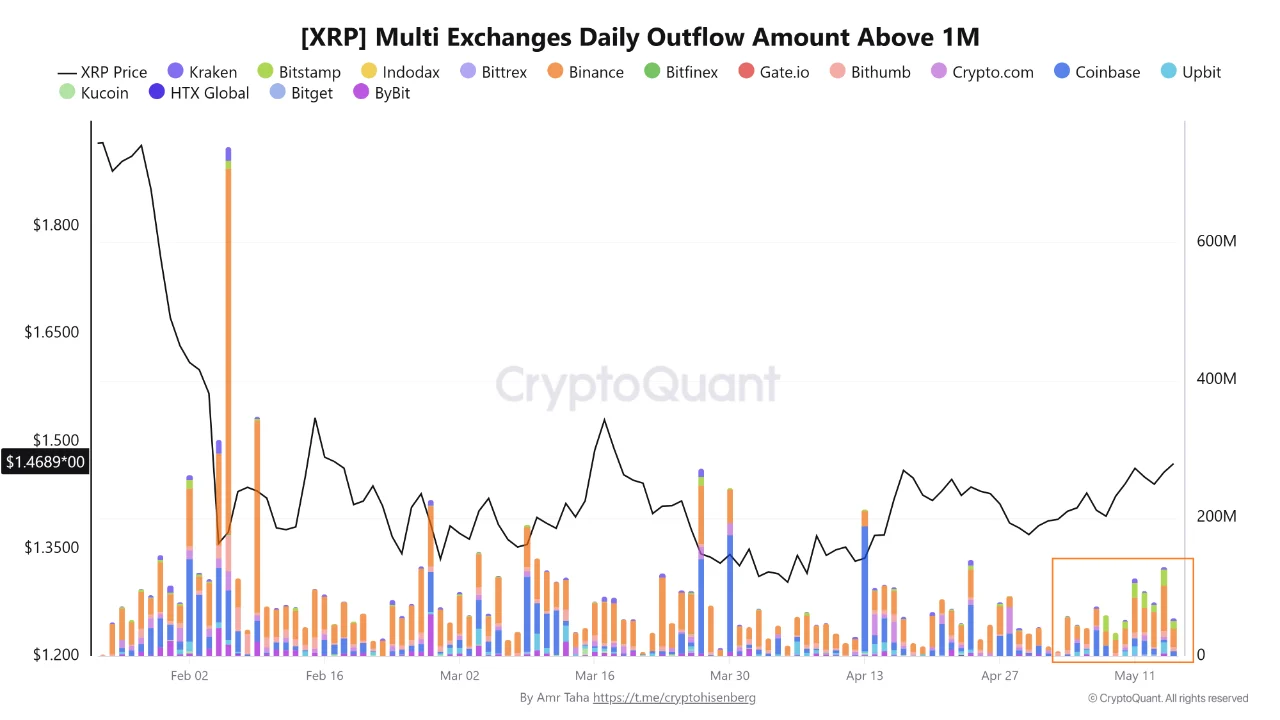
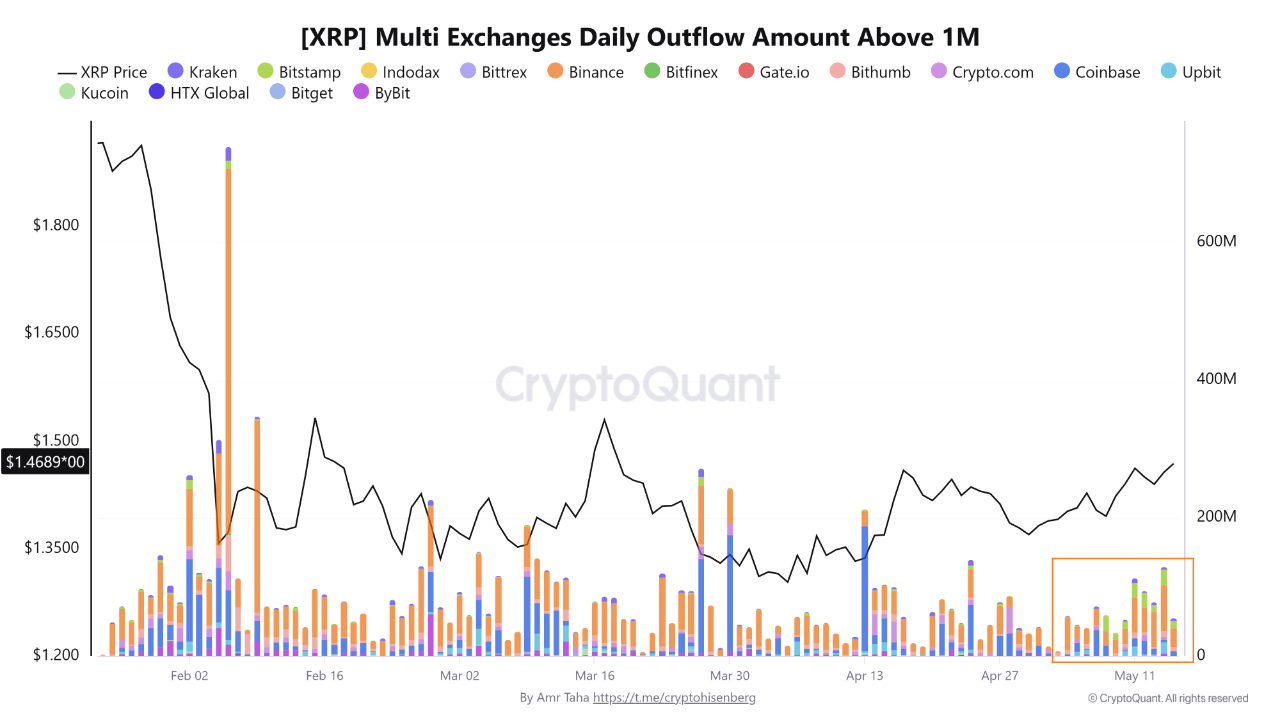
- Binance recorded near-daily XRP outflows above 1 million XRP per transaction from May 3 to May 15.
- Total large XRP withdrawals from Binance reached roughly 403 million XRP within a two-week period.
- Earlier whale withdrawals were concentrated on Coinbase in March and April when XRP traded near $1.34.
- Sustained exchange outflows may reflect reduced short-term selling intent or custody moves by large holders.
XRP large-scale withdrawals from Binance have reached roughly 403 million XRP between May 3 and May 15. The outflows track only transactions of 1 million XRP or more, pointing to whale or institutional activity.
Unlike isolated spikes, the pattern shows near-daily withdrawals. As XRP prices recover toward $1.47, this consistent movement away from one of the world’s biggest exchanges is drawing close attention from market observers.
Binance Sees Persistent XRP Whale Withdrawals Over Two Weeks
XRP outflows from Binance have not appeared as a one-time event. Instead, the data shows repeated large withdrawals occurring almost every day since May 3.
Each transaction meets or exceeds the 1 million XRP threshold, which filters out smaller retail activity entirely. This makes the trend a cleaner measure of what large holders are doing.
The total volume of these outflows reached approximately 403 million XRP by May 15. That figure accumulated across nearly two weeks of consistent withdrawal behavior.
Source: Cryptoquant
It reflects a pattern rather than a single moment of elevated activity. Analysts tracking on-chain data have flagged this as worth monitoring closely.
When whales remove coins from exchanges, the available supply for immediate selling can decrease. This does not automatically push prices higher, but it can reduce downward pressure on the market.
Fewer coins sitting on exchange order books means less liquidity for sellers to act quickly. Over time, this can shift the supply-demand balance.
The timing also adds context. These Binance outflows are happening as XRP trades near $1.47, a recovery zone above recent lows.
Large holders appear to be moving coins at higher price levels, which differs from panic-driven withdrawals. This behavior is more consistent with custody movement or long-term positioning.
Earlier Coinbase Withdrawals Compared to Current Binance Activity
Before the Binance trend emerged, large XRP withdrawals were concentrated on Coinbase. The most active days were March 27, March 30, and April 13.
During those dates, XRP was trading near $1.34, a lower price range. Those earlier outflows appeared as isolated spikes rather than a continuous flow.
That Coinbase activity suggested large holders were already accumulating or repositioning when XRP was cheaper.
The withdrawals on those specific dates aligned with periods of relatively subdued price action. Now the behavior has moved to a different exchange and taken on a more sustained character. The shift from Coinbase to Binance is a notable structural change.
Binance handles a large share of global XRP trading volume. Repeated outflows from this particular platform carry more weight than similar activity on smaller exchanges.
When large holders consistently pull XRP from Binance, it can reflect a shift in sentiment among institutional participants. The trend has moved from occasional to routine.
Historically, sustained large exchange withdrawals have been associated with accumulation phases or long-term custody decisions.
They can also reflect reduced short-term selling intent among major holders. Whether this current pattern leads to a meaningful price move remains to be seen. For now, the data points to a notable change in how large XRP holders are managing their positions.

The US CLARITY Act, introduced to provide clearer regulatory guardrails for crypto businesses, is being framed by a16z crypto as a potential lever for broader innovation in the United States. The firm argues that when policymakers articulate workable rules, domestic builders can deploy with greater certainty, which could spur not only sector growth but wider economic benefits.
Supporters also point to the GENIUS Act, passed in July 2025, as a tangible demonstration of what a clear regulatory path can achieve. A16z crypto noted that the GENIUS framework for stablecoins catalyzed a wave of growth and adoption, describing it as beneficial not only to the U.S. economy but also as a factor in the long-run leadership of the dollar on the global stage.
“When our legal frameworks are designed to both foster innovation and protect consumers, America leads and the world benefits.”
Source attribution for these observations comes from a16z crypto’s public remarks on X, where the firm framed CLARITY as a potential accelerator for homegrown innovation if enacted.
Key takeaways
- The CLARITY Act aims to deliver regulatory clarity for crypto companies, with industry players viewing it as a driver of domestic innovation if passed into law.
- GENIUS Act’s July 2025 enactment is cited as a precedent, illustrating how clear rules for stablecoins can spur growth and adoption beyond the crypto sector.
- Market signals. The U.S. dollar index (DXY) stood around 99.27, up roughly 1.28% over the prior 30 days, a context that commentators say highlights the broader macro backdrop for crypto policy shaping.
- Political dynamics remain a constraint. While the Senate Banking Committee moved the CLARITY Act forward, passage requires bipartisan support, a threshold complicated by the current Senate balance.
- Industry voices see the CLARITY Act as a global signal. Sharplink Gaming’s Joseph Chalom framed the act as more than a US phenomenon, suggesting it could influence regulatory directions in other jurisdictions.
Regulatory clarity as a catalyst for US innovation
Prospects around the CLARITY Act have revived a broader debate about how regulatory clarity can reshape the crypto landscape in the United States. Proponents argue that precise rules reduce the ambiguity that has clouded decision-making for exchanges, wallets, and issuers, enabling longer-term planning and investment. The argument is that a well-defined framework can attract capital and entrepreneurship that might otherwise migrate to more certain environments abroad.
In this framing, the GENIUS Act’s trajectory provides a useful proxy for what CLARITY could unlock. The GENIUS Act, enacted in mid-2025, established a pathway for stablecoins under a dedicated set of rules and oversight. A16z crypto’s assessment links that experience to the potential outcomes of CLARITY, suggesting the earlier act seeded a period of accelerated growth and adoption that fed into broader economic benefits and, in their view, bolstered confidence in the dollar’s global standing.
The conversation around regulatory design underscores a central tension in crypto policy: how to balance innovation with consumer protection and financial stability. A16z crypto’s framing emphasizes the upside for domestic builders and investors when clear guardrails reduce the regulatory risk premium that often weighs on venture decisions in the sector.
Industry sentiment and early signals
Industry observers point to a mix of optimism and cautious note-taking as CLARITY moves through the legislative process. Grayscale has been explicit about the political realities: while the odds of passage are perceived as favorable, the bill will require bipartisan backing to clear the full Senate. The firm notes that even with the favorable momentum, several procedural hurdles remain before CLARITY can become law.
In parallel, market strategists have highlighted how policy developments interact with broader macro signals. The dollar’s strength, as reflected by the DXY index sitting near 99.27 and having risen about 1.28% over the past month, provides context for crypto markets’ sensitivity to regulatory news—positive clarity could shift the calculus for both risk appetite and capital allocation within crypto assets.
Industry voices outside the investment community have also offered their read on CLARITY’s potential impact. Sharplink Gaming CEO Joseph Chalom framed the policy debate as a global signal, suggesting that while many view it as a distinctly American initiative, the implications could ripple through other jurisdictions as policymakers everywhere confront similar questions about crypto regulation.
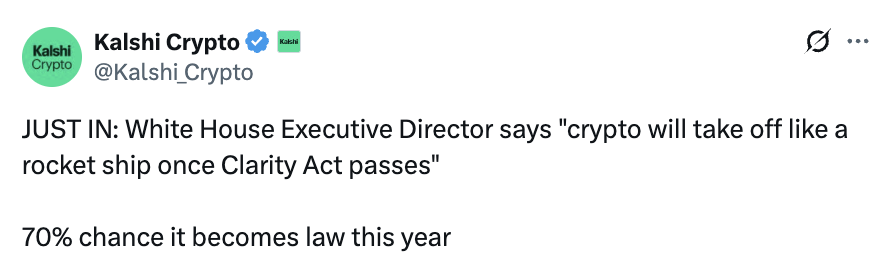
Kalshi Crypto, a platform known for tokenized event contracts, has echoed the sentiment that policy clarity matters beyond national borders, reinforcing the idea that a coherent U.S. framework could set a reference point for international regulators and market participants alike.
Grayscale’s analysis, published in a recent briefing, also pointed to the legislative dynamics at play. The firm’s reading is that the CLARITY Act will likely proceed given the current bipartisan incentives, but it remains contingent on continued cross-party support in a Senate environment that has shown both cooperation and contention on financial technology issues. The note references the GENIUS Act’s earlier Senate passage with a broad vote and substantial Democratic cross-party backing as a precedent that policymakers could repeat if they align on consumer protections and innovation goals.
Beyond the political arithmetic, the conversation has also touched on broader adoption dynamics. A notable point from industry commentary is that legislative clarity tends to catalyze both investor and operator confidence, potentially reducing the “policy risk premium” that has historically accompanied crypto ventures in uncertain regulatory climates.
What to watch next
For readers tracking the evolution of crypto policy, the most critical near-term milestone is whether CLARITY secures bipartisan support in the Senate and progresses to a formal conference or floor vote. The current Senate configuration—Republicans controlling a 53-seat bloc—means eventual passage will hinge on attracting Republican and Democratic supporters beyond the initial committee vote, a dynamic the Grayscale briefing frames as plausible given historical cross-party momentum on related regulatory efforts.
Observers will also monitor the ongoing interpretation and implementation patterns that could follow if CLARITY becomes law. Will the Act deliver a stable framework for issuers, exchanges, and asset managers anticipated to operate under a clarified set of rules? How regulators define consumer protections and systemic safeguards could shape the pace of innovation and the geographic distribution of crypto activity for years to come.
Finally, the broader policy landscape remains in flux. The GENIUS Act’s earlier success continues to be cited as a proof point for how a coherent, sector-specific regulatory approach can unlock growth, innovation, and longer-term macro benefits. As policymakers deliberate the next steps, market participants will be watching for cross-border signals—whether other jurisdictions adopt similar approaches, and how global competition for crypto talent and capital evolves in response to U.S. policy direction.
In the near term, observers should watch for updates from the US Senate Banking Committee and any subsequent floor action. If CLARITY advances, investors, builders, and users will have a clearer view of the regulatory environment—one that could shape funding cycles, product launches, and the geographic distribution of crypto innovation in the years ahead.

The US CLARITY Act, introduced to bring regulatory clarity to the crypto industry, is poised to influence more than just the sector itself. In recent commentary, venture firm a16z crypto argued that a well-defined framework would boost domestic innovation and create a more predictable operating environment for crypto builders in the United States.
Observers note that the CLARITY Act follows the GENIUS Act, which was enacted in July 2025 to establish a regulatory framework for stablecoins. a16z crypto described that act as a potential indicator of how targeted policy provisions can catalyze growth, adoption, and broader economic impact. The firm asserted that designed to protect consumers while fostering innovation, such frameworks can bolster confidence in the U.S. crypto economy and support dollar-centric leadership on the global stage.
The U.S. dollar index stood at 99.27 at the time of writing, up 1.28% over the last 30 days, according to TradingView, underscoring ongoing macro considerations that policymakers and market participants weigh alongside crypto regulation. a16z crypto framed the policy goal as balancing innovation with consumer protection to ensure America leads while the world benefits.
“When our legal frameworks are designed to both foster innovation and protect consumers, America leads and the world benefits.”
Source: a16z crypto
Industry observers have framed the CLARITY Act as more than a unilateral U.S. development. Sharplink Gaming’s Joseph Chalom noted that while the legislation is often perceived as a U.S. phenomenon, it is increasingly viewed as a global reference point for other jurisdictions. Kalshi Crypto also highlighted the broader signaling effect, suggesting that major policy moves in Washington could shape regulatory debates worldwide.
Grayscale, the U.S. asset management firm, published a report discussing the likelihood of the CLARITY Act becoming law. The firm assessed that passage remains plausible, though contingent on bipartisan support in the Senate. “There are still a few hurdles to clear before CLARITY can become law,” Grayscale said, while noting that the GENIUS Act previously advanced with broad cross-party backing and could serve as a constitutional precedent for the current measure.
Regulatory and political dynamics surrounding the CLARITY Act were further highlighted during recent committee proceedings. In a session of the U.S. Senate Banking Committee, all 13 Republican members and two Democrats voted to advance the proposal, while nine Democrats opposed it. With Republicans holding 53 seats in the Senate, proponents indicated that at least seven Democrats would need to support the bill for final passage. Grayscale referenced the GENIUS Act’s earlier Senate vote, noting it garnered 66 votes, including 18 Democrats, suggesting bipartisan potential in the right policy design.
According to a16z crypto, regulatory clarity that aligns with consumer protections and clear licensing pathways could drive long-term U.S. competitiveness in the digital asset space. The firm’s point aligns with a broader policy argument: thoughtful, targeted regulation can reduce uncertainty for institutions, exchanges, and banks seeking to participate in regulated crypto markets while addressing AML/KYC and oversight concerns.
Key takeaways
- The CLARITY Act aims to reduce regulatory uncertainty for crypto builders in the United States, signaling a shift toward formalized oversight designed to balance innovation with consumer protections.
- Legislative momentum exists, with the Senate Banking Committee advancing the bill, but final enactment depends on securing bipartisan support in a closely divided chamber.
- Analysts point to the GENIUS Act as a precedent for how discrete regulatory regimes (such as stablecoins) can unlock growth and adoption, potentially informing the CLARITY Act’s architecture.
- Global implications are being watched closely; industry participants view Washington’s framework as a potential reference for other jurisdictions, reinforcing the U.S. role in setting international policy benchmarks.
- Licensing, AML/KYC regimes, and cross-border compliance considerations are likely to be central to how firms plan product launches, custodial arrangements, and banking relationships in a regulated American market.
Regulatory momentum, policy context, and market signaling
The CLARITY Act emerges within a broader U.S. policy environment that seeks to codify crypto activity under clear legal parameters. Supporters argue that a precise framework would reduce ambiguity for fintech platforms, exchanges, and banks that engage with digital assets, while enabling robust consumer protections and enforcement capabilities. The GENIUS Act’s experience — which established a stablecoin framework and was associated with increased near-term activity according to representatives of the crypto industry — is cited by proponents as an empirical example of how targeted regulation can influence corporate strategy and capital allocation.
From a regulatory and enforcement perspective, the act raises questions about the delineation of permissible activities, the authorization and oversight of service providers, and the allocation of supervisory responsibilities among federal agencies. For market participants, clarity around licensing standards and ongoing compliance requirements will shape the cost of regulation, the cadence of product launches, and the appetite for traditional financial institutions to engage with crypto counterparts within a documented framework.
Industry voices emphasize that the CLARITY Act’s practical impact hinges on bipartisan support and precise drafting. While the Senate vote signals political interest, the path to law would require durable cross-party alignment on core issues such as registration regimes, consumer protections, and enforcement mechanisms. As Grayscale noted, “there are still a few hurdles to clear,” underscoring that regulatory certainty remains contingent on legislative compromise and detailed rulemaking.
Implications for institutions, compliance, and cross-border operations
For exchanges, asset managers, and banks seeking regulated access to crypto markets, a formal U.S. framework could streamline licensing processes and establish predictable AML/KYC prerequisites. In the compliance function, firms would need to align onboarding, transaction surveillance, and customer due diligence with the statutory requirements and agency expectations embedded in the final act and subsequent rulemaking. This alignment would also influence cross-border activity, as U.S. regulatory standards often inform or constrain international operations and interoperability with foreign markets under regimes such as MiCA in the European Union.
The policy conversation around the CLARITY Act also intersects with broader market structure considerations, including how stablecoins are treated, how custody and settlement are regulated, and how taxation and reporting obligations are structured for digital assets. Observers expect ongoing engagement from lawmakers, regulators, and industry participants as the text evolves and as implementing guidance is issued by relevant authorities.
In summary, the CLARITY Act represents a pivotal juncture in U.S. crypto regulation. If enacted with a balanced approach, it could provide the long-needed regulatory anchor for the sector, support innovation-driven growth in the U.S., and set a benchmark for international policy alignment. The next milestones will focus on committee debates, potential amendments, and the formulation of concrete regulatory requirements that will define the operational playbook for compliant, scalable crypto activity in the years ahead.
Related reference: US CLARITY Act brings ‘major spike of euphoria’ to Bitcoin: Santiment
Closing perspective: While the path to law remains subject to bipartisan negotiations, the CLARITY Act reflects a disciplined attempt to reconcile innovation with accountability in the fast-evolving crypto landscape. Stakeholders should monitor committee proceedings, rulemaking schedules, and cross-border policy signals as key indicators of the bill’s ultimate trajectory and its implications for institutional participation in U.S. crypto markets.
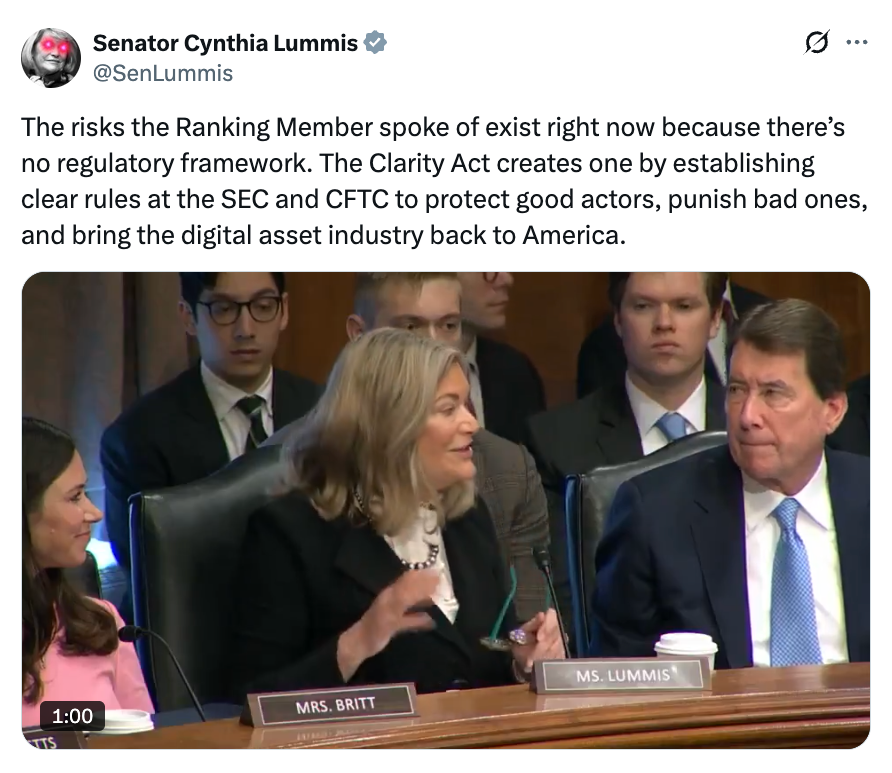
The US CLARITY Act, which aims to provide the US crypto industry with more regulatory clarity, could have a positive ripple effect beyond the crypto sector itself, according to venture capital firm a16z crypto.
“If the US provides builders with regulatory clarity, it will be a boon for domestic innovation,” a16z crypto said in an X post on Friday.
A16z pointed to the passage of the GENIUS Act in July 2025, which created a regulatory framework for stablecoins, as a possible indication of what may happen following the CLARITY Act.
“Its passage led to unprecedented growth and adoption, which is not only good for the U.S. economy, but is also good for long-term dominance of the US dollar,” a16z crypto said. The US dollar index, which tracks the dollar’s strength against a basket of major currencies, is 99.27 at the time of publication, up 1.28% over the past 30 days, according to TradingView. A16z said:
“When our legal frameworks are designed to both foster innovation and protect consumers, America leads and the world benefits.”
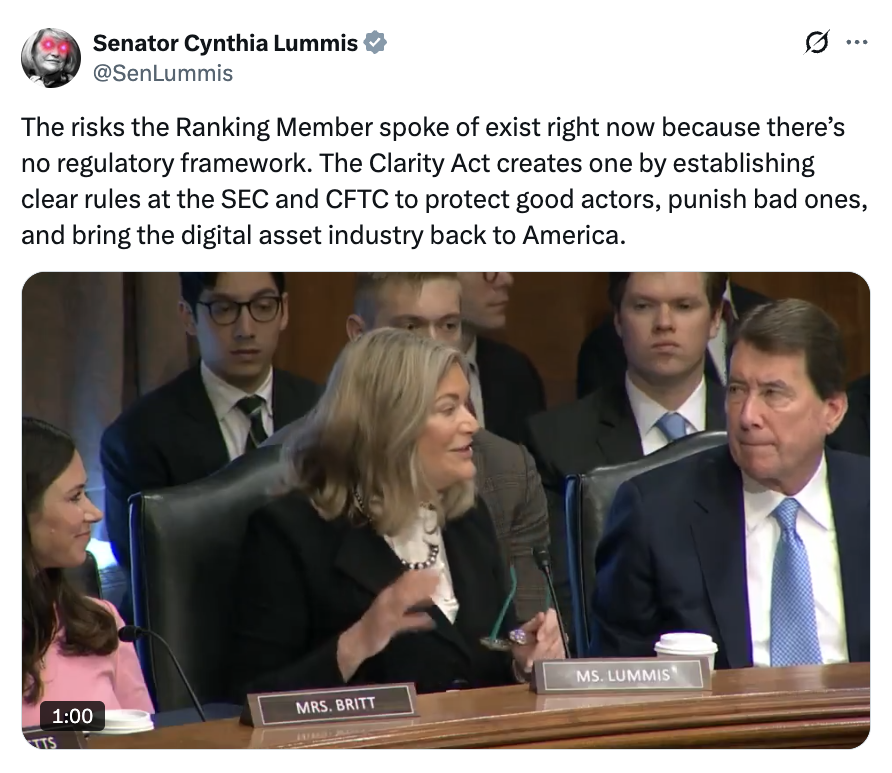
Source: Cynthia Lummis
Since the US CLARITY Act was introduced in July 2025, the crypto industry has been widely speculating about its potential impact on global markets.
Sharplink Gaming CEO Joseph Chalom recently said that while many view the legislation as “a US phenomenon,” it is also being seen as a major signal for other jurisdictions around the world.
Source: Kalshi Crypto
US asset management firm Grayscale said in a report published on Friday that the odds of the legislation passing are high in the firm’s view, but “the bill will require bipartisan support to clear the full Senate and become law.”
“There are still a few hurdles to clear before CLARITY can become law,” Grayscale said.
Related: US CLARITY Act brings ‘major spike of euphoria’ to Bitcoin: Santiment
The comments came after a Thursday session of the US Senate Banking Committee, in which all 13 Republican members and two Democrats voted to advance the bill, with nine Democrats also voting no on the bill.
Grayscale pointed out that Republicans currently hold 53 seats, meaning at least seven Democrats would need to support the bill. “We believe that’s possible: the GENIUS Act cleared the Senate with 66 votes including 18 Democrats,” Grayscale said.
Magazine: ETH stalls at $2.4K five times, SOL to rally to $120: Market Moves

Perpetual preferred stocks are being used as a crypto-adjacent financing tool, but they come with distinct risk profiles that the market may be underpricing. Strategy, a Bitcoin treasury-focused issuer, has popularized a specific instrument: Variable Rate Series A Perpetual Stretch Preferred Stock (STRC). These securities promise ongoing dividends without a scheduled principal repayment, which means investors never know when, or if, their original investment will be returned unless they sell on the secondary market. The result is a structure that can deliver income but exposes holders to liquidity and interest-rate dynamics that persist indefinitely because there is no maturity date.
Morgan Dines, chief investment officer of credit asset management firm Build Markets, emphasized that the “infinite duration” of perpetuals can complicate risk assessment for investors, particularly when spreads widen and fiat yields move higher. In conversation with Truth for the Commoner (TFTC), Dines explained that a disorderly move in liquidity could force investors to rely on the market’s willingness to provide an exit, which itself is sensitive to broader rate and liquidity conditions.
“If spreads start to rise and the market demands higher yields from corporate borrowers, you also have to attach that to the infinite duration of the perpetual. So, if this dislocation comes in liquidity, it will come from the fiat side.”
Despite the cautions, STRC has drawn substantial demand. Data tracked by SaylorTracker show basic performance metrics for Strategy’s perpetual preferred stock, underscoring how market interest has translated into trading activity. In parallel, Strategy has leveraged STRC as part of its broader financing strategy to support Bitcoin purchases, a dynamic that ties crypto-exposure directly to the instrument’s liquidity and yield profile.
Spotting the momentum, several market observers highlighted STRC’s liquidity surge. On a recent session, STRC’s daily trading volume surged to $1.5 billion, a record for the instrument, as Strategy leaned into issuing preferred stock to fund its Bitcoin purchases. The move reflects a broader appetite for crypto-native financing mechanisms that blend traditional capital markets features with digital asset strategies.
In addition to the market response, STRC’s structure and governance are evolving. Strategy has opened up voting for both its common equity and STRC holders to approve semi-monthly dividend payments, an unorthodox feature that injects a governance layer into cash-flow decisions. This dynamic could affect how quickly distributions respond to changes in BTC price, yield demands, or shifting liquidity conditions.
STRC’s overall capital framework provides context for how far the instrument can scale. Delphi Digital, a respected crypto research outfit, notes that STRC currently has an authorized issuance cap of about $28 billion. If the cap is not raised before reaching that ceiling, Strategy’s BTC accumulation pace could slow, potentially altering the funding cadence for its Bitcoin purchases. The notional value of outstanding STRC shares sits at about $8.5 billion, with the total market value hovering near $8.4 billion at the time of writing. The stock has traded around $99 per share and carries a dividend rate of 11.5%, with the rate adjusted monthly in line with the variable structure of the instrument.
The 11.5% yield is important for investors seeking notable income streams in a climate where traditional fixed income may offer limited carry. Yet the monthly adjustability and perpetual terms mean that investors must remain cognizant of how the yield responds to shifts in BTC holdings, the cost of capital, and liquidity conditions on the fiat side. Strategy’s governance shift toward semi-monthly dividend approvals adds another layer to watch as market participants assess whether the cash-flow profile remains aligned with the asset base backing STRC.
Context for these developments extends beyond STRC alone. Strategy’s broader capital-management moves, including a prior plan to repurchase $1.5 billion of 2029 convertible notes, illustrate the firm’s active approach to steering its balance sheet as it escalates Bitcoin accumulation. As the ecosystem weighs the implications of crypto-financing instruments that fuse equity-like upside with debt-like liquidity risk, STRC stands as a leading example of how crypto-native assets can be financed through traditional market vehicles while exposing investors to a long-duration exposure that is, by design, sensitive to fiat liquidity and interest-rate dynamics.
Notably, the market remains highly attentive to how the issuance cap will be managed going forward. If the cap is maintained at its current level, STRC’s capacity to support ongoing BTC purchases could face constraints, potentially slowing down the pace of accumulation and influencing the instrument’s price dynamics. Conversely, a decision to raise the cap could unlock additional issuance and extend Strategy’s ability to build its Bitcoin reserves using perpetual preferred stock as a funding backbone. The interplay between cap access, secondary-market liquidity, and monthly dividend adjustments will likely shape STRC’s trajectory in the near term.
With STRC trading near $99 per share and a 11.5% dividend yield subject to monthly recalibration, investors face a delicate balance: the potential for steady income alongside the possibility of liquidity risk if secondary-market demand ebbs or fiat yields rise. As Strategy continues to expand its Bitcoin-related financing through perpetual preferred stock, market participants should monitor how cap changes, liquidity conditions, and governance developments influence both the price and risk profile of STRC.
What comes next is tied to whether the issuance cap is adjusted upward, how rapidly BTC accumulation proceeds under the continued use of STRC, and how the market prices the risk of infinite duration in a sector where liquidity conditions can swing quickly. Readers should keep an eye on Delphi Digital’s updates regarding the cap, Strategy’s dividend governance decisions, and any shifts in STRC’s notional outstanding that could signal changing supply dynamics for this crypto-financing instrument.
As the market digests these evolving mechanics, the key question remains: will STRC’s financing model continue to scale in step with Strategy’s Bitcoin strategy, or will liquidity constraints and structural risks prompt a reassessment of perpetual preferreds as a core funding tool? The answer will hinge on cap policy, secondary-market resilience, and how investors weigh ongoing income against the long horizon of infinite-duration risk.
Related context from industry coverage indicates that Strategy’s broader funding moves, including the plan to repurchase convertible notes, continue to shape how crypto-native firms finance bullish Bitcoin strategies while managing risk for sophisticated investors. Keep watching how STRC’s governance and issuance policy evolve, and how market liquidity responds as the crypto market structure around perpetual preferred stock matures.

Federal Prosecutors Probe BlackRock Private-Credit Fund
Sovereign Wealth Funds Double Down on Bitcoin While Elite Universities Retreat

Harry Styles’ Setlist for ‘Together, Together’ Tour Revealed

Manchester United reach agreement with Casemiro over contract clause amid transfer speculation

US brings back mandatory military draft registration

Steven Gerrard disagrees with Gary Neville over ‘shock’ Chelsea and Arsenal claim | Football


-

 Crypto World1 day ago
BloFin War of Whales 2026 Grand Prix opens registration for $5M trading championship
-

 Fashion2 days ago
Weekend Open Thread: Theory – Corporette.com
-

 Crypto World1 day ago
E-Estate Announces 1 Year Live: Washington DC Summit as Real Estate Tokenization Enters Its Next Phase
-

 Fashion6 days ago
Coffee Break: Travel Steam Iron
-

 Fashion6 days ago
What to Know Before Buying a Curling Wand or Curling Iron
-

 Politics5 days ago
What to expect when you’re expecting a budget
-

 Tech2 days ago
Tech Moves: Microsoft AI leader jumps to OpenAI; former AI2 exec joins Meta; and more
-

 Tech6 days ago
GM Agrees To Pay $12.75 Million To Settle California Lawsuit Over Misuse Of Customers’ Driving Data
-
Crypto World4 days ago
Bitcoin Suisse expands with Digital Asset License and Investment Business Act Registration Approval in Bermuda
-

 Crypto World7 days ago
CZ says US crypto rivals tried to block Trump pardon
-

 Tech5 days ago
GM agrees to $12.75M California settlement over sale of drivers’ data
-

 Politics4 days ago
Pakistan to enter Chinese capital market as war inflation bites
-

 Crypto World4 days ago
Bitcoin Suisse expands with Digital Asset License and Investment Business Act Registration Approval in Bermuda
-

 Crypto World3 days ago
Google’s Gemini AI Predicts Incredible Solana Price by the End of 2026
-

 Politics7 days ago
Sky News Presenter Says Keir Starmer Is Not Waving But Drowning
-

 Business2 days ago
H&R Real Estate Investment Trust (HR.UN:CA) Q1 2026 Earnings Call Transcript
-

 Tech1 day ago
Google reimburses Register sources who were victims of API fraud
-
 Entertainment6 days ago
Prime Video’s Forgotten but Brilliant 2-Part Horror Anthology Is a Perfect Binge
-
 Entertainment6 days ago
‘Rivals’ Season 2 Is Bigger, Better, and Raunchier Than Ever
-

 Tech7 days ago
Audio-Technica Targets Better Vinyl Playback With New Turntable and Record Care Accessories
You must be logged in to post a comment Login