

Crypto World
Michael Saylor Floated Bitcoin Sales Idea to Avoid ‘Impairing The Asset’


Strategy executive chairman Michael Saylor said he raised the possibility of selling Bitcoin during Strategy’s recent earnings call to protect the asset’s long-term interests.
“We own about $65 billion worth of Bitcoin. If the market thought we would never sell it, the credit rating agencies would say, Well then, I guess it’s not an asset,” Saylor told Scott Melker on The Wolf Of All Streets podcast published to YouTube on May 10.
“There is $20 to $100 billion of liquidity in the Bitcoin market that is not correlated to our equity or to our credit. If we were to say we’re never going to take advantage of that liquidity and we’re never going to use that asset, then we’re impairing the asset, which 98% of the company is built on,” Saylor explained, adding:
“It’s pretty important to us to send the signal that if we need to, we can.”
It comes after growing speculation within the Bitcoin community after Saylor said during Strategy’s first-quarter earnings call that his company could sell Bitcoin to “inoculate” the market against sudden panic or to reinforce confidence in the company, in contrast to its long-standing “never sell” Bitcoin strategy.

Michael Saylor spoke to Scott Melker on The Wolf Of All Streets podcast. Source: The Wolf Of All Streets
Bitcoiners began to speculate on social media. Prominent Bitcoiner and BnkToTheFuture CEO Simon Dixon said on May 7 that Strategy “might need to sell some Bitcoin when the financial industrial complex manipulates our Bitcoin collateralized debt obligations and perpetual dividends wrappers.”
Strategy has been consistently buying Bitcoin since August 2020, when it began holding Bitcoin as a primary treasury asset. The company now holds 818,869 BTC at an average purchase price of $75,540 per coin, according to its website.
Related: Sharplink CEO points out 3 catalysts for Ethereum’s price to surge higher
On Monday, Cointelegraph reported that Strategy acquired 535 Bitcoin for $43 million between May 4 and May 10 at an average price of $80,340 per BTC.
While Saylor is known for regularly posting “Never sell your Bitcoin” on X, on May 6, he wrote, “Buy more bitcoin than you sell.”
Magazine: eToro founder timed Bitcoin top perfectly due to belief in 4 year cycles

Crypto World
Kalshi Reports 150+ Insider-Trading Investigations in Q1, Rolls Out Employer Checks for High-Risk Markets


Kalshi opened more than 150 insider-trading investigations in the first quarter of 2026, blocked over 100 potential insider trades using automated screening tools, and referred at least 20 cases to law enforcement. The CFTC-regulated prediction market paired the numbers Tuesday with three new… Read the full story at The Defiant

Bitcoin’s mining economics tightened further as on-chain activity cooled and miner revenues hit fresh lows. The Luxor Hashrate Index now estimates the daily return for 1 terahash per second of hashing power at just $0.28, down from $0.39 a month earlier, underscoring a profitability squeeze for operators who still hold substantial BTC exposure—the combined holdings of miners and mining pools exceed $110 billion in Bitcoin.
Meanwhile, a shift in demand toward AI infrastructure is influencing how miners allocate capital. Bernstein analysts have argued that the primary bottleneck for scaling AI data centers is electricity, a constraint that has prompted some miners to repurpose parts of their power assets to support AI workloads rather than pure mining. On the hardware profitability front, the estimated monthly gross profit for an Antminer S21 XP Hydro at an electricity rate of $0.07 per kilowatt-hour has slipped to about $137, from $192 last month.
Bitcoin’s price drifted toward the $60,000 level as these dynamics played out, with uncertainty about whether the market can sustain a meaningful move higher given the backdrop of cooling on-chain activity and tightening mining economics. The broader narrative remains that AI demand is reshaping how mining infrastructure is deployed, even as spot BTC demand from institutions continues to influence price formation.
The on-chain picture also shows miners tightening liquidity. The 14-day average net position change for Bitcoin held in miner and mining pool addresses turned negative in early May and has stayed in the red since, a signal that liquidations or withdrawals from these addresses are persisting as operators fund ongoing operations or pursue balance-sheet adjustments. This dynamic adds a heavy drag on Bitcoin’s price discovery, even as macro factors attract other market participants.
The balance of power in hashrate distribution continues to tilt toward the industry’s largest players. The combined share of the three biggest mining pools—Foundry USA, AntPool, and F2Pool—stood at about 59% over recent seven-day data. That concentration marks a meaningful contrast with 2022, when the top three pools controlled roughly 44% of hashrate, highlighting ongoing centralization concerns in Bitcoin mining as efficiency, scale, and electricity access drive consolidation.
Beyond efficiency and access to cheap power, energy availability remains the gating factor for broader AI infrastructure expansion. Bernstein’s assessment has fed into a wider industry narrative that the bottleneck for AI data centers is electricity, a constraint that is pushing some miners to repurpose energy assets to support AI workloads rather than purely cryptocurrency mining. This pivot partly explains why perceived mining profitability may diverge from the performance of AI compute assets that are funded by the same energy resources.
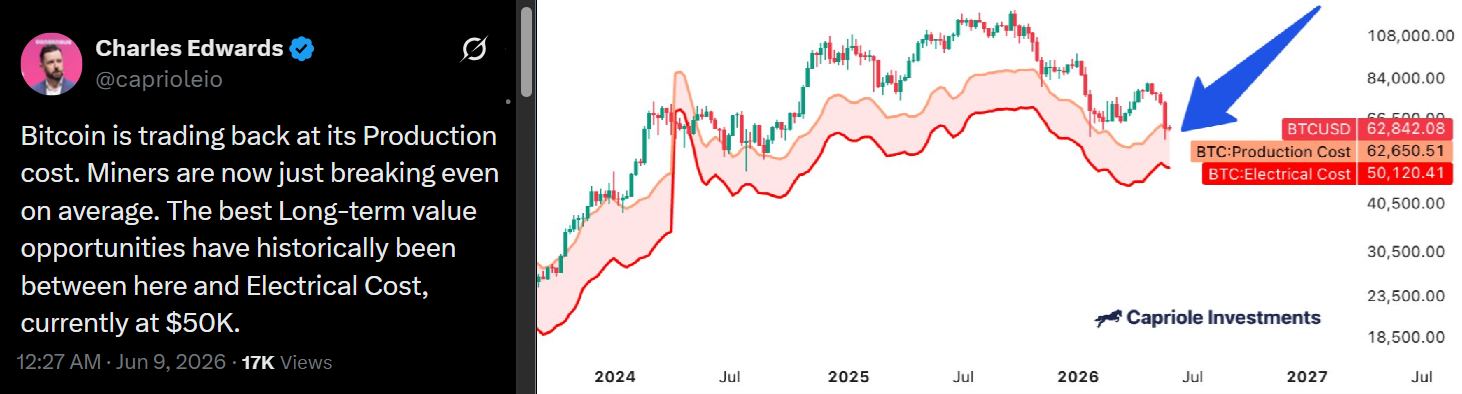
From a cost perspective, analysts note that production costs for Bitcoin mining vary widely by operator and region. Charles Edwards, founder of Capriole Investments, has highlighted that the Bitcoin mining production cost—accounting for depreciation and amortization—hovers around $62,650 per BTC, while the minimum electricity cost to break even sits near $50,120. Some publicly listed operators contend with more favorable economics thanks to newer ASIC models and industrial-scale power contracts. For American Bitcoin Corp (ABTC US), management reported gross operational costs near $36,200 per BTC mined in Q1 2026, illustrating how scale and efficiency can compress unit costs even as overall price pressures persist. Still, there is no single industry-wide figure, and some miners continue to run at losses for reasons such as tax planning or strategic positioning. Even with high-cost operations temporarily idling, spot institutional flows now vastly outweigh mined BTC output, underscoring macro forces as a primary driver of ongoing price dynamics.
Earlier coverage noted a related tension: as institutional demand for spot BTC has grown, Bitcoin has sometimes acted as a broader market canary in the coal mine during risk-off episodes, underscoring how macro liquidity can trump individual mining economics in the near term. For readers tracking this topic, see ongoing coverage on how risk-off dynamics influence BTC supply and price behavior.
Looking ahead, the key watchpoints are clear. Electricity prices and access to low-cost energy will continue to shape mining economics and any meaningful reallocation toward AI compute. At the same time, macro demand for Bitcoin as a risk-on or risk-off diversifier, plus regulatory developments around mining operations and energy contracts, will influence how miners navigate profitability, capacity deployment, and balance-sheet resilience. Investors and industry observers should monitor these intertwined threads to gauge whether mining margins recover, or if the AI-infrastructure pivot becomes the more durable driver of capital allocation in the Bitcoin ecosystem.
Watch for updates on energy pricing trends, AI data-center capacity expansion, and policy shifts that could impact the economics of large-scale mining. As the landscape evolves, the balance between profitability, energy constraints, and macro demand will continue to define Bitcoin’s mining narrative.
Sources and data references include the Luxor Hashrate Index for hashing-power returns, Glassnode Studio for miner net position changes, and statements from Bernstein on AI-data-center bottlenecks. Public disclosures from Capriole Investments and American Bitcoin Corp provide cross-checks on production costs and operational expenses, while market observers on X highlighted current hashrate concentration dynamics. Related context from Cointelegraph pieces on institutional flows and AI infrastructure themes complements the analysis.
Source notes: Daily return per 1 TH/s — Luxor Hashrate Index; 14-day miner net position change — Glassnode Studio; AI infrastructure bottlenecks — Bernstein (via Cointelegraph); 1) Antminer S21 XP Hydro profitability — Luxor Hashrate Index; Capriole Investments commentary — Capriole on X; ABTC Q1 2026 costs — ABTC via PR Newswire; broader context on institutional flows and AI infrastructure coverage — Cointelegraph.


Bill Gates has told a House panel that he regrets meeting Jeffrey Epstein while seeking support for global health work.
Summary
- Bill Gates said he regrets meeting Jeffrey Epstein while seeking support for global health work.
- Gates denied witnessing criminal conduct, visiting Epstein properties, or victimizing anyone.
- Lawmakers continue reviewing Epstein-related files and expect to release Gates’ testimony transcript soon.
The Microsoft co-founder denied witnessing criminal conduct and denied victimizing anyone in his prepared statement. His closed-door testimony came as lawmakers continue reviewing Epstein’s ties to wealthy and powerful figures.
Gates says Epstein meetings were a mistake
According to Bill Gates’ opening statement, he first met Epstein in 2011 through people he trusted professionally. Gates said the meetings focused on possible donations to the Gates Foundation and global health programs.
“I should never have met with Epstein in the first place,” Gates said. He added that any promised donors would not have justified the association. Gates said Epstein claimed he could raise billions of dollars from people connected to his tax and estate work. However, Gates said no charitable vehicle was created and no funds were raised.
He said he held three meetings with Epstein in 2011 and two meetings in 2012. Later talks in 2013 and 2014 focused on possible donor-advised funds. By 2014, Gates said he concluded Epstein would not deliver the promised support. He said he then stopped communicating and meeting with him.
Bill Gates denies seeing criminal conduct
Gates told lawmakers he never saw signs that Epstein engaged in ongoing criminal conduct. He also said he never visited Epstein’s island, ranch, or Florida home.
“I have never victimized anyone,” Gates said in the statement. He said Epstein may have sought a personal relationship, but he never reciprocated. Gates said he knew Epstein had prior legal issues, but not the full extent of his crimes. He said he accepted the introduction without the scrutiny he should have applied.
Epstein pleaded guilty in Florida in 2008 to charges linked to soliciting an underage girl for prostitution. He later died in a New York jail in 2019 after federal charges. Gates said Epstein later learned sensitive information about his personal life. He said Epstein tried to use those details and false claims to pressure him.
Lawmakers continue Epstein document review
The House Oversight and Government Reform Committee questioned Bill Gates behind closed doors on Wednesday. The committee interviewed Epstein’s former executive assistant, Lesley Groff, a day earlier. Gates left the interview around 3:50 p.m. ET without speaking to reporters. A transcript of his testimony is expected in the coming days.
Committee Chair James Comer said lawmakers may invite attorney Alan Dershowitz to testify. Dershowitz previously represented Epstein in legal matters. Rep. Robert Garcia said lawmakers wanted to understand who moved inside Epstein’s circle. He said the panel planned questions about emails tied to Gates and Epstein.
In his statement, Gates said he supports releasing all Epstein files. He also said survivors of Epstein’s crimes deserve justice. Gates said the association put the Gates Foundation’s work at risk. The foundation previously commissioned an external review of its past ties with Epstein.
Bitcoin remained under pressure near $61,750 as analysts warned that the upcoming SpaceX IPO could divert capital away from the crypto market at a time when ETF outflows and weak sentiment are already weighing on the market.
Summary
- Bitcoin fell 14% over the past week as ETF outflows, weak sentiment, and declining open interest weighed on the market.
- U.S. spot Bitcoin ETFs have recorded roughly $4.57 billion in net outflows over the past four weeks, signaling weaker institutional demand.
- Analysts warn SpaceX’s planned $75 billion IPO could compete with cryptocurrencies for investor capital and add further pressure to Bitcoin.
According to market data, Bitcoin (BTC) price has fallen about 14% over the past week, while the total cryptocurrency market capitalization slipped another 1.1% over the past 24 hours to $2.2 trillion. The decline comes as traders continue reducing exposure across derivatives markets, with Bitcoin open interest falling 0.57% to approximately $45 billion.
Sentiment has also deteriorated sharply. Data from Alternative’s Crypto Fear & Greed Index showed a reading of 9, marking another week in extreme fear territory as investors remain cautious amid growing macroeconomic and geopolitical uncertainty.
Bitcoin sentiment deteriorates as ETF outflows mount
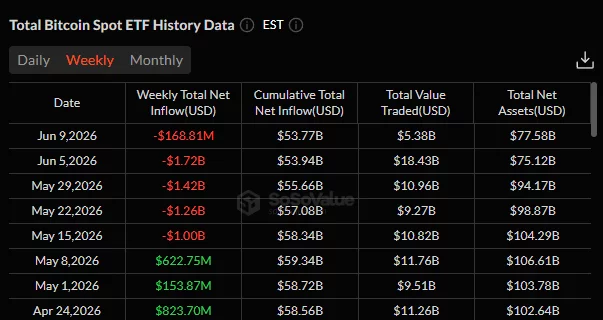
Institutional demand has also shown signs of weakening. Data from SoSoValue shows U.S. spot Bitcoin ETFs recorded net outflows of $168.8 million so far this week. The products also saw withdrawals of $1.72 billion, $1.42 billion, and $1.26 billion during the previous three weeks, bringing total outflows over the four-week period to roughly $4.57 billion.
The sustained withdrawals have coincided with a decline in total net assets held by spot Bitcoin ETFs. According to SoSoValue, combined assets under management fell from $104.29 billion in mid-May to $77.58 billion by June 9.
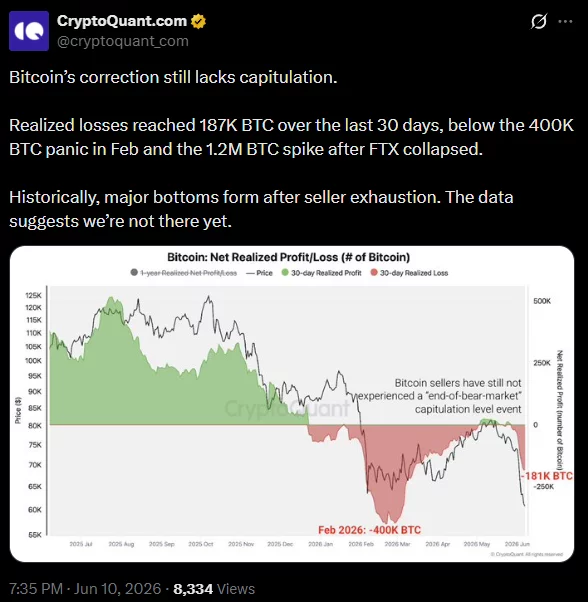
Additional on-chain data suggests the market may not have reached a capitulation phase typically associated with major cycle bottoms.
In a June 10 market update, CryptoQuant noted that realized losses totaled approximately 187,000 BTC over the past 30 days, below the roughly 400,000 BTC realized during the February panic and well below the 1.2 million BTC recorded following the FTX collapse.
“Historically, major bottoms form after seller exhaustion. The data suggests we’re not there yet.”
Technical indicators also remain fragile. Bitcoin is trading near the Murrey Math support zone around $62,500, while a break below the nearby $59,375 support level could expose the market to deeper downside risks.
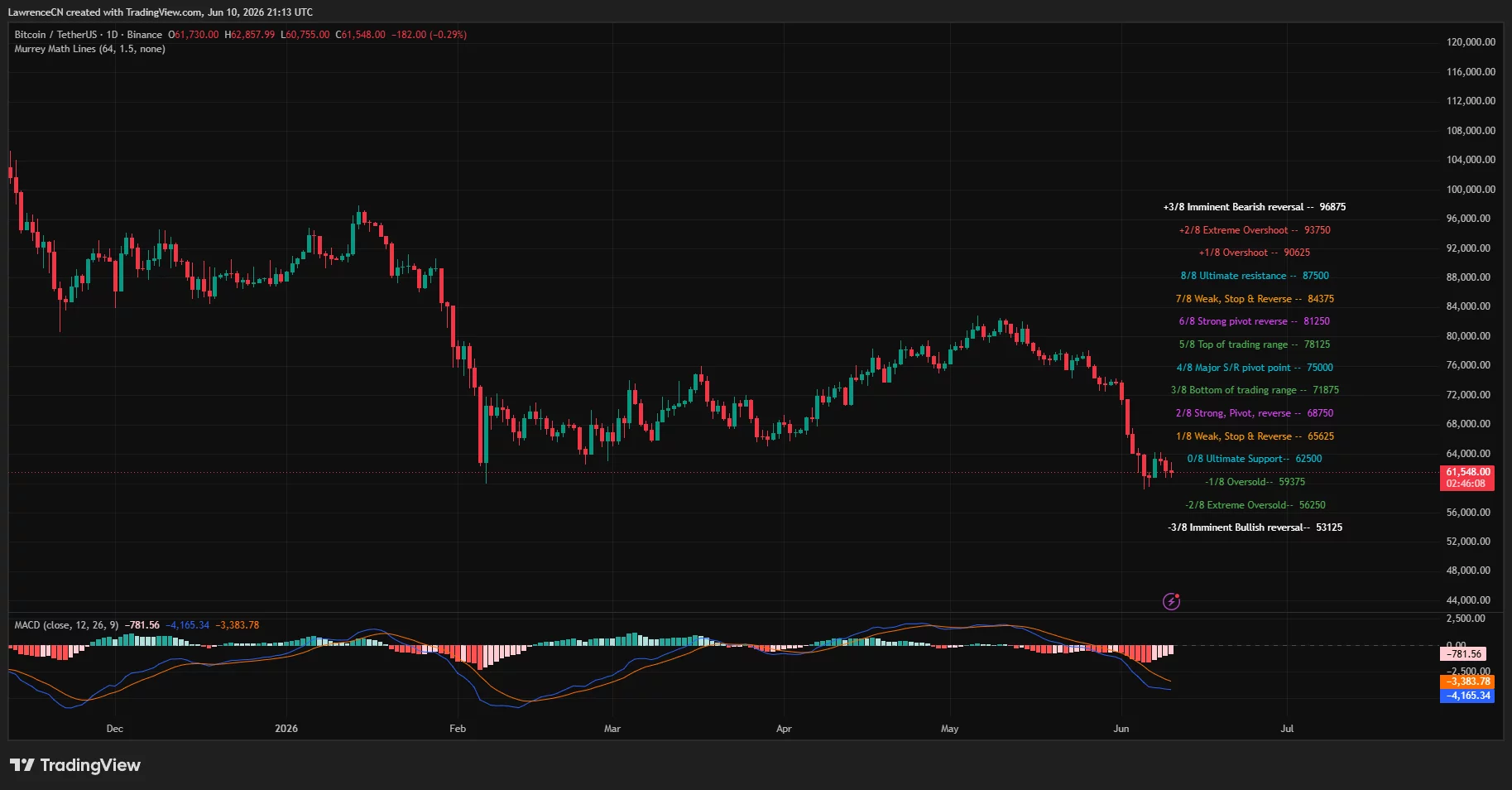
Momentum indicators continue to favor sellers, with the MACD remaining in bearish territory after a recent negative crossover. The widening gap between the MACD and signal lines suggests downward momentum has yet to fully weaken, increasing the risk of further losses if buyers fail to defend key support levels.
SpaceX IPO could compete for crypto liquidity
Against that backdrop, analysts are increasingly focused on the potential impact of SpaceX’s long-awaited public debut.
The aerospace company founded by Elon Musk is reportedly preparing a $75 billion public offering at a projected valuation of approximately $1.75 trillion. Reuters reported that about 30% of the offering could be reserved for retail investors, an unusually large allocation for an IPO of that size.
Some market participants believe the listing could attract capital that might otherwise flow into cryptocurrencies.
“Crypto is a funding currency for a lot of this,” Spencer Hallarn, global head of over-the-counter trading at GSR, told Reuters. “We’ve got to find $75 billion for this IPO, and it’s got to come from somewhere.”
Thomas Puech, chief executive of crypto firm INDIGO, also told Reuters that the offering could divert funds away from digital assets in the short term because both markets compete for the same pool of risk capital.
According to Puech, artificial intelligence-related investments currently represent a more attractive trade for many growth-focused investors.
While there is no direct evidence that recent Bitcoin ETF outflows are being redirected toward SpaceX shares, analysts say the timing of the IPO could create another headwind for digital assets.
With institutional demand weakening, sentiment stuck in extreme fear territory, and on-chain data suggesting seller exhaustion has yet to emerge, Bitcoin may remain vulnerable to additional liquidity pressures in the weeks ahead.
Disclosure: This article does not represent investment advice. The content and materials featured on this page are for educational purposes only.
Key takeaways:
- Record-low Bitcoin mining margins and rising demand for AI infrastructure incentivize miners to reduce their BTC positions.
- Institutional spot Bitcoin flows vastly surpass miner output, making macro trends more vital than miner profits alone.
Bitcoin’s price slide to $62,000 was paired with weak on-chain activity and declining BTC miner revenues, which have fallen to an all-time low. This revenue drop is fueling investor anxiety over potential sell pressure, especially since miners and mining pools still control over $110 billion in Bitcoin.
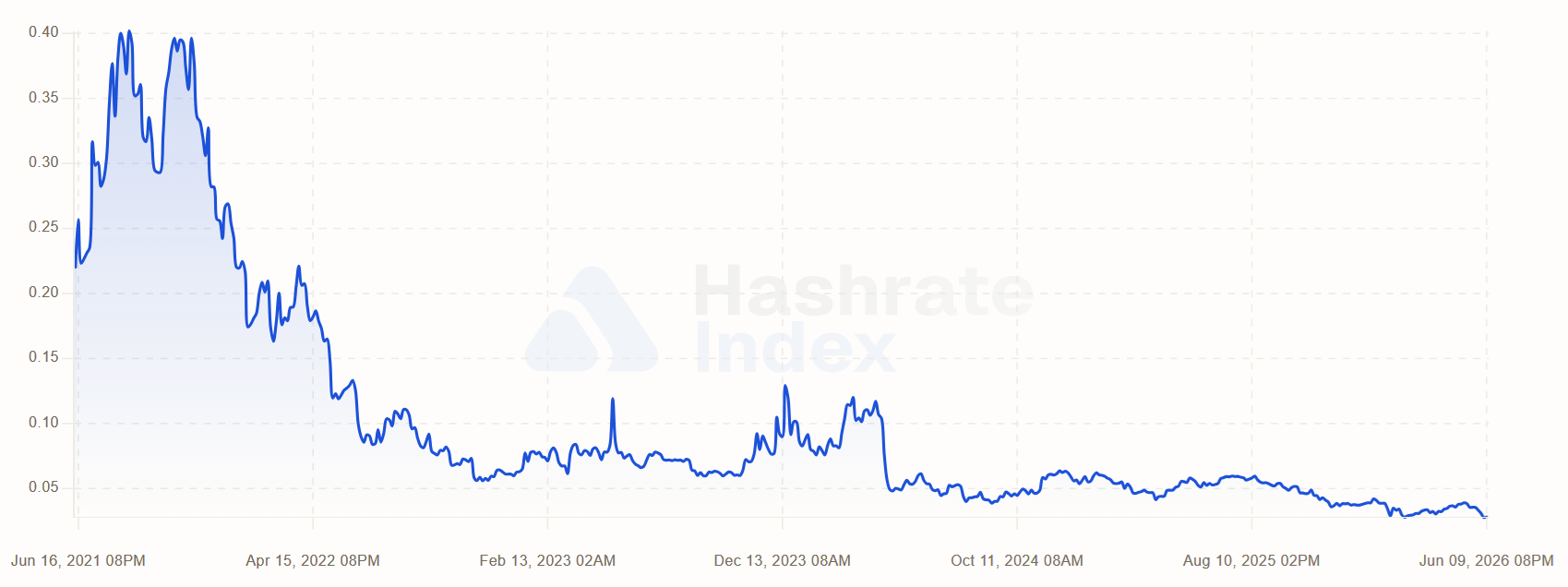
1 TH/second of hashing power per day returns, USD. Source: Luxor Hashrate Index
The estimated daily return for 1 terahash per second of hashing power plunged to an all-time low of $0.28 on Tuesday, down from $0.39 just a month ago. For context, the estimated monthly gross profit for an Antminer S21 XP Hydro (at an electricity cost of $0.07 per kilowatt-hour) has slid to $137, down from $192 last month.
This profitability crunch arrives as demand for AI capacity and infrastructure investments surged, dampening market sentiment just as the crucial $60,000 support level was put to the test.
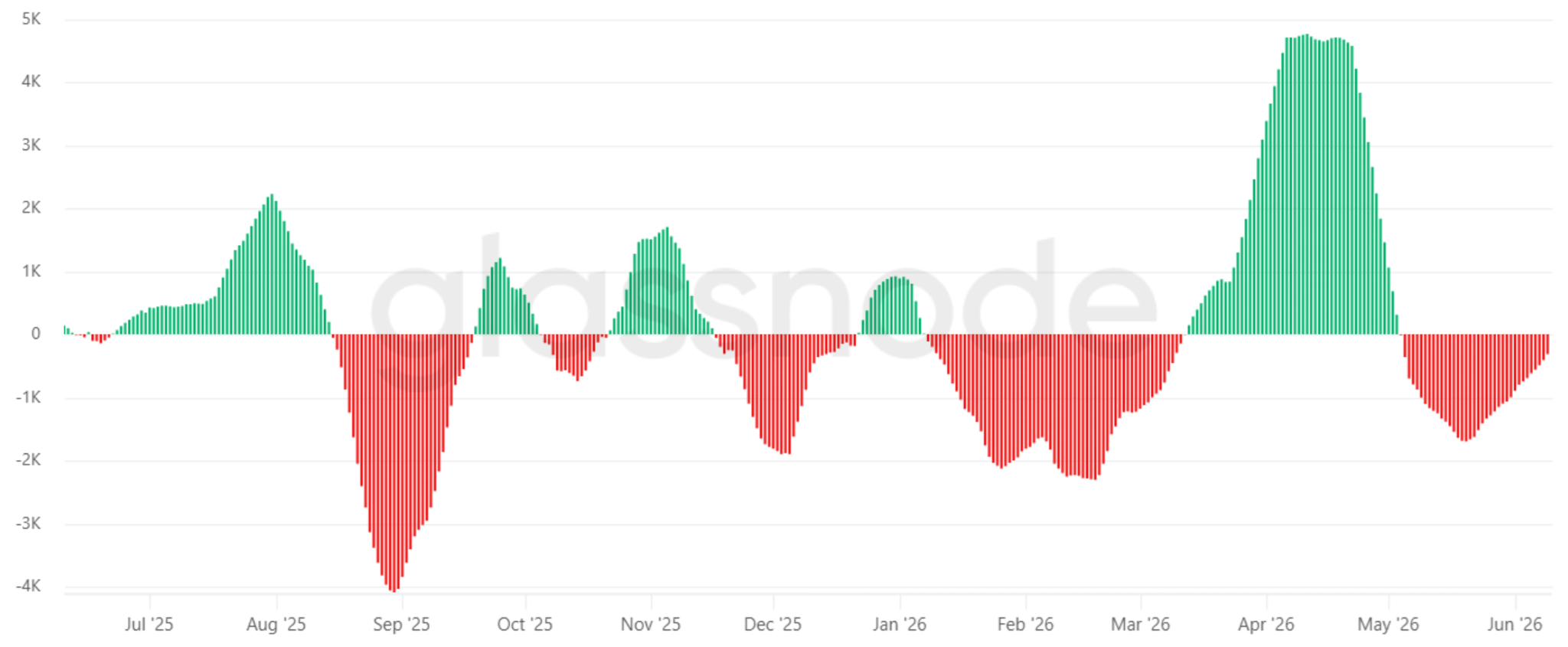
Bitcoin miners’ 30-day net position change, BTC. Source: Glassnode Studio
The 14-day average net position change for Bitcoin held in miner and mining pool addresses flipped negative in early May and has remained negative since. Whether these liquidations are intended to fund ongoing operations, reduce debt leverage, or bankroll expansion into AI data center computing, the net effect remains a heavy drag on Bitcoin’s price discovery.
Source: X/LightningNewsX
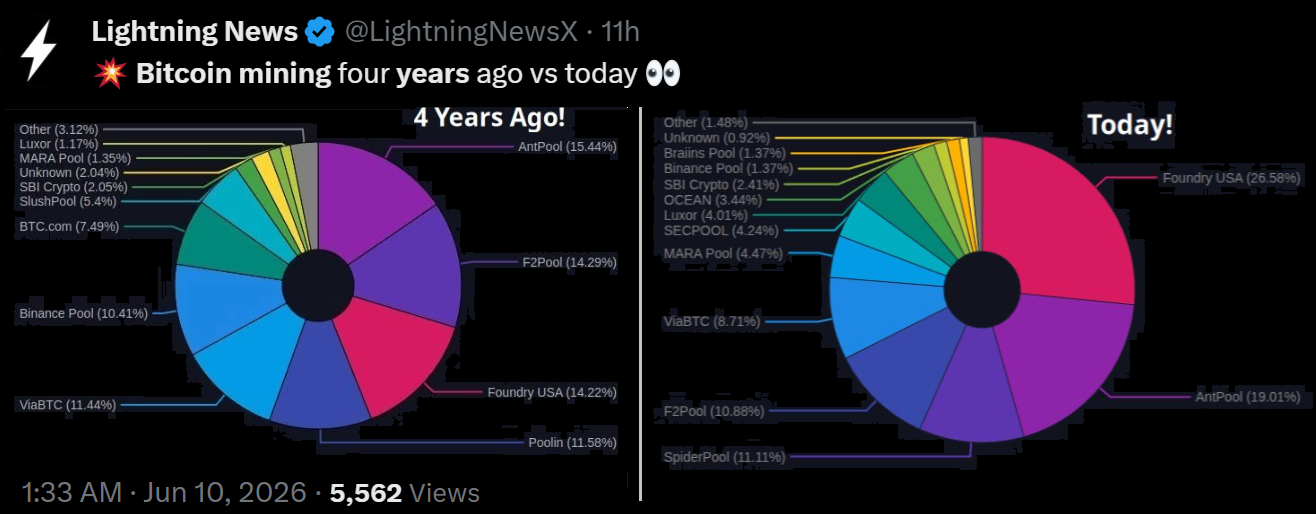
The high concentration of Bitcoin hashrate among the three largest mining pools is a frequent target of analyst criticism. The latest 7-day data show that Foundry USA, AntPool, and F2Pool control a combined 59% market share. In contrast, the top three Bitcoin mining pools held a combined 44% hashrate market share back in 2022.
According to Bernstein analysts, the primary bottleneck for scaling AI data centers is access to electricity rather than chips. This constraint is prompting some Bitcoin miners to repurpose parts of their power infrastructure to support AI computing applications, a sector currently viewed as more stable and lucrative than traditional crypto mining.
Source: X/Capriole Investments
According to Charles Edwards, founder of Capriole Investments, the Bitcoin mining production cost, including depreciation and amortization, stands at $62,650, while the absolute minimum to break even on electricity is $50,120. However, certain publicly listed companies leverage much more efficient ASIC models and industrial-scale energy contracts.
American Bitcoin Corp (ABTC US) reported gross operational costs near $36,200 per Bitcoin mined in the first quarter of 2026. Ultimately, pinning down a single, industry-wide production cost is impossible, and some operations choose to mine at a loss for specific tax benefits. Even if these high-cost miners temporarily shut down, spot institutional flows now vastly surpass miners’ output.
Related: Bitcoin may act as a ‘canary in the coal mine’ as risk-off pressure spreads–Bitwise
Bitcoin traded below its estimated production cost for more than six months in 2019 and again in 2023, based on Capriole Investments data. Whether the current market stagnation persists depends on investor risk perception amid broader macroeconomic uncertainty, rather than miner profitability alone.

TLDR
- Tether led a Series C funding round worth up to $1.4 billion in Neura Robotics.
- The deal closed after several months of discussions between Tether and the German robotics firm.
- Neura Robotics develops humanoid robots, precision arms, and autonomous mobile machines.
- Tether will integrate its Wallet Development Kit directly into Neura’s robotic systems.
- Tether stated that autonomous robots require built-in financial tools to complete transactions.
Tether confirmed it led a Series C round worth up to $1.4 billion in Neura Robotics. The stablecoin issuer announced the deal on Wednesday and outlined plans for wallet integration. The agreement follows earlier reports that Tether considered investing in the German robotics firm last year.
Tether commits up to $1.4 billion to Neura Robotics
Tether said it backed the raise of up to $1.4 billion from strategic and financial investors. The company described the move as a step toward advancing machine intelligence and autonomy. It stated that the investment supports a firm reshaping how machines think and move.
The company said, “By supporting the raise of up to $1.4 billion, the group takes a decisive step.”
It added that Neura Robotics aims to redefine how machines interact and transact in the physical world. Tether confirmed the funding round closed after several months of negotiations.
Neura Robotics develops humanoid robots and precision robotic arms for industrial use. The company also builds autonomous mobile robots and service robots for multiple sectors. Tether stated that these systems will operate where human and machine collaboration creates value.
Neura raised nearly $140 million in January 2025 from BlueCrest, C4 Ventures, Lingotto, and Volvo Cars Tech Fund. That round expanded its capital base before the Series C financing. The company competes with Tesla, which also plans to mass-produce robots.
Tether has expanded its venture capital activity through profits from its USDT stablecoin business. The firm holds reserves in yield-bearing assets such as U.S. Treasurys. These investments generate income that supports strategic deals like the Neura round.
Tether wallet tools set for robotic ecosystem integration
Tether said it will deploy technology within the Neura robotics ecosystem. The company confirmed that Neura will integrate Tether’s Wallet Development Kit into robotic systems.
Tether stated, “To be truly autonomous, robots need financial tools.”
The integration will allow robots to access digital payment capabilities directly. Tether explained that the wallet tools will support transactions within machine environments. The statement outlined plans to embed payment functions into robotic workflows.
Tether did not disclose the exact timing for deploying the wallet technology. However, it confirmed that development teams will work on direct integration. The company linked the effort to its broader digital asset infrastructure strategy.
Neura operates from Germany and focuses on collaborative robotics platforms. The company builds systems designed for industrial and service applications. It stated that its products aim to function across varied environments.
Tether did not release further financial details beyond the $1.4 billion figure. The company emphasized that diversified investors participated in the round. It confirmed that the funding and integration plans form part of the closed Series C agreement.

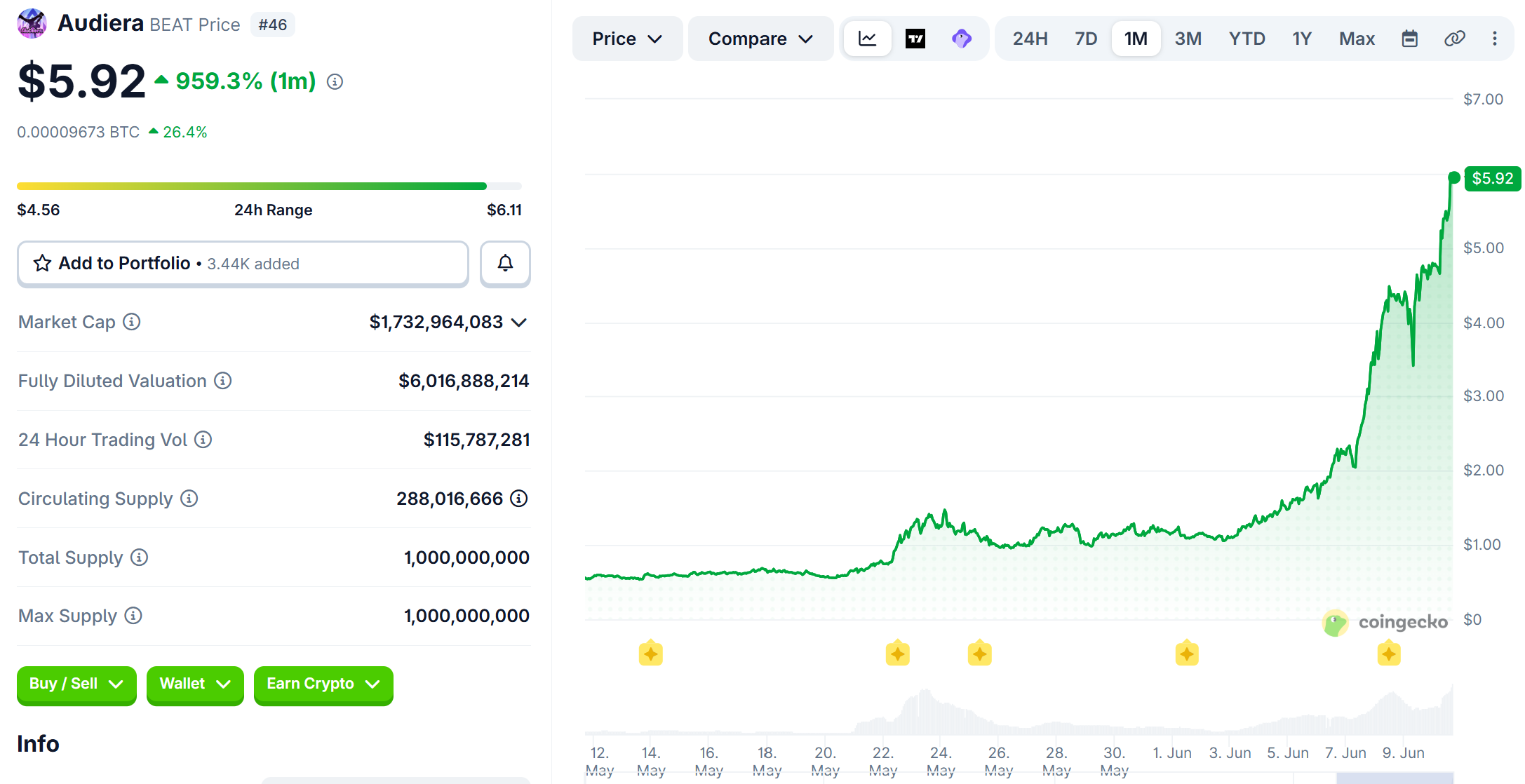
Audiera (BEAT) reached an all-time high of $6.11 on Wednesday, extending its weekly gain to 378% and monthly climb to nearly 960%. The surge has revived warnings that the token shares traits with RaveDAO (RAVE) and LAB before their collapses.
The rhythm gaming token now holds a $1.75 billion market cap and a fully diluted valuation (FDV) above $6 billion. However, less than a third of its supply circulates, a structure critics tie to recent manipulation episodes.

Why Audiera BEAT Draws RAVE and LAB Comparisons
Audiera’s circulating supply stands near 288 million BEAT, about 29% of its 1 billion maximum, according to CoinGecko.
RAVE and LAB launched with the same structure. Each caps supply at 1 billion tokens, and each traded with under a third of supply circulating.
On-chain investigator ZachXBT alleged insiders holding over 90% of RAVE’s supply coordinated the RAVE pump-dump scheme. The alleged activity spanned Binance, Bitget, and Gate.
RAVE shed more than 95% of its value in a day. It now trades near $0.32, almost 99% below its April peak of $27.88.
The pattern repeated when LAB crashed 77% in two hours on June 2, erasing close to $6 billion.
That collapse arrived days after LAB’s record high, with most holders still locked. LAB has since lost 53% in a week.
Audiera now faces similar scrutiny. Risk threads claim BEAT’s top 10 wallets control around 85% of supply.
BeInCrypto could not independently verify that figure.
“It looks like BEAT has the potential to become the next LAB/RAVE like scam coin It’s currently trading close to $6bn FDV. Strangely, it hasn’t been trading on negative funding at all. Maybe the funding will start pushing negative later to inflict max pain to shorts…,” one analyst noted.
Follow us on X to get the latest news as it happens
Pseudonymous trader DeFiVillain has flagged whale flows and funding dynamics resembling the RAVE playbook.
Similar warnings circulate in Telegram trading channels.
A Gaming Narrative Sets BEAT Apart, for Now
However, Audiera differs from its troubled predecessors in important ways.
The project is a Web3 revival of the Audition dance game on BNB Chain.
Binance ran a BEAT trading competition on Binance Alpha this spring, giving the token mainstream exchange exposure.
Moreover, no investigator has published a formal case against the project.
Warnings so far come from traders rather than hard evidence, though analysts flagged RaveDAO’s surge on similar grounds before its collapse.

Still, the gap between BEAT’s $6 billion FDV and $1.75 billion market cap leaves 712 million tokens to enter circulation.
How those tokens reach the market may decide whether BEAT escapes the pattern its critics describe.
The post This One Altcoin Flashes Red Flags That Preceded RaveDAO and LAB Crashes appeared first on BeInCrypto.


The recently released public version of Anthropic’s Claude Fable 5 AI model won’t let you audit your crypto smart contracts — or do much else when it comes to cybersecurity.
The new large language model (LLM), a scaled-back version of Anthropic’s previous Mythos model, was released yesterday to a mixed reception from scared and excited onlookers eager to see what it could do.
Much of the early criticism has focused on its guardrails.
Because of Fable 5’s’ touted capabilities, Anthropic has released it with a set of restrictions called “classifiers” that redirect topics on “cybersecurity, biology and chemistry, or distillation” to Claude Opus 4.8.
As a result, users who’ve tried to use Fable 5 to audit a smart contract — that is to check the underlying code of crypto infrastructure for any security vulnerabilities — have found themselves redirected to Opus.
- Colossus Pay CEO Joseph Delong said Fable 5 “outright refuses to do a smart contract audit,” and complained that it “won’t even look at my repo.”
- Yearn developer Banteg claimed that the model’s safety measures stopped all security-related prompts from working. They added, “It doesn’t matter if it’s smart if 100% of your queries go straight into a trash bin.”
- Crypto security expert Taylor Monahan noted that Fable 5 “changes nothing for your average security person,” and that the Mythos safeguards are not the typical ones “you encounter (and evade) on opus.”
- Wallet recovery tool founder Zeng Jiajun shared how Fable 5 frequently blocked his requests while citing usage policy violations. He said the AI model is “Too sensitive for even an Ethereum app development.”
Read more: Anthropic’s public Claude Fable release has crypto on edge
Mythos restrictions expand beyond smart contracts
So-called “distillation” guardrails are also being noticed. These involve redirecting anything that relates to the training of a rival AI model and the attempted distillation of Claude’s abilities.
It warns that this can be done by authoritarian countries, and that it “could indirectly lead to the proliferation of near-frontier AI capabilities — and these could be released without the appropriate safeguards.”
Indeed, former Palantir biology specialist Nabeel S. Qureshi noted that Anthropic is “invisibly nerfing any requests that target frontier LLM development.”
Biology-related safeguards have also drawn criticism. Biologist Olivia H. Scharfman claimed she couldn’t even greet Fable 5 before it switched to Claude Opus 4.8.
Read more: Secret Claude model ‘better than all but the most skilled humans’ at hacking
In another instance, the controversial race science blogger Jordan Lasker noted that he too couldn’t greet Fable 5 and that it barred questions on the mitochondria.
These particular guardrails are in place as Anthropic is concerned about the potential for abuse, specifically the creation bioweapons and viruses.
It said, “Our priority was to safely release Fable as soon as we could, even at the cost of overly broad safeguards. Therefore, for the time being we have arranged for Fable to fall back to Opus 4.8 on most requests related to biology and chemistry.”
The full release of Mythos is limited
Anthropic released Mythos last April. It was described as both a dangerous tool for hackers and a revolutionary upgrade for cybersecurity.
Because of this, Mythos’ initial release was limited to 50-60 large companies as part of Project Glasswing.
These firms will still have access to Mythos 5, while other early recipients include “select biology researchers” who are able to access Mythos 5 with just the biology and chemistry safeguards lifted “until our broader trusted access program is available.”
Got a tip? Send us an email securely via Protos Leaks. For more informed news and investigations, follow us on X, Bluesky, and Google News, or subscribe to our YouTube channel.
Crypto World
Kalshi now requires users to reveal employers as it fights insider trading and market manipulation


Kalshi said it will start requiring some users to disclose their employers as part of a broader push to crack down on insider trading and market manipulation on its prediction-market platform.
The federally regulated exchange said Tuesday the new policy will apply to markets it considers at higher risk for insider activity or abuse. Those traders may be screened before being allowed to place trades.
The company said the changes take effect immediately and follow recommendations from an independent Surveillance Audit Committee that reviewed Kalshi’s enforcement systems, monitoring tools, and trading controls.
“For markets with heightened insider or manipulation risk, we now collect employment information before traders can participate,” Kalshi said in a statement. The company said the process is designed to identify people who may have access to material nonpublic information tied to an event or outcome.
The platform’s new measures come as prediction markets face increasing scrutiny. Recently, a Yale and London Business School paper analyzing Polymarket trades from 2023 to 2025 found that only 3% of traders accounted for most price moves. The study highlighted the case of a U.S. Army Green Beret arrested in April for $400,000 bets on Polymarket on the raid in Venezuela to extract then-President Nicolas Maduro, in which he participated. A month later, a Google engineer was also arrested for alleged insider trading on Polymarket.
Prediction markets allow users to bet on the potential outcome of future events, including elections, economic data and corporate and political developments. As the industry grows, critics have raised concerns that traders with insider knowledge could exploit thinly traded or highly sensitive markets.
Kalshi said it blocked more than 100 potential insider trades in the first quarter using new screening tools. The company also said it opened more than 150 investigations, referred more than 20 cases to law enforcement, and issued five disciplinary actions. The company did not provide details about those cases, and the figures could not be independently verified.
The exchange also announced a new risk-scoring system that evaluates markets based on factors including insider-trading risk, market importance, regulatory concerns, and national-security implications. Markets viewed as carrying elevated manipulation risks could face tighter controls or be rejected from listing altogether.
Kalshi said it also added new whistleblower reporting tools that allow users to flag suspicious trading activity directly from individual markets.
Tim Meggs, CEO and co-founder of LO:TECH, a transparent market data infrastructure firm, told CoinDesk that prediction markets have grown so rapidly that questions about their integrity need to be addressed as they are no longer theoretical. “Kalshi’s move to require employment verification, risk-scored markets, and whistleblower tools highlights how the sector is starting to build the surveillance infrastructure to match its ambitions,” Meggs said. “That maturation matters as much as the volume numbers.”

Stand With Crypto UK is urging its 286,000 members to challenge British banks restricting transfers to cryptocurrency exchanges, arguing that blanket limits on transactions to regulated platforms are restricting access to digital assets.
The advocacy group cites a report from the UK Cryptoassets Business Council that found 40% of crypto transactions are blocked or restricted by UK banks. The group argues that many of the restrictions apply to transfers involving exchanges registered with the country’s Financial Conduct Authority and do not account for individual customer risk profiles.
According to the report, one exchange recorded nearly £1 billion in declined transactions over a one-year period due to bank-side rejections, while 80% of surveyed platforms reported an increase in blocked or restricted transfers.
Stand With Crypto said members can submit complaints through a tool on its website that generates letters challenging transfer restrictions, with responses from banks expected to inform the campaign’s next steps.
“Your money. Your choice.” is the tag line of Stand With Crypto UK’s advocacy campaign.
Mark Fairless, CEO of UK clearing bank ClearBank, told Cointelegraph that banks should take a risk-based approach to crypto-related payments rather than imposing broad restrictions across the sector.
“Interventions should be targeted and proportionate, as broad blocks risk undermining competition and the ability of regulated firms to operate effectively in the UK,” Fairless said.
Related: EU proposes ban on 11 crypto platforms in Russia sanctions push
Bank transfer restrictions and regulatory response
The campaign underscores a broader regulatory conversation about access to crypto markets and the role of banks in enforcing anti-money-laundering regimes. Analysts note that difficulty moving funds into regulated, FCA-registered exchanges can complicate onboarding for institutional and retail investors alike, potentially pushing activity toward non-compliant or offshore venues if constraints persist. Regulators have emphasized that the UK framework must balance consumer protection with competitive access to regulated crypto services.
UK stablecoins and market policy trajectory
The push around transfers sits within a wider UK policy debate over stablecoins and the infrastructure required to support a domestic market. In early May, a House of Lords committee examined proposed stablecoin regulations, with lawmakers questioning industry executives on bank-run risks, AML controls and the potential impact on traditional banking. Later in May, the Bank of England signaled it was reconsidering proposed caps on stablecoin holdings and reserve requirements as part of its review of pound-denominated stablecoins.
The policy objective is to foster a domestic stablecoin market while ensuring financial stability and access to banking for regulated issuers. DefiLlama data show the global stablecoin market cap, with non-dollar tokens comprising a relatively small share of overall liquidity.
In June, a House of Lords committee urged regulators to avoid measures that could inhibit the growth of GBP-denominated stablecoins, warning that reserve and holding rules could limit viability. The committee urged regulators to balance oversight with the ability of the sector to scale.
Broader digital-asset regulation and market infrastructure
Beyond stablecoins, UK regulators have advanced broader digital-asset initiatives. In May, the Bank of England proposed extending operating hours for the country’s settlement infrastructure to support tokenized markets. In June, the Financial Conduct Authority proposed allowing certain retail-focused investment funds to allocate up to 10% of their portfolios to crypto exchange-traded products, signaling a move toward broader institutional access while maintaining risk controls.
These developments occur in the context of ongoing efforts to align supervisory frameworks with evolving market structures, including settlement resilience, asset tokenization, and investor protection rules. The regulation-focused stance aims to shore up financial stability, while enabling compliant actors to participate in a growing digital-asset ecosystem.
As policymakers refine the UK’s approach, observers will monitor how banks implement risk-based decisioning for crypto-related payments and how draft stablecoin rules translate into licensing, custody, and liquidity requirements for regulated issuers.
Closing perspective: The UK’s stance on bank-partnered access to crypto markets and the pace of stablecoin regulation will shape the viability of domestic players and international cooperation on cross-border standards. Market participants should watch for further regulatory guidance, bank responses to complaints, and updates to the overarching digital-asset framework.

XRP HOLDERS I GOT MAJOR XRP NEWS!!!!

Belfast attack live: Protesters blasted with water cannon during second night of violence

Market Shifts From Risk On To Risk Off



-

 Fashion5 days ago
Weekend Open Thread: Evereve – Corporette.com
-
 Crypto World5 days ago
Jensen Huang Approves Samsung, SK Hynix, and Micron for NVIDIA (NVDA) HBM4 Memory Supply
-

 Crypto World3 days ago
Anatomy of the June crypto crash: Fed, Iran, Saylor
-
 Entertainment4 days ago
The Best Mystery Series of All Time Is Surging on Streaming 30 Years After It Ended
-

 NewsBeat3 days ago
Alexander Zverev wins the French Open to finally earn a 1st Grand Slam title
-

 Tech5 days ago
Suspicious Polyfill login prompts pop up on Toshiba, Muji websites
-
Crypto World4 days ago
Senator Cynthia Lummis Calls CLARITY Act the Most Consequential Financial Legislation of This Generation
-

 Tech6 days ago
Microsoft launches MXC, an OS-level sandbox for AI agents, with OpenAI and Nvidia already on board
-

 Tech3 days ago
Microsoft unveils seven homegrown AI models in new bid for ‘long term self-sufficiency’
-

 Business5 days ago
(VIDEO) Justin Bieber Delivers Surprise Happy Birthday Serenade to Diners at Los Angeles Mexican Restaurant
-
 Business4 days ago
The Pain Points Taking a Fragile Tech Rally Down a Notch
-
 Crypto World2 days ago
Eli Lilly (LLY) Stock Surges 4% Following Breakthrough Sleep Apnea Trial Results
-
Crypto World6 days ago
LBank Surpasses 25 Million Users Worldwide as AFA Partnership Continues to Drive Global Growth
-

 Tech5 days ago
Von der Leyen’s AI envoy pick draws conflict-of-interest fire
-

 Crypto World3 days ago
Trump’s AI Ownership Plan Could Benefit Anthropic at OpenAI’s Expense
-

 Tech5 days ago
Meta steals a tactic from Tesla and builds data centers in tents
-
 Sports1 day ago
Bangladesh beat Australia after 20 years in ODIs, register only their second win over six-time world champions | Cricket News
-

 Business3 days ago
High Stakes for Wembanyama as New York Pushes for 3-0 Lead
-

 Tech5 days ago
Hackers now exploit SolarWinds Serv-U flaw to crash servers
-

 Tech3 days ago
Notion restores access to Anthropic after service disruption
You must be logged in to post a comment Login