

Crypto World
Binance Retail Investor Bitcoin Inflows Drop By 73%, What’s Next for BTC?

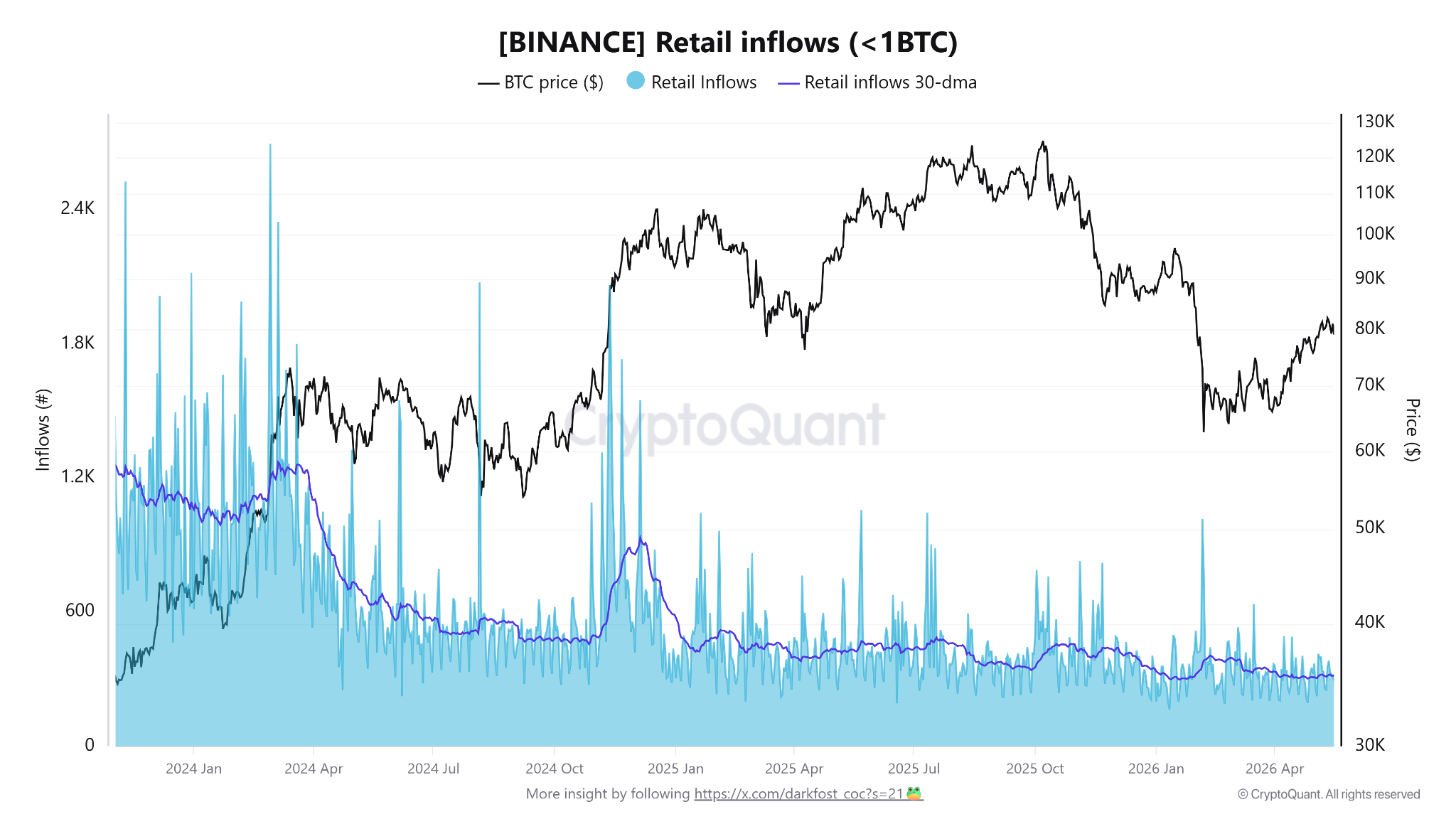
Bitcoin (BTC) retail investor activity on Binance has fallen to its lowest level in history. Retail BTC inflows on Binance now average near 314 BTC per month in 2026, down sharply from the 1,200 BTC range recorded in March 2024.
Bitcoin’s recovery in May also slowed as spot inflows on Binance weakened, with the 30-day net demand growth falling 73% over the past three weeks.
Bitcoin retail traders step back
CryptoQuant analyst Darkfost said retail Bitcoin inflows to Binance remained near its historic lows. The metric tracks BTC deposits from wallets holding less than 1 BTC, a common signal for retail investor activity.
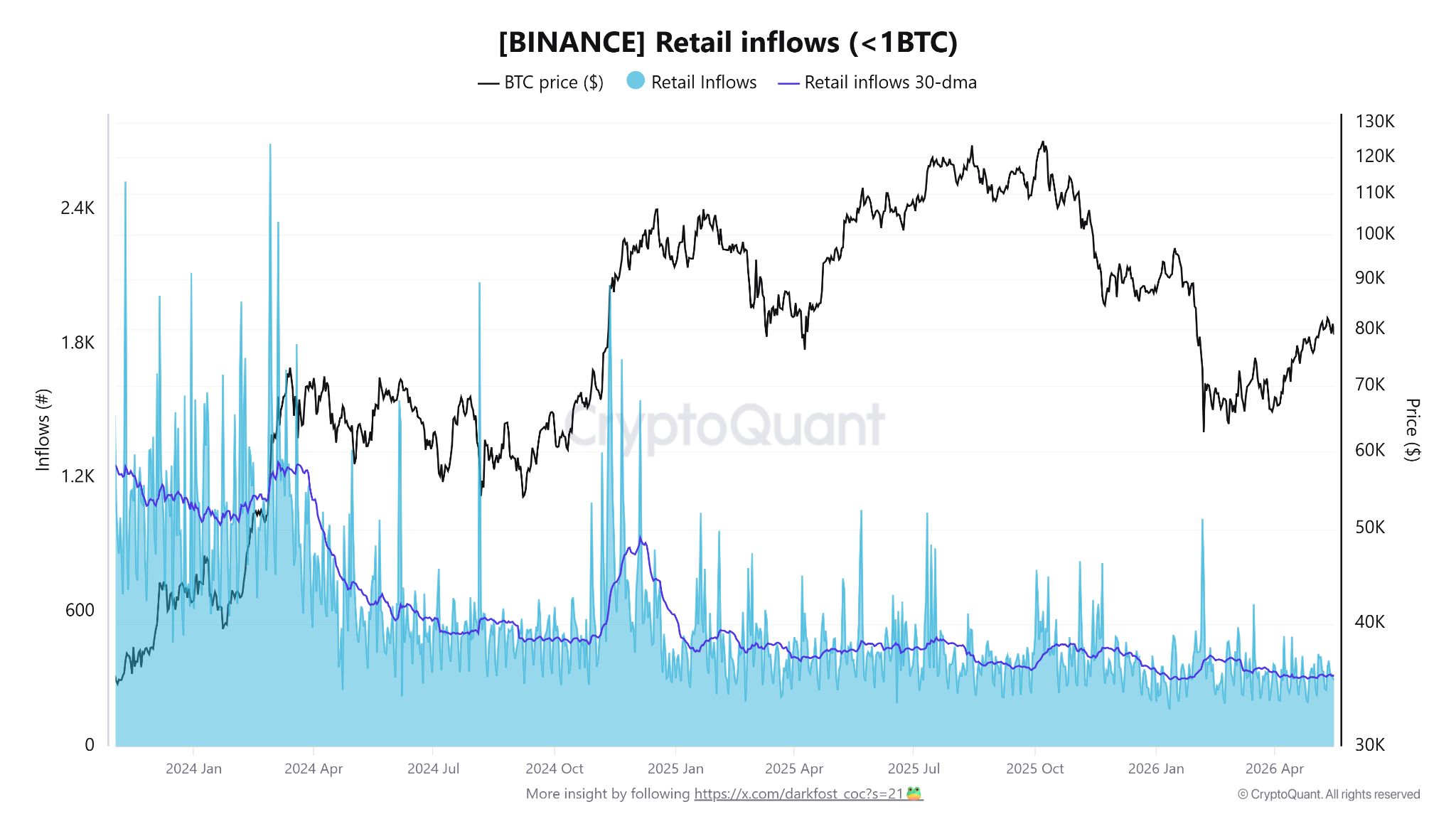
Bitcoin retail inflows (less than 1 BTC) on Binance. Source: CryptoQuant
Monthly retail BTC inflows on Binance now average just 314 BTC. The figure stood near 1,800 BTC during the 2022 bear market and around 1,200 BTC during Bitcoin’s March 2024 local top near $75,000. Earlier cycles showed far heavier retail participation, with inflows peaking near 5,400 BTC in 2018 and 2,600 BTC in 2021.
Darkfost said part of the shift likely stemmed from investors moving toward spot Bitcoin exchange-traded funds (ETFs) rather than directly holding BTC on exchanges.
CryptoQuant data also showed a cooldown in retail demand growth. The 30-day change in retail investor demand dropped to 3.12% from 7.39% last week. That earlier reading marked the strongest retail demand expansion since August 2025, when Bitcoin traded near $115,000. The decline points to weaker spot participation after a brief pickup in buying activity.
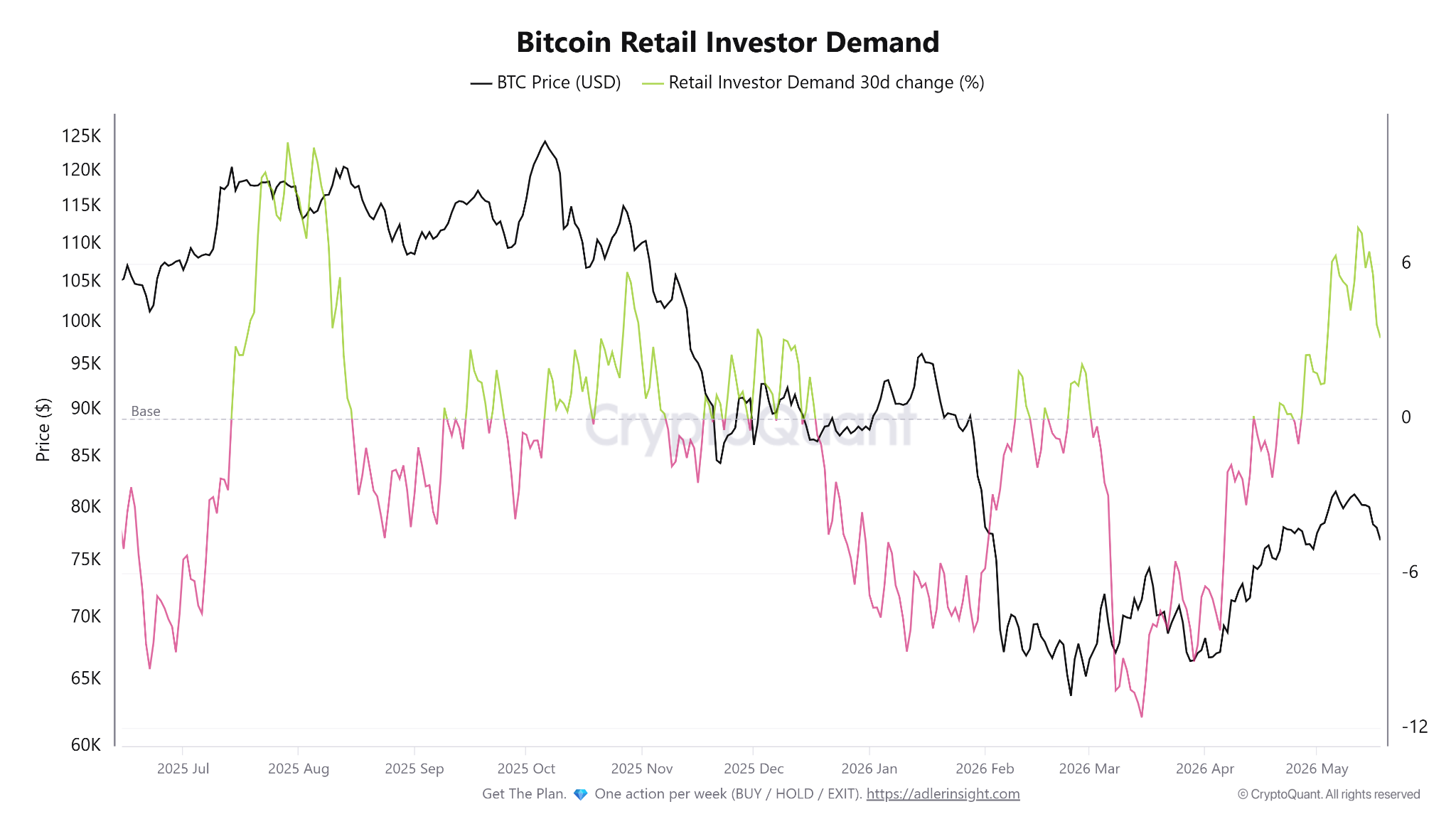
Bitcoin retail investor demand. Source: CryptoQuant
Related: Bitcoin price hits $76K, lowest since April after $1B ETF net outflow
BTC spot demand lags behind futures positioning
Crypto analyst Amr Taha said Binance recorded two large spikes in Bitcoin taker sell volume during the recent decline. The first reached roughly $1.5 billion on May 15. Another climbed above $1.1 billion as Bitcoin fell below $77,000.
Market analyst Crazzyblockk said one important signal still missing from Bitcoin’s recovery is a balanced spot demand. The previous rallies in October 2024, November 2024, and May 2025 showed that spot and futures demand rose together. Spot demand ranged between +97,000 BTC and +190,000 BTC during those price rallies, while the futures demand expanded alongside it.
The latest recovery showed a different pattern. BTC futures demand remained positive at +193,000 BTC over 30 days, while spot demand remained negative at -28,000 BTC and stayed below zero for 65 consecutive days. The total 30-day demand growth also fell from 232,000 BTC in early May to 62,000 BTC by May 16, recording a 73% decline.
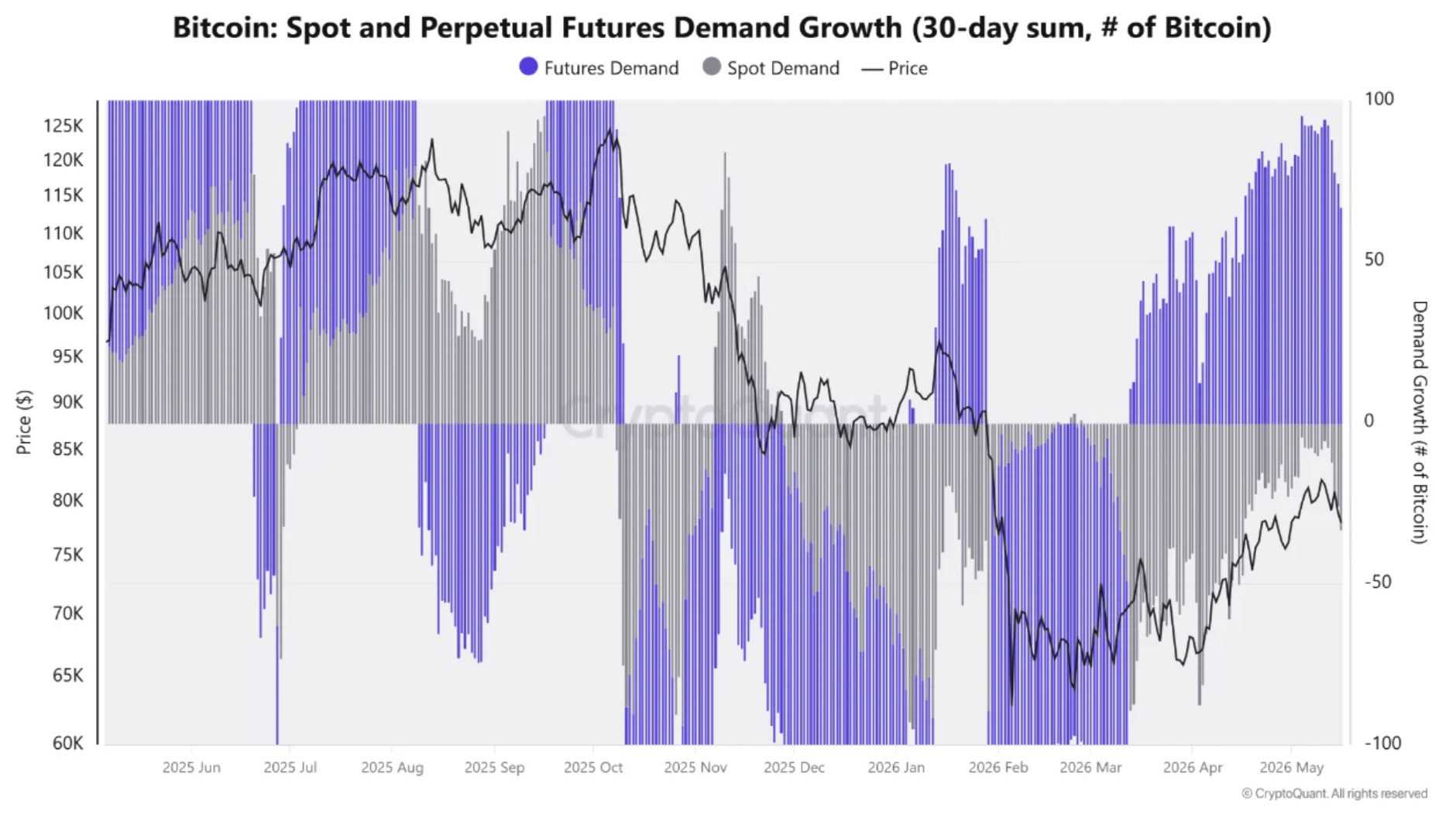
Bitcoin spot and futures demand growth (30-day sum). Source: CryptoQuant
Crazzyblockk also pointed to a sharp shift in Binance’s futures dominance last month. Binance previously controlled 40%-44% of global USDT-margined futures volume from October 2024 to March 2026.
In May 2026, Binance’s share dropped to 21.1% while OKX climbed to 26.3%, marking the first reversal in exchange leadership during the cycle.
Related: Price predictions 5/18: SPX, DXY, BTC, ETH, XRP, BNB, SOL, DOGE, HYPE, ADA


Key Highlights
- Zerohash obtains Electronic Money Institution authorization following MiCAR certification.
- Company becomes pioneering MiCAR-licensed entity to achieve complete Dutch EMI credentials.
- EMI authorization expands Zerohash’s capabilities for European stablecoin operations.
- Move reinforces company’s regulated digital asset payment infrastructure across EU.
- Dutch EMI credentials enhance Zerohash’s competitive stance in crypto services sector.
Zerohash Europe has obtained Electronic Money Institution authorization from De Nederlandsche Bank, establishing itself as the pioneering MiCAR-certified digital asset firm to achieve complete EMI credentials. This regulatory milestone provides the organization with expanded legal authority for cryptocurrency services and electronic payment operations. The approval solidifies Zerohash’s standing within Europe’s regulated blockchain asset ecosystem.
Electronic Money Authorization Broadens European Operations
The EMI authorization enables Zerohash to conduct conventional electronic payment activities throughout the European Economic Area. The organization can now facilitate payment transactions, stablecoin applications, and digital asset services under enhanced regulatory frameworks. This development establishes a transparent pathway for financial institutions, technology companies, trading platforms, and service providers requiring compliant operational infrastructure.
Zerohash obtained its MiCAR authorization in October 2025 from the Dutch Authority for the Financial Markets. MiCAR provides crypto-asset service operators with authorization to function throughout EU member states. Nevertheless, stablecoin-related transactions demand additional regulatory supervision under electronic money regulations.
The European Banking Authority implemented this regulatory distinction through official guidance issued in 2025 and subsequent clarifications published in 2026. The authority determined that certain electronic money token transactions fall within existing electronic payment regulatory frameworks. Consequently, the EMI authorization provides Zerohash with supplementary regulatory authority in areas where MiCAR certification alone might not encompass all service offerings.
Stablecoin Regulatory Framework Drives Strategic Expansion
The EMI authorization carries significant importance as European authorities continue developing comprehensive regulatory frameworks for stablecoins. Organizations processing stablecoin-enabled financial transactions require explicit authorization to integrate cryptocurrency infrastructure with conventional payment networks. Zerohash now possesses the capability to address this market need through combined MiCAR and EMI credentials.
The organization indicated that the dual authorization structure supports financial institutions, brokerage firms, payment processors, and enterprise platforms. It enables business partners to integrate cryptocurrency and stablecoin capabilities without developing comprehensive infrastructure internally. This operational approach aligns with Europe’s increasing demand for regulatory-compliant digital asset solutions.
Zerohash has strengthened its European operations from its Amsterdam headquarters in recent periods. The company currently provides services to Interactive Brokers Europe throughout the region. Furthermore, the EMI authorization strengthens the company’s market position as stablecoin utilization expands across payment systems, trading venues, and financial service platforms.
Capital Raising and Banking Charter Initiatives Provide Additional Perspective
Zerohash commenced operations in 2017 and currently maintains a workforce of approximately 200 employees globally. The organization operates facilities in New York, Chicago, North Carolina, and Amsterdam. The company successfully completed a $104 million Series D-2 financing round at a $1 billion corporate valuation.
The organization has additionally submitted an application to the U.S. Office of the Comptroller of the Currency seeking a national trust banking charter. This initiative demonstrates its strategic plan to expand regulated activities beyond European markets. The newly obtained EMI authorization adds strategic momentum to its worldwide regulatory compliance approach.
Industry reports also connect Zerohash to ongoing capital raising discussions following unsuccessful acquisition negotiations with Mastercard. The company reportedly seeks to raise $250 million at a $1.5 billion valuation. As a result, the EMI authorization reinforces its competitive market position as digital asset infrastructure providers compete for regulated enterprise clientele.



NYDIG says a rare bipartisan window to pass a comprehensive US crypto market‑structure bill could slam shut if Congress fails to move it before the August recess.
Summary
- NYDIG says the current bipartisan window for a comprehensive US crypto market-structure bill could close if Congress fails to move the legislation before the August recess.
- The bill would clarify digital asset classifications, split jurisdiction between the SEC and CFTC, and set unified operating standards for exchanges and crypto businesses.
- NYDIG warns prolonged uncertainty is already pushing capital and talent toward clearer regimes in the UAE, Singapore and the EU, and fears the US could slide back into regulatory stalemate.
Digital asset investment firm NYDIG has warned that the leading US crypto market-structure bill may effectively “fail” if it does not make substantial progress in Congress before lawmakers leave Washington for the August recess, according to FinanceFeeds. The firm argues that the fragile bipartisan consensus around a broad crypto regulatory framework amounts to a “brief window” that could slam shut once Congress returns to a calendar dominated by midterm elections, budget fights and partisan priorities.
August or bust for US market-structure reform
NYDIG’s assessment is blunt: if the bill does not advance “in the coming months,” the probability of passage “may significantly decrease” as legislative attention fragments and the political cost of tackling crypto grows. In that scenario, the US risks replaying the past several years of gridlock, with high-profile enforcement actions filling the vacuum left by the absence of a clear statutory market-structure regime.
At stake is one of the most ambitious attempts yet to build a comprehensive federal framework for digital assets in the US. The draft bill is designed to clarify how tokens are classified, draw a bright line between securities overseen by the SEC and commodities under the CFTC, and create unified operational standards for exchanges, brokers and other crypto businesses.
Core issues: SEC–CFTC lines, stablecoins and DeFi
According to the FinanceFeeds report, the proposed market-structure legislation would, for the first time, codify which digital assets fall under securities law and which are treated as commodities, addressing a long-running turf war between the SEC and CFTC. It would also establish common rules for trading venues and service providers, aiming to replace today’s patchwork of guidance, enforcement actions and state-by-state licensing with a single, more predictable regime.
But NYDIG notes that key issues remain unresolved, including stablecoin oversight, how to regulate DeFi protocols, the contours of consumer protection and how to handle conflicts of political interest. Those disagreements have slowed negotiations and raised doubts about whether lawmakers can lock in compromises before the August deadline.
The firm’s warning comes as global competition intensifies. NYDIG points out that extended US uncertainty is already driving capital, talent and innovation toward jurisdictions with clearer rules, citing the UAE, Singapore and the EU’s MiCA framework as examples of regions that are actively benefiting from America’s drift.
If Congress misses this legislative window, industry participants fear the US could again default to rulemaking by enforcement, with no durable settlement on market structure for years. That would leave exchanges, issuers and developers operating under legal ambiguity just as other financial centers lock in their own digital-asset regimes and pitch themselves as safer homes for long-term investment.
Crypto World
BeInCrypto Institutional Research: 10 Enterprise Blockchain Implementations Powering Production-Scale Finance


Best Institutional Enterprise Blockchain Implementation recognises named deployments that move real money or assets on distributed-ledger infrastructure, rather than the broader company or the underlying blockchain.
This category is a part of the BeInCrypto Institutional 100 awards. It sits under Pillar 6: Tokenization & Enterprise Blockchain. The 10 implementations below are listed alphabetically and are not ranked. A shortlist will be named in May 2026, with the winner announced at Proof of Talk in Paris on June 2–3, 2026.
Key Facts
- Long list: 10 production deployments across settlement, tokenized deposits, digital bonds, regulated stablecoins, capital markets infrastructure, cross-border interoperability, and institutional custody
- Initial pool: More than 25 enterprise blockchain deployments screened; 10 advanced to the long list
- Order: Listed alphabetically, not ranked
- Scoring: 30% quantitative data · 50% Expert Council · 20% disclosed company data
- Criteria assessed: Business impact and ROI, deployment scale, technical sophistication, innovation, replicability, stakeholder breadth, sustainability
- Boundary scope: This category evaluates the implementation itself, not the underlying chain, DLT framework, or parent company’s broader digital asset strategy
| Implementation / Firm | HQ & Listing | Reach | Representative Work |
|---|---|---|---|
| BNY Mellon Digital Asset Platform | New York, USA NYSE: BK |
Institutional digital asset stack within BNY Mellon’s $55.8T AUC/A platform BTC and ETH custody live since 2022 with Fireblocks integration |
IBIT primary cash custodian and administrator since spot Bitcoin ETF launch in Jan 2024 Co-custodian for Morgan Stanley Bitcoin Trust; tokenized MMF platform with Goldman Sachs live since Sep 2025 |
| Broadridge Distributed Ledger Repo (DLR) | New York, USA NYSE: BR |
More than $1T per month in tokenized repo transactions Production since 2018; built on Canton Network with DAML smart contracts |
UBS, Société Générale, HSBC, and BNY Mellon participate Privacy-preserving sponsored repo platform with JP Morgan Kinexys interoperability for collateral movement |
| Citi Token Services | New York, USA NYSE: C |
Citi tokenized deposit and trade finance platform Production since Sep 2023 across the US, Singapore, and the UK |
Tokenized deposit cross-border platform for institutional clients Smart-contract trade finance covering reverse factoring, automated FX, and programmable corporate liquidity |
| Goldman Sachs Digital Asset Platform (GS DAP) | New York, USA NYSE: GS |
Institutional digital bond platform built on Daml and Canton Spin-out as standalone industry utility announced with partners including BNY, BNP Paribas, Barclays, Microsoft, Tradeweb, Standard Chartered, and EquiLend |
European Investment Bank €100M digital bond issued in Nov 2022 HKMA Project Ensemble tokenized deposit pilots; interoperability alignment with Broadridge DLR through Daml and Canton |
| HSBC Orion | London / Hong Kong LSE / HKEX: HSBA |
HSBC permissioned blockchain digital bond issuance and tokenization platform Integrated with Hong Kong Central Moneymarkets Unit and active in multi-bank interoperability pilots |
Hong Kong government HK$6B digital green bond issued in Feb 2024 Digital bond platform connects Hong Kong CMU infrastructure with tokenized issuance rails |
| Kinexys by J.P. Morgan | New York, USA NYSE: JPM |
More than $5B daily transaction value as of Apr 2026 More than $3T cumulative volume since 2020; hundreds of institutional clients across five continents |
Kinexys Digital Payments processes tokenized deposits at production scale Kinexys Digital Assets includes intraday repo and Tokenized Collateral Network; Trimont settlement compressed from two days to near real time |
| Mastercard Multi-Token Network (MTN) | Purchase, New York / UK NYSE: MA |
$4.5B in stablecoin card spending in 2025 Crypto Partner Program launched in Mar 2026 with 85 participating companies |
Definitive agreement to acquire BVNK for up to $1.8B announced in Mar 2026 Integrated with JP Morgan Kinexys, Ondo OUSG, Fiserv Digital Asset Platform, USDG, PYUSD, USDC, and FIUSD |
| Société Générale FORGE (EURCV / USDCV) | Paris, France EPA: GLE |
EURCV about €105M circulating USDCV 26.3M tokens; multi-chain on Ethereum, Solana, and XRP Ledger |
First MiCA-compliant EUR stablecoin from a tier-one bank First US tokenized bond issuance on Canton Network; MetaMask integration via Consensys |
| SWIFT + Chainlink CCIP Cross-Border Interop | La Hulpe, Belgium Chainlink Labs: multi-location |
SWIFT network reaches 11,000+ banks Production interoperability launched in 2024 with partners including UBS, BNY Mellon, ANZ, Citi, and Lloyds |
UBS Asset Management Singapore tokenized fund cross-chain pilot MAS Project Guardian integration and Australia–EU interbank tokenized asset transfer corridor |
| Visa Tokenized Asset Platform (VTAP) | San Francisco, USA NYSE: V |
API-based bank-grade tokenization platform on Visa Developer Platform $7B annualized stablecoin settlement run rate; 15,000+ Visa-network banks accessible globally |
BBVA fiat-backed euro and dollar token on public Ethereum live in 2025 USDC settlement live in the US; Visa Direct stablecoin pilot; Circle Arc design role; Visa-Bridge card API program |
About This List
The BeInCrypto Institutional 100 — Best Institutional Enterprise Blockchain Implementation identifies production blockchain deployments in which regulated banks, payment networks, asset managers, and corporates have moved real money or real assets onto distributed ledger infrastructure.
Coverage includes tokenized deposit settlement, regulated bank stablecoins, B2B tokenization networks, institutional digital bond issuance, cross-border interoperability, DLT-based capital markets infrastructure, and institutional digital asset custody.
The category does not score the underlying chain or DLT framework. It also does not evaluate the parent institution’s broader digital asset adoption strategy. Pilots and proofs of concept are not eligible.
Methodology
This category is evaluated under Track B of the BeInCrypto Institutional 100 methodology: 30% quantitative metrics, 50% Expert Council scoring, and 20% disclosed company data.
Assessment spans seven criteria: business impact and ROI, deployment scale, technical sophistication, innovation, replicability, stakeholder breadth, and sustainability.
The disclosed data weighting reflects the limited public visibility into bank-operated tokenized deposit volumes, intra-platform settlement flows, permissioned network integrations, and named-counterparty programs.
Data was verified using regulatory registers, company annual reports, SEC EDGAR filings, audited platform disclosures, Chainlink CCIP and Canton Network transaction logs, RWA.xyz, DefiLlama, third-party rating agencies, private-market sources including PitchBook, Tracxn, and Crunchbase, and mainstream financial press.
The post BeInCrypto Institutional Research: 10 Enterprise Blockchain Implementations Powering Production-Scale Finance appeared first on BeInCrypto.
TLDR
- The White House confirmed that it will soon announce details about the Strategic Bitcoin Reserve.
- Patrick Witt said the administration completed key legal steps to secure the reserve.
- President Donald Trump signed the executive order creating the reserve on March 6, 2025.
- The reserve currently holds about 328,372 BTC from law enforcement seizures and forfeitures.
- The executive order prohibits the Treasury Department from selling any bitcoin in the reserve.
- A breach at the U.S. Marshals Service exposed weaknesses in crypto custody systems.
The White House plans to announce new details on the U.S. Bitcoin reserve soon. A senior official confirmed that the administration completed key legal work. The update signals progress on the government’s Strategic Bitcoin Reserve.
Patrick Witt, Executive Director of the President’s Council of Advisors for Digital Assets, confirmed the development this week. He said the administration resolved major legal questions tied to the reserve. “We’ll have an announcement,” Witt said, while declining to provide further specifics.
Witt described the development as a legal and operational milestone. He said the team ensured the structure remains legally sound and properly safeguards assets. He added that the administration had completed the most difficult phase of the process.
Strategic Bitcoin Reserve Framework Nears Completion
President Donald Trump signed an executive order on March 6, 2025, to create the Strategic Bitcoin Reserve. Since then, federal agencies have coordinated to define custody and reporting standards. Witt said his deputy, Harry John, led the interagency review and secured the required legal opinions. He explained that agencies built infrastructure suited for digital assets rather than gold-based systems.
The reserve currently holds about 328,372 BTC, or roughly 1.6% of global supply. Authorities accumulated the bitcoin through law enforcement seizures and forfeitures. These holdings include assets from the Silk Road case and the 2022 Bitfinex hack recovery. The executive order bars the Treasury Department from selling any bitcoin.
Witt previously told attendees at the Bitcoin 2026 conference in Las Vegas that an update would arrive within weeks. He repeated that timeline during his latest interview. He stated that the administration finalized procedures to protect private keys and maintain custody integrity.
Security Breach Spurs Legislative Push
Witt cited a breach at the U.S. Marshals Service to stress the urgency of secure custody. A contractor, John Daghita, allegedly stole more than $46 million in cryptocurrency in late 2025. The FBI arrested him in March 2026 after investigators traced the transactions.
Authorities also linked a separate $24 million theft to October 2024. Witt said these incidents underscored the need for structured oversight. “It’s a case in point for why it was so necessary that the president established the SBR,” he said.
Meanwhile, lawmakers have advanced two bills to formalize the reserve through legislation. Representative Nick Begich renamed the BITCOIN Act as the American Reserves Modernization Act, or ARMA. The proposal would authorize the Treasury to purchase up to 200,000 BTC per year for five years and lock holdings for 20 years.
Senator Cynthia Lummis has urged Congress to vote before the summer recess. She said lawmakers face tighter floor schedules as midterm campaigns approach. If Congress passes the measure, projections show the Treasury could begin open-market bitcoin purchases in Q4 2026.


Bernstein Circle analysts said the CLARITY Act yield compromise blocks rival stablecoin issuers from competing on rates
Summary
- Bernstein said the CLARITY Act language structurally favors Circle by banning deposit-like yield on passive stablecoin balances.
- Total dollar-backed stablecoin supply surpassed $300 billion this week, with USDC and USDT controlling roughly 97% of the market.
- The firm maintained an Outperform rating and $190 price target on Circle, implying about 67% upside from Friday’s close.
Bernstein analysts said the CLARITY Act’s yield compromise structurally favors Circle Internet Group, ending what they described as a looming stablecoin “interest rate arms race.” The note landed days after the bill cleared the Senate Banking Committee 15-9.
The compromise prohibits stablecoin issuers from paying yield economically equivalent to bank deposits, while preserving rewards tied to trading and payments. Bernstein argued the language protects USDC’s growth model.
Stablecoin supply tops $300 billion
Total dollar-backed stablecoin supply surpassed $300 billion this week, with Tether and USDC controlling roughly 97% of the market. Adjusted monthly transaction volume reached around $15 trillion, putting annualized flows near $100 trillion.
USDC’s market share in adjusted transaction volumes climbed from 41% to 60% year-over-year. Bernstein analysts led by Gautam Chhugani wrote that the compromise “cements stablecoins as payment instruments rather than deposit substitutes.”
Circle ARC blockchain reinforces thesis
Bernstein also highlighted Circle’s growing agentic payments infrastructure, including gas-free USDC transfers, the x402 protocol, and the ARC blockchain. ARC uses USDC as native gas under what the firm called “quantum-ready” architecture.
The bank maintained an Outperform rating and $190 price target on Circle, implying roughly 67% upside from its $114 close on Friday. Bernstein also kept an Outperform call on Coinbase with a $330 target.
Circle does not pay passive yield on USDC directly. Partners such as Coinbase instead use distribution arrangements and activity-linked rewards programs tied to USDC usage, structures the CLARITY Act compromise leaves intact.
The CLARITY Act now heads to a full Senate floor vote that requires 60 votes. The House must reconcile any differences before the bill reaches President Trump’s desk for signature.
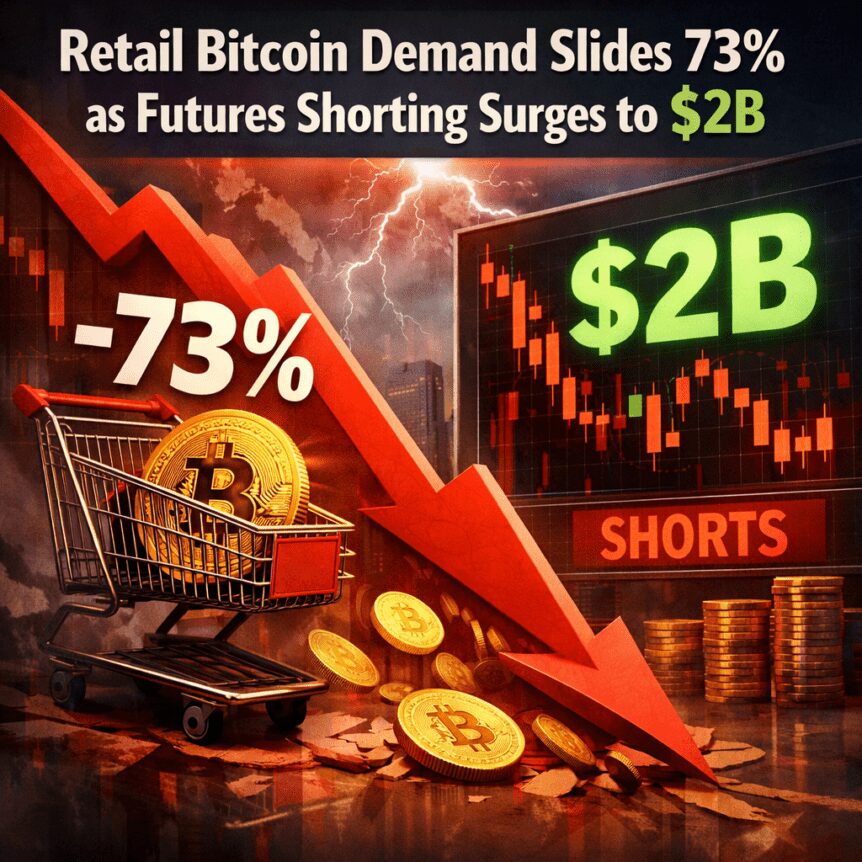
Bitcoin retail investor activity on Binance has slid to its weakest point on record, according to CryptoQuant metrics. Retail BTC inflows to the exchange are averaging roughly 314 BTC per month in 2026, a sharp drop from the around 1,200 BTC seen during Bitcoin’s March 2024 local top. The May recovery also cooled as spot inflows waned, with the 30-day net demand growth slipping 73% over the past three weeks.
Key takeaways
- Binance’s retail BTC inflows have collapsed to about 314 BTC per month in 2026, versus roughly 1,200 BTC at the March 2024 peak.
- The 30-day change in retail demand cooled from earlier levels, with growth at 3.12% this week versus 7.39% the prior week, indicating a thinning pace of retail buying activity.
- Market dynamics show a mismatch between futures and spot demand: futures demand remained positive while spot demand stayed negative, contributing to a more tepid recovery.
- Binance’s dominance in USDT-margined futures has waned, dropping to 21.1% in May 2026 as OKX rose to 26.3%, marking a notable leadership shift in the exchange landscape.
- Sharp taker-sell spikes during the May decline, underscoring ebbing retail participation even as price volatility persisted.
Retail activity cools on Binance as ETF drift considerations intensify
In recent months, observers have noted a shift in the behavior of retail-focused Bitcoin inflows. Darkfost, a CryptoQuant analyst, pointed out that retail inflows to Binance have remained near their historical lows, a condition that has persisted even as prices recovered from recent dips. The data tracks deposits from wallets holding less than 1 BTC, a conventional proxy for everyday retail participation. The current trajectory suggests a sustained reduction in the number of smaller investors actively adding BTC to spot positions on the exchange.
Historically, retail participation was far stronger during prior cycles, with inflows peaking well above current levels (notably around 5,400 BTC in 2018 and 2,600 BTC in 2021). The recent pattern—an extended period of subdued inflows and a halting price recovery—aligns with reports that some market participants may be shifting focus away from direct exchange holdings toward other exposure channels, including spot Bitcoin ETFs, where available. CryptoQuant’s data has also highlighted a cooldown in the pace of retail demand expansion, tempering the sense of a broad-based return to demand that characterized earlier rebound phases.
Evidence of a market mismatch: spot vs. futures demand
Analysts tracking Binance’s order book and flow dynamics have highlighted a notable split between futures and spot activity during the latest rebound. Amr Taha of CryptoQuant noted two sizable spikes in taker sell volume during the May decline, with one around $1.5 billion on May 15 and another exceeding $1.1 billion as Bitcoin traded under $77,000. The takeaway: large-scale price moves coincided with significant sell pressure from active traders, even as overall demand signals remained mixed.
Meanwhile, a broader narrative from market analysts centers on the absence of a balanced demand signal that typically accompanies healthy recoveries. Crazzyblockk, another CryptoQuant commentator, pointed out that the current rally diverges from prior episodes—October 2024, November 2024, and May 2025—when spot and futures demand moved higher in tandem. In the latest cycle, futures demand stayed positive, tallying around +193,000 BTC over 30 days, while spot demand stayed negative at roughly -28,000 BTC and remained subzero for 65 consecutive days. The overall 30-day demand growth declined sharply from about 232,000 BTC in early May to approximately 62,000 BTC by May 16, signaling a 73% drop in momentum.
The pattern matters because it hints at how sustainable the rebound might be. When spot and futures participation rise together, Bitcoin often enjoys stronger and more durable rallies. The current configuration—futures exposure still in positive territory while spot demand remains weak—suggests a fragility in the dip-recovery dynamic that could keep volatility elevated and limit upside unless spot participation improves.
Derivatives leadership shifts shape the market backdrop
The reshuffling of who dominates Bitcoin’s futures landscape adds another layer of complexity. Data cited by analysts show a clear shift in exchange leadership for USDT-margined futures over the past year and a half. Binance, which had commanded roughly 40% to 44% of global USDT-margined futures volume from October 2024 through March 2026, saw its share compress to 21.1% in May 2026.OKX stepped up to 26.3% in the same period, marking the first sustained reversal in exchange leadership for the cycle.
These dynamics matter for traders and liquidity providers because futures market structure often amplifies price moves and influences hedging activity. A decline in Binance’s dominance could reallocate risk and liquidity across venues, potentially affecting funding rates, order book depth, and the speed at which wholesale flows can move BTC across markets. For market participants, the shift underscores the evolving balance of power in the crypto derivatives space and the importance of monitoring cross-exchange flow interactions as price action unfolds.
Related coverage from the industry has underscored the broader context: as retail participation cools, institutional and ETF-linked channels may play an increasingly influential role in determining BTC’s price trajectories, especially if spot demand remains constrained. The market is watching for fresh data on ETF filings, regulatory developments, and any renewed retail appetite that could re-align the spot and futures curves.
In the near term, observers will be watching whether spot demand can recover in tandem with futures activity or whether the current pattern persists, with futures driving price moves while spot participation remains muted. The coming weeks could reveal whether the ETF channel and broader macro liquidity conditions will re-energize retail buying or whether the market settles into a more measured, less enthusiastic phase of recovery.
Across the board, the data points to a market that is transitioning in its participation mix. The interplay between ETF-driven exposure, exchange-specific inflows, and the evolving derivatives landscape will continue to shape Bitcoin’s liquidity profile and price dynamics as traders weigh the evolving risk environment.
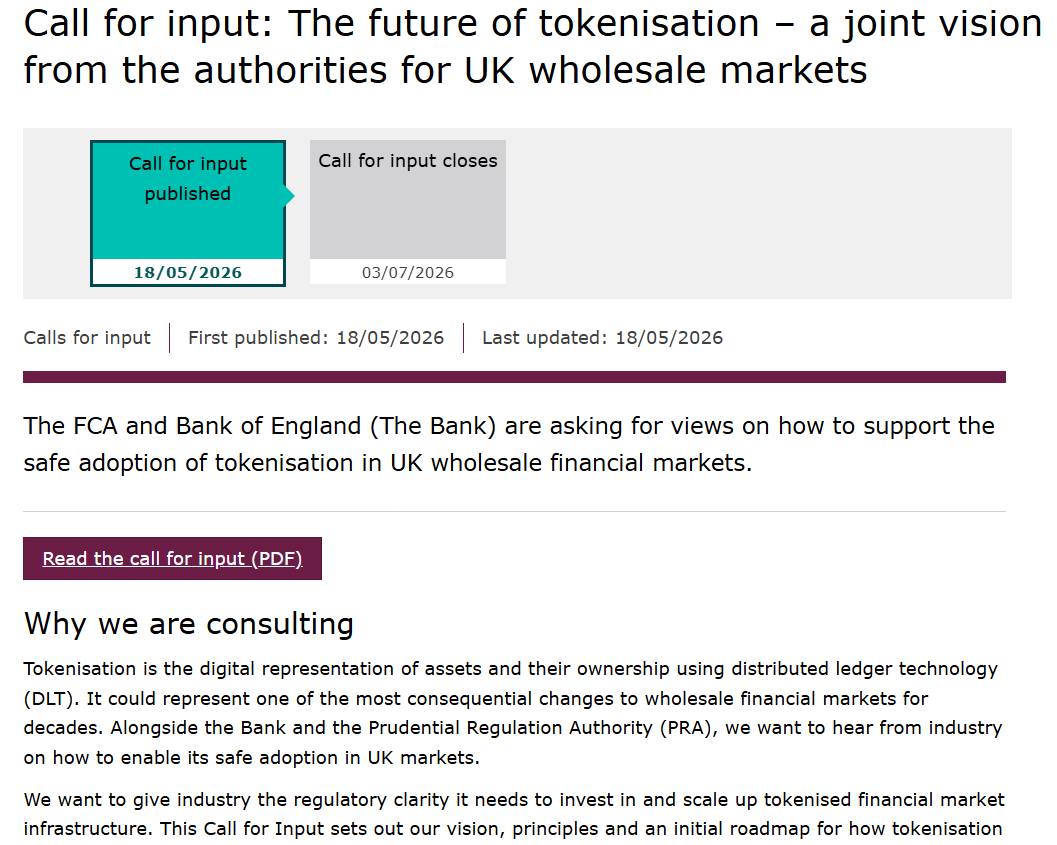
The Bank of England on Monday proposed extending operating hours for its core settlement infrastructure toward near-24/7 availability, part of a broader push with the Financial Conduct Authority (FCA) to prepare UK wholesale markets for tokenized finance.
The proposal seeks to add weekend and extended daily operating hours to the central bank’s settlement mechanism, Real-Time Gross Settlement (RTGS), and the Clearing House Automated Payment System (CHAPS).
The Bank of England said the expanded operating hours would support cross-border payments and new payment and settlement models as tokenization develops.
The consultation will support cross-border payments and new payment and settlement models based on tokenization developments, according to the joint letter published on Monday.
The BoE is seeking public feedback on the consultation paper until July 3 and plans to publish a feedback statement in the summer.
It comes weeks after the FCA said that tokenization and distributed ledger technologies could make fund management more efficient and support the innovation of the UK asset management sector.
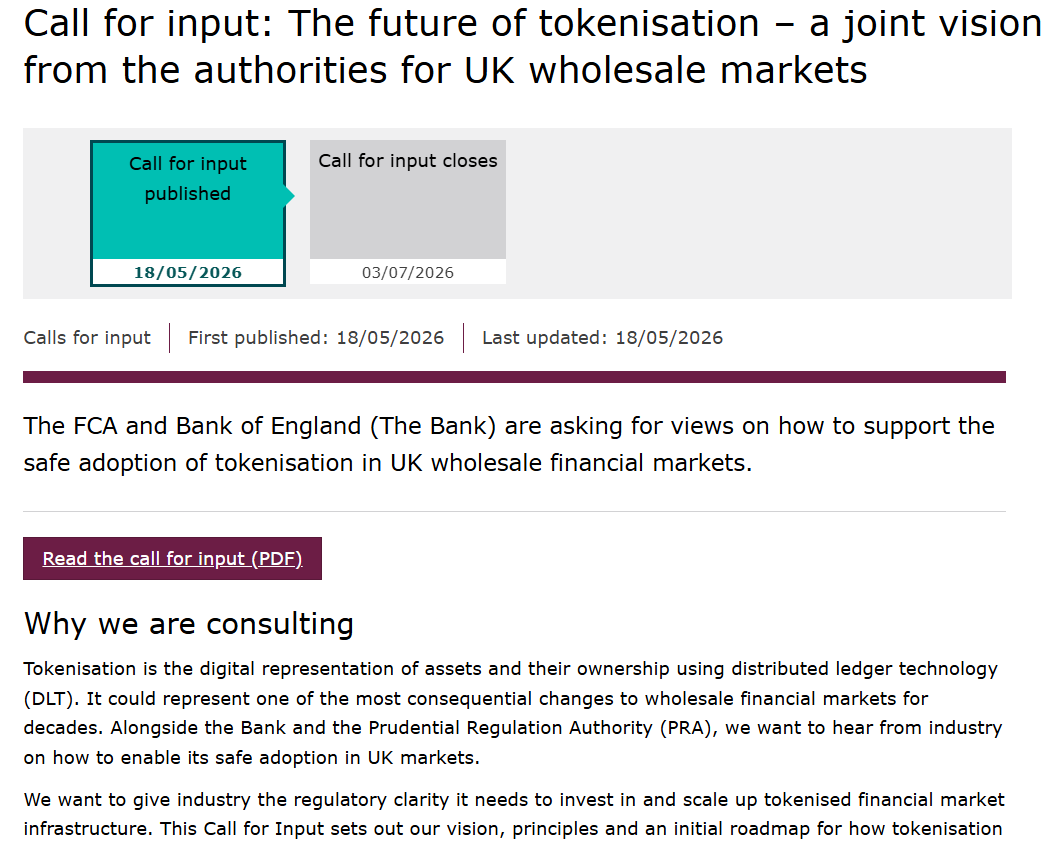
Call for input on the future of tokenization in UK wholesale markets. Source: FCA
“Fantastic to see the UK setting out a clear vision for tokenization in wholesale markets,” Katie Harries, head of policy for Europe at Coinbase, told Cointelegraph.
“The opportunity is huge — not only for companies seeking new pools of capital, but for the ‘unbrokered’: the many individuals globally who are not able to participate in capital markets today,” she added.
PRA plans consultation on tokenization framework in 2028
The Prudential Regulation Authority (PRA) also issued updated guidance for bank CEOs proposing that tokenized financial instruments receive the same regulatory treatment as their traditional equivalents when legal rights and risks are comparable, replacing prior guidance issued in 2022.
The PRA said the letter would serve as interim guidance until it publishes a broader prudential framework following the Basel Committee on Banking Supervision’s (BCBS) targeted review of banks’ crypto asset exposure standards.
Related: Farage faces UK standards probe over $7M gift from crypto billionaire
The BCBS launched the review in November 2025 to examine the prudential treatment of tokenization, stablecoins and permissionless blockchains, with updates expected later this year.
The PRA said it expects to consult on a proposed long-term framework in 2028 at the earliest.
Under the UK’s approach, crypto regulation would largely fall under the FCA, the country’s primary financial markets regulator.
The FCA separately opened a public consultation on its crypto regulatory regime on April 30, focusing on stablecoin issuance, trading, custody and staking. The regulator is expected to fully implement the framework by October 2027.
Magazine: How crypto laws changed in 2025 — and how they’ll change in 2026
Crypto World
Zerohash Becomes First MiCAR-Licensed Firm to Secure EMI Status for European Stablecoin Operations
TLDR:
- Zerohash is now the first firm holding both a MiCAR license and full EMI status across the European Economic Area.
- The EBA’s June 2025 No Action Letter required stablecoin firms to obtain EMI licenses beyond standard MiCAR registration.
- Zerohash is reportedly in talks to raise $250 million at a $1.5 billion valuation after Mastercard acquisition talks ended.
- The dual-license structure allows Zerohash to serve banks, fintechs, brokerages, and payment providers across Europe legally.
Zerohash Europe has obtained an Electronic Money Institution license from De Nederlandsche Bank, the Dutch central bank. This makes the company the first crypto-asset service provider licensed under MiCAR to also hold full EMI status.
The dual authorization allows Zerohash to legally process both crypto-asset services and traditional electronic money flows across the European Economic Area. This opens a broader path for stablecoin-powered financial services on the continent.
Zerohash Achieves Regulatory Milestone Under MiCAR Framework
Zerohash originally obtained its MiCAR license in October 2025 from the Dutch Authority for the Financial Markets. The Markets in Crypto-Assets Regulation covers most crypto activities across the EU trading bloc.
These include token custody, issuance, and trading services. The regulation is set to go into full effect in July and functions as a passport for crypto-asset service providers.
However, MiCAR registration alone was not enough for stablecoin operations. The European Banking Authority clarified in a June 2025 No Action Letter that certain e-money token flows qualify as electronic money.
Firms supporting stablecoin-powered financial flows therefore need an additional EMI license. Further regulatory guidance arrived in February, reinforcing that position.
The EMI license from De Nederlandsche Bank now bridges that regulatory gap for Zerohash. With the dual licenses in place, the company can work directly with “banks, brokerages, fintechs, payment providers, and enterprise platforms operating across the European market.”
This compliance structure gives Zerohash an advantage most competitors do not yet hold. It positions the firm to move faster in markets where stablecoin adoption is accelerating.
Zerohash Europe Managing Director Roeland Goldberg spoke directly to the opportunity. “Europe has a massive market for stablecoin applications,” Goldberg said.
The company has expanded its EU presence in Amsterdam and is currently powering partners including Interactive Brokers Europe in the region. That partnership reflects the firm’s growing institutional reach across the continent.
Zerohash Expands Footprint Through Funding and Charter Applications
Zerohash has also applied to the U.S. Office of the Comptroller of the Currency for a national trust bank charter. That application runs parallel to its European regulatory efforts.
Together, these moves show a clear strategy toward full-stack financial compliance across major markets. The company appears focused on building infrastructure that meets both crypto and traditional finance standards.
Founded in 2017, Zerohash employs approximately 200 people globally. Its offices span New York, Chicago, North Carolina, and Amsterdam.
Last September, the company raised a $104 million Series D-2 round led by Interactive Brokers. That round valued the company at $1 billion.
After acquisition talks with Mastercard fell through, Zerohash is now reportedly in discussions to raise $250 million. The new round is said to target a $1.5 billion valuation.
That would represent a notable jump in investor confidence from just months prior. The fundraising talks align closely with the company’s regulatory wins in Europe.
The EMI license adds material value to Zerohash’s European business model. Stablecoin flows now represent a growing share of crypto payment infrastructure globally. With both MiCAR and EMI status, Zerohash is structurally positioned to capture that demand.
The regulatory foundation it has built in the Netherlands may serve as a model for others entering European markets.


Disclosure: This article does not represent investment advice. The content and materials featured on this page are for educational purposes only.
AI crypto trading bots surge in demand as traders struggle with volatility and unreliable automation tools.
Summary
- AI trading bot market hits $11B+; SaintQuant ranks as no-code crypto bot with built-in risk controls and auto trading.
- SaintQuant offers no-code AI crypto trading with pre-optimized strategies, live execution, and built-in risk management.
- SaintQuant leads for beginners with automated execution and risk-managed strategies.
The global AI trading platform market surpassed $11 billion in 2024 and is on track toward $33 billion by 2030. Demand is surging — and so is disappointment.
Thousands of traders in 2026 are searching for a Claude AI trading bot, a quick ChatGPT-powered script, or a generic AI day trading bot they can deploy overnight. Most fail to profit. Many lose money. The reasons are consistent: untested strategies, zero built-in risk controls, and no live market optimization.
In 2026, crypto markets move faster than ever. Bitcoin volatility remains elevated, memecoin rotations happen within hours, and macro events shift liquidity across the entire digital asset market in minutes. Reacting manually — or relying on an improvised LLM-based script — is no longer viable.
This guide ranks the best platforms for automated AI crypto day trading, with an honest look at what separates winners from the rest.
The 2026 ranking: Best ai day trading bots
1. SaintQuant (editor’s pick)
Best for: Beginners, passive investors, and anyone who wants a no-code AI crypto trading bot with real risk management
SaintQuant is the clearest answer for traders who want automated AI day trading without technical setup or coding knowledge. While other platforms require strategy configuration, API wiring, and ongoing maintenance, SaintQuant provides pre-optimized quantitative strategies that are live and running from day one.
What makes SaintQuant stand out in 2026:
- No configuration needed — strategies are already optimized and ready to run
- No coding required — suitable for beginners and passive investors with no technical background
- AI-driven 24/7 execution — algorithms analyze market conditions and execute trades continuously
- Built-in risk management — every strategy includes volatility controls to limit drawdown
- Consistent quantitative approach — disciplined models, not emotional or reactive trading
New user offer (no deposit required):
- $99 free trial credit — experience live strategies without making an initial deposit
- $7 instant cash bonus — credited on registration, no conditions, no hidden requirements
Best for: Anyone searching for a reliable no-code AI crypto trading platform that handles execution, risk, and strategy automatically.
Limitation: Crypto-only (not stocks or forex); pre-built strategies are not manually customizable.
Verdict: SaintQuant is the most complete answer to what most traders actually want from an AI day trading bot in 2026 — hands-free execution with real risk controls, zero setup, and a risk-free way to start.
#2. 3Commas
Best for: Active traders who want multi-exchange control and custom strategy workflows
3Commas remains one of the most recognized names in crypto automation in 2026. It supports DCA bots, grid bots, and SmartTrade workflows across multiple exchanges. Its AI assistant surfaces model-driven suggestions for entries, risk settings, and targets — but users must review and act on these themselves.
- Supports multiple exchanges via API
- SmartTrade terminal with signal routing
- Requires meaningful setup and ongoing strategy management
- Expert plan: approximately $91/month (annual subscription, data as of January 2026)
Best for: Experienced traders who want hands-on control. Not ideal for beginners — results depend heavily on the user’s own strategy quality, and misconfigured bots are a common cause of losses.
Verdict: Powerful for active traders. Too complex and high-maintenance for those seeking a passive AI trading bot experience.
#3. Pionex
Best for: Cost-conscious beginners wanting built-in bots on a single exchange
Pionex integrates trading bots directly into its exchange, eliminating the need for external API connections. Its PionexGPT feature allows plain-English strategy creation for basic automation. No subscription fees — only standard trading fees apply.
- Free built-in grid, DCA, and Infinity Grid bots
- PionexGPT for simplified strategy creation
- Limited strategy depth; underperforms in trending or highly volatile markets
- Single-exchange only
Best for: Casual crypto traders who want low-cost automated crypto trading with minimal overhead. Falls short as a true AI-driven risk management solution in volatile 2026 market conditions.
Verdict: A solid starting point for experimentation, but not a substitute for a platform with genuine quantitative strategy depth.
4. Cryptohopper
Best for: Traders who want a strategy marketplace and copy trading
Cryptohopper combines a visual Strategy Designer, a curated Marketplace of community strategies, and Social/copy trading in a cloud environment. Its Algorithm Intelligence feature can switch strategies automatically based on conditions.
- Strategy marketplace with hundreds of community-built strategies
- Copy trading with risk controls
- Cloud-based, no local setup required
- Quality of marketplace strategies varies widely — due diligence required
Best for: Traders who want AI-assisted crypto automation with community strategy access. The open marketplace means strategy quality is uneven — beginners may struggle to identify what works.
Verdict: More flexible than most, but the burden of selecting good strategies still falls on the user.
5. DIY Claude AI / ChatGPT Trading Bots
Best for: Developers exploring experimental prototypes (not live trading)
In 2026, many traders still attempted to build a Claude AI trading bot or GPT-powered script from scratch using language model APIs. The appeal is obvious — but the execution is consistently problematic.
LLMs are not designed for real-time financial execution. They lack:
- Live market data feeds and WebSocket integrations
- Exchange API connections with latency-optimized order routing
- Quantitative risk frameworks and position sizing logic
- Backtesting infrastructure and walk-forward validation
The result is typically an unreliable bot that generates inconsistent signals, requires constant debugging, and operates with no circuit breakers during drawdowns. Several 2026 trading communities have documented significant capital losses from poorly implemented DIY bots.
Best for: Technical experimentation only. Never recommended for live capital deployment without a full quantitative infrastructure built around the LLM layer.
Verdict: An interesting engineering exercise — not a viable AI day trading bot for consistent returns. Use purpose-built platforms like SaintQuant instead.
How to choose the right AI day trading bot in 2026
The strongest AI crypto trading platforms in 2026 share three qualities: they simplify strategy setup, include adaptive risk management, and operate continuously without requiring user intervention. Here is a quick decision framework:
Goal
Recommended Platform
Fully hands-off, no coding, passive income
SaintQuant
Multi-exchange control, active management
3Commas
Free bots, single exchange, low fees
Pionex
Strategy marketplace, copy trading
Cryptohopper
Custom dev / quant infrastructure
Hummingbot or IBKR API
Start trading smarter — risk-free with SaintQuant
SaintQuant’s AI quantitative strategies are live and ready. No setup, no coding, no deposit needed to begin.
New user bonuses — automatically credited on registration:
- ✅ $99 free trial credit to run live strategies
- ✅ $7 instant cash bonus with no conditions
- ✅ No deposit required to get started
Start Trading Free at SaintQuant — No Deposit Required
FAQ
Can I use Claude AI as a crypto trading bot? Claude is a conversational AI assistant — it is not built for live automated crypto execution. It lacks real-time exchange integrations and quantitative risk controls. For actual AI-powered day trading, purpose-built platforms like SaintQuant are far more reliable and safer to use with real capital.
What makes an AI day trading bot actually profitable in 2026? Profitability in 2026 depends on two things most bots still lack: battle-tested quantitative strategies and adaptive risk management. SaintQuant embeds both into every strategy, so users are not exposed to unchecked drawdowns during volatile markets.
Is SaintQuant free to try? Yes. New users receive a $99 free trial credit to run live strategies, plus a $7 cash bonus on registration — with no deposit required and no hidden terms.
Do I need coding skills or trading experience to use SaintQuant? None at all. SaintQuant is designed specifically for users who want automated crypto trading without any technical background. Strategies are pre-configured and start with a few clicks.
How is SaintQuant different from other AI trading bots in 2026? Most platforms require users to configure strategies, monitor performance, and manage risk manually. SaintQuant handles all of this automatically — including built-in risk controls — making it the closest thing to a fully managed AI crypto trading solution available to retail investors.
Disclosure: This content is provided by a third party. Neither crypto.news nor the author of this article endorses any product mentioned on this page. Users should conduct their own research before taking any action related to the company.
TLDR
- Bitwise will allocate 10% of BHYP management fees to acquire HYPE for its balance sheet.
- The company confirmed that it will stake the HYPE tokens it holds to generate rewards.
- BHYP began trading on the New York Stock Exchange on Friday.
- HYPE has doubled in price in 2026 and now trades above $44.
- The token holds a market capitalization of more than $10.6 billion excluding stablecoins.
- 21Shares launched a competing Hyperliquid ETF on May 12 and recorded about $10.5 million in net inflows.
Bitwise Asset Management will allocate part of its new ETF fees to acquire HYPE tokens for its balance sheet. The firm said it will direct 10% of management fees from its BHYP fund to accumulate the token. The announcement came days after the ETF began trading on the New York Stock Exchange.
Bitwise and HYPE Strategy Linked to BHYP Fees
Bitwise confirmed the allocation plan in a statement posted on X on Monday. The company said, “Bitwise will be devoting 10% of the Bitwise Hyperliquid ETF (BHYP) management fee to holding HYPE on the Bitwise balance sheet.” It also stated that it will stake the acquired tokens to generate rewards.
The firm linked the move to Hyperliquid’s revenue model and token mechanics. Bitwise said the blockchain directs about 99% of its revenue to buy back and burn HYPE tokens. “In that spirit, we’re pleased to announce … we’re holding HYPE,” the company added.
Bitwise launched the Hyperliquid ETF under the ticker BHYP on Friday. The fund offers indirect exposure to HYPE and staking rewards. The company has not yet released trading volume data for the ETF.
Bitwise filed for a U.S. Hyperliquid ETF last year before other issuers. However, 21Shares launched its competing ETF, 2THYP, on May 12. SoSoValue data shows that 2THYP has recorded about $10.5 million in cumulative net inflows.
Grayscale also filed for a similar product after Bitwise submitted its application. The filings marked growing issuer interest in Hyperliquid-linked investment vehicles. However, Bitwise became one of the early applicants in the segment.
Hyperliquid Network Performance and HYPE Market Data
Hyperliquid has grown into a major onchain trading venue, especially for perpetual futures. Recent data from The Block shows the network generated nearly 40% of all blockchain fees last week. In comparison, Ethereum produced about 14%, while Solana generated close to 10%.
The platform’s native token HYPE has increased sharply this year. The token traded near $22 at the start of 2026. It now trades above $44, reflecting a gain of about 100%.
Market data indicates that HYPE ranks among the top 10 cryptocurrencies by market capitalization, excluding stablecoins. The price increase has coincided with rising activity on the Hyperliquid network.
Bitwise said it will stake the HYPE tokens held on its balance sheet. The firm confirmed that staking will form part of its holding strategy. The ETF continues to trade on the New York Stock Exchange under the ticker BHYP.

Premier League: Tense, tetchy but triumphant – Arsenal eyes now on Bournemouth

Former Google CEO Eric Schmidt booed by graduates at mention of AI
Zerohash Achieves Dual Licensing Milestone with Dutch EMI Authorization

Manchester United reach agreement with Casemiro over contract clause amid transfer speculation

US brings back mandatory military draft registration

Steven Gerrard disagrees with Gary Neville over ‘shock’ Chelsea and Arsenal claim | Football

How to make money more crisp when saving #moneyhacks #money #lifehack #moneysaving #fyp #viral #tips

URGENT: Here’s Why Bitcoin’s Next Move Will Surprise You!

Capricorn May 18, 2026: Financial Miracles for Makar Rashi Tomorrow! #horoscope
-

 Crypto World3 days ago
BloFin War of Whales 2026 Grand Prix opens registration for $5M trading championship
-

 Fashion3 days ago
Weekend Open Thread: Theory – Corporette.com
-

 Crypto World3 days ago
E-Estate Announces 1 Year Live: Washington DC Summit as Real Estate Tokenization Enters Its Next Phase
-

 Tech4 days ago
Tech Moves: Microsoft AI leader jumps to OpenAI; former AI2 exec joins Meta; and more
-
Crypto World6 days ago
Bitcoin Suisse expands with Digital Asset License and Investment Business Act Registration Approval in Bermuda
-

 Politics6 days ago
Pakistan to enter Chinese capital market as war inflation bites
-

 Crypto World6 days ago
Bitcoin Suisse expands with Digital Asset License and Investment Business Act Registration Approval in Bermuda
-
 Crypto World5 days ago
Google’s Gemini AI Predicts Incredible Solana Price by the End of 2026
-

 Business3 days ago
H&R Real Estate Investment Trust (HR.UN:CA) Q1 2026 Earnings Call Transcript
-

 Tech3 days ago
Google reimburses Register sources who were victims of API fraud
-

 Sports3 days ago
Napoleonic enters 2026 Doomben 10,000 field via Abounding withdrawal
-

 NewsBeat6 days ago
Comment on Keir Starmer surviving the day as Prime Minister like a turd that wont flush
-

 Fashion6 days ago
The Best-Kept Makeup Secret for a More Defined Face
-
 Entertainment4 days ago
Zara Larsson Has Blunt Response To Chris Brown Diss
-

 Politics6 days ago
The Trial of Majid Freeman, Verdict
-
 Tech6 days ago
Why AI is making typography a boardroom conversation
-
 Crypto World5 days ago
Two AI Tokens Lead May Rally, But Risks Are Rising
-

 Politics6 days ago
Palestine’s flag becoming a regular sight at European football stadiums
-

 Crypto World6 days ago
Senate Approves Kevin Warsh to Federal Reserve Board Seat
-

 Entertainment7 days ago
Insides Reveal Taylor Swift’s Wedding Gown Chaos With 6 Dresses
You must be logged in to post a comment Login