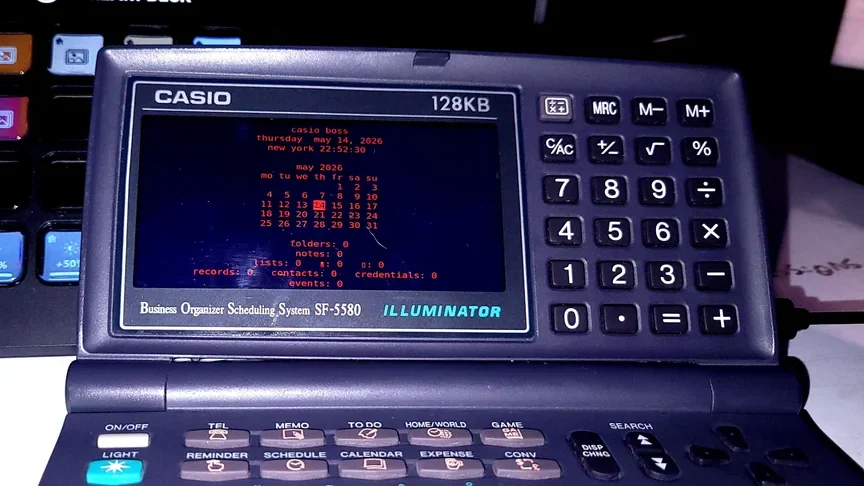
Remember digital organizers? They were like the lower-spec version of a PDA that couldn’t really do much more than store a few phone numbers and calendar entries. [TundraLegendZ] recently grabbed such a device from 1995 and set about transforming it into something a little more capable.
The device in question is a Casio Business Organizer Scheduling System SF-5580. The original guts have been replaced , though, with the power of a Raspberry Pi Zero. The single-board computer is hooked up to a small color LCD screen with a resolution of 480 x 800, which is tucked neatly into the spot where the original display lived. There’s also a Raspberry Pi Pico on board, which is charged with interfacing all 82 keys of the original keyboard. Power is courtesy of a 6000 mAh battery which should last a good few hours on a single charge. Hearing the buzzer hacked is fun, too. It’s more mobile phone ringtone than outright chiptune, but we still enjoyed listening to the results. Screencaps of the software show just what this setup can do with better hardware and a nicer screen than 1995 could provide. Future work is planned to give the build more capabilities with a HackRF upgrade.
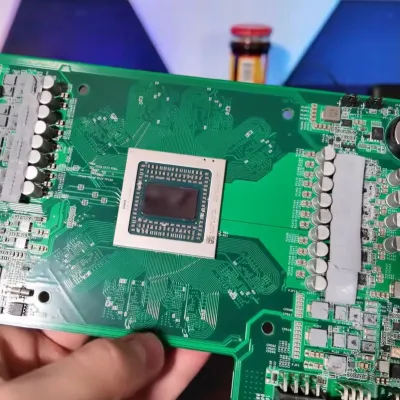
The custom APU at the core of Sony’s PlayStation 5 hasn’t just been quietly powering these game consoles, but also made their way onto cryptomining cards around 2023 which are called the BC-250. The APUs on these boards differ from the one found in the PS5 most notably by having two out of eight CPU cores disabled, along with many compute units (CUs) of the iGPU. Now apparently it seems that you can re-enable these CUs per instructions by [duggasco] if you’re feeling adventurous.
The BC-250’s AMD APU in all its glory. (Credit: Lowest Logan, YouTube)
As stated in the project’s README, BC-250 boards come with only 24 out of 40 CUs enabled, but this is not a permanent (e-fuse) thing. Instead you can write to two hardware registers during the GPU driver initialization, something which can be added to for example the Linux kernel module parameters.
Since many of these APUs likely had cores and CUs disabled due to them failing QA during PS5 APU manufacturing, there’s a good chance that some of the CUs truly are bad. Yet as we saw with the AMD Phenom II X3 with a supposedly bad fourth core back in the day, sometimes demand for the ‘defective’ part is high enough that good parts get mixed in as well.
Thus people like [Lowest Logan] decided to give it a shot, demonstrating the use of the patch with Bazzite Linux on a BC-250 system. After a reboot the system does indeed list 40 CUs as being enabled, and running Furmark shows a big boost in performance without any glitches or fire. There is of course thermal throttling, but that is due to the default cooling solution not being designed for running it at full blast.
Advertisement
Incidentally the real PS5 has only 36 active CUs, so this technically makes these unlocked APUs more powerful. With the water cooling solution demonstrated by [Lowest Logan] the thermal throttling is also resolved, showing that you can get a pretty nice gaming system out of these old cryptomining boards if you happen to win the silicon lottery.
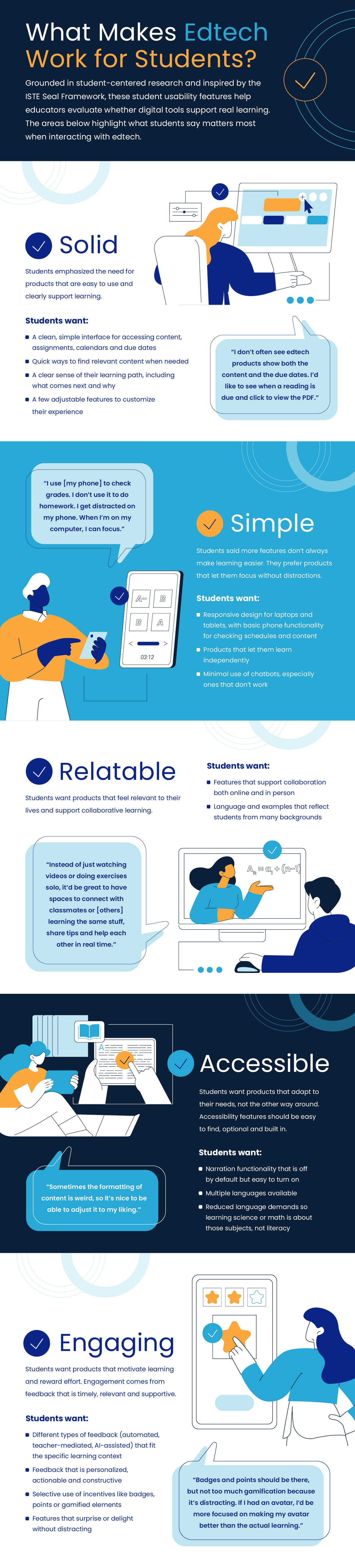
Even the most well-intentioned edtech can fall short if it does not meet students where they are. After several years studying the usability of edtech for teachers, the research team at ISTE+ASCD turned its attention to students — examining how the technical and pedagogical design of digital tools shapes their learning experiences.
In partnership with In Tandem and Sesame Workshop, researchers spoke with high school students across the United States to understand how they actually use edtech in real learning contexts. The findings identify five areas that matter most to students and offer guidance for educators and product designers seeking tools that are intuitive, meaningful and engaging.
A full framework and guidance for edtech buyers and product providers will be released in 2026.
This article was sponsored by ISTE+ASCD and produced by the Solutions Studio team.
Diorama111 released a fresh build just days ago that shows what happens when extreme miniaturization meets real remote control hardware. He started with an ordinary KATO 1/150 scale Toyota ProBox, the kind of plastic model that sits on N-gauge train layouts or display shelves. Most builders stop at painting and weathering. He kept going until the little van could roll under its own power, steer on command, and light up properly in both directions.
The finished model is only a few centimeters long, but at true scale, it is roughly 150th the size of a real Toyota ProBox. The exterior still looks like it just came off the production line, but everything inside had to be modified just to fit. This entailed designing new parts, modifying old ones, or just building them from scratch to allow for movement and electronics to fit within. Power is supplied by a tiny lithium-polymer cell measuring 9 by 9 by 4 millimeters. It sits on top of a custom control board and provides power to the complete arrangement. The duration is purposefully brief, just long enough to test it on a tabletop or in a diorama before it needs to be recharged quickly via the underside connectors.
A DC motor in the back propels the vehicle, and watch gears are used to slow it down significantly, allowing it to move at a suitable rate for its size. A brass-bushed axle is used to reduce friction, resulting in smooth acceleration and excellent control at low speeds. As a result, when observed from above, it looks to be moving steadily rather than bouncing about haphazardly.
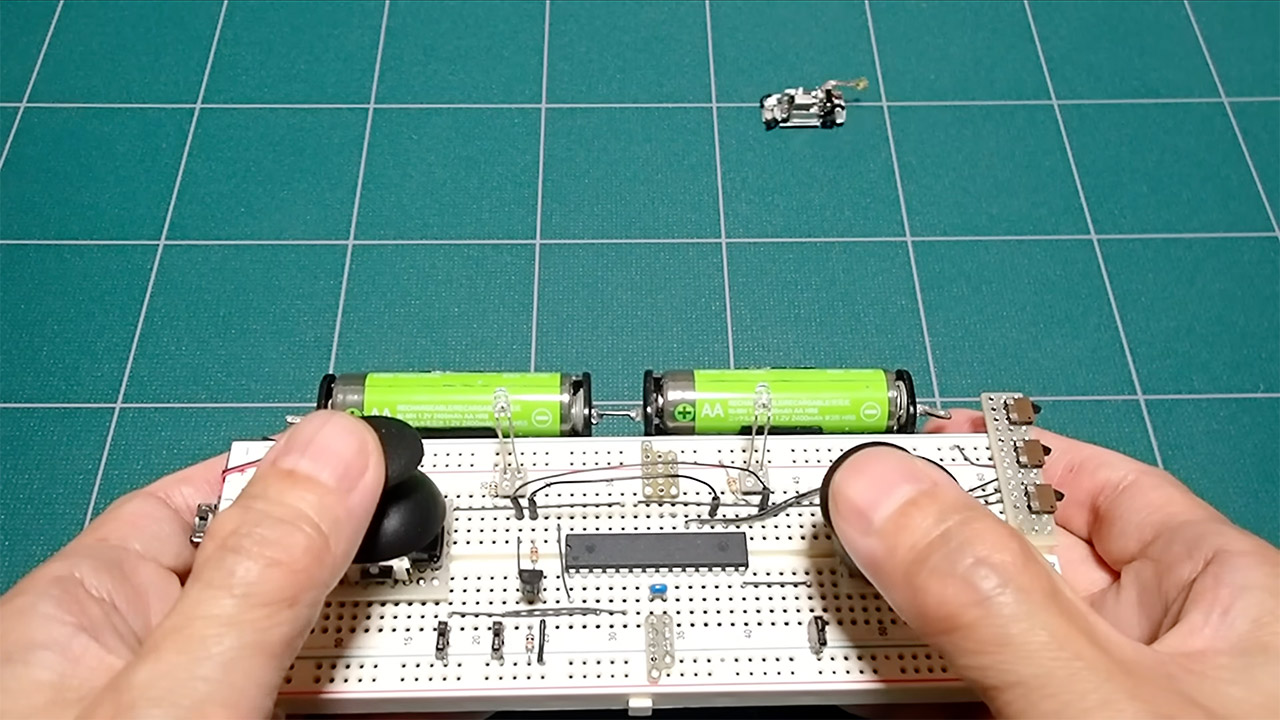
Steering was a challenge because the conventional solution would not have worked. So a second DC motor was added to drive a lead screw, and a rod-and-linkage system was adapted to convert linear motion into front wheel spin. Two photoreflector sensors continuously monitor the motor shaft and screw, providing feedback to the controller so that it knows exactly where the wheels are and can give true proportional steering rather than just on/off. This all fits into the compact chassis, leaving room for the battery and receiver.
The radio signal is sent via infrared because a small surface-mount IR receiver module is contained within the body. The matching handheld transmitter contains two analog joysticks that provide you independent control over the throttle and steering. It appears delicate enough to execute figure-eights, smooth turns, and faultless parking on a cutting mat. Lighting only adds to the illusion, with a few tiny surface-mount LEDs concealed beneath the headlight and taillight lenses. A hair-thin magnet wire runs through the roof and body, transferring power without adding mass. The headlights turn on as you go forward. When you change into reverse, the rear lights brighten. Direction sensing guarantees that the lights function in the same way as a full-size car does.
Building this micro car required a great deal of patience because each stage required extreme focus. The interior was removed to provide way for the construction process, and each mechanical part had to be precisely positioned and tested before being altered repeatedly until everything fit together neatly while still leaving room for the batteries and cables. The underside of the chassis contains terminals for charging the battery and reprogramming the controller, making it possible to do so without disassembling anything. [Source]
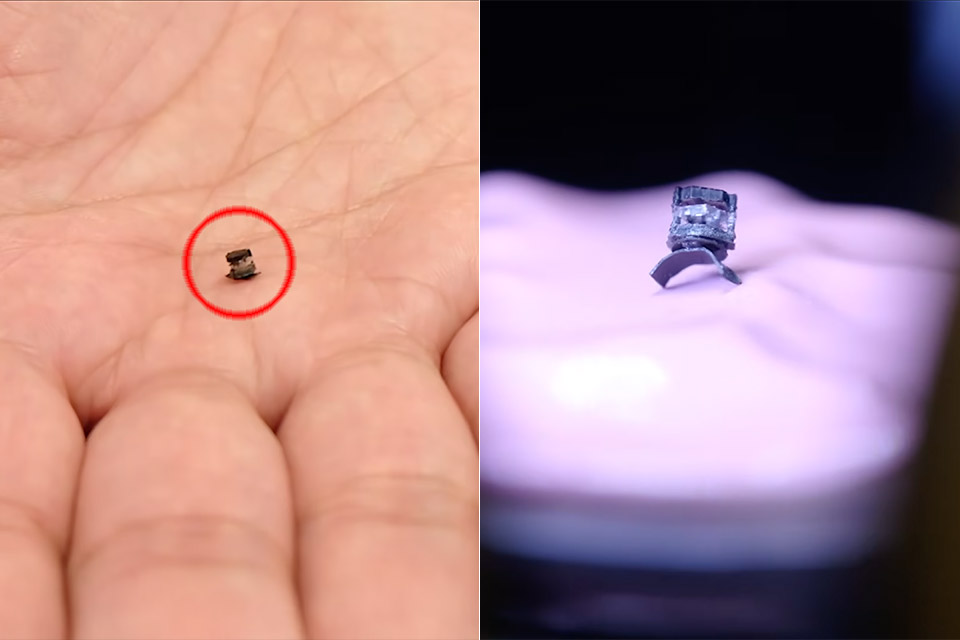
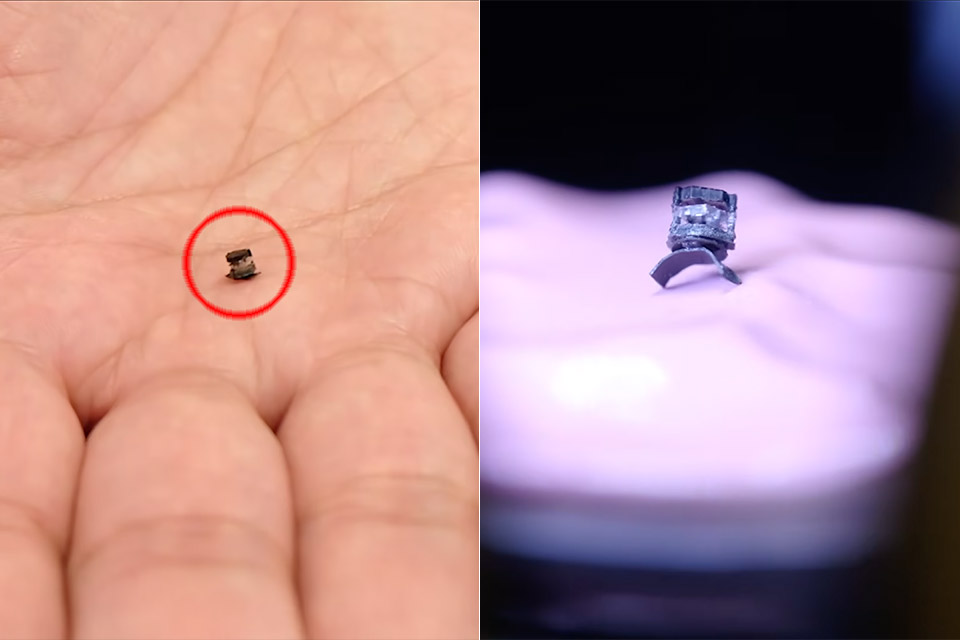
NTU researchers spent seven years building a magnetic robot just 4.4 millimeters long. The compact machine performs five surgical functions through external control alone. It travels across soft tissue, cuts when required, dispenses medicine, gathers samples, and creates localized heat. Work on the project took place in the School of Mechanical and Aerospace Engineering under Associate Professor Lum Guo Zhan.
Nicholas Yong Wei Foo, a PhD student, led the project’s hands-on development. Alumni and regulars, including Dr. Chelsea Shan Xian Ng and Yu Xuan Yeoh, made substantial contributions during the design and testing phases. The researchers published their findings in Advanced Materials after being funded by NTU funds, A*STAR, and the NHG Health group. NTUitive has received a technology disclosure and is poised to proceed. Almost every other magnetic robot of this size can only perform one or two tricks; this one can perform five, owing to a programmable core module.
With this set, based on the legendary Transformers Autobot, adults build LEGO Optimus Prime figure that converts from robot to truck and back
Relive the Transformers saga with accessories, including the ion blaster, Autobot Matrix of Leadership, an Energon axe, Energon cube and jetpack
This unique collectible robot model makes a great home décor piece – top off the build with a unique display plaque with Optimus Prime facts
The module’s magnetic state can be changed with a few external coils; just magnetize, demagnetize, or reverse the direction, and each condition corresponds to a specific tool or action. The innovative aspect is that zones in the body are designed to only illuminate active areas while leaving the rest dark. According to tests, a complete flip takes less than a second. Getting around is the first trick, but it is far from the only one. This robot can crawl on soft, uneven ground that replicates surfaces found deep within the body. It can also rotate along its long axis, which is important for achieving perfect alignment when things become tight or the surface starts to slope and fold. There’s also a blade that pops out for cutting, and in lab tests, it effortlessly sliced through chicken liver and gelatin models, or at least models designed to imitate the inside of a human.
Advertisement
When it comes to medicine delivery, the robot’s dispensing arm simulates drug delivery by using preloaded particles. The operator merely needs to maneuver it to the right spot and then press the release. The robot collects samples by utilizing a gripper to grab and secure tissue until it is ready for laboratory analysis. Test results showed that the gripper performed effectively on the models tested.
Then there’s heat generation, which is a different magnetic process that warms up a small region by creating high-frequency alternating fields that force the particles inside to warm up. The idea is that this might be used for targeted therapy, raising the temperature in a specific area without damaging the surrounding tissue.
The robot’s body is a clever combination of two flexible silicones, PDMS and Ecoflex, with magnetic particles that are barely five micrometers across. It has just enough give to bend and twist as needed while yet preserving enough shape to complete the task. Because there are no batteries, wires, or electronics inside the robot, all guidance and tool activation occurs from the outside. Because the robot is designed to be tiny and simple, all commands are given from the doctor’s control station.
Lab studies on actual biological samples showed that the design choices worked successfully. The robot completed all of the tasks on the samples, and subsequent tests comparing the materials to human skin cells found that more than 99% of the cells were still alive and active, which is optimistic for future development. According to Associate Professor Lum, most magnetic robots this size can only do one or two tasks. [Source]
A big civil rights deadline that impacts schools and vendors will hit this month.
Federal law has required accessibility for people with disabilities for decades, says Glenda Sims, chief information accessibility officer at Deque Systems, a company that specializes in digital accessibility.
But two years ago, the federal government finally gave schools a way to measure whether their websites, mobile apps and digital content were accessible under law when it released a “final rule.”
In essence, the final rule updated 2024 Title II of the Americans with Disabilities Act, a federal law concerning equal opportunity, setting out standards for public institutions around website and mobile app accessibility. When the deadline was put in place, disability experts told EdSurge that the rules provided clarity for schools and edtech vendors, and also set a ticking clock for when they would have to make changes. The rule set varying deadlines for school districts and state and local governments — in April 2026 or April 2027, based on population size.
Advertisement
On April 24, the first deadline will hit. By then, institutions have to make their web content and mobile apps comply with Level AA of the Web Content Accessibility Guidelines (WCAG) 2.1, a widely recognized accessibility standard that includes accommodations such as a minimum contrast ratio and a requirement for audio descriptions.
But with the well-advertised deadline just days away, schools are well behind schedule.
Some advocates worry that digital accessibility is being swept up in broader political trends. So, what happens when the deadline hits?
Not Ready for Prime Time
Only 14 percent of districts had completed the accessibility updates required by law, according to a survey from the National School Public Relations Association released last December. The survey also found fewer than half of districts prioritized digital accessibility or had procedures for vetting vendor accessibility, which is required by the rule.
Advertisement
It’s not just about course content, but also the apps that a school may use, says Sambhavi Chandrashekar, global accessibility lead at D2L, a company that runs a widely used learning management system. “I doubt if a single K-12 district in the U.S. or anywhere else has an inventory today of all the web apps and forms and content that they have that are not accessible,” Chandrashekar says.
NEWSLETTERS
STAY AHEAD IN EDUCATION.
Sign up for EdSurge newsletters for timely news, insights and analysis.
Figuring that out requires performing an audit, which most schools likely haven’t done and which can be expensive, she adds.
Advertisement
At EdSurge’s request, AAAtraq, a company that sells disability-related legal compliance services, surveyed around 20 of the largest schools across a number of states — in California, Colorado, Florida, Illinois, New York, Texas and Washington state. Many school websites and online PDFs failed along “basic accessibility fundamentals,” based on a benchmark the company uses to assess legal exposure. Alt text was missing, there was not enough color contrast and many websites didn’t have an accessibility statement, the company reports. The company found that 88 percent received an “F,” the lowest possible grade.
“Title II should have been a wake up call,” said AAAtraq CEO Lawrence Shaw in an emailed comment, referring to the major disability law behind the “final rule.” Yet many schools, including some of the largest in the country, have left themselves open to legal action.
Digital Exhaustion
Schools’ relationship to technology has also changed since two years ago, from rushing to embrace it to trying to limit it.
Advertisement
These days, beset by digital exhaustion and regret over the reach of tech into children’s lives, schools have sought to restrict screens in schools.
But it’s important for schools and lawmakers to distinguish between meaningful tech and doomscrolling on social media, says Luis Pérez, senior director of disability and accessibility for CAST, a digital access advocacy group. Students are under more pressure to manage their own attention, Pérez says, but those with disabilities and multilingual learners rely on certain digital tools, such as text-to-speech and adjustable text sizing to navigate daily learning. When used correctly, digital tools that expand accessibility can foster a sense of belonging, especially for underrepresented groups.
He worries that screen time laws that lump all screens together could make digital accessibility harder.
K-12 schools may be having the toughest time. Universities are usually more prepared for digital accessibility than state or local governments, which run K-12 public schools, says Sims of Deque. That’s partly because students with disabilities represent a more identifiable group in universities and that allows them to advocate for accommodation, she says.
Advertisement
These schools are heavily reliant on vendors for accessibility, Sims says.
It doesn’t help that there’s uncertainty at the moment.
Old Rules, New Rulers
While the accessibility deadline is still in place, the intentions of the federal government have become murky.
Last year, the Department of Justice signaled that it might issue a new “interim final rule” that would impact the deadline. And recently, the Office of Information and Regulatory Affairs — a federal agency that is usually not involved with accessibility — has been holding meetings on the rule, as “credible rumors” have circulated that the rule is in danger of getting delayed or scrapped.
Advertisement
Yet, the federal government has not publicly released information about its intentions, according to Jarret Cummings, senior adviser for policy and public relations at Educause.
The Office of Information and Regulatory Affairs did not immediately respond to a question from EdSurge about whether a delay is expected.
However, some documents related to the meetings are publicly accessible, giving a glimpse into what they are hearing.
A group representing more than 800 Minnesota cities argued in written testimony that none of the Minnesota cities that would be impacted by the rule are fully compliant with the law. The letter states that the cost of compliance would squeeze small government budgets. In a similar argument, testimony from the National Association of Counties estimated that it would cost small counties about $32,000 to fix problems with accessibility on their sites, and large counties as much as $700,000.
Advertisement
Cummings’ organization, Educause, has also argued that two years was not enough time for most higher-ed institutions to make changes. It suggested that the government alter the timeline.
In contrast, Mark Riccobono, president of the National Federation of the Blind, testified that the rulemaking process has been ongoing for decades, with ample time for comment. The bill represents a compromise that clarifies rules, while reducing the burden of those under the law by providing exceptions and generous timelines, Riccobono argued.
Politically, the national mood has changed since the rule was issued a couple of years ago.
The affiliation of accessibility with diversity, equity and inclusion has politically backfired under the Trump administration. The administration has shredded grants it has identified with “radical” DEI ideology, and mass firings have gutted agencies like the Education Department, which the administration is actively trying to dismantle.
Advertisement
For students with disabilities, it means that there’s no guarantee of federal support, even when a federal complaint is filed.
“I would say that so many of the places that were reasonably staffed… have been reduced to almost bare bones, nothing. And so even if there are complaints coming in, there’s no way to truly handle them,” says Sims, of Deque.
Indeed, mass firings have led to 90 percent of all student civil rights complaints, including from students with disabilities, being dismissed by the federal government in the second half of last year, according to a nonpartisan government watchdog report published in January.
In the absence of federal help, people with disabilities have turned to the courts. There were more than 3,000 accessibility lawsuits filed in federal court last year, according to legal analysis of court data.
Advertisement
Long-term Goals
Pérez of CAST maintains that advocates should keep on track, focusing on long-term strategy, no matter what happens at the federal level. Accessibility benefits everyone, regardless of their background or disability status, he says.
Sims, of Deque, has also made a “business case” for considering accessibility during the design of products, suggesting that as schools embrace accessibility, the vendors that can show they build accessibility into their products will be rewarded.
Some hope that artificial intelligence tools will help students with disabilities access information on their own, and point toward tools like Aira, an AI tool that aids in remote video interpretation for people with visual impairment.
But even there, disability law experts insist that the federal rule hasn’t actually changed. “The rule is the rule until it isn’t,” wrote Lainey Feingold in early March.
Tuesday’s patch bundle also fixed MiniPlasma, a separate vulnerability disclosed by Nightmare Eclipse. Microsoft said in an email that the vulnerability is tracked as CVE-2020-17103, a vulnerability Microsoft first fixed six years ago. That means MiniPlasma was the result of a regression or an incomplete patch in its initial form. The company is in the process of updating Tuesday’s bulletin to note the republication.
Microsoft has yet to release patches for other vulnerabilities disclosed by Nightmare Eclipse. The company did provide manual instructions for mitigating YellowKey, a vulnerability that allows attackers to defeat Bitlocker full-disk encryption. That could be a boon when attackers have physical access to a device (the precise scenario Bitlocker is designed to protect against). The company has yet to fix the underlying cause of the vulnerability.
The status of other vulnerabilities disclosed by Nightmare Eclipse are also unclear at the moment. The researcher named one vulnerability, present in Windows Defender RedSun. Another, named BlueHammer, is also a local privilege escalation flaw that provides SYSTEM rights.
Over the past few months, Nightmare Eclipse has taken multiple potshots at Microsoft. The specific criticisms remain unclear, but many make references to complaints about the company’s vulnerability disclosure program. Microsoft, in turn, has publicly railed against the researcher for “not responsibly” disclosing the vulnerabilities and made a vailed reference to the possibility of pursuing legal action. After a public backlash, Microsoft later relented and vowed no such legal action would occur.
Advertisement
On Tuesday, Nightmare Eclipse published exploit code for a new Windows vulnerability. It’s a race condition that targets Defender.
Tuesday’s patch batch included fixes for roughly 200 vulnerabilities. Notwithstanding the appearance that MiniPlasma was fixed, two of them were also confirmed as zero-days.
Post updated to include information Microsoft provided after initial publication of this post.
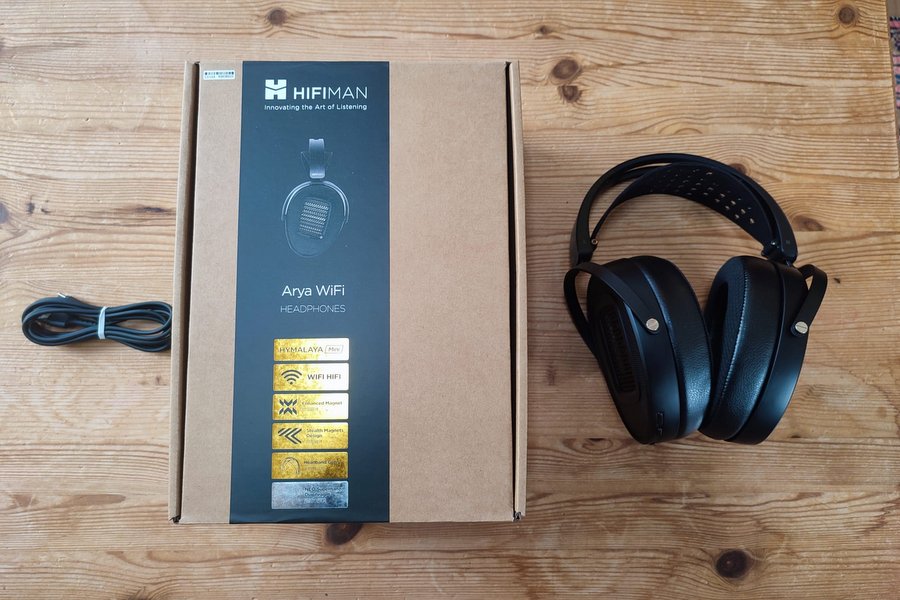
HiFiMAN Arya WiFi arrives as the more affordable sibling to the HE1000 WiFi, bringing open-back planar magnetic drivers, WiFi streaming, Bluetooth connectivity, and a very different approach to wireless listening in the high-end headphone category.
At $1,449, the Arya WiFi is less expensive than the HE1000 WiFi ($2,699), but nobody should mistake it for an inexpensive experiment. This is still a premium audiophile headphone with a very specific promise: better wireless sound quality by moving beyond the usual Bluetooth-first approach and letting listeners stream over WiFi at home or in the office.
That raises the question many people will ask right away: if the HE1000 WiFi delivered an exceptional listening experience but also revealed an operational issue that gave us pause, has HiFiMAN solved enough of the user-experience problem with the Arya WiFi to make the concept feel ready for prime time?
Because at this price, clever engineering is not enough. The Arya WiFi has to sound excellent, feel comfortable, connect reliably, and prove that WiFi headphones are not just another audiophile science project with ear pads.
Advertisement
HiFiMAN Arya WiFi (left) vs. HiFiMAN HE1000 WiFi Headphones (right)
Arya WiFi Specs & Technology
Inside the left earcup of the HiFiMAN Arya WiFi is the circuitry that allows the headphone to operate without a traditional source component, DAC, headphone amplifier, or cable hanging off your desk like audiophile spaghetti.
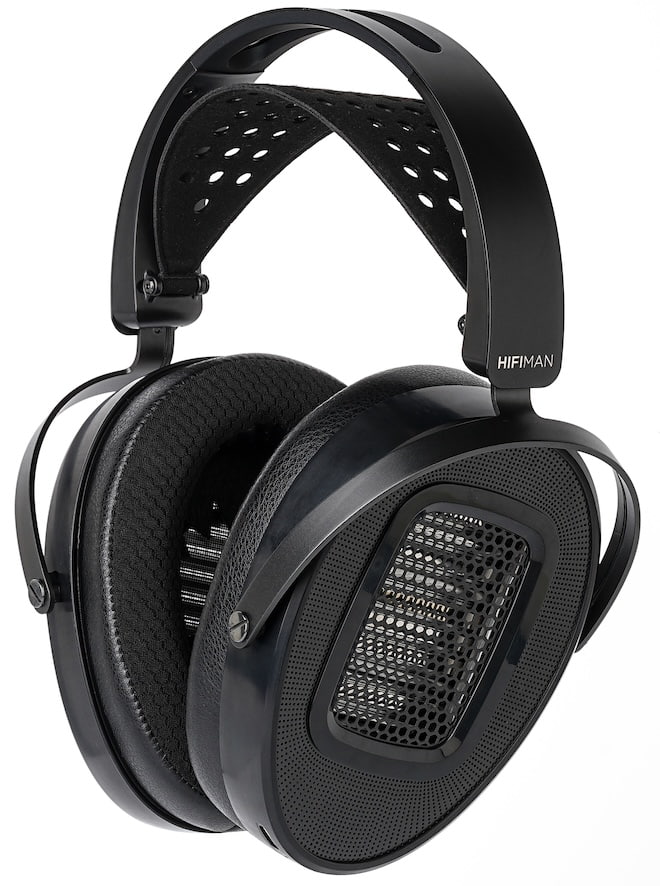
The core of the system is HiFiMAN’s 8mm HYMALAYA Mini DAC, which is specified at 0.0055% THD+N and 105dB channel separation. HiFiMAN also integrates the wireless streaming hardware and headphone amplification inside the earcup, which is rather impressive considering the Arya WiFi remains an open-back planar magnetic headphone weighing 452 grams.
The broader technology package is very similar to the HE1000 WiFi. Both models support WiFi, Bluetooth, and USB Audio operation, along with PCM playback from 44.1kHz to 768kHz, native DSD64 to DSD512, and Bluetooth codec support for SBC, AAC, aptX, aptX HD, and LDAC.
The key difference is the driver. The Arya WiFi uses HiFiMAN’s NEO Supernano Diaphragm Gen.2, while the HE1000 WiFi uses HiFiMAN’s nanometer-thickness diaphragm. HiFiMAN positions the HE1000 WiFi as the higher-resolution model, but the Arya WiFi shares much of the same wireless architecture at a significantly lower price. That makes the comparison more interesting than the price gap might suggest.
Advertisement
The Arya WiFi uses HiFiMAN’s planar magnetic driver platform with Stealth Magnets, a design intended to reduce wave diffraction as sound passes through the magnet structure. HiFiMAN says the result is lower distortion and improved clarity, but as always, the listening section is where the marketing language either earns its keep or quietly exits through the side door.
WiFi is the real point of difference here. Bluetooth remains convenient, but even the better codecs are still limited by available bandwidth and device support. By adding WiFi streaming, the Arya WiFi can support lossless and high-resolution playback in a way that conventional Bluetooth headphones cannot.
For listeners using TIDAL, Qobuz, Roon, or local high-resolution files, that matters. For Spotify users, the benefit is less about lossless playback and more about connection flexibility, convenience, and avoiding some of Bluetooth’s usual compromises.
Advertisement. Scroll to continue reading.
You can also use the Arya WiFi in wired mode via USB-C, or connect it to your playback device via Bluetooth thanks to the embedded Qualcomm QCC5181 chip, which is LDAC-compatible for up to 96kHz playback.
Advertisement
Design & Comfort
The HiFiMAN Arya WiFi follows the same general design language as the HE1000 WiFi, but with a different finish. The Arya WiFi wears a blacked-out look, while the HE1000 WiFi uses the more upscale brown and metallic color scheme. Black is the safer choice and probably the easier one to live with, unless your listening room already looks like a cigar lounge with a DAC budget.
The Gen.2 headband is comfortable and offers useful adjustment, although it does not provide the same full cup rotation found on some passive Arya and HE1000 models. That limits portability and flat storage, but this is still a better design than HiFiMAN’s older Sundara-style headband or the more basic strap-free assemblies used on models such as the HE400se and HE6se V2.
Build quality is good, but the Arya WiFi does not suddenly become a jewelry-grade headphone because WiFi has joined the party. There is still visible plastic, and the materials do not feel as premium as the price might suggest. That said, at $1,449 and positioned well below the HE1000 WiFi, those compromises are easier to accept.
Comfort remains one of the Arya WiFi’s strengths. The large open-back earcups, suspended headband, and familiar HiFiMAN pad shape make it easy to wear for longer sessions, provided you are comfortable with a firmer-than-average clamp. It is not featherlight, but the weight is distributed well enough that the Arya WiFi never feels like punishment for choosing wireless planar magnetic headphones.
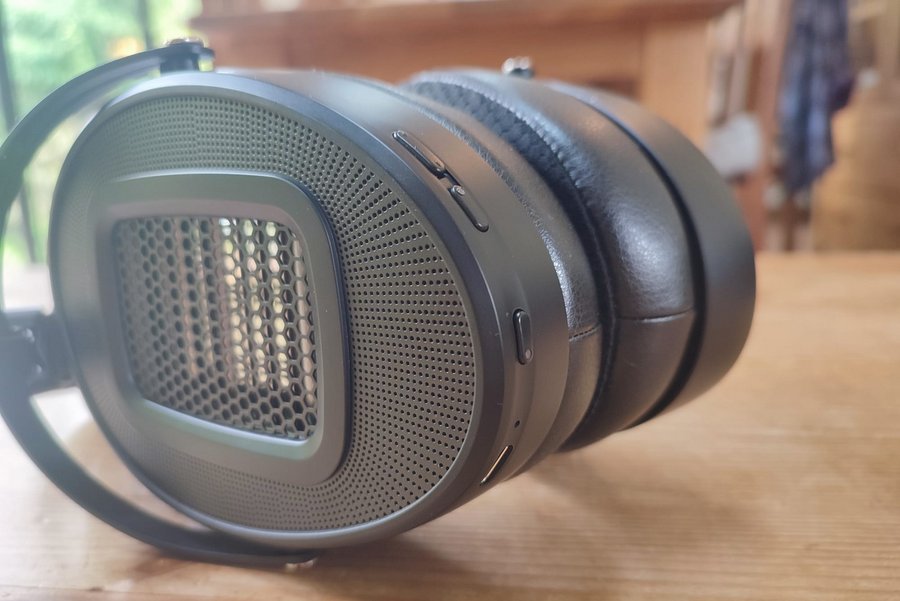
The button layout is the same as the HE1000 WiFi. From top to bottom, there is a volume rocker, a function button for switching between WiFi, USB, and Bluetooth modes, and a power button. The buttons use different colors to indicate operating mode, charging status, and battery state. It is straightforward once you learn the color system, although there is still a short adjustment period.
The layout itself is simple and intuitive, and the buttons are easy enough to find by touch. My main issue was with the voice prompt, which was extremely quiet on my review sample. I cannot say whether that is specific to this unit or representative of the product more broadly, but it made mode confirmation less useful than it should be. Volume adjustment also felt too coarse for my liking, with each step creating a larger change than I would prefer.
Advertisement
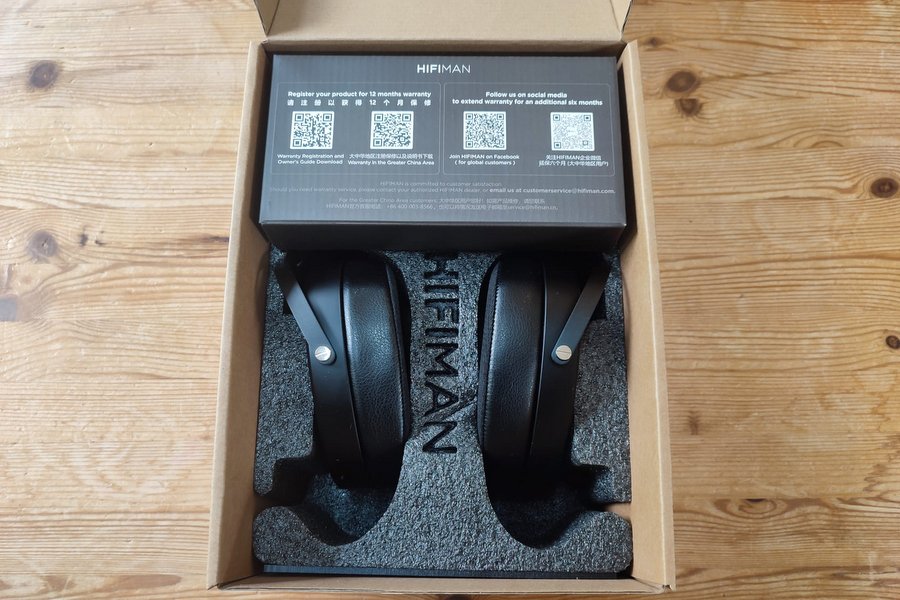
HiFiMAN keeps the included accessories minimal. The Arya WiFi includes a USB-C to USB-A cable roughly six feet long, and that is essentially it. There is no display case like the one included with the HE1000 WiFi. At $1,449, that does not change the performance case for the headphone, but it is worth noting for buyers expecting a more premium unboxing experience.
Setup & Usability
The first thing I tried to do after unboxing the Arya WiFi was connect it to my home WiFi network. That process proved more frustrating than expected.
Setup requires a specific sequence of button presses on the earcup, entering URLs on a smartphone, navigating web pages that feel unfinished, and entering more than one password before the headphones can join the network. If everything works the first time, the process may only take a few minutes. In my case, it repeatedly failed at the final stage when entering my router password, for reasons that were never clear. After roughly 20 minutes, I was eventually able to complete the connection.
That matters because WiFi is the feature that separates the Arya WiFi from a conventional wireless headphone. If users struggle with the setup process, some will likely default to Bluetooth or USB-C operation instead. Those modes are useful, but they also reduce the value of buying the WiFi version in the first place.
HiFiMAN already has the GAIA app, and this seems like the obvious place to guide users through WiFi setup in a clearer and more polished way. A step-by-step setup flow inside the app would be preferable to asking users to rely on a web-based process or a support video. For a company selling a $1,449 wireless planar headphone built around WiFi streaming, the setup experience needs to feel more mature.
Advertisement
Advertisement. Scroll to continue reading.
Battery life was also a concern. HiFiMAN rates the Arya WiFi at 6.5 to 7.5 hours in WiFi mode and up to 23 hours over Bluetooth. In my testing, WiFi playback landed closer to 5 to 6 hours, which is below the rated figure but not dramatically far off. Bluetooth battery life was more disappointing, coming in around 12 hours, well short of the claimed 23 hours. Battery life will vary with volume level, codec, connection stability, and usage conditions, but that gap is large enough to be noted.
Listening
The Arya WiFi and HE1000 WiFi look closely related, feel very similar on the head, and share much of the same internal wireless architecture. The obvious question, then, is whether they sound the same.
The answer is almost, but not quite. The two models are clearly cut from the same cloth, and the Arya WiFi gets closer to the HE1000 WiFi than the price difference might suggest. That makes the less expensive model a more interesting proposition than expected.
Among the wireless headphones I have heard, HiFiMAN’s WiFi models are among the most technically capable, even when used over Bluetooth. For this review, however, most of my listening was done in WiFi mode, using a mix of Spotify streams and high-resolution FLAC files. That matters because WiFi playback is the main reason these headphones exist, and it is the mode that gives the Arya WiFi its best chance to separate itself from conventional Bluetooth designs.
Advertisement
Bass
The Arya WiFi has a slightly elevated bass response, but it is not tuned like a consumer noise-cancelling headphone trying to win a fistfight in the low end. The bass sits just above the rest of the spectrum, giving music some added weight, warmth, and physical presence without overwhelming the midrange.
It is not the fastest or most controlled bass I have heard from a planar magnetic headphone, but that comparison mostly involves high-end wired models with dedicated amplification. Against other wireless headphones, the Arya WiFi is much stronger. Bass notes start and stop cleanly, texture is easy to follow, and there is very little sense of bloat or overhang.
Sub-bass extension is also impressive for an open-back wireless headphone. The Arya WiFi can reproduce very low information with useful audibility, including material around the 20Hz region, although there is some slight roll-off as it approaches the lowest octave. On Hans Zimmer and James Newton Howard’s “Why So Serious?,” the deep rumble around the 3:30 mark was clearly present, which is not something every open-back headphone manages convincingly.
Midrange
Moving up from the bass, the transition into the lower midrange is smooth and well controlled. Male vocals do not sound thickened or pushed back by excess upper-bass energy, which helps the Arya WiFi maintain good clarity through the lower registers.
The midrange itself is slightly relaxed compared to the bass and treble, but I would not call the Arya WiFi a strongly V-shaped headphone. It has some extra energy at the frequency extremes, while the center of the presentation remains smooth, open, and even-handed.
Advertisement
That character works in its favor with vocals and acoustic instruments. The Arya WiFi does not push singers forward in the way some midrange-focused headphones do, and listeners who prefer a more relaxed presentation may find it easier to live with over longer sessions. Compared with something like the Sennheiser HD600, the Arya WiFi is less intimate and less midrange-forward, but it still presents vocals and instruments with convincing timbre and very good tonal balance.
On Dominique Fils-Aimé’s “Birds,” breath detail, vocal texture, and the space around her voice were easy to hear without sounding exaggerated. The Arya WiFi does not put the singer right in your lap, which is probably healthier for everyone involved, but it does a strong job of preserving the natural shape and presence of the performance.
Treble
The Arya WiFi follows the HE1000 WiFi with a treble balance that is more forgiving than some of HiFiMAN’s older or brighter-leaning models, including the Arya Organic and HE6se V2. It still sounds open and detailed, but it avoids the sharper edge that can make long listening sessions feel like a test of character.
Advertisement. Scroll to continue reading.
Advertisement
There is enough presence in the upper registers to show what the planar magnetic drivers can do, particularly with cymbal decay, small percussion details, and the air around instruments. Fine detail is easy to follow, but the Arya WiFi does not push treble information forward just to create the impression of resolution.
“La lune” by L’Impératrice is one of my regular treble test tracks because of the faint triangle hit that runs through much of the song. The Arya WiFi keeps that detail audible within the mix without turning it into a distraction. It has the clarity to reveal the upper-frequency information, but enough restraint to keep the presentation smooth and listenable.
Soundstaging & Imaging
HiFiMAN’s egg-shaped open-back headphones are known for producing a wide, spacious soundstage, and the Arya WiFi continues that pattern. The presentation is larger than average for a wireless headphone, with good width and a convincing sense of height, although it does not sound quite as expansive as some of the wired Arya variants, including the Arya Organic and Arya Unveiled.
Imaging is the stronger part of the presentation. The Arya WiFi places sounds with very good precision, and that matters more to me than absolute stage size. On TOOL’s “Chocolate Chip Trip,” the headphone made it easy to follow the individual layers, percussion hits, and spatial effects without turning the mix into a blur. That track can become a mess on less capable headphones. The Arya WiFi kept it organized.
Advertisement
Detail retrieval is also strong. The Arya WiFi does not leave much feeling hidden, especially in WiFi mode with high-quality source material. The HE1000 WiFi still has a slight edge in resolution and low-level information, but the gap is not large. You are most likely to notice it during direct comparisons, not during normal listening. That is probably the healthier way to experience music anyway.
The Bottom Line
The HiFiMAN Arya WiFi makes a strong case for itself because it delivers much of the HE1000 WiFi experience at a significantly lower price. It does not quite match the more expensive model for resolution or refinement, but the gap is small enough that many listeners will find the Arya WiFi the more sensible buy.
Sound quality is the main reason to consider it. The Arya WiFi offers a spacious presentation, strong imaging, extended bass, smooth mids, and a treble balance that is detailed without becoming aggressive. In WiFi mode, it feels like a meaningful step beyond most Bluetooth headphones, especially with lossless or high-resolution material.
The problems are not sonic. The WiFi setup process needs to be more polished, and battery life is only fair in WiFi mode and disappointing over Bluetooth based on my testing. Those issues matter because they affect daily use, and they make the Arya WiFi feel less finished than it should at $1,449.
Still, if you can live with the setup process and the need for frequent charging, the Arya WiFi is the better value in HiFiMAN’s WiFi headphone lineup. The HE1000 WiFi remains the more capable headphone, but the Arya WiFi gets close enough where the extra money becomes harder to justify.
Advertisement
Pros:
Built-in WiFi streaming supports higher-quality wireless playback than conventional Bluetooth headphones
Can also be used over USB-C or Bluetooth
Comfortable fit with good weight distribution for longer listening sessions
Spacious soundstage, strong imaging, and excellent detail retrieval for a wireless headphone
More affordable than the HE1000 WiFi while retaining much of the same wireless architecture
Cons:
Build quality is good, but the visible plastic and limited accessories do not fully match the price
First-time WiFi setup is more complicated and less polished than it should be
Battery life fell short of HiFiMAN’s stated figures in testing
Bluetooth mode is useful, but does not deliver the main benefit of buying the WiFi version
The public face of AI is something we’re all very familiar with. Turn on your phone, tablet, or computer — hey presto — all the power of AI at your fingertips. However, the technology powering all that AI needs a vast network of data centers and network infrastructure.
The use and power of AI are both increasing exponentially, which is pushing the demand for more data centers. However, this isn’t as simple as building a big shed, cramming it full of technology, and plugging it in. There are plenty of bottlenecks stopping us from building enough data centers. Among the factors concerning the industry are environmental impact, power infrastructure inadequacies, and community concerns. The latter is demonstrated by the growing protests against AI data centers.
Now, one company believes it may have a solution that can help bridge this impending shortfall in computing power. San Francisco-based SPAN is not a tech giant; they’re a company that specializes in clean energy solutions for homes.
Advertisement
The company has released details of a scheme that could ease the computing power problem and the cost of your electricity bill. The company plans to use the spare electrical capacity available to most households to power a “mini data center.”
The system, known as XFRA, might not be as small as the tiny Odinn portable data center, but coming in at about the size of a domestic air-conditioner, it certainly doesn’t need to be housed in a data center. Let’s have a closer look at XFRA, and just what carrots the company is offering to entice you to install the air-con-sized unit in your garden.
Advertisement
What is Span’s XFRA system?
SPAN’s XFRA system is a distributed, residential-scale compute cloud. To understand why such a system is being considered, we need to look at the bottlenecks currently slowing the development of data-center capacity. More specifically, electrical distribution bottlenecks. In some cases, the grid can’t deliver power to new data centers, even if the power exists somewhere on the network.
XFRA addresses this bottleneck by utilizing the fact that residential electrical infrastructure has plenty of spare capacity up for grabs. Essentially, the grid is configured to run at peak capacity, but for most of the time, it only needs about half this capacity. The XFRA system proposes to use this capacity to power its mini data centers.
Each XFRA node is a liquid-cooled “compute module” built around a bank of eight enterprise-grade GPUs. Importantly, controlling this is a SPAN smart electrical panel. This panel monitors the household’s electrical circuitry and utilizes the spare capacity when household needs allow for it.
Advertisement
As well as the server and the control panel, a whole-home battery is part of the installation. Although homeowners should always consider a few things before installing a new home battery. The battery ensures that the hardware has a stable power supply that can ride through brief outages or fluctuations.
Finally, each node is connected to SPAN’s orchestration layer, which treats each distributed node as part of a single, cloud-like compute resource.
The company is hoping to have a pilot scheme running in 2026, with a larger-scale deployment following in 2027.
Advertisement
What’s in it for homeowners?
The size of the units means there won’t be too much intrusion for those who install them, at least aesthetically. However, very few people would rush to install such a system without there being some incentives on offer. From a hardware perspective, the most obvious advantage is the installation of a whole-home battery. While this supports the XFRA node, it also acts as a home power backup.
While the company doesn’t promise that householders can completely wave goodbye to electricity bills, there are financial incentives on offer. Primarily, it’s offering a monthly payment for hosting an XFRA node, essentially subsidizing energy and high-speed broadband bills to a large degree. In some cases, subsidies could be large enough to supply these utilities free of charge. There is also an optional solar panel scheme.
Advertisement
However, before we all rush out and get a data center installed in our yards, there are some potential downsides to consider. The first thing is that having such an expensive bit of technology in your yard could raise questions about theft and vandalism.
There are also some uncertainties about the underlying principles of the system. For grid planners, the spare domestic capacity isn’t a luxury; it’s a designed-in feature that’s often used to smooth the peaks and troughs of electrical demand. Power problems may also occur in situations where there are clusters of XFRA nodes in close proximity. This could lead to particular areas drawing more power than is expected under normal circumstances.
While everyone would love free electricity, the success of XFRA will depend on whether the advantages of having a mini data server next to your grill are worth it.
An anonymous reader quotes a report from 404 Media: The Federal Communications Commission (FCC) wants to make it effectively impossible for people to buy what many call burner phones — a phone not explicitly linked to your identity at the point of purchase — which would impact privacy-conscious people, to domestic abuse survivors, to journalists, and many more. The FCC plans to do this by legally forcing the country’s telecoms to store a wealth of personal information about essentially all phone customers, including a government issued identification number and their physical address, alarming privacy advocates and civil rights activists who compare the measures to those from authoritarian countries where it can be difficult to buy a mobile phone plan without giving up your identity.
The proposed change would drastically shake up how people obtain phone plans in the U.S., and have all sorts of privacy and cybersecurity knock-on effects. The FCC is proposing the data collection partly as a way to combat scammers, with telecoms being required to collect other information on business and foreign customers like the intended use case of their bulk phone plan purchase and their IP address. But the changes would mean telecoms collect data on all new and renewing customers, and the FCC provides a long list of other things that the collected data could help authorities with.
In a synopsis of the proposed changes, the FCC writes, “Specifically, we seek comment on requiring originating providers to, at a minimum, obtain and retain the name, physical address, government issued identification number, and an alternate telephone number of any new and renewing customer before granting access to its services.” The goal of collecting this data, the FCC writes, is to deter some scammers from getting onto a telecom network in the first place, and so “enforcers will be better able to identify the scammers when they do.” The FCC compares the changes to the sort of data collected by banks to prevent money laundering.
One section stresses that the newly collected data would help “law enforcement to more easily identify callers that use the network to perpetuate crimes by ensuring that voice providers have accurate and complete customer information.” It goes on to ask if the data would help identify people buying and selling illicit goods; the investigation of “fraud, espionage, or influence operations that undermine national security”, and “address abuse in text messaging networks.” “Criminals continue to leverage the anonymity provided by phone calls and texts to defraud Americans and exploit communications networks to further other crimes,” one section reads. “For decades, civil libertarians have looked overseas at authoritarian countries where the government requires people to register to get a mobile phone to ensure they can be tracked. We never thought that would happen here,” Jay Stanley, senior policy analyst at the American Civil Liberties Union’s (ACLU) Speech, Privacy, and Technology Project told 404 Media in an email. “But make no mistake: with this rulemaking, the government is contemplating taking away people’s ability to get a burner phone, which will hurt low-income people, domestic violence victims, and anyone else who cares about their privacy.”
Salesforce is acquiring m3ter, a London metering platform, to add native consumption billing to Agentforce Revenue Management.
Salesforce has signed a definitive agreement to acquire m3ter, a London-based metering and rating platform built for consumption-based billing. The deal will integrate m3ter’s infrastructure natively into Agentforce Revenue Management, giving Salesforce customers the ability to launch, track, and bill usage-based and outcome-based pricing models without leaving the platform. Financial terms were not disclosed.
The acquisition reflects a structural shift in how software companies charge for their products. Traditional per-seat subscriptions made sense when humans were the primary users, but AI agents that perform work autonomously create a billing problem: if one agent replaces ten employees, selling ten licences no longer works. Salesforce itself has been navigating this tension, moving Agentforce to a consumption model built on Flex Credits where each agent action costs roughly $0.10.
m3ter was founded in 2020 by Griffin Parry and John Griffin, who previously co-founded GameSparks, a cloud services company acquired by Amazon in 2017. The pair spent three years at AWS after the acquisition, where they saw first-hand how Amazon’s usage-based billing infrastructure worked at scale. They left to build m3ter as a standalone metering layer that could sit between a product and its billing system.
Advertisement
The 💜 of EU tech
The latest rumblings from the EU tech scene, a story from our wise ol’ founder Boris, and some questionable AI art. It’s free, every week, in your inbox. Sign up now!
The platform ingests product usage data in near real time, applies configurable pricing rules, and outputs billable charges to whatever CRM, ERP, or invoicing system a company uses. m3ter raised $17.5 million in seed funding from Union Square Ventures, Insight Partners, and Kindred Capital in 2022, followed by a $14 million Series A led by Notion Capital in 2023. Its customers include Paddle, Onfido, and Sift.
“We founded m3ter to solve the hardest problems in usage-based pricing,” Parry said. “Joining Salesforce allows us to bring our high-scale mediation and rating capabilities to the world’s largest enterprise install base.” The transaction is expected to close in the second quarter of Salesforce’s fiscal year 2027, subject to customary closing conditions.
Advertisement
m3ter is the latest in a series of acquisitions Salesforce has made to assemble the infrastructure for its AI agent strategy. The company acquired Contentful earlier this month for a native content layer, completed an $8 billion deal for Informatica in late 2025 for data integration, and bought Momentum, Qualified, and Cimulate for conversation intelligence, AI sales engagement, and digital experience simulation respectively.
The pattern is clear: Salesforce is buying the components it needs to make Agentforce a complete platform rather than a feature bolted onto its existing CRM. m3ter fills the monetisation gap, the infrastructure required to actually charge customers for what AI agents do. Without native metering, enterprises running consumption-based models have to stitch together third-party billing tools or build custom integrations, a problem that becomes harder as pricing models grow more complex.
Whether this translates into revenue growth is the question investors are watching. Salesforce reported $11.13 billion in revenue for fiscal Q1 2027, up 13% year on year, and Agentforce reached $1.2 billion in annual recurring revenue. The stock fell roughly 1.7% on the day of the m3ter announcement, sitting closer to its 52-week low of $163.52 than its high of $276.80.
Investors want proof that consumption-based AI revenue can scale fast enough to offset the structural threat to seat-based licensing. A billing infrastructure acquisition is a bet on plumbing rather than a growth catalyst, and the market priced it accordingly.
Advertisement
For m3ter, the outcome is a fast exit for a company that raised just $31.5 million in total funding. For Salesforce, it is another piece in a stack that now spans data (Informatica), content (Contentful), agents (Agentforce), and billing (m3ter). The question is whether enterprises will consolidate on that stack or continue assembling their own from best-of-breed vendors, a choice that the shift to consumption pricing makes more consequential with every agent deployed.






























































You must be logged in to post a comment Login