

Crypto World
Fireblocks launches agentic payment support, joins x402 Foundation



If even a fraction of the more than 1 billion people who use AI daily delegate authority to AI agents for online spending, stablecoin adoption would grow substantially, a Fireblocks executive said.



Terraform Labs’ liquidators have accused Jane Street of insider trading that allegedly netted $134 million during the May 2022 Terra/LUNA implosion, claiming the trading giant front‑ran the depeg using non‑public information while retail investors were wiped out.
Summary
- The court-appointed administrator says Jane Street used confidential data and private Telegram coordination to dump UST ahead of the collapse.
- The lawsuit alleges roughly $134 million in illicit profit from trades executed during a “death spiral” that erased around $40 billion in market value.
- Jane Street has moved to dismiss the case, calling the complaint “self‑defeating” and a “desperate effort” to shift blame for Terraform’s fraud.
The administrator winding down Do Kwon’s Terraform Labs has filed a federal lawsuit accusing Jane Street, its co‑founder Robert Granieri, and traders Bryce Pratt and Michael Huang of insider trading tied to the May 2022 Terra collapse.
Terraform liquidator targets Jane Street over May 2022 trades
According to the complaint, filed in the Southern District of New York and reviewed by the Financial Times, Jane Street “used material, non‑public information obtained from Terraform insiders to front‑run market‑moving events” and exit positions while ordinary investors were left holding collapsing UST and LUNA.
The complaint alleges that Jane Street coordinated its UST trades “through a private Telegram chat” and executed an “85 million UST” sale on May 7, 2022, minutes after confidential instructions were given to withdraw liquidity from a key pool. Terraform’s plan administrator claims those trades formed part of a broader scheme that generated “approximately $134 million in unlawful profits” as Terra’s algorithmic stablecoin lost its peg and the ecosystem unraveled in a matter of days.
In detailing the fallout, the lawsuit places Jane Street’s trading squarely inside one of crypto’s most destructive episodes, describing Terra’s failure as a “$40 billion collapse” that triggered cascading liquidations and contributed to a wider credit crunch across digital asset markets. Crypto.news has previously reported on the long legal afterlife of that implosion, including civil and criminal actions targeting Terraform, Do Kwon and other actors that helped reshape the regulatory conversation around so‑called algorithmic stablecoins.
Jane Street hits back, calls complaint ‘self‑defeating’
Jane Street has categorically denied the allegations and asked a Manhattan court to throw out the case with prejudice. In its motion to dismiss, the firm argues that the administrator “does not identify any material, nonpublic information Jane Street supposedly received” and that the complaint “concedes Jane Street’s single largest UST sale occurred ten minutes after the supposed material non‑public information was visible to the market,” making it “self‑defeating on its own terms.”
The trading firm also frames the lawsuit as an attempt to plug Terra’s hole with someone else’s balance sheet.
“This lawsuit is a desperate effort to pursue funds where none are owed,” a Jane Street spokesperson said, adding that “losses suffered by LUNA and UST holders were the direct result of the multibillion‑dollar fraud perpetrated by Terraform Labs’ leadership, not the actions of Jane Street.”
Coverage in the Wall Street Journal notes that the plaintiff is seeking to claw back the alleged $134 million plus additional damages from Jane Street and its executives, arguing that their trades “hastened the downfall” of Terraform by draining liquidity and accelerating panic. In a separate analysis, DL News reported that Jane Street told the court it simply “sold a deteriorating investment” as public signs of Terra’s failure mounted, insisting that sophisticated firms and retail traders were reacting to the same information as the peg broke.
The case now sits at the intersection of market‑structure reality and post‑crash scapegoating: a high‑frequency trading firm that profited by moving fast, and a liquidator trying to reframe that speed as illicit access to inside information. Whatever the outcome, the lawsuit ensures that the forensic fight over who really accelerated Terra’s $40 billion destruction—Terraform itself, Jane Street, or a combination of both—will play out in open court rather than just in crypto’s collective memory.

Missouri has filed a civil lawsuit against GPD Holdings, the operator behind CoinFlip’s network of crypto ATMs, accusing the company of knowingly facilitating fraudulent transactions and profiting from them. The action represents one of the most prominent state-level efforts to police crypto kiosks as regulators widen scrutiny over how digital-asset services interact with everyday consumers, including seniors and veterans who may be particularly vulnerable to scams.
The Missouri Attorney General’s Office, in a filing disclosed this week, seeks a wide-ranging remedy under the Missouri Merchandising Practices Act. The petition asks the court to declare CoinFlip’s practices unlawful, to enjoin the company from operating within Missouri, to impose civil penalties of $1,000 per violation for the past five years (potentially up to $1.826 million), and to award restitution to affected consumers. The office framed the case as part of a broader concern about the integrity of crypto kiosks and the protection of Missouri residents from fraudulent activity.
CoinFlip’s footprint in Missouri, according to the company’s own disclosures, includes 136 crypto kiosks in the state and a national network of 4,229 kiosks across the United States. The Missouri action comes amid a wider wave of regulatory interest in crypto ATM operators that has included investigations and local ordinances aimed at restricting or banning kiosk activity in several jurisdictions. The state’s inquiry first emerged last December as part of a broader probe into multiple crypto ATM operators, including Bitcoin Depot, which has faced its own regulatory and financial pressures in recent months.
Key takeaways
- The Missouri Attorney General filed a civil lawsuit against CoinFlip’s operator, alleging violations of the Missouri Merchandising Practices Act and seeking a court order to halt operations in Missouri, plus civil penalties and consumer restitution.
- CoinFlip reports 136 kiosks in Missouri and more than 4,200 nationwide, illustrating the scale of crypto ATM access in the United States and the potential exposure for consumers to fraud if operators fail to comply with consumer protections.
- The case is part of a broader regulatory push in the United States, where multiple states have scrutinized crypto kiosks and passed or considered laws restricting their use amid concerns about scams and fraudulent activity.
- In a related development, Bitcoin Depot disclosed material going-concern risk in an SEC filing ahead of its Chapter 11 filing, underscoring rising financial and legal pressures on major kiosk operators.
Broader regulatory momentum and the cited concerns
The Missouri action does not stand alone. The attorney general’s filing notes that the enforcement action is tied to a broader investigation launched in December into several crypto ATM operators. While the Missouri case centers on CoinFlip, it sits within a pattern of local and state authorities moving to constrain or regulate crypto kiosks as cases of alleged fraud or consumer harm come to light. This pattern has included other operators and, in some cases, actions aimed at specific practices or business models within the sector.
Meanwhile, Bitcoin Depot—another major crypto ATM operator—has faced a separate set of challenges. In a May filing with the U.S. Securities and Exchange Commission, Bitcoin Depot warned that substantial doubt existed about the company’s ability to continue as a going concern. The filing highlighted looming legal judgments and ongoing litigation as part of a broader risk profile. Days later, Bitcoin Depot proceeded with a voluntary Chapter 11 filing in Texas, underscoring how even the largest kiosk networks are navigating a high-stakes legal and financial environment.
These developments come as municipalities and states weigh concrete regulatory measures. Earlier reporting documented efforts in several jurisdictions to restrict or ban crypto kiosks, with Minnesota cited as considering a ban in the wake of scam-related incidents. The cumulative effect is a climate in which operators must contend with evolving compliance requirements, potential consumer redress obligations, and the financial strain that litigation and reorganizations can place on business models built around high-volume, low-margin ATM operations.
For investors and users, the implications extend beyond individual lawsuits. The Missouri action underscores the ongoing risk that state-level regulators will deploy consumer-protection tools to shape how crypto services operate at the kiosk level. As regulators demand higher standards for disclosures, transaction disclosures, and possibly Know-Your-Customer (KYC) controls, operators may need to accelerate compliance investments. In parallel, high-profile bankruptcies and insolvency risk among large operators remind the market that the sector remains exposed to liquidity pressures and legal headwinds even as demand for easy crypto access persists.
Operational and market implications for the crypto ATM sector
From an operator’s perspective, the Missouri suit serves as a practical case study in how consumer protection statutes can be leveraged to challenge business practices perceived as deceptive or unfair. The Missouri filing emphasizes the act at issue—the Missouri Merchandising Practices Act—as the vehicle for relief, signaling that consumer protection frameworks will be a major battleground as states refine their oversight of crypto kiosks. Operators may need to reassess marketing claims, fee structures, and the clarity of disclosures to avoid dispute over what constitutes deceptive practices.
For users, the proceedings highlight the ongoing need for diligence when using crypto kiosks. While these machines offer convenient on-ramps to digital assets, they carry risks related to scams, chargebacks, and potential misrepresentation of fees or operational limits. Consumer protection actions (and the potential for restitution) may become more common if regulators perceive that kiosk operators are not meeting established standards for safe, transparent transactions.
From a market dynamics standpoint, the regulatory actions could influence the pace and pattern of kiosk deployment. If states pursue stricter enforcement or impose additional operating constraints, operators might slow expansion plans or shift toward jurisdictions with clearer compliance pathways. Conversely, a more predictable regulatory framework could support broader consumer adoption by reducing scam-related incidents and building trust in crypto-enabled cash-in and cash-out channels.
The contrast between ongoing enforcement actions and the sector’s growth trajectory also feeds into an important question for the market: how sustainable is a model that relies heavily on quick, low-friction access to digital assets through physical kiosks? The answer may hinge on how effectively operators implement robust fraud-detection tools, user protections, and transparent fee structures, all of which regulators are likely to scrutinize closely in the months ahead.
As for the Missouri case specifically, observers will be watching how the court handles the arguments about deceptive practices, the scope of the relief requested, and what this could mean for other operators facing similar inquiries. The outcome could set a precedent for whether consumer protection statutes will play a decisive role in shaping the day-to-day realities of crypto kiosks across the country.
CoinFlip did not provide an immediate comment in response to the filing. The company’s disclosures show a national footprint that dwarfs its Missouri presence, but the case illustrates how state-level actions can affect even widely adopted platforms. In parallel, the sector’s consolidation and legal scrutiny continue to unfold, with major operators forced to navigate both courtroom risk and market volatility.
Readers should monitor further developments from the Missouri case as well as the broader regulatory responses across states. As more courts weigh questions of consumer protection versus innovation, the next steps will reveal not only how these kiosks operate within law but also how accessible and trustworthy they remain to the general public.
Looking ahead, the sector’s trajectory will depend on the balance between enforcement actions, corporate compliance upgrades, and consumer demand for easy on-ramps to digital assets. The Missouri suit is a reminder that regulatory clarity—and the willingness of courts to enforce it—will shape the practical accessibility of crypto services at the street level in the coming months.
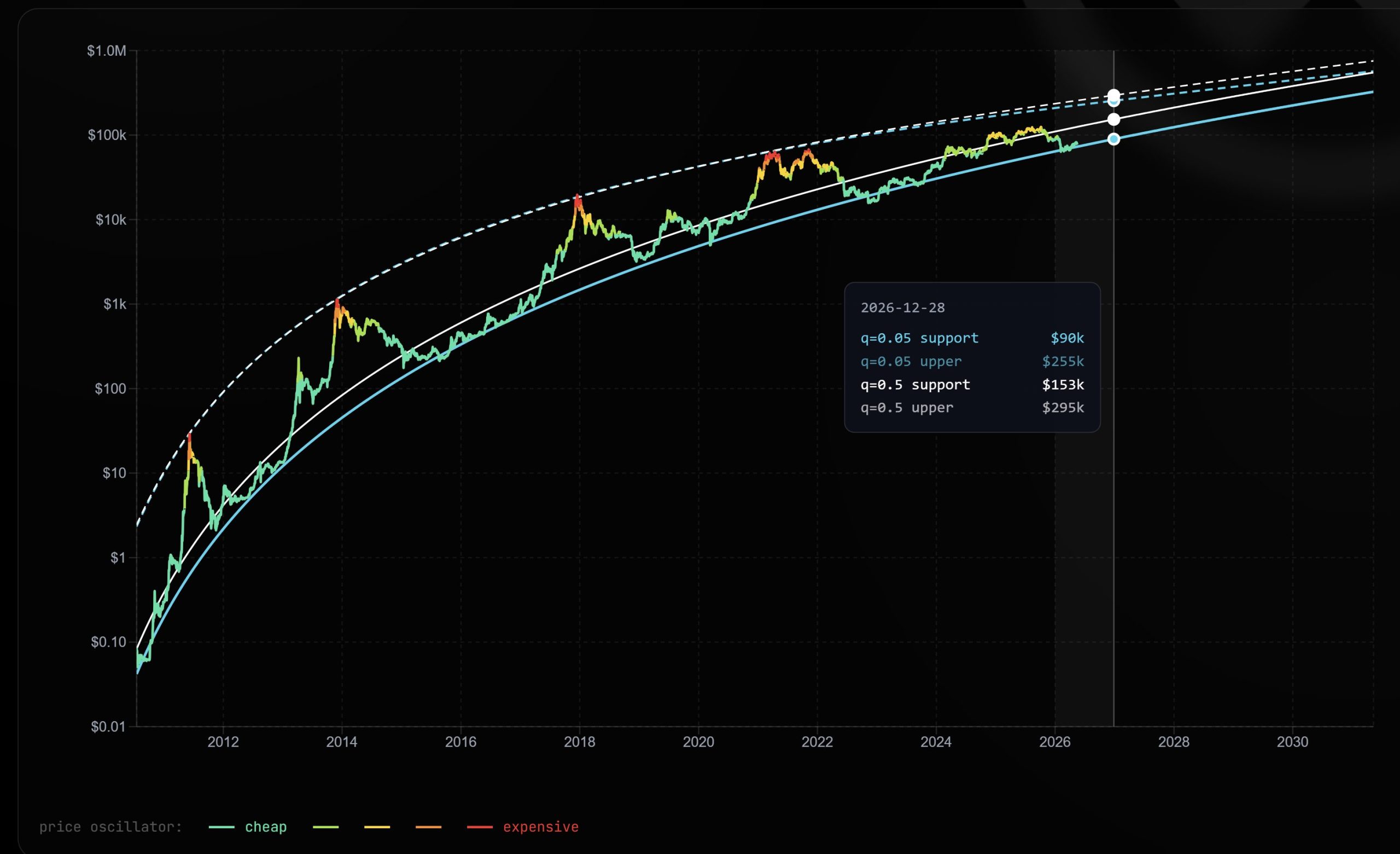
Bitcoin (BTC) is down roughly 40% from its October 2025 record high, but a long-term valuation model suggests the cryptocurrency could erase the entire decline and rally to as high as $255,000 by year-end.
Key takeaways:
- Bitcoin Decay Channel puts BTC’s conservative year-end range at $90,000–$255,000, with its 2027 range extending to $128,000–$308,000.
- Bearish HODL Waves suggest a possible higher bottom in the $65,900–$70,500 range.
Bitcoin model puts BTC’s year-end target in the $90,000–$255,000 range
The Bitcoin Decay Channel is a logarithmic price model that tracks BTC’s long-term uptrend while adjusting for smaller gains in each new cycle.
The cryptocurrency’s major tops in 2013, 2017 and 2021 formed near the model’s upper valuation bands, while bear-market lows repeatedly moved back toward its lower support zone.
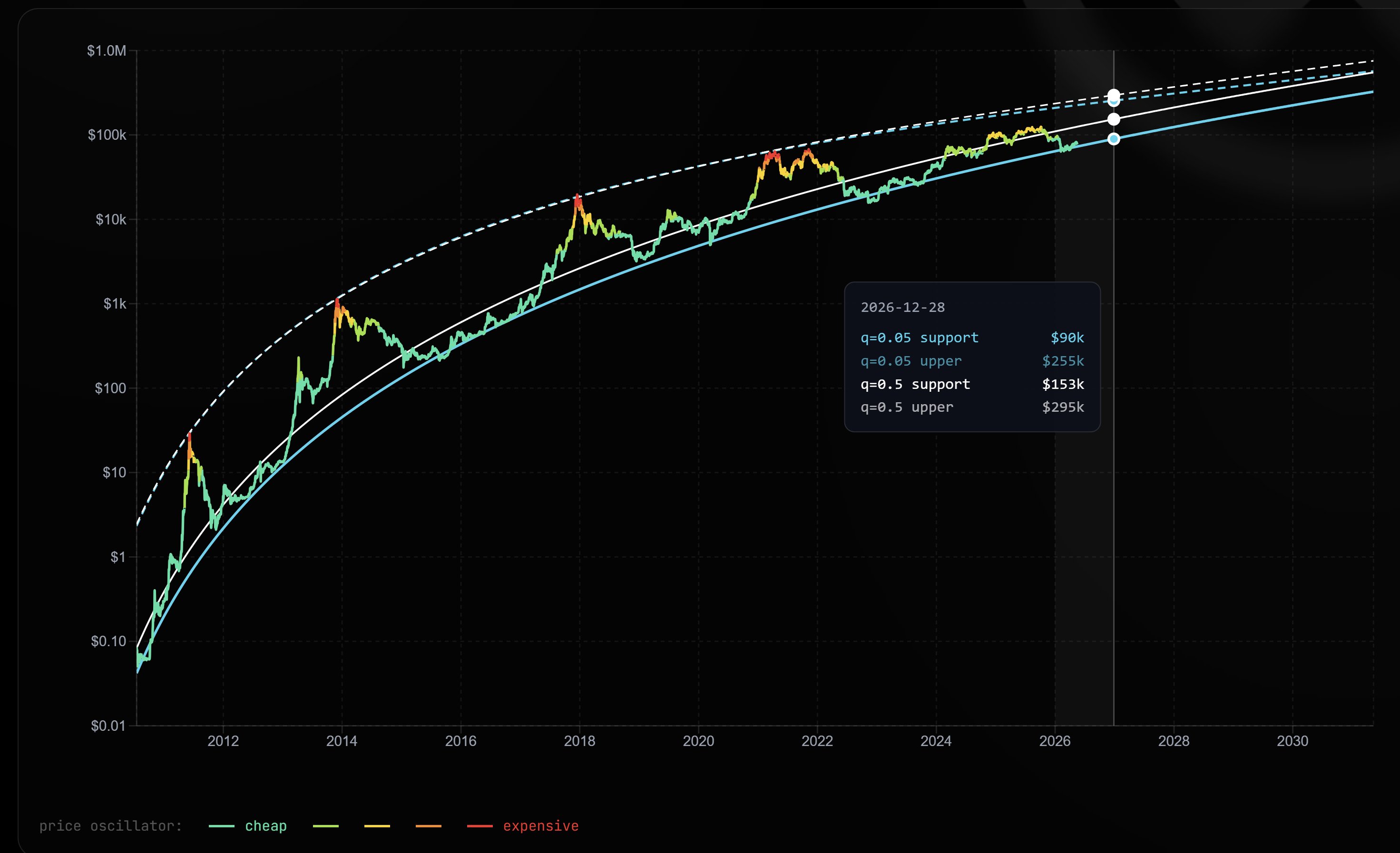
BTC/USD price performance to date. Source: Sminston/TradingView
Bitcoin’s latest rebound also began near the lower end of the Decay Channel in March-April, showing that buyers stepped in around a zone the model has historically treated as long-term support, or bottom.
That keeps the bullish case alive, according to analyst Sminston.
“Bitcoin Decay Channel gives a pretty reasonable range—conservative case—of $90k–$255k, by the end of this year. $128k – $308k for end of ’27,” he said in a Wednesday post, adding:
“For comparison, Bitcoin was $43k in December 2023.”
Sminston’s $90,000–$255,000 Bitcoin target range fits multiple predictions calling for BTC to reach a new all-time high in 2026.
Earlier, Bernstein analysts maintained a $150,000 Bitcoin target for 2026, while pushing their $200,000 peak forecast into 2027, citing a longer institutional adoption cycle led by BTC ETFs and public companies.
Related: Bitcoin price history suggests 77% odds of new all-time high within a year
BitMEX co-founder Arthur Hayes expected Bitcoin to reclaim $126,000 this year, citing US war spending in Iran, AI infrastructure demand and the resulting pressure for more fiat liquidity.
Bear flag and other indicators hint at persistent BTC sell-off risks
Bitcoin continues facing selloff warnings from a slew of bearish indicators, including a multi-month bear flag.
A bear flag typically resolves when the price drops by as much as the previous downtrend’s height. BTC risks plunging under $56,000, down about 30% from current prices, if the classic breakdown setup plays out as intended.
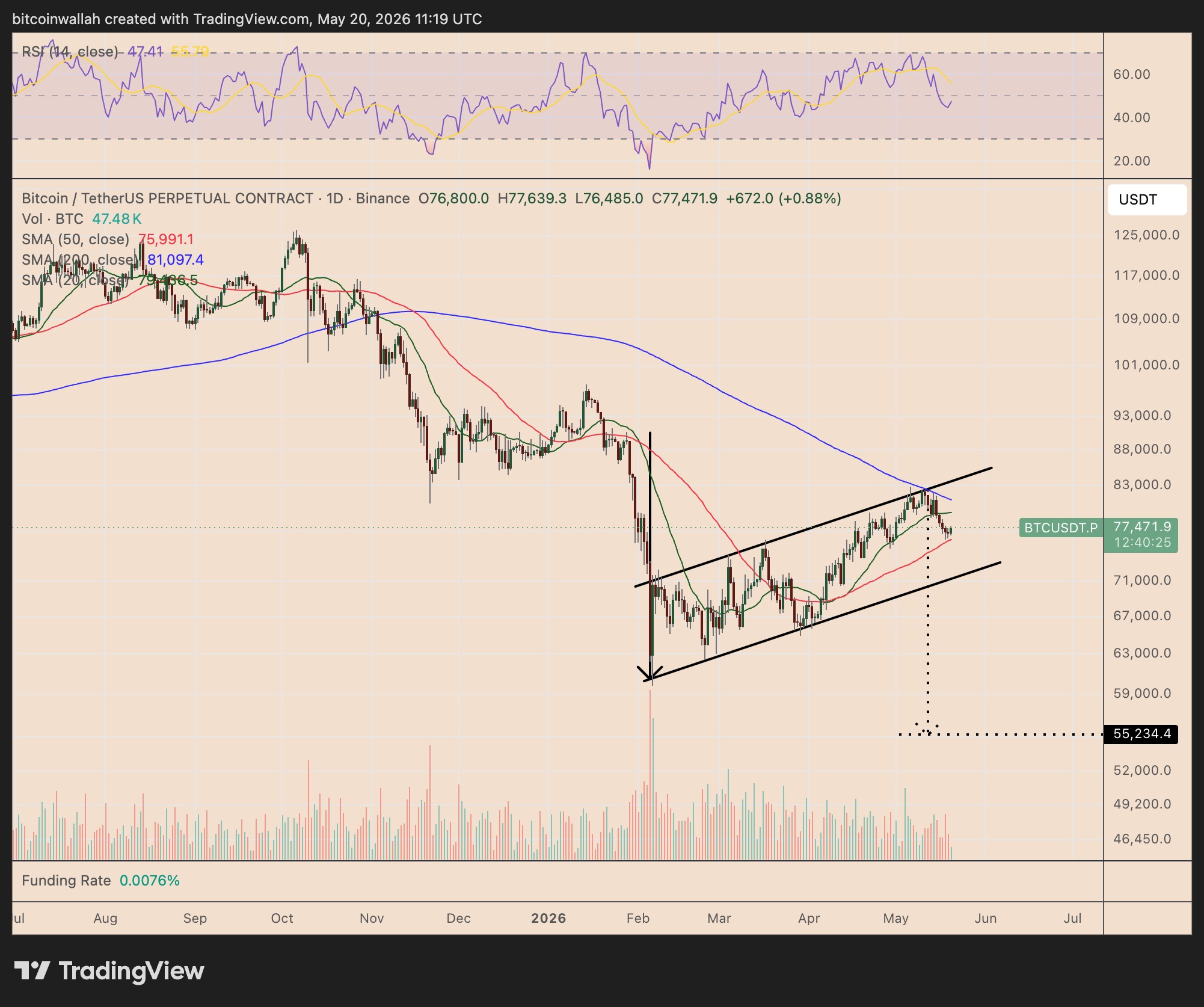
BTC/USDT daily chart. Source: TradingView
Onchain data suggests Bitcoin may not need to fall as far as the bear-flag target.
The Bitcoin HODL Waves indicator, which tracks how long BTC remains unmoved in wallets, suggests a possible bottom in the $65,900–$70,500 range if the weakness continues.
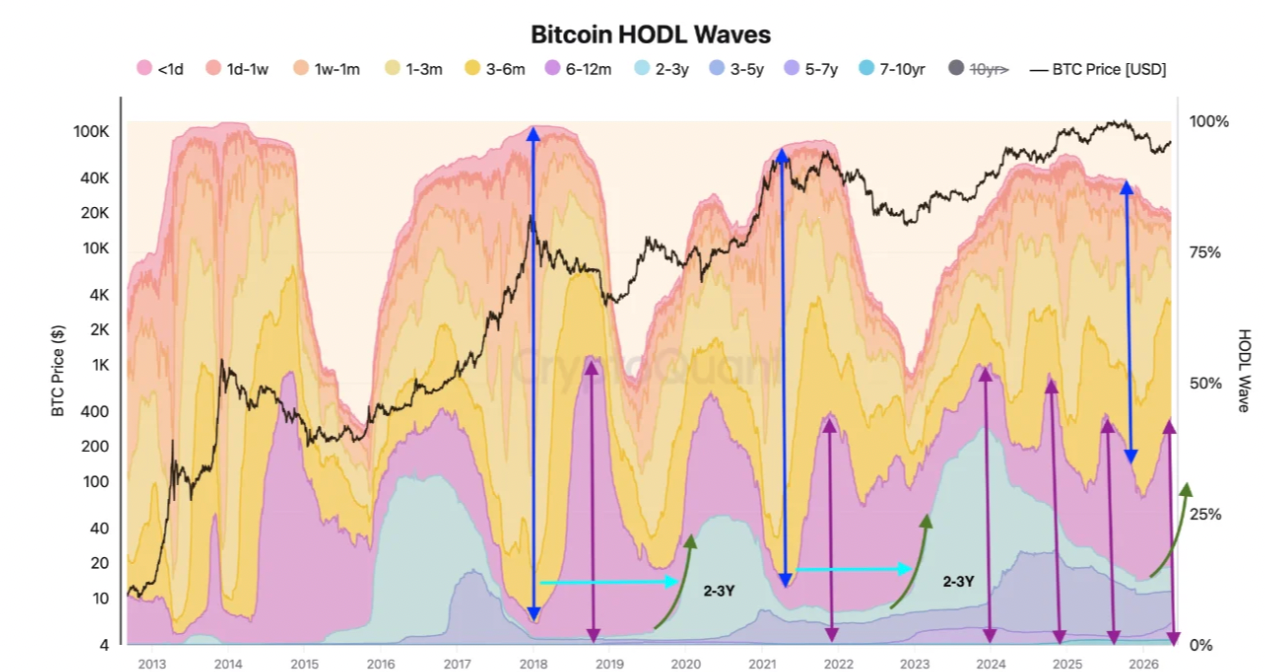
Bitcoin HODL wave indicator. Source: CryptoQuant
In a Tuesday post, CryptoQuant analyst Sunny Mom said a stronger long-term holder base may help BTC form a higher, slower bottom this cycle, with $70,500 as the key level to hold.


Nexo has renewed its title partnership for the Nexo Championship, which will return to Trump International Golf Links in Aberdeenshire on August 20-23, 2026.
Summary
- Nexo Championship returns to Aberdeenshire with a $3m prize fund
- Event closes the 2026 Closing Swing on the Race to Dubai
- Sponsorship reinforces Nexo’s broader premium sports portfolio
Digital assets wealth platform Nexo will headline the Nexo Championship for a second consecutive year in 2026, keeping the event at Trump International Golf Links in Aberdeenshire between August 20 and 23 as the final tournament of the DP World Tour’s Closing Swing and the first phase of the 2026 Race to Dubai. The renewed agreement follows Nexo’s 2025 entry as the Tour’s Official Digital Wealth Platform through 2027 and its rapid progression to title rights at the Championship, underscoring the brand’s focus on long-term, recurring visibility with a tightly defined, affluent audience.
Nexo extends title partnership as Race to Dubai landmark
From its debut, the Nexo Championship has been used as a testbed for new incentives and storytelling around performance. The inaugural 2025 edition introduced the Course Record presented by Nexo, a rolling, season-long prize that starts at $10,000 per tournament and grows with each event until a course record is broken, at which point the fund resets for the next stop. Nexo described the event as “something we are genuinely proud of – a tournament that launched the first-ever course record prize on the DP World Tour, and a Scottish champion on home soil in its inaugural year,” adding that the partnership “earns its place in our portfolio through measurable long-term view” and delivers “concentrated, recurring exposure to exactly the audience Nexo is built for – and that is a combination worth renewing.”
Trump International’s growing tournament profile
The 2026 Nexo Championship will again showcase Trump International Golf Links, with the Old Course returning as host after establishing itself as a striking backdrop in the previous edition. Ben Cowen, Chief Tournament and Operations Officer at the DP World Tour, said: “We are pleased to have reached this new agreement with both Nexo and Trump International Golf Links for the Nexo Championship to again be part of our global schedule, and we thank them for their continued commitment.” He praised the Trump International Old Course as “one of the leading new links courses in the United Kingdom,” noting that the venue will anchor a packed August in Aberdeen alongside the Staysure PGA Seniors Championship on the Staysure Legends Tour.
Eric F. Trump, speaking for the host venue, framed the renewed deal as validation of the property’s ambitions. “We are greatly honoured to host the DP World Tour’s Nexo Championship at Trump International, Scotland – home of the greatest 36 holes in world golf,” he said. “This is the second consecutive year we have hosted this prestigious event, and I am immensely proud of the two championships links courses that we have built along the spectacular North Sea shoreline. It is testament to their quality and stature that both the Old Course and New Course will host world-class tournaments this August.” Donald Trump Jr. added that “2026 is set to be another incredible year for championship golf at Trump International, Scotland,” and thanked Nexo and partners “committed to delivering this great event.”
As a tournament, the Nexo Championship first appeared on the Race to Dubai schedule in 2020 as the Scottish Championship, then evolved into a named Nexo property as the DP World Tour and Nexo aligned around more purposeful, long-term title partnerships at historically resonant venues. In 2025, Scotland’s Grant Forrest claimed his second DP World Tour title at the Nexo Championship, finishing eight under par and four strokes clear of England’s Joe Dean, and pocketed a $10,000 Course Record bonus for a second-round 66. The 2026 renewal will add a celebrity pro-am on Wednesday, August 19, broadening the tournament beyond the professional field and giving Nexo another touchpoint with fans and invited guests.
Nexo’s expanding global sports strategy
The Nexo Championship is one pillar in a broader, multi-sport strategy that Nexo is building across continents to reach “financially active, globally mobile” audiences. The company is also an Official Partner of the Audi Revolut Formula 1 Team, Official Crypto Partner of the Australian Open, title partner of the ATP 500 Dallas Open, and Official Regional Digital Asset Partner of the Argentine National Football Team ahead of the 2026 FIFA World Cup, creating a portfolio the firm describes as engineered for “compounding returns” in brand exposure and premium experiences.
Since 2018, Nexo has positioned itself as a premier digital assets wealth platform focused on helping clients grow, manage, and preserve their crypto holdings, with a mission to “lead the next generation of wealth creation” through tailored solutions, 24/7 client care, and a mix of security, infrastructure, and sustainable business practices. The company says it has served forward-thinking clients in more than 199 jurisdictions, processed over $403 billion globally, and built a platform designed to deliver “lasting value” and “long-lasting prosperity” to millions of users.
The DP World Tour, for its part, continues to frame its schedule as a global showcase for talent, destinations, and communities. Its 2026 Global Schedule features 42 tournaments in 25 countries, structured around five Global Swings, the Back 9, and the DP World Tour Play-Offs, with five Rolex Series events and four Majors all feeding into the Race to Dubai Rankings and season-ending DP World Tour Championship in Dubai. Backed by title partner DP World since 2022 and supported by major brands including Rolex, Emirates, BMW, and Nexo, the Tour emphasises innovation, creative content, and positive social and environmental impact as it expands its footprint — with the Nexo Championship in Aberdeenshire now firmly embedded as the Closing Swing’s decisive finale.


GSX has settled over $350m on-chain while none of its committed $125m settlement liquidity has moved yet.
Summary
- GSX co-founder Ryan Kirkley said zero of the committed $125m settlement liquidity has moved since the May 6 announcement.
- The firm has settled more than $350m on-chain, mostly through US dollar stablecoins.
- GSX is still forming the market maker entity that will deploy the committed liquidity.
Global Settlement Network co-founder Ryan Kirkley said the company has settled over $350m on-chain, even as none of its newly committed $125 million in settlement liquidity has moved.The disclosure, made in a recorded interview, draws a sharp line between the $125 million figure GSX announced on May 6 and the volume already running through its rails. “The answer right now is zero,” Kirkley said of the committed liquidity. “And that’s because we are forming our market maker entity as we speak.”
GSX separates committed liquidity from live volume
The $125 million includes a $100 million gold-backed stablecoin commitment led by Ubuntu Group, routed through Global Settlement Markets, the firm’s market-making subsidiary. Kirkley framed the sum as forward financing rather than active flow.
“This was future committed financing to allow us to be able to go through here and get everything set up correctly and get the proper rails in place,” he said.
The $350 million already settled has run mostly through US dollar stablecoins, Kirkley said. He added that GSX does not view those tokens as rivals, but as one option among several. “It is to say that there just has to be a secondary option and there’s a big market cap for that,” he said.
GSX declined to name the corridors or counterparties involved. “We wouldn’t necessarily disclose what countries choose to settle in because that’s obviously part of the reason why they work with us,” Kirkley said.The $11 million pre-seed and liquidity package landed days before the Senate Banking Committee advanced the CLARITY Act in a 15-9 vote, a bill many builders expect to reshape US digital asset rules.
Why GSX is not betting on the CLARITY Act
Kirkley said the firm is not building around the bill’s passage, despite industry optimism. “I approach this as the CLARITY Act is a bonus if it happens,” he said. “I’m not building the business for it to happen.”
Co-founder Kyle Sonlin echoed the point, citing nearly a decade in tokenized securities. “We’ve been building for years, man, and we’re going to keep building for years,” Sonlin said. “The opportunity exists for us on either side of this type of bill.”
Sonlin said the firm’s gold-backed approach targets countries caught between competing settlement blocs, a structure that overlaps with the broader push toward tokenization of real-world assets. GSX joined the Canton Network as a public validator and deployed its compliance product, GSX ID, on the network alongside institutions including Goldman Sachs and Visa.
The CLARITY Act still needs roughly seven more Democratic votes to clear the full Senate, a hurdle that also weighs on assets like XRP tied closely to US regulatory outcomes. Until then, GSX says its day-to-day operations remain unchanged, with the bulk of its committed capital still waiting on the sidelines.

The state of Missouri has filed a consumer-protection lawsuit against GPD Holdings, the entity behind CoinFlip, accusing the crypto ATM operator of “knowingly facilitating fraudulent transactions and profiting from them.” The action, announced by Attorney General Catherine Hanaway’s office, targets alleged fraud affecting Missourians, including seniors and veterans, and forms part of a broader state review of digital currency kiosks and ATMs.
According to Cointelegraph, the Missouri Attorney General’s Office seeks a court declaration that CoinFlip’s practices violate the Missouri Merchandising Practices Act; an injunction barring CoinFlip from operating in Missouri; civil penalties of $1,000 per violation over the past five years (potentially up to $1,826,000); and restitution to affected consumers. CoinFlip did not immediately respond to Cointelegraph’s request for comment.
Key takeaways
- Legal action and remedies: Missouri’s suit targets alleged violations of state consumer-protection law, seeking injunctive relief, civil penalties, and restitution, with penalties capped by the statute.
- Operational footprint cited: CoinFlip reports it operates 136 crypto kiosks in Missouri and 4,229 kiosks nationwide.
- Broader enforcement trend: The Missouri action is part of a wider wave of scrutiny of crypto ATM operators, with other firms facing probes and, in some cases, bankruptcy filings.
- Regulatory context and risk: The case arrives amid ongoing debates over licensing, AML/KYC requirements, and cross-state policy differences that could affect crypto kiosks and related services.
- Industry implications for compliance: Operators face heightened regulatory risk, with potential implications for consumer protection standards, disclosures, and incident remediation.
Missouri action and the scope of the allegations
The Missouri AG’s office asserts that CoinFlip’s business practices violate the state’s consumer-protection framework, specifically the Missouri Merchandising Practices Act. The filing requests an order that would prevent CoinFlip from operating within Missouri, alongside civil penalties and restitution obligations to consumers harmed by alleged fraudulent activities. The move reflects heightened attention from state authorities toward crypto kiosks, which have become high-profile vectors for both consumer-deception concerns and regulatory scrutiny.
CoinFlip’s own disclosures indicate a substantial footprint in the United States, with hundreds of kiosks deployed across the country. The Missouri action highlights the potential consumer-exposure risk associated with such networks and underscores regulatory expectations around how these platforms verify customers, process transactions, and respond to complaints or suspected fraud. While the specifics of the alleged schemes are set out in the petition, the case aligns with a broader, state-led effort to strengthen compliance standards for crypto-service providers operating in brick-and-mortar formats.
Industry-wide crackdown and the stakes for operators
Missouri’s suit is not an isolated development. Over recent months, several crypto ATM operators have faced regulatory actions at the state and municipal levels. Authorities in multiple jurisdictions have introduced or considered measures restricting or banning crypto kiosks, reflecting concerns about misused machines and consumer harm. In related industry developments, Bitcoin Depot—one of the larger players in the sector—recently filed for bankruptcy protection, signaling tightening liquidity and mounting regulatory and legal pressures for prominent operators.
Beyond litigations and bankruptcies, a May filing with the U.S. Securities and Exchange Commission by Bitcoin Depot signaled ongoing litigation exposure and a perspective that the company’s future operations could be challenged by mounting judgments and enforcement matters. The filing stated that there was “substantial doubt” about the company’s ability to continue as a going concern, referencing more than $20 in legal judgments in the fourth quarter and other ongoing legal matters. The company later sought Chapter 11 protection in Texas. These disclosures reflect how legal risks and enforcement exposures are increasingly baked into strategic planning for crypto ATM networks and ancillary services.
For Missouri and other states, the convergence of consumer-protection enforcement, potential licensing requirements, and AML/KYC expectations carries material implications for how crypto kiosks are deployed, monitored, and governed. The regulatory environment is further complicated by broader discussions at the federal and international levels regarding enforcement coordination, cross-border activity, and the development of standardized compliance frameworks for crypto services that interface with traditional financial systems.
Regulatory backdrop and policy implications
The Missouri action sits within a larger policy ecosystem that includes state consumer-protection regimes, potential licensing schemes for crypto kiosks, and ongoing debates about the appropriate balance between innovation and safeguards in digital asset services. In parallel, policymakers are weighing how to align disparate state approaches with federal expectations on AML/KYC compliance, consumer disclosures, and oversight of crypto service providers. The evolving regulatory landscape has potential consequences for licensing pathways, bank and payments-partner risk management, and the integration of digital asset services with traditional financial rails.
In a broader policy context, developments at the state level often presage or influence discussions around international standards and regional frameworks, including considerations linked to MiCA (the European Union’s Market in Crypto-Assets Regulation) and the alignment of U.S. enforcement priorities across agencies such as the SEC, CFTC, and DOJ. Operators in the crypto kiosk space may increasingly face standardized expectations for customer verification, incident reporting, and remediation, as authorities emphasize accountability for both conduct and outcomes.
Closing perspective
Missouri’s legal action against CoinFlip exemplifies the ongoing tightening of oversight for crypto kiosks and ATM networks. As enforcement actions proliferate and the regulatory landscape evolves, operators must prioritize robust consumer-protection measures, transparent disclosures, and rigorous compliance programs to mitigate legal and operational risk. The coming months are likely to clarify how these standards will be implemented across states and how industry participants adapt to a landscape that increasingly blends consumer protection with crypto-enabled services.


Tether has acquired SoftBank’s entire stake in Twenty One Capital, the Bitcoin treasury company co-founded by Jack Mallers, and is now pushing a broader merger plan involving Strike and Elektron Energy.
Summary
- Tether has taken over all of SoftBank’s shares in Twenty One Capital, consolidating control over the NYSE-listed Bitcoin vehicle.
- Twenty One Capital was launched with backing from Tether, SoftBank and Cantor Equity Partners and was built to debut with more than 42,000 Bitcoin.
- Tether has separately proposed merging Twenty One with Strike and Elektron Energy, signaling a push beyond treasury accumulation into a wider Bitcoin financial platform.
Tether has moved to absorb all of SoftBank’s ownership in Twenty One Capital, tightening its hold over one of the market’s most aggressive public Bitcoin treasury vehicles and reducing what had been one of the company’s few major outside ownership blocs.
When Twenty One Capital was unveiled in April 2025 through a business combination with Cantor Equity Partners, the company said it expected to launch with more than 42,000 BTC, which at the time would have made it the third-largest corporate Bitcoin treasury in the world, with an implied enterprise value of $3.6 billion based on a 10-day average Bitcoin reference price of $84,863.57.
In the launch announcement, CEO Jack Mallers said, “Markets need reliable money to measure value and allocate capital efficiently,” adding, “We believe that Bitcoin is the answer, and Twenty One is how we bring that answer to public markets.” Tether CEO Paolo Ardoino said, “Twenty One will take a Bitcoin-first approach that aligns with our vision—prioritizing accumulation over speculation and building long-term value for those who understand what Bitcoin represents.”
Tether pushes beyond a treasury trade
The SoftBank buyout matters because it shifts Twenty One further away from a three-party sponsorship model and closer to functioning as Tether’s public Bitcoin operating arm, while Bloomberg reported that Tether has also proposed combining the company with Strike and Elektron Energy to create a larger Bitcoin-focused group.
That proposal would give the combined entity a treasury, a payments and financial services layer, and mining infrastructure under one umbrella, turning Twenty One from a pure balance-sheet Bitcoin play into something closer to an integrated Bitcoin holding company.
In a previous crypto.news story, Tether added 4,812 BTC worth about $458.7 million to Twenty One’s treasury ahead of its listing, bringing the total at that stage to 36,312 BTC.
That same crypto.news said Tether was expected to contribute 23,950 BTC, SoftBank 10,500 BTC and Bitfinex about 7,000 BTC, all converted into shares priced at $10 each.
Bitcoin empire ambitions widen
Another crypto.news story framed Twenty One as a direct challenge to Strategy’s corporate Bitcoin model, noting that the company planned to measure performance using metrics such as Bitcoin Per Share and Bitcoin Return Rate instead of conventional earnings benchmarks.
A separate crypto.news story highlighted Jack Mallers’ role as chief executive of the new company, reinforcing that Twenty One was conceived not as a passive treasury wrapper but as a purpose-built Bitcoin-native public market vehicle.
With Bitcoin (BTC) at the center of Tether’s balance sheet, payments ambitions and public equity strategy, buying out SoftBank’s stake in Twenty One looks less like a portfolio adjustment and more like a deliberate consolidation of power around a Bitcoin corporate stack.

TLDR
- The 21Shares Hyperliquid ETF recorded a rapid increase in daily trading volume within days of its launch.
- The ETF’s turnover rose from about $1.8 million on its first day to nearly $14.08 million.
- The surge represents a 682% increase in trading activity over a short period.
- Bloomberg analyst Eric Balchunas said the growth reflects strong organic investor demand.
- The ETF’s share price has climbed more than 20% since its launch, rising above $28.
- The fund provides direct exposure to the Hyperliquid ecosystem through HYPE token backing.
The 21Shares, Hyperliquid ETF has recorded a sharp rise in trading activity within days of its debut. Daily turnover climbed to about $14.08 million, up from roughly $1.8 million on launch day. The ETF has also posted a price gain of over 20% since it began trading.
21Shares, Hyperliquid ETF Trading Volume Jumps After Launch
Bloomberg ETF analyst Eric Balchunas highlighted the rapid growth in trading volume in a recent post. He said the increase reflects strong organic demand from market participants.
The ETF launched on May 12 with an opening-day volume of about $1.8 million. Trading activity has since risen to around $14.08 million per day.
This represents a 682% increase in turnover over a short period. The rise shows continued investor engagement rather than a short-term spike.
Balchunas stated that higher volume supports improved liquidity for the ETF. He added that sustained trading activity often indicates stable investor interest.
The ETF initially trailed other crypto-linked launches in early volume. Bitwise’s Solana Staking ETF recorded about $56 million on its first day.
Despite this gap, market participants viewed the debut as a solid start. Volume growth in the following days has strengthened that view.
The ETF’s share price has also moved higher since launch. It rose 20.39% from about $23.49 to above $28.28.
Hyperliquid Ecosystem Gains Attention as Institutional Interest Grows
The 21Shares Hyperliquid ETF provides exposure to the Hyperliquid ecosystem. Each share is backed by HYPE tokens held by the issuer.
21Shares set the ETF’s management fee at 0.30%. This rate is slightly lower than Bitwise’s competing product at 0.34%.
Hyperliquid has gained traction in the crypto derivatives market. The platform leads in on-chain perpetual futures trading activity.
The HYPE token currently ranks among the top cryptocurrencies by market value. It holds an estimated valuation of $12.95 billion.
Institutional interest has also expanded in the ecosystem. Goldman Sachs recently disclosed a position linked to Hyperliquid.
The bank acquired 654,630 shares of Hyperliquid Strategies Inc. The purchase was valued at about $3.3 million at the time.
Hyperliquid Strategies is a Nasdaq-listed digital asset treasury firm. It focuses on investments tied to the Hyperliquid ecosystem.
Goldman Sachs reduced exposure to XRP and Solana before this move. The filing shows a shift toward assets linked to Hyperliquid. At the time of writing, the ETF continues to record daily trading volumes near $14 million.



Santander-backed Mouro Capital has closed its third fund at $400 million, with the new vehicle targeting startups at the intersection of AI, blockchain, capital markets and wealth management.
Summary
- Mouro Capital said its third fund closed at $400 million, taking total capital commitments since launch to more than $1 billion.
- Longtime backer Santander participated in the fund and remains central to the firm’s investment platform.
- Mouro’s focus includes AI-enabled finance, programmable money and blockchain infrastructure, including prior backing for M^ZERO.
Mouro Capital has closed its third fund at $400 million, extending a venture strategy that now explicitly targets the overlap between AI, blockchain, financial infrastructure, capital markets and wealth management as legacy financial systems are rebuilt around software and automation.
The new vehicle, backed again by Santander, pushes Mouro’s total capital commitments above $1 billion since launch in 2015, according to coverage from Vestbee, which said the London-based investor plans to keep backing companies modernizing payments, lending, insurance, compliance and core banking rails.
That investment thesis is not vague futurism. In separate reporting, Tech Funding News said Mouro has already made seven investments from the new fund, including ElevenLabs and Sakana AI, while emphasizing that the firm is now focused on “AI-native interfaces, stablecoins, and decentralized finance” as key building blocks for the next generation of financial services.
AI and blockchain converge
The blockchain angle is real, not decorative. On its own portfolio, Mouro lists M^ZERO as an investment and describes it as “decentralised stablecoin infrastructure that enables institutions to seamlessly transfer value,” which makes clear the fund is still willing to back crypto plumbing rather than just AI software wrapped in fintech language.
That matters because the market is increasingly rewarding firms that can sit between regulated finance and autonomous software systems. Pathfounders reported that Mouro is looking closely at governance, risk and compliance, capital markets, wealth management, payments infrastructure and stablecoins, which is another way of saying the fund sees the future financial stack as both AI-mediated and blockchain-aware.
The institutional logic is straightforward: if money, compliance and advisory workflows are becoming machine-assisted, then the systems moving value and verifying identity have to become programmable too. Mouro appears to be betting that AI will change the interface layer of finance while blockchain and stablecoin infrastructure reshape settlement, custody and transfer underneath it.
Capital keeps moving into the theme
The broader funding environment supports that view, even if some of the numbers in your prompt were off. Catena Labs disclosed an $18 million seed round led by a16z crypto, not $30 million, to build what it called the “first fully regulated AI-native financial institution.”
Meanwhile, Accel said it led Viktor’s $75 million Series A, describing the company as an “AI coworker” that operates inside Slack and Microsoft Teams and had already reached a $15 million revenue run rate after just 10 weeks.
In that context, Mouro’s new fund looks less like a routine venture close and more like another institutional vote that the next serious winners in fintech will be built where AI automation, digital asset infrastructure and regulated financial distribution start to overlap.
TLDR
- Fireblocks launched an Agentic Payments Suite to support AI-driven blockchain transactions.
- The company joined the x402 Foundation to help promote a standard payment protocol for AI agents.
- The new platform includes wallet infrastructure for AI agents to send and receive funds securely.
- Fireblocks added compliance and settlement tools to support regulated financial institutions.
- The framework focuses on expanding stablecoin adoption through AI-powered payments.
Fireblocks has launched a new AI-focused payments framework and joined the x402 Foundation to expand agent-driven blockchain transactions. The company introduced its Agentic Payments Suite to support the x402 protocol and stablecoin usage. Fireblocks’ x402 Foundation integration aims to build infrastructure for AI agents to send and receive payments.
The company said its platform covers the full lifecycle of AI agent payments. It includes wallet infrastructure, merchant acceptance tools, and compliance features.
Fireblocks, x402 Foundation Partnership Advances AI Payments
Fireblocks designed the Agentic Payments Suite to support machine-driven financial activity. The framework enables AI agents to execute transactions using blockchain-based assets.
The suite provides wallets for agents to send funds securely. It also includes an acceptance layer that allows merchants to receive payments from AI systems.
Fireblocks added compliance and settlement tools for regulated institutions. These features aim to support enterprise adoption of agentic payments.
Fireblocks co-founder Idan Ofrat said adoption could accelerate stablecoin usage. He stated that “over a billion people use AI assistants daily.”
Ofrat added that delegating spending authority to AI could increase stablecoin velocity. He said even limited adoption would expand transaction volumes.
Fireblocks also confirmed its membership in the x402 Foundation. The group promotes Coinbase’s x402 protocol as a standard for AI payments.
Early Adoption Data Shows Limited AI Agent Activity
Recent integrations have supported AI-driven crypto payments across platforms. Amazon Web Services integrated Coinbase’s x402 protocol into its Bedrock AgentCore system.
This integration allows AI agents to transact using USDC. It also enables access to services through AWS-managed payment controls.
Crypto wallet startup Oobit launched a Visa-backed virtual card for AI agents. The card allows agents to make purchases using USDT for businesses.
Despite these developments, adoption remains limited. Data from x402.org shows $24.2 million in trading volume over the past 30 days.
Ofrat said the industry is still building core infrastructure. He compared current progress to early card network development.
He noted that payment systems require time to establish trust and controls. He said these systems do not develop quickly.
AI agents can also transact using fiat currencies. Google has developed infrastructure for AI-driven payments in US dollars.
However, Ofrat said stablecoins remain the best fit for agentic payments. He stated that blockchain assets support instant and programmable transfers.
The x402 Foundation includes major technology and payment firms. Members include Google, Microsoft, Amazon Web Services, Visa, Mastercard, Circle, Polygon Labs, and the Solana Foundation.

McLaughlin: Ducks-Dawgs Recruiting Rivalry Heating Up

Tesla FSD launches in Lithuania as Europe rollout accelerates

China Sends HUGE WARNING To Financial System & its SPREADING To The Rest of The World


-

 Crypto World5 days ago
BloFin War of Whales 2026 Grand Prix opens registration for $5M trading championship
-

 Fashion5 days ago
Weekend Open Thread: Theory – Corporette.com
-

 Crypto World5 days ago
E-Estate Announces 1 Year Live: Washington DC Summit as Real Estate Tokenization Enters Its Next Phase
-

 Tech6 days ago
Tech Moves: Microsoft AI leader jumps to OpenAI; former AI2 exec joins Meta; and more
-

 Tech5 days ago
Google reimburses Register sources who were victims of API fraud
-
 Crypto World7 days ago
Google’s Gemini AI Predicts Incredible Solana Price by the End of 2026
-

 Business6 days ago
H&R Real Estate Investment Trust (HR.UN:CA) Q1 2026 Earnings Call Transcript
-
 Entertainment6 days ago
Zara Larsson Has Blunt Response To Chris Brown Diss
-

 Sports5 days ago
Napoleonic enters 2026 Doomben 10,000 field via Abounding withdrawal
-
 Crypto World5 days ago
BeInCrypto 100 Institutional Awards Nomination: KAST for Best Digital Assets Neobank and Best Digital Assets Fintech
-
 Crypto World5 days ago
Bitcoin Battles US Bond Nerves With BTC Price Dip Toward New May Lows
-

 Fashion4 days ago
On the Scene at Gucci’s Cruise Show in New York City: Mariah Carey, Kim Kardashian, Lindsay Lohan, Iman, and More!
-
 Crypto World5 days ago
Wall Street’s Boldest Gold Prediction Has Russians Rushing to Buy
-

 Crypto World5 days ago
ICE and CME urge US regulators to curb Hyperliquid energy trading
-

 Fashion5 days ago
Trending Western Style Vests Perfect for Summer
-

 Politics6 days ago
DWP PIP Timms review continues to be an absolute farce
-

 Entertainment6 days ago
David Letterman Returns to Late Show, Blasts Cancellation
-

 Crypto World5 days ago
IREN closes $3 billion convertible notes deal amid AI infrastructure expansion
-

 Fashion4 days ago
Amazon Sundays: Memorial Day Hosting
-
Crypto World6 days ago
Lido Finance Selects Chainlink CCIP as the Official Cross-Chain Infrastructure for wstETH Security
You must be logged in to post a comment Login