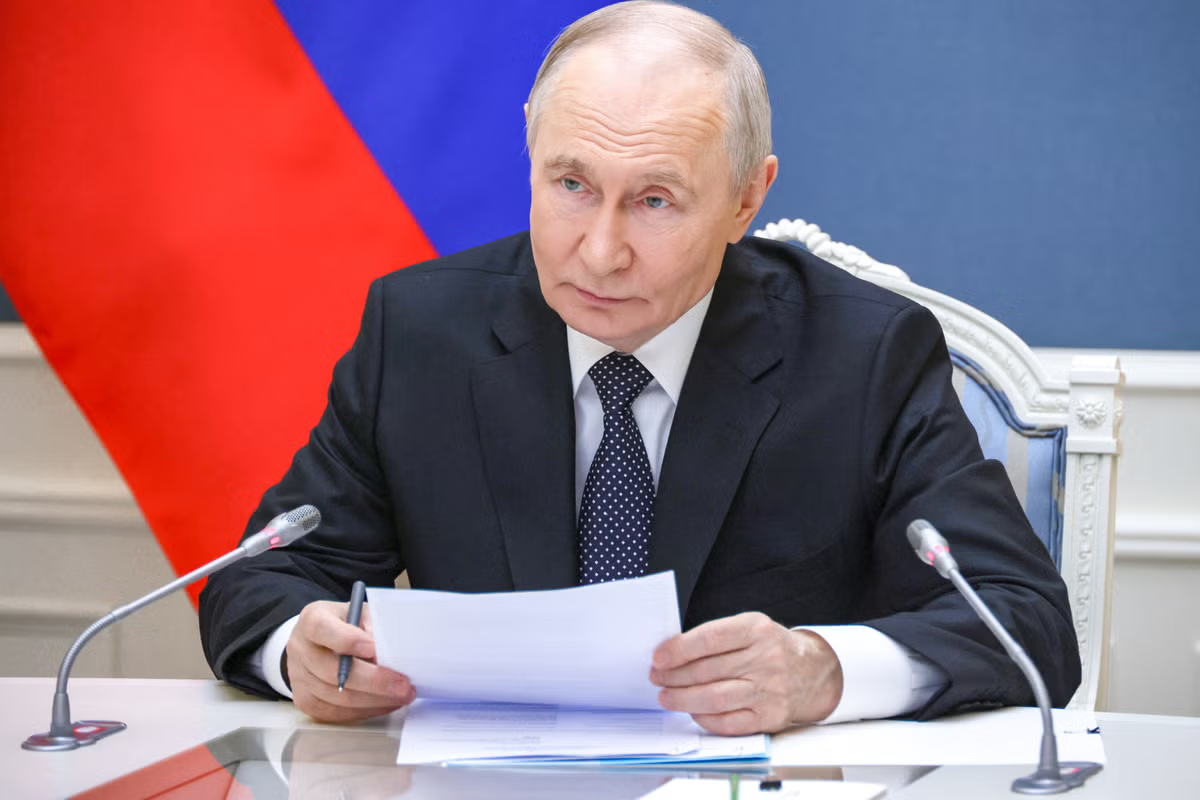
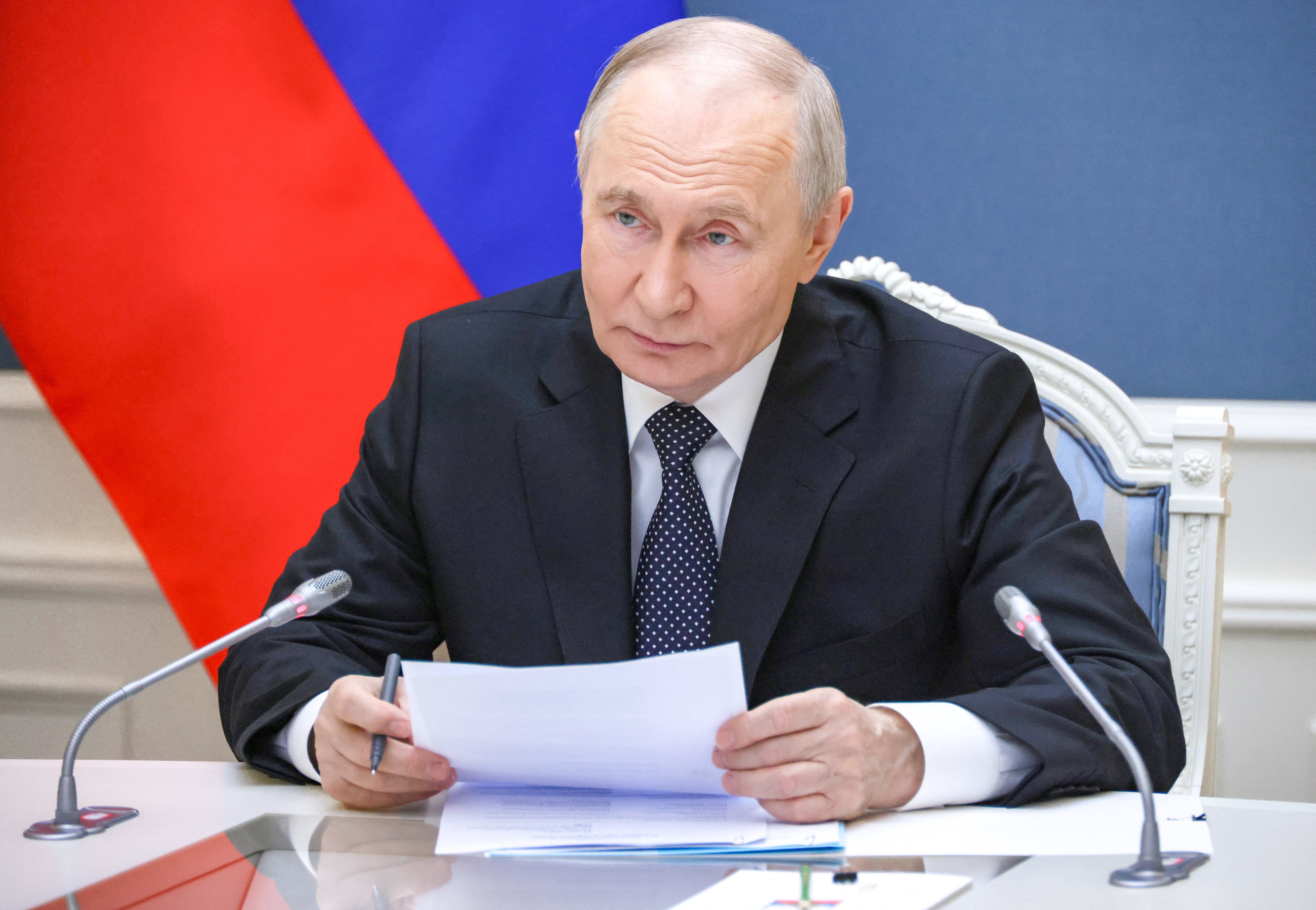
Vladimir Putin on Thursday said that the use of nuclear weapons was a “last resort” measure after Russia and Belarus held massive nuclear drills on land, sea and air.
The Russian president claimed that Moscow’s nuclear arsenal acted as a guarantor of “sovereignty” as his army wrapped up its biggest nuclear exercise in years, involving 64,000 troops as well as submarines and hypersonic missiles.
Europe has condemned the nuclear drills as provocative as tensions rise with Nato, with the alliance’s secretary general Mark Rutte warning that any attacks on Nato would incur a “devastating” response.
The three-day drills that began Tuesday come amid a surge in Ukrainian drone strikes, including on Moscow‘s suburbs that killed three people and damaged several buildings and industrial facilities.
Advertisement
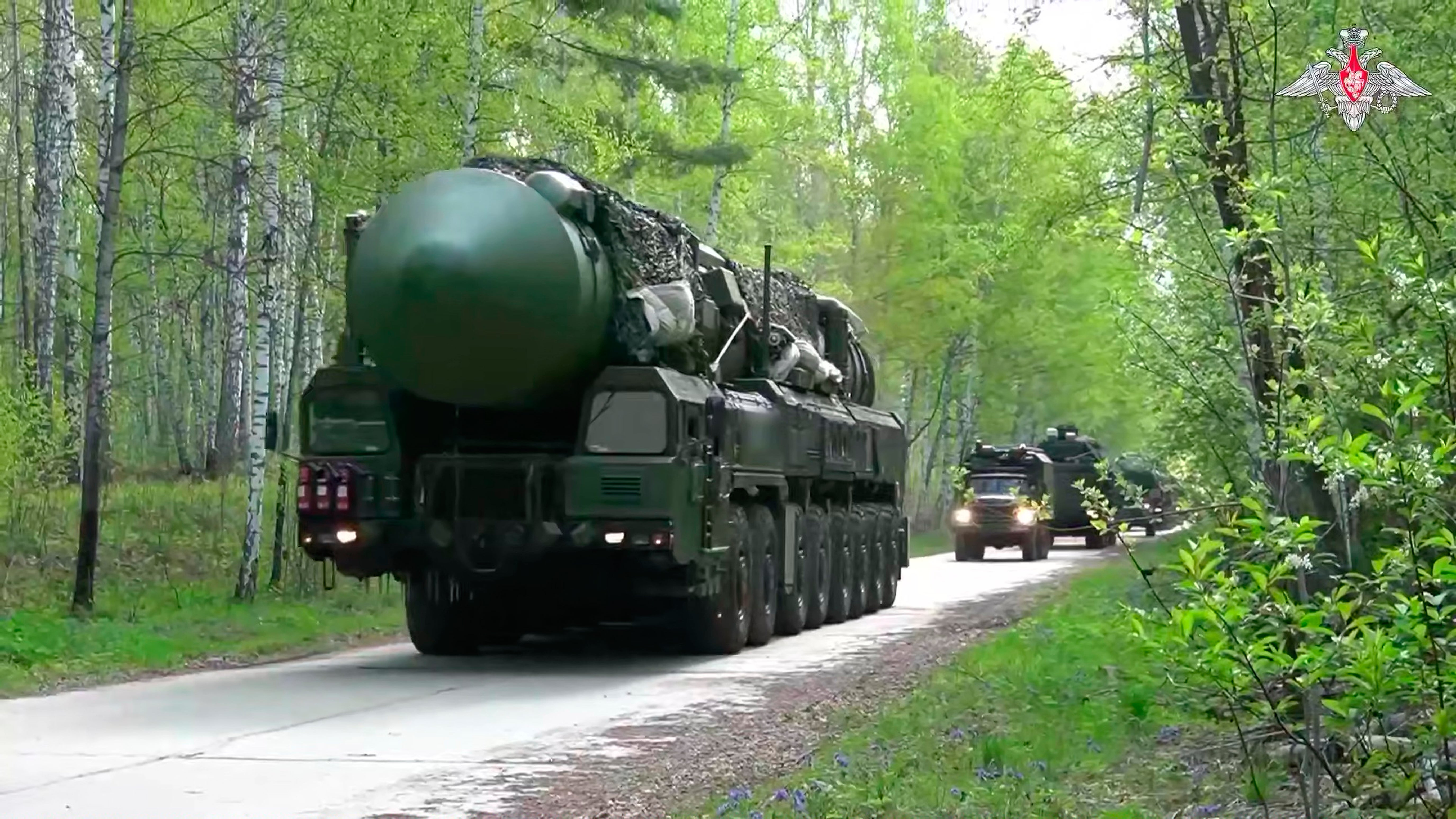
A Yars intercontinental ballistic missile during the drills (Russian Defense Ministry Press Service)
The strikes made it harder for officials in the Kremlin to cast the conflict in Ukraine — now in its fifth year — as something so distant that it doesn’t affect the daily routines of Russian civilians.
Russia’s Defence Ministry said the exercise involved 64,000 troops, over 200 missile launchers, more than 140 aircraft, 73 surface warships and 13 submarines, including eight armed with nuclear-tipped ICBMs. The drills will focus on the “preparation and use of nuclear forces under the threat of aggression,” it said.
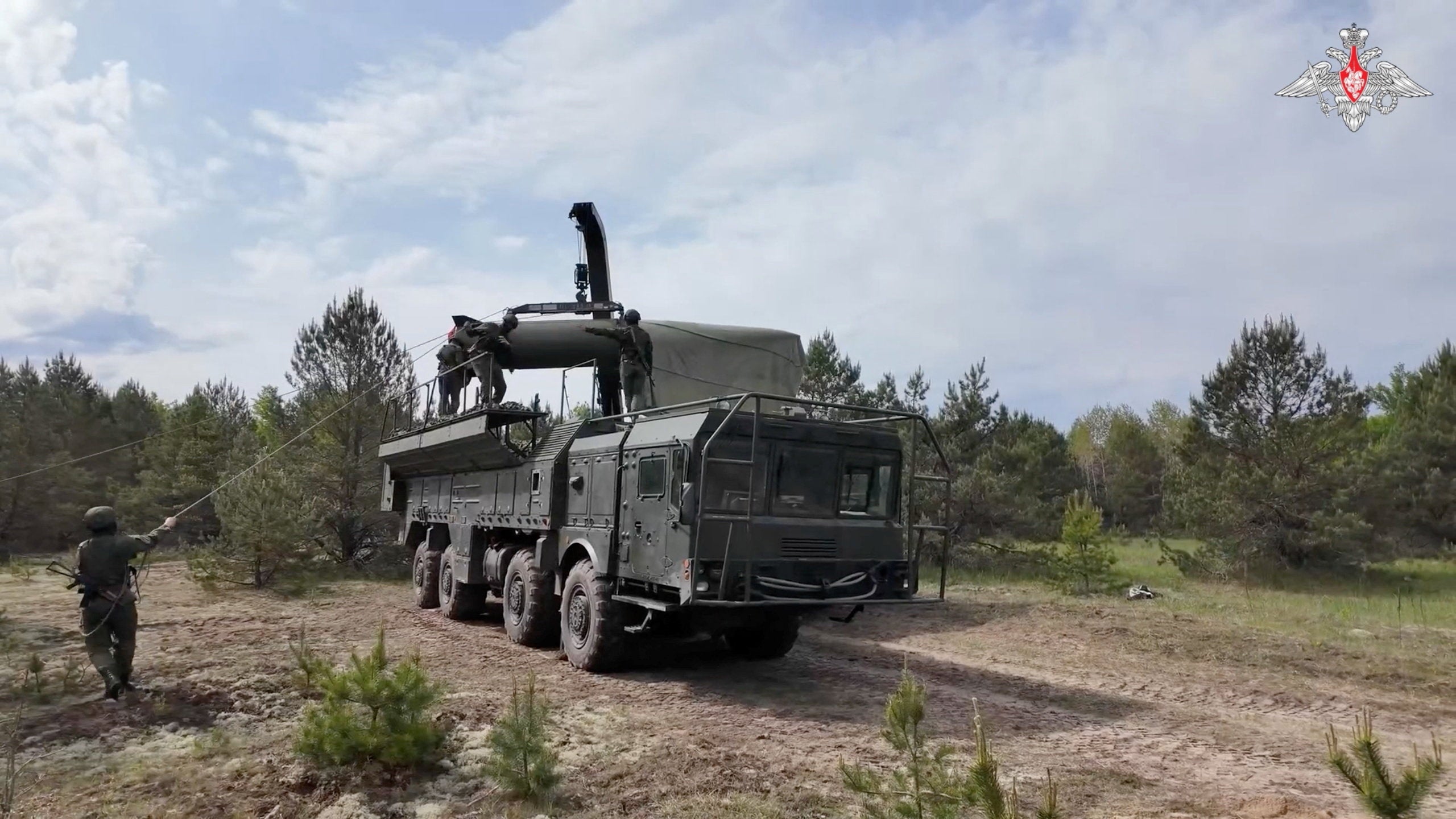
The drills also practice cooperation with Belarus, an ally that hosts Russian nuclear weapons. Russian arsenals in Belarus include its latest intermediate range nuclear-capable Oreshnik missile system.
Service members mount a missile on a Russian Iskander-M missile launcher during nuclear forces exercises at an unidentified location in Belarus (Russian Defence Ministry)
UK Senior Military Advisor, Colonel Joby Rimmer, said the drills reflected how Russia had “repeatedly employed irresponsible nuclear rhetoric and coercive signalling” during its war in Ukraine.
“The consequences are clear. As trust erodes, the risk of miscalculation increases; any reduced transparency over doctrine and force posture severely narrows the margin for error,” he said.
“When a participating State retreats from these frameworks while simultaneously intensifying nuclear signalling, the security environment deteriorates for all.”
Advertisement
Russian nuclear exercises typically use dummy warheads. One video released by the defence ministry showed a tarp-backed military truck travelling with minimal security, while others showed nuclear submarines, aircraft and warships.
Putin has repeatedly reminded the world about Moscow’s nuclear arsenals after sending troops into Ukraine in February 2022 to try to deter the West from ramping up support for Kyiv.
(AFP/Getty)
In 2024, Putin adopted a revised nuclear doctrine, noting that any nation’s conventional attack on Russia that is supported by a nuclear power will be considered a joint attack on his country.
That threat was clearly aimed at discouraging the West from allowing Ukraine to strike Russia with longer-range weapons and appears to significantly lower the threshold for the possible use of Moscow’s nuclear arsenal.
The revised doctrine that placed Belarus under the Russian nuclear umbrella. Putin has said that Moscow will retain control of its nuclear weapons deployed in Belarus but would allow its ally to select the targets in case of conflict.
Advertisement
Moscow has accused Baltic countries of allowing Ukraine to fly over their territory to attack northern Russia, an accusation that Nato has denied.
The Baltic states, all strong backers of Ukraine, counter that Russia is redirecting Ukrainian drones into their airspace from their intended targets in Russia.
Mediators in both the Iran and Ukraine wars have struggled to achieve meaningful ceasefires. Although the US and Iran reached an initial two-week truce on April 7, brokered by Pakistan, the agreement has been fragile from the beginning.
Meanwhile, the latest temporary ceasefire between Russia and Ukraine from May 9 to 11 seemed over before it had begun – a now familiar pattern in the four years since Russia’s full-scale invasion. Ukraine accused Russia of violating the US-mediated pause throughout the three-day period, which ended with drone attacks on Ukrainian civilian and energy infrastructure.
So why do temporary truces in Iran, Ukraine and elsewhere so often fail to last? Ceasefires are diverse in terms of what they aim to achieve, how long they are intended to last and how they try to constrain the use of force. For instance, not all ceasefires are supposed to last forever.
Advertisement
Agreeing to halt conflict for a period of time can keep channels of communication open and build trust and momentum for more substantive conversations. This was the aim of the April 7 ceasefire in Iran. That agreement enabled the US and Iranian delegations to come together for talks in Pakistan over a peace proposal covering Iran’s nuclear capabilities.
That those talks failed to reach a more substantive agreement was not unexpected. The two parties only held one 21-hour negotiation session, and the inexperience of the US negotiating team has been widely reported. There is also a severely low level of trust between the US and Iranian administrations. But the existence of a ceasefire, although limited, has enabled further exchanges of peace proposals between the two parties.
However, temporary ceasefires are likely to remain so unless parties can eventually agree to something that requires greater commitment. Research drawing on the University of Edinburgh’s PA-X Peace Agreements Database of written ceasefire agreements shows that ceasefires containing longer-term commitments aimed at reducing the capacity for violence are associated with violence being suspended for longer.
Advertisement
These commitments could include demobilisation – the disbanding or standing down of an armed group from combat-ready status. They may also include the establishment of demilitarised zones, or the acceptance of external guarantees, international monitoring and dispute resolution mechanisms. These mostly require the involvement of mandated third parties.
Full texts of the ceasefires in Ukraine and Iran have not been published. But public statements from people involved suggest that neither agreement included strong compliance or demobilisation mechanisms, and did not involve extensive consideration of longer-term security guarantees.
When announcing the initial April 7 ceasefire, for example, Trump said the US had agreed to a limited two-week suspension of force in exchange for the Iranian reopening of the Strait of Hormuz. But he made no reference to how compliance would be monitored or enforced by a third party, or what military actions would be mutually considered a violation.
Many analysts have noted Trump’s preference for reaching quick, transactional “deals” over sustainable agreements. Others have argued that his eagerness to announce conflicts as being solved is reducing ceasefires from being a tangible step on the exit route out of conflict to “performative diplomacy”.
Advertisement
The US president, Donald Trump, has repeatedly threatened to resume military action in Iran. Samuel Corum / EPA
It is also hard to see how the international system can enforce compliance with ceasefires in the Iran and Ukraine wars. The US and Russia’s membership of the UN Security Council means either country can veto attempts by the UN to constrain their conduct by, for example, deploying an international peacekeeping force.
Indeed, the refusal of key US allies in the Gulf such as Saudi Arabia to facilitate a recent American operation to escort oil tankers passing through the Strait of Hormuz, seems to be what has sustained the April ceasefire rather than agreed ceasefire terms or official compliance mechanisms. Iran had warned that it would respond to the operation with escalation and attacks.
Complex modern conflicts
The number and type of armed groups involved in many modern conflicts also makes sustaining ceasefires complicated. The temporary April ceasefire between Israel and Lebanon, for instance, did not formally include Hezbollah – one of the key protagonists in the conflict.
Hezbollah is a non-state armed group that prevents the Lebanese state from having a monopoly on force, and has repeatedly rejected calls from Israel and the US for it to disarm. Israel claimed that airstrikes following a May 15 agreement with Lebanon to extend the ceasefire did not violate its terms. The Israelis argued that Hezbollah was not a party to the ceasefire, allowing them to target the group’s facilities.
Advertisement
Adding another layer of complexity is the fact that the Israel-Lebanon conflict is intimately connected to events in Iran. The Iranian regime has explicitly made reaching a peace agreement with the US conditional on there being a “lasting ceasefire in Lebanon”.
The combination of these political factors – limited agreement terms, weak third-party enforcement and complex conflict networks – suggests that the current pattern of short-term ceasefires with fragile extensions is likely to continue until the costs of conflict become too much for parties to withstand. For affected civilians, such a tipping point cannot come too soon.
England dominated Group K in Uefa qualifying to book their place at next summer’s World Cup, winning all eight games without conceding a goal. But they disappointed in March’s international friendlies against Uruguay and Japan, and now the manager has to finalise his squad to take to USA, Canada and Mexico in June.
Late on Thursday, Harry Maguire revealed that he has not been named in Tuchel’s final 26. The Manchester United defender, back in the squad in March after a strong run of form, said he is “shocked and gutted” by the decision.
Tuchel made clear that he wants to build a squad with clearly defined roles, and two players for every position on the pitch, plus a third goalkeeper and three versatile outfield players to round out the 26. He sees his midfield comprising a No 6, a No 8 and No 10, and wants each player to know their specific role in the side.
So who will Tuchel select in his 26-man squad for the 2026 World Cup? While you can find everything you need to know about the announcement here.
Not selected
Harry Maguire: A stalwart of England’s last two World Cup campaigns, the Manchester United defender has been left out of Tuchel’s final squad. The 33-year-old is “shocked and gutted” by the decision, which comes as something of a surprise, given his strong club form and his call-up to the squad in March. Maguire also missed out on a spot at the last tournament, Euro 2024, in which England reached the final.
Advertisement
In a statement on social media, Maguire said: “I was confident I could of played a major part this summer for my country after the season I’ve had. I’ve been left shocked and gutted by the decision. I’ve loved nothing more than putting that shirt on and representing my country over the years. I wish the players all the best this summer.”
On the plane
Jordan Pickford: The Everton keeper was Gareth Southgate’s No 1 and has maintained top spot under Thomas Tuchel, with an impressive season for his club.
Dean Henderson: The Crystal Palace goalkeeper is set to be Pickford’s back-up.
Advertisement
England will take a 26-player squad to the 2026 World Cup (Getty Images/The Independent)
Nico O’Reilly: The Manchester City left-back was excellent in November’s World Cup qualifiers after impressing under Pep Guardiola this season, and his two-goal show in the Carabao Cup final only further secured his place in the England squad.
John Stones: The Manchester City defender has endured a difficult season with injury but, if he is fit, the experienced centre-back will play a role at the World Cup.
Marc Guehi: Stones’ fellow City centre-back is perhaps the most certain defender to start England’s first World Cup game.
Ezri Konsa: The Aston Villa centre-back has cemented his place as one of Tuchel’s most reliable options, having played more minutes under the German manager than any other defender.
Advertisement
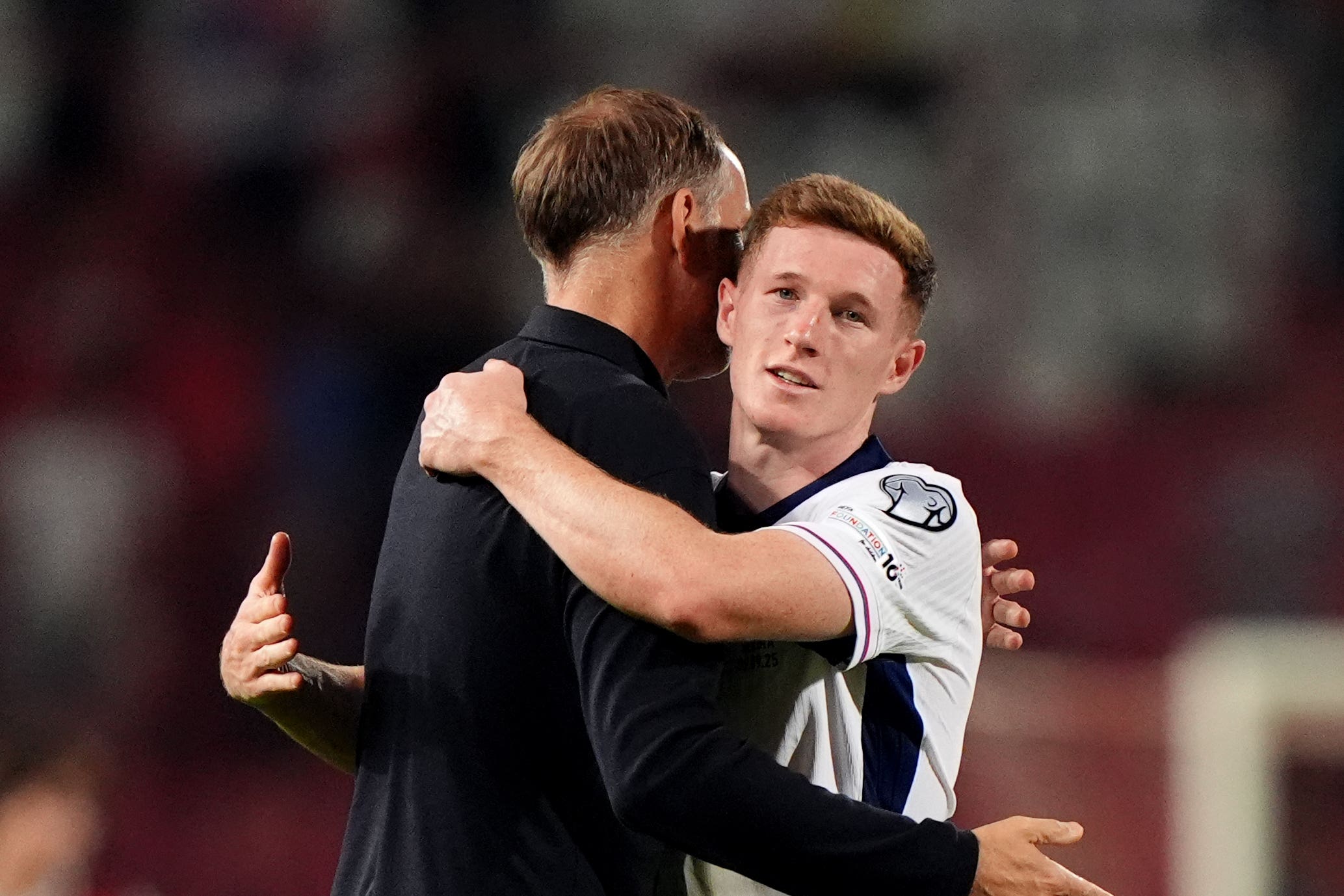
Elliot Anderson: Tuchel has made clear that Anderson is the leading candidate to play in the holding role position, and his performances for Nottingham Forest and England have been outstanding. Anderson’s defensive instincts will help free up Declan Rice in midfield.
Nottingham Forest’s Elliot Anderson is in Thomas Tuchel’s plans (PA)
Declan Rice: Part of Tuchel’s leadership group and essential to any success at the World Cup in England’s box-to-box No 8 position.
Jude Bellingham: The Real Madrid man has won back his place in the England squad, although there remains tension with the manager. Yet England need their best players firing to have any chance of winning the World Cup, and Bellingham is undoubtedly one of them.
Morgan Rogers: Tuchel turned to Rogers in Bellingham’s absence during qualifying, and the Villa midfielder looks poised to earn a place in the squad as an option at No 10.
Advertisement
Bukayo Saka: The 24-year-old winger has been under a little bit of pressure to refind his very best form for Arsenal, but he will certainly be in the squad and is the most likely starter on England’s right wing this summer.
Anthony Gordon: The Newcastle winger is contention to start on the left wing, and has regularly featured there for Tuchel so far. He has racked up more than 20 goal contributions this season, making him one of the few England forwards in form.
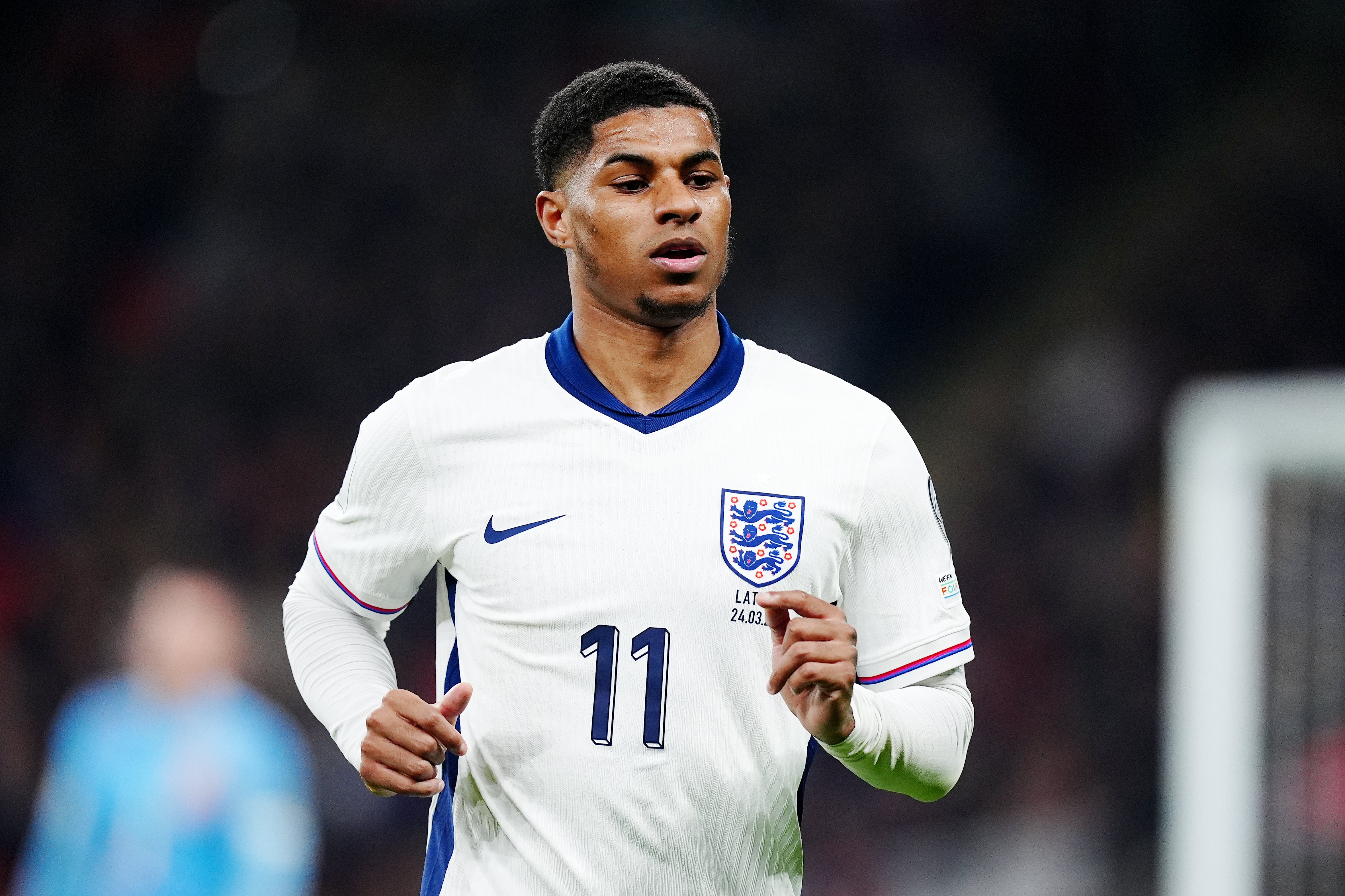
Marcus Rashford: Goals and assists for Barcelona have pushed Rashford’s cause and Tuchel likes him, although the manager has also had cautionary words about wasting his talent. Rashford’s versatility, able to cover both wing and striker should Kane need it, helps his selection cause.
Marcus Rashford has featured regularly in Thomas Tuchel’s England side (Mike Egerton/PA)
Harry Kane: It is easy to forget that plenty of pundits and fans wanted Kane dropped for the Euro 2024 final. He has been phenomenal ever since, surpassing 50 goals this campaign, and the big question now is whether England’s captain can translate his sensational club form at Bayern Munich into dominating an international tournament.
In contention
Advertisement
Aaron Ramsdale: Looked to have regained his place as England’s third-choice goalkeeper, but will Tuchel prefer to give James Trafford the experience of a major tournament?
James Trafford: Included in England’s March squad, but the goalkeeper’s lack of game time for Manchester City this season is the reason why he may miss out.
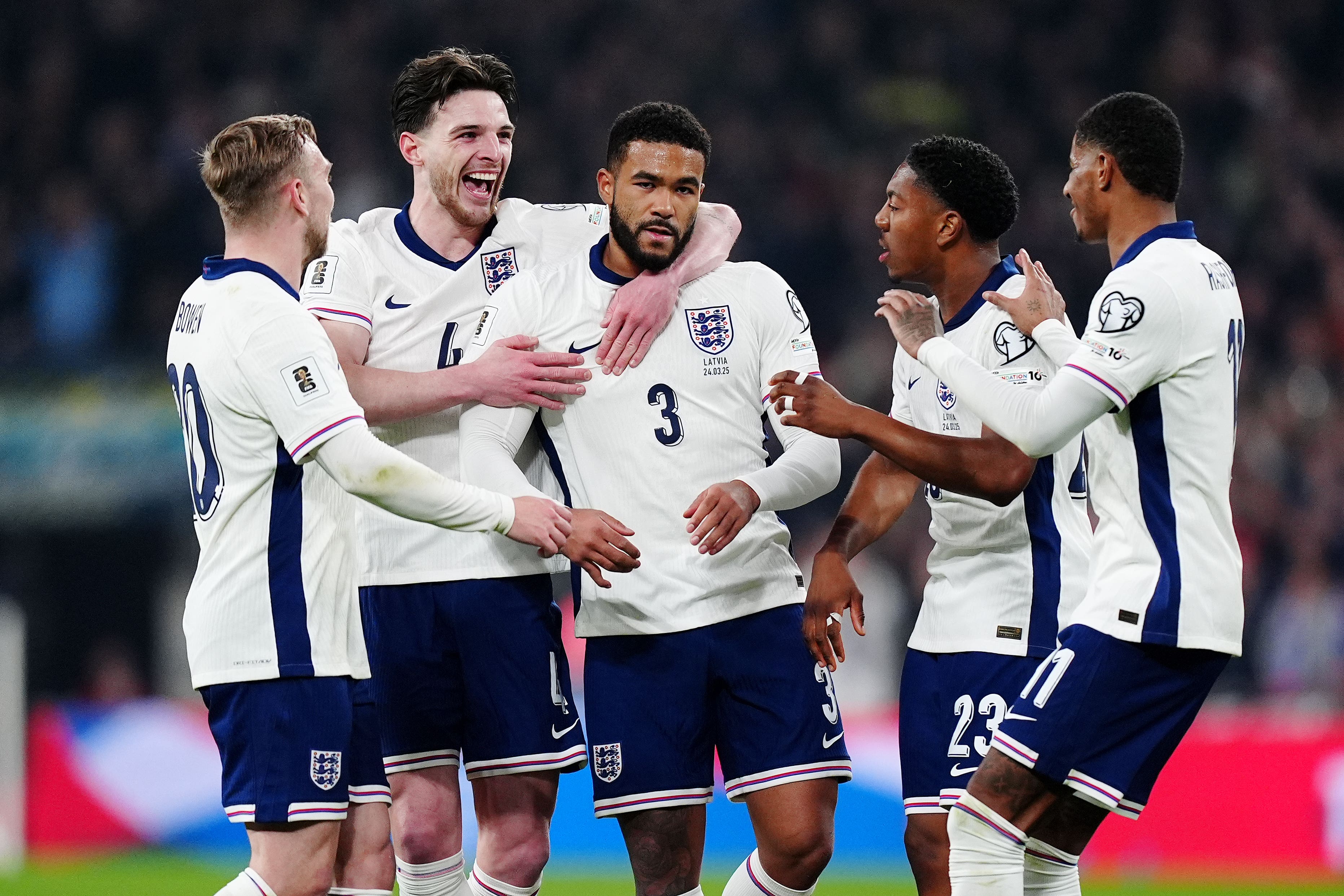
Reece James: Tuchel adores the Chelsea captain and there is no doubt James will be at the World Cup if he is fit, most likely as the starting right-back. But his fitness in itself is such an uncertainty – he has only recently recovered from a hamstring injury – that he doesn’t make our on-the-plane list, yet.
Tino Livramento: The Newcastle full-back is liked by Tuchel and his ability to play both sides adds to his appeal – but a thigh injury makes him a doubt to make the tournament.
Advertisement
Reece James, centre, celebrates his goal against Latvia (Mike Egerton/PA) (PA Wire)
Dan Burn: Burn is a popular squad player who adds something different with his towering physical presence. He is currently battling to be Tuchel’s fourth choice at centre-back behind Stones, Guehi and Konsa, but faces competition from Harry Maguire.
Djed Spence: Much like Livramento, Tuchel likes that Spence has experience playing both full-back roles for his club, Tottenham. But it may be that only one of the two full-backs goes to the World Cup, and Livramento has had the edge when both are fit.
Lewis Hall: The defender has been excellent for Newcastle this season and has a chance of making the World Cup squad after his involvement in recent internationals.
Myles Lewis-Skelly: Tuchel loves the Arsenal youngster, but he has barely featured at left-back for the Gunners this season, with Riccardo Calafiori and Piero Hincapie both preferred by Mikel Arteta – which cost him his place in November’s squad. Yet a recent, impressive run in central midfield could give Lewis-Skelly a route into England’s plans.
Advertisement
Myles Lewis-Skelly faces a fight for minutes at Arsenal this season (The FA via Getty)
JamesGarner: One of the few players to come away with any credit from England’s dismal March internationals, and could snatch one of the fringe places in the squad as back-up midfielder.
KobbieMainoo: Back in the squad after strong performances for a rejuvenated Manchester United under Michael Carrick, but looked a little sluggish defensively in the March friendly against Japan.
Jordan Henderson: Henderson has been a regular inclusion by Tuchel during qualifying and it is very possible he will be in the squad as the back-up to Anderson in the No 6 role.
Adam Wharton: The Crystal Palace midfielder was something of a surprise inclusion by Gareth Southgate at Euro 2024 but has since established himself as one of the best midfielders in the Premier League, with the ability to play as a deep-lying playmaker as well as in a box-to-box role. He played in November’s match against Albania as the No 6.
Eberechi Eze: Tuchel has spoken in glowing terms about Eze as a player who offers something different, creatively, from Bellingham and Rogers. His ability to play wide and as a No 10 would be a useful asset in the squad, although he still faces huge competition for a spot.
Advertisement
Morgan Gibbs-White: Gibbs-White was initially given minutes by Tuchel before being edged out by the sheer number of options in central roles. But his sensational late-season form for Forest has seen him climb back up the pecking order.
Cole Palmer: It seems incredible not to list Palmer on the plane, but the sheer intensity of competition for attacking spots makes his position uncertain, and his poor performance against Japan only increased the doubt over his place. Bellingham, Rogers and Eze can all play in that role, while Saka and Madueke appear likely to be first-choice options on the right flank. Palmer will probably be at the World Cup, but Tuchel has made no guarantees.
Cole Palmer struggled to impose himself on Japan at Wembley (John Walton/PA Wire)
Phil Foden: Foden, like Palmer, is another supremely talented England player who could be left behind. The City midfielder has barely featured under Tuchel so far and has lost his place in Pep Guardiola’s team. He struggled playing as a false nine against Japan in the March internationals, and his spot in the England squad is in serious doubt.
Noni Madueke: Madueke is Saka’s deputy at Arsenal and should fill the same role for England, having performed well in September’s thrashing of Serbia, the highlight of Tuchel’s reign so far.
Jarrod Bowen: The West Ham captain seems to be third choice on the right wing behind Saka and Madueke, but his league form has been good and he has a chance of squeezing onto the plane. Bowen’s ability to play as No 9 could also play in his favour, if Tuchel decides not to take a back-up striker.
Advertisement
DominicSolanke: The Tottenham striker has struggled for fitness this season, and is injured again, but was given gametime in the March friendlies. Could he be England’s back-up No 9?
Ollie Watkins: A sluggish start to the Premier League season saw Watkins left out of the squad for November’s internationals. But a late surge in form for Aston Villa has lifted him back into contention for a spot on the plane.
Outside bets
Trevoh Chalobah: A badly timed injury playing in the Champions League for Chelsea may have scuppered Chalobah’s hopes of making the World Cup, although he is back to fitness now.
Advertisement
Levi Colwill: The 23-year-old appears to have put his injury troubles behind him, and is known to be highly rated by the England hierarchy.
Ben White: Back in the fold for the first time since leaving the World Cup in Qatar, Tuchel was considering White as a right-back option. But a medial ligament injury sustained against West Ham earlier this month is likely to have ended his hopes.
FikayoTomori: The AC Milan defender was back in the squad for March, but faces stiff competition for a centre-back place.
Luke Shaw: Didn’t make the March squad, with Hall and O’Reilly preferred as left-back options.
Advertisement
Trent Alexander-Arnold: Tuchel has been frank about his preference for James and Livramento in the pecking order at right-back, hinting at concerns about Alexander-Arnold’s defensive concentration. Time seems to have run out for the Real Madrid defender to win back his place.
Trent Alexander-Arnold must impress at Real Madrid to be at the World Cup (PA)
Dominic Calvert-Lewin: An impressive goalscoring campaign for Leeds has seen Calvert-Lewin push himself into the reckoning. But he was sent home from the March camp while Solanke was retained, hinting at his true place in the pecking order.
Newsboy fancies his Nap, Tilani, to win at Bath and also hopes Orionis can score at Goodwood and complete his Daily Double
TILANI looks ripe for a quickfire hat-trick in the Download The Fairplay App Now Handicap (6.15) at Bath on Friday.A one-time winner when trained in Ireland – Tilani was 0-4 for Mick Halford before landing one of his seven attempts for Dermot Weld – Tilani moved to Ian Williams for the 2026.My selection was beaten at Wolverhampton and Musselburgh on his first two outings for Williams but came good at Newbury last Thursday, landing an apprentice handicap over a mile.Williams turned Tilani out at Great Yarmouth on Wednesday and, partnered by this afternoon’s jockey Jack Dace, the four-year-old son of Belardo followed up with a length-and-three-quarter call from Kamaway.Tilani shoulders a 5lb penalty for the latter success but is thriving in Williams’ care and, with Dace’s 5lb claim coming in very handy, he’s expected to carry on the good work.
Advertisement
At Goodwood, ORIONIS is the choice to make the perfect return for William Haggas by beating nine opponents for the British Stallion Studs EBF Fillies’ Handicap (3.42).Sea The Stars’ daughter progressed throughout 2025, tasting success at Ripon, Windsor and Newbury.A British Horseracing Authority mark of 90 demands a personal best on her first outing for 230 days but Cieren Fallon’s partner can prove up to the job.FRIDAY’S SELECTIONSGOODWOOD1.57 LOVE IS2.32 LAZURITE3.07 ST MAWES3.42 ORIONIS (NB)4.17 ENFJAAR4.52 CRIMSON SPIRIT5.27 NOGO’S DREAMHAYDOCK1.45 NOCHEBUENA2.20 MINZELLE2.55 ROSY AFFAIR3.30 TIME FOR THE MOON4.05 GOLSPIE4.40 KOKOLUNA5.15 YORKSHIRE QUEENBATH2.08 BASILETTE2.43 MADRISA3.18 FLIGHT SIGNAL3.53 SILVER WRAITH4.28 CONTROL ROOM5.03 SECRET HANDSHEIKH5.40 NEWYORKSTATEOFMIND6.15 TILANI (NAP)PONTEFRACT6.20 STONACRE JOE6.52 TOO MANY SPIRITS7.22 BETWEEN THE STICKS7.52 TROJAN SOLDIER8.22 BLONDINA8.52 POWERFUL RESPONSEWORCESTER4.57 BONGO MAN5.32 JET SMART6.06 CLOSING TIME6.41 PREMIER TENOR7.11 CREST OF ARMS7.41 NOBLE BLUE8.11 ICE JET8.41 SACCARYDOUBLE: TILANI and ORIONIS
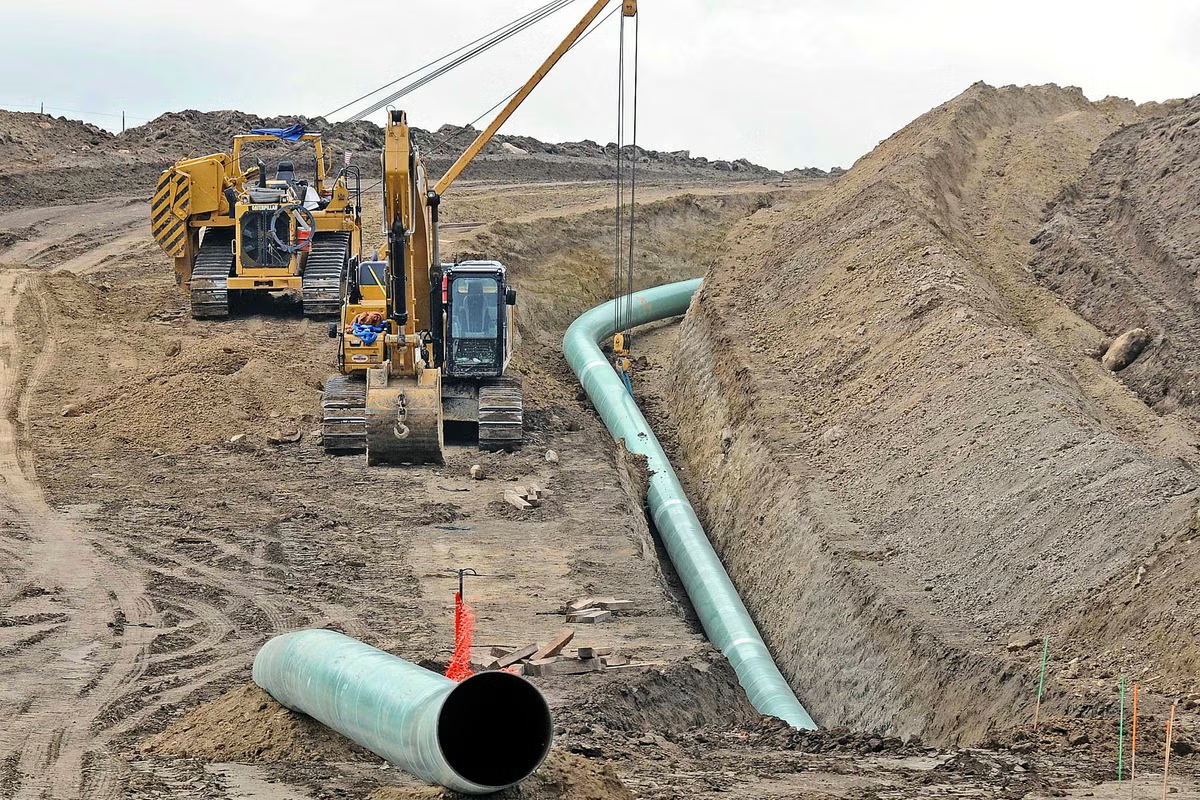
Federal officials on Thursday gave final approval for the Dakota Access oil pipeline to continue operating its contentious Missouri River crossing, an outcome that comes nearly a decade after boisterous protests against the project on the North Dakota prairie.
The U.S. Army Corps of Engineers’ decision to grant the key easement means the pipeline will keep operating but with added conditions for detecting leaks and monitoring groundwater, among others. The announcement brings an end to a drawn-out legal and regulatory saga stemming from the protests in 2016 and 2017, though further litigation over the pipeline is likely.
The $3.8 billion, multistate pipeline has been transporting oil since June 2017 from North Dakota’s Bakken oil field to a terminal in Illinois. The line carries about 4% of U.S. daily oil production, or roughly 540,000 barrels per day,
The Corps is “decisively putting years of delays to rest and moving out to safely execute this crossing beneath Lake Oahe,” Assistant Secretary of the Army for Civil Works Adam Telle said in a statement.
Advertisement
The pipeline crosses the river upstream from the Standing Rock Sioux Tribe’s reservation, which straddles the Dakotas. The tribe has long opposed the pipeline, fearing a spill and contamination of its water supply. In 2016 and 2017, thousands of people camped and protested for months near the river crossing.
The protests resulted in hundreds of arrests and related criminal cases and lawsuits, some of them still ongoing, including litigation that threatens the future of the environmental group Greenpeace.
In December, the Corps released its final environmental impact statement nearly six years after a federal judge ordered a more rigorous review of the pipeline’s crossing. In that document, the Corps endorsed the option to grant the easement for the crossing and keep the pipeline operating with modifications.
Those measures include enhanced leak detection and monitoring systems, expanded groundwater and surface water monitoring and third-party expert evaluation of the leak and detection systems, among others, the Corps said. The conditions also include studies of the sinking of the earth coordinated with affected tribes.
Advertisement
The Corps had weighed several options, including removing or abandoning the pipeline’s river crossing or even rerouting it north. The agency said its decision “best balances public safety, protection of environmental resources, and leak detection and response considerations while meeting the project’s purpose and need.”
Pipeline developer Energy Transfer hailed the decision, saying the pipeline has been safely operating for nearly 10 years and is critical to the country’s energy infrastructure.
“We want to thank the Corps for the tremendous amount of time and effort put in by so many to bring this matter to a thoughtful close,” said Vicki Granado, a company spokesperson.
The Associated Press sent text messages and emails to media representatives for the tribe and left a voicemail at the tribe’s headquarters. They didn’t immediately respond Thursday.
Advertisement
North Dakota Republican Gov. Kelly Armstrong, Interior Secretary and former North Dakota governor Doug Burgum and U.S. Senators John Hoeven and Kevin Cramer each welcomed the decision to ensure the pipeline continues operating.
The Corps’ announcement came as officials and oil industry leaders were gathered for a trade conference in Bismarck.
Energy Transfer and Enbridge are in early stages of a project to move about 250,000 daily barrels of light Canadian crude oil through the Dakota Access Pipeline by using another pipeline and building a 56-mile connecting line, spokespersons for the companies said. Enbridge will decide sometime in mid-2026 whether to move ahead.
Get previews of every single team at the World Cup sent directly to your inbox, featuring the players to look out for, games you shouldn’t miss and Metro’s big England predictions.
Diana Henry is the Telegraph’s much-loved cookery writer. She shares recipes each week, for everything from speedy family dinners to special menus that friends will remember for months. She is also a regular broadcaster on BBC Radio 4, and her journalism and recipe books, including Simple and How to Eat a Peach, are multi-award-winning. A mother of two sons, Diana can satisfy even the fussiest of eaters.
The new LEGO Batman game is an open-world adventure with lots of secrets for fans to discover.
LEGO Batman: Legacy of the Dark Knight is out now in early access, but you can only play if you’ve spent £79.99 on the Deluxe Edition.
Fortunately, the standard edition release date is almost here, which means everybody can enjoy the block-based Batman adventure that’s being favourably compared to the iconic Arkham trilogy.
Advertisement
LEGO Batman: Legacy of the Dark Knight has a May 22 release date for PS5, Xbox Series X|S and PC. The game will be available at midnight local time in all regions, apart from the west coast of the US.
Indeed, LEGO Batman has a midnight ET release time on May 22 on the east coast, but a 9pm PT (May 21) release time in the west.
The PC version is a little different and has a separate release time that’s bad news for UK fans looking to get stuck into the action.
According to the product page on Steam, LEGO Batman Legacy of the Dark Knight has a 6pm BST release time for PC gamers living in the UK.
Advertisement
That’s 10am PT / 1pm ET for US players, and 7pm CET for Batman fans playing in Europe.
Families will be able to enjoy activities for less throughout the summer thanks to this new government scheme
The UK Government has promised to slash VAT on certain family activities to help people enjoy more days out during the summer. The scheme will run from June 25 to September 1, 2026 and is aiming to support both businesses and families through the cost of living crisis.
Advertisement
The Great British Summer Savings scheme will reduce the costs of “children’s meals in restaurants, children’s tickets for theatres and cinemas and tickets for everyone for attractions like soft play, adventure centres, and theme parks”. Children between the ages of five and 15 in England will also be able to travel for free on local bus services in August.
The scheme is said to cost around £300 million and hopes to reduce borrowing and debt. The VAT rate on eligible activities will be cut from 20 per cent to 5 per cent across England, Wales, Scotland, and Northern Ireland.
The reduced VAT will apply to:
Children’s menu meals served in restaurants for consumption on the premises
Children’s and family tickets for cinemas, theatres, concerts, shows and exhibitions
Admission tickets, for both children and adults, to a range of attractions, including: amusement parks, fairs, museums, zoos, soft play centres, circuses, adventure parks, nature reserves, wildlife parks and observation attractions
HMRC has published guidance for businesses on how they can operate the scheme. Rachel Reeves, Chancellor of the Exchequer, said: “Whether it is a fun day out, a family meal or taking advantage of the thousands of amazing attractions across the UK, Great British Summer Savings will support families with the little treats in life while boosting business across the UK.
“This comes on top of support we’ve already put in place including freezing fuel duty, taking off £117 off energy bills, freezing prescriptions, fuel duty and rail fares.
Advertisement
“We are able do this because we have made the right choices, resulting in the UK having the fastest growing economy in the G7, with inflation going down.
“I know the cost of living is still a number one concern for households. Our economic plan is the right one, supporting families and businesses and building a stronger and more secure Britain.”
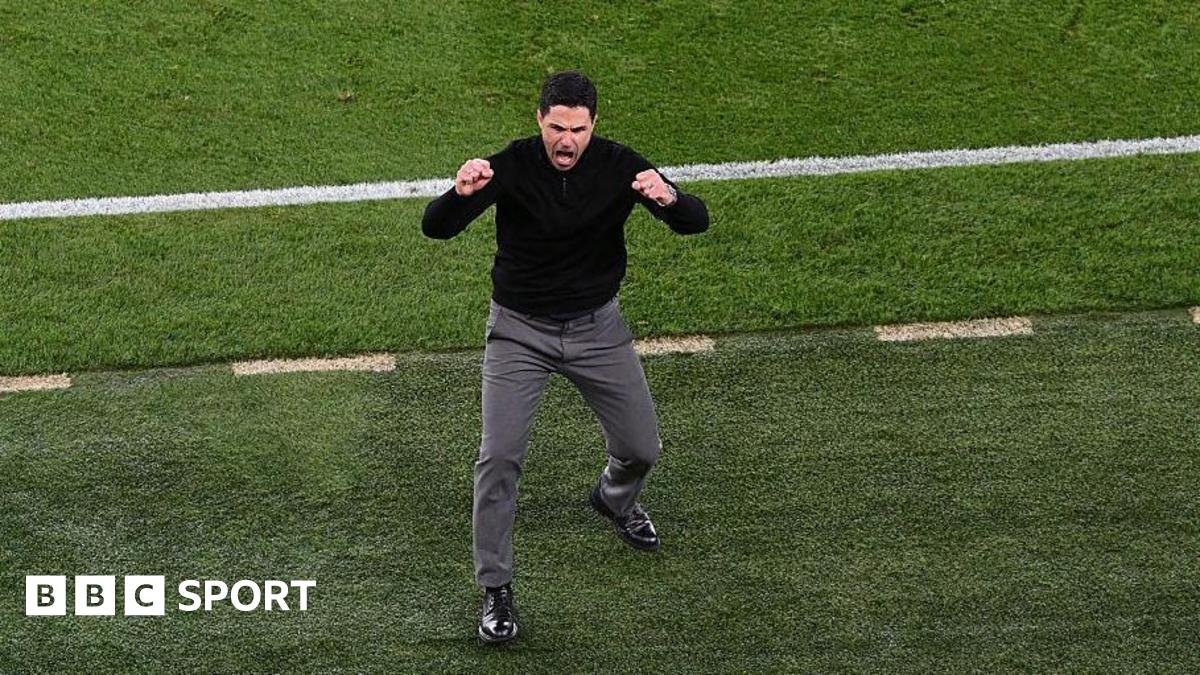
Arsenal boss Mikel Arteta says he learnt of his side’s Premier League title win from his tearful son while he had a barbecue in the garden.
The Spaniard says he did not watch Bournemouth holding title rivals Manchester City to a 1-1 draw – a result which meant the title would be heading to north London for the first time in 22 years.
The Arsenal players gathered at the training ground to watch the match that would see them crowned champions on Tuesday night, but Arteta says that he had to leave because he “couldn’t bring the energy that I wanted”.
“You probably don’t realise it. It’s one of the best feelings I’ve ever had,” Arteta said about winning the league title.
Advertisement
“I was supposed to be watching the game with the boys and the staff because that’s what they wanted – but I couldn’t.”
Arteta left for home 20 minutes before the game kicked off but did not actually watch the match.
“I went to the garden, started to build a fire and had a barbecue and I didn’t watch any of it,” he said.
“I was just hearing some noises in the living room and suddenly the magic happened.
Advertisement
“My oldest son opened the garden door, started to run towards me, started to cry, gave me a hug, and said: ‘We are champions, Daddy’.
“Then my other two boys and my wife came over and it was beautiful. Just to see that joy on them as well, that they are always with me, it was magical. A minute later, Martin [Odegaard] called me on video.”
He also revealed that after the game he rang Bournemouth manager and childhood friend Andoni Iraola to thank him.
Arteta and Iraola grew up in the same region of the Basque Country and played for youth team Antiguoko in San Sebastian.
Advertisement
“I didn’t message him, I rang him. I called firstly to congratulate him on the incredible job he has done with Bournemouth,” Arteta said.
“I told him he almost took the Premier League away from us [the 2-1 loss that Arsenal suffered to Bournemouth in April] and then helped us to win it.”
Iraloa has announced that he will depart Bournemouth at the end of the season once his contract expires and Arteta said the call was full of compliments and good wishes.
“I rang him to show my admiration towards him and wish him the best in the next chapter of his career, which I’m sure is going to be very successful,” he added.
Advertisement
Arsenal have the chance to add a second trophy this season when they take on Paris St-Germain in the Champions League final on Sunday, 30 May in Budapest.
The Gunners’ title-winning parade is set for the day after the final and Arteta, who is looking forward to celebrating with the thousands of fans who have already been to the stadium to enjoy the occasion, wants to make sure they see more success.
“We want to have the parade with two trophies,” he said.
“We had 48 hours to enjoy the success of winning the league; now we are going to prepare really well because we need to lift our habits and standards to be in the best possible way to compete [against Crystal Palace in the final Premier League game of the season] on Sunday.
Advertisement
“We will have a little window to lift the trophy and connect with the people around us – and then we have six days to write a new history in this football club.”
When Javier Milei took over as president of Argentina in December 2023, monthly inflation was 25.5%. The annual rate for that year was 211%. Now it has plummeted.
Milei, a rightwing populist famous for wielding a chainsaw on stage to make a point about fiscal conservatism, made cutting inflation a central part of his campaign.
Although the decrease has stalled somewhat in recent months, Milei continues to boast of his ability to keep price increases down – and insists his goal is still 0% inflation. He’s won conservative admirers around the world who see his policies as a blueprint for cutting inflation.
And yet economists like Can Cinar warn that Milei’s battle against inflation is more of a mirage than a miracle.
“On paper, it looks quite good,” Cinar says on the latest episode of The Conversation Weekly podcast, “but the bigger picture is that the economy is being undermined. It’s being hollowed out.”
Advertisement
Cinar, who recently wrote a book about populism and economics in Argentina, explains how Milei’s government managed to cut inflation by deliberately suppressing people’s wages, and the stark impact these policies are having on Argentinians.
This episode of The Conversation Weekly was written and produced by Mend Mariwany and the executive producer was Gemma Ware. Mixing by Eleanor Brezzi and theme music by Neeta Sarl.
Listen to The Conversation Weekly via any of the apps listed above, download it directly via our RSS feed or find out how else to listen here. A transcript of this episode is available via the Apple Podcasts or Spotify apps.



















































You must be logged in to post a comment Login