

Crypto World
U.S. CFTC secures deal with National Hockey League on prediction market safeguards



In the midst of its playoffs surge, the top professional hockey league has agreed to coordinate oversight of betting on popular prediction markets with the U.S. Commodity Futures Trading Commission, securing a new memorandum of understanding similar to the one recently struck with Major League Baseball.
The National Hockey League, which had officially linked itself last year with both Kalshi and Polymarket as the league’s official prediction market partners, has agreed to share information with the regulator on event contracts tied to its games, according to a Thursday statement from the agency. The CFTC has been pursuing similar arrangements with all of the professional sports leagues, Chairman Mike Selig said at an event last week.
“This agreement is another step toward safeguarding the integrity of sports and protecting market participants in prediction markets from insider trading, fraud, and other abuses,” he said of the NHL arrangement in a statement.
Selig has made it a point to foster the industry and to defend his agency’s role as its sole regulator.
Prediction market betting has seen explosive growth in recent years, and along with its popularity has come concerns that the wagering is being abused and is encouraging cheating. In a Senate Commerce Committee hearing this week, lawmakers criticized the dark side of the industry. Bad actors — including among the athletes themselves — threaten to “sow doubt in the minds of fans,” said committee Chairman Ted Cruz.
“Integrity has always been and remains paramount to the NHL and fundamental to the trust our fans and partners place in our game,” said NHL Commissioner Gary Bettman, in a statement released by the CFTC. “Our agreement with the CFTC enhances the comprehensive integrity monitoring systems already in place and strengthens our ability to identify, deter, and address potential risks.”
According to the new MOU, the league and regulator will “endeavor to share information, upon request, regarding the integrity of professional hockey and the event contract markets related thereto or other matters deemed appropriate.”
Read More: Prediction markets firms take heat in Senate Commerce hearing scrutinizing surge



Federal Reserve Chairman Kevin Warsh’s tough talk on inflation Wednesday reverberated through financial markets, with traders expecting that the central bank could start jacking up interest rates in just a few months.
Tapped to serve by President Donald Trump, who has repeatedly demanded lower rates, Warsh during a news conference instead focused on the battle against inflation, which has run above the Fed’s official 2% target for five years.
“Persistently high prices are a burden for the American people, but the recent past need not be prologue,” he said. “I am pleased to report that members of the [Federal Open Market Committee] are unambiguous and unanimous. This committee will deliver price stability.”
Markets immediately took notice as the new central bank leader sought to establish his inflation-fighting credentials.
The 2-year Treasury yield, seen as a market reflection of Fed moves, soared as Warsh spoke.
At the same time, futures market traders began placing bets on when the next rate hike would come. The probability for an increase at the July 28-29 meeting quickly climbed to about 1-in-3. Odds for a September hike spiked to 67% around midday Thursday, according to the CME Group’s FedWatch.

2-year yield
Dispelling the Warsh narrative
Moreover, traders priced in largely tighter Fed policy well into the future too.
The odds of a second hike by September 2027 rose above 45%. Even further out, the market-implied fed funds rate for May 2031 stood at 4.78%, indicating as many as five hikes in as many years from the current target range of 3.50%-3.75%.
A popular narrative that Warsh was sent to the Fed to ease monetary policy at all costs was quickly dispelled within the space of a 40-minute parley with reporters. At times serious and other times light-hearted, the session was notable for the inflation focus, with Warsh referring to “price stability” a dozen times.
Market veteran Ed Yardeni said he was “blown away” by Warsh’s remarks.
“We thought he was a dove who favored lowering the federal funds rate (FFR) because he believes that AI is boosting productivity and economic growth while keeping a lid on inflation,” the head of Yardeni Research said in an overnight note. “Instead, he hammered home a strict, orthodox message on inflation with a strong commitment to price stability.”
The pivot to inflation fighter shook investors, with stock market averages diving along with the spike in Treasury yields.
But apprehension about a possibly hawkish Warsh Fed dissipated Thursday as Wall Street digested the FOMC meeting outcome and focused more on positive developments in the Iran war and the prospect for lower energy costs ahead. Stocks rallied and yields were flat to lower.
Some positives on inflation
There seems reason for optimism that the chairman’s position in retrospect could be seen as a good deal of saber-rattling amid what might already be positive prospects for inflation. Even with popular inflation gauges at multi-year highs and well above the Fed’s 2% target, underlying pressures are easing, with core inflation up just 0.2% in the month in May.
Scott Clemons, chief investment strategist at Brown Brothers Harriman, thinks the Fed actually won’t make any moves this year on rates as it watches the shifting inflation dynamics and other factors play out.
“Far be it for me to disagree with the futures market, but I would be surprised if the Fed raises interest rates this year,” Clemons said. “It is an election year. This is already a hyper-politicized environment. There’s already concerns about politicization at the Fed. I’m not sure they want to feed that.”
In the past, Warsh has said it’s generally prudent to look through temporary supply disruptions that hit prices.
Commodity costs, in fact, are up just 6% since the war began in late February and have come off their May peak by some 17%, as measured by the S&P GSCI index. Should inflation ease and commodity prices continue to retreat — the price of gasoline dipped below $4 a gallon Thursday, according to AAA — and the economy wobble, that could get the central bank back into an easing posture.
“For now, for the markets, Warsh’s message was comforting and unsettling,” Steve Blitz, chief U.S. economist at TS Lombard, said in a note. “In declaring that inflation will be dealt with in no uncertain terms was comforting. By saying that markets will decide where to set rates rather than having them set with an eye to where the Fed wants them set was unsettling (to today’s traders, but this should, ultimately, prove comforting).”
These standards, according to the rule proposal, “must include reasonable procedures for: (1) verifying the identity of any person seeking to open an account to the extent reasonable and practicable; (2) maintaining records of the information used to verify a person’s identity, including name, address, and other identifying information; and (3) determining whether the person appears on any lists of known or suspected terrorists or terrorist organizations provided to the financial institution by any government agency.”
The Fed opened a 60-day public comment period alongside the other agencies in the joint effort, including the Office of the Comptroller of the Currency, Federal Deposit Insurance Corp., National Credit Union Administration and the Treasury Department’s financial-crimes arm.
In September, the regulators had issued a more preliminary document seeking comments to direct their GENIUS implementation in this and other areas, and the Treasury received 450 comments. This new stage is known as a “notice of proposed rulemaking,” which comes with another comment period and review before the agencies can eventually issue final joint rules and begin enforcing the regulations.
The Treasury’s Financial Crimes Enforcement Network (FinCEN) has pursued its own related rule to apply the GENIUS Act anti-money laundering provisions on issuers.
Ethereum has been under pressure across higher and lower timeframes over the past few weeks. While the price has staged a relief bounce from recent lows near $1.5K, the broader structure continues to favor sellers as ETH trades beneath major moving averages and inside a long-term descending channel. At the same time, exchange reserve data continues to trend lower aggressively, suggesting persistent supply withdrawal from centralized exchanges despite the weak price action.
Ethereum Price Analysis: The Daily Chart
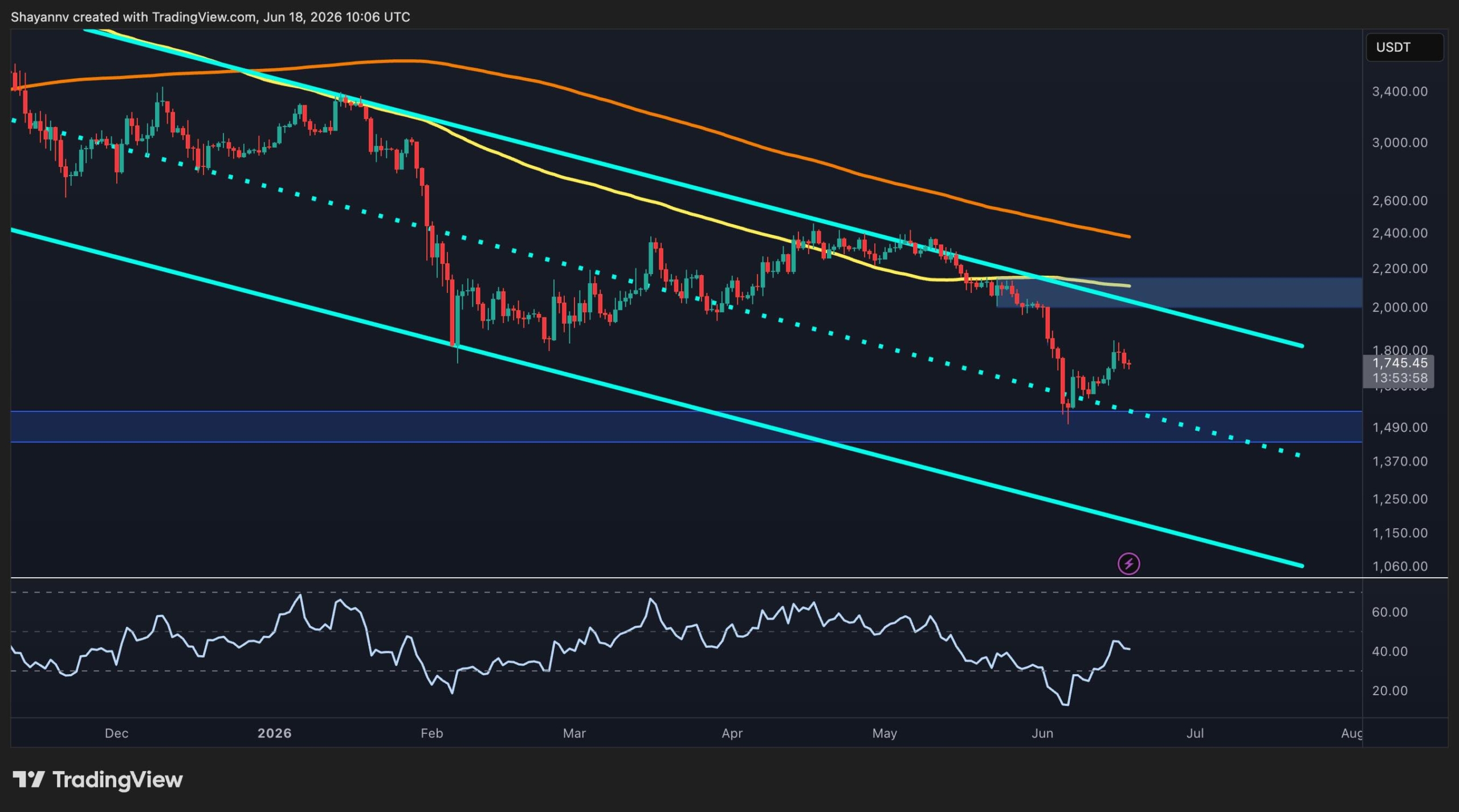
On the daily timeframe, ETH remains trapped inside the long-term descending channel that has governed the price action for several months. The recent rebound from the $1.5K support zone allowed buyers to recover part of the latest selloff. However, the bounce has so far failed to alter the broader bearish market structure.
The most important resistance sits between $2K and $2.2K, which is highlighted by the confluence of the 100-day moving average and a major supply zone. A daily close above this region would be the first meaningful signal that downside momentum is shifting and could open the door toward the $2.4K highs, where the 200-day moving average also currently resides. Until that happens, ETH will likely continue to print lower highs and lower lows. The inability to reclaim the $2K-$2.2K resistance zone keeps the broader trend bearish.
On the downside, the $1.5K support region remains the key level to watch. This zone recently attracted strong demand and produced the latest recovery. A breakdown below it would expose the lower boundary of the descending channel and potentially trigger another leg lower toward the $1K region. The RSI has also recovered from oversold conditions but remains below bullish territory, suggesting that the recent rebound appears corrective rather than the beginning of a sustained trend reversal.
ETH/USDT 4-Hour Chart
The 4-hour chart shows a more constructive short-term structure. Following the sharp selloff into the $1.5K demand zone, ETH has formed a series of higher lows, supported by a rising trendline that has guided the recovery over the past two weeks.
The rebound culminated in a strong impulsive move toward the $1.85K decision area, where sellers quickly re-entered the market. Since reaching that level, price has struggled to push higher again and has begun consolidating beneath resistance.
Currently, ETH is trading near $1.75K while holding just above the short-term ascending trendline. This creates a near-term inflection point. As long as the trendline remains intact, buyers may attempt another push toward the $1.85K resistance zone.
A successful breakout above that area would significantly improve short-term sentiment and could accelerate a move toward the higher-timeframe supply zone around $2K.
Conversely, losing the ascending trendline would likely invalidate the recent recovery structure and shift focus back toward the $1.5K support area. A breakdown below that zone would restore full bearish control and increase the probability of continuation toward much lower price levels.

On-Chain Analysis
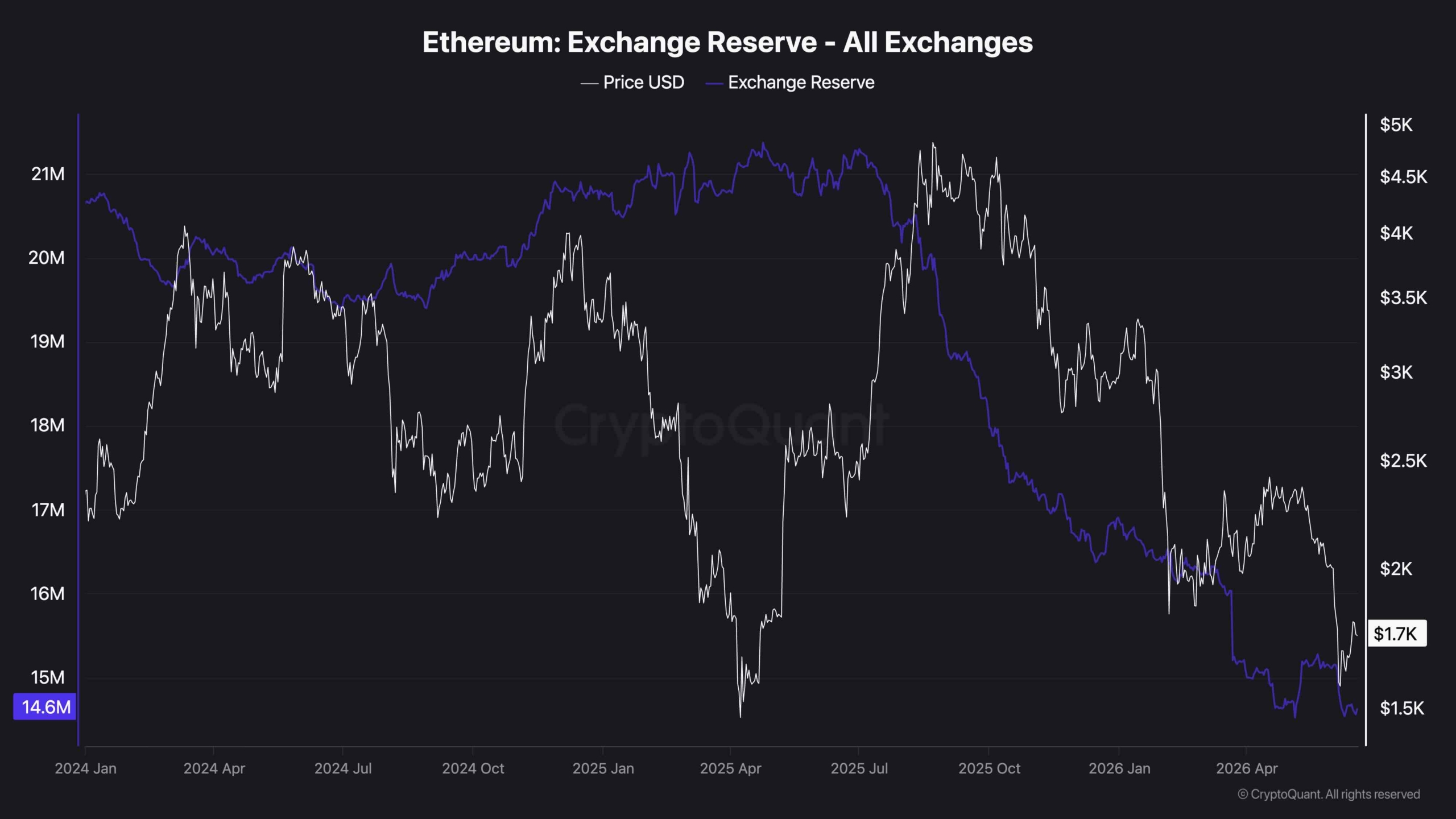
Ethereum’s exchange reserve continues to decline aggressively, reaching approximately 14.6 million ETH. The metric has been trending downward since mid-2025, even as the price has experienced substantial volatility.
A falling exchange reserve generally indicates that coins are being withdrawn from trading venues, reducing immediately available sell-side liquidity. Historically, sustained reserve declines tend to be viewed as a constructive long-term signal because they reflect accumulation and self-custody behavior among market participants.
However, the current divergence is noteworthy. Despite exchange balances falling to new lows, ETH remains unable to establish a bullish market structure. This suggests that macro sentiment and broader market conditions continue to outweigh the positive supply dynamics in the short term.
Nevertheless, if demand returns while exchange reserves remain near record lows, the reduced available supply could amplify future upside moves. For now, the on-chain backdrop remains structurally supportive, even though the technical picture still requires ETH to reclaim the $2K resistance region before a larger bullish reversal can be confirmed.
The post Ethereum Price Analysis: Sellers Remain in Control as ETH Recovery Hits a Wall appeared first on CryptoPotato.
Lite Strategy has invested $1 million in Litecoin Layer-2 developer ZK Innovations, extending its involvement beyond LTC accumulation and into infrastructure tied to the cryptocurrency’s future development.
Summary
- Lite Strategy invested $1 million in LitVM, a Layer-2 project bringing smart contracts to Litecoin.
- The deal gives Lite Strategy governance rights and potential exposure to future LitVM tokens.
- Santiment data showed Litecoin whale wallets rising despite weak transaction activity and recent price declines.
According to Lite Strategy, the funding gives the Nasdaq-listed company governance participation rights in the project and the opportunity to acquire a portion of LitVM’s future network tokens.
The investment centers on LitVM, a zero-knowledge Layer-2 platform designed to bring smart contracts, decentralized finance applications, tokenized real-world assets, and cross-chain liquidity tools to Litecoin.
The move comes as Lite Strategy continues to build one of the largest Litecoin treasury positions among public companies. According to the company, it currently holds about 850,000 LTC, representing roughly 1.1% of the mined Litecoin supply.
“We believe the best way to create shareholder value is not only to own Litecoin, but to help build the infrastructure that expands Litecoin utilization,” said Lite Strategy’s CEO and CFO, Jay File.
LitVM brings smart contract functionality to Litecoin
Details released by LitVM show that the platform is preparing to launch its mainnet infrastructure using BitcoinOS and Arbitrum Nitro technology.
According to the project, the network introduces zero-knowledge rollup scalability, Ethereum Virtual Machine compatibility, and trustless bridging for native LTC.
Through EVM compatibility, developers would be able to deploy existing Ethereum-based decentralized finance and tokenized asset applications on Litecoin with fewer modifications. Project documentation also states that LTC holders will be able to move native Litecoin onto the Layer-2 through a trustless bridge rather than relying on custodial solutions.
Charlie Lee, Litecoin’s creator and a member of Lite Strategy’s board, said the addition of a programmable layer could enable new use cases while maintaining Litecoin’s security and decentralized design.
For Lite Strategy, the investment links its treasury strategy more directly to ecosystem development. Company statements indicate that expanding Litecoin’s functionality could increase the utility and potential productivity of the LTC held on its balance sheet.
Whale accumulation continues despite weak network activity
Recent market data has drawn attention to Litecoin even as price performance and transaction activity remain subdued.
Last week, crypto.news reported that data from Santiment showed a steady increase in large Litecoin holders over the previous five months. According to Santiment, wallets holding at least 10,000 LTC increased by 42 addresses during that period, representing a 7% rise among the network’s largest holder groups.
At the same time, Santiment data showed transaction volume measured in U.S. dollars remaining near yearly lows. The analytics firm noted that large holders continued adding exposure despite weak network activity.
Discussion surrounding LitVM has also fueled social engagement around Litecoin. According to Santiment, conversations about the project and its zkLTC wrapper helped place Litecoin among the most discussed assets on its social-tracking metrics.
Market conditions have nevertheless weighed on LTC in recent sessions. Following the Federal Reserve’s latest policy meeting, where officials signaled a hawkish stance on future rate decisions, Litecoin moved lower alongside the rest of the crypto market.
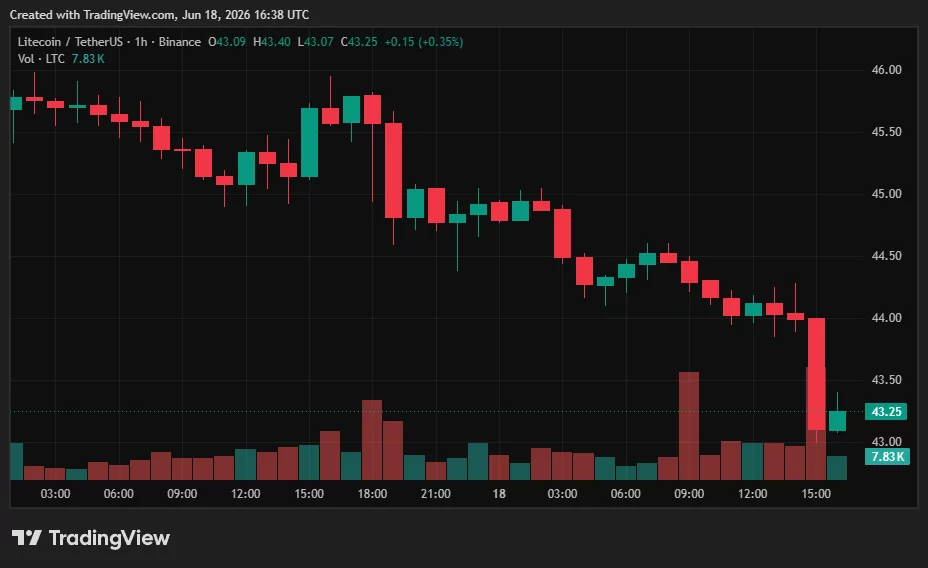
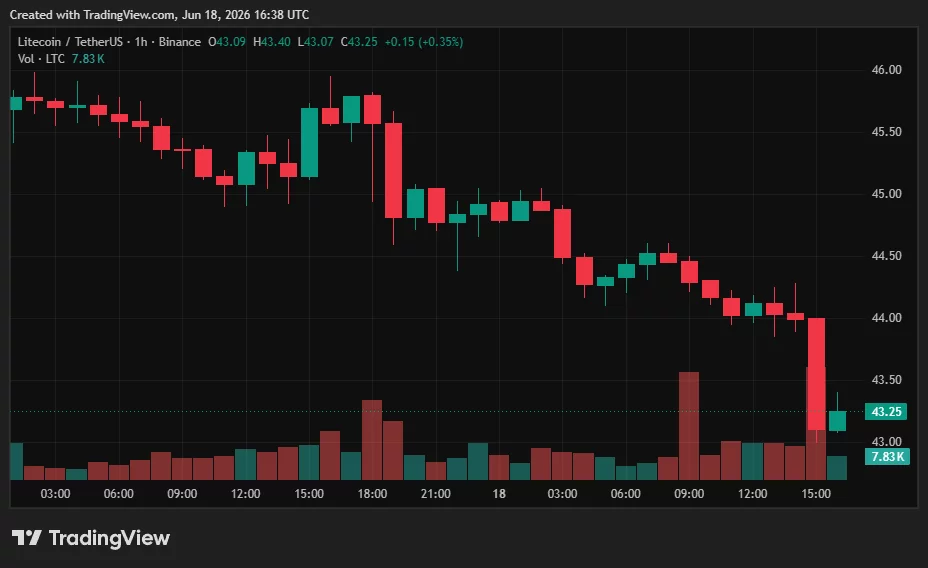
Litecoin (LTC) price fell 5.6% over the past 24 hours and touched an intraday low of $43 on June 17, even as whale accumulation and attention around LitVM continued to grow.

Uniswap saw a jump in network activity this week after new institutional price expectations for its UNI token hit the markets and social media.
According to a report by Santiment, whale transactions on the network reached a 7-month high while active whale addresses climbed to a four-month peak.
Whale Transactions Rise
The uptick came as traders reacted to a long-term forecast by the Standard Chartered research team led by Geoff Kendrick that placed UNI at $100 by 2030. The team tied their outlook to an expected jump in tokenized assets that will move on-chain in the next couple of years, with their estimate standing at about $4 trillion by the end of 2028, up from about $340 billion today.
Furthermore, the researchers noted that tokenized assets active on DeFi will multiply at least 37 times in the next four years, with the implication being that the exact same growth could be seen in Uniswap’s liquidity pools.
According to them, Uniswap is well-placed to capture that growth, considering its role as a general-purpose trading infrastructure, its longevity and brand recognition, and its dominance in trading highly correlated asset pairs, given that it’s the biggest DEX in the market right now.
In relation to that, last weekend, Uniswap confirmed that tokenized equities such as Apple, Tesla, and NVIDIA were now accessible through its app and API. Furthermore, earlier in the year, the protocol enabled trading access for BlackRock’s BUIDL tokenized fund through UniswapX, with the resulting attention helping its token climb 40%.
Standard Chartered’s price prediction for UNI was direct: it goes to $6.50 by the end of this year, hits $20 by 2027 and reaches $40 by the end of 2028. After that, Kendrick and co. see the cryptocurrency going up to $65 by 2029 and $100 before the curtains fall on 2030.
The above would represent a 40x increase from the level at which UNI was trading when the note was published, with the bank also projecting that the #45 token could outperform both Bitcoin and Ethereum across that timeframe.
“Uniswap shocked traders with a +24% surge and massive whale activity and volume,” Santiment reported on X.
That was on June 17, and a day later, the on-chain analytics platform came back with more big news: that active addresses had hit a 4-month high, and whale transactions had gone up enough to match their level from seven months ago.
UNI Price Action
Looking at the price charts, UNI was trading near $3.10 at the time of writing, although it touched $3.65 at some point in the last 24 hours, its highest level since mid-May, according to CoinGecko data.
The token has gained almost 24% in the past week and over 16% across 14 days. However, it is still in the red over one month by nearly 12%, and year-on-year it’s down 58%.
The post Uniswap Whale Activity Hits 7-Month Peak Following $100 Prediction appeared first on CryptoPotato.
Key Insights
BlackRock’s BITA brings covered-call income strategies to Bitcoin markets.
BITA targets monthly payouts while preserving much of Bitcoin’s upside.
Bitcoin ETFs are evolving beyond access toward specialized portfolio tools.
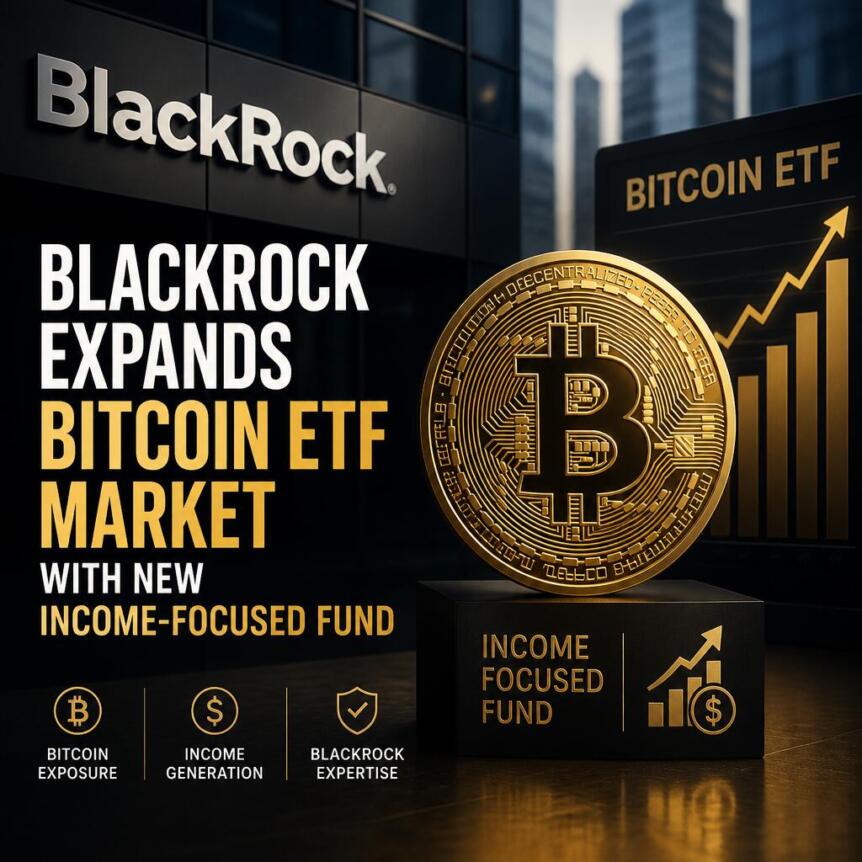
BlackRock has launched the iShares Bitcoin Premium Income ETF (BITA), adding a new layer to the growing Bitcoin ETF market. Bitcoin traded near $66,100 during the fund’s launch period, while BITA debuted on Nasdaq with a net asset value above $53. The new product combines Bitcoin exposure with monthly income generation through an options strategy.
The launch marks another step in the expansion of institutional Bitcoin products. Unlike traditional spot Bitcoin ETFs, BITA focuses on generating income alongside market exposure. As a result, the fund targets investors seeking regular distributions instead of pure price appreciation.
BlackRock structured the ETF around direct Bitcoin exposure and holdings in IBIT. The firm then writes covered call options against part of the portfolio. Consequently, the strategy converts Bitcoin volatility into monthly premium income.
BITA Introduces Income Generation To Bitcoin Exposure
BITA seeks to track Bitcoin performance while producing monthly income through an actively managed options program. The fund writes call options on approximately 25% to 35% of portfolio holdings. Therefore, it can generate option premiums that may be distributed to shareholders.
The ETF launched with a sponsor fee of 0.65%. In addition, BlackRock designed the product to retain a significant portion of Bitcoin’s potential upside. The structure aims to balance growth participation with recurring income.
Covered-call strategies already hold a strong presence in equity markets. Asset managers have used similar approaches for years to create income-oriented products. BlackRock now applies that framework to Bitcoin as digital assets become more integrated into traditional finance.
Bitcoin ETF Market Shifts Toward Specialization
The arrival of spot Bitcoin ETFs removed many barriers for traditional market participants. Investors gained access to Bitcoin through standard brokerage accounts without handling wallets or private keys. Consequently, demand began expanding beyond simple price exposure.
Bitcoin ETF issuers now compete across different strategies rather than basic access alone. Products such as IBIT, FBTC, and ARKB focus on direct Bitcoin tracking. BITA, however, introduces an alternative approach centered on income generation.
This development mirrors trends seen in the broader ETF industry. Equity ETFs evolved from broad market funds into specialized categories over time. Similarly, Bitcoin ETFs appear to be entering a stage where product differentiation drives growth.
Institutional Adoption Creates Demand For New Bitcoin Strategies
Large financial institutions continue expanding their digital asset offerings. As Bitcoin gains acceptance within traditional portfolios, firms are developing products that address varying investment objectives. Therefore, income-focused strategies have emerged alongside standard spot exposure.
BITA may appeal to market participants seeking cash flow from Bitcoin-linked investments. At the same time, the structure limits part of the upside during strong market rallies. This tradeoff reflects the core characteristic of covered-call strategies across asset classes.
The fund’s launch highlights a broader shift in crypto investing. Asset managers increasingly adapt traditional financial strategies for digital assets. As a result, Bitcoin is moving closer to becoming a standard component within diversified portfolio construction.

Quick Overview
- Alchemy introduces AgentCard, providing AI agents with Visa payment capabilities.
- The solution connects AI agents to Visa infrastructure, cryptocurrency payments, and spending management.
- Developers gain transaction limits and identity verification tools for autonomous AI commerce.
- AgentCard offers developers unified API access for agent credentials and payment processing.
- Alchemy positions itself in the agentic commerce space with Visa-powered AgentCard technology.
Artificial intelligence agents can now access mainstream e-commerce through Alchemy’s recently unveiled AgentCard. This virtual Visa card solution provides agents with verified identity, transaction capabilities, and spending oversight via a streamlined integration. The release positions Alchemy strategically within the rapidly expanding agentic payments sector.
AgentCard Bridges AI Agents to Visa Payment Infrastructure
Alchemy developed AgentCard by partnering with Visa Intelligent Commerce, Visa’s comprehensive framework for AI-driven payment solutions. The platform provides developers with virtual Visa payment tokens specifically designed for agents executing online purchases. Additionally, it provisions a unique email address, phone number, and cryptocurrency wallet through a single API endpoint.
AgentCard utilizes Visa-issued tokens as its primary payment mechanism, enabling agents to transact across established card networks. Nevertheless, the platform also accommodates cryptocurrency transactions when merchants support digital assets. It further integrates with next-generation agent payment protocols, including x402 and Stripe’s Machine Payments Protocol.
The solution addresses developers creating agents requiring practical spending capabilities. Common applications include API subscription payments, digital service purchases, delivery orders, and automated marketing expenditure management. Alchemy anticipates AgentCard will facilitate prediction market participation and other continuous digital operations.
Alchemy Implements Safeguards for Autonomous Transactions
Alchemy engineered AgentCard with comprehensive spending safeguards that grant users precise control over agent activity. Developers can establish merchant restrictions, transaction thresholds, prepaid funding amounts, and budget constraints before agents execute payments. These protections minimize financial exposure while enabling agents to fulfill designated responsibilities.
AgentCard incorporates live transaction monitoring, allowing developers to observe agent expenditures in real time. Consequently, organizations can audit payments, identify anomalous patterns, and modify restrictions without overhauling the entire infrastructure. The platform maintains payment discipline while facilitating increased automation.
The company indicated AgentCard can adapt payment methods as merchant acceptance evolves. For instance, the system may leverage cryptocurrency or agent-specific protocols when accessible. This flexibility allows developers to incorporate additional payment alternatives without comprehensive agent reconfiguration.
Agentic Commerce Accelerates Throughout Payment Industry
AgentCard emerges as leading payment processors and blockchain companies develop infrastructure for agentic commerce. Visa introduced Intelligent Commerce in 2025 to enable tokenized authentication for automated purchasing and payment processing. Similarly, Mastercard unveiled its Agent Pay for Machines program targeting high-frequency machine-to-machine transactions.
Additional cryptocurrency platforms have entered this domain with wallet and card offerings. Oobit released virtual corporate Visa cards linked to USDT holdings for automated users. MetaMask also debuted Agent Wallet, providing bots with Ethereum-based service access.
Alchemy advances into this marketplace with extensive web3 infrastructure expertise and an established developer community. The company currently supports prominent onchain applications, making AgentCard a natural extension beyond blockchain connectivity. Through this launch, Alchemy unifies agent identity verification, Visa payment processing, cryptocurrency infrastructure, and expenditure management within a single offering.


Bitcoin is trading around $64,000, nursing a modest 24-hour decline as macro conditions tighten, and has historically punished price prediction hard. The catalyst is familiar, but the intensity is fresh: Kevin Warsh, the chair of the Federal Reserve, has rattled markets with a hawkish posture.
To make things even worse, the U.S. Dollar Index has also surged more than 0.6% on Wednesday, breaking above the 100 resistance, with analysts targeting 106.20 as the next technical objective. The move came after fed funds futures repriced a 35% probability of a quarter-point rate hike by September, up sharply from 12% just one week prior.
JUST IN — Barchart (@Barchart) June 18, 2026
 : U.S. Dollar hits highest level in more than 1 year

 pic.twitter.com/rJuGBPqu3C
Short-dated Treasury yields jumped 10 basis points on the session, too. The S&P 500 dropped 0.4%, and BTC slipped below $67,000 in the immediate reaction, only to subsequently consolidate lower into the current range.
Discover: The Best Crypto to Diversify Your Portfolio
Bitcoin Price Prediction: What’s Next?
At $64,000, BTC sits in an uncomfortable middle zone. In the 48-hour setup, we flag overhead resistance concentrated in the mid-$60,000s, the same band that has repeatedly rejected upside attempts. Moving averages are flattening, momentum indicators are cooling, and ETF inflows have moderated.
Support in $62,000 is the line that matters most right now. A close below that area opens a path to deeper pullbacks that technical setups alone won’t prevent, and macro headwinds would accelerate the move.

The bulls would want DXY to stall, inflation data to print soft, and so BTC can reclaim mid-$60,000s resistance on volume, setting up a retest of $67,000.
However, if DXY drives above 106 and cracks BTC through the low-$60,000 support, it would open room toward the high $58,000.
Funding rates and open interest have already moderated, suggesting speculative leverage has been rinsed. That reduces the risk of a cascade, but it also means there’s less fuel for a sharp recovery bounce. The path of least resistance stays sideways-to-lower until macro clarity arrives.
Discover: The Best Token Presales
Bitcoin Hyper Targets Early-Mover Upside as Bitcoin Battles in Support Zone
When spot BTC is range-bound and macro headwinds are real, rotation capital tends to search for asymmetric early-stage exposure. Projects where the upside math is structurally different from buying an asset already deep into its price discovery cycle.
The dynamic above is exactly what makes the current environment worth scanning for infrastructure-layer presales with genuine technical differentiation.
Bitcoin Hyper ($HYPER) is positioned as the first Bitcoin Layer 2 with Solana Virtual Machine (SVM) integration, a combination that targets Bitcoin’s core limitations: slow throughput, high fees, and the absence of programmable smart contracts.
The project claims sub-Solana latency on its Layer 2 processing, with a Decentralized Canonical Bridge for native BTC transfers that preserves Bitcoin’s base-layer security.
The presale is currently priced at $0.0136, with $32 million raised. They are meaningful tractions for a pre-launch infrastructure play. Staking is also live with a high APY for early participants.
Those who want to assess the fundamentals further can research Bitcoin Hyper here before the current stage closes.
The post Bitcoin Price Prediction: The Dollar Index, Hawkish FOMC, and Other Threats appeared first on Cryptonews.


A crypto wallet does not hold your coins. It holds the keys that prove the coins are yours. Understanding that one distinction is the difference between keeping your crypto safe and losing it for good. Here is the complete guide.
Summary
- A crypto wallet stores the private keys that prove ownership of cryptocurrency held on the blockchain, rather than storing the coins themselves.
- Seed phrases act as the master recovery key for a wallet, making secure offline storage essential to prevent theft or permanent loss of funds.
- Hot wallets offer convenience for everyday transactions, while cold wallets provide stronger protection for long term holdings by keeping private keys offline.
A crypto wallet is the tool that lets you store, send, and receive cryptocurrency, but it does not work the way the name suggests. A physical wallet holds your cash. A crypto wallet holds no coins at all. Your cryptocurrency lives on the blockchain, a public ledger that records who owns what, and the wallet holds the cryptographic keys that prove a particular balance on that ledger belongs to you.
Whoever holds the keys controls the crypto. That single fact, that a wallet stores keys and not coins, is the foundation of everything that matters about crypto security, and misunderstanding it is how people lose their money.
This guide explains what a crypto wallet actually is, how the keys work, the difference between hot and cold wallets, what a seed phrase is and why it is the most important string of words you will ever write down, the main types of wallet and who each suits, and how to choose the right one for your situation.
It assumes no prior knowledge, and by the end you will understand not just which wallet to pick but why the choice matters, which is the part most guides skip. Getting this right is the single most important skill in crypto, because unlike a bank, there is no one to call if you lose access, and no one to reverse a theft. The responsibility is yours, and so is the control.
What a wallet actually stores
To use a wallet safely, you have to understand what is really happening underneath, and it comes down to two keys.
Every crypto wallet is built on a pair of cryptographic keys. The public key, and the address derived from it, is like an account number you can share freely: it is where people send crypto to you, and it can be posted publicly without risk.
The private key is the secret that proves ownership and authorizes spending. When you send crypto, your wallet uses the private key to sign the transaction, proving to the network that you are the legitimate owner of the funds at that address, without ever revealing the key itself.
The blockchain records the result. The coins never move into or out of your wallet in any physical sense; they simply get reassigned on the ledger from one address to another, and the private key is what gives you the authority to make that reassignment.
This is why the saying “not your keys, not your coins” is the most repeated phrase in crypto. If you hold the private key, you control the crypto, fully and unconditionally, and no one can freeze it, seize it, or move it without that key. If someone else holds the key, they control the crypto, regardless of whose name is on the account, because the blockchain only cares about the key, not about who claims ownership.
And if you lose the key with no backup, the crypto is gone forever, locked at an address you can no longer access, because there is no central authority that can reset it for you. The entire practice of crypto security is, at bottom, the practice of protecting private keys, and every wallet decision flows from how it handles them.
Hot wallets versus cold wallets
The most important division in the wallet world is between hot and cold, and it is entirely about one question: is the private key ever exposed to the internet?
A hot wallet is connected to the internet. It is software, an app on your phone, a browser extension, a program on your computer, and it keeps your private keys on an internet-connected device so you can transact quickly and conveniently.
Hot wallets are free, fast, and easy to use, ideal for crypto you trade or spend regularly, for interacting with decentralized applications, and for holding amounts you can afford to lose. The tradeoff is security: because the keys touch an internet-connected device, they are exposed, at least in principle, to malware, phishing, and remote attacks. A hot wallet is the checking account of crypto, convenient for daily use, but not where you keep your life savings.
A cold wallet keeps the private keys completely offline. The most common form is a hardware wallet, a small physical device resembling a USB drive that stores your keys on the device itself and signs transactions internally, so the private key never leaves the device and never touches your internet-connected computer even when you use it.
Because the keys are never exposed online, cold wallets are dramatically harder to compromise remotely; an attacker would generally need physical possession of the device and its access code. The tradeoff is convenience: cold wallets cost money, usually between sixty and two hundred dollars, and using them is slightly more cumbersome, since you have to connect the device to approve transactions.
A cold wallet is the vault of crypto, the right place for significant holdings you intend to keep for the long term. The general rule that experienced holders follow is simple: small amounts you use often go in a hot wallet, and larger amounts you hold for the long run go in cold storage.
What a seed phrase is, and why it matters most
When you create a wallet, you are given a seed phrase, and it is the single most important thing in this entire guide, because it is the master key to everything.
A seed phrase, also called a recovery phrase, is a list of usually twelve or twenty-four ordinary words generated when you set up a wallet, something like “ripple ladder cousin orbit…” and so on. Those words are a human-readable form of the master key from which all of your wallet’s private keys are derived.
This is the crucial point: the seed phrase is not a password you can change and it is not merely a backup of one account. It is the root from which your entire wallet regenerates. Anyone who has your seed phrase can recreate your wallet on any device, anywhere in the world, and take everything in it, and if you lose your seed phrase with no copy, you lose access to your crypto permanently, even if the wallet app or hardware still works, because the seed is what restores access when the device is lost, broken, or replaced.
The rules that follow from this are absolute, and they are where most theft and loss actually happen. Write the seed phrase down on paper, or stamp it into metal, and store it somewhere safe and private, ideally in more than one secure location to guard against fire or loss. Never store it digitally: no photos, no screenshots, no cloud storage, no notes app, no email to yourself, because anything connected to the internet can be hacked, and a seed phrase in a photo is a seed phrase one breach away from theft.
Never type it into a website or app unless you are deliberately restoring your wallet in the official software, because the most common crypto scam in existence is a fake site or message asking you to “verify” or “re-enter” your seed phrase, and entering it hands over everything. And never share it with anyone, ever, for any reason, because no legitimate company, support agent, or person will ever need your seed phrase, and anyone who asks for it is trying to rob you. The seed phrase is the keys to the kingdom written in plain words, and protecting it is the whole game.
The main types of wallet
Beyond the hot-and-cold division, wallets come in several forms, and knowing the categories helps you match a wallet to your needs.
Software wallets are applications you install, and they are the most common entry point. Mobile wallets are phone apps, convenient for everyday use and payments; desktop wallets are programs on a computer; and browser-extension wallets live in your web browser and are the standard way to interact with decentralized finance and other on-chain applications.
Most software wallets are hot wallets, holding keys on the connected device, and they range from general-purpose wallets that support many blockchains to specialized ones built for a particular network. They are free, quick to set up, and give you full control of your keys, which makes them the usual choice for active users, with the standing caution that an internet-connected wallet should not hold more than you are comfortable risking.
Hardware wallets are the physical devices described above, the gold standard for securing significant holdings, keeping keys offline while still letting you transact when you connect them. Paper wallets, an older approach, involve printing your keys or seed phrase on paper and holding no digital copy at all; they are maximally offline but fragile and awkward to use, and hardware devices have mostly replaced them.
Cutting across all of these is the most consequential distinction of all, custodial versus non-custodial, which determines who actually holds your keys.
Custodial versus non-custodial: who holds the keys
This distinction matters as much as hot versus cold, because it decides whether you or someone else is really in control, and beginners often do not realize which kind they are using.
A custodial wallet is one where a third party, usually a centralized exchange, holds your private keys on your behalf. When you buy crypto on an exchange and leave it there, you are using a custodial arrangement: the exchange controls the keys, and you hold an account balance that the exchange promises to honor, much like money in a bank.
A custodial wallet is one where a third party, usually a centralized exchange, holds your private keys on your behalf. When you buy crypto on an exchange and leave it there, you are using a custodial arrangement: the exchange controls the keys, and you hold an account balance that the exchange promises to honor, much like money in a bank.
This is convenient, since the exchange handles security and can help you recover access if you forget a password, but it means you do not truly control your crypto. You are trusting the exchange to stay solvent, secure, and honest, and history has repeatedly shown that exchanges can be hacked, can freeze withdrawals, or can fail, taking customer funds with them. The convenience is real, and so is the counterparty risk.
A non-custodial wallet is one where you, and only you, hold the private keys, through a software or hardware wallet you control. This is true ownership in the crypto sense: no third party can freeze, seize, or lose your funds, because no third party has the keys. The cost of that control is responsibility, since there is no one to recover your access if you lose your seed phrase, and no one to reverse a mistaken or fraudulent transaction.
The tradeoff between custodial and non-custodial is the tradeoff between convenience-with-trust and control-with-responsibility, and the common practice that balances them is to use a custodial exchange account for buying and active trading, then move crypto you intend to hold into a non-custodial wallet you control, so that your long-term savings are not sitting on a platform you do not control. “Not your keys, not your coins” is precisely a warning about custodial holdings: crypto on an exchange is, in the strict sense, not fully yours.
How to choose the right wallet
With the pieces in place, choosing becomes a matter of matching the wallet to how much you hold and what you intend to do with it.
Begin with the amount and the purpose. If you are holding a small amount and want to trade, spend, or experiment, a reputable non-custodial software wallet, or even an exchange account for pure trading, is reasonable, because the convenience outweighs the limited risk of a small balance. If you are holding a significant amount for the long term, a hardware wallet is strongly advisable, because the offline security is worth the cost and minor inconvenience once the value at stake is meaningful.
Many people use both: a hot software wallet for day-to-day activity holding a spending-money amount, and a cold hardware wallet for the bulk of their holdings, which mirrors how people keep some cash in a checking account and the rest in savings. The decision is not which single wallet is best, but which combination fits your balance and behavior.
A few practical criteria sharpen the choice. Favor non-custodial wallets for anything you want to truly own, reserving custodial exchange accounts for buying and active trading rather than long-term storage. Confirm the wallet supports the specific blockchains and assets you hold, since not every wallet handles every network.
Choose established, well-reviewed wallets with strong security track records over obscure ones, because a wallet is only as trustworthy as its code and its makers. And whatever you choose, treat the seed phrase with the discipline described above, because the most expensive wallet in the world cannot protect you if the seed phrase is photographed, shared, or typed into a scam site. The wallet is the tool; your handling of the keys is the security.
Common mistakes that cost people their crypto
Most crypto losses are not exotic hacks; they are a handful of avoidable mistakes, and knowing them is half of avoiding them.
The first is storing the seed phrase digitally, a photo, a screenshot, a cloud note, which turns the master key into something an attacker can steal remotely, and it is behind an enormous share of thefts. The second is entering the seed phrase into a fake site or giving it to a “support agent,” the most common scam in crypto, which works because beginners do not yet know that no legitimate party ever needs the seed phrase.
The third is keeping large, long-term holdings on an exchange, exposing them to the platform’s solvency and security rather than moving them to self-custody, a risk made vivid every time an exchange fails. The fourth is losing the seed phrase entirely through carelessness, no backup, a single fragile copy, which permanently locks the funds with no recovery. And the fifth is approving a malicious transaction or connecting a wallet to a fraudulent application, which can drain a hot wallet in seconds.
The defenses are the mirror image of the mistakes: keep the seed phrase offline and backed up in more than one secure place, never share or enter it except to restore your own wallet in official software, move long-term holdings into self-custody and ideally cold storage, and be cautious about what you connect your wallet to and what transactions you approve. None of this requires technical expertise. It requires understanding that you are your own bank, and that the discipline a bank would normally provide is now your responsibility. That shift in mindset, from trusting an institution to securing your own keys, is the real lesson of crypto wallets.
You are the bank now
A crypto wallet is not a container for coins; it is a keyring for the cryptographic keys that prove the coins on the blockchain are yours, and once that clicks, every other decision follows from it. Hot wallets keep those keys online for convenience and suit small, active balances. Cold wallets keep them offline for security and suit significant, long-term holdings.
Custodial arrangements let a third party hold the keys for ease at the cost of control, while non-custodial wallets give you full control at the cost of full responsibility. And the seed phrase sits beneath all of it as the master key that must be guarded above everything else.
The freedom crypto offers, money that no one can freeze, seize, or inflate away, is inseparable from the responsibility it demands, because the same design that removes the bank also removes the safety net the bank provided. There is no password reset, no fraud department, no one to reverse a theft or recover a lost key.
That can sound daunting, but it reduces to a few habits done consistently: protect the seed phrase, keep serious holdings in cold storage, use self-custody for what you truly want to own, and stay skeptical of anyone who asks for your keys. Master those, and you have mastered the foundational skill of crypto, the one that makes everything else safe to do. You are the bank now, and the wallet is how you hold the keys to your own vault.
Frequently Asked Questions
Does a crypto wallet actually hold my coins?
No. Your cryptocurrency exists on the blockchain, a public ledger that records ownership. The wallet holds the cryptographic keys that prove a balance on that ledger belongs to you and let you authorize transactions. The coins never physically move into a wallet; they are reassigned on the ledger from one address to another, and your private key is what gives you the authority to make that reassignment. Whoever holds the keys controls the crypto.
What is the difference between a hot wallet and a cold wallet?
A hot wallet is connected to the internet, typically a phone app, browser extension, or computer program, and is convenient for frequent use but more exposed to remote attacks. A cold wallet, usually a hardware device, keeps your private keys completely offline, making it far harder to compromise remotely but slightly less convenient. The common rule is to keep small, actively used amounts in a hot wallet and larger, long-term holdings in cold storage.
What is a seed phrase and why is it so important?
A seed phrase, or recovery phrase, is a list of usually twelve or twenty-four words generated when you create a wallet. It is the master key from which all your wallet’s private keys are derived, so anyone with it can recreate your wallet and take everything, and losing it with no backup means losing your crypto permanently. Write it on paper or metal, store it offline in more than one secure place, never store it digitally, and never share it or type it into any site except to restore your own wallet.
What does “not your keys, not your coins” mean?
It means that whoever controls the private keys controls the cryptocurrency, regardless of whose name is on an account. If your crypto sits on an exchange that holds the keys (a custodial arrangement), you do not fully control it; you are trusting the exchange. If you hold the keys yourself in a non-custodial wallet, no third party can freeze or seize your funds. The phrase warns that crypto left on an exchange is not, in the strict sense, entirely yours.
Should I use a custodial or non-custodial wallet?
It depends on your goal. Custodial wallets, like leaving crypto on an exchange, are convenient and offer password recovery but expose you to the platform’s solvency and security. Non-custodial wallets give you full control and true ownership but make you solely responsible, with no recovery if you lose your seed phrase. A common balance is to use a custodial exchange account for buying and active trading, then move long-term holdings into a non-custodial wallet you control.
Which crypto wallet should a beginner choose?
Match the wallet to how much you hold and what you plan to do. For small amounts you trade or experiment with, a reputable non-custodial software wallet is reasonable. For significant long-term holdings, a hardware (cold) wallet is strongly advisable for its offline security. Many people use both: a hot wallet for daily activity and a cold wallet for the bulk of their savings. Whatever you choose, pick an established, well-reviewed wallet and protect your seed phrase rigorously.
This guide is educational information, not financial advice. Cryptocurrency carries risk, and you are responsible for securing your own assets. Verify wallet providers and security practices independently before relying on them.


Buying your first crypto is simpler than the jargon makes it sound. This guide walks through every step, from choosing an exchange to securing what you bought, and the mistakes that cost beginners money along the way.
Summary
- Buying cryptocurrency typically involves choosing an exchange, verifying your identity, funding an account, and placing a buy order using regular currency.
- Market orders allow users to buy crypto immediately at the current price, while limit orders let buyers set a preferred purchase price.
- Security measures such as two-factor authentication and careful storage choices are presented as essential parts of the buying process.
Buying cryptocurrency for the first time feels intimidating, but the process is more straightforward than the acronyms and the noise suggest. At its core, buying crypto means opening an account on a platform that sells it, funding that account with regular money, placing an order for the crypto you want, and then deciding where to keep it.
Millions of ordinary people have done it, and you do not need a finance degree or any technical knowledge to do it safely. What you do need is to understand each step well enough to avoid the handful of mistakes that cost beginners money, and that is exactly what this guide provides.
This is a complete walkthrough for 2026: how to choose the right platform, how to set up and secure your account, how to fund it, how to actually place a buy order and the difference between the order types, how to store what you bought, and how to avoid the common traps.
It does not tell you what to buy or promise any returns, because no honest guide can, and crypto is volatile enough that you should only ever commit money you can afford to lose. What it does is give you the knowledge to make your own decisions and execute them without trusting strangers on the internet, which is the single most valuable thing a beginner can have.
Before you buy: a few things to settle first
A little preparation prevents most beginner mistakes, so it is worth settling a few things before you put any money in.
The first is the amount. The right starting amount is whatever you are completely comfortable losing, because the possibility of loss is real and crypto can fall sharply and fast. Many experienced investors suggest beginners start small, on the order of fifty to a hundred dollars, enough to learn the process without meaningful financial exposure, and most exchanges let you buy as little as ten or twenty dollars’ worth, so there is no need to commit a large sum to get started.
The goal of a first purchase is to learn the mechanics, not to make money, and treating it that way removes most of the pressure and most of the risk. The second thing to settle is your purpose: whether you are buying to hold for the long term, to trade actively, or simply to understand how it works, because that shapes which platform and which storage approach make sense.
It also helps to understand, before you start, that crypto markets are volatile and that this is a genuine investment risk, not a formality. Prices swing hard in both directions, exchanges and wallets can be targets for theft, regulations can shift, and most coins pay no dividend or yield, so the entire return depends on price.
None of this means you should not buy; it means you should buy deliberately, with money you can lose, after a little learning, instead of impulsively chasing something you saw pump on social media. The most reliable way beginners lose money is not a hack or a crash but buying into hype at the top, and the antidote is to start small, move slowly, and focus on understanding over quick gains.
Step one: choose an exchange
The first concrete step is choosing where to buy, and for most beginners that means a centralized cryptocurrency exchange.
A cryptocurrency exchange is a platform where you buy, sell, and trade crypto, the equivalent of a brokerage for digital assets. Centralized exchanges, run by companies, are the standard starting point because they are designed for ease of use: they let you fund an account with regular money from a bank or card, offer simple interfaces for buying, and handle the technical complexity behind the scenes.
Well-known examples include Coinbase, Kraken, and Binance, among others, and they require identity verification to comply with financial regulations. For a beginner, a reputable centralized exchange is almost always the right starting place, because it bridges the gap between the traditional banking system and crypto in a way that is hard to do otherwise.
Choosing among exchanges comes down to a few practical factors. Security and reputation matter most: favor established platforms with strong track records, real regulatory compliance, and a history of protecting customer funds, since the exchange will hold your money and, at least initially, your crypto. Fees matter, because exchanges charge for purchases and the rates vary, so it is worth comparing the cost of buying on different platforms.
Supported assets matter if you have a specific coin in mind, since not every exchange lists every cryptocurrency. Ease of use matters for a beginner, where a clean, simple interface is worth more than advanced trading features you will not use. And availability matters, because the exchanges open to you depend on where you live and local regulations. For most people starting out, picking a large, reputable, beginner-friendly exchange that operates in their country is the sensible choice, with the finer comparisons mattering more as you grow.
There is also the alternative of a decentralized exchange, or DEX, such as Uniswap, which lets you trade directly from your own wallet without an account or identity verification, using smart contracts instead of a company.
Decentralized exchanges are powerful and central to decentralized finance, but they are an intermediate-to-advanced tool: they require you to already have crypto and a self-custody wallet, they do not accept regular money from a bank, and they put the full burden of security on you. For a first purchase with regular money, a centralized exchange is the practical path, and the decentralized world is something to explore later once the basics are comfortable.
Step two: create and secure your account
Once you have chosen an exchange, setting up the account is straightforward, but the security steps you take here matter more than they appear.
Creating the account involves signing up with your email and a strong, unique password, then completing identity verification, often called KYC, for “know your customer,” which regulated exchanges require by law. Verification typically means providing your name, address, date of birth, and a photo of a government identification document, and sometimes a selfie, after which the exchange approves your account, usually within minutes to a day.
This step can feel intrusive, but it is standard and legally required for centralized platforms, and it is part of what makes them a safer on-ramp than unregulated alternatives. Use a password you do not use anywhere else, because an exchange account protects real money and a reused password is a common way accounts get compromised.
The security step that matters most is enabling two-factor authentication, or 2FA, before you deposit any money. Two-factor authentication requires a second code, in addition to your password, to log in or withdraw, so that even if someone steals your password, they cannot access the account.
Use an authenticator app instead of text-message codes where possible, because app-based codes are harder for attackers to intercept than codes sent to your phone number, which can be hijacked. Setting up strong authentication before funding the account is a small step that dramatically reduces the chance of losing your money to a compromised login, and it is worth doing carefully instead of skipping in a hurry to buy. The few minutes spent on security here protect everything you do afterward.
Step three: fund your account
With a secure account ready, the next step is putting money in, and exchanges offer several ways to do it.
The most common funding methods are bank transfer, debit or credit card, and, if you already hold it, stablecoin or other crypto from another wallet. Bank transfer is usually the cheapest option, though it can take a day or two to clear, while card payments are near-instant but typically carry higher fees, so the choice trades speed against cost. For a first purchase, either works; many beginners use a card for the immediacy of seeing the process through, then switch to bank transfers for lower fees once comfortable.
The exchange will show your deposited funds as a balance in your account currency, ready to be used to buy crypto. Deposit only what you have decided to commit, the amount you are comfortable losing, rather than funding a large balance you might be tempted to overspend.
It is worth understanding the fees at this stage, because they affect what you actually end up with. Exchanges typically charge a deposit fee in some cases, a trading fee when you buy, and a withdrawal fee when you later move crypto off the platform, and these vary by exchange and payment method.
None of them is usually large enough to matter for a learning-sized first purchase, but knowing they exist prevents surprise, and comparing them becomes more worthwhile as the amounts grow. Reading the exchange’s fee schedule once, before you buy, is a small habit that saves money over time and removes the confusion of seeing a final crypto amount slightly smaller than the cash you put in.
Step four: place your buy order
Now the actual purchase, which is where the order types come in, and understanding them is the difference between buying confidently and buying blindly.
The simplest way to buy is a market order, which purchases the crypto immediately at the best price currently available. You specify how much you want to spend, say fifty dollars, and the exchange fills the order right away at the going rate, giving you the corresponding amount of crypto in seconds. Market orders are the natural choice for a first purchase and for anyone who simply wants to own the asset without managing the timing, because they are instant and require no price judgment.
The minor tradeoff is that you accept whatever the current price is, which in a fast-moving market can be slightly different from what you saw a moment earlier, but for a beginner buying a learning-sized amount, that difference is negligible, and a market order is the sensible, simple choice.
The alternative is a limit order, which lets you set the specific price you are willing to pay, and the order fills only if the market reaches that price. If you think the asset is slightly overpriced right now and you would rather buy a bit lower, a limit order lets you wait for your price, executing automatically if the market comes to you and remaining unfilled if it does not.
Limit orders give you control over the price at the cost of certainty, since the order may never fill if the market does not reach your level, whereas a market order guarantees execution but not price. For a first purchase, a market order is usually the right tool for its simplicity; limit orders become valuable as you grow more deliberate about entry prices.
Whichever you use, the exchange will show you the amount of crypto you are buying and the fees before you confirm, so review those, and then place the order. Congratulations, you own cryptocurrency.
Step five: store what you bought
Buying is not the end; deciding where to keep your crypto is a real choice with real consequences, and it is the step beginners most often neglect.
When you buy on an exchange, your crypto sits in the exchange’s custody by default, meaning the exchange holds the keys and you hold an account balance. This is convenient and fine for small amounts, and for crypto you are actively trading, because you can buy and sell quickly without moving anything.
But leaving significant or long-term holdings on an exchange carries real risk, because the exchange controls the keys, and exchanges can be hacked, can freeze withdrawals, or can fail, taking customer funds with them, as history has repeatedly shown. The phrase “not your keys, not your coins” captures it: crypto on an exchange is, in the strict sense, not fully under your control.
The safer approach for anything you intend to hold is to move it into a wallet you control, a non-custodial wallet where you hold the keys. A software wallet, an app or browser extension, is free and suitable for moderate amounts, while a hardware wallet, a physical offline device, is the gold standard for significant long-term holdings because it keeps your keys off the internet entirely.
The common practice is to keep small, active balances on the exchange for convenience and move long-term holdings into self-custody, mirroring how people keep spending money in checking and savings in a vault.
Whichever you choose, the cardinal rule of self-custody is to protect your wallet’s seed phrase, the master recovery key, by storing it offline, never sharing it, and never entering it into any website, because that phrase is the one thing standing between you and the irreversible loss of your crypto. For a first small purchase, leaving it on a reputable exchange while you learn is acceptable; as your holdings grow, moving to self-custody becomes the responsible choice.
Common mistakes to avoid
Most of what goes wrong for beginners is predictable, and knowing the traps in advance is the best protection against them.
The first and most common is chasing hype: buying a coin because it just surged hundreds of percent and is all over social media, which usually means the smart money has already taken its profits and a beginner is buying near the top. Focus on understanding what you are buying instead of reacting to a pump, and treat anything that sounds too good to be true as exactly that. The second is overcommitting: putting in more than you can afford to lose, often by funding a large balance and then feeling pressure to use it, when starting small and adding gradually is far safer.
The third is skipping security: failing to enable two-factor authentication, reusing a password, or leaving large holdings on an exchange, each of which is an avoidable exposure. The fourth is falling for scams: responding to unsolicited messages offering help or returns, clicking links to fake exchange sites, or, worst of all, giving away a seed phrase, since every unsolicited crypto message is effectively a scam and no legitimate party ever needs your recovery phrase.
A simple discipline avoids nearly all of these. Buy only what you can lose, on a reputable exchange, with strong security enabled, after a little learning, and ignore hype and unsolicited messages entirely. Use dollar-cost averaging, spreading purchases over time instead of trying to time a perfect entry, to reduce the risk of buying everything at a bad moment. And move serious holdings into self-custody while protecting the seed phrase above all else.
None of this is complicated, and following it puts you ahead of most beginners, who lose money not to bad luck but to avoidable mistakes made in haste.
You are ready to buy
Buying cryptocurrency reduces to five clear steps: choose a reputable exchange, create and secure your account with strong authentication, fund it with an amount you can afford to lose, place a buy order using a simple market order or a price-controlled limit order, and decide where to store what you bought.
None of the steps is difficult on its own, and together they take a beginner from the outside of crypto to confidently owning their first digital asset, which is a genuine accomplishment given how opaque the space can seem from a distance.
The deeper lesson underneath the steps is that crypto puts you in control, and control brings responsibility. There is no broker to undo a hasty purchase, no fraud department to reverse a scam, and no one to recover a lost key, so the safeguards a beginner needs are the ones built into good habits: start small, learn the mechanics, secure the account, ignore the hype, and move long-term holdings into self-custody you protect carefully.
Do those, and the volatility and the risk become things you manage, not things that manage you. The mechanics of buying are simple and now familiar to you; the discipline around them is what turns a first purchase into a safe and lasting entry into crypto. Take your time, keep learning, and never commit more than you can comfortably lose.
Frequently Asked Questions
How much money do I need to start buying crypto?
Very little. Most exchanges let you buy as little as ten or twenty dollars’ worth, and many experienced investors suggest beginners start around fifty to a hundred dollars, enough to learn the process without meaningful exposure. The right amount is whatever you are completely comfortable losing, because crypto is volatile and the possibility of loss is real. The goal of a first purchase is to learn the mechanics, not to make money, so there is no need to commit a large sum.
What is the best way to buy cryptocurrency for the first time?
For most beginners, the simplest path is a reputable centralized exchange such as Coinbase, Kraken, or Binance. You create an account, complete identity verification, enable two-factor authentication, fund the account by bank transfer or card, and place a market order for the crypto you want. Centralized exchanges are designed for ease of use and bridge the gap between regular banking and crypto, making them the practical starting point before exploring more advanced options.
What is the difference between a market order and a limit order?
A market order buys immediately at the best price currently available, guaranteeing execution but accepting whatever the current price is. A limit order lets you set the specific price you are willing to pay, executing only if the market reaches that price, which gives you price control but no guarantee the order fills. For a first purchase, a market order is usually the simpler and more practical choice; limit orders become useful as you grow more deliberate about entry prices.
Do I have to verify my identity to buy crypto?
On a centralized exchange, yes. Regulated exchanges require identity verification, known as KYC (“know your customer”), by law, typically asking for your name, address, date of birth, and a photo of a government ID. This is standard and part of what makes regulated exchanges a safer on-ramp. Decentralized exchanges do not require verification but are an advanced tool that needs an existing wallet and crypto, not a practical first-purchase option.
Should I keep my crypto on the exchange after buying?
For a small first purchase while you are learning, leaving it on a reputable exchange is acceptable. But for significant or long-term holdings, moving it to a non-custodial wallet you control is safer, because the exchange holds the keys and exchanges can be hacked, freeze withdrawals, or fail. A software wallet suits moderate amounts, and a hardware wallet is best for large long-term holdings. Whatever you use, protect your wallet’s seed phrase rigorously.
How can I avoid losing money as a beginner?
The most common way beginners lose money is chasing hype, buying a coin after it has already surged because it is all over social media, which usually means buying near the top. Avoid that by focusing on understanding rather than quick gains, buying only what you can afford to lose, using dollar-cost averaging to spread purchases over time, enabling strong account security, ignoring unsolicited messages, and never sharing a seed phrase, and moving long-term holdings into self-custody.
This guide is educational information, not financial advice. Cryptocurrency is volatile and carries real risk; only commit money you can afford to lose, and verify platforms and security practices independently.

The 11 Best Early Amazon Prime Day Health And Wellness Deals

Did Jalen Brunson shade doubter Becky Hammon during Knicks parade speech?

Boy ended up in Johnsons of Old Hurst crocodile enclosure

Blockchain.com files with SEC for U.S. IPO

No Jackpot Winner as $257 Million Prize Rolls Over to $269 Million Monday Draw

Israel says it has killed new Hamas military leader in Gaza City airstrikes

No Limit G money Is The One Who Attacked No Limit Maneski! More Details Come Up.

The Smartest Guest in Financial Audit History

Radhika Merchant Ambani Speaks On Equality, Mutual Respect & Financial Freedom In Marriage | News18
-
 Business4 days ago
No Jackpot Winner as $257 Million Prize Rolls Over to $269 Million Monday Draw
-

 Fashion6 days ago
Weekend Open Thread: Tuckernuck – Corporette.com
-
Crypto World4 days ago
Zimbabwe Requires Crypto Businesses to Register Annually Under New FIU Regulations
-

 Crypto World5 days ago
Bitget enters Argentina’s regulated crypto market through PSAV registration
-

 Tech6 days ago
NanoClaw integrates JFrog registries to secure AI agent downloads
-

 Tech6 days ago
This Week In Security: Microsoft On Microsoft, Register Your Domains, Linux On ARM, And FreeBSD Joins The File Cache Club
-

 NewsBeat7 days ago
El Nino has formed in the Pacific and could set records, forecasters say
-

 NewsBeat6 days ago
FBI searches office of Ohio voter registration group
-
 Tech7 days ago
Anthropic is spending $150M to embed 1,000 AI fellows inside nonprofits. No degree required.
-
 Entertainment7 days ago
‘The Pitt’s Fan-Favorite Doctor Confirms Noah Wyle Gave His Blessing to Return [Exclusive]
-
 Crypto World7 days ago
Ripple and Bitso Bring MXNB Stablecoin to XRP Ledger
-

 Fashion7 days ago
Coffee Break: Scarf Waist Belt
-

 Tech7 days ago
Former AWS CEO Adam Selipsky to lead new $10B AI data center venture
-
 Entertainment4 days ago
Matt Damon’s Viral Sci-Fi Thriller Has Taken Over HBO Max
-

 Business4 days ago
Anthropic staff to meet White House officials next week, Axios reports
-

 Tech4 days ago
As AI companies race to go public, who else is along for the ride?
-

 Business7 days ago
Justin Bieber Prepares for 2026 Tour Return with New Music and Promoter Talks
-

 Politics4 days ago
“Israel’s” ban on ICRC visits ruled illegal, but Knesset moves to stop them permanently
-
 Tech7 days ago
Euro-Office 1.0 Arrives To Open-Source Infighting: ‘Compatibility Is Not Sovereignty’
-
 Crypto World4 days ago
Bitcoin could crash to $48,000, if this historical pattern is triggered
You must be logged in to post a comment Login