

Crypto World
SEC’s Tokenized Equity Initiative Sparks Market Fragmentation Concerns


Key Takeaways
-
Digital stock representations may divide market liquidity, leading to price inconsistencies between trading venues.
-
Trading fee income faces potential offshore migration as blockchain venues attract transaction volume.
-
Blockchain trading demand accelerates with Hyperliquid showing $2.6B in real-world asset exposure.
-
Major exchanges NYSE and Nasdaq build tokenization systems to preserve market dominance.
-
Digital equity tokens enable round-the-clock trading, partial share ownership, and worldwide participation.
The Securities and Exchange Commission’s latest innovation-focused exemption permits blockchain-based equity listings on alternative trading platforms. This regulatory shift authorizes the circulation of digital equity tokens representing traditional stocks without requiring company consent. Industry experts caution this development may scatter market depth and redirect transaction revenue from established trading venues.
Market Depth Distribution Challenges
Tokenized stock activity spanning numerous blockchain platforms dilutes order concentration from traditional exchanges. As a result, established marketplaces including NYSE and Nasdaq face potential declines in aggregated transaction volumes. Dispersed market depth can generate pricing inconsistencies and magnify execution costs for institutional-sized orders.
The proliferation of digital equity tokens redirects investment capital toward continuous blockchain trading environments. This evolution may undermine market efficiency standards and diminish the effectiveness of centralized pricing mechanisms. Distributed trading architectures also separate market participants into fragmented liquidity pools, elevating transaction execution uncertainty.
Blockchain-native platforms demonstrate expanding interest, with Hyperliquid documenting $2.6 billion in outstanding positions. The expansion of tokenized real-world asset markets reflects investor demand for uninterrupted market access. This transition compels conventional exchanges to rapidly embrace blockchain-based liquidity frameworks.
Trading Income Distribution Concerns
Transaction fee revenue streams may migrate internationally as digital equity tokens launch on alternative platforms. Conventional exchanges risk losing domestic fee-based income, impacting financial performance and competitive positioning. International fee redistribution could fundamentally alter market power dynamics beyond traditional infrastructure.
The SEC’s exemption framework hastens tokenized equity acceptance, disrupting consolidated revenue structures. Distributed trading diminishes centralized regulatory oversight and traditional exchange-driven market incentives. This evolution presents strategic challenges for both oversight agencies and financial market operators.
Nevertheless, tokenized stocks deliver accelerated settlement processes and reduced transaction expenses. Partial ownership capabilities and international accessibility broaden investor participation opportunities. These advantages particularly attract international investors and stimulate wider blockchain-based equity adoption.
Platform Development and Market Metrics
NYSE and Nasdaq are constructing tokenized equity systems to maintain competitive transaction flow. Strategic partnerships with digital transfer service providers and blockchain networks target settlement standardization. Measured implementation strategies may reduce liquidity dispersion and revenue migration risks.
Analytics from RWA.xyz indicate $1.53 billion in tokenized equity valuation across more than 272,000 token holders. Monthly transfer activity achieved $3.4 billion, demonstrating substantial blockchain trading engagement. These figures suggest tokenized equity markets remain nascent yet experience significant expansion momentum.
Tokenized stocks are fundamentally transforming trading structures and market operations. Liquidity dispersion and revenue migration represent substantial systemic challenges. Regulatory authorities and exchange operators must carefully balance innovation advantages against established market stability requirements.


The current state of financial markets is best described as macro-geopolitics first, crypto second.
The evidence is clear. Despite recent positive regulatory developments related to the Clarity Act, bitcoin has shown little excitement, trading near $77,200 – largely unchanged over the past 24 hours and for the week.
Meanwhile, oil remains elevated near $100 and speculative capital is pouring into copper amid fears of a sulfur shortage. The connection? Copper production is heavily dependent on sulfuric acid, whose supply has been disrupted through the Strait of Hormuz.
In essence, everything is revolving around Hormuz, driving commodity flows and prices higher, stoking inflation fears, lifting bond yields, which are supposedly weighing over crypto. The U.S. stocks, meanwhile, hover near record highs, driven by AI optimism.
Bitcoin is not at the center of this geo-economic and AI repricing.
It is no surprise, therefore, that U.S. spot bitcoin ETFs continue to bleed, recording $1.15 billion in outflows this week after $1 billion last week, according to SoSoValue. The Coinbase premium, a key gauge of U.S. demand relative to the rest of the world, has hit monthly lows.
Analysts have repeatedly emphasized that these indicators need marked improvement before a sustained rally can take hold. The question is whether that will happen while markets remain fixated on geopolitics and AI.
In the meantime, certain corners of the crypto market, particularly on-chain perpetuals and quantum-resistant tokens, continue to show strength, driven by specific news and narratives, as we discussed Thursday. Layer-1 blockchain Near Protocol’s token (NEAR) is the latest addition to that group, surging over 25% in the past 24 hours following the announcement of a major upgrade focused on automated scaling and quantum resilience.
In traditional markets, Nasdaq futures have surrendered early gains and are trading largely flat. Analysts remain broadly bullish on stocks following the latest earnings season. Stay alert.
Read more: For analysis of today’s activity in altcoins and derivatives, see Crypto Markets Today . For a comprehensive list of events this week, see CoinDesk’s “Crypto Week Ahead.”
What’s trending
Today’s signal

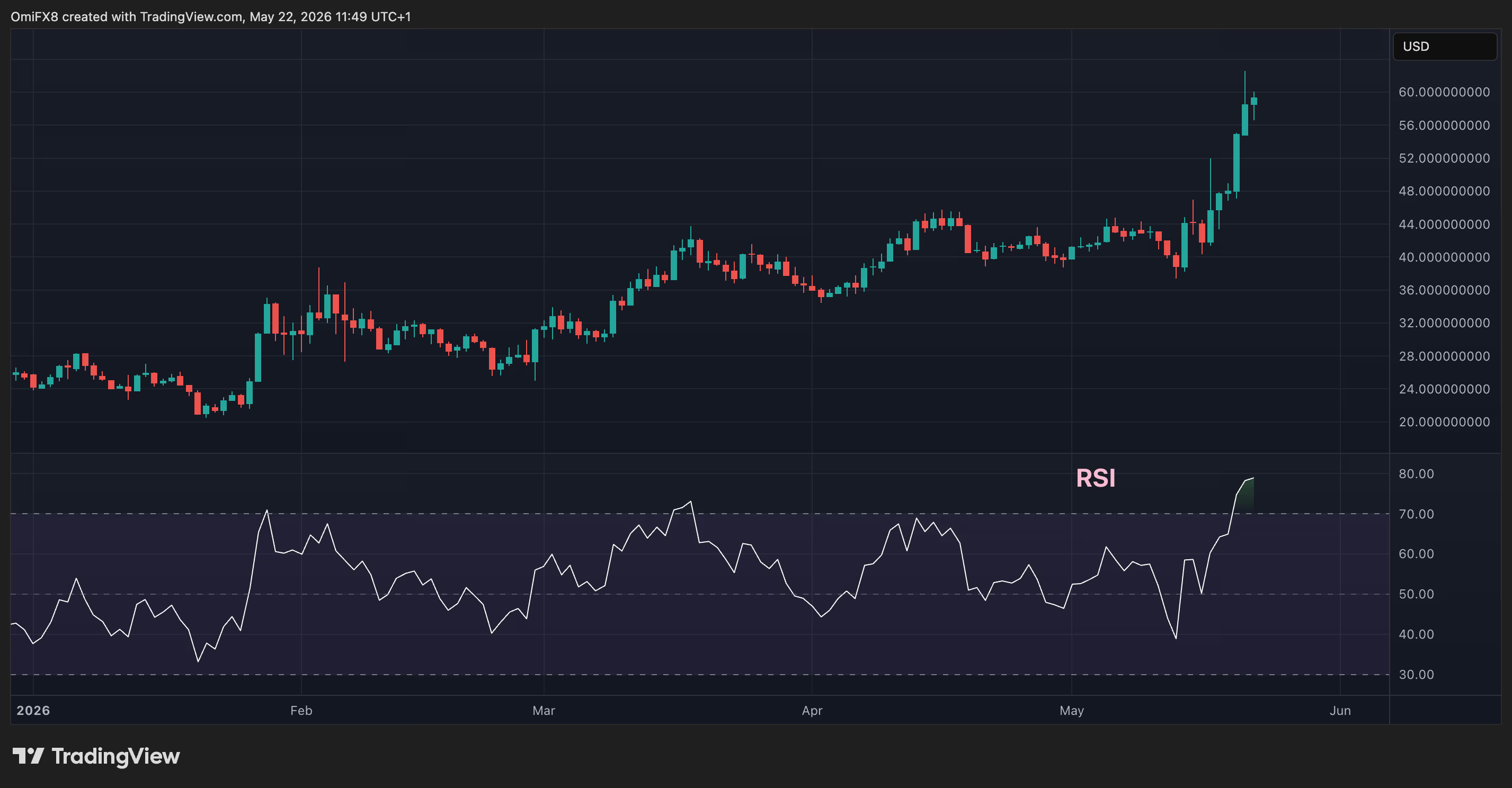
HYPE’s 14-day Relative Strength Index (RSI) has surged above 70. While readings above 70 are widely labeled as “overbought,” this interpretation is often misleading.
The RSI is a momentum oscillator that measures the speed and magnitude of recent price changes. A reading above 70 simply signals strong bullish momentum and suggests that the uptrend may still have room to run. It does not automatically mean the asset is overvalued or due for an imminent reversal, as the popular narrative often implies.
In strong trending markets, RSI can remain elevated for extended periods without triggering a meaningful pullback.

The attacker behind the Verus cross-chain bridge exploit has returned 4,052 ETH to the Verus team wallet, worth about $8.5 million at current prices. In a calculated turn, Verus had offered a 1,350 ETH bounty for the recovery of most of the stolen funds, with the exploiter retaining the remaining ETH as a reward, according to blockchain security firm PeckShield.
Verus signaled the bounty a day earlier, saying that if the attacker returned 4,052.4 ETH to the team address within 24 hours, the portion retained by the exploiter would be treated as a reward. The latest recovery illustrates how some projects pursue direct negotiations to reclaim stolen assets, a tactic that does not automatically shield individuals from law enforcement or third-party actions.
The recovery comes days after the Verus-Ethereum bridge was drained in a forged cross-chain transfer exploit, underscoring ongoing security concerns in 2026 as DeFi infrastructure faces repeated attack vectors. PeckShield documented the development on Friday, confirming the 4,052 ETH return and the 1,350 ETH bounty arrangement.
Source: PeckShield
Key takeaways
- 4,052 ETH was returned to the Verus team wallet, valued around $8.5 million, representing roughly 75% of the total funds stolen in the incident. The exploiter retains 1,350 ETH (about $2.8 million) as a bounty.
- Verus had offered the bounty as a potential incentive for recovery, stating the remaining ETH would be treated as a reward if 4,052.4 ETH was returned within 24 hours. The deal highlights a growing pattern of negotiated recoveries in DeFi incidents.
- The recovery follows a forged cross-chain drain of the Verus-Ethereum bridge, illustrating how cross-chain exploits continue to shape security priorities across DeFi infrastructure.
- April DeFi hacks surged to about $634 million in aggregate losses, with Drift Protocol ($280 million) and Kelp ($293 million) highlighted as the month’s largest incidents. May losses have slowed to roughly $38 million so far, per DefiLlama.
Verus’ recovery, and what it signals for DeFi security
The Verus incident sits at a crossroads of negotiation, enforcement, and tech risk. By publicly offering a bounty and engaging with the attacker to recover assets, Verus demonstrates a persistence among some projects to reclaim stolen funds through direct outreach rather than relying solely on external remedies. PeckShield’s analysis confirms that the recovered amount, coupled with the bounty structure, accounts for about three-quarters of the total stolen in this event, with roughly 5,400 ETH quoted as the overall loss when accounting for the bounty portion.
The game-theory aspect is notable: a targeted recovery such as this can get funds back into circulation and reduce the immediate attack surface for the protocol. Yet, it also leaves open the question of legal and regulatory action, and how authorities might respond to negotiable recoveries when illicit proceeds are involved. Verus’ public stance—recover the majority, treat the rest as a reward—reflects a pragmatic path taken by some teams under stress to preserve user assets and maintain confidence in cross-chain activity.
The broader security backdrop remains challenging. Cross-chain bridges have repeatedly proven vulnerable to forged transfers, replay attacks, and misconfigurations. The Verus incident adds to a lengthy ledger of DeFi exploits that have kept security teams and auditors on high alert. As the ecosystem experimen ts with more automated risk controls, incident response playbooks are evolving to balance rapid recovery with lawful process and transparent disclosure.
April’s DeFi breach wave and the lingering risk in May
DefiLlama’s data shows that April’s hacks totaled about $634 million in value stolen across numerous protocols, underscoring the sector’s persistent risk profile. Among the most substantial incidents in April were the Drift Protocol breach, which saw losses around $280 million, and the Kelp Restaking exploitation, with losses near $293 million. These incidents illustrate the fault lines in high-yield, cross-chain, and restaking architectures that have become attractive targets for adversaries.
By May, the pace of large breaches appeared to slow considerably. DefiLlama’s latest figures indicate approximately $38 million stolen so far in the month, suggesting a cooling period relative to the spike in April. Still, even a fraction of the earlier totals poses material risk for liquidity, governance, and user trust in DeFi ecosystems.
Beyond the raw dollar figures, the ongoing attack surface—bridges, restaking platforms, and other cross-chain primitives—remains a central concern for developers, auditors, and investors. Historical data show that private-key compromises, phishing, and credential-based breaches have driven a large share of losses over the past decade, a trend consistently highlighted by industry coverage and risk assessments. As the ecosystem evolves, observers will watch for improvements in key management, fraud prevention, and real-time fund recovery mechanisms.
Related coverage from Cointelegraph noted the broader regulatory and legal conversations surrounding DeFi security and asset recovery, as discussions about who can claim stolen funds continue to unfold in legal and policy circles. The field remains a dynamic intersection of technology, incentives, and governance that will shape how users and builders approach cross-chain activity in the years ahead.
Readers should monitor whether regulatory responses tighten the permissible scope of bounty-based recoveries or push for more standardized incident-response protocols. While the Verus case shows a potential pathway for asset reclamation, it also underscores that negotiation-based recoveries are not guaranteed to shield participants from potential enforcement actions or private litigation, depending on jurisdiction and circumstances.

Bitcoin Pizza Day has once again drawn attention to the first known real-world Bitcoin transaction, a 2010 pizza purchase that later became one of the most referenced moments in cryptocurrency history.
Summary
- Bitcoin Pizza Day commemorates the first known real-world Bitcoin purchase after Laszlo Hanyecz paid 10,000 BTC for two pizzas in 2010.
- The 10,000 BTC used in the transaction would now be worth more than $772 million with Bitcoin trading near $77,000.
- Crypto exchanges and online communities continue to celebrate May 22 each year with promotions, memes, and references to Bitcoin’s early history.
According to archived posts on the Bitcointalk forum, early Bitcoin developer Laszlo Hanyecz offered 10,000 BTC on May 18, 2010, to anyone willing to order and deliver two pizzas to his home in Florida. Four days later, 19-year-old Jeremy Sturdivant accepted the proposal and arranged for two large Papa John’s pizzas to be delivered in exchange for the coins.
At the time, Bitcoin traded for less than a cent, which placed the total value of the transaction at roughly $41. Forum discussions from that period showed that Hanyecz wanted to test whether Bitcoin could function as a payment method for physical goods rather than remain limited to online transfers between developers and hobbyists.

Laszlo Hanyecz’s post on the Bitcoin forum. Source: Near Legion on X.
Sixteen years later, the same 10,000 BTC used in the transaction would be valued at more than $772 million based on current Bitcoin prices near $77,000. Crypto users now refer to the purchase as the most expensive pizza order ever recorded.
How Bitcoin Pizza Day started
Back in 2010, Bitcoin operated as a niche software experiment with a small user base made up mostly of coders, miners, and forum members. No publicly traded companies held Bitcoin reserves, spot Bitcoin ETFs did not exist, and institutional custody services had not yet entered the market.
Against that backdrop, the pizza transaction became an early demonstration that Bitcoin could move beyond peer-to-peer testing and be exchanged for a real product. Although Sturdivant paid traditional currency to complete the pizza order, Hanyecz later transferred the agreed 10,000 BTC to him to settle the trade.
Early Bitcoin community discussions also identified Hanyecz as one of the contributors involved in advancing GPU mining. Historical accounts from Bitcoin users noted that GPU-based mining significantly increased processing efficiency compared to standard computer CPUs, allowing the network’s mining activity to scale faster during its early years.
Over time, May 22 evolved into an unofficial celebration across the crypto industry. Exchanges, traders, and blockchain companies now use the date for promotional campaigns, community events, and online memes tied to Bitcoin’s early history.
Why the pizza transaction still matters
For many Bitcoin supporters, the story remains important because it demonstrated practical utility during a period when the network had little public attention or commercial infrastructure.
In later interviews cited by crypto media outlets, both Hanyecz and Sturdivant said they did not regret the transaction despite Bitcoin’s massive price increase over the following years. Hanyecz reportedly explained that spending Bitcoin helped prove the asset could be used in economic activity rather than exist only as an experimental digital system.
Meanwhile, the anniversary has continued to serve as a reminder of Bitcoin’s growth from a forum-based project into a global financial asset traded through regulated investment products and institutional platforms.
“Bitcoin Pizza Day is far more than a historical novelty; it represents the exact inflection point where digital currency transitioned from abstract theory to real-world economic utility. What seemed like a routine transaction in 2010, exchanging 10,000 Bitcoins for two pizzas, served as the critical first proof of concept for a decentralized medium of exchange. It laid the foundational infrastructure for what has rapidly evolved into a multi-trillion-dollar digital asset economy.
Over the years, we have witnessed Bitcoin mature from an experimental internet currency into a globally recognized asset class and macro-hedging tool. The true significance of this milestone lies in the profound conviction required to champion transformative technology before its utility becomes mainstream.
Today, the narrative has shifted from skepticism to institutional imperative. With global banks, enterprise corporations, and sovereign governments actively participating in the ecosystem, Bitcoin is driving the vanguard of financial innovation. From accelerating asset tokenization to enabling seamless global value exchange, the legacy of that first transaction continues to redefine modern market structures, proving that groundbreaking innovation always begins on the fringes before reshaping the global financial core.”
– Sumit Gupta, Co-Founder of crypto exchange CoinDCX
Across social media platforms on Thursday, crypto users shared price comparisons, pizza-themed memes, and screenshots of the original Bitcointalk post as part of the yearly tradition surrounding Bitcoin Pizza Day.
16 years ago, Laszlo Hanyecz, a Floridian programmer, bought 2 Papa John's pizzas for 10,000 $BTC. Today, those pizzas would be valued at over $774M today.
Happy #Bitcoin Pizza Day, everyone! 🍕 pic.twitter.com/YlFnFgsSBX
— CoinGecko (@coingecko) May 22, 2026
This Friday, we examine Ethereum, Ripple, Cardano, Binance Coin, and Hyperliquid in greater detail.
Ethereum (ETH)
Ethereum closed the week in the red with a 6% loss after the price fell from its ascending channel. This is a bearish breakdown that could see the asset revisit the support at $2,000 in the coming week.
If the support at $2,000 doesn’t hold, the bulls will likely retreat to $1,800, a level that has held well in the past despite significant pressure from sellers. The current resistance is at $2,400 and has rejected the price several times.
Looking ahead, this cryptocurrency retains a bearish momentum on higher timeframes. This makes lower lows likely. On the other hand, the sell volume in this breakdown is declining, indicating a lack of interest from bears. This could allow bulls to return at the $2,000 support.

Ripple (XRP)
XRP fell by 7% this week after sellers rejected it at around $1.5. Since then, the bears have taken control and may soon push the price below the pennant in blue on the chart. If so, the downtrend will be reconfirmed with new lows likely.
The most important support levels are found at $1.2 and $1. Should the price fall below the pennant, a test of these levels becomes likely. The current resistance is at $1.6 and has rejected any attempts at a breakout.
Looking ahead, XRP may make new lows as its downtrend that started in July 2025 is still ongoing. Without a major break above $1.6 or even $2, it’s not possible to talk about a possible bottom and reversal.

Cardano (ADA)
ADA tried to rally, but failed and closed the week with a 6% loss. This comes after sellers rejected the price at the $0.28 resistance. Since then, this cryptocurrency fell back towards its key support at $0.24.
Should buyers not return soon, a retest of the key support would be interpreted as a bearish signal and weakness in the price action. Cardano has been moving sideways above $0.24 for months without any successful breakout.
Looking ahead, this cryptocurrency is walking a very thin line, which could cause it to drop below the key support. If so, new lows would open at $0.20 and $0.15, levels not seen since 2021.

Binance Coin (BNB)
BNB has been in a flat trend for months, stuck between the support at $580 and the resistance at $690. There were two attempts to break the key resistance, but both were rejected. This is why this cryptocurrency closed this week with a 4% loss.
If buyers don’t up their pressure soon, then the price is likely to slowly fall back to the key support. A break below that would open the way for sellers to aim for $500 next.
Looking ahead, Binance Coin remains in a downtrend that started in October 2025, after its all-time high at $1,300. This current sideways movement could be just a pause before lower lows resume.

Hype (HYPE)
HYPE was the undisputed leader this week after its price rallied by 30% to make a new record at $62.5. This impressive performance comes after the price cleared the resistance at $43. Since then, it has been up only.
This recent rally makes this cryptocurrency one of the very few altcoins that managed to triple in price since the lows from January, around $20. While most altcoins were in a bear market, HYPE rallied aggressively.
Looking ahead, the price may enter a pullback after touching $60, with good support found around $52. However, that level may not be tested if bulls remain aggressive and send this cryptocurrency higher yet again.

The post Crypto Price Analysis May-22: ETH, XRP, ADA, BNB, and HYPE appeared first on CryptoPotato.
Chinese and U.S. flags flutter near The Bund, before U.S. trade delegation meet their Chinese counterparts for talks in Shanghai, China July 30, 2019.
Aly Song | Reuters
SUZHOU, China — The U.S. is working hard to ensure American technology is used in Asia, a senior State Department official told CNBC, as China races to build alternatives that are often cheaper.
“We’re very active in promoting U.S. AI options and solutions,” Casey K. Mace, senior official for APEC and economic policy, told CNBC on Friday on the sidelines of the APEC trade ministers’ meeting in Suzhou, and a week after U.S. President Donald Trump brought a host of tech CEOs on his visit to the country.
As the two countries race to develop the technology, the U.S. has restricted Chinese access to advanced U.S. chips. Beijing has already banned Google and Facebook in mainland China.
Mace said U.S. tech companies would be giving workshops at an APEC “digital week” in Chengdu in July. While China is the host of the event, “it’s an opportunity to engage with all 21 [APEC] economies,” he added.
Mace declined to name specific U.S. companies taking part, and pushed back when asked if the U.S. was advocating “best in class” American tech over Chinese alternatives.
He said he had met with U.S. tech companies with a presence in China and that he expected they would be able to expand their access to its market.

China is hosting this year’s APEC trade ministers’ meetings, which are set to wrap up in November in the tech hub of Shenzhen.
Working-level conversations alongside Asia Pacific Economic Cooperation meetings in China this month focused on promoting U.S. AI in food traceability, genome sequencing and biotech, Mace said.
He said the tone has been “positive,” which he attributed partly to the “very successful meeting between President Trump and President Xi” in Beijing last week.
Following high-level engagement, the two countries have agreed to begin discussions about safe development of AI, China’s foreign ministry confirmed on Tuesday. It’s unclear when or how those talks will begin.
“There is pressure to distribute American compute globally,” Ryan Fedasiuk, fellow at the American Enterprise Institute, told CNBC last week.
“The Trump administration is right in trying to advocate and implement with this,” he said. “But it will compete with Chinese hyperscalers and Chinese AI labs that are attempting to do exactly the same.”
Fedasiuk added that he is watching for coordination between the U.S. and Chinese sides to screen vendors of DNA synthesis services so as to prevent the manufacture of another pandemic.


- AI developments helped push NEAR Protocol trading volume over $1 billion.
- The price of NEAR coin broke above a multi-year bearish trendline.
- Eyes are now on the support at $2.20 and the resistance at $2.30 for the next move.
NEAR Protocol surged nearly 29% in the last 24 hours, making it one of the strongest-performing large-cap cryptocurrencies in the market today.
The rally pushed the token to around $2.26 after trading as low as $1.73 earlier in the day.

NEAR’s trading activity also climbed sharply, with daily volume approaching $1 billion as momentum accelerated across major exchanges.
The reason why the Near Protocol coin price is rising
One of the biggest drivers behind the latest Near Protocol price jump is the growing interest in AI-focused blockchain projects.
NEAR Protocol has increasingly been associated with the AI sector due to its recent product developments, including AI integrations, intent-based transactions, and tools designed for autonomous agents.
The project recently highlighted progress around its NEAR Legion project.
The concept focuses on allowing AI agents to interact with blockchain networks, execute transactions, and coordinate activities without requiring constant human input.
This narrative has gained traction as the broader technology sector shifts attention toward agentic AI systems.
Notably, NVIDIA CEO Jensen Huang has repeatedly discussed the growing role of agentic AI in future software and computing systems.
That trend has spilled over into the crypto market, where traders are now looking at blockchain networks that could support machine-to-machine transactions and decentralised AI infrastructure.
NEAR Protocol has also expanded its Intents framework, which simplifies cross-chain interactions and transaction execution.
The technology is designed to let users or AI agents specify desired outcomes rather than manually executing every transaction step.
The market has responded positively to this development because it addresses one of crypto’s biggest problems: user experience.
Another development that attracted attention this week was the launch of PII anonymisation tools by NEAR AI.
The feature is designed to improve privacy for large language model applications by protecting sensitive information before it reaches AI systems.
Privacy-focused AI infrastructure has become an important discussion point as companies and developers face growing concerns around data protection and compliance.
The AI angle around NEAR carries additional weight because of the project’s leadership.
NEAR co-founder Illia Polosukhin previously co-authored the “Attention Is All You Need” research paper, which introduced the Transformer architecture that powers modern AI models such as ChatGPT and Gemini.
Analysts have increasingly pointed to this connection as evidence that NEAR’s AI strategy is more than just branding.
Technical breakout and short liquidations accelerated the rally
Beyond the AI narrative, technical factors also played a major role in today’s rally.
NEAR recently broke above a multi-year descending trendline that had capped its price since the 2022 bear market.
Analysts had been watching the $1.90 resistance zone closely because it acted as a ceiling during several previous recovery attempts.
Once the token moved above that level, buying momentum accelerated rapidly.
The breakout was accompanied by a sharp rise in trading volume, which is often viewed as confirmation that a move has strong market participation behind it.
NEAR also reclaimed several major moving averages during the rally, improving the token’s overall technical structure.
Short liquidations added further fuel to the move. Data from derivatives markets showed that most crypto liquidations tied to NEAR over the past 24 hours came from short positions.
As the price continued to rise, traders betting against the token were forced to buy back their positions, creating additional upward pressure.
NEAR price forecast
The Near Protocol token has gained nearly 60% in the last 30 days and is now up more than 43% over the past week.
However, despite the rally, NEAR remains far below its all-time high of $20.44 reached in January 2022.
The token is currently trading about 89% below that peak, although it has recovered more than 325% from its all-time low recorded in November 2020.
Moving ahead, the first major support zone sits around $2.20.
Holding above this level could help maintain bullish momentum in the near term. Below that, the $1.90 area remains important because it previously acted as a breakout resistance zone.
On the upside, the immediate resistance range sits between $2.30 and $2.40 after the latest surge stalled near those levels.
A decisive move above that region could open the door toward the psychological $3.00 level, which many traders are now monitoring as the next major target.


A petition for the abolition of South Korea’s planned 22% cryptocurrency tax has surpassed 50,000 signatures.
It now heads to the National Assembly’s Finance and Economic Planning Committee for review. Lodged on May 13, the petition crossed the threshold on May 21. It now holds 53,359 signatures.
Crypto Tax Set to Take Effect in 2027
South Korea’s 20% crypto tax, which rises to 22% with local surcharges, takes effect January 1, 2027. The law applies to gains exceeding 2.5 million won.
The petitioner argues it’s unfair that South Korea abolished the Financial Investment Income Tax (which would have taxed stock gains) but is still moving forward with taxing crypto gains.
They claim this creates inequality among investors, harms young people trying to build wealth, ignores the current crypto market downturn, and lacks adequate investor protection infrastructure.
“Due to soaring real estate prices, asset formation for young people is becoming increasingly difficult. In a reality where home purchase is impossible without accumulated assets, virtual assets are perceived by some young people as effectively a last investment opportunity. If an additional tax burden is added in this situation, asset-building opportunities for young people may be further reduce,” the petition reads.
Follow us on X to get the latest news as it happens
South Korea has delayed implementing crypto taxation three times since its original 2022 start date. This petition is part of the ongoing public pressure to scrap it entirely rather than just delay it again.
Meanwhile, in March, People Power Party floor leader Song Eon-seok filed a bill to eliminate all provisions related to digital asset taxation included in the current Income Tax Act.
Nonetheless, the Ministry of Economy and Finance publicly reaffirmed this month that the tax will proceed in January 2027. That’s the wall this petition is running into, and it landed just days before the petition was filed.
Subscribe to our YouTube channel to watch leaders and journalists provide expert insights
The post Over 50,000 South Koreans Sign Petition to Block 2027 Crypto Tax appeared first on BeInCrypto.


Bitget has launched SPCXUSDT, a SpaceX-linked pre-IPO perpetual contract that gives traders derivative exposure before any public listing.
Summary
- Bitget launched SPCXUSDT, a USDT-settled perpetual contract tied to SpaceX pre-IPO market expectations.
- The product offers 24/7 trading, 5x leverage, and eight-hour funding fee settlement.
- SpaceX-linked derivatives are growing as traders seek exposure before the company’s reported Nasdaq debut.
Bitget said SPCXUSDT is an IPO Pre-Market Perpetual Contract linked to SpaceX. The product is designed to let users trade market expectations around a possible SpaceX listing without waiting for public shares to begin trading.
The exchange said the contract is settled in USDT and runs on a 24/7 schedule. It supports up to 5x leverage, has a minimum price movement of 0.01, and settles funding fees every eight hours.
Bitget product tracks expectations, not real shares
The product does not give traders ownership of SpaceX stock. It is a derivative tied to market expectations around the company’s possible public listing.
That distinction matters because private-company valuation can move sharply before an IPO. Traders are betting on price discovery, not buying registered equity. Bitget has also listed preSPAX spot exposure through its pre-IPO zone, adding another SpaceX-linked product for users.
Moreover, SpaceX has become one of the most watched private companies due to Falcon rockets, Starlink, and Starship. Reuters reported that SpaceX is targeting a Nasdaq listing as early as June 12 under the ticker SPCX.
The same report said the company may seek about $75 billion at a valuation near $1.75 trillion. The IPO process could make SpaceX one of the largest market debuts ever if completed at those levels.
Bitget’s marketing also leaned into that demand. The exchange asked whether SpaceX could follow past post-IPO gains seen in large technology companies. That question remains speculative until official pricing, share count, and demand are clear.
Crypto venues chase SpaceX trading
Bitget is not alone. Related coverage noted that Bybit launched its own SPCXUSDT perpetual contract with up to 10x leverage, allowing round-the-clock trading before the planned IPO.
Financial Times also reported that crypto platforms including Binance, Bitget, and Trade.xyz have rushed to list derivatives tied to SpaceX. These products let traders speculate on SpaceX’s future share price without owning the stock.
The trend shows how crypto exchanges are moving beyond coins into private-market exposure, tokenized assets, commodities, and equity-linked derivatives. For traders, the appeal is early access. The risk is that these contracts can move on sentiment before official IPO terms are final.
For Bitget, SPCXUSDT fits its wider Universal Exchange strategy. For the market, it shows that SpaceX IPO demand is already being priced in crypto before Wall Street gets a final public share price.
Separately, Bitget has also linked its wider brand push to education and inclusion work. UNICEF says Bitget joined its Game Changers Coalition through Blockchain4Her, aiming to reach 300,000 people in 2025 and expand STEAM learning with blockchain and Web3 literacy.

Polymarket, a global prediction market platform, is reportedly seeking entry into Japan amid growing regulatory scrutiny of the sector worldwide.
The company has appointed Mike Eidlin, head of Japan at crypto firm Jupiter, to lead its local efforts and is preparing to lobby for authorization of prediction markets in the country, Bloomberg reported Friday, citing people familiar with the matter.
Polymarket is targeting government approval in Japan by 2030, viewing the market as a major untapped opportunity.
The plans come as prediction markets, including Polymarket and rival Kalshi, face increased regulatory pressure globally, with countries such as India among the latest to move against the platforms.
Japan’s strict gambling rules pose hurdle
Japan has strict laws around online gambling, permitting betting only on select government-authorized activities such as horse racing and public lotteries.
Authorities have stepped up scrutiny of online betting in recent years, with violations linked to online casino use carrying fines of up to $3,400 and potential prison sentences of up to three years for repeat offenses.
Polymarket reportedly said the company has seen “meaningful organic interest from users” in the country and across Asia, adding: “We’re always evaluating opportunities to expand access globally in compliant and locally appropriate ways.”
Cointelegraph approached Polymarket for comment but had not received a response by publication.
Related: CFTC sues Minnesota, Governor Tim Walz over prediction markets ban
Polymarket’s Japan community on X already exceeds 53,000 followers
Despite only seeking regulatory approval to operate in the country, Polymarket already has a Japan-focused X account with more than 53,000 followers,
Cointelegraph was not able to identify any other Polymarket regional community of comparable size on X at the time of writing.

Source: Polymarket Japan
Polymarket lists Japan among 35 restricted jurisdictions, including the United States, according to its country access policy. However, past reporting indicates users in restricted regions may still access the platform using tools such as VPNs.
Trading volumes fall amid regulatory pressure and competition
Polymarket’s trading activity has come under pressure amid rising regulatory scrutiny across multiple jurisdictions and growing competition from platforms such as Kalshi.
According to Token Terminal data, Polymarket’s monthly notional trading volume fell nearly 15% in April, while Kalshi saw an increase of about 13%.
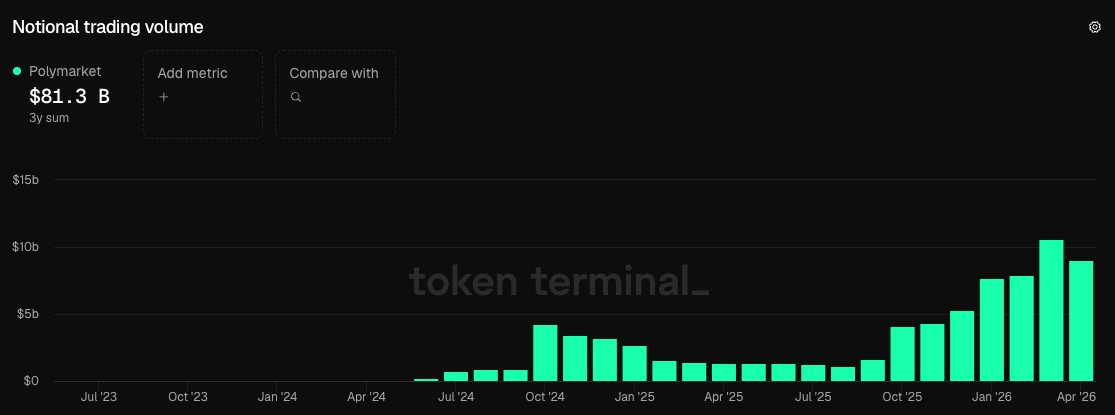
Polymarket’s monthly notional trading volume. Source: Token Terminal
Polymarket’s access is also increasingly restricted globally, with the platform blocked in roughly 34 countries and subject to “close-only” restrictions in four others, according to Start Polymarket data.
Related: Polymarket team says user funds safe as exploit losses climb above $600K
India is among the latest jurisdictions moving to restrict access to prediction markets, with authorities reportedly preparing blocking orders against rival platform Kalshi following earlier action against Polymarket.
Magazine: Should users be allowed to bet on war and death in prediction markets?


F2Pool co-founder Chun Wang plans to join SpaceX’s Starship program for a two-year mission that would fly beyond the Earth-Moon system and past Mars.
Summary
- F2Pool co-founder Chun Wang plans to join SpaceX’s two-year Starship mission for a Mars flyby.
- Wang previously commanded Fram2, the first human spaceflight to fly over Earth’s polar regions.
- F2Pool remains a major Bitcoin mining pool, holding about 10% market share by recent data.
SpaceX has announced Wang as part of a planned Starship mission that would travel beyond the Earth-Moon system, conduct a Mars flyby, and return to Earth. Universe Today reported that SpaceX described the trip as a two-year round journey, though no launch date has been announced.
Wang said the mission would start with a flyby rather than a landing. He said “It’s going to be a flyby mission of Mars,” adding that such a flight could help build momentum for future missions.
Lunar flight comes before Mars
Before the Mars trip, Wang is expected to join Dennis Tito and Akiko Tito on a planned commercial Starship flight around the Moon. The weeklong mission would pass within about 200 kilometers of the lunar surface, according to the same report.
Wang said the Moon flyby would test new work for Starship. He said “Even though it’s just a flyby,” the mission would attempt several things that have not been done before.
Meanwhile, Wang is not new to private spaceflight. Earlier reports noted that he funded and commanded Fram2, SpaceX’s first crewed mission to fly over Earth’s polar regions. The mission launched in 2025 with Wang, Jannicke Mikkelsen, Rabea Rogge, and Eric Philips aboard Dragon Resilience.
The mission aimed for a 90-degree inclination, sending the crew over both poles. Related coverage said Fram2 carried scientific work linked to human health, space travel, polar auroras, and microgravity.
F2Pool link keeps crypto in the story
Wang co-founded F2Pool in 2013. The pool later became one of the largest Bitcoin mining pools, giving Wang a central place in early Bitcoin mining history.
F2Pool still ranks among the largest Bitcoin mining pools. Hashrate Index data shows F2Pool with about 107.2 EH/s and an 10% Bitcoin mining pool market share, behind Foundry USA and AntPool.
The SpaceX plan now places Wang among the small group of crypto-linked figures using private wealth for human spaceflight. It also adds a new chapter to the link between Bitcoin mining profits and high-risk frontier projects.
For now, the Mars mission remains a plan without a fixed launch date. Starship is still in testing, and long-duration private flights beyond the Moon remain complex. Still, Wang’s role gives the crypto industry a rare connection to SpaceX’s push beyond Earth orbit.
Bitcoin (BTC) left behind in the geopolitical melee: Crypto Daily

Findings From Files On Andrew Mountbatten-Windsor’s Trade Envoy Job

St. George Illawarra Dragons vs New Zealand Warriors Tips, Odds, Teams & Predictions – NRL Round 12 2026


-

 Crypto World6 days ago
BloFin War of Whales 2026 Grand Prix opens registration for $5M trading championship
-

 Fashion7 days ago
Weekend Open Thread: Theory – Corporette.com
-

 Crypto World7 days ago
E-Estate Announces 1 Year Live: Washington DC Summit as Real Estate Tokenization Enters Its Next Phase
-

 Tech6 days ago
Google reimburses Register sources who were victims of API fraud
-

 Business7 days ago
H&R Real Estate Investment Trust (HR.UN:CA) Q1 2026 Earnings Call Transcript
-

 Entertainment7 days ago
David Letterman Returns to Late Show, Blasts Cancellation
-

 Sports7 days ago
Napoleonic enters 2026 Doomben 10,000 field via Abounding withdrawal
-

 Crypto World7 days ago
BeInCrypto 100 Institutional Awards Nomination: KAST for Best Digital Assets Neobank and Best Digital Assets Fintech
-
 Crypto World6 days ago
Bitcoin Battles US Bond Nerves With BTC Price Dip Toward New May Lows
-

 Crypto World7 days ago
ICE and CME urge US regulators to curb Hyperliquid energy trading
-
 Crypto World6 days ago
Wall Street’s Boldest Gold Prediction Has Russians Rushing to Buy
-

 Fashion5 days ago
On the Scene at Gucci’s Cruise Show in New York City: Mariah Carey, Kim Kardashian, Lindsay Lohan, Iman, and More!
-

 Crypto World7 days ago
IREN closes $3 billion convertible notes deal amid AI infrastructure expansion
-

 Fashion6 days ago
Trending Western Style Vests Perfect for Summer
-

 Politics6 days ago
Watch: far-right flag-fanatics run over victim, attack locals – Setup By the Left wing for your entertainment
-

 Crypto World18 hours ago
Blockchain.com files with SEC for U.S. IPO
-

 Fashion7 days ago
Creative Ideas for Custom T-Shirts
-

 Fashion5 days ago
Amazon Sundays: Memorial Day Hosting
-

 Crypto World7 days ago
Crypto Market Structure Bill Clears Committee; Senate Vote in Focus
-

 Entertainment5 days ago
Off Campus Easter Eggs Explained: Characters, Stories, More
You must be logged in to post a comment Login