

Crypto World
Over 50,000 South Koreans Sign Petition to Block 2027 Crypto Tax



A petition for the abolition of South Korea’s planned 22% cryptocurrency tax has surpassed 50,000 signatures.
It now heads to the National Assembly’s Finance and Economic Planning Committee for review. Lodged on May 13, the petition crossed the threshold on May 21. It now holds 53,359 signatures.
Crypto Tax Set to Take Effect in 2027
South Korea’s 20% crypto tax, which rises to 22% with local surcharges, takes effect January 1, 2027. The law applies to gains exceeding 2.5 million won.
The petitioner argues it’s unfair that South Korea abolished the Financial Investment Income Tax (which would have taxed stock gains) but is still moving forward with taxing crypto gains.
They claim this creates inequality among investors, harms young people trying to build wealth, ignores the current crypto market downturn, and lacks adequate investor protection infrastructure.
“Due to soaring real estate prices, asset formation for young people is becoming increasingly difficult. In a reality where home purchase is impossible without accumulated assets, virtual assets are perceived by some young people as effectively a last investment opportunity. If an additional tax burden is added in this situation, asset-building opportunities for young people may be further reduce,” the petition reads.
Follow us on X to get the latest news as it happens
South Korea has delayed implementing crypto taxation three times since its original 2022 start date. This petition is part of the ongoing public pressure to scrap it entirely rather than just delay it again.
Meanwhile, in March, People Power Party floor leader Song Eon-seok filed a bill to eliminate all provisions related to digital asset taxation included in the current Income Tax Act.
Nonetheless, the Ministry of Economy and Finance publicly reaffirmed this month that the tax will proceed in January 2027. That’s the wall this petition is running into, and it landed just days before the petition was filed.
Subscribe to our YouTube channel to watch leaders and journalists provide expert insights
The post Over 50,000 South Koreans Sign Petition to Block 2027 Crypto Tax appeared first on BeInCrypto.



Tom Lee, chairman of Bitmine Immersion Technologies and co-founder of Fundstrat, does not expect the coming wave of mega IPOs to derail markets even if they could eclipse the entire dot-com boom in scale.
Lee recently discussed the potential effect of SpaceX, Anthropic, and OpenAI listing which could unleash trillions of dollars in new equity supply into public markets.
In inflation adjusted terms, Elon Musk’s SpaceX alone could become the second largest IPO ever, seeking a market valuation above $1.5 trillion, behind only Saudi Aramco.
Lee acknowledged concerns about the amount of supply these listings could introduce into public markets, especially after the standard 90-day lock-up periods expire. He noted that SpaceX is likely the most anticipated IPO ever, Lee estimates the three IPOs could generate trillions in supply, equivalent to roughly 5% to 6% of the S&P 500’s total market capitalization.
Despite the scale, Lee does not believe the situation is necessarily outright bearish for the markets. He argues that family offices, pensions, and high net worth investors currently hold historically low allocations to public equities after years of favoring private markets and alternative investments.
There is significant capital available to absorb the liquidity as allocations rotate back toward U.S. public stocks, in Lee’s view.
He also expects many early investors to hedge or borrow against holdings rather than immediately sell and trigger large tax events.
Lee also discussed cryptocurrency’s underperformance against expectations despite growing institutional interest, highlighting how instant settlement and transaction verification are driving Wall Street’s push towards tokenisation, a point he previously made at Consensus Miami 2026.
Furthermore, Lee believes blockchain could provide a neutral framework for identity verification in an AI driven world. Banks are increasingly circling the industry because they recognize the significant revenue opportunities emerging from the convergence of crypto, AI, and finance, he added.
China’s securities regulator is shutting down mainland operations of major online brokers Tiger Brokers, Futu Holdings, and Longbridge over a two-year wind-down. These are online brokerage platforms based in Hong Kong and overseas that let users trade US, Hong Kong, and other global stocks from their phones.
Mainland Chinese investors flocked to them because they offered cheap, easy access to foreign markets like US equities. Now, some of that frozen capital could flow into crypto channels like USDT and OTC desks.
What the CSRC Crackdown Targets
The cases name Tiger Brokers (NZ) Limited, Futu Securities International (Hong Kong) Limited, and Longbridge Securities (Hong Kong) Limited.
Each entity allegedly handled trading orders, public fund sales, and futures brokerage for mainland customers without a Chinese license.
According to the CSRC, the firms violated the Securities Law, the Securities Investment Fund Law, and the Futures and Derivatives Law.
The agency plans to seize all illegal gains from the domestic and overseas units involved in the business.
“In accordance with relevant regulations, the CSRC intends to confiscate all illegal gains of Tiger Brokers (NZ) Limited, Futu Securities International (Hong Kong) Limited, and Changqiao Securities International (Hong Kong) Limited, both domestically and internationally, and impose severe penalties according to law,” local media reported.
Existing mainland users will only be allowed to sell positions and withdraw funds during the two-year wind-down. New deposits and new buy orders are blocked immediately.
After the cleanup window, the platforms must shut their China-facing websites, apps, and servers.
Legal overseas routes such as the Qualified Domestic Institutional Investor (QDII) program and the Hong Kong Stock Connect stay open.

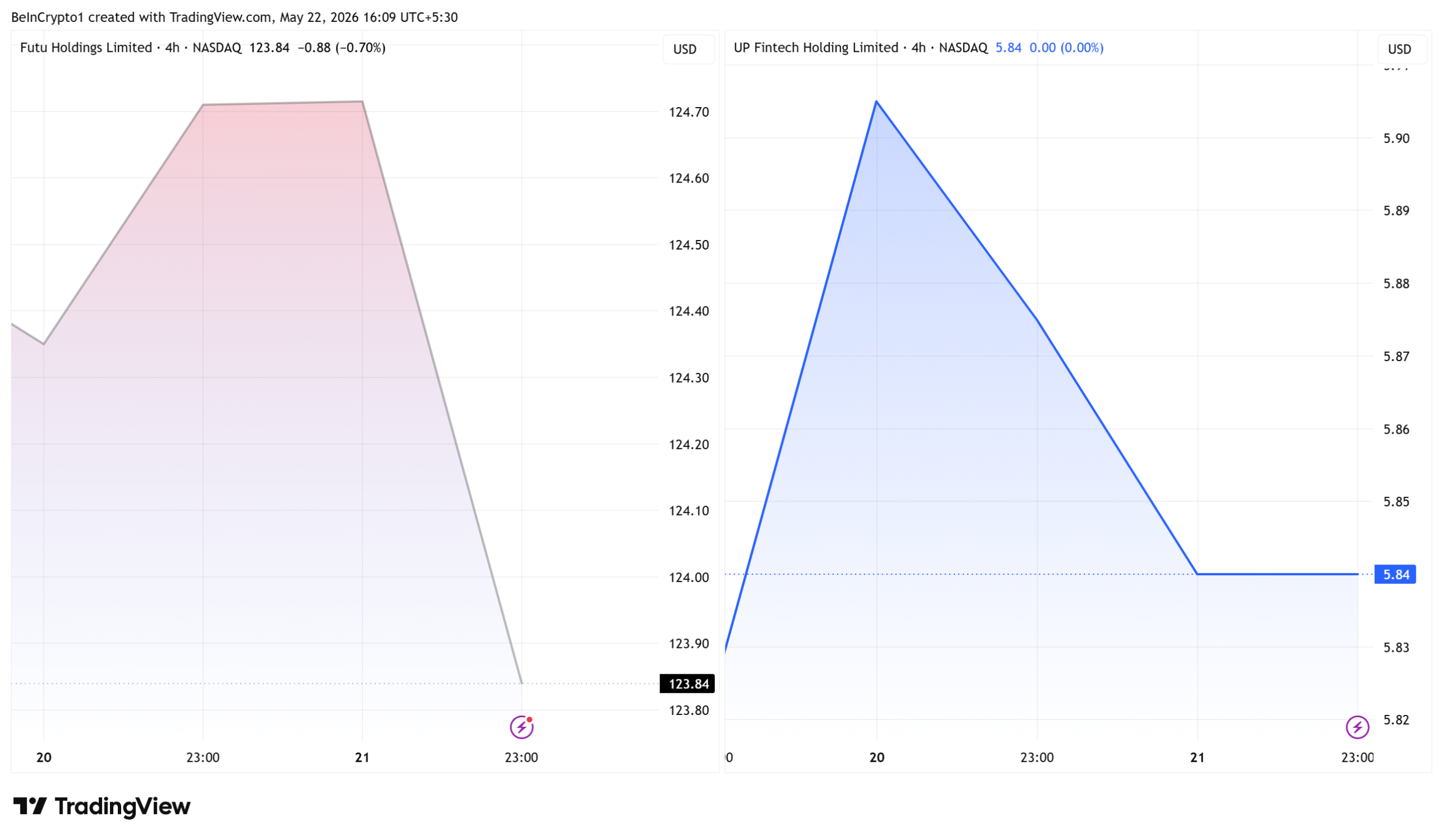
The FUTU and TIGR stocks dipped on the news and were trading for $123.84 and $5.84, respectively, as of this writing.
Why Crypto Rails Could Absorb Some of the Flow
China’s $50,000 annual foreign exchange quota leaves most retail investors with little legal room to move money offshore.
Tiger and Futu filled that gap for years through grey-market onboarding. Their mainland clients have driven a large share of trading revenue at both firms.
With those accounts frozen, demand could rotate toward over-the-counter (OTC) desks and peer-to-peer (P2P) exchanges.
These channels form the main route for Chinese traders bypassing restrictions, often running through offshore platforms accessed via VPN.
Tether’s USDT remains the dominant on-ramp. Underground brokers have routinely sold USDT at premium prices against the yuan during past capital flight episodes.
A similar premium could return if Tiger and Futu’s mainland clients shift to crypto.
The wider stablecoin dollar dominance trend shows how quickly USD-pegged tokens can fill gaps left by TradFi. Industry estimates put the number of Chinese crypto users at over 20 million despite the 2021 ban.
Legal Channels Survive, But Crypto Faces Its Own Wall
The QDII program, Cross-border Wealth Management Connect, and the Hong Kong Stock Connect remain open.
However, those routes carry strict quotas, higher fees, and limited product menus. None of them match the speed or breadth of US stock access Tiger and Futu offered.
“Bitcoin as a Limitless Haven: Unlike traditional investments, Bitcoin has no QDII/QFII limits…Chinese fund houses face overseas investment quotas under the QDII program… quotas are quickly reached daily, leading to premiums… quotas are maxed out, halting some mutual funds… tired of the restrictions…,” analyst Kyle Chasse stated.
Crypto is also far from a safe substitute. Beijing has spent 2026 widening its position against private digital assets.
The People’s Bank of China (PBOC) and the CSRC expanded China’s sweeping crypto ban in February. The notice now covers stablecoins and tokenization activity.
The same February policy, which marked China’s stablecoin enforcement push, targets foreign issuers that offer services to Chinese residents.
Any large rotation into USDT or on-chain US equity products would likely draw similar scrutiny.
The brokers have the right to a hearing before final penalties are issued. Beijing’s two-year deadline gives regulators time to monitor where displaced capital lands.
The post China’s Offshore Trading Crackdown Could Unleash a New Wave of Crypto Capital Flight appeared first on BeInCrypto.


Intercontinental Exchange Inc. (ICE), owner of the New York Stock Exchange, and OKX announced Friday that they are joining forces to roll out perpetual oil futures.
In a joint statement, the firms’ said ICE’s futures prices for Brent crude and West Texas Intermediate (WTI) will bolster the new perpetual contracts on OKX.
The new perpetual contracts based on ICE’s data will open energy benchmark product access to OKX’s 120 million retail traders, said Trabue Bland, senior vice president of futures exchanges at ICE.
The new contracts will be available on OKX, in which ICE holds a stake, across territories where the crypto company is already licensed to offer perpetual futures.
“Oil markets are critical to the world economy,” Haider Rafique, global managing partner at OKX, said in the statement. Bringing ICE’s benchmarks “into regulated perpetual futures is exactly the kind of bridge between traditional and digital markets that market participants have been asking for.”
The ICE and OKX foray into oil perps comes as Hyperliquid’s oil futures contracts that never expire have proven to be a tremendous success, consistently generating roughly $1.6 billion in daily trading volume and more than $1.3 billion in open interest.
Perpetual futures, also known as “perps,” are a type of derivative contract that give traders the ability to bet on prices of assets such as oil or bitcoin. But unlike traditional futures, perps never expire, so traders don’t have to take possession of physical barrels of oil or roll over those contracts.
Most perpetual products are offered on offshore exchanges and are not regulated the same way traditional commodity exchanges such as ICE and CME Group Inc. are in the U.S., but Michael Selig, the chair of the Commodity Futures Trading Commission (CFTC), recently said he will bring them under his agency’s oversight soon.
In a sign of the increasing confluence of crypto and traditional financial (TradFi) firms, ICE and OKX signed a deal in March to build technology, including blockchain networks, that would give ICE’s customers access to crypto-based futures and OKX customers the ability to trade tokenized securities on NYSE’s platform. ICE also made a strategic investment valuing the San Jose, California-based company at $25 billion.
Polymarket confirmed a security exploit affected part of its infrastructure, pointing to a possible private key compromise involving a wallet used for top-up operations, while saying user funds and market resolution were safe.
In a Friday X post, Polymarket developers said contracts and core infrastructure were unaffected. Polymarket product lead Akanshu Jain and multiple other Polymarket employees also said user funds and market resolution are safe.
Blockchain investigator ZachXBT first flagged the exploit as a compromise to the Polymarket-linked UMA Conditional Tokens Framework (CTF) Adapter contract on Polygon, with the exploiter draining at least $520,000.
However, Josh Stevens, Polymarket’s vice president of engineering, said the contracts were safe and that the exploit was limited to a six-year-old private key used for internal top-up operations. All permissions tied to the key have been revoked, he said.
The UMA CTF adapter is an oracle contract used to help resolve Polymarket prediction markets through UMA’s Optimistic Oracle. Polymarket is the world’s second-largest prediction market with $3.7 billion in monthly trading volume, according to DefiLlama.
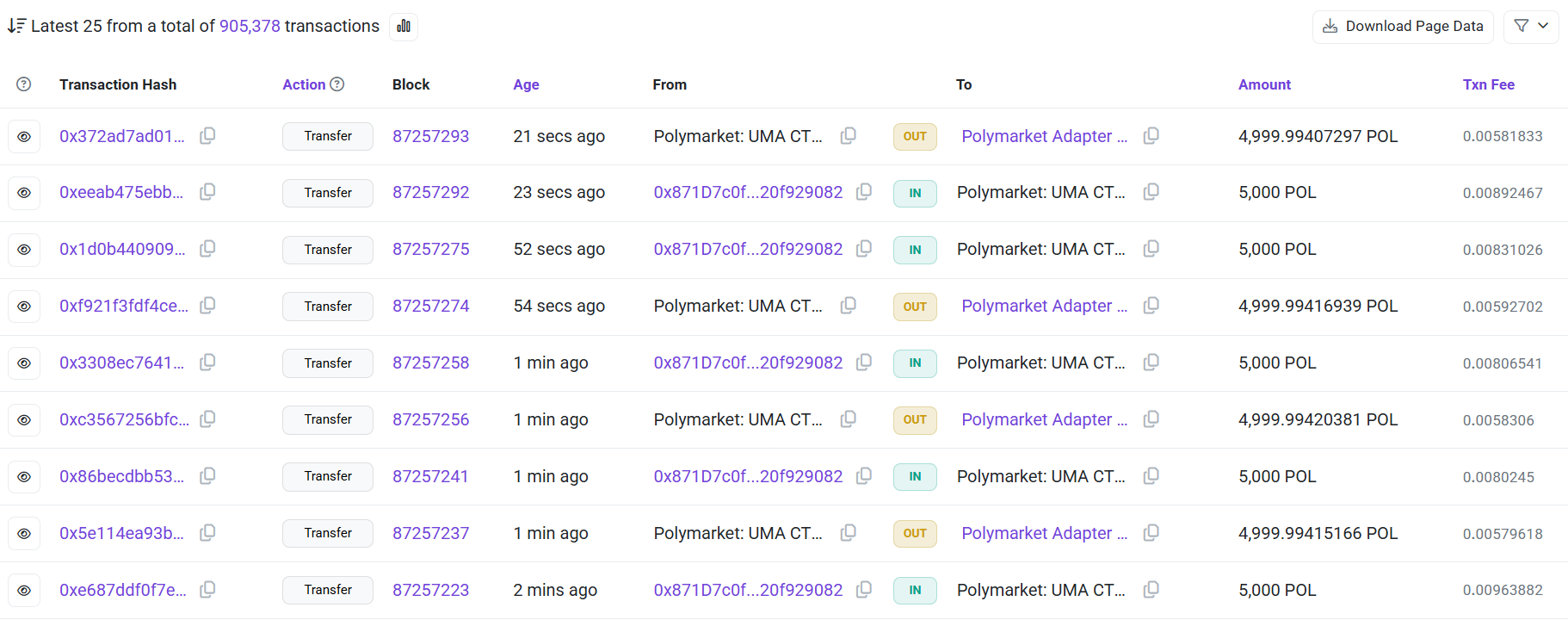
Polyscan data reviewed by Cointelegraph showed more than 100 small transfers into the alleged attacker wallet. Most were worth up to 5,000 Polygon (POL) tokens.
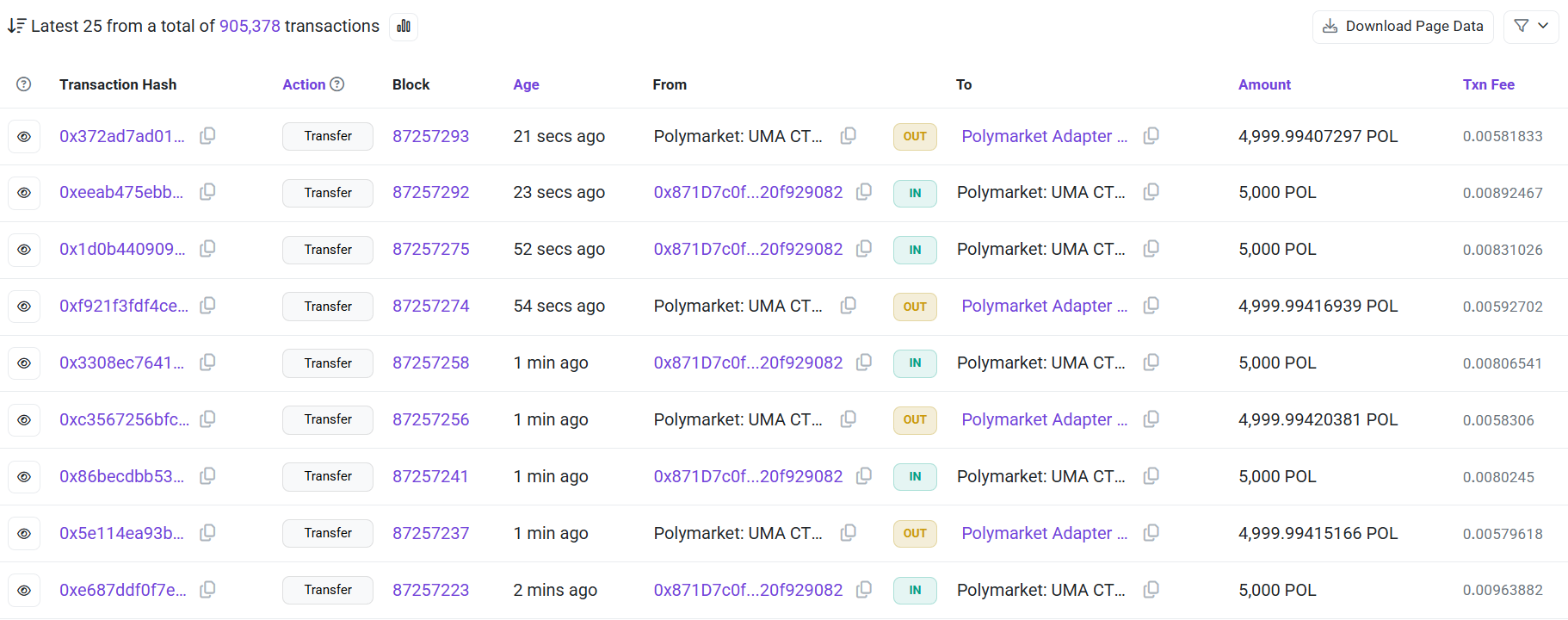
Address of the alleged Polymarket adapter contract attacker. Source: Polygonscan
Exploit losses climb past $600,000
Multiple blockchain data platforms reported similar onchain activity tied to the suspected exploit.
Blockchain data visualization platform Bubblemaps said in a Friday X post that the attacker continues to remove about 5,000 POL tokens every 30 seconds, amassing about $600,000 in stolen funds so far.
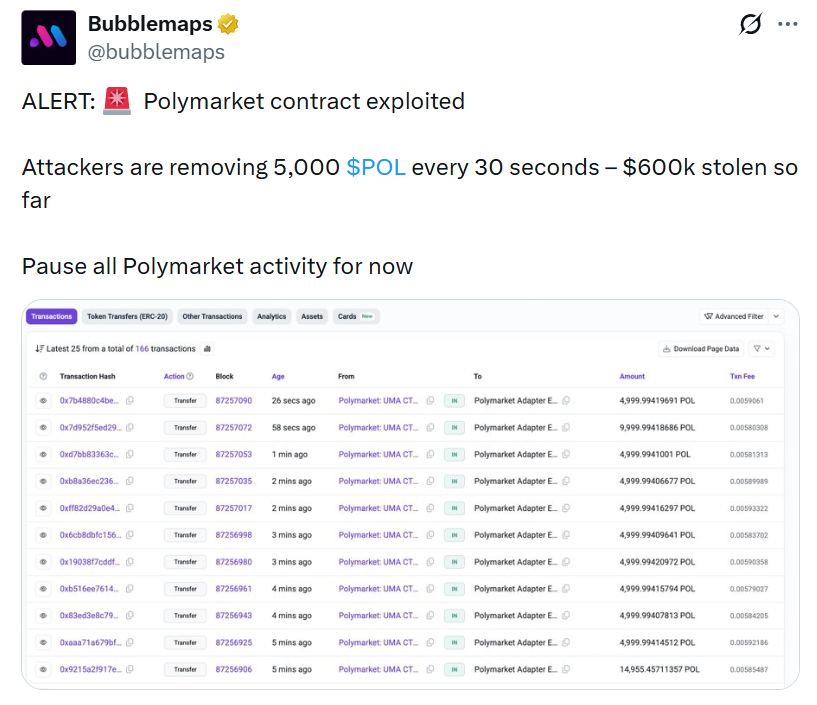
Source: Bubblemaps
Blockchain data platform Lookonchain estimated that about $660,000 was drained from the Polymarket-linked contract as of 9:01 am UTC on Friday.
Related: Crypto VC funding plunges to $659M in April, hits near two-year low
Polymarket integrated UMA’s optimistic oracle solution on Feb. 3, 2022, enabling automated and decentralized resolution for its prediction market contracts.
Cointelegraph contacted Polymarket and UMA for comment but had not received a response by publication.
Magazine: The legal battle over who can claim DeFi’s stolen millions


Ark Invest bought $5 million worth of Bullish (BLSH) stock on Thursday, the fourth day in a row it has added BLSH shares to its exchange-traded funds (ETFs).
Cathie Wood’s investment manager has purchased $12.5 million worth of shares in the crypto group, which is also CoinDesk’s parent company, since Monday based on the stock’s closing prices, according to emailed disclosures.
BLSH shares closed 0.2% lower at $35.96 on Thursday, having fallen more than 17% in the last two weeks, a period in which bitcoin struggled to break above the $80,000 resistance.
Ark frequently uses broader digital asset downturns, which tend to pull crypto equities lower, as an entry point into cryptocurrency companies.

Polymarket, a global prediction market platform, is pursuing a launch in Japan as regulators worldwide tighten scrutiny of the sector. Bloomberg reported that Polymarket has appointed Mike Eidlin—formerly the head of Japan at crypto firm Jupiter—to lead its local efforts and to push for regulatory authorization to operate prediction markets in the country. The company is aiming for government approval by 2030, signaling a long-range strategy to tap what it views as a sizeable, underpenetrated market.
The expansion plans come amid a broader tightening of regulatory oversight affecting prediction markets globally, with Polymarket and peers such as Kalshi facing increased scrutiny in multiple jurisdictions. Authorities in several regions have moved to curb or constrain access to these platforms, underscoring the compliance and licensing challenges inherent in cross-border operation.
Key takeaways
- Polymarket has named Mike Eidlin, the head of its Japan efforts at Jupiter, to spearhead a regulatory-entry push in Japan, with an aspirational timeline targeting 2030 for authorization, according to Bloomberg.
- Japan’s online betting regime is highly restrictive, permitting wagering only on select government-authorized activities such as horse racing and public lotteries, creating a substantial regulatory hurdle for prediction markets.
- Polymarket already maintains a prominent Japan-focused presence on social media, with a Tokyo-facing account amassing more than 53,000 followers, though the country remains within a roster of 35 restricted jurisdictions for the platform.
- Trading activity on Polymarket has cooled amid global regulatory pressure and rising competition from Kalshi, with notional volume dipping in recent months while Kalshi’s volume has risen.
- Global access to Polymarket has tightened, with about 34 countries blocking the platform and several others restricting access to “close-only” participation; India has stepped up enforcement against online betting platforms, signaling heightened regulatory risk for operators.
Polymarket’s Japan push: leadership, timelines, and regulatory strategy
Bloomberg’s reporting indicates that Polymarket has engaged a local executive to navigate Japan’s regulatory labyrinth and to lobby for formal authorization to offer prediction markets in the country. The appointment of Mike Eidlin—who previously led Polymarket’s Japan-focused operations—signals a deliberate, policy-oriented approach to market-entry that prioritizes licensing over rapid deployment. Polymarket publicly framed its objective as evaluating opportunities to expand access globally in ways that align with local rules, while acknowledging the complexity of obtaining regulatory approval in a jurisdiction with stringent gambling laws.
Industry observers note that achieving a formal green light in Japan would require a carefully designed compliance framework, licensing arrangements, and ongoing regulatory engagement. The 2030 target suggests a phased approach, likely beginning with pilot arrangements or restricted product offerings before any broader rollout. This strategy reflects a common pattern for cross-border entrants seeking to balance innovation with a robust regulatory posture in high-scrutiny markets.
Polymarket did not provide a response by publication time to requests for comment. The company’s efforts in Japan should be understood within a wider context of regulatory crosswinds affecting prediction markets, including U.S. and European discussions around licensing, consumer protections, and AML/KYC compliance standards. As noted in coverage surrounding the sector, the path to authorization in any jurisdiction is contingent on aligning product design, disclosure, and enforcement practices with local laws and regulatory expectations.
For context, Cointelegraph has highlighted that the sector is under tightening scrutiny, with enforcement actions and policy changes shaping how prediction markets operate and are accessed by users across borders. These regulatory dynamics underscore the importance of a careful, policy-driven approach to any expansion plan.
Japan’s gambling regime and market-entry hurdles
Japan imposes strict limits on online gambling, permitting wagering only on government-approved activities such as horse racing and public lotteries. This framework creates a formidable starting point for any platform seeking to host prediction-market-style products, which traditionally blur lines between gaming and forecasting.
Regulatory risk is further amplified by penalties associated with online betting violations. Recent enforcement trends and public reporting indicate that violations can attract fines and potential imprisonment for repeat offenses, underscoring the seriousness with which authorities treat online gambling and related activities.
Polymarket has acknowledged “meaningful organic interest from users” in Japan and across Asia, while reiterating its commitment to expanding access in ways that are compliant and locally appropriate. The country’s regulatory posture suggests that any entry will require significant adaptation to product design, risk controls, and licensing requirements to meet local standards. Additionally, Polymarket’s country-access policy lists Japan among 35 restricted jurisdictions, including the United States, indicating a cautious stance toward direct participation from certain regions. Past reporting also suggested that users in restricted regions may access the platform via circumventions such as VPNs, highlighting ongoing enforcement and the broader challenges of cross-border compliance.
In terms of market visibility, Polymarket’s Japan-focused social media presence—measured by follower count on X (formerly Twitter)—is notable, with the account reportedly exceeding 53,000 followers. This level of digital engagement operates as a signal of interest but does not substitute for regulatory authorization, licensing, or consumer-protection compliance in the local market.
Global regulatory pressure and market dynamics for prediction platforms
Polymarket’s trading volumes have faced headwinds as scrutiny over prediction markets has intensified. Data from market analytics platforms show a decline in Polymarket’s monthly notional trading volume in recent periods, contrasted with a rising trajectory for rival Kalshi. This divergence reflects a broader shift in the competitive and regulatory landscape, where operators contend with both enforcement actions and evolving licensing regimes across jurisdictions.
Access restrictions have grown more pervasive on a global basis. Start Polymarket tracks a roster of roughly 34 blocked countries, with additional markets applying “close-only” restrictions that limit participation in certain product categories. Meanwhile, India has emerged as a focal point of regulatory action, with authorities reportedly preparing blocking orders against Kalshi following earlier steps against Polymarket, signaling a heightened enforcement posture in one of the world’s fastest-growing digital markets.
These enforcement and market-structure dynamics have important implications for banks, exchanges, and institutional users. The need for robust KYC/AML controls, licensing compliance, and cross-border regulatory coordination becomes central to any platform seeking to operate internationally. For jurisdictions contemplating new regimes, the policy alignment considerations extend to licensing pathways, data-sharing arrangements, and compliance monitoring frameworks that can withstand multijurisdictional scrutiny.
From a policy and historical context, the broader debate around prediction markets continues to intersect with legitimate concerns about consumer protection, market integrity, and the potential for harmful use cases. Regulators are weighing how to balance innovation with safeguards, a calculus that directly affects how platforms design products, obtain licenses, and interact with financial and gaming authorities. As this sector evolves, institutional readers should monitor developments in major markets, including potential regulatory milestones in Japan, the United States, and the European Union, where ongoing discussions around licensing and cross-border access could redefine operating models for prediction markets.
Looking ahead, policymakers and industry participants will need to navigate a complex mix of jurisdiction-specific licensing requirements, AML/KYC standards, and consumer-protection regimes. The trajectory of Polymarket’s efforts in Japan, combined with ongoing global enforcement activity, suggests that the next several years will bring continued regulatory clarity—and potential restrictions—that will shape how prediction markets operate within compliant, bankable, and institutionally acceptable frameworks.
Closing perspective: as regulatory expectations sharpen, the feasibility of a major, globally accessible prediction-market footprint hinges on disciplined licensing, rigorous compliance, and transparent product governance. The 2030 timeline for Japan remains contingent on legal developments, regulatory alignment, and the ability of the operator to demonstrate robust safeguards and enforceable user protections in a highly regulated environment.
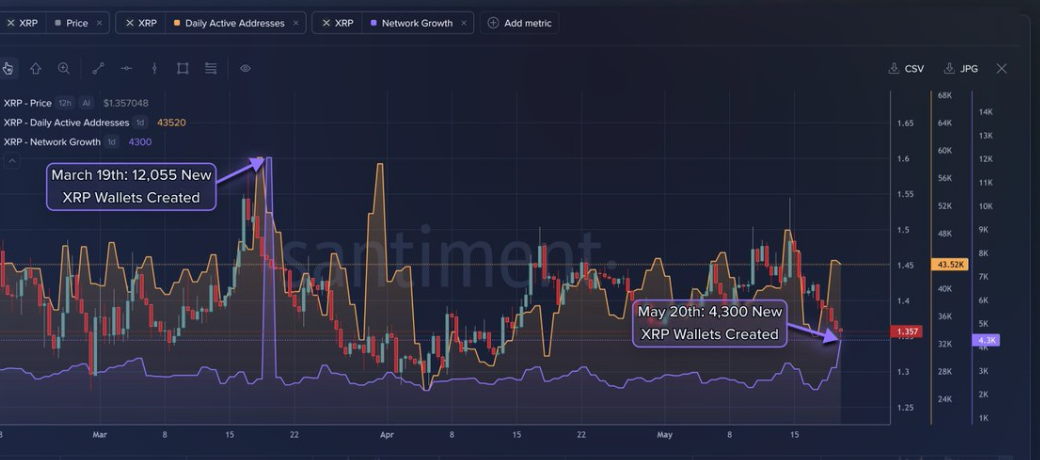
XRP Ledger has seen a spike in new addresses over the last 24 hours, but overhead resistance at $1.40 kept the XRP (XRP) price in check.
Key takeaways:
- XRP Ledger added 4,300 new wallets in 24 hours, marking the fourth-largest growth spike on the network in 2026.
- XRP price recovery may face resistance at $1.40, with a prolonged consolidation likely.
XRP Ledger sees fourth-largest growth spike in 2026
The XRP Ledger recorded one of its strongest growth surges of the year after adding 4,300 new wallets within 24 hours, the “fourth largest spike of 2026,” according to Santiment.
Related: XRP price may explode to $15 amid ‘quiet accumulation,’ analyst claims
The chart below shows that newly created XRP wallets increased to 4,300 on May 20, from about 2,500 on May 19. Similarly, daily active addresses increased to 43,520 from 32,000 over the same period.
“XRP is seeing one of its largest network growth stretches of the year,” the market intelligence firm said in a Thursday post on X, adding:
“Network growth is among the top leading signals to identify reversals.”
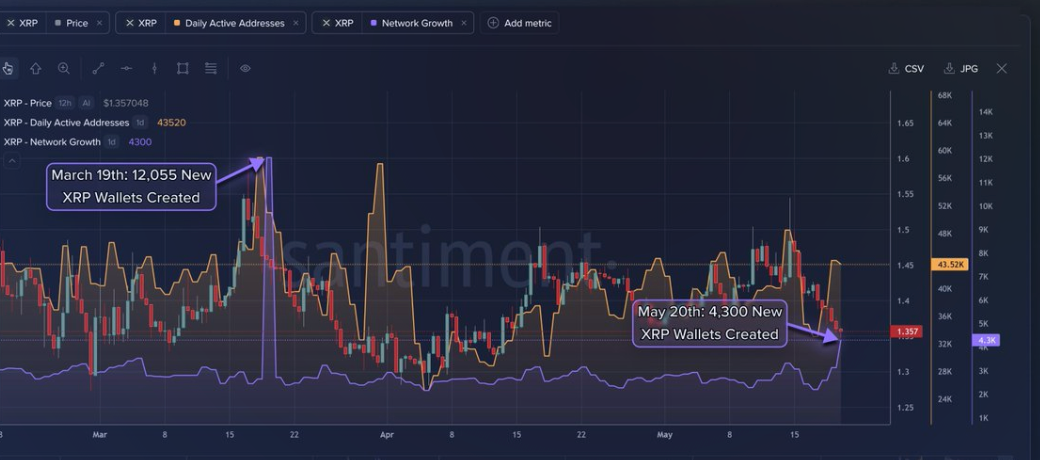
XRP Ledger active addresses and network growth. Source: Santiment
“When wallets rise like this, smart money pays attention,” analyst Amonyx commented, adding:
“$XRP reversal signal?”
Fellow analyst Niroshan682 said new wallet creation is often an “early signal of new network participation,” especially when it happens alongside growing institutional adoption and rising ETF inflows.
US-based spot XRP ETFs held about 1.34% of the XRP total supply after this month’s inflows. About $107.3 million worth of XRP ETFs flowed in May so far, with the $8.8 million in net inflows on Thursday marking the 12th straight day of positive flows.
This streak has pushed cumulative inflows to nearly $1.4 billion and assets under management (AUM) to $1.15 billion.
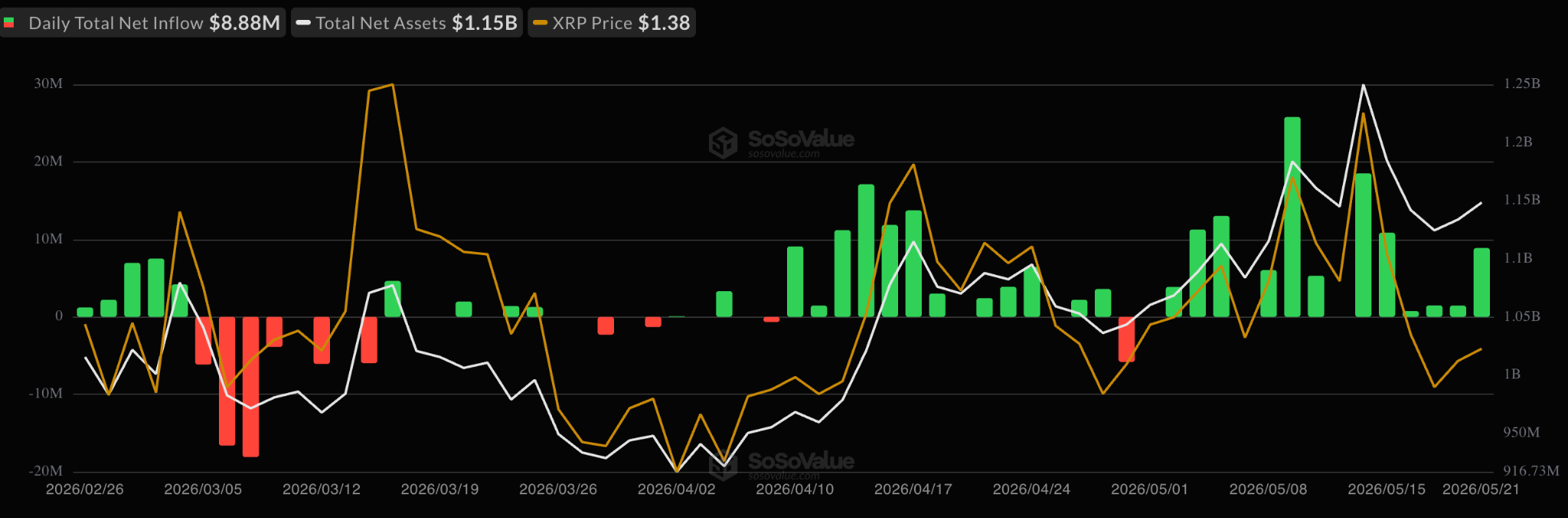
Spot XRP ETF flows chart. Source: SoSoValue
Despite these positive fundamentals, XRP/USD is down 1.5% over the last 24 hours, and remains 62% below its $3.66 multi-year high reached in July 2025.
XRP faces stiff overhead resistance
XRP’s latest 21% rally from the local low at $1.27 reached on April 5 stalled at $1.55, coinciding with the upper limit of a range that has capped its price action since early February.
Bulls must push the price above the $1.40-$1.55 resistance zone to confirm a breakout from consolidation. This area is also defined by the 50-day simple moving average (SMA), the 100-day SMA and the 100-day exponential moving average, as shown in the chart below.
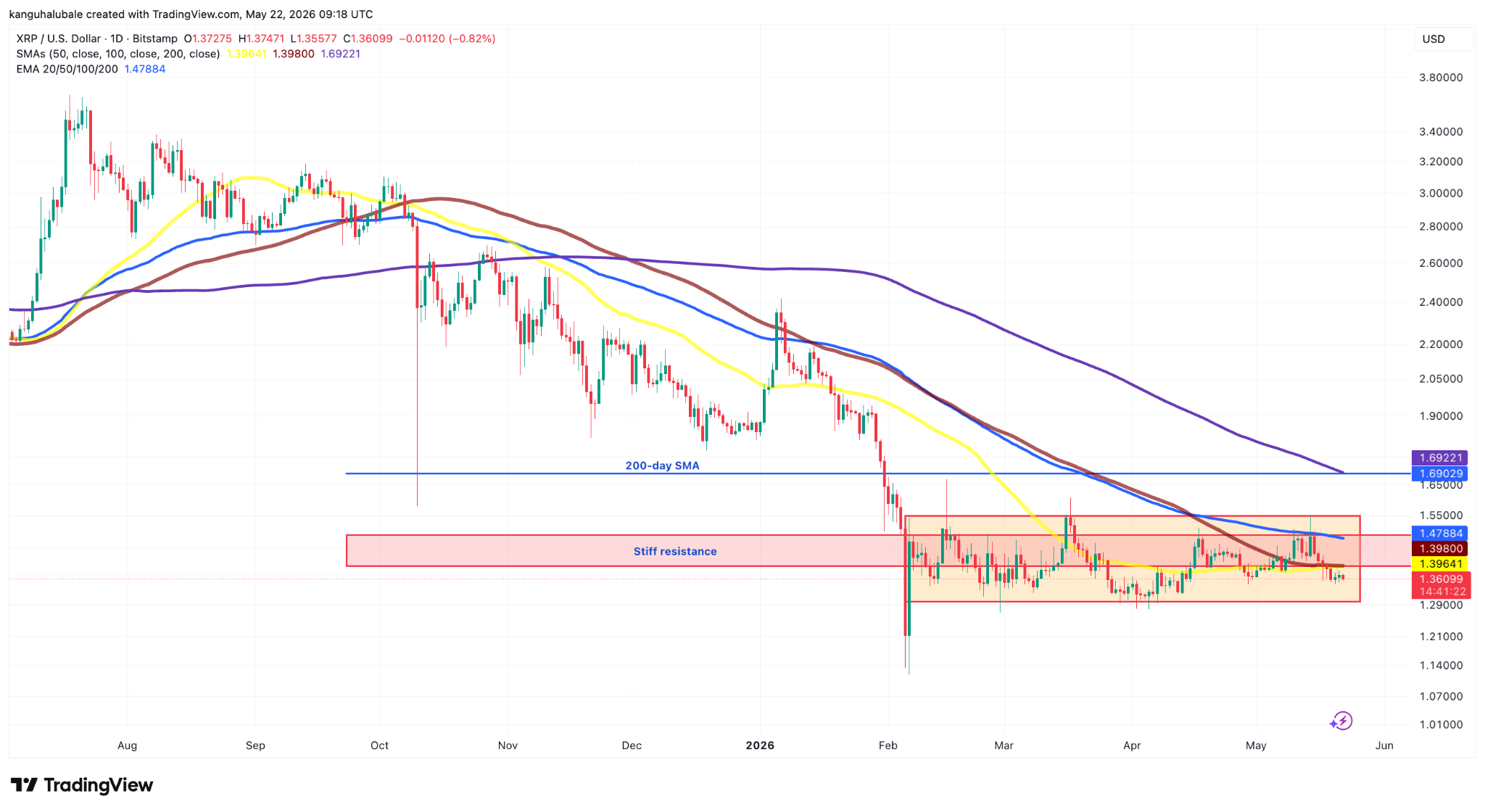
XRP/USD daily chart. Source: Cointelegraph/TradingView
According to XRP’s cost-basis distribution data, investors hold approximately 3.75 billion XRP at an average cost of $1.37-$1.45, creating a potential resistance zone.
This concentration suggests many investors may sell at break-even, potentially stalling XRP’s upward momentum.
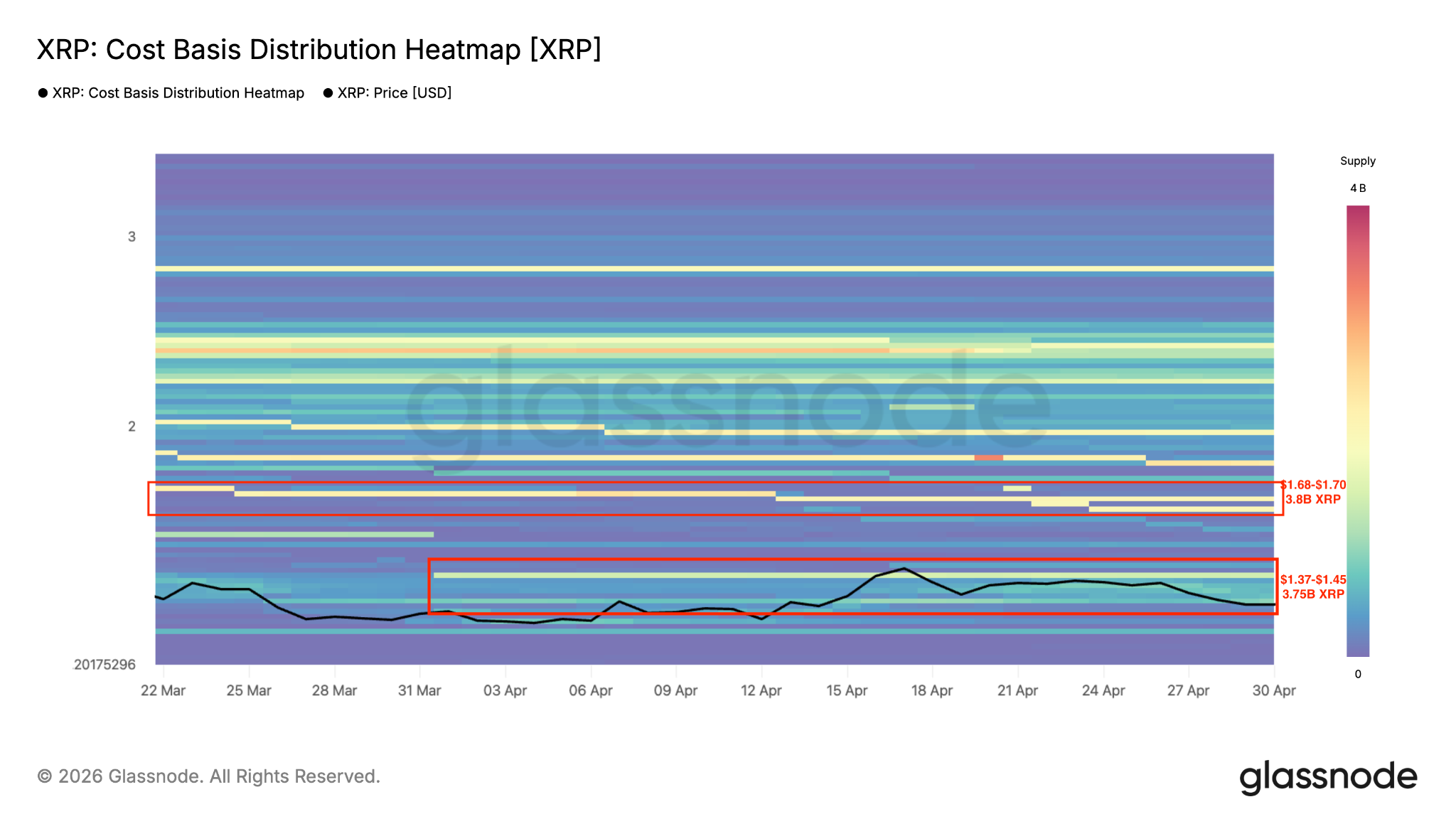
XRP cost basis distribution chart. Source: Glassnode
Another supply congestion zone is higher up at $1.68-$1.70, where investors bought approximately 3.8 billion XRP. This level coincides with the upper boundary of a falling wedge pattern, which is setting up the XRP/USD pair for a breakout, according to analyst Crypto Michael.
Note that a weekly close above the wedge’s upper trend line could open the way for a rally toward the measured target at $3.52, about 50% above the current price.
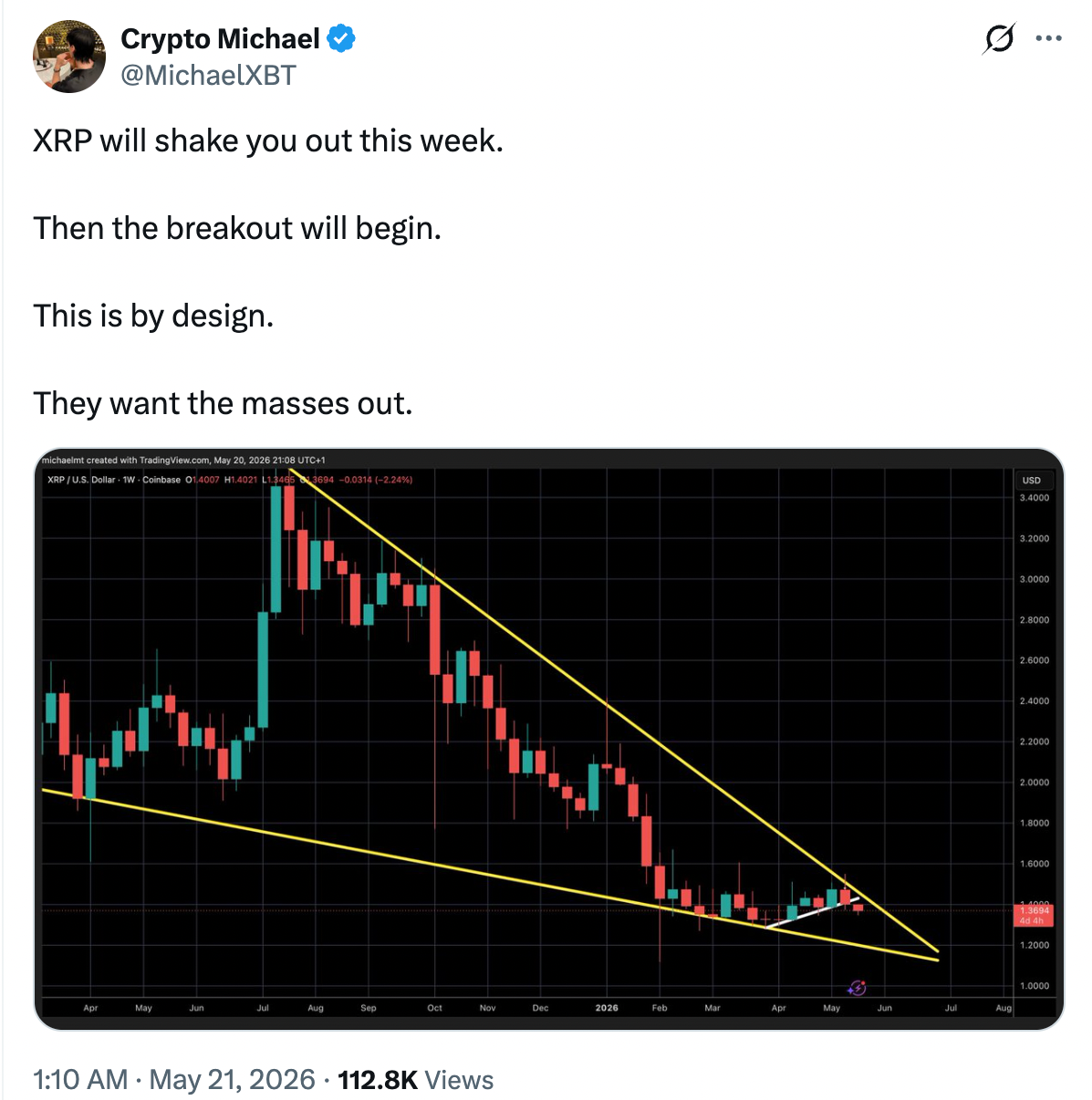
XRP/USD weekly chart. Source: Crypto Michael.
As Cointelegraph reported, buyers will have to push XRP/USD above the multi-month trend line at $1.40 to signal a comeback, while a close above $1.61 would confirm a potential trend change.
The current state of financial markets is best described as macro-geopolitics first, crypto second.
The evidence is clear. Despite recent positive regulatory developments related to the Clarity Act, bitcoin has shown little excitement, trading near $77,200 – largely unchanged over the past 24 hours and for the week.
Meanwhile, oil remains elevated near $100 and speculative capital is pouring into copper amid fears of a sulfur shortage. The connection? Copper production is heavily dependent on sulfuric acid, whose supply has been disrupted through the Strait of Hormuz.
In essence, everything is revolving around Hormuz, driving commodity flows and prices higher, stoking inflation fears, lifting bond yields, which are supposedly weighing over crypto. The U.S. stocks, meanwhile, hover near record highs, driven by AI optimism.
Bitcoin is not at the center of this geo-economic and AI repricing.
It is no surprise, therefore, that U.S. spot bitcoin ETFs continue to bleed, recording $1.15 billion in outflows this week after $1 billion last week, according to SoSoValue. The Coinbase premium, a key gauge of U.S. demand relative to the rest of the world, has hit monthly lows.
Analysts have repeatedly emphasized that these indicators need marked improvement before a sustained rally can take hold. The question is whether that will happen while markets remain fixated on geopolitics and AI.
In the meantime, certain corners of the crypto market, particularly on-chain perpetuals and quantum-resistant tokens, continue to show strength, driven by specific news and narratives, as we discussed Thursday. Layer-1 blockchain Near Protocol’s token (NEAR) is the latest addition to that group, surging over 25% in the past 24 hours following the announcement of a major upgrade focused on automated scaling and quantum resilience.
In traditional markets, Nasdaq futures have surrendered early gains and are trading largely flat. Analysts remain broadly bullish on stocks following the latest earnings season. Stay alert.
Read more: For analysis of today’s activity in altcoins and derivatives, see Crypto Markets Today . For a comprehensive list of events this week, see CoinDesk’s “Crypto Week Ahead.”
What’s trending
Today’s signal

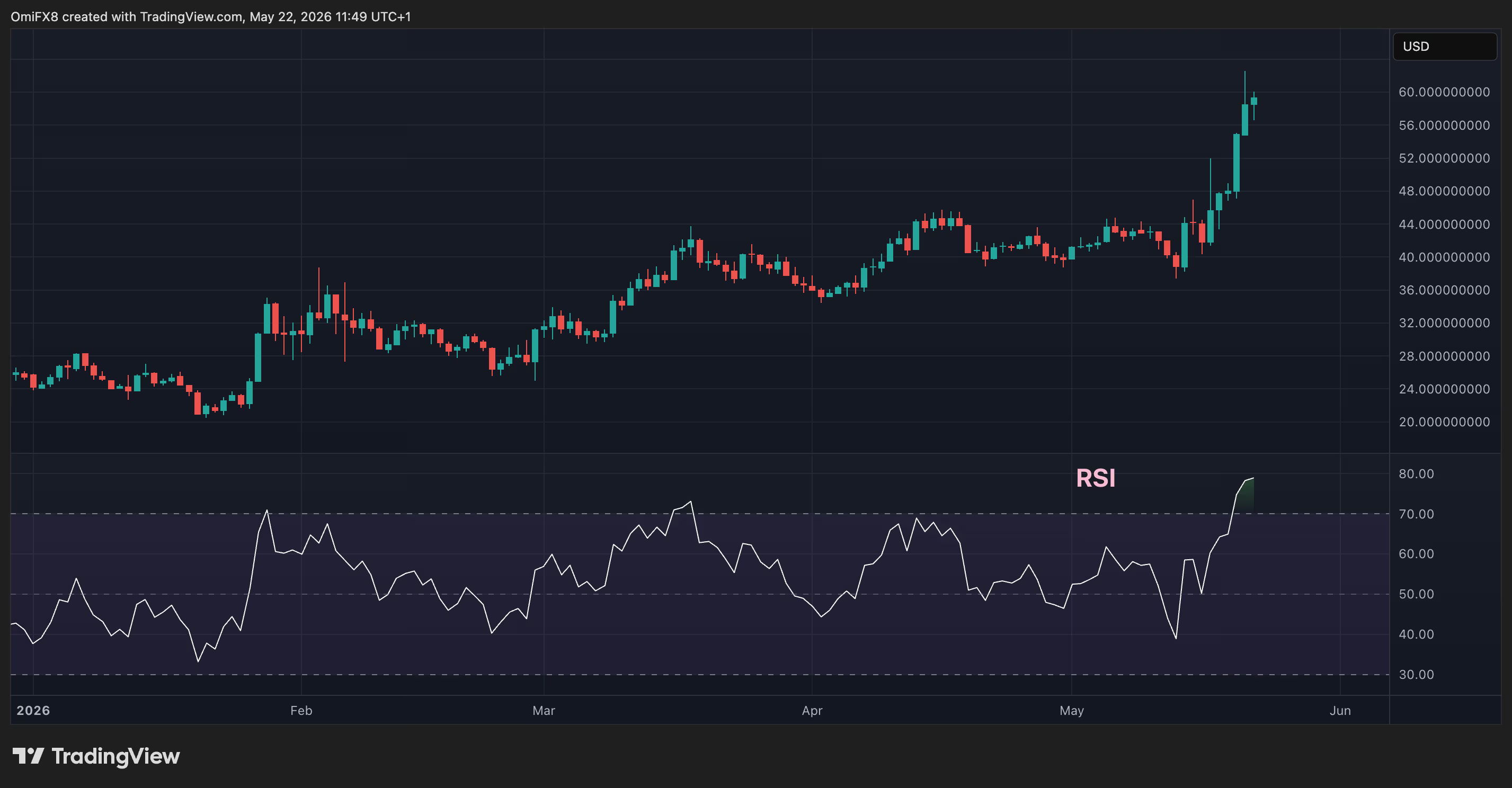
HYPE’s 14-day Relative Strength Index (RSI) has surged above 70. While readings above 70 are widely labeled as “overbought,” this interpretation is often misleading.
The RSI is a momentum oscillator that measures the speed and magnitude of recent price changes. A reading above 70 simply signals strong bullish momentum and suggests that the uptrend may still have room to run. It does not automatically mean the asset is overvalued or due for an imminent reversal, as the popular narrative often implies.
In strong trending markets, RSI can remain elevated for extended periods without triggering a meaningful pullback.

The attacker behind the Verus cross-chain bridge exploit has returned 4,052 ETH to the Verus team wallet, worth about $8.5 million at current prices. In a calculated turn, Verus had offered a 1,350 ETH bounty for the recovery of most of the stolen funds, with the exploiter retaining the remaining ETH as a reward, according to blockchain security firm PeckShield.
Verus signaled the bounty a day earlier, saying that if the attacker returned 4,052.4 ETH to the team address within 24 hours, the portion retained by the exploiter would be treated as a reward. The latest recovery illustrates how some projects pursue direct negotiations to reclaim stolen assets, a tactic that does not automatically shield individuals from law enforcement or third-party actions.
The recovery comes days after the Verus-Ethereum bridge was drained in a forged cross-chain transfer exploit, underscoring ongoing security concerns in 2026 as DeFi infrastructure faces repeated attack vectors. PeckShield documented the development on Friday, confirming the 4,052 ETH return and the 1,350 ETH bounty arrangement.
Source: PeckShield
Key takeaways
- 4,052 ETH was returned to the Verus team wallet, valued around $8.5 million, representing roughly 75% of the total funds stolen in the incident. The exploiter retains 1,350 ETH (about $2.8 million) as a bounty.
- Verus had offered the bounty as a potential incentive for recovery, stating the remaining ETH would be treated as a reward if 4,052.4 ETH was returned within 24 hours. The deal highlights a growing pattern of negotiated recoveries in DeFi incidents.
- The recovery follows a forged cross-chain drain of the Verus-Ethereum bridge, illustrating how cross-chain exploits continue to shape security priorities across DeFi infrastructure.
- April DeFi hacks surged to about $634 million in aggregate losses, with Drift Protocol ($280 million) and Kelp ($293 million) highlighted as the month’s largest incidents. May losses have slowed to roughly $38 million so far, per DefiLlama.
Verus’ recovery, and what it signals for DeFi security
The Verus incident sits at a crossroads of negotiation, enforcement, and tech risk. By publicly offering a bounty and engaging with the attacker to recover assets, Verus demonstrates a persistence among some projects to reclaim stolen funds through direct outreach rather than relying solely on external remedies. PeckShield’s analysis confirms that the recovered amount, coupled with the bounty structure, accounts for about three-quarters of the total stolen in this event, with roughly 5,400 ETH quoted as the overall loss when accounting for the bounty portion.
The game-theory aspect is notable: a targeted recovery such as this can get funds back into circulation and reduce the immediate attack surface for the protocol. Yet, it also leaves open the question of legal and regulatory action, and how authorities might respond to negotiable recoveries when illicit proceeds are involved. Verus’ public stance—recover the majority, treat the rest as a reward—reflects a pragmatic path taken by some teams under stress to preserve user assets and maintain confidence in cross-chain activity.
The broader security backdrop remains challenging. Cross-chain bridges have repeatedly proven vulnerable to forged transfers, replay attacks, and misconfigurations. The Verus incident adds to a lengthy ledger of DeFi exploits that have kept security teams and auditors on high alert. As the ecosystem experimen ts with more automated risk controls, incident response playbooks are evolving to balance rapid recovery with lawful process and transparent disclosure.
April’s DeFi breach wave and the lingering risk in May
DefiLlama’s data shows that April’s hacks totaled about $634 million in value stolen across numerous protocols, underscoring the sector’s persistent risk profile. Among the most substantial incidents in April were the Drift Protocol breach, which saw losses around $280 million, and the Kelp Restaking exploitation, with losses near $293 million. These incidents illustrate the fault lines in high-yield, cross-chain, and restaking architectures that have become attractive targets for adversaries.
By May, the pace of large breaches appeared to slow considerably. DefiLlama’s latest figures indicate approximately $38 million stolen so far in the month, suggesting a cooling period relative to the spike in April. Still, even a fraction of the earlier totals poses material risk for liquidity, governance, and user trust in DeFi ecosystems.
Beyond the raw dollar figures, the ongoing attack surface—bridges, restaking platforms, and other cross-chain primitives—remains a central concern for developers, auditors, and investors. Historical data show that private-key compromises, phishing, and credential-based breaches have driven a large share of losses over the past decade, a trend consistently highlighted by industry coverage and risk assessments. As the ecosystem evolves, observers will watch for improvements in key management, fraud prevention, and real-time fund recovery mechanisms.
Related coverage from Cointelegraph noted the broader regulatory and legal conversations surrounding DeFi security and asset recovery, as discussions about who can claim stolen funds continue to unfold in legal and policy circles. The field remains a dynamic intersection of technology, incentives, and governance that will shape how users and builders approach cross-chain activity in the years ahead.
Readers should monitor whether regulatory responses tighten the permissible scope of bounty-based recoveries or push for more standardized incident-response protocols. While the Verus case shows a potential pathway for asset reclamation, it also underscores that negotiation-based recoveries are not guaranteed to shield participants from potential enforcement actions or private litigation, depending on jurisdiction and circumstances.

Bitcoin Pizza Day has once again drawn attention to the first known real-world Bitcoin transaction, a 2010 pizza purchase that later became one of the most referenced moments in cryptocurrency history.
Summary
- Bitcoin Pizza Day commemorates the first known real-world Bitcoin purchase after Laszlo Hanyecz paid 10,000 BTC for two pizzas in 2010.
- The 10,000 BTC used in the transaction would now be worth more than $772 million with Bitcoin trading near $77,000.
- Crypto exchanges and online communities continue to celebrate May 22 each year with promotions, memes, and references to Bitcoin’s early history.
According to archived posts on the Bitcointalk forum, early Bitcoin developer Laszlo Hanyecz offered 10,000 BTC on May 18, 2010, to anyone willing to order and deliver two pizzas to his home in Florida. Four days later, 19-year-old Jeremy Sturdivant accepted the proposal and arranged for two large Papa John’s pizzas to be delivered in exchange for the coins.
At the time, Bitcoin traded for less than a cent, which placed the total value of the transaction at roughly $41. Forum discussions from that period showed that Hanyecz wanted to test whether Bitcoin could function as a payment method for physical goods rather than remain limited to online transfers between developers and hobbyists.

Laszlo Hanyecz’s post on the Bitcoin forum. Source: Near Legion on X.
Sixteen years later, the same 10,000 BTC used in the transaction would be valued at more than $772 million based on current Bitcoin prices near $77,000. Crypto users now refer to the purchase as the most expensive pizza order ever recorded.
How Bitcoin Pizza Day started
Back in 2010, Bitcoin operated as a niche software experiment with a small user base made up mostly of coders, miners, and forum members. No publicly traded companies held Bitcoin reserves, spot Bitcoin ETFs did not exist, and institutional custody services had not yet entered the market.
Against that backdrop, the pizza transaction became an early demonstration that Bitcoin could move beyond peer-to-peer testing and be exchanged for a real product. Although Sturdivant paid traditional currency to complete the pizza order, Hanyecz later transferred the agreed 10,000 BTC to him to settle the trade.
Early Bitcoin community discussions also identified Hanyecz as one of the contributors involved in advancing GPU mining. Historical accounts from Bitcoin users noted that GPU-based mining significantly increased processing efficiency compared to standard computer CPUs, allowing the network’s mining activity to scale faster during its early years.
Over time, May 22 evolved into an unofficial celebration across the crypto industry. Exchanges, traders, and blockchain companies now use the date for promotional campaigns, community events, and online memes tied to Bitcoin’s early history.
Why the pizza transaction still matters
For many Bitcoin supporters, the story remains important because it demonstrated practical utility during a period when the network had little public attention or commercial infrastructure.
In later interviews cited by crypto media outlets, both Hanyecz and Sturdivant said they did not regret the transaction despite Bitcoin’s massive price increase over the following years. Hanyecz reportedly explained that spending Bitcoin helped prove the asset could be used in economic activity rather than exist only as an experimental digital system.
Meanwhile, the anniversary has continued to serve as a reminder of Bitcoin’s growth from a forum-based project into a global financial asset traded through regulated investment products and institutional platforms.
“Bitcoin Pizza Day is far more than a historical novelty; it represents the exact inflection point where digital currency transitioned from abstract theory to real-world economic utility. What seemed like a routine transaction in 2010, exchanging 10,000 Bitcoins for two pizzas, served as the critical first proof of concept for a decentralized medium of exchange. It laid the foundational infrastructure for what has rapidly evolved into a multi-trillion-dollar digital asset economy.
Over the years, we have witnessed Bitcoin mature from an experimental internet currency into a globally recognized asset class and macro-hedging tool. The true significance of this milestone lies in the profound conviction required to champion transformative technology before its utility becomes mainstream.
Today, the narrative has shifted from skepticism to institutional imperative. With global banks, enterprise corporations, and sovereign governments actively participating in the ecosystem, Bitcoin is driving the vanguard of financial innovation. From accelerating asset tokenization to enabling seamless global value exchange, the legacy of that first transaction continues to redefine modern market structures, proving that groundbreaking innovation always begins on the fringes before reshaping the global financial core.”
– Sumit Gupta, Co-Founder of crypto exchange CoinDCX
Across social media platforms on Thursday, crypto users shared price comparisons, pizza-themed memes, and screenshots of the original Bitcointalk post as part of the yearly tradition surrounding Bitcoin Pizza Day.
16 years ago, Laszlo Hanyecz, a Floridian programmer, bought 2 Papa John's pizzas for 10,000 $BTC. Today, those pizzas would be valued at over $774M today.
Happy #Bitcoin Pizza Day, everyone! 🍕 pic.twitter.com/YlFnFgsSBX
— CoinGecko (@coingecko) May 22, 2026

Michael Saylor: ‘We’re Prepared To Sell Bitcoin’ – Historic Move Revealed

Judith Chalmers dies aged 90 as tributes paid to presenter

Calls for urgent review of EV sales rules imposed on car makers


-

 Crypto World6 days ago
BloFin War of Whales 2026 Grand Prix opens registration for $5M trading championship
-

 Fashion7 days ago
Weekend Open Thread: Theory – Corporette.com
-

 Crypto World7 days ago
E-Estate Announces 1 Year Live: Washington DC Summit as Real Estate Tokenization Enters Its Next Phase
-

 Tech7 days ago
Google reimburses Register sources who were victims of API fraud
-

 Business7 days ago
H&R Real Estate Investment Trust (HR.UN:CA) Q1 2026 Earnings Call Transcript
-

 Entertainment7 days ago
David Letterman Returns to Late Show, Blasts Cancellation
-

 Sports7 days ago
Napoleonic enters 2026 Doomben 10,000 field via Abounding withdrawal
-

 Crypto World7 days ago
BeInCrypto 100 Institutional Awards Nomination: KAST for Best Digital Assets Neobank and Best Digital Assets Fintech
-
 Crypto World7 days ago
Bitcoin Battles US Bond Nerves With BTC Price Dip Toward New May Lows
-

 Crypto World7 days ago
ICE and CME urge US regulators to curb Hyperliquid energy trading
-

 Fashion5 days ago
On the Scene at Gucci’s Cruise Show in New York City: Mariah Carey, Kim Kardashian, Lindsay Lohan, Iman, and More!
-
 Crypto World7 days ago
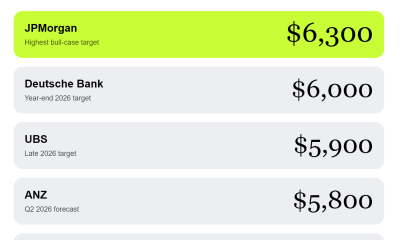
Wall Street’s Boldest Gold Prediction Has Russians Rushing to Buy
-

 Crypto World7 days ago
IREN closes $3 billion convertible notes deal amid AI infrastructure expansion
-

 Fashion6 days ago
Trending Western Style Vests Perfect for Summer
-

 Politics6 days ago
Watch: far-right flag-fanatics run over victim, attack locals – Setup By the Left wing for your entertainment
-

 Crypto World19 hours ago
Blockchain.com files with SEC for U.S. IPO
-

 Fashion7 days ago
Creative Ideas for Custom T-Shirts
-

 Fashion5 days ago
Amazon Sundays: Memorial Day Hosting
-

 Crypto World7 days ago
Crypto Market Structure Bill Clears Committee; Senate Vote in Focus
-

 Entertainment5 days ago
Off Campus Easter Eggs Explained: Characters, Stories, More
You must be logged in to post a comment Login