

Crypto World
Temporary Economies in Crypto – Smart Liquidity Research


Crypto has never been just about money. It’s about moments—short-lived bursts of coordination where attention, incentives, and speculation collide to create what can only be described as temporary economies.
These economies don’t behave like traditional markets. They emerge fast, scale brutally, and often dissolve just as quickly. Yet in their brief existence, they move billions, shape narratives, and test the limits of human behavior at internet speed.
Let’s break down what they are, why they exist, and what they’re quietly teaching us about the future of digital finance. ⚡
What Are “Temporary Economies”?
A temporary economy in crypto is a short-lived financial ecosystem built around incentives designed to expire or decay rapidly.
They typically form around:
- Token launches or airdrops
- Liquidity mining programs
- GameFi reward cycles
- NFT mints and hype windows
- Points systems and “seasonal” campaigns
- Viral DeFi incentive loops
At their core, they are coordination machines powered by incentives, not long-term productive structures.
Unlike traditional economies, they don’t assume permanence. They assume velocity.
Why Crypto Keeps Creating Them
Crypto is uniquely suited to temporary economies for a few structural reasons:
1. Incentives Are Programmable
Smart contracts allow projects to write behavior into existence literally. Reward trading? Done. Reward liquidity? Easy. Reward attention? Increasingly common.
This makes experimentation cheap—and failure fast.
2. Capital Is Highly Mobile
In traditional finance, capital moves slowly through regulation, friction, and trust barriers.
In crypto, capital moves like water on a hot pan.
If yields appear somewhere else, liquidity evaporates instantly.
3. Attention Is the Real Currency
Many crypto ecosystems are not competing for users—they’re competing for attention cycles.
Temporary economies are often just sophisticated attention traps wrapped in financial incentives.
4. Speculation Is the Default Behavior
Let’s be honest: most participants aren’t farming “protocol growth.” They’re farming asymmetry—the chance that early entry beats later exit.
That expectation alone creates the conditions for short-lived economies.
The Anatomy of a Temporary Economy
Most of these systems follow a predictable lifecycle:
Phase 1: Spark 🔥
A new incentive is introduced:
- Airdrop rumors
- Yield opportunity
- NFT mint
- Points system
Attention floods in.
Phase 2: Acceleration 🚀
Participants rush to:
- Maximize rewards
- Loop capital
- Optimize strategies
- Spread alpha on social platforms
This phase feels like innovation—but it’s usually optimization.
Phase 3: Saturation 🧨
Returns start compressing:
- Too much capital enters
- Rewards dilute
- Fees rise, or benefits decrease
Smart money begins exiting.
Phase 4: Dissipation 🌫️
The incentive ends or loses meaning.
Liquidity leaves.
Attention moves on.
The economy collapses or becomes a shadow of itself.
Why People Keep Coming Back
Despite the predictable lifecycle, participation never slows. Why?
Because temporary economies offer something powerful:
1. Speed of Wealth Discovery
Traditional systems reward patience. Crypto rewards timing.
2. Psychological Engagement
Every cycle feels like:
“This time, I might be early.”
That belief alone is enough to sustain participation.
3. Community Momentum
Temporary economies create intense social bonding:
- Telegram groups
- Twitter threads
- Strategy sharing
- Competitive farming culture
People aren’t just chasing yield—they’re participating in a game of collective timing
The Dark Side: Inevitability of Extraction
Here’s the uncomfortable truth:
Most temporary economies extract more value in attention and capital than they distribute in rewards.
Not always maliciously—but structurally.
Common outcomes include:
- Late entrants subsidizing early exits
- Reward dilution through over-participation
- Token inflation without sustainable demand
- Short-term hype replacing long-term utility
The system doesn’t need to “scam” anyone. It just needs to cycle faster than participants adapt.
Are They All Bad? Not at All.
Temporary economies are not inherently destructive. In fact, they serve important roles:
1. Bootstrapping Liquidity
No liquidity → no network.
Temporary incentives solve the cold-start problem.
2. Market Discovery Mechanisms
They help identify:
- Demand for new primitives
- User behavior patterns
- Product-market fit signals
3. Innovation Stress Testing
They force protocols to prove resilience under:
- Extreme usage spikes
- Arbitrage pressure
- Behavioral chaos
The Evolution: From Temporary to Sustainable
The real challenge in crypto today is not creating temporary economies—it’s graduating from them.
The next generation of protocols will need to:
- Convert attention into retention
- Convert incentives into utility
- Convert speculation into participation
- Replace “yield loops” with “value loops.”
We are slowly moving from:
“Farm and exit” systems
to
“Engage and persist” systems
But the transition is far from complete.
Final Thoughts
Temporary economies are not bugs in crypto—they are features of an experimental financial internet.
They represent:
- Speed over stability
- Incentives over institutions
- Behavior over belief
And while they can feel chaotic, even extractive, they are also the raw material from which more durable systems will eventually emerge.
The real question is not whether temporary economies will disappear.
It’s whether we will learn fast enough to build something that lasts beyond them. 🧠⚡
REQUEST AN ARTICLE

Crypto World
Ethereum Price Prediction: Vitalik Streamlines Operations to Curb Ethereum Foundation Selling

In a candid Twitter post, Vitalik Buterin remarks on the Ethereum Foundation’s future direction with a structural reset that could change ETH’s long-term dynamics. This has brought the Ethereum price prediction into bullish territory.
Buterin published a lengthy personal statement outlining his vision for a leaner, more principled Ethereum Foundation, explicitly acknowledging that his own influence within the organization will continue to diminish, a transition he “personally welcomes.”
Crucially, the post signals reduced selling pressure from the Foundation going forward as operational streamlining takes hold. Vitalik framed the EF’s evolution through a sharp analogy, saying that Google once carried idealistic founding principles before commercial pressures eroded them.
Buterin’s message was blunt, and Ethereum must not repeat that mistake.
Discover: The Best Crypto to Diversify Your Portfolio
Ethereum Price Prediction: Can ETH Break Downtrend as Foundation Selling Pressure Eases?
ETH is still in the $2,100 handle this week, a weekly support after a brutal downtrend from $2,500. The stable daily candle this week came with visible accumulation signals that show slow positioning.
Currently, we are seeing an inverse head-and-shoulders pattern on the daily chart, with the neckline sitting near $2,150. If ETH breaks decisively above it, this pattern projects a measured target of around $2,600.
For ETH, it needs to at least hold above $2,150 on a weekly close. If the pattern confirms, momentum could carry it toward $2,400 first, then back above $2,500.

But the most likely scenario would likely see a Consolidation between $2,100-$2,200 through mid-year as macro conditions remain mixed, with $2,400 target acting as near-term resistance.
ETH’s ETF dynamics have added another layer to the structural demand picture, with institutional flows increasingly cited as a non-trivial price driver heading into the second half of 2025.
Discover: The Best Token Presales
Bitcoin Hyper Offers Early Mover Upside as ETH Stuck in $2,000 range
ETH is compelling, but the ceiling on a $250 billion asset is structurally different from what’s possible at the seed stage. Traders who’ve already captured the ETH move are quietly rotating into earlier-stage infrastructure plays where the asymmetry is sharper. That’s where Bitcoin Hyper ($HYPER) enters the picture.
Bitcoin Hyper is positioning itself as the first-ever Bitcoin Layer 2 with full Solana Virtual Machine (SVM) integration. It delivers sub-second finality and low-cost smart contract execution directly on top of Bitcoin’s security layer.
The pitch: Bitcoin’s trust, Solana’s speed, none of the trade-offs.
The presale has raised $32.7 million at a current price of $0.0136, with staking already live and generating high APY for early participants. A decentralized canonical bridge handles native BTC transfers, preserving the trustless architecture that Bitcoin holders actually care about.
Research Bitcoin Hyper before the next price tier.
The post Ethereum Price Prediction: Vitalik Streamlines Operations to Curb Ethereum Foundation Selling appeared first on Cryptonews.
Crypto World
Robotics Revolution: How Three Stocks Are Capitalizing on the $200B Humanoid Robot Boom

Key Takeaways
- Barclays projects the humanoid robotics sector will surge from approximately $2–3 billion currently to $200 billion by 2035
- Manufacturing costs per humanoid unit have plummeted from $3 million ten years ago to roughly $100,000 today
- AeroVironment delivered 143% revenue expansion to $408 million with a funded backlog exceeding $1.1 billion
- Rockwell Automation achieved 12% sales increase and 36% operating earnings growth in fiscal Q1 2026
- Symbotic reached profitability with $630 million in quarterly revenue, marking 29% annual growth
The humanoid robotics sector is experiencing explosive expansion, with several publicly-traded companies already capturing substantial market share. The financial data paints a compelling picture.
A recent Barclays analysis forecasts the humanoid robot industry will balloon to $200 billion by 2035. Current market valuation sits between $2 billion and $3 billion. While this represents massive growth, the underlying fundamentals support these projections.
Manufacturing expenses for humanoid robots have experienced a dramatic decline, falling from approximately $3 million per unit ten years ago to roughly $100,000 currently. Chinese producers have driven prices even lower through mass production capabilities and vertically integrated manufacturing ecosystems.
Deployment rates are climbing rapidly. Approximately 2,000 units entered service during 2024. This figure jumped to 15,000 throughout 2025, with forecasts indicating 60,000 installations in 2026. China dominates with roughly 85% of worldwide deployments, supported by significant government initiatives.
Barclays characterizes humanoid robots as the evolution beyond traditional industrial machinery and digital AI systems. Unlike previous generation robots engineered for narrow applications, humanoids function effectively in human-designed environments, utilizing standard tools and facilities without requiring extensive infrastructure modifications.
Market drivers include demographic aging trends, workforce availability constraints, and increasing challenges recruiting workers for physically intensive roles across manufacturing, distribution, healthcare, and elderly care sectors.
The research highlights three core technology pillars enabling humanoids: brains, encompassing artificial intelligence algorithms and sensor arrays; brawn, representing actuators and physical mechanics; and battery systems providing operational power.
Public Companies Showing Strong Performance Metrics
Beyond long-range forecasts, several corporations are delivering impressive financial performance right now.
AeroVironment, specializing in military drones and autonomous aerial systems, announced fiscal third quarter revenue reaching $408 million. This represented a remarkable 143% year-over-year increase. The company maintains a funded backlog totaling $1.1 billion, with management projecting fiscal 2026 revenue between $1.85 billion and $1.95 billion.
Rockwell Automation, a major industrial automation provider, recorded sales of $2.105 billion during fiscal Q1 2026, representing 12% year-over-year growth. Total segment operating earnings climbed 36% during the identical timeframe. Annual recurring revenue expanded 7%.
Symbotic, concentrating on warehouse automation and intelligent supply chain technologies, disclosed $630 million in fiscal Q1 2026 revenue, reflecting 29% year-over-year advancement. The organization achieved profitability, recording net income of $13 million versus a $17 million net loss in the prior year period. Second quarter revenue guidance targets $650 million to $670 million.
Investment Implications and Market Outlook
Financial markets are increasingly prioritizing concrete performance over speculative potential in robotics companies. Emphasis has transitioned toward quantifiable metrics: revenue expansion, margin enhancement, and robust order pipelines.
Barclays estimates the comprehensive physical AI ecosystem, incorporating autonomous transportation, unmanned aerial vehicles, and sophisticated robotics platforms, could achieve valuations approaching $1 trillion by 2035.
Investment strategies span humanoid manufacturers, component providers, and specialized robotics exchange-traded funds.
The three enterprises examined represent distinct robotics segments, spanning defense unmanned systems to industrial automation to warehouse optimization. Each company reported recent quarterly financials demonstrating sustained expansion with forward guidance signaling continued momentum.


Key Highlights
- Over the past year, Alphabet’s stock has climbed approximately 130%, pushing its market capitalization to $4.6 trillion.
- First quarter 2026 revenue reached $109.9 billion, representing 22% annual growth — the strongest pace in four years.
- Google Cloud’s revenue surged 63% compared to last year, supported by a $462 billion customer backlog.
- The Gemini AI platform now serves over 650 million monthly active users, reflecting 45% quarterly expansion.
- Capital spending is projected at $180–$190 billion for 2026, sparking debates over future profitability.
Alphabet (GOOGL) shares are currently hovering near $383, marking an impressive 130% gain over the trailing twelve months. This performance positions the tech giant among the top-performing large-cap stocks of the year, with a market valuation of $4.6 trillion — trailing only Nvidia in size.
The extraordinary rally stems primarily from a single catalyst: artificial intelligence progress that’s translating into measurable financial results.
During the first quarter of 2026, Alphabet reported revenue of $109.9 billion, marking a 22% year-over-year climb that surpassed analyst projections. This represented the company’s most robust revenue expansion in four years.
Google Search revenue advanced 19% from the prior year. Chief Business Officer Philipp Schindler attributed the strength to AI Overviews and AI Mode, which have driven increased search activity, particularly in commercial queries.
YouTube advertising revenue expanded nearly 11%, while Waymo is now handling more than 500,000 weekly rides.
Cloud Division Steals the Spotlight
Google Cloud emerged as the quarter’s undisputed champion. Revenue soared 63% year over year — outpacing both Amazon Web Services and Microsoft Azure’s growth rates.
The division concluded Q1 with an impressive $462 billion customer backlog, nearly twice the level recorded three months earlier. Market analysts are forecasting 60% year-over-year cloud revenue growth for fiscal 2026, approximately 11% above consensus projections.
Backlog expansion accelerated to 82% in recent quarters, up sharply from 37% in the previous period — an indicator of robust pipeline visibility.
Gemini’s Rapid User Expansion
The Gemini AI platform has accumulated more than 650 million monthly active users, representing 45% quarter-over-quarter growth. Daily active mobile users increased 14%, while monthly engagement climbed 18%.
The Gemini 3.0 rollout received positive market reception, alleviating concerns about potential search cannibalization. Additional growth opportunities include consumer subscription offerings and a potential integration with Apple’s Siri assistant.
Alphabet’s adjusted operating margin reached 39.7% after accounting for a $3.5 billion European Commission penalty — exceeding market expectations.
The stock currently trades at a price-to-earnings multiple of approximately 29.6. Wall Street analysts anticipate diluted earnings per share will compound at roughly 17% annually from 2025 through 2028. Fiscal 2026 revenue is estimated at $479.86 billion, climbing to $561.50 billion in 2027. Thirty analysts have recently increased their earnings forecasts for upcoming periods.
The Capital Investment Challenge
This growth trajectory requires significant investment. Alphabet allocated $91 billion to capital expenditure in 2025 and plans $180–$190 billion in 2026. CFO Anat Ashkenazi has indicated that capex will increase further in 2027.
The company also intends to scale compute capacity to 35 gigawatts by 2028. Analysts project capex could reach $124 billion in 2026 as infrastructure buildout continues.
Elevated depreciation from these investments will pressure margins in coming periods. Analysts believe robust cloud and search performance will counterbalance this impact, though investment returns remain the critical variable.
Wells Fargo maintains a $387 price target with an Overweight rating, while Bank of America carries a Buy recommendation with a $335 price objective.
Hyperliquid’s native token HYPE has surged more than 40% over the past seven days, fueled by aggressive institutional accumulation, fresh all-time highs in derivatives activity, and a major technical breakout that has traders eyeing another leg higher.
Summary
- Hyperliquid price has surged more than 40% over the past week, supported by ETF inflows, protocol buybacks, and rising perpetual futures activity.
- CoinGlass liquidation data showed heavy short liquidation clusters between $65 and $66.7, raising the possibility of a fresh squeeze if bulls break higher.
- Whale activity intensified during the rally, with trader Garrett Jin accumulating over $9 million in HYPE while other large holders placed sell orders near the $70 region.
According to data from crypto.news, Hyperliquid (HYPE) climbed from around $45 last week to an intraday high near $64 on May 25 before consolidating around the $63 region at press time. The move came even as Bitcoin struggled to decisively reclaim the $110,000 level and several large-cap altcoins traded sideways amid renewed macro uncertainty tied to U.S. Treasury yields and Federal Reserve rate expectations.
Institutional catalysts have played a central role in the rally. Earlier this month, both the 21Shares Hyperliquid ETF and Bitwise’s Hyperliquid ETF debuted on U.S. exchanges, opening direct institutional access to HYPE exposure. Combined inflows into the two products reportedly surpassed $53 million during their opening sessions, adding significant spot demand pressure to an already supply-constrained market.
Adding to the bullish narrative, Bitwise disclosed that it would allocate 10% of ETF management fees toward purchasing and holding HYPE tokens on its balance sheet. Traders interpreted the move as an early sign that asset managers may begin treating HYPE as a strategic treasury asset rather than merely a speculative trading token.
Meanwhile, the protocol’s structural partnership with Coinbase and Circle under the AQAv2 framework strengthened the long-term revenue outlook for Hyperliquid’s ecosystem.
Coinbase agreed to route a large share of reserve-yield revenues generated from USDC deployed on Hyperliquid back into the protocol, while Circle committed to staking 500,000 HYPE tokens to support liquidity infrastructure on the network.
Protocol fundamentals have accelerated alongside the price rally. Hyperliquid’s perpetual futures platform recently crossed record volumes in synthetic commodities, binary prediction contracts, and pre-IPO trading markets, sharply boosting fee generation. Forbes previously noted that between 97% and 99% of all trading fees generated on Hyperliquid are redirected toward automatic HYPE buybacks through its on-chain Assistance Fund.
As trading activity intensified, the protocol’s buyback engine continuously purchased HYPE tokens at block intervals, creating a feedback loop between rising volumes and spot demand. Traders increasingly view the model as one of the most aggressive deflationary mechanisms currently operating within crypto markets.
Whale activity has added another layer of volatility to the recent move. According to blockchain tracking platform Lookonchain, trader Garrett Jin accumulated 145,050 HYPE worth roughly $9.05 million over the past four days and simultaneously placed a TWAP order to acquire an additional 39,940 HYPE valued near $2.44 million.
At the same time, not all large holders are positioning for further upside.
The positioning suggests some whales are beginning to distribute into strength as HYPE price approaches psychologically important resistance zones.
Can Hyperliquid’s technical breakout trigger another rally?
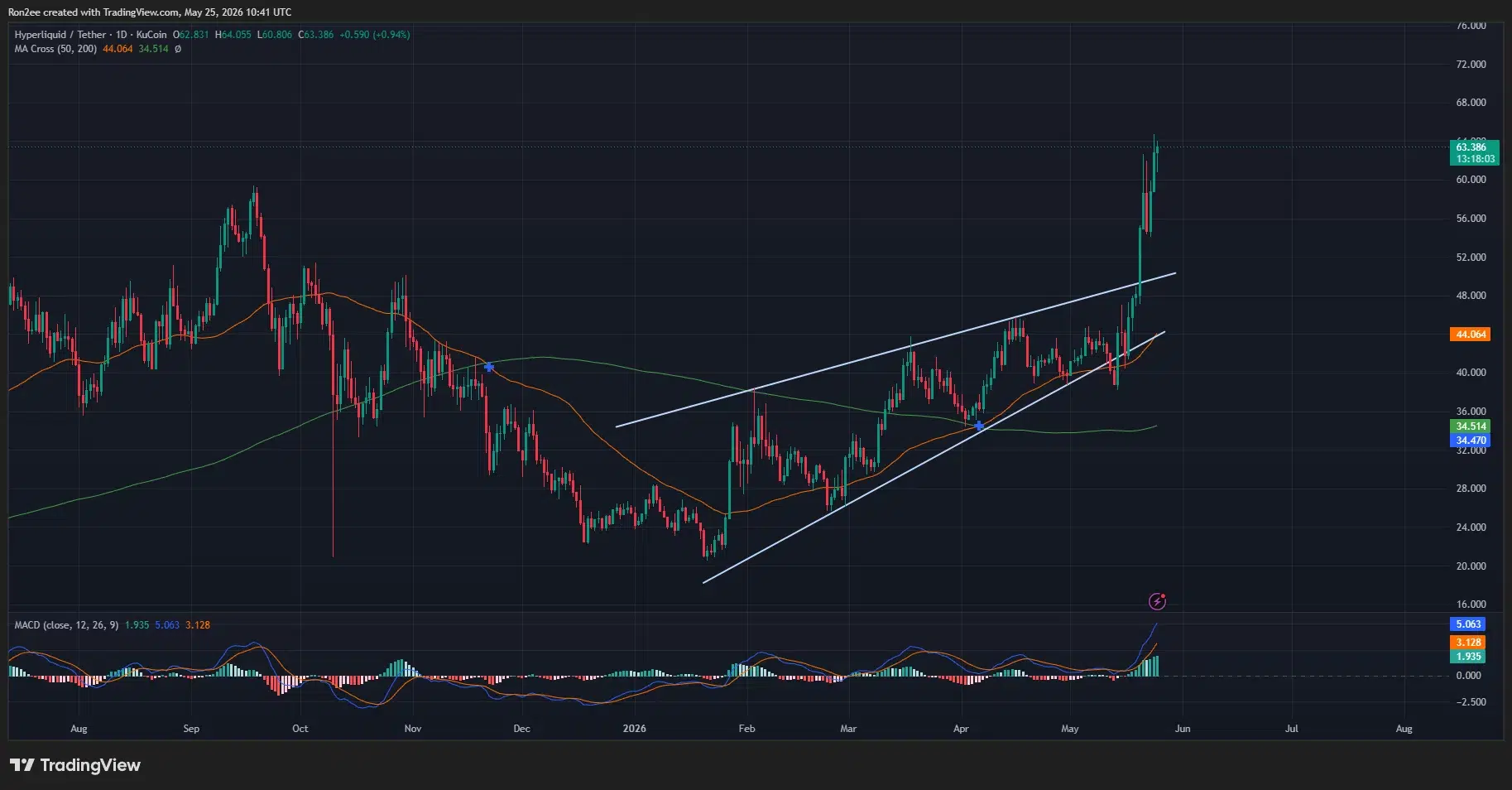
On the daily chart, HYPE appears to have completed a powerful breakout from a multi-month ascending channel formation that had capped price action since February.
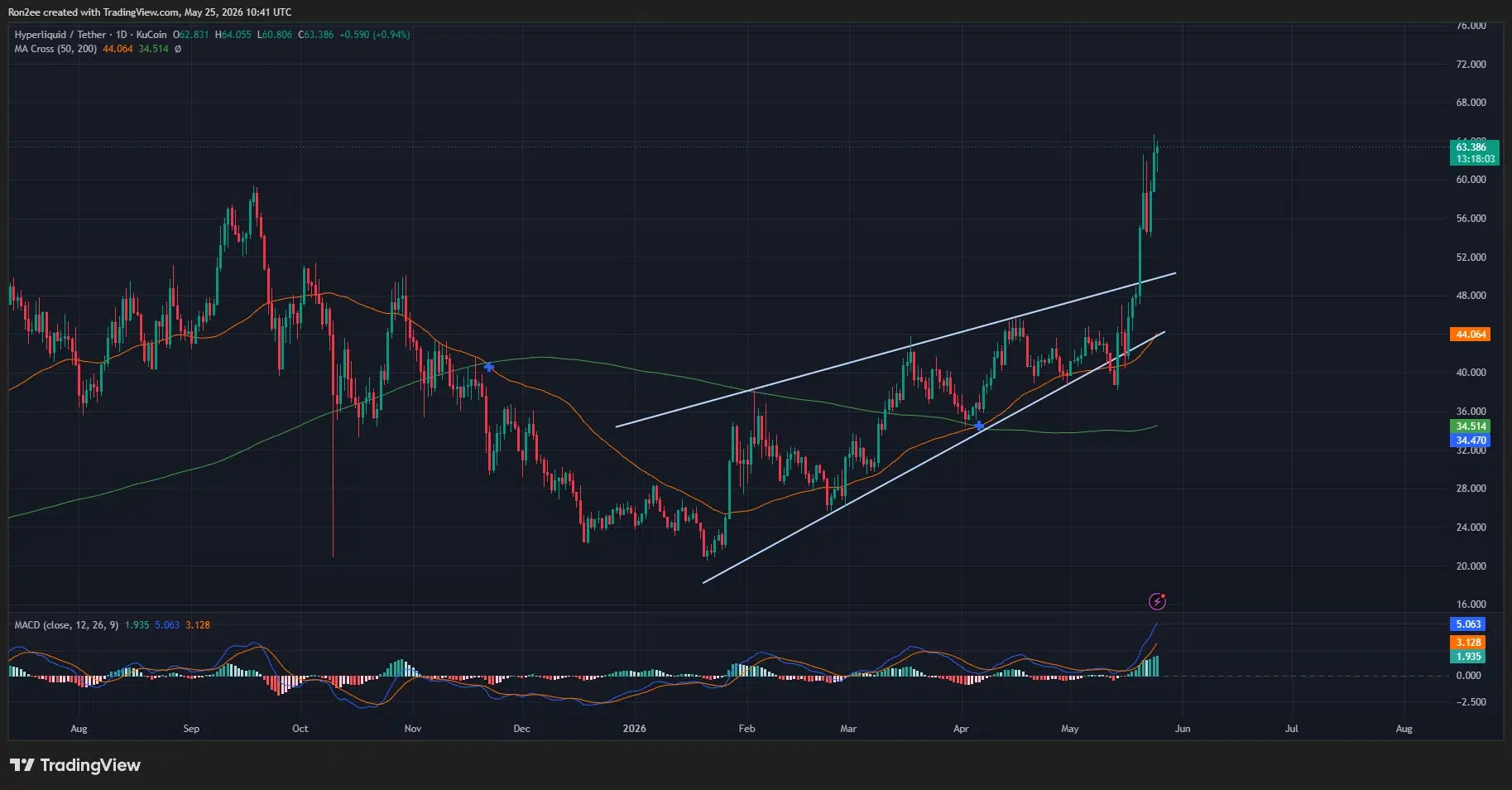
After consolidating near the upper trendline throughout April and early May, bulls forced a vertical breakout above channel resistance near $50, triggering an accelerated momentum move toward the current $64 region. The breakout also invalidated previous bearish divergence concerns that had emerged earlier this quarter.
The 50-day moving average currently sits near $44 while the 200-day moving average remains around $34.5, highlighting the strength of the ongoing trend structure. HYPE continues to trade substantially above both key support levels, a setup that typically signals strong bullish continuation conditions.
Momentum indicators have also turned decisively bullish. On the daily timeframe, the MACD histogram remains deeply positive while the MACD line continues expanding above its signal line after a strong crossover earlier this month. Expanding histogram bars suggest buying momentum has not yet fully exhausted itself despite the steep rally.
Derivatives positioning also points toward elevated volatility ahead. According to CoinGlass liquidation heatmaps, large leveraged short liquidation clusters are concentrated between $65 and $66.7. A decisive breakthrough in this region could trigger forced liquidations from overleveraged bears, potentially accelerating upside momentum in a short squeeze scenario.
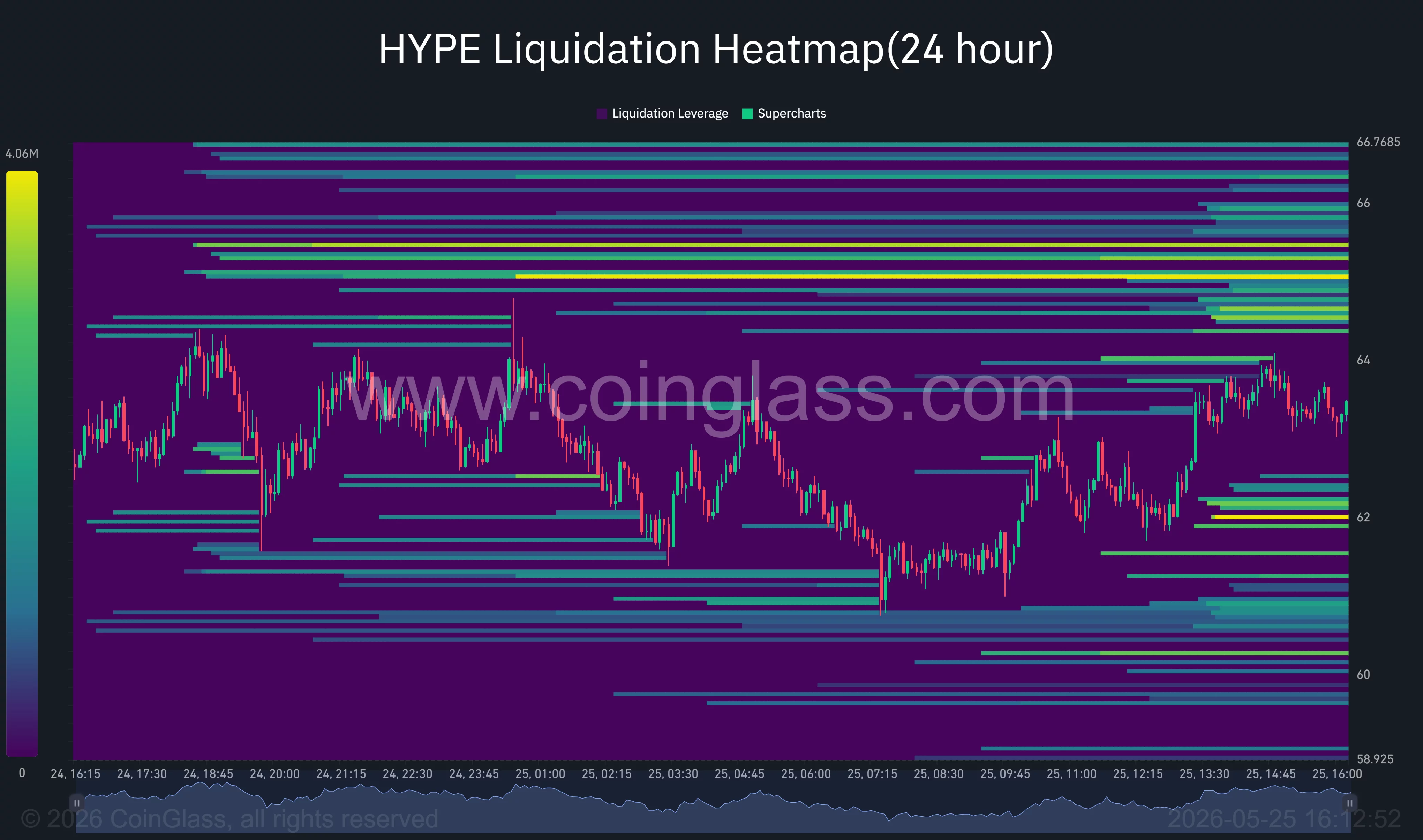
Beneath current prices, notable liquidity pockets have formed near $61 and $60.5, creating important short-term support zones in the event of profit-taking pressure. Heavy leverage concentration around these levels suggests bulls will likely attempt to defend them aggressively during pullbacks.
Funding rates across major exchanges have remained positive but have not yet reached the overheated extremes typically associated with local cycle tops. Open interest, however, has climbed sharply alongside price, indicating new leveraged positions continue entering the market rather than traders merely closing shorts.
Market analyst Altcoin Sherpa noted on X that HYPE remains “one of the strongest trend structures in crypto right now,” adding that momentum traders will likely continue buying dips unless Bitcoin experiences a sharp macro-driven correction.
What risks could slow the HYPE rally?
Despite the strong trend, several macro and market risks could disrupt the rally over the coming sessions.
Federal Reserve policy expectations remain a major variable for speculative assets. Recent U.S. economic data showed inflation pressures stabilizing more slowly than expected, pushing Treasury yields higher and reducing expectations for immediate rate cuts. Higher yields have historically pressured risk assets, particularly highly leveraged crypto trades.
Oil markets also remain volatile amid ongoing geopolitical tensions surrounding Iran and shipping flows through the Strait of Hormuz. Sudden spikes in crude prices could weaken overall market risk appetite, even though Hyperliquid has benefited from increased commodities trading activity tied to these same tensions.
Profit-taking pressure from whales may also intensify near the $65 to $70 region, particularly as traders begin locking in gains after HYPE’s nearly uninterrupted multi-week advance. Large limit sell walls identified by on-chain trackers could temporarily cap upside momentum unless fresh spot demand absorbs the supply.
Still, structural demand drivers continue supporting the bullish case. ETF inflows, automatic protocol buybacks, expanding derivatives volume, and institutional integrations have combined to create one of the strongest narrative setups currently present in the altcoin market.
If bulls successfully clear the $66.7 liquidation cluster in the near term, the next major psychological resistance sits near $70, followed by a potential extension toward the mid-$70 range. Failure to hold above the $60 support zone, however, could expose HYPE to a deeper retracement toward the breakout region near $50, where previous channel resistance may now act as support.
Disclosure: This article does not represent investment advice. The content and materials featured on this page are for educational purposes only.

- Deel launched stablecoin salary payouts on Polygon for full-time employees on May 20, 2026, starting with eligible users in the US and Eurozone.
- The rollout places crypto payroll inside HR software used by global employers, rather than inside crypto-native contractor products alone.
- Competitors such as Toku, Rise, and Bitwage show payroll already has meaningful stablecoin usage, with volume, compliance, and off-ramp access becoming the main tests.
Deel launched stablecoin salary payouts for full-time employees on Polygon, starting with eligible customers in the US and Eurozone. Employees can choose a stablecoin allocation from net salary after taxes and deductions, while employers keep existing payroll workflows, funding options, and compliance processes inside Deel. The product operates inside a global HR platform with 40,000+ customers, service across 150+ countries, and more than $20 billion in processed global payroll.
Importantly, stablecoin pay now appears inside payroll, employment, tax, and HR records, where finance teams already manage salaries.
The launch arrives in a $322.9 billion stablecoin market:
- DeFiLlama data shows USDT with 58.7% market share, while USDC remains the second-largest dollar stablecoin;
- Visa has also expanded its stablecoin settlement pilot to nine blockchains and reported a $7 billion annualized settlement run rate in April 2026, up 50% from the prior quarter.
Payroll is a serious commercial test, where companies need stablecoin payouts to work alongside tax, labor law, KYC, sanctions checks, reporting, support, and reconciliation.
Payroll as a Harder Stablecoin Use Case
Contractor payouts gave stablecoin payroll its early market. Freelancers, DAO contributors, and Web3 teams often cared more about speed and dollar access than conventional employee benefits. Employers also faced fewer full-time employment obligations in many contractor workflows.
Employee payroll is a stricter environment. Salary payouts pass through gross-to-net calculations, statutory deductions, employer records, paid leave, benefits, local reporting, and worker support. A missed invoice can be escalated manually. A late salary creates legal, operational, and reputational exposure.
This is why Deel’s launch is important. The product keeps payroll workflows intact and places stablecoin choice after payroll calculations, where the worker receives part of net pay in a supported digital dollar. In product terms, stablecoins become an employee payout preference rather than a separate finance process.
Stablecoin Payroll to the HR Mainstream
Deel already markets fiat and crypto workforce tools to blockchain companies, including compliant payroll across 130+ countries and EOR service across 150+ countries. Its crypto page says employers can fund payroll through local bank accounts or crypto wallets and let workers receive funds in bank accounts or crypto wallets.
With 40,000+ customers, Deel brings stablecoin payroll to buyers already using a mainstream HR suite. Its advantage is distribution, rather than crypto-native depth. Deel can reach HR, legal, and finance teams inside companies already paying global employees through its software.
Deel also enters a field with real competitors:
- Toku says it processes more than $1 billion in annual token payroll volume across 100+ countries and connects stablecoin payroll to ADP, Workday, UKG, and other payroll systems.
- Rise passed $1 billion in total payroll volume in November 2025, nine months after crossing $500 million. Mercury’s Rise case study says 53%+ of Rise users choose stablecoin payouts.
- Bitwage has a longer operating history. The company says it launched the first beta version of its Bitcoin payroll product in July 2014. Its current site lists more than $400 million in payroll processed, 90,000+ registered workers, and 4,500+ registered companies.
Deel’s launch should be judged within an existing category. Deel expands access through HR distribution. Toku focuses on compliance connectivity with large payroll systems. Rise brings stablecoin-native payroll usage data. Bitwage brings a decade of crypto payroll history.
A Note on Polygon’s Role
Polygon was chosen by Deel for its place in the payroll story. Toku runs stablecoin payroll on Polygon and Visa added Polygon to its stablecoin settlement pilot in April 2026, alongside Arc, Base, Canton, and Tempo.
Payroll platforms and payment companies are choosing networks based on cost, settlement reliability, wallet support, stablecoin liquidity, and partner coverage.
Off-Ramps as the Payroll Test
The strongest part of stablecoin payroll is also its hardest operational requirement. A salary can settle in minutes on-chain, but an employee still needs a usable wallet, a safe way to convert into local currency, and predictable tax treatment.
In countries with weak banking access or high inflation, holding dollars may be valuable. In mature payroll markets such as the US and Eurozone, the value proposition must compete with low-cost bank deposits, employment protections, and familiar payroll expectations.
Payroll teams judge new payout methods through failure scenarios:
- Tax and wage-law treatment decide coverage;
- KYC and sanctions workflows decide access;
- Off-ramp liquidity decides worker value;
- Support response decides trust when a transaction is delayed;
- Fees decide whether a stablecoin payout feels like a cost benefit.
The crypto part moves value, but the payroll part makes the transfer acceptable to employers and usable to workers.
Deel’s Launch Deserves the Spotlight
Stablecoin payroll has left the whitepaper phase. It has measurable payroll volume through Rise and Toku, long-running market history through Bitwage, and new enterprise distribution through Deel. Payment giants such as Visa are testing stablecoin settlement in parallel, which gives the category more institutional reference points.
The strongest argument for stablecoin salaries is speed plus dollar access, especially across borders. However, stablecoin payroll has to match payroll reliability as well as crypto speed. A worker may value instant USDC, but still needs clear net salary records, local spending access, and support if a wallet or off-ramp problem appears.
Deel gives this discussion a mainstream software setting. Its rollout makes stablecoin payroll available through a platform finance and HR teams already know.
Now, the focus turns to adoption by geography, average salary allocation, stablecoin choice, payout failures, off-ramp cost, and employer retention of the feature after the first few payroll cycles.
Until those numbers appear, strong claims about payroll transformation deserve caution. The launch is meaningful because it lets the market test stablecoin salaries inside normal HR operations.
The post Deel Brings Stablecoin Payroll Into Mainstream HR Software appeared first on BeInCrypto.
Crypto World
Sivers Semiconductors (SIVO) Stock Rockets 50% on Defense Contract Amid Insider Trading Scandal
TLDR
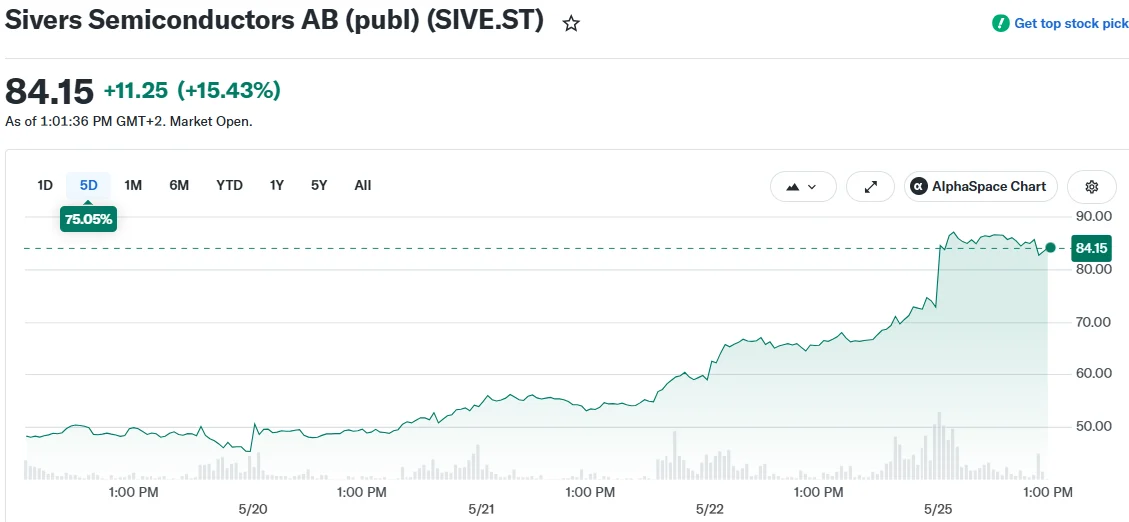
- Sivers Semiconductors jumped approximately 50% in a two-day period after landing a $6.6M Department of Defense contract for year two of the EW STAR initiative under CHIPS Act funding.
- Shares reached 87.70 Swedish kronor during Monday trading, marking a 20.30% daily increase after climbing 23.45% the previous session.
- The firm revised its financial statements for both 2024 and 2025, showing an expanded 2025 net deficit of 222.6 million kronor versus the initially disclosed 186.5 million.
- Swedish authorities are probing potential insider trading related to premature disclosure of the company’s planned Nasdaq dual-listing.
- Current valuation reflects a price-to-sales ratio of 59.69, significantly exceeding the consensus analyst target of 6.55 Swedish kronor per share.
Sivers Semiconductors has delivered one of the most dramatic stock performances in European markets this year. The Swedish manufacturer of photonics and RF semiconductor components rallied approximately 50% over just two trading days — powered by a $6.6 million U.S. military contract and growing investor enthusiasm for AI infrastructure opportunities.
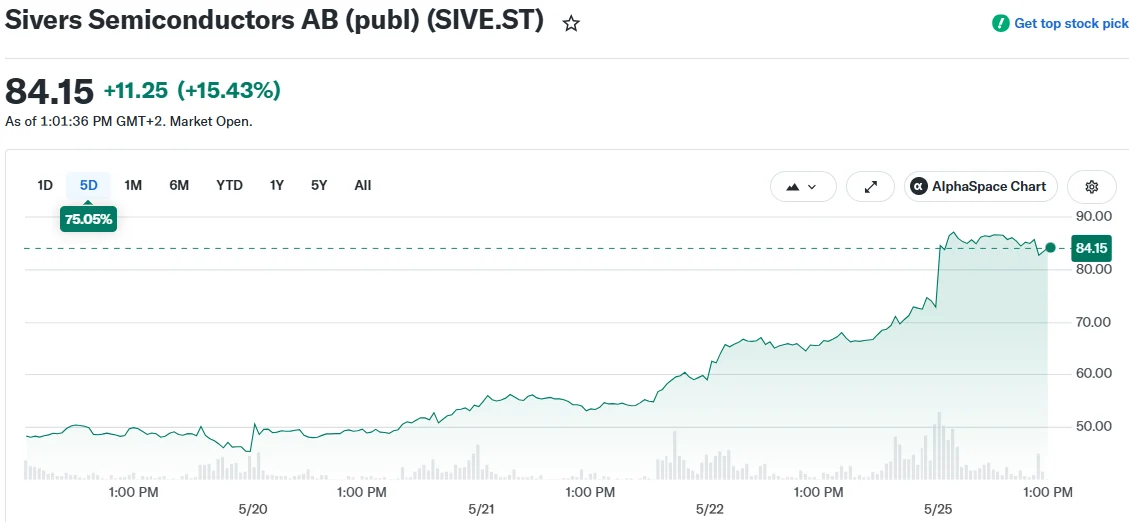
When markets closed on Monday, shares stood at 87.70 Swedish kronor, representing a 20.30% single-day advance. This came immediately after a 23.45% surge from 72.90 kronor in the preceding session. The consecutive gains elevated the company’s market capitalization to approximately 21.54 billion Swedish kronor.
The driving force behind this momentum was the second-year funding approval under the EW STAR initiative, administered through the U.S. Microelectronics Commons program with backing from the CHIPS and Science Act. The Pentagon-supported financing comes via the Northeast Microelectronics Coalition Hub, which encompasses eight states across the northeastern United States. Significantly, these funds are milestone-dependent — Sivers secured payment only after successfully completing year-one technical objectives, lending some legitimacy to the achievement.
EW STAR concentrates on developing broadband antenna array systems designed for simultaneous transmission and reception capabilities in electronic warfare, radar detection, and secure communications. Sivers is simultaneously marketing its beamforming and photonic innovations for satellite connectivity and AI-powered data center infrastructure — two segments where investor demand has been particularly intense recently.
Momentum Accelerates Without Fresh Catalysts
Monday’s 20% spike occurred without any new company disclosures. The preceding days had featured governance announcements — a recommended board restructuring that would introduce two new directors with expertise in capital markets and technology expansion, while removing several founding members and early investors. The incoming nominees, Joakim Nideborn and Helena Svancar, align with the company’s strategic pivot toward American markets and AI-related infrastructure.
The board overhaul also signals mounting pressure from various stakeholders. Achilles Capital, Sivers’ top individual shareholder, maintains connections to DDM Finance, currently undergoing debt restructuring with plans to liquidate €30–50 million in holdings. Whether Sivers shares factor into that disposal remains uncertain. Meanwhile, short positions include Voleon Capital at 1.86% and Two Sigma at 1.78%.
Financial Revisions and Criminal Scrutiny
The company’s financial standing presents challenges. Sivers reissued its accounts for 2024 and 2025 to align with U.S. PCAOB compliance requirements in preparation for a prospective Nasdaq dual-listing. The 2025 revision showed revenue of 306.6 million kronor, while the operating deficit expanded to 177.8 million kronor and the net loss reached 222.6 million kronor — substantially higher than the previously disclosed 186.5 million. The 2024 adjustments proved even more significant, reducing revenue from 243.7 million to 219.2 million kronor and enlarging the net loss from 116.3 million to 183.9 million kronor.
Compounding these concerns, Sweden’s Economic Crime Authority has launched an investigation into suspected insider trading. An unidentified social media profile with substantial reach published specifics about the Nasdaq listing strategy approximately 48 hours ahead of the official statement, triggering abnormal trading activity. Prosecutor Jonas Myrdal is evaluating whether violations of EU Market Abuse Regulation occurred.
Despite these headwinds, the stock commands a price-to-sales multiple of 59.69 and a price-to-book ratio of 20.00. The mean analyst price target remains at only 6.55 Swedish kronor — substantially below current trading levels.
Sivers has postponed its Q1 earnings release until May 29 and scheduled its annual general meeting for June 15, where investors will decide on a management incentive structure covering up to 7 million stock options, equating to roughly 2% equity dilution.
JAN3 CEO Samson Mow has renewed criticism of Ethereum as ETH trades near $2,100 and continues to lag Bitcoin.
Summary
- Samson Mow said he feels sorry for Ethereum as ETH struggles against Bitcoin and market pressure.
- Ethereum trades near $2,115, with weak price action keeping attention on support and institutional losses.
- Vitalik Buterin said the Ethereum Foundation will sell less ETH and focus on long-term survival.
In a post on X, Mow said he dislikes Ethereum as much as other Bitcoin maximalists, but added that he felt sorry for the network’s current state.
The comment came as Ethereum’s market setup remains weak. ETH was trading at $2,100 at press time, down 0.19% on the day, with an intraday range between $2,066.23 and $2,124.48, according to crypto.news data.
Samson Mow targets Ethereum weakness
Mow’s post framed Ethereum’s current position as difficult, even from the view of a long-time Bitcoin supporter. He said, “I can’t help but feel a bit sorry for how bad things are for them now.”
His comment followed months of pressure on Ethereum’s market standing. ETH has struggled to regain stronger momentum, while Bitcoin has drawn more attention from investors seeking relative strength during risk-off periods.
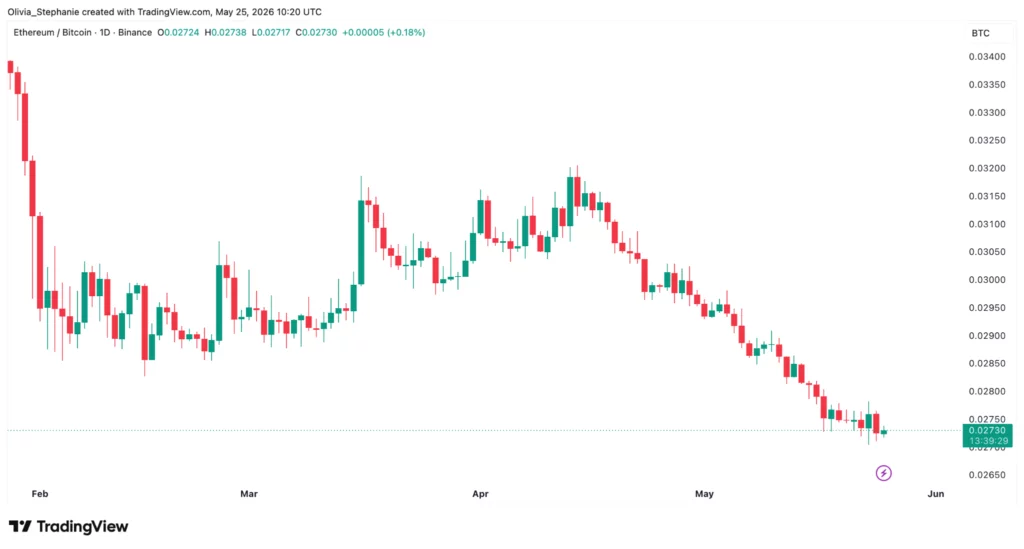
The ETH/BTC ratio has also stayed under pressure. The ratio recently sat near 0.027, showing that Ethereum has continued to weaken against Bitcoin in relative terms.
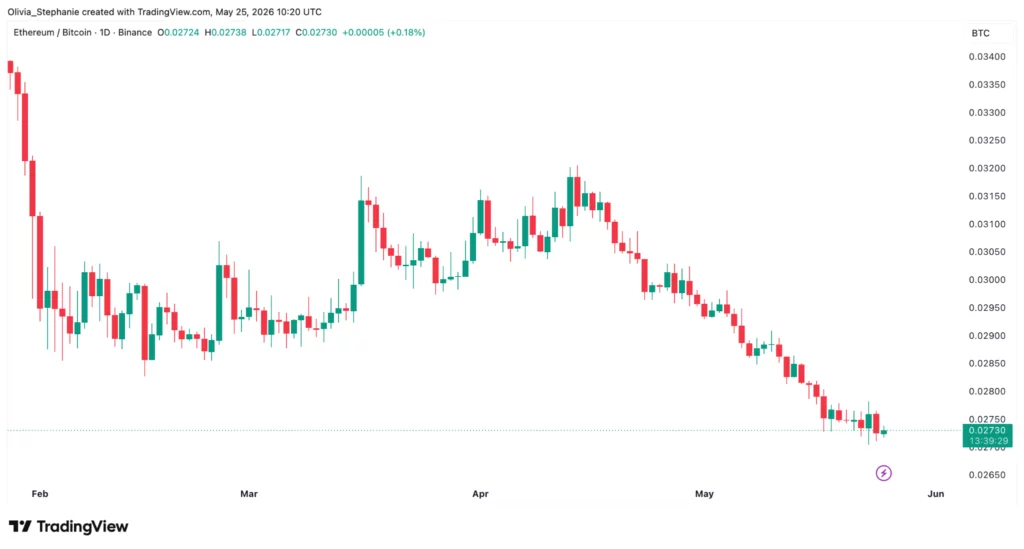
That weakness has fed a wider debate about whether Ethereum’s scaling path has helped the network or reduced demand for its base layer. Layer-2 networks have made transactions cheaper, but they have also moved user activity away from Ethereum mainnet fees.
Layer-2 growth raises base-layer questions
Ethereum’s rollup strategy helped the network handle more transactions through Layer-2 platforms such as Arbitrum, Optimism, and Base. That approach lowered user costs and improved access.
However, critics argue that the same model can reduce direct fee demand for Ethereum’s base layer. When activity moves to separate rollups, value can become spread across many networks instead of staying concentrated on mainnet.
Concerns also remain around centralized sequencers and large staking pools. These issues have kept the decentralization debate active, even as Ethereum developers continue to push technical upgrades.
Mow’s criticism fits that wider debate. His post did not present a detailed technical review, but it added attention to Ethereum’s current mix of weak price action, reduced relative strength, and structural questions.
BitMine and ETH treasury losses add pressure
Related market updates show that Ethereum treasury holders have also faced pressure. Crypto.news reported that BitMine’s ETH holdings crossed 5,078,386 ETH on April 27, after the firm bought the tokens at an average price of $2,369 each. At that time, the position was worth about $12 billion.
The same report said BitMine had carried an estimated $3.5 billion in unrealized losses in February 2026, while still buying ETH during the drawdown.
Other public ETH treasury strategies have also faced weak accounting results. Crypto.news reported that SharpLink posted a $685.6 million net loss in Q1, driven mainly by non-cash ETH market losses and impairment charges.
SharpLink reported $506.7 million in unrealized ETH losses and a $191.7 million LsETH impairment charge. The company said those accounting losses did not reduce its ETH holdings.
Vitalik Buterin backs smaller Ethereum Foundation
Mow’s comment also came soon after Vitalik Buterin described a new direction for the Ethereum Foundation. Buterin said the foundation will use its remaining resources to focus on long-term survival instead of expanding its activities.
Crypto.news reported that Buterin said the Ethereum Foundation will sell less ETH going forward. He also said the foundation holds about 0.16% of all ETH and should act as one node in Ethereum, not the center of the network.
Buterin’s plan focuses on censorship resistance, privacy, openness, and security. He also said Ethereum must become more impressive in areas such as safer code, stronger consensus, and fewer transaction intermediaries.
Cardano launched its on-chain governance system in 2025 with the promise that ADA holders would finally control the network’s $470 million treasury. Eighteen months later, that promise is producing exactly what it was designed to: a community that is now openly rejecting funding proposals from the project’s founder. Charles Hoskinson is in a public, escalating dispute with the Cardano Foundation, Emurgo, and the DRep voter base he helped create. Three concurrent governance battles in 2026 have already shaped how Cardano’s treasury gets spent, who controls the next generation of protocol development, and whether the network can preserve its identity as crypto’s “science coin” while its own elected representatives vote against research funding. This is the story almost no major outlet is telling properly.
Summary
- Cardano’s DRep governance system has repeatedly voted against treasury proposals backed by Charles Hoskinson, Emurgo, and Input Output Global during multiple disputes in 2026.
- A proposed 32.9 million ADA research funding request tied to Leios scaling and quantum-resistant cryptography faced overwhelming opposition from DRep voters ahead of the June 8 vote deadline.
- Tensions between Hoskinson, the Cardano Foundation, and community delegates have raised questions about who now controls Cardano’s long-term direction and treasury spending priorities.
The promise and the trap
Cardano spent more than seven years building toward Voltaire, the governance era that would hand control of the network from its founding entities to its community of (ADA) holders. When the Plomin hard fork activated in early 2025, the system went live. ADA holders could now delegate their voting rights to “DReps” (Delegated Representatives), the on-chain equivalent of elected officials, who would vote on protocol changes and treasury withdrawals. The Cardano Constitution, ratified in 2024, gave DReps real authority. The treasury, which had grown to hundreds of millions of ADA from transaction fees and reserves, would be spent only with DRep approval.
This was the dream. A blockchain that did what most crypto projects only said they did: handed real power to its users.
What nobody quite anticipated is what happens when the founder of a network disagrees with the network’s elected representatives.
The first warning came in late 2025 with the Genesis ADA dispute. The first major test came in April 2026 when the Cardano Summit 2026 budget proposal hit the DRep voting system. And the third, still unfolding as of late May 2026, is the rejection of Input Output Global’s “Cardano Vision 2026” research proposal, which would fund the foundational work on Leios scaling and quantum-resistant cryptography. All three battles trace to the same underlying fault line: who decides what Cardano is for, and who gets to spend its money to get there.
The story is not, strictly, about Hoskinson. It is about what happens to a project’s founding figure when the governance system they helped design starts producing outcomes they did not expect. And it is happening, in public, with documented statements from every named participant, on a chain where every vote is permanently recorded.
The Genesis ADA dispute: who owns what
The first fight set the tone for everything that followed.
In November 2025, the major Cardano organizations (IO, Emurgo, the Cardano Foundation, Midnight Foundation, and Intersect) submitted a joint proposal to withdraw 70 million ADA from the on-chain treasury to fund what they described as critical 2026 integrations: stablecoin partnerships, custody providers, analytics services, cross-chain bridges, and price feed oracles. At the prevailing ADA price, this was roughly $18 million worth of treasury draw.
Some community members pushed back. The argument was that Genesis ADA, the initial token allocations given to IO, Emurgo, and the Cardano Foundation when the network launched, should cover these integration costs rather than the community treasury. The implication was clear: if the founding entities benefit from these integrations, the founding entities should pay for them.
Hoskinson responded on November 30 during a livestream he titled “Genesis ADA.” The remarks were direct. Genesis ADA was not a community treasury, he said. It was private earnings from the early-stage risk taken by the founding entities when the project could have failed. The allocations to IO and Emurgo were “rewards for building the original infrastructure, funding early operations, and supporting” the network during a period of regulatory uncertainty. They were not, and had never been, public funds. Calls to redirect them now were “retroactive and unfounded,” he argued, because many of today’s integrations did not even exist when Genesis ADA was defined.
The deeper point, which Hoskinson made openly in the same livestream, was that the Genesis ADA debate was a proxy for something larger. Cardano was preparing for what he called a “pentad” governance restructure in 2026, moving from the original three-entity model (IO, Emurgo, Cardano Foundation) to a five-entity executive layer, adding the Midnight Foundation and Intersect. The expanded structure, he argued, was needed to compete with “large and aggressive industry players” and coordinate negotiations for major infrastructure deals.
The community pushback held. The 70 million ADA request became one of the most-discussed treasury proposals in Cardano’s history, and the underlying tension between “private earnings” and “community treasury” did not resolve. It carried into 2026.
The Summit 2026 vote: the first time DReps said no
The second battle was procedurally smaller than the Genesis ADA dispute, but politically larger, because it produced a clean, public, on-chain outcome.
In April 2026, Emurgo submitted a treasury withdrawal proposal to fund the Cardano Summit 2026 in Berlin and presence at Token 2049 in Singapore. The original request was for 14.07 million ADA, roughly $3.66 million at the time. The 2025 edition of the Summit had been approved under the same governance framework, and the funding had passed, so Emurgo went into the 2026 vote expecting a similar outcome.
That is not what happened.
DReps pushed back immediately. The 2026 budget nearly doubled the 2025 cost. ADA’s price had fallen sharply through Q1 2026, sitting in the $0.24 to $0.30 range, and community sentiment had shifted toward what one DRep called “doing more with less.” The proposal’s gross budget was $2.26 million against a revenue target of only $450,000, an imbalance that became a focal point of criticism. The Cardano Foundation, in an unusual move for a major founding entity, abstained from the vote rather than backing Emurgo’s request, stating it wanted “to avoid directing the outcome.”
Hoskinson weighed in publicly. On April 11, 2026, he posted to X, arguing that “parties” would not save ADA’s price. Infrastructure would. He proposed the same money could fund “up to six permanent offices worldwide that would operate like a hub in Buenos Aires,” shifting Cardano’s outreach model from event-based marketing to permanent local presence. He went further: the treasury, he argued, should stop issuing “free grants” entirely, and funded projects should return up to 30 percent of capital to the treasury, which would then buy ADA from the market, creating natural buy pressure.
The original proposal failed. Emurgo submitted a revised version requesting 7.8 million ADA (approximately $1.95 million), with the Foundation contributing an additional $380,000 internally. The revised version was, by analyst accounts, materially stronger than the original. The Cardano Foundation again abstained from voting on it, formally noting it wanted the community to decide independently.
The Summit vote was, in plain terms, the first time the Cardano Foundation and Emurgo discovered they no longer set the budget themselves. DReps did. And the DReps, weighted by ADA delegations, were not in the mood to approve eight-figure event sponsorships during a price downturn.
The IO research proposal: the most consequential vote yet
The third battle is the most important one, and the one most likely to define what Cardano looks like in 2027 and beyond.
In May 2026, Input Output Global submitted a proposal titled “Cardano Vision 2026: Human Centred, Scalable, Post Quantum Secure – IO Research.” The request was for 32.9 million ADA in treasury funding (roughly $8.6 million at the prevailing price) to fund advanced research initiatives, including the Leios scaling technology and quantum-resistant cryptography. Leios is Cardano’s next-generation consensus protocol upgrade, designed to sharply raise the network’s transaction throughput, targeting the 2030 scaling strategy of 27 million monthly transactions. Quantum-resistant cryptography is the long-horizon defense against the threat that future quantum computers could break the elliptic curve cryptography that secures every major blockchain today.
This was, in IO’s framing, the foundational research that would keep Cardano relevant for the next decade.
DReps started voting against it almost immediately.
As of the week of May 19, 2026, with the vote scheduled to close on June 8, 86.72 percent of votes are “No,” with only 13.28 percent supporting the proposal. Among the most influential opposing voices was a DRep operating under the name YUTA, who announced an abstention vote and argued the proposal “mixes valuable research with what he considers unnecessary treasury spending.” YUTA’s stated preference was for the proposal to be split into separate submissions, so DReps could approve the Leios scaling work without simultaneously approving everything else IO had bundled with it.
A separate cluster of Japanese DReps voted against the proposal on different grounds, raising structural concerns about how IO was using the treasury to fund what they saw as work that should be covered by Genesis ADA allocations. The argument echoed the November 2025 Genesis dispute almost verbatim, but with sharper teeth: this time, the DRep system was actually voting, and the votes were going against IO.
Hoskinson’s response was extraordinary by any measure of crypto founder discourse. He warned, publicly, that if the proposal failed, IO would not resubmit it. He warned that “layoffs could follow if proposals fail.” He warned that ADA’s “downturn could become permanent if Cardano loses its research-driven edge.” He criticized opposing DReps as undermining “years of technological progress” for the sake of “ADA’s temporary price downturn.” And he warned that Cardano risked losing its identity as the “science coin,” the reputation it had built over “more than a decade of development and hundreds of millions of dollars invested in peer-reviewed research and academic rigor.”
The framing was that DReps voting against the proposal were not just rejecting a budget request. They were rejecting the foundational identity of Cardano itself.
DReps kept voting no.
What the three fights have in common
Step back from the specifics of each battle, and a pattern emerges that explains all three.
The Cardano governance system was designed to give ADA holders real authority over treasury spending. The system is now exercising that authority. The DReps who hold delegated voting rights are not, on net, voting the way the founding entities want them to vote.
This is not a failure of the governance system. It is the system working exactly as designed. The unstated assumption among many of the project’s founding entities had been that Voltaire would produce a decentralized rubber stamp for proposals the founding entities themselves brought forward. The reality has been the opposite: DReps are rejecting proposals, including high-profile ones, from the project’s most senior figures.
There is a price dimension to all of this that cannot be ignored. ADA has been trapped in the $0.24 to $0.30 range since January 2026, down sharply from earlier highs. Treasury proposals that fund event marketing, large research initiatives, or anything that does not produce immediate measurable value have become much harder to pass in this environment. The community has, in effect, become a fiscal hawk. DReps are protecting the treasury because the treasury’s purchasing power has shrunk, and they want to see clear returns on what little spending does occur.
There is also a structural dimension. The Cardano Foundation expanded its DRep delegation program in January 2026, adding 220 million ADA across 11 DReps. The move was designed, by the Foundation’s framing, to distribute voting power more broadly and maintain coordinated governance participation. The unintended effect has been to create a class of DReps who are accountable to no single entity, and who can vote against any of the founding organizations, including the Foundation itself. The Foundation’s abstention on the Summit 2026 votes is, in part, an acknowledgment that the Foundation itself can no longer count on the community to follow its lead.
And there is a personal dimension. Hoskinson’s public communication style has, by his own admission, contributed to the friction. In a Thanksgiving 2025 livestream, he openly accepted “responsibility for some of the tension” and urged the ecosystem “not to polarize.” The months that followed did not produce a less polarized ecosystem. The April 2026 “no more parties” post, the criticisms of DReps as undermining Cardano’s research mission, and the recurring framing of disputes as existential threats to the project have not lowered the temperature.
The deeper question is whether Cardano’s founder still has the political capital to push proposals through a governance system designed to operate without him.
The Foundation’s careful position
The Cardano Foundation deserves separate attention because its conduct during these three battles has been notably different from Emurgo’s, and notably different from IO’s.
The Foundation has not, in any of the three disputes, openly opposed Hoskinson. It has also not, in any of the three disputes, openly backed him. On the Summit 2026 vote, the Foundation abstained both times, formally stating its reasons. On the Genesis ADA dispute, the Foundation did not weigh in publicly. On the IO research proposal, the Foundation has stayed largely silent.
What the Foundation has done is build governance infrastructure. The January 2026 DRep delegation expansion put 220 million ADA into circulation across 11 DReps. The Foundation has introduced new standards (CIP-0113, the Programmable Tokens standard) and backed tokenization initiatives. It has, in effect, focused on the structural work of making governance function rather than on the political work of taking sides in any particular vote.
The Hoskinson-Foundation tension has surfaced periodically. In November 2025, Hoskinson posted criticism of the Foundation’s spending discipline, framing it as resistance to “accountability, oversight, or real KPIs.” The Foundation’s community and governance lead, Nicolas Cerny, responded by pushing back against what he called “CF derangement syndrome” and advising community members to practice “critical thinking rather than simply parroting the talking points of certain individuals.” The exchange, conducted publicly on X, was unusually sharp for an organization-to-founder communication in crypto.
The Foundation’s quieter posture in 2026 may reflect an institutional judgment that the public fights are not worth having. Or it may reflect a strategic patience: if Hoskinson’s relationship with the DRep community keeps deteriorating, the Foundation’s careful neutrality becomes more valuable, not less.
Either way, the asymmetry between the Foundation’s silence and Hoskinson’s public statements is one of the most telling features of the current dynamic.
What this means for ADA holders
For an ADA holder, the civil war has direct, material consequences that extend beyond founder drama.
Treasury spending is now harder to approve. This is, on balance, neutral or positive for ADA’s price in the short term, because every rejected proposal is a smaller draw against the treasury, which means less sell pressure from funded projects converting ADA to fiat. The Summit 2026 rejection alone kept approximately $3.66 million of ADA out of the market. The IO research proposal, if it fails as currently projected, would keep an additional $8.6 million from being sold.
Treasury spending is also slower. The lag between proposal submission and DRep vote, combined with the now-common pattern of revisions and resubmissions, means projects requesting funding face longer timelines and more uncertainty. This is good for fiscal discipline. It is bad for execution speed, particularly for time-sensitive infrastructure work.
The most consequential outcome for ADA holders is what happens to the founder. If Hoskinson follows through on the warning that IO will not resubmit the research proposal if it fails, the Cardano Vision 2026 research initiative would not proceed in its current form. IO’s research division has been one of the project’s strongest differentiators, the source of the peer-reviewed papers, academic partnerships, and “science coin” reputation that has carried Cardano through multiple downturns. If that engine slows, Cardano’s competitive position against Ethereum, Solana, and the broader Layer-1 field changes materially.
For now, the situation is unresolved. The IO research proposal vote closes June 8, 2026. The pentad governance restructure is still under discussion. The Summit 2026 revised vote is still active. Each of these has the potential to either de-escalate the tension or sharpen it further, and there is no clear signal yet which direction the next round will move.
The deeper question
Strip away the specifics, and Cardano is testing a question every other major crypto project will eventually have to answer.
What happens when a network’s governance system, designed to give power to its community, starts producing outcomes the founding figures of the network disagree with?
The honest answer is that this is what decentralization actually looks like. Bitcoin’s founder is gone. Ethereum’s founder has explicitly stepped back from operational influence. Cardano’s founder is still active, still vocal, and still convinced his vision for the project is the correct one, but the governance system he helped design no longer requires the community to agree with him.
That is not a failure mode. That is a feature. But it is a feature that produces visible discomfort when it operates against the founder’s preferences, and the discomfort is now public, ongoing, and documented on-chain.
Cardano’s civil war is therefore not a crisis. It is a test. The project that emerges from 2026 will be either one where DReps and the founding entities have learned to coordinate productively, or one where the founding entities accept reduced political influence over a system that has, by design, outgrown them.
Both outcomes are plausible. Neither is settled.
The Pi Network community has spent years asking when tier-1 listings would arrive. The Cardano community is asking a harder question: when the founder of the network and the community of the network disagree, who actually decides?
The answer, on chain, is increasingly clear. The DReps decide. Whether Hoskinson can rebuild political capital with that community, or whether Cardano will keep shipping through a governance system that no longer defers to him, is the story to watch through the rest of 2026 and into 2027.
For now, the votes are running. The proposals are being rejected. And the man who built the system that produced this outcome is, by his own framing, watching his project lose the identity he spent over a decade building.
That is the civil war. It is happening in public, in real time, and it is shaping Cardano in ways the project’s founder did not anticipate when the system that produced it was first designed.
This article is for informational purposes and does not constitute financial or investment advice. Governance votes and ecosystem disputes evolve quickly; the figures and statements described reflect reporting available as of late May 2026. Always do your own research.
Crypto World
Bitcoin price prediction: BTC faces critical resistance at $78,000 as ETF outflows mount


- Bitcoin ETFs posted $1.25 billion in weekly net outflows.
- BTC must clear $78,152 to sustain bullish momentum.
- Strategy paused Bitcoin purchases despite holding 843,738 BTC.
Bitcoin (BTC) continued to trade near the $77,000 level on Monday amid growing institutional outflows against improving macro sentiment and rising demand from spot buyers.
The world’s largest cryptocurrency was up 0.5% over the past 24 hours, trading at $77,182 at press time, slightly outperforming the broader crypto market.
The slight rebound pushed BTC’s price closer to a major resistance zone near $78,000, a level that traders are watching closely after weeks of volatile price action and heavy selling pressure from spot exchange-traded funds.
The market is reacting to easing geopolitical tensions after US President Donald Trump said a potential agreement with Iran was “largely negotiated,” reducing fears of a wider Middle East conflict.
Bitcoin ETF outflows continue to pressure sentiment
Institutional demand for Bitcoin ETFs weakened sharply over the past week, with spot Bitcoin ETFs recording roughly $1.256 billion in net outflows between May 18 and May 22, according to CoinGlass data.
Several of the largest withdrawals came from products linked to BlackRock and Fidelity, two firms that played a major role in driving institutional adoption after spot Bitcoin ETFs launched in the United States in early 2024.
The outflows added to concerns that institutional appetite for BTC exposure may be cooling as investors rotate capital toward other sectors, particularly artificial intelligence and semiconductor-focused investments.
At the same time, Strategy, formerly known as MicroStrategy, has paused its aggressive Bitcoin buying campaign this week.
Nevertheless, the company still holds 843,738 BTC, making it the largest corporate Bitcoin holder globally, but it chose to buy bonds instead of adding more Bitcoin to its treasury.
The move attracted attention across the crypto market because Strategy and executive chairman Michael Saylor have been among Bitcoin’s strongest corporate supporters over the past several years.
Meanwhile, BlackRock CEO Larry Fink adopted a more measured tone while discussing Bitcoin’s role in institutional portfolios.
Although Fink highlighted the success of Bitcoin ETFs, his recent comments reflected a more cautious stance compared to earlier bullish statements.
Still, not all institutional activity turned negative. El Salvador added another eight Bitcoin to its national reserves, extending the country’s long-running accumulation strategy under President Nayib Bukele.
Bitcoin dominance rises as traders rotate out of altcoins
Even with ETF outflows accelerating, Bitcoin managed to hold above key support levels as capital continued rotating away from smaller cryptocurrencies and into BTC.
Market data shows Bitcoin outperforming much of the altcoin market during the latest recovery.
At the same time, derivatives activity has increased sharply, with open interest in perpetual futures contracts jumping 11.44% within 24 hours, signalling rising leveraged positioning among short-term traders.
That increase in leverage amplified Bitcoin’s move higher but also raised the risk of sharper volatility if macroeconomic data or market sentiment shifts suddenly.
Technical indicators point to a critical resistance zone
Technical indicators currently present a mixed picture for Bitcoin’s short-term outlook.
Data from 23 technical indicators shows four buy signals and nine sell signals, leaving the broader short-term trend tilted bearish despite the latest rebound.
The most important resistance level sits at $78,152. Bitcoin needs a decisive close above that level to sustain upward momentum and target the next resistance near $79,331.
On the downside, immediate support stands at $76,773. A breakdown below that level could expose Bitcoin to deeper losses, especially if traders begin unwinding leveraged positions.
The 14-day Relative Strength Index currently stands at 47.70, suggesting neutral conditions rather than an overheated market.

Moving averages also continue signalling caution.
The Bitcoin price currently trades above only two of the five major exponential moving averages, while remaining below the long-term 200-day EMA, a level many traders use to assess broader market direction.
Analysts are also watching the 61.8% Fibonacci retracement level near $76,590, which has emerged as another important support area during the latest consolidation phase.


Crypto fund flows are starting to fracture, with investors exiting bitcoin and ether (ETH) exchange-traded funds (ETFs) while rotating into alternative tokens such as Hyperliquid’s hype (HYPE) and XRP (XRP).
Bitcoin ETFs saw more than $1 billion in outflows last week, extending a sharp institutional pullback, while ether funds lost another $215 million, according to data source SoSoValue. The continued bleeding from the two largest assets signals a cooling appetite for broad, benchmark crypto exposure.
But the redemptions haven’t been uniform.
Spot products investing in Hyperliquid’s hype token, issued by Bitwise and 21Shares, attracted a combined $72.38 million, underscoring that capital is being redeployed with precision rather than exiting the market altogether. XRP and sol ETFs registered inflows worth $22 million and $15.6 million, respectively.
“The broader message: capital has not left crypto uniformly. It is rotating toward newer narratives and away from crowded large-cap exposure,” Timothy Misir, head of research at BRN, said in an email.
Hype is real
The strong uptake for hype ETFs, which went live a week ago, coincides with a sharp rally in the token’s price and robust network activity.
The token has been on a tear, jumping from $38 to $63 in the past 10 days, CoinDesk data show. It has gained 59% for the month, a staggering performance compared with market leader bitcoin’s 1% gain.
Decentralized platform Hyperliquid has generated $13.2 million in fees over the past seven days, the fifth-largest tally, trailing stablecoin behemoths such as Tether and Circle Internet (CRCL) as well as launchpad Pump. Canton Network ranks fourth, though, according to DeFiLlama, that is largely driven by substantial incentives.
Hyperliquid’s revenue is expected to rise further, thanks to its recent agreement with Coinbase and Circle to integrate stablecoin USDC as a quote asset.
Some analysts say Hyperliquid is rapidly emerging as a challenger to traditional trading platforms and prediction markets. And for good reasons: Since the Iran war began in late February, the platform’s HIP-3 market has consistently handled millions in trading volume in perpetual futures tied to traditional and real-world assets (RWA) such as oil, gold and U.S. equity indexes.
“Hyperliquid fundamental metrics continue to strengthen across the board as HIP-3 markets reached new weekly highs at 2.6B in open interest across RWA perp markets. HIP-4 launched outcome markets a couple of weeks ago to more modest growth,” data tracking website Artemis said in the weekly newsletter.
“Equity perpetuals, pre-IPO markets and prediction markets are all in the very early innings, and Hyperliquid is well positioned to capitalize on that momentum,” Artemis said.

Napoli and Antonio Conte part ways: Is he in contention to return as Italy manager?

Does Your Internet Hold Up to Its Promise? Vote in the 2026 People’s Picks Awards

Hajj 2026 LIVE: Muslims begin the annual pilgrimage in sweltering Saudi Arabia heat


-

 Crypto World4 days ago
Blockchain.com files with SEC for U.S. IPO
-

 Fashion3 days ago
Holiday Weekend Open Thread – Corporette.com
-
 Crypto World3 days ago
Bitcoin Accumulation Weakens as BTC Realized Losses Hit $600M
-
 Business3 days ago
Dell Technologies DELL Stock Surges 15% on AI Server Momentum and Analyst Upgrades in 2026
-
 Crypto World3 days ago
Space X IPO Is ‘Bad News’ for Tech Stocks: But What About Bitcoin?
-

 Politics3 days ago
Makerfield: a tale of two social-media histories
-

 Crypto World2 days ago
Robinhood crypto COO Tanya Denisova exits
-
 Crypto World3 days ago
MicroStrategy’s Saylor Says Miners No Longer Set Bitcoin Price, Another Force Has Taken Over
-

 Business18 hours ago
NYT Strands Answers May 24 2026 Revealed for Puzzle No. 812 Theme Summer Essentials
-
 Tech3 days ago
A 0.12% parameter add-on gives AI agents the working memory RAG can’t
-

 Crypto World3 days ago
AI infrastructure race heats up as IREN pitches full-stack strategy, WhiteFiber lands $160M deal
-

 Tech4 days ago
WhatsApp ads could make Irish debut after discussions with DPC
-

 Tech3 days ago
You Can Now Add ChatGPT To PowerPoint
-

 Business3 days ago
Trump Invests $1M-$5M in Kura Sushi USA Chain With 27 California Locations
-
 Crypto World7 days ago
Revolut Launches Dogecoin Debit Card Across UK and EU
-
 NewsBeat4 days ago
Charity run by Reform leader Malcolm Offord accused of ‘law breaking’ over Scottish registration
-

 Sports3 days ago
2026 CJ Cup Byron Nelson leaderboard: Brooks Koepka finds putting stroke in Round 1
-
Business3 days ago
Goldman Sachs reinstates Ageas stock coverage with neutral rating
-

 Crypto World5 days ago
Exa Labs raises $250 million in funding led by a16z
-

 Crypto World3 days ago
Trump Media’s Bitcoin Stash Shrinks Again as 2,650 BTC Lands on Crypto.com
You must be logged in to post a comment Login