

Crypto World
Market Analysis: GBP/USD Turns Bullish Again While EUR/GBP Drops More

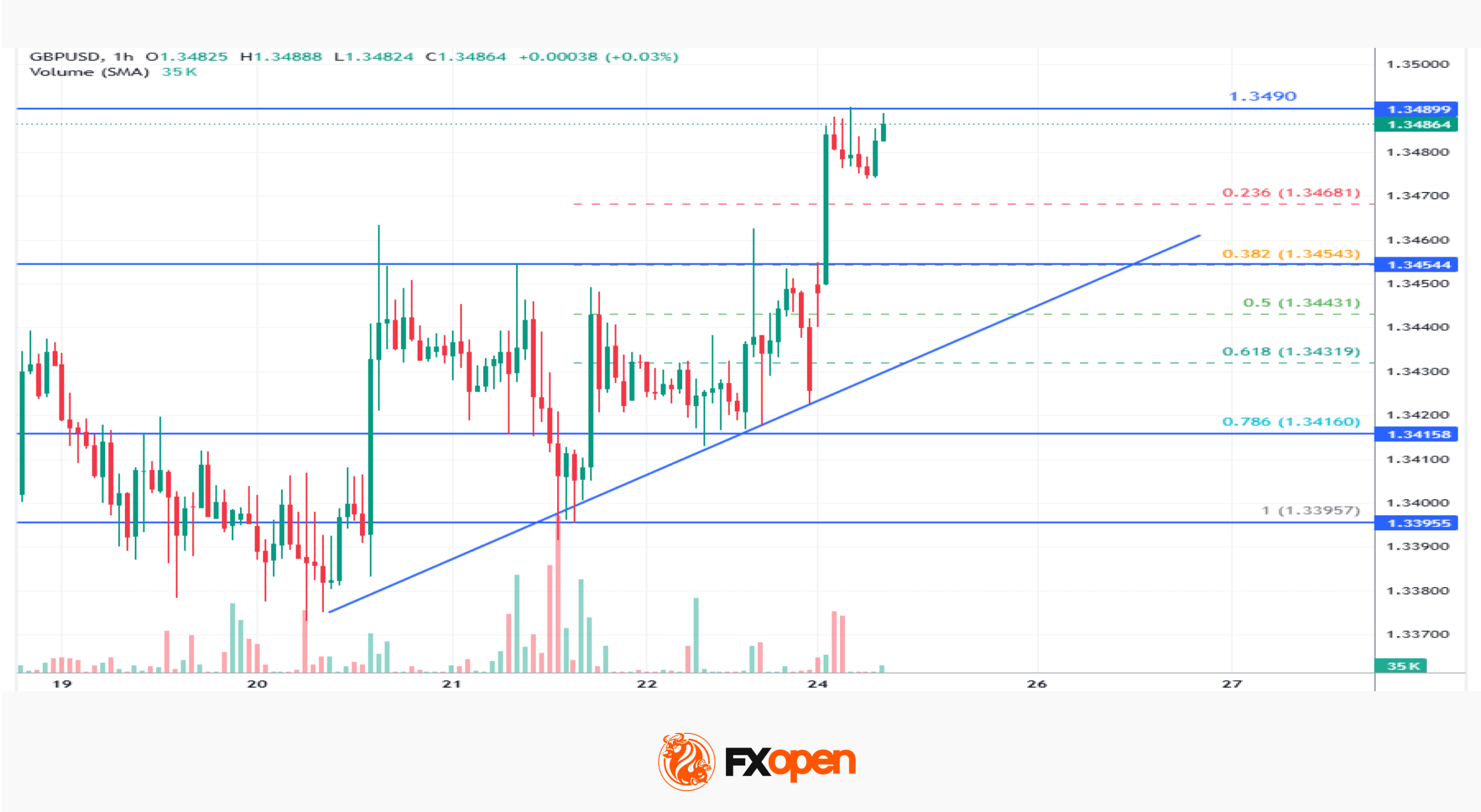
GBP/USD is showing positive signs above 1.3440 and 1.3460. EUR/GBP declined and is now consolidating losses below 0.8680.
Important Takeaways for GBP/USD and EUR/GBP Analysis Today
· The British Pound started a fresh increase above 1.3420 to enter a positive zone.
· There is a bullish trend line forming with support at 1.3450 on the hourly chart of GBP/USD at FXOpen.
· EUR/GBP is trading in a bearish zone below the 0.8660 pivot level.
· There is a connecting bearish trend line forming with resistance near 0.8650 on the hourly chart at FXOpen.
GBP/USD Technical Analysis
On the hourly chart of GBP/USD at FXOpen, the pair remained well-bid above 1.3350. The British Pound started a decent increase above 1.3400 against the US Dollar.
The bulls were able to push the pair above the 50-hour simple moving average and 1.3440. The pair even climbed above 1.3480. A high was formed at 1.3490, and the pair is now consolidating gains above the 23.6% Fib retracement level of the upward move from the 1.3395 swing low to the 1.3490 high.
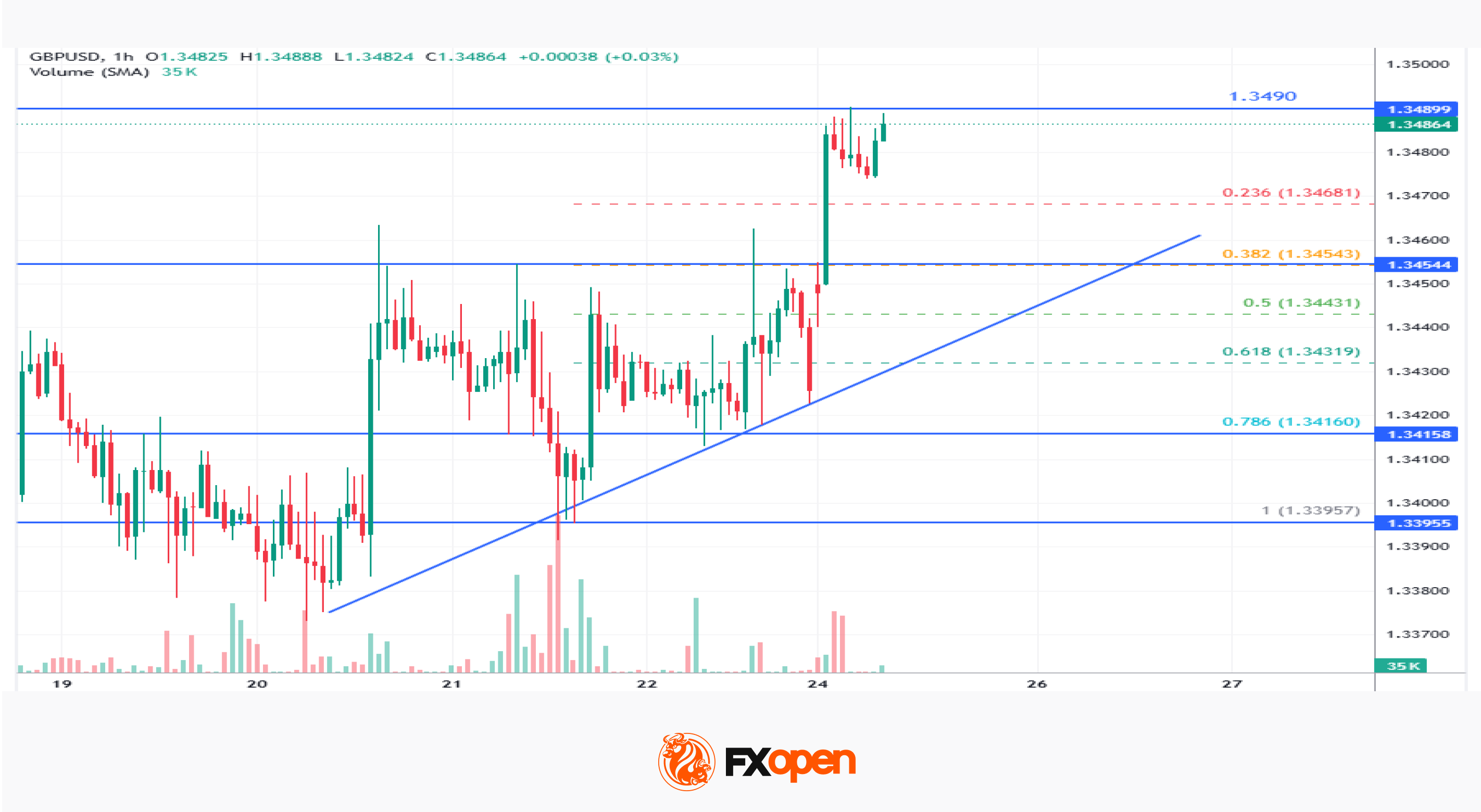
On the upside, the GBP/USD chart indicates that the pair is facing resistance near 1.3490. The next hurdle for the bulls could be 1.3500. A close above 1.3500 could open the doors for a move toward 1.3550. Any more gains might send GBP/USD toward 1.3600.
On the downside, the bulls might remain active near 1.3450. There is also a bullish trend line forming with support at 1.3450. If there is a downside break below 1.3450, the pair could accelerate lower.
The first major support could be at 1.3430 and the 61.8% Fib retracement, below which the pair could test 1.3470. The next key area for the bulls could be 1.3415, below which the pair could test 1.3395. Any more losses could lead the pair toward 1.3350.
EUR/GBP Technical Analysis
On the hourly chart of EUR/GBP at FXOpen, the pair started a steady decline from well above 0.8700. The Euro traded below 0.8680 against the British Pound.
The EUR/GBP chart suggests that the pair even declined below 0.8660 and the 50-hour simple moving average. A low was formed at 0.8630, and the pair is now consolidating losses below the 23.6% Fib retracement level of the downward move from the 0.8730 swing high to the 0.8630 low.
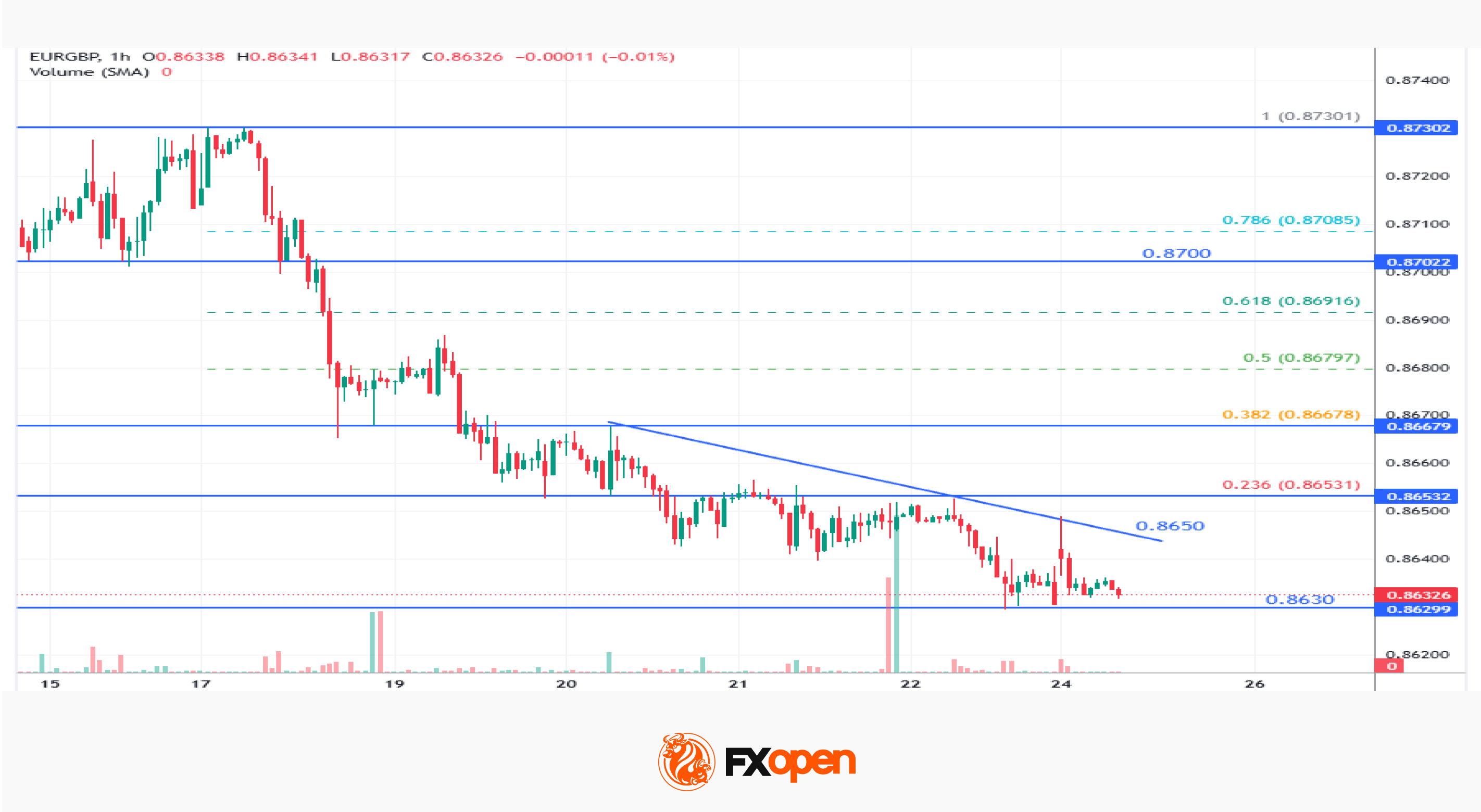
The pair is now facing resistance near a connecting bearish trend line at 0.8650. The next major barrier for the bulls could be 0.8665 and the 38.2% Fib retracement.
A close above 0.8665 might accelerate gains. In the stated case, the bulls may perhaps aim for a test of 0.8670. Any more gains might send the pair toward the 0.8730 pivot. The main hurdle for the bulls might be at 0.8780.
Immediate support could sit near 0.8630. The first key zone migbt be at 0.8600. A downside break below 0.8600 might call for more downsides. In the stated case, the pair could drop toward 0.8565.
Trade over 50 forex markets 24 hours a day with FXOpen. Take advantage of low commissions, deep liquidity, and spreads from 0.0 pips (additional fees may apply). Open your FXOpen account now or learn more about trading forex with FXOpen.
This article represents the opinion of the Companies operating under the FXOpen brand only. It is not to be construed as an offer, solicitation, or recommendation with respect to products and services provided by the Companies operating under the FXOpen brand, nor is it to be considered financial advice.


- The malware spread through npm, PyPI, and Rust packages in coordinated waves.
- It steals crypto wallets, SSH keys, and cloud developer credentials.
- AI coding tools were also targeted through malicious config files.
A coordinated malware campaign known as TrapDoor has hit software ecosystems widely used by crypto and blockchain developers.
Security researchers identified dozens of malicious packages spread across major open-source repositories, all designed to steal sensitive developer data such as wallet keys, cloud credentials, and source code access tokens.
Instead of a single malicious upload, attackers deployed multiple packages in waves using different accounts.
This approach made the activity harder to detect at the early stages and allowed the malware to blend into routine dependency updates.
Coordinated attack across major developer ecosystems
The TrapDoor operation affected at least three major package ecosystems: npm, PyPI, and Crates.io.
Together, researchers identified more than 30 malicious packages and over 300 affected versions distributed within a short window.
The activity reportedly began around May 22, 2026, although GitHub reported unauthorized access to internal repositories on May 20. It then escalated quickly over the following days.
The packages were not isolated incidents. Instead, they appeared to be part of a coordinated release strategy involving multiple developer accounts.
This structure suggests planning rather than opportunistic abuse. Each package carried similar behavior patterns and pointed to a shared malicious framework used by the attackers.
How the TrapDoor malware operates inside developer systems
Once installed, TrapDoor packages execute automatically through standard build and installation processes used in modern development environments.
In JavaScript packages, malicious code is triggered through post-install scripts, which run immediately after a dependency is added.
In Python packages, the malware can activate during import, allowing it to execute without any explicit function call.
Rust packages use build scripts to achieve the same result during compilation.
After execution, the malware scans local systems for valuable data. This includes SSH keys, API tokens, and configuration files commonly used in cloud and blockchain development workflows.
It also targets browser-stored credentials and environment variables, which often contain sensitive authentication data.
Stolen information is then sent to external servers controlled by the attackers.
In some cases, the malware attempts to maintain persistence by modifying startup processes or inserting malicious hooks into development tools.
Crypto-focused targeting and high-value data theft
What makes this campaign particularly concerning is its focus on crypto-related development environments.
The malware specifically searches for crypto wallet-related files and credentials linked to platforms such as Coinbase, MetaMask, Binance, and Solana-based tools.
It also targets cloud infrastructure credentials from providers like AWS and GitHub access tokens.
These are especially valuable because they can provide attackers with direct access to private repositories, deployment pipelines, and backend systems.
In addition, the malware attempts to collect SSH keys that could allow remote access to developer machines or production servers.
This combination of targets gives attackers a wide range of entry points into both personal and enterprise systems.
AI development tools also under pressure
One of the more unusual elements of the TrapDoor campaign is its interaction with AI-assisted development environments.
Some malicious packages include configuration files designed to influence coding assistants and automated development tools.
Files such as .cursorrules and CLAUDE.md were reportedly used to manipulate AI coding assistants into performing actions that could expose sensitive information.
Instead of directly hacking systems, the attackers attempted to exploit how AI tools interpret project instructions.
This approach reflects a shift in attack methods.
Rather than targeting only code execution, the campaign also attempts to influence developer workflows that rely on AI-generated suggestions and automated analysis.
Internet Computer (ICP) led every major blockchain in transaction volume over the past 30 days.
Its volume reached roughly 6.5 billion on the Chainspect rankings dated May 24.
Follow us on X to get the latest news as it happens
The figure more than doubled Solana’s count of 2.9 billion. Fogo, BNB Chain, and TRON rounded out the top five on the same chart. Each network posted under 500 million transactions, leaving ICP and Solana alone at the top of the activity rankings.
This highlights strong network activity. Internet Computer splits its workload across more than 49 subnets. Each subnet runs an independent consensus, allowing the chain to scale horizontally instead of through a single execution layer.
Chainspect data shows ICP has processed 287 billion transactions since its May 2021 launch. The network currently processes 2,891 transactions per second, with 10.4 million in the past hour alone.
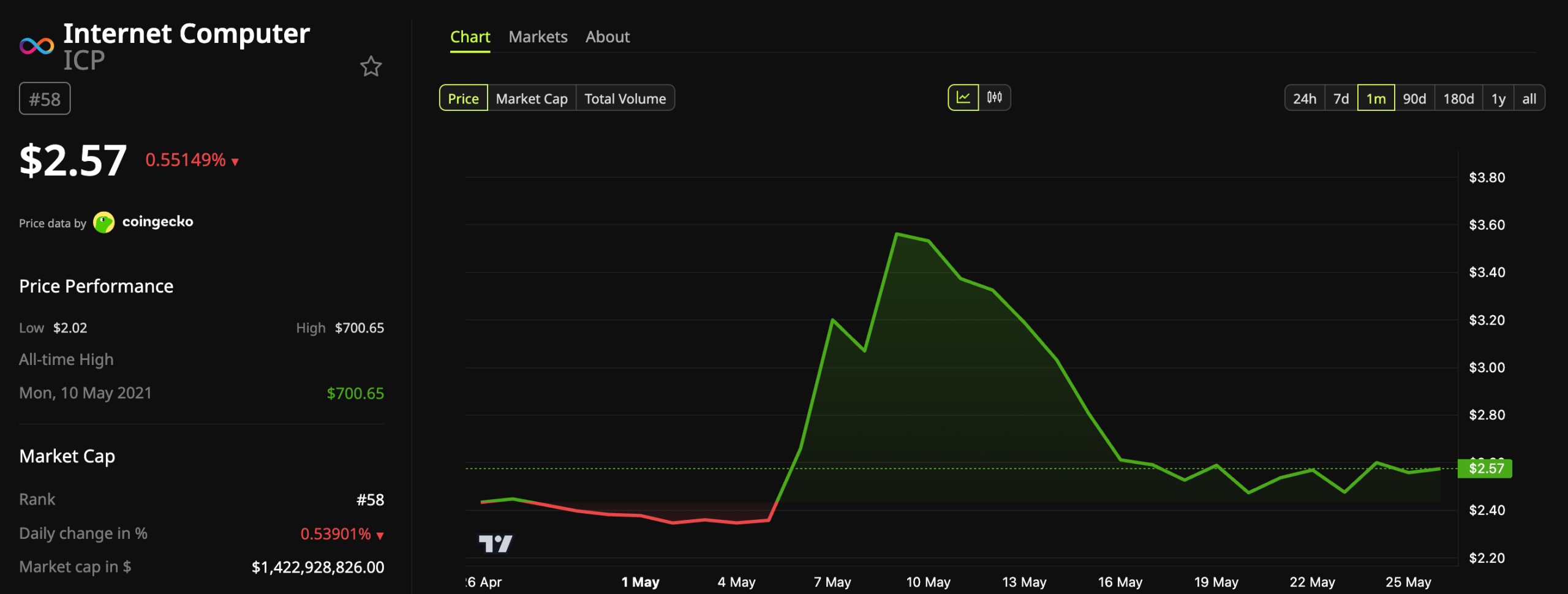
Despite the strong network activity, the price has faced headwinds. ICP token surged nearly 49% in early May. However, the altcoin has given up most of its gains, dropping over 28% since May 9.

At press time, ICP traded at $2.57, down 0.55% over the past day. The volume surge points to network health, but it has not yet sparked a meaningful price recovery. Whether the gap closes anytime soon remains an open question.
Subscribe to our YouTube channel to watch leaders and journalists provide expert insights
The post Internet Computer Beats Solana and BNB Chain in 30-Day Activity Race appeared first on BeInCrypto.

A lawsuit filed in a New York court in May 2026 seeks to declare a claimant known as Noah Doe the legal owner of more than 39,000 dormant Bitcoin (BTC) wallets, targeting a combined 3.79 million BTC.
They reported the addresses to the NYPD and sent on-chain and press notices to potential owners, though questions have since emerged about whether the notifications actually reached the wallets that hold the funds.
Lawsuit Targets Satoshi Nakamoto’s Alleged Stash
The amended complaint names wallets attributed to Satoshi Nakamoto alongside early miner addresses, Casascius Coin holdings, and wallets linked to hackers and unidentified entities. The combined face value of those addresses runs into hundreds of billions of dollars at current bitcoin prices. Recurring debates about Satoshi’s alleged Bitcoin holdings and the Bitcoin creator’s identity have long shown how difficult it is to attribute early wallets with any certainty.
Ripple CTO David Schwartz, known on X as JoelKatz, offered a dry take on the case. One post had observed that a court might one day approve “something dumb like this” and that any such ruling would carry little practical weight. Schwartz, who recently flagged a major BitLocker security flaw and shared his meme coin investing views, agreed but carved out one exception.
Bitcoin SV (BSV) is the Craig Wright-linked fork that has historically adopted governance positions. Critics argue these choices make it more open to external legal pressure than the main network. Wright himself has pursued court-ordered claims over BTC-related assets and intellectual property in the past. This lends Schwartz’s quip a pointed edge.
Why Bitcoin’s Node Network Would Simply Ignore the Ruling
Bitcoin itself operates without any central authority capable of enforcing a forced ownership transfer. Thousands of independent node operators globally maintain the protocol. None of them would implement a change to satisfy a court order. Any ruling purporting to transfer dormant BTC would be enforceable only under specific conditions. This requires that private keys could be seized through traditional legal channels. However, this condition does not apply to the wallets at the center of this suit.
The post Ripple EX-CTO Mocks Lawsuit Claiming Ownership of 3.7 Million Abandoned Bitcoins appeared first on BeInCrypto.
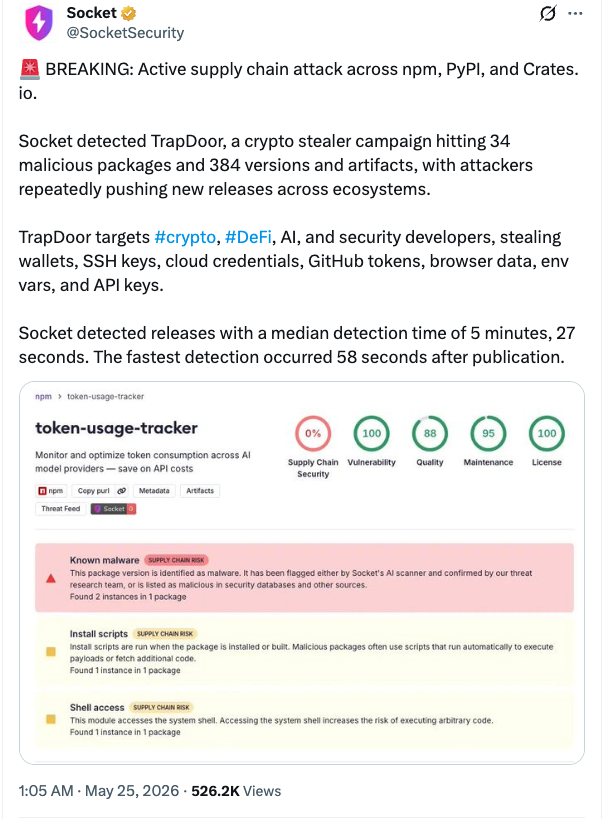
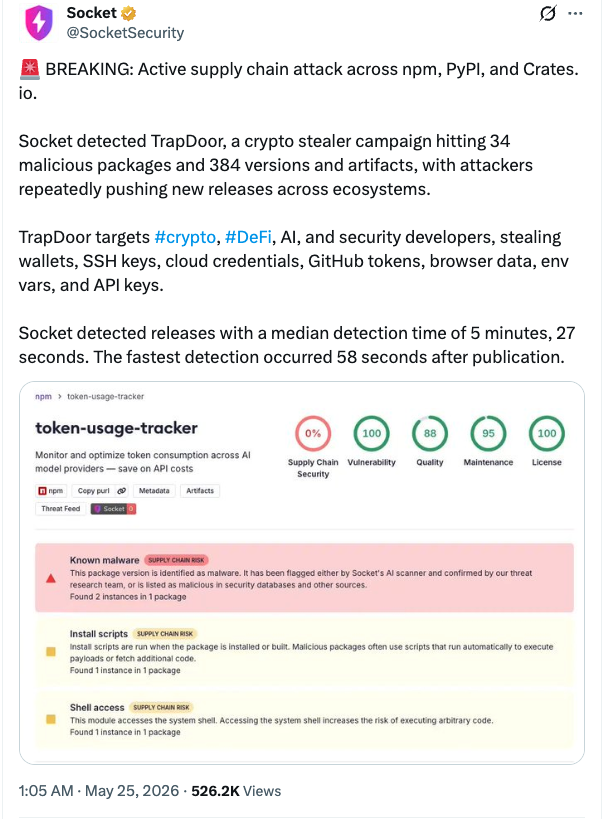
An active supply chain attack is targeting crypto and artificial intelligence developers in a bid to steal crypto, data or credentials, says the developer platform Socket.
Socket said in a report on Sunday that it discovered the malware campaign, which it dubbed “TrapDoor,” on Friday, and the campaign has deployed more than 34 malicious packages and 384 related versions, with attackers repeatedly pushing new releases across ecosystems.
TrapDoor targets crypto, decentralized finance, AI, and security developers, stealing wallet data, Secure Shell, or SSH keys, cloud credentials, GitHub tokens, browser extension data and API keys, Socket said.
The malware also targets popular crypto wallets, including Coinbase, Binance, Solana, Sui, Aptos, and MetaMask in addition to the Brave internet browser, Socket chief technology officer Ahmad Nassri said on Sunday.
Nassri said the malware injects hidden instructions to “hijack your AI coding assistant,” targeting Claude and Cursor. “The goal appears to be to trick AI assistants into running a ‘security scan’ or similar workflow that causes secret discovery and exfiltration,” Socket said.
Source: Socket
Crypto and AI developers have increasingly become targets as malicious actors have been loading poisoned packages into “app stores” for developers, knowing they will install them as part of their normal workflow, often without checking.
TrapDoor specifically targets popular developer resources such as npm (node package manager), the package store for JavaScript/Node.js developers, the language behind most websites and web apps.
It was also found in PyPI, the equivalent for Python developers, which is widely used in data science, AI, and automation, and Crates, the same thing for Rust developers.
Related: GitHub investigates unauthorized access to internal repositories
The malicious package names are crafted to look like “development helpers, project setup tools, model routing utilities, prompt engineering packages, Solidity tooling, and Sui or Move build helpers,” Socket said.
“This gives the campaign broad reach across adjacent developer communities where crypto wallets, cloud credentials, GitHub tokens, and SSH keys are likely to be present,” it added.
Developer platform GitHub has been used to disseminate the malicious packages, Socket said, adding the attack appeared to be AI-assisted.
“The GitHub activity shows signs of rapid, AI-assisted-style iteration: broad security-themed scaffolding, generic lure repositories, prompt-injection documentation, and partially implemented extraction concepts mixed with working malware components.”
GitHub itself was compromised on May 20 when it reported unauthorized access to its internal repositories following the compromise of an employee’s device.
Magazine: Polymarket seeks Japan entry, Harvard dumps entire ETH position: Hodler’s Digest

After years of research, engineering, and community collaboration, Panther Protocol is now live on Polygon.
This community-driven milestone introduces a new primitive for decentralized finance: programmable privacy — infrastructure designed to enable confidential on-chain interactions while supporting verifiable compliance when required.
The Panther interface is accessible at: https://pantherdao.app
A New Phase for Privacy in DeFi
Panther combines zero-knowledge cryptography, non-custodial architecture, and DAO governance to explore how privacy and accountability can coexist in decentralized environments.
Users interact directly with smart contracts while retaining full control of their assets, with cryptographic proofs generated locally in their own browser or device.
Compliance Without Surveillance
The initial deployment includes a compliance-enabled zone powered by credentials issued by independent providers such as AMLBot via PureFi tooling.
Participants present zero-knowledge attestations on-chain, allowing the protocol to verify eligibility without exposing personal data or transferring identity information to the DAO or protocol infrastructure.
This model demonstrates a path toward privacy-preserving compliance compatible with institutional participation.
Connected to Real DeFi
The system is designed to integrate with existing decentralized liquidity sources, enabling confidential interactions without isolating users from broader DeFi markets.
Panther Reward Points (PRPs)
The network introduces Panther Reward Points (PRPs), a participation-based mechanism that recognizes protocol activity.
Users accrue PRPs through actions such as interacting with privacy-enabled zones and other qualifying protocol interactions, according to rules defined by Panther DAO governance.
PRPs are intended to support long-term ecosystem participation and alignment as Panther infrastructure develops across additional chains and integrations.
Built for the Long Term
Panther’s architecture includes Forensic Data Escrow, enabling governed disclosure of encrypted metadata under defined conditions, alongside a roadmap that includes:
- Multi-chain expansion
- Additional integrations and adapters
- New zones and participation models
A grant approved by Panther DAO will support open-source development work intended to enable a potential future community deployment on Base.
About Panther Protocol Foundation
Panther Protocol Foundation is a non-profit organization that supports the ecosystem through research funding, open-source development grants, and ecosystem initiatives.
The Foundation does not operate the protocol, deploy smart contracts, host interfaces, custody assets, or provide financial or digital asset services.For more information, visit www.panther.org
The post Programmable Privacy Is Live: Panther Protocol Deploys on Polygon appeared first on BeInCrypto.
Crypto has never been just about money. It’s about moments—short-lived bursts of coordination where attention, incentives, and speculation collide to create what can only be described as temporary economies.
These economies don’t behave like traditional markets. They emerge fast, scale brutally, and often dissolve just as quickly. Yet in their brief existence, they move billions, shape narratives, and test the limits of human behavior at internet speed.
Let’s break down what they are, why they exist, and what they’re quietly teaching us about the future of digital finance. ⚡
What Are “Temporary Economies”?
A temporary economy in crypto is a short-lived financial ecosystem built around incentives designed to expire or decay rapidly.
They typically form around:
- Token launches or airdrops
- Liquidity mining programs
- GameFi reward cycles
- NFT mints and hype windows
- Points systems and “seasonal” campaigns
- Viral DeFi incentive loops
At their core, they are coordination machines powered by incentives, not long-term productive structures.
Unlike traditional economies, they don’t assume permanence. They assume velocity.
Why Crypto Keeps Creating Them
Crypto is uniquely suited to temporary economies for a few structural reasons:
1. Incentives Are Programmable
Smart contracts allow projects to write behavior into existence literally. Reward trading? Done. Reward liquidity? Easy. Reward attention? Increasingly common.
This makes experimentation cheap—and failure fast.
2. Capital Is Highly Mobile
In traditional finance, capital moves slowly through regulation, friction, and trust barriers.
In crypto, capital moves like water on a hot pan.
If yields appear somewhere else, liquidity evaporates instantly.
3. Attention Is the Real Currency
Many crypto ecosystems are not competing for users—they’re competing for attention cycles.
Temporary economies are often just sophisticated attention traps wrapped in financial incentives.
4. Speculation Is the Default Behavior
Let’s be honest: most participants aren’t farming “protocol growth.” They’re farming asymmetry—the chance that early entry beats later exit.
That expectation alone creates the conditions for short-lived economies.
The Anatomy of a Temporary Economy
Most of these systems follow a predictable lifecycle:
Phase 1: Spark 🔥
A new incentive is introduced:
- Airdrop rumors
- Yield opportunity
- NFT mint
- Points system
Attention floods in.
Phase 2: Acceleration 🚀
Participants rush to:
- Maximize rewards
- Loop capital
- Optimize strategies
- Spread alpha on social platforms
This phase feels like innovation—but it’s usually optimization.
Phase 3: Saturation 🧨
Returns start compressing:
- Too much capital enters
- Rewards dilute
- Fees rise, or benefits decrease
Smart money begins exiting.
Phase 4: Dissipation 🌫️
The incentive ends or loses meaning.
Liquidity leaves.
Attention moves on.
The economy collapses or becomes a shadow of itself.
Why People Keep Coming Back
Despite the predictable lifecycle, participation never slows. Why?
Because temporary economies offer something powerful:
1. Speed of Wealth Discovery
Traditional systems reward patience. Crypto rewards timing.
2. Psychological Engagement
Every cycle feels like:
“This time, I might be early.”
That belief alone is enough to sustain participation.
3. Community Momentum
Temporary economies create intense social bonding:
- Telegram groups
- Twitter threads
- Strategy sharing
- Competitive farming culture
People aren’t just chasing yield—they’re participating in a game of collective timing
The Dark Side: Inevitability of Extraction
Here’s the uncomfortable truth:
Most temporary economies extract more value in attention and capital than they distribute in rewards.
Not always maliciously—but structurally.
Common outcomes include:
- Late entrants subsidizing early exits
- Reward dilution through over-participation
- Token inflation without sustainable demand
- Short-term hype replacing long-term utility
The system doesn’t need to “scam” anyone. It just needs to cycle faster than participants adapt.
Are They All Bad? Not at All.
Temporary economies are not inherently destructive. In fact, they serve important roles:
1. Bootstrapping Liquidity
No liquidity → no network.
Temporary incentives solve the cold-start problem.
2. Market Discovery Mechanisms
They help identify:
- Demand for new primitives
- User behavior patterns
- Product-market fit signals
3. Innovation Stress Testing
They force protocols to prove resilience under:
- Extreme usage spikes
- Arbitrage pressure
- Behavioral chaos
The Evolution: From Temporary to Sustainable
The real challenge in crypto today is not creating temporary economies—it’s graduating from them.
The next generation of protocols will need to:
- Convert attention into retention
- Convert incentives into utility
- Convert speculation into participation
- Replace “yield loops” with “value loops.”
We are slowly moving from:
“Farm and exit” systems
to
“Engage and persist” systems
But the transition is far from complete.
Final Thoughts
Temporary economies are not bugs in crypto—they are features of an experimental financial internet.
They represent:
- Speed over stability
- Incentives over institutions
- Behavior over belief
And while they can feel chaotic, even extractive, they are also the raw material from which more durable systems will eventually emerge.
The real question is not whether temporary economies will disappear.
It’s whether we will learn fast enough to build something that lasts beyond them. 🧠⚡
REQUEST AN ARTICLE
Someone told you about Pi Network. Maybe a friend, a relative, a coworker. They said you can mine cryptocurrency on your phone by tapping a button once a day. You looked it up and ended up more confused than when you started. There are 60 million users, a price chart, a 24-word recovery phrase, something called KYC, and a long list of words you do not recognize. This guide explains, in plain English, what Pi Network actually is, how it works, what you do with the app, what happens when you actually own PI, and what the honest tradeoffs look like before you decide whether to bother.
Summary
- Pi Network lets users earn PI tokens through a mobile app by checking in daily instead of using traditional crypto mining hardware.
- Around 19 million users have completed KYC, and 16 million have migrated their PI holdings to Mainnet as of mid 2026.
- PI traded near $0.15 in May 2026 while the project continued expanding its ecosystem with smart contracts, merchant payments, and planned decentralized exchange features.
What Pi Network is, in one paragraph
Pi Network is a cryptocurrency project built around a mobile app. You install the app, open it once a day, and tap a button. The app says you are “mining” PI (PI) tokens. After enough days of doing this, and after you complete identity verification, those tokens become real and can be moved off the app to a wallet or sold on certain exchanges. The project has been running since 2019, claims around 60 million users, and as of mid-2026, one PI trades at about $0.15. It is one of the most-downloaded crypto apps in the world and also one of the most debated. This guide will explain why both of those things are true.
Why does Pi Network exist?
Most cryptocurrencies are hard to use for ordinary people. To mine Bitcoin, you need specialized hardware and access to cheap electricity. To buy Bitcoin, you need a bank account, an exchange, and some idea of what you are doing. For most of the world’s population, both routes are out of reach.
Pi Network’s founders, a group of Stanford-affiliated researchers led by Nicolas Kokkalis and Chengdiao Fan, started with a simple question. What if ordinary people could get their first taste of cryptocurrency through nothing more than the phone they already own? No hardware to buy. No exchange account to open. No bank required.
That was the original pitch in 2019, and it is still the pitch today. Pi is designed to be the easiest possible on-ramp into crypto. The tradeoffs that come with that design choice are what most of the debate around Pi is actually about.
How does the “mining” work?
This is the part that confuses people most, so it is worth being precise.
When you mine Bitcoin, your computer is doing real cryptographic work. That work secures the network and is rewarded with new Bitcoin. Mining costs electricity, requires hardware, and produces a real economic output.
When you “mine” PI by tapping a button on your phone, your phone is not doing cryptographic work. It is not contributing computing power. The button is essentially a check-in. By tapping it, you are telling Pi’s system you are still an active human user, and the system credits you with PI tokens at a rate that decreases as the total network grows.
Pi calls this approach “social mining.” Rather than computing power, the resource Pi is using to allocate tokens is verified, active humans. The Security Circle feature, where you add five trusted people who can vouch for you, is part of the same idea. The network is trying to build a trust graph of real, distinct people, and the daily tap is the signal that you are still part of it.
The actual security of the Pi blockchain comes from validator nodes, which run on desktop computers operated by a subset of users. The mobile app is the user-facing layer. The two should not be confused: tapping the lightning button on the app is not what secures the network, even though Pi uses the word “mining” for both.
What does PI actually look like when it is yours?
Here, the process gets more complicated, and it is the part where many users get stuck.
The PI you earn by tapping the button is not immediately usable. It sits in your Pi app account as a balance. To turn that balance into real PI you can send, hold, or sell, you have to clear three more steps.
First, you complete KYC. KYC stands for Know Your Customer, the same identity verification process banks use. Pi asks you to submit a photo of a government-issued ID (passport, driver’s license, or national ID) and a selfie or live video. The system, partially automated and partially handled by community validators, checks that the ID is real and matches you. The wait time varies. Some users are verified in days.
Some are stuck in “tentative” status for months or longer, particularly if their ID format is unusual or the system flags their submission for manual review.
Second, you create a Pi Wallet. This happens inside the Pi Browser, a separate app from the main mining app. The wallet generates a 24-word recovery phrase, which is the master key to your PI. Lose that phrase, and your PI is gone forever. Pi cannot recover it for you. Anyone who gets it can take your PI. Write it on paper, store it somewhere safe, and never type it into a website or share it with anyone.
Third, you migrate to Mainnet. This moves your mined PI from the app’s internal ledger to the actual Pi blockchain. After migration, your PI sits in your Pi Wallet, identified by an address that starts with a “G” (Pi uses Stellar-style addresses). At that point, the PI is yours in the same sense that Bitcoin in a Bitcoin wallet is yours. You can send it to someone else. You can move it to certain exchanges. You can sell it.
As of mid-2026, of Pi’s claimed 60 million users, about 19 million have completed KYC, and about 16 million have completed mainnet migration. The other roughly 44 million are at various points in the funnel, often stuck on KYC. This gap is one of the most-discussed features of the Pi experience.
Where can you actually use PI?
Once you have PI in a Mainnet wallet, your options fall into three categories.
You can spend it inside the Pi ecosystem. Pi has been building a network of merchants and apps that accept PI as payment. The annual PiFest event encourages real-world merchants to take PI, and Pi has reported over 100,000 merchants signing up for at least one PiFest period. Some users have bought small electronics, food, clothing, and other items in PI. The reach is uneven and concentrated in particular regions and communities, but it exists. The Pi App Studio, a platform inside the Pi ecosystem, lets developers build apps that accept Mainnet PI payments.
You can trade it on exchanges. PI is listed on a range of cryptocurrency exchanges, including OKX, Bitget, MEXC, Gate, Bitfinex, and HTX. You can send your PI to one of these exchanges (subject to the exchange’s deposit requirements and Pi’s transfer rules) and sell it for stablecoins like USDT or for fiat currency via the exchange’s withdrawal options. The two largest exchanges in the world, Binance and Coinbase, have not listed PI as of mid-2026. Kraken put PI on its 2026 roadmap, but the listing has not yet been completed.
You can hold it. Some users keep PI in their Pi Wallet and keep mining, betting on the project’s long-term growth. Pi offers lockup configurations where you commit your PI to be held for a fixed period in exchange for a higher mining rate. Whether this is a sensible thing to do depends entirely on your view of where PI’s price will go, which is the part nobody can answer for you.
How much is PI worth, and is it volatile?
In May 2026, PI trades at about $0.15. The all-time high was $2.99, reached shortly after Pi opened external trading in February 2025. The all-time low, briefly touched on the same day Pi opened to external trading, was about $0.049. The price has been in a long decline from the early-2025 peak, with some periods of recovery and some of further selling. The current market capitalization is around $1.6 billion, which places PI around the 55th-largest cryptocurrency by market value.
A few things are worth knowing about that price, because they explain why it has moved the way it has.
PI’s circulating supply is growing. About 10.4 billion of the maximum 100 billion PI are currently in circulation. As more users complete KYC and migrate to Mainnet, more PI enters the market. This adds supply against a finite demand pool, which is a structural reason for downward price pressure even when other things go well for the project.
Trading volume is modest. PI’s daily trading volume sits roughly in the $1.5 million to $25 million range, depending on the source and the day, which is small for a token of its market cap rank. Smaller volume means larger price moves on relatively small buys or sells, and it means the price you see can change quickly.
Listings drive demand. When a new exchange lists PI, the price usually moves up on anticipation, then often retraces as the new supply available to that exchange’s users gets absorbed. The biggest pending listings (Binance, Coinbase, completion of the Kraken listing) are watched closely by the community and will, if they come, be meaningful price events.
Does it cost anything to start?
Mining PI is free in the direct sense. The app is free. There is no fee to tap the button. There is no fee to complete KYC.
There are indirect costs worth being honest about.
The time cost is real. Pi requires you to open the app and tap the lightning button every 24 hours to maintain your mining rate. Miss a day, and you do not mine that day. Miss enough days, and your rate decreases. Over years of mining, the time investment adds up.
The attention cost is real. The app shows ads, and the ad revenue is part of how Pi funds its operations. If you mine Pi consistently, you are exchanging some amount of your attention for some amount of PI tokens. Whether that exchange is worth it depends on what those tokens end up being worth.
The data cost is real. KYC requires submitting government ID and biometric data to Pi’s systems. Pi has its own policies around how that data is handled and stored. As with any KYC process at any company, you are trusting the operator to handle your data responsibly. Pi is far from unique in collecting this data, but it is worth knowing you are submitting it.
The opportunity cost is real, but harder to measure. The years spent mining Pi could have been spent on other crypto strategies, or on nothing at all. If PI ultimately reaches a price that makes the time worthwhile, the opportunity cost is zero. If it does not, it was real. Nobody can tell you in advance which one will be true.
Is it safe? What about scams?
Pi Network itself is a real project. The team is identifiable, the app is in official app stores, the blockchain is live, the founders appeared at Consensus 2026 (one of the largest events in the crypto industry), and the project has been running for over six years. In the basic sense of “is this a real company with real people building a real thing,” the answer is yes.
Pi Network has also become a magnet for third-party scams. Because the community is large, because the KYC process is slow, and because many users do not understand the difference between the official Pi system and external services, scammers have built an entire ecosystem of fake “KYC acceleration” services, fake Pi websites, fake exchanges, and fake support accounts on Telegram, Twitter, and Discord.
The rules to stay safe are simple.
Only use the official Pi Network app, downloaded from the Apple App Store or Google Play. The official app is published by the Pi Core Team. There are no priority KYC services. There is no way to speed up your verification by paying someone.
Never share your 24-word recovery phrase with anyone, ever. Nobody legitimate will ask for it. If anyone asks for it, including someone claiming to be Pi support, they are trying to steal your PI.
Be skeptical of every “exchange” or “service” that promises to trade your PI before you have migrated to Mainnet. Some smaller platforms trade IOU tokens that are not the same as native PI. An IOU is a promise to deliver PI under certain conditions. The price of an IOU can drift from the real PI price, and not every IOU operator is reliable.
Do not click links in messages from people claiming to be Pi Network officials. The Core Team communicates through the official app, the official website (minepi.com), and verified social media accounts. Anyone reaching out to you directly with offers, fixes, or special access is almost certainly trying to scam you.
What are the actual risks of using Pi?
This is the part most beginner guides skip, and it is the part you most need to know before deciding whether to use Pi.
The first risk is that PI may not be worth much. PI’s price has been in a long decline since its early-2025 peak, the circulating supply keeps growing, and the project is still waiting on major exchange listings. If you mine PI, hoping it will fund a major purchase someday, the honest answer is nobody knows whether it will. The crypto market is generally volatile. PI specifically has structural headwinds that may or may not be overcome.
The second risk is that you spend years in the KYC backlog and never successfully migrate. Of Pi’s claimed users, roughly two-thirds have not yet completed KYC. Some never will. The mined PI of an unverified user sits inside the Pi system but cannot be moved or sold. Pi has been working on this, including new biometric options and validator-reward incentives, but the backlog is real, and the timeline for clearing it is unclear.
The third risk is centralization. Pi’s network is not as decentralized as many other major cryptocurrencies. The Core Team retains significant control over the protocol, the validator set, and the distribution of tokens. Critics have raised questions about the proportion of the total token supply held by the team. This is not unique to Pi (many cryptocurrencies start out centralized and gradually decentralize), but it is a factor to weigh.
The fourth risk is regulatory. Different jurisdictions treat cryptocurrencies differently, and the rules are still being written. The CLARITY Act and other US legislation may eventually clarify how tokens like PI are treated, but until those rules land, there is some legal ambiguity around what PI is, how it is taxed, and how it can be used.
The fifth risk is the meta-risk: the time you spend matters whether or not the project succeeds. Even if all of the above resolve in Pi’s favor, the years you spent tapping the button were spent. The question is whether the eventual value of the PI you mined justifies that time. Nobody can promise you it will.
What is the ecosystem actually doing right now?
Pi has been shipping technical milestones through 2025 and 2026, and as of mid-May 2026, several pieces of the ecosystem are live or nearly live.
Smart contracts went live on Mainnet on May 11, 2026, with the Protocol 23 upgrade. This opens the door for decentralized applications, decentralized exchanges, and lending protocols to run on Pi.
Pi Launchpad, a platform for new projects to issue tokens within the Pi ecosystem, has a Minimum Viable Product on Testnet as of Pi Day 2026 (March 14).
Pi DEX, a decentralized exchange running on the Pi blockchain, is targeted for Q2 2026 launch.
Pi App Studio has been updated to accept Mainnet PI payments, so apps built on the platform can transact in real PI rather than test tokens.
The “human infrastructure for AI” positioning is the newest strategic framing from the Core Team. Pi argues that its KYC-verified user base, which has completed over 526 million human verification tasks across the network, could become a useful resource for AI training, identity verification, and similar applications. This is forward-looking, and the market has not yet priced it in or rejected it.
Whether any of this turns into meaningful product traction is the open question. The infrastructure is being built. What gets built on top of it is the part to watch over the rest of 2026.
How do you actually get started, step by step?
If you have read this far and want to try Pi, here is the practical sequence.
Step 1. Download the Pi Network app from the official Apple App Store or Google Play. Reject anything that is not in an official app store.
Step 2. Create an account using your phone number or a Facebook login. Use your real first and last name, because this has to match the government ID you will use for KYC later. Choose a username (this also becomes your referral code).
Step 3. Enter a referral code if you have one. You need a code from an existing user to join. If you do not have one, find a real person you know who is already on Pi and ask for theirs. Do not use random codes from strangers online.
Step 4. Verify your phone number or email, depending on how you signed up.
Step 5. Tap the lightning bolt button on the main screen. This starts your first 24-hour mining session. Set a reminder to come back tomorrow and tap it again.
Step 6. After about three days of mining, the app will unlock the Security Circle feature. Add three to five people you genuinely trust (real friends and family, not strangers). This raises your mining rate and is part of how the network builds its trust graph.
Step 7. Complete KYC when the app prompts you. Have your government-issued ID ready. The verification will ask for a photo of the ID and either a selfie or a brief liveness video (or in newer rollouts, a palm scan). Submit accurate information. Pi cannot fix mismatches between your account name and your ID.
Step 8. Install the Pi Browser app (separate from the main Pi app, also on the official app stores). Inside the Pi Browser, create a Pi Wallet. The system will generate your 24-word recovery phrase. Write it on paper, store it somewhere safe, and never enter it into a website.
Step 9. Once KYC is approved (this can take days to months), follow the in-app prompts to migrate your mined PI to Mainnet. After migration, your PI sits in your Pi Wallet and can be sent, held, or traded.
Step 10. If you decide to sell, send your PI from your Pi Wallet to a supported exchange (OKX, Bitget, MEXC, Gate, and others). Always double-check the deposit address. Always send a small test amount first if you are doing a large transfer.
The honest summary
Pi Network is real. It is also unfinished. Whether using it is worth your time depends on what you are looking for.
If you are curious about cryptocurrency and want a free, low-stakes way to see what a wallet, a private key, and a real digital asset feel like, Pi is one of the lowest-friction options out there. The app is free, the time commitment is small, and the worst case is that you spend a few minutes a day on something that did not pan out. The best case is that you have PI tokens of some value and a working understanding of how a non-trivial cryptocurrency ecosystem actually works.
If you are looking for a guaranteed financial return, Pi cannot offer you that. No cryptocurrency can. The price could go up. It could go down. It could stay where it is for a long time. The structural questions around supply, listings, and adoption are real and unresolved.
If you are looking to “invest” in Pi by buying it on an exchange, treat it the way you would treat any speculative crypto holding. Position size matters. Do not put in more than you are comfortable losing. The token is volatile, the listings are incomplete, and the unlock schedule keeps adding supply.
The most important things for a beginner to take away are these. Pi is one of the easiest entry points into crypto in the world. The mining itself costs nothing. The risks are mostly time, data, and the chance that the tokens do not become valuable. The safeguards are simple: only use official apps, never share your recovery phrase, never trust anyone offering KYC shortcuts. Beyond that, what you decide to do with Pi is up to you, and there is no rush to decide today.
Take a few days to think about it. Pi will still be there when you come back.
This article is for informational purposes and does not constitute financial or investment advice. Cryptocurrency markets are volatile, and project details can change quickly; the figures and milestones described reflect reporting available as of mid-May 2026. Always do your own research.

TLDR
- The prediction market operator Kalshi has established Americans for Fair Markets (AFM), a lobbying organization designed to influence federal policy on prediction markets.
- Taylor Budowich, who previously served in the Trump administration, has joined the organization as a strategic advisor.
- AFM’s debut coincided with the House Oversight Committee’s announcement of insider trading investigations targeting Kalshi and competitor Polymarket.
- The organization frames its mission as countering misinformation from traditional gaming establishments like sportsbooks and casinos.
- Traditional gaming interests have responded by characterizing prediction markets as disguised sports betting platforms.
The federally regulated prediction market operator Kalshi has established a political advocacy organization named Americans for Fair Markets. This new entity seeks to shape how federal policymakers and regulatory agencies approach prediction markets across the country.
Taylor Budowich, who held a senior position in President Donald Trump’s White House, has been brought on as the organization’s strategic advisor. Before departing his role in September, Budowich oversaw communications operations for both the White House and a Trump-aligned super PAC.
Kalshi provided backing for AFM’s formation, though representatives indicate additional members are involved. While a spokesperson characterized the organization as having substantial financial resources, specific funding details were not disclosed.
The organization’s primary objective involves challenging what Kalshi characterizes as misleading claims about prediction markets circulated by established gambling sector players. According to AFM, traditional sportsbooks and casino operators are attempting to safeguard their market positions by portraying prediction markets negatively.
“Entrenched interests protecting their monopolies won’t outspend or out-organize us,” stated John Bivona, who serves as Kalshi’s head of government relations and has assumed a position on AFM’s board.
Congressional Investigation Announced Simultaneously
AFM’s unveiling occurred the very same day House Oversight Committee Chairman James Comer revealed investigations into potential insider trading activities at both Kalshi and Polymarket. Comer highlighted questionable wagers placed before military operations involving Venezuela and Iran, incidents that have already resulted in arrests domestically and in Israel.
Kalshi has expressed support for Commodity Futures Trading Commission oversight. The CFTC and state authorities have engaged in jurisdictional disputes, with state officials contending that prediction markets breach local gambling regulations.
Polymarket maintains a regulated platform for US users while handling the majority of its wagering activity through international channels. Kalshi, in contrast, functions predominantly as a federally supervised exchange.
Traditional Gaming Sector Responds
The American Gaming Association has adopted an aggressive position opposing prediction markets. During congressional testimony this week, Bill Miller, the organization’s president and CEO, characterized these platforms as “deceptively calling sports betting financial contracts and investing.”
AFM’s online presence presents a contrasting viewpoint, contending that prohibiting prediction markets would drive them to “unregulated platforms with no identity verification, no consumer protections, no insider trading rules.”
AFM becomes part of an expanding lobbying effort that includes the Coalition for Prediction Markets, which emerged in December 2025 with support from Coinbase, Crypto.com, and Robinhood.
The organization states it will advocate for platforms implementing consumer safeguards including know-your-customer protocols, insider trading prohibitions, and limitations on markets connected to violence or terrorism.
President Trump has expressed conflicting views regarding prediction markets. Last month, he indicated dissatisfaction with these platforms but subsequently moderated his stance, warning the US risked being “left out in the cold” through prohibition. His son, Donald Trump Jr., has made investments in Polymarket and holds positions on both Polymarket’s advisory board and as an advisor to Kalshi.
Kalshi’s company valuation recently reached $22 billion, doubling after securing $1 billion in new funding.


Chun Wang, the Chinese-born Maltese entrepreneur who founded the Bitcoin mining pool F2Pool, has joined SpaceX’s first planned interplanetary mission to Mars after “purchasing” the mission.
SpaceX announced Thursday that the two-year-long mission will explore beyond the moon, fly by Mars, and return to Earth. Wang has also bought a ticket for a planned weeklong commercial spaceflight around the moon that will launch before the Mars mission.
“I believe that even without private investment in lunar flights, we will still reach the Moon, and likely very soon. As competition between the United States and China intensifies, governments will turn lunar bases into reality,” Wang said in a post on X on Friday.
“And I am happy to sit back and watch that happen. On the other hand, I have no confidence that Mars will still happen within our lifetime. And I think I should do something about that. I hope that by purchasing a flyby mission to Mars, SpaceX will have another reason not to forget about Mars. Because we seriously shouldn’t defer Mars to our next generation,” he added.

Source: Chun Wang
A growing number of tech entrepreneurs have started funding and taking part in trips to space, including Amazon founder Jeff Bezos, Virgin Group co-founder Richard Branson and Jared Isaacman, founder of the American payment processing company Shift4 Payments.
Starship cargo flights to Mars for research, development and exploratory missions are expected to start no earlier than 2028, according to SpaceX.
The ultimate goal is to establish a self-sufficient city on Mars, which SpaceX estimates will require more than 1 million people and millions of tons of cargo.
“I hope this mission can show the public that Mars is not just a point of light in a telescope. It is a real place, and humans can fly there and come back alive and come back healthy,” Wang said.
Wang, a Chinese-born citizen of Malta, founded F2Pool in 2013, one of China’s first Bitcoin mining pools. It is currently the third largest pool, with a market share of over 11.85%, according to mempool.space.
Related: F2Pool co-founder says Thailand condo bought for 2,900 Bitcoin sold for 7
Last April, Wang also bankrolled and commanded the “Fram2” mission, another SpaceX venture that flew over the Earth’s poles and carried out experiments such as taking an X-ray in space and growing mushrooms.
German polar scientist Rabea Rogge, Norwegian cinematographer Jannicke Mikkelsen and Australian Arctic adventurer Eric Philips made up the rest of the four-person crew.
Magazine: Polymarket seeks Japan entry, Harvard dumps entire ETH position: Hodler’s Digest, May 17 – 23
Strategy has paused its Bitcoin purchases this week as the company moved to repurchase convertible debt, while Michael Saylor has continued signaling that future Bitcoin sales remain possible as part of the firm’s capital management strategy.
Summary
- Strategy paused Bitcoin purchases this week as the company moved to repurchase nearly $1.5 billion in convertible notes.
- Michael Saylor has said that Bitcoin sales before the end of 2026 are “not unlikely” as Strategy adjusts its capital structure.
- The company currently holds 843,738 BTC worth more than $65 billion.
According to a post published by Strategy executive chairman Michael Saylor on X, the company bought bonds instead of Bitcoin this week, with Saylor stating that the “BitVac is charging.”
The comment came as investors watched for signs of another Bitcoin acquisition following recent weakness in both Bitcoin and MSTR stock.
Earlier disclosures from Strategy showed the company plans to repurchase nearly $1.5 billion in face value of its 0% convertible senior notes due 2029 for about $1.38 billion in cash. Company filings said the repurchase could be funded through existing cash reserves, proceeds from at-the-market stock sales, and potential Bitcoin sales.
Just days before the latest announcement, Saylor said during an interview that it was “not unlikely” that Strategy could sell some Bitcoin before the end of 2026. During the interview, Saylor said models relying only on equity, credit, or Bitcoin underperformed compared with a more flexible capital allocation approach.
Strategy keeps focus on balance sheet and Bitcoin accumulation
Strategy has continued adding to its Bitcoin holdings in recent months. The company previously disclosed that it purchased 24,869 BTC for about $2.01 billion using proceeds raised through sales of STRC perpetual preferred shares and MSTR stock.
Company data showed Strategy currently holds 843,738 BTC valued at about $65.25 billion. Those holdings were acquired for roughly $63.88 billion, leaving the company with unrealized gains based on current Bitcoin prices.
Meanwhile, Saylor has framed the temporary pause in Bitcoin buying as part of a larger financing strategy rather than a retreat from accumulation. In the Coin Stories interview, he described Strategy’s treasury model as programmatic and data-driven, with liabilities managed across cash, equity, credit, and Bitcoin.
While discussing possible Bitcoin sales, Saylor has reiterated that any disposal would likely remain small compared with Bitcoin’s estimated daily liquidity of $20 billion to $50 billion. He also argued that the company could still acquire roughly 20 Bitcoin for every one sold if dividend obligations were fully funded through BTC sales.
In the long term, Saylor said Strategy’s target remains increasing Bitcoin per share through 2033, describing any future Bitcoin sale as a capital allocation decision rather than a change in the company’s conviction around the asset.
Additional comments from Saylor also pointed to the company’s long-term funding structure. He said Strategy does not plan to retire products such as STRF, STRD, and STRK preferred shares, while convertible bonds remain liabilities the company intends to reduce over time.
The debt repurchase has also drawn attention from equity investors because retiring convertible notes at a discount could reduce future stock dilution risks for MSTR shareholders. Strategy stated that the move improves its balance sheet while preserving flexibility to raise capital later through debt, equity offerings, or preferred share issuances.
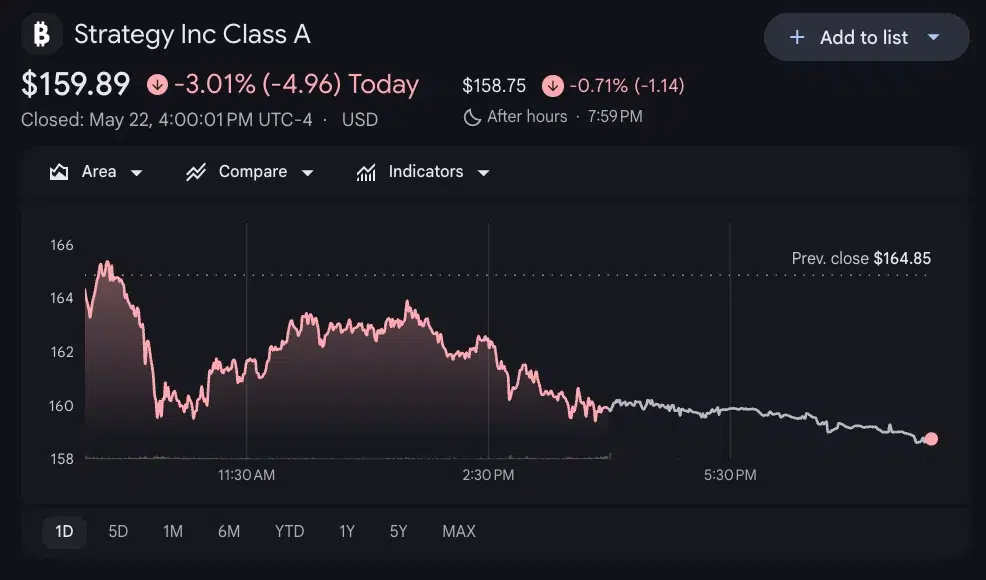
Recent market pressure has nevertheless weighed on the stock. MSTR closed down 3.01% at $159.89 on Friday after falling more than 5% over the week.
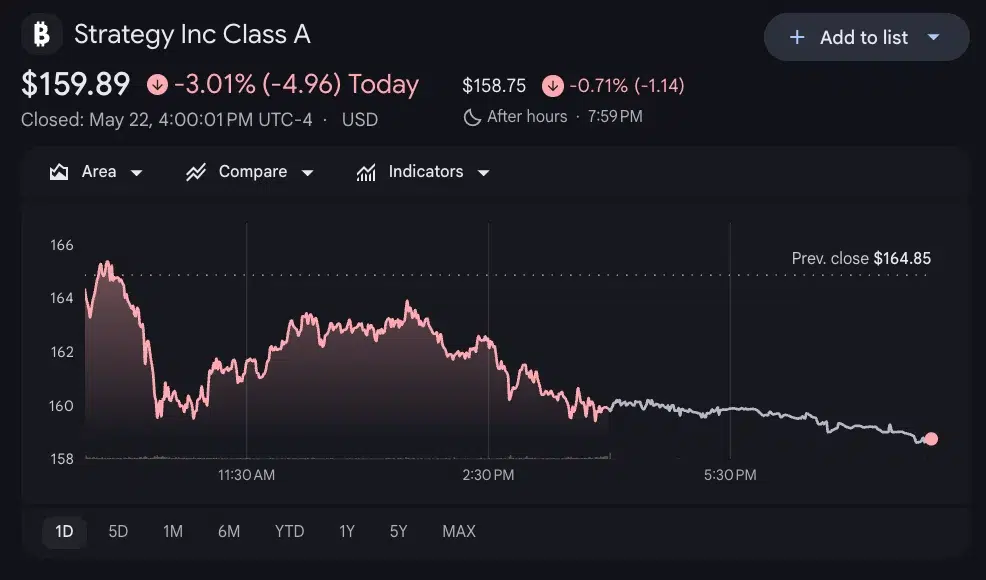
Strategy share price. Source: Google Finance.

Peace deal Confirmed ? Nifty , Crypto & Gold Analysis II 25th May II Lakshya Live

How to watch the League Two play-off final on TV: Channel, kick-off time and live stream

Is Walmart and Costco Stores Opened On Memorial Day 2026?


-

 Crypto World4 days ago
Blockchain.com files with SEC for U.S. IPO
-

 Fashion3 days ago
Holiday Weekend Open Thread – Corporette.com
-
 Crypto World3 days ago
Bitcoin Accumulation Weakens as BTC Realized Losses Hit $600M
-

 Business3 days ago
Dell Technologies DELL Stock Surges 15% on AI Server Momentum and Analyst Upgrades in 2026
-

 Crypto World3 days ago
Space X IPO Is ‘Bad News’ for Tech Stocks: But What About Bitcoin?
-

 Politics3 days ago
Makerfield: a tale of two social-media histories
-
 Crypto World3 days ago
MicroStrategy’s Saylor Says Miners No Longer Set Bitcoin Price, Another Force Has Taken Over
-

 Crypto World2 days ago
Robinhood crypto COO Tanya Denisova exits
-

 Business15 hours ago
NYT Strands Answers May 24 2026 Revealed for Puzzle No. 812 Theme Summer Essentials
-
 Tech3 days ago
A 0.12% parameter add-on gives AI agents the working memory RAG can’t
-

 Tech3 days ago
WhatsApp ads could make Irish debut after discussions with DPC
-

 Crypto World3 days ago
AI infrastructure race heats up as IREN pitches full-stack strategy, WhiteFiber lands $160M deal
-

 Tech3 days ago
You Can Now Add ChatGPT To PowerPoint
-

 Business3 days ago
Trump Invests $1M-$5M in Kura Sushi USA Chain With 27 California Locations
-
Crypto World7 days ago
Revolut Launches Dogecoin Debit Card Across UK and EU
-
 NewsBeat4 days ago
Charity run by Reform leader Malcolm Offord accused of ‘law breaking’ over Scottish registration
-

 Sports3 days ago
2026 CJ Cup Byron Nelson leaderboard: Brooks Koepka finds putting stroke in Round 1
-
Business3 days ago
Goldman Sachs reinstates Ageas stock coverage with neutral rating
-

 Crypto World5 days ago
Exa Labs raises $250 million in funding led by a16z
-

 Crypto World3 days ago
Trump Media’s Bitcoin Stash Shrinks Again as 2,650 BTC Lands on Crypto.com
You must be logged in to post a comment Login