

Politics
The House | Maritime Chokepoints: It Could Get Worse Than The Strait Of Hormuz Closure

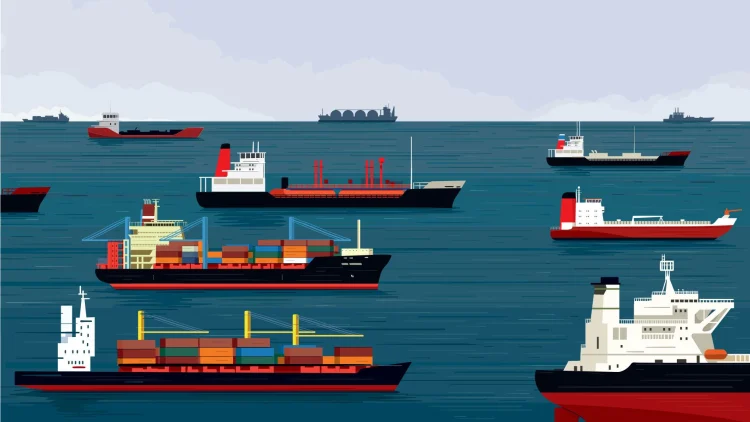

Illustration by Tracy Worrall

9 min read
Supply chains have been badly hit by the closure of the Strait of Hormuz, but – as Noah Vickers reports – the worst could still be to come.
The war in Iran and the closure of the Strait of Hormuz has wrought significant harm on the global economy, but for the shipping industry, it is only the latest disruption in a series of damaging episodes.
The Covid pandemic triggered a collapse in maritime trade. Then, in 2021, the Ever Given ship blocked up the Suez Canal for five catastrophic days and, in 2023, Houthi rebels in the Red Sea began attacking ships in the Bab al-Mandab strait. From 2023 into 2024, Panama experienced one of its worst droughts in recorded history, limiting the number and weight of ships which could pass through its vital canal – a situation likely to become more frequent with climate change.
The closure of Hormuz, which normally accommodates roughly a quarter of the world’s seaborne oil trade, has therefore added pain to a system already dealing with multiple headaches. But experts warn the impacts on supply chains could become far worse if the conflict drags on over several months, while concerns grow that it could set a precedent for other maritime chokepoints to be weaponised.
In a recent analysis, maritime research consultancy Drewry found that while a short war would be “manageable” for the container shipping industry, a longer conflict of up to a year would “impose a severe shock that will reverberate for years to come”.
A crucial issue is the supply of bunker fuel used by vessels. Since the start of the war, bunker prices have risen by between 60 and 80 per cent.
Drewry’s senior manager for container research, Simon Heaney, tells The House: “The risk from a fuel perspective goes from being a cost risk, which it currently is, to becoming more of a supply risk.
“At the moment, significant inventories have created a buffer, but as those stocks deplete, there could be an issue in terms of just physically getting these ships to do their job.
“I think we’re a long way off from that, but if it carries on for that duration [of up to a year], you’ll see some panic. It will have an impact in terms of how fast ships go – they will slow down to preserve consumption…
“It will start to move from what is currently a fairly limited network issue – a regional problem, and a slight hike in costs – to something much bigger, and it will have wider effects.”
An analysis by S&P Global Market Intelligence meanwhile warns that fuel shortages will have “implications for agriculture, mining and industry as well as transport”, with parts of Africa and south Asia thought to be most exposed.
Sourcing alternative fuels to gasoline and diesel “may be limited”, it adds, as countries start restricting “exports of their own production to protect domestic markets, as has already been the case with mainland China and South Korea”. The Malaysian government has similarly said it will prioritise its domestic supply.
The analysis also highlights the Middle East’s importance in supplying raw materials, gases, plastics and fertilisers to industries around the world, with the potential to “bring down entire supply networks”.
For instance, it points out that while Taiwan’s imports from the region are equivalent to only 2.39 per cent of its GDP, a loss of helium supplies could cripple its electronics output equivalent to 25.2 per cent of its national output.
Nor would the UK be immune to some of these impacts.
“We’ve got exposure to diesel, sulphur, unwrought aluminium,” says Chris Rogers, S&P’s head of supply chain research. “About a third of our imports of unwrought aluminium come from the region, so there is that economic effect even for the UK, directly.”
He points out that the peak shipping season, which typically starts in July, is still to come, meaning that capacity will soon become more stretched. In addition, due to the length of voyages undertaken on different trade routes, there is a substantial time-lag for the impact of disruptions like Hormuz to be felt.
“If we look, for example, at shipping from the Middle East to the United States, in April, the volumes only fell by 25 per cent year-on-year because the last boats hadn’t yet arrived,” says Rogers.
“The UK is still seeing some of that as well, because it’s a similar kind of journey time. It’s only really over the next few weeks that the boats that should have arrived, won’t have arrived… To a certain extent, we could have peace today and there would still be an impact.”
To substitute some of the lost trade to and from the Gulf, the shipping industry has been forced to rapidly utilise several overland alternatives across and around the Arabian peninsula.
MSC, the world’s largest container shipping line, is using the Red Sea ports at King Abdullah and Jeddah, while CMA CGM, the third-largest carrier, has utilised the Turkish port of Mersin.
“They’re using a variety of avenues – it’s not all being concentrated into a couple of substitute ports,” says Heaney. “There are different ways in, but even with these multi-modal solutions, the amount of goods in and out of the Gulf is going to be drastically lower.”
Bolstering these links and building new ones, he warns, will be “urgent”, as countries on the Gulf were “very ill-prepared” for such disruption to their trade flows.
Could other nations follow Iran’s example by using chokepoints as leverage? At an April symposium in Jakarta, Indonesian finance minister Purbaya Yudhi Sadewa floated the possibility of imposing a toll on ships through the Strait of Malacca – before quickly playing the idea down.
There could be an issue in terms of just physically getting these ships to do their job
“Whether that was a serious suggestion, I doubt,” says Heaney, “but it’s sort of a warning sign: don’t mess with us, because we could do something similar. In the absence of a nuclear deterrent, it’s an economic deterrent they could at least flag, without necessarily needing to deploy.”
Rogers points out that closing either Malacca or Panama would severely hit the economies of the countries in control of those chokepoints. A more realistic threat could come from China.
“The bigger question isn’t ‘Would Singapore or Malaysia feel emboldened to close the Strait of Malacca?,’” says Rogers. The question, he suggests, is: “Does China feel more emboldened to say ‘American sea power ain’t all that, so actually we could blockade Taiwan, and the American navy’s not going to be able to unblockade [it], they’re not going to be able to guarantee shipping’.”
For the shipping industry, the closure of Hormuz has further underscored the need for global trade networks to become more flexible and resilient.
“A lot of talk has gone into resilience and how you make supply chains more robust and able to withstand these shocks that are coming at a far greater speed than ever before,” says Heaney. “You can never eliminate it, but I think we are going to see a recognition that we need to diversify and not put all our eggs in one corridor.
“Even if the Red Sea opens and Suez transits are safe all of a sudden and Hormuz is safe, there needs to be investment and diversification in terms of the routing, just so there is a bit more redundancy in te whole system.”

If cargo distributors can devise “chokepoint-immune supply networks”, says Rogers, with Europe sourcing goods from Turkey and North Africa, and countries in the Americas sourcing more from one another, that could also reduce the scope for severe disruption.
But Jim Hall, an Oxford professor who recently co-authored a research paper on maritime chokepoints, is sceptical about whether this response, known as ‘near-shoring’, would provide much of a solution.
“We know that globalisation is only partially going into reverse, and much as Trump or whoever it may be would wish it away, actually, it brings us a great deal of benefit,” he says.
“I don’t think near-shoring, on-shoring, is going to much reduce our exposure to chokepoint-related disruptions to global trade. Decarbonisation of our economies would do more in that sense.”
The changing climate will also prompt interest from shipping firms in whether more use can be made of the Arctic Sea. The route from north-west Europe to east Asia via Russia’s northern coast is roughly 40 per cent shorter than taking the Suez Canal, but the route is only free of ice during the warmer months of the year and specific vessel types are needed even then.
“They’re smaller [vessels], so you don’t get the economies of scale,” says Heaney. “Even though the climate is making the season that you could use the Arctic a bit longer, it’s debatable how long that is and it’s not necessarily reliable.”
While some Chinese firms have been carrying out test runs along the route, the economics still don’t stack up for large western carriers, he argues – and nor does travelling through Russian waters do any favours for their brand image: “The PR, the optics, from a major carrier perspective are terrible, so none of them really want to touch it with a bargepole.”
Maritime chokepoints show no sign of becoming less critical to the world’s economy, as ships continue to carry about 80 per cent of traded volumes and 50 per cent of traded value worldwide.
Hall’s research, published late last year, found that disruptions at chokepoints affect around $192bn worth of maritime trade each year, which in turn result in estimated economic losses of about $14bn annually, through delays, rerouting, insurance premiums and higher freight costs.
Environmental threats, like tropical cyclones in the Taiwan Strait and droughts in the Panama Canal, account for some of the risk. But Hormuz has demonstrated just how much disruption can be caused when states decide to flout the internationally agreed principle of freedom of navigation.
“It is dawning on smaller nations, who geographically happen to have this leverage,” warns Heaney, “that all of a sudden, here is something you’ve got, that you could potentially use to your advantage.”


Apologies in advance, but there’s a pretty gross reason our pillowcases turn yellow.
The colour change is usually due to a buildup of our sweat, skin oils, hair oils, and drool – and parts of these deposits, like proteins and fats, yellow with age. (Rarely, clear sweat changes hue after contact with bacteria in a process called pseudochromhidrosis.)
Depending on how discoloured your pillowcase has become, a regular wash might not cut through this residue.
Luckily, though, some experts say there’s a two-ingredient solution to the problem.
Baking soda and water could help
Panda London said that a “mixture of baking soda and water” can help to banish stubborn stains.
They reccomend turning it into a paste and applying it to your case before washing. Begin with a small patch to test whether it works on your material.
Southern Living recommended a similar method.
Baking soda, they explained, can help to lift stains and boost the effectiveness of your detergent later on.
Spot-treat affected areas with a baking soda and water paste, they suggest, before rubbing off the mixture before washing.
When you do chuck the offending item in your machine, make sure to add 110-135g of baking soda in your drum alongside your usual detergents.
The Spruce said you should wait until your paste is completely dry before removing it and putting it in the wash.
They also point out that baking soda “softens clothes and boosts the detergent’s power,” and can even help to keep your washing machine drum clean.
Lastly, speaking to Ideal Homes, Petya Holevich, a cleaning expert at Fantastic Services, said it could help to improve the smell of your pillowcase, too: “Baking soda acts as a natural deodoriser and mild pillow stain remover”.
What if I have really severe yellow stains on my pillowcase?
For more severe stains, oxygen bleach may be needed.
This is a “safer alternative to chlorine bleach for whitening,” Holevitch said.
Soak your clothes in a mixture containing the product for at least an hour before washing.
However, there are exceptions: silk, wool, and fabric with leather strips or wooden buttons can suffer in the solution.
Make sure you check the care label on your pillowcase first.

Keir Starmer will announce that under-16s will be banned from accessing the biggest social media platforms as part of plans to “keep children safe online”.
The prime minister, who had previously been opposed to such a ban, will use a Downing Street press conference on Monday morning to unveil the plans.
He is expected to say that the UK will follow Australia’s example in raising the minimum age to 16 for sites including TikTok, Instagram, Threads, Facebook, X, YouTube, Snapchat and Reddit.
More than 90% of parents backed the move in a government consultation.
Starmer said: “How we keep kids safe online is one of the biggest debates of our time. As a dad, I know every parent wants their child to grow up safe and happy.
“This is a choice about whose side we’re on: families across the country, or a status quo that isn’t working.
“People rightly expect action, and this government will always stand up for parents and put children first.
“That’s why we will call time on a system that’s failing our kids and take bold action to give every child the best possible start in life.”
But the father of a teenager who took her own life after viewing harmful content online accused the prime minister of “playing politics” by rushing the announcement amid speculation about his future.
Ian Russell, whose daughter Molly died in 2017 aged just 14, said the PM’s behaviour was “deplorable”.
Speaking to the BBC’s Sunday with Laura Kuenssberg programme, he said: “In opposition, Keir Starmer promised to tighten up the online safety world by regulating better.
“Early last year, father to father, I met with him briefly and he was very concerned – and he promised me he would look into effective solutions to deal with this problem.
“But as we sit here on the verge of this announcement, it seems that he’s not kept either of those promises.”
He said the prime minister had “promised a group of bereaved parents” an announcement could be expected by the summer recess, which falls in mid-July, “so he’s rushed that forward for some reason”.
“I can’t think of a reason other than a political reason… if he’s playing politics, what he’s doing is gambling with young people’s lives – and I find that deplorable,” he said.
Starmer is also expected to announce a social media curfew for 16 and 17-year-olds after 8.30pm.
Critics pointed out that Labour also want to lower the voting age to 16.
Liberal Democrat education, children and families spokesperson Munira Wilson said: “The government appears to have cobbled together a hodgepodge of social media restrictions which don’t keep children safe, nor hold big tech’s feet to the fire.
“The government must heed the lessons from Australia and stand up to big tech with a credible set of measures that genuinely protects our children, rather than rushing through a half-baked policy just to secure a political legacy.”
Tory shadow education secretary Laura Trott said: “It’s shameful that it’s taken the Prime Minister’s job to be on the line for the government to finally U-turn and ban social media for under 16s.
“Three times Labour voted against a ban, failing to stand up to Big Tech and protect children from the extreme content they are exposed to every day.”
Subscribe to Commons People, the podcast that makes politics easy. Every week, Kevin Schofield and Kate Nicholson unpack the week’s biggest stories to keep you informed. Join us for straightforward analysis of what’s going on at Westminster.
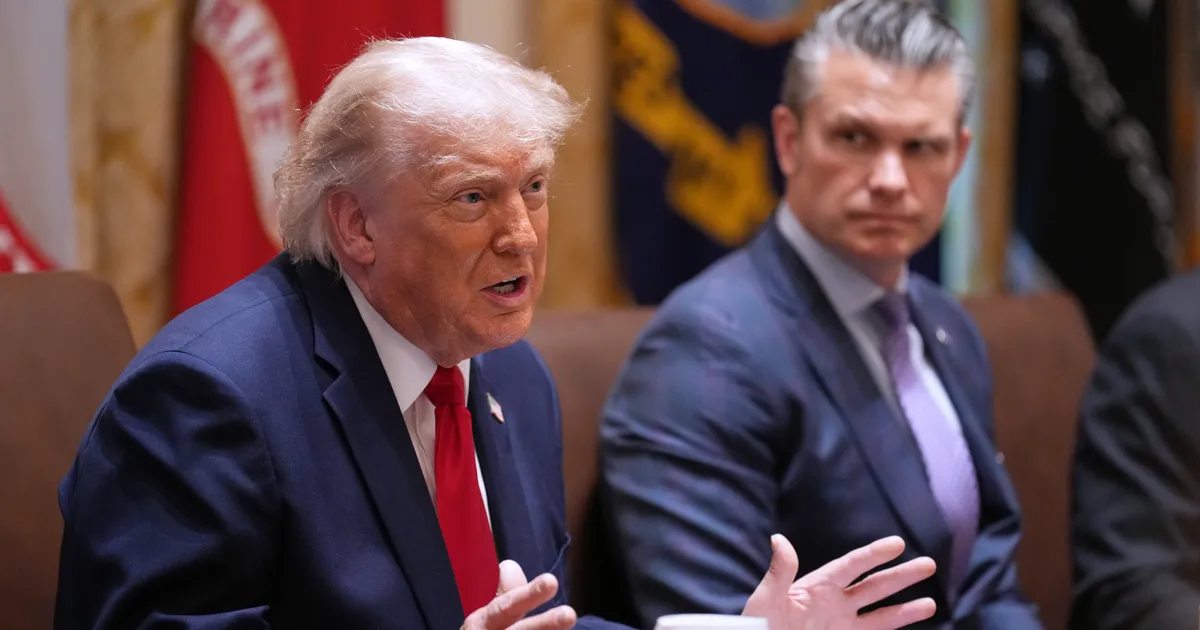
President Donald Trump announced on Sunday that his administration has reached a peace deal with Iran more than three months after the US and Israel launched a disastrous war that has put intense strain on the world’s energy supply, and left the Iranian regime strengthened and emboldened.
The agreement constitutes the most notable diplomatic development since the strikes on Iran began on February 28.
American and Israeli forces decapitated the Iranian government by reportedly acting on information that many of the country’s top leaders would be in the same place at the same time.
The Iranian regime, however, has managed to sustain its grip on power, even in the wake of mass protests that were put down with ruthless violence earlier this year.
After some initial confusion among Trump’s own Republican Party as to what the US military action was ultimately meant to accomplish, the president began repeating that Iran could not be permitted to develop a nuclear weapon, and that the Strait of Hormuz needed to be reopened to commercial shipping, as it was before the war began.
He has also said that Iran’s nuclear “dust” — or the remnants of nuclear materials that were targeted in US airstrikes last summer — must also be destroyed. The issue of how the country will dispose of its highly enriched uranium has long been a point of contention.
Fully reopening the Strait of Hormuz is expected to alleviate some of the pressure on global fuel markets, which have seen major spikes in oil and gas prices due to the closure of the waterway.
Prior to the Iran war, 20% of the global oil and gas supply moved through the Strait.
Iran effectively shut it down by threatening to attack ships that attempted to cross, leaving some crews stranded on ships waiting for the conflict to resolve.
Casualty estimates from the war vary, with the Israel Defense Forces estimating some 6,000 Iranians have been killed. The US officially counts 13 deaths on its side.
News of a previous possible deal between the US and Iran drew pushback in May from some Senate Republicans, who favored a harsher approach toward Iran.
Trump had signalled he would not be rushed into an agreement. He repeatedly pushed back on the idea that the upcoming midterms were putting political pressure on him, due to rising prices that could be directly tied back to his decision to launch the war.
“I don’t care about the midterms,” Trump said bluntly at one point. At another, when asked whether he shared Americans’ concerns over the high cost of living, he was even more abrasive.
“The only thing that matters when I’m talking about Iran — they can’t have a nuclear weapon. I don’t think about Americans’ financial situation. I don’t think about anybody. I think about one thing — we cannot let Iran have a nuclear weapon. That’s all,” he said.
He doubled down on that sentiment last week, saying, “I love the inflation.”
Politics
Politics Home Article | PM Announces Under-16 Social Media Ban In “Big Moment For Our Country”

(Alamy)
2 min read
Keir Starmer has confirmed that the government will ban social media for under-16s.
In a Downing Street press conference on Monday morning, the Prime Minister said the Australia-style ban is “not something I do lightly” and isn’t “cost-free”.
However, the Prime Minister added: “I will not be prepared to compromise on the safety and happiness of our children.”
Starmer said he would now “move at speed” to introduce the necessary legislation with the aim of the ban coming into effect “in the early part of next year”.
While Starmer was believed to be sceptical about hardline measures like Australia’s ban initially, he told reporters this morning that he had reached this decision “having looked at the evidence, having gone through the consultation, having looked at what happened in other countries, having listened to parents, listened hard”.
The proposals announced today will include restrictions on specific platforms for under-16s, including Snapchat, TikTok, YouTube, Instagram, Facebook and X, but also restrictions on gaming services, live streaming platforms, and stranger communication.
Children will not be banned from accessing messaging services such as WhatsApp and Signal.
The government is also expected to make further announcements about night-time social media curfews for 16-and 17-year-olds in the coming weeks.
Speaking this morning, the PM said he did not accept the argument that an under-16 social media ban is not worthwhile because some children will get around it, saying it would be like opposing drinking laws because underage people sometimes drink alcohol.
“This is not something I do lightly, and I will not present it as cost-free, as if social media has brought no benefits to young people, because clearly that is wrong, but government is always about choices, and it’s clear to me that a full ban is the right choice,” Starmer said.
“Social media is making children unhappy. It’s making it easier for bullies to harass and abuse them, and it could even be harming their mental health, exposing them to content that is dangerous, because that is what grabs the attention. It is designed to be addictive.”
Starmer said that the Online Safety Act meant the government had an understanding of how to apply age verification, and powers introduced under the Children’s Wellbeing and Schools Act, will allow them to “now move at pace”, and “adapt as technology changes”.

Justin Trudeau has responded to his critics after watching his girlfriend Katy Perry performing at the opening ceremony of the World Cup in the USA, rather than supporting his native Canada during their first match.
The former Canadian prime minister and Grammy-nominated pop singer have been an item for the better part of a year now, with Trudeau in the audience as she performed her 143 album cut Wonder on the pitch on Friday.
However, not everyone was happy that Canada’s former leader didn’t turn up to support his home country.

On Sunday, he responded to a post on X pointing out that “on a day that Canada and the United States both opened their campaigns at the World Cup, Justin Trudeau opted to watch Team USA, where his girlfriend Katy Perry was performing in the opening ceremony”.
“Sometimes supportive boyfriend duties call,” he claimed, but insisted: “You know who I’m rooting for to take the Cup.”
The couple had jaws dropping the world over last summer, when it was first reported in the press that they were in the early stages of dating.
More recently, he was pictured looking loved-up with Katy on the red carpet at the premiere of her upcoming concert film during the Tribeca Film Festival.

Katy was previously married to the comedian Russell Brand, and shares a five-year-old daughter, Daisy, with her former long-term partner Orlando Bloom.
Justin, meanwhile, had been single for around two and a half years before he and his new famous girlfriend began going out, following the announcement in August 2023 that he and his wife of 18 years, Sophie Grégoire, had separated.
He and his ex share three children, sons 18-year-old Xavier, 16-year-old Ella-Grace and 11-year-old Hadrien.
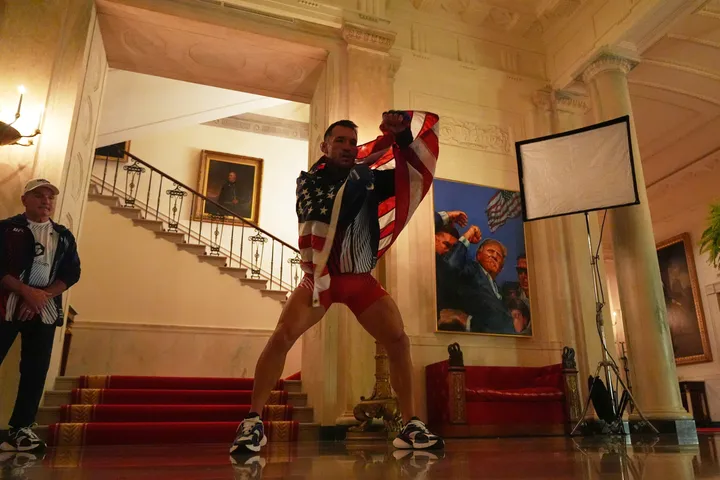
For the second year in a row, President Donald Trump commemorated his birthday with a bizarre spectacle in Washington DC.
After an inclement weather delay, Trump’s UFC extravaganza – which also marked America’s 250th birthday – kicked off on Sunday evening with a bout between two featherweight fighters who made their entrances from the White House.
The opening underscored the strangeness of the gathering, which marked the rare use of the White House for a professional sports competition and for a function hosted by a private company.
Trump has faced criticism for promoting such events at the White House and for backing an exhibition that’s expected to benefit numerous commercial interests, including the UFC and Paramount.

Additionally, the fight has drawn scrutiny, given the emphasis Trump placed on it while grappling with other major issues, including a struggling economy and the effort to finalise a deal to end the US war on Iran.
Just hours before the main card of “UFC Freedom 250” was set to begin, Trump said that an agreement with Iran was “now complete,” though it isn’t expected to be formally signed until Friday.
According to a Reuters report, France also pushed back the G7 summit to allow Trump to attend the cage fight on the White House lawn.
Last year, Trump held a military parade for his birthday, which featured tanks and rocket launchers rolling down the streets of the capital.

Tasos Katopodis via Getty Images
Sunday’s fight also included large displays, including the construction of a massive 92-foot, 600-ton fighting ring called “The Claw” that towered over the White House on the South Lawn.
That venue, which was covered in flashing red, white and blue lights, sat roughly 4,000 guests on Sunday evening. Service members wearing colonial attire could also be seen lining the entrance from the White House to the “Octagon,” the trademark eight-sided cage that UFC fighters use.
“The South Lawn has served as one of the most important and ceremonial spaces in American history,” a UFC commentator said as part of a streaming broadcast on Paramount+. “Now, the Octagon is part of that history.”

Win McNamee via Getty Images
All told, there were seven mixed martial arts match-ups, including a face-off between Ilia Topuria and Justin Gaethje for the lightweight title.
Much of the audience was comprised of military service members and Trump allies, including Paramount Skydance CEO David Ellison, comedian Tony Hinchcliffe and Meta CEO Mark Zuckerberg, who has frequented past UFC matches. Trump was also seen watching the fight alongside members of his family, Vice President JD Vance and UFC President Dana White, a longtime supporter.
The UFC exhibition has been nearly a year in the making and underscores Trump’s deep ties with the mixed martial arts company and its leadership.
Trump first floated the idea in July 2025 during a kickoff for activities commemorating America’s 250th birthday. He’s also been friends with White, who has repeatedly backed his presidential runs and welcomed him ringside at past matches, for years. According to PBS, White also played a role in influencing podcaster Joe Rogan, who was once a UFC color commentator, to throw his backing behind Trump.
More recently, Trump’s brokerage account purchased shares in TKO Holdings, UFC’s parent company, raising questions about whether he could personally see gains from holding the fight on the White House lawn. The Trump organization has said the president had no control over the transaction, and the White House has also denied any conflict of interest.
Branding for various companies was omnipresent at the fight on Sunday, with logos adorning the venue itself and one bout sponsored by Trump’s social media platform, Truth Social.
The staging of the cage match at the White House was also previously met with widespread opposition.

Kevin Dietsch via Getty Images
It recently drew a court challenge from the Public Integrity Project, which described the fight as “corrupt” and argued that the administration needed congressional approval for construction related to the UFC event. Last week, a judge ultimately ruled that the fight could proceed.
According to a recent Reuters/Ipsos poll, just 16% of Americans said it was appropriate for Trump to use the White House grounds for this event.

Brooklyn Peltz Beckham has once again hit out at his famous family, after reports of an attempted reconciliation between them emerged in the press.
The eldest of the Beckham siblings has been estranged from his parents, brothers and sister in recent months, and was the only member of the immediate family who didn’t attend his dad Sir David Beckham’s star unveiling on the Hollywood Walk Of Fame last week.
After the ceremony, Page Six published pictures of Brooklyn’s younger sister, 14-year-old Harper, showing up to his home to deliver what was reported to be a handwritten letter for her eldest brother.
She apparently left moments later after no one answered the door to her, but according to the US outlet, neither Brooklyn nor his wife Nicola Peltz Beckham were at the property as they’re currently out of town.
A spokesperson for Brooklyn then accused his parents, Sir David and Victoria Beckham, of “choreographing” the whole thing as a stunt.

“[The fact] that photographers were in place as the letter was hand delivered says it all – this was choreographed for the cameras,” they alleged.
HuffPost UK has contacted Sir David and Victoria Beckham’s teams for comment.
At the beginning of this year, Brooklyn sparked international headlines with a series of candid Instagram posts, in which he accused his parents of “trying to endlessly ruin” his relationship with his wife, following months of reports about a family feud.
In his statement, Brooklyn took aim at his parents for what he referred to as “performative” and “controlling” behaviour on their part over the course of his “entire life”, as well as claiming that they had tried “endlessly” to “ruin” his relationship with his now-wife.
He went on to allege that his mum “hijacked” his first dance with Nicola during their 2022 wedding ceremony.
Sir David has still not commented publicly on Brooklyn’s claims, but Victoria said in April: “We’ve always tried to be the best parents that we can be. And you know, we’ve been in the public eye for more than 30 years right now, and all we’ve ever tried to do is protect our children and love our children.
“And, you know, that’s all I really want to say about it.”
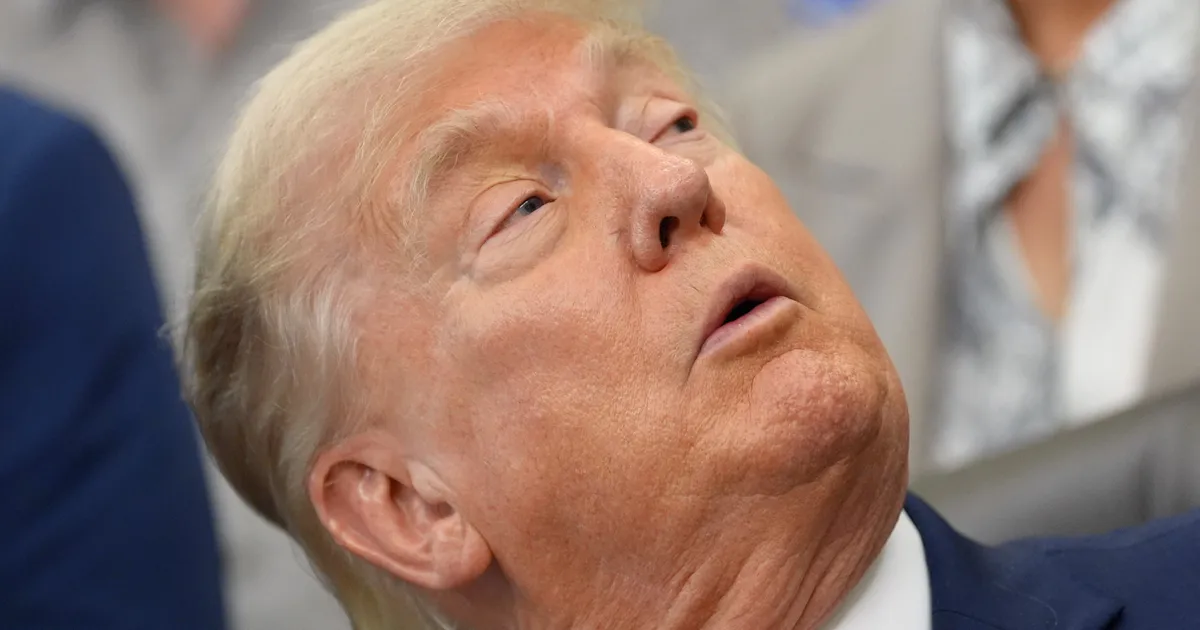
Donald Trump’s war in Iran will go down as one of the US president’s “worst foreign policy blunders so far”, according to a BBC expert.
The US and Iran agreed to a framework deal to end the conflict on Sunday night, set to be signed later this week.
The 60-day ceasefire come almost four months after he and the Israeli prime minister Benjamin Netanyahu first bombed Tehran.
Since then, Iran has rocked the global economy by closing the major oil shipping lane, the Strait of Hormuz.
Trump has already celebrated the “great deal”, claiming on social media: “Let the oil flow!”
But the BBC’s international editor Jeremy Bowen poured cold water on the idea that the conflict had been in any way a success.
Speaking to Radio 4′s Today programme, he said: “It’s not simply a question of switching on [the Strait] and shipping out. The waterway will have to be checked, there are mines in it.
“It’s going to be a slow process and there’s the whole business of the longer term impact of the way oil is going to be produced as well as things like fertiliser.”
He also warned: “There are loads of long-term consequences of this war, it’s going to go down, I think, as one of Donald Trump’s worst foreign policy blunders so far.”
Bowen said Trump and Netanyahu expected the Iranian regime to fall quite quickly after the brutal public protests and the subsequent oppression in January.
“The regime was under a lot of pressure,” he recalled. ”[But] essentially they got it really wrong. Far from crumbling, the regime if anything has come out of this stronger because they’ve discovered the potency of the Strait of Hormuz weapon which was always suspected but now they’ve tested it and it really works.
“The regime is still there because it was engineered for survival and that engineering worked.
“On the other hand, the Americans have had their limits of their power very clearly demonstrated.
“They burned through hard to replace weapons, their global rivals the Chinese will have been looking with great interest at what has been going on there.”
Bowen predicted that when historians write up this entire war and “look at the long-term decline of the United States, there will be a substantial amount written about this episode”.
Trump is “going to do everything he can to claim victory, of course, I think that other people will be looking at it way more sceptically”.
He also pointed out the 14-point agreement is yet to be released.
“It’s clear that the big issue, the nuclear issue, has been deferred. That will go into negotiations that may go on for an awfully long time,” the expert noted.
“The assumption that the regime would fall in Tehran has gone, the business model of Gulf countries that rely on making the area a zone of stability in the region, that’s gone.
“Their faith in their alliance with the United States as their protectors has been badly damaged, and I think they will try and have – over the coming years – some rapprochement with the Iranians.”
Bowen added that the Israeli press has been “quite apocalyptic” about the damage to their strategic relationship with the US, and fears that Trump will blame Netanyahu for “dragging him” into the war.
The journalist also noted that the violence is still not over.
He pointed out that the Israelis have also confirmed they are determined to continue their offensive against Iran’s ally, Hezbollah, and determined to hold onto the territory it has gained in southern Lebanon.
Subscribe to Commons People, the podcast that makes politics easy. Every week, Kevin Schofield and Kate Nicholson unpack the week’s biggest stories to keep you informed. Join us for straightforward analysis of what’s going on at Westminster.



Dave Bench, Chief Executive
| CropLife UK
The government’s proposed UK-EU SPS agreement could reshape British farming for years to come, but concerns remain that rapid regulatory alignment with the EU risks damaging UK growers, productivity, and long-term investment
The past few weeks in Westminster have carried a tone of chilling familiarity. And while the government tussles over by-election selections and the arcana of Labour leadership rules, serious and consequential conversations are taking place behind the closed doors of Whitehall and the chancelleries of Europe. Chief among these is the government’s much-touted reset with the European Union. As we saw from the King’s Speech on the 13 May, with the announcement of the European Partnership Bill, the proposed UK-EU Sanitary and Phytosanitary (SPS) agreement remains at the heart of the government’s legislative and diplomatic agenda. With the attention of SW1 focused on the policies and personalities of rival leadership hopefuls, this agreement, which will shape the way we eat, grow, and sell food for the next decade, is not receiving nearly the attention it deserves. If the government’s ambitious timetable is to be met, we could be little more than a year away from the deal taking effect. The government has one chance to get this right.
The SPS agreement sounds technical, but in reality it is intensely political. Its stated aim is to reduce costs to consumers by reducing friction at the border. However, this comes with a significant trade-off in regulatory freedom. Since leaving the European Union, Great Britain has been able to make decisions about the use of genetic technologies and the regulation of Plant Protection Products (PPPs) independently of EU institutions. This has enabled UK regulators to bring innovative products to market more quickly and to better reflect the unique growing conditions of the British Isles. Divergence has been Fabian in nature, as much of the regulation currently in use is simply transplanted EU law; however, a rapid boomerang back to EU decision making would have a major impact. A closer relationship with our nearest trading partner is vital, but the pace of these negotiations risks seriously undermining the potential benefits.
This is not entirely new information. In January this year, the Andersons Centre report, commissioned by CropLife UK, produced a report highlighting the risks to farmers and growers of an SPS cliff-edge scenario. The findings were stark. In the “immediate alignment” scenario modelled by Andersons, UK crop production falls by around 3 – 6 per cent in the first year, while total income from farming drops by 7 – 11 per cent, a hit of between £500m and £810m, with growers losing access to key tools on which they currently rely. That translates into double-digit income losses for some crops, with wheat volumes down by 9 – 16 per cent, potatoes by 4 – 6 per cent, and apples by 3 – 7 per cent, alongside pressure on berries and leafy salads. Since the report was published, the wider landscape for growers has become even more challenging, with rising input costs adding further strain. CropLife UK has been clear that it supports a deal that cuts red tape and smooths trade, but a deal that automatically overrides legitimate GB science-based decisions on plant protection products and maximum residue levels would be devastating for British farming. The government, and any future government, must ask whether it is willing to sacrifice farmers and rural communities in order to secure this deal as quickly as possible.
The good news is that none of this is inevitable. The Andersons’ work for CropLife UK is clear that the greatest damage comes from an “immediate alignment” model, and that a managed approach to alignment under an SPS deal would greatly mitigate the shock to production and incomes. Managed alignment, in political terms, means three simple things: respecting legitimate GB decisions; ensuring UK involvement in EU decisions relating to UK-specific conditions and varieties; and building in realistic transitional periods so that EU approvals or Maximum Residue Level (MRL) divergences do not remove essential tools from farmers overnight. This is not a call for lower standards, but for evidence-based, predictable processes that allow growers to plan, invest, and maintain yields while moving together towards high, shared outcomes on food safety, the environment, and trade.
If Labour wants to be trusted on both the economy and Brexit, whoever leads the party needs to be bold and explicit about any SPS deal. They must fight for an agreement that reduces barriers to trade with our neighbours without embedding automatic alignment that undermines British growers’ ability to compete and invest.
For the Labour leadership, the future should be to commit to an SPS agreement with sensible transition periods and managed alignment on plant protection products and MRLs, rather than overnight overrides of GB rules. Insist on genuine UK involvement in any EU decisions that would subsequently apply here, including proper consultation and impact assessments for UK farming. Use the European Partnership Bill to create a combined regulatory regime that reflects new technologies and UK agronomy, and stress-test any draft text with growers and the wider food chain before signing, not afterwards.
Click here to read the Andersons Centre report.
Politics
Lord Ashcroft: My survey of Reform members – Will they win? How will the Civil Service react? Who should follow Farage?
Lord Ashcroft KCMG PC is an international businessman, philanthropist, author and pollster. For more information on his work, visit lordashcroft.com
Last month I surveyed 850 members of Reform UK, asking about their priorities for government, their attitudes to Britain, Conservative defectors, how they see prominent figures inside and outside the party, whether they trust elections, and how they think the civil service and the political establishment would react to a Reform victory. A separate survey of the general population allows us to compare their views with those of the general public.
Policies and priorities
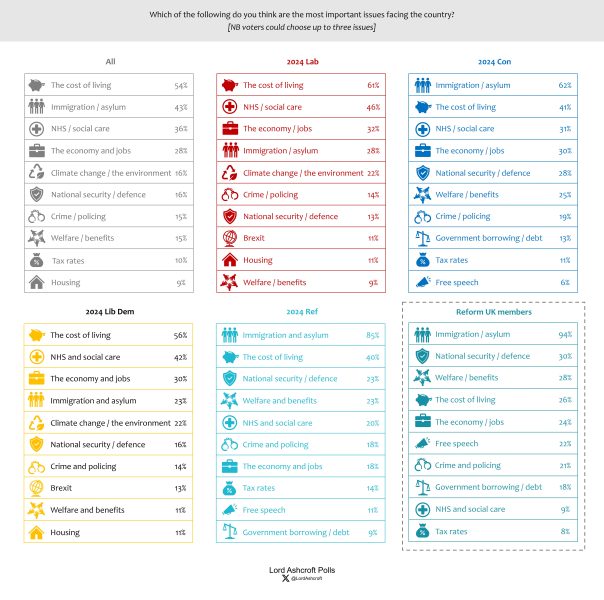
Ninety-four per cent of Reform members named immigration and asylum among the three most important issues facing the country. Second was national security and defence, chosen by 30 per cent, followed by welfare and benefits. The cost of living was in fourth place chosen by just over a quarter. The general public were more than twice as likely as Reform UK members to choose the cost of living, less than half as likely to choose immigration and asylum, and four times as likely to choose the NHS and social care. Reform members were more than four times as likely to mention free speech as the general public.
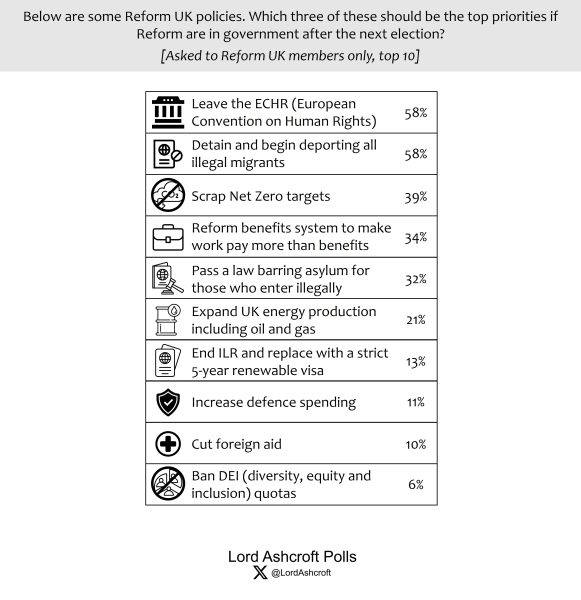
Asked which Reform policies they see as the most important priorities for government, party members were most likely to choose leaving the ECHR and detaining and deporting illegal migrants. These were followed by scrapping net zero targets, reforming welfare and ensuring that anyone entering Britain illegally is ineligible for asylum.

Presented with a selection of policy ideas (not currently Reform UK policies), Reform UK members were most supportive of a law stating that women-only spaces should be defined by biological sex (98 per cent, compared to 68 per cent of the general public), banning the burqa and other religious coverings (also 98 per cent, compared to 51 per cent of the general public), deporting illegal migrants even if they have since been granted asylum (96 per cent, compared to 54 per cent of the general public), and requiring civil servants to sign a contract promising to implement the wishes of the elected government (also 96 per cent, compared to 40 per cent of the general public).
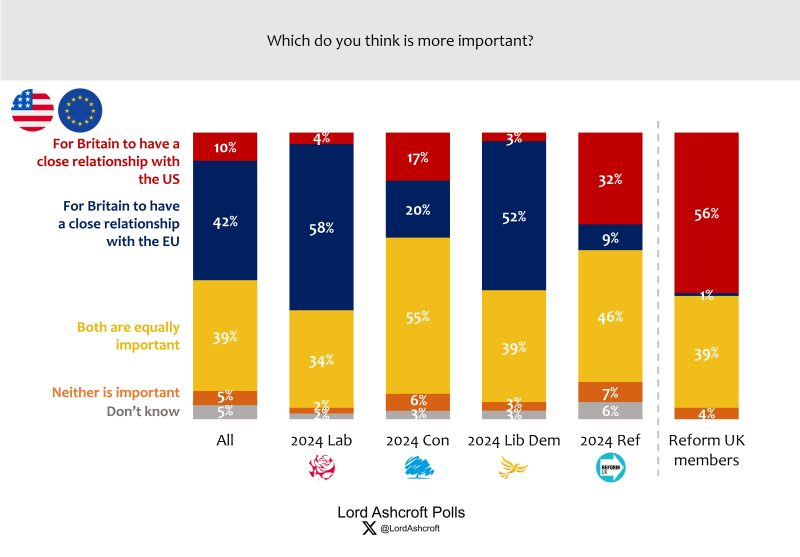
A majority of Reform UK members said it was more important for Britain to have a close relationship with the US than with the EU. A further 39 per cent thought the two were equally important. Only one in a hundred thought it was more important to have a close relationship with the EU than with the US. The general public were as likely as Reform UK members to say the two were equally important, but were much more likely to prioritise the EU relationship than the US one.
Nigel Farage, Reform leadership and other political figures
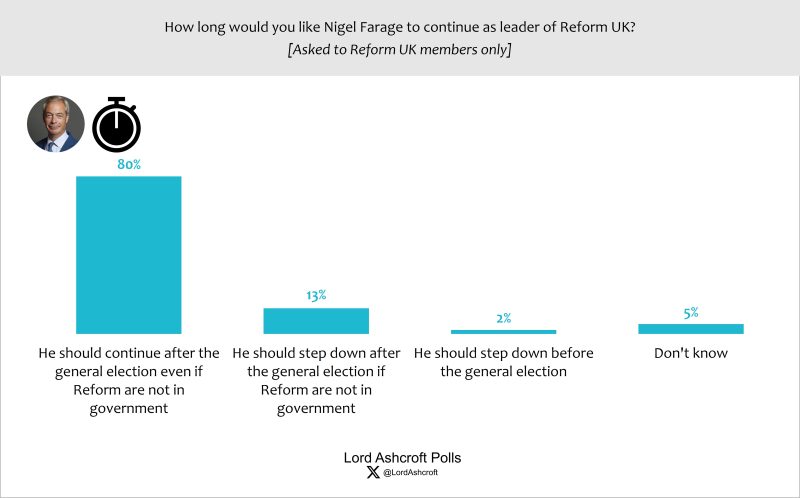
Four out of five Reform UK members said they would want Nigel Farage to continue as leader even if the party is not in government after the general election. Thirteen per cent said he should step down if Reform UK are not in government.

Just under two thirds of Reform UK members said they think Farage attracts more people to the party than he puts off. Just under three in ten think he attracts and repels people in equal numbers. Only 3 per cent think he puts more people off than he attracts. Voters as a whole were slightly more likely to think Farage puts off more people than he attracts than the reverse.
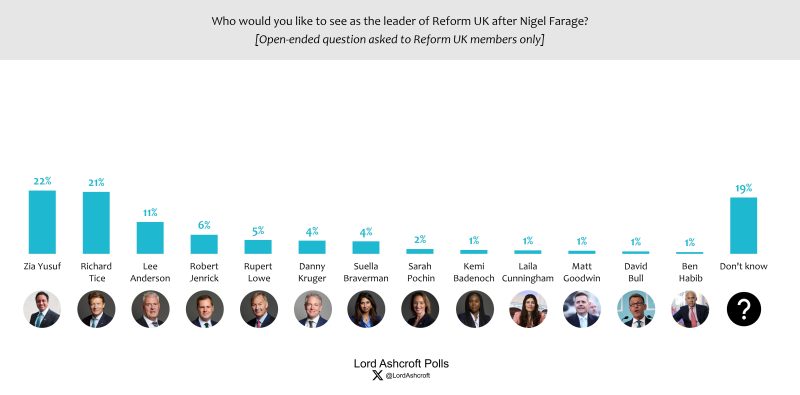
Asked unprompted to say who they would like to see as the next Reform UK leader, party members were most likely to name Zia Yusuf, closely followed by Richard Tice. Just over one in ten named Lee Anderson, with 6 per cent suggesting Robert Jenrick.

The most popular political figures among Reform UK members were Nigel Farage, Richard Tice, Lee Anderson and Zia Yusuf. More members gave a positive score to Kemi Badenoch than to Danny Kruger, Rupert Lowe or Nadhim Zahawi.
Conservative defectors
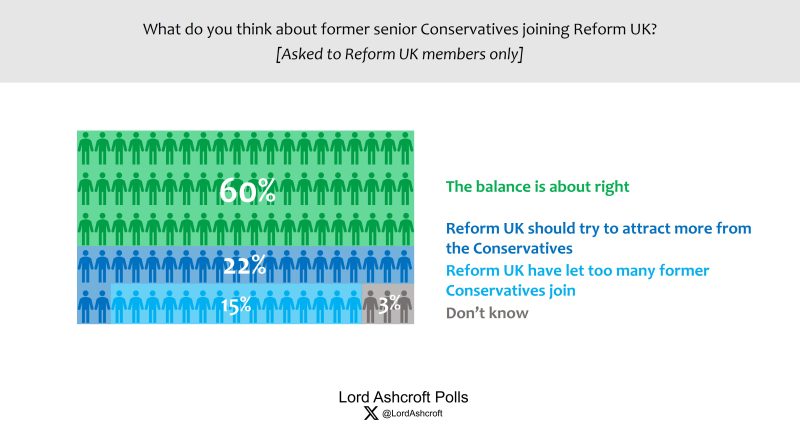
Three quarters of Reform UK members thought either that the party had let too many former Conservatives join or that the balance was about right. Only just over one in five said Reform should try to attract more from the Conservatives.
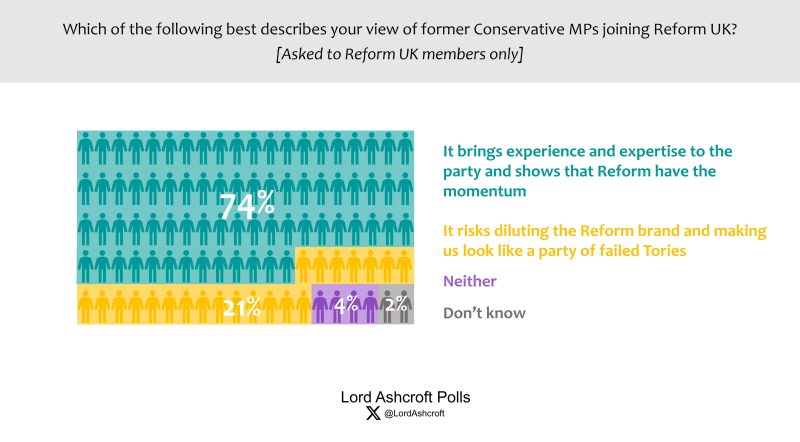
Nearly three quarters of Reform UK members said Conservative MPs joining Reform UK brought expertise and experience to the party and showed that Reform had the momentum. Just over one in five said it diluted Reform’s brand and made it look like a party of failed Tories.
The next general election
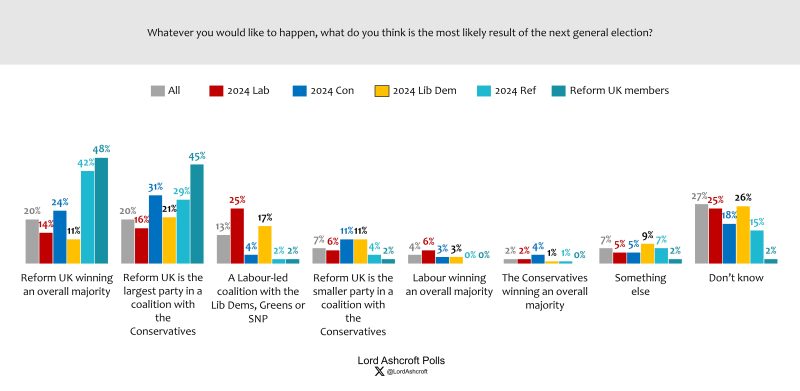
Just under half of Reform UK members expected the party to win the next general election with an overall majority. A further 45 per cent said the most likely result was Reform UK being the largest party in coalition with the Conservatives. Overall, 95 per cent of members expected the party to be in government after the election. The public as a whole were equally likely to expect a Reform UK majority or a Reform-Conservative coalition (20 per cent each), with 13 per cent expecting a Labour-led coalition with other parties of the left.
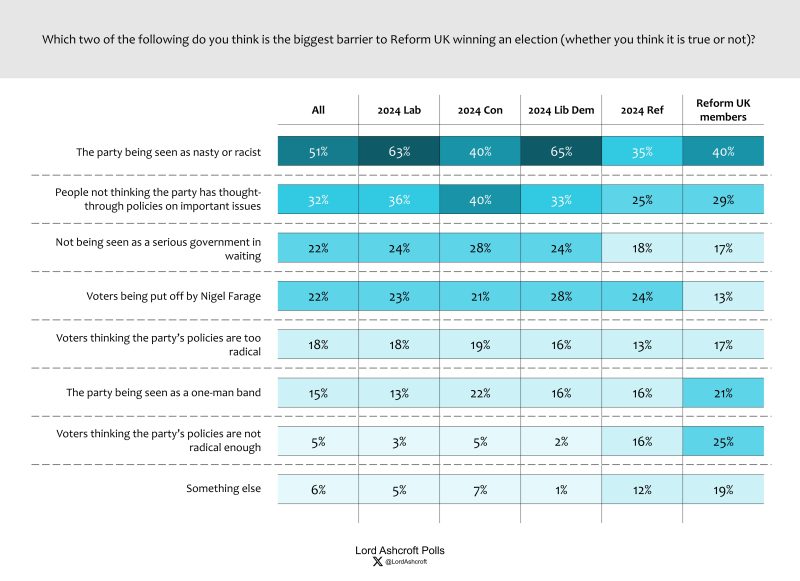
Reform UK members were most likely to see “the party being seen as nasty or racist” as one of the biggest barriers to winning the next election, followed by “people not thinking the party has thought-through policies on important issues”. They were more likely to think the party’s policies not being radical enough was a potential obstacle than being seen as too radical. Only 13 per cent thought voters being put off by Farage himself was one of the biggest barriers.
Voters as a whole agreed with Reform UK members on the two biggest barriers (the party being seen as nasty or racist, and not having thought-through policies). However, they thought the next biggest obstacles were not being seen as a serious government in waiting, and voters being put off by Nigel Farage.
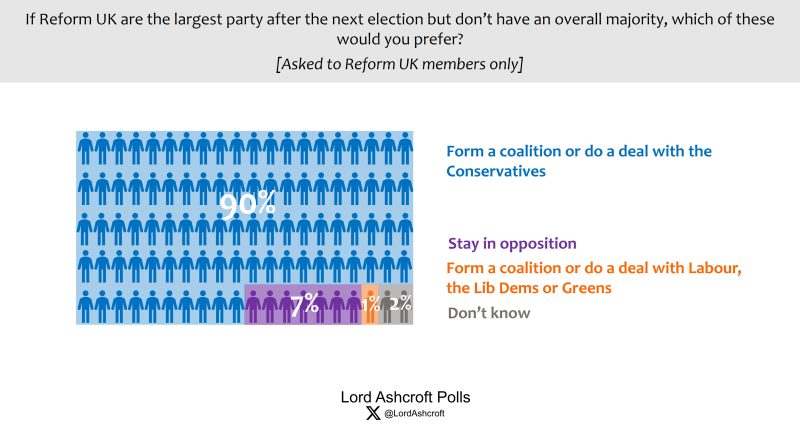
Nine out of ten Reform UK members said they would want a coalition or a deal with the Conservatives if Reform were the largest party after the election but don’t have an overall majority. Seven per cent said they would rather stay in opposition.
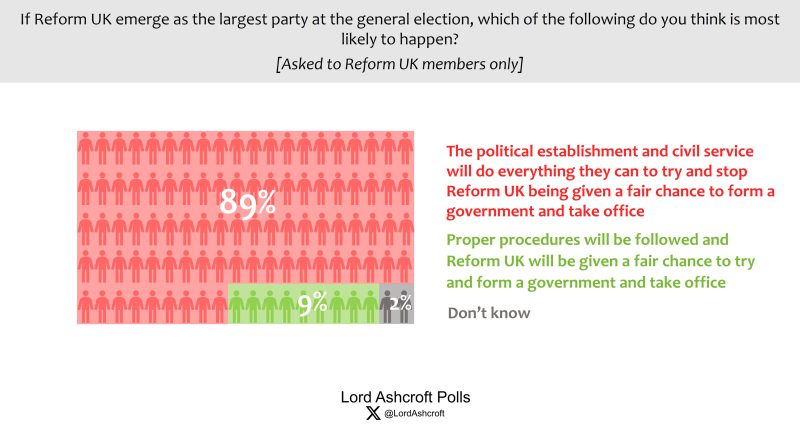
Fewer than one in ten party members think Reform UK would be given a fair chance to form a government and take office if they emerge as the largest party after the general election. Nearly nine out of ten think the political establishment and the civil service will do everything they can to stop this happening.

A majority of Reform UK members said they were not confident that elections in Britain are conducted fairly. This included 17 per cent who said they were not at all confident. Among the public as a whole, two thirds said they were somewhat or completely confident that British elections are conducted fairly.
A Reform UK government and the civil service
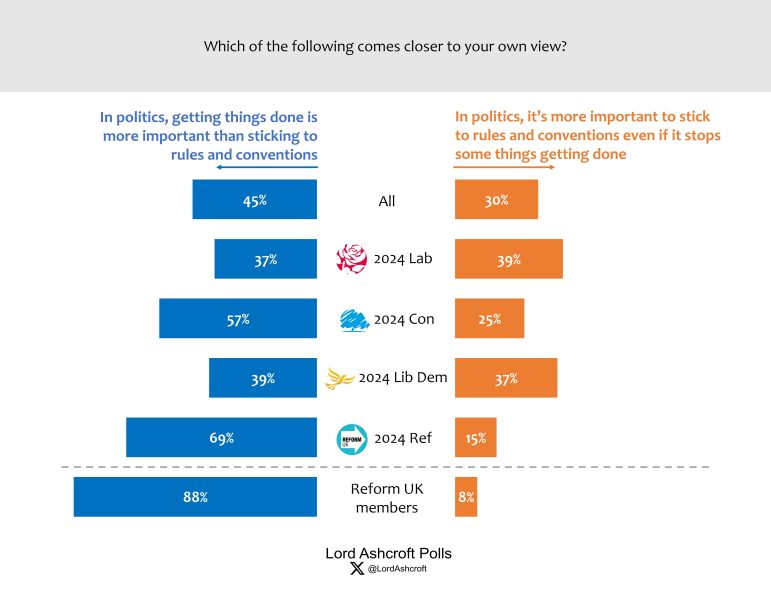 Nearly nine out of ten Reform UK members said that in politics, getting things done is more important than sticking to rules and conventions. They were nearly twice as likely to think this as the general public, who were nearly four times as likely as Reform UK members to think it was more important to stick to rules and conventions even if it stops some things getting done.
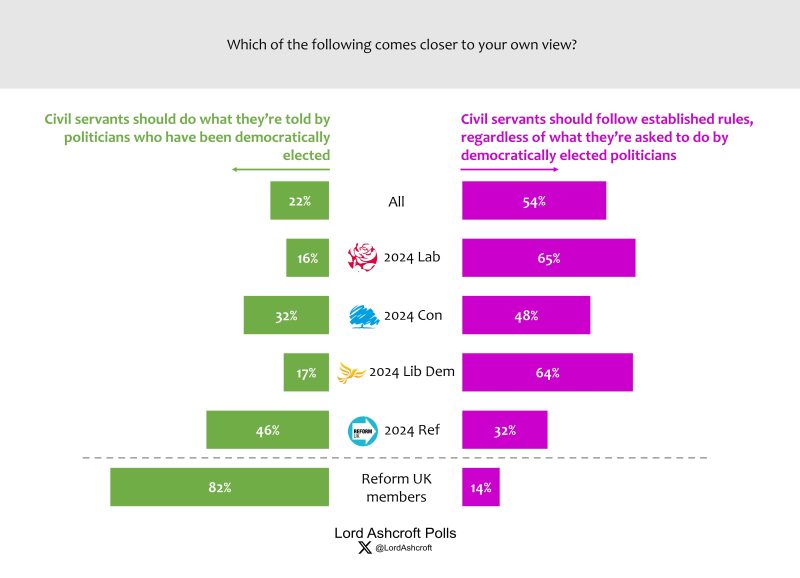
More than eight out of ten Reform UK members said civil servants should do what they’re told by politicians who have been democratically elected. Fourteen per cent said they should follow established rules regardless of what elected politicians ask them to do. By contrast, a majority of the general public said civil servants should follow established rules regardless of what they’re asked to do by elected politicians.
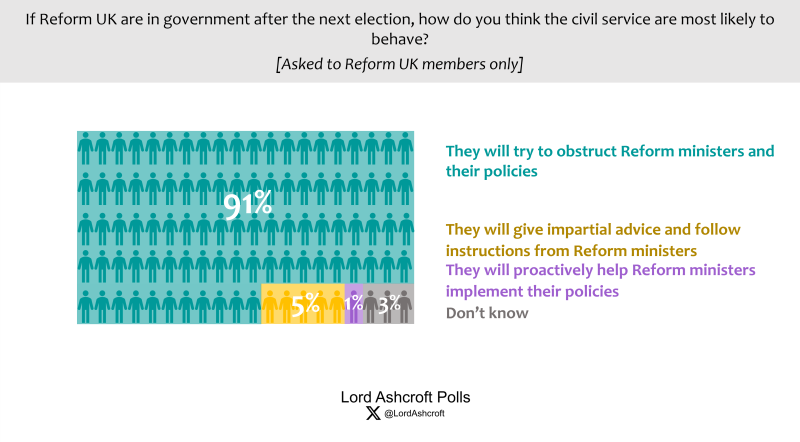
More than nine out of ten Reform UK members think the civil service will try to obstruct Reform ministers and their policies if the party is in government after the election. Only 0ne in twenty think civil servants would give impartial advice and follow instructions, and only 1 per cent think they would proactively help Reform ministers implement their policies.
Attitudes to Britain
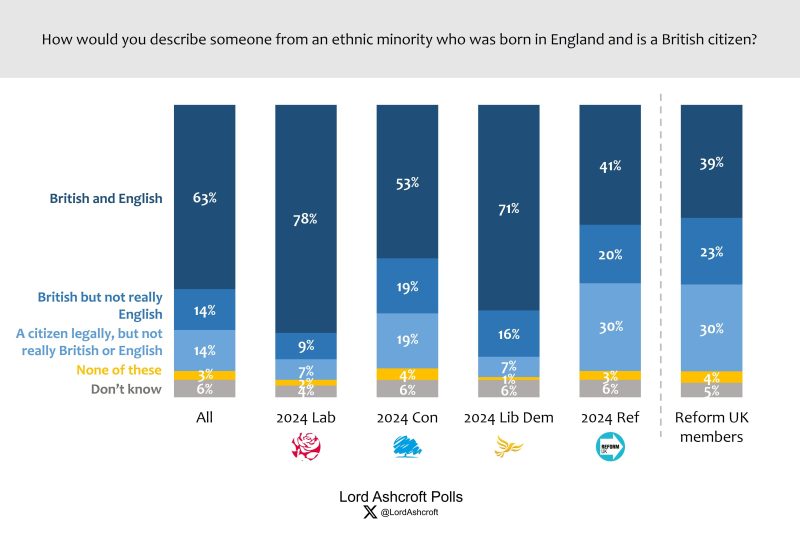
Just under four in ten Reform UK members said they would describe someone who was from an ethnic minority, was born in England and was a British citizen as both British and English. Just under a quarter said the person would be British but not really English. Three in ten said the person would be a citizen legally, but not really British or English. Among the public as a whole, a clear majority said the person would be both British and English.
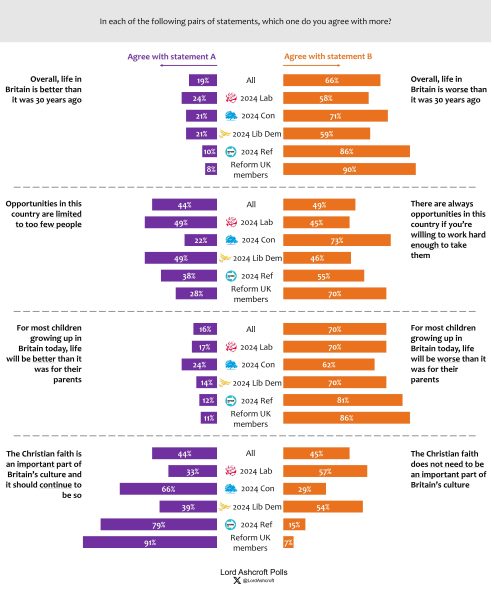
Nine in ten Reform UK members say life in Britain is worse than it was 30 years ago, compared to two thirds of the public as a whole. Seven in ten Reform UK members say there are always opportunities in this country for people willing to work hard enough to take them, compared to 49 per cent of the general public. Nearly nine in ten Reform UK members think that for most children growing up in Britain today, life will be worse than it was for their parents, compared to 70 per cent of the public as a whole. More than nine in ten Reform UK members say the Christian faith is an important part of Britain’s culture and should continue to be so, compared to 44 per cent of the general public.
Previous support and alternative parties

Nearly three quarters of Reform members said they had supported the Conservatives before Reform UK. 8% named the Brexit Party, with 6 per cent each naming Labour and UKIP. A further 6 per cent said Reform was the first party they had supported.

Asked who they would vote for if no Reform candidate was available in their constituency, 42 per cent of Reform UK members named Restore Britain. One in three named the Conservatives. A further 13 per cent said they would not vote.
Full data tables at LordAshcroftPolls.com

How Can I Make Yellow Pillowcases White Again?

Bangor confirm Arthurs return after suspension

A Smart Home With No Internet? It’s More Possible Than It Sounds


-

 Crypto World4 days ago
Oppenheimer backs SpaceX as $70 billion retail frenzy builds
-

 Business17 hours ago
No Jackpot Winner as $257 Million Prize Rolls Over to $269 Million Monday Draw
-

 Crypto World4 days ago
Markets Rally as SpaceX IPO Looms Amid Iran Tensions and Inflation Surge
-

 Sports7 days ago
FIFA WC 2026 Group C: Morocco, Scotland challenge Brazil’s hunt for glory | FIFA World Cup 2022
-

 Fashion3 days ago
Weekend Open Thread: Tuckernuck – Corporette.com
-
 Crypto World7 days ago
Eli Lilly (LLY) Stock Surges 4% Following Breakthrough Sleep Apnea Trial Results
-
 Crypto World9 hours ago
Zimbabwe Requires Crypto Businesses to Register Annually Under New FIU Regulations
-

 Entertainment6 days ago
The Ryan Gosling True Crime Thriller On Netflix That Gets Even Stranger, Stream It Now
-
 Sports6 days ago
Bangladesh beat Australia after 20 years in ODIs, register only their second win over six-time world champions | Cricket News
-

 Tech2 days ago
NanoClaw integrates JFrog registries to secure AI agent downloads
-

 Tech3 days ago
This Week In Security: Microsoft On Microsoft, Register Your Domains, Linux On ARM, And FreeBSD Joins The File Cache Club
-

 Crypto World2 days ago
Bitget enters Argentina’s regulated crypto market through PSAV registration
-

 Politics4 days ago
Politics Home | Healey Resignation Is “Colossal Failure Of Government”, Says Former Labour Defence Secretary
-

 Tech5 days ago
‘This is Seattle’s position on AI’: City Council votes unanimously to pause big new data centers
-
 Tech4 days ago
Dutton Ranch star claims they ‘didn’t see any disruption’ on set following Chad Feehan’s exit from Yellowstone spinoff fueled by Taylor Sheridan clash rumors
-

 NewsBeat3 days ago
El Nino has formed in the Pacific and could set records, forecasters say
-
 Entertainment4 days ago
Donnie Wahlberg & More Heat Up Las Vegas at Circa’s Barry’s Downtown Prime
-

 Sports4 days ago
First Time Since 1971: Australia Register Historic Low In ODI Cricket
-
 Tech4 days ago
Opendoor Ends India Operations, Fueling a Bigger Conversation About AI and Outsourcing
-

 Tech7 days ago
Nvidia and Hyundai deepen their robotics push around Atlas
You must be logged in to post a comment Login