

Crypto World
Ethereum Price Prediction: Vitalik Streamlines Operations to Curb Ethereum Foundation Selling


In a candid Twitter post, Vitalik Buterin remarks on the Ethereum Foundation’s future direction with a structural reset that could change ETH’s long-term dynamics. This has brought the Ethereum price prediction into bullish territory.
Buterin published a lengthy personal statement outlining his vision for a leaner, more principled Ethereum Foundation, explicitly acknowledging that his own influence within the organization will continue to diminish, a transition he “personally welcomes.”
Crucially, the post signals reduced selling pressure from the Foundation going forward as operational streamlining takes hold. Vitalik framed the EF’s evolution through a sharp analogy, saying that Google once carried idealistic founding principles before commercial pressures eroded them.
Buterin’s message was blunt, and Ethereum must not repeat that mistake.
Discover: The Best Crypto to Diversify Your Portfolio
Ethereum Price Prediction: Can ETH Break Downtrend as Foundation Selling Pressure Eases?
ETH is still in the $2,100 handle this week, a weekly support after a brutal downtrend from $2,500. The stable daily candle this week came with visible accumulation signals that show slow positioning.
Currently, we are seeing an inverse head-and-shoulders pattern on the daily chart, with the neckline sitting near $2,150. If ETH breaks decisively above it, this pattern projects a measured target of around $2,600.
For ETH, it needs to at least hold above $2,150 on a weekly close. If the pattern confirms, momentum could carry it toward $2,400 first, then back above $2,500.

But the most likely scenario would likely see a Consolidation between $2,100-$2,200 through mid-year as macro conditions remain mixed, with $2,400 target acting as near-term resistance.
ETH’s ETF dynamics have added another layer to the structural demand picture, with institutional flows increasingly cited as a non-trivial price driver heading into the second half of 2025.
Discover: The Best Token Presales
Bitcoin Hyper Offers Early Mover Upside as ETH Stuck in $2,000 range
ETH is compelling, but the ceiling on a $250 billion asset is structurally different from what’s possible at the seed stage. Traders who’ve already captured the ETH move are quietly rotating into earlier-stage infrastructure plays where the asymmetry is sharper. That’s where Bitcoin Hyper ($HYPER) enters the picture.
Bitcoin Hyper is positioning itself as the first-ever Bitcoin Layer 2 with full Solana Virtual Machine (SVM) integration. It delivers sub-second finality and low-cost smart contract execution directly on top of Bitcoin’s security layer.
The pitch: Bitcoin’s trust, Solana’s speed, none of the trade-offs.
The presale has raised $32.7 million at a current price of $0.0136, with staking already live and generating high APY for early participants. A decentralized canonical bridge handles native BTC transfers, preserving the trustless architecture that Bitcoin holders actually care about.
Research Bitcoin Hyper before the next price tier.
The post Ethereum Price Prediction: Vitalik Streamlines Operations to Curb Ethereum Foundation Selling appeared first on Cryptonews.



The coming week appears to be macro-led, with U.S. economic data carrying the main calendar risk. Inflation, growth, jobless claims and housing numbers all land before the open, giving markets insight on whether the Fed has room to cut rates.
Prediction markets and the CME’s FedWatch tool currently point to rates remaining unchanged in June’s meeting.
The data comes amid the ongoing Middle East war, which keeps oil prices and inflation risk in focus. Any move higher in energy costs could make softer inflation harder to sustain and weigh on risk assets.
What to Watch
(All times ET)
- Crypto
- May 26–June 1: Kevin Warsh officially begins his first week as Federal Reserve Chair following his confirmation.
- Macro
- May 26, 08:00 a.m.: U.S. S&P/Case-Shiller Home Price YoY for March est. 1.1% (Prev. 0.9%)
- May 26, 08:00 a.m.: U.S. House Price Index YoY for March est. 1.8% (Prev. 1.7%)
- May 26, 09:00 a.m.: U.S. CB Consumer Confidence for May est. 92 (Prev. 92.8)
- May 26, 08:30 p.m.: Australia Consumer Price Index YoY for April est. 4.4% (Prev. 4.6%)
- May 27, 08:00 p.m.: Bank of Korea Interest Rate Decision (Prev. 2.5%)
- May 28, 04:00 a.m.: Eurozone Economic Sentiment for May est. 92 (Prev. 93)
- May 28, 07:30 a.m.: U.S. PCE Price Index YoY for April (Prev. 3.5%); Core PCE (Prev. 3.2%)
- May 28, 07:30 a.m.: U.S. Initial Jobless Claims for period ending May 23 est. 212K (Prev. 209K)
- May 28, 08:00 a.m.: South Africa Reserve Bank Interest Rate Decision est. 7.0% (Prev. 6.75%)
- May 28, 09:00 a.m.: U.S. New Home Sales for April est. 0.67M (Prev. 0.682M)
- May 28, 03:30 p.m.: U.S. Fed Balance Sheet for period ending May 27 (Prev. $6.713T)
- May 28, 06:30 p.m.: Japan Tokyo Consumer Price Index YoY Prel for May (Prev. 1.5%)
- May 29, 07:30 a.m.: Canada GDP Growth Rate Annualized for Q1 (Prev. -0.6%); QoQ (Prev. -0.2%)
- May 29, 08:45 a.m.: U.S. Chicago PMI for May est. 49.5 (Prev. 49.2)
- May 30, 08:30 p.m.: China NBS Manufacturing PMI for May est. 50.5 (Prev. 50.3)
- Earnings
- Governance Votes & Calls
- Compound DAO is voting on a proposal to update Compound III supply caps for USDC, USDT, and WETH across Optimism, Polygon, and Unichain. Voting ends on May 25.
- Aave DAO is voting on a proposal to establish a 3-of-4 rewards operations multisig to manage third-party incentive funding for growth campaigns. Voting ends on May 25.
- Instadapp DAO is voting on a proposal to rebalance wstUSR vaults, withdraw 750,000 FLUID to fund rewards, configure PST launch limits, and consolidate InstaConnectorsV2 administrative controls to the Team Multisig. Voting ends on May 26.
- Bancor DAO is voting on a proposal to increase the vortex MaxSaleAmount parameter from 100 to 100,000 for the TAC and IOTA EVM blockchains. Voting ends on May 27.
- Arbitrum DAO is voting on an amended proposal to transfer 30,765.66 frozen ETH, tied to the rsETH incident, to an Aave LLC-controlled wallet. Voting ends on May 29.
- Unlock DAO is voting on a proposal to process the May constant payment roll, compensating contributors David Moderator, Ceci Sakura, and Trigs for their roles. Voting ends on May 30.
- Uniswap DAO is voting on proposals to expand protocol fee infrastructure to BNB Chain, Polygon, and Celo, and to recall 12.5M delegated UNI from the Franchiser system to the Governance Timelock. Voting ends on May 30.
- Unlocks
- May 26: Plasma (XPL) to unlock 3.38% of its circulating supply worth $7.39 million.
- May 26: Huma Finance (HUMA) to unlock 20.04% of its circulating supply worth $11.76 million
- May 29: Grass (GRASS) to unlock 3.55% of its circulating supply worth $11.29 million.
- May 30: Falcon Finance (FF) to unlock 4.06% of its circulating supply worth $8.26 million.
- June 1: EigenCloud (EIGEN) to unlock 4.99% of its circulating supply worth $8.48 million.
- Token Launches
Big Tech’s $2 trillion AI gold rush is hiding a structural flaw. Critics say the giants are quietly paying themselves through their own cloud bills, igniting fresh AI bubble fears that increasingly echo the dot-com era.
Latest corporate filings show OpenAI and Anthropic alone anchor over half of the roughly $2 trillion in future cloud commitments held by Microsoft, Amazon, Google, and Oracle. This leaves four trillion-dollar companies leaning on two unprofitable startups.
The Cloud Loop That Pays Itself
Critics call the mechanism a round-trip funding loop. A tech giant writes a billion-dollar check to an AI startup. The contract then forces that same money straight back, in the form of cloud rent. The cash never leaves the building.
Microsoft’s $13 billion stake in OpenAI is the textbook case. The investment landed largely as Azure cloud credits. OpenAI fed those credits into training models, and Microsoft turned around and booked the consumption as fresh commercial revenue.
OpenAI’s annual cloud bill has reportedly ballooned past $60 billion. The company’s actual revenue sits closer to $25 billion.
Subscribe to our YouTube channel to watch leaders and journalists provide expert insights
Anthropic plays the same hand with Amazon. The Claude developer spent $2.66 billion on Amazon Web Services in nine months, roughly every dollar it earned.
“The entire AI boom might be built on fake revenue,” remarked analyst Bull Theory.
The pattern echoes 2001, when Global Crossing and Qwest Communications swapped fiber-optic capacity to fabricate sales.
Qwest eventually erased $1.4 billion in fictitious income, and Global Crossing went bankrupt. The 2026 version stays fully legal under current accounting rules.
Paper Profits Are Doing the Heavy Lifting
The second leg of the loop sits on the income statement. Every fresh funding round for an AI startup lets its Big Tech backer mark up the investment and drop the paper gain straight into net income.
Alphabet posted a record $62.6 billion profit in Q1 2026. About $28.7 billion of that figure came from a markup on its Anthropic stake, according to its filing.
Amazon mirrored the trick. Roughly $16.8 billion of its $30.3 billion in net income tracked back to the same Anthropic revenue story, according to Fortune’s analysis.
Behind the headline profit, Amazon’s free cash flow cratered 95% to $1.2 billion. The company poured $44.2 billion into physical data centers in the same quarter.
Microsoft now carries 49% of its $627 billion future backlog tied to OpenAI alone. Oracle leans harder still, with 54% of its $553 billion pipeline riding on that same single customer.
Real Companies Are Already Hitting the Wall
The bigger problem starts the moment AI leaves the protected loop and lands in a budget meeting. Ordinary companies cannot recycle infrastructure spending into their own revenue, and the invoices are arriving fast.
Uber torched its full 2026 AI coding budget by April after handing Anthropic’s Claude Code and Cursor to thousands of engineers. Some staff burned $500 to $2,000 in monthly API charges each.
Microsoft, despite a multi-billion Anthropic partnership, ordered its own employees to stop using Claude Code internally after token consumption had become unsustainable, according to Fortune’s report.
Nvidia’s vice president of applied deep learning Bryan Catanzaro admitted his team now spends more on compute than on human salaries.
“For my team, the cost of compute is far beyond the costs of the employees,” Catanzaro recently told Axios.
Cheaper chips may not rescue the math. Lower token prices tend to invite heavier agentic workloads, and enterprise AI spending may keep climbing even if hardware costs fall sharply.
The AI Bubble Enters Its Prove-It Phase
The market is no longer asking whether AI can grow. It is asking whether AI can pay for itself.
“The first companies to actually use AI at scale are not able to afford it,” one analyst remarked.
Index funds and retirement accounts have been dragged deeper into a tight cluster of trillion-dollar names whose AI-linked profits hinge on a handful of unprofitable startups.
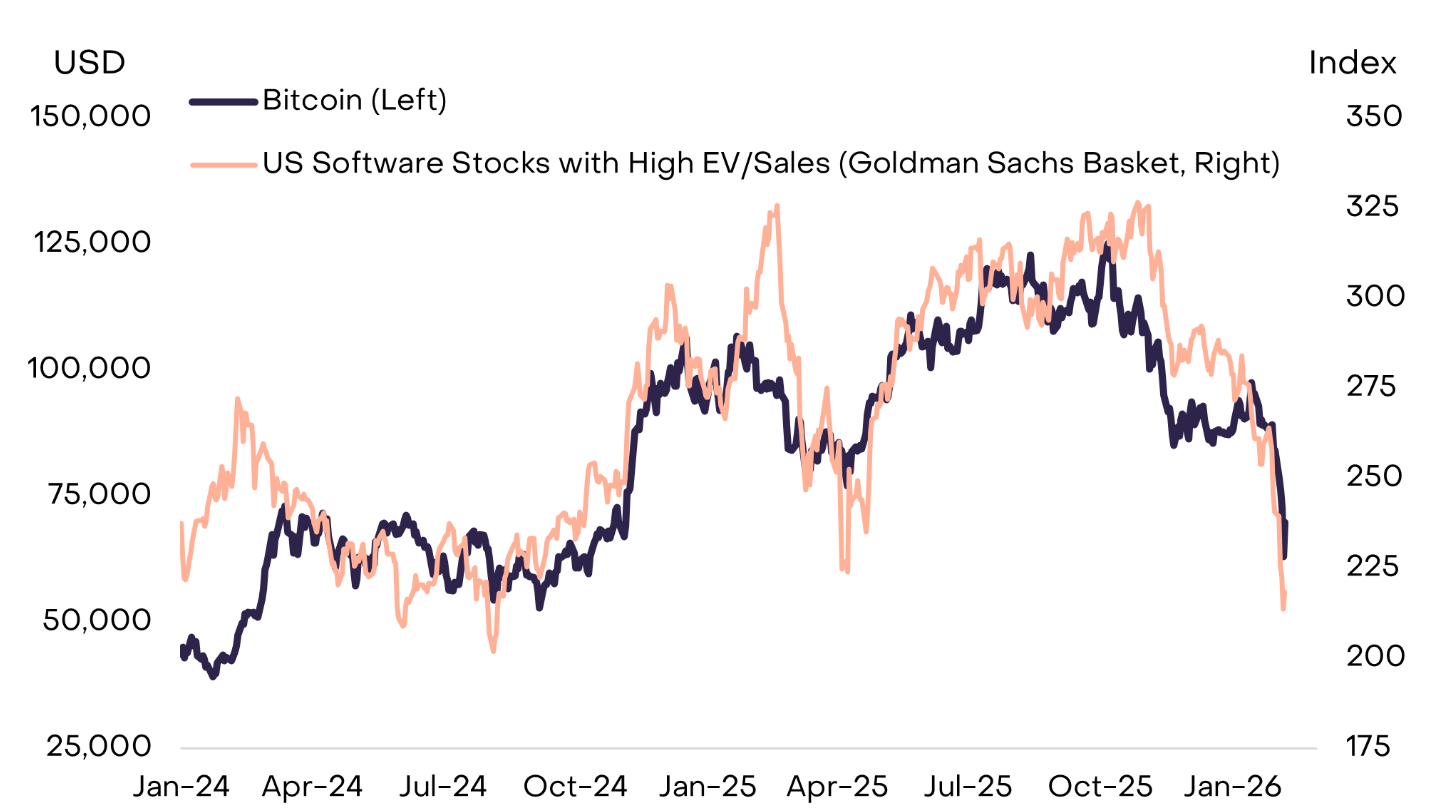
Crypto investors hold a direct stake. Bitcoin (BTC) hit a correlation with Nasdaq of 0.75 in January 2026,

This means any unwind of the Nvidia and OpenAI trade likely ripples straight into digital assets. AI tokens, already volatile, would feel the first blow.

The falling chip prices, agentic adoption, or cold accounting math winning the next round is now in the balance, with the AI boom officially entering its prove-it phase.
Notably, mainstream finance has already taken notice, with Fidelity’s own AI bubble framework listing five warning checks.
“We think 5 indicators may offer directional insights into future AI-driven market and economic trends,” Fidelity listed.
- The rate of aggregate earnings growth
- Aggregate earnings quality
- Valuations vs. history
- The affordability/sustainability of corporate capex spending, and
- The interest-rate cycle
Big Tech’s Q1 filings already trip two of them, earnings quality and capex affordability.
The boom may not get the chance to prove anything if the warning lights keep multiplying.
The post AI Bubble Fears Grow as Big Tech Allegedly Pays Itself in Cloud Loop appeared first on BeInCrypto.
Crypto World
Bitcoin News Today: Saylor Moves to MicroStrategy 2.0 with Treasury Bonds as the Company Stops Buying BTC

In Bitcoin News today, Strategy has paused its BTC purchases this week to repurchase $1.5 billion in face value of its 0% convertible senior notes due 2029 for approximately $1.38 billion in cash. Michael Saylor confirmed it himself on X with a single line: “This week we bought bonds, not bitcoin. The ₿itVac is charging.”
This is no longer a one-way accumulation machine. Strategy is now actively managing its capital structure, retiring debt at a discount, recycling capacity, and integrating US Treasury instruments as a yield-generating funding leg. The company that pioneered corporate Bitcoin accumulation is evolving into something closer to a macro carry trade vehicle.
Discover: The Best Crypto to Diversify Your Portfolio
Treasury Yield Leg Could Work
The mechanics are straightforward, with Strategy raising capital through equity sales, convertible notes, and perpetual preferred shares like STRC. A portion of the capital gets parked in short-duration US Treasuries and money-market instruments, generating yield while BTC accumulation conditions are evaluated.
That yield becomes the “safe leg” of a macro barbell as Treasuries generate cash flow that can service dividends on STRC, fund opportunistic buybacks of discounted convertibles, and eventually recycle into BTC purchases when the entry is right.
The Carry Trade logic here is that Strategy borrows or issues at ultra-low cost (0% coupon on the 2029 notes, fixed dividends on STRC) and earns spread against Treasury returns and BTC appreciation.
The $1.38 billion bond repurchase this week is a direct expression of that logic. Strategy is retiring debt at a discount to face value ($1.38B cash for $1.5B face), which immediately improves its balance sheet, reduces future share dilution (fewer notes means fewer potential conversion events into MSTR equity), and increases Bitcoin per share for existing holders.
Strategy currently holds 843,738 BTC, worth $65.25 billion, against an acquisition cost of $63.88 billion, for approximately $1.50 billion in unrealized profit. No Bitcoin was sold to fund this bond repurchase. The BitVac, as Saylor frames it, is recharging. It is not liquidating.
Bitcoin News Today: What the Carry Trade Structure Does to MSTR’s Risk Profile
MSTR is no longer a clean Bitcoin proxy. It is a layered instrument: BTC price exposure stacked on top of rate sensitivity stacked on top of equity volatility. Institutional desks now need to model three variables simultaneously, and that changes how the stock behaves in different macro regimes.

The clearest structural risk is the 2028 liquidity window. Strategy carries around $3 billion in convertible notes with put rights that allow holders to demand cash repayment beginning June 2028. If capital markets are closed, or MSTR is trading poorly relative to conversion prices, those obligations could force Bitcoin sales at the worst possible time. That is precisely why Strategy is front-loading debt retirement now, while it trades at a discount and before the put window opens.
Discover: The Best Token Presales
The post Bitcoin News Today: Saylor Moves to MicroStrategy 2.0 with Treasury Bonds as the Company Stops Buying BTC appeared first on Cryptonews.

The U.S. Senate is moving to unbanned passive stablecoin yield from every regulated platform in the country, as the industry is already engineering its way around it. The CLARITY Act has previously extended a yield prohibition that the earlier Genius Act applied only to issuers and now targets exchanges, brokers, and any custodial intermediary offering APY on idle stablecoin balances.
— Coin Bureau (@coinbureau) May 23, 2026
 THE CLARITY ACT COULD UNLOCK “YIELD-AS-A-SERVICE”
STBL’s Joe Vollono says this may be the bill’s biggest outcome, creating an entirely new crypto market. pic.twitter.com/p94apRj2cn
Joe Vollono, Chief Compliance Officer at STBL, argues that the legislative pressure is not killing yield so much as relocating it. According to him, Yield-as-a-Service becomes the dominant architecture once direct issuer-to-holder yield is prohibited, with AI agents acting as the compliance and execution layer between regulated stablecoins and yield-generating DeFi protocols.
Discover: The Best Crypto to Diversify Your Portfolio
The CLARITY Act and Yield Ban
The current Senate draft retains prior language banning rewards on idle stablecoin balances held in accounts while explicitly permitting yield generated through transactional activity. The critical legal phrase is “functional or economic equivalent” of bank-deposit interest: if a product looks like a savings APY, it is treated as a savings APY, regardless of its label.
The Tillis–Brooks compromise, driving the current bill, explicitly closes that exemption. Under the new text, the prohibition reaches “all intermediaries, any exchange, any platform holding your stablecoins.”
The White House Council of Economic Advisers models the full prohibition as increasing U.S. bank lending by roughly $2.1 billion while imposing a net welfare cost of $800 million, a cost-benefit ratio of 6.6 that reflects the amount of consumer surplus passive yield that was being generated.
As we know, the Banking and credit-union groups are lobbying hard to keep the ban tight, arguing that stablecoin rewards amount to unregulated shadow banking that competes directly with insured deposits.
Yield-as-a-Service: The Technical Stack It Requires
Vollono’s Yield-as-a-Service framework reframes the compliance constraint as a market-structure shift. If the issuer cannot pay yield and the custodian cannot pay yield, the yield must come from somewhere the law does not yet reach, specifically, from active strategy execution rather than passive balance accumulation.
The architecture requires an AI agent layer positioned between the user’s regulated stablecoin balance and the DeFi protocols generating returns. These AI agents monitor chain liquidity in real time, score protocol risk dynamically, and execute trades to capture yield-generating opportunities. They are the operational core of the model.
The agents do not hold the stablecoins; they route them through compliant DeFi pools, collect returns from transactional activity explicitly permitted under the CLARITY Act carve-outs, and return net yield to users as the product of active management.
The Golden Age of simple Earn programs is closing. What replaces it depends on whether AI agents can close the integration gap before regulators close the transactional yield carve-out too.
Discover: The Best Token Presales
The post Clarity Act Chaos? Automating Compliant Crypto Yield with AI appeared first on Cryptonews.
Disclosure: This article does not represent investment advice. The content and materials featured on this page are for educational purposes only.
Bitcoin mining enters a new era as Bitmain and AntPool push hash rate financialization and ecosystem integration.
Summary
- Bitcoin mining is shifting toward a broader “BTC Ecosystem” model focused on hash-rate financialization and infrastructure integration.
- BTC Ecosystem uses renewable-powered mining operations across Texas, Canada, and Australia.
- The company positions low-cost renewable energy, ASIC efficiency, and scalable infrastructure as key long-term mining advantages.
Throughout the history of cryptocurrency, mining has remained the ironclad foundation safeguarding Bitcoin’s network security and decentralization. Yet with the rapid emergence of the “BTC Ecosystem” narrative, the mining industry is evolving far beyond the traditional model of simply “mining and selling coins.” A new era centered on the financialization of hash rate is now taking shape.
Against this backdrop, the strategic alliance between Bitmain, AntPool, and leading BTC ecosystem projects signals a profound transformation underway across the mining sector. From hardware efficiency and hash rate allocation to capital deployment and ecosystem integration, the industry is entering a new phase of vertical integration — a strategic evolution increasingly favored by Western capital markets.
Core technology: Pushing the limits of computing efficiency
The technological foundation of this collaboration lies in the deep integration of next-generation mining hardware with the rapidly expanding BTC ecosystem infrastructure. At the center of this evolution is Bitmain’s latest Antminer S21 Pro series, delivering an industry-leading energy efficiency ratio below 15J/T. Through deeper protocol-level optimization, miners can achieve more stable firmware upgrades and significantly faster response speeds when processing complex inscriptions and Bitcoin Layer 2 transactions, laying the groundwork for a more efficient and scalable mining ecosystem.
To meet the growing demand for high-frequency computing within the BTC ecosystem, AntPool and its strategic partners are accelerating the large-scale deployment of liquid-cooling infrastructure. Standardized liquid-cooled mining cabinets not only extend the operational lifespan of ASIC chips but also improve heat dissipation efficiency by nearly 40%. This advancement enables industrial-scale mining farms to transition toward a more stable and efficient “high-frequency profitability” model, further enhancing overall operational performance.
At the same time, industry speculation suggests that future Antminer models may integrate dedicated modules designed to accelerate Bitcoin Layer 2 zero-knowledge proof (ZK) computation. If realized, this innovation would fundamentally redefine the role of mining hardware — transforming miners from simple block producers into decentralized computing providers capable of supporting DApps, sidechains, and broader BTC ecosystem infrastructure.
What is the BTC Ecosystem?
The BTC Ecosystem is operated byADAPT ECOSYSTEM PTY LTD, an Australia-registered company regulated under the oversight framework of the Australian Securities and Investments Commission (ASIC). Established in October 2022, the company focuses on building next-generation mining infrastructure powered by renewable energy, positioning itself at the intersection of Bitcoin mining, sustainable energy, and ecosystem expansion.
Its mining operations are strategically distributed across multiple global regions to optimize both energy efficiency and long-term scalability. In Texas, operations benefit from a mature and highly stable power grid capable of supporting large-scale, continuous mining activity. In Canada, abundant hydroelectric resources provide cleaner and more cost-efficient energy solutions, helping improve operational efficiency while maintaining competitive mining costs.
Meanwhile, in Australia, the company is progressively integrating solar and wind energy into its infrastructure strategy to support the sustainable expansion of its mining ecosystem. This multi-regional energy deployment model reflects the broader industry trend toward greener, more resilient, and institutionally scalable Bitcoin mining operations.
Investment potential: From commodities to creating yield-generating contracts
In the eyes of institutional investors in Europe and the United States, simply holding Bitcoin yields Beta returns, while participating in this “mining + ecosystem” collaboration is the key to obtaining Alpha returns
BTC Ecosystem operates data centers sited in regions tied to long-term renewable energy contracts. Geothermal, hydro, and wind power the fleet, and the company reports operating costs roughly 30% below the industry average as a result. Hardware is a current-generation ASIC, with continuous firmware management and redundancy built into the facility layer.
The renewable footprint is not just an ESG talking point. As global mining difficulty continues to climb, marginal cost decides the difference between a profitable operation and a stranded fleet. Siting compute near cheap, contracted renewable power is the structural advantage the company is building around.
Contract tiers and a $15 no-deposit trial
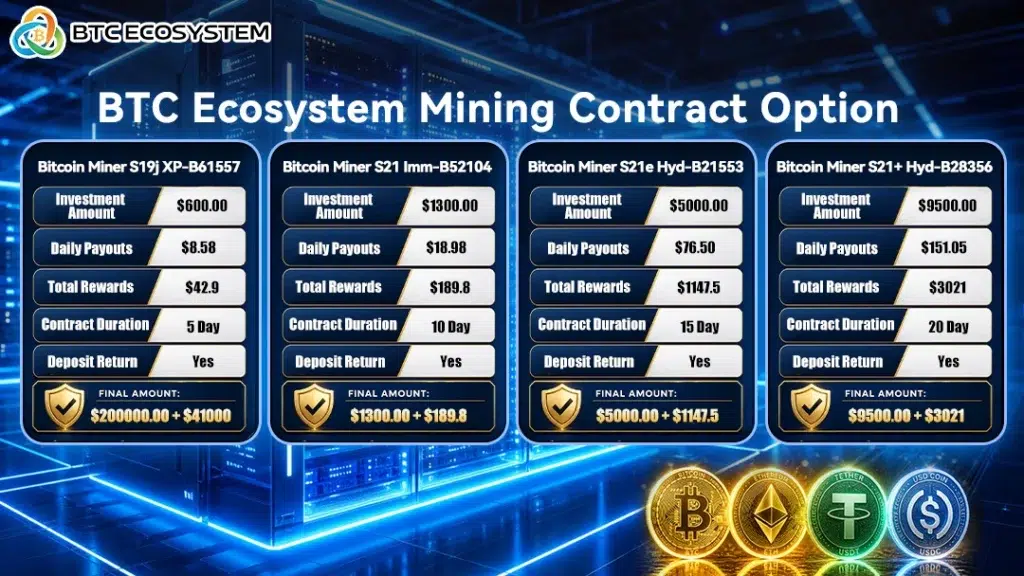
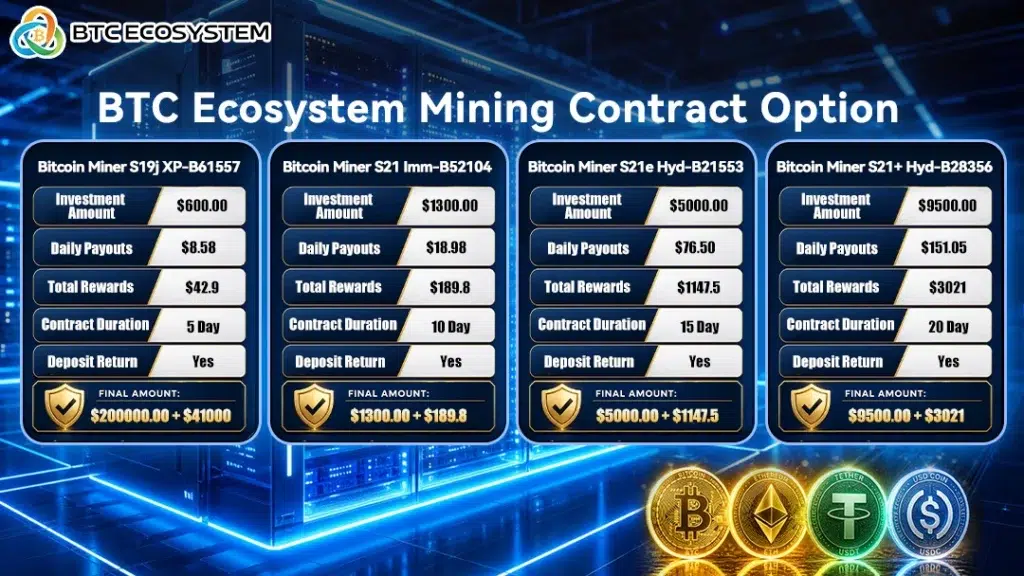
The platform’s contract menu is tiered by capital commitment and duration. Headline tiers include:
- A $15 welcome contract is activated at signup, returning $0.53 per day. This contract is designed to let new users see daily settlement before committing capital of their own.
- A $1,500 contract over 10 days, returning approximately $21.75 per day.
- A $9,000 contract over 20 days, returning approximately $142.20 per day.
- A $30,000 contract over 30 days, returning approximately $528 per day.
- Institutional-scale allocations up to $300,000, with daily returns reported in the four-figure range.
Earnings settle to user accounts on a 24-hour cadence. Withdrawals become available once a balance reaches $100. The platform supports BTC, ETH, USDT (ERC20 and TRC20), LTC, BCH, XRP, SOL, and DOGE for both deposits and payouts.
Industry observations and future outlook
This strategic collaboration sends a clear signal to the market: Bitcoin is evolving beyond “digital gold” into a decentralized computing platform. As the BTC ecosystem expands, mining infrastructure is no longer limited to block production, but is becoming a core layer supporting Layer 2 networks, DApps, and on-chain computation.
At the same time, ESG compliance and institutional adoption are accelerating industry transformation. Bitmain’s high-efficiency mining hardware aligns more closely with Western ESG standards, making large-scale mining infrastructure increasingly attractive to institutional capital, including pension funds and insurance investors.
However, as industry giants strengthen collaboration and improve operational efficiency, hashrate decentralization remains a key concern within the crypto community. In response, AntPool and its partners have emphasized more transparent pooling mechanisms and governance models. Ultimately, this shift represents not only an advancement in mining technology, but also a new era of capital efficiency — where transforming “cold computing power” into a thriving ecosystem may define the next crypto cycle.
For more information, visit the official website.
Disclosure: This content is provided by a third party. Neither crypto.news nor the author of this article endorses any product mentioned on this page. Users should conduct their own research before taking any action related to the company.
Crypto World
BNB Chain Launches Agent Survival Pack, Bringing Onchain Payments to AI Agents Across 6 Partner Projects

[PRESS RELEASE – Dubai, UAE, May 25th, 2026]
21 May: BNB Chain, one of the most active blockchain ecosystems worldwide, today announced the launch of the Agent Survival Pack, a coordinated initiative bringing together six AI infrastructure partners to give autonomous AI agents the ability to pay for their own operating costs directly on-chain.
Participating projects span the two layers an AI agent needs to operate (LLM access and financial infrastructure), with every transaction settling in BNB or BEP-20 tokens on BNB Smart Chain (BSC).
The initiative addresses a structural gap in current AI agent deployments. Most agents today still rely on human-managed billing infrastructure, including AWS accounts, OpenAI API keys, and SaaS subscriptions tied to individual cards. This forces human intervention whenever payment, top-up, or service changes are required, creating a hard limit on how autonomously an agent can operate.
Participating projects span the two layers an AI agent needs to operate: LLM access and financial infrastructure.
LLM access and compute:
- Alt AI: Access to leading models through a unified interface, with payment settled in BEP-20 tokens.
- Pieverse: An AI gateway built on x402b, its own extension of the x402 HTTP payment standard for BNB Chain. Agents pay for API calls inline using stablecoins, with every payment generating a verifiable on-chain receipt.
- Bankr: OpenAI-compatible access to 30+ models including Claude, GPT, Gemini, Grok, and DeepSeek, with payment metered on-chain per token.
- WorldClaw: A unified router across 300+ AI models with stablecoin settlement on BNB Chain. Active users earn credits and points through ongoing platform activity.
Financial infrastructure:
- B.AI (Bank of AI): A comprehensive financial layer integrating on-chain payments (via x402), on-chain identity (via ERC-8004), and DeFi access including lending, swap, and yield, deployable in a single line of code.
- AEON: A bridge between on-chain agents and the real-world economy, enabling agents to pay via QR code at physical merchants across Southeast Asia, with Visa and Mastercard rails rolling out next.
Each participating project is running its own incentive program alongside the launch, designed to lower the barrier to entry for builders and agents testing the integrations. All programs are tracked on-chain, with no separate signup or claim form required. Specifics vary by project and are detailed in the Agent Survival Pack launch documentation.
The Agent Survival Pack is part of BNB Chain’s broader strategy to position BSC as the operating layer for autonomous AI agents. The launch follows the introduction of the BNBAgent SDK and the chain’s continued growth as a destination for AI agent activity, with BNB Chain currently hosting one of the largest deployed agent populations of any public blockchain.
About BNB Chain
BNB Chain is a community-driven decentralized blockchain ecosystem powering Web3 applications across DeFi, AI, gaming, and consumer use cases. Its multi-chain architecture spans BNB Smart Chain (BSC), opBNB, and BNB Greenfield, providing the infrastructure for builders deploying onchain applications at scale. For more information, visit www.bnbchain.org.
Disclaimer
BNB Chain is not affiliated with or operating any of the projects featured in this article. The Agent Survival Pack is an ecosystem initiative showcasing independent projects building on BNB Chain. This content is for informational purposes only and does not constitute financial or investment advice. Always do your own research and assess potential security risks before interacting with any project mentioned.
The post BNB Chain Launches Agent Survival Pack, Bringing Onchain Payments to AI Agents Across 6 Partner Projects appeared first on CryptoPotato.
Crypto World
Influence360 Launches as the First AI & Data-Driven Web3 KOL Platform with Global KOL Coverage and Real Attribution


Influence360 introduces a campaign engine that enables Web3 projects to discover KOLs globally, execute structured campaigns, and track real performance across regions, languages, and channels.
A benchmark study of 143 Web3 KOLs highlights major gaps in payments, access, and campaign infrastructure, providing context for the platform’s launch.
Influence360 today announced the launch of its platform, introducing a new infrastructure layer for Web3 influencer marketing built around trust, data, and global execution.
Projects can discover web3 KOLs across 10+ languages and key platforms, including X, YouTube, TikTok, and Telegram; launch structured campaigns; and manage execution in one place with AI-powered optimization, smart contract escrow, and real-time performance tracking, enabling transparent payments and clear attribution at a global scale.
“Web3 influencer marketing already moves serious budgets, but the infrastructure around it still feels too basic for the level the market has reached,” said Dejan Horvat, founder & CEO of Influence360. “The biggest issue in the industry is that campaigns don’t compound, as teams aren’t learning what actually drives performance. Influence360 turns every campaign into data, showing which creators deliver value, what content works, and how to optimize spend over time. That’s how we bring trust, structure, and measurable performance to Web3 marketing.”
Influence360 is built by a team with extensive experience in Web3 influencer marketing and campaign execution. Through their previous work at Innovion, the co-founders, Dejan Horvat and Laura Toma, have collaborated with leading blockchain projects and KOL networks across multiple regions over the last 9 years, managing campaigns and partnerships that directly informed the platform’s design and its focus on real-world execution challenges.
Influence360 also extends this infrastructure to Web3 agencies and talent managers. Through a permission-based system, influencers can grant agencies custom access levels covering everything from campaign applications to payment handling, while agencies manage their full roster from a single account. Agencies can apply to campaigns on behalf of creators, set their own pricing on top of influencer rates, and earn a share of platform fees from influencers they bring on, for life. This structure is part of Influence360’s broader referral program, which will expand to include a dedicated affiliate marketing feature focused on performance-based campaigns.
Influence360 is now open to Web3 projects looking to run structured campaigns, KOLs seeking reliable partnerships, agencies managing creator rosters, and affiliate marketing partners focused on performance-driven growth. Learn more and join at influence360.io.
For its launch, Influence360 is releasing The State of Web3 Influencer Marketing 2026, based on survey responses from 143 Web3 KOLs across seven global regions.
The research shows a financially active ecosystem, where more than half of KOLs earn between $1,000 and $5,000 per campaign, with experienced KOLs exceeding that range. The report highlights a persistent trust gap in the market, with only 35% of KOLs reporting that they have been paid by every project they have worked with.
The findings also confirm that Web3 influencer marketing is already a repeat-driven and increasingly professionalized channel. 97% of the KOLs surveyed have worked with the same projects multiple times, while most evaluate factors such as team transparency, investor backing, and project credibility before accepting collaborations. However, the lack of structured tooling, reliable payments, and performance attribution continues to limit efficiency and scale.
Influence360 is built to close this gap by combining campaign execution, real attribution, and a growing data layer that will power AI-driven campaign benchmarking and optimization. With a roadmap that expands into advanced analytics, UGC campaign infrastructure, and automation, the platform is positioning itself as a long-term growth engine for Web3 marketing, where campaigns are continuously measured and improved.
About Influence360
Influence360 is a Web3 creator marketing platform designed to make influencer campaigns transparent, fairly compensated, and measurable at scale. The platform enables global creator discovery across regions, languages, and niches; structured campaign execution; smart-contract escrow payments; performance tracking linked to real outcomes; and AI-powered campaign strategy and optimization. Visit influence360.io.
The post Influence360 Launches as the First AI & Data-Driven Web3 KOL Platform with Global KOL Coverage and Real Attribution appeared first on BeInCrypto.


Tether and Georgia’s government will launch GEL₮, a stablecoin pegged to the Georgian Lari, in one of the first cases of placing sovereign fiat onto blockchain rails.
The launch sits inside Georgia’s new stablecoin regime, which the country built to align with the US GENIUS Act. This positions Georgia as one of the earliest jurisdictions pursuing regulatory interoperability with Washington’s digital asset rules.
Why a National Stablecoin Now
Stablecoins are moving from crypto rails into mainstream payment infrastructure. Monthly adjusted onchain volume hit $7.6 trillion in April 2026. Tether also noted that stablecoins are gaining traction for payments, settlements, remittances, and international transfers.
Meanwhile, forecasts keep climbing. Ripple projected $33 trillion in onchain stablecoin volume for 2026. Chainalysis estimates that adjusted stablecoin transaction volume will climb to $719 trillion by 2035 through organic growth alone.
The firm added that if broader macroeconomic catalysts, such as generational wealth transfer and point-of-sale saturation, accelerate adoption, the figure may expand toward $1.5 quadrillion.
Follow us on X to get the latest news as it happens
Georgia has positioned itself for the shift. The country already allows tax payments via instant conversion of digital assets. The fiat-pegged token extends that approach into sovereign monetary infrastructure.
GEL₮ will serve as a digital version of the Georgian Lari, offering lower transaction fees, near-instant settlement, programmable payments, and smoother value transfers across digital financial networks.
The initiative aims to strengthen cross-border trade, expand fintech innovation, improve digital payment systems, and widen access to programmable financial infrastructure across Georgia and the broader region.
“In partnership with Tether, the global leader in digital assets and stablecoin innovation, Georgia has the opportunity to become a strategic bridge between traditional finance and the digital economy of the future,” Vakhtang Turnava, Member of the Parliament of Georgia, said.
The announcement added that further details regarding GEL₮’s structure, rollout timeline, and regulatory framework will be disclosed at a later stage.
Whether other governments follow Georgia’s playbook of pairing national stablecoins with US-aligned rules will shape how sovereign fiat travels onchain.
Subscribe to our YouTube channel to watch leaders and journalists provide expert insights
The post Tether Plans Georgian Lari Stablecoin in Sovereign Currency Partnership appeared first on BeInCrypto.
Crypto World
Crypto News Today: Near Protocol ($NEAR) & Hyperliquid ($HYPE) Whales Flock To SurgeXRP As $SGP Presale Momentum Accelerates Across XRPL

A fresh rotation of whale capital is beginning to hit the XRP Ledger ecosystem, and traders previously positioned in Near Protocol ($NEAR) and Hyperliquid ($HYPE) are now turning attention toward SurgeXRP, the XRPL-based real estate marketplace whose ongoing $SGP presale is rapidly gaining momentum across crypto communities.
As profits continue flowing out of already-expanded narratives, many investors are now aggressively searching for earlier-stage opportunities with stronger upside potential before mainstream attention arrives.
That search is increasingly leading toward XRP ecosystem projects, particularly those connected to real-world assets.
SurgeXRP has quickly emerged as one of the most talked-about XRP presales after early contributors pushed the project beyond 10% of its presale soft cap within days of launch, triggering growing speculation that the current entry window may not remain open for long.
[Join SurgeXRP Presale]
What is driving the momentum is not just hype.
It is the structure behind the presale itself.
Unlike conventional crypto launches that lock in fixed valuations before public participation begins, SurgeXRP has removed the fixed token price entirely.
There is no set presale valuation.
Instead, the final price of $SGP will be determined entirely by the total amount of XRP raised during the presale period, creating a market-driven structure that is already fueling aggressive positioning from XRP whales and high-conviction traders attempting to secure exposure before public trading begins.
At the same time, the project has confirmed planned listings on XPMarket and MagneticDEX at a valuation 30% higher than the final presale price, creating an additional layer of urgency among early contributors.
For many traders, the logic is simple: position before the market fully notices.
Why Traders From NEAR & Hyperliquid Are Watching SurgeXRP
Whale rotations are one of crypto’s strongest early signals.
Once major gains begin slowing in established narratives, larger traders often move aggressively into earlier-stage sectors before retail momentum follows.
That pattern now appears to be forming around XRPL real-world asset infrastructure.
SurgeXRP is building a marketplace designed to bring rental real estate ownership on-chain through the XRP Ledger, allowing users globally to access fractional participation in income-generating rental properties using blockchain-based settlement and ownership infrastructure.
As the real-world asset sector continues becoming one of crypto’s fastest-growing narratives, many investors increasingly believe XRPL is positioned to become a major blockchain for tokenized assets due to its low fees, fast settlement, and native tokenization capabilities.
That narrative is helping SurgeXRP gain traction rapidly.
Additional Presale Incentives Fueling FOMO
The project has also introduced multiple bonus structures that are intensifying competition throughout the presale.
The first 100 contributors receive a 10% bonus allocation on purchased SGP tokens.
In addition, SurgeXRP is preparing to launch a real-time contributor leaderboard where the top 20 contributors will receive another 10% bonus allocation.
The upcoming live dashboard will allow users to monitor:
Estimated SGP allocations
Total XRP raised
Leaderboard rankings
Bonus eligibility status
Presale milestone progress
[Buy SGP Token]
$SGP Presale Details
Blockchain: XRP Ledger
Token: $SGP
Total Supply: 200 million SGP
Presale Allocation: 100 million SGP
Presale Price: Determined by total XRP raised
DEX Listings: XPMarket & MagneticDEX
Planned Listing Valuation: 30% higher than final presale price
First 100 Bonus: 10%
Top 20 Leaderboard Bonus: Additional 10%
As momentum across XRPL and RWA narratives continues accelerating, many traders believe SurgeXRP could become one of the most closely watched XRP ecosystem launches before the next phase of the market begins.
Website: surgexrp.com
Join Presale: surgexrp.com/presale
Whitepaper: docs.surgexrp.com
Telegram: t.me/surgexrpdotcom
Disclaimer: This is a Press Release provided by a third party who is responsible for the content. Please conduct your own research before taking any action based on the content.



The CLARITY Act cleared the Senate Banking Committee 15-9 on May 14, 2026, but the biggest threat to its passage was never the crypto skeptics or the SEC holdouts. It was the American Bankers Association. The ABA spent April and May running an emergency lobbying campaign to close what it calls the “stablecoin yield loophole” in the bill, a provision that lets crypto exchanges pay activity-based rewards on stablecoin balances. The ABA’s own research estimates that yield-bearing stablecoins could grow the market from $300 billion to $2 trillion at the direct expense of bank deposits, reducing lending capacity by 20 percent or more. The fight is not about consumer protection or financial stability. It is about banks defending a profit model built on zero-yield checking accounts against a structurally superior alternative. This is the political fight nobody is properly explaining.
Summary
- The CLARITY Act’s stablecoin rewards provision has become the main flashpoint between the crypto industry and U.S. banking groups over fears of deposit migration from traditional banks.
- The American Bankers Association warned that yield-bearing stablecoins could expand the market to $2 trillion and reduce lending capacity across consumer, small business, and agricultural sectors.
- Crypto industry advocates argued that banks are defending low-yield deposit models as exchanges push for activity-based stablecoin rewards under the proposed legislation.
What the loophole actually is
The CLARITY Act, in its current form, contains a provision that has become the most contested single fight in crypto legislation in 2026. Most coverage refers to it vaguely as “stablecoin yield provisions” without explaining what is actually at stake. The specifics matter.
The 2025 GENIUS Act, which established federal stablecoin regulation, prohibits stablecoin issuers from paying interest or yield on payment stablecoins. The ban applies to the issuer (Circle for USDC, Tether for USDT, Ripple for RLUSD, Paxos for various tokens). The intent was to keep stablecoins working as payment instruments rather than competing with bank deposits.
The CLARITY Act contains language that, as currently drafted, lets crypto exchanges and digital asset service providers offer rewards on stablecoin balances held with them, even though the underlying issuer cannot pay yield directly. The Tillis-Alsobrooks compromise language, released in early May, refined the original draft. The compromise prohibits rewards that are “economically or functionally equivalent to the payment of interest or yield on an interest-bearing bank deposit.” But it allows rewards tied to “activity-based” participation in exchange membership programs, including rewards calculated by reference to balance, duration, and tenure.
That last clause is the loophole the banking industry is fighting. From the ABA’s perspective, an exchange offering a 4 percent reward on USDC balances held in a membership program is functionally identical to a bank paying 4 percent interest on a checking account. The fact that the reward is technically tied to “activity” rather than balance does not change the economic reality for the consumer. The depositor sees yield. The depositor moves money. The bank loses the deposit.
The banking industry is correct this is a loophole in the original GENIUS Act framework. Whether it should be closed is the political fight that has dragged CLARITY’s path through the Senate Banking Committee.
The deposit flight argument
The American Bankers Association’s central argument against the CLARITY language is the threat of deposit flight, and the numbers the ABA cites are striking enough to deserve serious examination.
On April 13, 2026, the ABA published its own commissioned study estimating that yield-bearing stablecoins could grow the global stablecoin market from approximately $300 billion today to $2 trillion within several years. The growth, the ABA argues, would come largely at the direct expense of traditional bank deposits, particularly checking accounts and money market accounts that currently pay little or no interest.
A coalition of banking trade groups, including the ABA, Bank Policy Institute, Independent Community Bankers of America, Consumer Bankers Association, and Mid-Size Bank Coalition of America, wrote to Senate Banking Committee leaders in early May, warning that “research indicates deposit flight driven by the widespread adoption of yield-bearing stablecoins could reduce consumer, small-business, and agricultural lending by one-fifth or more.”
This is the headline number that gets cited in coverage. A 20 percent reduction in lending capacity would be a material macroeconomic event. Banks fund commercial loans, mortgages, small business credit, and agricultural lending substantially from deposit bases. If deposits flee to yield-bearing stablecoins, the funding capacity for those loans shrinks proportionally. The banks’ argument is that this is not a marginal concern. It is a structural threat to the way credit flows through the US economy.
The argument has surface plausibility. The FDIC’s own analysis of the 2023 spring bank failures (Silicon Valley Bank, Signature Bank, First Republic) found depositors with substantial uninsured funds were far more likely to run during stress events than insured retail depositors. The pattern suggests deposit stability is more fragile than banks publicly admit, particularly for uninsured balances and sophisticated depositors who actively manage cash positions.
What the deposit flight argument leaves out is the most important context. American checking accounts currently pay close to nothing. The national average interest rate on checking accounts is approximately 0.07 percent. On savings accounts, the average is approximately 0.43 percent. Both numbers have stayed near zero through the entire post-2008 era of low interest rates and have not risen materially even as the Federal Reserve raised the federal funds rate to over 5 percent in 2024.
The gap between what banks pay depositors and what banks earn on those same deposits has been one of the most profitable elements of the banking business for over a decade. Banks take in deposits at near-zero cost, lend them out at much higher rates, and capture the spread. The arrangement works for banks precisely because depositors have had no comparable alternative.
Yield-bearing stablecoins backed by US Treasuries can offer 3 to 5 percent returns to holders, depending on the underlying yield environment. The math is not subtle. A depositor with $10,000 in a zero-yield checking account is giving up roughly $400 per year in potential interest income. A depositor with $100,000 across various bank accounts is giving up roughly $4,000. The choice between zero yield in a bank account and 4 percent yield in a tokenized money market alternative is not a choice most rational consumers would make in favor of the bank, if the alternative existed at scale.
This is what the ABA’s deposit flight argument actually means in plain English. Banks are afraid the loophole will let consumers earn what their deposits should arguably have been earning all along. The “deposit flight” the ABA is warning about is, in part, consumers rationally responding to a better product.
What the banks are actually defending
The honest framing of the banking industry’s position requires understanding what banks are actually trying to protect.
The first thing banks are protecting is the zero-yield checking account business model. American banks currently hold approximately $17 trillion in customer deposits. A substantial portion of those deposits are in non-interest-bearing checking accounts or low-interest savings accounts. The interest rate banks pay on these deposits has been compressed near zero for over a decade. The income banks generate from lending these deposits at market rates is, in turn, one of the most reliable profit streams in the industry.
If stablecoins offering 4 to 5 percent yield became widely available and easy to access, the economic logic for keeping money in zero-yield bank accounts would weaken substantially. Banks would face a choice: raise deposit rates to compete (which would compress their net interest margins and reduce profitability), or lose deposits to stablecoin alternatives (which would force them to seek more expensive funding sources or reduce lending).
The second thing banks are protecting is the regulatory moat. Banks run under extensive regulatory requirements (capital adequacy, liquidity coverage, FDIC insurance assessments, Community Reinvestment Act obligations, Bank Secrecy Act compliance) stablecoin issuers do not face in the same form. The CLARITY Act would let stablecoin-related products compete with bank deposits without imposing equivalent regulatory burdens on the stablecoin side. Banks argue this creates an unlevel playing field. The argument has merit.
The third thing banks are protecting is the structural role of banks in credit creation. Under the current US banking system, deposits at commercial banks are the primary funding source for consumer and commercial lending. If deposits migrate to stablecoins, the funding model has to adjust. Banks would need to raise capital through wholesale funding (more expensive and less stable), or the lending capacity of the system would shrink, or some combination of both. The ABA’s argument this could reduce lending by 20 percent or more is contested but not implausible.
The fourth thing banks are protecting is their political position. Banking is one of the most heavily regulated industries in the United States, and the banking industry has spent decades building relationships with Congress, regulators, and the Federal Reserve. The political infrastructure banks have built gives them significant influence over financial legislation. Allowing stablecoins to compete with deposits would, over time, shift some of that political power to a new industry (the crypto industry) banks have historically opposed. Banks are not just defending their economic interests. They are defending the political ecosystem that protects those interests.
None of this is necessarily improper. Industries lobby for their interests. Banks have legitimate concerns about deposit funding, regulatory parity, and systemic stability. The argument is not that the banking industry’s position is illegitimate. The argument is the banking industry’s position is being framed as consumer protection and financial stability when it is, more straightforwardly, a defense of the existing profit model against a competitive threat.
The crypto industry’s response
The crypto industry’s pushback against the ABA campaign has been unusually pointed for what is typically a politically careful sector.
Paul Grewal, Chief Legal Officer at Coinbase, responded directly to the ABA’s lobbying campaign in early May. His argument was that banks have already had their preferred outcome in the GENIUS Act, which banned yield payments by stablecoin issuers themselves. Banks won “idle yield killed,” in Grewal’s framing, which was already a loss for consumers but a clear win for banks. The CLARITY Act compromise on activity-based rewards represents a further concession to banking industry concerns, and Grewal’s view is that the banks should “take yes for an answer.”
Cody Carbone, Chief Policy Officer at The Digital Chamber, was sharper. He criticized the banking industry for “waiting until the final days before the markup to raise objections.” The framing was that the banks had multiple opportunities to negotiate the language during the months of bipartisan negotiations and chose to wait until the eleventh hour to mount an emergency campaign. “The arrogance is astounding,” Carbone wrote in a public post.
The crypto industry’s substantive argument against the ABA is twofold. First, the deposit flight concern is overstated because banks can easily mitigate the issue by raising deposit rates to competitive levels. If banks paid 3 percent interest on checking accounts, the relative attractiveness of yield-bearing stablecoins would diminish considerably. The fact banks have chosen not to raise rates, even as the federal funds rate has stayed elevated for years, is a strategic choice rather than an unavoidable constraint.
Second, the lending capacity argument assumes banks are the only legitimate source of credit creation in the US economy. The reality is non-bank lending has grown substantially over the past decade. Private credit funds, fintech lenders, peer-to-peer platforms, and now potentially stablecoin-funded lending platforms all extend credit outside the traditional banking system. The deposit flight argument treats banks as irreplaceable. The economic reality is capital flows to where it can be deployed productively, and the structural role of banks has been gradually eroding for years.
The White House has taken a position broadly aligned with the crypto industry on this specific question. Patrick Witt, Executive Director of the President’s Council of Advisors on Digital Assets, publicly criticized the ABA’s late-stage lobbying effort, noting the bankers had been invited to the White House in February to discuss the compromise language and had not made themselves available at that time. The administration’s view is the Tillis-Alsobrooks compromise language is final, and the ABA’s continued lobbying is an attempt to relitigate a settled question.
Why the compromise still leaves space the banks oppose
The Tillis-Alsobrooks compromise language is the result of months of negotiation between crypto industry advocates and banking industry concerns. The language has been narrowed several times in response to bank lobbying. The current draft is, by ABA’s own admission, improved from earlier versions. But the banks are still fighting because the compromise still permits the specific mechanism that worries them most.
Under the current language, stablecoin issuers cannot pay yield directly. That part is unchanged from the GENIUS Act. Exchanges and crypto intermediaries cannot pay rewards “in a manner that is economically or functionally equivalent to the payment of interest or yield on an interest-bearing bank deposit.” This is the new restriction the compromise added.
But the language permits exchanges to pay rewards for “user participation in an exchange’s membership program,” with rewards potentially calculated by reference to duration, balance, and tenure. This is the loophole the banks want closed.
In practice, this means a crypto exchange could offer a membership program with tiered benefits. Higher membership tiers receive rewards based on the user’s overall engagement with the platform, including their stablecoin holdings. The rewards could be calculated as a percentage of the user’s average stablecoin balance over a given period, denominated in stablecoins or other tokens. The structure would be technically distinct from interest payments on a bank deposit, but the economic effect for the user would be similar.
The banking industry’s position is this structure is a designed workaround. The ABA’s letter to senators called the activity-based rewards provision “a significant loophole” that would let exchanges offer “interest-like incentives” through marginally different legal structures. If the goal of the GENIUS Act ban was to prevent stablecoins from competing with bank deposits, the ABA argues, the CLARITY language undermines that goal by allowing the same competition through a different mechanism.
The crypto industry’s position is activity-based rewards are not the same as yield payments and serve legitimate user engagement purposes exchanges should be allowed to design. The compromise language, on this view, is the correct balance: it bans the most direct form of stablecoin yield while preserving exchanges’ ability to compete on user experience.
The actual answer probably lies between the two positions. The activity-based rewards mechanism is, in practice, a partial substitute for direct yield. Whether it is enough of a substitute to trigger the deposit flight banks are warning about is an empirical question nobody can answer with certainty in advance. The compromise language is a bet that the answer is “no, or not by enough to cause systemic concern.” The banks’ continued lobbying is a bet that the answer is “yes, eventually, and the cost will be too high to undo.”
What this fight tells you about CLARITY’s real politics
The stablecoin yield fight reveals something about CLARITY’s broader political dynamics that most coverage misses.
The bill is being treated as a crypto industry victory in many headlines. The reality is that CLARITY is the product of extensive compromises with multiple stakeholder groups, each of which had to be partially accommodated for the bill to advance. The banking industry got the GENIUS Act ban on direct stablecoin yield. The crypto industry got the activity-based rewards carve-out. The progressive Democrats got partial ethics provisions that have not yet been finalized. The administration got the Anti-CBDC Surveillance State Act language. The CFTC got expanded jurisdiction over digital commodities. The SEC retained jurisdiction over digital securities.
The bill that emerged from this process is a negotiated settlement among multiple powerful interest groups, not a clean crypto industry win. The banks were not the only stakeholders who had to compromise. The crypto industry made substantial concessions, too. The bill that exists is the bill that could be negotiated, not the bill that any single party wanted.
This is normal for major financial legislation. The Dodd-Frank Act of 2010 was a similar product of multi-stakeholder compromise. The Bank Secrecy Act amendments over the years have been similarly negotiated. The legislative process is, in many ways, a process of finding the minimum acceptable set of concessions that lets a bill move forward.
What is unusual about CLARITY is that the banking industry is openly trying to extract additional concessions during the floor vote stage, after the committee process has completed. This is a high-risk strategy for the banks. If they push too hard and Democrats walk away from the bipartisan compromise, CLARITY could stall on the Senate floor. If they push successfully and the language is further restricted, crypto industry support could weaken, and Republican senators could face pressure from their own constituents to vote against a bill that no longer accomplishes what was promised.
The banks are betting they have enough political leverage to extract further concessions without killing the bill. The crypto industry is betting the banks have already overplayed their hand. Both bets cannot be right.
The realistic outcome
Based on the current political dynamics, several outcomes are plausible for the stablecoin yield provisions in the final CLARITY Act.
The first possibility is that the compromise language survives substantially unchanged. The Tillis-Alsobrooks framework was the product of months of negotiation. Both senators have indicated they consider the language final. If the Senate floor vote happens in June or July 2026, as the White House targets, the compromise language could move through with only minor technical refinements. This is the outcome the crypto industry wants, and the banks are trying to prevent.
The second possibility is that the language gets tightened during floor amendments. Democrats negotiating for the bipartisan votes needed to overcome a filibuster could demand additional restrictions on activity-based rewards in exchange for their support. The ABA’s lobbying campaign is designed to create this dynamic. If banks can convince Democrats that the loophole is too large, the floor amendment process could narrow the rewards mechanism further.
The third possibility is that the language gets removed entirely during conference reconciliation with the House version. The House passed its version of crypto market structure legislation in 2024 (FIT21), and the final CLARITY Act will need to reconcile differences between the House and Senate versions. The conference committee process is opaque and often produces unexpected outcomes. The stablecoin yield provisions could be substantially modified during reconciliation.
The fourth possibility is that CLARITY stalls or fails entirely. If the stablecoin yield fight becomes too contentious, or if the broader ethics provisions and law enforcement issues cannot be resolved, the bill could miss its July 4 White House signing target and slip past the 2026 midterm elections. Senator Cynthia Lummis warned that failure to clear the committee before Memorial Day could push the next viable legislative window past November 2026. The bill cleared the committee on May 14, but the broader timeline pressure is real.
The fifth possibility, which gets less attention, is that the law passes substantially as drafted, but the agency-level rulemaking process narrows the rewards mechanism in implementation. CLARITY would direct the SEC and CFTC to develop joint rules on stablecoin-related products. The rulemaking process, which stretches into 2027 and 2028, would let regulators apply more restrictive interpretations than the statutory language strictly requires. This is the outcome banks may quietly prefer if they cannot win during the legislative phase.
What this tells you about banks and crypto going forward
The CLARITY Act stablecoin yield fight is, in many ways, a preview of the larger battle between banks and crypto that will play out over the rest of the decade.
The fundamental dynamic is that crypto-native infrastructure (stablecoins, decentralized exchanges, on-chain settlement) can offer customers economic terms that traditional banks cannot match while protecting their existing profit models. The crypto industry’s competitive advantage is not the underlying technology. It is the lack of legacy infrastructure costs and regulatory overhead that lets crypto firms pass through more value to end users.
For banks, the existential question is whether they can adapt their business models to compete with crypto-native alternatives or whether they need to keep regulatory moats that prevent direct competition. The CLARITY Act fight is one specific instance of this larger question. Future fights over central bank digital currencies, tokenized deposits, programmable money, and DeFi lending will all touch on the same fundamental issue.
The banking industry’s preferred strategy, visible in the ABA’s CLARITY campaign, is to use regulatory and political channels to constrain crypto competition rather than adapt to it. This strategy has worked historically. Banks have successfully constrained money market funds, peer-to-peer lending, and other deposit substitutes through regulatory and political pressure for decades. The question is whether the strategy keeps working as crypto becomes more established and politically powerful.
The crypto industry’s preferred strategy is to win the legislative fights that establish clear rules for digital assets and then compete on the merits in the resulting regulated market. The CLARITY Act, in its current form, would give crypto firms a clearer legal framework than they have ever operated under in the United States. If the bill passes substantially as drafted, the crypto industry would have a structural opportunity to compete with banks on more level terms than has ever existed before.
Whether the banks succeed in narrowing the CLARITY language further, or whether the crypto industry holds the line on the compromise, will be determined over the next two to three months. The vote count on the Senate floor will be the proximate indicator. The ABA’s lobbying intensity in the coming weeks will be the leading signal.
For readers tracking the fight, three things are worth watching. First, whether Senator Tillis or Senator Alsobrooks shows any signs of reopening the compromise language under pressure from banking constituents. Second, whether the ABA’s deposit flight studies gain traction with moderate Democrats who could shift the floor vote dynamics. Third, whether crypto industry advocacy groups (Blockchain Association, Digital Chamber, Coinbase’s policy team) successfully counter-mobilize their own grassroots networks in the way the banking industry has done.
The bottom line
The CLARITY Act is on a path to becoming law in 2026, but the path is narrower than the headlines suggest. The single biggest obstacle is not the SEC, the CFTC, the Democrats opposing the bill on ethics grounds, or the libertarian objections to government oversight of crypto. It is the American Bankers Association and the broader banking industry coalition fighting to close the stablecoin yield loophole the Tillis-Alsobrooks compromise created.
The fight is not about consumer protection or financial stability, despite how the ABA frames it. It is about banks defending a profit model built on zero-yield deposits against a structurally superior alternative. The deposit flight scenario the banks warn about is, in part, consumers rationally responding to a better product. The lending capacity reduction is a real concern, but the underlying issue is whether banks should be the only legitimate channel for credit creation in the US economy, which is a contestable proposition.
The CLARITY Act, in its current form, represents a negotiated compromise that gives banks substantial concessions (the GENIUS Act ban on direct stablecoin yield) while preserving some space for stablecoin-related products to compete (the activity-based rewards mechanism). The compromise is not perfect from either industry’s perspective. It is, by the standards of major financial legislation, a reasonable balance.
What happens next will be determined by which side overplays its hand. If the banks push for further restrictions and Democrats walk away from the bipartisan compromise, CLARITY could stall on the Senate floor and miss its 2026 window entirely. If the crypto industry holds the line and the bill passes substantially as drafted, banks will face a structural competitive threat they have not faced in decades.
Both outcomes are plausible. Neither is guaranteed.
For crypto.news readers, the practical lesson is to watch the floor vote dynamics, the conference reconciliation process, and the agency rulemaking that will follow passage. The legislative outcome will set the framework. The administrative implementation will determine how much of that framework actually works in practice. Both phases will be shaped by ongoing pressure from the banking industry that is unlikely to stop just because the bill becomes law.
The banks are not trying to kill CLARITY because they oppose crypto regulation. They are trying to kill the specific version of CLARITY that lets stablecoins compete with bank deposits on terms banks cannot match without raising their own deposit rates. The fight is, in its essentials, about who gets to capture the spread between zero-yield deposits and Treasury-backed yields.
The answer to that question will shape American banking for the next decade.
This article is for informational purposes and does not constitute legal, financial, or investment advice. Legislative outcomes and policy debates evolve quickly; the analysis described reflects reporting available as of late May 2026. Always do your own research and consult appropriate counsel for specific regulatory matters.

Callum Turner’s 100% RT Time-Travelling Sci-Fi Mystery Sets Sail on Rough Waters in New Images

I visited 90-year-old Cambs lido for the first time and felt like I was on holiday

Yatra Online, Inc. 2026 Q4 – Results – Earnings Call Presentation (NASDAQ:YTRA) 2026-05-25

US brings back mandatory military draft registration

Steven Gerrard disagrees with Gary Neville over ‘shock’ Chelsea and Arsenal claim | Football

Register Renaming | Hackaday

How To Actually Make $180/day Trading Crypto For Beginners

How to Become a Crorepati | Business vs Job Motivation in Tamil | Financial Freedom Tips#viraltamil

Trump administration sparks MAJOR shift toward Bitcoin home loans
-

 Crypto World4 days ago
Blockchain.com files with SEC for U.S. IPO
-

 Fashion3 days ago
Holiday Weekend Open Thread – Corporette.com
-

 Crypto World3 days ago
Bitcoin Accumulation Weakens as BTC Realized Losses Hit $600M
-

 Business3 days ago
Dell Technologies DELL Stock Surges 15% on AI Server Momentum and Analyst Upgrades in 2026
-

 Crypto World3 days ago
Space X IPO Is ‘Bad News’ for Tech Stocks: But What About Bitcoin?
-

 Politics3 days ago
Makerfield: a tale of two social-media histories
-

 Crypto World2 days ago
Robinhood crypto COO Tanya Denisova exits
-

 Crypto World3 days ago
MicroStrategy’s Saylor Says Miners No Longer Set Bitcoin Price, Another Force Has Taken Over
-

 Business19 hours ago
NYT Strands Answers May 24 2026 Revealed for Puzzle No. 812 Theme Summer Essentials
-

 Crypto World3 days ago
AI infrastructure race heats up as IREN pitches full-stack strategy, WhiteFiber lands $160M deal
-
 Tech3 days ago
A 0.12% parameter add-on gives AI agents the working memory RAG can’t
-

 Tech4 days ago
WhatsApp ads could make Irish debut after discussions with DPC
-

 Tech3 days ago
You Can Now Add ChatGPT To PowerPoint
-

 Business3 days ago
Trump Invests $1M-$5M in Kura Sushi USA Chain With 27 California Locations
-
Crypto World7 days ago
Revolut Launches Dogecoin Debit Card Across UK and EU
-
 NewsBeat4 days ago
Charity run by Reform leader Malcolm Offord accused of ‘law breaking’ over Scottish registration
-

 Sports4 days ago
2026 CJ Cup Byron Nelson leaderboard: Brooks Koepka finds putting stroke in Round 1
-

 Crypto World3 days ago
Trump Media’s Bitcoin Stash Shrinks Again as 2,650 BTC Lands on Crypto.com
-
Business3 days ago
Goldman Sachs reinstates Ageas stock coverage with neutral rating
-

 Crypto World5 days ago
Exa Labs raises $250 million in funding led by a16z
You must be logged in to post a comment Login