

Crypto World
Bitcoin Shorts are up for a Squeeze as Traders Eye $80,000 Reclaim

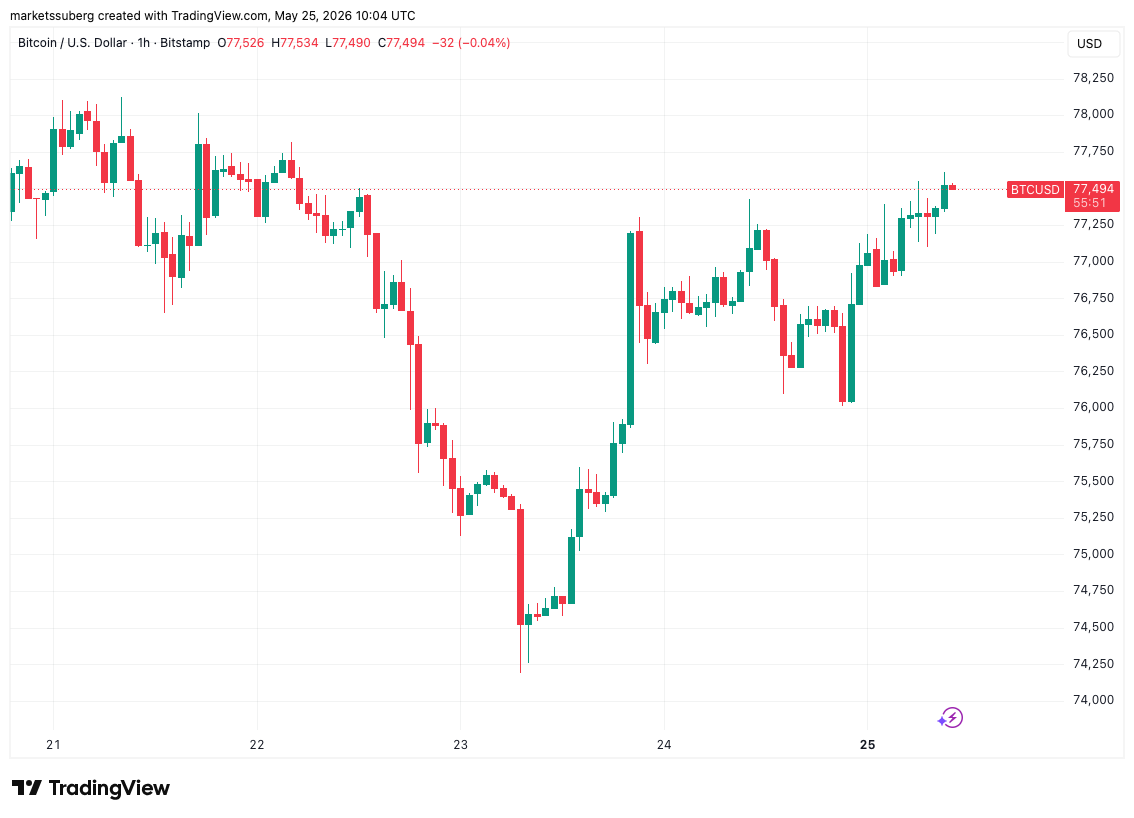
Bitcoin (BTC) starts the final week of May with traders optimistic about an $80,000 rebound — will it end up as a liquidity grab?
- Bitcoin recovers from its trip to monthly lows as shorts above $80,000 could get squeezed next.
- Excitement is growing over a US-Iran peace deal, and stock markets are already heading to record highs.
- Inflation pressures remain a headache for the Federal Reserve as PCE data for April is released.
- Binance has seen conspicuously high net BTC inflows over the past ten days and has added 16,000 BTC in a month.
- Bitcoin faces multiple bearish catalysts, research warns, predicting a “large liquidation event” as a result.
Bitcoin shorts face “significant” pressure at $80,000
Bitcoin price action struggled over the weekend, dipping below $75,000 to its lowest levels since mid-April, per data from TradingView.
A rebound then brought $77,000 back into focus in line with optimism around a US-Iran peace deal.
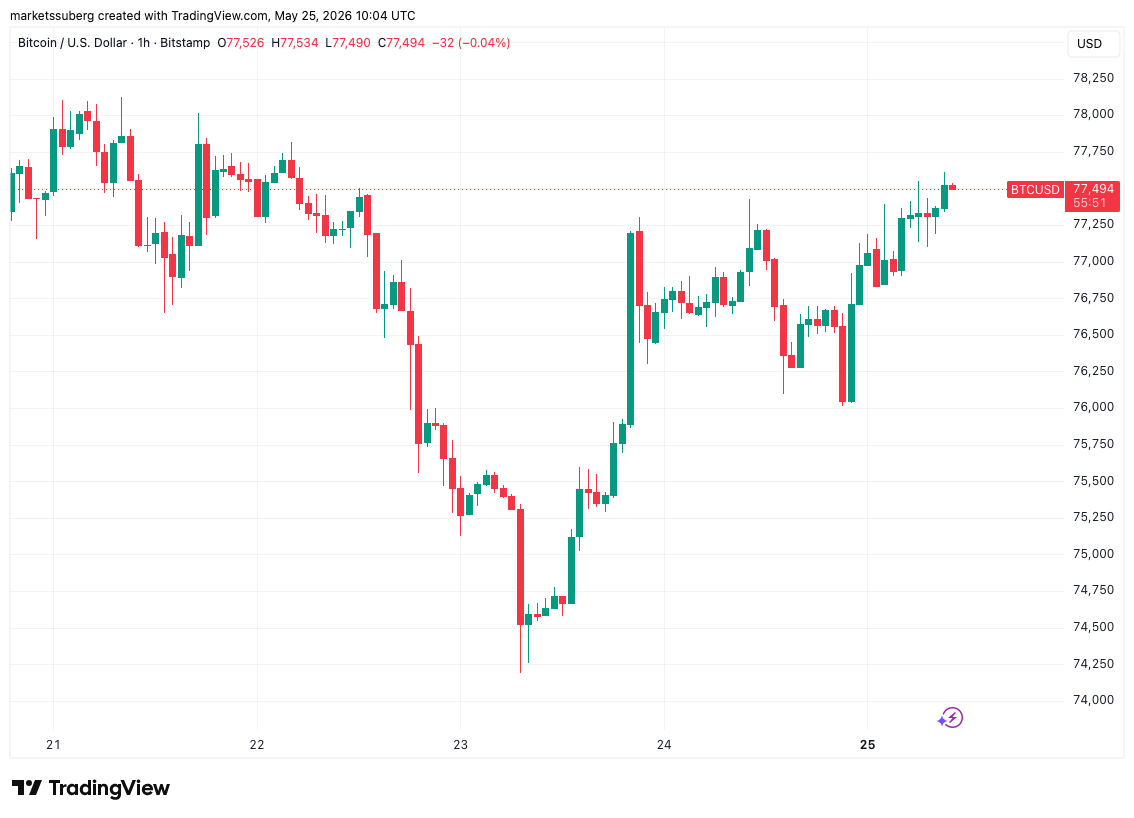
BTC/USD one-hour chart. Source: Cointelegraph/TradingView
In its latest market commentary, X analytics account Cryptic Trades called the dip a “fakeout,” noting its proximity to Bitcoin’s lowest levels of 2025, also seen in April that year.
“We saw a brief deviation below the high-timeframe support range aligning with the April 2025 bottoming formation,” it summarized.
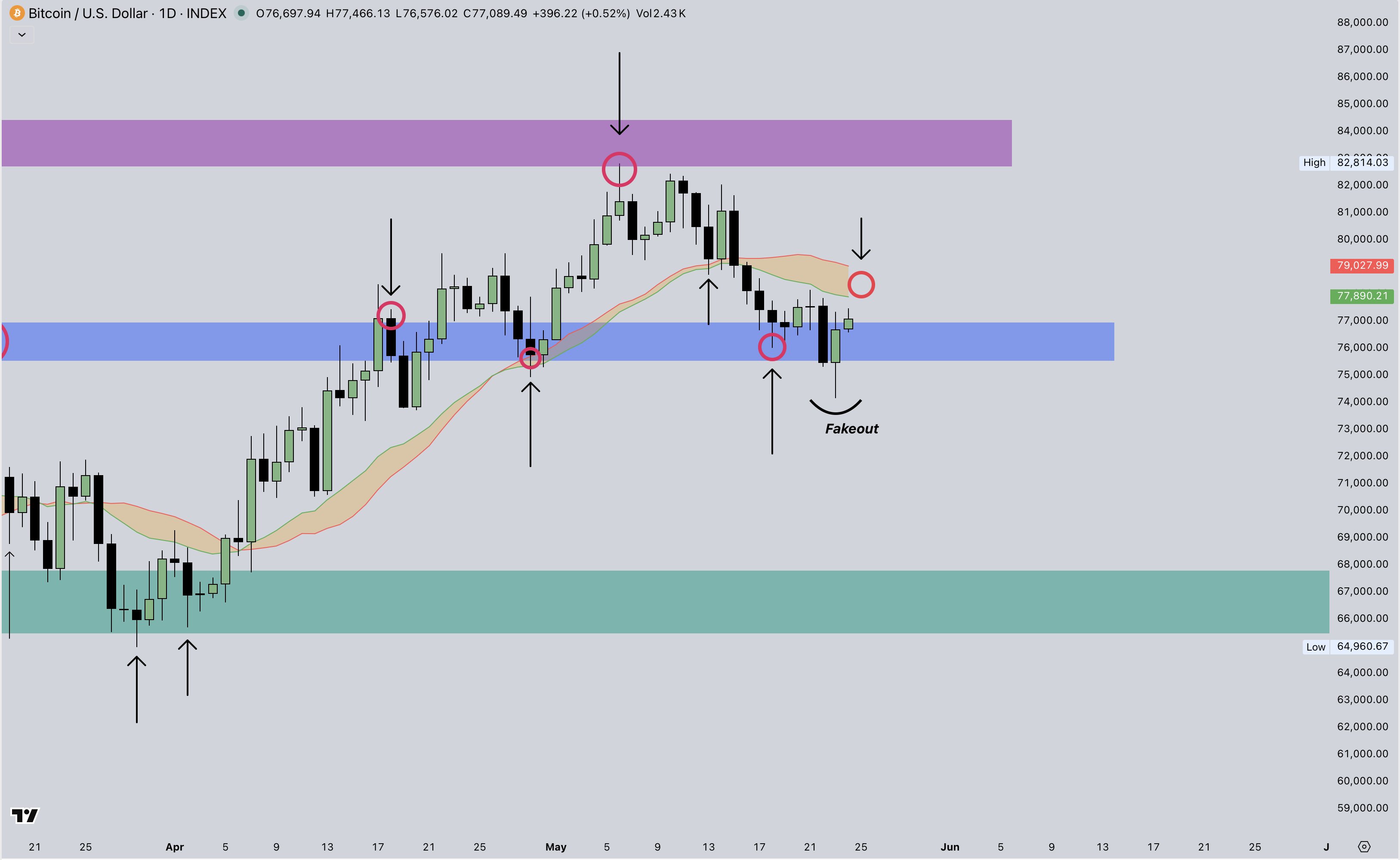
BTC/USD one-day chart. Source: Cryptic Trades/X
Cryptic Trades said that BTC/USD needed to reclaim its daily bull market support band — a “strong reversal zone over the last couple of months” — in order to have a bullish bias on low time frames.
“Bulls need to keep holding this area to keep this short/mid timeframe momentum in their favor,” trader Daan Crypto Trades agreed.
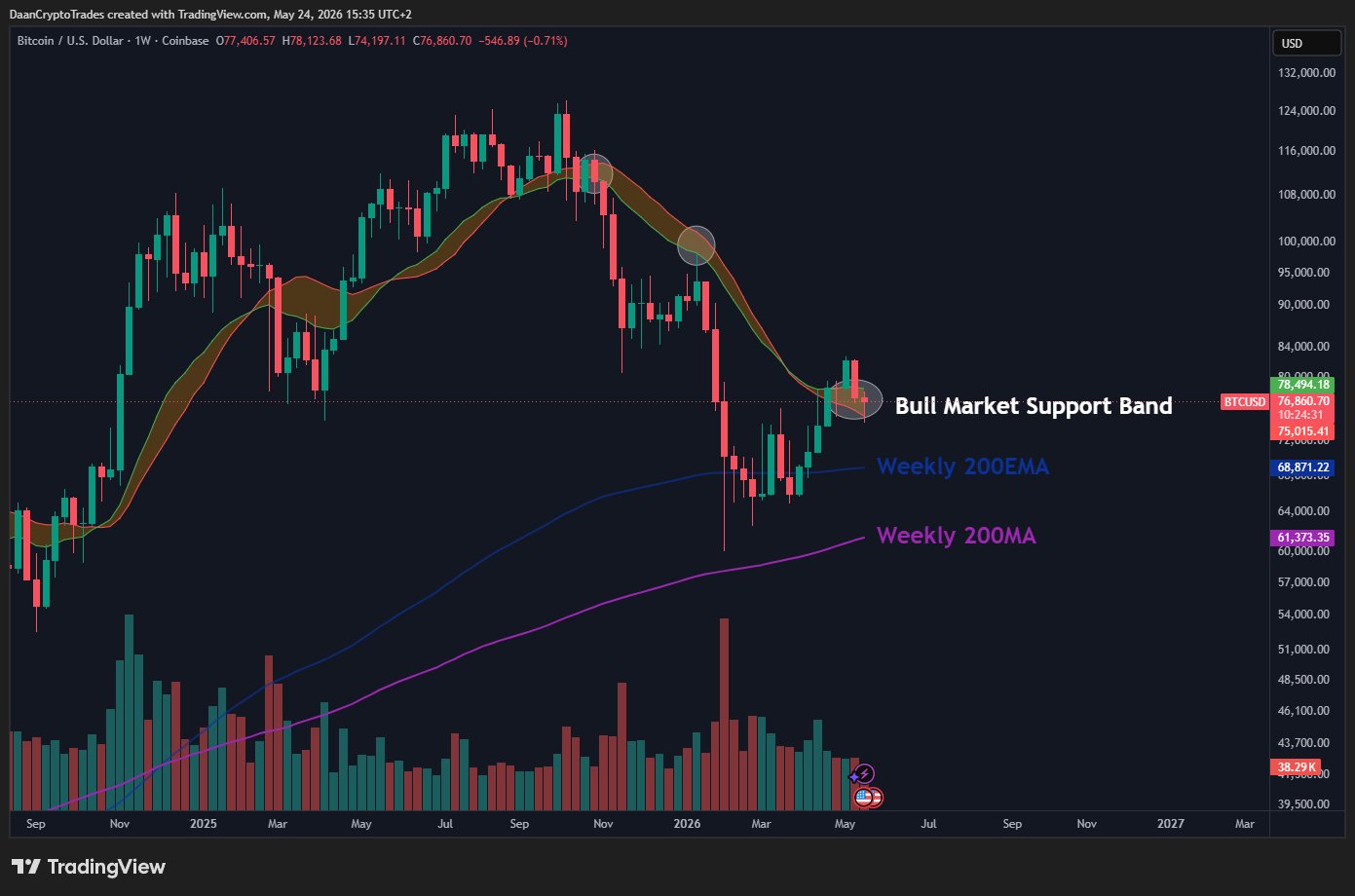
BTC/USD one-week chart. Source: Daan Crypto Trades/X
Trader and analyst Lennaert Snyder referred to Bitcoin’s trip below $75,000 as a “very nice liquidity sweep.”
“Strong daily close after the sweep and price is taking out the previous daily highs,” he told X followers.
“I’m intraday bullish on Bitcoin, and I’m still eyeing that 79/80 level to retest. Would be great if the 74.2K low could get us there, I’ll watch 79/80K closely for quality shorts after my trigger.”
Trader CW also eyed exchange order-book liquidity for clues as to how high the price might go next.
“$BTC has risen to just before the high-leverage short position zone. The upcoming rise will be a liquidation process for short positions,” they predicted.
“There is a significant amount of short position pressure until 80.5k.”
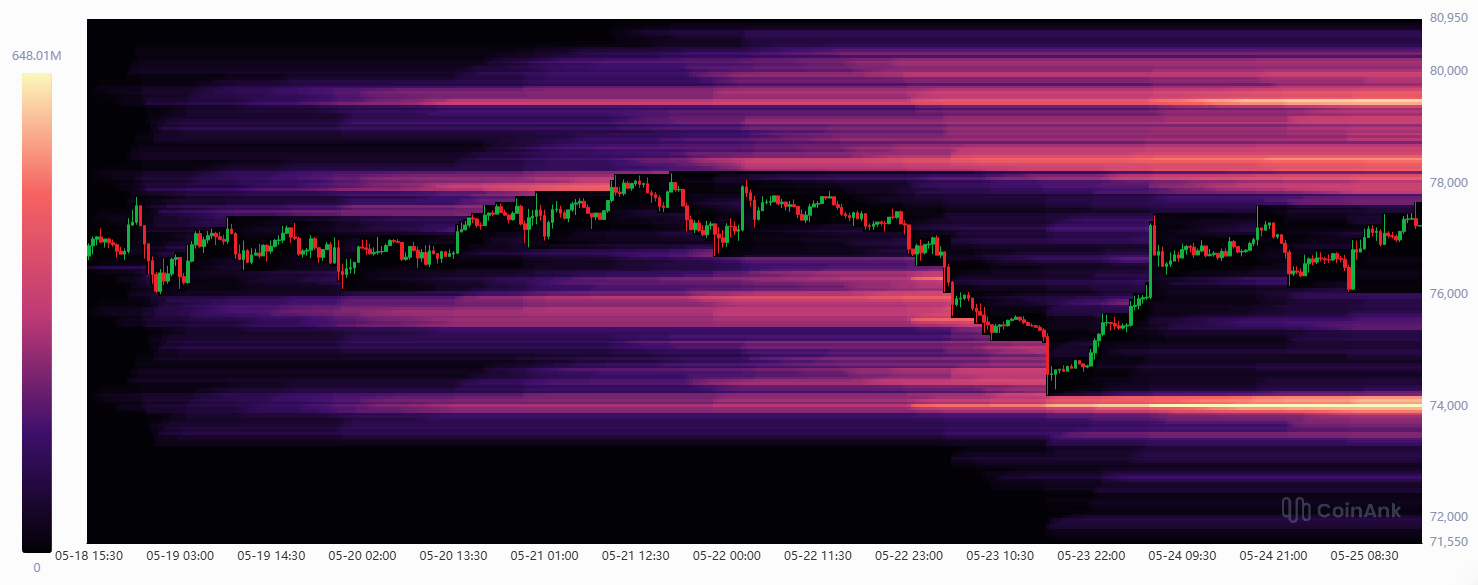
BTC liquidation heatmap. Source: CW/X
Iran peace deal bets send stocks to new highs
There may finally be some good news for risk assets when it comes to the US-Iran war this week.
A peace deal between the two sides seems closer than ever, and markets are already pricing in the end of the conflict.
US stocks futures surged at the weekly open, with both the S&P 500 and Nasdaq 100 hitting new all-time highs. Japan’s stock market gained 3.5%.
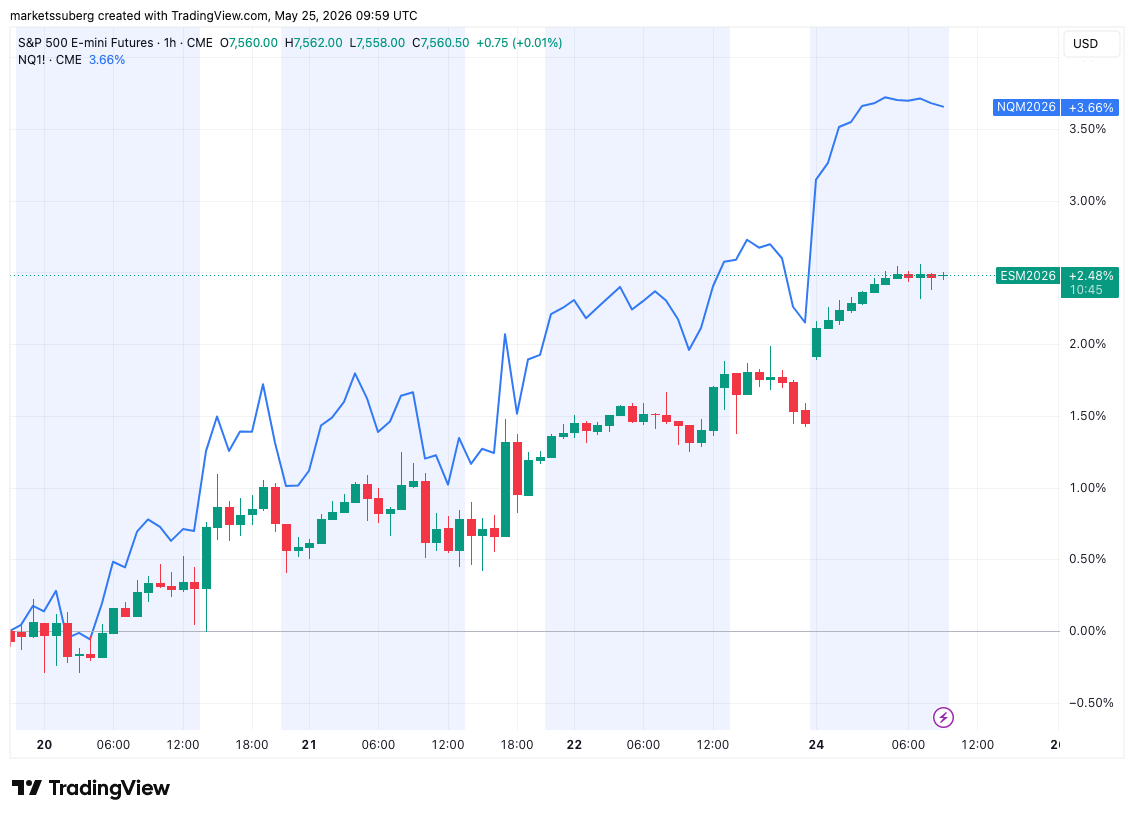
S&P 500 futures vs. Nasdaq 100 futures one-hour chart. Source: Cointelegraph/TradingView
Oil, by contrast, began to fall, with WTI crude nearing $90 per barrel.
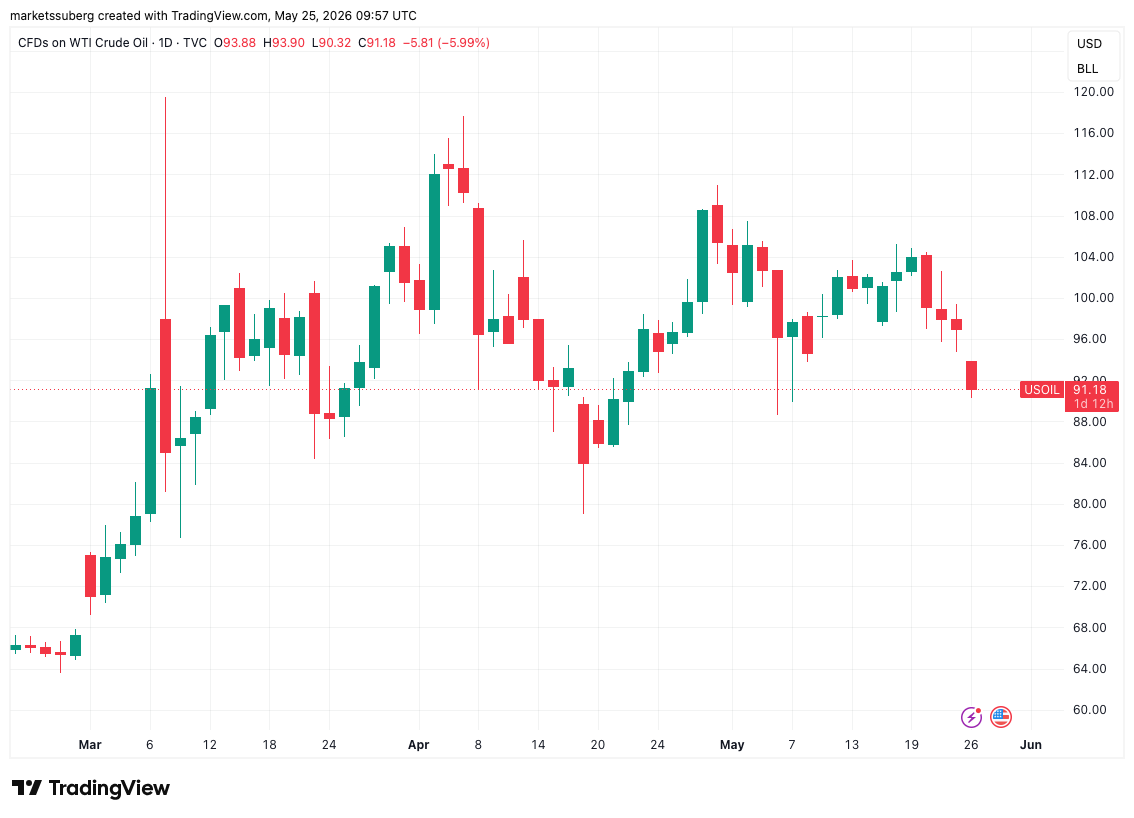
CFDs on WTI crude oil one-day chart. Source: Cointelegraph/TradingView
In a post on Truth Social, US President Donald Trump pledged to make a deal that was “good and proper.”
“Unlike those before me who should have solved this problem many years ago, I don’t make bad deals!” he wrote.
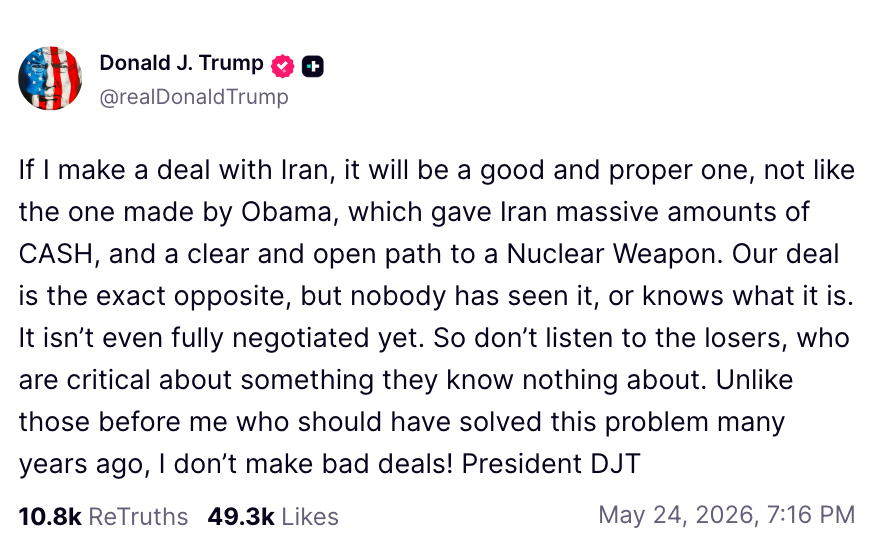
Source: Truth Social
Bitcoin’s response was more muted, continuing a trend from last week where stock market records failed to ignite upward momentum for crypto.
Nonetheless, market participants are already betting on the peace deal acting as the next tailwind.
“I think Bitcoin is ready for higher grounds,” trader and analyst Michaël van de Poppe commented on X.
Van de Poppe saw BTC/USD rising above $80,000 should a deal take effect.
“That is likely the plan,” he concluded, seeing risk assets performing strongly across the board.
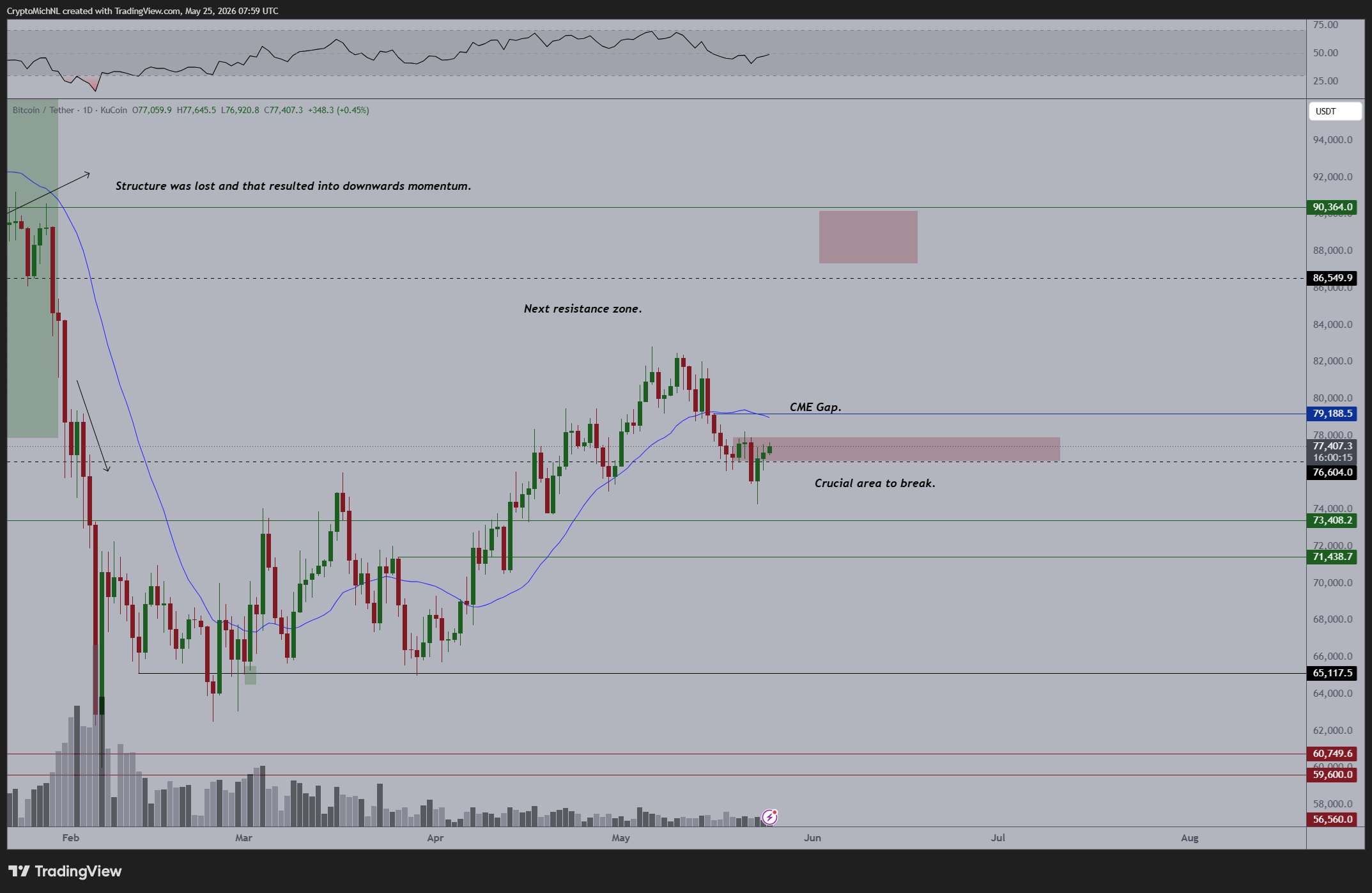
BTC/USDT one-day chart. Source: Michaël van de Poppe/X
Inflation flips Fed hawkish ahead of PCE data
The deal would also mean good news for US inflation trends, which have surged on the back of high oil prices.
This week, however, both markets and the Federal Reserve will have to contend with April’s Personal Consumption Expenditures (PCE) Index print, which will reflect the full impact of the Iran conflict.
PCE, known as the Fed’s “preferred” inflation gauge, will be the first for its new Chair, Kevin Warsh.
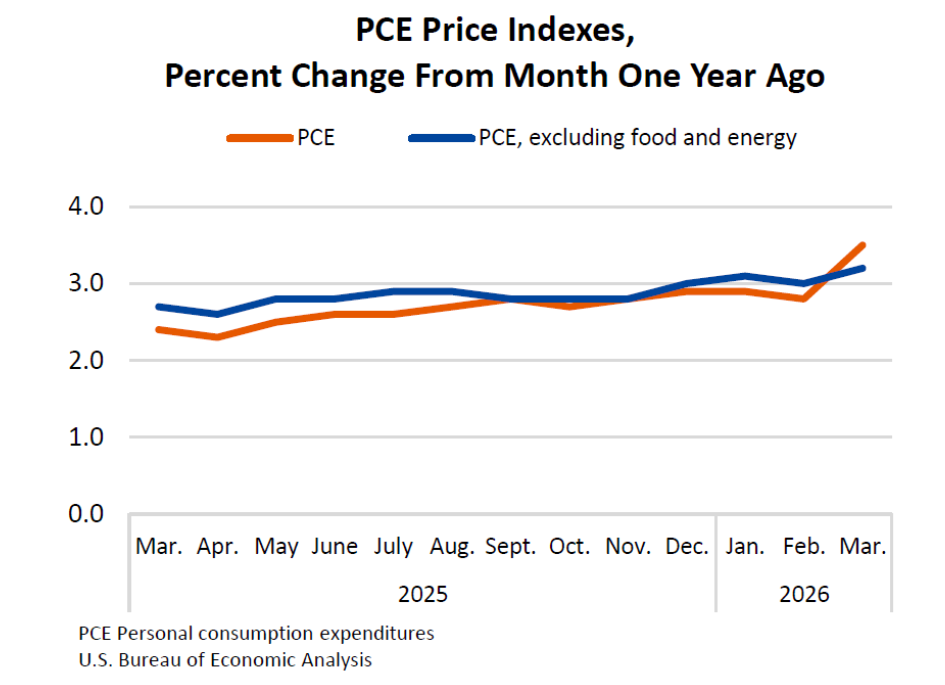
US PCE % change (screenshot). Source: Bureau of Economic Analysis
Expectations remain that policy could tighten to contain inflationary pressures this year. In the latest edition of its regular newsletter, “The Market Mosaic,” trading resource Mosaic Asset Company noted that even Fed officials themselves were changing their tone.
“In a speech last week, Christopher Waller stated that ‘inflation is not moving in the right direction’ and can ‘no longer rule out rate hikes further down the road,’” it reported, referring to a member of the Fed Board of Governors.
“Waller previously was a leading proponent for cutting rates on labor market concerns.”
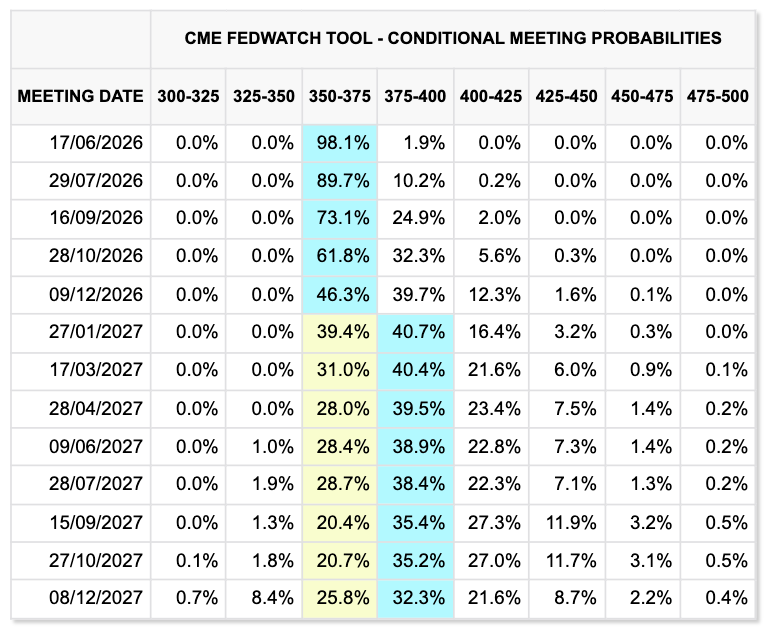
Fed target rate probabilities (screenshot). Source: CME Group
Data from CME Group’s FedWatch Tool likewise underscores the lack of optimism when it comes to interest-rate cuts before 2027.
While that is ostensibly a headwind for crypto, Mosaic acknowledged that Iran-based inflation upticks could be “temporary,” with stocks primed for further gains.
Binance inflow “intensity” causes alarm
Geopolitical uncertainty has led onchain analytics platform CryptoQuant to warn about a Bitcoin “sell signal.”
In one of its QuickTake blog posts on Sunday, contributor Darkfost flagged nearly 10 days of BTC inflows to the largest global exchange, Binance.
“On May 16th, the weekly average of inflows on Binance stood at 378 BTC. It now reaches 1,190 BTC today, representing a more than 3x increase in less than 10 days,” he revealed.
“The largest single day recorded over 3,600 BTC on May 18th, a relatively high level for a single day that clearly illustrates the intensity of the movement.”
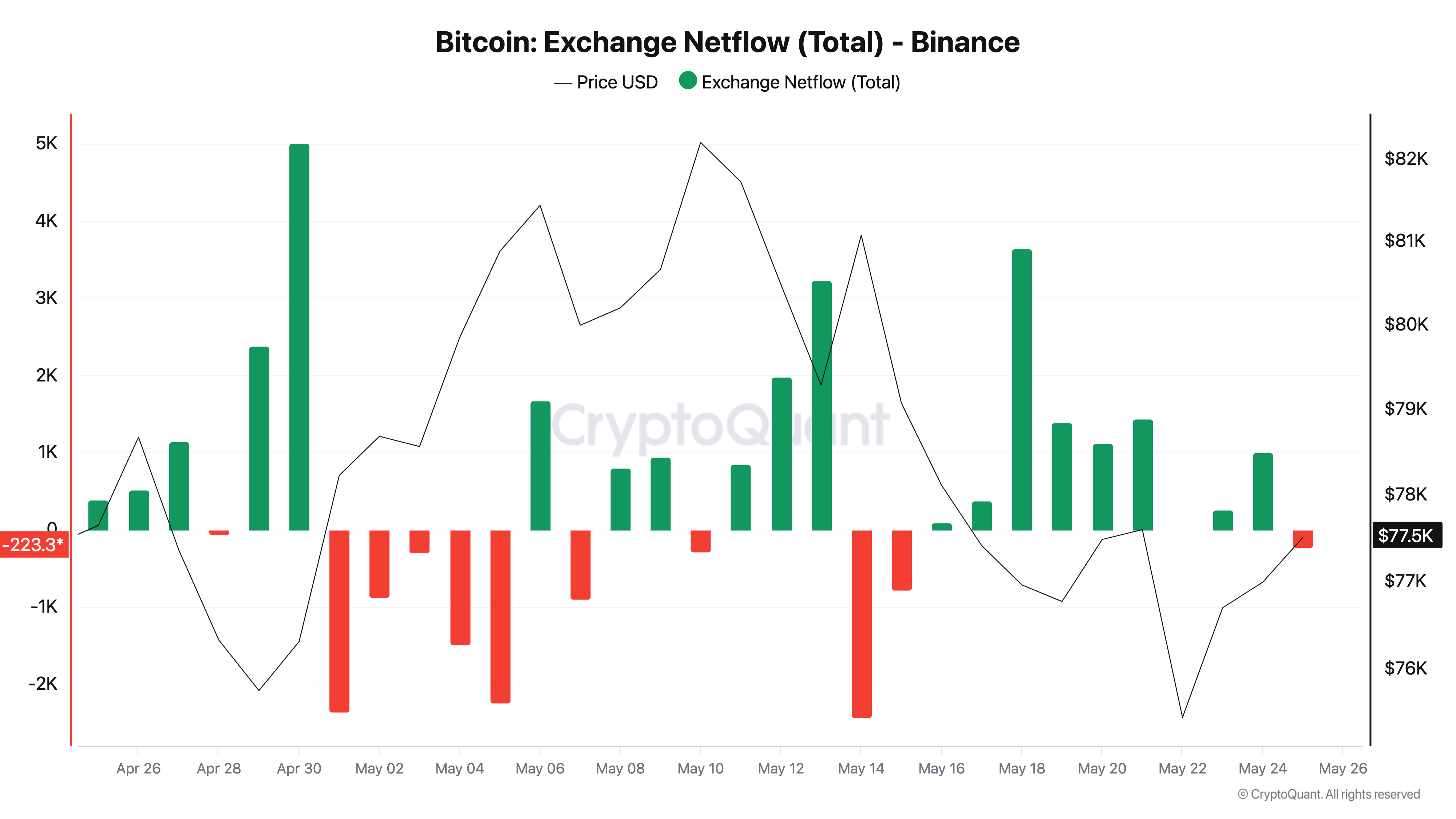
Bitcoin netflows for Binance. Source: CryptoQuant
Darkfost noted that Binance’s Bitcoin reserves had increased by 16,000 BTC in a single month.
“When inflows become dominant and consistent on a platform like Binance, this is traditionally interpreted as a potential sell signal,” he continued.
“Holders transferring their BTC to an exchange most often do so with the intent to sell, whether it be profit taking, reducing exposure, or a more defensive repositioning.”
Last week, Cointelegraph reported on weak US demand causing consistent downside price pressure after the Wall Street open. The Coinbase Premium Index, which measures the difference in price between Coinbase’s BTC/USD and Binance’s BTC/USDT pairs, hit its largest negative values in several months.
Analysis warns of “large liquidation event”
In further bad news for Bitcoin bulls, CryptoQuant contributor XWIN Japan described a cocktail of hurdles that remain unconquered.
Related: Bitcoin price record 90-day uptrend ‘resembles bull market rally:’ New analysis
In addition to the weak demand, institutional capital has been exiting the US spot Bitcoin exchange-traded funds (ETFs).
“US spot Bitcoin ETFs have now seen more than $1.74 billion in cumulative outflows, while the Coinbase Premium has turned deeply negative. Since this metric is often viewed as a proxy for US institutional spot demand, it suggests that large investors are becoming less active buyers,” a QuickTake post read.
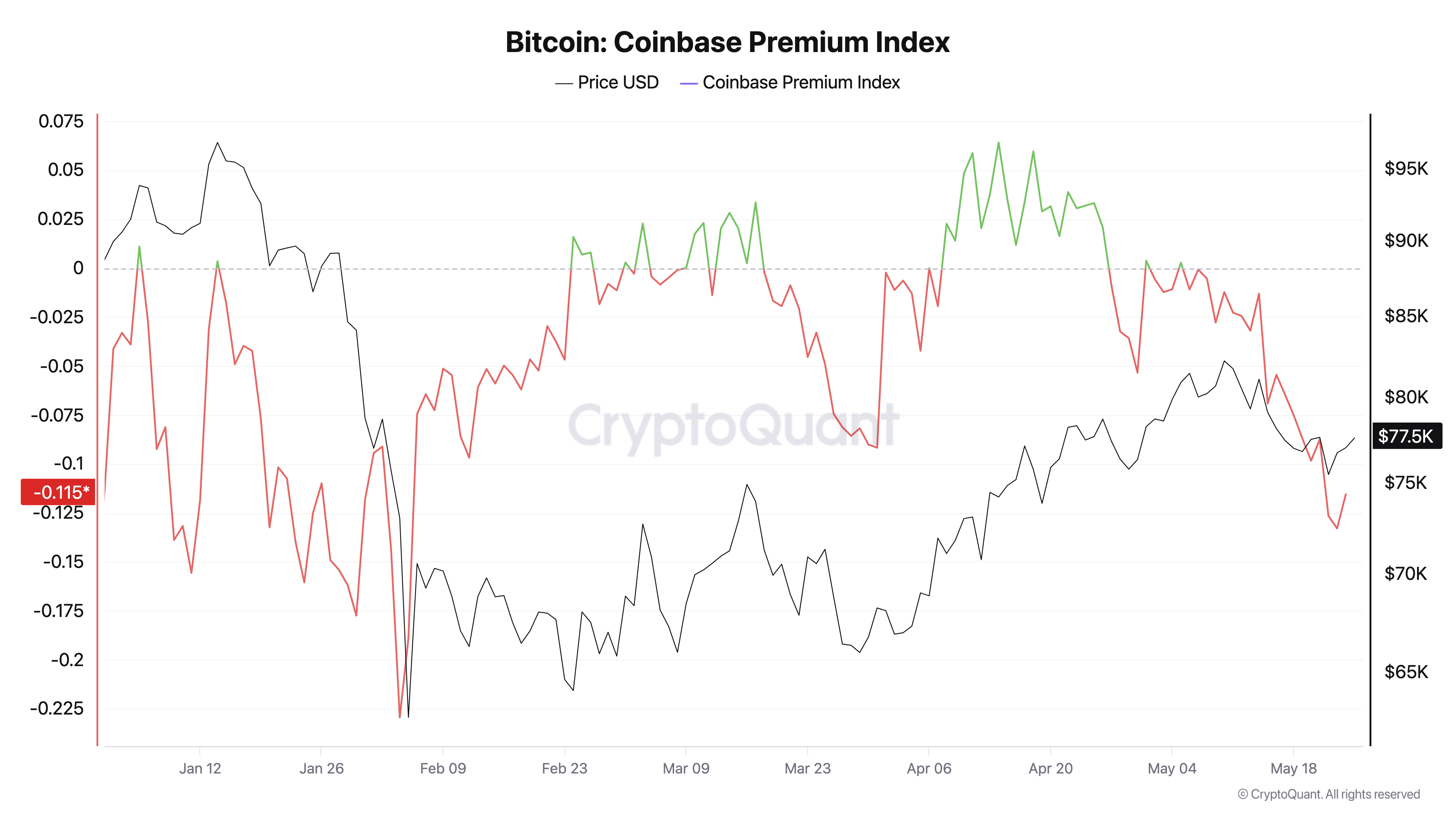
Bitcoin Coinbase Premium Index. Source: CryptoQuant
Binance’s netflows, meanwhile, come as stablecoin volumes decrease — a sign of waning liquidity and reduced risk appetite.
Traders who remain active, by contrast, are “aggressively long,” and positive funding rates imply that leverage is becoming more popular.
“The problem is that Open Interest remains well below late-2025 highs. This suggests the recent rebound is being supported more by leveraged futures activity than by strong spot demand,” XWIN explained.
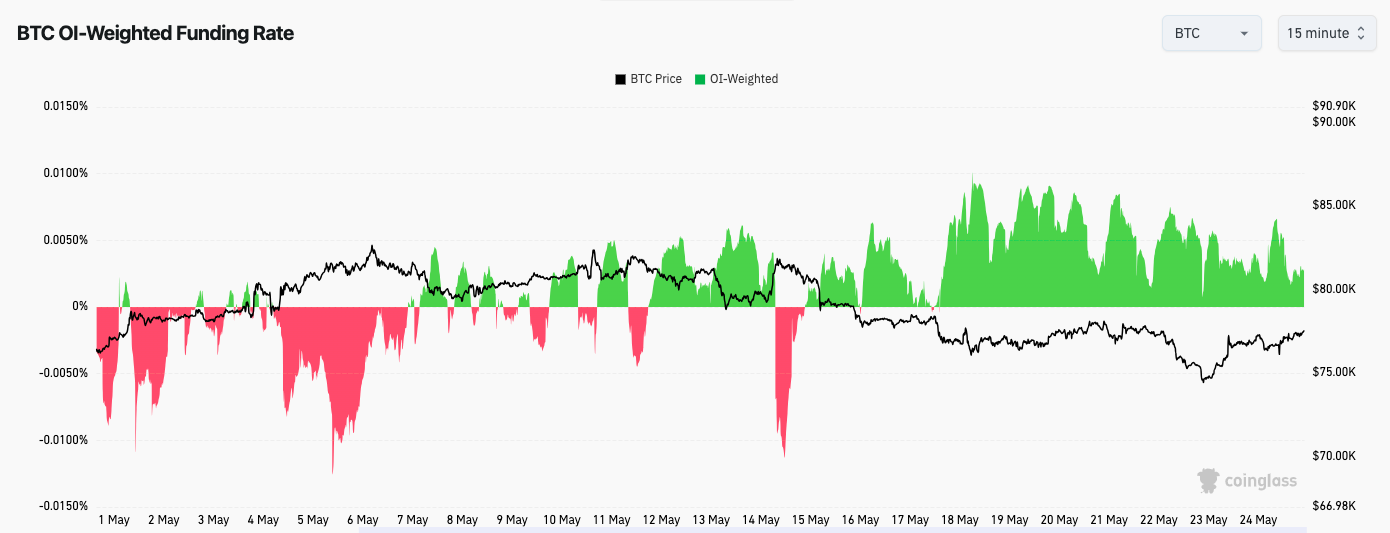
Bitcoin open interest-weighted funding rate (screenshot). Source: CoinGlass
Looking ahead, this combination of factors suggests that the market is due for a shakeout.
“Historically, periods with ETF outflows, negative Coinbase Premium, weak spot demand, and crowded longs have often preceded large liquidation events,” the post concluded.
“For now, Bitcoin looks less like a healthy bull market and more like a fragile rebound driven by leverage rather than real demand.”



Ethereum co-founder Vitalik Buterin said the Ethereum Foundation will choose “longevity over breadth,” reduce ETH sales and narrow its focus to CROPS: censorship resistance, capture resistance, openness, privacy and security.
In a lengthy post on X, Buterin detailed that the Ethereum Foundation holds roughly 0.16% of all ETH, well below the 10% to 50% he said it’s common for the central foundations of other blockchains to hold.
Nearly 90% of his own net worth sits in ETH, with the remaining roughly $40 million in onchain fiat already earmarked for open-source biotech, software and hardware initiatives, Buterin added.
His influence within the EF will continue to decrease as the board expands, aligning with his desire to be less influential there. However, he also hedged his words, saying, “This is only my own view. The board is not just me, and I have no extra special powers on the board that the other board members do not.”
He framed the EF as “one node, with a defined purpose, alongside other nodes,” not the center of Ethereum. Addressing throughput, Buterin said it would be a mistake for Ethereum to maximize it.
“Being as fast and as scalable as possible, and only a small epsilon more decentralized than the others, is a route to mediocrity, and if we try it, we will lose.”
Instead, Buterin pointed to Ethereum striving to be “deeply impressive” in what he called the “CROPS dimension.” That involves making Ethereum provably bug-free, which is argued to be within reach given AI-powered verification.
The post landed after at least 8 senior EF contributors left or announced departures in 2026, 5 in May alone, reigniting debate over the foundation’s direction.
Crypto community reacts
Prominent Ethereum voices were supportive of Buterin.
Anthony Sassano, an independent Ethereum educator, angel investor and advisor, replied directly to the post, thanking Buterin. A separate quote tweet from Sassano focused on Buterin’s framing of ETH as the most high-value “product” of the Ethereum blockchain.
Author and early Ethereum advisor William Mougayar quote-tweeted the post: “Basically, Ethereum just got its own Clarity Act over the weekend. It was a crystal clear message, and the road ahead is super clear. Ethereum is untouchable.”
Developer Suhail Kakar also replied directly, calling the post “bullish.” “A foundation voluntarily shrinking its own power is the rarest thing in crypto. genuinely the most cypherpunk thing I’ve read in a long time.”
Meanwhile, core developers picked at the CROPS framework.
Go-Ethereum developer Marius van der Wijden replied that security was being underdiscussed: “When people talk about CROPS, they seem to focus on the CR, OS and Privacy part. The security part is in my opinion the most important! Without a secure L1 none of this makes any sense and we have taken Ethereum’s base layer security for granted by now.”
Consensus layer developer Potuz followed up in the thread, noting that “one of Ethereum’s biggest selling points is the no downtime since genesis” and that the record made every fork a concentrated risk.
Laura Shin, host of Unchained, asked the governance question the post left open: “What’s the process for adding new members to the board?” Buterin did not publicly answer at the time of writing. DeFiPrime founder Nick Sawinyh noted the EF now sounded “less like a cathedral and more like a protocol commons operator.”
Others criticized the cryptocurrency’s performance. Ether has fallen nearly 60% against bitcoin over the last five years, to 0.02738 BTC. Over that period, bitcoin’s price nearly doubled from $35,600 to $77,500 at the time of writing.
Read more: Ethereum’s identity crisis is deepening after high-profile ‘brain drain’ frustrates the community


Jeremy “jercos” Sturdivant, the recipient of the historic Bitcoin Pizza Day transaction, has confirmed he spent his 10,000 Bitcoin (BTC) on a road trip across the United States after running out of money.
The story resurfaced after Adam Back, CEO of Blockstream, reposted a video clip of Sturdivant discussing the exchange. The post spread quickly across crypto social media and drew fresh attention to one of Bitcoin’s most often-cited transactions.
The 10,000 BTC That Funded a Road Trip
On May 22, 2010, Sturdivant received 10,000 BTC from developer Laszlo Hanyecz. The payment covered two Papa John’s pizzas ordered on Sturdivant’s credit card. That transaction is now observed annually as Bitcoin Pizza Day and stands as the first documented commercial use of Bitcoin.
Sturdivant said he never considered the BTC an investment. He treated the coins as functional currency and spent them as their value gradually climbed. He emphasized that Bitcoin was meant to be used, not stored as a speculative asset. When a cross-country road trip left him short on funds, the Bitcoin covered the gap.
Bitcoin reached an all-time high of approximately $126,000 in October 2025. At that price, the original 10,000 BTC would have been worth over $1.26 billion. BTC traded near $77,787 on Pizza Day 2026, still placing the notional value of that stack above $770 million.
Bitcoin Pizza Day Revives an Old Debate
Back stands among Bitcoin’s most prominent advocates. He has been vocal about long-term holding strategies as fiat currencies weaken. Just days before reposting the clip, he urged investors to buy BTC at current price levels. His decision to amplify Sturdivant’s remarks was notable for the contrast it implied.
Sturdivant’s approach was to use the coins as money, not accumulate them. Back’s position represents the opposite view. That divide sits at the center of a Bitcoin in culture debate that has persisted since the network’s earliest transactions. Sturdivant wanted BTC to function as a living currency. Back has argued that people should treat it as a hard monetary asset.
Sturdivant has said he has no regrets. The transaction was worth roughly $41 at the time. How that philosophy holds up depends on where the current Bitcoin price cycle ends up.
The post Bitcoin Pizza Day Recipient Speaks Out: How the 10,000 BTC Was Spent appeared first on BeInCrypto.

A New York civil action filed on May 1 seeks a court ruling that ownership of 39,069 dormant Bitcoin addresses rests with the plaintiffs—Noah Doe and two Wyoming-based limited liability companies, ABC Company and XYZ Company. The suit claims the coins tied to these addresses constitute abandoned property discovered by the plaintiffs and reported to the New York Police Department, with a claim under New York Lost Property Law.
According to Cointelegraph, the filing argues that the wallets contain Bitcoin belonging to a spectrum of historic holders, including early miners and addresses attributed to the Bitcoin creator, Satoshi Nakamoto, along with other lost or unidentified entities. The action foregrounds long-standing questions about how inactive Bitcoin should be treated under property regimes and what ownership means when private keys are not accessible.
Industry observers note that even a court’s recognition of ownership would face fundamental, real-world constraints: the Bitcoin network has no mechanism to reallocate funds without the private keys that authorize transactions. The case underscores a core tension between legal theories of property and the operational realities of a distributed ledger.
“The network has no mechanism to reassign funds without a private key,” said Noveleader, lead research analyst at Castle Labs. “The one narrow exception would be if any of these coins are moved to a regulated custodian or exchange, at which point a court could compel that intermediary to act.”
The research perspective added that many of the coins cited in the suit may belong to deceased holders, lost keys, or long-term holders who have not transacted—further complicating claims of legal abandonment.
ABC Company, XYZ Company, Noah Doe, lawsuit against John Does holding 39,069 BTC. Source: ilawconotices.com
Key takeaways
- The suit seeks a court declaration that ownership of 39,069 dormant Bitcoin addresses rests with the plaintiffs under New York Lost Property Law, raising questions about how abandoned crypto assets could be treated legally.
- Even with a favorable ruling, direct reallocation of funds would be technically unfeasible without private keys; enforcement would likely depend on custodians or exchanges under court direction.
- Notice concerns arise from the address formats used: notices were sent to Pay-to-Public-Key-Hash (P2PKH) identifiers, while the coins may reside in Pay-to-Public-Key (P2PK) outputs, potentially undermining abandonment notices.
- The addresses include references to historically significant targets (Satoshi-era wallets and Mt. Gox-related addresses), but the bulk of assets may belong to non-responsive or deceased holders, complicating a clean legal claim of abandonment.
- Independent estimates suggest a substantial dormant BTC stock, underscoring the scale at stake for property-law interpretation and regulatory oversight in a modern digital asset regime.
- The case sits at the intersection of property law, digital custody, and regulatory policy, with potential implications for exchanges, custodians, and cross-border enforcement frameworks.
Legal contours of the NY case and the ownership question
The 901-page filing seeks to establish that the Bitcoin tied to tens of thousands of addresses constitutes abandoned property that the plaintiffs discovered and reported to law enforcement, thereby creating a potential claim under New York’s lost-property framework. In practical terms, abandonment claims hinge on whether the asset has a demonstrable holder who manifests an intent to relinquish ownership, a determination that is technically inapplicable given the cryptographic nature of Bitcoin ownership and the absence of a traditional custodian.
According to Cointelegraph, the inclusion of addresses associated with historic wallets—some linked to Satoshi Nakamoto and others tied to high-profile incidents like the Mt. Gox hack—raises questions about actual ownership and provenance. Even if a court issued a declaration, the inability to transfer funds without private keys would severely circumscribe the practical effect of any ruling.
Noveleader’s commentary emphasizes a narrow, regulatory pathway: a court could compel a regulated intermediary (for example, a custodian or exchange) to act if coins were moved into such a venue. Outside of that scenario, the on-chain protocol cannot effect a reallocation of the assets, creating a discrepancy between legal recognition and technical feasibility.
Dormant Bitcoin stock and regulatory context
Beyond the legal dispute, the case highlights the broader phenomenon of substantial dormant Bitcoin. Industry data indicate that a sizable portion of the supply has not circulated on-chain for many years. Reports estimate that roughly 3.5 million BTC have been dormant for the past decade, with about 6.6 million BTC dormant for more than five years, representing hundreds of billions of dollars in value at current price levels. These figures underscore how a large, potentially inaccessible stock of coins intersects with questions of property rights, loss, and potential regulatory oversight.
From a policy perspective, the dispute touches on core regulatory questions about how authorities categorize and treat crypto assets that lack active holders or known keys. If courts begin to recognize ownership claims on dormant addresses, this could prompt a reevaluation of record-keeping for crypto assets, influence custodial standards, and shape enforcement approaches in jurisdictions facing diverging rules on crypto property, licensing, and consumer protection.
In the broader policy landscape, the case intersects with ongoing debates around MiCA in the European Union, U.S. enforcement priorities from agencies such as the SEC, CFTC, and DOJ, and the development of AML/KYC frameworks for crypto entities. It also raises practical considerations for licensing, regulatory oversight, and cross-border cooperation in asset recovery, as well as implications for stablecoins and their banking integration where custody and ownership rights must be established under legal regimes.
Analysts note that the outcome may influence how exchanges and custodians approach dormant or inaccessible holdings, including any need for standardized procedures to address abandoned assets within regulatory-compliant frameworks. While a ruling could set a legal precedent, the technical infeasibility of reassigning funds without keys remains a fundamental constraint on enforcement and real-world recovery.
Closing perspective
As regulators and financial institutions continue to refine crypto-property frameworks, this NY case underscores the need for clear, interoperable rules governing dormant assets, custody, and enforcement. The next developments—whether the court dismisses, rules in part, or awaits subsequent proceedings—will be watched for signals about how jurisdictions reconcile traditional property concepts with decentralized digital assets and their unique technical realities.


May 25, 2026 — Canton Foundation, Toss, BitGo Among Co-Hosts at Private Event; Token Launch Slated for Second Half of 2026.
On May 21, ARIQO, an on-chain financial platform, made its first public appearance at Southeast Asia Blockchain Week (SEABW) in Bangkok.
Earlier that day on the conference floor, ARIQO co-founder Emanuel Escobar Duro (CBO) spoke with teams from Orca and Viva Republica (Toss) about the shifting role of DeFi platforms and the trajectory of institutional RWA adoption. The broad direction, he noted, is already clear — institutional capital is moving on-chain. The open question is which platforms actually have the infrastructure to receive it, and on that front, the field is still thin.
That evening, ARIQO hosted a private networking event, Alpha After Dark: Where Liquidity Meets Opportunity. Canton Foundation, Viva Republica (Toss), BitGo, Bitkub Exchange, and BLOCKSTREET joined as co-hosts. Running from 8 p.m. to midnight, the gathering brought together institutional investors, liquidity providers, and protocol teams.
The conversations centered on three threads. The first was the structural gap in today’s RWA market: institutional demand for tokenized real-world assets is climbing fast, but the infrastructure to actually trade and manage them onchain remains early-stage. The second was the liquidity bootstrap problem — the cold start that new onchain venues keep running into, where there are no traders without liquidity and no liquidity without traders, and how to break that loop. The third was what it takes for institutional capital to move into the DeFi layer: transparency of yield structures, smart contract audits, predictability of capital management — and how far current protocols actually meet those bars. Attendees traded candid views on each.
It was hard to read the event as a routine networking night. The fact that a project still ahead of launch could bring Canton Foundation, Viva Republica (Toss), BitGo, Bitkub Exchange, and BLOCKSTREET to the table as co-hosts speaks to the credibility ARIQO has already built. The discussion carried weight, too. Real, unsolved problems — the structural gaps in RWA, the DEX cold start, the conditions for institutional inflows — were put on the table, and attendees spoke frankly about them.
ARIQO defines itself not as a single product but as a three-phase financial infrastructure strategy. Where most blockchain projects work backward from a token launch, ARIQO builds the revenue-generating infrastructure first and places the token on top of it. The team sums up its principle in one line: “Capital first. Flow second. Native market last.”
The first phase is the Vault, set to launch in Q3 this year. It runs multiple stablecoin vaults with distinct risk-return profiles, and the TVL gathered here becomes the capital base for every phase that follows. The aim at this stage is not to win an APY race, but to establish ARIQO first as a platform that manages capital reliably.
The second is the Terminal, a trade-aggregation layer that sits on top of existing exchanges. Users keep trading on Binance, OKX, and the venues they already use; by connecting through ARIQO’s interface, rebates are optimized across exchanges and can be automatically reinvested into the Vault. At this stage, ARIQO absorbs external trading flow into its own layer without building a new exchange.
The last is the native RWA Perp DEX. An orderbook-based perpetuals exchange covering crypto, commodities, indices, and synthetic real-world assets, it launches at a point when TVL from the Vault and a trader base from the Terminal already exist — a design that structurally sidesteps the cold start problem, the hardest part of any DEX launch. Fee revenue at this stage flows into $AQV buybacks and back to the Vault, closing the full loop.
The $AQV TGE is scheduled for the second half of this year, after the Vault and Terminal are live. CTO Julius Nielsen, who leads technical implementation, and CSO Daniel J. Aldridge, who handles operational strategy, round out the team alongside co-founders Jin Tang (COO) and Emanuel Escobar Duro (CBO).
The Q3 Vault launch marks the first step of this strategy. Official information and the waitlist are available at ariqo.com, with updates on @ARIQO_X.
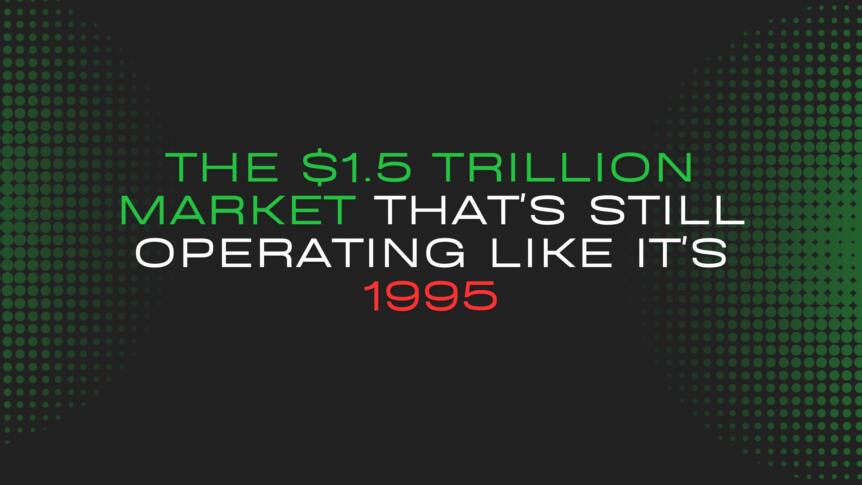
Everything else has gone direct-to-consumer. Live events are still controlled by gatekeepers. Here’s why that’s about to change.
The Contradiction Nobody Notices
You can buy a Tesla directly from Elon. You can invest in SpaceX through secondary markets. You can own a piece of a podcast through equity crowdfunding.
Direct-to-consumer has become the default everywhere.
Except live events.
If you want to attend a concert, a festival, a sporting event—you go through Ticketmaster. You pay their fees. You accept their terms. You have no ownership. No stake. No say.
It’s the last frontier of pure gatekeeping in an otherwise disintermediated world.
And the market is $1.5 trillion annually.
Why Live Events Got Frozen in Time
This wasn’t an accident. It happened because live events have a constraint that other industries don’t: physical scarcity.
You can only sell so many tickets. There’s only so much space. The venue has limits.
That scarcity created gatekeepers. Promoters. Ticketing platforms. Middlemen who controlled access.
For decades, that made sense. Physical constraints meant you needed someone to manage capacity, coordinate logistics, handle the complexity.
But here’s what changed: the value of live events shifted from the event itself to the community around it.
Nobody goes to a music festival just for the music. They go for the experience. The crowd. The community. The shared moment.
That community value can be monetized, shared, and distributed. But only if you remove the gatekeepers first.
What Direct-to-Consumer Actually Means
When Tesla sold directly to consumers, they eliminated dealerships and their markup.
When Substack creators went direct, they eliminated publishers and their take.
When crowdfunding platforms appeared, they eliminated traditional venture and their gatekeeping.
Direct-to-consumer means: the creator and the customer can transact without intermediaries.
Live events should work the same way.
An artist or promoter should be able to:
- Sell tickets directly
- Let fans invest in the event
- Share revenue transparently
- Build community ownership
Instead, they go through Ticketmaster. Pay fees. Have no direct relationship with their audience.
The technology to do direct-to-consumer live events has existed for years. Blockchain. Smart contracts. Community tokens. Revenue-sharing protocols.
But the infrastructure wasn’t there. The business models weren’t proven. The platforms didn’t exist.
The Gatekeepers Fought Hard To Keep It That Way
Ticketmaster didn’t become a monopoly by accident.
Live Nation (which owns Ticketmaster) understood something crucial: whoever controls ticketing controls the entire live events ecosystem.
Control the tickets, control pricing. Control pricing, control margins. Control margins, control the industry.
So they built walls. They made exclusive deals with venues. They bundled ticketing with promotion with artist management. They made it nearly impossible to operate outside their system.
And for 20+ years, it worked.
But markets don’t freeze forever. Eventually, the pressure builds.
Why Now? Three Things Changed
1. Blockchain made community investment possible.
You can now tokenize event rights. Let fans own a piece of the upside. Distribute revenue transparently. No intermediary needed.
2. Crypto proved direct-to-community works.
Every successful crypto project did what live events should do: build community, give ownership, share revenue. The playbook exists.
3. Creators are desperate to escape gatekeepers.
Artists are tired of Ticketmaster fees. Promoters are tired of venue cuts. Venues are tired of promoter margins. Everyone’s squeezed by the system.
The moment someone showed a better way, the entire structure would collapse.
What Direct-to-Consumer Live Events Actually Look Like
Imagine:
An artist decides to hold a festival. Instead of going through a promoter and Ticketmaster:
- They sell tickets directly to fans
- Fans can invest in the event (get tokenized equity)
- The event happens
- Revenue gets distributed transparently (artist, community investors, venue, crew—all proportional)
- Fans who invested get their return
Now the artist has:
- Direct relationship with their audience
- Higher margins (no Ticketmaster fees)
- Community owners who care about success
- Data about their audience
- Future bookings based on direct relationships
The fans have:
- Actual ownership (not just a ticket)
- Transparency (see exactly where money goes)
- Upside (if the event succeeds, they profit)
- Community (they’re investors, not just consumers)
The venue has:
- Full capacity guaranteed (community investors bought in)
- Direct relationship with the promoter (no middleman)
- Higher per-ticket revenue (no third-party cuts)
Everyone wins except the gatekeepers.
Why The $1.5 Trillion Hasn’t Moved
The infrastructure exists. The technology works. The incentives are aligned.
So why is the live events market still operating like it’s 1995?
Because changing it requires attacking the most powerful players in entertainment: Live Nation, AEG, the major promoters. They’ve spent decades building moats.
But moats can be crossed.
The moment a legitimate alternative platform launches—one that makes it easy for artists to go direct, for fans to own, for venues to participate—the entire structure becomes optional.
And when something becomes optional, it ceases to be the default.
What Breaking Free Actually Changes
If the live events industry went direct-to-consumer, it wouldn’t just be a business model shift. It would be a structural change to who captures value.
Right now: Ticketmaster and Live Nation capture the majority of upside. Artists, fans, venues get squeezed.
Direct-to-consumer: Value distributed to everyone who creates it. Artists, fans, venues all participate in upside.
That’s not just better business. That’s a realignment of incentives.
And that’s terrifying to anyone profiting from the current system.
The Inevitable Outcome
Every industry that had gatekeepers has had them disrupted eventually.
Retail had Amazon. Media had YouTube. Finance had crypto. Education has online courses.
Live events will too.
The question isn’t whether it will happen. It’s when. And who builds it.
Someone will create a platform that makes it trivial for artists to sell directly. That lets fans own pieces of events. That distributes revenue transparently.
And the moment that works at scale, Ticketmaster becomes optional.
What Comes Next
The infrastructure is almost ready. The incentives are aligned. The technology works.
What’s missing is: a platform that makes going direct easier than going through gatekeepers.
That’s not about technology. That’s about business model design.
How do you make direct-to-consumer so frictionless that artists choose it? How do you make community investment so attractive that fans participate? How do you make the revenue model so transparent that venues trust it?
Answer those questions, and you’ve built the platform that disrupts a $1.5 trillion market.
The last market still operating like it’s 1995.
Someone’s Already Building This
This isn’t theoretical. Stoyan Angelov and the Atmosphera team are designing exactly this: a platform that lets communities invest in live events and share revenue transparently.
They understand what the industry has been too comfortable to admit: gatekeepers exist because nobody’s built a better infrastructure yet.
Atmosphera is attempting to change that equation. Direct artist-to-fan relationships. Community ownership. Transparent revenue sharing. All of it designed to make gatekeeping optional.
Whether they succeed or not, the attempt itself proves something important: the alternative is buildable.
Once you can see what’s possible, you can’t unsee it. And the industry can’t pretend the current model is inevitable anymore.
The question shifts from “Is this possible?” to “Why would anyone choose Ticketmaster once there’s a better option?”
The Uncomfortable Truth
Ticketmaster exists because we’ve accepted gatekeeping as inevitable.
But it’s not. It’s just the path of least resistance.
Direct-to-consumer live events aren’t a future possibility. They’re the logical endpoint of a trend that’s already disrupted every other industry.
The only question is: how much longer until the alternative becomes undeniable?
Someone like Stoyan’s team at Atmosphera is already showing us what that alternative looks like. Not hype. Not theoretical. Actual infrastructure designed around community ownership and transparent economics.
The moment that works at scale, Ticketmaster becomes optional.
And when something becomes optional, it ceases to be the default.
What would make you leave Ticketmaster? Drop your answer—but make it grounded in what you actually want, not what the industry tells you to want.
Ethereum is trading at $2,120 as the final week of May begins, caught in a tug-of-war with the 100-day MA that encapsulates everything frustrating about this cycle.
Having briefly reclaimed the moving average in late April for the first time since the correction began, ETH surrendered it again during the May breakdown and is now trading just below it.
Yet, the moving average is close enough that a single strong daily close could flip the script, but it has been unable to do so with the momentum currently available.
The next few days will determine whether that reclaim sticks or the key $1.8K demand zone finally becomes the next topic of conversation.
Ethereum Price Analysis: The Daily Chart
On the daily chart, it is evident that ETH briefly reclaimed the declining 100-day moving average in late April, only to lose it again during the May breakdown. The price is now trading just below it at approximately $2.1K, with the 100-day moving average sitting a short distance overhead and acting as resistance once more rather than support.
The RSI has also recovered from its low last week near 30 to approximately 40, which is a modest bounce with no directional conviction yet.
The dynamic has shifted subtly but meaningfully, as this is no longer a case of the 100-day MA sitting far above as an aspirational target. It is close enough to touch, and the daily closes around $2.1K represent an ongoing battle to reclaim it.
A sustained close above the moving average and the $2.2k level would confirm the reclaim and shift the structure back toward neutral. On the other hand, a close below $2,000 would simultaneously breach the ascending channel’s lower boundary, leaving $1.8k as the only remaining structural support before a full reassessment of the recovery thesis.

ETH/USDT 4-Hour Chart
The 4-hour chart shows the price compressing into an increasingly tight range between the $2k support zone below and the $2.15k area overhead. The RSI is recovering from oversold territory to just above 50, which is enough to stabilize the market without yet generating upside momentum.
The white ascending channel’s lower boundary at $2.08k converges with the lower boundary of the $2.15k resistance zone, making that band the last technical defense before $1.8k.
The first meaningful target above is the $2.25k zone, which is the level that acted as support through most of April and early May before the breakdown.
A 4-hour close back above it would signal that the worst of the selling pressure has passed and open a path toward $2.4k. Until that reclaim happens, the tight range between $2.15k and $2k is likely to continue as the market waits for a catalyst in either direction.

Sentiment Analysis
ETH’s funding rate has been predominantly positive throughout most of the corrective phase, with only brief negative spikes rather than the sustained red dominance.
The notable exception was late April, when funding tilted mostly negative for an extended stretch, which coincided with the period where price stalled repeatedly at $2.4k and eventually broke down.
That negative phase appears to have cleared, as funding has returned to positive and has recently printed some of the higher green readings of the past two to three months. The current reading of +0.005 sits at the upper end of what has been a muted range.
The timing of this shift matters. Funding turning aggressively positive while price is sitting at $2.1k, closer to the multi-month lows than to resistance, suggests that a fresh cohort of longs is building positions at current levels with conviction rather than chasing a breakout.
The current setup is more structurally sound, as longs are accumulating near support rather than at the ceiling. Whether that conviction is rewarded depends entirely on whether the $2k channel floor holds and the 100-day moving average is reclaimed again.
-

Source: TradingView
The post Ethereum Price Prediction: ETH Battles 100-Day MA as $2K Support Holds the Key appeared first on CryptoPotato.


Binance Wallet has rolled out Event Rush, a 42.space powered dApp on BNB Chain that lets verified users buy and trade tokens representing real world event outcomes using USDT on BSC.
Summary
- Event Rush lets users speculate on sports, crypto prices, and news outcomes via event tokens
- Pricing uses a bonding curve model instead of fixed odds or a traditional order book
- Users can sell tokens before settlement or hold to share in the USDT prize pool at expiration
- Access is limited to KYC verified Binance Wallet users and excludes restricted regions
According to the official announcement, Event Rush is integrated directly into Binance Wallet and “transforms real world outcomes into tradable tokens” on BNB Chain, with users able to access the feature through the dApp section of the wallet interface.
The product is built on the 42.space protocol, and Binance explains that “Event Rush is where token trading meets real world events,” allowing users to buy event tokens on topics including sports scores, cryptocurrency price targets, and news developments.
How does Binance Event Rush work as an on chain prediction venue?
FinanceFeeds reports that each outcome is represented by a distinct event token, and prices are set via a bonding curve that automatically adjusts based on supply and demand rather than a central bookmaker or external market maker.
Every purchase mints event tokens along the curve, pushing the price higher as demand increases, while selling burns tokens and moves the price back down, which keeps a two sided price available even when liquidity is thin.
Per Binance, users fund trades with USDT on BNB Smart Chain, can exit positions at any time before settlement by selling back into the curve, or hold through resolution to claim a share of the USDT collateral pool if their chosen outcome is correct.
FinanceFeeds notes that winners “share the entire USDT collateral pool, including value from losing tokens,” creating theoretically uncapped upside for popular, correctly priced outcomes while losers forfeit their stake.
The structure blends speculative trading and pari mutuel style payoff mechanics, since all stakes on losing outcomes are redistributed proportionally to winning token holders at settlement rather than paid out at fixed odds.
Binance states that Event Rush is available to “all verified Binance Wallet users” but that it “may not be accessible in certain restricted regions,” framing the product as a Web3 feature distinct from centralized derivatives even as it clearly enables real money betting on future events.
Is Event Rush a prediction market or entertainment product?
From a design perspective, Event Rush functions much like an on chain prediction market, but Binance consistently brands the product around “event tokens” and “trading real world events” rather than using the language of betting or derivatives in its public communications.
This linguistic choice comes as some regulators have started classifying decentralized prediction platforms as unlicensed gambling, with ChainCatcher pointing to a recent Reuters report on Indonesia’s ban of Polymarket for offering “bets and speculation on events that have not yet concluded.”
At the same time, Binance is clearly leaning into this narrative space inside its wallet stack, following earlier experiments with bonding curve based token launches and the Meme Rush feature that merged speculation and community driven assets.
FinanceFeeds highlights that Event Rush “eliminates the necessity for external market makers” because the bonding curve contract itself ensures a continuous price, which is a marked contrast to centralized products like futures where liquidity is warehoused by professional desks.
The launch also comes amid a broader push to use wallet level interfaces as distribution for experimental markets, echoing what Unchained has described in coverage of Binance’s Pump fun style bonding curve model and earlier bonding curve token launches.
For now, Event Rush sits in a regulatory grey zone between derivative exposure and entertainment, but by routing activity through BNB Chain and the 42.space protocol while limiting access to KYC users, Binance appears to be betting it can keep the infrastructure sufficiently “on chain” to frame the product as a Web3 event trading layer rather than a conventional sportsbook.
If that positioning holds, Event Rush could become a template for how large exchanges front end decentralized prediction rails, much as DeFi options and perpetuals have already blurred the line between on chain protocols and exchange style user experiences.


Strategy passed on Bitcoin this week, directing capital instead toward repurchasing approximately $1.5 billion of its own convertible bonds below face value.
Executive chairman Michael Saylor described the decision as temporary. He suggested the company’s Bitcoin accumulation engine is already preparing for its next move.
What Are Strategy’s Bonds?
Strategy’s convertible senior notes are corporate debt instruments with no interest rate, set to mature in 2029. Holders can convert them into company shares if Strategy’s stock crosses a defined price threshold. The company raised $3 billion through this structure in November 2024, channeling proceeds almost entirely into Bitcoin (BTC) purchases.
Repurchasing that debt at a discount serves two purposes. It reduces future liabilities and frees up balance sheet flexibility ahead of the next BTC buying round. Strategy paid approximately $1.38 billion in cash to retire $1.5 billion of face-value obligations, locking in a saving of around $120 million. The firm had already posted a Q1 2026 accounting loss of $12.5 billion, driven largely by unrealized Bitcoin write-downs under new accounting rules.
On X, Saylor framed the week’s move as a deliberate pause.
The “BitVac” metaphor describes Strategy’s Bitcoin buying machine. The week’s slowest BTC buy of 2026 had already signaled a near-term deceleration, making a full pause notable but not entirely surprising.
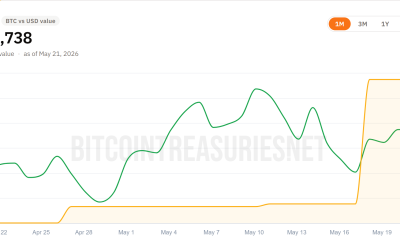
As of May 24, Strategy holds 843,738 BTC worth approximately $64.45 billion at an average purchase price of $75,701 per coin, across 110 transactions since August 2020. The firm’s STRC share program outpaced ETF inflows in BTC accumulation for much of the year.
Peter Schiff has raised MicroStrategy death spiral concerns, arguing the model depends on perpetually rising BTC prices. The gold advocate has also slammed STRC leverage risks as structurally unsound. He may view the bond repurchase as further evidence of financial strain rather than strategic discipline.
Whether the BitVac fires up again next week or further debt management takes priority is the key signal to watch.
The post Michael Saylor Didn’t Buy Bitcoin This Week: Here’s What Strategy Bought Instead appeared first on BeInCrypto.
The broader crypto market dropped more than 5% this week, yet XRP whales accumulated 71 million tokens, ETF inflows held firm, and ledger activity surged sharply.
Claude analyzed the catalysts, the risks, and the realistic path forward, outlining three scenarios that could define the trajectory of XRP throughout 2026.
Whales and Ledger Activity Defy the Market Slump
XRP accumulation refers to large wallets increasing their holdings during price weakness, signaling long-term conviction rather than panic.
Data shared by analyst Ali Martinez shows whales added 71 million XRP over seven days while the token traded near $1.36, marking one of the most aggressive accumulation phases in recent months.
This pattern matters because it reframes the narrative around the recent sell-off. Stronger hands are expanding exposure while weaker holders exit positions, even though the price has yet to reflect the buying pressure in any meaningful way.
Follow us on X to get the latest news as it happens
Whale behavior often precedes major directional moves, and the current setup suggests that institutional confidence remains intact despite negative headlines across the broader crypto market.
XRP Ledger activity also strengthened during the downturn, painting a picture that contradicts the bearish price action.
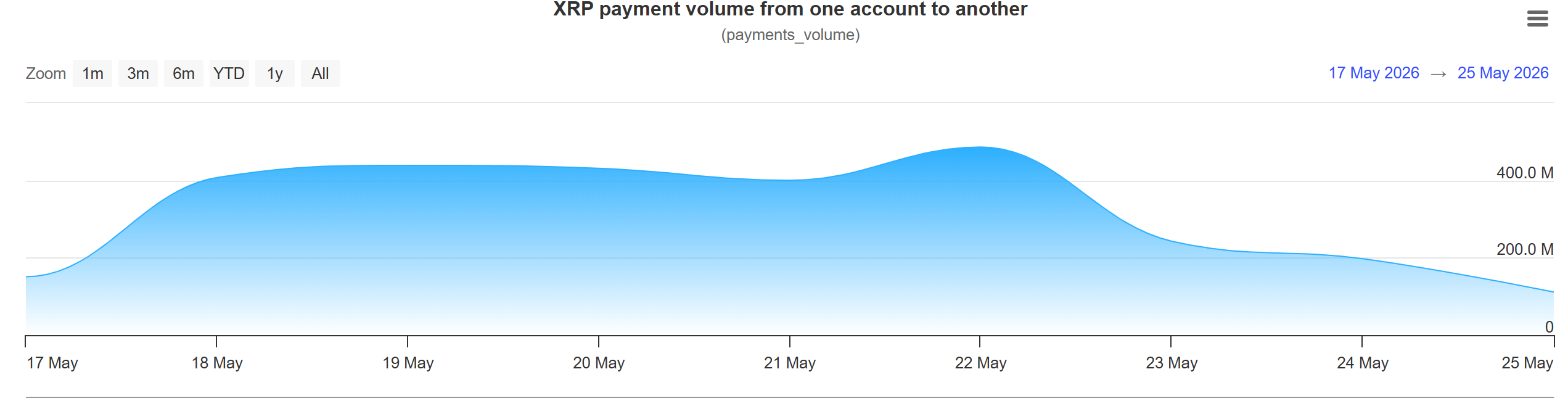
Account-to-account payments climbed from under one million at the start of the week to 1.22 million by May 22, according to XRPScan data.

The jump reflects genuine network usage rather than speculative trading on centralized exchanges.
ETF inflows added another layer of underlying demand that institutional investors clearly value. SoSoValue data shows XRP spot products attracted over $65 million last week, with another $22,04 million in net daily inflows arriving this week despite broader market weakness.

The consistency of these flows during a correction is particularly noteworthy.
These ETF flows differ fundamentally from ordinary exchange trading. Buyers are accessing XRP through structured vehicles, not leveraged positions or short-term speculation, creating a quieter but more durable layer of underlying support beneath the current price action.
Together, whale accumulation, network usage, and ETF inflows form a three-pillar foundation that could shape the next move once sentiment turns.
Claude Maps 3 Scenarios for XRP in 2026
Claude analyzed the current XRP landscape and identified three distinct trajectories that could happen throughout the rest of 2026.
Each scenario depends on how regulation, institutional flows, and broader market conditions interact during the coming months.
Claude points to Senate approval of the CLARITY Act as the most decisive regulatory catalyst still pending, while Standard Chartered lowered the target from $8 to $2.80 by the end of 2026 under bullish conditions.
Federal Reserve rate cuts could also accelerate institutional rotation into higher-risk digital assets during the second half of the year.
Subscribe to our YouTube channel to watch leaders and journalists provide expert insights
However, the chatbot also highlights structural obstacles that limit upside potential. Up to 2,6 billion XRP could be released from escrow before year-end, creating fresh selling pressure across the market.
ETF inflows still trail far behind the volumes seen in Bitcoin and Ethereum products, while macroeconomic uncertainty and competition from stablecoins remain persistent risks throughout the cycle.
Claude concludes that the moderate scenario is the most probable outcome. The three scenarios break down as follows:
- Bullish case between $5 and $8, requiring full regulatory alignment and aggressive ETF demand
- Moderate case between $2 and $3.50, the most realistic path according to current data
- Bearish case between $0.75 and $1.50 if catalysts fail and selling pressure dominates

A new all-time high remains possible but only if regulation, institutional flows, and a broader crypto bull cycle converge simultaneously.
Without that alignment, the path forward stays defined by accumulation rather than breakout.
Remember that AI predictions like Claude’s offer useful analytical frameworks but cannot guarantee market outcomes. Always combine them with independent research, personal risk tolerance, and qualified professional financial advice.
The post 3 Key Scenarios for XRP Price To Hit a New All-Time High in 2026, Claude Predicts appeared first on BeInCrypto.
2026 DeFi losses crossed $1 billion in four months, with April alone draining $634 million across 28+ incidents, the worst month on record.
Drift ($285M) and KelpDAO ($292M) alone accounted for $577 million of April’s losses, and neither was a code exploit.
DefiLlama’s 2026 hack breakdown tells the same thing.
The biggest slices are LayerZero bridge exploits (18%), compromised admin keys (16%), spoof tokens (14%), and private key compromises (11%).
Combined, operational and key-management failures account for the majority of all stolen value this year. Smart contract bugs like re-entrancy and oracle manipulation barely register.
Echo Protocol just became the latest data point.
On May 18, an attacker broke into the Echo Protocol on Monad and printed 1,000 fake eBTC for themselves. That’s $76.7M on paper.
The problem is, fake tokens don’t buy you anything unless you can trade them for something real. So they took a small chunk, dropped it into Curvance’s lending app as collateral, and borrowed real Bitcoin against it.
Then bridged that Bitcoin to Ethereum, swapped it for ETH, and ran it through Tornado Cash. Final take: around $816,000.
Everyone’s calling it $76.7 million but the real number is $816,000, and why those two numbers are so far apart is the main story here.
This breakdown covers what happened, how, and what it says about DeFi security right now.
The bottom line: The contract was fine. A stolen admin key and lazy controls did everything else, and that’s how most of 2026’s DeFi losses are happening.
Post Mortem (The Summary)
- Echo Protocol was not hacked through bad smart contract code. The attacker stole or accessed an admin key.
- That admin key controlled minting rights for Echo’s eBTC token on Monad. One private key was enough to create fake Bitcoin-backed tokens.
- The attacker minted 1,000 fake eBTC, worth about $76.7 million on paper. But those tokens had no real BTC backing.
- They could not cash out the full amount because Monad liquidity was thin. So they used 45 fake eBTC as collateral on Curvance.
- Curvance accepted the fake eBTC as normal collateral and let the attacker borrow real WBTC.
- The attacker escaped with about $816,000 in real value, not $76.7 million.
- Echo later burned the remaining 955 fake eBTC and paused affected functions.
- Monad itself was not hacked. Curvance’s main protocol was not directly hacked either. The failure came from Echo’s admin setup and Curvance trusting newly minted collateral.
- The core lesson: DeFi attackers are now targeting keys, admins, bridges, infrastructure, and team operations more than smart contract bugs.
- Basic protections could have reduced or stopped this: multisig admin control, timelocks, mint caps, rate limits, and collateral checks.
- Echo got lucky. The attacker only failed to drain more because there was not enough liquidity to cash out the fake tokens.

The Players
Here’s the full breakdown of what happened, and how.
- Echo Protocol
A BTCFi (Bitcoin DeFi) project. Their pitch: take your BTC, get a yield-bearing wrapped version of it that works in DeFi.
Their home base is Aptos, where the token is called aBTC. They hit a peak TVL of $878 million on Aptos in May 2025, currently sitting around $254 million.
Echo expanded to Monad as part of Monad’s mainnet ecosystem push. On Monad, their wrapped BTC token is called eBTC.
This is critical: aBTC and eBTC are completely separate, non-bridgeable assets. They’re parallel deployments, not connected. The hack hit eBTC on Monad only.
- Monad
A new high-performance parallelized EVM L1. One of the hyped chains of 2025-26. Just out of the mainnet, with lots of protocols deploying fresh.
Echo is one of them. Monad itself was NOT compromised in any way. Co-founder @keoneHD confirmed the network ran normally throughout. It was a protocol-level failure on top of Monad.

- Curvance
A lending protocol deployed on Monad. Functions like Aave but with isolated markets, where each collateral asset lives in its own siloed pool so a compromised asset can’t infect the rest of the lending protocol.
They had listed eBTC as a collateral asset.
- Tornado Cash
Sanctioned ETH mixer. You send ETH in, you get ETH out from a different wallet, and break the on-chain trail. Standard exit tool for hackers.
What Got Exploited
Echo’s eBTC token on Monad is a standard ERC-20 contract that uses OpenZeppelin’s role-based access control system. This is industry standard, used by basically every serious DeFi project.
Two roles matter in its setup:
- DEFAULT_ADMIN_ROLE: the master role. Can grant or revoke any other role on the contract.
- MINTER_ROLE: can call mint() and create new eBTC tokens.
Normally, only Echo’s team holds these. Minting only happens when real BTC gets locked somewhere, and the team mints the matching eBTC. That’s the entire trust model behind a wrapped token.
Here’s where Echo messed up.
The DEFAULT_ADMIN_ROLE sat on a single EOA, basically just a normal wallet with one private key behind it. And the wallet had no safety nets. Whoever held that key could mint as much as they wanted, whenever they wanted, with nothing to slow them down.
So the entire $254M+ Echo ecosystem on Monad was, in security terms, sitting behind one private key. That key got stolen. Nobody’s said how yet. Could be phishing, malware on a team laptop, an infra breach, an insider, secrets leaked in a repo, supply chain attack through a dev tool. Echo hasn’t disclosed.
The Attack Step by Step
Date: May 18, 2026, around 5:55 PM ET
- Step 1: Attackers use the stolen admin key to grant themselves DEFAULT_ADMIN_ROLE on a fresh wallet. They’re now admin too.
- Step 2: From that new admin role, they grant themselves MINTER_ROLE. They can now mint.
- Step 3: They call mint(attacker_wallet, 1000e8). 1,000 eBTC shows up in their wallet. Notional value $76.7M. Real BTC backing: zero. These tokens are completely fake, phantom claims on Bitcoin that don’t exist anywhere.
- Step 4: They revoke the original Echo admin and their own admin role too. Cleanup move so it looks less suspicious on-chain. From the outside, it just looks like a random wallet holding 1,000 eBTC.
At this point, the peg is mathematically broken. There are 1,000 more eBTC tokens than there is BTC backing them.
But the attacker hasn’t actually taken anything yet. Fake tokens are worthless unless you can convert them into real money.
The Cashout Flow
You can’t just dump 1,000 fake eBTC on a DEX. Monad’s DEXs don’t have anywhere close to that liquidity. You’d crash the price to zero before extracting anything, and arbitrageurs would catch it instantly. So the attacker went to a lending market instead.
- Step 5. Deposit 45 eBTC ($3.45M paper value) into Curvance as collateral. Curvance accepts it because, from the contract’s view, eBTC is eBTC. No oracle or check that separates “freshly minted fake eBTC” from “legit BTC-backed eBTC.” That’s the second failure of this hack. Lending markets just accept new collateral at face value without checking where it came from.
- Step 6. Borrow 11.29 WBTC against it, about $868K of real wrapped Bitcoin. WBTC is the major BTC-on-Ethereum token, deep liquidity, fully backed. They now have $868K of real value, secured by $3.45M of fake collateral they’re never coming back for.
- Step 7. Bridge the WBTC to Ethereum. That’s where liquidity lives and where Tornado works.
- Step 8. Swap WBTC to ~384 ETH on Ethereum (~$822K).
- Step 9. Run the 384 ETH through Tornado Cash. Trail breaks. Funds land in fresh wallets that can’t be traced back.
Total real money out: approximately $816,000.
How Echo Responded
Within hours of the hack going public, Echo reclaimed the admin key, burned the 955 eBTC still sitting in the attacker’s wallet (which no longer exists), and paused all cross-chain functionality on Monad.
They also paused the Aptos bridge and Aptos lending even though Aptos was clean, just to be safe. Pushed a contract upgrade on Monad to restrict the affected operations and said they’d patch their other EVM bridge deployments too.
Curvance paused the eBTC market, confirmed that their own contracts were fine, and noted that their isolated market design prevented the damage from spreading to other lending pools.
Keone from Monad clarified the chain was untouched and pegged the actual loss at around $816K.
The Breakdown
The gap between $76.7 million and $816,000 is the whole story. Curvance was the only viable exit, and its depth capped the borrow at approximately $868,000.
eBTC minted
1,000 (notional $76.7M)
Deposited to Curvance
45 eBTC
WBTC borrowed
11.29 (~$868K)
Sent through Tornado
~384 ETH (~$822K)
Actually stolen
~$816K
eBTC burned by Echo
955
Aptos exposure
~$71K
ECHO drawdown
~11-12%
The other 955 eBTC had nowhere to go until Echo burned it. Monad’s thin liquidity saved Echo from a much bigger loss. On Ethereum, this would’ve been close to $76M out the door.
Why this was an operational hack, not a smart contract hack
The code wasn’t the issue. It worked the way it was supposed to. The real problem was how Echo set things up around the contract:
- The admin role was held by a single wallet instead of a multisig. Stealing a single private key was enough to take over the entire protocol.
- There was no time lock. When the attacker granted themselves admin and then minter rights, those changes went live immediately. No delay, no window for the team to notice and respond.
- The contract had no maximum supply. Minting 1,000 eBTC with zero BTC backing was technically allowed by the rules of the contract itself.
- No rate limit either. The attacker minted the entire 1,000 in a single transaction, rather than being forced to spread it out.
- Curvance accepted the freshly minted eBTC as collateral without checking whether it was legitimately backed. The lending market just saw eBTC tokens in a wallet and treated them the same as real ones.
None of these are obscure or experimental fixes. Multisigs, timelocks, mint caps, and supply checks are stuff serious DeFi protocols have been shipping for years. Echo just didn’t bother with any of them.
May 2026 looks like this
Echo is the 14th hack this month. The year so far:
| Protocol | Loss | Vector |
| KelpDAO (Apr) | $292M | RPC poisoning + DDoS (Lazarus) |
| Drift | $285M | Social engineering (Lazarus, UNC4736) |
| THORChain (May 15) | $10M+ | Vault breach |
| Verus bridge (May 17) | $11.6M | Cross-chain verification |
| Echo (May 18) | $816K | Admin key |
| Transit Finance | $1.88M | Deprecated contract |
Approximately $328.6 million lost to bridge hacks in 2026 across 8 incidents. None of these were Solidity bugs. Keys, signers, RPC endpoints, off-chain verifiers, that’s where the money is leaving now. The attackers moved up the stack. A few from this year worth paying attention to:
- Drift (April): Not a technical exploit. UNC4736 (North Korea) spent six months social engineering Drift employees, then drained $285M in 12 minutes. Six months of prep, 12 minutes of execution. That’s a military op, not a hack.
- KelpDAO (17 days later): Same group, completely different vector. They poisoned LayerZero’s RPC infrastructure and forged cross-chain messages for $292M. State-sponsored teams running multiple playbooks in parallel.
- AI is showing up too: Google confirmed the first AI-powered mass exploit on May 11 (AI found a zero-day and wrote bypass code for 2FA). GoPlus reported a 231% MoM jump in Web3 losses partly tied to AI. CrowdStrike puts the average eCrime breakout time at 29 minutes, with the fastest at 27 seconds. The attack side is automating, defense mostly isn’t.
- Resolv Labs (March): Admin key compromise on a stablecoin issuer. Attacker minted 80M unbacked USR, drained $25M, and USR depegged by 80%. Same root cause as Echo, completely different protocol type. The pattern doesn’t care what you’re building.
Ondo Finance put it bluntly in their post-incident analysis: “there is no single class of vulnerability to defend against.” That’s the part most protocols still haven’t internalized.
So when Echo got drained through a stolen admin key, it didn’t happen in a vacuum. It happened during the most hostile threat environment DeFi has ever seen, and the protocol was set up as if it were still 2022.
So what?
DeFi spent the last five years getting good at smart contract security. Audits, bug bounties, formal verification, all of it.
So the attackers stopped targeting the code and started targeting everything else. Keys, infrastructure, employees, signers. None of that gets audited.
For any wrapped BTC protocol, the only security question that actually matters is who can mint, and how hard is it for someone to take that power from them.
If the answer is “a multisig with a timelock, a mint cap, and a lending market that checks where new collateral came from,” you have a real protocol. If the answer is “one wallet with one key,” you have $254M sitting there waiting to be taken. Echo was the second kind.
The damage doesn’t stay in one place either. Aave wasn’t hacked in April, but it lost $5.4B in TVL within 48 hours of the KelpDAO exploit anyway. People just panicked and pulled their money out of everything. That’s what happens now. One protocol gets hit and the whole sector gets repriced.
The fixes are not new. They’ve been around for years. Multisig the admin, timelock the changes, cap the supply, check the collateral. It’s just that none of it makes a protocol more competitive on the front end, so nobody ships it until they’re the next headline.
Echo got off easy because Monad’s liquidity was too thin for the attacker to fully cash out. The next protocol probably won’t have that excuse.
The post Echo Protocol Hack Autopsy: The $76 Million Exploit That Wasn’t Really a Hack appeared first on BeInCrypto.

Search for missing person between Staithes and Sandsend

GSK: Improved Prospects After Correction

Vitalik Biterin breaks silence about Ethereum Foundation amid community frustration


-

 Crypto World4 days ago
Blockchain.com files with SEC for U.S. IPO
-

 Fashion3 days ago
Holiday Weekend Open Thread – Corporette.com
-

 Crypto World3 days ago
Bitcoin Accumulation Weakens as BTC Realized Losses Hit $600M
-

 Business3 days ago
Dell Technologies DELL Stock Surges 15% on AI Server Momentum and Analyst Upgrades in 2026
-

 Crypto World3 days ago
Space X IPO Is ‘Bad News’ for Tech Stocks: But What About Bitcoin?
-

 Politics3 days ago
Makerfield: a tale of two social-media histories
-

 Crypto World2 days ago
Robinhood crypto COO Tanya Denisova exits
-
 Crypto World4 days ago
MicroStrategy’s Saylor Says Miners No Longer Set Bitcoin Price, Another Force Has Taken Over
-

 Business22 hours ago
NYT Strands Answers May 24 2026 Revealed for Puzzle No. 812 Theme Summer Essentials
-

 Crypto World3 days ago
AI infrastructure race heats up as IREN pitches full-stack strategy, WhiteFiber lands $160M deal
-
 Tech3 days ago
A 0.12% parameter add-on gives AI agents the working memory RAG can’t
-

 Tech4 days ago
WhatsApp ads could make Irish debut after discussions with DPC
-

 Tech4 days ago
You Can Now Add ChatGPT To PowerPoint
-

 Business3 days ago
Trump Invests $1M-$5M in Kura Sushi USA Chain With 27 California Locations
-
 Crypto World7 days ago
Revolut Launches Dogecoin Debit Card Across UK and EU
-
 NewsBeat4 days ago
Charity run by Reform leader Malcolm Offord accused of ‘law breaking’ over Scottish registration
-

 Sports4 days ago
2026 CJ Cup Byron Nelson leaderboard: Brooks Koepka finds putting stroke in Round 1
-

 Crypto World3 days ago
Trump Media’s Bitcoin Stash Shrinks Again as 2,650 BTC Lands on Crypto.com
-
Business3 days ago
Goldman Sachs reinstates Ageas stock coverage with neutral rating
-

 Crypto World5 days ago
Exa Labs raises $250 million in funding led by a16z
You must be logged in to post a comment Login