HANDS ON Even after 60 releases, to borrow Carlsberg’s slogan, OpenBSD is probably the most secure FOSS Unix-like OS in the world.
OpenBSD 7.9 arrived just a couple of days after
project lead Theo de Raadt’s birthday. Our congratulations to both. The
last four months or so have seen the fastest succession of security
issues in Linux that we can remember in the project’s existence so far,
but OpenBSD sails on serenely.
Back in March, Anthropic announced that
its Claude Mythos LLM had found a successful OpenBSD attack – but it
wasn’t a hole. A TCP/IP packet with malformed Selective
Acknowledgement options could crash the kernel. This was a real
problem, and the bug that caused it went back 27 years, but it doesn’t
let anyone in. The OpenBSD developers had already included a fix
for the bug two weeks earlier, so OpenBSD 7.8 users would get it the
next time they ran sysupdate, and it is of course fixed in
this version.
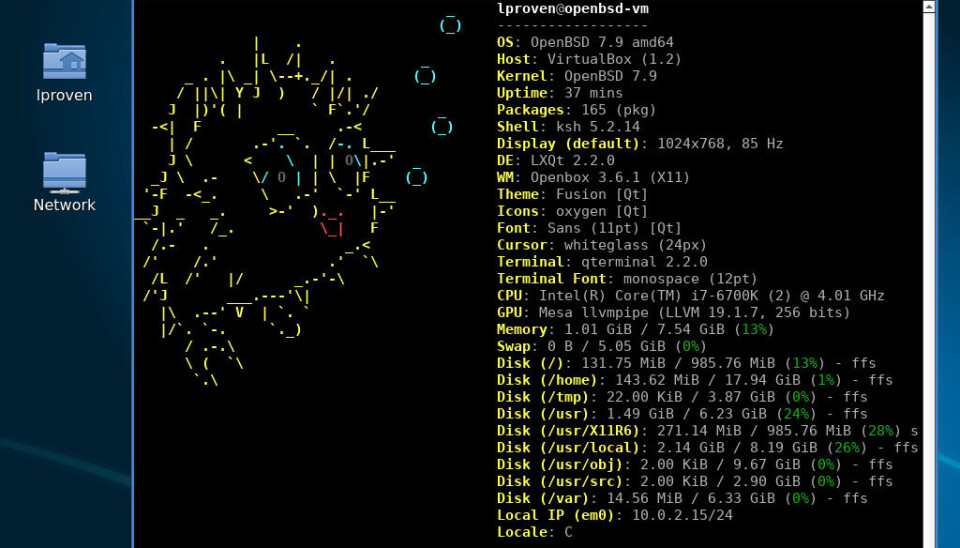
LXQt on OpenBSD, because you don’t have to live in an xterm if you don’t want to
The new features in version 7.9 are relatively modest. On x86-64
machines – which it terms amd64 – 7.9 now supports a
maximum of 255 processor cores, and fixes a bug on machines with over
512 GB of RAM. It can also handle up to 52 partitions per disk.
Internally, there can be up to 64, but the limit is now the number of lowercase and uppercase letters of the Roman alphabet, which it uses in
labels.
Advertisement
On x86-64 and Arm64, the CPU scheduler now understands heterogeneous
CPU cores with different performance levels, and can assign processes to
four different performance levels described by the letters S-P-E-L,
denoting SMT, performance, efficient, and lethargic.
This should improve power management, and another feature called
“delayed hibernation” can also help. Rather than letting a suspended
laptop simply turn off if its battery runs out, when power levels get
very low, the machine will wake up then immediately hibernate – a
process that ends with it turning completely off. OpenBSD still doesn’t have a
journaling file system. It uses FFS2, an improved
version of the original Berkeley Fast File
System developed by Kirk McKusick. This used to include a
performance enhancement called soft updates (McKusick’s
own explanation) but these were removed
in 2023. That means that turning off a running machine without
shutting it down could cause disk corruption. Delayed hibernation will
help prevent one cause of that, at least.
The release announcement also lists other changes, including improved support for RISC-V boards, basic support for Wi-Fi 6, the
graphics driver stack from Linux kernel 6.18, and even more
optimizations to the already-low-latency sound driver stack. There are
various tweaks and bug fixes for the various RISC
platforms it supports. Version upgrades include LibreSSL 4.3.0,
OpenSSH 10.3, and many improvements to the Berkeley Packet Filter (bpf) and Packet Filter firewall (pf), including source
and state limiters.
Desktop use is not the primary goal of OpenBSD, but you certainly
can. It includes multiple window managers and desktops, as documented
in its handbook – although this is slightly out of date. Version 7.9
includes GNOME 49, KDE Plasma 6.6, MATE 1.28, Xfce 4.20, LXQt 2.2, and
various more minimal window managers. It has its own X11 server, Xenocara, based on X.org 7.7 and
Xserver 21.1.21, but you can also run XLibre with some manual effort,
and some desktops support Wayland. There is also a downstream project to
build a live bootable medium called FuguIta, although it hasn’t caught up
with the new release just yet.
Advertisement
OpenBSD releases are each accompanied by a unique banner painting and theme tune. This time, it’s a swinging jazz instrumental called Diamond in
the Rough [MP3], which we really enjoyed. It’s by Bob Kitella, who along
with de Raadt is one of the team at the Alberta internet
exchange YYCIX.
Calling OpenBSD a diamond in the rough seems quite
appropriate. It does have some significant gaps in its
functionality, but it is small, clean, and secure. We very much enjoyed
a recent essay on ascetic computing by
Dave “Ratfactor” Gauer, in
which he discusses why his OS of choice is OpenBSD.
Out there in the chaos of the open source communities on the social
networks that this vulture visits, we often encounter great resistance
when we tell people that they’re experiencing problems because of their
poor choice of equipment. For an easy life and a reliable computing
experience, we advise against wireless devices (peripherals or
networks), Bluetooth audio devices, and so on. The vicissitudes of
Nvidia support on Linux have long been well understood, and eloquently
conveyed by Torvalds himself.
Avoid this stuff, use devices with plain old cables, and things tend
to work more easily and more reliably. Here, we are coming to
appreciate the OpenBSD stance on Bluetooth, for instance: it simply does
not support it at all. This approach reminds us of the way that Python
sliced through the Gordian knot of indentation styles. For instance,
this C
style guide [PDF] identifies 14 named indentation systems. Python
dispenses with all that by making indentation syntactically significant,
ending the flame wars at a stroke. Of course, many veterans howl their
dismay and rage at this – and yet Python consistently ranks as the
world’s favorite language, over
and over
and over
again. OpenBSD cuts through some of the complexities of Linux and
the other BSDs in a broadly similar way.
No LLM-created code has been committed directly into OpenBSD as yet – and it looks unlikely, if only for copyright reasons, as de Raadt laid
out in March. The tmux changes were grandfathered in indirectly because OpenBSD has included tmux in its base system since 2009. We’ve
looked at the changes and they seem small, clean, and innocuous to us.
Arguably, the objection is an ideological one of purity. We fear that
OpenBSD may end up on the Open
Slopware list we mentioned in January. When we reported
recently on Fedora and Ubuntu’s AI moves, we mentioned the Stop slopware site and the No-AI Software
Directory. This probably means OpenBSD won’t appear on the latter either, but we suspect that the team will not care.
OpenBSD version upgrades are relatively simple, straightforward, and well
documented. So, to take 7.9 for a spin, we first tried it in a
VirtualBox VM. Although it’s a small OS, it wants a large virtual drive because by default it creates nine separate partitions, and
because of their different permissions, they’re a key part of the OS’s
enviable security. Worse still, their sizes cannot be dynamically
adjusted. Since the installation program is a very low-tech plain-text
affair, it offers no help with customizing the layout: if you don’t like
its proposal, then you must devise your own completely from scratch. It
really would help massively if OpenBSD had some kind of simple Logical
Volume Manager.
Give it enough space, though, and installation goes smoothly. We
also tried on the bare metal of an old Lenovo ThinkPad X220, with its
own dedicated 128 GB SSD. This threw up an interesting wrinkle: it found
the machine’s Wi-Fi controller no problem, identifying it as an
Intel Centrino Advanced-N 6205 – but because the necessary firmware was not included on the 761 MiB ISO
download, it couldn’t activate the device, even though it let us enter our WLAN credentials. That’s a problem, as the installer defaults to
fetching the installation file sets from the internet. We plugged in an
Ethernet cable, and then installation continued and finished
successfully. The installer automatically installed the required
firmware package, so on our first reboot, the Wi-Fi connection came
online all on its own.
Advertisement
Installing this vulture’s preferred desktop
environment was as simple as logging in as root and
entering pkg_add xfce. Selecting it is not quite so easy,
though: OpenBSD’s display manager, xenodm,
lacks the ability to choose a desktop environment. To fix that, we
needed a one-line, two-word script: create an ~/.xsession file containing exec startxfce4, and that was it – a fully working graphical desktop. We added a second monitor, and it was
detected, added, and enabled automatically, and we could set it to
portrait mode in Xfce’s display settings.
Although the X11
section of the OpenBSD Handbook says that KDE’s
recently replaced SDDM is available, as far as we can tell, it has been removed from 7.9 – as has Ubuntu’s LightDM. Even so,
just saying “yes” when the installation program asks if you want GUI
results in a working Fvwm 2.2.5
environment.
The Reg FOSS desk has been exploring OpenBSD since version
7.1 in 2022, including 7.2, 7.5, 7.6, 7.7,
and 7.8.
It’s still not an easy OS to install, but if you can dedicate a computer
to it, installation is much easier. We recommend avoiding complexities
like dual-booting and multiple drives. As a small bonus, it boots and
installs perfectly from a Ventoy
multi-OS USB key.
OpenBSD still supports x86-32, there’s no trace of systemd and never
will be, and if you really want GNOME or KDE, you can have them.
Bringing up a GUI-based system remains substantially easier than it does
on FreeBSD. If you’re prepared to obtain the hardware it wants, rather
than hoping that it will support whatever kit you happen to already
have, this is an excellent way to improve your Unix skills – as well as
starting to enjoy computing again, free of the distractions of shinier
FOSS OSes. ®
The Web Serial API lets websites write to (and read from) serial devices using JavaScript, including USB and Bluetooth devices with virtual serial ports. And this week’s Firefox 151 release introduced support for the Web Serial API on desktop.
“Most folks won’t use this API,” acknowledges Mozilla’s blog, “but for our community of builders and tinkerers, it unlocks the ability to use Firefox to communicate directly with compatible hardware devices like microcontrollers, development boards, and other serial-connected devices…”
With Firefox’s browser engine, Gecko, now supporting Web Serial, users can now connect, code, configure, and control compatible hardware directly from the browser in many workflows, often without additional software or complicated setup…
As part of this week’s launch, Adafruit, one of the internet’s most beloved open-source hardware communities, is collaborating with us to test and validate what browser-based hardware development can look like in Firefox with Web Serial support… With Web Serial support in Firefox 151, Adafruit’s browser-based hardware workflows now work directly in Firefox as well, with no additional software or complicated setup required for many projects. We invite you to give it a try…
Advertisement
We want the web to be open, flexible, and shaped by the diversity of people building on it. If you’re wiring up your first board, experimenting with hardware projects, or dusting off an old electronics kit, give Adafruit and Web Serial in Firefox a try. Build something amazing. Make something useful. Tell us what works. Tell us what breaks. Most of all, make it your own.
Mozilla’s “Hacks” blog demonstrates with an Adafruit ESP32-S2 based board “where messages sent from web code can be directly displayed on the device over Web Serial.”
“Social engineering” sounds like something out of a conspiracy thriller, charged with totalitarian control and fringe paranoia. More mundanely, it’s come to be associated with phishing and other scams, in which fraudsters manipulate people into disclosing personal information.
Yet the concept is older and more benign: it is the deliberate shaping of human behavior, often at scale. It predates silicon—and became pervasive, and ungoverned, especially once its practitioners learned to hide it. Authoritarian regimes and more recently scammers and big companies have profited from it. To defend ourselves from bad actors, and to benefit from social engineering’s good side, we need to reclaim the name, and govern it prudently.
The roots of engineering
In 1894, Dutch entrepreneur Jacques van Marken urged companies to hire “social engineers” to manage human systems such as insurance, education, and profit sharing for workers as carefully as they did mechanical ones. Fifteen years later, reformer William H. Tolman published Social Engineering, describing how U.S. industrialists optimized workers’ conditions alongside manufacturing methods. If industrialists could shape steel and electricity on demand, why not society itself?
By the 1920s, that confidence had spread. The architect Le Corbusier declared that dwellings were “machines for living in,” imagining cities as orderly lattices where people moved like parts on a conveyor belt. Civilization would run like a Swiss watch.
Advertisement
The idea soon darkened. Authoritarian regimes pushed it to extremes, promising to fashion “the New Man.” In Nazi Germany, engineer Fritz Todt founded Organization Todt, a vast state engineering enterprise that emerged from the autobahn highway system and later operated concentration camps using slave labor.
In the Soviet Union, leaders adopted U.S. scientific management techniques to plan factory-worker movements and classify populations through centralized records, feeding both rapid industrialization drives and the gulag system of forced labor. The same tools and managerial methods used to build highways and enact five-year plans worked for repression and mass control.
By the 1950s, “social engineering” had become a contaminated phrase. The revelations of Nazi and Soviet abuses, along with Cold War critiques of grand social planning turned the term from a progressive slogan into a warning label. Banishing the words pushed the practice underground, making it harder to recognize when it resurfaced in new forms—such as organizational psychology and systems management that still relied on classification and behavioral influence techniques but under softer, less loaded labels.
Social engineering’s more subtle spread
In the postwar years, the new social-engineering lexicon included “human factors” and “urban planning,” all promising integration rather than command. As computing advanced, the language shifted again: “customer journey mapping” to track interactions, “user experience” to script them. Engineering, which began as a means of reshaping physical space, set its sights on shaping behavior. Digital design features embedded in our smartphones now target our attention and desire.
Advertisement
Language helps conceal these modern forms of social engineering. “Data analytics” sounds neutral beside “surveillance.” “Personalization” flatters individuality while still sorting users into predictable categories. “Behavioral nudges” guide decisions without the sense of intrusion. We attach “social” as a favorable modifier to sciences, capital, and media, yet recoil when it meets “engineering.”
That discomfort is a clue. Engineering implies control, and control prompts us to ask who directs whom, toward what ends, and with whose permission.
Not all social engineering these days is hidden. Hackers don’t need to break a firewall if someone hands over their password. Romance scammers cultivate intimacy the way farmers cultivate crops. They succeed not through force but by exploiting trust. If even these obvious attacks work, the invisible kind, with roots in social engineering, are a shoo-in.
Most of the social engineering we encounter is proprietary and beyond our control. Firms build recommendation algorithms tuned to boost engagement and profit with no hearings or right of appeal. Browser and cookie defaults decide what data we surrender. A single autoplay toggle can cost users hours and build unhealthy habits. These are acts of engineering as deliberate as laying a road or redrawing an electoral district. They create a kind of curated itch by which boredom never settles, and satisfaction never arrives. The results are predictable—users click on targeted ads, make purchases, form habits, and lock in opinions.
Advertisement
Consent has transformed along with it. Once straightforward and revocable, it is now subtle and persistent, buried in defaults or opaque terms of service too quickly accepted. You remain free to opt out, much as you are free to refuse roads or electricity. Consent has become the preselected setting of modern life.
When social engineering operated more in the open, citizens could contest it, at least in societies with responsive government. Today’s invisible version diffuses accountability so thoroughly that scrutiny becomes hard to direct. Despite recent congressional hearings on social media’s impact on youth mental health and juries agreeing that firms are knowingly designing algorithms that cause harm, pinpointing responsibility remains elusive. When the mechanism is buried inside a system used by billions, we cannot easily point to a single decision-maker or trace the precise moment of manipulation.
Today’s social engineering is less overt and theatrical than its predecessors. Earlier versions arrived on public posters and loudspeakers for mass audiences. Today’s version is more intimate, delivered through personal devices and constant feeds tailored to the individual. The model succeeds because participation feels like freedom, not control.
Not all social engineering is dystopian. Well-kept parks foster community, accessible buildings extend dignity, vaccines and seatbelts save lives. Even in the digital realm, positive examples exist: browser extensions that automatically block hidden trackers, search engines that refuse to build personalized surveillance profiles, and decentralized social platforms that give users greater control over their own data and feeds.
Advertisement
The term “social engineering” still unsettles, though. But “asocial” engineering, which ignores human consequences entirely, is worse. Recognition of the human dimension to engineering is the beginning of repair. Only by seeing the machinery clearly and naming it honestly can we decide who engineers what and why. The machinery will not dismantle itself. Once named, it becomes subject to choice. That negotiation of purpose, power, and process are the defining political questions of any real democracy. We cannot ensure that social engineering serves and sustains society so long as we dodge the words.
PLUS: Huawei says it’s replaced Moore’s Law; Chinese mobile plans add token allowances; Singtel slinging Optus; And more!
ASIA IN BRIEF Workers at Samsung Electronics may score bonuses of well over $100,000 after calling off a planned strike.
Samsung’s profits recently shot into the stratosphere along with the price of memory and solid-state storage. Staff threatened to strike if the company did not share some of the largesse.
Advertisement
Last-minute talks saw the National Samsung Electronics Union (NSEU) agree not to strike, after Samsung agreed to create a fund that will share profits with workers. A Bloomberg report suggests some workers could be in line for payments of $340,000 under the scheme.
The Union is now running a vote on whether to approve the plan.
Workers appear to have mixed feelings about the plan, as on Sunday the Union published a post in which it tries to justify the settlement as benefiting workers from all divisions of Samsung Electronics, and its plan to create a fund that would see all employees granted around $17,000.
“Your anger must be directed not at us, but at the company,” wrote NSEU Acting Representative Woo Ha-kyung. “It must be directed at the company that is dividing us. I earnestly hope that workers will not thrust arrows of blame and criticism at other workers, but instead unite our strength to move forward.”
Advertisement
Huawei claims it’s leapfrogged Moore’s Law
Huawei on Monday proposed a new scaling law to replace Moore’s Law – which isn’t a law at all and postulates that the number of transistors in an integrated circuit doubles about every two years.
Speaking at the Institute of Electrical and Electronics Engineers (IEEE) 2026 International Symposium on Circuits and Systems, the president of Huawei’s semiconductor division He Tingbo proposed the Tau (τ) Scaling Law.
According to Huawei’s announcement, “This law proposes replacing geometric scaling with time (τ) scaling as a new guiding principle for the evolution of both semiconductors and electronic systems.”
This “law” seems to be tangled up with a technology Huawei calls the “LogicFolding architecture” which apparently represents an alternative to traditional semiconductor design by “significantly shortening critical-path wiring, effectively reducing the resistive and capacitive load of signal propagation, and ultimately boosting transistor density and circuit performance.”
Advertisement
Huawei will debut LogicFolding chips later this year and says “By 2031, the high-end chips Huawei designs based on the τ Scaling Law are expected to feature a transistor density that is equivalent to 1.4 nm processes.”
If accurate, that would mean Huawei is five years away from a manufacturing process that will be comparable to the most advanced tech offered by the likes of TSMC and Intel.
Chinese mobile phone plans now come with token allowances
Some mobile phone subscriptions in China now include a quota of tokens to use on AI services.
In the last ten days at least two Chinese telcos – China Telecom and Shanghai Telecom –launched plans that include a token allowance.
Advertisement
State media hailed the plans as representing “a shift in how China’s telecom sector hopes to profit from generative AI, as operators attempt to transform computing power and AI model access into a utility-like service resembling traditional mobile data packages.”
Telcos around the world have historically struggled to create new revenue streams from technology innovations – Google, Meta, and Apple have scooped most of the profits flowing from mass adoption of smartphones, leaving carriers to operate low-margin connectivity services.
APAC bit barn boom peaks in Australia, Malaysia
Commercial real estate outfit CBRE last week reported that datacenter investment in the Asia Pacific region hit a record US$11.6 billion in 2025, much of it going on neoclouds.
“For neocloud providers, access to power is increasingly outweighing traditional location advantages,” said Matt Madden, CBRE’s senior managing director for data center solutions in the region. “This is directing demand toward markets that can support high-density campuses at scale, particularly across India, Malaysia, and parts of Southeast Asia.”
Advertisement
Malaysia’s Johor saw a 53 percent year-on-year increase in live capacity last year, ahead of 37 percent growth in the Australian city of Melbourne.
“This underscores strong expansion momentum outside mature markets such as Singapore and Hong Kong SAR, with around 6-8 percent growth,” CBRE said.
$11.5 billion is a tiny fraction of the giant sums Big Tech is spending on datacenters and infrastructure. Last year we spotted $142 billion of spending in Q3 alone. The world’s most populous region clearly isn’t getting much of that.
In related news, IBM Cloud last week flicked the switch on a new region in the Indian city of Mumbai.
Advertisement
Singtel ready to sling Optus
Singtel last week published a filing [PDF] that declares it is open to offloading a substantial stake in its Australian telco operation, Optus.
Readers may recall that Optus has a long history of trouble, including failing to notice a breakdown of its emergency calling service that is thought to have cost at least two lives, a massive outage, and a major data breach.
Singtel hopes to court “potential Australian partners that align with its objectives of ensuring that Optus continues to be a strong alternative operator in the industry, providing a reliable and trusted critical service to all Australians. Singtel contemplates a like-minded long-term local partner owning a meaningful minority stake in Optus.” ®
Ferrari has officially entered the electric era with the unveiling of the all-new Ferrari Luce, the first fully electric production car in the company’s history. Revealed in Rome, the Luce marks one of the biggest shifts the Maranello-based automaker has made since the company was founded in 1939.
For years, Ferrari resisted going fully electric. The company repeatedly argued that emotion, sound, and driver engagement were core to the Ferrari experience, something enthusiasts believed could not exist without a combustion engine. Even when rivals like Porsche launched EVs such as the Porsche Taycan and brands like Lamborghini began discussing electrification strategies, Ferrari largely stayed focused on hybrids and traditional performance cars.
Tactile controls and digital interactions blend into one cohesive interface, shaped through deep collaboration across engineering, interaction, graphics, typography, sound, and industrial design. pic.twitter.com/j9IX2JXdG7
That changed as emissions regulations tightened globally and EV technology matured enough to support the kind of performance Ferrari customers expect. Ferrari first outlined its “multi-energy strategy” in 2022, confirming electrification would become part of the brand’s future without replacing combustion engines entirely.
Advertisement
The result is the Ferrari Luce, a car Ferrari says is not simply “an electric Ferrari,” but an entirely new type of Ferrari built around an all-electric architecture. The company worked alongside the design collective LoveFrom, led by former Apple design chief Jony Ive and designer Marc Newson, to create the car’s unusually minimalist design language.
And that design is already proving divisive
Unlike Ferrari’s traditionally aggressive and sculpted supercars, the Luce adopts a much smoother, cleaner appearance dominated by a massive glasshouse design and floating aerodynamic wings. Ferrari describes it as “shell-like,” while critics online have compared it to a futuristic crossover more than a traditional Ferrari.
The proportions are also different from what many expect from the brand. The Luce is Ferrari’s second four-door model and its first with five seats. It rides on enormous 23-inch front and 24-inch rear wheels, making it one of the largest road-going Ferraris ever built.
Advertisement
Underneath the controversial styling is an extremely ambitious EV platform. The Ferrari Luce uses four independent electric motors – one for each wheel – producing a combined 1,050 horsepower (772kW). Ferrari claims a 0-100km/h sprint in just 2.5 seconds, 0-200km/h in 6.8 seconds, and a top speed exceeding 310km/h.
Power comes from a large 122kWh battery pack developed in-house at Maranello using 800V architecture. Ferrari says the car supports charging speeds up to 350kW and can recover around 70kWh of charge in 20 minutes under ideal conditions. The estimated driving range is over 530km.
The Luce also introduces several technologies never before seen on a Ferrari road car. These include active aerodynamic grilles, four-wheel independent torque vectoring, active suspension derived from the Ferrari F80 hypercar, and Ferrari’s new “Torque Shift Engagement” system, which attempts to recreate progressive acceleration feel through paddle-controlled torque delivery.
Ferrari says it achieves the lowest drag coefficient ever seen on one of its road cars thanks to its smooth bodywork, active aerodynamic grilles, and adaptive ride height system that lowers the front by 10mm at higher speeds.
Advertisement
So, what’s up with the Luce – is it worth the hype?
Perhaps unsurprisingly, Ferrari has also spent considerable effort trying to address the emotional side of EV driving. Instead of fake engine sounds, the Luce uses accelerometers mounted inside the drivetrain to capture real vibrations and mechanical frequencies from the electric motors. Ferrari then amplifies and refines those sounds both inside and outside the vehicle to create what it calls an “authentic and functional” soundtrack.
Inside, the Luce looks more like futuristic consumer electronics than a traditional sports car. The cabin features OLED displays developed with Samsung Display, a rotating center control panel, extensive use of recycled aluminum and glass, and a 21-speaker 3,000W audio system.
Ferrari LuceFerrari
The EV platform also enables a lower centre of gravity and improved weight distribution for sharper handling. Ferrari’s new Vehicle Control Unit manages power delivery and dynamics in real time, while the brand’s first electric all-wheel-drive system uses advanced torque vectoring for better responsiveness.
Whether Ferrari enthusiasts fully embrace the Luce remains uncertain. But one thing is clear: Ferrari is no longer treating electrification as a side experiment. The Luce represents the company’s clearest acknowledgment yet that the future of high-performance cars will include EVs — even if that future looks very different from Ferrari’s past.
The tech giant claims it can reach cutting-edge chip density by 2031, closing the gap with TSMC.
Huawei has proposed a new guiding principle for the semiconductor industry that it says could allow it to design chips rivalling the world’s most advanced processes, without needing the cutting-edge manufacturing equipment it has been denied under US sanctions.
At the 2026 IEEE International Symposium on Circuits and Systems (ISCAS) in Shanghai today (25 May), He Tingbo, president of Huawei’s semiconductor business and chair of its Scientist Committee, delivered a keynote speech entitled ‘New Semiconductor Path in Practice’, in which she presented what the company calls the ‘Tau Scaling Law’.
The law proposes replacing geometric scaling, the decades-old practice of physically shrinking transistors, with time scaling as the new guiding principle for semiconductor evolution. The idea is to reduce the time it takes for signals to propagate through chips and computing systems rather than making individual components smaller.
Advertisement
The principle has already acquired a nickname: “Her’s Law”, according to the South China Morning Post – a play on both He Tingbo’s surname and the tradition of naming foundational scientific laws after their originators, as with Moore’s Law.
The approach relies heavily on a technology Huawei calls LogicFolding. By breaking down the physical boundaries of traditional circuit layouts and significantly shortening critical-path wiring, LogicFolding aims to reduce resistive and capacitive load on signal propagation, ultimately boosting transistor density and circuit performance.
The ambitious production target puts Huawei in direct competition with the world’s leading chipmakers. According to Bloomberg, there is currently around a five-year gap between what TSMC can produce and what Huawei, working with its manufacturing partner SMIC, is capable of.
TSMC, the world’s largest producer of advanced chips, currently uses 2nm manufacturing technology and plans to introduce a 1.4nm process for mass production in 2028. Huawei says it will reach that same 1.4nm equivalence by 2031, although it did not provide independent data to support its claims.
Advertisement
Huawei says the framework is already in production. Over the past six years, it has designed and mass-produced 381 chips based on the Tau Scaling Law, for industries from smartphones to AI computing, it says. The Kirin chips scheduled to launch in autumn 2026 will be the first to adopt the LogicFolding architecture.
“We believe that openness and collaboration are key to driving ongoing progress in the semiconductor industry,” He Tingbo said. “No single company can independently find all the answers along the path of semiconductor evolution.”
Nvidia CEO Jensen Huang recently told CNBC the company had “largely conceded” China’s AI chip market to Huawei.
Don’t miss out on the knowledge you need to succeed. Sign up for the Daily Brief, Silicon Republic’s digest of need-to-know sci-tech news.
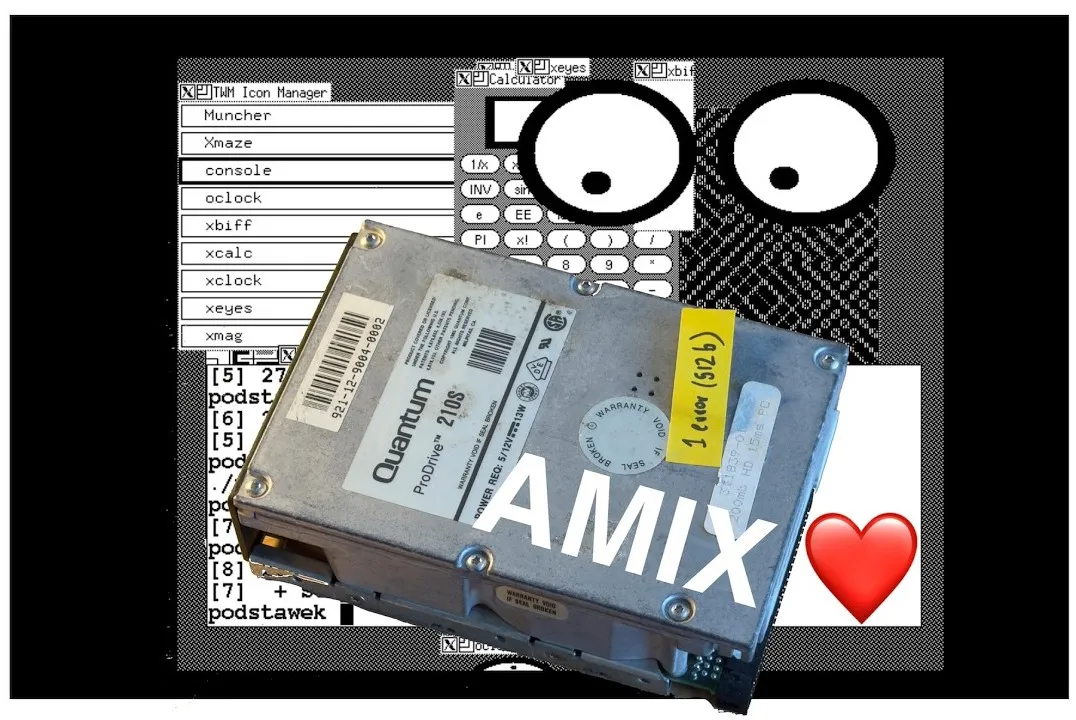
Some of you may know there’s a version of UNIX for the Commodore Amiga, aptly called Amiga Unix or AMIX. There is an almost complete record of versions from 1.0 to 2.03, but 2.02 was lost media–until [Forgotten Computer] found it on an old Amiga.
It starts with an auction held for the 40 year anniversary of the Free Software Foundation where, by just one second, the highest bidder was too late. What do you do first with an artifact as valuable as an old FSF computer? You image the hard drive. Then you make several copies, including on different computers–after all, you wouldn’t want to lose the data on it. Preservation secured, the natural next thing is to boot it–and that’s when we see the magic 2.02c version number. According to thorough digging by [Forgotten Computer], this version was–until now–lost.
In the video after the break, [Forgotten Computer] goes over what Amiga Unix is, the discovery process, and explores what’s on the disk–including FSF staples like GCC, G++ and core utilities like GNU less.
The company said its next-gen chips will be “feasible and affordable.”
Wongsakorn 2468/Shutterstock
Huawei has made a bold claim that it can manufacture its own semiconductor chips that are just as good as the competition thanks to a new breakthrough. At a semiconductor symposium in Shanghai, the Chinese company said it will be able to produce chips with transistor density that can match the 1.4-nanometer processes that competitors are expected to use, like Taiwan Semiconductor Manufacturing Corp (TSMC), Samsung and others.
If achieved, this development for Huawei would be a major deal since it’s been subject to continually expanding US trade sanctions going back to 2019. The restrictions have held Huawei back behind the competition, as it doesn’t allow access to specialized equipment that other companies are using to achieve that 1.4nm level. On the other hand, TSMC revealed its 1.4nm process that will enter production in 2028.
While Huawei would be five years behind the leading company, it could offer a more cost-effective solution. He Tingbo, Huawei’s head of its chip department, said its process is “feasible and affordable,” according to The Wall Street Journal. Currently, China’s biggest semiconductor manufacturer, Semiconductor Manufacturing International Corp offers chips with a 7nm processor, which can be seen in Huawei’s Mate 60 smartphones.
The Galaxy S26 Ultra is Samsung’s most powerful smartphone to date. It’s powered by the Snapdragon 8 Elite Gen 5 SoC and is available with up to 1TB of storage and 16GB of RAM. You get a quad-camera setup on the rear comprising a 200-megapixel main sensor, two telephoto lenses, and a 50-megapixel ultrawide sensor. It’s also the only premium smartphone from a mainstream brand that comes with a stylus built in.
Though Samsung hasn’t overhauled the design of its Galaxy S Ultra flagship in over four years, the Galaxy S26 Ultra does feature a unique hardware addition — Privacy Display. Despite the growing selection of Samsung Galaxy features, there aren’t many year-over-year changes hardware-wise. The Galaxy S26 Ultra has a massive 6.9-inch display and is by no means a compact flagship — yet, it’s only powered by a 5,000 mAh battery.
Fortunately, owing to the chip’s efficiency and Samsung’s excellent software optimization, the Galaxy S26 Ultra actually lasts all day on a single charge. Its charging speeds have also gotten much faster, at up to 60W with a compatible adapter. However, if battery life is at the top of your priorities, you can do much better than what Samsung is offering here. We’ve compiled a selection of smartphones with comparable performance that edge out the Galaxy S26 Ultra in battery endurance. It’s worth noting that a few of our picks aren’t officially sold in the U.S., and importing them may first require you to verify carrier compatibility.
Advertisement
iPhone 17 Pro Max
Chris Davies/SlashGear
The iPhone 17 Pro Max we reviewed is the safest flagship recommendation if you value the display and camera performance of the Galaxy S26 Ultra. It’s available globally and is actually priced cheaper than Samsung’s flagship. iPhones have never had the biggest battery capacities on paper, but have always managed to match or outperform their Android counterparts thanks to the fact that Apple controls both the hardware and software — yielding maximum efficiency.
The iPhone 17 Pro Max packs in a marginally larger battery at 5,088 mAh for the e-SIM model that should power the experience for an entire day and then some. In a comparison carried out by GSMArena, the iPhone 17 Pro Max beat the Galaxy S26 Ultra in web browsing and gaming endurance tests. In fact, this was the model that shipped with a physical SIM card slot, which has a smaller 4,832 mAh battery. The charging time for the iPhone, however, is noticeably slower. It still takes over an hour to fully charge, while the S26 Ultra can do it in roughly 40 minutes.
Advertisement
While you’re not getting spectacularly longer battery life with the iPhone 17 Pro Max, you do need to factor in the fact that it’s the only smartphone from a mainstream brand in the U.S. that confidently matches the Galaxy S26 Ultra in other aspects, such as performance, camera quality, and long-term software support. Pricing starts at $1,199 for the 256GB model, which is a hundred bucks less than the Galaxy S26 Ultra’s launch price.
Advertisement
OnePlus 15
Adnan Ahmed/SlashGear
Over the years, OnePlus has earned a reputation for offering some of the fastest smartphones at a fraction of the price of the iPhones and Samsungs of the world. Though pricing has crept up over the years, the $900 OnePlus 15 is still considerably more affordable than the Galaxy S26 Ultra. It’s powered by the same chipset and can be decked out with up to 16GB of RAM. However, OnePlus’ emphasis on snappy performance is evident, given all the animation tweaks and optimization that OxygenOS has got going.
One of the OnePlus 15’s highlights is its massive 7,300 mAh battery. Like most other Chinese OEMs, OnePlus has shifted to using high-density silicon-carbon batteries for its smartphones. This is why, despite its smaller footprint, the OnePlus 15 packs in a much larger battery compared to the Galaxy S26 Ultra. Furthermore, OxygenOS is pretty aggressive with battery management — there’s negligible battery drain overnight, and even under heavy load, the Snapdragon 8 Elite Gen 5 displays great efficiency.
In our review of the OnePlus 15, we practically couldn’t kill it in a day. With regular use, it comfortably lasts a day and a half — sometimes even two days. When it’s finally time to plug it in, the included 80W SuperVOOC charger charges it in under an hour. Models sold in China and India can be charged even faster with the 120W SuperVOOC charger that OnePlus bundles in with every purchase.
Advertisement
RedMagic 11 Pro
The Galaxy S26 Ultra is a great smartphone to play games on, but if gaming is a priority, you might want to consider the RedMagic 11 Pro. It’s powered by the Snapdragon 8 Elite Gen 5 chip and can be configured with up to 24GB of RAM and a terabyte of storage. If you can ignore its semi-transparent industrial look, you’ll actually find its shape and camera module very similar to that of the Galaxy S26 Ultra. On the front is a 6.85-inch 144Hz notchless display, with the front-facing camera hidden underneath the panel.
All of this power is backed by a mammoth 7,500 mAh silicon-carbon battery. PhoneArena reviewed the phone in great detail and highlighted how the battery is practically impossible to kill in a single day, even with intensive use or gaming. RedMagic bundles a power adapter that can fast charge the device with up to 80W of power. Interestingly enough, it matches its wireless charging speeds at 80W as well, though you will need to buy a compatible charger for it.
Since the RedMagic 11 Pro is a gaming phone at its core, you do get a sprinkle of unique features, including capacitive shoulder triggers and a 3.5mm headphone jack. Camera performance isn’t too bad, but the Galaxy S26 Ultra has the RedMagic 11 Pro soundly beat in this department. Pricing, however, is a treat — the phone starts at $700 for the 256GB storage variant that comes with 12GB of RAM.
Advertisement
Oppo Find X9 Pro
Jimmy Gunawan/Shutterstock
Oppo doesn’t operate in the U.S., but in the countries where it does, the brand has shifted its focus toward delivering flagships with class-leading cameras. The Oppo Find X9 Pro features a triple-camera setup, consisting of 50-megapixel wide and ultrawide sensors, and an additional 200-megapixel 3x telephoto lens. The design feels familiar because the Find X9 Pro is basically a OnePlus 15 with a better set of cameras. Although the Find X9 Ultra is the brand’s most powerful smartphone, the Find X9 Pro actually has it beat when it comes to battery capacity.
It packs in a 7,500 mAh silicon-carbon battery that can charge at up to 80W wired or 50W wirelessly. In GSMArena’s battery test, the Find X9 Pro dwarfs the Galaxy S26 Ultra and the iPhone 17 Pro Max. Since it runs ColorOS, which is very similar in form and function to OxygenOS, you can expect excellent standby times and efficiency. The MediaTek Dimensity 9500 that powers the phone trades blows with the Snapdragon 8 Elite Gen 5 that other prominent flagships in the space utilize.
Advertisement
The Find X9 Pro sports a 6.78-inch 120Hz AMOLED display and comes with up to 16GB of RAM and 1TB of fast UFS 4.1 storage. Like the OnePlus 15, you can use reverse wireless charging to charge other devices with up to 10W of power. The phone was launched at CNY 5,300, which works out to roughly $800.
Advertisement
Xiaomi 17 Pro Max
Elvard project/Shutterstock
Xiaomi is another tech giant that, unfortunately, doesn’t have a strong presence in the U.S. market. The Xiaomi 17 Pro Max looks and sounds a lot like Apple’s flagship, but if you can look past the unapologetic imitation here, you’ll find great value in the device. For starters, it’s powered by the Snapdragon 8 Elite Gen 5 SoC and comes in RAM and storage capacities of 16GB and 1TB, respectively. On paper, it’s just as powerful as the Galaxy S26 Ultra and other flagships. An area it beats the S26 Ultra in, however, is endurance.
The Xiaomi 17 Pro Max is a large device, with a 6.9-inch AMOLED display. It makes good use of its footprint — the 7,500 mAh silicon-carbon battery inside means the phone lasts hours on end with intensive use. When it does eventually drain out, you can charge it in under an hour with the included 100W charger. The device scored 89% in Notebookcheck’s comprehensive review, which also praised its long-lasting battery.
The rest of the phone is just as interesting — there’s an entire second 120Hz AMOLED display on the back that can display notifications or double as a viewfinder for the rear camera. You get a triple 50-megapixel camera setup, comprising a wide, an ultrawide, and a telephoto sensor. The phone was launched in China at CNY 6,000, which roughly converts to around $900.
The emergence of Anthropic’s Mythos has sparked wide-ranging concern about potential threats posed by it and other similar AI models.
The European Central Bank (ECB) is to urge quicker action on improving the IT security of lending organisations amid evolving AI threats when it summons representatives to a meeting tomorrow (26 May), according to the Financial Times (FT).
“This is something that is game-changing. We want banks to look into this seriously. The clock is ticking,” Frank Elderson, vice-chair of the ECB supervisory board that oversees banks, told the FT.
The emergence in April of Anthropic’s Mythos AI model, with its reported high levels of capability in finding and exploiting cybersecurity weaknesses in browsers and operating systems, has sparked wide-ranging concern about potential threats posed by it and other similar models.
Advertisement
“There is a whole range of issues on cybersecurity that we have been engaging on with the banks for years which are all still valid, but given the progress in AI, they need to be dealt with faster,” Elderson told the FT.
US banks such as JP Morgan Chase, Goldman Sachs, Citigroup, Bank of America and Morgan Stanley have been allowed controlled preview access to Mythos, and according to the FT, the ECB hopes for collaboration between US and European lenders on the issue.
Although restricted by a current lack of access to Mythos, European banks still need to be prepared for the threats it, and others, could pose, Elderson told the publication.
“The fact that you don’t have access to this model is not an excuse for inaction,” he said. “Malicious actors might have access to this technology soon.”
Advertisement
Last month, it was reported that a private Discord group had gained unauthorised access to Mythos soon after its launch, although had not used it for malicious purposes.
Meanwhile, a new survey of compliance professionals in Ireland has found that more than one-third of participants believe AI is making it more challenging for financial institutions to safeguard customer and other sensitive data, while just 7pc feel it has made data protection easier.
The study by the Compliance Institute, Ireland’s professional body for compliance practitioners, gathered responses from approximately 150 compliance professionals working primarily across Irish financial services organisations to explore views on the impact of AI on data protection, as well as the steps companies are taking to comply with new EU rules which require them to ensure that staff have an appropriate level of AI literacy.
Michael Kavanagh, CEO of the Compliance Institute, said: “AI is increasingly being used in day-to-day operations across the sector, and that is changing how organisations think about governance, oversight and capability.
Advertisement
“What the results really show is a period of adjustment, where firms are actively building and strengthening the frameworks needed to support the safe and effective use of these technologies alongside their existing regulatory responsibilities.”
Don’t miss out on the knowledge you need to succeed. Sign up for the Daily Brief, Silicon Republic’s digest of need-to-know sci-tech news.
Our first look at the entire luxury EV designed by LoveFrom.
Ferrari
If the wild, Jony Ive- and Marc Newson-designed interior for the Ferrari Luce had you intrigued and wanting more, here’s the payoff. After committing to build an EV last year, ignoring those earlier statements that it would never happen, Ferrari has finally given me a look at the entire finished product. As big a departure as that interior is from Ferrari’s current suite of sports cars, the exterior is an even bigger step, one that not everyone is going to love.
Whether you love it or hate it, you can likewise attribute Luce’s exterior styling to LoveFrom, the design house founded by Jony Ive in 2019. Though this is LoveFrom’s first full car design, it’s actually Newson’s second, following on the Ford 021C concept from 1999. That vehicle has a very different shape from the Luce, but it does feature doors that open the same way, and I’m picking up similar vibes from both.
Advertisement
A distinctive shape
The Luce is definitely not a traditional sports car, more like an SUV in its size and shape, featuring four doors and five seats. It isn’t Ferrari’s first four-door; the Purosangue SUV bears that honor, but it is the first time a car with a prancing horse on the hood has seated more than four people.
And it does so reasonably comfortably. The back seat is quite roomy, accessed via a pair of so-called suicide doors that hinge at the rear, making for a slightly more glamorous, less awkward entry to the back. For extra style on the red carpet, there’s a button that swings them shut for you.
I found headroom in the second row to be just a bit limited, but otherwise, I was quite content. There’s even a little control pad back there to fiddle with that has the same funky knobs and dials as found in the interior up front.
Advertisement
Not yet functional
I spent more time fiddling with those controls from the driver’s seat, and I’m sorry to report the software is still largely non-functional at that point. The cheeky little stopwatch in the upper-right of the touchscreen did nothing, nor did the drive modes or seat ventilation. Still, everything looked good and felt great, something that can’t be said for most pre-production models like this.
Seeing the interior inside of an actual car, rather than standing free on pedestals as I experienced it before, gave me a very different impression. Where previously I thought it was far too cold and clinical for a Ferrari, surrounded by the scent and presence of warm leather, it actually seemed to fit.
Advertisement
I still don’t think the typical Ferrari owner is going to immediately fall in love with that interior, but then I don’t think the typical Ferrari owner is going to fall in love with the exterior, either. This is a model to not only extend Ferrari’s portfolio but also to diversify its clientele, too. Or, as Ferrari CMO Enrico Galliera said: “The possibility to enlarge our Ferrari community.”
Where it counts
Ferrari
It may not look or feel like a Ferrari, but it should offer the kind of outrageous performance typical of the brand. It has 1,035 horsepower, which is certainly a lot, but more importantly, it comes from a set of four motors. That means one per wheel, a setup that should deliver some impressive dynamics.
By adding more power to the outside wheels, the Luce can be made to turn into corners more aggressively. And, by modulating power individually, the EV can more precisely handle low-grip situations, or even wheelspin on high-grip surfaces, which will surely be an issue since 1,035 horsepower is plenty enough to liquify even the best of tires.
Advertisement
The car also has four-wheel steering, so it can turn the back wheels with or against the fronts to either add more stability or agility. The Luce features a version of Ferrari’s active suspension, which relies on an electrically actuated damper system to not only provide varying degrees of stiffness or softness, but to dynamically adjust ride height, too. Get up to speed on the highway (maximum 193 mph), and it’ll lower itself by 10mm.
Power and control
All that comes together with a new, more advanced traction and stability control systems, all managed by what Ferrari calls the Vehicle Control Unit, or VCU. The system is designed to sample the road surface and motor output on all four corners every 5 milliseconds, adjusting power output and suspension behavior to best suit conditions.
Advertisement
Power comes from a 122-kWh gross battery pack situated down low in the car, skateboard-style. That charges at a maximum speed of 350 kW, and Ferrari says it’ll deliver 329 miles on the European WLTP cycle. If that holds, it’ll likely be somewhere south of 300 miles on the harsher EPA cycle.
That’s all fair enough, and I look forward to experiencing how well it comes together in due time, but there’s one other system onboard that might prove equally vital in forming the complete driving experience.
Advertisement
Sound design
Ferrari
EVs, of course, make very little noise. Their silence is one of their strongest attributes when you’re just cruising to work. But with Ferrari, the sound has always been a crucial part of the experience. Thankfully, that continues with the Luce.
Rather than creating a wholly synthesized sound, like Hyundai’s Ioniq 5 N, for example, the Luce actually has a sort of acoustic pickup mounted on the rear axle. There, it can sample the vibrations of the rear motors. That signal is then pumped through a sort of amplifier to create a distinctive note that is suitably evocative but still wholly distinctive. It has a familiar sound that isn’t far off from some of the company’s high-strung V8s in the past, but yet clearly isn’t trying to pretend to be something else. It is its own thing.
Ferrari likens the process to an amp for an electric guitar, pointing to this being the next evolution beyond analog motoring. Ferrari has already evolved through numerous powertrains in the past, both large and small, and with engines mounted ahead of or behind the driver.
This, though, feels rather more significant, a complete reboot to both the brand’s look and feel as well as its means of propulsion. Will it be successful? Before anyone can draw a conclusion there we’ll have to see how it drives. Hopefully that’s an answer we can provide soon.
Hopefully we’ll know how much it costs soon, too. Ferrari has not yet set U.S. pricing, but in its home market of Italy it will carry a starting price of €550,000. That will make it the company’s most expensive model, pricing it well above the roughly $430,000 Purosangue. That’s quite an ask, but then most of LoveFrom’s prior designs have carried quite a premium, so why shouldn’t this?















































You must be logged in to post a comment Login