Many of the top global prop firms accept Australian residents. These firms target retail traders who are onboarded via trader challenges, and those who succeed proceed to funded accounts. Some estimates show that 32 prop firms accept traders from Australia, although the real count is likely higher. That volume of options is, on its face, a good thing. But for a trader entering the funded space for the first time, it also creates a problem: how do you know which firm is actually worth your money and your time?
This guide works through that question. We investigated the firms that accept Australian traders and settled on the eight best companies, which we present here.
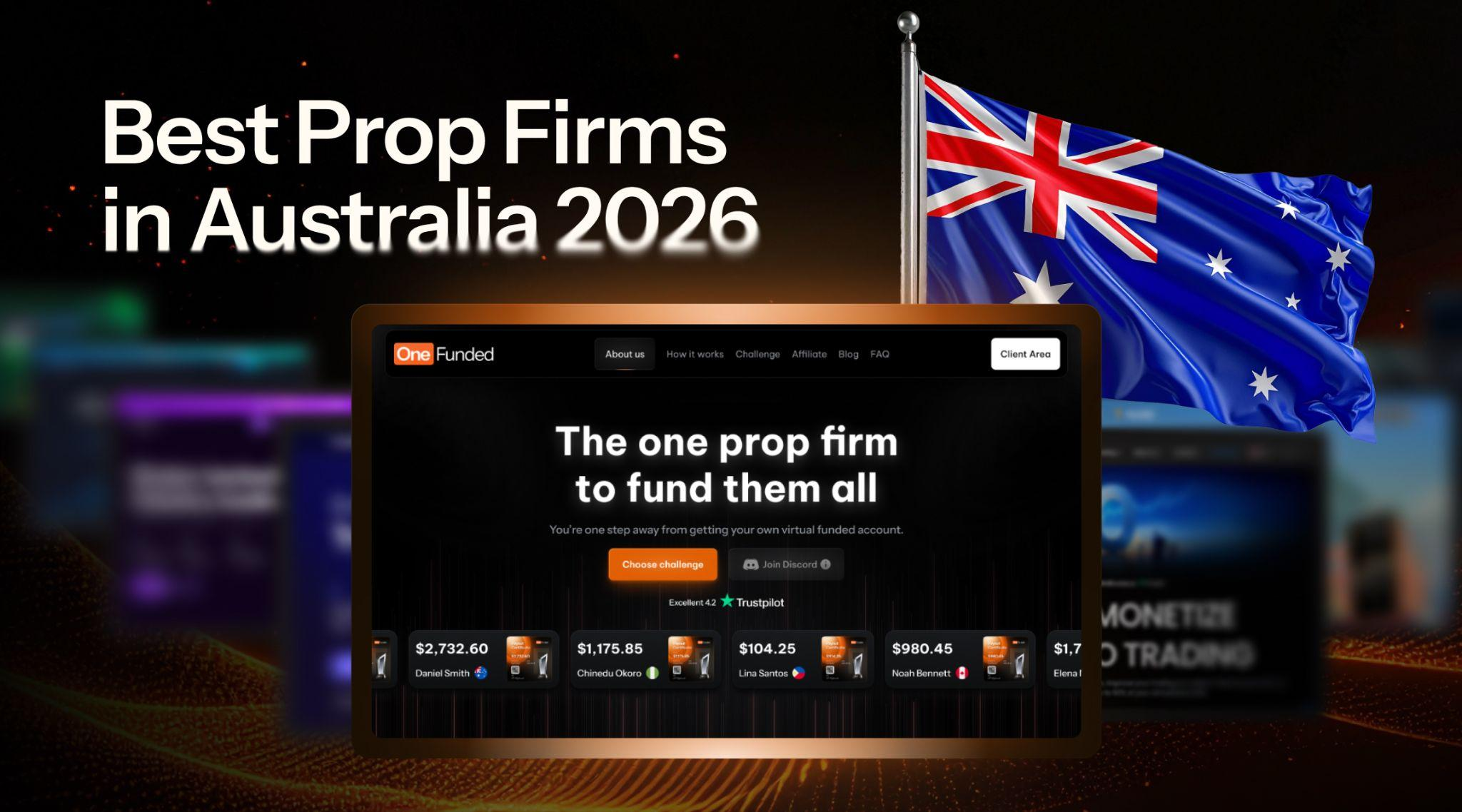
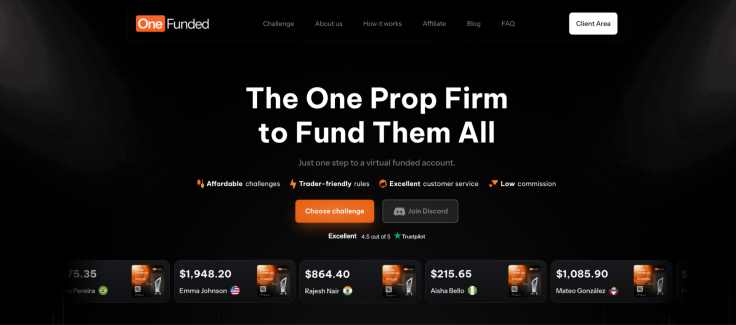
OneFunded operates under Brynex Tech Limited, registered in the United Kingdom, although it delivers trading services through OneFunded Capital Ltd. based in Saint Lucia. The firm operates on a simulated-trading model, which means that traders pay a one-time evaluation fee, complete a challenge, and upon passing, receive a funded account. This account supports payouts of real profits.
OneFunded
Those who choose OneFunded can trade on cTrader and TradeLocker for now and later on MetaTrader 5 too. They can access these platforms on all devices. But if you are an Australian that wants to trade while abroad, say the United States, cTrader won’t be available to you. This makes TradeLocker the most ideal; it is also the primary platform for most OneFunded traders.
Challenge Structures
OneFunded currently offers four challenge tracks: Flash (1-step), Core (2-step), Value (2-step), and Flex (2-step). You should note from the onset that there are no time constraints across all the tracks. This is an important point to note because it removes the psychological pressure common in evaluations that impose deadlines. This feature allows traders to learn how to set up winning traders without feeling the pressure of deadlines.
Advertisement
Flash (1-Step)
This is the only single-phase evaluation in OneFunded’s line up. So, all you need to do is hit the profit target, meet the minimum trading days, and stay within drawdown limits, and you move directly to a funded account. This makes it the fastest route to funding, though it carries the tightest overall drawdown limit of the four tracks.
Core (2-Step)
The Core challenge uses a two-phase structure with a lower profit target in each phase. The drawdown limits are also wider, making it a more forgiving path for traders who prefer building profit incrementally rather than in a single concentrated push.
Value (2-Step)
The Value challenge is the most affordable entry point among the two-phase tracks. It has identical profit targets across both phases and the lowest fee structure. Our research concluded that this track is suited for traders who want to keep the cost of attempting a funded challenge as low as possible. However, the trade-off is a 35% consistency cap and a non-refundable entry fee.
Flex (2-Step)
Flex is the only challenge that completely disables the consistency rule. This makes it particularly relevant for traders whose strategies are naturally lumpy. That includes swing traders holding for a few large moves, or event-driven traders who generate outsized gains on specific days. It is also the most expensive of the four tracks, and the entry fee is non-refundable.
Advertisement
The table below summarizes the key details across the challenge types:
Flash
Core (2-Step)
Value (2-Step)
Flex (2-Step)
Account sizes
$5K – $200K
$5K – $200K
$5K – $100K
$5K – $200K
Entry fee range
$56 – $899
$35 – $799
$29 – $349
$59 – $959
Phases
1
2
2
2
Profit target
10%
8%/5%
6%/6%
7%/4%
Minimum trading days
5
3 per phase
4 per phase
3 per phase
Maximum daily loss
4%
5%
4%
4%
Maximum overall loss
6%
10%
8%
10%
Consistency cap
50%
50%
40%
Off
Trading period
Unlimited
Unlimited
Unlimited
Unlimited
Inactivity limit
60 days
60 days
60 days
60 days
Profit split
80% (90% add-on)
80% (90% add-on)
80% (90% add-on)
80% (90% add-on)
Fee refundable?
Yes, 100%
Yes, 100%
No
No
Trading Rules
OneFunded permits news trading across both evaluation and funded phases. Although this may be restricted during what the firm describes as a “News Volatility Period.” This is a five-minute window on either side of a scheduled high-impact release. During this window, traders may still open, modify, and close positions, but activity that appears designed to exploit price spikes may be flagged for compliance review.
You can also engage in overnight and weekend holding, and there are no mandatory stop-loss requirements. Expert Advisors (EAs) are allowed, though automated strategies that rely on latency arbitrage, data freezing, gap billing, or external delayed data feeds are prohibited.
Payouts
Payouts at OneFunded operate on a 14-day cycle. The first request becomes available on the 15th day following the initial trade on the funded account, covering only the profit earned during those first 14 days. Subsequent payout windows follow the same bi-weekly cadence.
Advertisement
Traders who want access to profits on a shorter cycle can purchase the Weekly Payout Add-on, which reduces the window to every 7 days. The minimum payout amount is $100. And the payment method are Crypto and Bank Transfer
Incentives
OneFunded encourages traders to invest in their career in two ways. First, there is a rewards center. Here, traders accumulate points through platform engagement, which includes completing evaluations, achieving payout milestones, and maintaining consistent trading patterns. These points operate on a progressive redemption scale: 15 points unlock a 15% discount on future challenges, scaling to 100 points which confer a complimentary $5,000 evaluation account.
The second approach is the Leaderboard functionality. This displays verified payout distributions across geographic regions through a self-updating carousel on the platform’s landing page. And it serves dual purposes. First, it provides social proof of the firm’s payout reliability and, second, creates performance benchmarking opportunities.
2. RebelsFunding
Advertisement
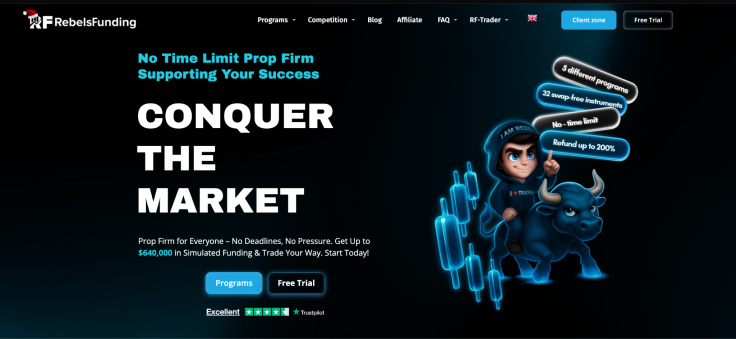
RebelsFunding is a European prop firm formally registered as RIFM, S.R.O., and headquartered in Bratislava, Slovakia. The firm was founded by Marek Soska, whose background is in retail trading and trader education; the firm grew out of a trading education business that had been operating since 2015.
RebelsFunding
Unlike many competitors in this list, RebelsFunding use their own trading platform called RF-Trader. This platform has TradingView charts as a key feature but keeps execution and risk monitoring within their own system. It is available on web, desktop, and mobile.
Program Structure
The company offers five different evaluation programs ranging from a four-step gradual assessment to instant funding. These programs are named after metals and gemstones in ascending order of complexity: Copper (4-phase), Bronze (3-phase), Silver (2-phase), Gold (1-phase), and Diamond (1-phase, 10-level). Each program targets a different trader profile and carries its own rules, drawdown parameters, leverage caps, and scaling potential.
The table below summarizes the key features for each program:
Copper
Bronze
Silver
Gold
Diamond
Evaluation Type
4-Step
3-Step
2-Step
1-Step
Instant Funding
Account Sizes
$1K-$320K
$5K-$160K
$2.5K-$80K
$2.5K-$40K
$1K-$20K
Phase 1 Target
5%
5%
8%
10%
10% (for first payout)
Phase 2 Target
5%
5%
5%
N/A
N/A
Phase 3 Target
5%
5%
N/A
N/A
N/A
Phase 4 Target
5%
N/A
N/A
N/A
N/A
Daily Drawdown
5%
5%
5%
4%
None
Max Drawdown
10%
10%
10%
6%
6%
Min Trading Days
Unlimited time
Unlimited time
Unlimited time
Unlimited time
Unlimited time
Min Trades
4 per phase
5 per phase
6 per phase
8 total
5 total
Leverage (Eval)
1:200
1:200
1:100
1:50
1:50
Leverage (Funded)
1:100
1:100
1:50
1:50
1:50
Profit Split
80-90%
80-90%
75-90%
75-90%
75%
Fee Range
€9-€812
€37-€597
€29-€344
€41-€230
€41-€585
Refund Policy
200% with payout
150% with payout
100% with payout
100% with payout
100% after passing
According to our investigation, RebelsFunding’s Copper and Bronze tracks are built for traders who are either newer to the industry or who want to access large capital allocations at the lowest possible entry cost. But the trade-off is more phases, which means more profit targets to hit before reaching the RCF account. The 200% fee refund on Copper is the highest of any program on the list.
Advertisement
The Silver program is the standard two-phase structure, comparable in format to what most prop firms offer. And the Gold track condenses everything into a single phase. This comes with a 10% profit target, tighter drawdown limits, and the lowest leverage ceiling among the multi-account programs at 1:50. It is the most compressed evaluation.
Lastly, Diamond is the most distinctive in terms of structure. It is a 10-level scaling program where the trader completes a short training round (Level 0), earns back 100% of the entry fee upon hitting a 10% profit target, and then progresses through ten increasingly capitalized RCF account levels. The account grows by approximately 60% at each new level. There is no daily drawdown limit on Diamond; only the 6% overall drawdown applies, and the maximum capital a Diamond trader can reach is $530,000. The profit split on Diamond is fixed at 75% across all levels, whereas the other programs start at 75-80% and can progress to 90%.
Trading Rules
RebelsFunding technically allows news trading across all programs. You should note, however, that the firm’s rules strongly advises against holding positions open during high-impact releases such as NFP, GDP, and FOMC events. The language used is advisory rather than prohibitive, but traders should be aware that accounts can be reviewed for compliance after the fact.
Martingale, grid trading, aggressive scalping, and full-margin strategies are all prohibited. Also, a 1.5% maximum risk per trade is specified, with a recommendation to keep individual position risk closer to 0.5%.
Advertisement
Payouts
You can request the first payout on any RCF account no earlier than 14 days from the date of the first trade. And, the minimum withdrawal amount is $50. The firm processes payouts through the client zone, and all positions must be closed before a withdrawal request is submitted.
Scaling Plan
Each program carries a defined growth plan that applies once a trader is on the RCF account. On Copper and Bronze, accounts increase by 25% of the original value for every three consecutive months, where aggregate profit exceeds 15%, with at least two of those months being profitable. After a year of qualified performance, the account can double in size.
Silver and Gold follow a similar structure but require four consecutive qualified months instead of three. This means that progression is slower via these tracks. Diamond’s scaling is automatic and built directly into the program structure. That is, each time a trader hits 10% profit on their current level, the account size increases to the next level, without requiring a separate request or review process.
What RebelsFunding Gets Right, and Where to Look Closely
The breadth of program options is genuinely useful. A trader who is new to the space and wants to minimize entry cost while building a track record can start with Copper at €9 for a $1K account. On the other hand, a trader with a consistent but slow approach who wants maximum scaling potential has Diamond. The range is wider than most firms on this list.
Advertisement
The areas that deserve attention are the expert advisor (EA) restriction and the news trading advisory. Traders who rely on automated systems will need to look elsewhere. And traders whose edge involves holding positions through major macro events should read the rules documentation carefully before committing, since “advisory” language can translate into practical consequences at payout time.
3. FTMO
FTMO is the benchmark against which most other prop firms are measured, especially because it is one of the established companies in the industry. The firm was founded in 2014 under the Czech name Získej účet, or Get an Account in English, operating only in the Czech Republic and Slovakia, before rebranding to FTMO in 2017 when it expanded internationally.
FTMO
The company has built a massive infrastructure around trader education and analytics. It operates the FTMO Academy and the Account MetriX dashboard for performance tracking. This educational overlay is a notable investment in trader development beyond the basic challenge-passing model.
The firm supports four trading platforms: MetaTrader 4, MetaTrader 5, cTrader, and DXtrade. FTMO also distinguishes between account types through “Normal” and “Aggressive” risk profiles. The latter doubles both profit targets and drawdown allowances for traders seeking accelerated evaluation.
Advertisement
Challenge Structure
FTMO recently introduced a 1-Step challenge alongside its legacy 2-Step process. This move, the company said, gives traders more paths to join the most established prop firm in the prop trading sector.
Both paths operate with unlimited time to complete, though they differ significantly in fee refundability and profit-split structures. The table below summarizes the key features:
FTMO 2-Step Evaluation (Standard Model):
Account Size
Phase 1 Target
Phase 2 Target
Max Daily Loss
Max Overall Loss
Min Trading Days
Fee
$10,000
10%
5%
5%
10%
4 days
€89
$25,000
10%
5%
5%
10%
4 days
€250
$50,000
10%
5%
5%
10%
4 days
€345
$100,000
10%
5%
5%
10%
4 days
€540
$200,000
10%
5%
5%
10%
4 days
€1,080
For all 2-Step accounts, the trading period is unlimited and fees are 100% refundable on first reward withdrawal.
FTMO 1-Step Evaluation:
Trading Objective
FTMO Challenge
FTMO Account
Profit Target
10%
Unlimited
Max Daily Loss
3%
3%
Max Overall Loss
10%
10%
Profit Split
–
90%
Max Account Size
$200,000
$200,000
The 1-Step Challenge condenses the profit target into a single 10% target but retains the entry fee regardless of outcome. And as it was before, you begin to earn payouts at the FTMO account level.
Advertisement
Trading Rules
FTMO has detailed, published trading rules that apply throughout both the evaluation and the funded phase. The following is the list of permitted tools and strategies:
Swing trading and overnight holding (on Swing account type)
EAs/automated strategies, but must remain within server load limits, that is max 2,000 server requests/day.
Scalping
The prohibited list includes:
Gap trading, that is, opening positions within two hours of a scheduled major news event or within two hours before a relevant market closes for two or more hours.
Opposite-position hedging across connected accounts (hedging on a single account is permitted)
Deliberately managing positions to exploit the firm’s evaluation structure
Using slow or erroneous price feeds
High-frequency/ultra-speed tools that give unfair advantages
Payouts
The base profit split is 80% to the trader, which can climb to 90% after meeting scaling plan criteria.
Payout frequency is bi-weekly and the average processing time is 8 hours
100% of the challenge fee is refunded with the first payout
Payment methods include Mastercard, Visa, Discover, Diners Club, Apple Pay, Google Pay, Skrill, and cryptocurrency
Pros and Cons
Pros:
Established track record since 2014 with consistent payout history and substantial processing volumes.
Entry fee fully refunded on the 2-Step Challenge upon first successful payout
Comprehensive educational resources
Choice of four trading platforms including MetaTrader 4, MetaTrader 5, cTrader, and DXtrade.
No time limits on evaluations, allowing traders to wait for optimal market setups.
Cons:
1-Step Challenge offers no fee refund, increasing the cost of unsuccessful attempts.
News trading restricted within 2-minute windows around high-impact releases, limiting strategy flexibility.
Fees are charged in euros regardless of account currency
4. The5ers
The5ers is operated by Five Percent Online Ltd., a company registered in Israel, and has been active since 2016. The firm describes its core philosophy as prioritizing fair play, transparency, and genuine trader development over short-term profit extraction. As of 2025, the firm has onboarded over 262,000 funded traders, employs 148 staff across 23 countries, and processes roughly 3,740 payouts monthly.
The5ers
Program Structure
The5ers offers three CFD evaluation programs, Hyper Growth (1-step), High Stakes (2-step), and Bootcamp (3-step). There is also a Futures track that includes Basecamp and Rebate programs.
All CFD trading is conducted on MetaTrader 5, or MT5 Hedge, and accounts are denominated in USD, EUR, GBP, and INR. The firm’s standout feature is the ability to scale up to $4 million on the Hyper Growth path and $500,000 on the High Stakes path.
The table below summarizes the challenges and their key details:
Advertisement
Hyper Growth
High Stakes
Bootcamp
Evaluation Steps
1-Step
2-Step
3-Step
Account Sizes
$5K-$20K
$2.5K-$100K
$20K-$250K
Phase 1 Target
10%
8%
6%
Phase 2 Target
N/A
5%
6%
Phase 3 Target
N/A
N/A
6%
Max Drawdown
6%
10%
5%
Daily Limit
3%
5%
None (evaluation);3% (funded)
Minimum Trading Days
None
3 profitable days (0.5% min)
None
Time Limit
Unlimited
Unlimited
Unlimited
Profit Share
Up to 100% in eval and funded
$2 in Step 1;80-100% in funded
Up to 100% in funded account
The Hyper Growth program offers the fastest path to funding. Traders pay a one-time fee, starting at $260 for a $5K account, and must hit a single 10% profit target with no time cap. The account doubles at each milestone up to a maximum of $4,000,000.
High Stakes is the firm’s most popular program and features the highest leverage of the three plans at 1:100. Phase 1 requires an 8% profit target; Phase 2 requires 5%. Once funded, traders scale every 10% toward a maximum of $500,000. A unique feature is that Phase 1 pays a small cash reward ($2 per step) before the trader is funded.
The5ers positions the Bootcamp program as the most capital-efficient entry. Phases 1 through 3 each require a 6% profit target on progressively larger demo balances before a trader is funded with a live account starting at $20K, $100K, or $250K depending on the track chosen. The Bootcamp path scales on a 5% milestone cadence and can grow to $4 million.
Trading Rules
These differ by program, particularly around news trading and leverage, but several policies apply across all tracks. For example:
Advertisement
Overnight and weekend holding is permitted across all programs. For indices, weekend holding is allowed but carries high swap costs.
News trading: For Hyper Growth and Bootcamp, news trading is permitted except for bracket strategies placed around high-impact events. For High Stakes, orders may not be executed within 2 minutes before or after high-impact news releases.
Accounts with no trading activity for 30 or more consecutive days are automatically expired across all three programs.
EAs are permitted provided the trader owns the source code
Payout access opens after a trader reaches the first funded level. From that point, withdrawals can be requested on a biweekly basis.
Available withdrawal methods include crypto (2% commission), Rise (2% commission), bank transfer (3% commission), and hub credits (no commission, usable only toward buying new accounts).
Pros and Cons
Pros:
Scaling potential up to $4 million
100% profit split with fixed monthly bonuses at elite High Stakes tiers
Unlimited trading days on evaluations
Wide range of educational resources, including blog, academy, and tools
Cons:
Minimum profitable days requirement
High Stakes prohibits news trading
All withdrawal methods carry a processing fee, 2%-3%, with the exception of hub credits, which are non-withdrawable.
5. ThinkCapital
ThinkCapital is legally registered as Think Capital Services UK Ltd., and is headquartered in London, United Kingdom. The firm launched in 2024 as a subsidiary of ThinkMarkets, a multi-regulated global brokerage with over 15 years in the industry. As of 2026, ThinkCapital has attracted over 40,000 traders to its community and has paid out over $5 million to funded traders worldwide.
ThinkCapital
The broker-backed model is the firm’s most standout structural feature. All trading infrastructure, execution, and liquidity are powered by ThinkMarkets. The broker holds licenses from multiple tier-1 regulators including the FCA (UK) and ASIC (Australia). This distinguishes ThinkCapital from the majority of prop firms that operate on white-labeled retail platforms with no underlying regulatory oversight. Traders also benefit from a proprietary platform, ThinkTrader, as well as direct TradingView integration and Platform 5.
Challenge Structure
ThinkCapital offers three evaluation paths: Lightning (1-step), Dual Step (2-step, with Intraday and Swing sub-variants), and Nexus (3-step). And account sizes range from $5,000 to $100,000 at the challenge level, and the maximum funded allocation reaches $1,000,000.
The table below provides a summary of the accounts and key features:
Advertisement
Lightning (1-Step)
Dual Step Intraday (2-Step)
Dual Step Swing (2-Step)
Nexus (3-Step)
Account Sizes
$5K-$100K
$5K-$100K
$5K-$100K
$5K-$100K
Phase 1 Profit Target
10%
9%
9%
7%
Phase 2 Profit Target
—
5%
5%
6%
Phase 3 Profit Target
—
—
—
5%
Max Loss Limit
6%
7%
7%
8%
Daily Loss Limit
3% (Balance-based)
4% (Equity-based)
4% (Balance-based)
4% (Balance-based)
Min. Trading Days
3
3
3 days
3 days
Leverage
1:30
Dynamic up to 1:100
Dynamic up to 1:100
1:100
News Trading
Not allowed (4-min window)
Not allowed (4-min window)
Allowed
Not allowed (add-on available)
Weekend Holding
Allowed
Not allowed
Allowed
Allowed
Entry Fee range
$59 ($5K);$499 ($100K)
$59-$499
$82-$698
$59-$499
The Lightning program is ThinkCapital’s fastest evaluation path. However, the Dual Step program is the most structurally flexible program due to its two sub-variants tailored for different styles. The Intraday variant uses an equity-based daily loss and prohibits news trading and weekend holding. This makes it ideal for traders who enter and exit within a session. The Swing variant uses a balance-based daily loss, and it permits news trading without restriction, and allows weekend holding. This is a great option for traders who hold positions across multiple sessions.
Trading Rules
All three programs require at least three profitable trading days before a challenge phase can be completed.
There is no maximum trading period on any of the three programs
An account is subject to closure if no trades are placed for 30 or more consecutive days across all programs.
EAs are permitted across all programs without restriction on whether the trader owns the source code.
No consistency rule is enforced on any of the three programs
Payouts and Profit Split
The base profit split across all programs starts at 80%. You can escalate the share to 90% through scaling or using an addon. And there is no consistency rule requirement before requesting a payout.
The standard payout cycle is biweekly, although traders can access weekly payouts by purchasing an addon. Before the first withdrawal, funded traders must achieve three separate profitable trading days where the account balance is above the starting balance, with each of those days generating at least 0.5% profit. This consistency metric is specifically tied to payout qualification, not to challenge phase completion.
Withdrawal methods include cryptocurrency, USDT (TRC20/ERC20) and USDC, which is generally the fastest option, Rise; with a $50 monthly flat fee for processing, and ThinkMarkets Live Account.
Pros and Cons
Pros
Being broker-backed provides a level of execution quality, financial stability, and counterparty credibility rarely found in standalone prop firms.
The ability to transfer profits directly into a personal ThinkMarkets brokerage account.
No consistency rule on any program
Dual Step Swing variant gives news traders and swing traders a purpose-built path without requiring any add-on purchase.
Cons
News trading restricted by default on Lightning and Nexus
Payout 0.5% consistency requirement before first withdrawal
Rise payout method carries a recurring $50 flat fee per month
6. BrightFunded
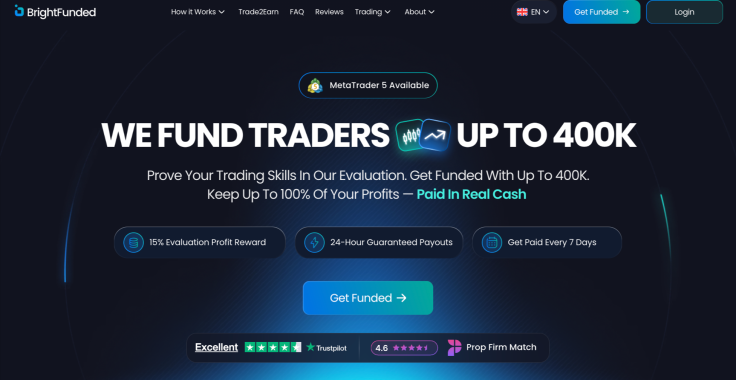
BrightFunded, like OneFunded, is a new company, launched in late 2023, that is coming up quickly, especially in Australia. The company is headquartered in Dubai and has satellite offices in Amsterdam, Netherlands and Warsaw, Poland. Despite its age, the firm claims to have already paid out more than $11.5 million to funded traders and counts over 27,500 active participants globally.
Advertisement
BrightFunded
The prop firm describes its model as a “modern prop trading firm,” that emphases fast payouts, transparent rules, and a proprietary loyalty rewards program it calls Trade2Earn. Australians can access all of BrightFunded programs and services without any restrictions.
Challenge Structures
BrightFunded offers a single evaluation program, which it has structured into two phases. The challenge is available across six account sizes, with entry fees scaling proportionally from smaller to larger allocations.
The structure is straightforward. Traders must hit an 8% profit target in Phase 1 and 5% in Phase 2. While at it, they must keep daily drawdown below 5% and total drawdown below 10% at all times. Both phases have unlimited trading periods and a minimum of 5 trading days per phase.
See the table below for details:
Account Sizes
$5K/$10K/$25K/$50K/$100K/$200K
Phase 1 Target
8%
Phase 2 Target
5%
Daily Drawdown
5%
Maximum Drawdown
10% (static from initial balance)
Minimum Trading Days
5 per phase
Time Limit
Unlimited
Leverage
Up to 1:100
Entry Fee Range
€55-€975
Fee Refund
Yes (with first payout)
Profit Split Start
80%
Maximum Profit Split
100% (via scaling)
Trading Rules
One of the key rules is the drawdown style, where the firm enforces a static EOD high-watermark drawdown. It measures the limit against the highest balance or equity recorded at the close of the previous trading day. This means drawdown limits do not trail intraday price peaks, which is notably trader-friendly compared to firms using trailing drawdowns.
Advertisement
On news trading, the rules vary by account phase. In phase one and two of the challenge stage, news trading is unrestricted. Traders may open, close, or adjust positions around any economic event without limitation.
But when it gets to the Funded Star Account, a 10-minute window applies to targeted instruments. Opening or closing trades, or triggering stop loss or take profit orders within this window, constitutes a “soft breach.” That is, profits from the affected trade are deducted, but the account is not terminated. Trades held for more than 48 hours prior to the event and closed during the window are exempt.
The firm also prohibits certain strategies across all phases, including:
Hedging across multiple accounts
Exploiting platform delays, data feed lags, or technical errors
Coordinated multi-account manipulation
Grid trading, arbitrage, tick scalping, and high-frequency trading
Use of AI or automated tools designed for superhuman execution speed
Overleveraging, overexposure, or account rolling
Payouts
Once a trader passes the second phase and signs their Funded Star Account contract, they may request their first payout after 30 days from placing the first trade on the funded account. Subsequent payouts can be requested every bi-weekly by default.
The company supports payouts via bank transfer, processed in Euros, and USDC via ERC-20 network. It processes payouts within 24 hours of request.
Advertisement
Pros and Cons
Pros
No consistency rules or profit caps
Fixed drawdown, not trailing
Unlimited trading period for the evaluation phase
24-hour payouts with a minimum threshold of $0.01
Trade2Earn loyalty program rewards trading volume with redeemable tokens for free evaluations, discounts, and higher profit splits.
Cons
Headquartered in Dubai with no regional presence in Australia or the Asia-Pacific
Payouts are denominated in Euros or USDC
Scaling is not automatic; traders must proactively request it through support
7. City Traders Imperium
City Traders Imperium, or CTI, launched in 2018 in London, the UK, but operates from Dubai. The firm describes itself as a unique organization because it has two distinct offerings under one roof: a trading academy and a funding division. These programs run concurrently. The academy side, CTI Academy, is included free with every funding program purchase, meaning Australian traders are not just getting capital access but an accompanying educational environment built by practicing traders.
But the company’s most defining feature must be the VIP Program. This is a loyalty tier system that rewards consistent funded traders with progressively better conditions. It culminates at the Gold level where a potential one-year monthly salary is available.
Challenge Structures
If you choose CTI, you can join via two evaluation paths or two instant funding tracks. The second instant funding path is a VIP program that operates differently from the other three.
The table below summarizes the key details of the paths:
Advertisement
1-Step Challenge
2-Step Challenge
Instant Funding
Instant Funding Pro
Account Sizes
$2.5K-$100K
$2.5K-$100K
$2.5K-$80K
$5K-$80K
Phase 1 Profit Target
8%
10%
10% per level to scale
10% per level to scale
Phase 2 Profit Target
N/A
5%
N/A
N/A
Max Daily Drawdown
None
5% of initial balance
None
None
Max Overall Drawdown
5% trailing
10% static
6% static
6% static
Min Profitable Days
3
3 per phase
Based on Consistency Score (20%)
Based on Consistency Score (20%)
Profit Share
80%-100% for CTI Trader (Funded)
80%-100% for CTI Trader (Funded)
Up to 100%
Up to 100%
Entry fee range
$27-$412
$34-$482
$62-$1,315
$263-$4,223
The firm also operates a VIP Program that rewards consistent performance with escalating benefits. Some of its key features include:
Scaling occurs when traders achieve 10% profit targets in the funded account. This doubles account sizes up to a maximum of $4 million in total buying power. The firm permits up to three accounts simultaneously, with specific combination rules, for example, one $250,000 account plus two $100,000 accounts.
Trading Rules
CTI’s rules are quite permissive by industry standards. They include:
The 1-Step Challenge uses a maximum trailing drawdown of 5%
The 2-Step Challenge uses a balance-based daily drawdown, 5%, and a static overall drawdown, 10%. Both are calculated from the initial balance rather than floating equity.
The Instant Funding programs use a static drawdown of 6% of the initial balance with no daily cap and no trailing component.
Permitted strategies include: News trading, Weekend and overnight trade holding, Third-party EAs are permitted on the 1-Step Challenge, provided they are not used for copy trading.
Payouts
CTI, like most prop firms, supports payouts at the funded stage. The first payout is on demand once the trader has at least seven profitable trading days and a minimum of 2% net profit, or $100, whichever is greater. Subsequent payouts are monthly, during the last five business days of each month. And after the trader’s first 10% cumulative profit is achieved, payouts become bi-weekly.
If you achieve funded status via the instant funding track, you get 50% profit share at level 1, but after you hit the 10% profit target. From Level 2 onwards, and all Instant Pro levels, the first payout is on demand, but only once you reach five profitable trading days and 2% net profit. The firm supports withdrawals via bank cards, bank transfers, Wise, PayPal, Revolut, and crypto.
Pros and Cons
Pros:
Monthly salary program provides steady income for funded traders regardless of monthly performance.
All challenge types allow unlimited time to complete
News trading, weekend holding, and automated strategies permitted without restrictions.
Fast payout processing within 24 hours via cryptocurrency or bank transfer
Profit splits scale up to 100% through the VIP Program
Cons:
CTI is not regulated by ASIC
First payout requires seven profitable trading days plus 2% profit
Instant Funding option starts with only 50% profit split, lower than industry standard entry levels.
8. FXIFY
FXIFY launched in 2023 and is operated by FXIFY Solutions Limited, a UK-registered company based in London. It has a separate licensed entity, FXIFY Markets Ltd., that holds a money broker license in Labuan, Malaysia. According to its founders, David Bhidey and Peter Brown, FXIFY was built on the foundation of a group of fintech and FX companies. They describe themselves as carrying over 20 years of brokerage industry experience. The firm uses FXPIG, a licensed broker, as its partner for execution.
Advertisement
FXIFY
Challenges Structure
FXIFY’s range of programs is the widest available across the firms in this list. There are five distinct products within the FX/CFD division alone, and one crypto-focused path. The following table summarizes the key details of the non-crypto tracks:
One Phase
Two Phase
Three Phase
Instant Funding
Lightning Challenge
Evaluation Phases
1
2
3
None
1
Account Sizes
$5K-$400K
$5K-$100K
$5K-$400K
$1K-$100K
$10K-$100K
Phase 1 Profit Target
10%
5%
5%
No target
5%
Phase 2 Profit Target
N/A
10%
5%
N/A
N/A
Phase 3 Profit Target
N/A
N/A
5%
N/A
N/A
Max Daily Drawdown
3%
4%
5%
8%
3%
Max Overall Drawdown
6% trailing
10% static
5% static
8% trailing
8%
Min Trading Days
5
5 per phase
5 per phase
N/A
3
Time Limit
Unlimited
Unlimited
Unlimited
N/A
5 days
Consistency Rule
None
None
None
None
30%
Profit Split
Up to 90%
Up to 100%
Up to 90%
Up to 90%
Up to 90%
News Trading
Allowed
Allowed
Allowed
Not allowed
Not allowed
Weekend/Overnight Holds
Allowed
Allowed
Allowed
Not allowed
Allowed
EAs
Allowed
Allowed
Allowed
Not allowed
Not allowed
Entry fee range*
$42.48-$2124
$42.48-$395.28
$49.68-$1151.28
$28.08-$3059.28
$42.48-$287.28
*The entry fees are discounted.
Permitted and Prohibited Strategies
News trading is fully permitted on One Phase, Two Phase, and Three Phase programs, and proscribed on Instant Funding or Lightning Challenge accounts.
EAs and algorithmic trading are permitted on evaluation accounts only
Martingale and grid strategies are listed as permitted addons in FXIFY’s checkout, though the prohibited strategies policy cautions against “doubling down” in a pure loss-recovery context without underlying risk management.
Reverse hedging, group hedging, account management, and high-frequency trading are all expressly prohibited.
Payouts
Like most firms, payouts are available for funded traders. And FXIFY supports on demand on several account types, although this is only possible after a minimum of five trading days and a $50 minimum account balance. Also, no minimum profit percentage is required for the first payout. Subsequent payouts are allowed monthly, or bi-weekly if you purchase the Bi-Weekly Payouts addon at checkout.
FXIFY processes payouts via Rise, and where this method is unavailable, the firm supports crypto.
Pros and Cons
Pros:
Fee is 125% refundable upon first payout
Unlimited time on most challenges
Broker-backed infrastructure through FXPIG
First payout is truly on demand after 5 trading days with no minimum profit percentage target.
Cons:
Lightning and Instant Funding programs prohibit EAs
News trading is restricted on Instant Funding and Lightning Challenge accounts
Trailing drawdown on One-Phase and Two-Phase programs tightens risk limits as profits accumulate.
How These 8 Firms Compare at a Glance
Firm
Max Allocation
Profit Split
Evaluation Steps
Best Feature
Trustpilot Rating
OneFunded
$200,000
80% (up to 90%)
1-Step or 2-Step
Rewards Center; Leaderboard; unlimited evaluation time; 100% fee refund on Flash and Core, Clear and Transparent Rules
4.5/5
RebelsFunding
$320,000 (up to $530,000 via scaling)
75-90%
1-Step, 2-Step, 3-Step, 4-Step, or Instant
Five tiered programs (Copper to Diamond); up to 200% fee refund on Copper; proprietary RF-Trader platform
4.4/5
FTMO
$200,000
80% (up to 90%)
1-Step or 2-Step
Established track record since 2014; FTMO Academy educational resources; Account MetriX analytics; fee refund on 2-Step
4.8/5
The5ers
$4,000,000
Up to 100%
1-Step, 2-Step, or 3-Step
Scaling potential up to $4 million; monthly salary at elite High Stakes tiers ($4,000-$10,000); unlimited time on all programs
4.8/5
ThinkCapital
$1,000,000
80% (up to 90%)
1-Step, 2-Step, or 3-Step
Broker-backed by regulated ThinkMarkets; direct TradingView integration; Dual Step Swing variant permits news trading
Monthly salary program for funded traders; VIP Program tiers (Bronze/Silver/Gold) with escalating benefits; unlimited time on all challenges
4.4/5
FXIFY
$400,000
Up to 90% (up to 100% on Two Phase)
1-Step, 2-Step, 3-Step, or Instant
125% fee refund upon first payout; five distinct program paths (One Phase to Lightning); broker-backed via FXPIG
4.4/5
What to Look for When Choosing a Prop Firm in Australia
It doesn’t really matter where you are, in Australia or elsewhere, the rules of choosing a prop firm are the same. In that case, here are a few tips to guide you:
Regulatory Standing and Company Transparency
No prop firm operating in Australia is currently regulated by ASIC; that applies to every firm on this list. But what separates the more trustworthy ones from the rest is transparency about who runs the company, where it is registered, and who holds the trading capital.
So, look for firms that publish their company registration details, have verifiable leadership, or operate through a licensed broker partnership. Beyond registration, check whether the firm has an Australian Privacy Policy, accepts Australian traders explicitly, and has a track record of consistent payouts.
Advertisement
Challenge Rules That Match Your Trading Style
The fine print in a prop firm’s rulebook can end your funded account faster than a losing trade. Before signing up, identify what your trading style actually requires and match it against the firm’s rules. Watch out for:
Drawdown type: Static drawdowns are more predictable; trailing drawdowns move with your equity, which can catch swing traders off guard
Consistency rules: Some firms require that no single day account for more than a set percentage of total profits, which restricts aggressive trading days
News trading: If you trade around RBA rate decisions or US NFP, confirm the firm allows it.
Weekend holds: Relevant for traders who carry positions over the Sydney open on Monday mornings
Pricing, Fees, and the Fee Refund Policy
Challenge fees vary significantly across firms, and the cheapest option is not always the best value. For instance, a $59 Two Phase challenge sounds attractive, but if it comes with no fee refund, a tighter drawdown, and a lower performance split, then a slightly more expensive program with a 100% refund on the first payout may cost less in practice.
Performance Split and Scaling Potential
The profit split percentage is what most traders focus on, but the scaling plan matters just as much for anyone thinking beyond their first funded account. A firm offering 80% on a $10K account with no scaling path is worth less over time than one offering 75% on a $100K account that can grow to $4M.
Payout Reliability and Methods Available to Australian Traders
A funded account is only as valuable as the firm’s ability to pay you. For Australian traders, the most practical payout routes are bank transfer and cryptocurrency; both are widely supported. The primary platform used by most firms on this list is Rise (RiseWorks), which supports bank withdrawals in AUD once KYC is completed.
Also, check reviews specifically for payout complaints, not just general satisfaction scores. Look at how long payouts typically take, whether there is a minimum withdrawal threshold that suits your trading size, and whether the firm has ever paused or delayed payments without clear communication. Firms with a published payout leaderboard or live proof-of-payment feeds offer an additional layer of confidence.
Advertisement
Customer Support and Community
When something goes wrong, the quality of support determines whether you recover from it or simply lose your account. So, look for firms that offer live chat during hours that overlap with the Australian trading day, maintain an active Discord or community, and respond to support tickets within a reasonable timeframe.
It has struck a new long-term lease at its Port of Cardiff terminal operation with Associated British Ports
15:00, 10 Jun 2026Updated 15:05, 10 Jun 2026
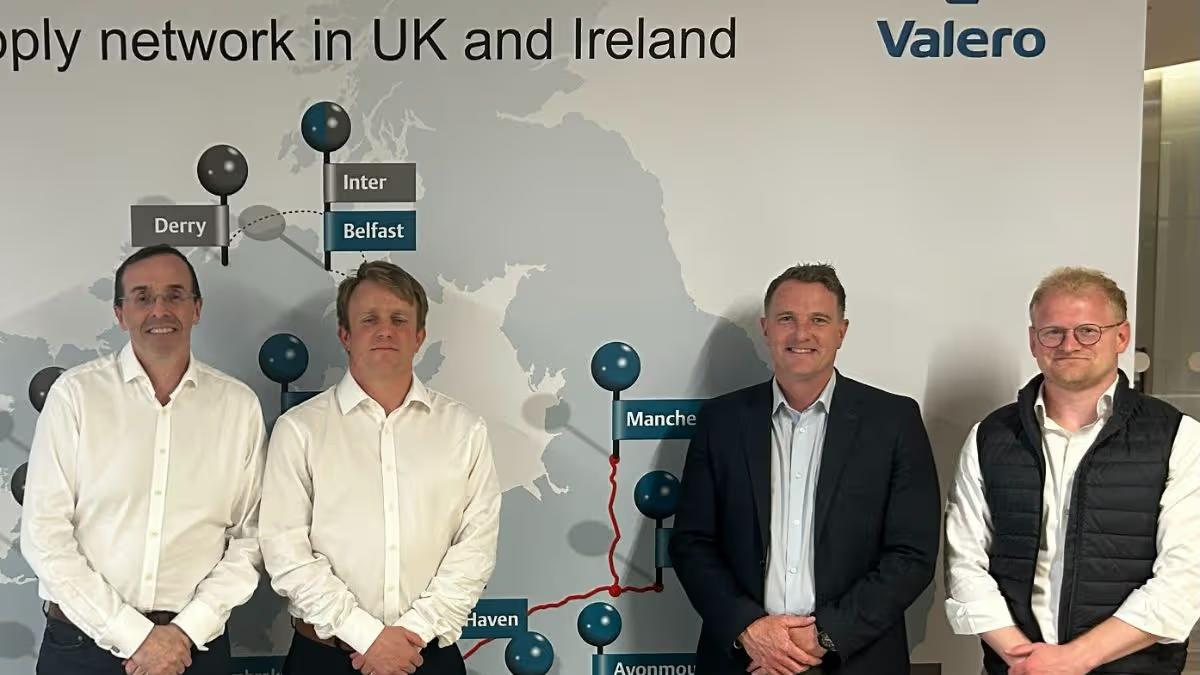
From left to right: David McLoughlin, director pipelines and terminals, Valero; Haydn Dawson, lead estates Manager, ABP; Richard Butler, lead commercial director, ABP and Sam Marsh, director of product supply, Valero.
One of the world’s biggest independent petroleum refiners, Valero, has committed to its Port of Cardiff operation for the long-term.
The company has agreed a new long-term lease with the port’s owner Association British Port’s for its 12-acre liquid fuels terminal at Roath Dock, the largest such facility at the Port of Cardiff.
Advertisement
The deal safeguards skilled jobs on site and supports the supply of fuel for households, businesses, airports and commercial fleets across South Wales, the south west of England and the M4 and M5 corridors. It also takes thousands of HGV’s off the road network by linking Valero’s Pembroke refinery with Cardiff by vessels accessing coastal shipping routes.
Valero, as operated at Cardiff since 1996 and continues to invest in the terminal to support significant annual throughput by sea. The new agreement provides certainty for long-term operations, while enabling further investment to extend the life and resilience of critical energy infrastructure.
As part of the long-term lease ABP will invest in port infrastructure to further support Valero’s forward investment programme. The agreement is expected to generate long-term economic value for the port while strengthening Cardiff’s role as a strategically important energy gateway
Richard Butler, lead commercial manager at ABP, said: We are delighted to extend our partnership with Valero at the Port of Cardiff, supporting vital fuel supplies and critical jobs across South Wales for decades to come.
Advertisement
“This new agreement with demonstrates our shared commitment to support regional economic activity and ensuring the Cardiff City Region continues to benefit from reliable access to essential energy supplies.
“This investment also reflects ABP’s long-term confidence in Cardiff and our role in supporting the UK’s energy security.”
The Port of Cardiff is one of ABP’s key ports in South Wales as a hub for energy, bulk and general cargoes.
The NFO market remained subdued. Of the 13 funds launched in May, 12 of them were from the passive space (Index as well as ETF). Together, they garnered net assets worth 471 cores highlighting investors cautious stance by not going overboard, said Himanshu Srivastava, Principal, Manager Research, Morningstar Investment Research India.
The annual celebration of the best businesses in the Humber area will take place on November 19
15:19, 10 Jun 2026Updated 15:23, 10 Jun 2026
Hull and East Yorkshire Business Awards – FEO chair and current Entrepreneur of the Year, David Hall, second right, and Hull and East Yorkshire Business Awards organisers Simon Jones and Jane Smallwood, left, with Jan Brumby, CEO of FEO, right.(Image: Fred PR/Hull and East Yorkshire Business Awards)
Hull and East Yorkshire Business Awards are back for 2026, with a double award winner from last year’s silver anniversary spectacular now helping shape its future success.
Since an emphatic evening at the gala celebration in November, Beverley Leisure Homes managing director David Hall has been elected as chair of headline partner For Entrepreneurs Only, the Hull-based leadership support organisation.
Advertisement
The royally-recognised group joined forces with talent entrepreneur Simon Jones and events specialist Jane Smallwood in 2025, with Mr Hall now committing the past Queen’s Award winner for the long term.
He said “FEO should be associated with the biggest events as we are one of the biggest business organisations out there. Simon has really given it a different feel, injecting his youthful enthusiasm, so it is good for FEO to ensure that support is there. I see it as a long-term relationship between FEO and Hull and East Yorkshire Business Awards, and as a partnership we’re learning together. There’s a drive from both organisations to make what they do better each year.”
Hull and East Yorkshire Business Awards(Image: Fred PR/Hull and East Yorkshire Business Awards)
Mr Jones, who is behind the acclaimed Top 30 Under 30 programme, is preparing for the third edition of the awards under his watch, and the 26th since it was launched by the Hull Daily Mail. Last year saw a 45% increase in entries across the 12 categories.
And the winning experience has fired up Mr Hall when it comes to the Hull and East Yorkshire Business Awards, having been named Entrepreneur of the Year while his Beverley Leisure Homes company was recognised as Small Business of the Year. He said: “I didn’t realise quite how important these events were, for the business and for the team. We spend so much time in an industry bubble, where we’re quite well known, but we were all inspired by what we saw from the local business community.
Advertisement
“To win was fantastic for the business too. The awards sit next to our signing-in book in our reception, so whether it is a couple coming to look at a new lodge or someone selling insurance, they know we have won. They are great talking points, and with the industry having been in quite a negative place over the past few years, to have such a positive story is a refreshing change for us. It was a focal point for the business year.”
Three major new partners are also on board for 2026, with BAE Systems, H&H Comms and Siemens Gamesa joining the existing backers.
Businesses across Hull and East Yorkshire are now being invited to elevate themselves in such a manner, with entries for 2026 now open.
Mr Jones said: “It was a big step forward last year. We are building confidence in the awards, and we need to celebrate and provide that platform.
Advertisement
“It is more important than ever, that we celebrate success as a business community. We are all facing challenges, we all know it is not easy out there, that’s why good news, making a difference and growing and trying things against the tide is really something to shout about. We need to showcase what is possible in difficult times. It is easy to say ‘not now’ when things are tough, it gives us excuses for not doing things and not being bold. We need more people to be bold and brave, not less.”
The entry window closes on September 18, with the gala celebration on November 19 at DoubleTree by Hilton Hotel in Hull. Full details of how to enter and the criteria for each category can be found on the website – www.heybusinessawards.co.uk
This year’s award categories are:
Lifetime Achievement Award
Advertisement
Start-Up Business of the Year (Less than two years old)
Small Business of the Year (Less than 50 employees)
The author is presently an entrepreneur and an investor focused on investing in public companies. The author has over ten years of financial services experience, which includes long and short bottoms up fundamental buy-side research, private equity, M and A Advisory, and accounting. See SA policy on anonymous authors: http://seekingalpha.com/page/policy_anonymous_contributors Disclaimer: In no event will the author writing under the pen name Research and Value (hereafter referred to as R&V) or any affiliated party be liable for any direct or indirect trading losses caused by any information published by R&V. Use of the author’s articles is at your own risk. You should do your own research and due diligence and consult with your own advisers before making any investment decision with respect to securities discussed in articles published by the author. No publication made by R&V is an offer to sell or a solicitation of an offer to buy any security, nor shall any security be offered or sold to any person, in any jurisdiction in which such offer would be unlawful under the securities laws of such jurisdiction. R&V is not registered as an investment advisor in the United States or has similar registration in any other jurisdiction. R&V strives to provide accurate and reliable information contained in its articles, however no-one is error free and R&V is not responsible for any errors, omissions, or accuracy of any and all information presented in its articles. All information is presented “as is,” without warranty of any kind, whether express or implied. R&V makes no representation, express or implied, as to the accuracy, timeliness, or completeness of any information or with regard to the results to be obtained from its use. All expressions of opinion are subject to change without notice, and R&V does not undertake to update or supplement its articles or any of the information contained therein.
Analyst’s Disclosure: I/we have a beneficial long position in the shares of HUBS either through stock ownership, options, or other derivatives. I wrote this article myself, and it expresses my own opinions. I am not receiving compensation for it (other than from Seeking Alpha). I have no business relationship with any company whose stock is mentioned in this article.
Seeking Alpha’s Disclosure: Past performance is no guarantee of future results. No recommendation or advice is being given as to whether any investment is suitable for a particular investor. Any views or opinions expressed above may not reflect those of Seeking Alpha as a whole. Seeking Alpha is not a licensed securities dealer, broker or US investment adviser or investment bank. Our analysts are third party authors that include both professional investors and individual investors who may not be licensed or certified by any institute or regulatory body.
With a professional background spanning multiple industries, from ecnomocis to logistics and construction to retail, I bring a diverse perspective to investing. My international education and career experiences have provided me with a global outlook and the ability to analyze market dynamics from different cultural and economic perspectives. I have been actively investing for over a decade, honing a strategy that focuses on cyclical industries while maintaining a diversified portfolio that includes bonds, commodities, and forex. My interest in cyclical sectors stems from their potential for significant returns during periods of economic recovery and growth. However, I also recognize the importance of balancing risk, which is why I incorporate fixed-income investments (long or short).
Analyst’s Disclosure: I/we have no stock, option or similar derivative position in any of the companies mentioned, and no plans to initiate any such positions within the next 72 hours. I wrote this article myself, and it expresses my own opinions. I am not receiving compensation for it (other than from Seeking Alpha). I have no business relationship with any company whose stock is mentioned in this article.
Seeking Alpha’s Disclosure: Past performance is no guarantee of future results. No recommendation or advice is being given as to whether any investment is suitable for a particular investor. Any views or opinions expressed above may not reflect those of Seeking Alpha as a whole. Seeking Alpha is not a licensed securities dealer, broker or US investment adviser or investment bank. Our analysts are third party authors that include both professional investors and individual investors who may not be licensed or certified by any institute or regulatory body.
The rupee closed at 95.2650 per dollar, up marginally compared to its close of 95.35 in the previous session.
The local currency oscillated between 95.11 and 95.56 over the course of the trading session. State-run banks were spotted offering dollars and conducting dollar-rupee buy/sell swaps, most likely on behalf of the Reserve Bank of India, traders said.
Brent oil prices steadied near $90 per barrel on Wednesday after swinging between $98 and $89 per barrel over the previous two sessions.
Advertisement
Iran’s Revolutionary Guards said they had carried out missile and drone attacks on U.S. military bases in Jordan, Kuwait and Bahrain on Wednesday in retaliation for American strikes on Iranian targets around the Strait of Hormuz.
Live Events
“The initial market response to renewed military strikes between Iran and the U.S. has been relatively muted suggesting confidence that the fallout will be contained,” MUFG said in a note. The escalation in violence though deepens doubts about the prospects for a deal to end the war that started on February 28 and has sparked the most severe oil supply disruption in history, clouding the outlook for energy importing economies like India.Later in the day, the focus will turn to the release of U.S. consumer inflation data for May. The data is expected to show that CPI rose 4.2% year-on-year last month, up from 3.8% in April.
“With the distribution of outcomes unusually wide, today’s CPI release carries heightened potential for outsized market moves relative to recent data prints,” per MUFG.
Presenting its new targets at an investor day, Kongsberg said it is aiming to increase revenue from 33 billion Norwegian kroner ($3.47 billion) in 2025 to 100 billion kroner in 2029 and 150 billion kroner in 2033. It targets an operating margin of over 16%, from 15.1% in 2025.
KUWAIT CITY, Kuwait — Kuwait International Airport was open on Tuesday, June 10, with flights operating after a phased reopening that has gradually restored service at the country’s main aviation hub. Official departures information remained live, and flight-status pages showed active departures along with some delays and cancellations.
The reopening marks a return to service after the airport was disrupted by regional conflict and then brought back online in stages. Terminal 1 reopened June 1, according to an Associated Press video report, while other terminals had already resumed limited traffic before that. The result is an airport that is functioning again, though not all operations appear to have returned to pre-disruption levels.
AP’s June 1 report quoted Mansour Al-Hashemi, director of operation at Kuwait airport civil aviation, saying: “Kuwait Airport has resumed flights from terminal one”. He also said, “Flights will resume today, with each airline operating one flight per day,” as the airport moved to restart service under tighter conditions. The same report said passengers were seen checking in and moving through the terminal as the airport resumed operations.
Live flight listings on Tuesday showed departures from Kuwait International Airport, including Kuwait Airways and Jazeera Airways flights, along with some canceled and delayed services. That mix suggests the airport is open today, but airline operations remain somewhat uneven as the system normalizes. Travelers with flights through Kuwait should verify terminal and gate details directly with their carrier before heading to the airport.
Airport officials had earlier said service would return in phases, and the current flight boards reflect that approach. The airport’s official departures page is currently active, reinforcing that operations are ongoing. For now, the clearest answer for travelers is straightforward: Kuwait International Airport is open today, but passengers should still expect schedule changes and airline-specific restrictions.




























![DJ KANJI - MONEY UP (feat. 7 & eyden) [Official Music Video]](https://wordupnews.com/wp-content/uploads/2026/04/1776001891_maxresdefault-80x80.jpg)

































You must be logged in to post a comment Login