

Crypto World
Grvt Launches 3 Tokenized Yield Funds Backed by Institutional RWAs


Decentralized derivatives platform Grvt is partnering with tokenization specialist Plume to launch three tokenized real-world asset (RWA) yield products. The move integrates fixed-income and structured-credit exposure directly into Grvt’s platform, enabling users to access on-chain yield strategies from self-custodial wallets without moving assets to separate venues.
The products will track tokenized institutional-grade assets, including exposure to the iShares AAA CLO Active ETF, which totals roughly $2.2 billion in assets. The three investment vehicles — Base Yield Fund, Balanced Fund and Opportunistic Fund — will be available inside Grvt’s trading environment, letting users tap into yield strategies from the same wallet they already use for perpetual futures trading.
Plume, which focuses on tokenized real-world assets, provides the on-chain yield infrastructure that underpins these products. Grvt’s announcement notes that the arrangement merges tokenized fixed-income exposure with Plume’s network, expanding the utility of perpetual futures by layering yield opportunities onto the same self-custodial balance.
Perpetual futures contracts, or perps, are a staple for traders seeking to speculate on price movements without owning the underlying asset. Unlike traditional futures, perps carry no expiration, allowing positions to be maintained indefinitely. Grvt’s daily trading activity sits within a wider DeFi ecosystem that processed about $15.2 billion in perpetual DEX volume over the last 24 hours, according to data from CoinGecko, with Grvt handling around $1.23 billion of that turnover.
In February, Grvt also integrated the Aave lending protocol to let traders earn yield on margin collateral while their perpetual positions remain open, illustrating the platform’s ongoing push to combine on-chain liquidity with yield opportunities.
Key takeaways
- Grvt and Plume will launch three tokenized RWA yield products — Base Yield Fund, Balanced Fund, and Opportunistic Fund — integrated directly into Grvt’s platform.
- The products provide exposure to tokenized institutional-grade assets, including about $2.2 billion in iShares AAA CLO Active ETF assets.
- Access to the yield strategies is designed to occur within self-custodial wallets used for trading, eliminating the need to transfer assets across separate custody or brokerage setups.
- Overall market activity for perpetual futures remains substantial, with 24-hour DEX volume near $15.2 billion and Grvt contributing roughly $1.23 billion of that total.
RWAs on-chain: scale, momentum and what changes for users
The Grvt–Plume collaboration sits amid a broader surge in tokenized real-world assets, a sector that data provider RWA.xyz puts at more than $34 billion in on-chain value. That figure marks a substantial increase from about $5.8 billion at the start of 2025, underscoring rising institutional interest in on-chain renditions of traditional financial products.
The trend is visible across the crypto ecosystem as exchanges, trading venues, and tokenization firms push to bring asset classes like fixed income, private credit and securitized assets onto blockchains. For readers following the rails that enable these products, the momentum is as much about infrastructure as about novelty — from tokenized funds to on-chain settlement and collateral models that could broaden access to traditional assets for crypto traders and institutions alike.
In context, the market momentum is mirrored by notable cross-sector moves. In March, EtherFi allocated $25 million to Plume’s Nest protocol to provide users with exposure to tokenized yield strategies tied to institutional assets and government securities. Around the same time, BTC Markets signaled plans to approach Australia’s securities regulator for a markets license to offer tokenized RWAs, including equities and bonds. Earlier in February, Binance expanded its tokenized assets by adding tokenized equities and ETFs from Ondo Finance to its Binance Alpha platform. Separately, Securitize announced a collaboration with Hamilton Lane, OKX Ventures and stablecoin infrastructure provider STBL to launch a stablecoin backed by tokenized private credit assets.
Industry observers also point to research from Boston Consulting Group, which in a May report highlighted tokenized funds, collateral and fixed-income products among the digital-asset offerings most likely to gain broader institutional adoption over the coming decade. The shift signals digital assets moving beyond purely speculative trading toward infrastructure that supports payments, settlement and capital markets operations.
What to watch next: integration, adoption and regulatory signals
The Grvt–Plume integration adds a concrete use case for on-chain yield in a space where tokenized RWAs are increasingly seen as a differentiator for platforms seeking richer, income-generating offerings. For investors and traders, the key questions are how quickly these products scale, what risk controls accompany tokenized fixed income on-chain, and how on-chain yield will interact with broader regulatory expectations as tokenized RWAs grow in prominence.
As ecosystems mature and more venues bring tokenized assets to market, readers should monitor user uptake of these new yield products, the resilience of on-chain yield infrastructure in volatile markets, and any regulatory clarifications that could shape the deployment of tokenized fixed-income strategies across decentralized platforms.
Source data and market figures referenced in this article include CoinGecko for perpetual futures volume and Grvt’s own disclosures, while on-chain asset totals are tracked by RWA.xyz. For context on related ecosystem activity, industry updates point to EtherFi, BTC Markets and Binance’s tokenized equities initiatives, as well as ongoing collaborations like Securitize’s. The broader market outlook from institutions such as Boston Consulting Group frames tokenized RWAs as a meaningful frontier for institutional adoption in the coming years.

Crypto investment products posted a net outflow of about $1.47 billion last week, extending a retreat that began in the prior period. The majority of the selling came from Bitcoin-focused exchange-traded products (ETPs), according to CoinShares’ latest weekly flows report. While Bitcoin funds bore the brunt, some altcoin ETPs and thematics still attracted fresh money, underscoring a market that remains skittish on the leading asset but selective about where to deploy capital.
Total assets under management across crypto ETPs stood around $148.7 billion, with Bitcoin funds accounting for roughly 80% of that stack, or about $120.2 billion. The slide in Bitcoin products marked the largest weekly withdrawal of 2026 for BTC-focused vehicles, while Ether funds shed $223 million, CoinShares noted. Analysts pointed to a risk-off mood tied to geopolitical and macro concerns, even as the CLARITY Act seen by some as a potential catalyst for domestic innovation moves closer to reality.
Key takeaways
- Bitcoin ETPs faced roughly $1.3 billion in outflows, the largest weekly withdrawal of 2026, while Ether funds fell by $223 million. Overall crypto ETPs carried about $148.7 billion in AUM, with BTC representing about $120.2 billion of that total.
- Altcoin ETPs attracted selective inflows: XRP led with about $31.8 million, Solana around $7.7 million, and a broader mix showing continued demand for non-BTC exposures.
- The Hyperliquid (HYPE) ETF segment recorded notable inflows—about $72.3 million—signaling appetite for diversified or innovative strategies within crypto ETFs.
- Smaller inflows appeared for Sui (SUI) and Chainlink (LINK) at roughly $0.6 million and $0.4 million, respectively, while short Bitcoin products drew in $10.2 million amid risk-off sentiment.
- Geographically, the US led the exodus with about $1.43 billion in outflows, including $1.26 billion from US-listed spot Bitcoin ETFs. Europe showed more resilience in prior weeks, but outflows also appeared in Switzerland, Canada, Hong Kong, and Germany, with the Netherlands and Australia registering inflows.
Bitcoin’s retreat defines the broader flow dynamic
According to CoinShares, Bitcoin products accounted for the lion’s share of last week’s traffic, with net outflowstopping roughly $1.3 billion. This marked the heaviest weekly withdrawal from BTC-focused ETPs so far in 2026, emphasizing an ongoing risk-off posture among investors who continue to reassess the safest way to express exposure to the largest digital asset.
Elsewhere in the sector, Ether-based funds lost about $223 million, underscoring a more conservative stance toward the second-largest crypto asset within the ETP universe. CoinShares quantified the broader picture, noting that total crypto ETP assets stood at around $148.7 billion by week’s end, and that Bitcoin vehicles continued to dominate the landscape with an 80% share of assets under management.
Analysts linked the selling pressure to a broader risk-off tilt, including renewed attention to geopolitical tensions and macro risks. However, within that environment, the market’s tone wasn’t uniformly negative: a portion of capital flowed into non-BTC exposures, signaling selective appetite for growth-oriented or diversified strategies rather than broad-based BTC accumulation.
Altcoins attract pockets of fresh interest
Despite the overarching downturn, several altcoin ETPs registered inflows above notable thresholds. XRP (XRP) led among altcoins with roughly $31.8 million of inflows, while Solana (SOL) drew about $7.7 million. The data illustrate a bifurcated market: while BTC pricing remains the focal point of risk assessment, traders continue to seek exposure to alternative narratives and ecosystems within the crypto space.
In another sign of thematic activity, SoSoValue’s data highlighted that Hyperliquid (HYPE) ETFs drew in about $72.3 million, reflecting investor interest in innovative liquidity and strategy profiles within the sector.
Smaller inflows appeared for Sui (SUI) and Chainlink (LINK), at around $0.6 million and $0.4 million respectively, suggesting a measured appetite for newer layer-one ecosystems and on-chain data/aggregation primitives within regulated vehicles. On the flip side, short Bitcoin products added approximately $10.2 million, a pattern consistent with broader risk-off positioning in paring downside risk on BTC exposure.
These dynamics align with the broader narrative: while BTC remains the dominant anchor, capital continues to search for selective opportunities within the crypto universe, even amid a tougher macro backdrop.
Global distribution underscores a mixed risk appetite
The week’s regional data painted a nuanced picture. The United States led outflows, with about $1.43 billion exiting crypto ETPs, including $1.26 billion from US-listed spot Bitcoin ETFs, according to SoSoValue’s assessment of the flows. While the US contributed the largest absolute hits, other major markets also posted withdrawals: Switzerland saw $16.2 million in outflows, Canada about $12.5 million, Hong Kong roughly $12.2 million, and Germany about $4.4 million.
On the other hand, the Netherlands stood out as an inflow bright spot, drawing in about $6.6 million, with Australia notching a smaller inflow of around $0.7 million. The geographic divergence signals that risk sentiment and regulatory catalysts continue to drive distinct regional behavior, even as cross-border liquidity remains important for asset-allocators across the crypto ETF space.
Analysts noted that the period’s macro and regulatory backdrop shapes positioning. While the CLARITY Act is seen by many in the industry as a potential boon for domestic innovation and exchange-traded products related to crypto, its precise impact remains a matter of interpretation until more concrete steps emerge from policymakers and market participants alike.
For context, CoinShares’ data is commonly cross-referenced with other trackers to gauge the health and direction of crypto ETP flows. The broader takeaway remains: while broad selloffs compress BTC exposure, selective inflows in altcoins and thematic funds reveal a market seeking differentiated bet structures and a more nuanced risk posture.
Industry observers have previously treated outflows in leading BTC products as potential contrarian signals, a thread sometimes highlighted by market analytics teams such as Santiment. The takeaway for investors is that market liquidity and regulatory clarity will continue to shape whether the recent flow patterns signal fatigue, opportunity, or a mix of both as 2026 unfolds.
What’s next for crypto ETPs?
Looking ahead, observers expect a continued tug-of-war between risk-off dynamics and selective demand for non-BTC exposures. The CLARITY Act and other regulatory developments could influence the appetite for crypto ETPs by providing greater clarity for market participants and product issuers. Traders will also want to monitor whether alternative narratives within DeFi, layer-1 ecosystems, or cross-chain data infrastructure begin to gain traction in structured products as the year progresses.
As the week closes, investors will be watching whether US-outflows moderate in response to potential regulatory milestones or whether new macro surprises reignite risk-off pressure across traditional equities and digital assets alike. With a $148.7 billion AUM footprint in crypto ETPs and a BTC-heavy distribution, even modest shifts in perception could have outsized implications for fund flows and product design in the months ahead.
Readers should keep an eye on evolving data from CoinShares and SoSoValue for any real-time shifts in sentiment, especially around US-listed BTC ETFs and the performance of altcoin baskets that have shown resilience within this period of flux.

A round of purchases from smaller Bitcoin treasury holders suggests continued demand for the asset even as the largest corporate buyers pressed pause. In total, 602.6 BTC — worth about $46 million at recent prices — moved into treasuries last week. The buys included Strive’s 381.6 BTC acquisition, a 200 BTC purchase by DDC Enterprise Limited, 19 BTC acquired by The Smarter Web Company (SWC), and 2 BTC bought by Hyperscale Data, according to filings and announcements cited in coverage.
The pattern points to a shift in the buyer base rather than a wholesale retreat from corporate Bitcoin accumulation. While Strategy, the largest known treasury holder, reportedly paused its weekly buying cadence, smaller treasury firms stepped in to accumulate on a dip below $80,000 per BTC.
Key takeaways
- Smaller corporate treasuries added 602.6 BTC last week, signaling persistent demand even as larger holders paused.
- Purchases included 381.6 BTC by Strive (SEC Form 8-K), 200 BTC by DDC Enterprise Limited, 19 BTC by SWC, and 2 BTC by Hyperscale Data.
- Around-the-market context shows Bitcoin dipping under $80,000 at the time of several buys, with specific average entry prices reported by the buyers.
- Bitcointreasuries.net tallies show roughly 198 public Bitcoin treasury companies holding about 1.24 million BTC, or ~5.9% of supply.
- ETF outflows during the week raised questions about investor sentiment, though market-watchers cautioned the signal may reflect retail-driven positioning rather than smart-money flows.
Bitcoin treasuries: a dip-driven deployment by smaller buyers
The purchases came as Bitcoin traded in a choppy range, with the dip below the $80,000 mark providing what proponents described as a ‘neutral-to-bullish’ entry point for treasury buyers. Strive’s latest acquisition was completed at an average price of $79,348 per BTC, while DDC Enterprise Limited reported an average entry of $79,496 per BTC for its 200-BTC buy. SWC’s 19 BTC purchase carried an average price of $77,687 per BTC. Hyperscale Data disclosed a 2 BTC open-market purchase, with the Sunday price close cited at $76,981.
These entries matter because the average purchasing price hints at the current unrealized position of these treasuries. In Strive’s case, the 381.6 BTC at roughly $79k implies a modest current unrealized gain if BTC sustains recent price levels; for SWC and DDC, similar dynamics apply. Hyperscale did not disclose an average price, but its timing aligns with a broader rotation among smaller treasury holders as prices traced a downshift through the weekend.
Strategy’s pause and the evolving buyer landscape
Earlier this month, Strategy announced a media- and market-disrupting move: a substantial accumulation of 24,869 BTC for about $2.01 billion, executed between May 11 and May 17 at an average price of roughly $80,985 per BTC. That deployment stood out as one of the year’s largest single-batch purchases and underscored the depth of corporate conviction in Bitcoin as a treasury asset. The latest turn — with Strategy pausing its weekly buys — suggests a temporary rebalancing rather than a retreat from long-term exposure.
Alongside this, the broader environment shows a mixed signal from ETF-related flows. Farside Investors’ data indicate combined net outflows of about $1.54 billion across spot Bitcoin ETFs in the six trading days leading up to Friday. Some observers, however, argue the data reflects retail sentiment more than smart-money positioning, a perspective echoed by crypto sentiment analytics firm Santiment, which described ETF outflows as a counter-indicator rather than a straightforward market negative.
The treasuries landscape: breadth, concentration, and what’s next
Bitcointreasuries.net provides a snapshot of the ecosystem: nearly 198 public Bitcoin treasury holders oversee about 1.24 million BTC, representing roughly 5.9% of the total supply. The ongoing participation of a wide range of corporate buyers — from specialized treasury vehicles to consumer brands and AI-focused infrastructure operators — indicates a broadening base of actors deploying BTC as a balance-sheet asset rather than a niche investment.
There is also a status-check element in the current environment. The divergence between the aggressive, large-buyer activity reported earlier in May and the more cautious cadence observed during the past week underscores a potential readjustment in risk appetite among “big pockets” while niche buyers maintain a steady drumbeat of purchases. That contrast could influence price action in the near term, especially if large holders resume buys or if ETF inflows turn decisively into outflows in the other direction.
As markets digest these cross-currents, investors and treasury teams will be watching for a few signals: whether Strategy resumes regular acquisitions alongside other big holders, whether smaller treasuries maintain a steady cadence, and how ETF flows respond to macro and crypto-specific catalysts. The evolving mix of buyers could impact the perceived cost basis of corporate BTC holdings and influence long-term capital allocation decisions across the sector.
Top Bitcoin treasury companies by holdings. Source: Bitcointreasuries.net
The broader narrative remains: corporate BTC ownership is not monolithic in intent or timing. While some of the largest buyers may scale back temporarily, the sustained activity from smaller treasury firms indicates an ongoing, underlying demand that could help anchor prices during volatility and support confidence in Bitcoin as a treasury asset over time.
What remains uncertain is the tempo of large-holder activity once the market absorbs the latest price dynamics and macro cues. Next developments to watch include any renewed tranche by Strategy or other major treasuries, shifts in ETF flow patterns, and how the evolving incentive landscape (mining economics, on-chain activity, and regulatory dynamics) interacts with corporate treasury behavior in the weeks ahead.
The United Kingdom has added HTX, the exchange formerly known as Huobi Global, to its sanctions list over alleged support for Russia. The designation follows a UK government assessment that there are reasonable grounds to suspect HTX has facilitated activities benefiting Moscow’s government through linked entities such as A7 Limited Liability Company and Garantex, both previously sanctioned. HTX is registered in Panama and has been singled out as part of a broader crackdown on entities the UK believes Russia relies on to bypass sanctions.
In announcing the designation, UK authorities underscored that the move targets efforts to shield Russia from Western penalties. “If the Kremlin thinks it can evade our sanctions by hiding behind crypto networks and shadow financial systems, it is gravely mistaken,” stated Foreign Secretary Yvette Cooper, emphasizing the government’s resolve to tighten controls over crypto-enabled evasion. The designation positions HTX alongside other sanctions-listed entities that the UK says have supported Russia’s government or its military actions through financial services and digital assets.
“Regulatory compliance remains our absolute top priority at HTX. We proactively monitor and strictly adhere to regulatory frameworks in all jurisdictions where we operate globally, including the UK.”
HTX’s official response to the designation, provided to Cointelegraph, centers on compliance. The exchange asserted that it maintains rigorous oversight and adheres to regulatory frameworks across its operating footprint, including the UK. The public statement reflects the ongoing push-pull between sanctions enforcement and the crypto industry’s efforts to reassure users and regulators that it can operate within strict rules.
The UK designation comes amid a wider, high-stakes regulatory moment for crypto in Europe and beyond. In April, the European Commission announced a package of crypto-related sanctions targeting stablecoins and other digital asset entities associated with Russia and Belarus. The move signals a broader intent to curb crypto channels that could be exploited to circumvent traditional financial restrictions. Regulators abroad are watching closely how sanctions regimes intersect with rapidly evolving crypto markets, particularly as exchanges and custodians expand cross-border services.
The reality of Russia’s evolving regulatory landscape also looms large. In April, Russian lawmakers advanced measures designed to curb unlicensed digital asset services, potentially imposing criminal penalties for breaches and mandating registration with the country’s central bank. The proposals sit alongside bills that would limit crypto use by retail investors and reinforce prohibitions on digital asset payments. These developments highlight a dual track: tightening controls within Russia while increasing international scrutiny on entities that may facilitate Russian access to global markets.
Key takeaways
- HTX (formerly Huobi Global) has been added to the UK sanctions list for alleged support to Russia via sanctioned entities A7 LLC and Garantex, with HTX registered in Panama.
- The designation is framed as part of a broader UK crackdown on entities the government says Russia uses to evade sanctions, underscoring the UK’s intent to police crypto-enabled flows that could bypass traditional controls.
- HTX disputes the allegations via a statement to Cointelegraph, asserting strict regulatory compliance and proactive monitoring across jurisdictions including the UK.
- Europe’s regulatory stance toward crypto-related sanctions has sharpened, with the European Commission issuing a new package targeting stablecoins and crypto actors tied to Russia and Belarus.
- Russia’s own crypto regulation is intensifying, with proposals to criminalize unregistered digital asset services and to impose stricter limits on crypto usage by retail investors and as a form of payment.
Sanctions, compliance, and the crypto ecosystem
The UK’s designation of HTX illustrates a broader trend in which authorities are increasingly treating certain crypto firms as extensions of state-centered risk. By tying enforcement to entities that facilitate cross-border finance in support of sanctioned regimes, regulators aim to close channels that might otherwise appear legitimate due to the anonymity or speed offered by digital assets. For investors and users, the move reinforces a clear expectation: crypto firms must demonstrate transparent compliance programs, robust know-your-customer and anti-money-laundering tools, and a willingness to cooperate with sanctions regimes across multiple jurisdictions.
From a market perspective, sanctions actions against exchanges can introduce volatility in the short term as counterparties reassess exposure to sanctioned entities or restricted jurisdictions. They also raise operational questions for exchanges that operate globally: how to implement and enforce sanctions lists in real time across diverse regulatory landscapes; how to handle custodial and trading flows that may be routed through complex networks; and how to communicate these controls to customers without compromising user experience. The HTX case adds to a growing list of examples where sanctions obligations intersect with the operational realities of international crypto platforms.
Critically, the EU’s sanctions move in April signals a parallel tightening across a key regional bloc. By signaling penalties and restrictions around stablecoins and other crypto instruments tied to sanctioned entities, Brussels is shaping a framework that could influence global standards. For market participants, this may translate into heightened vigilance around counterparties, quicker updates to screening and compliance workflows, and clearer mapping of sanctioned relationships in cross-border operations.
On the regulatory front inside Russia, the proposed measures would elevate penalties for unlicensed digital asset services and potentially enforce centralized oversight through the central bank. While these proposals could slow the pace of retail adoption in the near term, they reflect a longer-term trajectory toward formalizing a state-led regulatory environment for crypto activity. For international exchanges and service providers, the implications are twofold: ensuring alignment with Russian requirements if they operate there, and preparing to navigate a more complex, possibly fragmented, global compliance landscape as different jurisdictions diverge in their approach to crypto assets.
HTX’s situation also revisits the topic of past regulatory actions in the UK. The UK Financial Conduct Authority previously pursued enforcement against HTX in 2025 over alleged illegal crypto promotions conducted across social media platforms, including TikTok, X, Facebook, Instagram, and YouTube. That episode underscores a longstanding tension between aggressive marketing tactics common in the sector and the regulatory emphasis on investor protections and compliant communications. The current sanctions designation adds a new layer to the regulatory narrative surrounding HTX and similar platforms.
For market observers, the balance of power in crypto regulation remains a central question. On one hand, authorities seek to prevent evasion of sanctions and curtail Russia-linked financial channels. On the other, the industry argues that legitimate, regulated crypto activity can enhance financial integrity and transparency if properly supervised. The HTX designation contributes to that ongoing dialogue, illustrating how geopolitics, sanctions policy, and crypto compliance intersect in real time.
As policymakers, regulators, and industry participants closely monitor developments, several questions will shape the near-term landscape: Which other crypto services may be scrutinized next under sanctions regimes? How quickly will exchanges scale their compliance programs to meet evolving rules across regions? And how will customers adapt as more jurisdictions require rigorous verification, traceability, and restrictions on certain asset flows?
In the coming weeks, market players will be watching for further clarity on the UK’s designation criteria, any additional entities brought into the sanctions fold, and the practical impact on cross-border trading, liquidity, and customer onboarding. The HTX case may serve as a bellwether for how aggressively governments intend to police crypto-enabled pathways that could bypass conventional financial controls.
What remains uncertain is how closely other jurisdictions will mirror the UK’s approach and whether parallel sanctions measures will emerge in new forms, such as tighter enforcement of stablecoins or expanded restrictions on digital asset services linked to state actors. For now, investors and builders should prepare for a more integrated regulatory regime where sanctions risk and compliance costs are increasingly embedded into the operational fabric of crypto platforms.
Readers should continue to monitor official government designations and regulator statements, as well as updates from major exchanges about their sanctions screening capabilities and regional compliance rollouts. The HTX designation is a reminder that crypto firms operate in a high-stakes regulatory environment where geopolitical tensions can rapidly reshape the risk landscape and, with it, market opportunities and challenges alike.
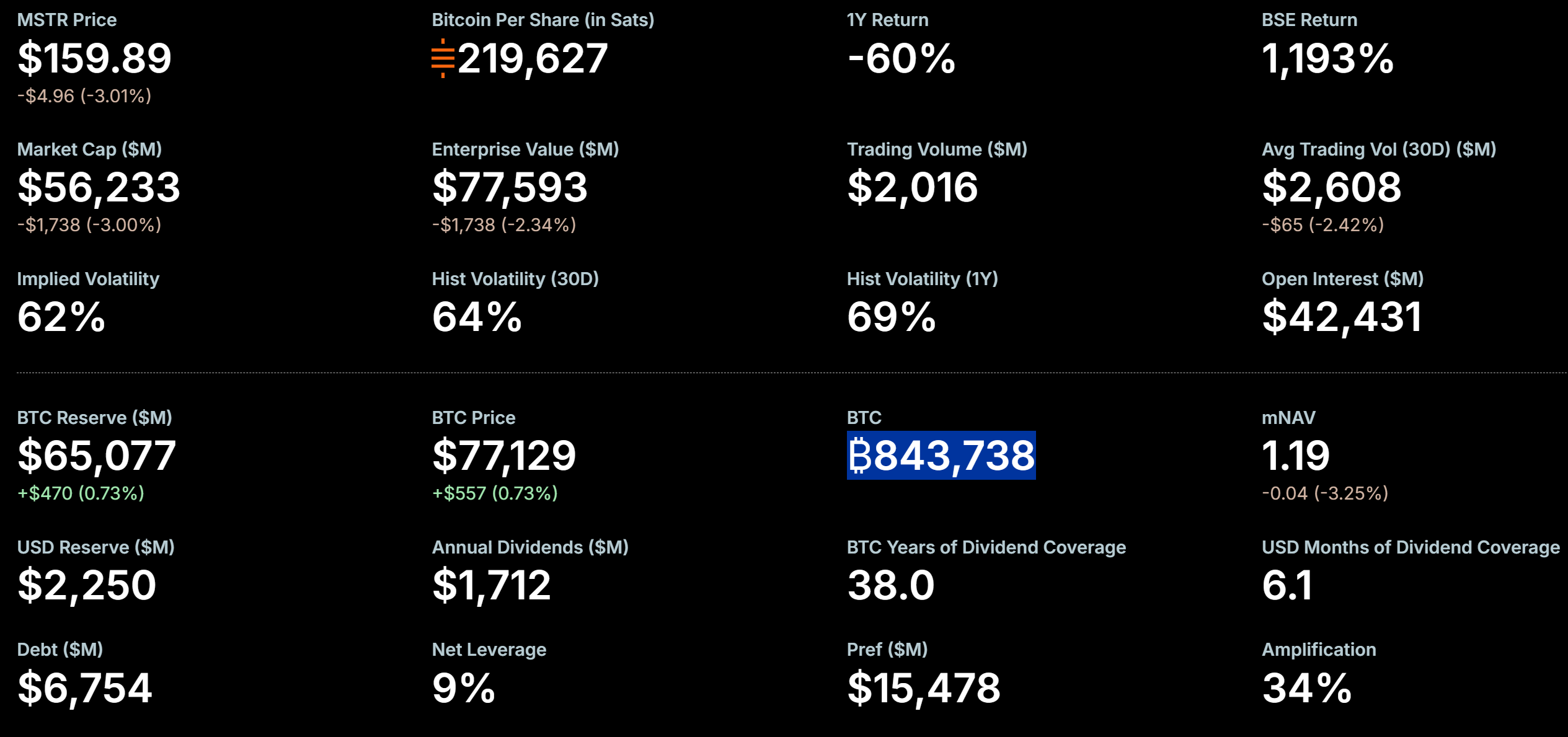
MicroStrategy spent $1.38 billion from its cash reserve to repurchase $1.5 billion of zero-coupon convertible notes due 2029, settling the debt at an 8% discount to par.
The buyback consumed most of the company’s roughly $2 billion USD Reserve, leaving $871 million on hand. Bitcoin purchases were paused for the week as the balance sheet was restructured.
Cash Reserve Drained for Discount Buyback
The Tysons Corner firm completed the privately negotiated transactions between May 11 and May 25, 2026, according to its filing.
The 2029 notes carry a 0% coupon and were issued in November 2024 to fund Bitcoin (BTC) accumulation that has since grown into record Bitcoin treasury holdings.
Paying $1.38 billion for $1.5 billion in face value locked in roughly $120 million of savings versus full repayment.
The deal also generated a “BTC Gain” of 4,391 bitcoin through the effective discount, the company said in its filing.
Convertible Debt Stack Drops to $6.7 Billion
Total convertible notes outstanding fell from $8.2 billion to $6.7 billion after settlement, reducing future share-dilution risk if MSTR climbs above the $672 conversion price.
The shift marks active liability management for a firm previously associated with Strategy buying the dip rather than retiring debt.
President and CEO Phong Le framed the cash deployment as a disciplined capital decision, while CFO Andrew Kang said the company will rebuild the reserve through a mix of equity, credit, and digital capital instruments.
“We retired $1.5 billion of convertible debt for $1.38 billion in cash. Year to date, we have achieved BTC Yield of 13.3%,” read an excerpt in the announcement, citing Phong Le.
Follow us on X to get the latest news as it happens
Bitcoin Buys Pause as Treasury Reaches 843,738 BTC
Strategy did not add to its Bitcoin treasury during the past week as the deal closed, though it bought 24,869 BTC earlier in the May 11 to May 25 window using STRC preferred and MSTR equity proceeds.
The treasury now totals 843,738 BTC, worth roughly $65 billion at the current price near $77,031.

The pause echoes a recent Saylor Bitcoin skip and follows a stretch where STRC preferred outpaced ETFs on net accumulation.
With $6.7 billion of converts still outstanding, the next funding round will signal whether discount buybacks remain a recurring tool, even as some analysts flag potential collapse risk scenarios.
The post MicroStrategy Spends Nearly 70% of Its Cash Reserve to Clear Massive Debt appeared first on BeInCrypto.
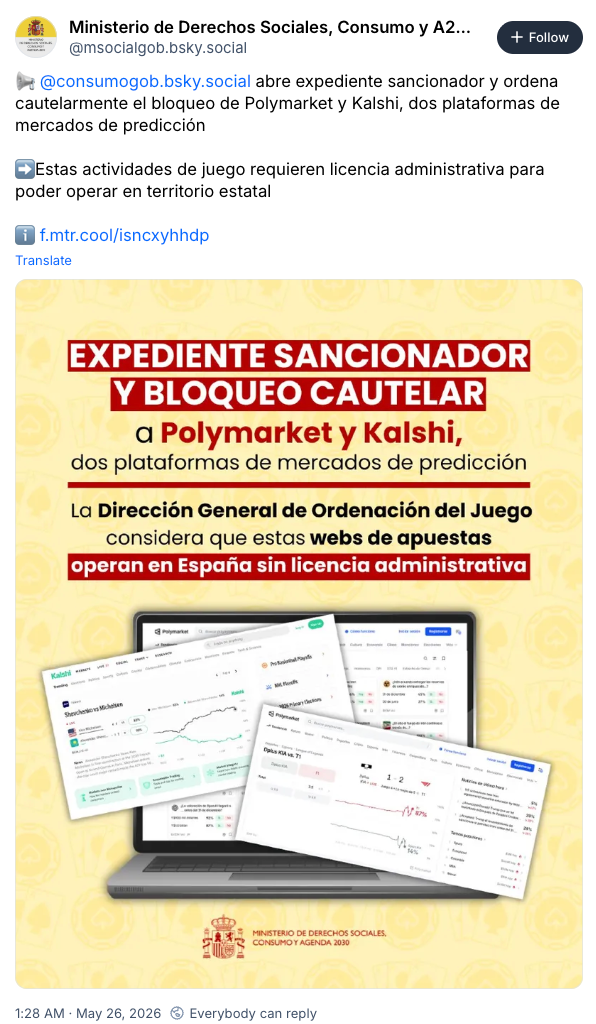
Spain’s gambling regulator blocked local users from Polymarket and Kalshi “as a precautionary measure” as authorities there address allegations the prediction markets platforms were in violation of gambling laws.
On Tuesday, Spain’s Directorate General for the Regulation of Gambling (DGOJ) said the country’s Ministry of Social Rights, Consumption, and Agenda 2030 had opened legal proceedings against the two companies, as they appeared to be operating without necessary licensing. The DGOJ issued an order blocking Spanish users from Kalshi and Polymarket until the proceedings were resolved, expected in three to four months.
“The DGOJ wishes to remind the public that, in Spain — in line with other European jurisdictions — prediction markets are deemed to constitute games of chance when bets are placed on uncertain future outcomes,” according to a Tuesday notice. “Consequently, operating such markets within Spanish territory requires obtaining a specific administrative license.”
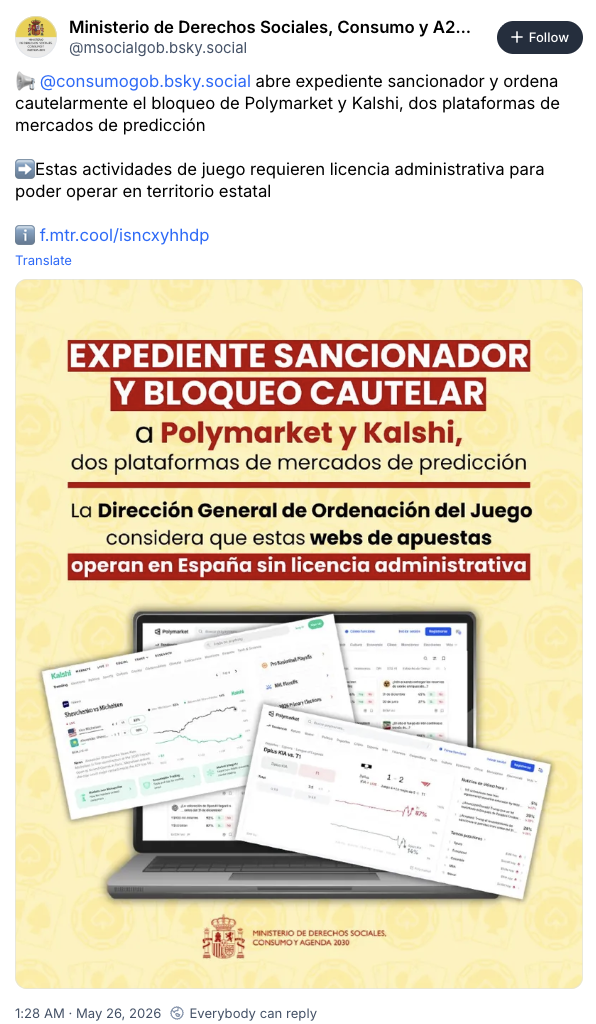
Source: Spain’s Ministry of Social Rights, Consumer Affairs, and Agenda 2030
The move by Spanish authorities follows a similar governmental ban in Indonesia, which blocked access to Polymarket on Friday after the platform listed bets on whether President Prabowo Subianto would leave office before the end of his term. Other countries, including Australia, France, Poland, Singapore, Ukraine and Switzerland, have restricted access to Polymarket over gambling concerns, with the platforms also facing US state-level crackdowns and restrictions.
Related: Kalshi valuation doubles to $22B after $1B funding round
A spokesperson for Polymarket told Cointelegraph that the platform was “committed to engaging constructively with relevant authorities in every jurisdiction.” A Kalshi spokesperson declined to comment.
Kalshi and Polymarket are two of the largest prediction markets platforms by trading volume, with combined in weekly notational volume $6.1 billion, according to DeFi Rate.
NYT report shines light on US federal response to prediction markets
On Sunday, the New York Times reported that officials at the Commodity Futures Trading Commission (CFTC) were pushed out of the agency after they voiced concerns about prediction markets like Kalshi and Polymarket.
The financial regulator, under US President Donald Trump’s hand-picked chair, Michael Selig, has taken the stance that the CFTC has “exclusive authority” over the platforms, filing lawsuits against any state authority that challenged this position.
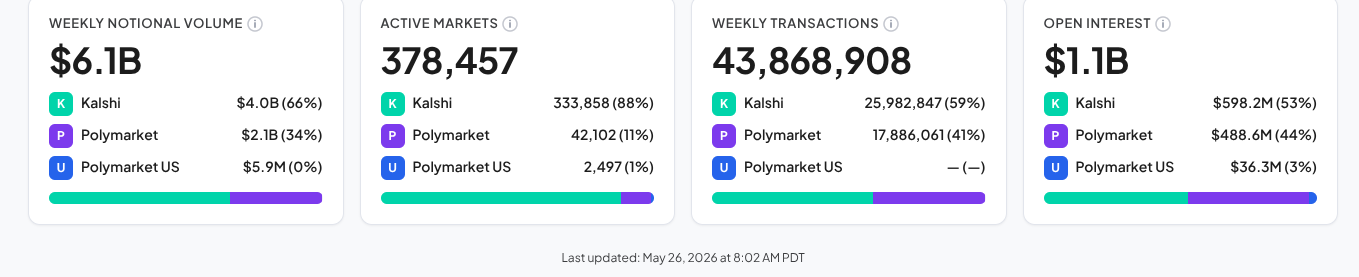
Prediction Market Volume: Kalshi & Polymarket Aggregated Data. Source: DeFi Rate
Lawmakers on the US House of Representatives’ Oversight and Government Reform Committee announced on Friday that they had initiated a probe into Kalshi and Polymarket over insider trading concerns. Committee Chair James Comer cited reports of “suspiciously timed trades” on the platforms ahead of US military actions against Iran, allowing certain users to potentially profit from insider information.
Magazine: 50K investors fight Korean crypto tax, Singapore cancels Bsquared: Asia Express
The UK government has added cryptocurrency exchange HTX to its list of sanctioned entities over its support of Russia.
On Tuesday, UK authorities said that there were “reasonable grounds to suspect” HTX, formerly Huobi Global, has been supporting Russia’s government through financial services and funds facilitated by the A7 Limited Liability Company and Garantex, other sanctioned entities. The crypto exchange, headquartered in Panama, was the latest to be named as part of a crackdown on entities “exploited by Russia to circumvent UK sanctions.”
“If the Kremlin thinks it can evade our sanctions by hiding behind crypto networks and shadow financial systems, it is gravely mistaken,” said UK Foreign Secretary Yvette Cooper.
An HTX spokesperson told Cointelegraph:
“Regulatory compliance remains our absolute top priority at HTX. We proactively monitor and strictly adhere to regulatory frameworks in all jurisdictions where we operate globally, including the UK.”
Source: HTX Global
Russia continues to face sanctions by multiple countries in the European Union and globally over its military actions in Ukraine, launched in 2022. In April, the European Commission announced a package of crypto-related sanctions targeting stablecoins like A7A5 and digital asset operators linked to Belarus.
Related: UK politician Nigel Farage bought $1.8M house after $6.7M crypto gift
HTX has previously been a target of the UK’s Financial Conduct Authority, which in 2025 opened legal proceedings against the company for illegal crypto promotions on social media. The UK watchdog said HTX had pushed promotions on TikTok, X, Facebook, Instagram and YouTube, in violation of marketing rules.
Russia could criminalize crypto activities with new legislation
In April, Russian lawmakers advanced measures that could allow authorities to impose criminal penalties on unlicensed digital asset services and mandate registration with the country’s central bank. The proposals came alongside bills that passed first reading in the lower house of parliament, imposing limits on crypto for retail investors and reinforcing a prohibition on digital asset payments.
Magazine: 50K investors fight Korean crypto tax, Singapore cancels Bsquared: Asia Express

TLDR:
- Micron’s market cap surged from $70 billion to $1 trillion in twelve months, driven by AI memory demand.
- Q3 fiscal 2026 guidance projects $33.5 billion in revenue with gross margins expected to exceed 81%.
- Micron can only fulfill 50% to two-thirds of demand from its largest AI customers in the near term.
- The HBM total addressable market is forecast to grow from $35 billion in 2025 to $100 billion by 2028.
Micron Technology has officially crossed the $1 trillion market capitalization milestone for the first time in its history.
The company’s stock climbed from a $70 billion valuation just twelve months ago. That represents a 14x move in a single year.
AI-driven demand for high-bandwidth memory is widely credited for the dramatic shift in Micron’s financial position.
AI Infrastructure Drives Unprecedented Memory Shortage
Traditional memory markets operated on a predictable boom-and-bust cycle for decades. Oversupply would crush prices, margins would collapse, and weaker players would exit.
That pattern depended on memory being cheap and interchangeable over time. However, the AI buildout has fundamentally changed that dynamic.
Every AI inference call requires DRAM to process. An AI server consumes roughly eight times more DRAM than a traditional server.
High-bandwidth memory, or HBM, required by Nvidia’s H100s and B200s, uses over three times more wafer capacity per bit than DDR5. This creates a supply gap the industry was never built to fill.
As Milk Road AI noted, Micron’s CEO confirmed on camera that the company can only fulfill 50% to two-thirds of demand from its largest AI customers. Samsung raised DRAM list prices approximately 60% since September.
Spot DRAM prices are up roughly 3x year over year, while supplier stockpiles fell from 17 weeks in late 2024 to just two to four weeks by October 2025.
Contract pricing and allocation constraints are now structural features of the market. They are not temporary disruptions that will self-correct within a quarter or two.
The shortage is expected to persist until at least 2028, based on current production timelines from major manufacturers.
Financial Results Reflect Scarcity-Driven Pricing Power
Micron reported Q2 fiscal 2026 revenue of $23.86 billion, up 196% year over year. That result beat estimates by 24%. Gross margins reached 74.4%, more than doubling within a single year.
The company’s gross margin sat below 20% in 2023, making the turnaround notable by any financial measure.
Q3 guidance calls for $33.5 billion in revenue, up over 200% year over year. Gross margins are expected to exceed 81%, with EPS projected at $19.15 against a consensus estimate of $12.05. Management described the current cash generation as levels “not seen in its history.”
UBS raised its price target for Micron to $1,625, pointing to the structural nature of the shortage and locked-in HBM contracts.
Despite those figures, the stock still trades at roughly 8x forward P/E on fiscal 2026 consensus earnings. That multiple is typically associated with slower-growing, lower-margin businesses.
New manufacturing capacity in Boise will not reach full production until mid-2027. The second phase runs to late 2028, and the New York fab does not contribute meaningfully until 2030.
The HBM total addressable market alone is forecast to grow from $35 billion in 2025 to $100 billion by 2028.



The Smarter Web Company has increased its Bitcoin holdings after buying another 10 BTC, adding to its growing treasury strategy.
Summary
- The Smarter Web Company purchased 10 more Bitcoins and raised its total holdings to 2,869 BTC.
- The company used its Coinbase credit facility to support its Bitcoin treasury strategy while keeping leverage at about 12.19%.
- The latest purchase places the firm among publicly listed Bitcoin treasury companies expanding their BTC reserves.
The Smarter Web Company said in a May 26 disclosure that it purchased 10 Bitcoin at an average price of £55,786 per coin. The UK-listed firm said the deal cost £557,865 and lifted its total Bitcoin holdings to 2,869 BTC.
According to the company, its total Bitcoin investment now stands at £232.48 million. The firm also reported an average purchase cost of £81,032 per BTC, or about $109,000, across its full Bitcoin position.
The latest purchase came at a lower price than the company’s average cost basis. The disclosure showed that the new Bitcoin was bought at about $74,904 per coin, based on the stated pound-to-dollar equivalent.
Coinbase facility supports BTC strategy
The Smarter Web Company said the Bitcoin purchase follows the continued use of a credit facility arranged with Coinbase. The company has drawn £18 million from the facility so far.
According to the disclosure, the company’s leverage ratio stands at about 12.19%. The loan is secured against existing Bitcoin holdings, which means the firm is using part of its BTC position to support further treasury activity.
The company said the Coinbase facility carries a variable interest rate between 6.75% and 7.25%. It also said the loan can be repaid at any time without penalty, giving management room to adjust its debt exposure.
Bitcoin yield remains a key metric
Management said the company has achieved a quarter-to-date Bitcoin yield of 15.43%. The company uses this figure to measure changes in Bitcoin holdings compared with its fully diluted share count.
The Smarter Web Company has used this metric as part of its Bitcoin treasury reporting. The company’s disclosure tied the figure to its focus on building BTC holdings through capital allocation decisions.
The firm, which provides web design, development, and online marketing services, began accepting Bitcoin payments in 2022. Since then, it has added Bitcoin to its corporate treasury plans.
Public Bitcoin treasury firms gain attention
The Smarter Web Company now ranks 27th among publicly listed Bitcoin treasury companies by total holdings, based on the figures included in the company’s latest update. Its 2,869 BTC position places it among listed firms using Bitcoin as a balance sheet asset.
Additional context from the sector shows that other firms are also expanding or adjusting their Bitcoin strategies. Strive recently disclosed that its SATA preferred stock absorbed about 453 Bitcoin in one day, which was more than the daily mining supply.
At the same time, Strategy has focused on reducing debt while still increasing its Bitcoin holdings through equity issuance. Recent related reports said Strategy repurchased $1.5 billion of convertible debt at an 8% discount and raised its Bitcoin holdings to 843,738 BTC.
The Smarter Web Company said it is also pursuing acquisitions to grow its client base and recurring revenue while continuing to build its Bitcoin position. Its latest 10 BTC purchase now raises total holdings to 2,869 BTC, extending the strategy previously covered by Crypto.news as more public companies add Bitcoin to their balance sheets.


Spain has blocked both prediction markets Polymarket and Kalshi for operating without gambling licences.
Summary
- Spain’s gambling regulator ordered ISPs to block Polymarket and Kalshi within seven to ten days, with a formal investigation expected to last three to four months.
- The platforms were cited for lacking required gambling authorisation, age verification systems, and self-exclusion mechanisms under Spanish consumer protection law.
- Spain is the fifth country to block one or both platforms in 2026, following Brazil, Indonesia, India, and Portugal, as governments classify prediction markets as unlicensed gambling.
Spain’s gambling regulator, the Directorate General for Gambling Regulation, ordered internet service providers to block access to Polymarket and Kalshi after the Ministry of Consumer Affairs published formal sanction proceedings in Spain’s Official State Gazette on May 26.
The block is expected to take effect within seven to ten days and will remain in place for approximately three to four months while the investigation concludes.
Spain classified both platforms as illegal gambling operators for offering money-staked bets on uncertain future outcomes without the required administrative authorisation.
Authorities cited a total absence of age verification controls, self-exclusion mechanisms, and identity checks safeguards that Spanish gambling law requires from all online operators taking money-staked wagers.
Why Spain moved now and what triggered the regulatory action
The timing has a political dimension. Polymarket recently opened a market on whether Prime Minister Pedro Sánchez’s government would fall early, and Kalshi lists Sánchez at 29% odds to leave office in 2026. Both markets generated significant traffic on Spanish social media, accelerating regulatory attention that might otherwise have moved more slowly.
Spanish authorities were explicit that blockchain infrastructure does not exempt platforms from gambling law. “Using crypto or blockchain doesn’t change platforms that let users wager on uncertain outcomes from being gambling products,” authorities stated in published notices. The same legal framing has now been adopted by at least five separate national jurisdictions.
Brazil blocked both platforms in April as part of a sweeping action covering approximately 28 platforms. Indonesia blocked Polymarket on May 25 as illegal online gambling. India issued a formal blocking order on May 21 after reclassifying prediction markets as “money games” under rules that took effect May 1.
Portugal blocked Polymarket in January after a surge in presidential election bets, and Argentina followed with a court-ordered block in March. The Netherlands escalated enforcement in February and Belgium made a referral in March, making Spain the third European-level action of 2026.
Crypto.news has covered the regulatory calendar pressure in 2026, including the House Oversight Committee separately requesting records from Kalshi and Polymarket over insider trading risks and KYC compliance concerns.
What the global crackdown means for the prediction market industry
Polymarket is currently valued at approximately $15 billion and Kalshi at around $22 billion. Both platforms together processed several billion dollars in trading volume around the 2024 US presidential election and have continued expanding into sports, geopolitics, and corporate-event contracts. The crackdowns do not eliminate these businesses but meaningfully restrict European and emerging-market access.
In the United States, the CFTC has actively defended Kalshi’s right to operate under federal oversight and has moved to sue states attempting their own restrictions, creating a diverging regulatory map.
Crypto.news has reported on AML enforcement becoming the dominant regulatory pressure axis for crypto-adjacent services in 2026. Crypto.news has also tracked the US Treasury’s push to bring financial intermediaries operating without regulated frameworks under Bank Secrecy Act obligations, the same structural argument underpinning Spain’s position.
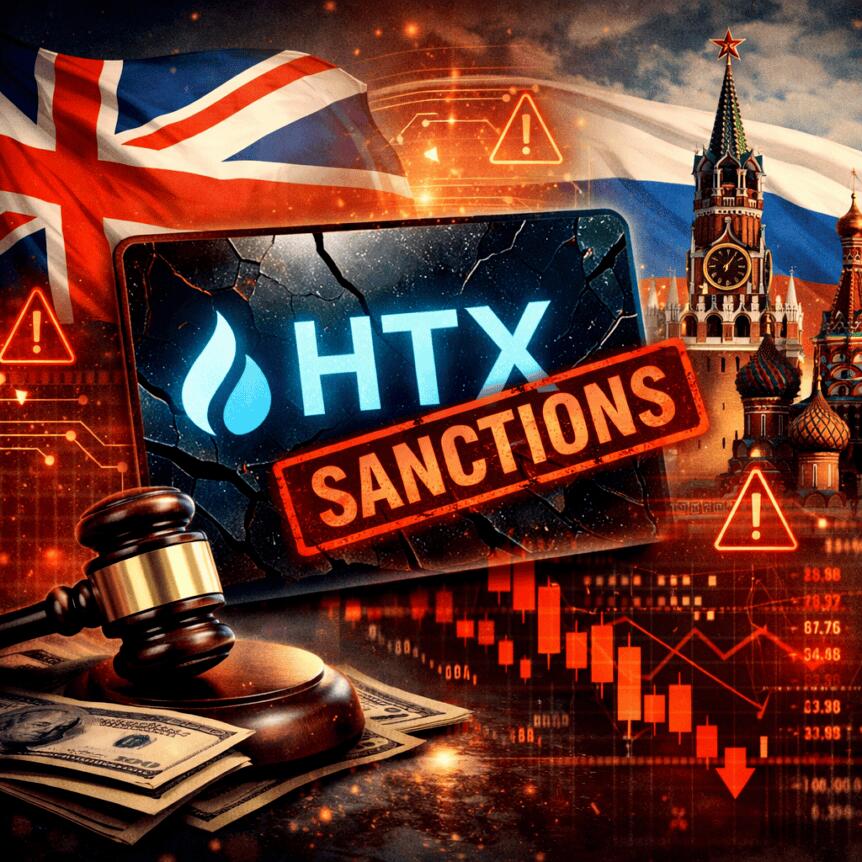
The United Kingdom has added HTX, the exchange formerly known as Huobi Global, to its sanctions list in response to alleged support for the Russian government. The designation underscores the UK’s tightening stance on crypto entities that may be exploited to bypass financial restrictions amid ongoing tensions over Moscow’s actions in Ukraine.
Authorities stated there were “reasonable grounds to suspect” that HTX facilitated financial services and funds linked to Russia through entities tied to A7 Limited Liability Company and Garantex, both sanctioned in separate actions. HTX, which is registered as a Panama-based company, was singled out as part of a broader crackdown on firms “exploited by Russia to circumvent UK sanctions.”
“If the Kremlin thinks it can evade our sanctions by hiding behind crypto networks and shadow financial systems, it is gravely mistaken,” said Foreign Secretary Yvette Cooper.
According to Cointelegraph, HTX told the publication that regulatory compliance remains its top priority and that the firm actively monitors and adheres to regulatory frameworks in all jurisdictions where it operates, including the United Kingdom. The exchange’s official stance highlights ongoing tensions between global regulators and crypto platforms over sanctions enforcement and cross-border compliance.
Separately, the broader sanctions environment around crypto and Russia has continued to evolve. In April, the European Commission announced a package of crypto-related sanctions targeting stablecoins and digital-asset operators connected to Belarus, reinforcing a trend toward tightening oversight of crypto vehicles used in sanctioned-adjacent activity. The measures come amid a wider push by Western authorities to limit Russia’s access to crypto-enabled financial services.
HTX has previously drawn scrutiny from the UK’s Financial Conduct Authority. In 2025, the FCA initiated legal proceedings against the exchange for allegedly illegal crypto promotions conducted on social media, with the regulator contending that HTX violated marketing rules across platforms such as TikTok, X, Facebook, Instagram and YouTube.
Key takeaways
- The UK designated HTX (formerly Huobi Global) as a sanctioned entity due to alleged support for the Russian government via tied financial channels, intensifying sanctions enforcement in the crypto sector.
- The designation reflects ongoing regulatory concern that crypto networks could be exploited to evade financial restrictions, prompting enhanced scrutiny of exchanges with cross-border operations.
- EU authorities have separately broadened crypto-related sanctions, including actions targeting stablecoins and operators linked to Russia and Belarus, illustrating harmonized, cross-jurisdictional risk management for crypto firms.
- HTX has faced prior FCA action in the UK over alleged illegal crypto promotions, signaling that regulatory oversight of marketing practices remains a compliance priority for crypto platforms operating in the UK.
Regulatory landscape and enforcement implications
The UK’s designation of HTX adds to a growing matrix of regulatory tools used to constrain Russian-linked financial activity within crypto markets. Sanctions classifications carry practical implications for exchanges, banks, and institutions that provide banking or on/off-ramp services to sanctioned entities or customers. For crypto firms, this elevates the importance of comprehensive sanctions screening, robust AML/KYC controls, and the ability to demonstrate auditable compliance across multiple regulatory regimes. While HTX asserts its commitment to regulatory adherence, the designation increases the operational burden of maintaining up-to-date sanctions lists, monitoring counterparties, and ensuring effective geographic risk management.
From a policy perspective, the action aligns with the evolving approach of Western regulators to treat crypto platforms as potential vectors for sanction evasion. The UK government’s stance dovetails with broader international efforts to prevent sanctioned entities from accessing or laundering funds through crypto rails, while also emphasizing that regulatory latitude and enforceability extend beyond traditional banking channels. This has immediate implications for licensing requirements, oversight, and potential penalties for non-compliance, particularly for platforms with global footprints or those that advertise services in multiple jurisdictions.
Analysts should watch for how UK sanctions interact with ongoing global discussions on crypto regulation, including cross-border information sharing, the emergence of standardized due-diligence procedures, and potential alignment or friction with frameworks such as MiCA in the European Union. While MiCA provides a harmonized EU regime for crypto-asset service providers, the UK’s post-Brexit regulatory posture continues to develop its own standards for licensing, oversight, and enforcement, potentially creating complex compliance frontiers for exchanges that operate in both markets.
Geopolitical and historical context shaping regulatory risk
The sanctions narrative around HTX sits within a broader historical arc of tightening controls on crypto activities tied to geopolitical conflict. The EU’s April sanctions package, which targeted crypto-related instruments and operators connected to Belarus, illustrates a continuing trend toward constraining crypto-enabled financial activity in sanctioned contexts. The parallel focus in the UK reinforces the idea that national regulators are converging on a zero-tolerance approach to sanction circumvention via digital assets.
On the regulatory front in Russia, lawmakers advanced measures that could criminalize unlicensed digital-asset services and compel registration with the central bank. Proposals also included retail investor limits and restrictions on digital asset payments, signaling a potential tightening of domestic crypto activity and a push for formalization of the sector within a state-centric framework. This policy trajectory—criminal penalties for unregistered services and mandatory central-bank registration—could raise the cost and complexity for foreign exchanges seeking access to the Russian market whether directly or via correspondent banking relationships.
For institutional and compliance teams, these developments underscore the need for a holistic, policy-aware risk posture. Firms operating across multiple jurisdictions must reconcile divergent regulatory expectations, implement consistent cross-border sanctions screening, and anticipate evolving requirements for licensing, registration, and ongoing oversight. In an ecosystem where enforcement can be asymmetric and penalties for non-compliance are increasing, robust governance, transparent disclosures, and defensible compliance controls become central to risk management strategy.
Related coverage from Cointelegraph notes that regulatory authorities continue to scrutinize the broader crypto landscape as authorities pursue more assertive enforcement. The interplay between sanctions regimes, consumer protection rules, and evolving technological risk requires ongoing adaptation by exchanges, custodians, and financial institutions that engage with crypto markets.
Looking ahead, observers should monitor how UK and EU regulators coordinate with other jurisdictions to close gaps that could enable sanction evasion through digital assets. The balance between fostering legitimate innovation in crypto markets and safeguarding financial integrity will shape licensing regimes, capital requirements, and the due-diligence expectations for market participants in the coming years.
Closing perspective: The HTX designation signals a sustained regulatory counterweight to sanctioned activity in crypto markets. As enforcement tools mature and cross-border cooperation intensifies, firms must embed rigorous governance, export-control awareness, and sanctions-compliance into their core operations to navigate a rapidly changing policy environment.

Mythos Detected 23,000 Vulnerabilities Across 1,000 OSS Projects

the other Iranian exports being choked by the war

Is The U.S. Running Out Of Oil? Setting The Record Straight


-

 Crypto World5 days ago
Blockchain.com files with SEC for U.S. IPO
-

 Fashion4 days ago
Holiday Weekend Open Thread – Corporette.com
-

 Business4 days ago
Dell Technologies DELL Stock Surges 15% on AI Server Momentum and Analyst Upgrades in 2026
-

 Crypto World5 days ago
Bitcoin Accumulation Weakens as BTC Realized Losses Hit $600M
-

 Crypto World3 days ago
Robinhood crypto COO Tanya Denisova exits
-

 Crypto World4 days ago
Space X IPO Is ‘Bad News’ for Tech Stocks: But What About Bitcoin?
-

 Politics4 days ago
Makerfield: a tale of two social-media histories
-

 Business2 days ago
NYT Strands Answers May 24 2026 Revealed for Puzzle No. 812 Theme Summer Essentials
-

 Tech1 day ago
Microsoft’s quiet Claude Code retreat and the real cost of enterprise AI
-

 Crypto World5 days ago
MicroStrategy’s Saylor Says Miners No Longer Set Bitcoin Price, Another Force Has Taken Over
-

 Tech5 days ago
WhatsApp ads could make Irish debut after discussions with DPC
-

 Crypto World4 days ago
AI infrastructure race heats up as IREN pitches full-stack strategy, WhiteFiber lands $160M deal
-
 Tech4 days ago
A 0.12% parameter add-on gives AI agents the working memory RAG can’t
-

 Tech5 days ago
You Can Now Add ChatGPT To PowerPoint
-
 NewsBeat5 days ago
Charity run by Reform leader Malcolm Offord accused of ‘law breaking’ over Scottish registration
-

 Business5 days ago
Trump Invests $1M-$5M in Kura Sushi USA Chain With 27 California Locations
-
 Crypto World1 day ago
Nvidia (NVDA) CEO Calls on Super Micro to Strengthen Export Controls Amid Smuggling Probe
-

 Tech1 day ago
Westone Audio and Etymotic Acquired by Fidelity Collective in Major IEM Market Move
-

 Sports5 days ago
2026 CJ Cup Byron Nelson leaderboard: Brooks Koepka finds putting stroke in Round 1
-

 Crypto World6 days ago
Exa Labs raises $250 million in funding led by a16z
You must be logged in to post a comment Login