

Business
Five things UK SMEs should do before April 2026


Most UK SME owner-managers running consumer-facing businesses know the regulatory ground is shifting. Far fewer have a concrete checklist for what to do about it before the new rules bite hardest, around April 2026.
Three changes converge next spring. The Gambling Commission’s affordability-check regime moves from pilot to full implementation. HM Treasury’s remote gaming duty rises to 40 per cent for online gambling operators. The FCA’s expanded Consumer Duty bites deeper across consumer credit. The pattern matters even if you do not operate in those sectors: comparison platforms, regulators and consumers themselves are converging on the same expectation that trust signals carry more weight than headline offers, and the recent decision by Evoke, William Hill’s parent group, to explore a sale shows what happens to operators who are slow to adjust.
Britain’s biggest bookmakers are now threatening legal action against the Gambling Commission over the proposed affordability rules, and the shape of that fight will preview how the next eighteen months play out across other consumer-facing categories. Here are five things to do before that timeline starts to bind.
1. Audit your home page
Open your home page and ask where the licensing, regulatory or compliance information sits. If it lives in the footer next to the cookie policy, move it up. The larger UK regulated operators have already done this. Licence numbers, payout-speed or service-level claims, complaint-handling statements and harm-reduction shortcuts now sit alongside the headline offer, because that is what consumer-facing comparison platforms increasingly score on. Aim to have at least one trust signal above the fold and one inside the welcome-offer panel.
2. Rebuild your welcome flow around trust, not size
Welcome packages should lead with cleaner onboarding and faster verification, not the largest possible introductory offer. The Gambling Commission’s financial risk assessments pilot data showed that even “frictionless” compliance checks produce a service touchpoint when something goes wrong, so the customer-service offer is now part of the marketing offer. Map the first ten minutes of the customer journey end to end, identify the step most likely to break, and brief your customer-service team on what to do when it does.
3. Treat comparison platforms as part of your acquisition mix
Independent comparison platforms have taken over a meaningful share of the first-touch journey across regulated consumer categories, and they have stopped scoring purely on price or bonus size. The pattern is most developed in gambling, where a recent independent comparison of UK licensed operators, for example, now ranks operators on licence number, GambleAware integration and payout speed alongside the headline bonus. The same dynamic is now visible in current-account switching, energy-tariff comparison and motor insurance. If your sector already has equivalent platforms, your scorecard there is a brand asset; if it does not yet, expect one within eighteen months. Either way, treat comparison-platform performance as a structural part of your acquisition mix rather than an afterthought, and brief whoever owns your brand or PR on how the ranking criteria are evolving.
4. Bring compliance into the marketing brief
Compliance disclosures are no longer the small print under the campaign creative. In every consumer-facing regulated category, they are becoming the creative itself. Schedule a quarterly review with your compliance lead to align brand claims, legal disclosures and customer-service scripts. The same logic that has pushed UK gambling brands to lead with licence numbers is now visible in the mounting ministerial pressure on gambling advertising, where polling shows public support for stronger curbs at 70 per cent. Compliance-forward marketing is no longer a sector-specific story.
5. Put two dates in your calendar
The first is the Gambling Commission’s decision on whether to impose financial risk assessments without amendment, which will set a precedent for how other UK regulators expect consumer-facing operators to behave. The second is the 40 per cent remote gaming duty taking effect from April 2026, announced in the Autumn Budget and already reflected in operator share prices. Even if you do not operate in gambling, a similar margin shift in your own sector triggered by Consumer Duty or sector-specific reform is more likely than not. Run the numbers now on how a 5 to 10 per cent compression in operating margin would land on your acquisition budget, and decide which line you cut first.
The owner-managers who get ahead of this will be the ones who treat trust signals as the headline offer, not as the small print. Those who wait for the regulator to force the change may find the comparison platforms have already done the scoring for them publicly.


Up to $118,000 of funding is set to be allocated to a physical commemorative display of the Ore Obelisk sculpture in a motion passed by the City of Perth council last night.

Mt Hawthorn-based Platina Resources has appointed Dr Paul Polito as its managing director, effective from July 20.


Julian Lin is a financial analyst. He finds undervalued companies with secular growth that appreciate over time. His approach is to look for companies with strong balance sheets and management teams in sectors with long growth runways.
Julian is the leader of the investing group Best Of Breed Growth Stocks where he only shares positions in stocks which have a large probability of delivering large alpha relative to the S&P 500. He also combines growth-oriented principles with strict valuation hurdles to add an additional layer to the conventional margin of safety. Features include: exclusive access to Julian’s highest conviction picks, full stock research reports, real-time trade alerts, macro market analysis, individual industry reports, a filtered watchlist, and community chat with access to Julian 24/7. Learn more.
Analyst’s Disclosure: I/we have a beneficial long position in the shares of NVDA, AMD either through stock ownership, options, or other derivatives. I wrote this article myself, and it expresses my own opinions. I am not receiving compensation for it (other than from Seeking Alpha). I have no business relationship with any company whose stock is mentioned in this article.
Seeking Alpha’s Disclosure: Past performance is no guarantee of future results. No recommendation or advice is being given as to whether any investment is suitable for a particular investor. Any views or opinions expressed above may not reflect those of Seeking Alpha as a whole. Seeking Alpha is not a licensed securities dealer, broker or US investment adviser or investment bank. Our analysts are third party authors that include both professional investors and individual investors who may not be licensed or certified by any institute or regulatory body.
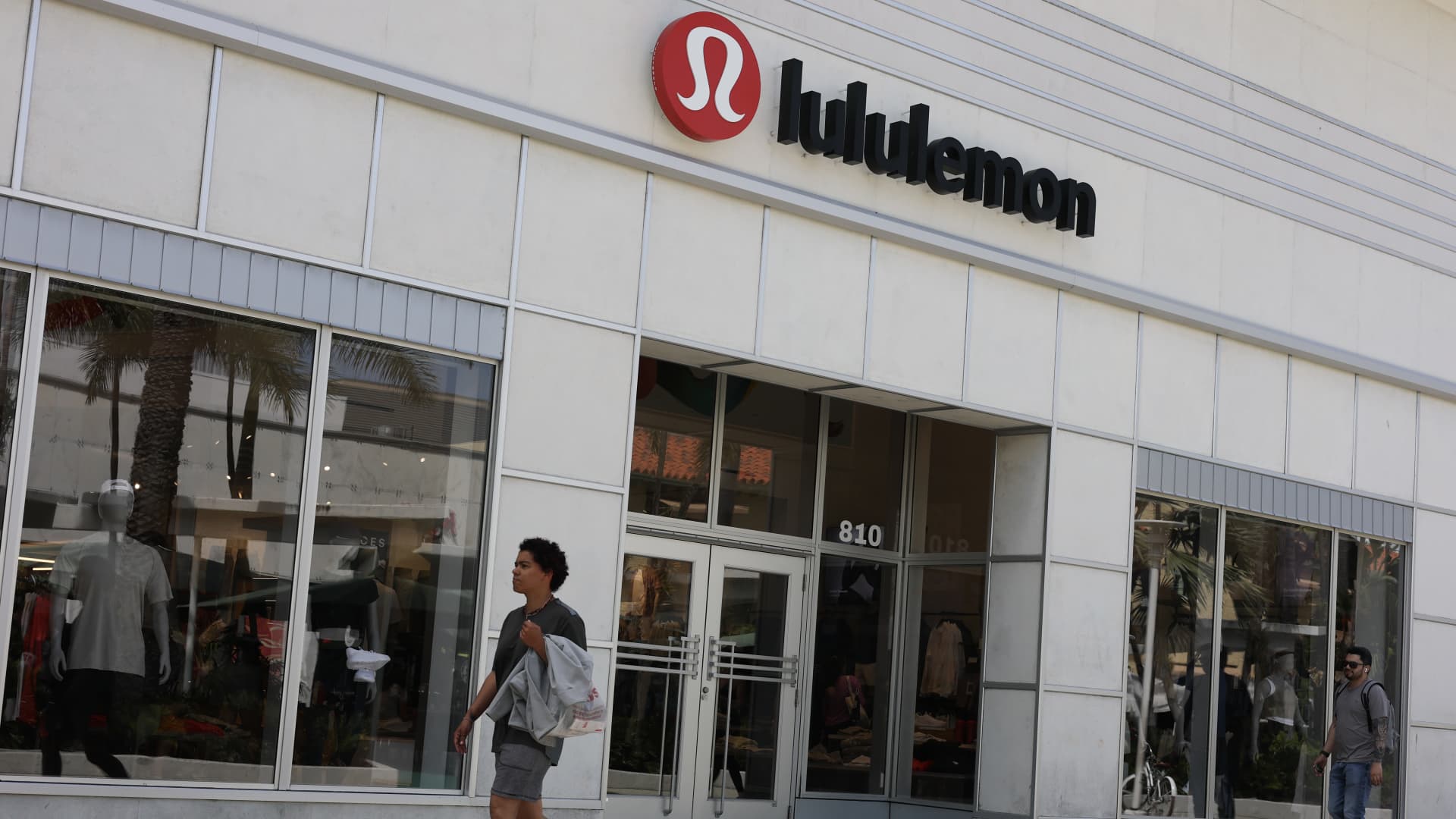
People walk past a Lululemon store on April 03, 2025 in Miami Beach, Florida.
Joe Raedle | Getty Images
Lululemon is ending its feud with founder Chip Wilson.
The athletic apparel company entered into an agreement with Wilson on Wednesday that ended a messy proxy contest the founder started late last year as its largest individual shareholder.
Under the terms of the deal, Luluelmon has agreed to appoint two of Wilson’s nominees – former On co-CEO Marc Maurer and former ESPN Chief Marketing Officer Laura Gentile – and an additional director with “product and brand expertise in apparel” by October.
In exchange, Wilson agreed not to bad mouth the company for about a year and a half, among other provisions.
Shares rose about 4% in premarket trading.
Wilson previously asked the company to reimburse expenses associated with his proxy contest, but ultimately agreed instead to a donation that Lululemon will make to Kitsilano Beach in Vancouver, where Lululemon was founded, to support athletics, art and landscaping.
“We are pleased to reach this agreement with Chip Wilson, which allows lululemon to focus on continuing to strengthen its performance,” said Marti Morfitt, Lululemon’s executive chair.
“We look forward to welcoming Laura and Marc, who will bring additional perspective to our existing group of qualified directors. Lululemon now has a clear path forward for our incoming CEO, Heidi O’Neill, and our leadership team, as we continue to advance our strategies to foster strong brand health, reaccelerate growth, and deliver enhanced value for our shareholders.”
Wilson said the appointees, alongside strategic changes already made, “reflect meaningful progress toward restoring the company’s product-first vision and unlocking tremendous value for shareholders.”

The founder, who has been publicly sparring with the company he founded since late last year, was nearing a deal with Lululemon two weeks ago, but settlement talks fell apart when he upped his demands.
Lululemon then took the proxy contest public, issuing a scathing letter to shareholders where it said Wilson had “outdated perspectives” and “troubling conflicts of interest” that will derail its turnaround plan.
“Wilson, who stopped serving on the Board over a decade ago for well-documented reasons, has been attacking the company and the Board for many years, damaging the brand and hurting shareholders. He has now put forward three opposing nominees in an attempt to regain increased influence over the company that he has coveted since he left,” the letter stated.
At the time, the company said its board “firmly believes that replacing any of lululemon’s directors with Mr. Wilson’s less qualified nominees would endorse his misguided perspectives, deprive the company of critical skills and expertise, and risk derailing our progress in an especially pivotal time for our business and organization.”
Soon after Lululemon issued its letter to shareholders, Wilson released his own press release saying he was under the impression he and the retailer were in agreement and there is “no reason” why they can’t “reach a resolution to this fight quickly.”
Just over a week later, the sides announced a deal.
Wilson has long been critical of Lululemon since he stepped down as chairman in 2013, but ramped up his attacks in recent months as the retailer’s performance faltered and its share price plummeted.
Following several years of rapid growth, Lululemon’s business in the Americas, its largest market, has slowed as it navigates tariff costs, an unsteady U.S. consumer and a product assortment that’s failed to win over shoppers in the same way it once did.
It also faced steep competition from upstarts like Vuori and Alo Yoga as the global athleisure market started to cool.
When it reported fiscal fourth-quarter earnings in March, Lululemon issued weak fiscal 2026 guidance and warned higher tariffs and its proxy battle with Wilson would weigh on its bottom line. As of Tuesday’s close, the company’s shares are down almost 39% year to date.

Newly minted Minerals Council of Australia chair Amanda Lacaze has warned of the undesirable consequences of the looming tax changes for the minerals exploration sector.

Argus downgrades Zoetis stock rating on competition, margin pressure

Nebius: Verticalization Is Strengthening The Bull Case
Business
Cantor Fitzgerald raises DeFi Development stock price target to $7 on treasury yield expansion
Cantor Fitzgerald raises DeFi Development stock price target to $7 on treasury yield expansion
Corcept to resubmit relacorilant application to FDA

Buying second hand software safely online means choosing genuine licences at competitive prices from certified resellers.
The primary way to purchase original software is the official websites of individual publishers, such as Microsoft and Adobe. However, the market for second hand software licences should not be overlooked, as it offers a way to obtain legitimate products at a lower cost.
Online resellers offer activation keys at competitive prices, and these licences frequently originate from corporate surpluses or legally permitted reallocations, making it a cost-effective approach for private users, self-employed professionals, or small offices looking to cut costs without compromising on quality or security.
Is It Legal to Buy Second Hand Software in the UK?
Yes, purchasing second hand software licences is legal, but it is not uncommon to encounter sceptical users. The term “second hand software” refers to the possibility of purchasing pre-owned licences at a discounted price that are nonetheless entirely genuine.
According to the Court of Justice of the European Union ruling C-128/11 of 2012 (the case UsedSoft v Oracle International Corp.), a publisher’s right of distribution is exhausted upon the first sale. After that point, the publisher cannot prevent the resale of perpetual licences, whether distributed on physical media or as ESD (Electronic Software Distribution).
That said, there are still conditions and limitations governing this practice, and it is the responsibility of a reputable reseller to operate with full transparency. Maintaining full legal compliance throughout the supply chain is essential, not only for the reseller’s own credibility, but also to preserve the trust of their customers.
How to Identify a Trustworthy Reseller?
When it comes to “certified resellers” of pre-owned licences, it is easy to fall into basic traps. After all, anyone can claim to hold such a status without necessarily having to substantiate it. A user may take the claim at face value after seeing a logo on a website and look no further.
A reputable portal, however, should provide direct links to the pages of publishers whose partner status it claims to hold. As such, a Microsoft Cloud Solution Provider or an Adobe Certified Reseller should be independently verifiable via the respective publishers’ own portals. Both Microsoft and Adobe, for instance, offer internal search tools on their websites through which this information can be confirmed.
Reviews on Aggregators Such as Trustpilot
A common way to assess whether it is worth purchasing second hand software from a given seller is through first-hand experience. Most buyers check reviews, whether direct, indirect (via discussions on forums such as Reddit), or left on Trustpilot and similar aggregators. This has become one of the standard best practices among digital-era consumers.
Beyond the score itself, it is also worth reading the content of the reviews to understand a brand’s key strengths and any potential weaknesses, such as speed of licence delivery, ease of activation, or post-sale customer support. These are all critical factors when it comes to the reliability and promptness of an online licence sales service.
Risks and Issues in the Second Hand Software Sector
Whilst a low price is attractive, it is important to bear in mind that prices that seem too good to be true, such as those as low as a few pounds, should raise immediate concerns. A good deal is always welcome, but discounts that are unrealistic relative to market averages (or to the value of the licence obtainable directly from the official publisher’s website) may conceal issues relating to the product’s legality.
In some instances, licences are revoked after activation, particularly when a publisher detects improper use. This can cause direct inconvenience to the user who has paid for their activation key and is subsequently unable to use the software. A trustworthy reseller must offer the right of withdrawal in line with applicable consumer protection legislation: typically 30 days for a refund if the key has not been activated, as well as providing refunds and replacements, thereby covering the most common post-sale requirements.
PrimeLicense: An Established Second Hand Software Reseller
PrimeLicense is a second hand software reseller, operating under Prime Digital Solutions Inc., with more than 15,000 paying customers across five European markets, including over 4,700 in the United Kingdom, since 2023. The brand’s reputation can be independently verified on Trustpilot, where the brand holds a 4.8 / 5 “Excellent” rating from more than 1,400 verified customer reviews. Every order on PrimeLicense is covered by Trusted Shops Buyer Protection up to €2,500, providing an independent layer of protection on the purchase amount.
PrimeLicense is also a verified Microsoft Cloud Partner, listed in the official Microsoft AppSource Partner Directory, and operates as an authorised reseller for publishers, including Adobe, Kaspersky and McAfee.
How Much Can You Save by Buying Genuine Second Hand Software Licences?
This is a legitimate question buyers regularly ask, it is therefore worth making a direct comparison across some of the most in-demand products, such as Microsoft Office Home 2024, a perpetual licence that is increasingly hard to find on the open market.
Let’s look at Microsoft Office Home & Business 2024, a perpetual licence sold on the official Microsoft website for £249.99. Through a reseller, the same genuine licence is heavily discounted, bringing the final price down to £110.90. Purchasing a lifetime licence today can deliver savings over years compared to subscription costs.
Checklist: How to Identify a Trustworthy Seller?
Before drawing conclusions, here is a quick checklist to help determine straight away whether you are choosing a reliable second hand software seller:
- Independently verifiable certifications and partnerships
- High review scores
- Discounted but realistic pricing
- Active, responsive customer support in your language
- Legal transparency
- Secure and traceable payment methods
Conclusion
The search for second hand software online has become a savvy way to save on the ever-rising cost of licences and subscription plans. This practice is common among private users but has also extended to self-employed professionals and small offices seeking to manage costs whilst retaining access to genuine productivity tools, operating systems, antivirus software, and more.
Whilst the market features many trustworthy resellers, it can also conceal pitfalls so it is advisable to do your research carefully, following the guidance set out above, before taking the final step.
FAQs
Where can I buy cheap software?
The key is finding an authorised reseller who can offer genuine licences at below-retail prices. Look for a certified Microsoft or Adobe partner, transparent return policies, secure payment methods and verifiable customer reviews on independent platforms such as Trustpilot.
How do you get a software licence?
Getting a software licence is straightforward: you purchase it directly from the software developer, a certified retailer or an authorised reseller. Once purchased, you receive an activation code via email, along with specific instructions for downloading and installing the software.
Is second hand software legal?
Yes. The resale of second hand software has been legal across the European Union since under the Court of Justice of the EU ruling C-128/11 of 3 July 2012 (UsedSoft v Oracle). The principle of exhaustion permits the resale of perpetual licences, provided they were legitimately purchased and are no longer in use by the original owner.
Why is second hand software cheaper than buying from official websites?
Prices are lower because second hand licences are already on the market, originating from corporate decommissioning, surpluses, or business stock. Since they are not sold directly by the publisher, the licences can be offered at a lower cost.
Can I use the licence on multiple devices?
It depends on the type of licence purchased. OEM licences are tied to a single device and cannot be transferred: once activated, they remain permanently associated with that device. Retail licences, by contrast, can be transferred, but only one device may be active at a time; the licence must be deactivated on the original device before being activated on a new one. Volume licences are designed for the business market and allow activation across multiple devices.
Is PrimeLicense a certified reseller?
Yes. PrimeLicense is the consumer software-licensing brand operated by Prime Digital Solutions, Inc., a US company incorporated in Delaware. The entity is listed as a Microsoft Cloud Partner in the official Microsoft AppSource Partner Directory and operates as an authorised reseller for publishers including Adobe, Kaspersky, and McAfee. Independent verification is available directly on the Microsoft AppSource Partner Directory and on PrimeLicense’s Trustpilot profile.

Can Bitcoin mining fund the AI data center boom? One entity is trying to find out
Jennifer Lopez reunites with “Selena” dad Edward James Olmos in powerful red carpet moment: 'I love you so much'

Perth’s ‘kebab’ sculpture to live on in physical display


-

 Crypto World6 days ago
Blockchain.com files with SEC for U.S. IPO
-

 Fashion5 days ago
Holiday Weekend Open Thread – Corporette.com
-

 Crypto World5 days ago
Bitcoin Accumulation Weakens as BTC Realized Losses Hit $600M
-

 Business5 days ago
Dell Technologies DELL Stock Surges 15% on AI Server Momentum and Analyst Upgrades in 2026
-

 Crypto World4 days ago
Robinhood crypto COO Tanya Denisova exits
-

 Politics5 days ago
Makerfield: a tale of two social-media histories
-

 Business3 days ago
NYT Strands Answers May 24 2026 Revealed for Puzzle No. 812 Theme Summer Essentials
-

 Crypto World5 days ago
Space X IPO Is ‘Bad News’ for Tech Stocks: But What About Bitcoin?
-

 Tech2 days ago
Microsoft’s quiet Claude Code retreat and the real cost of enterprise AI
-

 Crypto World5 days ago
MicroStrategy’s Saylor Says Miners No Longer Set Bitcoin Price, Another Force Has Taken Over
-

 Tech6 days ago
WhatsApp ads could make Irish debut after discussions with DPC
-
 NewsBeat6 days ago
Charity run by Reform leader Malcolm Offord accused of ‘law breaking’ over Scottish registration
-
 Tech5 days ago
A 0.12% parameter add-on gives AI agents the working memory RAG can’t
-

 Crypto World5 days ago
AI infrastructure race heats up as IREN pitches full-stack strategy, WhiteFiber lands $160M deal
-
 Crypto World2 days ago
Nvidia (NVDA) CEO Calls on Super Micro to Strengthen Export Controls Amid Smuggling Probe
-

 Tech5 days ago
You Can Now Add ChatGPT To PowerPoint
-

 Business5 days ago
Trump Invests $1M-$5M in Kura Sushi USA Chain With 27 California Locations
-

 Tech2 days ago
Westone Audio and Etymotic Acquired by Fidelity Collective in Major IEM Market Move
-

 Sports5 days ago
2026 CJ Cup Byron Nelson leaderboard: Brooks Koepka finds putting stroke in Round 1
-

 Crypto World7 days ago
Exa Labs raises $250 million in funding led by a16z
You must be logged in to post a comment Login