Connect with us
DAPA Banner
DAPA Coin
DAPA
COIN PAYMENT ASSET
PRIVACY · BLOCKDAG · HOMOMORPHIC ENCRYPTION · RUST
ElGamal Encrypted MINE DAPA
🚫 GENESIS SOLD OUT
DAPAPAY COMING

Business

Legrand opens new job-creating Northumberland ‘centre of excellence’

Published

on

Business Live

The Cramlington base was first announced in 2024 with the expectation it would create 200 new jobs

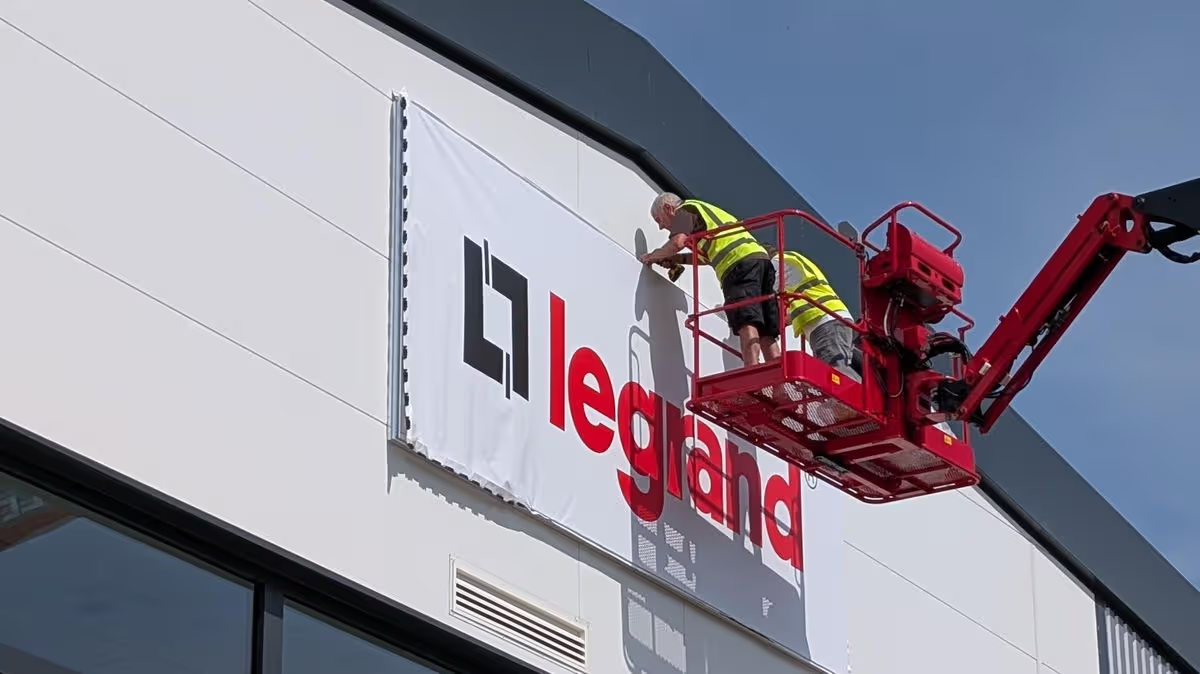
Legrand has opened its new North East centre of excellence.

Legrand has opened its new North East centre of excellence.(Image: Legrand)

European manufacturing giant Legrand has launched a new electronics base in Northumberland which is expected to create scores of new jobs.

The group initially revealed plans to open a new North East base back in 2024, as part of a strategy to set itself up closer to the region’s growing offshore renewable energy cluster. The new base is designed to supplement its existing UK sites, including its Birmingham head office and bases in Wembley, Scarborough and Consett.

Advertisement

Construction started in 2024 on a 43,000 sqft facility in Cramlington, with 200 new jobs to be created. Legrand UK & Ireland has now opened the electronics manufacturing facility at Nelson Park, which directors said establishes a new centre of excellence for the Legrand Group in Europe.

The site is home to Legrand’s CP Electronics lighting controls and Legrand Care brands, positioned close to the North East’s growing clean energy sector and skilled workforce. The new manufacturing site will extend Legrand’s presence in the UK, which spans more than 40 years.

The company said it has been designed and built with net zero principles at its core, and that the facility is entirely gas-free. An air source heat pump system provides heating and cooling across the site. It is also fitted with a rooftop solar PV array with an installed capacity of 163 kilowatt-peak, expected to generate close to 128,000 kWh annually, significantly reducing reliance on grid electricity.

Inside Legrand's Cramlington base.

Inside Legrand’s Cramlington base.(Image: Legrand)

The site also incorporates EV charging infrastructure, sustainable drainage, permeable paving and high-performance insulation.

Advertisement

The facility has also been equipped with Legrand’s own products where possible, including its Linea 5000 door entry panels, cable management solutions and digital energy metering technology. Bosses said the systems contribute to the site’s connectivity and energy efficiency while serving as a working showcase for the company’s product portfolio.

Paolo Murdocca, COO at Legrand UK & Ireland, said: “This facility represents a significant milestone for Legrand in the UK. We have built a site that not only strengthens our manufacturing capability but also reflects the standards we set for our customers.

“Cramlington gives us a modern, sustainable base from which to grow our CP Electronics and Legrand Care brands, and it demonstrates that high-quality electronics manufacturing and genuine environmental responsibility can go hand in hand. The North East offers exactly the skills and supply chain we need, and we are proud to be investing here for the long term.”

Like this story? For more news from the manufacturing sector, visit our dedicated page for the latest news and analysis here


Advertisement
Continue Reading
Click to comment

You must be logged in to post a comment Login

Leave a Reply

Business

Abercrombie & Fitch (ANF) earnings Q1 2026

Published

on

Abercrombie & Fitch (ANF) earnings Q1 2026

Abercrombie & Fitch posted mixed first-quarter results on Wednesday and weaker-than-expected guidance after the conflict in the Middle East “directly impacted” sales, the company said. 

Despite those challenges, shares jumped about 13% in morning trading as the company easily topped Wall Street’s earnings estimates.

Sales in Abercrombie’s Europe, Middle East and Africa region fell 10% during the quarter, driven by a slowdown in demand at the brand’s Hollister banner that came as the conflict ramped up, finance chief Robert Ball said on a call with analysts. 

Overall, it reduced first-quarter total company net sales growth by more than 0.5 percentage points relative to the retailer’s outlook, he said. 

Advertisement

“We’re focused on what we can control, including our inventory levels and marketing investments, ensuring we can respond to what’s happening in real-time,” CEO Fran Horowitz added on the call. “Despite these EMEA headwinds, we expect total sales growth for the second quarter, along with full-year 2026, which would be our fourth consecutive year of net sales growth.” 

In the current quarter, Abercrombie expects earnings per share to be between $1.80 and $2, well behind estimates of $2.54, according to LSEG. 

Though the company’s outlook for the current quarter was worth than analysts expected, it reaffirmed its full-year guidance. Abercrombie anticipates net sales will rise 3% to 5% for the fiscal year, with earnings per share of $10.20 to $11.

Despite the slowdown in EMEA, which represents about 15% of total company sales, Abercrombie’s companywide sales climbed 2%. Still, that growth didn’t come from organic consumer demand and was instead driven by new store openings and favorable foreign exchange rates, Ball said.

Advertisement

Here’s how the apparel company did in its first fiscal quarter compared with what Wall Street was anticipating, based on a survey of analysts by LSEG:

  • Earnings per share: $1.47 vs. $1.28 expected
  • Revenue: $1.11 billion vs. $1.12 billion expected

The company’s reported net income for the three-month period that ended May 2 was $67.13 million, or $1.47 per share, compared with $80.41 million, or $1.59 per share, a year earlier.  

Sales rose to $1.11 billion, up about 2% from $1.10 billion a year earlier. 

When asked about its current quarter outlook, and what it expects to change in the back half of the year, Ball mentioned easier comparisons to last year’s results and lower marketing spending, among other facors, not an expected improvement in demand. 

“It is a balanced story here. Tariffs and freight, by the time we get to year-end, will be just slight headwinds year-over-year,Ball explained. Aside from the challenges its seeing in the Middle East and the EMEA region, the company is seeing modest growth in average unit retail, which is funding the investments its making and keeping it in line with a 12% to 12.5% operating margin, Ball said.

Advertisement

Unlike many of its peers, Abercrombie is factoring in recent reductions in tariff rates after the U.S. Supreme Court ruled President Donald Trump’s so-called reciprocal tariffs are illegal, which helped its financial outlook. 

It’s now expecting tariffs to impact profitability by 0.2 percentage points in fiscal 2026, compared to previous expectations of around 0.7 percentage points. It said it has applied for a tariff refund of around $100 million but didn’t factor that potential influx into its outlook. 

Continue Reading

Business

Smaller Companies Step Up In Global Defense Cycle

Published

on

Engineer in Military Uniform Assembling Unmanned Aerial Vehicle

This article was written by

ClearBridge is a leading global asset manager committed to active management. Research-based stock selection guides our investment approach, with our strategies reflecting the highest-conviction ideas of our portfolio managers. We convey these ideas to investors on a frequent basis through investment commentaries and thought leadership and look forward to sharing the latest insights from our white papers, blog posts as well as videos and podcasts.

Analyst’s Disclosure: I/we have a beneficial long position in the shares of LMT, KTOS, KRMN, RBC, TDY, YES, RKLB either through stock ownership, options, or other derivatives. I wrote this article myself, and it expresses my own opinions. I am not receiving compensation for it. I have no business relationship with any company whose stock is mentioned in this article.

Seeking Alpha’s Disclosure: Past performance is no guarantee of future results. No recommendation or advice is being given as to whether any investment is suitable for a particular investor. Any views or opinions expressed above may not reflect those of Seeking Alpha as a whole. Seeking Alpha is not a licensed securities dealer, broker or US investment adviser or investment bank. Our analysts are third party authors that include both professional investors and individual investors who may not be licensed or certified by any institute or regulatory body.

Advertisement
Continue Reading

Business

Phytolon raises $23.6 million in Series B funding

Published

on

Phytolon raises $23.6 million in Series B funding

Company commercializing its perceived as natural food colors in the United States. 

Continue Reading

Business

NYC hotel costs poised to climb following historic union contract

Published

on

NYC hotel costs poised to climb following historic union contract

New York City hotel rates could climb even higher after hotel owners signed what industry officials describe as the most expensive union contract in the industry’s history, locking in major wage increases for workers while raising affordability concerns for travelers and smaller hotels.

The agreement, reported by The Wall Street Journal, reached last week to avoid a strike ahead of next month’s FIFA World Cup kickoff, increases hourly pay for most hotel workers by roughly 50% over eight years. By 2032, some housekeepers are expected to earn six-figure salaries.

Advertisement

Hotel owners say the deal will significantly raise operating costs in a city that already has some of the nation’s highest average hotel prices outside major resort markets. New York hotel rooms averaged $334 per night last year, according to CoStar.

NEWSGUILD BATTLES NEW YORK TIMES OVER HYBRID WORK, ‘WRONGLY EXCLUDING JOBS’ FROM UNION AND HEALTH FUND

Man checking into a hotel

Hotel owners say the deal will significantly raise operating costs in a city that already has some of the nation’s highest average hotel prices outside major resort markets. (iStock)

“The only way to maintain your profit when your costs go up is to keep raising your rates,” Cornell University hospitality professor David Sherwyn told The Journal. 

Industry officials estimate the new contract will increase annual property operating costs by about 15%, adding pressure on hotels to pass those expenses onto consumers at a time when many travelers are already facing higher fuel, airfare and vacation costs.

Advertisement

AIRBNB LAUNCHES MAJOR EXPANSION WITH AIRPORT PICKUPS, LUGGAGE STORAGE AND AI-POWERED TRAVEL TOOLS

2026 FIFA World Cup official logo and trophy

The agreement was reached last week to avoid a strike ahead of next month’s FIFA World Cup kickoff. (Photo by Eva Marie Uzcategui – FIFA/FIFA via Getty Images / Getty Images)

The labor agreement also arrives at a difficult moment for hotel operators who had hoped the FIFA World Cup would deliver a major tourism boost. As of mid-May, New York City hotel occupancy for June – when the tournament begins – was running about 12 percentage points below last year’s levels, according to CoStar, despite the region hosting eight matches, including the championship final.

Analysts say some tourists and business travelers may be avoiding the city because of concerns about crowds and soaring World Cup ticket prices.

LAS VEGAS HOTEL-CASINO THAT CLOSED DURING COVID AND NEVER REOPENED IS DEMOLISHED

Advertisement

Luxury hotels are expected to fare better because higher-income travelers have continued spending despite rising costs. Midrange and lower-tier hotels could face greater pressure as lower-income households reduce travel spending this year, according to Bank of America Institute data.

Skyline view of New York City

Industry officials estimate the new contract will increase annual property operating costs by about 15%. (Gary Hershorn/Getty Images)

International tourism also remains a concern for the city’s hotel industry. Hoteliers say overseas bookings weakened earlier this year amid geopolitical tensions tied to the Iran conflict, though some operators report demand is beginning to recover.

CLICK HERE TO GET FOX BUSINESS ON THE GO

Hotel executives warn that additional risks – including higher airline ticket prices, flight cuts and concerns about U.S. border screenings – could further slow the recovery in international travel, which has long been considered a critical driver of New York’s tourism economy.

Advertisement
Continue Reading

Business

UN raises alarm over Israel’s killings of Gazans near armistice line

Published

on

UN raises alarm over Israel’s killings of Gazans near armistice line


UN raises alarm over Israel’s killings of Gazans near armistice line

Continue Reading

Business

BonBon Swedish Candy Co. goes savory

Published

on

BonBon Swedish Candy Co. goes savory

The confectionery company is launching potato chips. 

Continue Reading

Business

UK Pension Funds Still Failing British Tech Scale-Ups, Says OSE Chief Ed Bussey

Published

on

UK Pension Funds Still Failing British Tech Scale-Ups, Says OSE Chief Ed Bussey

The boss of Oxford University’s flagship spin-out fund has delivered a stinging verdict on the City’s biggest savers, accusing UK pension funds of being “way off the pace” when it comes to writing cheques for the country’s most promising technology businesses, despite successive governments promising to fix the problem.

Ed Bussey, chief executive of Oxford Science Enterprises (OSE), said reform efforts such as the Mansion House accord, under which seventeen of Britain’s largest workplace providers voluntarily pledged to put more of their members’ savings into private and high-growth companies, are simply not moving quickly enough to keep up with the pace at which Oxford-rooted businesses are scaling.

“Everyone’s diagnosed the problem, but the movement towards the solution is just way off the pace in terms of the speed at which we and others are building companies,” Bussey told Business Matters. “We’ve got companies with technology that should be thinking about $100 billion in terms of the scale of opportunity, and that’s reflected in the international capital — and particularly US capital — that is being attracted into these sorts of companies.”

A british problem with American fingerprints

The numbers tell their own story. Bussey said the vast majority of the £300 million in external capital raised by OSE’s portfolio companies last year came from American investors rather than domestic backers. Across the wider market, UK scale-ups now source as much as 80 per cent of their funding from overseas, according to figures from UK Private Capital, the trade body for the British private equity and venture industry.

“There’s nothing wrong with US money per se,” Bussey said. “But the share of UK money, particularly UK pension money, just needs to be dialled up about ten times. I think there’s a lack of understanding [within pension funds] of this space, of the opportunity, of the potential returns.”

Advertisement

His frustration was sharpened by a recent conversation with a Gulf-based backer. “One of my Gulf investors said: ‘You are sitting on our equivalent of Gulf oil.’ But UK pension funds are largely missing in action from this opportunity. The rest of the world scratches its heads when they look at this.”

It is a complaint that will sound familiar to anyone who has tracked the growing chorus calling on Britain’s pension giants to back homegrown scale-ups before the upside is shipped offshore. For all the political enthusiasm around turning the UK into the “next Silicon Valley”, the capital that ultimately reaps the rewards of British science still tends to be raised in Boston, San Francisco or Abu Dhabi — not in Edinburgh or the Square Mile.

The Mansion House promise, and its critics

Both the previous Conservative administration and Sir Keir Starmer’s Labour government have made unlocking domestic pension capital a flagship policy. The 2023 Mansion House compact set a target of 5 per cent of default fund assets in private markets. Last summer, that ambition was doubled when seventeen workplace pension providers signed up to the Mansion House accord, formally announced by the Treasury, agreeing to allocate at least 10 per cent of their default funds to private assets by 2030, with at least half of that ringfenced for the UK, releasing an estimated £25 billion into the domestic economy.

Lord Vallance of Balham, the science minister, conceded the pace had been a source of impatience but insisted momentum was building. “Is it as fast as everyone wants? No. But it’s starting and I really believe that’s going to change quite rapidly,” he said.

Advertisement

Critics, however, argue that without firmer incentives — or, more controversially, mandates, Britain’s defined contribution savers will continue to underwrite foreign infrastructure and foreign pensioners’ retirements rather than the domestic innovation economy. As Business Matters publisher Richard Alvin has previously argued, the UK’s real scale-up crisis is one of conviction as much as capital: a structural inability to back our own.

From lab bench to billion-pound business

Bussey’s broadside arrived alongside OSE’s latest annual report, which painted a far brighter picture of operational performance. Net asset value rose 17 per cent year-on-year to £1.26 billion, lifted by two landmark exits.

In September, IonQ’s $1.08 billion acquisition of quantum computing pioneer Oxford Ionics handed OSE its first unicorn exit. Before the year was out, the fund also completed the sale of cancer-drug discovery business Dark Blue Therapeutics to US biotech giant Amgen in a deal worth up to $840 million. Between them, the two transactions returned more than £283 million to OSE.

Bussey said further realisations were now firmly in view. “Within the next two to four years we’re going to hit a phase of regular realisations. We’ve proven that we can take science out of a lab and create a billion-pound company. What’s more exciting is now we’ve got line of sight to that happening on a consistent basis.”

Advertisement

For Britain’s SME ecosystem, and the universities, investors and founders trying to turn world-class research into world-class companies, the question is whether the country’s own pension savers will own a meaningful slice of that upside, or whether, once again, the wealth created in British labs will end up funding retirements on the other side of the Atlantic.


Amy Ingham

Amy is a newly qualified journalist specialising in business journalism at Business Matters with responsibility for news content for what is now the UK’s largest print and online source of current business news.

Advertisement
Continue Reading

Business

Slideshow: Firing up the grill for summer product innovations

Published

on

Slideshow: Firing up the grill for summer product innovations

Manufacturers are introducing co-branded seasonal offerings and spicy flavor profiles.

Continue Reading

Business

Cob expanding sorghum-based product line

Published

on

Cob expanding sorghum-based product line

Sorghum-based chips follows company’s launch of its sorghum-based popcorn.

Continue Reading

Business

Jamie Dimon says JPMorgan Chase could do $20 billion acquisition

Published

on

Jamie Dimon says JPMorgan Chase could do $20 billion acquisition

Jamie Dimon, CEO of JPMorgan Chase, speaks at the American Business Forum at the Kaseya Center in Miami on Nov. 6, 2025.

Chandan Khanna | AFP | Getty Images

JPMorgan Chase CEO Jamie Dimon said Wednesday that his bank could spend up to $20 billion on an acquisition in the coming years.

Advertisement

A deal that size would be the largest of Dimon’s 20-year tenure atop JPMorgan and test regulators’ appetite for consolidation among the biggest U.S. banks.

“I do think there might be opportunities, and so we are on the lookout,” Dimon told analysts at a New York financial conference.

“There might be, in the next couple years, a chance to put $10 [billion] or $20 billion to work buying something,” Dimon said.
The comments came with caveats. Dimon framed acquisitions almost as a tool of last resort, not a growth strategy, and warned that bankers who lean too hard on dealmaking are often compensating for poor organic growth.

Advertisement

“You sit around a lot of management meetings, the first thing they do when they’re not doing well in organic growth is they start to bulls–t about [mergers and acquisitions],” Dimon said. “I don’t want to hear about M&A … What are you doing to grow your business — sales, branches, tech, profits, products, services?”

Any takeover target, he said, would need to integrate cleanly into JPMorgan’s existing operations, fit the bank’s culture, and enhance core businesses rather than sit as a separate standalone unit.

“It can’t be just a pie-in-the-sky type of thing,” Dimon said.

JPMorgan has mostly grown organically in recent years, with the notable exception of its FDIC-assisted acquisition of First Republic Bank in 2023. It made a $10.6 billion payment to the regulator as part of that transaction.

Advertisement

Under Dimon, the bank’s largest and most consequential M&A deals were mostly crisis-era acquisitions of regulated banks, including First Republic, Bear Stearns and the retail operations of Washington Mutual.

The firm also acquired a string of smaller fintech firms but slowed down after spending $175 million to acquire Frank in 2021, a college aid startup that was later revealed to be a fraud.

Choose CNBC as your preferred source on Google and never miss a moment from the most trusted name in business news.
Continue Reading

Trending

Copyright © 2025