









Connect with us
DAPA Banner
DAPA Coin
DAPA
COIN PAYMENT ASSET
PRIVACY · BLOCKDAG · HOMOMORPHIC ENCRYPTION · RUST
ElGamal Encrypted MINE DAPA
🚫 GENESIS SOLD OUT
DAPAPAY COMING

Tech

ROKU Keeps Pushing for a Better Streaming Experience with New Home Screen Design

Published

on

What do you do when you’re one of the world’s top Smart TV and Connected TV platforms? You double down on what people love about your system while making the whole user experience even more streamlined and personalized for each individual viewer.

While Android TV/Google TV may lead the global streaming TV platforms in overall market share, Roku is #1 in North America, with more than a third of all streaming viewers. With a combination of streaming sticks which can turn any TV into a Smart TV, Roku branded Smart TVs and partnerships with TV makers such as Hisense, Philips, and ONN, Roku has established itself as the go-to streaming platform for over 100 million TV viewers and movie lovers.

While alternative Smart TV platforms like Amazon’s Fire TV and Google TV tend to push certain streaming services or shopping services over others, Roku has earned high marks from its users for providing a more service-agnostic user experience. And the company seems to be leaning into this philosophy with significant updates to its user interface.

PXL_20260527_130519917.MP~2-roku-panel-900px
A panel of Roku executives discuss what went into the Roku’s new Home Screen.

At an event in New York City this morning, Roku unveiled a new version of their Home Screen which promises a more dynamic, smarter experience. Featuring more relevant recommendations and faster pathways to content, the new Roku Home Screen is designed to reduce friction, maintain Roku’s signature simplicity, and help viewers find their next favorite movie or TV show with ease.

While Roku typically makes running tweaks to their user interface and home screen to improve the overall user experience, today’s update to the Home Screen is the most substantial and significant update we’ve seen to the platform in the past ten years.

Advertisement
PXL_20260527_125157508-roku-stuff-900px
Roku is now available in projectors, TVs, streaming sticks and streaming boxes. The company had several of these on display at the launch event in Manhattan on May 27, 2026.

Company reps told us that the change wasn’t made just for the sake of change, but was informed by direct customer feedback as well as detailed analysis of viewer behavior, with the end goal of streamlining and optimizing the user experience. The new personalized Home Screen tackles the biggest challenges in streaming, while offering a tailored, content-forward way to start watching.

Roku executives at the event stressed that they wanted to make sure they maintained the snappy, responsive feel that Roku users love while improving every element of the user experience. The company has done extensive testing with employees, and actual customers over its development, even allowing customers to opt in early to explore the new features and provide feedback. to the development team along the way.

Roku-Home-Short-Cuts-900px

“When we set out to rethink the Home Screen, we knew we should listen to the people who use it every day,” said Anthony Wood, Roku’s Founder and CEO. “So we talked to the viewers, we tested extensively, and we pushed until the design and the data lined up for a meaningful update. Now, our new Home Screen puts entertainment at the center of everything, while staying true to Roku’s simple, intuitive roots. More than 100 million households will feel the difference the moment they turn on their TV—and it opens up a better, more powerful experience for our partners as well.”

To take things from abstract to actual, one specific data point was critical in inspiring this set of changes: A majority of Roku customers (82%) said they would love it if they turned on their TV and the show they wanted to watch was right on their Home Screen. The new Roku Home Screen does just that, recommending content based on the viewer’s past activity and interests, helping the viewer get up and watching the content they crave quicker. Out of the billions of potential Home Screen layouts, the new system is designed to offer just what you want to see, when you want to see it, for each individual viewer.

Preston Smalley, Roku’s Vice President of Viewer Product, told event attendees that the net effect of the change has been moving from a static Home Screen to a fluid experience that is more dynamic and personalized around each individual user and which changes based on evolving tastes and needs. In Preston’s words, “We want the UI to recede into the background. We want the content to really shine.”

Highlights of the New Home Screen Include:

Advertisement
Advertisement. Scroll to continue reading.
  • Quick Access for your most used apps, continuously adapting to your routine
  • An intelligence-driven and expanded content-first “Top Picks for You” section
  • New genre-based destinations such as:
    • “For You,” built on your interests and filled with fresh personalized picks
    • “Subscriptions,” allowing for a convenient way to browse and discover from across all your subscriptions in one place
  • Search in key destinations with relevant suggestions and results
  • A streamlined collapsible menu
  • Elevated shortcuts for everyday actions including Save List, Continued Watching, and more
  • “Your Daily Scoop,” a dynamic row that brings you a curated digest of breakout shows and cultural trends
  • A “Roku City” tile, taking you to an interactive version of your favorite screensaver
Roku Home Screen Lifestyle 900px

The new Roku Home Screen begins rolling out today (May 27, 2026) across all Roku TVs and streaming devices in the United States. Expansion to additional countries will follow in the coming months.

The Bottom Line

Any time we hear about a major user interface redesign rolling out to all devices, we wonder whether it will be a home run, which users of the platform embrace, or it will lead to the disaster that plagued Sonos just a few years ago. From what we saw at the event, we believe the new Home Screen redesign builds on the simple service-agnostic user interface that has built up Roku’s loyal fan base over the years. If the rollout goes well, these changes should help cement the platform’s popularity in the coming years.

Roku Unveils New TVs and Slimmest Streaming Sticks Ever

Source link

Advertisement
Continue Reading
Click to comment

You must be logged in to post a comment Login

Leave a Reply

Tech

Can you enforce strong Active Directory password rules without frustrating users?

Published

on

Cybersecurity laptop

Protecting Active Directory (AD) accounts starts with strong password policies, backed by consistent enforcement across the organization. However, make the rules too weak and you increase your attack surface; make them too strict and users will find workarounds, such as writing passwords down, reusing them across systems, or adding a predictable “!” to the end of the last version.

The challenge is enforcing modern, resilient password standards that avoid increasing helpdesk tickets or frustrating the people you’re trying to protect. However, with the right approach, you can strengthen your AD password posture and make life easier for users at the same time.

Adopt passphrases over complex passwords

Traditional password complexity rules are frustrating, and do not provide the protection needed for today’s threat landscape. When people are forced to include symbols, numbers, and mixed cases, they tend to fall back on memorable, but guessable, options like Password!2026.

A better approach is to prioritize length over complexity with passphrases. Longer passwords made up of multiple words are easier to remember and significantly harder to crack. NIST recommends allowing passwords up to 64 characters.

Advertisement

While most users won’t reach that limit, raising the minimum length (for example, to 15 characters or more) strengthens security and reduces the need for awkward, error-prone passwords.

Block weak and compromised passwords

Even with longer passwords, users are still likely to choose weak or common options. Password spraying attacks rely on exploiting that tendency, so it’s crucial that organizations actively block weak password creation. It’s here that solutions like Specops Password Policy help:

  • Creating custom banned word lists: Security teams can build tailored dictionaries of blocked terms that reflect their organization’s environment. This helps prevent common weak choices, including passwords based on usernames, display names, repeated characters, incremental changes, or reused elements from existing credentials.
  • Breach password protection: By continuously checking passwords against a database of over 5.4 billion known breached credentials, Specops Password Policy helps stop compromised passwords from being used in AD and allows issues to be addressed quickly.

Stopping weak passwords at creation is far more effective than trying to fix the problem after an account has been compromised.

Specops Password Policy

Rethink password expirations

When users are required to reset credentials too often, they tend to make minimal tweaks, changing a few characters or making incremental changes. To avoid this, those setting password policies should move away from mandatory password expiration unless there is evidence of a compromise.

That doesn’t mean expiry should be removed without consideration, particularly where password reuse is a concern. However, there’s a strong case for extending expiry periods when users are creating long, robust passwords and you have controls in place to detect compromised credentials.

Length-based aging reinforces this approach. Tying expiration periods to password length encourages longer, stronger credentials with the reward of extended or even removed expiry, unless a compromise is detected.

Advertisement

Verizon’s Data Breach Investigation Report found stolen credentials are involved in 44.7% of breaches. 


Effortlessly secure Active Directory with compliant password policies, blocking 4+ billion compromised passwords, boosting security, and slashing support hassles!

Try it for free

Use a password manager

One of the biggest challenges with strong password policies is reuse. Even when employees create a good AD password, they’re likely to repeat it across other systems simply because remembering dozens of credentials isn’t realistic.

An approved password manager, implemented securely, removes that burden. It allows users to generate and, more importantly, store every long, unique password they need for their accounts. For IT teams, enterprise password managers also support better control over shared credentials and privileged accounts. Combined with passphrase-friendly AD policies, they’re a practical way to improve security while reducing friction.

Implement self-service password resets

Password resets are one of the most common causes of helpdesk tickets in AD environments. When policies are strict and employees make mistakes, support queues quickly fill up.

Advertisement

Secure self-service password reset reduces that pressure. By verifying identity through MFA or other authentication methods, staff can reset their own passwords quickly, in many cases eliminating the need to raise a ticket.

Faster recovery reduces downtime, limits risky workarounds, and improves user experience. When people know they won’t be locked out for long, password policies feel far less disruptive.

Customizable notifications

Users shouldn’t be caught off guard by sudden lockouts or last-minute expiry warnings. It’s these annoyances that lead to unnecessary disruption and support calls.

Clear, timely notifications make a difference, highlighting when action is needed and clearly explaining requirements. Good communication won’t replace robust controls, but it helps users stay compliant and reduces the friction that often comes with password enforcement.

Advertisement

Provide dynamic feedback at password creation

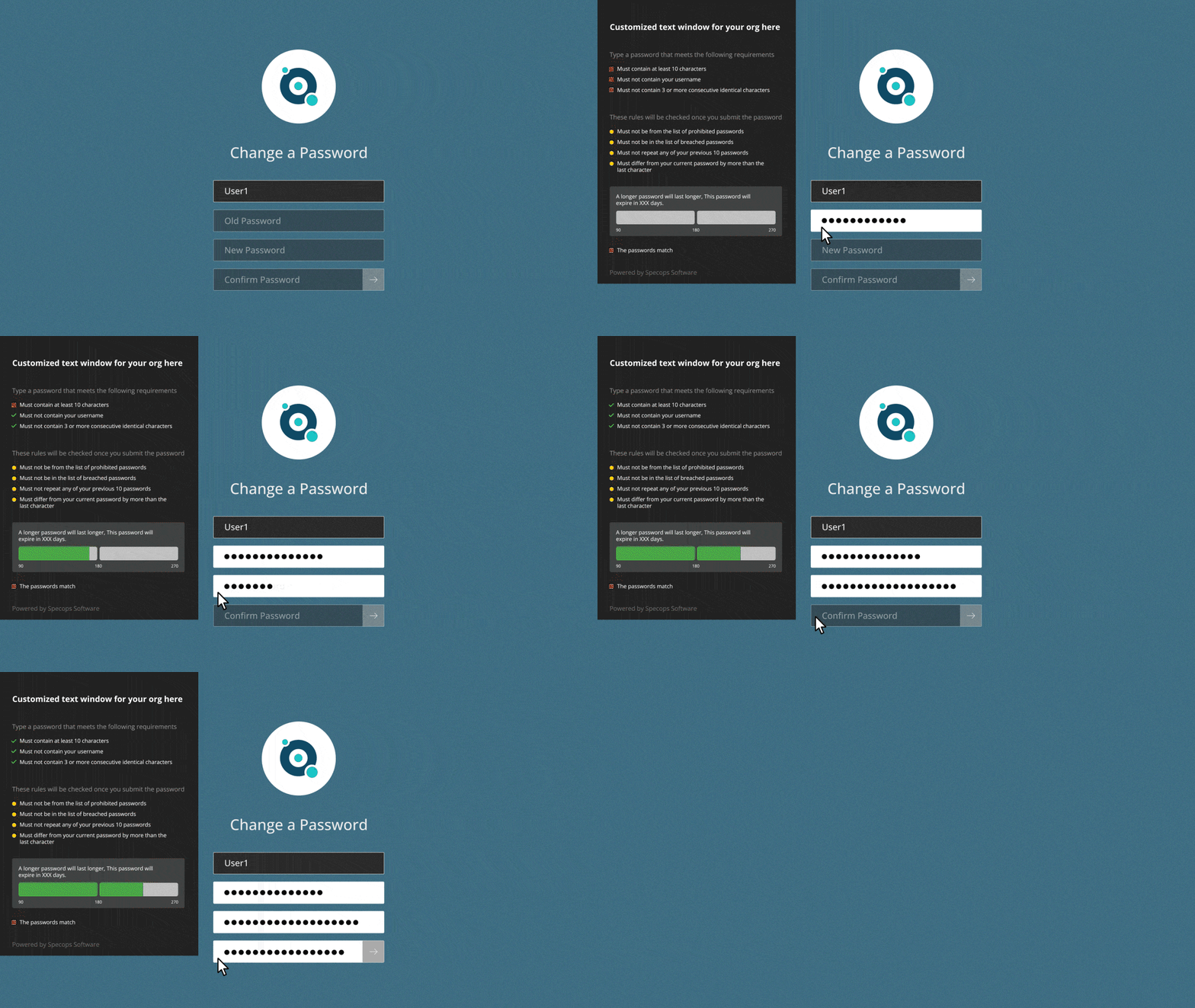
Vague “password does not meet requirements” messages are unhelpful. Effectively enforcing AD rules means supplying real-time, specific feedback when creating or changing passwords. Strength meters, banned password checks, and clear prompts make it easy for users to see exactly what the requirements are.

When feedback is immediate and actionable, users are more likely to create stronger credentials. It’s a small usability improvement that delivers a noticeable uplift in password quality.

How Specops can help

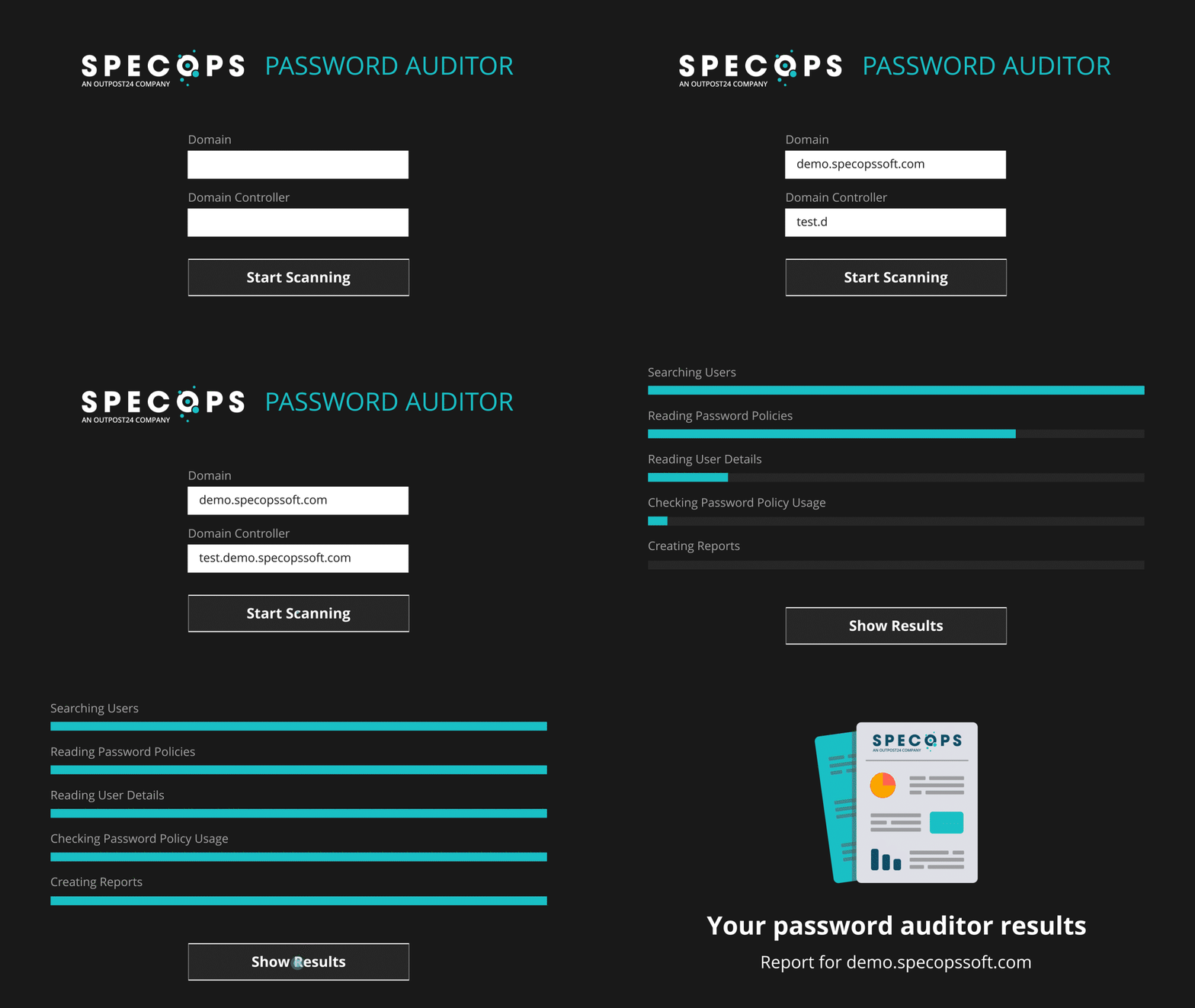
Reviewing and updating AD password policies is a balance between security and usability. A good starting point is auditing your AD environment using solutions like Specops Password Auditor. This free tool runs a read-only scan of your AD and highlights any password-related vulnerabilities, presented in an easy-to-understand report.

Specops Password Auditor

Specops Password Policy then helps organizations remediate any password-related issues and ensure continued policy enforcement across their environment. This includes practical improvements that strengthen resilience, such as continuously scanning for breached passwords and supporting passphrase implementation.

If you’re rethinking your password strategy, we can help you build an approach that improves protection while maintaining the user experience.

Advertisement

Contact us today or book a demo to see our solutions in action.

Sponsored and written by Specops Software.

Source link

Advertisement
Continue Reading

Tech

How Smart Devices Are Actually Built: An Engineer’s View

Published

on

Pick up any smart device you own. A doorbell that recognizes faces, a watch that reads your heart rhythm, a thermostat that learns when you leave for work. They feel simple. You tap, they respond.

That simplicity is a lie. A useful one, but a lie.

Behind the clean app and the satisfying click is a stack of engineering decisions that most people never see. And the gap between a device that works for five years and one that dies in eight months almost always traces back to those invisible choices. So let’s look at what actually goes into building the connected gadgets shipping in 2026.

Smart starts with the circuit board, not the cloud

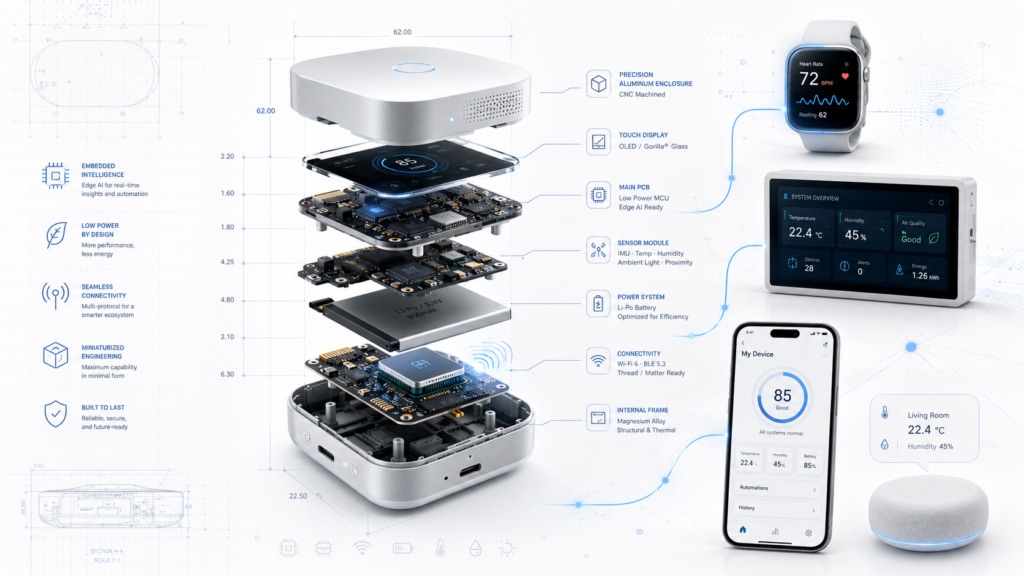
Most coverage of smart devices jumps straight to AI features and voice assistants. But the foundation is physical. A device is a printed circuit board, a microcontroller, a fistful of sensors, a radio, and a battery, all crammed into a shell that has to survive being dropped, sat on, and left in a hot car.

Advertisement

This is where hardware development does its quiet, unglamorous work. Engineers pick a microcontroller based on how much computing the device needs versus how little power it can afford to burn. They route signal traces on the board so a Wi-Fi radio doesn’t drown out a delicate sensor reading. They run the whole thing through thermal testing, drop testing, and certification for FCC and CE marks before it can legally ship.

Get this layer wrong, and no amount of clever software saves you. A poorly designed board produces flaky sensor data. Bad antenna placement means the device drops off your network the moment you walk to the next room. These aren’t software bugs. You can’t patch your way out of a physics problem.

The companies building good hardware treat the proof-of-concept stage as a real checkpoint. They wire up development boards and modular parts to test the core idea cheaply, before committing to a custom design that costs real money to manufacture. It’s the boring discipline that separates products from expensive paperweights.

Firmware is where the device actually thinks

Sitting on top of the hardware is firmware. This is the low-level code that tells the chip what to do, when to wake up, how to read a sensor, and when to phone home. People mix up firmware and software all the time, so here’s the clean split. Software runs on your phone or in the cloud and handles the screens you tap. Firmware lives inside the device and controls the hardware directly.

Advertisement

Firmware is genuinely hard to write well. The constraints are brutal. A typical IoT microcontroller has a tiny amount of memory, often measured in kilobytes, and it might run on a coin cell that needs to last a year. Every line of code competes for space and power.

Then there’s timing. A lot of devices need deterministic, real-time behavior, meaning a sensor reading has to be processed within a fixed window or the whole thing falls apart. A heart monitor that processes a beat “eventually” is useless. The firmware has to guarantee it happens now.

If you want the deep version of how this gets built in practice, Yalantis published a solid breakdown of firmware development for embedded IoT devices that covers architecture, power management, and the over-the-air update workflows that keep a device current after it ships. The OTA piece matters more than it sounds. A device that can’t safely update its own firmware is frozen in time the day it leaves the factory.

Connectivity is a series of trade-offs

Your smart device has to talk to something. Your phone, your router, a cloud server, or all three. Choosing how it talks is one of the most consequential engineering calls in the whole project, and there’s no single right answer.

Advertisement

Bluetooth Low Energy sips power and works great for a wearable talking to your phone, but its range is short and it can’t reach the internet on its own. Wi-Fi reaches everything but drains batteries fast. LoRaWAN travels for miles on almost no power, which is perfect for a soil sensor in a field, but it carries tiny amounts of data slowly. Cellular options like NB-IoT and LTE-M let a device work anywhere there’s a signal, with the catch of ongoing data costs and bigger power draw.

Engineers usually mix these. A fitness band might use BLE to sync with your phone, and your phone carries the data the rest of the way. An industrial sensor in a remote location might use LoRaWAN to a gateway, which then forwards everything over cellular. The “right” combination depends entirely on power budget, data volume, range, and cost, which is exactly why this decision gets made early and gets revisited often.

Sensors and the messy job of trusting them

A smart device is only as good as the data it collects. And raw sensor data is messy.

Take a simple temperature reading. The sensor drifts over time. It gets warmed by the heat of the chip sitting next to it. It returns noisy values that jitter up and down even when nothing changes. Firmware has to calibrate, filter, and sanity-check all of it before the device acts on a single number.

Advertisement

This gets serious fast in regulated fields. A continuous glucose monitor or a medical wearable can’t ship a reading that’s “close enough.” The sensor design, the calibration, and the firmware that validates the data all have to meet standards that consumer gadgets never face. The engineering bar is much higher, and the cost of getting it wrong is measured in patient safety, not customer reviews.

For everyday devices the stakes are lower, but the principle holds. Good devices spend a lot of hidden effort turning unreliable physical signals into numbers you can actually trust.

Where the AI hype meets the silicon

Here’s the part that has changed most recently. A growing share of smart devices now run machine learning models directly on the chip instead of sending everything to the cloud. This is edge computing, and it’s reshaping how devices get built.

The appeal is obvious. Processing data on the device means lower latency, since you’re not waiting on a round trip to a server. It means better privacy, because your data never leaves your hand. And it means the device keeps working when your internet goes down.

Advertisement

The catch is that running a model on a chip with kilobytes of memory is an engineering puzzle. Models have to be shrunk, quantized, and optimized until they fit in the space available without melting the battery. The face-recognition that runs locally on a modern doorbell is a heavily compressed version of what would run on a server. Squeezing it down to fit is real, specialized work, and it’s increasingly where the competitive difference between two similar gadgets actually lives.

Security can’t be the last step

For years, connected devices treated security as an afterthought. Ship the product, patch problems later. That approach has aged badly.

Outdated firmware is now one of the most common ways attackers break into IoT systems. Research from the security firm ONEKEY found that vulnerable firmware accounts for a large majority of successful attacks on connected devices. Once an attacker is inside one poorly secured gadget on your network, they have a foothold to reach everything else.

Building security in from the start means encrypting data both when it’s stored on the device and when it travels to the cloud. It means signing firmware updates so a device only accepts legitimate code, not something an attacker swapped in. And it means designing for recovery, so a compromised device can be safely reset and restored rather than turned into a permanent liability sitting on your shelf.

Advertisement

This is the layer consumers never think about and pay the most for when it’s done badly.

Why the next generation is harder to build

Smart devices are getting more capable, and that capability has a cost that lands squarely on the engineering team. More on-device intelligence. Stricter privacy rules. Longer battery expectations. Tighter security. Regulatory scrutiny that used to apply only to medical gear now creeping toward consumer products too.

None of this shows up in the marketing. The ad shows a person tapping a screen and a light turning on. What it doesn’t show is the year of board revisions, firmware rewrites, connectivity tests, and security audits that made that tap reliable.

So the next time a smart device just works, give a small nod to the invisible stack underneath. The clean experience on the surface is the product of a lot of unglamorous engineering refusing to cut corners. That refusal is the whole difference between a gadget you trust and one you return.

Advertisement

Source link

Continue Reading

Tech

Apple's M5 MacBook Air drops to $899 in latest deal

Published

on

Apple’s latest MacBook Air is down to $899, matching one of the lowest prices seen so far for the ultraportable. The base config includes 16GB of RAM, a 512GB SSD, and a 13.6″ Liquid Retina display, while the M5 chip adds improved AI and productivity performance in Apple’s fanless thin-and-light design.

Read Entire Article
Source link

Continue Reading

Tech

South Africa AI Policy Leverage as Africa’s Test Case

Published

on

This article is adapted by the author with permission from Tech Policy Press. Read the original article.

South Africa is not just another developing country struggling to govern artificial intelligence (AI); it is the exception with leverage, and the window to act on it is closing. It holds approximately 88% of global platinum-group metal reserves, critical inputs to parts of the semiconductor and data center supply chains that make AI infrastructure possible. It hosts the largest data center market on the continent. Its existing hyperscaler relationships give it procurement leverage that most African states will never have. And a major geopolitical contest over AI infrastructure is being fought on its soil right now, between Chinese and American technology companies competing for control of the systems that will underpin an entire continent’s public sector.

In physics, leverage requires three things: a fulcrum, a lever arm and the ability to apply force. The Bushveld Complex, the world’s largest platinum-group metal deposit, is the fulcrum: a mineral endowment that gives South Africa a position in the semiconductor supply chain that no other African state holds. The since-withdrawn draft policy is the lever arm. The unresolved “OPTION” provisions in the policy are where force would be applied. Without a policy that specifies what South Africa wants in return for market access, the lever arm sits unused, and the weight of two of the world’s largest technology ecosystems settles exactly where those ecosystems want it to settle.

This makes South Africa a global test case. Not because its proposed means of governance is exemplary, but because it is the one developing country with enough structural leverage to negotiate genuinely different terms, and the one that is choosing, through inaction, not to. The recent announcement of a new panel to update the draft policy is an important opportunity. But the deeper failure is not that an AI policy contained bad references. It is that no verification process caught them before the document entered the public domain. That is a systems problem, not merely a political one. It points to a missing layer in how governments are adopting AI.

Advertisement

The contest already underway

Last year, Huawei, pitched an emerging product bundle to tech executives across the continent. Huawei was now bundling access to the DeepSeek’s large language model with its own cloud and storage infrastructure. The price differential was stark: in some cases by more than 90%.

At the same time, Microsoft announced plans to spend ZAR 5.4 billion ($300 million) by the end of 2027 on cloud and AI infrastructure in South Africa, building on a prior ZAR 20.4 billion investment. Google, AWS and Oracle already have cloud regions in the country. According to one analysis, the country’s data center market was valued at $2.16 billion in 2024, the largest in Africa.

These are not commercially neutral investments. Huawei’s infrastructure reach has been explicitly linked to Chinese strategic objectives, including a documented track record of providing governments with surveillance infrastructure through its Safe Cities network. US hyperscaler investment comes with its own dependency structure: closed models, pricing set unilaterally and terms of access that no African government has meaningfully shaped. South Africa is being asked to choose between these dependency models without a policy that specifies what it wants in return.

The leverage it has

There is a particular irony in South Africa’s position. The country whose mines supply platinum-group metals essential to semiconductor manufacturing, and through them to AI compute, has drafted a policy that treats it as a consumer of AI systems rather than a stakeholder in their governance. South Africa digs up the minerals that make AI possible. It has no say over the AI built from them.

Advertisement

The AI triad framework covers algorithms, compute, and data. South Africa has no frontier model development capacity. South Africa holds significant data assets in financial services, healthcare and agriculture, with no clear framework for their sovereign management. South Africa possesses PGM leverage of global significance on the compute axis, currently being transferred without meaningful condition. It also has exceptionally high solar irradiance and significant renewable energy potential. A country that can offer both critical mineral inputs and the energy to power the infrastructure those minerals help build occupies a negotiating position of unusual strength.

The Draft Policy proposes no minimum terms for hyperscaler investment, no data sovereignty requirements, no technology transfer conditions and no compute visibility mechanism. Multiple provisions are explicitly left unresolved, marked “OPTION”, including the most consequential choices about how governance will function. Infrastructure decisions made now determine what is renegotiable later, and the answer is: very little.

Three futures, one default

The three infrastructure futures on offer each create a structurally different form of dependency, and only one creates sovereign capability. The Huawei-hosted DeepSeek integration offers low cost and open-source weights, but with data stored on infrastructure potentially accessible under Chinese legal frameworks, creating surveillance dependency in a pattern already documented across Africa. The second is US closed-model dependency: higher capability, more reliable data protection, but complete API dependency on developers abroad. The third is locally hosted open-weight infrastructure: models governed under South African data sovereignty rules, on infrastructure subject to minimum terms, developed with South African data. As Nathan Lambert at Interconnects has observed, open-weight models are likely the only realistic way to get sovereign AI off the ground as a real effort, enabling local communities and economies to integrate meaningfully with the technology. But this requires procurement conditions, not goodwill.

What binding governance looks like

The GovAI “Governing Through the Cloud” framework identifies four roles compute providers should accept as conditions of operating at scale: securers (protecting model weights and training data), record keepers (maintaining infrastructure usage logs), verifiers (confirming customer compliance with safety standards) and enforcers (restricting access when violations occur). These are operational requirements, not theoretical categories — specific, enforceable, and well within the bargaining power of a market of South Africa’s size and mineral position.

Advertisement

A detailed policy analysis submitted to the Department of Communications and Digital Technologies (DCDT) identifies the specific provisions the final policy must contain: mandatory minimum terms for foreign compute infrastructure investments above ZAR 500 million (~$30 million); a compute reporting threshold; a National AI Safety Institute mandate covering defensive monitoring of AI capability accumulation; and National AI Champion Sector designations to create data assets for domestic model development. Each provision converts a structural advantage into a governance instrument before that advantage is foreclosed by market reality. Just as modern software security increasingly depends on knowing what components are inside a system—model provider, training data, compute environment, evaluation methods, update cadence, human review points, and failure-reporting procedures—public-sector AI governance requires a clear account of the stack before deployment, not after a problem surfaces. A public institution that cannot verify the sources in its own AI policy is unlikely to be ready to verify the AI systems it procures, deploys, or regulates.

Why this is the continental test case

South Africa’s choices will establish a regional precedent for what is commercially negotiable in AI infrastructure. If South Africa negotiates data sovereignty guarantees and technology transfer conditions as requirements for hyperscaler investment, it creates a replicable model. If Microsoft’s $300 million investment and Huawei’s infrastructure expansion proceed on standard commercial terms, as they are currently, it normalizes extractive AI infrastructure across the continent. The lesson is not specific to Africa. Governments everywhere are producing AI strategies while lacking AI assurance infrastructure. South Africa is an early warning, not an isolated case.

The public comment period closed when the policy was withdrawn. But a parallel process remains live: the National Treasury’s Draft General Public Procurement Regulations—the legal instrument that will govern every government AI contract—closes for comment on June 15. Those regulations contain no AI-specific provisions.

South Africa has more AI leverage than any country on the continent. Some argue, with force, that governance requirements risk deterring the infrastructure investment South Africa urgently needs: compute capacity, reliable energy, venture capital, and talent retention. That concern deserves a direct answer. Minimum procurement terms, compute reporting thresholds, and technology transfer conditions are not barriers to investment. They are the conditions under which investment serves the host country rather than extracting from it. Infrastructure built without minimum terms produces dependency. Infrastructure built with them produces leverage. To serve the public interest, its AI policy must use it.

Advertisement

When late last month News24 reported AI-hallucinated references in the draft AI policy, Minister of Communications and Digital Technologies Solly Malatsi withdrew the draft policy. That was a mistake that could cost South Africa and the rest of the continent the initiative on this urgent issue. His more recent constitution of an independent panel is a belated step in the right direction, if it can turn South Africa’s leverage into policy. The panel—chaired by Prof Benjamin Rosman of the Wits Machine Intelligence and Neural Discovery Institute, and including Profs Vukosi Marivate and Alison Gillwald of Research ICT Africa, and Dr Jabu Mtsweni of the CSIR—has the technical and governance credibility to produce a stronger document. What it has not yet produced is a timeline. No revised draft has been scheduled. South Africa remains without a formal AI governance framework in the interim.

From Your Site Articles

Related Articles Around the Web

Source link

Advertisement
Continue Reading

Tech

Startup Battlefield 200 applications close today

Published

on

Today is the final day to apply or nominate a startup for Startup Battlefield 200. Once the clock strikes 11:59 p.m. PT, the window closes on your chance to compete for $100,000 in equity-free funding, gain global visibility, connect directly with investors, and launch on the TechCrunch Disrupt stage.

If you’re building a breakout startup — or know a founder who is — this is the moment to move.

Apply now for the opportunity to join 200 of the world’s most promising early-stage startups at TechCrunch Disrupt.

Kevin A. Damoa, Founder & CEO, Glīd, Claire Kroft and Ankit Malhotra, winners of the Startup Battlefield 2025, pose onstage during day three of TechCrunch Disrupt 2025 at Moscone Center on October 29, 2025 in San Francisco, California.
Image Credits:Kimberly White / Getty Images

Last call for ambitious founders

Founders, this is it. The application window closes tonight.

The strongest startups are already in the arena, and applications always surge in the final hours. If your company has been nominated but you haven’t completed your application yet, don’t risk missing your shot by waiting until the last minute.

Advertisement

And if you know a startup that deserves investor attention, media exposure, and a global stage, nominate them now while there’s still time to apply before the deadline.

Breakout startups started with small moments

Some of the most influential companies in tech history didn’t begin with perfect pitches or massive funding rounds. They started by taking a chance.

Dropbox demoed to skeptics before cloud storage was mainstream. Cloudflare pitched before most people understood edge infrastructure. Discord entered as a scrappy gaming startup called Hammer & Chisel.

TechCrunch Startup Battlefield 200 2023
Image Credits:Kimberly White / Getty Images

All of them came through Startup Battlefield.

That’s because Startup Battlefield 200 has never been about rewarding the most polished companies. It’s about identifying the most promising ones. Pre-launch is fine. Early traction is fine. No revenue is fine. What matters is whether you’re building something that genuinely changes an industry.

Advertisement

The application itself is your first pitch. And today is your final opportunity to make it.

More than a pitch competition

Startup Battlefield 200 is where breakout startups get discovered.

Selected companies will showcase at TechCrunch Disrupt in front of 10,000+ attendees, leading venture capital firms, global media, and the broader TechCrunch audience. Founders gain direct investor access, live exposure, and the opportunity to prove they belong among the next generation of category-defining companies.

Every selected startup receives:

Advertisement
  • A fully funded three-day exhibition booth at Disrupt
  • Complimentary team passes
  • Founder masterclasses with top VCs and operators
  • A featured startup profile in the event app
  • Press list access and lead-generation opportunities
  • Opportunities for TechCrunch editorial coverage, podcasts, and speaking appearances as the company grows
TechCrunch Disrupt 2024 SB200 exhibitor
Image Credits:Slava Blazer Photography

Every selected company pitches live, whether on the Disrupt Stage or the Pitch Showcase Stage. Both put founders directly in front of investors, media, customers, and partners looking for what’s next.

You do not need to win the competition for this experience to change your company’s trajectory. The exposure you get from this alone could be what pushes the needle.

The track record speaks for itself

More than 1,700 startups have participated in Startup Battlefield over the years. Together, they’ve raised over $32 billion and produced more than 250 exits, including acquisitions by Microsoft, Google, Salesforce, Uber, and Amazon.

Alumni include companies like Dropbox, Cloudflare, Discord, Fitbit, Mint, and Trello.

Behind every one of those success stories was a founder willing to put their company forward before the rest of the world caught up.

Advertisement

Who should apply?

We’re looking for ambitious early-stage startups building innovative, potentially category-defining products.

Applications are open globally across industries. Most selected startups are pre-Series A, though select Series A companies may qualify.

To apply, startups should have:

  • Founders with vision, execution, and traction

Thousands apply every year. Only 200 are selected. Just 20 finalists pitch on the main Disrupt Stage. One startup wins $100,000 in equity-free funding.

The deadline is tonight at 11:59 p.m. PT

The founders who change industries rarely wait until they feel completely ready. They apply before certainty exists.

Advertisement

If you’ve been debating whether to submit, this is your final chance. The deadline closes tonight, 11:59 p.m. PT.

If you’re building something category-defining — or know a startup that deserves the spotlight — submit your nomination and complete your application before time runs out.

Startup Battlefield 200 2026
Image Credits:TechCrunch

When you purchase through links in our articles, we may earn a small commission. This doesn’t affect our editorial independence.

Source link

Advertisement
Continue Reading

Tech

RedMagic’s new gaming phone packs a huge battery and crazy cooling

Published

on

RedMagic’s latest gaming phone is going all-in on battery life and cooling.

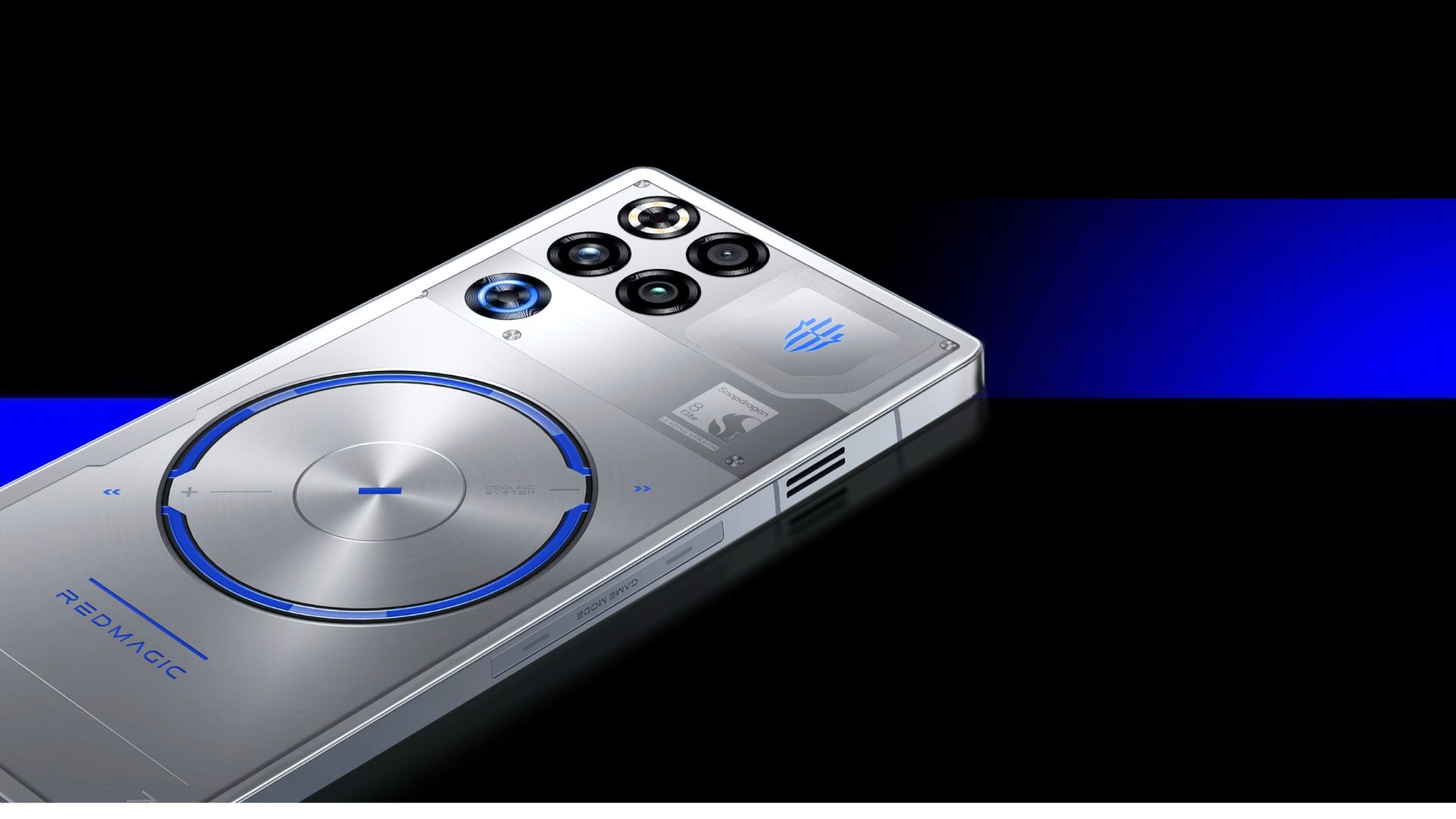
The gaming-focused RedMagic 11S Pro has now launched globally, bringing Qualcomm’s latest Snapdragon 8 Elite Gen 5 Leading Version chip alongside RedMagic’s dedicated RedCore R4 gaming processor. That combination is designed to push smoother frame rates, faster AI features and more stable performance during longer gaming sessions.

But the bigger story here is what RedMagic is doing to keep all that power under control.

The RedMagic 11S Pro introduces a revamped AquaCore Cooling System. This system combines a 24,000 RPM internal turbo fan, a larger vapour chamber and what the company calls an industry-first “flowing fluorinated liquid cooling” setup. It’s clearly built with sustained gaming performance in mind, especially for demanding titles that tend to turn phones into hand warmers after 20 minutes.

Advertisement

Battery life also sounds seriously impressive, packing a huge 7,500mAh battery paired with 80W fast charging that should comfortably outlast most flagship phones on the market. For gamers who spend hours on titles like Call of Duty Mobile or Genshin Impact, that could end up being one of the phone’s biggest selling points.

Advertisement

Around the front, the 11S Pro uses a 144Hz BOE full-screen display with an under-display selfie camera that helps keep the screen free from punch-hole interruptions while gaming. RedMagic is also bringing back its shoulder triggers for extra control in competitive games.

The design stays true to RedMagic’s usual style too, with transparent finishes available on selected models that show off some of the internal detailing.

Advertisement

Outside of gaming, the phone runs RedMagic OS 11.5 based on Android 16, with Google Gemini AI integration included as part of the software experience.

The RedMagic 11S Pro will be available globally from June 10, with pricing starting at $799. Early Bird sales begin June 9, while voucher sales open from June 3.

Source link

Advertisement
Continue Reading

Tech

4 Perks That Come With A Harley Owners Group Membership

Published

on


For passionate bikers, having a support system can be a great way to take your biking experience to the next level. When it comes to community, Harley-Davidson knows what it’s doing. If you own a Harley-Davidson motorcycle, you can join the Harley Owners Group or H.O.G. To register as a member, you’ll need to sign up on the Harley-Davidson website. Depending on your country, there are slightly different membership packages that offer different benefits. However, for those based in the United States, you have two options to choose from: the Harley Owners Group and Harley Owners Group Passenger (requires H.O.G. member sponsorship), which both cost $59 a year. According to Harley-Davidson, the key difference is that the passenger membership swaps out the roadside assistance benefit for $30 worth of reward points.

To register as part of the Harley Owners Group, you’ll first need to select your country from the drop-down menu. Next, find the Vehicle Identification Number (VIN), which you can locate either on your frame, engine, or insurance card. Afterward, you’ll need to supply your name, home address, language preference, and email address. Bear in mind that even an H.O.G. Passenger will need to share their sponsoring member’s number during the registration process. Either way, if you’re set on committing to the H.O.G. community, Harley-Davidson also offers promotions for setting up auto-renewal, including free merchandise. For women, there’s also the option to join Ladies of Harley, which holds community events specifically for women. 

Advertisement

Free access to the Harley-Davidson Museum

One of the most straightforward benefits of being an H.O.G. member is free access to the Harley-Davidson Museum. It’s located at 400 W. Canal St., Milwaukee, WI 53203, open from 10 a.m. to 5 p.m., and has regular programs and special exhibits. Without the membership, the standard ticket price is $25 for adults or $21 for senior citizens (65+), students, and U.S. military members. There’s also an $11 ticket for children aged 5 to 17, while children under 5 are free. With this, all you have to do is visit three times a year to be able to make up the price of an annual H.O.G. membership. 

To use this benefit, you’ll need to show your H.O.G. membership card and photo ID. If you suddenly realize that your U.S. membership has expired, renewing it at the museum also gives you the added benefit of a $20 gift card. Even H.O.G. members need to pay extra for guided tours, which cost anywhere from $15 to $135 and require advance booking. If you realize that you just really want an annual pass to the museum, they also offer individual passes ($50), family passes for two people ($75), and VIP passes ($150) for up to 4 people. All Harley-Davidson Museum annual passes also include free admission for children under 18, 50% of accompanied guests, and other discounts on-site.

Advertisement

Unlimited roadside assistance

With your H.O.G. membership, you get free Deluxe roadside assistance benefits for up to two Harley-Davidson motorcycles. It covers one of each type of service every seven days, which includes battery jumpstart service, lost key assistance, flat tire assistance, and extrication assistance. While it does cover fuel, oil, fluid, and water delivery, you’ll still need to pay for the cost of these separately, and they’re not covered by the Harley-Davidson warranty. The service also includes towing to the nearest dealership, which it recommends for issues related to its battery.

Alternatively, if you want some added flexibility, you can opt to upgrade to the Ultra Plus package, which is $69.95 per year. Similar to the complimentary benefit, it lets you use unlimited services per year, with each type of service every seven days. Some key differences include towing to any destination up to 35 miles, so you’re not limited to the dealership. Aside from your motorcycles, you can also request to cover an additional light-duty auto or truck. There’s also emergency travel reimbursement for the motorcycles of up to $1,000. Regardless of which option you choose, both Deluxe and Ultra Plus require registration with Agero. One caveat is that both offers are only covered in the United States, Canada, and Puerto Rico.

Advertisement

Harley-Davidson credit card benefits

Issued by the U.S. Bank National Association, Harley-Davidson offers two types of Visa cards: the Harley-Davidson Visa Signature card and the Harley-Davidson H.O.G. Elite Visa Signature card. While you still need to apply, H.O.G. members have added benefits for both of them once approved.

For the Harley-Davidson Visa Signature card, which doesn’t have an annual fee, you can get 1 point for every mile you’ve ridden. To be considered valid, you have to be a H.O.G. member in good standing and in good standing. Additionally, you have to have your odometer read at a dealership or authorized recording center. You can earn up to 50,000 points in this way. For every dollar spent on eligible Harley-Davidson purchases, you also get three times as many points. Lastly, for each use, you’ll also have double the amount of entries for its daily $500-A-Day Giveaway Sweepstakes, which runs until December 31, 2026.

While the Harley-Davidson H.O.G. Elite Visa Signature card does have a $99 annual fee, you do get a $59 H.O.G. membership credit that can cover an entire year, a $10 SiriusXM credit, and a $30 dealership credit. This tier also offers twice as many points for every mile, but with the same maximum 50,000 points per calendar year. It also has a much higher 5x points multiplier for Harley-Davidson purchases, plus gas stations, and shares the same rules for the $500-A-Day Giveaway. Both credit cards also enjoy point multipliers for partner establishments, like restaurants, bars, and hotels.

Advertisement

Exclusive content, experiences, and shopping benefits

In the past, we’ve mentioned how going to the Harley-Davidson Homecoming Festival should definitely be on your bucket list. Not only is it a unique opportunity to learn more about what goes inside your bike, but the pilgrimage is also the perfect place to meet other riders from all over the world. But even if you can’t make it, being a member of H.O.G. lets you experience community in other ways. 

Along with access to exclusive events, you can also add a +1 and take advantage of discounted prices for paid experiences. One of the most exciting parts of being part of the H.O.G. community is the global rallies that happen in North America, Latin America, and Europe. In 2026, some rallies span weekends to extended tours that can last more than a week. While there are national events, there are also more than 1,400 H.O.G. global chapters that organize their own experiences. Apart from group rides, they also host competitions, safety courses, and charity events. While you may have to pay a separate chapter fee, there is no limit to the number of chapters you can join.

Advertisement

You’ll also have access to exclusive content and merchandise, such as annual gifts like pins and patches, the publication, and even T-shirts. For orders above $99, you’ll also have the option for free expedited shipping, which can be perfect for snagging gifts for Harley-Davidson fans. In addition, you get additional discounts from partners, such as Hilton, EAGLERIDER, KOA, and Insta360.


Advertisement

Source link

Continue Reading

Tech

Hunting Submarines Via Gravity Is A Tough Errand

Published

on

Among so many other technological advances, the Cold War saw the advent of the ballistic missile submarine. The concept was simple—pack enough nuclear warheads to destroy a small civilization into a compact metal tube, and then hide it underwater. The oceans would act as a cloak for your fleet of world-enders, and keep your enemies forever on their toes. A terrifying machine that could both start and end a war with the push of a button.

Most nation states are populated by humans with the will to live. Thus, there has been a great incentive to find ways to keep tabs on these sunken doombringers. Great efforts have gone into improving sonar and magnetic detection methods over the decades, which are the bread and butter of sub hunting to this day. However, military researchers have also explored the prospect of whether submarines could be detected via their effect on the gravitational field alone.

Do You Feel It?

Ballistic missile submarines can carry enough nuclear weapons to ruin almost everybody’s day, all at once. Thus, there is a great incentive for novel solutions on how to keep track of them. Credit: US Navy, public domain

The simple matter is that every object with mass has its own gravitational field. We don’t typically think about it, because gravity is the weakest of the fundamental forces. On anything less than a planetary scale, it’s generally not obvious to us in our daily lives. However, submarines are quite heavy and large, particularly those that are armed with a complement of nuclear-capable ballistic missiles. Thus is raised the prospect of detecting these massive objects via their perturbations to the local gravitational field. This has been a hot-button news item in military commentary circles of late, with much bluster that advanced measurement equipment could potentially render the ocean transparent and reveal the locations of submarines at great distances.

Naturally, it’s difficult to comment accurately on top-secret military capabilities from a civilian viewpoint. Such a technology would be game-changing in a strategic sense, to the point that any nation state with such a capability would have great reason to keep its existence strictly hidden. However, there is some literature on the topic that is in the public domain, which discusses just how hard this feat would be to execute in practice. A great example is a report prepared by the Pacific-Sierra Research Corporation in 1989, under the sponsorship of the Naval Air Development Center.

How It Works

A Chinese research effort has built a gradiometer of great sensitivity, which lead to widespread speculation around its potential military applications. Credit: CAS

When it comes to detecting the gravitational anomaly of a submarine, you might think it would be easy given the sheer mass of such a craft. However, the way submarines operate frustrates this at a very fundamental level. In normal operation, a submarine is neutrally buoyant, displacing an amount of water roughly equal to its own mass. Thus, the submarine is not really distinguishable from the water around it in terms of its first-order effect on the gravitational field, being roughly as heavy as the water that would otherwise be there.

There is a wrinkle, though, in that a submarine is bottom-heavy for the sake of stability. This does create a variance in the gravitational field versus the otherwise uniform field in open water, and it’s one that could theoretically be detectable with a sensitive enough apparatus.

Advertisement

The device used for measuring gravitational variation is called a gravimeter. They are essentially a special-case variant of accelerometer, specifically designed to very accurately measure the local acceleration due to gravity at a single point. Then there is the gravity gradiometer, which measures the spatial rate of change of gravitational acceleration. By virtue of measuring acceleration gradients, a gradiometer is not sensitive to the acceleration perturbations of a moving platform, making it particularly useful for use in a moving frame of reference such as towing behind a ship or aircraft. Various types of each instrument exist, from portable units to high accuracy laboratory instruments; creating an exhaustive list of all  variants is outside the scope of this article. The real question is, based on the gravitational anomaly generated by a large submarine, to what useful range could a gravimeter or gradiometer detect one?
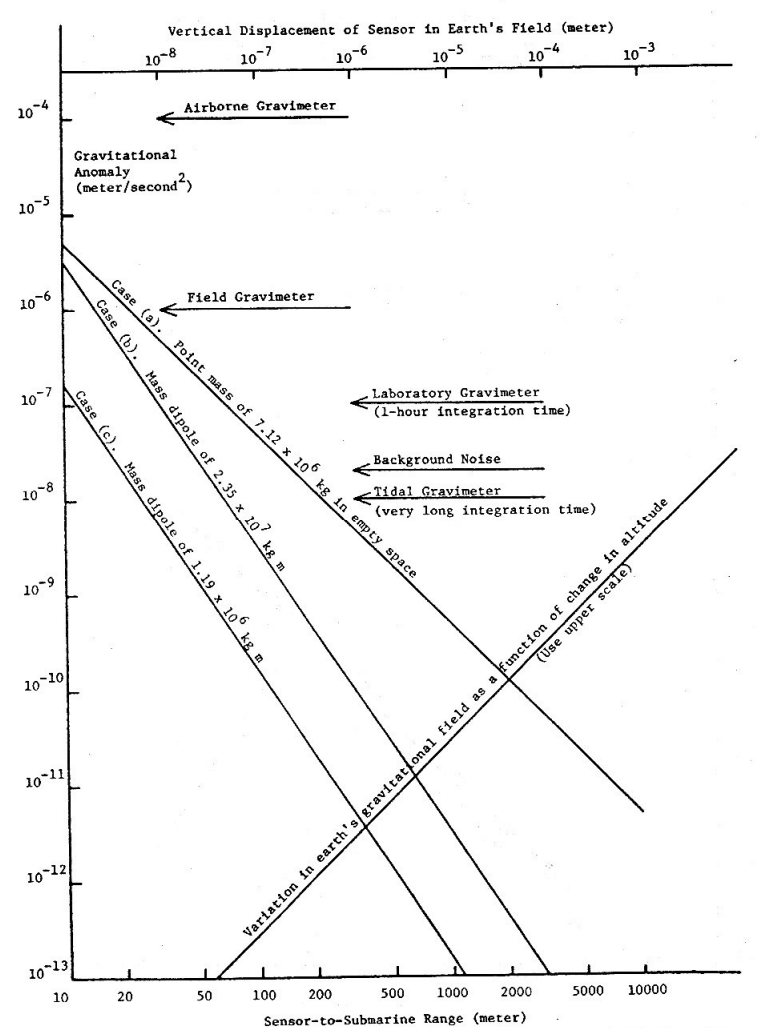
A graph highlighting the challenge of detecting submarines via gravimetry. In 1989, the best gravimeters might have been able to detect a submarine within 30 meters or so—a militarily useless figure. There have been improvements in technology since, but short of an increase in capability of many orders of magnitude, gravitational methods of detection remain difficult to execute at range. Credit: research paper

Unfortunately, the maths says that you have to get very, very close. In the 1989 study, calculations suggested the best gravimeters and gradiometers in the world would maybe be able to pick up a large submarine from a distance of tens of meters, at best. The simple problem being that the gravitational anomaly generated by an underwater submarine, and the gradient of that anomaly, are both so small, that even highly sensitive instruments would struggle to pick it up when the submarine is practically in visual range. Even if the problem were simplified, and one were trying to detect a submarine as a heavy point mass in empty space, detection ranges would stretch to somewhere in the range of 100 meters at most. Of course, this would be largely irrelevant due to the neutral buoyancy considerations explained above.

It’s true that technology has moved on since 1989. We have more advanced gravimeters and gradiometers available now, including quantum units with greater sensitivity than ever. And yet, even with these advances, it would be still be a struggle to detect a submarine at useful range. Sensitivities would have to jump by four or five orders of magnitude to enable detection at ranges of 1000 meters. Even still, if this were achieved with some highly classified system, it would still be relatively limited in capability versus more established techniques in magnetic or acoustic detection.

The parameters of the problem, combined with the sheer weakness of gravitational forces, means that gravitational detection is not some silver bullet for tracking enemy submarines at great range. While it would be desirable to have some kind of sensor that could reveal where these nuclear weapon platforms are lurking at all times, that technology seems beyond the reach of even the most capable navies at this time. For now, strategic planners will continue to sweat over the threat these weapons pose, never quite knowing whether they’re lurking just off the coast or half a world away.


 

Advertisement


Source link

Advertisement
Continue Reading

Tech

e2Value on why historical context matters in a new era of AI

Published

on

TL;DR

e2Value co-founder Todd Rissel argues that AI-powered property valuation only works when grounded in decades of historical context, construction trends, economic cycles, and shifting cost environments, that shape what replacement cost actually means today.

For many participants across insurance and property ecosystems, current valuation challenges did not emerge from a single moment or event. Multiple economic cycles, demographic shifts, evolving construction practices, and changing consumer expectations have accumulated over time, creating a landscape that can sometimes feel difficult to fully trace. Limited visibility into how these layers developed has made present-day valuation conversations increasingly nuanced. Within this environment, e2Value has focused on studying the long arc of property intelligence, using historical context alongside modern technology to support a more informed view of valuation.

Advertisement

Current discussions around property valuation often begin with present conditions, although a broader historical lens offers an important perspective. “In earlier decades, people generally saw homeownership through a simpler financial lens,” Todd Rissel, co-founder and CEO of e2Value, says. “A house was viewed as simply a place to live, and estimating its value tended to feel more straightforward because prices, replacement costs, and household budgets usually stayed closer together.

Over time, economic expansion, rising residential values, and changing patterns of household wealth introduced additional layers of complexity. According to Rissel, during the 1980s and 1990s, evolving building standards, energy-related considerations, and increased private investment into residential markets contributed to an environment where homes became larger financial commitments for many families. Property ownership increasingly carried dimensions extending beyond shelter and into long-term wealth accumulation.

As these changes unfolded, distinctions between purchase price, market value, replacement cost, and appreciation became more difficult for consumers to separate. A home’s purchase price could reflect market demand and neighborhood dynamics, while replacement cost involves an entirely different calculation based on the availability of labor, quality of materials, and local market conditions.

Rissel offers a broader perspective on this evolution. He says, “Every economic era leaves behind a set of assumptions that people tend to hold onto. Those assumptions can keep shaping decisions long after the conditions that formed them have shifted.

Additional economic developments introduced another layer of complexity. For many years, rising incomes and broad access to capital moved alongside increasing property values. Following the financial disruption of the late 2000s, that relationship entered a different phase. Property values remained elevated across many regions while access to capital moved through a period of recalibration, creating a longer-term adjustment across housing and financial systems.

Advertisement

Valuation standards increasingly became part of a larger conversation involving affordability, underwriting, and risk assessment as those conditions continued to develop. Consumers often encountered difficulty distinguishing between the value associated with purchasing a home and the cost associated with rebuilding that same structure.

Present conditions reflect the accumulation of these historical developments. According to Deloitte’s 2026 Insurance Industry Outlook report, insurers are navigating expanding complexity linked to catastrophic events, changing customer expectations, and rapidly evolving technology environments. The report also notes that technology priorities are increasingly focused on strengthening data foundations and creating systems capable of supporting meaningful AI implementation.

This progression naturally brings AI into the discussion. Across insurance ecosystems, AI has generated significant interest because of its ability to process extensive amounts of information and identify patterns across large datasets. EY reports that many senior leaders are reevaluating enterprise AI strategies with greater emphasis on long-term value creation, data quality, and future adaptability.

Still, technology itself represents only part of the equation. AI systems rely heavily on the information used to train and guide them. Historical context becomes particularly important because valuation is influenced by decades of construction practices, regional patterns, economic cycles, and changing cost environments.

Advertisement

Rissel explains this relationship through a broader lens. “Technology can organize and process information at remarkable speed, although meaningful insight often begins with understanding where the information originated and why it matters,” he says. “Data gains value when context travels alongside it.

This perspective aligns closely with e2Value’s own role within the valuation ecosystem. Since its founding in 2000, the company has focused on preserving historical property intelligence while integrating modern modeling capabilities into its valuation platforms. That role extends beyond creating software designed to generate estimates.

We’ve spent years examining how structures behave as economic assets that are influenced by construction practices, local market dynamics, material costs, labor conditions, and broader macroeconomic patterns,” Rissel shares. Through that work, the company developed valuation methodologies intended to reflect the larger environment surrounding a property instead of viewing a structure only as an isolated collection of components.

That perspective has also influenced how e2Value interacts with different parts of the insurance ecosystem. Across underwriting, risk evaluation, claims environments, and portfolio management discussions, valuation increasingly functions as a source of insight that supports larger decisions. Replacement cost estimates can influence coverage discussions, portfolio assessments, and broader conversations surrounding risk exposure. As data expectations continue expanding across the industry, connecting those elements within a unified framework has become increasingly important.

Advertisement

Overall, the long arc of valuation shows that today’s complexity is a product of decades of shifting economics, construction practices, and consumer expectations. As Rissel emphasizes, assumptions formed in earlier eras still shape how people interpret value, even as conditions evolve. In this environment, e2Value helps insurers, underwriters, and property stakeholders navigate a landscape where replacement cost, market value, and risk are increasingly intertwined by grounding advanced modeling in the context that gives data meaning.

Source link

Advertisement
Continue Reading

Tech

Starlink and Amazon May Be Able To Buy Into EU Mobile Satellite Spectrum Plan

Published

on

An anonymous reader quotes a report from Reuters: Elon Musk’s Starlink and Amazon’s low-earth-orbit satellite business may be able to acquire some European mobile satellite spectrum next year, two people with direct knowledge of the matter said on Tuesday. But they said two-thirds of the satellite spectrum that allows mobile devices and vehicles to communicate seamlessly even in remote locations, would be reserved for European companies.

U.S. companies Viasat and EchoStar hold licenses that are due to expire in May 2027 and the European Commission has been considering how to allocate future spectrum at the same time as the bloc pushes to reduce reliance on U.S. tech. The European Union’s IRIS2 multi-orbit array of 290 satellites, a response to Starlink, will be among the European companies to receive some spectrum, the sources said. British and Norwegian companies can also bid for a license, the people said. Details of the proposal, set to be announced on Wednesday, could still change at a meeting of commissioners on the day, one of the sources. Commission spokesman Thomas Regnier said EU-wide satellite connectivity was “synonymous with resilience, security, and capability” given the current geopolitical context.

“Satellite connectivity is a key piece of our technological sovereignty, our security, and our defense, as also highlighted by IRIS2,” he added.

Source link

Advertisement
Continue Reading

Trending

Copyright © 2025