

Crypto World
Stake DAO hit by hack as DeFi security confidence hits new low



Longtime DeFi platform Stake DAO has become the latest victim in an increasingly worrying run of DeFi hacks.
In what appears to be a private key compromise, an attacker was able to mint 5.4 trillion of the project’s vsdCRV tokens on the Arbitrum network.
Blockchain monitoring firm Blockaid explains that an attacker used the compromised deployer to reconfigure the token’s LayerZero OFT contract to grant minting authority to an “attacker-deployed malicious contract.”
Read more: Bridge hacks back in vogue as Verus exploit brings 2026 total to $329M
The hacker swapped a portion of the tokens, a yield-bearing, wrapped version of Curve Finance’s CRV, for a total of 44 ETH. After presumably depleting on-chain liquidity, the approximately $91,000 of total profit was then bridged back to Ethereum.
The project posted to X that it is “aware of the ongoing situation,” urging users not to interact with csdCRV. Additionally, Curve Finance advised its users to exit LlamaLend positions involving asdCRV to avoid the risk of liquidation.
Launched in 2021, Stake DAO has weathered DeFi’s stormy seas for over five years. But this isn’t the first time it has faced trouble.
On March 12 this year, the platform’s Votemarket rewards program was attacked via a “peripheral oracle update mechanism.” Most of the $175,000 stolen on Arbitrum and Base was later returned.
Read more: Polymarket exploited for $700K in private key hack
Crisis of confidence in DeFi security
Today’s Stake DAO hack comes amidst a heated, ongoing debate over DeFi security in the age of AI.
Hours before the hack, Manuel Aráoz, co-founder of OpenZeppelin, posted to X that he considers all of DeFi “unsafe.”
Read more: DeFi sector in $14B meltdown as $290M rsETH hack fallout burns Aave
OpenZeppelin, founded in 2015, provides secure standards for smart contracts for use in DeFi applications and audit services for projects. But Aráoz believes that “superhuman” coding agents put even “low-risk ‘blue chips’ like Aave, MakerDAO & Compound” at risk.
However, former Aave delegate Marc Zeller calls Aráoz’ post “moronic.” He argues that the majority of DeFi losses are down to “bad parameter configuration, collateral blow up and poor opsec,” rather than smart contract exploits.
Pseudonymous Yearn developer banteg agrees that DeFi’s asymmetric security landscape means “one small mistake is enough to kill you.” However, they agree that recent hacks are dominated by “privileged role or key compromises or configuration errors.”
Got a tip? Send us an email securely via Protos Leaks. For more informed news and investigations, follow us on X, Bluesky, and Google News, or subscribe to our YouTube channel.

XBIT DEX is expanding the toolkit for on-chain prediction markets by introducing a dedicated leverage layer, with the 2026 FIFA World Cup serving as the initial proving ground. The platform has opened whitelist applications for Prediction Leverage, signaling a shift toward more flexible risk management in on-chain forecasts.
May 27, 2026 — The once-spot-centric world of on-chain predictions is embracing leverage as users seek ways to hedge, scale, and manage exposure across event-driven markets. Industry data show a surge in activity: March 2026 alone saw monthly trading volume north of $25 billion, a stark acceleration from the year prior. In this environment, Polymarket has emerged as the official prediction market partner for XBIT DEX, and Coinbase has broadened prediction contracts across all 50 U.S. states. Yet, even as capital floods in, the underlying product architectures have struggled to keep pace with demand.
Traditional prediction markets have largely operated on a straightforward, all-in, full-amount purchase model with settlement based on binary outcomes. Participants could not easily add to positions, hedge risk, or adjust leverage in real time. This lack of flexibility mirrors an earlier phase seen in crypto derivatives before the arrival of perpetuals in 2016, which catalyzed a surge in derivatives volumes relative to spot trading. XBIT DEX is positioning Prediction Leverage as the next evolution for on-chain predictions, building a bespoke leveraged infrastructure tailored to the unique mechanics of event contracts.
Leverage system built specifically for prediction markets
Event contracts underpin prediction markets by delivering outcomes that settle to 0 or 100. Unlike perpetuals, these contracts do not rely on continuous funding rates, which leaves a misaligned incentive structure for traditional leverage. To bridge this gap, XBIT DEX has devised an independent leveraged lending framework that borrows against authentic order flow from external prediction markets. Instead of funding rates, leverage openings accrue borrowing interest that adjusts dynamically with supply and demand. The design also emphasizes resilient risk controls: extreme-value liquidation mechanics and adaptive leverage management aimed at handling the pronounced volatility as contracts approach settlement.
The result is a system that can accommodate leveraged exposure in a domain where payouts hinge on discrete, binary outcomes, while still preserving the trustless, on-chain nature of the platform. XBIT DEX describes the approach as a necessary evolution to unlock a broader range of trading strategies within event-driven markets, enabling users to hedge, scale, and diversify positions without leaving the on-chain ecosystem.
World Cup as the testing ground for Prediction Leverage
Prediction markets span politics, finance, and sports, but the World Cup offers a combination of settlement certainty, high event density, and concentrated order flow that suits automated, algorithmic trading. Sports events provide clear outcomes and synchronized global viewership, which translates into more robust liquidity for event-based derivatives. The 2026 FIFA World Cup, kicking off on June 11, is the largest edition to date, with 48 teams, 104 matches, and a 39-day schedule. This environment is being used to seed XBIT DEX’s initial Prediction Leverage offerings, featuring 2x to 5x dynamic leverage that adjusts in real time in response to market conditions.
As part of the rollout, XBIT DEX has already begun offering leveraged prediction trading around selected World Cup teams, with the leverage settings designed to respond to shifts in liquidity and risk. The white-label testing phase is specifically designed to validate the mechanics and guardrails before broader platform-wide deployment.
Whitelist rollout and incentives
Access to Prediction Leverage is currently limited to a whitelist, operating on a first-come, first-served basis. Interested traders can apply at app.xbit.com/whitelist, with eligibility unlocked by completing a series of trading milestones. Early engagement appears strong, with more than 1,700 users already on the waitlist, signaling demand for a more sophisticated toolkit in on-chain predictions. The plan is to open platform-wide access in the lead-up to the World Cup kickoff, aligning product readiness with a surge of global interest in event markets.
In conjunction with the whitelist, XBIT DEX launched a two-week trading campaign running from May 26 through June 10. The promotion includes a 35,000 USDC prize pool distributed across three categories: Early Bird Trading, Referrals, and a Leaderboard. Details are published on the whitelist page, offering participants a structured incentive to explore the new leverage features while the platform validates its risk controls and performance in a live environment.
About XBIT DEX
XBIT DEX markets itself as a decentralized aggregated trading platform that brings together multiple on-chain liquidity sources to deliver low-slippage trading across a suite of products. The platform already supports perpetual contracts, prediction markets, and plans to enable a U.S. stock trading avenue for real-world assets (RWA), with more than 150 tokens accessible to traders. By leveraging its established derivatives infrastructure, XBIT DEX positions itself as the first DEX to introduce a dedicated leverage layer for prediction markets, aiming to unlock more nuanced trading strategies for participants who want to hedge, speculate, or arbitrage across event-driven outcomes.
For more information about the platform and its offerings, readers can visit the official site at XBIT DEX Official Website.
As the World Cup shape and global participation evolve, the industry will watch closely to see how the new Prediction Leverage feature performs under real-world liquidity pressures and settlement dynamics. If successful, the model could redefine how traders approach on-chain event markets, moving beyond binary bets toward more sophisticated risk management and strategy design within the predictable cadence of major sporting events.
Readers should keep an eye on the whitelist progress and the platform’s broader rollout timeline, as well as any regulatory developments that could influence leverage-enabled prediction markets and cross-border capital flows. In the near term, the World Cup stands as a critical proving ground for whether prediction markets can scale with financial innovation while maintaining robust risk controls and transparent settlement.

Grayscale rolls out ETF combining spot Ether exposure with staking rewards
Grayscale has launched the Grayscale Ethereum Staking Mini ETF, a product the firm says provides spot Ether exposure alongside staking rewards and can be bought through brokerage and retirement accounts. Grayscale reports the vehicle has generated more than $15 million in staking rewards since October 2025, and lists a management fee of 0.15% as of March 30, 2026.
What the product offers
The new fund is positioned to give investors a single security that represents exposure to Ether plus the economic benefits of staking, without requiring holders to operate validators, manage private keys, or custody tokens directly. That model appeals to investors who want yield associated with staking but prefer the convenience and custodial safeguards common to traditional investment products.
Key features highlighted by Grayscale include brokerage and retirement account accessibility, the fund’s role in collecting staking rewards on behalf of shareholders, and a relatively low fee compared with some actively managed crypto products. Grayscale also notes the fund is structured differently from ETFs registered under the Investment Company Act of 1940, and therefore is not subject to the same regulatory regime as conventional mutual funds or registered ETFs.
How staking within an ETF works and the trade-offs
When an ETF or fund stakes Ether, it commits the underlying tokens to protocol staking mechanisms; those tokens are typically locked for the period required by the network. For the fund, staking can generate rewards, but it also introduces operational considerations and limits liquidity. The fund cannot sell or transfer staked tokens during lock-up windows, which can prevent timely rebalancing or sales if market conditions change.
Grayscale cautions investors that staking inside the fund carries the same broad categories of risk found in direct staking: smart contract vulnerabilities, validator or custodian failures, network outages, and the potential for partial or total loss of staked assets or rewards. The fund earns staking rewards and then distributes value to the fund itself; investors receive the economic benefit through the share price rather than direct token distributions.
Context: why this matters for investors and the market
Bringing staking into an exchange-traded vehicle responds to growing demand for simplified access to on-chain yield without the technical and custody burdens. For retail and many institutional investors, the ability to allocate to a product through familiar brokerage platforms and retirement accounts lowers operational friction and may broaden participation.
At the same time, using a fund wrapper changes the risk and tax profile compared with holding and staking Ether directly. Investors should weigh the convenience of delegated staking and centralized custody against the potential cost of indirect ownership, including any fee drag and counterparty risks.
Regulatory and disclosure points
Grayscale’s materials note the fund is not an investment company registered under the Investment Company Act of 1940. That distinction is important because it means different regulatory requirements apply than those governing registered ETFs and mutual funds. The firm also emphasizes that the information provided is not investment advice and encourages prospective buyers to consult the fund prospectus.
Prospectus and investor guidance: Grayscale’s release reiterates that a prospectus must accompany or precede information about the fund and that investors should read it carefully. The prospectus includes details on fees, risks, staking mechanics, and the fund’s structure.
Implications for market participants
For asset managers and product designers, the product demonstrates another step in converting on-chain yield into tradable financial instruments. For investors, the ETF may offer a way to gain ETH exposure plus additional yield without the complexities of self-custody, but it also concentrates custodian and protocol risk into a single counterparty relationship.
Ultimately, the appeal of such products will depend on investor priorities: whether they prioritize custody and operational simplicity, prefer direct engagement with the protocol for governance or yield maximization, or seek tax treatments that differ between pooled funds and direct holdings.
Investors interested in the Grayscale Ethereum Staking Mini ETF should review the fund’s prospectus, understand the staking-specific risks and lock-up mechanics, and consider how the product fits their broader portfolio strategy. As with all digital-asset investments, heightened volatility and the potential for total loss remain salient considerations.


Kraken has launched Bitcoin Vault, a new earning product designed for long-term Bitcoin holders to generate yield on their BTC holdings. The product offers customers up to 2.5% in BTC-denominated rewards while maintaining custody of their Bitcoin. Bitcoin Vault is powered by Veda, with strategy… Read the full story at The Defiant

Tuesday turned ugly for crypto markets, with a broad wave of selling hitting altcoins across the board, led by Zcash (ZEC), which dropped 11%, World Liberty Financial’s WLFI, which was down 8%, and Ondo Finance (ONDO), falling 7%.
The losses came against a backdrop of rising bearish sentiment in the crowd, which, according to blockchain analytics firm Santiment, has historically happened right before prices rebounded.
Details of the Sell-Off
Santiment flagged the damage in a post on X earlier today, noting drops in Ondo, Zcash, WLFI, and DeXe, among others.
For Ondo, the timing was particularly grim, seeing as the dip came right on the heels of the passing of 32-year-old founder and CEO Nathan Allman. The company announced that longtime President Ian De Bode will take over as CEO. The token is now trading near $0.41, putting its performance in the last seven days up by roughly 9%.
Zcash’s 11% single-day drop was the sharpest among the named losers, although at the time of writing the decline was at about 7.5% in the last 24 hours, with ZEC trading at around $570. For context, the asset is up 60% over the past month and nearly 970% across the last year, so the daily move looks less alarming against that backdrop.
Meanwhile, WLFI’s 8% dip added to a difficult stretch for the token, which hit a new all-time low in late April after crashing 16% in one day. It has had to navigate a controversial lock-up proposal, a lawsuit by Tron’s Justin Sun, and continued scrutiny over ties to the Trump family.
It Wasn’t All Red
Despite the losses mentioned above, the weekly picture looked different for some tokens. For example, NEAR was up more than 55% over seven days, and it was changing hands around the $2.50 level, although it pulled back nearly 8% on Tuesday alone. Another gainer was Hyperliquid’s HYPE token, which went up 25% per Santiment’s data.
However, the week’s standout was RAIN, which hit an all-time high of around $0.012 on Tuesday after climbing almost 55% for the week and over 44% in the last 24 hours alone.
Separate data from Santiment posted on the same day showed that bearish crowd expectations have been building for about 10 days now, with the firm noting that this kind of collective lean toward caution has historically heralded price recoveries, considering that markets tend to move against the crowd’s prevailing mood.
But traders will have to wait and see whether that plays out this time, especially with Bitcoin still stuck below $77,000 and struggling to break above its descending 200-day moving average near $80,000.
The post Altcoins Crushed as Bearish Sentiment Sweeps Crypto Markets appeared first on CryptoPotato.

Vessels in the Strait of Hormuz near Bandar Abbas, Iran, May 4, 2026.
Amirhosein Khorgooi | ISNA | WANA | Via Reuters
Iran thinks it can get the Strait of Hormuz to its prewar status within one month of a peace deal with the U.S. Traders on prediction market platform Kalshi are more skeptical.
They place just a 38% chance that traffic flows through the strait will return to normal by July 1. The contract defines normal flows as the seven-day moving average of transit through the strait crossing 60 based on data from IMF PortWatch.
That level, though, is higher than the roughly 32% chance that traders gave of that happening before the new reports Wednesday.
Reuters cited Iranian state television, which said it had a draft framework of a memorandum of understanding with the U.S., where the detail was learned. The White House denied the existence of any framework with Iran.
Traders are more confident that flows will return to normal by Aug. 1. They put 60% odds on it happening, higher than the 50-50 chance they had before the reports.
However, all of these odds are lower than chances traders had over the weekend, when there appeared to be a potential imminent announcement of a deal between the two countries. Odds that traffic in the strait returned to normal by July were as high as 50% on Sunday.
Disclosure: CNBC and Kalshi have a commercial relationship that includes customer acquisition and a minority investment.

XBIT DEX takes the lead in introducing leverage to on-chain prediction markets, prioritizing the 2026 FIFA World Cup for its initial category. The whitelist application is now live.
May 27, 2026 – On-chain prediction markets are undergoing explosive growth. In March 2026, monthly trading volume surpassed $25 billion, a more than 20-fold increase compared to the same period last year. Polymarket has become the official prediction market partner for X, and Coinbase has launched prediction contracts across all 50 US states. However, while users and capital are flooding in, product architecture has yet to keep pace.
Currently, mainstream prediction market platforms still predominantly rely on a spot logic of full-amount purchasing and waiting for settlement. Users lack tools to add positions, hedge, or flexibly adjust risk exposure through leverage. The crypto market went through a similar phase until the emergence of perpetual contracts in 2016, which led to derivatives trading volume completely overtaking spot volume in less than four years.
Prediction markets are now entering the same inflection point. XBIT DEX, a decentralized aggregated trading platform, recently opened whitelist applications for Prediction Leverage, officially bringing leverage mechanics into the on-chain prediction market sector. Because the underlying contract structure of prediction markets fundamentally differs from that of perpetual contracts, XBIT DEX has built a specialized leverage infrastructure tailored specifically for prediction markets.
Leverage system built specifically for prediction markets
Perpetual contracts track continuous price movements, whereas prediction markets are based on event contracts, where prices fluctuate between 0 and 100, ultimately settling in a binary format of either zero or full value. Under this binary settlement structure, the traditional funding rate loses its anchoring mechanism.
To address this structural difference, XBIT DEX has constructed an independent leveraged lending system. Every leveraged order is executed based on authentic order flow from external prediction markets. The platform replaces funding rates with borrowing interest, with interest rates adjusting dynamically based on supply and demand. In terms of risk control, the platform introduces extreme-value liquidation and dynamic leverage adjustment mechanisms to handle the unique price volatility characteristics of event contracts as they approach settlement.
Building on this framework, XBIT DEX has selected sports events as the debut category for its Prediction Leverage feature.
Launching with sports events and the 2026 World Cup
Prediction markets span multiple event categories, including politics, finance, and sports. Political events often carry ambiguities in their settlement definitions, posing a risk to automated clearing engines. Financial predictions (such as the trajectory of macroeconomic data) heavily overlap with existing derivatives markets, offering limited incremental trading scenarios.
Sports events, by contrast, offer absolute settlement certainty, high event density, and concentrated order flow driven by synchronized global viewing, making them a natural fit as the underlying vehicle for prediction market derivatives.
The 2026 FIFA World Cup will kick off on June 11, featuring 48 teams and 104 matches distributed across a 39-day schedule, making it the largest iteration in World Cup history. XBIT DEX has already launched leveraged prediction trading for multiple popular teams surrounding the tournament, offering 2x to 5x dynamic leverage that adjusts in real time based on market conditions.
Currently, the Prediction Leverage feature has entered its whitelist testing phase.
Whitelist and campaign
Whitelist spots are limited and allocated on a first-come, first-served basis. Users can submit applications via app.xbit.com/whitelist and unlock eligibility by completing designated trading milestones. Over 1,700 users have already joined the waitlist, and the feature is expected to open platform-wide before the World Cup kickoff.
In tandem, XBIT DEX has launched a two-week trading campaign running from May 26 to June 10. A 35,000 USDC prize pool covers three reward categories: Early Bird Trading, Referrals, and a Leaderboard. Full details are available on the XBIT DEX whitelist page.
About XBIT DEX
XBIT DEX is a decentralized aggregated trading platform that integrates multi-source on-chain liquidity to deliver a low-slippage trading experience. The platform supports perpetual contracts, prediction markets, and RWA US stock trading (under planning), covering more than 150 tokens. Leveraging its established derivatives infrastructure, XBIT DEX has become the first DEX platform in the prediction market track to introduce leverage functionality.
Learn More: XBIT DEX Official Website
Bybit warns customers that any HTX-linked deposits or withdrawals could trigger additional anti-money laundering (AML), compliance, or risk-control checks. The advisory arrived hours after the UK sanctioned HTX operator Huobi Global S.A.
The notice marks one of the first public moves by a top-tier exchange to wall off HTX flows. Bybit advised users to avoid HTX-related wallets when funding accounts and keep all activity inside local rules.
Bybit Walls Off HTX-Linked Transfers
Specifically, Bybit said that HTX-linked transfers may face additional AML, compliance, or risk-control checks. The exchange told users to keep all account activity aligned with local laws and platform policies.
Meanwhile, HTX draws a sharp line between the sanctioned entity and its consumer platform. The exchange said Huobi Global S.A. is distinct from the online HTX platform.
“To clarify, the listed entity Huobi Global S. A. is distinct from the online HTX exchange,” the exchange stated.
That separation, HTX argued, means the designation should not affect day-to-day operations.
In the same tone, Huobi Global’s advisor, Justin Sun, said that the relevant team will work with the UK authorities to address any concerns promptly.
Experts Warn Of Stablecoin Freeze Spillover
Vitaly Gorbenko, chief executive at CoinKit, told BeInCrypto the move sets a global precedent, flagging the order’s asset-freeze clause as the most pressing risk.
“This means issuers themselves could potentially block assets. That is alarming because, based on public data alone, HTX wallets hold more than 100 million USDT.”
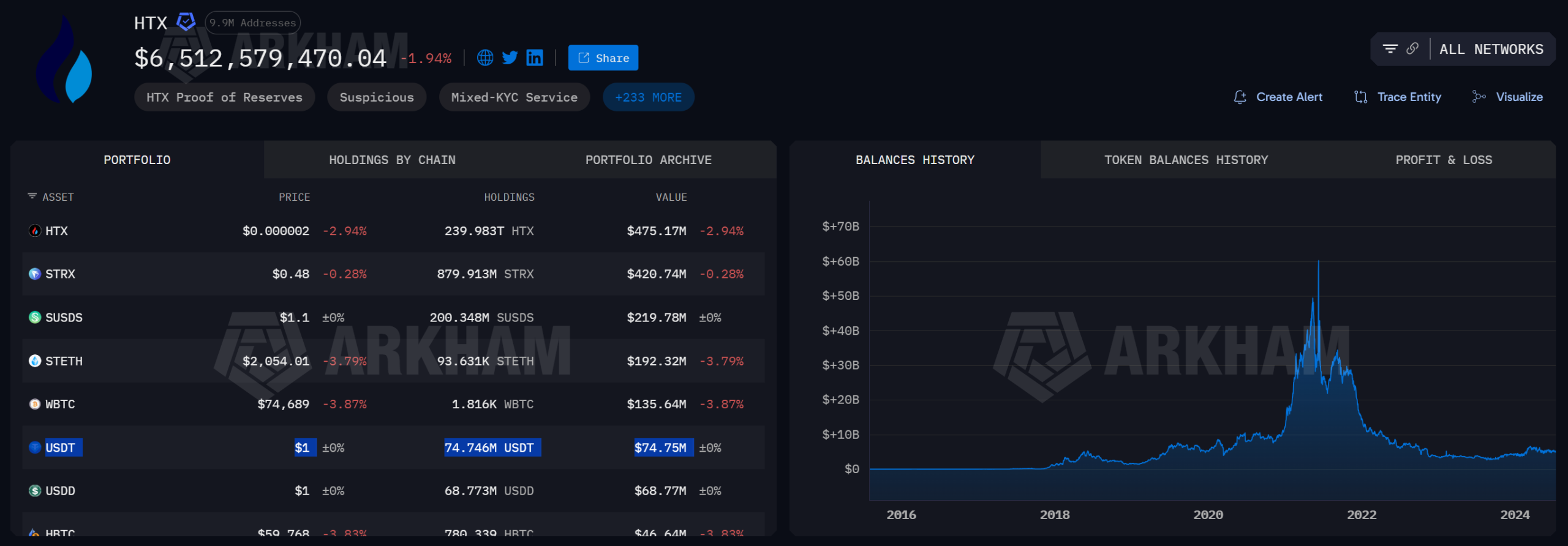
Data according to Arkham shows HTX holds over $74 million worth of USDT, which features among its top 10 holdings by portfolio value metrics.

Fedor Ivanov, analytics director at AML provider SHARD, said the British order binds only UK residents and entities.
Still, he expects global banks and stablecoin issuers to tighten screens on HTX counterparties.
Tether has previously frozen USDT on flagged wallets and moved earlier against Russian exchange Garantex.
Ivanov added that AML labelling spread the UK designation through compliance pipelines within hours. That speed accelerates a split between sanctioned and non-sanctioned crypto ecosystems.
Pending European AML rules due in 2027 may widen that divide further.
With over $100 million in HTX-controlled USDT under the microscope, attention turns to whether Tether or Circle act next.
The notice fits Bybit’s regulatory push toward compliance optics as global enforcement tightens around sanctioned counterparties.
The post Bybit Distances Itself From HTX As Experts Warn Of USDT Freeze Risk appeared first on BeInCrypto.


SoFi Technologies, a publicly traded US neobank, has made SoFiUSD available inside its banking app for 14.7 million members, the company said in a press release published Wednesda. Members can now buy, sell, hold, and convert SoFiUSD directly within the SoFi app. Full availability is expected by… Read the full story at The Defiant
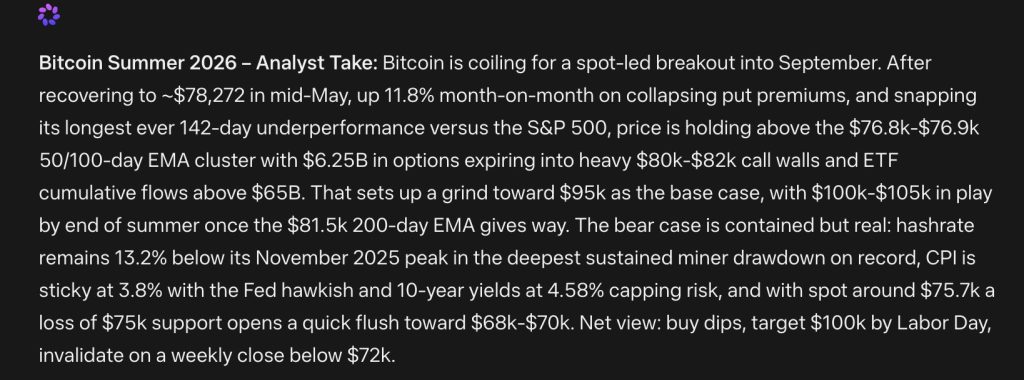
Mark Zuckerberg Model Meta AI is not mincing predicts on Bitcoin, the model sees a spot-led breakout coiling up right now, with $100,000 to $105,000 on the table by end of summer 2026 from a current price of $75,650.
The setup Zuckerberg’s AI is pointing to is more technical than narrative-driven, and that is what makes it interesting.
Bitcoin already recovered to around $78,272 in mid-May, up 11.8% month-on-month while put premiums collapsed, a signal that the options market was quietly repricing risk to the upside.
That move also snapped a 142-day stretch of underperforming the S&P 500, which was the longest on record, and price has been holding above the $76,800 to $76,900 zone where the 50 and 100-day EMAs are clustered.
ETF cumulative flows sitting above $65 billion is not a small number. That is real structural demand that keeps a floor underneath any meaningful dip.

The base case Meta AI is running with is a grind toward $95,000 first, with $100,000 to $105,000 coming once the $81,500 200-day EMA breaks and flips to support.
The bear case is contained but not dismissible. Hashrate is still 13.2% below its November 2025 peak, representing the deepest sustained miner drawdown on record, and miners under pressure eventually sell.
CPI stuck at 3.8% with the Fed staying hawkish, and 10-year yields at 4.58% keeps risk appetite on a leash. If $75,000 support cracks, Meta AI sees a quick flush toward $68,000 to $70,000, with the whole thesis invalidated on a weekly close below $72,000.
Bitcoin Price Prediction: BTC Is Rebuilding from the Wreckage, but the Chart Says the Hard Part Is Not Over
BTC is printing $75,650 on the daily, and the structure tells a story of an asset that went through something brutal and is still figuring out where it stands.
From the November 2025 peak near $124,000, Bitcoin got cut in half. The slide accelerated through December and into February 2026, eventually wicking down toward $61,000 before buyers finally showed up with enough size to matter.
What followed was a recovery attempt that pushed Bitcoin price back toward $98,000 in early April, a 60% bounce off the lows, before sellers came back in and reversed most of it.
That rejection from $98,000 is the most important piece of recent structure on this chart, because it showed that supply above $95,000 is real and heavy.

Since late April, the price has been compressing between roughly $72,000 and $80,000, grinding in a range that has not resolved in either direction yet.
The $80,000 level is the ceiling that matters most in the near term, and it lines up almost exactly with where Meta AI says the $81,500 200-day EMA sits. Bulls need to take that level out cleanly to open the path toward $95,000.
On the downside, $72,000 is the floor Meta AI flagged as the line in the sand; a weekly close below it changes everything.
RSI is at 42.15, with the signal line at 46.95; the gap between them is the most bearish RSI reading across everything analyzed in this series. RSI sitting nearly 5 points below its own signal line, parked in the low 40s, tells you momentum is leaning down even as price holds a relatively stable range.
There is no bullish divergence forming here, no curl upward that hints at a reversal loading. For the $100,000 target to become real, Bitcoin needs RSI to first cross back above 50 and hold, and that has not happened on the daily since the April rejection.
Meta AI Predicts Bitcoin Hyper To Hit 1000x After Launch
The traders who move earliest in a cycle rotation rarely announce it.
Large-cap upside is compressing. Bitcoin needs a macro catalyst that keeps getting delayed. Ethereum is range-bound, waiting on the same institutional flows that have been “coming” for two quarters. The obvious trades are crowded, and the returns reflect it.
Some capital is already past that conversation entirely.
Bitcoin Hyper is targeting the gap that neither Ethereum nor Solana has touched. The project is building a Layer 2 on top of Bitcoin using the Solana Virtual Machine, which means sub-Solana transaction latency while the entire system runs on Bitcoin’s security model.
Fast execution, near-zero fees, and native smart contract support without abandoning the trust layer that makes Bitcoin worth building on in the first place.
That combination does not exist anywhere else right now.
The presale has raised $32.7 million at $0.013679 per token. High APY staking is available for early participants while the platform builds toward launch.
The risk profile here is different from buying BTC or XRP. Execution is unproven. Adoption post-launch is an unknown. An earlier entry means higher potential and higher uncertainty, and anyone telling you otherwise is not being straight with you.
That tradeoff is exactly the point. The assets that deliver 10x or 50x in a cycle are never the ones that already feel safe. They are the ones who solved something real before the rest of the market understood what was being solved.
The post Mark Zuckerberg New META AI Predicts Bitcoin Price For Summer 2026 appeared first on Cryptonews.

TLDR:
- Bitcoin’s May monthly candle is forming a Shooting Star after a sharp rejection from the $82,500 high.
- The STH MVRV failed to reclaim the 1.0 level on May 8, confirming the bounce lacked real momentum.
- Both the Coinbase Premium and Korea Premium are deeply negative, reflecting weak demand East and West.
- A $1.3B dark pool sell order on IBIT suggests institutions are quietly distributing Bitcoin off-exchange.
“Sell in May and walk away” is proving relevant for Bitcoin this year. After reaching $82,500 mid-month, BTC has retreated sharply to around $75,650.
The monthly candle is shaping up as a Shooting Star, a classic top-rejection pattern. Capital outflows from both the U.S. and South Korea are deepening the concern.
A $1.3 billion dark pool sell order has further fueled the bearish narrative heading into the monthly close.
Old Wall Street Adage Finds New Life in Bitcoin’s May Price Action
The phrase “sell in May and walk away” has long been associated with traditional equity markets. This year, however, Bitcoin’s price behavior is giving the saying fresh relevance in the crypto space. The monthly chart tells the story clearly and directly.
Analyst Sunny Mom captured the setup in a recent post, stating that Bitcoin’s May monthly candle is shaping up as a Shooting Star.
After peaking near $82,500 mid-month, the price was heavily rejected and retraced to around $75,650, near the month’s lows. The post described it as a clear “top rejection,” with supply dominant at the highs.
The Shooting Star pattern appears when bulls push prices higher but fail to hold gains, leaving a long upper wick. It signals that sellers overwhelmed buyers at elevated levels, handing control back to the bears. A weak monthly close at current levels would confirm the failed recovery attempt.
On-chain data adds further weight to the technical warning. The STH MVRV failed to reclaim the critical 1.0 profit-loss line on May 8, showing that short-term holders remain in a loss position.
When recent buyers cannot reach profitability on a bounce, the rally is signaling a lack of momentum from the start.
Capital Flow Data Backs the Case for Stepping Aside in May
Beyond the chart, the money flow data tells a consistent story of retreat. The Coinbase Premium has slipped to −0.136, sitting near recent lows. That negative reading reflects a clear absence of aggressive buying from U.S. institutional players.
Across the Pacific, the Korea Premium has dropped to −2.1, a deeply negative level. Korean retail investors, historically among the most active crypto participants, are sitting on the sidelines. Both Eastern and Western demand pillars are pulling back at the same time, a rare and telling alignment.
Then came the development that sharpened the seasonal narrative further. On May 26, a $1.3 billion sell order for the IBIT spot Bitcoin ETF surfaced in a dark pool.
Combined with the weak Coinbase Premium, it strongly points to institutions quietly distributing holdings off-exchange to avoid crashing the market.
The key level now standing between current prices and a sharper drop is $75,400. That zone marks the first major URPD support wall, and it is holding, though barely.
A clean break below it could send BTC toward $70,500 quickly. For now, the “sell in May” script is playing out with uncomfortable precision.


Iranians gradually regain internet access after monthslong shutdown

XBIT DEX Opens Leverage Whitelist; Prediction Markets Enter Derivatives

Jennifer Garner’s Retro Sneakers Give Jeans a Cool-Girl Twist


-

 Crypto World6 days ago
Blockchain.com files with SEC for U.S. IPO
-

 Fashion5 days ago
Holiday Weekend Open Thread – Corporette.com
-
 Crypto World5 days ago
Bitcoin Accumulation Weakens as BTC Realized Losses Hit $600M
-

 Tech2 days ago
Microsoft’s quiet Claude Code retreat and the real cost of enterprise AI
-

 Business5 days ago
Dell Technologies DELL Stock Surges 15% on AI Server Momentum and Analyst Upgrades in 2026
-

 Crypto World4 days ago
Robinhood crypto COO Tanya Denisova exits
-

 Politics5 days ago
Makerfield: a tale of two social-media histories
-

 Business3 days ago
NYT Strands Answers May 24 2026 Revealed for Puzzle No. 812 Theme Summer Essentials
-

 Crypto World5 days ago
Space X IPO Is ‘Bad News’ for Tech Stocks: But What About Bitcoin?
-

 Business5 days ago
Trump Invests $1M-$5M in Kura Sushi USA Chain With 27 California Locations
-
 Crypto World6 days ago
MicroStrategy’s Saylor Says Miners No Longer Set Bitcoin Price, Another Force Has Taken Over
-

 Tech6 days ago
WhatsApp ads could make Irish debut after discussions with DPC
-
 NewsBeat6 days ago
Charity run by Reform leader Malcolm Offord accused of ‘law breaking’ over Scottish registration
-
 Tech5 days ago
A 0.12% parameter add-on gives AI agents the working memory RAG can’t
-

 Crypto World5 days ago
AI infrastructure race heats up as IREN pitches full-stack strategy, WhiteFiber lands $160M deal
-
Tech6 hours ago
The Samsung pay deal is the moment Korean unions changed register
-
 Crypto World2 days ago
Nvidia (NVDA) CEO Calls on Super Micro to Strengthen Export Controls Amid Smuggling Probe
-

 Tech2 days ago
Westone Audio and Etymotic Acquired by Fidelity Collective in Major IEM Market Move
-

 Tech6 days ago
You Can Now Add ChatGPT To PowerPoint
-

 Sports6 days ago
2026 CJ Cup Byron Nelson leaderboard: Brooks Koepka finds putting stroke in Round 1
You must be logged in to post a comment Login