

Crypto World
Cash App Goes Live With Fee-Free USDC Transfers, Framing Stablecoins as a Path to Bitcoin



Cash App, the payments platform owned by Block, the financial technology company co-founded by Jack Dorsey, launched support for sending and receiving USDC on Wednesday, offering fee-free stablecoin transfers across four blockchain networks with no separate wallet or crypto setup required. Users… Read the full story at The Defiant


Key Takeaways
- Bank of America maintains Buy rating on Walmart while adjusting price target from $150 down to $144
- Revised target suggests 18.7% potential gain from approximately $121, positioning the recent decline as an attractive entry point
- Company elevated full-year net sales outlook to the upper boundary of its 3.5%–4.5% forecast range
- First-quarter revenue climbed 7.3% to reach $177.8 billion; worldwide e-commerce surged 26%
- Shares tumbled 8.1% following earnings announcement and started Wednesday trading at $118.57
Bank of America remains bullish on Walmart despite the recent market turbulence.
Christopher Nardone, an analyst at the firm, maintained his Buy recommendation on Walmart (WMT) shares while adjusting the price objective to $144 from the previous $150. Based on the $121.34 valuation referenced in the firm’s analysis, this represents approximately 18.7% potential appreciation.
WMT began Wednesday’s session at $118.57. The shares have fallen considerably from their 12-month peak of $135.15, with the 8.1% post-earnings decline accounting for a substantial portion of that retreat.
The first-quarter results were genuinely impressive. Revenue reached $177.75 billion, representing a 7.4% year-over-year increase and exceeding the $174.84 billion analyst consensus. Earnings per share landed at $0.66, precisely matching projections.
Worldwide e-commerce revenue expanded 26%, and Walmart elevated its full-year net sales forecast to the upper end of its 3.5%–4.5% constant-currency projection. Second-quarter guidance anticipates 4%–5% expansion.
What triggered the market reaction? Rising expenses. Company leadership highlighted approximately $1 billion in additional freight and fuel costs, and the full-year operating profit growth forecast of 6%–8% fell short of some optimistic projections. UBS similarly reduced its price objective following the earnings release.
The Bull Case from Bank of America
Bank of America’s fundamental thesis centers on Walmart’s positioning during periods of consumer caution. When shoppers tighten their budgets, they naturally gravitate toward value retailers — precisely where Walmart dominates.
The investment firm notes that Walmart is “playing offense,” with price rollbacks climbing 20% year over year during the first quarter. Analysts anticipate Walmart will be among the final major retailers to implement price increases should fuel costs drive inflation higher during the latter half of the year.
Bank of America also emphasized Walmart’s diversified revenue channels — including advertising, marketplace commissions, and membership subscriptions — as margin protection mechanisms. These higher-margin operations have become increasingly central to the investment narrative.
The firm noted that fiscal 2026 demonstrates Walmart’s capability to navigate cost pressures. During that period, the retailer absorbed more than $1 billion in challenges from claims expenses and tariff impacts while still achieving 5.4% constant-currency operating income growth.
Institutional Ownership Trends
King Luther Capital Management expanded its Walmart holdings by 8.8% during the fourth quarter, purchasing 113,952 shares to reach a total position of 1,415,423 shares, valued at approximately $157.7 million.
Additional institutional activity showed varied patterns. Tennessee Valley Asset Management increased its stake by 466.6% in the third quarter. Fox Run Management and Life Cycle Investment Partners both established fresh positions.
Institutional investors and hedge funds combined control 26.76% of WMT shares.
Regarding insider transactions, Director C. Douglas McMillon divested 19,416 shares at $132.21 on April 23rd, while EVP John Rainey sold 20,000 shares at $127.79 during March. Aggregate insider sales over the past 90 days totaled 126,008 shares valued at roughly $15.9 million.
The Wall Street consensus recommendation stands at “Moderate Buy” with an average price objective of $138.71. Thirty-one analysts rate the stock as Buy, two assign Strong Buy ratings, and three maintain Hold positions.
Walmart’s FY2027 EPS projection ranges from $2.75–$2.85, with second-quarter guidance established at $0.72–$0.74.
The retailer is also scheduled to enter the top 10 constituents of the Russell 3000 during the June 2026 rebalancing.


Strategy’s preferred stock STRC is now a larger buyer of Bitcoin (BTC) in peak weeks than every US spot ETF combined.
However, unlike ETF flows, it only moves in one direction, and that asymmetry, according to a recent analysis by on-chain researchers at Pine Analytics, is why STRC’s volatility is becoming one of the most important variables for a sustained move higher for BTC.
One-Way Flow vs. Two-Way Traffic
In a report it shared on May 27, Pine Analytics made its argument, comparing STRC BTC buying and ETFs. According to the firm, during the week of March 9-15, 2026, STRC’s at-the-market share sales generated $1.18 billion, which Strategy used to buy 17,994 BTC at an average price of $70,946.
In the same week, all 12 US spot Bitcoin ETFs took in approximately $763 million combined, meaning STRC alone beat the entire BTC ETF complex.
However, the more important point that Pine’s analysts mentioned was structural, with ETF flows usually going in two directions and Strategy’s STRC in one. For example, on January 29, the ETFs posted net outflows of $817.8 million, meaning authorized participants sold Bitcoin into the market to meet redemptions. That’s a mechanism STRC doesn’t have. When holders of the stock sell, they do so in the equity market, and Strategy never touches its Bitcoin stash.
“STRC does not exist to pay a dividend. It exists to buy Bitcoin,” the market watchers wrote. “The dividend is the cost of keeping the machines running.”
More importantly, they pointed out that every dollar used to buy an STRC share creates a Bitcoin bid, while no amount of STRC selling can create a BTC ask. And that’s the structural difference: ETFs drain Bitcoin liquidity, and STRC physically cannot.
Additionally, the report mentioned that Strategy can only issue new STRC shares when they are trading at or above $100, with anything raised above the $100 par going directly to buying Bitcoin. It means that the issuance is entirely dependent on price stability.
Why Volatility Is the Main Variable
But the connection goes deeper than par mechanics, seeing as in leverage markets, lower volatility means smaller haircuts, which means more borrowing capacity per dollar held, which pulls in more institutional capital into the position.
Looking at STRC, since it was launched, its 30-day rolling volatility has compressed from 18% to about 2%, meaning every institution holding it could size up. And more capital coming in would mean more ATM issuance, more Bitcoin buys, and a stronger balance sheet for Strategy, which would then lead to a more stable STRC. It’s essentially a loop that compounds on its own track record.
As of the latest data from Strategy’s website, the 30-day historical volatility is near 4.2%, with STRC priced just below par at $99.47. That sub-par print matters, and a BitcoinQuant chart cited in a follow-up post by Pine shows visible price pressure across the preferred series since March, with the firm saying, “this does not look good.”
The fragility can be consequential, as was seen earlier in the year, when a routine ex-dividend dip paused issuance and collapsed weekly BTC purchases from 17,994 to just 1,031. And a real credit event, where the peg breaks and stays broken, would shut down the ATM program entirely and remove one of the largest systemic bids in the Bitcoin market.
The post Report: Why STRC Volatility Matters More Than ETF Flows for Bitcoin appeared first on CryptoPotato.
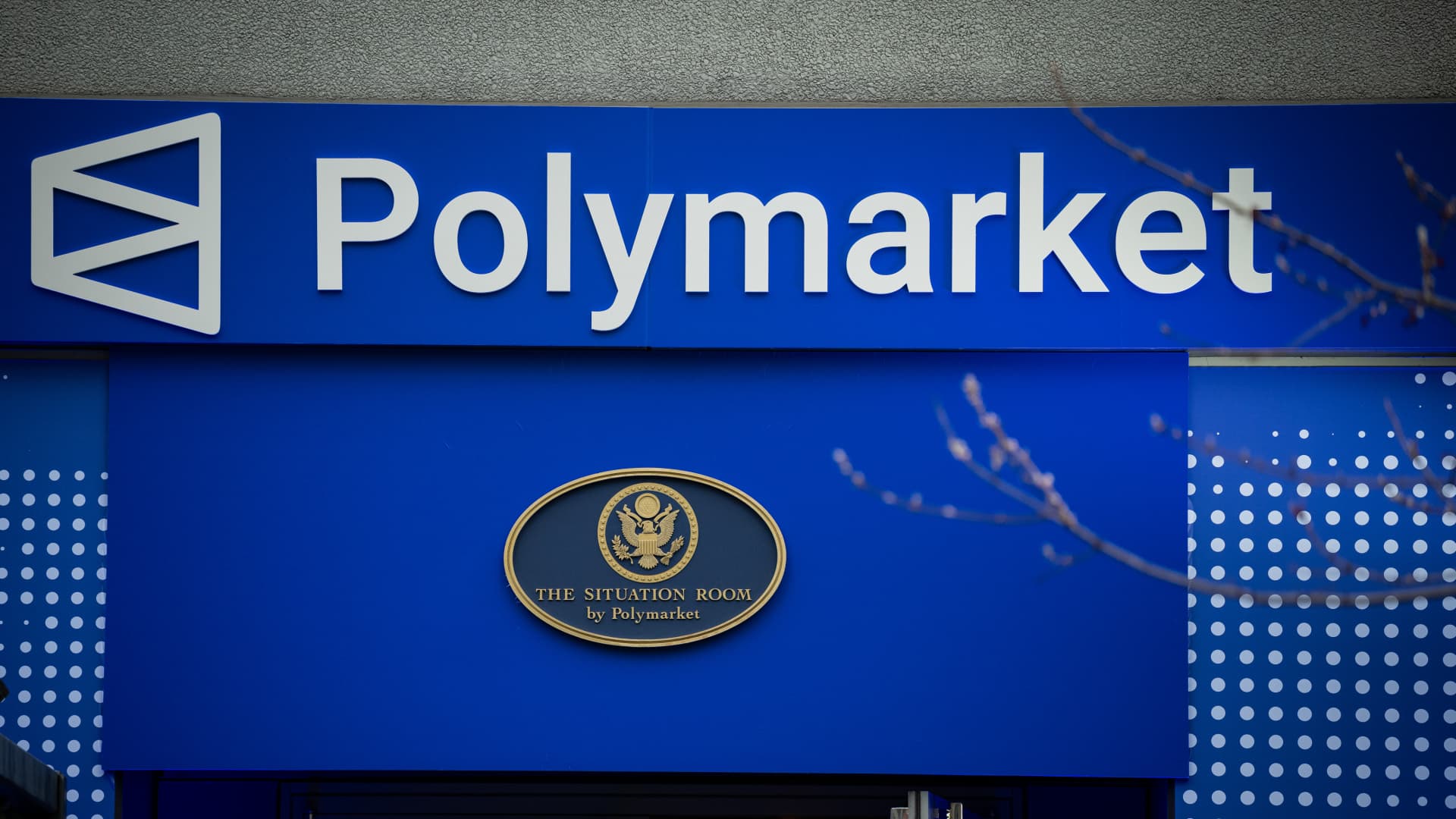
Signage at the Situation Room by Polymarket pop-up bar in Washington, DC, US, on Friday, March 20, 2026.
Graeme Sloan | Bloomberg | Getty Images
Federal prosecutors charged a Google employee with fraud on Wednesday, alleging that he made $1.2 million off of bets using insider information on Polymarket.
Prosecutors claim that Michele Spagnuolo, a staff information security engineer at Google, used confidential information to place trades correctly betting that singer d4vd would be Google’s most searched person in 2025.
Spagnuolo has been charged with money laundering, commodities fraud and wire fraud. The complaint, filed in the Southern District of New York, was unsealed on Wednesday.
ABC News first reported on the complaint. Spagnuolo was arrested Wednesday morning in New York, ABC reported.
“Spagnuolo had access to Google’s internal data systems, including a particular Google internal software tool that provided him access to confidential, nonpublic Year in Search data,” the prosecutors said in their complaint.
Some observers of the Polymarket platform flagged the user “AlphaRaccoon” back in December for suspicious trades on the most searched person contracts. The complaint Wednesday said that Spagnuolo was the person behind that account.
“Google officially and publicly announced its Year in Search 2025 results on or about December 4, 2025. Soon after it did so, Spagnuolo’s AlphaRaccoon account, profited approximately $1.2 million on his Google Year in Search 2025-related bets,” the complaint said.
Spagnuolo appeared before a federal magistrate judge Wednesday, He did not enter a plea and was released on a $2.25 million bond, ABC reported.
“We’re working with law enforcement on their investigation,” Google said in a statement. “The employee accessed our marketing material using a tool available to all employees, but using such confidential information to place bets is a serious breach of our policies.”
“We’ve placed the employee on leave and will take the appropriate action,” the company added.
“Polymarket worked closely with the U.S. Attorney’s Office for the Southern District of New York and the CFTC, and is the only prediction platform to date whose cooperation has led to insider trading charges in the United States,” a Polymarket spokesperson said in a statement. “We are committed to maintaining accurate, fair, and transparent markets as well as enforcing our rules and working with our regulators and law enforcement.”
Spagnuolo is also facing a civil case from the Commodity Futures Trading Commission, according to a listing in the federal court filing system.
The federal complaint marks the second high-profile insider trading case on Polymarket in just over a month.
In April, then-active U.S. Army Special Forces master sergeant Gannon Ken Van Dyke was arrested over charges that he used classified information to bet on contracts related to the U.S. operation to capture Venezuela President Nicolás Maduro. Prosecutors said Van Dyke made more than $400,000 off his trades.


Just a $70 billion company one year ago, memory chip maker Micron Technology (MU) yesterday soared 21% and topped a $1 trillion valuation alongside a massive price target hike from UBS.
South Korea’s SK Hynix followed suit, rising 9.3% in Seoul on Wednesday to top $1 trillion in market value. It’s shares are higher by more than 1,000% over the past year. Earlier this month, peer Samsung Electronics also topped $1 trillion.
The memory stocks are one leg of the AI boom, with investors expecting chip shortages — and thus pricing power — to last into 2028.
Micron is higher by another 8% in U.S. premarket trading Wednesday morning, with the tech-heavy Nasdaq ahead 0.9%.
Sentiment in the gutter
Bitcoin (BTC), meanwhile, is down 1.5% over the past 24 hours at $75,800, as the action in AI-related names continues to draw attention and capital from crypto markets, which — despite decent bounces from the early February lows — remain engulfed in poor vibes.
“Nobody cares about bitcoin right now … and you just love to see it,” said analyst James Check earlier this week. “Bitcoin sentiment is in the absolute gutter, and the bears are measurably the most confident they have been in a long time.”
“Anger, annoyance, disappointment, it’s all happening right now.”


Vitalik Buterin will pause his trademark long-form blog posts to write a sci-fi novel about decentralized governance, the Ethereum co-founder announced Wednesday from his Farcaster account.
He has already finished chapters one and two and posted them to his personal site, signaling a pivot from technical essays to sustained narrative fiction built around governance experiments in crypto-native systems.
Buterin’s Sci-Fi Novel Takes Governance Into Fiction
Buterin shared the experiment on Farcaster, where his account vitalik.eth posted a short note pointing followers to the in-progress draft.
In lieu of more of the usual blog posts, decided to try my hand at writing decentralized governance scifi,” he stated.
For years, his essays have dissected coordination problems in decentralized autonomous organizations, voting mechanisms, and public goods funding.
Shifting that inquiry into fiction lets him stress-test ideas in hypothetical societies rather than on the Ethereum mainnet, where mistakes carry real costs.
Why a Sci-Fi Format, and Why Now
The pivot lands while many DAOs face well-documented long-term governance challenges, including low voter turnout, treasury exposure, and concentration among large token holders.
Buterin has previously argued that quadratic voting and pluralist mechanisms can dilute that influence. The narrative format gives him room to dramatize those mechanisms inside imagined cities and crisis scenarios.
Recently, the co-founder signaled a broader retreat from Ethereum Foundation influence, calling the organization one node in a wider ecosystem.
His praise for Farcaster as a usable platform also explains why the announcement landed there rather than on a centralized network.
Whether the draft becomes a finished novel or remains an open experiment, the project gives Ethereum’s most visible thinker a new venue for working through governance questions.
The coming weeks will reveal whether crypto readers treat each chapter like an Ethereum Improvement Proposal.
The post Vitalik Buterin Pauses Essays to Write Decentralized Governance Sci-Fi Novel appeared first on BeInCrypto.

Tokenized-assets platform Streamex is unveiling a Solana-based marketplace for trading regulated, tokenized assets in a partnership with Orca, a decentralized exchange built on Solana. The new trading layer will let verified accredited investors buy and sell Streamex’s yield-bearing, gold-backed GLDY token through regulated on-chain pools that operate 24/7, with identity and accreditation controls locking access to approved participants.
Under the arrangement, Streamex and Orca emphasize that neither firm acts as a broker or intermediary for secondary-market resales. Instead, trading occurs in permissioned liquidity pools on Orca’s automated market maker (AMM) framework, with investor wallets held in a temporary freeze until KYC and accreditation checks are completed. Eligibility data is updated on-chain in real time to ensure only approved investors can participate, a model designed to balance liquidity with regulatory compliance for a tokenized commodity asset.
The GLDY token is described as yield-bearing and gold-backed, tying on-chain income streams to a physical-asset anchor. Orca notes its AMM infrastructure has processed more than $500 billion in cumulative trading volume since launch, a statistic the partners view as a potential blueprint for tokenized variants spanning stocks, bonds, real estate and other commodities.
The collaboration arrives amid a broader push to establish regulated rails for tokenized traditional assets, and follows a wave of regulatory activity in the United States and beyond. Earlier this month, the U.S. Securities and Exchange Commission approved Nasdaq’s pilot to allow tokenized stocks and exchange-traded funds to trade alongside their conventional counterparts on the same exchange, sharing order books, tickers and shareholder rights in the pilot phase. Participation is initially limited to eligible investors and securities tied to the Russell 1000 index and select ETFs.
The momentum around tokenized securities infrastructure extends beyond Nasdaq. In March, the New York Stock Exchange signed an agreement with Securitize to develop infrastructure for tokenized stocks and ETFs tied to Intercontinental Exchange’s planned digital trading platform. Separately, Centrifuge has signaled plans to bring tokenized Treasurys, private-credit products and AAA-rated collateralized loan obligations to the Monad blockchain for broader lending, collateral and secondary-market activity.
Market data from RWA.xyz places the tokenized real-world-asset (RWA) market at roughly $34 billion, with Treasury- and commodity-backed products among the largest segments. The ongoing expansion of tokenized assets aligns with growing regulatory clarity and investor access, even as participants stress the importance of robust on-chain compliance and custody frameworks.
Key takeaways
- Streamex and Orca launch a Solana-based, permissioned marketplace to trade the GLDY gold-backed token for accredited investors, with identity checks enforcing access.
- Trading happens in on-chain liquidity pools, where investor wallets are frozen until KYC and accreditation verification are completed; eligibility is updated on-chain in real time.
- Orca’s AMM platform has processed over $500 billion in cumulative volume since inception, reinforcing Solana-based liquidity capacity for tokenized assets.
- The move occurs against a backdrop of regulatory progress, including Nasdaq’s tokenized-trading pilot approved by the SEC and NYSE’s tokenization collaboration with Securitize.
- Market data indicates a growing tokenized-RWA landscape, with roughly $34 billion in assets tokenized to date, highlighting potential expansion into stocks, bonds and other traditional assets.
Regulatory rails and the tokenization wave
The Streamex–Orca initiative sits at the intersection of product innovation and regulatory development. The SEC’s approval of Nasdaq’s pilot signals a willingness to test tokenized securities within existing market structures, potentially allowing tokenized instruments to share order books and shareholder rights with traditional shares. The pilot remains selective, focusing initially on securities linked to the Russell 1000 and a subset of ETFs, but it underscores a broader industry trend toward on-chain settlement and regulated access for sophisticated investors.
Meanwhile, the NYSE’s engagement with Securitize points to ongoing collaboration between legacy exchanges and tokenization platforms to extend digital rails to a wider range of assets, including those tied to Intercontinental Exchange’s planned digital trading ecosystem. These developments collectively illustrate a market-wide push to bridge conventional financial assets with blockchain-based trading and settlement.
Industry participants stress that successful tokenization hinges on more than on-chain liquidity; robust identity verification, risk controls, and custodial safeguards are essential to meet institutional demands. In that context, the Streamex–Orca model—where eligibility data is verified on-chain before trading access is granted—represents a pragmatic approach to coupling liquidity with compliance.
RWA-based platforms and providers like Centrifuge are also expanding the scope of tokenized assets beyond commodities and simple securities, aiming to include tokenized Treasurys and structured credit. The broader market is watching how these rails perform under real-market conditions, how custody and settlement timelines compare with traditional markets, and how retail and accredited-investor demand evolve as more assets come online.
For readers tracking market development, the current wave of tokenized-asset activity suggests more pilots and launches are likely in the near term. The GLDY experiment could become a reference point for future permissioned liquidity pools, particularly if it demonstrates strong liquidity, compliance integrity and efficient on-chain eligibility updates in a regulated setting.
As the ecosystem matures, observers will want to monitor how widely these regulated tokenization rails are adopted across asset classes, how they handle cross-border participants, and what risk-management standards emerge to complement on-chain trading and settlement.
Further reading on the rapid expansion of tokenized real-world assets and related regulatory context can be found in industry coverage and research notes, including analyses of the tokenized-RWA market growth and regulatory milestones cited above.
What remains uncertain is the pace at which these rails will achieve broad participation beyond accredited investors, and how traditional custodians and counterparties will integrate with on-chain liquidity. Yet the signals from Streamex, Orca and the broader regulatory landscape point to a period of meaningful evolution for tokenized finance, where access-controlled markets could complement existing exchanges rather than replace them.

Key Takeaways
- A Goldman Sachs analysis indicates that Nvidia and Micron may collectively contribute approximately one-third of total S&P 500 earnings expansion in 2026.
- Companies benefiting from AI infrastructure buildout are projected to fuel close to 50% of S&P 500 EPS expansion in both 2026 and 2027.
- Nvidia’s position stems from surging AI accelerator demand, while Micron’s growth links to memory needs for expanding AI models and data center operations.
- The investment bank highlighted increasing depreciation expenses from massive hyperscaler capital spending as a potential headwind to profit growth, especially by 2027.
- Analyst consensus shows 45.4% potential upside for NVDA with a price target of $306.46, whereas MU faces a 21.6% downside projection.
A recent Goldman Sachs analysis has positioned two semiconductor titans as critical drivers of S&P 500 profit expansion for 2026, with projections that are commanding attention across Wall Street.
According to Goldman Sachs forecasts issued on May 27, Nvidia and Micron are poised to deliver approximately one-third of the S&P 500’s total earnings growth this year.
This represents a remarkable concentration of earnings power within just two corporate entities.
Goldman’s comprehensive analysis suggests that AI infrastructure beneficiaries collectively will drive approximately half of S&P 500 earnings per share expansion across 2026 and 2027. This category encompasses not only semiconductor manufacturers but extends to technology hardware providers, industrial companies, and utility firms capitalizing on the data center construction boom.
NVDA stock declined 1.14% during the trading session, while MU advanced 1.25%.
Nvidia’s central role in this narrative is clear-cut. The appetite for AI accelerators — specialized GPUs that enable model training and inference operations — has remained robust. The company has established itself as the primary choice for organizations expanding AI capabilities.
Micron’s contribution, though receiving less attention, carries equal significance. As artificial intelligence models expand in scale and data center operations intensify, high-bandwidth memory requirements escalate proportionally. This represents Micron’s strategic opportunity.
Goldman’s research emphasizes that the impact extends beyond the semiconductor sector. Utilities and industrial companies connected to data center infrastructure development are also capturing earnings benefits as the infrastructure expansion continues.
Potential Headwinds Identified by Goldman
The outlook isn’t without complications. Goldman explicitly cautioned that hyperscale cloud platforms are deploying substantial capital toward AI infrastructure, creating costs that persist over time. Depreciation expenses associated with this spending will begin pressuring earnings, particularly as 2027 approaches.
This represents a meaningful consideration. Today’s substantial capital investment generates future accounting expenses that could diminish portions of Goldman’s projected earnings acceleration.
Insider trading patterns at Nvidia merit attention as well. During the past three months, company insiders offloaded $163.7 million in shares without any recorded purchases. While not inherently alarming, this activity provides relevant context.
Analyst Sentiment and Projections
When examining analyst preferences between these stocks, a significant divergence emerges.
NVDA holds a consensus Wall Street price target of $306.46, suggesting 45.4% appreciation potential from present levels. Micron’s analyst consensus, conversely, indicates 21.6% downside risk.
Nvidia maintains a GF Score of 96 out of 100, achieving perfect 10/10 rankings in both profitability and growth categories. Its current P/E ratio stands at 32.17x, reflecting the valuation premium investors have assigned given its earnings momentum.
While Goldman Sachs’ AI infrastructure investment thesis encompasses numerous companies, Nvidia and Micron represent the most direct semiconductor beneficiaries of this secular trend.


Orca, one of the biggest decentralized exchanges on Solana, is launching new infrastructure aimed at bringing regulated real-world assets onchain, as crypto firms push deeper into tokenized stocks, commodities and other traditional financial products.
The Solana-based platform said Wednesday it had rolled out “permissioned pools,” a system that allows only approved investors to trade certain tokenized assets. The setup is focused on the U.S. market and is designed for issuers that need to comply with securities laws, including identity checks and investor eligibility requirements.
Streamex, a company focused on tokenizing commodity-based assets, will be the first issuer to use the new system, according to Orca. The company said in a press release shared with CoinDesk that its tokenized gold-linked security, GLDY, will be the first regulated asset to trade through Orca’s new infrastructure.
The launch marks an expansion for Orca beyond pure crypto trading and into infrastructure for tokenized financial assets. This comes as crypto companies increasingly focus on tokenizing traditional financial assets, a market many in the industry see as a major growth opportunity.
Under the new setup, investors must complete know-your-customer (KYC) checks before they can buy, hold or trade regulated tokens. Issuers can also decide who is eligible to access their assets, with Orca’s system automatically enforcing those rules onchain.
The trading pools run on Orca’s existing liquidity infrastructure, while the exchange’s interface will show users whether an asset has restrictions and whether they qualify to trade it.
“Orca has spent five years building the liquidity infrastructure that Solana’s market structure runs on,” said Orca CEO Michael Hwang in a press release. “As tokenized equities, funds and real-world assets arrive onchain at exponential rates, issuers need more than a place to list.”
Read more: Solana-Based DEX Orca’s Native Token Skyrockets 92% as Upbit Announces Listing
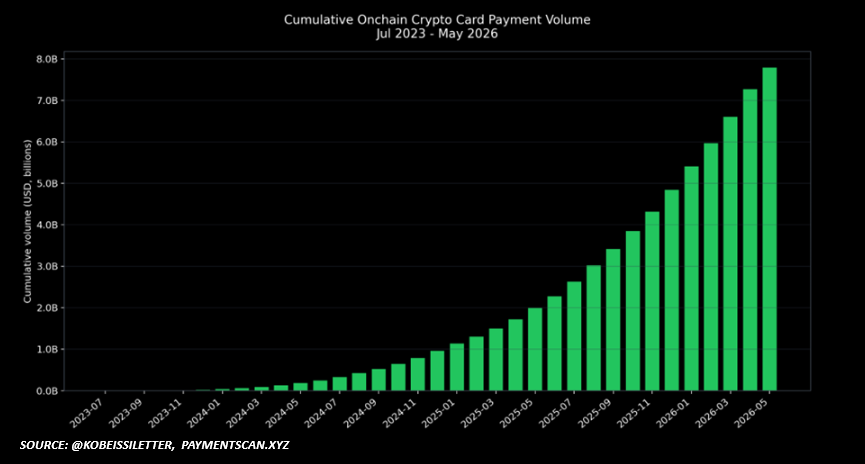
Monthly payment volume on crypto-linked debit and credit cards is up about 230% over last year, amid a proliferation of crypto-related payment products.
Cumulative volume on crypto-linked payment cards reached $7.8 billion this month, according to The Kobeissi Letter, a market research publication.
Payments giant Visa is capturing about 90% of crypto card transactions through partnerships with onchain native companies like Jupiter Global, analysts at The Kobeissi Letter said.
Cumulative crypto card volume between 2023 and 2026.
Source: The Kobeissi Letter
Jupiter Global is the payments project launched by the team behind the Jupiter decentralized crypto exchange on the Solana network. The Kobeissi Letter added:
“Crypto card adoption has rapidly accelerated in 2026 due to growing access to stablecoins as a payment rail through crypto cards. In other words, more people can now spend stablecoins like fiat by using crypto cards, further driving adoption.”
The growth of crypto payment cards highlights how digital assets, particularly stablecoins, are becoming integrated into the traditional financial system without displacing incumbent payment providers like Mastercard and Visa.
Related: Solayer launches Visa-compatible card for USDC payments
Crypto cards are powering everyday payments around the globe
Crypto exchange OKX launched a stablecoin payments card for customers in Europe in January 2026, which operates on the Mastercard network.
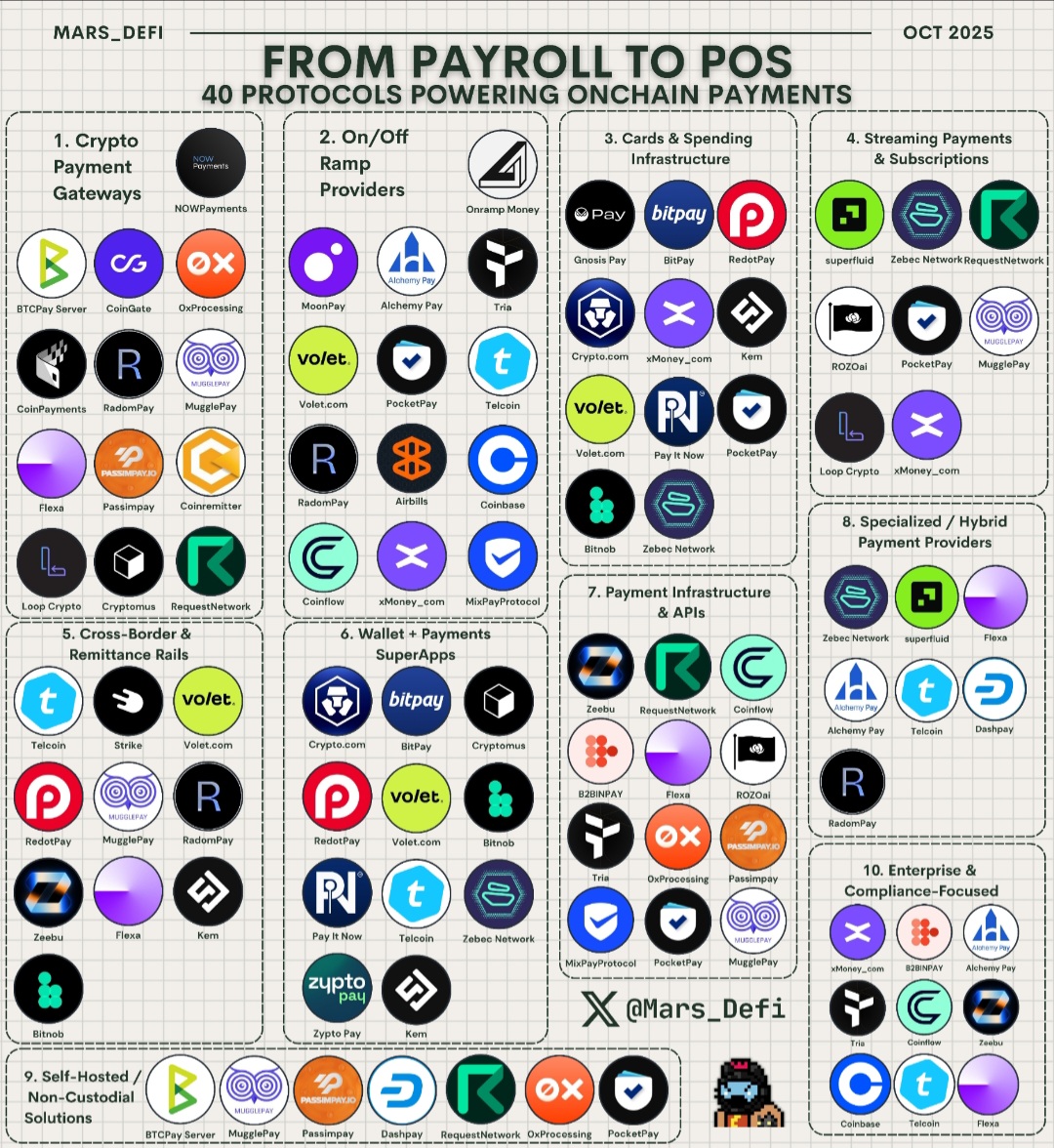
Crypto protocols and platforms helping facilitate onchain payments products. Source: Mars DeFi
Grocery store purchases were the top spending category and accounted for about 26% of all OKX card transactions in January, while restaurants accounted for 18% of the total transaction volume, according to data from OKX.
Online shopping was the third-biggest spending category, accounting for about 13% of the total transaction volume for the month.
“When crypto pays for lunch, payment adoption is real. For years, critics pointed to a lack of everyday utility as crypto’s weak point: great as a speculative asset, less useful as actual money,” the OKX team said.
In March, Visa and Bridge, a fintech company owned by payments company Stripe, announced plans to roll out stablecoin-linked payment cards in over 100 countries.
Initially, 18 countries were supported, including Argentina, Colombia, Ecuador, Mexico, Peru and Chile, with plans to expand the product into the Asia-Pacific (APAC), Africa, and Middle East regions by the end of 2026.
Magazine: Guide to the top and emerging global crypto hubs: Mid-2026
ChatGPT is swinging big on XRP, Sam Altman’s AI predicts a path to $5 to $8 by late 2026, with a wildcard double-digit scenario on the table if Bitcoin enters full euphoric mode, all from a current price of $1.33.
The asymmetry here is what makes the call interesting. ChatGPT is not just throwing a number out; it is pointing to a specific convergence of tailwinds that have been building quietly under the surface.
Ripple keeps expanding its global payment partnerships, US regulatory clarity is improving in a way that was unthinkable 2 years ago, and institutional adoption is no longer a talking point but an actual trend with ETF momentum behind it.

When retail speculation layers on top of that during the next major crypto expansion cycle, ChatGPT’s argument is that volume and liquidity could explode in a way that mirrors previous cycles, and in previous cycles, XRP moved in ways that made people feel stupid for not holding it.
The double-digit scenario is the tail risk that XRP holders dream about. It requires Bitcoin going full parabolic and dragging the altcoin market into a genuine euphoric phase, but ChatGPT acknowledges it as a realistic if unlikely outcome rather than dismissing it outright.
The bear case is the one XRP has been living in for most of 2026. Heavy resistance from market structure, token supply pressure from escrow releases, and weak broader sentiment could keep XRP pinned between $0.80 and $2.00 for an extended stretch.
That range has been its prison for months, and without a macro catalyst or a Ripple-specific headline, there is no obvious escape hatch.
XRP Price Prediction: From $1.33 to $8, Here Is What Needs to Break First
XRP is trading at $1.33 on the daily, and the chart has a clear roadmap drawn right on it. Price has been locked in a tight consolidation between $1.20 support and $1.60 resistance since February, and every attempted move in either direction has been met with the same response, a snap back to the middle of the range.
The $1.20 support zone is the line in the sand. It has been tested multiple times and held, but it is not a fortress; it is a floor that gets weaker every time it gets touched.
A clean breakdown below it opens the door to the $0.80 level ChatGPT mentioned in the bear case, and that would be a damaging structural shift.

On the upside the sequence is laid out plainly on this chart. $1.60 is the first wall, and it has rejected price convincingly. Above that $2.40 is the next meaningful target, then $3.10, then $3.64 which lines up with the prior cycle high.
Each of those levels represents a real supply zone where sellers from previous rallies are sitting and waiting. Getting through all of them to reach $5 requires sustained momentum that this chart has not shown in a long time.
RSI is at 39.03 with the signal line at 44.64, and that is the most bearish RSI setup in this entire series. RSI sitting nearly 6 points below its signal line, dipping toward oversold territory at 39, is telling you that selling pressure is quietly building even as price holds the range.
It is not a collapse signal yet, but it is not a base-building signal either. For the $1.60 breakout that kicks off the whole sequence to happen, RSI needs to stop making lower readings and curl back above 44, then 50.
Right now the momentum picture and the price picture are telling 2 very different stories, and usually the momentum picture wins.
Discover: The best crypto to diversify your portfolio with
ChatGPT AI Predicts Bitcoin Hyper to Outperform XRP by 1000x
Bitcoin has a ceiling that most people have stopped questioning.
No native smart contracts. No high-speed execution. No programmability that does not require leaving the network entirely. Every developer who has tried to build something meaningful on Bitcoin has eventually migrated to Ethereum or Solana because the infrastructure demanded it.
Bitcoin Hyper is building the reason to stay.
The project combines a Bitcoin Layer 2 with Solana Virtual Machine integration, which means developers get the execution speed and programmability of Solana without giving up the security foundation that makes Bitcoin the most trusted network in crypto. Fast transactions, low fees, and full smart contract support sitting directly on top of Bitcoin’s security layer.
The gap it is targeting has existed since Bitcoin launched. Nobody has cleanly solved it yet.
The presale is at $0.013679 with over $32 million raised and staking incentives available for early participants.
Large cap returns at Bitcoin’s current market cap require billions in new inflows to move the needle meaningfully. Early stage infrastructure plays operate on completely different math. The entry is earlier, the upside is larger, and the execution risk is real. That is always the tradeoff at this stage of the lifecycle.
The question is not whether the gap exists. It clearly does. The question is whether this is the project that closes it.
The post Sam Altman ChatGPT AI Predicts Shocking XRP Price By End of 2026 appeared first on Cryptonews.

Mural of Scotland hero John McGinn appears in his hometown ahead of World Cup

Is 'out of control' US tipping culture spreading overseas?
BofA Maintains Buy Rating on Walmart (WMT) Stock Despite Price Target Reduction


-

 Crypto World6 days ago
Blockchain.com files with SEC for U.S. IPO
-

 Fashion5 days ago
Holiday Weekend Open Thread – Corporette.com
-

 Crypto World6 days ago
Bitcoin Accumulation Weakens as BTC Realized Losses Hit $600M
-

 Tech2 days ago
Microsoft’s quiet Claude Code retreat and the real cost of enterprise AI
-

 Business5 days ago
Dell Technologies DELL Stock Surges 15% on AI Server Momentum and Analyst Upgrades in 2026
-

 Crypto World5 days ago
Robinhood crypto COO Tanya Denisova exits
-

 Business3 days ago
NYT Strands Answers May 24 2026 Revealed for Puzzle No. 812 Theme Summer Essentials
-

 Politics5 days ago
Makerfield: a tale of two social-media histories
-

 Crypto World5 days ago
Space X IPO Is ‘Bad News’ for Tech Stocks: But What About Bitcoin?
-

 Business6 days ago
Trump Invests $1M-$5M in Kura Sushi USA Chain With 27 California Locations
-

 Crypto World6 days ago
MicroStrategy’s Saylor Says Miners No Longer Set Bitcoin Price, Another Force Has Taken Over
-

 Tech6 days ago
WhatsApp ads could make Irish debut after discussions with DPC
-
Tech12 hours ago
The Samsung pay deal is the moment Korean unions changed register
-
 NewsBeat7 days ago
Charity run by Reform leader Malcolm Offord accused of ‘law breaking’ over Scottish registration
-

 Crypto World5 days ago
AI infrastructure race heats up as IREN pitches full-stack strategy, WhiteFiber lands $160M deal
-
 Tech5 days ago
A 0.12% parameter add-on gives AI agents the working memory RAG can’t
-
 Crypto World3 days ago
Nvidia (NVDA) CEO Calls on Super Micro to Strengthen Export Controls Amid Smuggling Probe
-

 Tech2 days ago
Westone Audio and Etymotic Acquired by Fidelity Collective in Major IEM Market Move
-

 Tech6 days ago
You Can Now Add ChatGPT To PowerPoint
-

 Sports6 days ago
2026 CJ Cup Byron Nelson leaderboard: Brooks Koepka finds putting stroke in Round 1
You must be logged in to post a comment Login