Connect with us
DAPA Banner
DAPA Coin
DAPA
COIN PAYMENT ASSET
PRIVACY · BLOCKDAG · HOMOMORPHIC ENCRYPTION · RUST
ElGamal Encrypted MINE DAPA
🚫 GENESIS SOLD OUT
DAPAPAY COMING

Tech

MiniMax teases upcoming M3 model with new sparse attention mechanism and 15.6X long-context response speed boost

Published

on

Among the many Chinese AI companies and laboratories vying for market share and attention (no pun intended) on the global marketplace, MiniMax stands out for its commitment to providing frontier-level intelligence across a range of modalities, including text, coding, and video (through its Hailuo model series) — often under permissive, enterprise-friendly, standard open source licenses.

Now, MiniMax is again raising the eyebrows of AI power users and developers around the world by releasing a new, in-depth technical report on the making of its popular M2 series of language models (M2, M2.5, and M2.7) shedding light on its numerous engineering innovations and clever approaches — while the company and its leaders also teased a whole new sparse attention approach for its upcoming MiniMax M3 series of models, which it says yields up to 15.6 times faster decoding (or LLM response) speed at long contexts (a million tokens) by adopting a custom sub-quadratic framework. In so doing, MiniMax has designed M3 to make ultra-long-context AI agent deployment economically viable.

The M2 report is noteworthy for any enterprise working with AI models, and especially those looking to fine-tune and train their own in-house. After all, MiniMax’s M2 series models often achieved top benchmarks in the world for open source AI performance when they were released.

While the title has since been eclipsed by several other Chinese labs including DeepSeek and Xiaomi, MiniMax’s new report offers a blueprint that can be used to improve AI model and agent performance by enterprises around the world.

Advertisement

As Adina Yakup of Hugging Face observed on X, “Beyond the benchmarks, they’ve done some really solid work on MoE efficiency and agent oriented design. Excited to see where M3 goes next!”

The attention dilemma

The core technical architecture of the M2 series relies on a sparse Mixture-of-Experts (MoE) decoder-only Transformer layout used by numerous other state-of-the-art LLMs.

The foundational backbone houses 229.9 billion total parameters, yet maintains a remarkably lean operational footprint by activating just 9.8 billion parameters per token across 256 fine-grained experts.

To optimize routing and avoid standard load-balancing issues, however, MiniMax implemented sigmoid gating paired with learnable, expert-specific bias terms, heavily reducing reliance on restrictive auxiliary losses.

Advertisement

The most definitive engineering decision documented in the M2 paper was the strict adherence to full multi-head attention with Grouped Query Attention (GQA) across all 62 layers.

In large language models, “quadratic scaling” refers to the computationally expensive reality of standard full attention mechanisms, where every token in a sequence must mathematically connect to every other token. To use a real-world analogy, it is akin to attending a networking event and being forced to have a deep conversation with every single person in the room while simultaneously monitoring all other ongoing conversations.

While this approach yields incredibly thorough context, the processing power and memory required explode at the square of the input length, creating a severe hardware bottleneck as models attempt to ingest hundreds of thousands of words.

The problem with sub-quadratic scaling

“Sub-quadratic” scaling introduces architectural shortcuts designed to bypass this exponential computational load. Instead of mapping every possible connection, sub-quadratic methods—such as Sliding Window Attention or compressed linear attention—might only analyze a localized window of nearby words or generate a compressed summary of the broader text.

Advertisement

These efficient methods drastically reduce hardware costs and allow models to process massive documents at high speeds, but they historically introduce severe trade-offs in accuracy, often causing the AI to miss the “big picture” or lose track of distant context.

This mathematical dilemma defines the architectural evolution from MiniMax’s M2 to its upcoming M3 series. During M2’s development, researchers rigorously tested sub-quadratic shortcuts but found they crippled the model’s “multi-hop reasoning”—its ability to connect disparate clues across a long document—forcing the team to absorb the massive computational cost of full quadratic attention to maintain frontier-level intelligence.

Indeed, they aggressively benchmarked efficient attention alternatives during pre-training but intentionally threw them out. They experimented extensively with hybrid setups, interleaving full attention with sub-quadratic architectures like Lightning Attention or hybrid Sliding Window Attention (SWA) configurations.

The empirical results were definitive: at a larger scale, linear and windowed attention variants exhibited severe reasoning deficits.

Advertisement

On evaluations exceeding 32K context windows, SWA variants performed significantly worse than full attention, dropping from a baseline score of 90.0 to 72.0 on the RULER 128K complex word extraction task.

Sub-quadratic configurations proved prone to memory-bound constraints during training, lacked native prefix caching support, and failed to smoothly align with Multi-Token Prediction (MTP) modules used for speculative decoding. Full attention was deemed necessary to preserve multi-hop reasoning capability.

However, recognizing that physical hardware limits cannot sustain quadratic scaling indefinitely, MiniMax is designing the M3 series around a novel sub-quadratic framework to finally deliver both high-speed processing and uncompromised reasoning.

MiniMax Sparse Attention (MSA) and sub-quadratic scaling incoming

The upcoming MiniMax-M3 breaks away from the compute-heavy constraints of its predecessor. As disclosed by MiniMax’s engineering team under the banner “Something BIG is coming,” M3 introduces “MiniMax Sparse Attention” (MSA).

Advertisement

Unlike DeepSeek’s Multi-head Latent Attention (MLA), which compresses keys and values into a low-dimensional latent space, MSA operates on a standard GQA backbone but utilizes block-level selection on real, uncompressed Key-Values.

Elie Bakouch at AI training infrastructure and platform lab Prime Intellect posted on X noting that the main changes feature “block level selection like in CSA but attention is done on the real KV, not in [compressed space].”

This solves the precision loss and prefix-caching obstacles noted in the M2 paper. By filtering and selecting block-level sequences dynamically, MSA delivers an architectural leap: early hardware profiling indicates a 9.7x speedup in prefilling latency and a massive 15.6x speedup during decoding phases at a 1-million token sequence length compared to the full-attention M2 architecture.

To understand why a speedup in the “decoding phase” is so significant, it helps to break down how an AI actually reads and writes information. When you interact with an AI, the processing happens in two distinct steps: prefilling and decoding.

Advertisement

When you hand an AI a prompt—whether it’s a short sentence or a massive 1,000-page document—it processes that entire chunk of text all at once in parallel, known as “prefilling.” It essentially “reads” the input in one big gulp to build its initial understanding and establish context.

In order to generate a response, the AI must enter a “decoding phase.” To predict the first word of its response, it looks at the prompt. To predict the second word, it has to look at the prompt plus the first word. To predict the hundredth word, it must recalculate the context of the prompt and the previous 99 words it just wrote. So the response actually becomes harder to generate as it goes on, with the end requiring a full review of all prior parts.

For a layperson, imagine reading a dense legal brief (prefilling) and then being forced to write a summary report where, before writing every single new word, you must rapidly reread the entire brief plus everything you’ve written so far to ensure your next word makes sense (decoding).

Because the AI must constantly and repetitively look backward to generate each new step forward, the decoding phase is the most severe computational bottleneck in generating text. It is why AI models often type out their answers word-by-word, and why they slow down significantly as conversations get longer.

Advertisement

Therefore, when the passage states the new architecture achieves a massive 15.6x speedup during the decoding phase at a 1-million token sequence length, it means the model has found a structural shortcut to generate its answer—token by token—nearly 16 times faster. It directly solves the exact bottleneck that normally makes AI chatbots freeze or stutter when handling massive amounts of information.

The evolution of the MiniMax M series and the creation of ‘Forge’

On a product level, MiniMax has consistently evolved its models from simple text generation interfaces into autonomous workers.

The M2 series pioneered an “interleaved thinking” protocol where the model alternates between natural-language planning traces and explicit tool invocations inside a single trajectory. Rather than dropping the intermediate chain-of-thought blocks between execution turns, M2 appends the full thinking history directly into the conversation context. This planning persistence prevents state drift, allowing the model to recover gracefully from runtime errors and revise its strategies based on environment feedback.

To train these long-horizon workflows, MiniMax built “Forge,” a scalable agent-native reinforcement learning system. Forge decouples execution into three independent modules—the Agent Side, the middleware abstraction layer (Gateway Server and Data Pool), and the Training/Inference engines.

Advertisement

As MiniMax engineer Olive Song explained on the ThursdAI podcast, “What we realized is that there’s a lot of potential with a small model like this if we train reinforcement learning on it with a large amount of environments and agents… But it’s not a very easy thing to do,” adding that this environmental training was where the team spent a significant portion of their development timeline. To absorb the extreme trajectory-length variance common in multi-step agent environments, Forge implements two vital engineering solutions:

  1. Windowed FIFO Scheduling: A training scheduler that maps a sliding window over the generation queue. It permits greedy, high-throughput fetching of completed tasks within the window to prevent cluster idle time, while strictly enforcing FIFO boundaries to maintain distributional stability and avoid gradient oscillation.

  2. Prefix Tree Merging: An optimization that restructures batch training into tree computation. Completions sharing identical conversation prefixes are calculated exactly once in the forward pass before branching. This eliminates redundant calculations, generating up to a 40x training speedup with zero approximation error.

This reinforcement infrastructure directly spawned the M2.7 checkpoint, moving the series toward “self-evolution”. Operating inside an automated agent harness, M2.7 functions as an independent machine learning engineer. The model profiles its own active training runs, diagnoses anomalies, reads logs, and automatically modifies its own codebase and configurations.

According to MiniMax, M2.7 successfully handled between 30% and 50% of its own development workflow.

On OpenAI’s rigorous MLE Bench Lite suite, which tests autonomous ML research capability, M2.7 achieved a 66.6% medal rate across independent 24-hour trials, effectively tying Google’s closed-weight Gemini 3.1 Pro.

Advertisement

The continuous cadence from M2 to M2.5, which famously completed 30% of internal tasks and 80% of newly committed code at MiniMax HQ, underlines a broader vision.

As the MiniMax team noted during that phase of deployment, “we believe that M2.5 provides virtually limitless possibilities for the development and operation of agents in the economy.”

With the technical report codifying the M2 generation’s successes and the MSA tech blog on the horizon, MiniMax is signaling that the next frontier of AI is explicitly about translating a mini-activation footprint into maximum real-world intelligence.

Source link

Advertisement
Continue Reading
Click to comment

You must be logged in to post a comment Login

Leave a Reply

Tech

Illinois Lawmakers Just Passed America’s Strongest AI Safety Bill

Published

on

The Illinois House of Representatives passed a bill on Wednesday requiring frontier AI labs like OpenAI, Anthropic, and Google DeepMind to have their safety practices audited by a third party. If signed into law, AI safety experts tell WIRED, it would be the nation’s leading check on the power of major AI companies.

The bill, SB 315, now heads to governor JB Pritzker’s desk. In a post on social media on Wednesday, Pritzker said he plans to sign the bill, citing a need to hold Big Tech accountable.

Since Congress has yet to pass any meaningful AI safety legislation, state lawmakers have happily stepped up in recent years to promote bills that show their constituents they’re keeping Silicon Valley in check. As AI tools become increasingly popular, and the companies behind them race toward massive IPOs, polls show that American voters are looking for more AI regulation.

As a result, safety advocates and tech companies have zeroed in on state legislatures as the primary battleground to hash out how these laws should look. OpenAI’s chief of global affairs, Chris Lehane, told WIRED last week that the company’s AI policy is now oriented around passing a series of similar state laws.

Advertisement

California and New York have the strongest AI safety laws, requiring tech companies to provide information about model guardrails and to publish reports on safety incidents as they occur. Illinois’ bill goes a step further, requiring independent auditors to verify that an AI lab is adhering to its own safety standards. Previously, no independent body was required to keep an AI lab accountable to its own safety claims.

“We’re in a situation where the AI companies grade their own homework,” says Scott Wisor, policy director at Secure AI Project, a nonprofit that supports SB 315. “Should SB 315 become law, Illinois would require an independent auditor to check whether the AI labs in fact adhere to their safety commitments.”

Wisor says it’s broadly expected that, under SB 315, AI labs could use the Big Four accounting and auditing firms—Deloitte, EY, KPMG, and PwC—to audit their safety practices. He also says it’s possible that AI labs could tap members of the AI Evaluator Forum—a coalition of smaller research organizations including METR, Transluce, and Averi—to assess adherence to safety standards.

Illinois state representative Daniel Didech, a sponsor of SB 315, tells WIRED that state legislatures are playing an important role by shaping America’s AI policy and acting as a testing ground for any federal laws that might come in the future. “Laws like this create a world where it’s more likely for the federal government to pass something,” Didech says.

Advertisement

Corporate Interests

Illinois has emerged as a major arena in the ongoing fight over state AI laws. OpenAI previously supported a bill in Illinois that would let AI labs dodge liability if their models caused catastrophic harm. However, Lehane has since said the company’s blanket support for the bill was an oversight, and it never supported the liability shield in the bill. More recently, OpenAI endorsed SB 315.

“The Illinois General Assembly has shown real bipartisan leadership in advancing SB 315 and developing a thoughtful framework for frontier AI safety. As AI systems become more capable, clear expectations around safety, transparency, incident reporting, and accountability matter,” Lehane said in a statement to WIRED.

Source link

Advertisement
Continue Reading

Tech

Bare metal cloud servers now cheaper and more readily available than on-prem hardware, says Nutanix CEO

Published

on

Virtualization

Hyperscalers can get hardware before enterprise vendors and buyers don’t much care where they land

Hyperscalers’ purchasing power means bare metal servers offered by major clouds can now be cheaper and easier to acquire than on-prem servers, according to Nutanix CEO Rajiv Ramaswami.

The CEO told The Register hyperscalers’ ability to buy servers and memory in bulk means they can often make infrastructure available faster than enterprise hardware players, and sees some customers who have previously preferred on-premises infrastructure heading for the cloud.

Advertisement

Ramaswami said he expects high memory and solid state storage prices will persist into next year and noted the impact of current price rises on the cost of servers.

“What that means for customers is they need to plan and budget carefully,” he said. “They pick servers on price and lead time” – and clouds often win on both metrics.

At the same time, Ramaswami said customers increasingly favor on-prem AI infrastructure to keep costs predictable. They want that because the CEO thinks AI remains “one of those things where people feel they have to do it” and return on investment is unclear.

“People are seeing incremental benefits,” he said, citing document search and summaries as the most common on-prem AI applications. Nutanix, he said, has measured a ten-percent improvement in service response times from using AI, while its developers are delivering new features 50 percent faster than before they used AI helpers.

Advertisement

Enterprise virtualization stacks like Nutanix’s products can require several hefty hosts to run. Ramaswami said he’s comfortable the footprint of his company’s products is not an issue for new buyers, but that he is also keenly aware that customers are looking for smaller hosts – and even servers running non-x86 processors.

For now, he doesn’t see sufficient appetite for Arm servers that Nutanix will devote developer time to porting its stack to that platform. But if demand comes, Ramaswami is confident it won’t be a major job as FOSS projects the company relies on – such as Kubernetes and the KVM hypervisor – already run on Arm silicon.

The CEO’s remarks came on the same day Nutanix reported its Q3 2026 results, which included news that the company won 730 new clients in the last quarter with Ramaswami saying “most moved from legacy vendors to us.”

That’s almost certainly a reference to VMware. Whether Nutanix is hurting its rival remains to be seen: pre-acquisition VMware had over 350,000 customers and now focuses on the top 10,000. Nutanix can pick up former Virtzilla users without disrupting Broadcom’s master plan.

Advertisement

Ramaswami said many new customers have taken advantage of Nutanix’s shift to allow use of external storage, a change from its previous insistence on using only its own software-defined storage. The CEO said the company scored a pair of seven-figure deals with companies that chose to continue using external storage from Everpure (formerly Pure Storage) and Dell, respectively.

Q3 revenue was $703 million, a ten percent year on year jump. Nutanix has always preferred to emphasize annual recurring revenue as a metric, and that rose 15 percent year over year to $2.43 billion.

Investors liked what they heard, sending Nutanix’s share price up a couple of points in after hours trading. ®

Source link

Advertisement
Continue Reading

Tech

What Is The 4-Gallon Minimum ‘Law’ And Which Fuel Type Does It Apply To?

Published

on


Federal law usually concerns itself with the big stuff, like how much you can earn before the IRS takes notice to where you can build. Then there’s this: Some gas pumps have a sticker warning about the minimum amount of fuel you can fill, which is four gallons. It’s a federal law, too — although it applies to a specific fuel pulled from one specific kind of pump.

That fuel is E10, the standard that blends 90% gasoline and 10% ethanol. While this basically flows through almost every car on U.S. roads, the rule isn’t specifically made for the type of fuel. Rather, it only kicks in when the same pump also dispenses E15, which is a higher-ethanol blend sitting at 15% ethanol and 85% gasoline, through the same hose and nozzle. These pumps are referred to as blender pumps. If you use a nozzle dedicated to just E10, the limits disappear.

This is actually to protect consumers themselves, specifically those who own older cars that do not support E15 fuel. After someone fills up on E15, about a third of a gallon of fuel actually remains inside the hose. If you’re next in line and want to fill up E10, what lands in your tank first is actually closer to 33% E15. Even that much E15 with its limited ethanol can damage older vehicles. To offset any chances of that happening, the EPA has set the floor at four gallons. This helps dilute any leftover E15 to safe levels.

Advertisement

How common is it, and what if your tank is too small?

When the rule was first announced back in 2012, it generated a lot of push back. Wisconsin Republican Jim Sensenbrenner actually went on the record calling it an unacceptable intrusion into drivers’ lives even though, at the time, the actual footprint of this rule at gas stations was tiny since very few dispensed E15 via blender pumps. Today, their numbers have grown significantly, with over 5,000 stations across the US doing so. Of course, this is still a small fraction of the 150,000+ stations in total across the States.

Advertisement

When the rule first arrived, the American Motorcyclist Association flagged an obvious problem with the small gas tanks of motorcycles and lawn mowers. The average yard-equipment gas tank tops out at just one or two gallons. As a result, in February 2013, the EPA signed off on a third configuration proposed by the Renewable Fuels Association, which said that stations that dispense E15 must also offer at least one nozzle exclusively dispensing fuel with 10% ethanol or less. These pumps will be labeled “Passenger Vehicles Only,” and gas stations should also post signage pointing customers toward them.

One other thing to note is that this only applies to E15, excluding gasoline with higher blends of ethanol. It’s because E15 is actually the legal limit for standard cars. Anything higher than that can only be handled by flex-fuel vehicles, which can run just fine even on an E85 blend. These higher blends also use dedicated hoses, thereby eliminating any chances of cross-contamination.

Advertisement


Source link

Continue Reading

Tech

Last.fm Goes Independent After Breaking Up With Paramount Skydance

Published

on

Don’t worry: It will keep your profiles and scrobbles.

Last.fm is an independent company again, it has announced on its forum, nearly two decades after it was acquired by CBS. “Today, Last.fm begins a new chapter as an independent company,” the announcement reads. “Ownership has changed, but the product you use every day has not.” It also said that it will keep its current team. Last.fm is a music website that can track what you listen to across platforms, apps and streaming services, including Spotify, YouTube and Apple Music. 

The company will retain your accounts and scrobbles, which are what it calls the recorded plays of a song, as they are. When you play a track on a streaming service you’ve connected to Last.fm, it “scrobbles” that song and logs it to your profile for tracking. Every play is equivalent to one scrobble. It will also keep your data and privacy settings, as well as your Pro subscription and your billing information if you’ve been paying for its premium features. 

Last.fm started as an internet radio station in 2002, and it didn’t get scrobbling until a few years later when it merged with the original team that created the tracking process. It operated as an independent company until it was acquired by CBS Interactive, which is now part of the merged Paramount Skydance Corporation, for $280 million in 2007. In 2014, it killed off its $3-a-month subscription radio service to focus on tracking your listening habits on other providers. The company promised to share more about what you can expect from the transition in the coming weeks, but everything will work on Last.fm “exactly as it did yesterday” for now. 

Advertisement

Source link

Advertisement
Continue Reading

Tech

Linux Distributions And Who Is Responsible For The Software

Published

on

The topic of downstream and upstream is an important one in the Linux ecosystem, where from one base distribution you can go many layers of distros deep before even looking at all the other base distributions. Within that veritable jungle you get questions about who is responsible for packaging software, where to report bugs found with a specific application, as well as what ‘LTS’ truly means in a consumer context. These and other points are raised in a recent video by [Brodie Robertson], with many examples of things going tragically wrong.

There’s a good argument to be made that ultimately it is the distro that is responsible for the software that they provide via their repositories. As [Brodie] shows in the video, there are a few cases where an ‘LTS’ distro uses an old version of some software that contains a bug that has been fixed a while ago, so reporting it to the developer is rather pointless, while the distro maintainers should fix it with backporting of patches or updating the version.

From an end user experience this also makes the most sense, as in the end they just want to have the Windows experience of downloading a proverbial installer, clicking through whatever dialogs pop and have working software. If the software is provided via the distro, it is their responsibility, the same way that you contact the developer if you get a DEB or RPM from a GitHub project page and it doesn’t work.

Advertisement

This current Linux Chaos Vortex can be called a major issue when e.g. FreeBSD has no such upstream/downstream issues, with cross-platform installers being basically impossible on Linux ever since the Linux Standard Base effort died.

Perhaps Linux will get a distroless future, however, which may finally herald that Year of the Linux Desktop.

Advertisement

Source link

Continue Reading

Tech

Meta To Start Testing AI Subscription Services

Published

on

Meta will begin testing paid subscriptions for its Meta AI app and website, with a $7.99/month Meta One Plus plan and a more capable $19.99/month Meta One Premium plan offering. The test will start next month in Singapore, Guatemala, and Bolivia as Meta looks for AI revenue beyond advertising while continuing to offer a free tier. CNBC reports: Naomi Gleit, the head of product at Meta, revealed the subscription testing in an Instagram video, announcing that the plans “give people who use Meta AI more to work with, more capacity, bigger, more complex requests, and more room to create for businesses and creators.”

Meta One Plus will cost $7.99 a month and the Meta One Premium plan will cost $19.99 a month, the company confirmed. The more expensive version offers users additional computing capacity to produce more comprehensive responses and other advanced features. The company will continue to provide a free version of the app and site.

“We’re offering premium tools that allow you to enhance presence, supercharge content, automate tasks, and protect your brand,” Gleit said in the post. “We’re also thinking about how to bring this all together in a way that makes sense.”

Advertisement

Source link

Continue Reading

Tech

Patrick Brammall leads Apple TV thriller Last Seen’

Published

on

Apple TV is bringing Patrick Brammall’s Australian thriller “Last Seen” to its growing lineup of serialized crime dramas with a global premiere set for later in 2026.

Apple shared a first look at the six-episode series on May 27, and confirmed “Last Seen” will debut globally on September 9, 2026. Patrick Brammall’s latest drama joins a growing lineup of weekly thrillers and crime series on the streaming platform.

Brammall stars in the adaptation of Ryan David Jahn’s award-winning novel “The Dispatcher.” Apple TV originally developed the project under the same title, before the shift to “Last Seen.”

“Last Seen” follows police detective Ian Ridley, whose daughter vanished 11 years ago without a trace. A distress call from a teenage girl convinces Ridley she may be Maggie and pulls him back into the search for his daughter.

Advertisement

Production took place in Victoria, Australia, with Kris Mrksa adapting the novel and serving as an executive producer. Emmy Award-nominated filmmaker Christian Schwochow directed and executive produced the series.

Alongside Brammall, the cast includes Maxine Peake, Brendan Cowell, Daniel Henshall, Jessica Wren, Zahra Newman, and Chloe Jean Lourdes.

Thrillers remain a major focus for Apple TV

Crime dramas and serialized thrillers continue occupying a prominent place in Apple TV’s original programming slate. Recent releases and renewals have kept the service closely associated with prestige dramas built around recognizable actors and weekly release schedules.

Prestige originals including Best Picture winner “CODA” helped establish Apple TV as a destination for high-profile original programming. Acclaimed spy dramas and breakout science-fiction series have continued pushing the streaming service deeper into prestige television.

Advertisement

Source link

Continue Reading

Tech

JMGO N3 Ultimate projector review: Specs, features, price

Published

on

The $2,999 JMGO N3 Ultimate is a 4K laser projector that’s pricey, but delivers easy placement, paired with excellent video quality. Too bad it’s badly let down by Google TV software.

Most projectors assume you can put them exactly where they need to be. Real living rooms rarely work that way.

The usual fix is digital keystone correction, which electronically adjusts a skewed image to look straight. It works, but it costs you resolution and brightness in the process.

The N3 Ultimate is built around avoiding that trade-off entirely. JMGO calls its combination of placement tools the 3-in-1 system, and it takes a different approach to each part of the problem.

Advertisement

We previously reviewed JMGO’s N1S Ultra, which delivered excellent picture quality but left us wanting more from its smart TV software and speaker output. The N3 Ultimate sits higher in JMGO’s lineup and addresses several of those sticking points.

Not all of them, though.

JMGO N3 Ultimate review: Specifications

Advertisement

Advertisement

Advertisement

Advertisement

Advertisement

Advertisement

Advertisement

Display
Resolution 4K UHD
Brightness 5,800 ISO Lumens
Contrast ratio 20,000:1 (FOFO)
Color gamut 110% BT.2020
Color accuracy Delta E approximately 0.7
HDR support Dolby Vision, HDR10
Image size 40 to 300 inches
Throw ratio 0.88 to 1.7:1 optical zoom
Lens shift Vertical 130%, Horizontal 53%
Light source Tri-color laser (RGB)
Display technology DLP
Processor MT9679
RAM / Storage 4GB / 64GB
HDMI 2x HDMI 2.1, one with eARC
USB USB 3.0
Wi-Fi Wi-Fi 6
Bluetooth 5.2
Audio
Speakers 12.5W x 2 (25W total)
Audio formats Dolby Audio, DTS-X
Operating system Google TV with native Netflix
Dimensions 12.1 x 9.1 x 10.8 inches
Weight 15.3 pounds
Power consumption 300W
Noise level Under 26dB

All of this adds up to a very capable projector on paper. And fortunately, the combo delivers, with one notable exception.

JMGO N3 Ultimate review: Physical design

The N3 Ultimate measures 12.1 by 9.1 by 10.8 inches and weighs 15.3 pounds. That is a significant unit, but not an immovable one.

The most distinctive physical feature is the gimbal head, which houses the lens and rotates independently from the base. This is what lets the projector stay on a flat surface while pointing at a wall or ceiling without physically moving the whole unit.
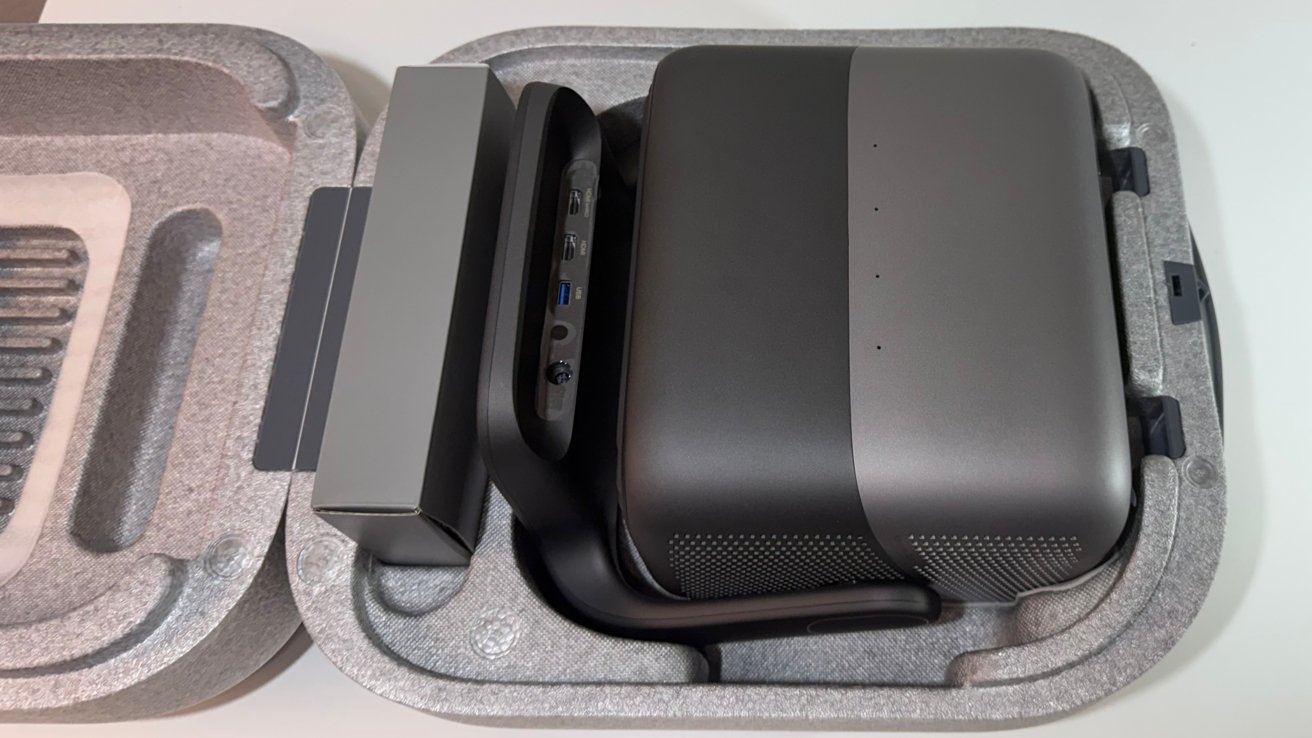
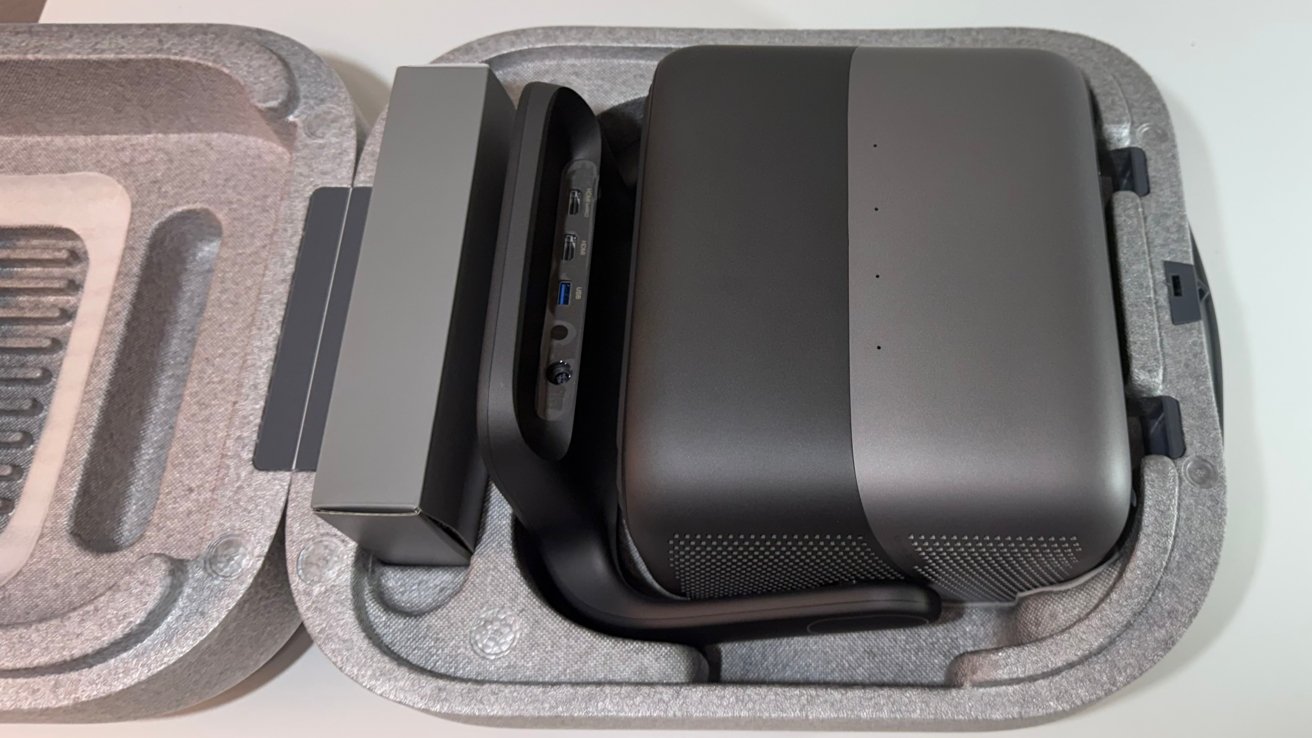
Compact dark gray desktop computer and accessories neatly packed in a molded gray foam tray with lid open, showing ports and ventilation grilles on the side

JMGO N3 Ultimate review: Unboxing from quite sturdy packaging.

Advertisement

The body is built from aluminum, which helps keep things cool given the powerful laser light source inside. It is clearly a living room piece rather than something you’ll move around often.

Around the back are two HDMI 2.1 ports, one of which supports eARC (which allows the projector to send audio back out to a connected sound system without a separate cable), plus a USB 3.0 port. Wi-Fi 6 and Bluetooth 5.2 handle wireless connectivity.

The built-in speaker system is 25W total across two channels. Noise output is rated below 26dB during operation.

JMGO N3 Ultimate review: The 3-in-1 placement system

The N3 Ultimate’s central selling point is how it handles placement. It tackles this in three ways.

Advertisement

The first is the optical zoom, which covers a 0.88 to 1.7:1 throw ratio. In practical terms, a 100-inch image can be produced from as close as roughly seven feet or as far as around fourteen, without affecting image quality.

The second is dual-direction lens shift, which moves the image up, down, left, or right by up to 130% vertically and 53% horizontally. Crucially, this is a purely optical adjustment, unlike digital keystone correction, so there is no loss of resolution or brightness.
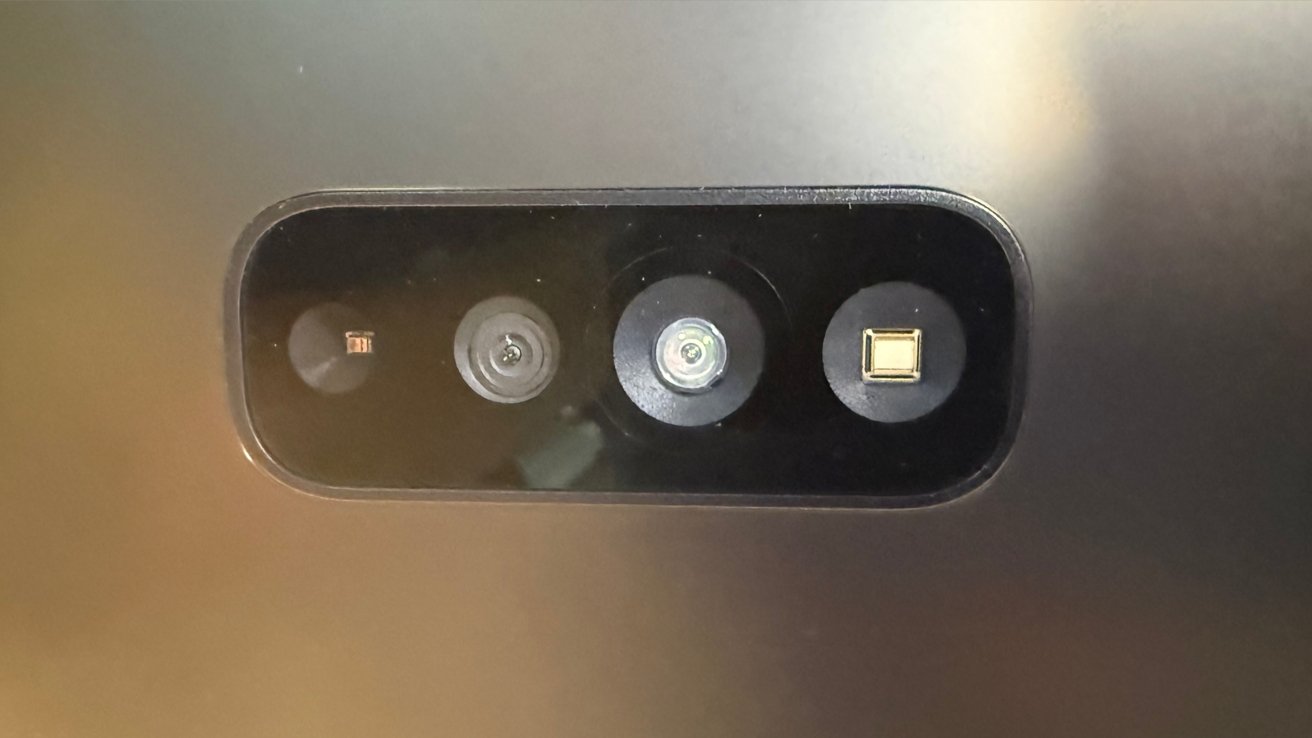
Close-up of a smartphone's rear camera module, showing three circular lenses and a small square flash arranged horizontally on a dark, smooth background

JMGO N3 Ultimate review: Sensors to manage the image

The third is the AI gimbal, which JMGO claims is a first for the US market. It rotates the projector head automatically, letting it point at a different wall or the ceiling without the user touching the unit.

Advertisement

All three work together under JMGO’s Optical Image Optimization system. A single button press triggers automatic screen fitting, focus, keystone correction, and obstacle detection at the same time. A feature called AI Spatial Memory then stores those setups, so the projector can switch between surfaces without needing to recalibrate each time.

Use the automatic system. Manually doing it from the remote is fussy, and you will ultimately get frustrated by the process.

JMGO N3 Ultimate review: Image quality

The light source is a tri-color RGB laser, which JMGO calls MALC 5.0. It is the latest version of the same system used in the N1S Ultra we reviewed previously, with improved brightness and color figures.

The system is decent, with it minimizing speckling. There’s still the occasional rainbow effect at play.

Advertisement

Rainbow effect is a visual aberration. Not everyone is sensitive to this effect. Some users, including two of the five viewers on our panel, can see this on other projectors as flashes of red, blue, and green color during high-contrast scenes, or action shots.

In short, it’s a slight strobing around movement.
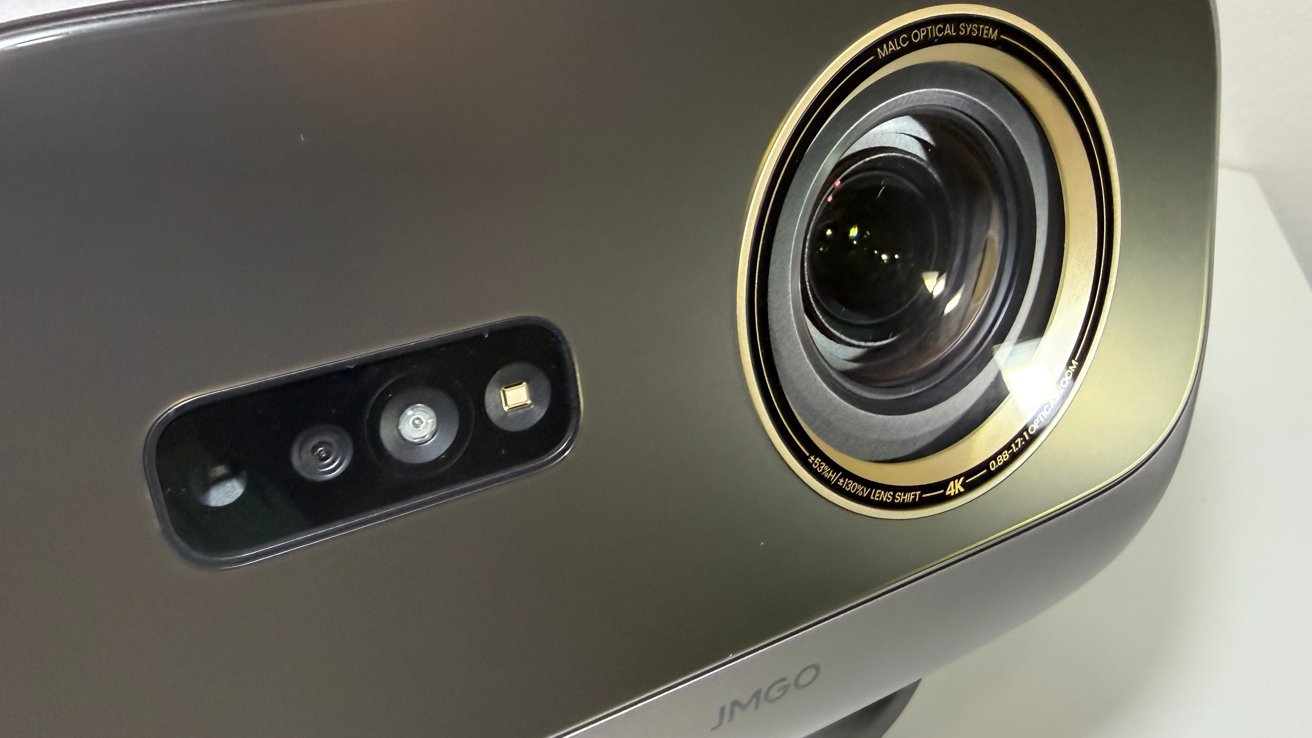
Close-up of a sleek modern projector, showing a large circular lens with a gold ring and a nearby rectangular panel containing three small sensor lenses on a metallic gray body

JMGO N3 Ultimate review: Front lens and sensor array.

Our five-person testing panel watched a bunch of action movies, as they seem to show off and challenge projectors the most. With some other lower-end projectors, our testers saw the rainbow effect in a Star Wars fighter battle, and so forth.

Advertisement

One of our two testers saw the rainbow effect while watching the latest Dune movie. The other didn’t see it on Dune, but did see it in Star Wars: Andor‘s escape from the prison, as the escapees jumped into the water.

Good enough.

Output is rated at up to 5,800 ISO lumens. That is more than double the N1S Ultra’s 2,800 lumens, which is a meaningful jump for use in rooms with ambient light.

Contrast is rated at 20,000:1 using FOFO measurement (a standardized method that measures contrast in real projection conditions, rather than in a darkened test environment). This is supported by AI Dynamic Black processing and Shadow Detail Enhancement.

Advertisement

Color coverage is 110% of the BT.2020 standard, with a color accuracy rating of Delta E approximately 0.7. A Delta E below 1.0 is generally considered reference-grade, so this figure is impressive on paper.

Our AV expert brought his hardware over to the house to test the claims. The claims matched up with reality, with the expert measuring a more reasonable 0.8 Delta E in practice.

Still, this varies in testing environments. Like hard drive speeds in the real world not matching up with manufacturer’s claims, this is close enough.

HDR support covers Dolby Vision and HDR10. However, while Dolby Vision seems perfect, support for the plainer HDR10 support is a little off when it comes to color on both Google TV and a connected Apple TV set-top box. Our AV expert didn’t have an answer for why, but said that it “was still reasonable” in a unit at this price point.

Advertisement

From a regular viewer’s standpoint, this isn’t terrible. It is noticeable if you’re viewing something that does not support Dolby Vision.

The image can scale from 40 inches up to 300 inches. This is a good range, especially if you want to watch on a big screen and you happen to have a clear side of your home available for outdoor viewing.

JMGO N3 Ultimate review: Smart features and software

The N3 Ultimate runs Google TV with native Netflix support. It has 4GB of RAM and 64GB of storage, which is generous for a projector.

When we reviewed the N1S Ultra, Google TV’s performance on JMGO’s hardware was a weak point. The MT9679 chip is used again here, so the same limitations apply.

Advertisement

For Apple users, the N3 Ultimate supports AirPlay, allowing iPhones and Macs to stream or mirror content directly to the projector without extra hardware. The Apple TV app is also available via Google TV.
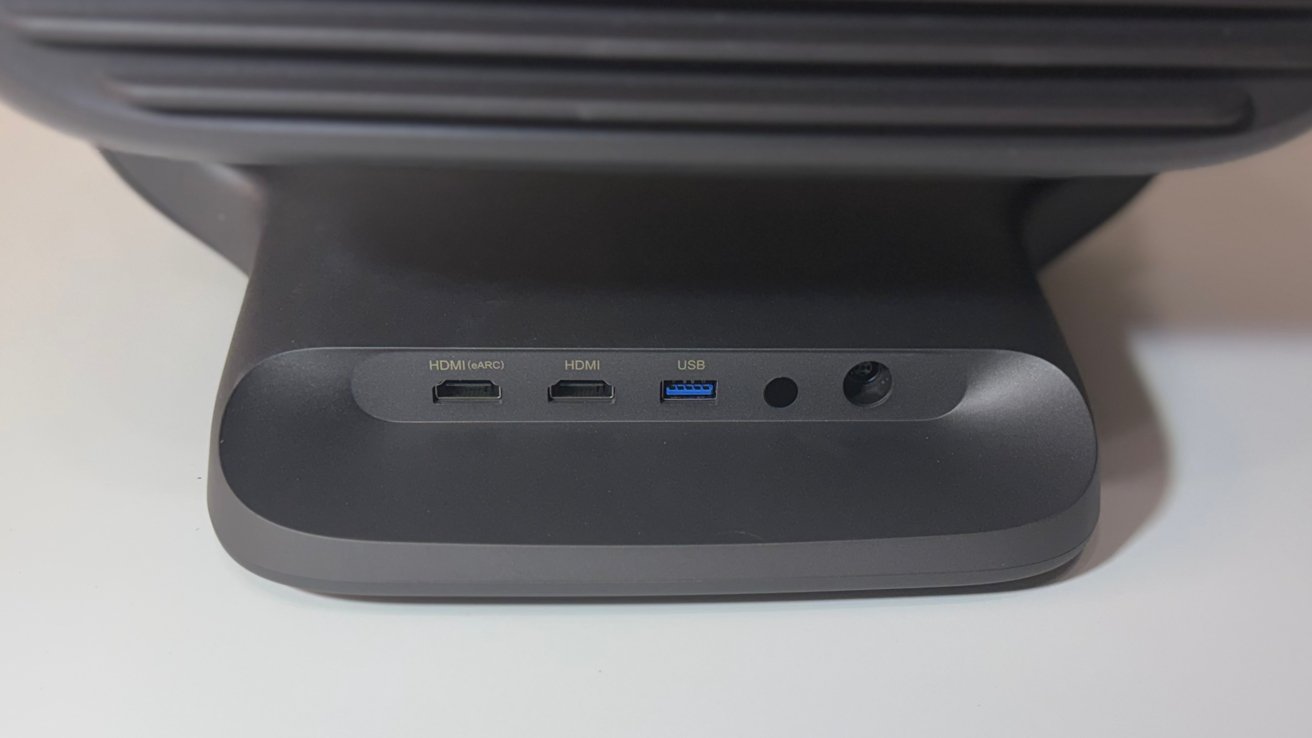
Close-up of the back of a dark gray monitor stand showing several ports including USB-C, HDMI, USB-A, audio jack, and power connector on a light surface

JMGO N3 Ultimate review: Rear ports.

For a cleaner Apple experience overall, pairing with an Apple TV box via one of the HDMI 2.1 ports remains the recommended approach, as it was with the N1S Ultra.

AI features include automatic screen fitting, focus, keystone correction, obstacle avoidance, eye protection, and wall color adaptation. The AI Spatial Memory system can store multiple projection setups, including position, image size, and the last-used app, for quick switching between surfaces.

Advertisement

Calling all this “AI” is marketing, and not much else. A few years ago, it’d have been called “computer vision” or the like.

And, we hooked up an Xbox Series X to the N3 Ultimate. Input lag is rated at 1ms, and it supports Variable Refresh Rate (VRR) that synchronizes the projector’s frame output with the console or PC for smoother motion. It also has up to a 240Hz refresh rate, but at a lower resolution that max.

A dedicated Pro Game Mode is also available. These figures are competitive with dedicated gaming monitors, which is unusual for a projector. Our test group liked the feature, and compared it positively to the 120Hz 4K display that I have on my desk.

PlayStation 5 and Xbox Series X users benefit from VRR directly over the HDMI 2.1 connections. Apple TV 4K users pairing via HDMI will also see a responsive, low-lag connection.

Advertisement

Upscaling of retro consoles is better handled by an emulator or an external box, though, if that’s your thing.

JMGO N3 Ultimate review: Audio

The N3 Ultimate has a 25W stereo speaker system with Dolby Audio and DTS-X support. That is a step up from the N1S Ultra’s 20W setup in name, though the configuration differs.

As with just about every projector’s speaker systems, whether this is adequate for your large-screen setup is something only hands-on use will confirm. We didn’t like it, and preferred our own Dolby Audio solution.

As was the case with the N1S Ultra, external audio is probably what you want. A soundbar or, for Apple users, a receiver with external speakers or a full-sized HomePod paired in low-latency mode via Apple TV, makes the most of what the projector can deliver.

Advertisement

JMGO N3 Ultimate review: A more complete package

The N3 Ultimate builds directly on what JMGO established with the N1S Ultra. The picture is substantially better, the placement system is more flexible, and the gaming credentials are genuinely competitive with screens.

The 3-in-1 system is a real differentiator. For users who cannot mount a projector to a ceiling, or who want flexibility in how they use a room, the ability to repoint the projector automatically without losing image quality is worth paying for.
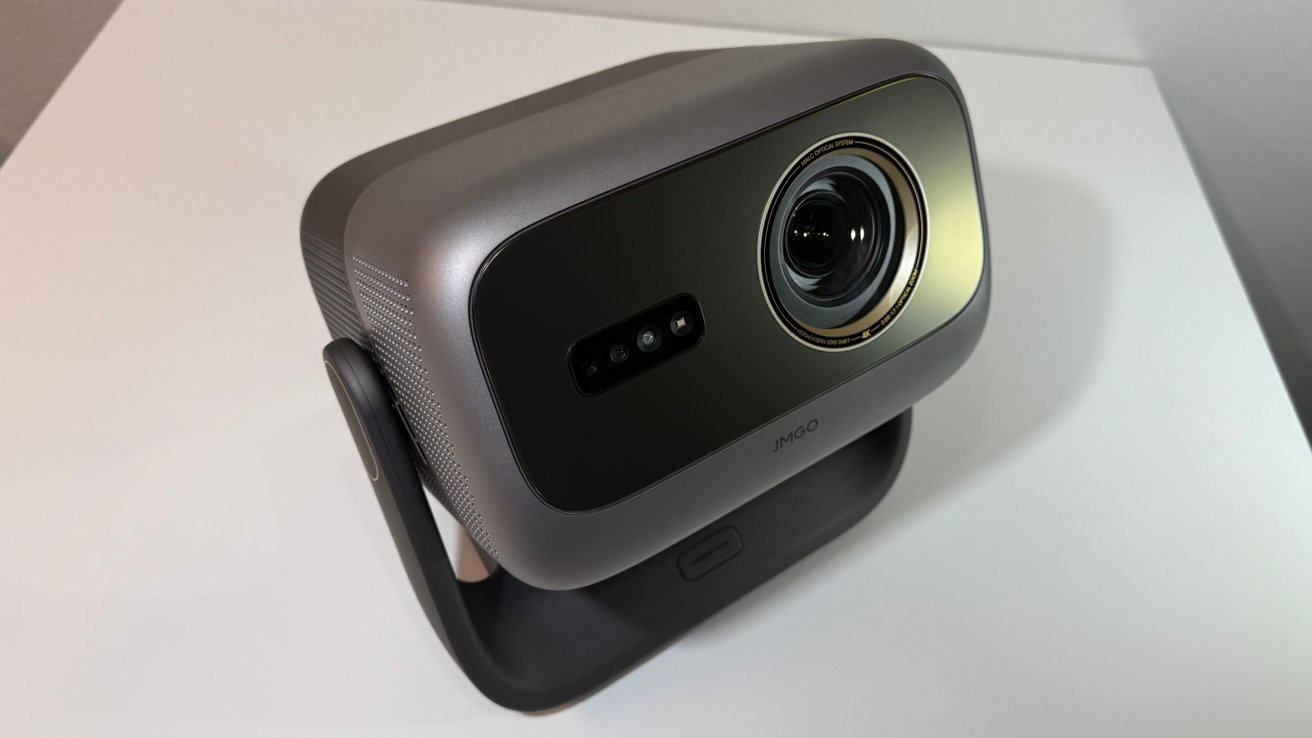
Compact gray digital projector with a large front lens, small sensor window, and a curved black handle-style stand, sitting on a clean white tabletop in soft lighting

JMGO N3 Ultimate review: A decent home cinema projector.

At a MSRP of $2,999, it is a premium product. It is priced for people who want the best image they can get in a living room context, and who value placement flexibility alongside it.

Advertisement

That Google TV, though, is awful. It’s slow, it’s not very responsive, and it’s janky. All of this is not JMGO’s fault, and Google might be able to make it better. Eventually. Maybe.

But, Google is on Google TV 5.0, though. You’d think they’d have fixed it by now.

Apple users will find it integrates well with an Apple TV or Mac mini in the chain. It is clearly not an Apple product, but it is a good projector for one.

JMGO N3 Ultimate Pros

  • 3-in-1 lossless placement system
  • Significantly improved brightness over previous models
  • Competitive gaming specs

JMGO N3 Ultimate Cons

  • Premium price
  • Google TV performance is very bad
  • Onboard audio is a bit weak, and should be replaced with another solution

Rating: 4 out of 5

I liked the JMGO N1S Ultra. I like the N3 more, but I still hate Google TV.

AirPlay to the unit natively isn’t enough. Hook it up to an Apple TV with HDMI, and that removes most of the friction of the product for Apple users.

Advertisement

Where to buy the JMGO N3 Ultimate

The JMGO N3 Ultimate is available from Amazon, currently discounted to $2,399 from $2,999.

Source link

Advertisement
Continue Reading

Tech

Cool off and save money with this tempting Duux Whisper fan deal

Published

on

Ever wondered why fan manufacturers think three speed settings are enough, when what you actually want is the difference between “barely there” and “I can finally sleep” that only proper granular control can deliver?

Most fans force you to choose between a breeze that does nothing and a roar that drowns out everything else, and the gap between those two extremes is where summer nights get genuinely miserable for anyone who runs warm.

Duux Whisper 3 Fan on a black and white backgroundDuux Whisper 3 Fan on a black and white background

The Duux Whisper 3 fan drops in price today, letting you cool off and save money at once

The Duux Whisper 3 is built to keep you cool on those summer nights, and with a 22% discount, it is considerably easier to justify.

Advertisement

View Deal

That gap is exactly what the Duux Whisper 3 is built to close, and right now it’s down from £139.99 to £109, saving you £30.99 with a 22% discount that makes it considerably easier to justify.

Advertisement

The 26 speed settings are the heart of the case here, because that level of granularity means you’re not approximating comfort, you’re dialling into it precisely, whether that’s a faint background circulation or a 15-metre throw of air across a large room.

Noise levels start at 13 decibels on the lowest setting, which is quieter than a whispered conversation and quiet enough that running it overnight won’t disrupt sleep the way a conventional fan would, even at its lowest speed.

Advertisement

The Whatsapp LogoThe Whatsapp Logo

Get Updates Straight to Your WhatsApp

Advertisement

Join Now

The brushless motor keeps energy consumption to 1.6W at the bottom end and only 19W at maximum power, which is a meaningful figure for anyone planning to run it through a heatwave without watching their electricity bill climb alongside the temperature.

Advertisement

A Natural Wind Mode varies the airflow automatically to mimic an outdoor breeze rather than the mechanical monotony of a fixed setting, and the included remote means none of this requires leaving your chair to adjust it.

The Duux Whisper 3 also oscillates both vertically and horizontally, which is less common than it sounds and more useful than it seems, because it means a single unit can cover a room rather than just one corner of it.

This is the fan for anyone who has ever turned a cheap model off at 2am because the noise was worse than the heat. If you want the full picture before buying, our best fans 2026 guide rounds up every worthy alternative at this price.

Advertisement

Advertisement

SQUIRREL_PLAYLIST_10148964


Source link

Advertisement
Continue Reading

Tech

‘It’s gonna be awesome’: Salesforce CEO Marc Benioff has high hopes for using AI in its products, says ‘it’s impossible to describe what we’re gonna be able to do for customers’

Published

on


  • Salesforce CEO Marc Benioff extols effects of AI at work once again
  • Benioff hails efficiency gains, but also cost savings of using AI
  • Having AI agents and humans working together can take your company to the next level, Benioff says

Salesforce CEO Marc Benioff has spoken out again on his vision of the future of AI in software, predicting that the technology will bring forward huge boosts in productivity and efficiency.

Speaking on the All-In podcast, Benioff was unsurprisingly effusive in his praise of AI, particularly when combined with human workers, noting, “Everything’s gonna be cheaper to make, it’s more efficient.”

Source link

Advertisement
Continue Reading

Trending

Copyright © 2025