Connect with us
DAPA Banner
DAPA Coin
DAPA
COIN PAYMENT ASSET
PRIVACY · BLOCKDAG · HOMOMORPHIC ENCRYPTION · RUST
ElGamal Encrypted MINE DAPA
🚫 GENESIS SOLD OUT
DAPAPAY COMING

Business

3M sued for $2 billion over PFAS chemicals

Published

on

3M sued for $2 billion over PFAS chemicals

The federal government is suing global industrial science company 3M for $2 billion over the costs of past and ongoing damage to defence sites, including RAAF Pearce, caused by PFAS chemicals.

Continue Reading
Click to comment

You must be logged in to post a comment Login

Leave a Reply

Business

ETMarkets PMS Talk | A ‘private equity approach’ to public markets has driven our investing success for 15 years: Sameer Shah

Published

on

ETMarkets PMS Talk | A 'private equity approach' to public markets has driven our investing success for 15 years: Sameer Shah
In an era where passive investing, benchmark tracking and broad diversification dominate investor conversations, Sameer Shah believes long-term wealth creation still comes from identifying transformative business trends early and backing them with conviction.

Over the past 15 years, ValueQuest Investment Advisors has built its investment framework around what Shah describes as a “private equity approach” to public markets—focusing on deep research, management quality, industry structures and long-term profit pools before making investment decisions.

In this edition of ETMarkets PMS Talk, Shah discusses how the firm’s investment philosophy has evolved across market cycles, why concentrated portfolios can outperform when backed by rigorous analysis, and the structural themes—from manufacturing and defence to AI, aerospace and energy transition—that could shape the next decade of investing.

He also shares his views on where alpha opportunities lie in today’s market and why some of the most compelling investment ideas remain under-owned and under-appreciated by the broader market. Edited Excerpts –

Advertisement

Q) Value Quest has completed 15 years in the investment management business. How has your investment philosophy evolved over the years, especially across different market cycles?

A) Over the last 15 years, our philosophy has remained anchored in identifying structural themes and trends early, supported by a strong top-down understanding of the economy and industry cycles.
We combine this with deep bottom-up research to identify businesses that are emerging leaders or credible challengers within those themes.
What has evolved over time is the institutionalisation of our process — we have added stronger guardrails around risk, portfolio construction and governance to improve consistency of outcomes across market cycles.
This balance of conviction-led investing and disciplined risk management continues to define ValueQuest’s approach.

Q) Your firm follows a high-conviction and concentrated portfolio strategy. In a market where diversification is often emphasised, what gives you confidence in this approach?
A) At ValueQuest, we follow what we often describe as a “private equity approach” to public markets — spending significant time understanding industries, management teams, competitive advantages, and long-term profit pools before making investment decisions.

We have always believed that informed concentration is different from speculative concentration. When you understand management quality, industry structure and business fundamentals deeply, a concentrated portfolio can lead to better risk-adjusted outcomes.

Diversification beyond a point it can dilute conviction and impact. Our focus remains on understanding businesses deeply and managing risks proactively.

Advertisement

Q) ValueQuest has consistently focused on identifying structural megatrends early. Which themes currently excite you the most over the next 5–10 years?
A) Over the next 5–10 years, we remain highly constructive on India’s manufacturing opportunity, driven by both domestic demand and global supply chain diversification. AI is emerging as a defining global theme, and select Indian companies are increasingly becoming part of the hyperscaler and data centre ecosystem.

We also see strong long-term potential in defence and precision engineering, especially across aerospace and space-linked opportunities. Energy transition continues to benefit from powerful structural and geopolitical tailwinds, while pharma CDMO and the emerging GLP-1 ecosystem remain compelling healthcare themes. These opportunities are being shaped by policy support, technological disruption and rising strategic self-reliance globally.

Q) Given the current market valuations, where are you finding alpha opportunities today — largecaps, midcaps, or emerging businesses?
A) We do not approach markets through the lens of market-cap segmentation. Our investment process is driven more by identifying emerging trends, structural shifts, and areas where large profit pools can potentially develop over the next 5–10 years.

Our top-down thematic research helps us identify sectors and businesses that are beneficiaries of these long-term changes, irrespective of whether they are classified as largecaps, midcaps, or emerging companies.

Advertisement

Historically, alpha generation has often come from identifying under-appreciated businesses early in their growth journey rather than focusing on size classifications.

Q) The factsheet highlighted sectors such as energy transition, defence, aerospace, and manufacturing as key focus areas. What makes these sectors particularly attractive from a long-term investment perspective?
A) These sectors are attractive because they are aligned with powerful structural, geopolitical and policy-led tailwinds. Energy transition is likely to accelerate further amid recurring oil shocks and the increasing global focus on energy security and localisation.

Defence spending is also set to rise meaningfully over the next decade as countries prioritise self-reliance and modern warfare shifts from traditional platforms towards drones, anti-drone systems and advanced technologies.

In aerospace and precision engineering, India has a strong structural advantage driven by its engineering talent, cost competitiveness and growing role in global supply chains.

Advertisement

Q) India’s manufacturing story is gaining global attention due to supply chain diversification and policy support. How are you positioning portfolios to capture this opportunity?
A) Manufacturing is entering a multi-year upcycle as the world moves from an asset-light model towards rebuilding hard assets and resilient domestic supply chains, creating long-duration opportunities for globally competitive Indian businesses.

We are positioning portfolios to capitalise on this opportunity largely through “picks and shovels” businesses – particularly capital goods, industrial technology and engineering-led companies that enable this broader manufacturing buildout.

Our focus remains on identifying companies with strong execution capabilities, technological differentiation and the ability to gain market share as both domestic capex and global supply chain diversification accelerate.

Q) As a firm managing over Rs 27,000 crore across mandates, how do you maintain agility and continue generating alpha at scale?

A) Generating alpha at scale requires staying ahead of emerging trends while maintaining deep research and strong risk discipline.

We prefer scalable businesses with strong execution and market leadership, which allows us to deploy capital meaningfully without losing agility.

Advertisement

Our “private equity lens” helps us develop differentiated insights, assess industries with a long-term ownership mindset, and identify early signs when an investment thesis is evolving or getting challenged.

We believe intellectual agility and deep engagement with portfolio companies are far more important than attempting to mirror benchmarks or cover every sector.

Q) Which sectors or themes do you believe are still under-owned or under-appreciated by the broader market?
A) Many of the most compelling opportunities today are still in relatively early stages of growth and often lie outside benchmark indices, which naturally leads to lower institutional ownership and market attention.

Aerospace, precision engineering and AI/ data center plays are still early in their growth journey and not fully reflected in market positioning.

Advertisement

Similarly, energy transition continues to be viewed narrowly despite the long runway and shifting profit pools emerging across the ecosystem. We recently put out a note highlighting the same.

(Disclaimer: Recommendations, suggestions, views, and opinions given by experts are their own. These do not represent the views of the Economic Times)

Continue Reading

Business

Work to begin on ‘thriving new destination’ in Chorlton

Published

on

Business Live

PJ Livesey starting first phase of Chorlton Cross Shopping Centre scheme

Makers Yard in Chorlton, part of the regeneration of the former Chorlton Cross Shopping Centre.

Makers Yard in Chorlton, part of the regeneration of the former Chorlton Cross Shopping Centre(Image: Local Democracy Reporting Service)

An area in Chorlton is about to be turned into a ‘thriving new destination’ with more homes and public spaces on the way.

Advertisement

Plans are in place by PJ Livesey to redevelop the former Chorlton Cross Shopping Centre on Wilbraham Road in a major regeneration scheme. The project was granted planning permission at the end of 2025.

That work is due to start with phase one focused around dismantling the former shopping centre and Graeme House buildings.

Bosses behind the scheme say the first step will be to close the precinct car park at the end May 2026.

New hoardings will be put up around the site, and the cut through via Manchester Road to Nicolas Road will be closed to pedestrians and vehicles for safety reasons.

Advertisement

Demolition of the existing buildings is expected to begin in June and finish in August. Material from the existing buildings are set to be reused during construction of the new neighbourhood, to reduce vehicle trips during the work.

The approved plans include building 262 apartments with a mix of one, two and three bedrooms, all with access to outdoor space through balconies and gardens. A total of 53 affordable homes will be available through a mix of tenures, with 49 for social rent.

That’s alongside 3,500 sq metres of public open space, including a ‘fully walkable route’ through Manchester Road and outdoor seating areas. Among the mix of new shops, there will be a new ‘Makers Yard’ said to be suitable for smaller, start-up businesses.

All the homes in the scheme will be designed and built to reduce energy demand and residents’ bills, bosses said.

Advertisement

The neighbourhood will be all-electric with some renewable energy generation on site and future proofed EV charging.

Up to 60 new trees will be planted across the site, with ‘maximised retention’ of the existing set.

The scheme was brought forward in partnership with the Greater Manchester Pension Fund.

Georgina Lynch, managing director at PJ Livesey, said: “Demolition marks another major milestone for the project which will completely transform the former shopping centre.

Advertisement

“Keeping local people safe and minimising disruption is our top priority. We’ve been working with the existing traders to carefully manage any disruption during the demolition.

“This has included arranging new servicing access for the businesses on Wilbraham Road.

“Our demolition contractor will carefully manage any issues throughout the work, and we will continue to stay in regular contact with local residents and businesses as the demolition progresses.”

To find all the planning applications, traffic diversions, road layout changes, alcohol licence applications and more in your community, visit the Public Notices Portal.

Advertisement
Continue Reading

Business

Why Fifa is being investigated over World Cup ticket prices

Published

on

Why Fifa is being investigated over World Cup ticket prices

Fifa is under investigation over its ticket pricing ahead of the 2026 World Cup.

The attorneys general of New York and New Jersey are investigating the association over allegations of “artificially inflating prices” and “misleading fans” over the sale of tickets. Fans have reportedly been “misled” about the location of seats, including through the creation of more expensive “front” category tickets released after the initial sales, according to the report.

Fifa president Gianni Infantino defended the prices earlier in May, saying they reflect the public’s “absolutely crazy” appetite, though Fifa declined to comment on recent events.

BBC’s Nada Tawfik explains what comes next with the World Cup just days away.

Advertisement
Continue Reading

Business

Oil Price Today (May 28): Crude oil surges nearly 3% after Iran says it targeted US airbase in retaliation for fresh American strikes

Published

on

Oil Price Today (May 28): Crude oil surges nearly 3% after Iran says it targeted US airbase in retaliation for fresh American strikes
Oil prices climbed on Thursday after fresh US strikes in Iran reignited fears of disruptions to commercial shipping through the Strait of Hormuz.

Brent crude, the global benchmark, surged more than 3% to $97.29 a barrel, while US West Texas Intermediate (WTI) crude jumped 3.42% to $91.71 a barrel.

Iran’s Revolutionary Guards said that they struck a US airbase at around 4:50 a.m. local time, according to the country’s semi-official Tasnim news agency, though the IRGC did not disclose the location of the base.

US officials said Central Command forces shot down four Iranian one-way attack drones that posed a threat near the Strait of Hormuz. The US military also struck an Iranian ground control station in Bandar Abbas that was preparing to launch a fifth drone.

Advertisement

The latest escalation comes days after the US military carried out what it described as “self-defense strikes” in southern Iran, targeting vessels allegedly attempting to deploy mines along with missile launch sites. US Central Command said the operation was aimed at protecting American troops and commercial shipping routes.


Iran’s Islamic Revolutionary Guard Corps later said it would respond to ceasefire violations after detecting and engaging US drones and an F-35 fighter jet that had entered Iranian airspace. A US official said the latest strikes targeted an Iranian military facility believed to pose a threat to American forces and maritime traffic moving through the strait.
Meanwhile, President Donald Trump said Iran was “negotiating on fumes” and added that the upcoming US midterm elections would not pressure him into rushing a deal to end the nearly three-month-old conflict.In a note released late Wednesday, Citi said oil markets were stabilising as investors gradually moved away from pricing in severe supply disruption risks amid signs of progress in negotiations between Washington and Tehran.

However, the bank said uncertainty around the timing of any agreement continued to keep central banks cautious, as policymakers assessed the inflationary impact of elevated energy prices.

Citi added that the sustained rise in crude prices was beginning to feed into broader inflation pressures through what it described as “second round effects”, pushing some central banks toward a more hawkish stance.

Swiss investment bank UBS said on Friday that pressure on the global oil market was intensifying as inventories continued to shrink amid disruptions to shipments through the Strait of Hormuz. The bank noted that global oil inventories declined by a combined 246 million barrels in March and April, while cumulative production losses could exceed 1 billion barrels by the end of May.

Advertisement

Analysts said that even if a deal is reached, shipping activity through the strait may take several months to normalise, while damaged energy infrastructure could take even longer to recover fully.

Earlier this month, Saudi Aramco CEO Amin Nasser warned that disruptions in Hormuz could delay stability in global oil markets until 2027, with nearly 100 million barrels of oil supply per week potentially impacted. Saudi Aramco is the world’s largest oil producer.

Morgan Stanley described the current oil market as being in “a race against time”, saying the factors that have so far prevented a sharper rise in crude prices may weaken if the Strait of Hormuz remains shut through June.

The brokerage said higher US crude exports and softer demand from China had helped absorb part of the supply shock. However, it cautioned that an extended closure of Hormuz could tighten global supplies again if disruptions continue beyond what the US and China can comfortably offset.

Advertisement

(Disclaimer: Recommendations, suggestions, views and opinions given by the experts are their own. These do not represent the views of The Economic Times)

Continue Reading

Business

SpaceX’s AI Business Waits for Liftoff | AI & Business for May 26

Published

on

SpaceX’s AI Business Waits for Liftoff | AI & Business for May 26

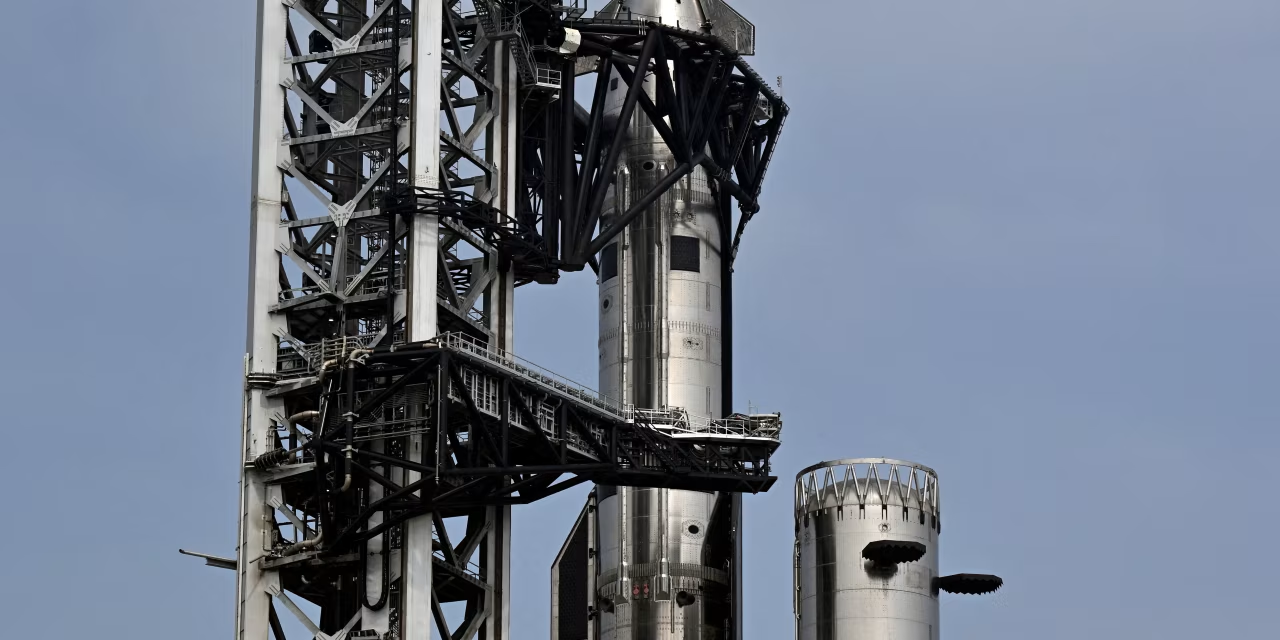
SpaceX’s regulatory filing last week ahead of its IPO revealed a financially smart marriage between its space-launch services division and its profitable Starlink satellite internet operation.

Its AI business looks much shakier.

Copyright ©2026 Dow Jones & Company, Inc. All Rights Reserved. 87990cbe856818d5eddac44c7b1cdeb8

Continue Reading

Business

Sri Lanka’s surprise rate hike risks choking off IMF-backed recovery

Published

on

Sri Lanka’s surprise rate hike risks choking off IMF-backed recovery


Sri Lanka’s surprise rate hike risks choking off IMF-backed recovery

Continue Reading

Business

HP Inc. 2026 Q2 – Results – Earnings Call Presentation (NYSE:HPQ) 2026-05-27

Published

on

OneWater Marine Inc. (ONEW) Q1 2026 Earnings Call Transcript

Q2: 2026-05-27 Earnings Summary

EPS of $0.86 beats by $0.14

 | Revenue of $14.41B (8.99% Y/Y) beats by $337.07M

This article was written by

Seeking Alpha’s transcripts team is responsible for the development of all of our transcript-related projects. We currently publish thousands of quarterly earnings calls per quarter on our site and are continuing to grow and expand our coverage. The purpose of this profile is to allow us to share with our readers new transcript-related developments. Thanks, SA Transcripts Team

Advertisement
Continue Reading

Business

Which Semiconductor Stock Offers Best Value in Late 2026?

Published

on

Amazon Recalls 500,000+ Products Over Deadly Safety Risks — Here's

NEW YORK — As investors weigh opportunities in the semiconductor sector amid the ongoing artificial intelligence boom, the choice between Intel, NVIDIA and Taiwan Semiconductor Manufacturing Co. (TSMC) has become a central debate for portfolios seeking exposure to chips powering data centers, consumer devices and advanced computing.

Each company occupies a distinct position in the semiconductor ecosystem. NVIDIA dominates AI accelerator chips, TSMC leads as the world’s premier contract chip manufacturer, and Intel is executing a high-stakes turnaround in both processor design and foundry services. With the sector facing strong long-term demand but short-term volatility from capital spending cycles and geopolitical risks, analysts differ on which stock offers the most compelling risk-reward profile heading into the final months of 2026.

NVIDIA: AI Dominance with Premium Valuation

NVIDIA remains the clearest pure-play beneficiary of the AI surge. The company continues to command an estimated 80-85% share of the AI GPU market, with its Blackwell and upcoming Rubin platforms driving substantial revenue. First-quarter fiscal 2027 results showed record performance, though some investors have expressed caution over high valuations and potential slowdowns in hyperscaler spending.

The stock has delivered strong returns but experienced periods of consolidation in 2026 as the market digests massive prior gains. Analysts generally maintain bullish outlooks, citing sustained AI infrastructure buildouts and new applications in robotics and autonomous systems. However, the premium multiple leaves limited margin for error if AI capital expenditure growth moderates.

Advertisement

TSMC: Stable Foundry Leader with Clear Visibility

TSMC stands out as the most consistent and lower-risk option among the three. As the manufacturer for NVIDIA, Apple, AMD and others, it captures broad industry growth with exceptional execution. The company has raised full-year growth guidance multiple times in 2026, benefiting from strong demand for advanced 2nm and 3nm processes.

Analysts frequently describe TSMC as the “picks and shovels” play in the AI gold rush, with more predictable revenue streams and strong margins. Geopolitical risks tied to its Taiwan base remain a concern, but the company’s strategic importance has drawn international support and diversification efforts. For conservative investors seeking semiconductor exposure with lower execution risk, TSMC often ranks as the preferred choice.

Intel: High-Risk Turnaround with Significant Upside Potential

Intel has delivered one of the most dramatic stock recoveries in the sector during 2026, with shares surging over 200% in some periods after a multi-year slump. The company’s 18A process node has shown promising yields, and it has secured partnerships with NVIDIA, Tesla and others for foundry services. U.S. government support and foundry ambitions have fueled optimism.

However, Intel still faces profitability challenges in its foundry business and must prove it can consistently win major external customers against TSMC. Some analysts have grown cautious on valuation after the sharp rally, with recent downgrades citing rich pricing relative to near-term execution risks.

Advertisement

Comparative Outlook for Late 2026

NVIDIA offers the highest growth potential but carries elevated valuation risk. Strong AI demand should continue, yet any signs of hyperscaler budget fatigue could trigger volatility.

TSMC provides the most balanced profile — strong secular tailwinds, industry-leading technology and more stable financials. It benefits regardless of which chip designer wins market share.

Intel represents the highest-risk, highest-reward option. Successful foundry execution and data center CPU gains could drive further upside, but delays or competitive losses might pressure the stock.

Diversification across all three may offer the most prudent approach for many investors, balancing NVIDIA’s growth, TSMC’s stability and Intel’s turnaround optionality. Sector fundamentals remain supportive, with global semiconductor sales projected to approach or exceed $1 trillion in 2026, driven primarily by AI infrastructure.

Advertisement

Key Risks Across the Sector

Geopolitical tensions, particularly around Taiwan, represent a shared risk for all three companies. Supply chain disruptions, export restrictions and capital expenditure shifts by major cloud providers could influence performance. Additionally, energy costs for AI data centers and potential economic slowdowns remain watchpoints.

Longer-term, the AI investment cycle, advancements in alternative computing architectures and regulatory developments will shape relative performance.

Investment Considerations

Investors should assess their risk tolerance, time horizon and portfolio allocation before deciding. Those with higher risk appetites may favor NVIDIA or Intel for potential outsized returns, while conservative investors might prefer TSMC’s more predictable growth profile.

Dollar-cost averaging and thorough fundamental analysis remain advisable in this dynamic sector. Professional financial advice tailored to individual circumstances is recommended before making investment decisions.

Advertisement

The semiconductor industry’s importance to technological progress and economic growth ensures continued attention on these leading players. As 2026 progresses, quarterly results, AI adoption metrics and geopolitical developments will provide further clarity on which company is best positioned for sustained success.

Continue Reading

Business

Construction green light for IG6's micronising facility

Published

on

Construction green light for IG6's micronising facility

North Perth-based International Graphite has announced a key milestone in relation to its mooted Collie micronising facility.

Continue Reading

Business

Gold, silver slide up to 2% as fresh US strikes on Iran fuel inflation fears, hurt peace hopes

Published

on

Gold, silver slide up to 2% as fresh US strikes on Iran fuel inflation fears, hurt peace hopes
Gold prices slipped on Thursday after fresh U.S. strikes on Iran lifted oil prices, fuelling concerns over inflation and adding uncertainty to the outlook for interest rates.

Spot gold fell 0.8% to $4,419.60 per ounce, while U.S. gold futures for June delivery declined 0.7% to $4,417.10. Among other precious metals, spot silver dropped 1.7% to $73.34 per ounce, platinum eased 0.5% to $1,909.15 and palladium declined 0.7% to $1,381.64.

The dollar also strengthened, making dollar-priced bullion more expensive for buyers holding other currencies.

A U.S. official said the American military launched new strikes in Iran targeting a military site believed to threaten U.S. forces and commercial shipping through the Strait of Hormuz. The development came hours after President Donald Trump rejected an Iranian report claiming a deal had been reached to restore traffic through the strategic waterway.

Advertisement

Investors are now awaiting the release of U.S. Personal Consumption Expenditures data later in the day for further signals on the Federal Reserve’s policy direction.


A Reuters report stated that Federal Reserve Governor Lisa Cook said that the U.S. central bank should keep short-term interest rates unchanged for now. However, she added that tariffs, the Iran conflict and rising AI-linked investments were increasing price pressures, and the Fed could raise rates if required. Federal Reserve Vice Chair Philip Jefferson also said the current monetary policy stance remained appropriate given ongoing upside risks to inflation.
Investors are now awaiting the release of the U.S. Personal Consumption Expenditures data later in the day for further signals on the Federal Reserve’s policy direction.As for levels, COMEX Gold is consolidating within the $4,500–$4,540 range, maintaining a cautious undertone. Immediate resistance is placed at the $4,560–$4,600 zone; a sustained move above this band could strengthen upside momentum and push prices toward the $4,660–$4,700 range.

“On the downside, immediate support remains at $4,500–$4,460, and a break below this zone could trigger corrective weakness toward the $4,400–$4,350 levels. Overall, the structure remains cautious, with prices needing to sustain above the $4,500 support level, while a decisive break below immediate support could weaken momentum and increase downside pressure,” Ponmudi R, CEO of Enrich Money said.

Meanwhile, the Multi Commodity Exchange of India will remain shut during the morning session on May 28 and resume trading in the evening session. As per MCX’s annual trading calendar, the exchange has 16 trading holidays in 2026, including partial and full-day closures.

(Disclaimer: Recommendations, suggestions, views and opinions given by the experts are their own. These do not represent the views of The Economic Times)

Advertisement
Continue Reading

Trending

Copyright © 2025