

Crypto World
Bitcoin’s 35% Crash Signal Just Returned But a Whale Bought $66 Million Anyway

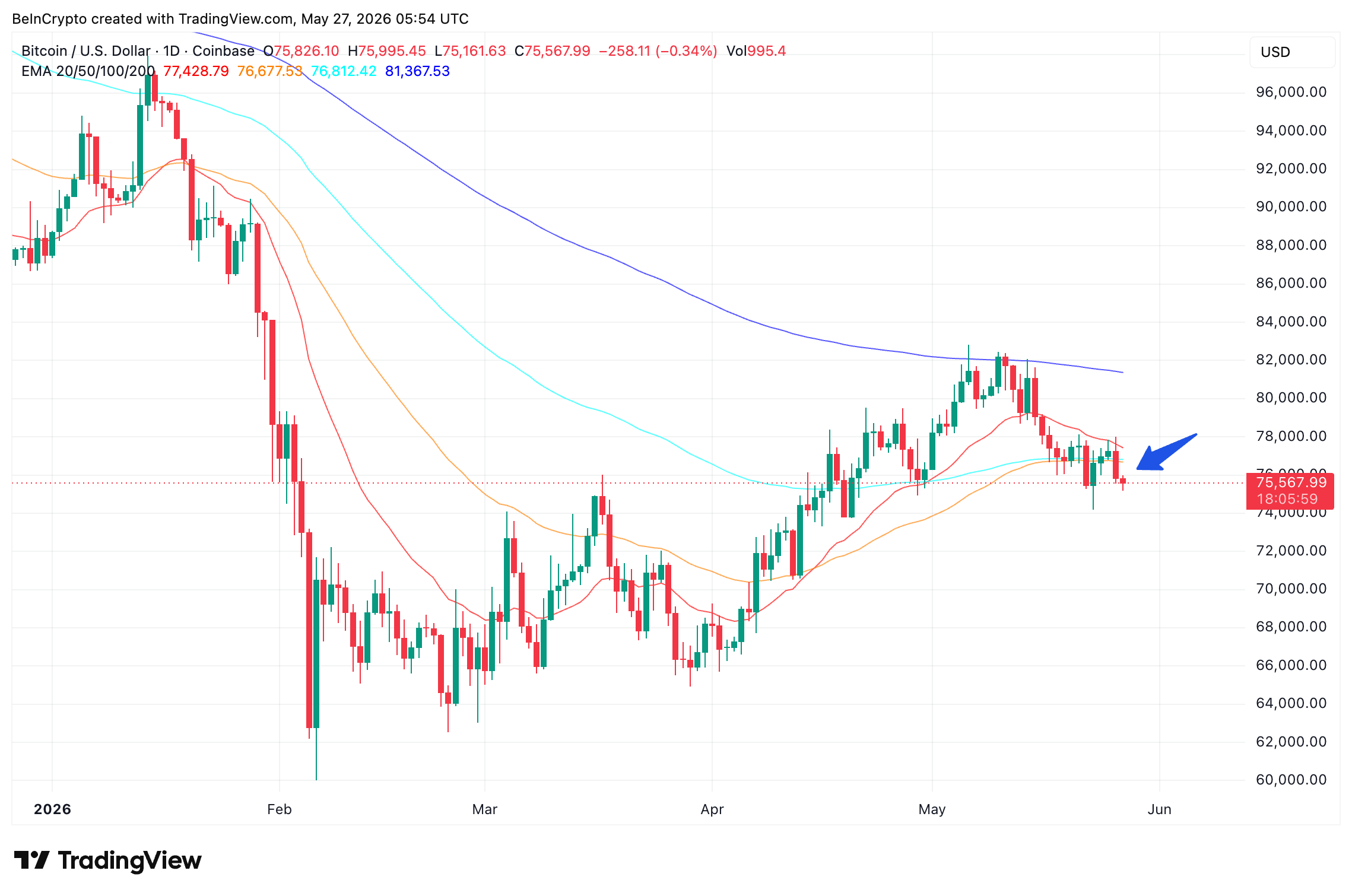
Bitcoin price just flashed the same warning that preceded its 35% January collapse, slipping below a cluster of critical technical lines on the daily chart.
A single wallet still withdrew 873 BTC worth $66 million from OKX, possibly betting the outcome this time will look nothing like January.
Bitcoin Price Cracks All Four EMAs as a $66 Million Whale Buy Hits
Bitcoin (BTC) is trading at $75,567, now below all four key Exponential Moving Averages (EMAs), trend indicators that smooth recent price action to flag the underlying direction. The 20-day EMA sits at $77,428, the 50-day at $76,677, the 100-day at $76,812, and the 200-day at $81,367.

Around the same time, an on-chain tracker flagged a wallet withdrawing 873.29 BTC worth $66.24 million from OKX early Wednesday. The wallet now holds 881 BTC worth roughly $66.73 million, with prior smaller withdrawals stretching back about a week.
The two signals point in opposite directions. A clean loss of every EMA is one of the most reliable bearish daily signals in 2026, while a fresh $66 million accumulation suggests at least one large operator sees a buy. The historical record explains why both sides have a case.
The Last Three EMA Breaches Show One Crash and Two Bargains
Bitcoin has fully lost all four EMAs three times in 2026. The outcomes split sharply.
Want more token insights like this? Sign up for Editor Harsh Notariya’s Daily Crypto Newsletter here.
The first event began in late January. Bitcoin closed below every EMA and triggered a 35.02% slide over the following two weeks. It was the deepest single drawdown of the year.
The next two events landed in completely different terrain. On March 26, Bitcoin lost the EMA cluster but the damage stopped at 7.36% before a recovery rally took over. On May 22, an even smaller 3.32% dip preceded a rebound back into the EMA zone.

The pattern shows declining severity, with the last two events behaving like brief consolidations rather than full breakdowns. The catastrophic January event remains the outlier. Whatever made January different from March and May is the only question that matters for this fourth breach.
The on-chain record points directly at the answer.
Long-Term Holder Behavior Explains the January Outlier
Glassnode’s Long-Term Holder Net Position Change, a metric that tracks whether wallets holding Bitcoin for more than 365 days are net accumulating or distributing, reveals a sharp regime shift in early March.
Note: Standard “Hodlers” are the ones holding for 155 days or more.
Through late 2025 and across the January 2026 breakdown, long-term holders were heavy net sellers. The red bars on the chart deepened toward roughly -200,000 BTC at peak distribution, exactly as Bitcoin was sliding. That coordinated long-term holder selling supplied the structural pressure that turned a routine EMA breach into a 35% rout.

Since early March 2026, the picture flipped. Long-term holders have stayed in net accumulation territory for roughly three months, with daily inflows often above 100,000 BTC. That backdrop coincided directly with the muted 7.36% and 3.32% drops in March and May.
The current EMA breach is happening into a long-term holder regime that is still green. The structural seller cohort that powered the January collapse is absent. This is the data point the whale appears to be reading, and it sets the downside math for what follows.
Bitcoin Price Levels Between the 3% Bargain and the January Repeat
Bitcoin price has already shed roughly 2% since losing the EMA cluster. If this breach mirrors the May 22 event, the drop stalls near $73,873, the 0.5 Fibonacci level of the late-March to mid-May rally. That zone aligns with the 3-to-4% magnitude of the May precedent.
If buyers fail to defend $73,873 and the breach scales closer to the March 26 episode, the next checkpoint is $71,773 (0.618 Fibonacci), marking a 6-to-7% total drop from the EMA loss.
The recovery path requires sequential daily closes back above resistance. The first step is reclaiming $75,973 (0.382 Fibonacci) on a daily close. The next is breaking above $78,572 (0.236 Fibonacci), which sits just over the key EMA cluster. A clean move above $82,772 would put Bitcoin price back above every moving average and resume the prior uptrend.

The January risk has not disappeared. If long-term holder net position flips negative on Glassnode during this drop, the comparison to March and May fails, and the path opens toward another deeper dip scenario back toward the mid-$60,000 range.
A daily close above $75,973 separates the 3-to-7% bargain scenario backed by the $66 million whale from a deeper unwind that would invalidate the long-term holder thesis.
The post Bitcoin’s 35% Crash Signal Just Returned But a Whale Bought $66 Million Anyway appeared first on BeInCrypto.


HIVE schedules Q4 and full-year 2026 results, earnings call to outline mining and AI compute performance
HIVE Digital Technologies Ltd., a publicly traded miner and data center operator, will publish its fiscal fourth-quarter and full-year 2026 results on June 1, followed by a webcasted earnings call on June 2 at 8:00 AM Eastern Time. The company, listed on the TSX and Nasdaq under the ticker HIVE, operates Bitcoin mining facilities and GPU-accelerated data centers across multiple jurisdictions.
Investors in listed mining companies will be watching HIVE closely. The company presents a hybrid business model that combines traditional proof-of-work Bitcoin mining with growing GPU-based hosting and AI compute services. That mix positions HIVE differently from pure-play miners, and the upcoming disclosure will be parsed for signs of how that strategy is translating into revenue and margin trends.
What investors will look for
While HIVE has not released financial figures ahead of the scheduled date, there are several operational and financial indicators market participants typically focus on for miners and data center operators:
- Bitcoin production and holdings – Quarterly BTC mined, the companys selling policy and changes in inventory are key for revenue recognition and balance sheet exposure to price volatility.
- Hash rate and capacity utilization – Changes in deployed ASICs, average network difficulty and effective hash rate provide insight into output capability and operational scale.
- Energy costs and sourcing – Miners margin heavily depends on power rates and availability. HIVE has emphasized low-carbon energy in its public materials, which can influence long-term operating costs and regulatory positioning.
- GPU hosting and AI compute revenue – Demand for GPU capacity from AI workloads has become a diversification avenue for several miners. The degree to which HIVE converts GPU deployment into recurring hosting revenue will be important for assessing revenue mix.
- Geographic performance – HIVE operates facilities in Canada, Sweden and Paraguay. Regional differences in power pricing, regulatory frameworks and uptime can materially affect results.
Strategic position and sector context
HIVE’s dual emphasis on hashrate services for Bitcoin and GPU-accelerated AI compute follows a broader industry trend where mining companies seek to diversify revenue streams amid cyclical crypto markets. GPU hosting can partially offset the volatility tied to BTC prices, by providing steady, contractual revenue from enterprise AI customers and cloud workloads. That said, GPU markets are competitive and capital intensive, and successful monetization depends on efficient deployment and strong client uptake.
For equity investors, HIVE and peers are often treated as barometers for several interlinked markets: the spot price of Bitcoin, the supply and utilization of mining hardware, and the emerging market for specialized AI compute capacity. Quarterly disclosures can influence sentiment across the miner cohort, particularly if companies adjust capital allocation between ASIC expansion and GPU deployment.
Governance, listings and leadership
HIVE trades on multiple exchanges, including the Toronto Stock Exchange and Nasdaq. The company has described itself publicly as an operator of Tier-I and Tier-III data centers and has highlighted energy sourcing as part of its operational narrative. Executive leaders named in prior corporate communications include Executive Chairman Frank Holmes and President and CEO Aydin Kilic. Management commentary on the earnings call will be closely watched for updates on strategy, capital spending plans and demand for GPU services.
Event access and disclosures
The company has said it will post the earnings release and a replay of the webcast on its investor relations website. Participation in the live call typically requires advance registration; registered participants receive dial-in details and the webcast link. As with most public companies, the formal financial statement and management discussion will provide the definitive view of performance for the period.
Implications for the market
Quarterly results from HIVE may have outsized relevance for several investor groups. Equity holders in mining firms will parse the report for operational efficiency and capital allocation between ASICs and GPUs. Bond and credit market participants and potential strategic partners may look for indications of stable hosting revenue that could underpin longer-term contracts. Finally, because mining companies often hold BTC on their balance sheets, results can influence both crypto market flows and the valuation multiples investors are willing to pay for miner equities.
Analysts and market commentators will also be watching for any commentary on supply chain dynamics for ASICs and GPUs, power procurement strategies, and regional expansion plans. These factors will help determine whether HIVE’s hybrid model offers a durable advantage against the backdrop of heightened demand for AI compute and the persistent cyclicality of crypto markets.
The companys full results and management commentary will be available after the scheduled release on June 1, and the earnings call on June 2 will provide additional colour on operational execution and strategic priorities.
How to follow
Investors and analysts can find the earnings release and webcast replay on HIVEs investor relations page. Those seeking the live discussion should register in advance to receive dial-in details and the webcast link.
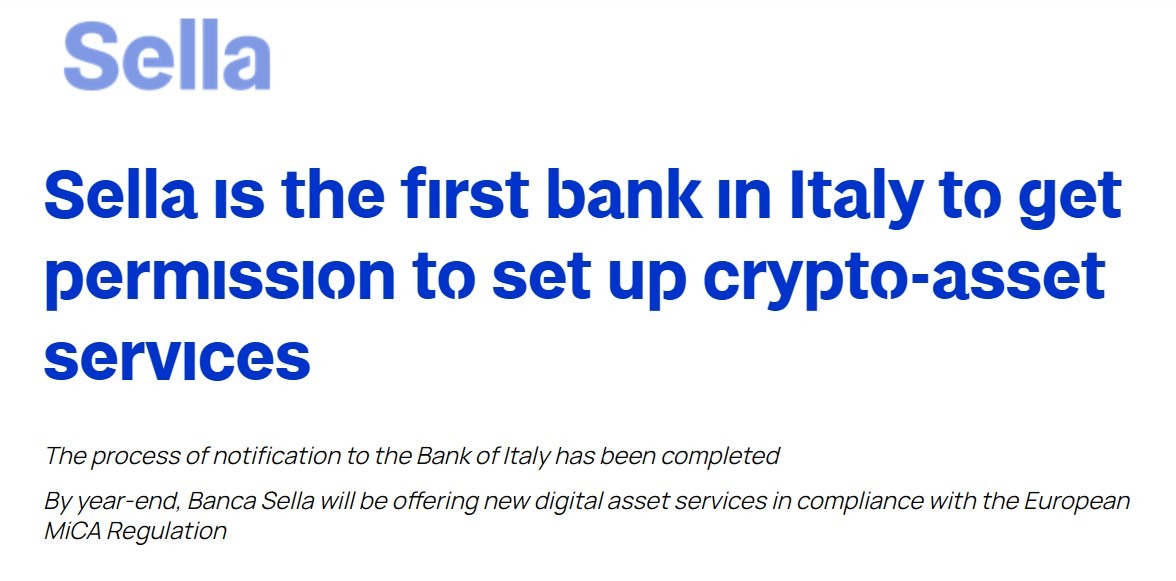
Italian bank Banca Sella announced that it has completed its notification process with the Bank of Italy under the European Union’s Markets in Crypto-Assets (MiCA) regulation, allowing it to offer crypto-asset services.
On Wednesday, the bank said it is the first bank in Italy authorized to offer crypto-asset services, adding that the approval will allow it to launch a solution focused on the custody, transfer and receipt of digital assets in 2026, aimed at “selected categories” of customers.
Banca Sella is the commercial bank of Sella Group. According to Sella Group, it has almost 300 branches and more than 2,400 employees.
The approval gives Italy’s banking sector a regulated entry point into digital assets under MiCA, as European financial institutions move from crypto pilots and partnerships toward licensed custody, tokenized payments and stablecoin infrastructure.
Andrea Tessera, managing director of digital banking at Banca Sella, said tokenization is contributing to a shift toward “instant, interoperable, and programmable” payments. He said the bank’s planned crypto service is part of that shift.
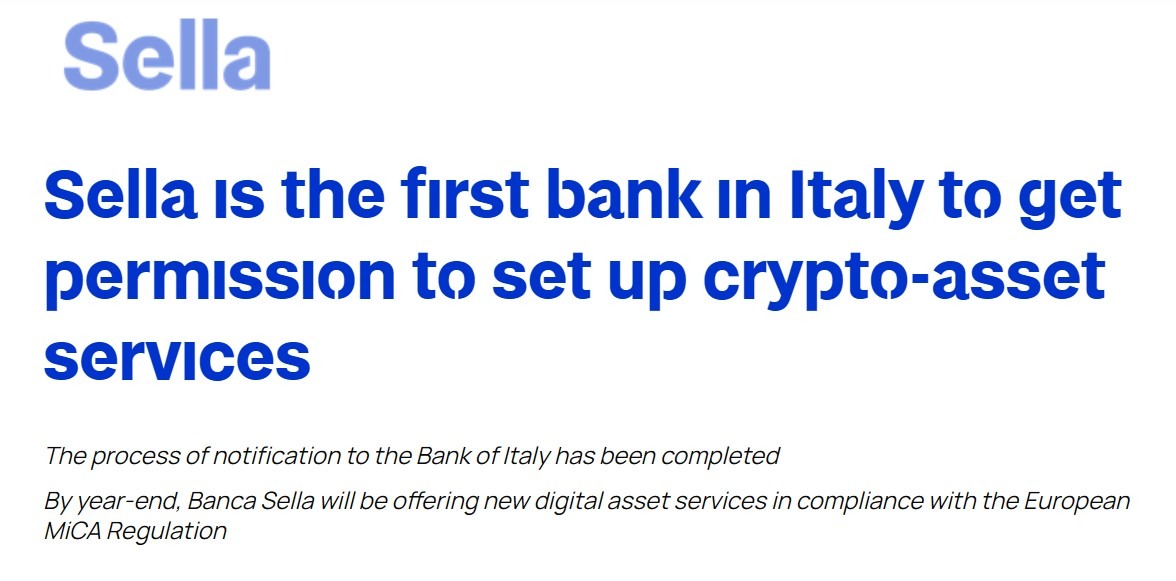
Sella announces MiCA approval. Source: Sella
Hype gave earlier crypto exposure
The MiCA approval is not Banca Sella’s first connection to crypto. Banca Sella also said in the announcement that its MiCA approval follows its participation in a distributed ledger technology pilot promoted by the Bank of Italy’s Fintech Milano Hub in 2022.
Banca Sella said it has also created an internal DLT and digital assets team, and added that it’s also among the founders of Qivalis, a consortium of 37 European banks that plans to issue a euro-denominated stablecoin.
Related: Bank of Italy chief says banks, not stablecoins, anchor digital money
The bank also previously had crypto exposure through Hype, its digital banking brand, which integrated Bitcoin wallet services through Italian crypto firm Conio.
Conio said its first banking integration became operational in March 2020 through a partnership with Hype, Banca Sella Group’s digital banking brand. According to Conio, Hype went live in 2020 and allowed retail customers to buy, sell, send and receive digital assets.
Hype’s current website advertises a Bitcoin wallet that lets adult customers create a wallet and buy, sell or exchange Bitcoin directly from the Hype app.
In 2024, Reuters reported that Banca Sella had around 1.3 million customers, while Hype served around 1.7 million customers.
Magazine: 50K investors fight Korean crypto tax, Singapore cancels Bsquared: Asia Express
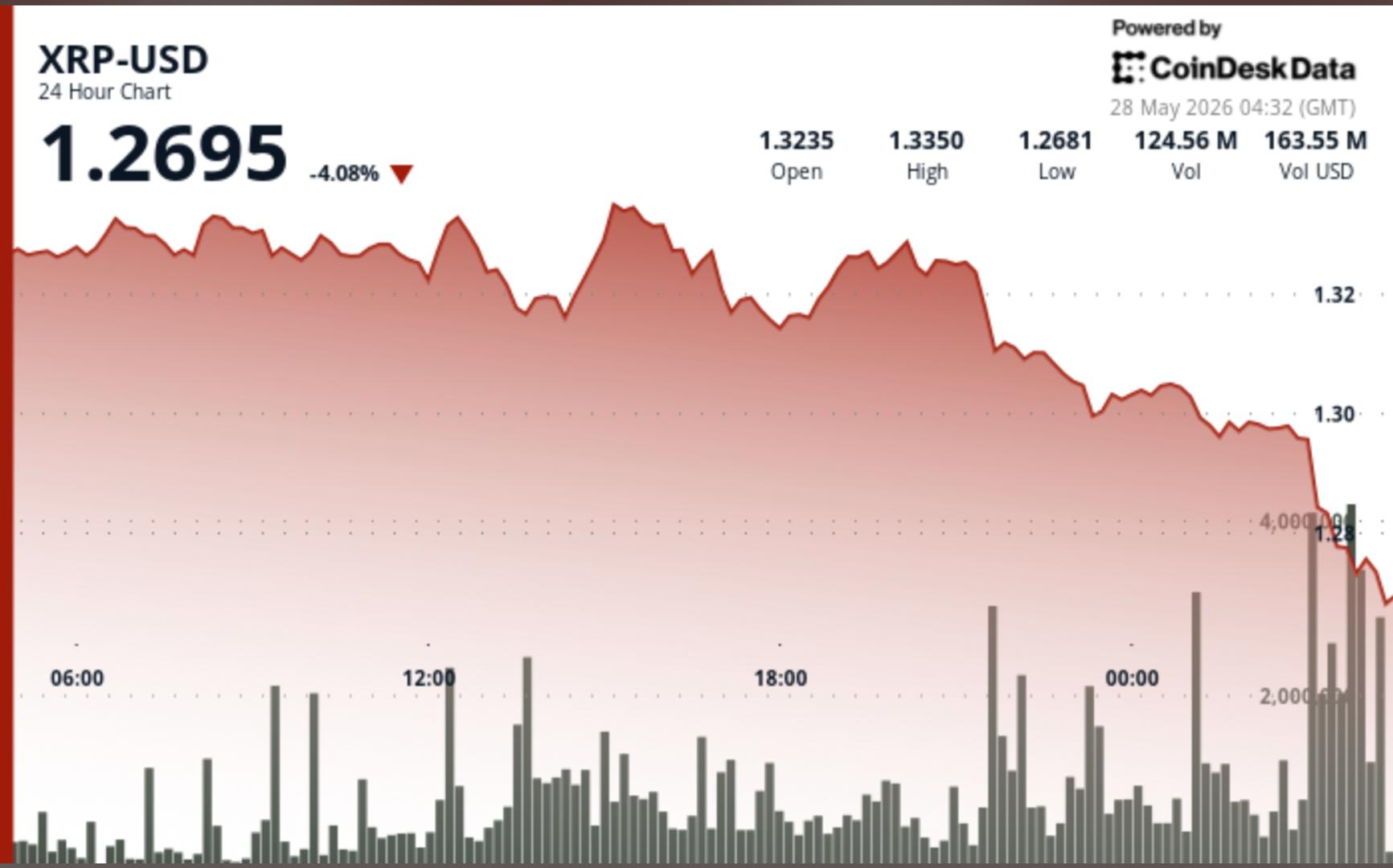
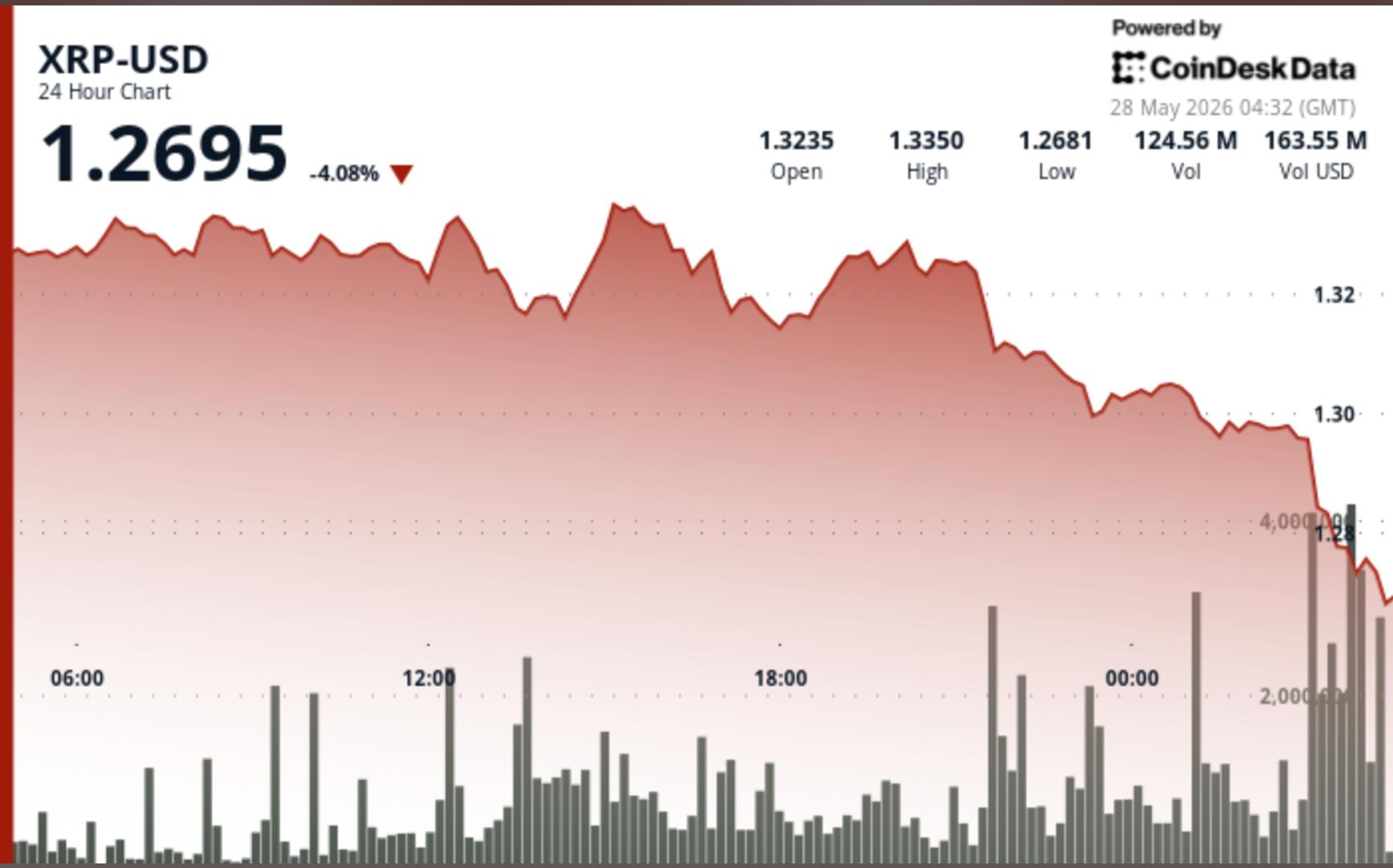
XRP finally slipped below the $1.30 area traders had been defending for months, and the move came with enough volume to matter. The market had already been weakening beneath resistance near $1.35, but once support gave way, sellers pushed price lower quickly before dip buyers stepped in near session lows.
News Background
• XRP derivatives positioning continued cooling during the session, with falling open interest signaling weaker trader conviction across futures markets.
• Analysts also kept pointing to a symmetrical triangle structure that has compressed XRP price action since early 2025, with the market now nearing the apex of that range.
• On-chain data still showed XRP leaving exchanges, a pattern some traders continue interpreting as longer-term accumulation despite the short-term weakness.
Price Action Summary
• XRP fell from $1.3267 to $1.2993 during the 24-hour session, briefly dropping as low as $1.2931.
• The sharpest selling came during the May 27 23:00 UTC session, when 64M XRP traded as price broke below support near $1.3150.
• XRP later staged a short-term rebound from session lows, recovering back toward the $1.30 area into the close.
Technical Analysis
• The breakdown below $1.30 matters because that level had repeatedly acted as a floor throughout the broader consolidation structure.
• XRP is now trading beneath several key resistance levels, with sellers continuing to defend the $1.33-$1.36 zone aggressively.
• The bounce from $1.2931 showed some evidence of exhausted selling pressure, though the recovery remained weak relative to the earlier breakdown.
• The broader symmetrical triangle pattern is still intact for now, but price is drifting dangerously close to the lower edge of the structure.
What traders should watch
• $1.30 becomes the immediate recovery level XRP needs to reclaim to stabilize short-term momentum.
• Failure to hold above recent lows increases the risk of a deeper move toward the mid-$1.20s and potentially the $1.10 area highlighted by several analysts.
• The longer XRP trades near the bottom of its compression range, the higher the odds the eventual breakout resolves lower rather than higher.

Kraken is expanding its yield offerings with a new non-custodial Bitcoin product that promises a 2.5% annual return. Built in collaboration with yield infrastructure provider Veda, the solution aims to simplify earning on Bitcoin without the common frictions of wrapping, moving, or managing a crypto wallet. The move comes as Bitcoin holders show growing interest in yield-style products, even as native yield mechanisms on BTC remain limited compared with programmable blockchains.
Kraken unveiled the product with the backing of Veda, which emphasized that the offering is designed to remove the headaches often associated with BTC yield strategies. In Kraken’s own messaging, the product is pitched as a straightforward way to earn on Bitcoin the exchange already intends to hold, addressing user demand for ease of use and reliability.
Key takeaways
- Kraken launches a non-custodial Bitcoin yield product at 2.5% APY, leveraging Veda’s yield infrastructure to route BTC into lending markets.
- The system uses Kraken Wrapped Bitcoin (kBTC) as a price-tracking representation of BTC, with Sentora allocating funds across Aave, Morpho, and Tydro through the integration.
- Withdrawals are non-instant and are expected to take about five days, with a 25% performance fee on rewards paid to the involved service providers.
- Early traction: roughly $30 million in BTC deposits from around 4,000 unique wallets were reported by Veda about 10 hours after launch.
- Kraken’s broader yield portfolio—three stablecoin yield products launched in January—has amassed about $245 million in deposits and generated over $2.2 million in yield since Jan. 26.
A fresh approach to Bitcoin yield
The new offering marks a notable evolution in the BTC yield space by delivering a non-custodial structure that lets holders earn on their Bitcoin without surrendering custody or performing intricate wallet operations. Kraken’s Earn product director, John Zettler, framed the initiative as addressing a clear investor preference: “Many Bitcoin holders on Kraken have made it clear they want simple ways to earn on the Bitcoin they already plan to hold.”
In practice, the model begins with BTC being swapped into kBTC, a token designed to mirror Bitcoin’s price. From there, Sentora—another linked component in the pipeline—channels the value into established lending venues such as Aave, Morpho, and Tydro. This multi-step approach allows users to gain exposure to yield-generating activity without the traditional friction of moving assets between wallets or custodians.
What makes this structure distinctive is its non-custodial nature. Depositors retain control over their funds, with withdrawals subject to a multi-day processing window. The arrangement also includes a 25% performance fee on rewards, a rate that’s aligned with other professional yield structures but could impact net returns for users depending on the performance of the underlying lending markets.
How the product operates and who benefits
At the heart of the offering is a cycle that begins with Bitcoin being represented as kBTC within Kraken’s ecosystem. This representation helps bridge BTC with the yield infrastructure built around decentralized lending protocols. By routing kBTC into traditional lending arenas via Sentora, Kraken users can theoretically earn a yield while maintaining exposure to BTC’s price movements.
For users, the upside is straightforward: a simple, non-custodial way to generate returns on BTC holdings that are otherwise idle. For the ecosystem, the product expands the array of Bitcoin-native yield options, potentially providing greater utility for BTC as a store of value. On the flip side, the non-custodial model concentrates trust in the security and reliability of the involved counterparties—in particular, Kraken, Veda, Sentora, and the lending protocols they tap into.
Deposit growth toward the product has already been significant in its infancy. Veda reported that within roughly 10 hours of launch, the Bitcoin yield product had crossed $30 million in deposits from about 4,000 unique wallets. Such rapid uptake signals a strong appetite among Bitcoin holders for yield-oriented products that avoid custody risk while preserving ownership of funds.
To provide context for readers tracking market evolution, Kraken’s three existing stablecoin yield products, which launched in January, have collectively drawn around $245 million in customer deposits and produced more than $2.2 million in yield since their inception on Jan. 26. This backdrop highlights Kraken’s broader strategy of layering yield offerings across asset classes to meet diverse investor preferences.
Adoption signals and market context
The Bitcoin yield landscape has been characterized by limited native yield opportunities, primarily because BTC’s design does not include built-in mechanisms to generate interest or rewards like some programmable blockchains. The new Kraken-Veda pairing taps into the broader crypto lending ecosystem to convert BTC exposure into yield potential, while attempting to mitigate the typical custody headaches associated with such strategies.
Analysts and market observers are watching how the model scales, particularly as it relates to liquidity, the stability of the kBTC representation, and the performance of the underlying lending platforms. The reliance on multiple counterparties and cross-network routing could introduce new operational risk layers, even as it offers a potentially compelling path to earn yield without moving away from BTC holdings.
In the broader crypto yield space, the trend toward diversified, user-friendly structures persists. The incorporation of non-custodial approaches contrasts with fully custodial yield products, underscoring a market appetite for options that balance ease of use, control, and risk management. As institutions and retail users alike reassess their BTC allocations, products like Kraken’s non-custodial yield offer a tangible way to monetize BTC holdings beyond price appreciation alone.
The development also sits within a broader regulatory and security context. While non-custodial solutions reduce custody risk, users must still evaluate the security posture of each component in the chain—the exchange, the yield infrastructure provider, and the lending platforms—to understand potential exposure during market stress or asset sharp moves.
What remains uncertain is how durable the early demand will be and how attractive the net yield will prove once governance and fee structures interact with shifting lending conditions. Observers will be looking for longer-term deposit trends, withdrawal reliability, and any changes to the fee framework as the product matures.
For traders and developers, the continued expansion of Bitcoin yield options is a reminder that BTC as an asset class is increasingly embedded in the broader DeFi and yield-enabled ecosystem. The pace at which new, user-friendly, non-custodial solutions emerge will shape how quickly more Bitcoin holders adopt yield-generating strategies without compromising control over their funds.
Readers should keep an eye on momentum in deposits, any shifts in the underlying lending rate environment, and how regulators respond to non-custodial yield constructs that blend traditional crypto custody with DeFi mechanics.
In the near term, the story to follow is the balance between user uptake and the performance of the lending channels that underpin the yield. If the trajectory holds, Kraken’s non-custodial Bitcoin yield product could become a meaningful reference point for BTC-native yield strategies in a market still eager for practical, secure ways to earn on crypto assets.
Source signals from Kraken and Veda indicate that the product is designed to deliver simplicity and accessibility for Bitcoin holders seeking yield without the usual operational overhead. As the ecosystem evolves, observers will watch how this model scales and what it implies for the broader adoption of BTC-yield approaches.


Russian officials have moved closer to a long-term shutdown of crypto mining in Moscow and nearby regions as lawmakers have advanced a separate bill to jail unregistered miners.
Summary
- A Russian power-industry commission has backed a proposal to ban crypto mining in Moscow, Moscow Oblast, and parts of Kursk until at least 2032.
- Kommersant reported that the government is also weighing a wider mining ban across 19 regions within Moscow’s power distribution zone.
- The State Duma has advanced a bill to criminalize illegal mining, with fines of up to 2.5 million rubles and prison terms of up to 5 years.
According to TASS, Deputy Energy Minister Evgeniy Grabchak said a government commission overseeing the electric power industry has backed a proposal to ban mining in the city of Moscow, the surrounding Moscow Oblast, and parts of the Kursk region, with the restriction expected to last until at least 2032.
Local officials raised the issue in late April, the ministry said, and the final decision will take their positions into account, according to a report by RBC.
Moscow area faces proposed six-year prohibition
In Moscow Oblast, regional Energy Minister Sergey Voropanov has argued that crypto mining brings little benefit to the local economy and has said that earlier restrictions elsewhere produced positive results, according to reports cited by RBC and Bits.media.
Bits.media has also recalled that Moscow Oblast Governor Andrey Vorobyov and Moscow Mayor Sergey Sobyanin have both proposed limits on mining in their jurisdictions.
The Russian energy ministry has counted at least 65 data processing centers connected to the grid across Moscow and the Moscow region, with a total capacity of 734 megawatts, according to figures cited in the report.
A separate Kommersant report has said the government is weighing a mining ban across 19 regions within Moscow’s power distribution zone, a move that would curb activity across the Central Federal District, which Kommersant described as the country’s main economic center.
In the Kursk region, Governor Alexander Khinshtein has proposed restricting mining in eight districts and the city of Lgov, according to the same coverage.
Khinshtein’s administration has said the region’s power supply problems have worsened due to the war in neighboring Ukraine, and has argued that a mining ban would free up reserve capacity and save electricity for other users, including residential and industrial customers.
The planned limits in Kursk have been discussed alongside the Moscow-area proposal, as Russian authorities consider how to reduce strain on local grids in regions with heavy power demand.
State Duma advances bill to criminalize illegal mining
In Moscow, the State Duma has passed a bill on first reading that would criminalize illegal mining, according to RIA Novosti and Prime.
The draft law sets penalties for mining without registration or for using stolen electricity, with punishments that can include fines, forced labor, and prison terms, RIA Novosti and Prime have reported.
Operators whose illegal facilities generate large income or cause major financial damage could face fines up to 2.5 million rubles, or about $35,000, according to the same reports.
For mining tied to an organized crime group, the legislation allows prison sentences of up to 5 years, forced labor, and additional fines, while also granting authorities the power to confiscate property, RIA Novosti and Prime reported.
Tightening rules after mining was legalized in 2024
Russia legalized cryptocurrency mining in 2024, with officials describing the country’s energy resources and climate as advantages, according to prior reporting referenced in the article.
After miners clustered in places with cheap electricity, energy deficits followed in several areas, the same coverage said, and Russian authorities responded last year by banning mining in 13 regions until spring 2031.
Those territories include Irkutsk Oblast, the Republic of Buryatia, Zabaykalsky Krai, most republics in the North Caucasus, and four occupied Ukrainian regions, according to the report.
Although individuals and companies can mine legally if they register and pay taxes, an explanatory note to the draft law has said fewer than 1,500 of an estimated 50,000 mining businesses have registered so far.
Bitcoin broke below $73,000 for the first time in months as fresh U.S. strikes on Iran sent risk assets lower and triggered one of the largest liquidation events of the year.
Bitcoin traded at $72,978 in Asian hours Thursday, down 3.4% over 24 hours and 6.3% over the past seven days, per CoinDesk data, after touching a low of $72,912. TEther (ETH) fell 4.2% to $1,976, losing the $2,000 level, and is down 7.7% over the past seven days. Solana (SOL) dropped 3.5% to $80.57, XRP slid 3.6% to $1.28, and Dogecoin lost 3.2% to $0.0979.
Hyperliquid (HYPE) was the only major to hold a weekly gain, down 4.5% on the day but still up 2.4% over the past seven days. Tron (TRX) held a 1.9% weekly gain despite the broad decline.
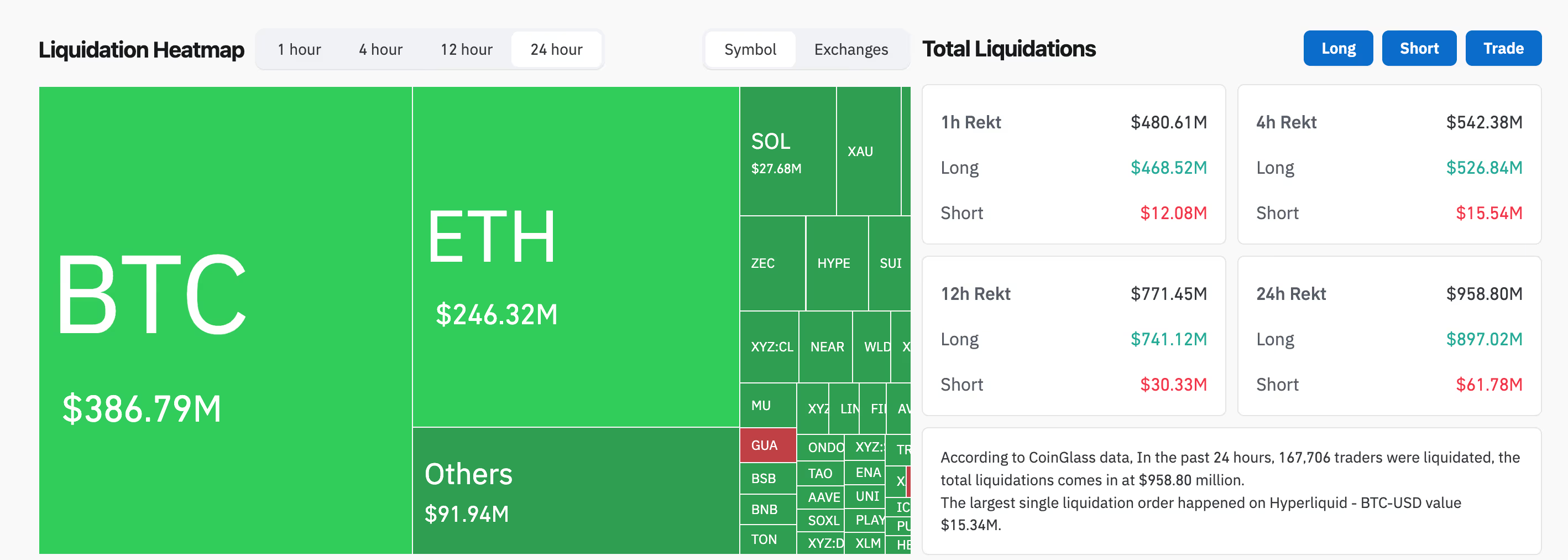
The drop flushed leveraged traders. CoinGlass data shows $958.8 million in total liquidations over 24 hours across 167,706 traders, with $897 million coming from long positions and $61 million from shorts.
Bitcoin liquidations led at $386 million, followed by ether at $246 million, with the largest single liquidation order was a $15.34 million BTC position on Hyperliquid.

A 93% long-skew on a near-billion-dollar flush is what happens when traders are positioned for a recovery and the market moves the other way. The leverage built up through the mid-May range got cleared in a single session.
The trigger came from the Middle East. U.S. Central Command carried out airstrikes on an Iranian military site near the Strait of Hormuz and shot down four one-way Iranian attack drones fired at a commercial ship, with a U.S. official describing the action as defensive and aimed at maintaining the ceasefire that began last month.
The U.S. Treasury imposed new sanctions on Iran’s Persian Gulf Strait Authority, accusing it of extorting vessels transiting the strait. Iran targeted the American airbase the strikes originated from, according to a report citing the Islamic Revolutionary Guard Corps.
Kuwait said it was responding to hostile missile and drone threats, with its army warning that explosions heard in the country were air defense systems intercepting targets.
President Donald Trump said no single nation would control the waterway. “It’s international waters,” Trump told a cabinet meeting at the White House. “The strait’s going to be open to everybody,” adding that the U.S. would “watch over it.”
Risk assets fell across the board. The MSCI All Country World Index retreated 0.4% from a record high, a gauge of Asian shares dropped 1.7%, and futures for the S&P 500 and Nasdaq 100 pointed lower. Oil climbed as the strikes clouded the outlook for a deal to reopen the strait.
The reaction shows how quickly the ceasefire optimism that had been building unwound. Crypto had held its range through several weeks of Iran headlines, with bitcoin staying above $74,000 even as ETF demand cooled. Thursday’s strikes broke that floor, and the speed of the liquidation cascade suggests traders were caught leaning the wrong way.


SpaceX has emerged as a potential major public Bitcoin holder as Grayscale Research links the company’s planned June listing to its reported BTC treasury
Summary
- SpaceX could become the largest diversified public company holding Bitcoin if its planned June listing goes through.
- Grayscale said SpaceX holds 18,712 BTC worth about $1.4 billion, which would make it the eighth-largest known corporate Bitcoin holder globally.
- SpaceX’s Bitcoin would still represent only about 0.1% of its projected $1.75 trillion valuation.
Grayscale Research said Elon Musk’s SpaceX could rank as the largest publicly traded diversified company with Bitcoin on its balance sheet if its planned public listing takes place in early June.
Grayscale says SpaceX could lead diversified Bitcoin holders
Zach Pandl, head of research at Grayscale, said SpaceX currently holds 18,712 Bitcoin, worth about $1.4 billion, based on the company’s latest S-1 filing. According to Pandl, those holdings would place SpaceX as the eighth-largest known corporate Bitcoin holder worldwide.
Pandl added that prediction market estimates around SpaceX’s possible post-IPO valuation could make the company the top publicly traded diversified business holding Bitcoin. Strategy Inc. would still be ahead of other public companies with much larger Bitcoin positions.
Grayscale’s report separated corporate Bitcoin buyers into two main groups. The first group includesDigital Asset Treasuries, such as Strategy, that primarily provide equity investors with exposure to Bitcoin. The second group includes diversified companies such as Tesla, Coinbase, and Block, in which Bitcoin is part of a broader treasury strategy.
Bitcoin would remain small part of SpaceX valuation
According to Grayscale Research, SpaceX is reportedly seeking a valuation close to $1.75 trillion, which could make the listing one of the largest IPOs ever. Pandl estimated that the company’s Bitcoin holdings would equal about 0.1% of its expected market capitalization.
Because of that small share, Grayscale placed SpaceX in the diversified corporate holder category rather than the Bitcoin treasury company category. The report also noted that Tesla, another Musk-led company, holds more than 11,500 BTC.
Meanwhile, Strategy remains the largest corporate Bitcoin holder, with about 850,000 Bitcoin valued near $65 billion, according to Grayscale’s figures. Pandl said diversified companies usually keep Bitcoin as a limited part of company value, unlike dedicated treasury firms.
Retail interest builds around planned listing
According to Stocktwits, retail sentiment around SPCX remained in the “extremely bullish” zone, while message activity also remained at “extremely high” levels over the past day. The strong discussion came as investors watched SpaceX’s expected June public market debut.
Grayscale Research said more diversified companies could add Bitcoin to their treasuries over time. The firm tied that view to treasury diversification and concerns about fiat currency risk.
Musk pushes GrokaAI, and banks prepare IPO deal
In related developments, Musk urged investors to subscribe to GrokaAI to support the SpaceX IPO campaign. As previously reported by crypto.news, Bank of America, Citigroup, Goldman Sachs, JPMorgan Chase, and Morgan Stanley are serving as active bookrunners for the deal.
International banks, including Royal Bank of Canada, Mizuho Financial Group, and Macquarie Group, are also involved in share distribution across their markets. Musk separately asked the banks working on the offering to advertise on X.
Crypto World
If iPhone is Apple stock’s ‘agentic AI moat’ at $312, does tokenization factor into the upside?


Apple is being re-rated as an AI winner on the back of “agentic” iPhone and Mac ecosystems rather than frontier models, and the next question is whether on-device agents eventually plug into tokenized payments and assets.
Summary
- Bank of America’s Wamsi Mohan argues Apple’s end-to-end ecosystem gives it an “agentic AI moat” despite a late start in models
- He lifted his Apple price target to $380 from $330, implying roughly 20% upside from the current $312.69 share price
- Apple’s control over identity, payments and trust could naturally extend to tokenized assets as AI agents automate commerce and finance
Apple’s perceived AI weakness, a sluggish Siri upgrade cycle and no marquee in-house foundation modeL, is being reframed as a strategic strength built around the iPhone and Mac as “agentic AI” hubs. In a recent investor note, Bank of America technology analyst Wamsi Mohan argued that Apple’s control of silicon, operating systems and the services stack gives it an “agentic AI moat,” because the value in an AI agent world accrues less to the model and more to the platform that owns intent, identity and payments. “In an agentic world, value accrues to the platform that controls user intent, personal context, app access, permissions, identity, authentication, payments, and trust,” he wrote, adding that the smartphone is “the scaled consumer device where these factors already converge.”
Mohan’s thesis is simple: if AI assistants become the new front door for search, apps, commerce, scheduling, payments and workflow completion, then the device and ecosystem that intermediate those interactions will hold leverage over model providers, app developers, merchants, advertisers and payment networks. Apple, with the iPhone at the center of a tightly integrated ecosystem and the Mac emerging as a go-to workstation for AI, looks uniquely positioned to capture that choke point. On the back of that argument, he maintained a Buy rating on the stock and raised his price target from $330 to $380, implying about 20% upside from Apple’s roughly $312.69 level in recent trading.
Agentic AI meets the iPhone – and eventually tokenization
Agentic AI, in this framing, is not just “smarter Siri.” It is a layer of semi-autonomous and fully autonomous digital helpers that live across devices and constantly execute tasks: sorting files, reading email, booking travel, managing subscriptions, triaging notifications and, crucially, initiating and settling payments. Mohan notes that “Apple does not need to own the best frontier model if it owns the trusted interface that routes intent across local models, Apple-controlled cloud models, external models, and app actions.” That interface is the iPhone, fortified by secure enclaves, biometric identity, App Store curation and a deeply entrenched payments stack in Apple Pay and Apple Cash.
As AI agents are given more autonomy over money flows from paying bills, moving savings, refinancing loans, rebalancing portfolios, topping up stablecoins, the underlying financial rails matter. The same GENIUS-Act style logic that is now being used to define compliant, fully reserved stablecoins and tokenized deposits for institutions points toward a future where “money” inside an agentic Apple ecosystem is not just a bank balance, but a collection of tokenized claims: regulated stablecoins, tokenized Treasuries, tokenized card receivables, even tokenized Apple services credits. Apple already controls identity, authentication and payments; plugging tokenized instruments into that stack is not a philosophical leap, it is an implementation detail. In that world, the moat is not just AI, but AI plus tokenized, programmable value moving through a closed, trusted interface.
Mac Mini, Mac Studio and the hardware side of the moat
This shift is not theoretical on the hardware side. While the iPhone is the obvious agentic endpoint, Apple’s Macs are already functioning as agent workhorses. The Mac Mini and Mac Studio, powered by Apple Silicon and priced aggressively relative to competing AI-capable desktops, have been selling out as developers and power users adopt them as local agent platforms. Tim Cook underscored this dynamic on Apple’s latest earnings call, calling the Mac Mini and Mac Studio “amazing platforms for AI and agentic tools” and noting that “customer recognition of that is happening faster than what we had predicted,” leading to higher-than-expected demand and several months of anticipated supply-demand imbalance.
That hardware story matters for tokenization too. If developers are building agents on Mac that will eventually run on iPhone, those agents will need to integrate with whatever financial primitives regulators allow at scale: bank APIs, card networks, and increasingly, compliant tokenized instruments. Apple’s incentive is to keep that complexity invisible to the user while keeping the trust layer entirely under its control. For investors staring at a $312 share price and a $380 target, the question is whether the market is properly pricing not just Apple’s agentic AI positioning, but the second-order effect of becoming the default interface for tokenized money and assets in a world where agents do most of the transacting.
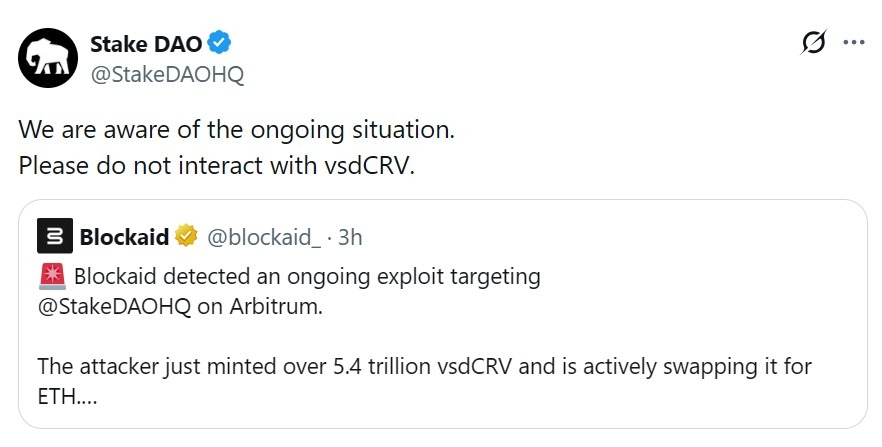
An attacker minted more than 5.4 trillion vsdCRV on Arbitrum after a suspected compromise of a StakeDAO-linked deployer key, though thin liquidity limited the realized proceeds to about $91,000.
Blockchain security firm PeckShield said Wednesday the attacker swapped part of the minted vsdCRV for 43.7 Ether (ETH), worth about $91,000, and bridged the funds to Ethereum. Onchain analyst EmberCN said the attacker swapped about 16.83 million vsdCRV, while the remaining tokens had little meaningful liquidity to exit.
EmberCN estimated the 5.4 trillion vsdCRV at about $763 billion on paper, though the figure does not represent the attacker’s realized profit or the protocol’s confirmed loss.
The incident highlights the gap between nominal token values and extractable value in decentralized finance exploits, where attackers can mint enormous token amounts but only cash out what available liquidity allows. In this case, the attacker’s proceeds were limited by the small size of vsdCRV liquidity pools.
StakeDAO said it was aware of the incident and warned its users not to interact with vsdCRV.
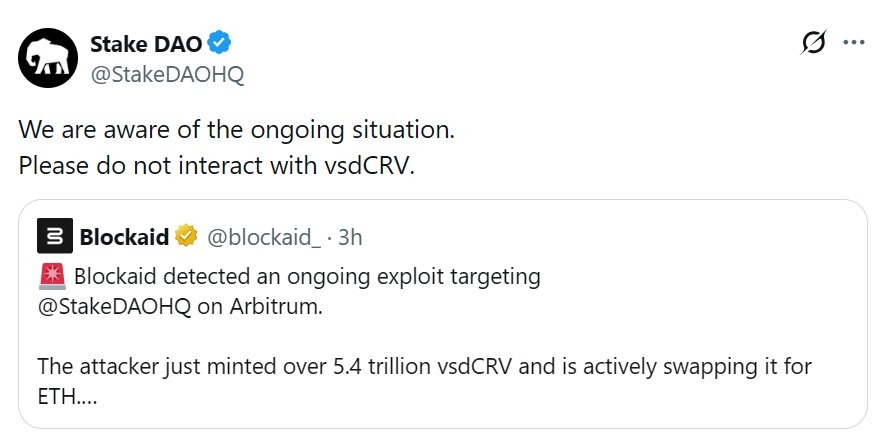
Stake DAO said it was aware of the incident. Source: Stake DAO
Incident points to a deployer-key compromise
Shalev Keren, chief product officer and co-founder of crypto key-management firm Sodot, told Cointelegraph that the StakeDAO incident was “structurally similar” to other deployer-key compromises seen this year, including the Wasabi incident last month, which drained about $5.5 million in crypto.
Keren said a single StakeDAO deployer key on Arbitrum was used to repoint the vsdCRV cross-chain bridge configuration to an attacker-controlled contract on Ethereum. About 25 seconds later, that contract sent a LayerZero message back to Arbitrum, causing the legitimate Arbitrum token to mint more than 5 trillion vsdCRV to the attacker.
Related: Crypto hackers stole $17B over past 10 years: DefiLlama
“There is no smart contract bug here and no flaw in LayerZero,” Keren said. “There is one private key, controlling one privileged configuration function, with no multi-signature and no delay between the configuration change going through and the mint clearing onchain.”
Keren said the broader issue for DeFi protocols in 2026 is no longer only whether contracts are audited, but whether the operational keys behind those contracts remain single points of failure.
Magazine: ETH bears growling, Tom Lee’s buying, XRP to ‘explode’: Market Moves


JPMorgan Chase CEO Jamie Dimon has said the bank could spend as much as $20 billion on a major acquisition over the next two years if the right target appears.
Summary
- JPMorgan CEO Jamie Dimon said the bank could spend $10 billion to $20 billion on a major acquisition over the next two years.
- Dimon said any deal must fit JPMorgan’s operations and culture, and acquisitions should not replace organic growth.
- JPMorgan’s May 21 report said tokenized funds make up only 5% of the stablecoin market, as stablecoins remain more widely used in crypto trading, collateral, and payments.
According to CNBC, Dimon made the comments on Wednesday during a fireside chat at the Bernstein Strategic Decisions Conference, where he said JPMorgan may have the opportunity to invest between $10 billion and $20 billion in buying another company.
Dimon sets conditions for any deal
During the conference, Dimon said JPMorgan would not pursue a takeover simply because it has the balance sheet to do so. Per CNBC, he said any company bought by the bank would need to fit properly inside JPMorgan’s existing operations and culture.
Dimon also pushed back against the idea that acquisitions should replace day-to-day business growth. CNBC quoted him as saying he did not want to hear only about mergers and acquisitions, but about work being done in sales, branches, technology, profits, products, and services.
The JPMorgan chief described dealmaking as a last-resort tool, according to the report. He said companies that lean too heavily on acquisitions may be using them to cover weak internal growth.
First Republic remains JPMorgan’s largest recent deal
Under Dimon, JPMorgan has completed several major purchases, though none have reached the $20 billion level he discussed at the conference. In 2023, JPMorgan acquired a substantial majority of First Republic Bank’s assets for $10.6 billion after regulators seized the lender. The deal expanded JPMorgan’s deposits and wealth management business.
During the 2008 financial crisis, JPMorgan bought Bear Stearns for about $1.4 billion and acquired Washington Mutual’s banking operations for $1.9 billion. Those transactions added scale to the bank’s investment banking and consumer banking franchises.
Other deals under Dimon include JPMorgan’s purchase of the remaining stake in U.K. broker Cazenove for about $1.7 billion in 2009, fintech firm WePay for roughly $220 million in 2017, and healthcare payments company InstaMed for more than $500 million in 2019.
JPMorgan also tracks digital finance trends
The acquisition comments came as JPMorgan continues to publish research on changes in digital finance and payments.
As previously reported by crypto.news, JPMorgan said in a May 21 report that tokenized funds account for only 5% of the stablecoin market supply, even though they offer higher yields.
According to the bank’s report, stablecoins remain the main cash tool across crypto trading, collateral use, and payments. JPMorgan said stablecoins hold that role because they are already built into centralized exchanges, DeFi protocols, and cross-border payment systems.
The same report said tokenized funds face more friction because users must go through subscription and redemption steps. JPMorgan said those extra steps limit their use in fast on-chain activity.

Vaibhav Sooryavanshi’s Respectful Gesture For Sunil Gavaskar Wins Hearts – Video

The attack dominating financial services doesn’t steal passwords. It resets MFA and steals the token.

FLARE CEO JUST SAID IT LIVE!!! (XRP/FLARE EXPLOSIVE NEWS)


-

 Crypto World6 days ago
Blockchain.com files with SEC for U.S. IPO
-

 Fashion5 days ago
Holiday Weekend Open Thread – Corporette.com
-

 Crypto World6 days ago
Bitcoin Accumulation Weakens as BTC Realized Losses Hit $600M
-

 Tech3 days ago
Microsoft’s quiet Claude Code retreat and the real cost of enterprise AI
-

 Business6 days ago
Dell Technologies DELL Stock Surges 15% on AI Server Momentum and Analyst Upgrades in 2026
-

 Crypto World5 days ago
Robinhood crypto COO Tanya Denisova exits
-

 Business3 days ago
NYT Strands Answers May 24 2026 Revealed for Puzzle No. 812 Theme Summer Essentials
-

 Politics5 days ago
Makerfield: a tale of two social-media histories
-

 Crypto World6 days ago
Space X IPO Is ‘Bad News’ for Tech Stocks: But What About Bitcoin?
-

 Business6 days ago
Trump Invests $1M-$5M in Kura Sushi USA Chain With 27 California Locations
-

 Crypto World6 days ago
MicroStrategy’s Saylor Says Miners No Longer Set Bitcoin Price, Another Force Has Taken Over
-

 Tech6 days ago
WhatsApp ads could make Irish debut after discussions with DPC
-
Tech17 hours ago
The Samsung pay deal is the moment Korean unions changed register
-
 NewsBeat7 days ago
Charity run by Reform leader Malcolm Offord accused of ‘law breaking’ over Scottish registration
-
 Tech6 days ago
A 0.12% parameter add-on gives AI agents the working memory RAG can’t
-

 Crypto World6 days ago
AI infrastructure race heats up as IREN pitches full-stack strategy, WhiteFiber lands $160M deal
-
 Crypto World3 days ago
Nvidia (NVDA) CEO Calls on Super Micro to Strengthen Export Controls Amid Smuggling Probe
-

 Tech6 days ago
You Can Now Add ChatGPT To PowerPoint
-

 Tech3 days ago
Westone Audio and Etymotic Acquired by Fidelity Collective in Major IEM Market Move
-

 Sports6 days ago
2026 CJ Cup Byron Nelson leaderboard: Brooks Koepka finds putting stroke in Round 1
You must be logged in to post a comment Login