

Connect with us
DAPA Banner
DAPA Coin
DAPA
COIN PAYMENT ASSET
PRIVACY · BLOCKDAG · HOMOMORPHIC ENCRYPTION · RUST
ElGamal Encrypted MINE DAPA
🚫 GENESIS SOLD OUT
DAPAPAY COMING

Tech

Researchers automated LLM reasoning strategy design and cut token usage by 69.5%

Published

on

Test-time scaling (TTS) has emerged as a proven method to improve the performance of large language models in real-world applications by giving them extra compute cycles at inference time. However, TTS strategies have historically been handcrafted, relying heavily on human intuition to dictate the rules of the model’s reasoning. 

To address this bottleneck, researchers from Meta, Google, and several universities have introduced AutoTTS, a framework that automatically discovers optimal TTS strategies. This automated approach allows enterprise organizations to dynamically optimize compute allocation without manually tuning heuristics. 

By implementing the optimal strategies discovered by AutoTTS, organizations can directly reduce the token usage and operational costs of deploying advanced reasoning models in production environments. In experimental trials, AutoTTS managed inference budgets efficiently, successfully reducing token consumption by up to 69.5% without sacrificing accuracy.

The manual bottleneck in test-time scaling

Test-time scaling enhances LLMs by granting them extra compute when generating answers. This extra compute allows the model to generate multiple reasoning paths or evaluate its intermediate steps before arriving at a final response. 

Advertisement

The primary challenge for designing TTS strategies is determining how to allocate this extra computation optimally. Historically, researchers have designed these strategies manually, relying on guesswork to build rigid heuristics. Engineers must hypothesize the rules and thresholds for when a model should branch out into new reasoning paths, probe deeper into an existing path, prune an unpromising branch, or stop reasoning altogether. 

Because this manual tuning process is constrained by human intuition, a vast amount of possible approaches remain unexplored. This often results in suboptimal trade-offs between model accuracy and computing costs.

Current TTS algorithms can be mapped to a width-depth control space — “width” being the number of reasoning branches explored, “depth” being how far each develops. Self-consistency (SC) samples a fixed number of trajectories and majority-votes the answer. Adaptive-consistency (ASC) saves compute by stopping early once a confidence threshold is hit. Parallel-probe takes a more granular approach, pruning unpromising branches while deepening the rest. All three are hand-crafted, and that’s the constraint AutoTTS is designed to break.

While some more advanced methods employ richer structures like tree search or external verifiers, they all share one key characteristic: they are meticulously hand-crafted. This manual approach restricts the scope of strategy discovery, leaving a massive portion of the potential resource-allocation space untouched.

Advertisement

Automating strategy discovery with AutoTTS

AutoTTS reframes the way test-time scaling is optimized. Instead of treating strategy design as a human task, AutoTTS approaches it as an algorithmic search problem within a controlled environment. 

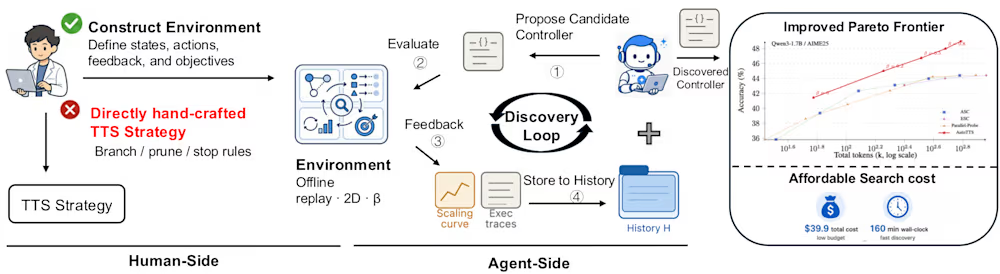
This framework redefines the roles of both the human engineer and the AI model. Rather than hand-crafting specific rules for when an LLM should branch, prune, or stop reasoning, the engineer’s role shifts to constructing the discovery environment. The human defines the boundaries, including the control space of states and actions, optimization objectives balancing accuracy versus cost, and the specific feedback mechanisms. 

autotts.

AutoTTS framework (source: arXiv)

An explorer LLM, such as Claude Code, designs the strategy. This explorer acts as an autonomous agent that iteratively proposes TTS “controllers.” These controllers are code-defined policies or algorithms that dictate how an AI model allocates its computational budget during inference. The explorer tests and refines these controllers based on feedback until it discovers an optimal resource-allocation policy. 

Advertisement

To make this automated search computationally affordable, AutoTTS relies on an “offline replay environment.” If the explorer LLM had to invoke a base reasoning model to generate new tokens every time it tested a new strategy, the compute costs would be astronomical. Instead, it relies on thousands of reasoning trajectories pre-collected from the base LLM. These trajectories include “probe signals,” which are intermediate answers that help the controller evaluate progress across different reasoning branches. 

During the discovery loop, the explorer agent proposes a controller and evaluates it against this offline data. The agent observes the execution traces of the proposed controller that show it allocated compute over time. By analyzing these traces, the agent can diagnose specific failure modes, such as noting if a controller pruned branches too aggressively in a specific scenario. This provides an advantage over just viewing a final result. The agent then iteratively rewrites its code to improve the accuracy-cost tradeoff. 

Inside the AI-designed controller

Because the explorer agent is not constrained by human intuition, it can discover highly coordinated, complex rules that a human engineer would likely never hand-code. One optimal controller discovered by AutoTTS, named the Confidence Momentum Controller, leverages several non-obvious mechanisms to manage compute:

  • Trend-based stopping: Hand-crafted strategies often instruct the model to stop reasoning once it hits a certain instantaneous confidence threshold. The AutoTTS agent discovered that instantaneous confidence can be misleading due to temporary spikes. Instead, the controller tracks an exponential moving average (EMA) of confidence and only stops if the overall confidence level is high and the trend is not actively declining.

  • Coupled width-depth control: Manually designed algorithms usually treat the “widening” of new reasoning paths and the “deepening” of current paths as separate decisions. AutoTTS discovered a closed feedback loop where the two actions are linked. If the confidence of the current branches stalls or regresses, the controller automatically triggers the spawning of new branches.

  • Alignment-aware depth allocation: Instead of giving all active reasoning branches an equal computation budget, the controller dynamically identifies which branches agree with the current leading answer. It then gives those branches priority “bursts” of extra computation. This concentrates the computational budget on the emerging consensus to quickly verify if it is correct.

Cost savings and accuracy gains in real-world benchmarks

To test whether an AI could autonomously discover a better test-time scaling strategy, researchers set up a rigorous evaluation framework. The core experiments were conducted on Qwen3 models ranging from 0.6B to 8B parameters. The researchers also tested the system’s ability to generalize on a distilled 8B version of the DeepSeek-R1 model. 

Advertisement

The explorer AI agent was initially tasked with discovering an optimal strategy using the AIME24 mathematical reasoning benchmark. This discovered strategy was then tested on two held-out math benchmarks, AIME25 and HMMT25, as well as the graduate-level general reasoning benchmark GPQA-Diamond. 

The AutoTTS discovered controller was pitted against four manually designed test-time scaling algorithms in the industry. These baselines included Self-Consistency with 64 parallel reasoning paths (SC@64), Adaptive-Consistency (ASC), Parallel-Probe, and Early-Stopping Self-Consistency (ESC). ESC is a hybrid approach that generates trajectories in parallel and stops early when an answer seems stable.

scaling curves

AutoTTS (red line) outperforms other baselines on industry benchmarks (source: arXiv)

When set to a balanced, cost-conscious mode, the AutoTTS-discovered controller reduced total token consumption by approximately 69.5% compared to SC@64. At the same time, the controller maintained the same average accuracy across the four Qwen models. When the inference budget was turned up, AutoTTS pushed peak accuracy beyond all handcrafted baselines in five out of eight test cases.

Advertisement

This efficiency translated to other tasks. On the GPQA-Diamond benchmark, the balanced AutoTTS variant slashed the inference token cost from 510K tokens down to just 151K tokens, while slightly improving overall accuracy. On the DeepSeek model, AutoTTS achieved the highest overall accuracy on the HMMT25 benchmark while cutting the token spend nearly in half.

For practitioners building enterprise AI applications, these experiments highlight two major operational benefits:

  • Raising peak performance: AutoTTS doesn’t just save money on token consumption. It actively raises the peak attainable performance of the base model. The AI-designed controller is remarkably good at detecting noisy or unproductive reasoning branches on the fly and continuously redirecting its compute budget toward the branches generating the most useful reasoning signals.

  • Cost-effective custom development: Because the framework relies on an offline replay environment, the entire discovery process cost only $39.90 and took 160 minutes. For enterprise teams, that means optimized reasoning strategies tailored to proprietary models and internal tasks are now within reach — without a dedicated research budget.

Both the AutoTTS framework and the Confidence Momentum Controller are available on GitHub; the CMC can be used as a drop-in replacement for other TTS controllers.

Source link

Advertisement
Continue Reading
Click to comment

You must be logged in to post a comment Login

Leave a Reply

Tech

Investigating how hormones affect brain health

Published

on

UL’s Prof George Barreto discusses his research and how it could help form new treatments for treating and protecting the brain.

Prof George Barreto is a professor in cell biology/immunology at the University of Limerick (UL), and a neuroscientist.

Outside the lab, Barreto is the assistant dean for equality, diversity and inclusion (EDI) in UL’s Faculty of Science and Engineering.

“And I teach,” he tells SiliconRepublic.com. “I run some courses for our undergraduate and master’s students, mostly on how the body works, how medicines work (pharmacology) and how cells behave (cell biology).

Advertisement

“So my job is really a mix of three things – running my research lab, teaching the next generation of scientists and helping build a better academic culture.”

Here, Barreto tells us more about his work.

Can you tell us about your current research?

My lab studies how the hormones in our bodies, the ones we usually link to being male or female, affect the brain, and how that differs between men and women. We pay special attention to a tiny part of every cell that acts like its battery or power plant. These are called mitochondria, and these little batteries do not just give our cells energy. They also help decide whether our cells stay healthy or die.

Our hormones have a big influence on how well these powerhouses work in the brain. A key point is that those hormone levels naturally drop as we get older. I believe that is possibly one of the main reasons why diseases like Alzheimer’s are more common in women than in men.

Advertisement

So, our lab works on a few connected questions. Why does the ageing brain go from being resilient to being vulnerable? How do hormones keep brain cells healthy, and why does that protection fade with age? How does a head injury throw the body’s hormones out of balance and cause harmful inflammation in the brain?

And finally, I think the part I find most hopeful, can we take drugs that already exist (and are FDA-approved) and use them in a new way to protect the brain?

What drew you to this area/subject?

It came from a question I just could not let go of – why are women hit harder by Alzheimer’s and similar diseases, and why does that risk seem to change around the time of menopause? For a long time, medical research either ignored the differences between men and women or treated them as a minor detail. The more I looked, the more I felt this was not a small detail at all, it was right at the heart of the problem.

And then there are the brain’s support cells, the astrocytes. They have fascinated me since my very first steps in research, back in Brazil and later in Madrid, and now in Ireland, and honestly, they still do.

Advertisement

People used to dismiss them as the glue that just holds the brain together, but I came to see them as real decision-makers. They have a big say in whether the brain heals after damage or not. Once I put that together with hormones, which fade so differently in men and women, and with those tiny batteries that hold the power of life and death over a cell, I finally felt I had a way to actually explain these differences, instead of just pointing at them.

Why is this research important?

I think there are two reasons. The first is very simple – as people live longer, more of us will face diseases like dementia, and women carry more of that burden. If we can really understand why the loss of hormones makes the female brain more vulnerable, we can start to design treatments that fit a person’s biology, rather than treating everyone the same way, which is mostly what we still do today.

The second reason is more about the bigger picture. When those little cell batteries start to fail, it is not a problem unique to one disease. We see it in ageing, in brain injury, in inflammation, in dementia. So, if we can find ways for hormones to keep those batteries running, we have found something that could help in many situations at once.

That is exactly why we focus on drugs that already exist and are already known to be safe. Taking an approved drug and giving it a new purpose is a much faster, cheaper way to reach patients than developing one from scratch. And for people who are suffering now, speed matters.

Advertisement
What has been the most surprising insight/discovery in your research?

The biggest surprise has been just how much sex matters, right down to a single cell.

We tend to assume a drug does roughly the same thing in everyone. But when we studied a hormone-based drug called tibolone, we found it acted differently in cells taken from females than in cells taken from males.

The cells responded in their own distinct ways, and the drug even restored their natural cleaning-up ability differently depending on whether they were male or female. The idea that a cell sitting in a dish still ‘knows’ whether it is male or female and reacts to the very same drug differently because of it is striking, and it is still something a lot of people do not fully understand.

What surprised me even more was that this difference goes right down to those tiny batteries (mitochondria) inside the cell that I mentioned earlier.

Advertisement

We discovered that, in the brain’s support cells (astrocytes), mitochondria from females were tougher and coped far better than the ones from males when we exposed them to high levels of saturated fat, the kind of stress the body goes through in obesity.

In other words, the female brain cells’ energy systems were simply more resilient under that pressure. That was a real eye-opener for me, because it suggests these male/female differences are not just small details, but they are built deep into how a cell powers itself and protects itself. And it reinforces why we cannot keep designing treatments as if one size fits all.

What are your thoughts on Ireland’s research landscape? What improvements would you suggest?

I think Ireland is at a really interesting turning point. In 2024, the Government brought its two main research funding bodies together into one, now called Research Ireland, which now funds work across every subject, from science and engineering to the arts and social sciences. I see that as a good move. Before, some subjects were not properly included in the funding system, which put Ireland a step behind other countries. For me, whose work crosses several fields at once, a system that genuinely supports that kind of crosstalk between different areas is very much welcome!

There is real ambition behind it too. Ireland plans to invest in its universities and wants to support thousands of new PhD students and researchers who are early in their careers. And for such a small country, what strikes me most is the talent and the genuinely close links between academia, industry and pharma. That combination is honestly quite unique in the world, and it is part of what made me want to build my lab here.

Advertisement

That said, there are a few things I would push on. First, I would love to see steadier, more predictable money for fundamental research. Applied work matters enormously, but the truly big breakthroughs so often start as curiosity-driven science with no obvious (and long-term impact) commercial angle. My own tibolone work began exactly like that.

Second, we have to look after our younger researchers, the PhD students, the postdocs, the research assistants and the new group leaders. The ambition to train thousands of them is wonderful, but only if we then value them and build real ways to keep them here, instead of losing them abroad.

Third, our infrastructure. Modern biomedical research needs advanced imaging, computing power, data science and shared facilities, and that needs continued investment.

And fourth, and this one is close to my heart given my EDI role, I would like to see equality, diversity and inclusion treated as part of research excellence, not as a box-ticking exercise on the side. For me, they are the same thing. Broader participation, inclusive teams, and fair structures simply produce better science.

Advertisement

My own field is the proof. Ignoring the differences between men and women held the science back for decades. This is not acceptable.

Finally, I think Ireland is perfectly placed to connect academia, healthcare, industry, policy and communities. For areas like dementia, women’s health and menopause, the real progress will come from people working across those boundaries. Ireland is small enough that you can actually get those people into a room quickly, and ambitious enough to lead the world if we support those connections properly.

Don’t miss out on the knowledge you need to succeed. Sign up for the Daily Brief, Silicon Republic’s digest of need-to-know sci-tech news.

Advertisement

Source link

Continue Reading

Tech

WWDC 2026 is shaping up to be all about on-device AI

Published

on

Apple’s big yearly software event looks set to focus a lot on on-device AI, with reports suggesting the company’s in-house chip architecture will give it a key advantage over rivals.

WWDC 2026 kicks off on 9 June, with iOS 27 for iPhone and software updates for iPad, Mac, Apple Watch, and Apple Vision Pro all expected to be previewed at the event, and AI is widely anticipated to be integrated into pretty much every new feature Apple introduces.

The shift toward on-device processing addresses a core limitation of most AI implementations, where queries travel to remote data centres and back before a result reaches the user, introducing latency that depends entirely on network quality and connection speed.

Apple’s silicon lineup, which powers everything from the iPhone through to the Mac, carries enough processing headroom to handle AI inference locally, cutting out that round trip entirely and keeping the workload on the device itself.

Advertisement

Privacy and cost implications

That architectural difference carries particular weight on the privacy front, since on-device processing means user data never leaves the hardware, removing the exposure point that cloud-based AI systems create when queries pass through third-party infrastructure.

Advertisement

Running AI on-device also removes the per-query cost of data centre processing, a significant consideration as Apple scales Apple Intelligence features across hundreds of millions of active devices worldwide.

According to The Information, Apple is working with a version of Google’s Gemini model as a reference point for training a smaller, locally-capable model, and the company is also reportedly evaluating acquisitions of firms with expertise in models optimised for on-device deployment.

Advertisement

Whatever Apple announces on 9 June, the features themselves will not reach users immediately; software updates across all platforms are expected to follow the standard testing cycle ahead of a likely September release.

Source link

Advertisement
Continue Reading

Tech

An answer to the datacenter energy crisis

Published

on

Partner Content This
year, the global build-out of datacenters has become impossible to
ignore, with the debate spilling into national media, local
newspapers, and community council meetings alike. From Arkansas to
Southern California, Nevada, Pennsylvania, West Virginia, and most
recently Box Elder, Utah, communities are weighing the economic
promise of datacenter expansion against mounting concerns over
energy, infrastructure, and residential impact. The same dynamic is
playing out in the UK, where OpenAI’s “Stargate UK” project
has been partly shelved
amid energy consumption concerns and regulatory pressure.

Drop media element here …

Advertisement

A typical new hyperscale datacenter can face grid-connection
bottlenecks of up to seven
years
in certain markets, well before the necessary
transmission, substations, generation capacity, and transformers are
in place. McKinsey, meanwhile, estimates that global datacenter
spending could reach $7
trillion by 2030
– a figure comparable to the size of a
top-12 global economy.

AI intelligence at scale now dominates enterprise strategy and
global politics because the promise of the technology is matched only
by the infrastructure required to deliver it. Energy consumption is
unavoidable in this new world, and the bet enterprise leaders are
making is that the value AI creates will outstrip the cost of the
power feeding it. That trade-off has produced a new equation for
executives: intelligence
per watt
.

Advertisement

Is your agentic ambition constrained by energy?

AI-driven datacenters already account for
roughly 1.5 percent of global electricity consumption, and the IEA
expects that demand to more
than double
by 2030, approaching three percent of global
electricity use. That’s more than many major industrial sectors,
including agriculture.

The pressure will compound over the next three years, with IDC
projecting onebillion
agents running 217 billion daily actions
by 2029. From
Seattle to Barnsley in the UK, the race to build more datacenters
close to energy sources is now a daily occurrence.

If the right datacenter, grid, and power infrastructure for the
first billion agents takes up to seven years to build, supporting
two, three, or even eight billion agents implies timelines the
industry has yet to cost. The mismatch between enterprise intent and
energy capacity is widening.

For enterprise leaders, this is a defining moment of decision.
With 95
percent
of global enterprises intending to become their
own AI and data platforms in less than 780 days, AI, data, and energy
can no longer be treated as separate priorities; they are now
interconnected parts of a single platform strategy. The harder
question is how executives can pursue those AI ambitions while
managing energy efficiently at agentic scale.

Advertisement

BFSI might be showing us the way forward

Banking, financial services, and insurance
(BFSI) enterprises have traditionally invested more heavily in
technology than any other major sector. McKinsey estimates banking IT
spending typically runs at between
six and 12 percent of revenue
, compared with 3.75 percent
to five percent for the next-highest sector.

The pressure to deliver new technology value, particularly through
AI and agentic systems, is creating an operating language shared by
CIOs, CTOs, and business leaders alike. AI and data are increasingly
framed as the new competitive moat, yet the energy costs associated
with maintaining that moat introduce a fresh dynamic into technology
decision-making.

The 13
percent of global enterprises
winning with AI and agentic
systems are more likely to build their data strategies around
control, efficiency, and sustainability. The common pattern is
repatriation: pulling AI and data out of single-hyperscaler silos and
into their own control planes, where they can govern and manage
information across clouds, on-premises environments, and systems they
own.

The pattern recurs among agentic AI leaders across EMEA, North
America, Singapore, and Japan. The principle is straightforward:
bring AI to the data, because the two must work together across the
front lines and back offices of the business rather than operating as
separate concerns.

Advertisement

That logic explains why BFSI leaders such as Wells Fargo,
Mastercard, HSBC, JPMorgan Chase, Bank of America, Citigroup, Goldman
Sachs, BNP Paribas, ING, Crédit Agricole, UBS, and NatWest have made
public carbon-neutrality commitments alongside ambitious plans to
become their own sovereign AI and data platforms.

AI and data sovereignty in Postgres wins on OpEx, environment, and
ROI

Agents operate at the data layer, which
means energy must be managed at the same layer, since this is where
much of the work happens. The alternative is the equivalent of
turning on the heat while leaving every window open in the middle of
winter. Only by controlling the data layer, agents, and broader data
estate can enterprises build the foundation for managing energy
consumption.

Energy efficiency has to begin where enterprise operations already
run, which is why PostgreSQL®, the world’s most widely used database
among developers, is well suited to the challenge. EDB
Postgres AI
is built specifically to address the
energy-intensive nature of modern datacenters by improving database
and AI efficiency at the point where workloads execute.

By shrinking core usage requirements and tightening data-intensive
agentic operations such as search, retrieval, and vector indexing,
EDB Postgres AI can cut datacenter energy consumption by up to 81
percent and reduce emissions by as
much as 87 percent
.

Advertisement

The ambition to become an AI and data platform carries one
foundational requirement: AI and data sovereignty. Organizations that
adopt this model not only achieve 5x
ROI and deploy 2x more AI and agentic AI systems
; they
also gain more control, greater efficiency, and a smarter way to
design and operate datacenters for the agentic era.

The formula for success is sovereignty in Postgres — the most
practical path to achieving more intelligence per watt.

Contributed by EDB.

Source link

Advertisement
Continue Reading

Tech

Windows BitLocker exploit sparks messy feud between Microsoft and the researcher who exposed it

Published

on


The issue centers on a zero-day exploit called “YellowKey,” published earlier this month by a security researcher known as Chaotic Eclipse, also known online as Nightmare-Eclipse. The proof of concept demonstrates a method for accessing BitLocker-encrypted drives on Windows 11 using a USB device.
Read Entire Article
Source link

Continue Reading

Tech

An Atic Atac Minimap For The ZX Spectrum

Published

on

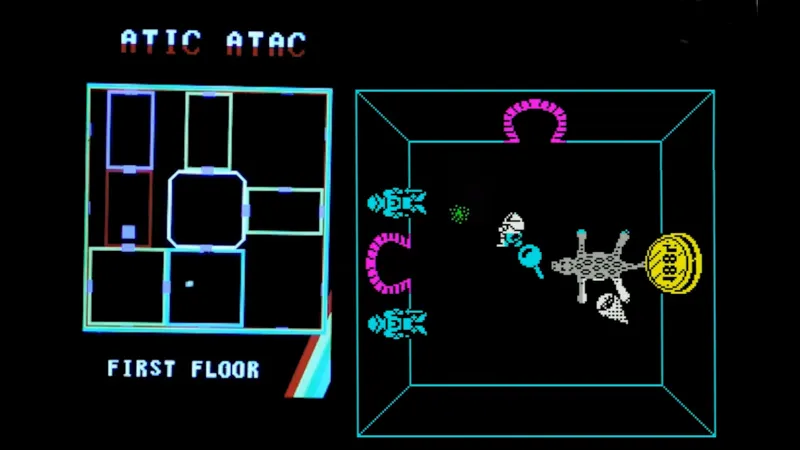
The use of modern microcontrollers as add-on peripherals for 1980s home computers has delivered significant benefits and capabilities unimaginable in the days when those machines were new. A great example come from [Happy Little Diodes], who’s using a Pi Pico based peripheral for a Sinclair ZX Spectrum to provide something that looks far more modern, a hardware minimap for the iconic Spectrum game, Atic Atac.

The ZX expansion port provides all the bus signals from the Z80 microprocessor, and the peripheral uses a latch to capture Spectrum memory writes. Because the game’s operation is well known it can easily watch out for updates to the in-memory variable that contains the game room ID. It’s then a case of drawing the map with the player centered on the room the are in, for a much more 21st century game interface component.

Having been around when both the ZX and this game were new, we like this add-on, a lot. We can imagine it could relatively easily support other games, too.

Advertisement

Haven’t got a Spectrum? Never fear, you can make yourself one!

Advertisement

Source link

Continue Reading

Tech

Autodesk buys MaintainX for $3.6bn to push from design into operations

Published

on

Autodesk has spent four decades selling the software that engineers and architects use to design buildings, factories and machines. With its latest acquisition, it is buying its way into what happens after those things are built.

The company has agreed to acquire MaintainX, a maintenance and operations platform, for about $3.6 billion in cash.

The deal, announced on 28 May, is an all-cash transaction Autodesk plans to fund with cash on hand and new debt. Closing is targeted for as early as 3 August, subject to regulatory and customary conditions.

Alongside the headline price, Autodesk said it would issue $150 million in restricted stock to MaintainX employees, the standard retention sweetener that signals the buyer wants the team, not just the product.

Advertisement

MaintainX is the kind of company that is invisible until something breaks. Founded in San Francisco in 2018 and led by chief executive Chris Turlica, it makes mobile-first maintenance software, a modern take on the computerised maintenance management systems, or CMMS, that factories and facilities use to track work orders, assets and repairs.

Advertisement

More than 500,000 frontline workers use it, and the company was last valued at around $2.5 billion privately, on annual recurring revenue reported near $115 million.

At roughly $3.6 billion, Autodesk is paying a clear premium to that last private mark, which is the going rate when a strategic buyer wants a category leader rather than a turnaround.

The number also looks large against MaintainX’s revenue, the kind of multiple that only makes sense if the buyer is pricing the strategic fit rather than the current financials.

That fit is the whole rationale. Autodesk frames its strategy as converging “design, make and operate,” the idea that data should flow continuously from the moment something is designed to the years it spends in service. It has the design and the make; operations was the gap.

Advertisement

MaintainX slots into a new division Autodesk is calling Autodesk Operations Solutions, giving it a foothold in the daily work of the maintenance teams who keep its customers’ physical assets alive.

There is an AI logic underneath the org chart. Maintenance data, every work order, every breakdown, every part replaced, is exactly the kind of structured operational record that trains useful predictive models, and Autodesk has been pushing its own generative-AI design tools.

Owning the operate layer gives it a data stream it did not have, at a moment when every enterprise-software company is racing to turn its workflows into AI features.

For MaintainX, a $3.6bn cash exit is a clean outcome for its backers and a fast one for a company not yet a decade old.

Advertisement

For Autodesk, the harder work begins after August: integrating a mobile-first frontline product into a design-software giant, and proving that “design, make and operate” is a platform customers will buy as one thing rather than a slide that explains an acquisition.

Source link

Advertisement
Continue Reading

Tech

PS4 and Xbox One players are getting booted from Call of Duty Warzone soon

Published

on

Call of Duty players on previous-generation consoles can’t seem to catch a break. First, Activision announced that the next Call of Duty, which we now know is Call of Duty: Modern Warfare 4, will not be released on PS4 and Xbox One. Now, the company is also taking Call of Duty: Warzone away from both older consoles.

The publisher has confirmed that Warzone support on PS4 and Xbox One will be reduced in stages before ending later this year. The first step begins on June 4, when Warzone will be removed from the PlayStation 4 and Xbox One digital storefronts. After that, new downloads will no longer be available on either platform.

Warzone’s last-gen exit starts in June

Players who already have Warzone in their library will still be able to install and play the game for a limited time. Activision says the game will remain playable on PS4 and Xbox One through the end of Season 06 for Call of Duty: Black Ops 7.

The next major change arrives on June 25, when the Warzone in-game store will be removed from both last-gen versions. COD Points can still be redeemed in the store until then, and gameplay will continue to count toward Battle Pass progression. Players without the paid Battle Pass can still unlock free-tier rewards, including new weapons, during the remaining Black Ops 7 seasons.

The final cutoff comes with Modern Warfare 4 Season 1. Once that season begins, Warzone will no longer be playable on PS4 or Xbox One.

Advertisement

Upgrading may sting for PS4 holdouts

For PlayStation players, the timing is awkward. Sony’s Days of Play 2026 sale is live, but the PS5 console itself does not appear to be getting a discount. The upside is that players who do upgrade can still pick up discounted PS5 games, accessories, and PlayStation Plus memberships while the sale runs through June 10.

Activision says players will not lose their Warzone progress if they move to PS5, Xbox Series X|S, or PC using the same linked Activision account. Items bought with COD Points will also carry over. However, unused COD Points stay tied to the same console family, so PS4 players can use them on PS5, and Xbox One players can use them on Xbox Series X|S.

Warzone gave PS4 and Xbox One players a long runway after the current-gen consoles arrived. That runway is now almost over, and anyone who wants to keep playing Call of Duty’s battle royale after this season will need to move to newer hardware soon.

Advertisement

Source link

Continue Reading

Tech

This Week In Security: Ubiquiti Fixes, And FreeBSD Joins The Club You Don’t Want To Join

Published

on

Ubiquiti released a new security bulletin detailing fixes for six security issues, including one rated 9.1 (critical) and one scoring a perfect 10.0 on the CVE risk scale.

The vulnerabilities range from path traversal revealing configuration files (escaping from the web server by requesting a path like “../../../../../etc/passwd” for instance), to command injection (running arbitrary shell commands on the system), and actually changing device configurations. Some of the reported vulnerabilities require an account on the management server, but some only require network access .

Fortunately, all of the vulnerabilities require access to the network in the first place to exploit – but this could include access to open guest networks as well as trusted users. If you run Ubiquti or UniFi equipment, chances are the automatic update function has already integrated the fixes, but make sure to check the advisory to see if you’re impacted and update accordingly!

FreeBSD Root Exploit

FatGid lets FreeBSD join the fun of kernel exploits to gain root.

Advertisement

The FatGid vulnerability doesn’t require any manipulation of disk cache; instead it is a direct kernel stack overflow in a system call. The kernel miscalculates the size of a variable as 8 bytes instead of 4, which when used later interacting with a user buffer allows the stack overflow.

Like the recent spate of Linux local privilege escalation attacks, this requires the attacker to already have an account on the system or the ability to run arbitrary programs, but remember that any bug in network services which allows command execution gets you there, so if you run network exposed FreeBSD, it’s time to update!

Kali365 Phishing-as-a-Service

Phishing-as-a-service platforms have been gaining traction, allowing criminals to automate targeting users with crafted lures. The FBI has issued a warning about the Kali365 service in particular.

Kali365 targets credentials for Microsoft 365 accounts by directing users to the official Microsoft portal for linking additional devices to the account, attaching an attacker device directly to the user identity. Alternatively, the framework steals credentials by directing the user through a hostile service which presents a false login page which captures browser sessions along with authentication cookies and tokens once the user answers the fake multi-factor login prompts.

Advertisement

Automating the phishing process lowers the bar for the skill level needed to create authentic-looking lures and makes it simpler for criminal groups to attack large numbers of users; Phishing-as-a-service groups operate as companies offering customer support, tracking dashboards, and pre-made phishing templates.

Glassworm Botnet Takedown

CrowdStrike, Google, and the ShadowServer Foundation have done a coordinated takedown of the infrastructure used by the Glassworm supply-chain botnet.

Glassworm has been mentioned previously; it is one of several major worms infecting the open source package supply chain repositories like NPM and PyPi or the Visual Studio extension repository. Once a victim installs a compromised package or extension, the Glassworm trojan steals any saved authentication tokens for package repositories, GitHub accounts, AI services, and any SSH keys found, and begins the stage two infection. Using the stolen credentials, the worm infects any GitHub workflows, packages, and extensions the user has access to, and installs a remote-access trojan which waits for further commands.

Glassworm used a complex control server structure including blockchain memos, BitTorrent files, and public Google Calendar entries, but the coalition of companies was able to interrupt all control channels simultaneously. Hard-coded aspects of the worm will continue to function, but all behavior which requires downloading payloads from the control servers has been disrupted.

Advertisement

This isn’t the first time multiple Internet companies have coordinated to take down malware, but it’s always good to see action against threats which have been decimating the package repository infrastructure lately.

TechCrunch Spyware Avoidance

On the positive side of things, TechCrunch has an article about modern features to protect users against spyware. If this isn’t news to you, there’s still almost certainly someone in your life who will benefit from a user-friendly write up of best practices!

Both major commercial mobile platforms (iOS and Android) offer advanced protection features which are minimally invasive. For users who are likely to be higher targets of spyware like journalists, lawyers, and human rights activists, or simply those who are worried, these features offer real protection.

The features explained in the article include Apple’s Lockdown mode, Androids Advanced protection mode, and WhatsApp specific application settings, all of which work to reduce common attack surfaces for devices. The advanced security modes typically have minor impacts on performance and battery life due to disabling optimization features which introduce additional complexity and attack surfaces (such as just-in-time compilation of JavaScript code into native instructions.). When situations call for an abundance of caution, a few percent of battery life daily is a reasonable compromise.

Advertisement

Go check out the full write up!

Microsoft Bans NightmareEclipse

An exploit researcher known only as “NightmareEclipse” has been featured here several times in the past months already. Showing intense frustration with their experience with the administrators of the Microsoft security bug bounty program, they have taken to releasing zero-day exploits against Windows, often coinciding with Patch Tuesday (clearly no accident; by releasing a new exploit on the same day as the Microsoft patch set, it’s unlikely to be fixed before the next months Patch Tuesday at the earliest). Previous exploits released by NightmareEclipse include BlueSun and RedHammer (local user to Windows SYSTEM privilege escalation), UnDefend to disable Windows Defender, and YellowKey which unlocks BitLocker drives using a collection of nothing more than magically named files.

Toms Hardware reports that Microsoft has disabled the researchers GitHub accounts (GitHub being owned by Microsoft has long been a point of concern for security researchers who find vulnerabilities in Microsoft products), as well as the actual Microsoft account used by the researcher.

While it’s certainly within the terms of service of Microsoft and GitHub that accounts may be terminated, the optics are particularly poor in this case, given the confusion around the initial interactions which led the researchers original anger. NightmareEclipse has moved their example code repositories to GitLab in the mean time, and promises Microsoft that “I will make sure your bones are shattered on July 14”, implying there will be additional releases (on, you guessed it, what looks like another Patch Tuesday).

Advertisement

Further clouding the issue, an official Microsoft statement indicates they are attempting to bring criminal (not just civil) charges against researchers who do not cooperate with the Microsoft disclosure policies, a stance which will certainly in no way exacerbate the situation.

Fingerprinting Devices by SSD

Dan Goodin at Ars Technica highlights a new paper on fingerprinting users via SSD disk performance, using just standard JavaScript.

The modern web is a hellscape of user tracking, and this attack, dubbed FROST, highlights another technique for identifying unique devices and user patterns based entirely on hardware behavior. By generating a large file using local browser storage via OPFS (origin private file system, an API for JavaScript to create raw files inside the browser storage area) and continually reading and writing data while monitoring the performance, a web page is able to monitor the disk access performance of the device.

Using a neural network trained on timing data, researchers say they are able to determine what apps may be running on the computer alongside the browser – and sometimes even what other websites are being viewed, based solely on the delays in disk IO caused by other applications and websites accessing the SSD. The paper will be presented in July, with researchers saying that the neural network can be trained to recognize “any system which reliably generates SSD accesses”.

Advertisement

Likely, browser developers can mitigate FROST by decreasing the performance of file operations in the OPFS API so that the performance data lacks the fidelity needed to derive user behavior.

FROST is a “side channel attack”; by monitoring one set of characteristics, side channel attacks are able to infer other system behaviors. Side channel attacks can be incredibly subtle and difficult to predict: Another side channel attack method has been to use extremely fine-grained monitoring of the power consumption of a device to derive encryption keys, predicting the CPU instructions and values based on the amount of power used to set the internal registers.

Improving Memory Safety in C#

Programming languages have been moving towards stronger default memory models, making programs more secure by default by eliminating behaviors which are commonly exploitable. Using a memory-safe language does not prevent logic errors or other security issues, but can still help by eliminating common mistakes.

Microsoft has posted an extensive article about new enhancements for C# in .NET 11. Borrowing in many ways (that’s a programming joke) from the Rust memory model, C# 16 will add additional memory enforcement and object lifetime, detecting when memory is no longer available and preventing invalid memory accesses on expired objects, with the goal of eliminating use-after-free memory corruption and attacks.

Advertisement

C# 16 will also increase the meaning of the “unsafe” keyword, a mechanism introduced in C# 1.0 and since heavily adopted by newer languages such as Rust and Swift. Code marked as unsafe in C# 16 is able to bypass the stricter memory model, but all code referencing it must also be marked as unsafe. Making unsafe code more difficult to use increases the overall friction of doing things the dangerous way, while clearly marking code which is higher risk.

There are few magic bullets for secure programming, but reducing the ways a programmer can make simple mistakes can be a big win.

Source link

Advertisement
Continue Reading

Tech

When Is An Apple Laptop Not A Macbook? When It’s An Apple II

Published

on

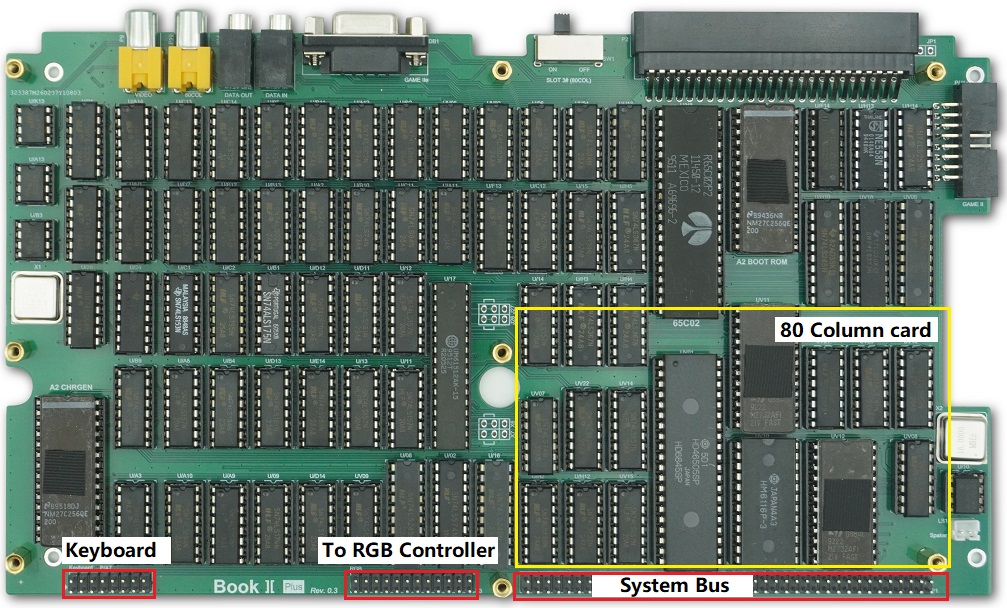
Do you remember, some years ago, when that brand-new 8086-based laptop hit the shelves? Great for PC lovers, but not so fun for those on the fruitier side of the street. Well, the same Chinese firm that brought us the Book8086 are back, this time with an ‘Apple’ Laptop that is decidedly not a MacBook– the Book II is a dual-processor Apple II clone in a laptop form factor.

… but just look at all those DIPs on the inside. Authentically retro!

Dual processor? On an Apple II? It wasn’t that uncommon, back in the day — that’s what the Z80 softcard was, after all: a second processor that let you run CP/M and associated business applications, and this one has it built-in. It also has the 80-column video card, a second floppy controller, a printer interface, and a 16 kB ROM card for languages. That leaves two of the Apple’s expansion slots available, one of which is broken out externally on the back of the laptop, along with the printer and floppy ports.

Useful? Probably no more so than the NEC V20-based PC version. Still, those did find buyers and we have no doubt that this new laptop will, too. Especially since with the right expansion card, you might get this machine running DOS as well. Of course if you don’t feel like shelling out the quid or running an emulator, you can always roll your own Apple II on an FPGA.

Thanks to [Stephen Walters] for the tip! We usually steer clear of product announcements like this, but [Stephen] figured we’d be interested in this one since we covered the then-new retro PC versions way back in 2023.

Advertisement

Source link

Advertisement
Continue Reading

Tech

This Soft Clock Drives Its Display With Pneumatic Logic

Published

on

Electrons are great. We use them to move vehicles, illuminate cities, and, of course, compute. But computation is not confined to the world of electronics. And shifting to alternative nonelectronic realms can unlock unique advantages: Photonic chips, for instance, process information with light while generating little heat. Another compelling alternative is fluidics, which uses pressurized gases or liquids to build logic circuits. Pioneered in the 1960s but sidelined by microchips, the field reemerged in the 1990s as “microfluidics.” This approach aims to shrink laboratories onto a single chip by creating microscopic fluid channels with integrated micropneumatic control systems.

Today, there is a second fluidic revival, this time in the domain of soft robotics. Scaling microfluidic designs up to the millimeter-scale range (millifluidics) enables the higher flow rates necessary to drive robotic actuators. These robots exploit the nonlinear behaviors of soft materials to create lifelike motion and safer interactions, often utilizing pressurized air.

By building systems that “think” with the same air that powers them, we can drastically reduce the need for bulky electronic-to-pneumatic interfaces. This is the focus of my Soiboi Studio robotics lab. With millifluidic logic, I have steadily scaled the complexity of my designs. What began with a simple oscillator has most recently evolved into a clock featuring a soft, four-digit, seven-segment display.

What Is Millifluidics?

Building on microfluidics research from the early 2000s and recent developments from the Grover Lab at the University of California, Riverside, I’ve developed millifluidic devices using standard 3D printing and silicone casting. The basic architecture is simple: A flexible membrane is sandwiched between rigid layers embedded with networks of air channels.

Advertisement

Just as electronics rely on differing voltage potentials, these fluidic circuits operate on the pressure difference between atmospheric pressure (logical 0) and a near-vacuum at around −60 kilopascals of relative pressure (logical 1). Using negative pressure means the membrane is pulled into openings. This creates robust seals that allow me to replicate electronic building blocks.

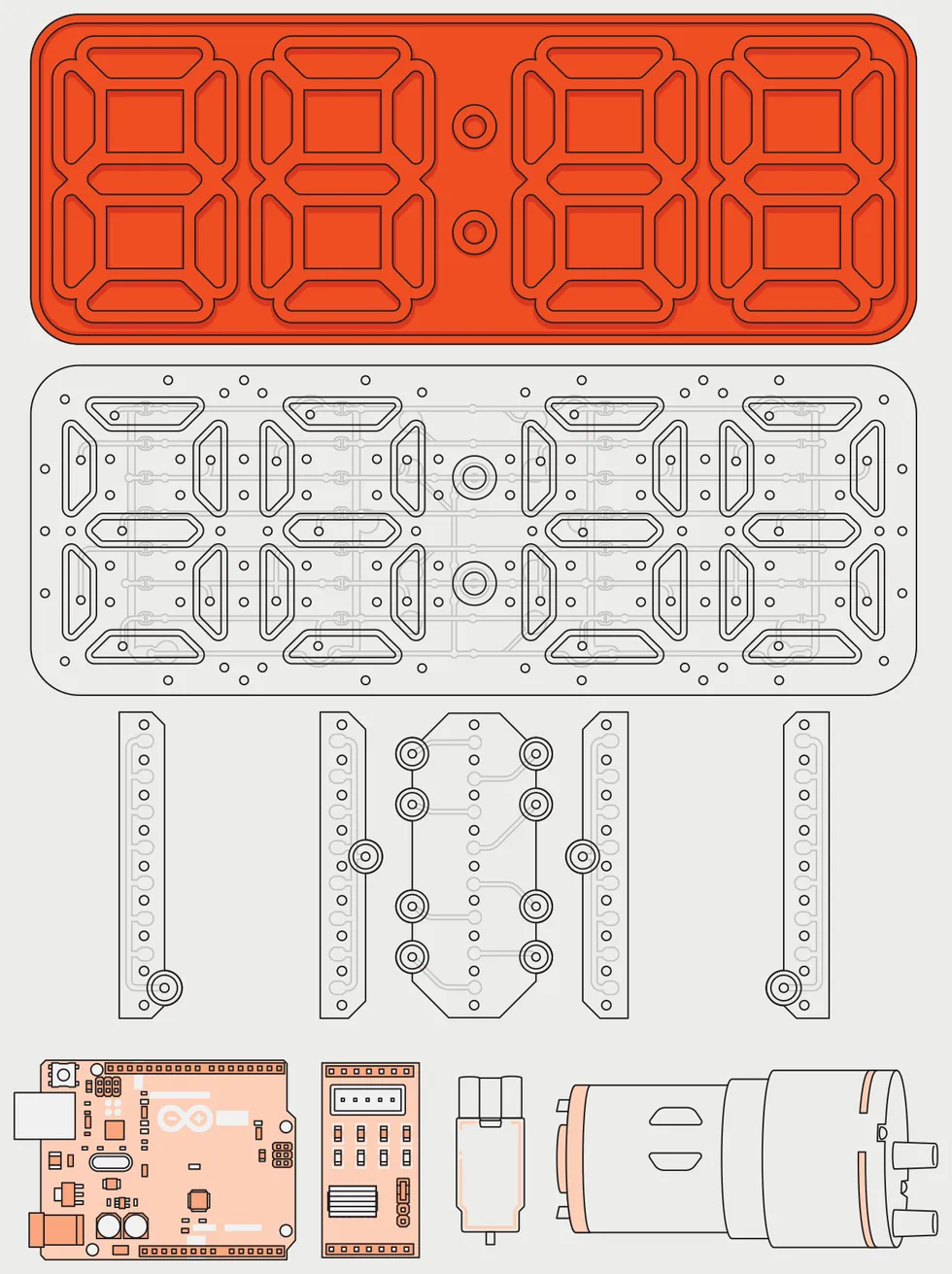
Major components of the soft clock. A cast silicone membrane forms the face of the clock [top], while behind it sits 3D-printed millifluidic blocks [middle rows]. An Arduino Uno controls driver boards that operate solenoids, which are connected to valves that are attached to a vacuum pump [bottom row].James Provost

While fluidic resistors are easily realized by adjusting the channel geometry, the heart of the system is a valve that mimics a metal-oxide-semiconductor field-effect transistor, or MOSFET. This vacuum “transistor” features a flow layer with two chambers (the source and drain) divided by a central valve seat and a control layer containing a cavity (the gate). A membrane runs between the control and flow layers and normally prevents airflow between the source and drain chambers. To switch the transistor on, a vacuum is applied to the gate chamber, sucking the membrane into the cavity and lifting it off the seat. This opens a path for airflow, equivalent to closing an electric circuit. By adding a small aperture to the membrane, I created a check valve—the fluidic equivalent of a diode. By combining transistors and resistive “pull-down” channels, I can build a full suite of logic gates.

The original microfluidic designs that inspired me were fabricated from etched glass and milled acrylic. Adapting them for a standard 3D printer required reengineering the logic elements and mastering two critical fabrication techniques.

First, I need airtight prints, yet printed plastic is notoriously porous. By printing at elevated temperatures, slow speeds, and slight overextrusion, I was able to fill microscopic gaps. When you’re using transparent filament, there’s a handy visual indicator: The more transparent the plastic appears, the lower its porosity.

Advertisement

Second, I used glass for my print bed. By printing the upper and lower chambers directly against this bed, I got the interface surface to become mirror smooth. This finish is essential for creating reliable, airtight seals. A 0.3-millimeter silicone membrane is placed between the layers and secured with screws.

How Does the Soft Clock Work?

The clockface is a cast silicone membrane. Each digit segment is formed by a small underlying cavity. When air is evacuated from this cavity, the membrane is sucked inward to create a concave hollow; when atmospheric pressure is restored, the silicone pops back flush with the surface. The result is a mesmerizing, organic motion.

The “brain” of the clock is an Arduino Uno, while the fluidics significantly reduce the hardware footprint. A four-digit, seven-segment display with two separator dots would require 29 solenoid valves to control directly. My clock needs just 11 valves.

An illustration of the three chambers of a pneumatic transistor, with two lower chambers separated by a wall overlaid by a membrane, with an upper chamber straddling the wall. A pneumatic transistor is off when its upper control chamber is at atmospheric pressure [top]. When air is removed from the control chamber, it lifts a membrane, which allows air to flow between lower flow chambers and turns the transistor on [bottom]. James Provost

To understand how it works, consider a standard electronic four-digit, seven-segment LED display. This also uses 11 pins to drive its digits. (In clockface displays, an additional pin is required to drive the separator dots.) Every digit is connected to a shared data bus with seven lines, one per segment. The four control lines select individual digits. Only one digit is illuminated at time, and strobing the digits at least 50 times per second creates the illusion that all four are simultaneously illuminated.

Advertisement

Such high-speed switching is not possible with air. Instead, I rely on memory. Each segment acts like a capacitor: By evacuating its cavity (logic 1), you “charge” the segment; by restoring atmospheric pressure (logic 0), you discharge it. Hence, each digit acts as an independent 7-bit memory. If the system is sufficiently airtight, the segments maintain their state for several seconds.

Like the electronic display, the system utilizes a seven-line data bus. Each line connects to a solenoid valve that provides either vacuum or atmospheric pressure. To selectively address the individual digits, I placed a fluidic transistor between each segment and its data line. All the transistors’ control inputs for a given digit are combined into one “write enable” line connected to its own solenoid valve. Activating this valve allows me to write data into the corresponding digit’s memory.

The clock updates one digit per second, meaning a full cycle across the face takes 4 seconds. This cycle also drives the separator dots: A set of fluidic diodes connects the enable lines to the dots’ cavities. Consequently, as each digit is addressed, the dots pulse automatically.

This display is more than a clock; it is a soft robot that happens to tell time. By offloading computation to the same air that powers movement, the clock approaches a new class of machines that are simpler, lighter, and more integrated. I’m now developing a guide for getting started with vacuum-powered logic and may release a refined version of this clock in the future. Watching the silicone skin morph serves as a fascinating reminder that not all logic needs silicon; sometimes, all you need is flexible silicone and a flow of air.

Advertisement

This article appears in the June 2026 print issue as “The Soft Clock.”

From Your Site Articles

Related Articles Around the Web

Source link

Advertisement
Continue Reading

Trending

Copyright © 2025