

Crypto World
Ethereum’s Largest Wallets Now Control Over 22% of Supply Amid Fresh Accumulation Wave

Ethereum (ETH) briefly plunged below the $2,000 threshold this week for the first time since March 29. While the price has since stabilized and is currently trading near $2,002, it still remains almost 60% below August’s high of nearly $5,000.
But data suggest that ETH’s largest whales are accumulating again
ETH Whales Tighten Grip on Supply
Wallets holding at least 100,000 Ethereum now collectively own 17.41 million ETH, the highest level in nine weeks. These holdings account for 22.03% of Ethereum’s total supply and mark a 10-week high.
The latest findings come after Santiment reported that the asset’s fall below $2,000 triggered a wave of “buy the dip” calls from retail traders. According to the analytics firm, crypto markets typically react to sharp declines in two ways: either fear takes over, and traders begin abandoning the asset, or optimism grows as traders view lower prices as a buying opportunity.
The second reaction appeared to be dominating sentiment around ETH despite the recent weakness, which essentially meant that retail traders were increasingly confident that the decline represented a discounted entry point rather than a warning sign of deeper downside.
However, Santiment warned that excessive optimism from the crowd has historically been a bearish signal, as retail traders often misread market direction during volatile periods. The firm went on to add that a stronger buying opportunity may emerge once the current FOMO fades and sentiment shifts toward panic, which it described as a more typical setup seen near market bottoms.
Downside Targets
Bearish technical signals have not completely disappeared from the market. Crypto analyst Ali Martinez, for one, said Ethereum could see accelerated downside pressure if it records a weekly close below the $1,850 level.
Based on the broader channel structure, Martinez identified two potential downside targets following the rejection. The first target stands around $1,560, which he described as interim structural support, while the second target sits near $1,070, which marks the lower boundary of the crypto asset’s multi-year range.
The post Ethereum’s Largest Wallets Now Control Over 22% of Supply Amid Fresh Accumulation Wave appeared first on CryptoPotato.

Solana price has held above the key $80 support zone despite mounting selling pressure, with one analyst arguing the level could determine whether the token begins a new recovery phase or enters a deeper bear market decline.
Summary
- Solana price has fallen toward the key $80 support zone after retreating from its May high near $98.
- Crypto analyst Scient said holding the $79–$80 range could keep the door open for a move toward $100–$120.
- A break below major support could trigger a deeper correction, while reclaiming $98 may revive bullish momentum.
According to data from crypto.news, Solana (SOL) price was trading near $82 on May 29 after briefly falling toward the $80 region during a broader crypto market correction.
The token remains down roughly 16% from its May high near $98 as traders continue to react to macroeconomic uncertainty, whale selling activity, and renewed geopolitical tensions in the Middle East.
Solana’s ongoing drop coincided with a sharp risk-off move across digital assets after Bitcoin (BTC) slipped below $73,000 and Ethereum (ETH) briefly traded under $2,000. Concerns over potential disruptions to shipping routes through the Strait of Hormuz pushed Brent crude oil prices higher this week, reviving inflation fears and reducing demand for speculative assets.
On-chain activity has added further pressure. As reported earlier by crypto.news Memecoin launchpad Pump.fun recently transferred more than 100,000 SOL worth roughly $8.3 million to Kraken. The move followed reports that a long-term Solana whale had unstaked and sold more than $137 million worth of SOL, adding significant supply to the market during an already fragile period.
Despite those headwinds, some analysts believe Solana remains at a pivotal technical level that could determine the direction of the next major move.
Can Solana defend a multi-year support zone near $80?
According to analyst Scient, the most important area on Solana’s weekly chart remains the range between $79 and $80, which coincides with the 2024 cycle low.
“The $79-$80 is the level for SOL. Hold it and the setup remains intact. Lose it and price likely revisits the mid $20s.”
The analyst highlighted a broader multi-year structure stretching back to the previous bull cycle. Solana has attempted to break above the $210 region on three separate occasions since 2021 but has failed each time. Following the latest rejection near that level in late 2025, SOL price returned to the lower end of the range where buyers have repeatedly stepped in.
Scient argued that current price action resembles accumulation rather than a confirmed breakdown. The analyst noted that SOL continues to trade above long-term support despite months of volatility and suggested the current range could serve as the foundation for another breakout attempt if buyers maintain control.
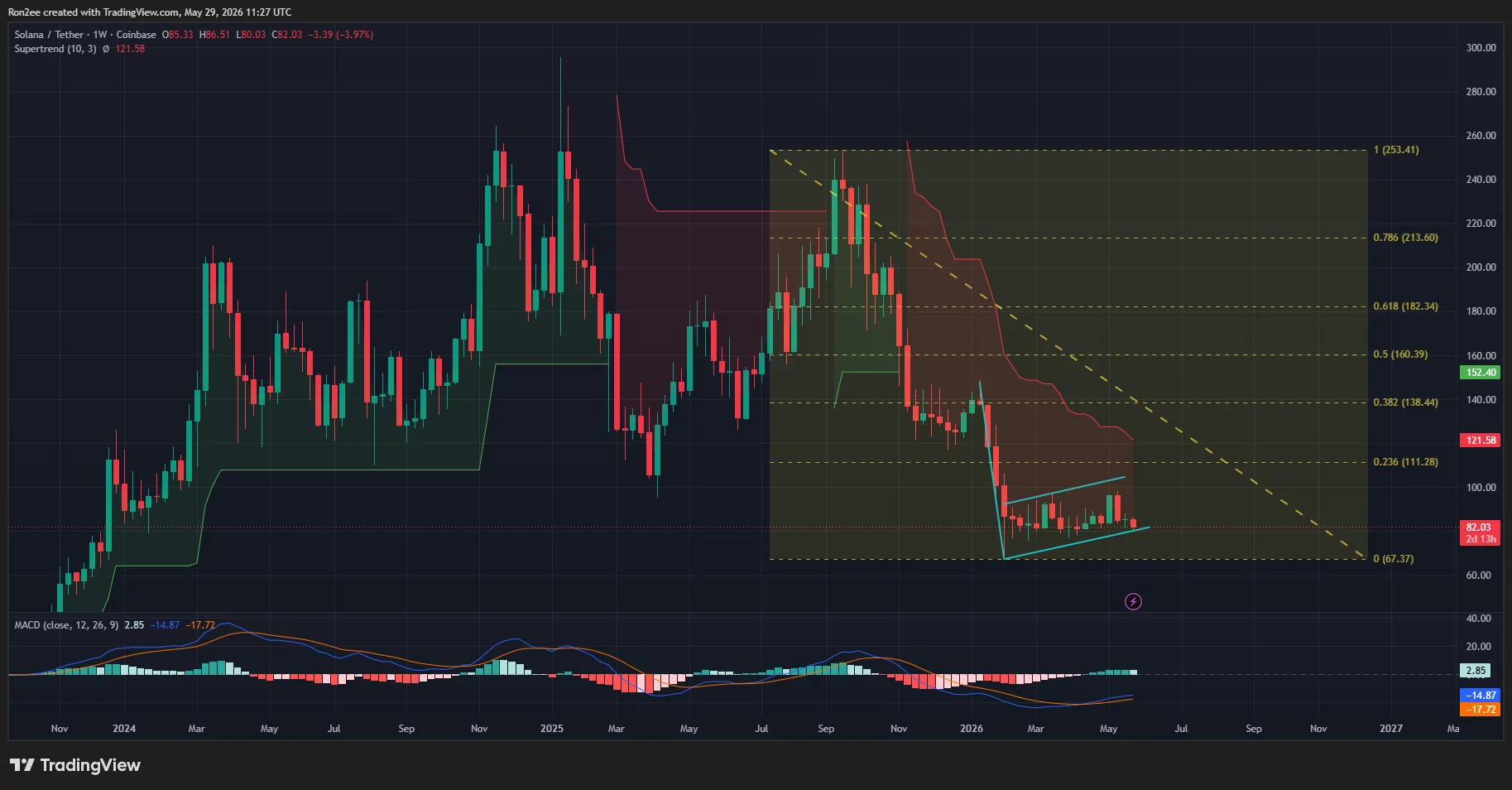
The weekly chart also shows SOL trading near the lower boundary of a large consolidation range that has contained price action for more than a year.
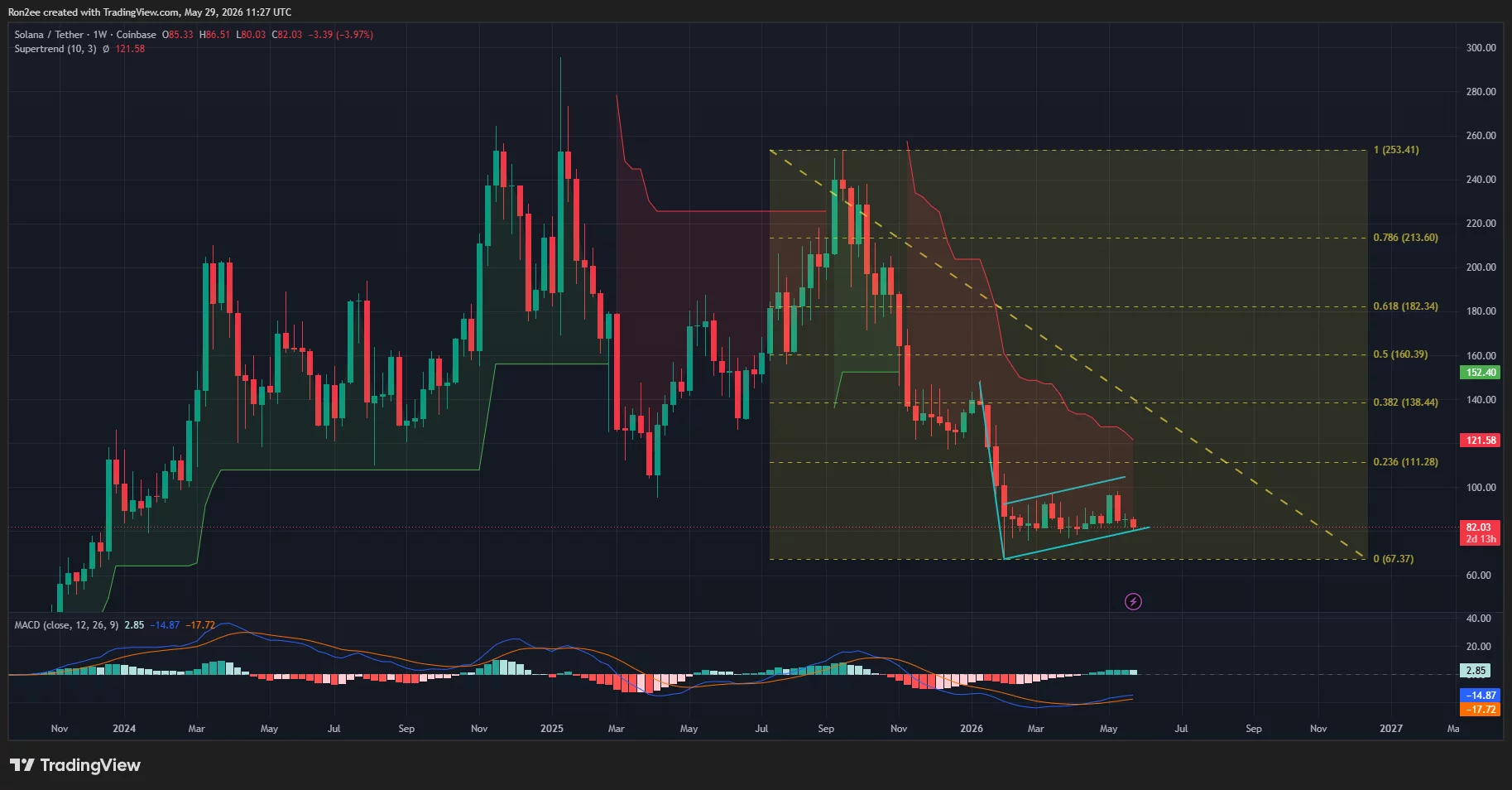
While the token remains well below the 0.236 Fibonacci retracement level near $111 and the weekly Supertrend resistance around $121, the $79-$80 support area has continued to attract buyers during repeated selloffs.
According to analysts at More Crypto Online, Solana could decline toward $62 if it fails to hold the key $72–$78 support zone. Conversely, a rebound above the May 12 high near $98 could pave the way for a move toward the $110 level.
Institutional sentiment toward Solana has remained mixed. Reports that Goldman Sachs liquidated its Solana ETF exposure earlier this year removed a notable source of institutional demand, while several asset managers continue pursuing crypto-related investment products tied to major layer-1 networks.
Traders have increasingly focused on whether fresh institutional participation emerges if market conditions stabilize during the second half of the year.
What technical risks could invalidate the bullish thesis?
The daily chart presents a more cautious picture. Solana price recently formed a bearish double-top pattern after failing twice near the $98 resistance area, first in March and again in May. The structure developed as momentum weakened across the recovery rally and sellers repeatedly defended the same overhead resistance zone.
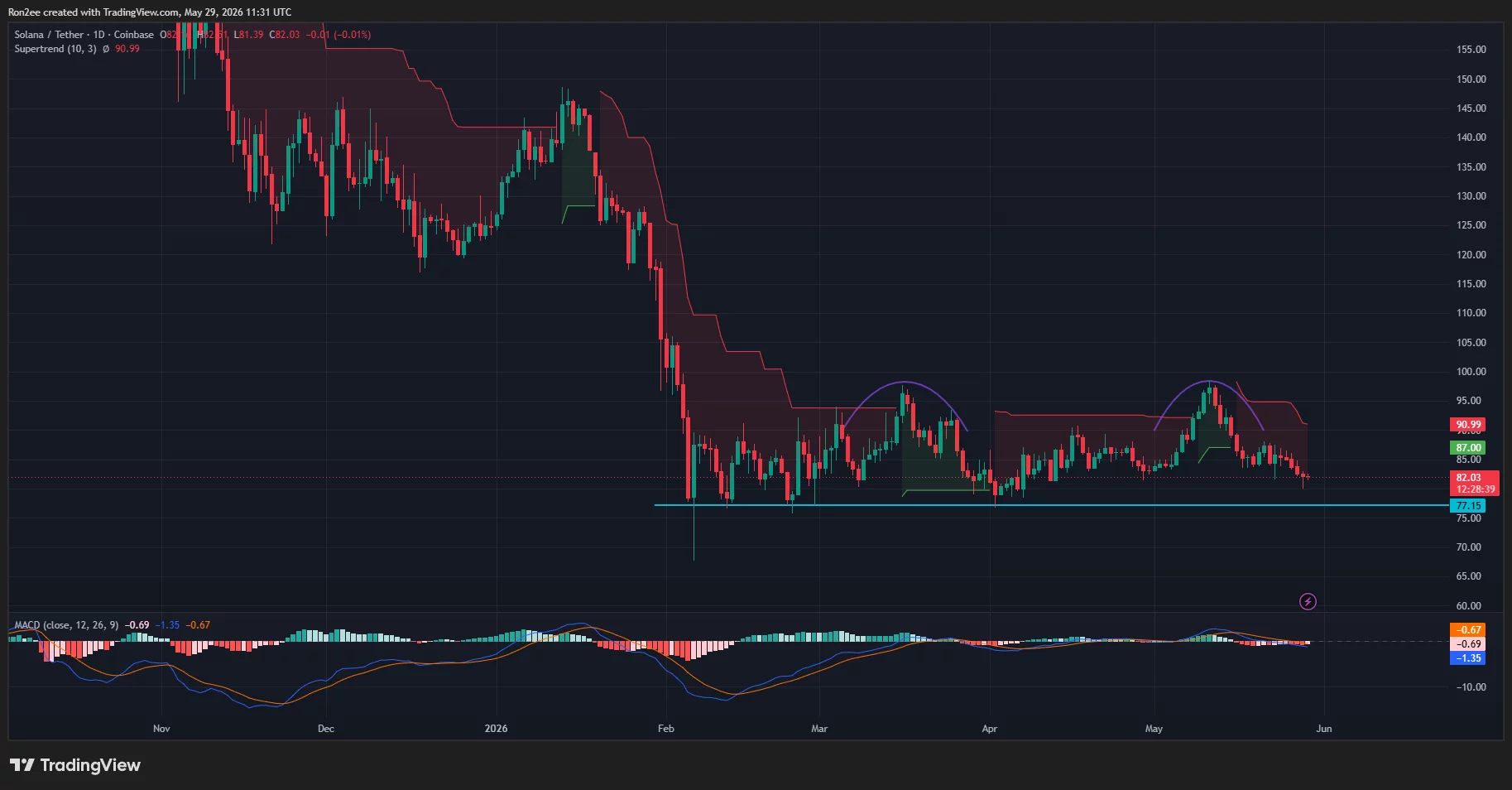
The chart shows that SOL has already fallen below several short-term support levels near $90 and $85. The daily Supertrend indicator remains bearish around $91, while the MACD has crossed lower and continues to trend below its signal line.
A separate longer-term chart structure also warrants attention. The weekly timeframe shows SOL trading inside what appears to be a bearish flag formation following its collapse from the 2025 highs.
Technical analysis treats such formations as continuation patterns, with breakdowns often producing another leg lower in the direction of the previous trend.
Derivatives positioning remains defensive as well. Open interest across Solana perpetual futures has declined during the recent correction, suggesting traders have reduced leveraged long exposure rather than adding new bullish bets.
Funding rates on several major exchanges have remained negative, showing that short sellers continue to dominate positioning.
CoinGlass liquidation data highlights another important battleground around current prices. A large cluster of leveraged positions sits near the $80 level, making it one of the most significant liquidity zones on the chart. Additional liquidation pools are concentrated around $84, $85, and $86, where short sellers could face pressure if price stages a recovery.
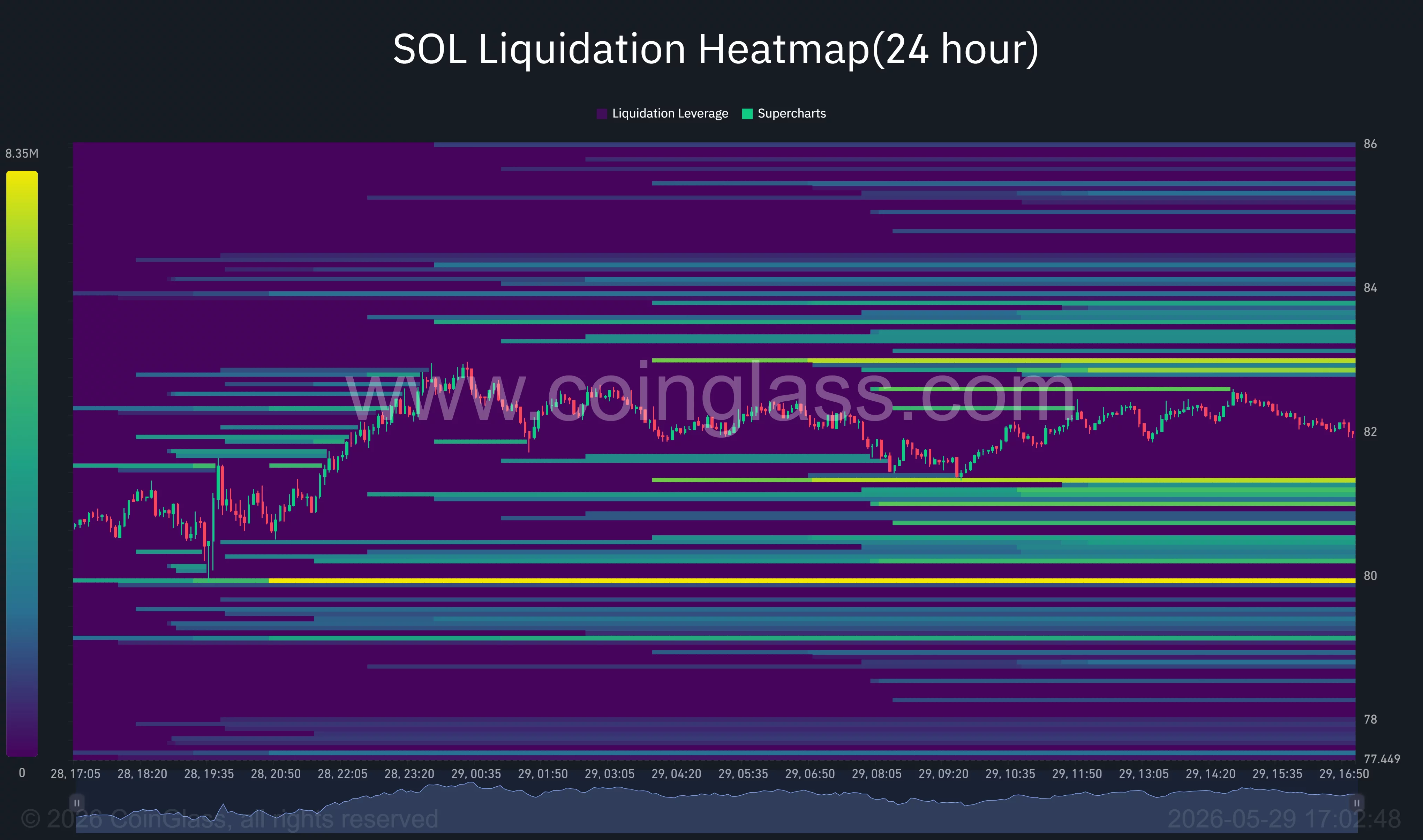
The heatmap suggests volatility could increase sharply if SOL breaks away from its current range. A move below $80 could trigger another wave of long liquidations and expose support near the $75-$77 region. Conversely, a recovery above $84 may force short-covering activity and create room for a move toward the $88 resistance cluster.
Macro conditions remain another source of uncertainty. Elevated oil prices have complicated expectations for Federal Reserve rate cuts later this year, particularly after recent inflation data showed price pressures remain stubbornly above target.
Higher borrowing costs and tighter financial conditions have historically weighed on high-beta cryptocurrencies such as Solana.
For now, traders appear focused on a single level. While daily charts continue to show a bearish double-top structure and weekly charts hint at a larger bearish flag, Scient’s thesis remains valid as long as the $79-$80 support zone survives.
Holding that area could allow buyers to target a recovery toward $100 and potentially $120, where volume profile data shows relatively limited resistance.
A decisive break beneath support, however, would invalidate the accumulation narrative and shift attention toward deeper downside targets that some analysts believe could extend well below the current trading range.
Disclosure: This article does not represent investment advice. The content and materials featured on this page are for educational purposes only.
Toncoin (TON) traded between $2.39 and $2.89 in late May 2026, doubling in roughly ten days after sitting at $1.30 on April 28. The catalyst was a single sentence from Pavel Durov on May 4. Telegram, the 950-million-user messaging app he founded, would replace the TON Foundation as the largest validator and primary force behind The Open Network. This isn’t a governance reshuffle. It’s a 950-million-monthly-active-user messaging platform formally fusing its entire ecosystem to one blockchain.
Summary
- Telegram’s takeover of TON as the network’s largest validator helped drive a rally from $1.30 to $2.89, supported by technical upgrades and new ecosystem developments.
- The bullish outlook depends on successful Telegram integration, stronger user adoption through TON Pay and Stars, and continued execution of the MTONGA roadmap.
- Regulatory setbacks, weak user adoption, or delays in Telegram’s rollout plans could keep TON under pressure and limit long-term growth.
The Catchain 2.0 upgrade (completed April 2026) brought block finality to 0.6 seconds, among the fastest of any major Layer 1. Transaction fees dropped 6x to $0.0005 per transaction. TON Pay 2.0 launches Q2 2026 for instant in-app payments. TON Teleport launches mid-2026, bringing Bitcoin liquidity into the ecosystem. TON Tech launched Agentic Wallets April 28 for AI agents operating on the network.
The MTONGA roadmap (“Make TON Great Again”) represents Durov’s 7-step plan for full Telegram-TON integration. Belarus approved TON for licensed banking and custody services on May 14, 2026. The network processed 1.5 billion transactions in Q1 2026 alone. TVL reached $1.2 billion. TON’s daily transaction volumes briefly surpassed Solana’s average during peak periods.
Telegram Ad Platform creates a demand loop: advertisers buy ad placements using TON, channel owners receive 50% crypto revenue share in TON. Telegram Stars expansion planned for Q3 2026.
The honest read: TON is the rare Layer-1 with distribution already solved. The risk sits entirely on execution, on Telegram delivering MTONGA on schedule, on users actually converting from messaging to payments, and on Durov’s French legal situation resolving without disrupting operations.
This piece walks through the mechanics, the bull case ($8 to $18 by 2030), the base case ($3 to $6), and the bear case ($0.80 to $2), with the specific variables that determine which one materializes.
Why TON is at $2.50 right now
The current Toncoin price reflects the resolution of one of the most concrete catalyst events in crypto for 2026: the formal Telegram takeover of the TON network announced May 4-5.
The starting point: TON traded around $1.30 on April 28, 2026, having declined 83% from its June 2024 all-time high of $8.24. The decline reflected uncertainty about Telegram-TON relationship clarity, broader altcoin weakness, and ecosystem development questions. TON had built substantial usage metrics (1.5B transactions Q1 2026, $1.2B TVL) without translation to proportional token appreciation.
The May 4-5 catalyst: Pavel Durov announced on May 4 that Telegram will replace the TON Foundation as the driving force behind TON and become its largest validator. The exact wording: “Telegram to replace the TON Foundation as the driving force behind TON and to become its largest validator.” Short, deliberate, and structurally big.
The structural significance: this is not governance reshuffling. It’s Telegram formally fusing its 950 million monthly active users to a single blockchain. The validator role means Telegram has direct economic stake in TON network performance. The “driving force” designation indicates Telegram will lead technical development, ecosystem building, and strategic direction rather than a community-run foundation managing these functions.
The immediate market response: TON ran from $1.354 open to $1.598 intraday high on $309 million volume (324% volume explosion). Subsequent days saw continued appreciation as the market priced in the structural change. By May 7, TON reached $2.89, representing 110+% appreciation from the April 28 close.
The Catchain 2.0 upgrade: completed in April 2026, the consensus upgrade brought block finality to 0.6 seconds, making TON among the fastest major Layer 1 blockchains. The technical capability matches or exceeds Solana (~400ms) and Aptos/Sui (sub-second). The performance enables consumer applications that require near-instant settlement.
The fee reduction: transaction fees dropped 6x to $0.0005 per transaction. The change enables economic viability for microtransactions and high-frequency consumer applications that previous fee structures couldn’t support. TON Pay 2.0 (Q2 2026 launch) targets sub-$0.0005 cost per transaction for Telegram-integrated payments.
The agentic wallets launch: April 28, 2026, TON Tech launched Agentic Wallets as an open standard for AI agents operating on the TON blockchain. The launch positions TON for the AI-crypto convergence narrative competing with NEAR’s positioning. AI agents can execute autonomous transactions through native TON infrastructure.
The MTONGA roadmap: Durov’s 7-step plan for fully integrating Telegram’s ecosystem with the TON blockchain. Sequential elements include Catchain 2.0 (completed), validator transition (in progress), TON Pay 2.0 Q2 2026, TON Teleport mid-2026 (Bitcoin liquidity integration), expanded Telegram Stars Q3 2026, and additional development phases through 2026-2027.
The regulatory developments: Belarus approved TON for licensed banking and custody services on May 14, 2026. This represents jurisdiction-specific regulatory acceptance that may signal a pathway for additional regulatory clarity. CLARITY Act framework could provide US regulatory clarity for TON as a commodity classification.
The transaction volume context: TON processed 1.5 billion transactions in Q1 2026, briefly surpassing Solana’s daily average during peak periods. The volume reflects existing Telegram-TON integration through mini-apps, Telegram Stars, and the ad platform without yet incorporating full MTONGA roadmap deployment.
The ad platform revenue loop: Telegram Ad Platform creates a demand loop where advertisers buy ad placements using TON, and channel owners receive a 50% crypto revenue share paid in TON. Every ad purchased creates buying pressure on TON. Every payout circulates TON through the ecosystem. The demand loop is different in kind from speculative demand cycles.
What the price action signals structurally: the May 2026 catalyst event represents one of the most concrete structural transformations in crypto. The market is repricing TON for the new reality where Telegram is formally driving network development with 950M MAU distribution. The current $2.50 level reflects partial repricing plus uncertainty about the execution timeline for the MTONGA roadmap. Significant additional appreciation depends on successful execution of the announced changes.
The bull case: $8-$18 by 2030
The bull case for TON requires the MTONGA roadmap to successfully execute across all phases plus significant user conversion to TON transaction activity.
The user conversion success: Telegram successfully converts a meaningful fraction of its 950 million monthly active users into TON transaction activity. Conservative bull case assumes 10-20% of users (95-190M users) become regular TON transactors. Average user transactions translate to substantial network volume and fee revenue. The conversion happens through TON Pay 2.0 (instant in-app payments), Telegram Stars expansion, mini-app integration, and creator economy applications.
The MTONGA roadmap execution: all 7 steps deploy successfully across the 2026-2027 timeline. TON Pay 2.0 launches Q2 2026 with seamless Telegram integration. TON Teleport mid-2026 brings Bitcoin liquidity, creating multi-chain utility. Expanded Telegram Stars Q3 2026 drives transaction volume. Additional development phases deliver promised functionality on schedule. The execution proves Telegram can deliver complex technical roadmap.
The payment volume scaling: TON Pay processing scales to billions of transactions monthly. The transaction volume drives validator economics, fee revenue, and structural TON demand through Universal payment dynamics. Telegram becomes the largest consumer-facing crypto payments network globally, leveraging WhatsApp/Messenger competitive gap in crypto integration.
The ad platform expansion: Telegram Ad Platform revenue scales significantly through expanded targeting capabilities, additional ad formats, and creator economy integration. The advertiser TON purchases and creator TON payouts create a sustained demand loop at increasing scale. Annual ad platform volume scales from current levels to billions of dollars equivalent.
The validator economics: Telegram’s validator role shows that institutional infrastructure can sustainably operate TON validators. Validator rewards (20+% APR mentioned in some sources) create attractive returns that drive additional staking participation. Staking ratio expands creating supply lock-up dynamics.
The competitive positioning: TON captures a meaningful share of the consumer crypto market from Solana, Ethereum L2s, and other competitors. The Telegram distribution advantage proves decisive for consumer adoption. While other chains compete for DeFi and institutional positioning, TON dominates consumer crypto through its messaging app integration.
The AI agents integration: Agentic Wallets standard enables AI agents to operate natively on TON. As AI agents become commercially significant, TON captures meaningful share through technical capability plus Telegram distribution. The positioning competes with NEAR for AI-crypto convergence.
The regulatory clarity: CLARITY Act framework provides US regulatory clarity. Belarus banking approval extends to additional jurisdictions. Durov’s legal situation resolves favorably without disrupting Telegram or TON operations. The regulatory pathway opens for institutional adoption beyond current crypto-native investor base.
The TON ETF potential: spot TON ETF eventually filed and approved following the patterns set by Bitcoin, Ethereum, Solana, and other crypto ETFs. Institutional accessibility expands beyond crypto-native investors to broader institutional and retail capital.
If multiple bull case conditions materialize, the price targets are:
- 2026 year-end: $5-9
- 2027 year-end: $7-13
- 2028 year-end: $8-16
- 2029 year-end: $8-17
- 2030 year-end: $8-18
The bull case requires sustained execution across user conversion, technical deployment, ecosystem expansion, and regulatory navigation. The most probable bull case outcome per multiple analyst frameworks targets $6-15 range over 2-4 years if Telegram-TON integration delivers expected user adoption and transaction volume.
The base case: $3-$6 by 2030
The base case assumes meaningful but not big MTONGA roadmap execution plus moderate user conversion.
The user conversion scenario: Telegram converts 3-8% of 950M MAU (28-76M users) to regular TON transaction activity. The conversion is meaningful but doesn’t reach the scale required for the bull case. User adoption develops gradually as TON Pay 2.0 launches and Stars expands.
The MTONGA execution: most roadmap steps deploy with some delays or modified scope. TON Pay 2.0 launches but with an extended rollout timeline. TON Teleport ships but Bitcoin liquidity integration takes longer to scale. Telegram Stars expansion happens but reaches a smaller portion of the user base than the bull case envisions.
The payment volume: TON Pay processes meaningful but modest transaction volume relative to the bull case. Hundreds of millions of monthly transactions rather than billions. Fee revenue grows from current levels without reaching transformative scale.
The ad platform: Telegram Ad Platform revenue continues at a moderate pace. Some advertisers adopt TON payments, some channel owners receive TON revenue share. The demand loop functions without explosive growth.
The validator economics: Telegram maintains validator role successfully. Additional institutional validators join. Staking ratio expands moderately. Validator economics stays sustainable.
The competitive dynamics: TON holds its position as a significant consumer-focused Layer 1, but faces continued competition from Solana, Ethereum L2s, and others. Market share is stable or slightly expanding rather than dominating consumer crypto.
The AI agents adoption: Agentic Wallets achieve some traction, but AI-crypto convergence happens across multiple platforms. TON captures specific use cases without dominating the AI agents market.
The regulatory environment: regulatory clarity develops gradually. Some jurisdictions approve TON for specific uses. Durov’s legal situation resolves without major disruption. ETF approval comes in 2027-2028 with modest initial flows.
Base case targets:
- 2026 year-end: $2.50-4
- 2027 year-end: $3-4.50
- 2028 year-end: $3-5
- 2029 year-end: $3-5.50
- 2030 year-end: $3-6
The base case represents meaningful appreciation from current $2.50 levels plus continued volatility around catalyst developments. The support comes from Telegram integration and ecosystem development without producing big price action.
The bear case: $0.80-$2 by 2030
The bear case requires either Telegram-specific setbacks or execution failures disrupting the MTONGA thesis.
The Durov regulatory action: Durov’s legal situation in France or other jurisdictions escalates significantly. Telegram faces restrictions on operations in major markets. The platform’s ability to drive TON integration is compromised by external regulatory pressure on Telegram’s broader business.
The user conversion failure: Telegram users don’t convert to TON transaction activity at meaningful scale. The 950M MAU number proves to be a vanity metric rather than predictive of crypto adoption. Telegram users use the messaging app without engaging with crypto features. TON Pay 2.0 launches but achieves low adoption.
The MTONGA execution failures: roadmap steps face significant delays, scope reductions, or quality issues. Telegram’s technical team encounters challenges delivering complex blockchain infrastructure. Multiple roadmap items get delayed beyond their announced timelines.
The competitive displacement: Solana captures consumer crypto market share through superior performance, deeper liquidity, and broader application ecosystem. WhatsApp or Messenger eventually launch competing crypto integrations leveraging their larger user bases. Telegram-TON loses competitive advantage.
The Telegram strategic shift: Telegram leadership changes priorities, reducing TON integration commitment. Alternative crypto strategies (Telegram Open Network 2.0, multi-chain approach, exit from crypto) emerge. The validator transition is reversed or significantly modified.
The validator economics failure: validator participation declines as institutional validators exit. Staking yields decline. The 20+% APR proves unsustainable. Network security concerns emerge.
The AI agents disappointment: agentic wallets fail to attract meaningful AI agent adoption. NEAR or other AI-focused chains capture the AI-crypto convergence market. TON’s positioning becomes incremental rather than differentiated.
The regulatory deterioration: CLARITY Act stalls or fails. International regulatory pressure increases on consumer crypto applications. Telegram faces restrictions on cryptocurrency features specifically. ETF approval is delayed indefinitely or rejected.
The technical failures: Catchain 2.0 or subsequent upgrades encounter post-deployment issues. Network outages affect user experience. Security incidents damage trust. The technical foundation supporting consumer adoption develops vulnerabilities.
The macro deterioration: broader crypto market weakness disproportionately impacts altcoins including TON. Consumer crypto applications face headwinds during risk-off periods.
Bear case targets:
- 2026 year-end: $0.90-1.80
- 2027 year-end: $0.80-1.80
- 2028 year-end: $0.80-1.90
- 2029 year-end: $0.80-1.95
- 2030 year-end: $0.80-2
The bear case represents significant downside from current levels but assumes TON retains some ecosystem positioning. Complete failure scenarios (price below $0.50) would require Telegram completely abandoning TON integration plus severe market dynamics.
The five variables that determine outcome
Five specific variables determine which scenario materializes.
Variable 1: TON Pay 2.0 launch and adoption (Q2 2026). The most important single near-term variable. Successful launch with meaningful user adoption validates Telegram-TON integration thesis. Delayed or limited launch signals execution challenges. Monitor: TON Pay 2.0 launch announcements, user activation metrics, transaction volumes through Pay 2.0, merchant adoption patterns, and Telegram integration completeness.
Variable 2: MTONGA roadmap execution across staying steps. Catchain 2.0 completed. Validator transition in progress. TON Pay 2.0 Q2 2026. TON Teleport mid-2026. Telegram Stars expansion Q3 2026.
Variable 2: MTONGA roadmap execution across staying steps. Catchain 2.0 completed. Validator transition in progress. TON Pay 2.0 Q2 2026. TON Teleport mid-2026. Telegram Stars expansion Q3 2026. Monitor: Pavel Durov public statements on roadmap progress, technical deliverable announcements, specific milestone completion dates, and quality assessments of deployed features.
Variable 3: User conversion to TON transaction activity. 950M Telegram MAU represents potential. Actual conversion to regular TON transactors is what drives sustainable value. Monitor: TON network active wallet counts, mini-app usage growth, Stars transaction volumes, ad platform participation rates, and overall on-chain activity metrics.
Variable 4: Validator transition status and economics. Telegram replacing TON Foundation as the largest validator is in progress. Sustainable validator economics with attractive yields drives staking participation. Monitor: validator participation rates, staking APR sustainability, TON staked supply growth, additional institutional validator announcements, and validator transition completion timeline.
Variable 5: Regulatory environment specifically affecting Telegram and TON. Durov’s legal situation, CLARITY Act passage affecting TON classification, additional jurisdiction approvals (following the Belarus pattern), and international regulatory dynamics. Monitor: Durov-related legal developments, regulatory announcements affecting Telegram, country-specific TON approvals or restrictions, and ETF filing developments.
The variables interact significantly. TON Pay 2.0 success drives user conversion. MTONGA roadmap execution validates Telegram commitment. Validator economics affect network security. Regulatory clarity enables broader institutional adoption. User conversion creates demand that affects everything else.
What this means for TON holders and traders
For current TON holders, the practical implication is that the asset has undergone a fundamental structural shift through the May 2026 Telegram takeover announcement. The five variables framework provides a way to evaluate whether the MTONGA roadmap is delivering expected outcomes. The current price reflects partial repricing for the new structural reality, with significant additional appreciation depending on execution.
For potential TON buyers, the practical implication is that entry at current $2.50 levels represents the post-catalyst price after the initial structural shift announcement. The risk-reward depends on assessment of MTONGA execution probability and user conversion potential. The Telegram distribution advantage is unique among Layer-1 tokens, but execution risk is concentrated in Telegram’s ability to deliver complex blockchain infrastructure.
For traders specifically, the practical implication is that TON has shown significant catalyst sensitivity (110+% appreciation in 10 days following announcement). Trading around MTONGA roadmap milestones requires monitoring Pavel Durov announcements, technical deliverable dates, and user adoption metrics. The catalyst-driven volatility creates both opportunities and risks.
For institutional investors evaluating TON allocation, the practical implication is TON offers exposure to consumer crypto adoption through unique Telegram distribution. The investment case depends on the belief that messaging app integration can produce sustainable crypto adoption at scale. Belarus banking approval and the CLARITY Act framework provide a regulatory pathway. ETF accessibility may develop following set crypto ETF patterns.
For Telegram users curious about TON adoption, the practical implication is the platform is actively building toward seamless crypto integration. TON Pay 2.0 (Q2 2026) and Telegram Stars expansion (Q3 2026) will provide direct user touchpoints for TON activity. The user experience improvements may make crypto more accessible than current alternatives.
The honest bottom line
On May 4, Pavel Durov announced that Telegram, not the TON Foundation, would run TON. Two days later, TON doubled. The market wasn’t pricing a governance reshuffle. It was pricing a messaging app with 950 million monthly active users formally tying its product roadmap to a single blockchain. TON Pay 2.0 is the next test. If it ships in Q2 and a meaningful slice of Telegram users actually use it for payments, the May rally is the beginning. If it slips or lands without traction, $2.50 is the top, not the floor.
The May 2026 Telegram takeover is fundamentally big. Pavel Durov’s announcement that Telegram replaces TON Foundation as the largest validator and primary driving force represents 950 million monthly active users formally fusing to one blockchain. This is unprecedented in crypto: no other Layer 1 has comparable distribution advantage through an existing major platform.
The technical capabilities are competitive. Catchain 2.0 produces 0.6-second finality matching or exceeding Solana, Aptos, Sui. Transaction fees at $0.0005 enable microtransactions. TON Pay 2.0 will integrate directly into Telegram for instant in-app payments. The technical foundation supports the consumer adoption thesis.
The main risks are real and material: Durov’s legal situation in France could escalate, affecting Telegram operations. User conversion to TON activity may prove difficult despite distribution access. MTONGA roadmap execution requires Telegram to deliver complex blockchain infrastructure on schedule. Competitive pressure from Solana and emerging consumer chains. Telegram strategic shifts could alter TON commitment.
The 2030 price range across scenarios is wide: $0.80-$18 depending on how the structural variables resolve. The base case ($3-$6) represents meaningful appreciation from current $2.50 levels, assuming MTONGA executes successfully with moderate user conversion. The bull case ($8-$18) requires big user conversion plus successful technical execution. The bear case ($0.80-$2) assumes execution failures or regulatory setbacks.
TON’s distribution problem is solved. What hasn’t been proven is whether Telegram can ship blockchain infrastructure on schedule. The distribution advantage is real and unique. The execution challenge is substantial. The next 6-12 months will determine whether Telegram can deliver the MTONGA roadmap on the announced timeline.
The TON Pay 2.0 launch is the most important near-term catalyst variable. Q2 2026 deployment with meaningful user adoption would validate the integration thesis. Delayed or limited launch would signal execution challenges.
User conversion is the most important sustainability variable. 950M MAU represents potential. Actual conversion to regular TON transactors determines whether the distribution advantage translates to sustainable token demand.
The Durov regulatory situation is the most important downside variable. Adverse developments could disrupt Telegram operations, affecting TON integration. Favorable resolution would remove an overhang affecting institutional positioning.
For 2026 specifically, expect TON to trade in the $2-$5 range with significant catalysts around TON Pay 2.0 launch, MTONGA roadmap milestones, user adoption metrics, and Durov-related developments. The support at $2-$2.50 reflects current Telegram integration positioning. The upside ($4-$7) depends on a successful TON Pay 2.0 launch and meaningful user adoption.
For 2027-2030, the structural variables compound. Sustained execution across roadmap delivery, user conversion, validator economics, and regulatory clarity produces a bull case trajectory. Deterioration produces a bear case. The base case assumes mixed outcomes producing meaningful appreciation.
The TON story is ultimately about whether messaging app distribution can produce sustainable crypto adoption at consumer scale. The early evidence is promising: 1.5B Q1 2026 transactions, $1.2B TVL, growing ad platform revenue, Telegram formal commitment through validator transition. The execution challenges are substantial but identifiable. The next phase will determine whether TON achieves the consumer crypto positioning that 950M MAU distribution makes possible.
Frequently Asked Questions
What happened with Pavel Durov’s TON announcement?
On May 4, 2026, Telegram CEO Pavel Durov announced Telegram would replace the TON Foundation as the driving force behind The Open Network and become its largest validator. This represents 950 million monthly active users formally fusing to one blockchain. TON surged from $1.30 (April 28) to $2.89 (May 7), representing 110+% appreciation in 10 days.
Can Toncoin reach $10 by 2030?
$10 is within the bull case range ($8-$18 by 2030). Required conditions: TON Pay 2.0 successful Q2 2026 launch with meaningful adoption, MTONGA roadmap executing across all 7 steps, significant user conversion from Telegram’s 950M MAU to TON activity, Telegram Stars expansion driving transaction volume, validator economics scaling sustainably, and a regulatory environment supporting institutional access. The base case for 2030 is $3-$6.
What is the MTONGA roadmap?
MTONGA stands for “Make TON Great Again” – Pavel Durov’s 7-step roadmap for fully integrating Telegram’s ecosystem with the TON blockchain. Sequential elements include: Catchain 2.0 upgrade (completed April 2026), validator transition (in progress), TON Pay 2.0 (Q2 2026), TON Teleport for Bitcoin liquidity (mid-2026), expanded Telegram Stars (Q3 2026), and additional development phases through 2026-2027.
How does TON’s 0.6-second finality compare to other chains?
Catchain 2.0 brought TON’s block finality to 0.6 seconds, among the fastest of any major Layer 1. Comparison: Solana ~400ms (Alpenglow target 150ms), Aptos sub-second, Sui sub-second, Ethereum L1 ~12 seconds, Bitcoin ~10 minutes. TON’s performance enables consumer applications requiring near-instant settlement and supports microtransactions at $0.0005 fee level.
What are the main risks to TON’s bull case?
Six primary risks: (1) Pavel Durov’s legal situation escalating, affecting Telegram operations, (2) user conversion failing to materialize at meaningful scale, (3) MTONGA roadmap execution facing significant delays or scope reductions, (4) competitive displacement by Solana or emerging consumer chains, (5) Telegram strategic shifts reducing TON integration commitment, (6) regulatory deterioration affecting Telegram messenger or TON specifically.
What is TON Pay 2.0?
TON Pay 2.0 is the next major version of TON’s Layer 2 payment network, designed specifically for the Telegram ecosystem. It aims to make peer-to-peer and merchant payments nearly instant and extremely cheap, targeting sub-$0.0005 cost per transaction. The Q2 2026 launch is positioned to enable seamless microtransactions for Telegram’s billion-plus user base.
How does TON compare to Solana for consumer crypto?
Both target consumer applications with high performance. Solana advantages: deeper DeFi ecosystem ($5.5B TVL vs TON’s $1.2B), broader institutional adoption (Solana ETFs trading vs no TON ETFs yet), longer track record. TON advantages: 950M MAU Telegram distribution advantage (Solana has no comparable consumer platform), formal validator commitment from a major tech platform, Catchain 2.0 sub-second finality. Different consumer crypto adoption pathways.
Should I buy TON given the recent rally?
This piece does not provide investment advice. Current $2.50 represents partial repricing after the May 2026 shift. Further appreciation depends on MTONGA roadmap execution and user conversion. The asymmetric upside potential (if execution succeeds) versus downside risk (if execution fails or Durov regulatory issues escalate) requires individual assessment. The five-variable framework provides objective monitoring signals.
This article is for informational purposes and does not constitute financial or investment advice. Cryptocurrency markets are highly volatile, and price predictions are inherently speculative. The figures and analysis described reflect data available as of late May 2026. Always do your own research and consult with qualified financial professionals before making investment decisions.
Crypto World
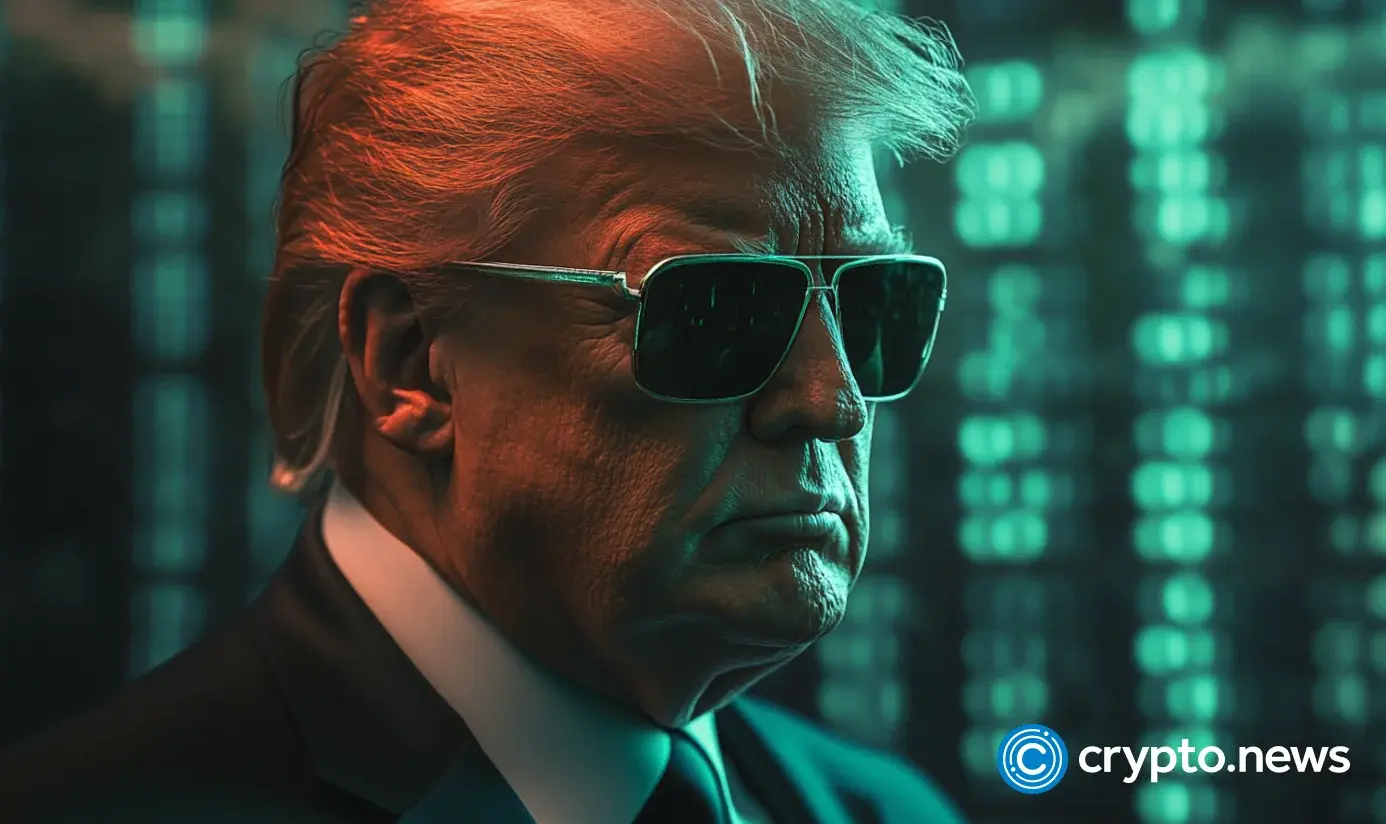
Trump vows to push pro-Bitcoin policies; SHRMiner cloud mining’s $7,000 passive income opportunity draws attention
Disclosure: This article does not represent investment advice. The content and materials featured on this page are for educational purposes only.
Trump’s crypto support boosts interest in Bitcoin and cloud mining platforms like SHRMiner among retail investors.
Summary
- Donald Trump’s recent pro-crypto remarks have increased optimism around a potentially friendlier U.S. regulatory environment for digital assets.
- Platforms such as SHRMiner are gaining attention by offering cloud mining access that removes the need for expensive hardware or technical mining expertise.
- SHRMiner provides multiple cloud mining contract options designed for users seeking either short-term flexibility or longer-term crypto mining reward exposure.
In an article published on Truth Social, Trump accused former SEC Chairman Gary Gensler and the “anti-crypto army” of nearly destroying the U.S. digital asset market by “pushing innovation overseas.”
“The United States is now the cryptocurrency capital of the world,” Trump wrote. He even pledged to establish a “future-proof digital asset market structure that those cryptocurrency opponents cannot shake.”
U.S. President Donald Trump recently publicly expressed his support for the cryptocurrency industry. His statement has bolstered optimism and is viewed by the market as a significant indication that the regulatory environment for digital assets in the U.S. may become more relaxed in the future. With improved policy expectations, more and more investors are refocusing on Bitcoin and cryptocurrency-related market opportunities.
The cloud mining model — exemplified by platforms such as SHRMiner — is rapidly gaining market attention. By offering rentable computing power services that yield mining rewards, this model eliminates the need for users to purchase expensive hardware or master specialized technical expertise, thereby making the economics of cryptocurrency mining more accessible to the average investor.
This article will delve into the core operational logic, participation methods, and market development trends of cloud mining and explore why, in 2026, an increasing number of investors are beginning to view cloud mining as a new wave of opportunities for generating cryptocurrency returns.
What is SHRMiner cloud mining?
SHRMiner is a leading global innovator in cloud mining services, dedicated to empowering the global Bitcoin network through its industry-leading cloud mining platform, rapidly expanding infrastructure, and innovative mining services, providing miners at all levels with the only way to access full cloud mining and earn BTC mining rewards.
How to earn passive income from BTC through SHEMiner cloud mining
Anyone can start earning money in just three simple steps.
1. Create an account: Complete registration to receive $15 in free computing power and earn $0.60 per day by purchasing a free trial contract (click here to complete registration).
2. Select a mining contract plan: Choose a popular short-term or long-term cloud mining contract (1–50 days available) based on financial preferences.
3. Start earning profits: After purchasing the contract, profits will be automatically settled within 24 hours without any additional management or operation. Users can withdraw their profits to their cryptocurrency wallet address at any time according to their own needs, or reinvest the profits to obtain higher returns.
The main advantage of this model is that it significantly lowers the barrier to entry. There is no need to research specific mining hardware models or computing power configurations, nor is there a need to build a personal system environment; simply complete account registration, deposit assets, and select a mining plan to start earning profits.
Selected popular cloud mining contract plans
SHRMiner offers a variety of yield-based cloud mining contract options to meet the investment preferences and financial goals of different users. Whether seeking flexible short-term returns or prioritizing stable long-term returns, users can find a suitable option on the platform.
Example of mining contract revenue
Contract Name
Price
Profit
Days
Principal+TotalReturn
NewUserExperienceAgreement
$100
$4
2
$100+$8
Bitdeer Sealminer A2 Pro
$500
$6.25
5
$500.00 + $31.25
Litecoin Miner L9
$1000.00
$13.00
10
$1000.00 + $130
Bitcoin Miner S21 XP Imm
$5000.00
$70.00
25
$5000.00 + $1750
Bitcoin Miner S21e XP Hyd
$10000.00
$150.00
35
$10000.00 + $5250
ANTSPACE HK3
$30000.00
$510.00
40
$30000.00 + $20400
For example, by leasing 300 TH/s of computing power — equivalent to a Bitcoin Miner S21 XP Imm mining rig — users can generate a BTC return of $1,750. Users can track their mining earnings in real-time via the control panel.
(Click here for more contract details).
Platform Core Advantages
- Zero Learning Curve: No technical skills required, no hardware needed, no complex procedures, and no hidden fees — simply click to earn.
- Bank-Grade Security: Dual security certification from McAfee® and Cloudflare®.
- Multi-Currency Mining Support: Earn major cryptocurrencies such as BTC, XRP, ETH, DOGE, USDC, USDT, SOL, LTC, BCH, and more.
- Global Coverage: Serving over 5 million users across more than 180 countries and regions. Enjoy 100% remote access; cloud-based operations are fully accessible via the SHRMiner app or web browser.
- UK-Compliant Operations: Holds a UK operating license, ensuring full regulatory compliance and transparency.
- 24/7 Technical Support: Our system operates with rock-solid stability around the clock, backed by a team of experienced experts and customer service representatives available to assist 24/7.
With SHRMiner, there is no need to be a technical expert or operate personal hardware. Users can directly invest in ASIC high-performance mining: completely transparent, zero-cost mining, and stable daily returns.
Affiliate Program:
Now, in addition to experiencing SHRMiner’s cloud mining services, users can also easily earn up to $30,000 in commission rewards through the platform’s limited-time affiliate promotion program.
Simply share an exclusive invitation link — whether via social media or by inviting friends to join — and get the opportunity to generate ongoing promotional earnings. This means that what is received daily is not merely income, but digital assets with the potential to appreciate in value over time.
An unimaginable earning opportunity
What sets SHRMiner apart is its extraordinary daily passive income potential, offering users the opportunity to earn $7,700 — or even more — every day, thereby realizing their dream of achieving financial success online. Imagine generating substantial income without the need for constant effort or complex setups — this is precisely what SHRMiner delivers.
In short
For those who are looking for ways to generate passive income, cloud mining is an excellent choice. When utilized effectively, these opportunities can help them effortlessly accumulate cryptocurrency wealth on “autopilot,” requiring only a minimal time commitment. At the very least, they should be far less time-consuming than any form of active trading. Passive income is the ultimate goal for every investor and trader, and with SHRMiner, maximizing passive income potential has never been easier.
For more information about SHRMiner, please visit its official website.
Disclosure: This content is provided by a third party. Neither crypto.news nor the author of this article endorses any product mentioned on this page. Users should conduct their own research before taking any action related to the company.
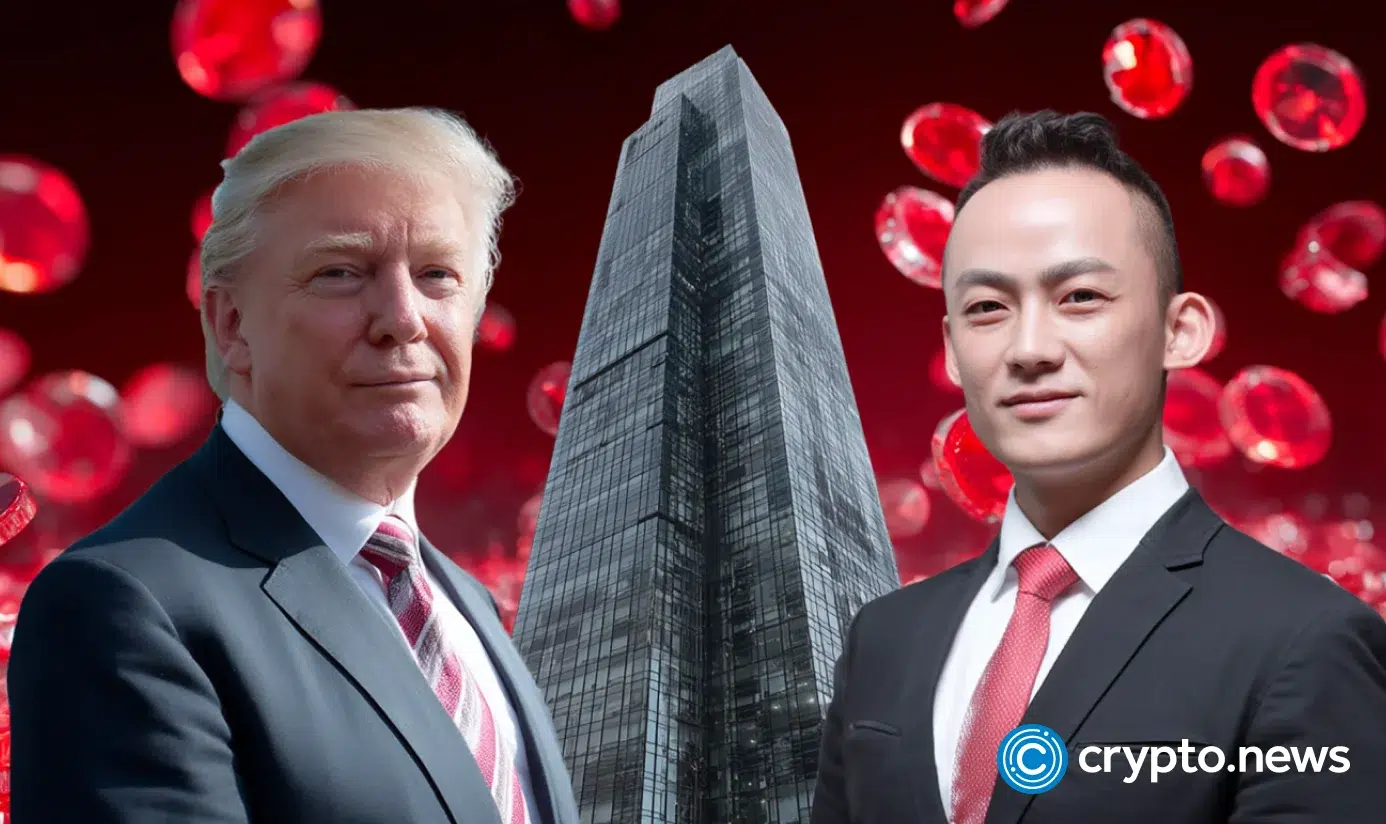
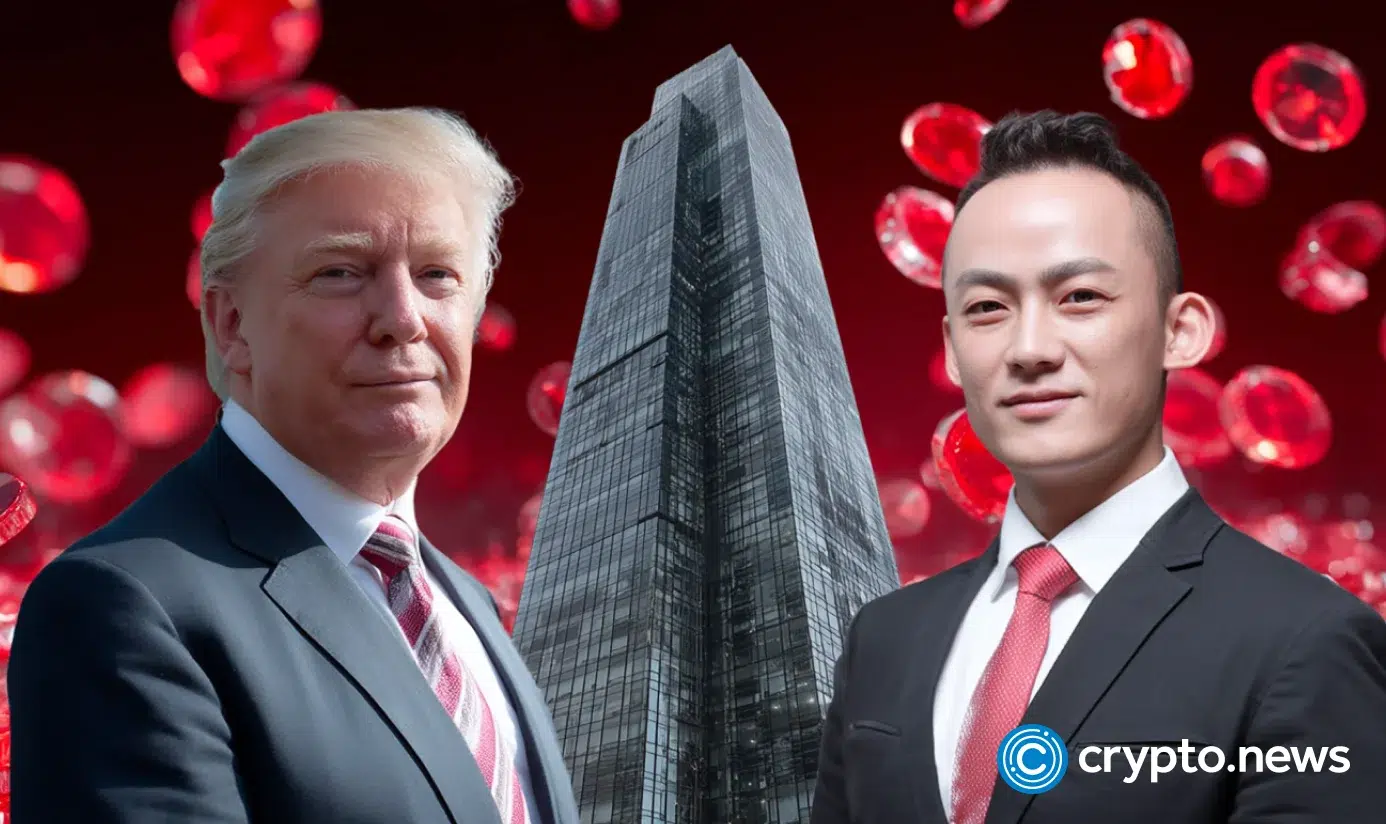
The dispute between World Liberty Financial and Tron founder Justin Sun is one of the most operatic feuds in crypto history.
Summary
- Justin Sun invested about $75M in WLFI before becoming its loudest critic.
- WLFI froze Sun’s wallet after alleging a $9M token-transfer violation.
- Sun sued WLFI in California, while WLFI countersued him in Florida.
- The feud raises larger questions about DeFi governance and token blacklists.
Sun became WLFI’s single largest investor in late 2024, putting approximately $75 million into the project and receiving 1 billion tokens as an advisor. WLFI publicly credited him with rescuing the project from a slow start.
In September 2025, WLFI froze 272 wallets including Sun’s after a phishing incident, alleging he had moved approximately $9 million in tokens in violation of investment terms. Sun denied any intent to sell. By December 2025, his locked position had lost $60 million in value. In April 2026, after CoinDesk reported WLFI’s circular borrowing on Dolomite, Sun broke publicly with the project, calling the team a “personal ATM” and accusing it of extracting illegitimate fees.
WLFI responded with “See you in court” and on May 4 countersued in Florida for defamation, alleging Sun violated contractual limits and engaged in short-selling against the WLFI token. Sun had already filed in California federal court on April 21 for breach of contract, fraud, and conversion, with his claimed losses now exceeding $320 million.
The dispute exposes deep structural questions about smart contract governance, the limits of DeFi decentralization, blacklisting mechanisms in governance tokens, and what happens when crypto’s most controversial figures fall out with its most politically connected project. This piece walks through the full timeline, the actual legal claims, the structural issues the feud reveals, and what it means for the broader WLFI ecosystem.
How Sun became WLFI’s largest backer
The Sun-WLFI relationship started as the kind of partnership both sides publicly celebrated, and the early dynamics matter because they establish how high the stakes became when things fell apart.
Justin Sun is one of the most controversial figures in cryptocurrency. The Tron founder built one of the largest blockchain ecosystems by total value locked and stablecoin transaction volume, made and lost multiple fortunes, faced an SEC fraud and market manipulation lawsuit eventually dropped in February 2025, and has been a constant presence at industry conferences and political events. His investment style is aggressive, his public persona is theatrical, and his willingness to deploy major capital at speed has made him one of the most consequential individual investors in the sector.
According to Sun’s April 2026 court filing in the US District Court for the Northern District of California, Sun invested $45 million in WLFI tokens between November 2024 and January 2025, with additional purchases bringing his total cash investment to approximately $75 million. Sun also received 1 billion WLFI tokens as an advisor to the project. The advisor allocation reflected what was at the time a productive working relationship: Sun’s industry network, Tron’s distribution channels for USDT, and his willingness to publicly champion the project gave WLFI credibility and reach during its critical launch phase.
WLFI publicly acknowledged Sun’s role. The project credited Sun with helping rescue WLFI from a slow start. Sun made statements supporting the venture and President Trump’s broader crypto-friendly policy direction. The early relationship represented something unusual in crypto: a politically connected project receiving major support from one of the industry’s most controversial individual investors, with both sides benefiting from the association.
The structural dynamics Sun’s position created were significant. He became WLFI’s single largest token holder. His Tron network became a major distribution channel for USD1 (the WLFI stablecoin). His public statements moved the WLFI token price. His access to other major crypto investors meant his endorsement carried weight beyond his personal capital deployment. In effect, Sun was not just an investor in WLFI. He was a structural participant in the venture’s growth strategy.
The timing of Sun’s investment matters in retrospect. Sun deployed capital into WLFI starting in November 2024, immediately after Trump’s election victory and before the inauguration. The investment took place while Sun was actively fighting his SEC fraud case. By February 2025, after Trump took office and his SEC appointees began reviewing pending enforcement actions, the SEC dropped its case against Sun. The dropping of the case was widely interpreted as part of the broader administration shift in crypto enforcement priorities, though no formal documentation established direct causation between Sun’s WLFI investment and the case resolution.
Sun himself has been consistent in framing his support for WLFI as ideological rather than transactional. He has repeatedly stated his support for President Trump’s crypto-friendly policy direction. In his April 2026 lawsuit filing and accompanying public statements, Sun stressed he had “always been, and remain, an ardent supporter of President Trump” while specifically criticizing WLFI leadership. The framing matters because it shapes how Sun positions himself within the dispute: as a loyal Trump supporter pushed into legal action by misconduct of project leadership rather than by political disagreement.
What the early relationship established was the structural foundation for how serious the eventual breakdown would become. Sun was not a marginal investor whose departure could be quietly absorbed. He was the single largest token holder, a structural distribution partner, and a publicly endorsed early backer. When the relationship broke down, it broke down with proportional intensity.
The September 2025 freeze
The first inflection point in the WLFI-Sun relationship was WLFI’s decision in September 2025 to freeze Sun’s wallet as part of a broader security action, and the mechanics of that freeze deserve careful unpacking because they established the legal framework for everything that followed.
In September 2025, WLFI announced it had frozen 272 wallets as part of a security response to a phishing incident. According to WLFI’s public statements at the time, the freeze was a defensive measure meant to protect user funds from exploitation following the phishing attack. The 272 wallets included addresses WLFI flagged as potentially compromised, addresses showing patterns consistent with token-sale violations, and addresses linked to suspicious trading activity.
Sun’s wallet was one of the 272. WLFI’s specific justification for including Sun’s wallet was the project’s allegation that Sun had moved approximately $9 million worth of WLFI tokens, an action WLFI characterized as a potential attempt to cash out early in violation of his investment terms. The original WLFI token sale terms included contractual restrictions on token transfers and sales during specific vesting periods, meant to prevent early backers from dumping holdings into thin markets.
Sun denied any intent to sell. His public statements at the time framed the token movements as routine wallet management rather than sale attempts. He argued the freeze was disproportionate to the alleged behavior and lacked due process. WLFI’s response was the freeze was contractually authorized and operationally necessary.
The market impact on Sun’s position was substantial. By December 2025, his locked WLFI tokens had lost approximately $60 million in value as the WLFI token declined sharply from its October 2025 trading peak. The token had already fallen more than 40 percent since trading began. Sun’s inability to sell or move his tokens meant he was structurally exposed to ongoing price decline without recourse.
The legal architecture of the freeze raised structural questions central to the eventual lawsuit. According to Sun’s April 2026 court filing, WLFI’s smart contract for the WLFI token includes a blacklisting function letting the project freeze any holder’s tokens without notice or recourse. Sun’s lawsuit alleges this function constitutes a “secret backdoor” embedded in the smart contract, and the existence of the function was not adequately disclosed to investors at the time of token purchase.
WLFI’s response to this characterization has been the freeze function was disclosed in the token sale documents and Sun’s purchase agreements specifically authorized the project’s ability to enforce contractual restrictions through technical means including freezing. WLFI’s May 2026 countersuit argues Sun’s claims about the freeze are factually inaccurate because the freeze capability was contractually disclosed.
The structural question the freeze raised is fundamental to DeFi governance: can a project marketing itself as decentralized infrastructure simultaneously keep centralized control mechanisms over its own governance token? The WLFI smart contract clearly includes the technical capability to freeze any holder’s tokens. The disclosure question is whether this capability was adequately communicated to investors as material risk. The contractual question is whether enforcement of the freeze against Sun’s specific behavior was authorized by the agreements he signed.
These questions are now in active litigation. Both sides have strong public positions. The eventual judicial resolution will likely set significant precedents for how DeFi projects can structure their token contracts, what counts as material disclosure for governance tokens, and what limits exist on centralized control of supposedly decentralized assets.
The April 2026 breakdown
The relationship between Sun and WLFI deteriorated through late 2025 and early 2026 as Sun’s locked position kept losing value while WLFI made decisions Sun increasingly viewed as harmful to ordinary token holders. The full breakdown came in April 2026 in direct response to the Dolomite controversy.
On April 9, 2026, CoinDesk published its detailed on-chain analysis of WLFI’s Dolomite borrowing activity. The report documented WLFI had pledged 5 billion of its own WLFI governance tokens as collateral on Dolomite (a lending platform whose co-founder is a WLFI advisor) and borrowed approximately $75 million in stablecoins. The borrowing drained the Dolomite USD1 lending pool to nearly 100 percent utilization, meaning other depositors who had supplied USD1 expecting to earn interest could not withdraw their funds because WLFI had borrowed nearly all of it.
For Sun, the Dolomite events represented confirmation of structural concerns he had been developing for months. From his perspective, the project he had backed was now using its own infrastructure to extract value for insiders while ordinary depositors had their funds trapped. The pattern was consistent with concerns about whether WLFI ran as legitimate DeFi or as a value-extraction mechanism for the Trump-affiliated entities controlling the venture.
On April 12, 2026, Sun publicly broke with WLFI. In a series of social media posts and public statements, he accused the project of treating its users as a “personal ATM” and extracting illegitimate fees. His specific language was pointed: “Every action taken by the WLFI team to extract fees from users and to treat the crypto community as a personal ATM is illegitimate.” He called himself “the project’s first and single largest victim” of WLFI’s practices.
Sun’s framing of his criticism was important: he positioned himself as a loyal Trump supporter who had been victimized by misconduct of WLFI’s operational leadership, rather than as a political opponent. He repeatedly stressed his continued support for President Trump while specifically criticizing the people running WLFI day-to-day. The framing was strategically sophisticated. It let him keep political alignment while creating maximum pressure on WLFI’s leadership.
WLFI’s response on April 13 escalated rapidly. The project published a public statement on X accusing Sun of running a pressure campaign with “baseless allegations” meant to “cover up his own misconduct.” The statement ended with the phrase “See you in court,” signaling WLFI’s intent to pursue legal action. WLFI’s specific accusations against Sun included allegations he had attempted to sell tokens in violation of his investment terms, engaged in market manipulation through short-selling activity, and made defamatory public statements.
The public exchange marked the formal end of the Sun-WLFI relationship. Both sides moved from internal dispute resolution to public confrontation. The legal positions hardened. Each side began preparing for protracted litigation. The market response was swift: WLFI token dropped approximately 10 percent in the immediate aftermath as the public dispute compounded concerns about the project’s governance and stability.
The structural breakdown reflected something deeper than just the immediate Dolomite trigger. Sun’s accumulated frustrations included the September 2025 freeze, the ongoing decline in his locked token value, what he viewed as inadequate governance representation despite his position as the largest token holder, and what he characterized as a pattern of insider value extraction at the expense of ordinary participants. The Dolomite events were the visible trigger, but the underlying dynamics had been building for months.
WLFI’s accumulated frustrations included Sun’s perceived violation of token transfer restrictions, his public criticism the project viewed as undermining institutional credibility, and his alleged actions through related entities to short the WLFI token and move tokens through unauthorized channels. From WLFI’s perspective, Sun had become a hostile insider whose continued participation in the project was operationally harmful.
The April 2026 breakdown made resolution through private negotiation effectively impossible. Once both sides committed to public confrontation and legal action, the dispute became a winner-take-all litigation matter with major implications for both parties and for the broader DeFi sector.
Sun’s lawsuit: the legal claims
Sun filed his lawsuit on April 21, 2026 in the US District Court for the Northern District of California. The filing was made by Sun personally along with two British Virgin Islands companies he controls: Blue Anthem Limited and Black Anthem Limited. The defendant is World Liberty Financial. The legal claims and the specific allegations deserve careful unpacking because they will shape the eventual judicial outcome.
The legal claims in Sun’s lawsuit are breach of contract, fraud, and conversion. Sun seeks damages (estimated at over $320 million based on the peak value of his locked tokens) and injunctive relief requiring WLFI to unfreeze his tokens, restore his governance voting rights, and refrain from burning his tokens.
The specific factual allegations include the following. WLFI embedded a “secret backdoor” in the WLFI smart contract giving the project the ability to blacklist and freeze any holder’s tokens. The existence of this backdoor was not adequately disclosed to investors at the time of token purchase. WLFI froze Sun’s tokens twice (initially in September 2025 and again in a subsequent action) without proper justification or due process. WLFI stripped Sun of his governance voting rights despite his position as the largest token holder. WLFI threatened to permanently destroy (“burn”) his tokens, wiping out his investment entirely. WLFI attempted to extort Sun into minting additional tokens or taking other actions through the threat of token destruction.
The contractual basis for Sun’s claims is WLFI’s actions violated the token purchase agreements he signed and the public representations WLFI made about how the governance token would function. The fraud claim is WLFI made representations about decentralization, governance, and investor rights it did not intend to honor or could not honor given the smart contract’s actual technical structure. The conversion claim is WLFI’s freeze of Sun’s tokens constituted unlawful interference with his property rights.
The expert analysis on the lawsuit has stressed the gap between WLFI’s public marketing and the smart contract’s actual technical capabilities. Decrypt’s coverage of the filing quoted experts noting the defensibility of WLFI’s position “weakens sharply” when the public marketing of decentralization conflicts with the smart contract’s actual centralized control mechanisms. If a court finds the freeze function was material to investor decisions and was not adequately disclosed, WLFI faces significant legal exposure.
The damages calculation Sun seeks reflects both the value of his original investment ($75 million) and the appreciation he claims was wrongfully wiped out through the freeze. At peak WLFI token prices (October 2025), Sun’s combined position was worth substantially more than his initial cash investment. The $320 million figure represents Sun’s view of what his position would be worth absent the freeze, including both his purchased tokens and his advisor allocation.
The injunctive relief Sun seeks is in some ways more significant than the damages claim. If a court orders WLFI to unfreeze Sun’s tokens and restore his governance rights, Sun would regain his position as the largest WLFI token holder with full ability to vote on governance proposals, transfer tokens, and exercise the rights of ownership. This would create immediate market pressure as Sun could potentially sell substantial holdings, and would also create governance disruption as Sun could potentially vote against WLFI leadership on key proposals.
The legal strategy reflects Sun’s broader objective. He is not seeking a settlement exiting him from the project quietly. He is seeking full restoration of his rights as a WLFI token holder, with full ability to keep taking part in (or disrupting) the project as he sees fit. This makes the lawsuit more existentially threatening for WLFI than a simple monetary dispute would be.
WLFI’s countersuit: the response
WLFI filed its countersuit on May 4, 2026 in Florida state court. The legal claim is defamation. The specific allegations and the structural strategy behind WLFI’s counter-legal action deserve equal attention because they reveal WLFI’s view of the broader dispute.
The defamation claim is based on Sun’s public statements through April 2026, particularly his “personal ATM” allegations and his characterization of WLFI’s leadership as engaging in deceptive DeFi practices. WLFI argues these statements were factually inaccurate, were made with knowledge of their inaccuracy or with reckless disregard for the truth, and caused measurable harm to WLFI’s business reputation and operational position.
The specific factual allegations supporting WLFI’s countersuit include the following. The freeze function in the WLFI smart contract was disclosed in the token sale documents Sun signed, contradicting his “secret backdoor” characterization. Sun’s freeze was specifically justified by his violation of contractual transfer restrictions, contradicting his claim it was without justification. Sun-linked entities moved WLFI tokens to Binance in violation of contractual limits. Sun-linked entities bought WLFI tokens for other investors in arrangements that may have violated securities regulations. Sun-linked parties engaged in short-selling activity against the WLFI token, creating financial incentive for Sun to publicly attack the project.
The legal strategy behind the countersuit is defensive rather than primarily offensive. WLFI is not realistically expecting to win major monetary damages from Sun. The countersuit serves three strategic purposes. It establishes WLFI’s narrative that Sun is the bad actor in the dispute rather than the victim. It creates legal exposure for Sun that raises settlement pressure on Sun’s California lawsuit. It signals to other potential plaintiffs that WLFI will aggressively defend against legal action including through counter-litigation.
The Florida venue choice is also strategic. Florida state courts are generally considered favorable to defendants in defamation cases compared to California federal courts. The forum split (Sun’s case in California federal court, WLFI’s case in Florida state court) means the dispute will likely be litigated in two jurisdictions with potentially different procedural rules, creating complexity that may favor whichever party has more resources for sustained litigation.
WLFI’s specific allegations about Sun’s market activities are interesting structurally. The accusations that Sun moved tokens to Binance in violation of contractual limits, bought tokens for other investors, and engaged in short-selling against the WLFI token, if substantiated, would establish patterns of behavior that could support securities law violations beyond just the contractual disputes. The countersuit functions in part as a discovery vehicle that may let WLFI obtain documentation about Sun’s broader trading activities through the legal process.
The Consensus Miami appearance on May 7, 2026 by Donald Trump Jr. and WLFI CEO Zach Witkoff served as a public extension of the countersuit narrative. Both Trump Jr. and Witkoff stressed WLFI would not have filed the case without strong evidence, signaled confidence in the legal position, and addressed broader rumors about the project’s stability. The public appearances were strategically coordinated with the legal action to project strength and stability despite the ongoing dispute.
WLFI’s broader strategy appears to be using the litigation to reset the narrative around the dispute. From WLFI’s perspective, Sun is a hostile insider whose public criticism is motivated by personal financial interest (his frozen position) rather than by legitimate concerns about the project’s governance. The countersuit is designed to reframe the dispute in those terms and to create legal exposure for Sun that may force him toward settlement on WLFI’s terms.
What the dispute reveals about smart contract governance
The Sun-WLFI dispute exposes structural questions about how governance tokens actually function in supposedly decentralized projects, and the implications go far beyond just this specific feud.
The first structural question is about disclosure of centralized control mechanisms. WLFI’s smart contract includes the technical capability to freeze any holder’s tokens. This capability is functionally equivalent to a centralized authority keeping the ability to seize assets from individual users. The existence of this capability is not unusual in tokens that have compliance or regulatory requirements. The disclosure question is whether the existence of such capabilities should be prominently communicated to token purchasers as material to their investment decision, or whether burying the capability in smart contract code with limited documentation is adequate disclosure.
The marketing-versus-technical-reality gap is structurally important. WLFI marketed itself as building “DeFi platforms” and stressed decentralization, governance participation, and user empowerment. The smart contract technically includes mechanisms allowing centralized override of holder rights. Whether this represents adequate disclosure or material misrepresentation depends on what reasonable investors should be expected to investigate before purchasing, and what platforms can reasonably claim about decentralization given the technical reality of their contracts.
The Sun lawsuit will likely produce judicial guidance on this question. If a court finds the disclosure was adequate, it establishes smart contract code itself counts as adequate disclosure of all capabilities embedded in it, regardless of how the project markets itself. If a court finds the disclosure was inadequate, it establishes projects need to clearly communicate centralized control mechanisms in plain language to investors. Either ruling will have significant implications for how DeFi projects structure their disclosures going forward.
The second structural question is about due process for blacklisting decisions. WLFI’s freeze of Sun’s wallet happened without prior notice, without a formal hearing, and without an appeal process. From a centralized financial institution’s perspective, freezing an account suspected of misconduct is routine. From a DeFi project’s perspective marketing itself as alternative to traditional finance, applying centralized control mechanisms without due process represents exactly the dynamic DeFi is supposed to avoid.
The legal question is whether token purchase agreements can validly waive due process protections that would otherwise apply, or whether some minimum procedural protections are required regardless of contractual terms. The judicial answer will likely depend heavily on whether tokens are classified as securities (in which case investor protection requirements apply) or as commodities (in which case more permissive contractual flexibility applies). The SEC’s evolving treatment of governance tokens makes this categorization itself contested.
The third structural question is about the nature of decentralization claims. The crypto industry routinely markets projects as decentralized while keeping substantial centralized control mechanisms. WLFI is far from unique in this dynamic. Many major DeFi projects have admin keys, governance multisigs, or other mechanisms letting centralized actors override the supposedly autonomous operation of the protocol. The question Sun’s lawsuit raises is whether the gap between decentralization claims and centralization reality is large enough in WLFI’s case to constitute misrepresentation.
The implications for the broader DeFi sector are substantial. If WLFI’s contract structure (governance token with embedded freeze function) is found to be inadequately disclosed, similar structures across the DeFi sector will face scrutiny. If WLFI’s contract structure is upheld as adequately disclosed, projects will keep maintaining centralized control mechanisms while marketing decentralization, with the legal protection of “the code is the disclosure.”
The fourth structural question is about insider conflicts and value extraction. The Dolomite events Sun cited as the trigger for his public break with WLFI involved WLFI using its own governance tokens as collateral to borrow against its own stablecoin from a lending platform with insider relationships to the venture. This pattern is not necessarily illegal, but it raises questions about whether DeFi projects can simultaneously serve as legitimate infrastructure for outside users and as value-extraction mechanisms for insiders. Sun’s allegation is WLFI prioritized the latter at the expense of the former.
The resolution of these structural questions through Sun’s litigation will likely take years. The immediate dispute will probably be resolved through some combination of settlement negotiations, dismissals on procedural grounds, and partial judicial rulings on specific claims. The broader structural questions about DeFi governance, smart contract disclosure, and decentralization claims will keep evolving through subsequent cases, regulatory actions, and industry practices.
What it means for WLFI and the broader ecosystem
The implications of the Sun-WLFI dispute go beyond just the immediate legal battle and reach into the broader trajectory of the WLFI project and the political-crypto integration story.
For WLFI specifically, the dispute is operationally damaging regardless of the eventual legal outcome. The ongoing litigation creates persistent uncertainty about the project’s governance and stability. Sun’s public statements keep generating critical coverage. Other large token holders may be reluctant to commit additional capital while the legal situation is unresolved. Institutional partners may delay integrations until they can assess the legal exposure. The project’s WLFI governance token has been under sustained selling pressure since the dispute began, falling approximately 76 percent from its October 2025 all-time high.
The narrative impact may be more significant than the financial impact. WLFI has been working to position itself as institutionally credible (BitGo custody, BlackRock reserve management, Chainlink Proof of Reserves, pursuit of national trust bank charter for USD1). Sun’s public criticism that the project treats users as a “personal ATM” is exactly the kind of narrative undermining institutional credibility. Even if WLFI prevails in court, the reputational damage from the sustained public dispute is substantial.
For Sun specifically, the dispute represents both opportunity and risk. The opportunity is regaining access to his frozen tokens (potentially worth substantial amounts even after the WLFI decline) and establishing himself as a champion of legitimate DeFi against insider extraction. The risk is the countersuit, the potential securities law exposure from his market activities, and the reputational damage from being publicly identified as a hostile actor against a Trump-aligned project. Sun’s political alignment efforts (his continued public support for Trump while criticizing WLFI leadership) suggest he understands the political dimensions of his risk profile.
For the broader DeFi sector, the dispute creates several precedents that will shape future project structures. The judicial rulings on the freeze function disclosure will affect how all DeFi projects structure their smart contracts and disclosures. The handling of the cross-jurisdictional litigation (California versus Florida) will influence forum-shopping strategies in future disputes. The eventual resolution will likely become reference precedent in how courts handle disputes between token holders and project teams about governance rights and protocol control.
For the political-crypto integration story, the Sun-WLFI dispute is one of the clearest examples of how crypto’s political alignments can fracture under operational pressure. Sun was politically aligned with WLFI through his Trump support and through the perceived favorable treatment his SEC case received from the Trump administration. The breakdown of his WLFI relationship took place despite, not because of, the political alignment. This suggests political alignment is not a stable substitute for operational alignment in cryptocurrency businesses.
For institutional users evaluating WLFI products (USD1 specifically), the dispute adds another layer of consideration alongside the political and operational concerns previously documented. The institutional architecture of USD1 (BitGo, BlackRock, Chainlink) stays technically credible. The political controversies surrounding WLFI generally stay documented. The Sun litigation adds specific operational and governance concerns separate from but related to the broader political dimensions. Each layer affects different institutional users differently based on their specific risk tolerances.
For crypto.news readers specifically, the practical takeaway is the Sun-WLFI dispute is not yet resolved and will likely keep evolving through 2026 and into 2027. The immediate legal proceedings (Sun’s California case, WLFI’s Florida countersuit) will produce filings, motions, and potentially partial rulings over the coming quarters. The eventual judicial outcomes will affect WLFI’s operational position and broader DeFi precedents. Both parties have substantial resources and strategic incentives to pursue the litigation aggressively. Quick settlement is possible but not the most likely outcome based on the trajectory of public statements so far.
The bottom line
The Sun-WLFI dispute is one of the most operatically dramatic feuds in crypto history, and the structural significance goes beyond just the personal dynamics between Justin Sun and the WLFI leadership.
The timeline is documented. Sun invested approximately $75 million in WLFI tokens between November 2024 and January 2025, plus 1 billion tokens as an advisor allocation. He became WLFI’s single largest backer. WLFI publicly credited him with helping rescue the project from a slow start. In September 2025, WLFI froze Sun’s wallet as part of a 272-wallet security action following a phishing incident, alleging Sun had moved approximately $9 million in tokens in violation of investment terms. Sun denied any intent to sell. By December 2025, his locked position had lost $60 million in value. The relationship deteriorated through Q1 2026.
The breakdown came in April 2026 in direct response to the Dolomite controversy. On April 9, CoinDesk reported WLFI’s circular borrowing on Dolomite. On April 12, Sun publicly accused WLFI of treating users as a “personal ATM.” On April 13, WLFI responded with “See you in court.” On April 21, Sun filed his lawsuit in the US District Court for the Northern District of California, alleging breach of contract, fraud, and conversion, seeking damages over $320 million and injunctive relief. On May 4, WLFI countersued in Florida state court for defamation. On May 7, Trump Jr. and Zach Witkoff defended WLFI publicly at Consensus Miami.
The legal claims are substantive on both sides. Sun’s case turns on whether WLFI’s smart contract freeze function was adequately disclosed and whether his specific freeze was justified by his actual behavior. WLFI’s case turns on whether Sun’s public statements meet the legal standard for defamation given the public-figure nature of the dispute. Expert analysis has suggested Sun’s case is stronger on the disclosure question than WLFI’s is on the defamation question, but both parties have credible legal arguments and substantial resources for sustained litigation.
The structural questions the dispute exposes are bigger than the immediate feud. Smart contract disclosure of centralized control mechanisms is a fundamental question for the DeFi sector. The gap between decentralization marketing and centralization technical reality is industry-wide, not just WLFI-specific. Due process protections for blacklisting decisions are unresolved. The classification of governance tokens as securities versus commodities affects what protections apply. Insider value extraction patterns in projects with concentrated ownership create governance questions independent of the specific WLFI case.
For WLFI as a venture, the dispute is operationally damaging regardless of legal outcome. The WLFI token has fallen approximately 76 percent from its October 2025 peak. The institutional credibility WLFI has been building through USD1’s BitGo/BlackRock/Chainlink architecture is undermined by the ongoing public dispute. Even prevailing in court would not erase the reputational damage from sustained public confrontation with the project’s largest backer.
For Sun as an investor, the dispute represents both opportunity to recover his frozen position and risk of broader legal exposure from his market activities. His strategy of keeping political alignment with Trump while specifically criticizing WLFI leadership is sophisticated and may produce the best available outcome given the constraints of his situation. The dual lawsuits (his California case and WLFI’s Florida countersuit) will likely produce extended litigation through 2026 and 2027.
For the broader DeFi sector, the dispute creates precedents that will shape how projects structure smart contracts and disclosures going forward. The judicial rulings on the freeze function disclosure issue will be reference points for future cases. The handling of cross-jurisdictional litigation will influence forum-shopping strategies. The eventual settlement or judicial resolution will become part of the developing legal framework around governance tokens, decentralization claims, and protocol-level control mechanisms.
For the political-crypto integration story, the Sun-WLFI breakdown shows political alignment is not a stable substitute for operational alignment. Sun was politically aligned with WLFI through his Trump support and the favorable treatment of his SEC case under the new administration. The breakdown took place despite this political alignment because of operational disputes about governance, smart contract control, and value extraction. The implication is crypto projects relying on political relationships for stability are exposed to the same operational risks as any other business.
What happens next depends on factors playing out over months and years rather than weeks. The legal proceedings in California and Florida will produce filings, motions, and rulings that gradually narrow the disputed issues. The market response to each development will affect the WLFI token price and the broader perception of the project’s stability. Political developments around the broader Trump administration crypto policy environment will create context affecting both parties’ strategic positions.
Other major WLFI stakeholders (MGX, the various institutional integrations) will make their own decisions about continued participation based on how the dispute evolves.
The honest read is the Sun-WLFI dispute is not just a celebrity crypto feud. It is a structural case study in how decentralization claims, smart contract control mechanisms, governance token rights, insider relationships, and political alignments interact when major participants in a crypto venture have a serious operational falling out. The specific facts of this dispute will likely produce judicial precedents shaping how the broader sector runs for years to come.
For now, what is established is the dispute is real, the legal claims are substantive on both sides, the operational damage to WLFI is significant, and Sun’s strategic position combines genuine grievances with sophisticated political positioning. Where it ends depends on what courts decide, how the parties strategically maneuver through the litigation, and how the broader political and regulatory environment evolves.
The Tron-Trump feud is the kind of story crypto produces uniquely. Largest backer becomes loudest critic. Political alignment fractures under operational pressure. Smart contract code becomes evidence in federal court. Dueling lawsuits cross jurisdictions. The participants are crypto’s most distinctive figures. The stakes are measured in hundreds of millions of dollars. The implications reach into the foundations of how decentralized finance actually functions.
The story is still being written. The judgments and resolutions will come over the next several years through specific legal milestones rather than through any single defining event. What is certain is the dispute has already shaped how crypto operators, regulators, and investors think about the gap between decentralization marketing and centralization reality. Whatever the eventual resolution, that shift in industry consciousness is already established.
This article is for informational purposes and does not constitute legal or investment advice. The legal proceedings, factual allegations, and operational developments described reflect reporting available as of late May 2026. Both parties have substantive legal positions and the ultimate resolution will be determined by judicial proceedings rather than by media coverage. Always do your own research.

TLDR:
- Ethereum whale wallets accumulated 17.41 million ETH, representing nearly 22% of the total supply.
- Santiment data showed major holders buying aggressively during Ethereum’s latest market weakness.
- ETH remained below key resistance levels as traders monitored support near the $1,850 zone.
- Analysts projected a potential downside to $1,560 if Ethereum loses its weekly support structure.
Ethereum whale accumulation Santiment data reveals that large wallets reached a nine-week high in ETH holdings.
In the meantime, traders are closely monitoring the critical $1,850 support level for signs of Ethereum’s next directional move.
Whales Quietly Increase ETH Exposure During Market Weakness
Santiment reported that wallets holding at least 100,000 ETH collectively control 17.41 million ETH, marking the highest balance recorded in nearly two months.
The development surfaced while retail sentiment remained cautious across the crypto market. Many short-term traders responded defensively to Ethereum’s declining price structure.
Meanwhile, high-value holders appeared focused on positioning ahead of potential long-term recovery conditions.
Santiment shared the latest on-chain trend through a market update on X, noting that major Ethereum addresses steadily increased holdings during the correction.
The divergence between declining prices and rising whale balances quickly fueled discussions surrounding smart money activity.
Growing concentration among large holders may also tighten exchange liquidity over time. As more ETH shifts into long-term storage wallets, the circulating supply available for immediate selling gradually declines. That setup can increase volatility once broader demand returns to the market.
Institutional players often accumulate during periods of weak sentiment rather than during euphoric rallies. Ethereum’s continued dominance across decentralized finance, stablecoin settlements, tokenization, and smart contract activity may explain why large holders remain confident despite current uncertainty.
Ethereum Price Risks Deeper Correction Below $1,850
Ethereum’s technical structure now sits near a decisive support area that analysts continue monitoring closely. Market participants identified the $1,850 level as a major defensive zone capable of shaping Ethereum’s medium-term direction.
Recent price action reflected persistent weakness across higher timeframes. Ethereum repeatedly failed to reclaim resistance near $2,282 while remaining trapped beneath the 50-week simple moving average. At the same time, tightening volatility conditions signaled the possibility of a sharp directional breakout.
Analysts warned that a confirmed weekly close below $1,850 could accelerate downside pressure rapidly. Once higher-timeframe support zones fail, traders often shift away from aggressive dip-buying strategies and prioritize defensive positioning.
The first downside target currently sits near the $1,560 region, where Ethereum previously established strong support during earlier correction phases. However, sustained bearish momentum could expose ETH to deeper losses toward the $1,070 area over time.
Even with growing technical pressure, on-chain activity continues painting a different picture beneath the surface. Large holders continue to increase exposure during periods of weakness, suggesting sophisticated investors still view current market conditions as a strategic accumulation phase rather than a breakdown in Ethereum’s broader network strength.

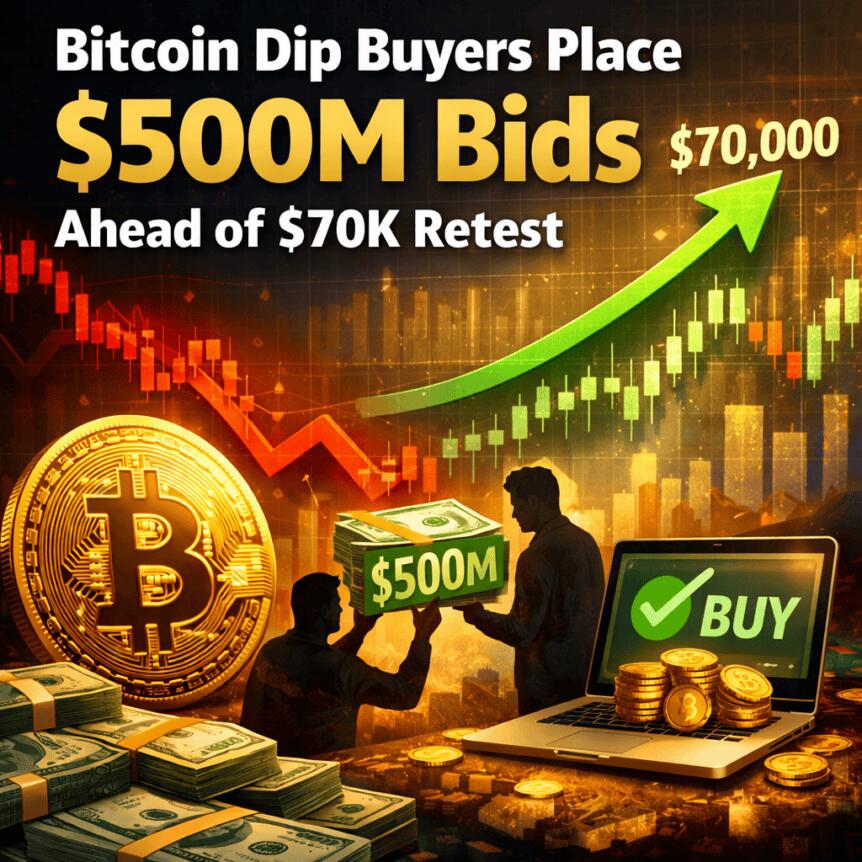
Bitcoin is hovering near a critical liquidity zone as traders line up sizable buy orders around the $70,000 mark. Fresh data shows a substantial bid wall between $72,000 and $70,000, totaling more than 6,000 BTC and roughly $443 million in current value. The heaviest concentration sits just above $70,000, positioning buyers to absorb selling pressure if price dips into that area.
Key takeaways
- A formidable bid wall exists between $72,000 and $70,000, comprising about 6,235 BTC and roughly $443 million in buy liquidity.
- The largest cluster sits directly above $70,000, with additional demand at $68,505 (1,012 BTC, about $69 million), while bids thin below $68,500.
- Liquidation risk visually centers near $70,000: around $2 billion in long positions are exposed, versus over $5 billion in short exposure near $78,000, signaling pronounced hedging and potential volatility if the zone is breached.
- The daily RSI has slipped to about 33, its lowest in three months, and BTC is trading in a descending channel with support around $72,000–$73,000.
- Put options around the $70,000 strike totaling close to $10 million indicate targeted hedging near the key level, underscoring how traders are positioning for a move near $70k.
Liquidity as the compass for BTC’s near-term path
From the bid side, the concentration of buy orders around and just above $70,000 suggests market participants expect eventual support if prices test that zone. The 6,235 BTC resting between $72,000 and $70,000 translates to roughly $443 million in buy pressure at current prices, a sizable cushion should selling accelerate. In practical terms, this liquidity cluster can slow down a slide and potentially catalyze a rebound if demand adequately absorbs supply.
The next notable pile sits at $68,505, where traders have placed about 1,012 BTC, worth around $69 million. Beyond that, the order book thins noticeably, with few visible bids below $68,500. Such a thin lower respaldo means a break through the $68,500 zone could expose BTC to sharper moves if selling accelerates and buyers recede from the page.
On the risk side, the liquidation heatmap paints a vivid picture of trader positioning. Approximately $2 billion in long positions sit at risk near the $70,000 area, while more than $5 billion in short exposure concentrates around $78,000. The juxtaposition implies that a visit to the $70k bid cluster could set off a cascade—shorts unwinding as new buyers step in, potentially triggering a relief rally that pushes price toward higher liquidity pockets and liquidation zones above.
Data visualizations supporting these insights originate from CoinGlass’s market analytics, which track both bid liquidity and liquidation dynamics. The reader should note that these figures reflect snapshot data and may shift quickly in response to macro headlines, order execution, and market sentiment.
Related: Bitcoin falls out of the global top 10 assets as market cap dips below $1.5T
Momentum and the broader price architecture
Bitcoin’s daily trend has turned bearish after failing to hold above the $74,800 level, yielding a pattern of lower highs and lower lows. On the chart, BTC continues to press within a descending channel, with near-term support clustered around $72,000–$73,000. The technical backdrop is underscored by a weak momentum read, as the relative strength index (RSI) slipped to about 33 — its lowest reading in roughly three months — and has remained below the neutral 50 level during the latest leg down. This tilt toward selling pressure aligns with a price action narrative characterized by renewed downside risk into the critical liquidity zones described above.
The market narrative around resistance also centers on a roughly $74,500–$75,500 area, a region some traders view as a broad barrier across multiple timeframes. A rejection from that zone could keep price anchored near the lower end of the channel, while a break above the resistance could alter the short-term trajectory and invite a test of higher levels. As one trader on social channels noted, the dynamics around $74,500–$75,500 remain a focal point for directional bets, even as bid clusters around $70k provide a potential floor if selling accelerates.
Options market activity corroborates a cautious stance around the key price zone. Glassnode data cited market chatter that traders had spent near $10 million on put options with a $70,000 strike during the recent dip. Put options tend to increase in value as prices fall, serving as a hedge against downside risk. Although some of that hedging activity has eased as traders book profits, the concentration of protective positioning around $70,000 highlights how closely the market is watching the level and how a move through that threshold could alter hedging dynamics and implied volatility going forward.
The macro mosaic around BTC—comprising bid liquidity near $70k, a bearish but still-cautious momentum setup, and a hedging emphasis around the same price—paints a nuanced picture. While the near-term path remains uncertain, the liquidity layer could be pivotal in determining whether BTC finds support and reverses, or breaks lower toward the next local hazard in the lower-$60k or mid-$60k neighborhood.
For readers tracking lead indicators, the link between order-book depth, price action, and hedging preferences remains a telling barometer of sentiment as the market approaches a potential inflection point near $70,000.
Related reading that highlights broader hodling dynamics and investor behavior can be found in analyses touching on major holder activity and hedging flows, including CryptoQuant coverage on demand patterns across large holders.
Meanwhile, market observers will keep a close eye on whether the bid clusters at $70k hold firm or give way under renewed selling pressure, and how that interacts with ongoing hedging activity and option positioning as BTC navigates a volatile path forward.
What to watch next: a clean test of the $70,000 zone could either validate the idea that demand is sufficient to anchor a bounce or signal a renewed leg lower if sellers overwhelm the bid wall. Traders will be watching liquidity shifts, delta exposure, and how quickly hedges unwind if price stabilizes above or breaks below the critical level.
TLDR:
- NEAR market capitalization jumped from $2.7 billion to nearly $3.8 billion within days.
- NEAR Intents has processed over $19 billion in volume across 35+ blockchain networks.
- Chain abstraction technology aims to simplify cross-chain transactions for users and AI agents.
- Protocol revenue surpassed $8 million after the fee switch activation and buyback mechanism.
NEAR Protocol has emerged as one of the week’s strongest crypto narratives after a sharp rise in market capitalization.
The move comes as investors increasingly focus on the network’s AI infrastructure, cross-chain capabilities, and growing adoption of products designed for autonomous digital economies.
NEAR Protocol Gains Momentum as Investors Reassess AI Strategy
NEAR Protocol spent much of the previous market cycle away from the spotlight. While many projects focused on short-term attention, the network concentrated on building infrastructure aimed at long-term adoption.
That strategy is now drawing renewed interest as artificial intelligence becomes a dominant theme across technology and digital assets.
The recent market cap surge reflects that changing perception. During the past seven days, NEAR’s valuation climbed from roughly $2.7 billion to nearly $3.8 billion before stabilizing above previous levels.
More importantly, the network maintained a higher valuation range after the initial rally, indicating continued demand despite market volatility.
At the center of the investment thesis is NEAR’s focus on chain abstraction. Traditional blockchain interactions often require users to manage multiple wallets, bridges, and gas tokens.
NEAR aims to remove those barriers by creating a system where multiple networks operate as a unified environment.
This vision extends beyond human users. As AI agents become more capable of performing economic tasks, blockchain infrastructure must support seamless execution across ecosystems. NEAR’s architecture is increasingly being viewed as a framework designed for that future.
Recent ecosystem commentary has emphasized user-owned AI, confidential inference, and AI-native applications as major areas of development. These initiatives are helping position NEAR Protocol as more than a conventional Layer 1 blockchain.
NEAR Intents Growth Strengthens Ecosystem Fundamentals
A major contributor to the growing attention around NEAR Protocol is the rapid expansion of NEAR Intents. The product allows users to express desired outcomes while network participants handle execution and routing behind the scenes.
According to ecosystem data, Intents has processed more than $19 billion in all-time volume. The platform currently connects liquidity across over 35 blockchains and supports more than 135 assets. This growing reach has expanded its role within decentralized finance infrastructure.
Network activity has also translated into measurable revenue generation. Since the fee switch was activated, NEAR has generated more than $8 million in revenue directed toward token buybacks.
At the same time, confidential transaction volume continues to expand alongside support for emerging asset categories.
The protocol’s economic structure is also evolving. Its token supply is fully unlocked, while a halving-related upgrade reduced maximum annual inflation by 50%.
Combined with increasing network usage, these developments are strengthening the project’s economic foundation.
As a result, investors appear to be evaluating NEAR Protocol through a different lens. The conversation is increasingly centered on whether the network can become critical infrastructure for AI agents operating across the broader digital economy.
Crypto World
JPMorgan CEO Jamie Dimon Vows to Fight CLARITY Act Over Stablecoin Rewards and AML Concerns
TLDR:
- Jamie Dimon confirmed banks will oppose the CLARITY Act due to stablecoin reward provisions and AML gaps.
- Dimon accused Coinbase CEO Brian Armstrong of spending hundreds of millions lobbying for the crypto bill.
- Coinbase’s policy chief fired back, urging the Senate to bring the CLARITY Act to a floor vote soon.
- Dimon supports blockchain and stablecoins for payments but warns of major risks without thoughtful regulation.
JPMorgan Chase CEO Jamie Dimon announced that banks will oppose the CLARITY Act in its current form. He cited concerns over stablecoin rewards and regulatory gaps.
Dimon also launched sharp criticism at Coinbase CEO Brian Armstrong, accusing him of spending hundreds of millions lobbying for the bill.
The remarks came during a Fox Business interview on May 29, 2026, adding fresh tension to the ongoing debate between banks and the crypto industry.
Banks Push Back on Stablecoin Reward Provisions
The CLARITY Act aims to establish a regulatory framework for digital assets in the United States. However, Dimon argues the bill as written creates an uneven playing field.
He said the legislation allows crypto firms to effectively pay interest on stablecoin deposits. Traditional banks are required to meet strict oversight standards for similar products.
Dimon was direct about the bill’s regulatory shortcomings. “It allows cryptocurrency firms to effectively pay interest on deposits, stablecoins or something like that, without the protection that they should have,” he said.
He also pointed out that the bill falls short on Anti-Money Laundering requirements and the Bank Secrecy Act. He concluded that the CLARITY Act “has almost no legal protections … so the banks will not accept it that way.”
The stablecoin rewards debate has been at the center of industry disagreements for weeks. Banks argue that permitting such incentives could drive deposit flight away from traditional institutions.
They maintain that firms offering bank-like products should face comparable regulatory scrutiny. This position has drawn a clear dividing line between legacy finance and the crypto sector.
Coinbase Chief Policy Officer Faryar Shirzad responded by email, defending the legislation. “At the end of the day, we all share the same goal: improving the financial lives of Americans,” Shirzad said.
He added that millions of Americans support preserving rewards programs and clear consumer protections. He then called on the Senate to bring the CLARITY Act to the floor.
Dimon Criticizes Armstrong’s Lobbying Campaign
Beyond the policy dispute, Dimon took direct aim at Coinbase CEO Brian Armstrong. He claimed Armstrong is spending hundreds of millions of dollars in Washington to advance the bill.
“No one is going to bow down to this guy,” Dimon said bluntly. He then called Armstrong “full of sh–” in remarks that drew immediate attention.
This is not the first time Dimon has made such remarks about Armstrong. He delivered similar criticism earlier this year at the World Economic Forum in Davos.
The repeated comments show the depth of tension between the two executives. They also reflect broader friction between Wall Street and the crypto industry.
Despite his opposition, Dimon expressed support for blockchain technology and acknowledged stablecoins have practical uses. He pointed to cross-border payments as one area where the technology shows real promise.
However, he stressed the need for careful government oversight of fiat-pegged tokens. “If they don’t do it thoughtfully, it will be a huge problem,” he warned.
The debate over the CLARITY Act continues as the 2026 midterm elections draw closer. Scrutiny over President Trump’s crypto interests has further complicated the legislative process.
Both sides remain firmly entrenched in their positions. The outcome will likely shape the future of crypto regulation in the United States.
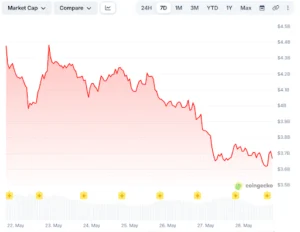
TLDR:
- Sui Network Stall stopped block production after a gas charging bug disrupted validator activity
- SUI fell up to 8% during the outage as trading volumes spiked across major exchanges
- The mainnet resumed after validators upgraded, restoring activity following a six-hour halt
- This marks Sui’s third major outage since launch, raising concerns over upgrade stability risks
Sui Network Stall disrupted blockchain operations after a gas charging bug halted validator activity across the mainnet.
The network paused block production for hours, triggering sharp SUI volatility. Operations resumed later, but the event renewed attention on system stability and resilience.
Gas Logic Bug Halts Validators and Freezes Mainnet
The Sui Network Stall validators stopped finalising blocks as the bug broke transaction processing rules inside the network’s fee calculation system.
SuiScan data showed a complete freeze in checkpoint production, confirming that no blocks entered the chain during the outage window.
The development team quickly identified the faulty update and coordinated a rollback-style fix through validator upgrades.
More than two-thirds of the total stake was upgraded, allowing the network to restart block production after nearly six hours.
RPC endpoints stayed online, so users viewed balances but could not execute transactions or interact with protocols. Sui confirmed that no funds were lost and no chain splits occurred during the disruption period.
The Sui Network Stall also affected ecosystem applications, which paused operations until finality returned across validators.
Developers linked the issue directly to the gas charging module, a core component that calculates transaction fees.
Earlier outages in 2024 and January 2026 showed similar validator coordination issues during system updates. Sui continues to position itself as a high-throughput blockchain, yet repeated disruptions challenge that narrative.
The team plans a full post-incident report to explain how the update bypassed testing safeguards. Recovery is completed once validators synchronize under the patched version of the protocol.
Market Reacts as SUI Drops Before Partial Recovery
SUI reacted immediately when the Sui Network Stall hit the market, as traders rushed to adjust positions. The token dropped between 6.6% and 8% during the outage as liquidity thinned across major exchanges.
Market capitalization briefly lost around $3.7 billion before stabilising after a partial recovery in trading hours. Bitcoin weakness during the same period increased selling pressure and deepened short-term downside movement in SUI.
Source: CoinGecko
Price action broke below the $1.00 support zone, a level that previously held during consolidation phases. Traders now watch the $1.05–$1.10 region as a recovery band if momentum returns after the incident.
The Sui Network Stall added volatility spikes across derivatives markets as funding rates fluctuated sharply. Institutional interest remains active, supported by staking programs and ecosystem expansion despite repeated network interruptions.
Sui has recorded three major outages since 2024, with each incident tied to upgrade or coordination failures. Market participants now question whether upgrade cycles introduce recurring operational risks for validators.
For now, traders remain cautious as they reassess exposure following the latest disruption event.
Disclosure: This article does not represent investment advice. The content and materials featured on this page are for educational purposes only.
AI trading robots expand from stocks into crypto as traders use automation tools like BulkQuant for market monitoring.
Summary
- AI trading robots are moving from stock tools into crypto as traders need automation for 24/7 markets; profits are not guaranteed.
- Platforms like BulkQuant position themselves as AI-assisted trading workflows offering multi-market access, automation, and risk controls.
- Experts stress these tools support decision-making and monitoring but do not ensure returns; advanced traders may prefer coding-based systems.
In 2026, more traders are looking beyond a single market. A few years ago, the phrase AI stock trading robot usually referred to stock scanners, technical alerts, automated equity trading tools, or software that helped traders filter market signals.
Now the conversation is changing.
If an AI stock trading robot can help traders scan stocks, identify volatility, and follow strategy rules, can similar AI automation logic also help traders find crypto income opportunities?
The question makes sense.
Stocks and cryptocurrencies are different markets, but traders face many of the same problems in both: too much data, fast price movements, emotional decision-making, and limited time to monitor charts manually. Crypto adds another challenge because the market runs 24 hours a day, seven days a week. It does not pause when traders sleep, work, travel, or step away from their screens.
Before going further, one point should be clear: an AI trading robot cannot guarantee income. It cannot remove crypto market risk, and it cannot make every strategy profitable. The phrase crypto income opportunities should be understood as potential trading setups that traders may identify, monitor, and manage with the help of automation — not as fixed income, passive income, or guaranteed returns.
That is why platforms such as BulkQuant are entering the discussion. Instead of treating “AI” as only a marketing label, BulkQuant focuses on bringing market monitoring, automated strategy execution, multi-market access, and risk settings into a more understandable workflow. For users who do not want to code their own trading systems but still want to explore AI trading robots, this kind of platform can offer a practical starting point.
This article looks at how AI stock trading robot-style automation may help traders explore crypto income opportunities in 2026, what features matter most, and how users can approach these tools without ignoring risk.
1. From stock screening to crypto opportunity filtering
One of the earliest reasons traders used AI stock trading robots was simple: there are too many stocks to monitor manually.
A trader cannot review every chart, every price movement, every volume spike, and every technical setup in real time. AI-powered tools can help narrow the field by scanning for price changes, volume expansion, volatility shifts, technical patterns, or market momentum.
In crypto, this problem becomes even larger.
Traders are not only watching Bitcoin and Ethereum. They may also track altcoins, exchange pairs, sector rotations, liquidity changes, and sudden moves across different platforms. The market never closes, and both opportunities and risks can appear quickly.
This is where the logic behind AI trading robots can move from stock trading into crypto trading.
The robot does not need to “predict the future” to be useful. Its first value is helping traders filter chaotic market information into conditions worth reviewing.
For traders searching for crypto income opportunities, the first step is not always placing a trade. Often, the first step is knowing where to look.
2. Crypto markets never sleep, so traders need better monitoring
Stock traders work around defined market sessions. There is an opening bell, a closing bell, and time to review the market after the session ends.
Crypto traders do not have that structure.
Bitcoin can break a key level at night. Ethereum can move sharply over the weekend. An altcoin can react to news, liquidity changes, exchange announcements, or on-chain activity within minutes.
Many traders miss potential opportunities not because they lack judgment, but because they cannot be online all the time.
An AI trading robot can help by creating a more stable monitoring process. It may be used to:
- Track price movement across major crypto assets
- Watch for unusual volume changes
- Identify volatility expansion
- Monitor breakout or pullback conditions
- Organize signals across different markets
- Alert users when predefined conditions appear
This matters because crypto income opportunities often appear quickly and disappear quickly. A more consistent monitoring system can reduce the chance of missing important market changes.
BulkQuant fits naturally into this part of the discussion because it supports crypto, forex, and stock-related trading automation workflows. Its value is not that it creates risk-free opportunities, but that it gives users a simpler way to observe markets and understand how AI-assisted strategy execution may work across different asset classes.
Monitoring a potential opportunity does not mean a trader should immediately act on it. It simply helps users see market changes earlier and with more structure.
3. AI trading robots can help reduce emotional income expectations
Many traders who search for crypto income opportunities are hoping to find a faster and easier way to make money.
That expectation can be dangerous.
Crypto markets can intensify emotion. When prices rise quickly, traders fear missing out. When prices fall sharply, they panic. After a loss, some traders increase their position size to recover quickly. After seeing others post gains, they may enter risky assets without a plan.
One of the practical benefits of an AI trading robot is that it can move the trading process away from emotion and closer to rules.
A structured automated workflow may require users to define:
- Which market conditions matter
- Which assets should be monitored
- When a strategy becomes active
- How much exposure is allowed
- When a stop-loss should apply
- When a position should be reduced or closed
- When automation should be paused
These rules may not sound exciting, but they are more useful than trading based on a feeling.
For traders who want to explore crypto income opportunities over time, discipline matters more than impulse. AI trading robots should not encourage users to trade more aggressively. They should help make trading behavior more controlled.
4. Stock-style AI scanning can be applied to crypto market signals
A common function of AI stock trading robots is market scanning.
These systems may look for price breakouts, volume expansion, trend shifts, technical indicator triggers, volatility changes, or unusual market behavior.
Crypto traders often watch similar signals:
- Bitcoin breaking a key price range
- Ethereum showing stronger volume
- Altcoins rotating after major coins move
- The market entering a high-volatility phase
- A token showing repeated strength
- Support and resistance levels changing
- Capital moving from large-cap crypto assets into smaller tokens
AI trading robots can help organize these signals faster than manual review.
This is important because traders do not need to watch everything with equal attention. A better approach is to filter noise first, then spend more time analyzing markets that actually match their strategy.
Effective trading is not about looking at more charts. It is about knowing which signals deserve attention.
5. Crypto income opportunities often depend on consistent execution
Many traders believe income opportunities come from finding the perfect setup.
In reality, execution is often the bigger problem.
A trader may identify the right direction but enter too late. Another may close too early. Some refuse to cut losses. Others change their plan in the middle of a trade. Some abandon their rules after a few losing trades.
AI trading robots can help improve execution consistency.
Through an automated strategy workflow, traders may define:
- Entry conditions
- Exit conditions
- Stop-loss rules
- Take-profit behavior
- Position size
- Risk exposure
- Pause conditions
This does not mean a strategy will always work. It means the trader is less dependent on last-minute emotion.
In crypto, this matters because price movement is fast and sentiment changes quickly. Without rules, trading can easily become chasing rallies and panic-selling pullbacks.
If an AI trading robot helps traders find crypto income opportunities, its real value is not guessing every move correctly. Its value is helping users handle potential opportunities with a more stable process.
This is where BulkQuant can be positioned carefully. It is better understood as an AI-assisted trading workflow platform rather than a simple buy-and-sell robot. Users can explore how market direction, automated strategy execution, and risk settings connect before deciding how deeply they want to use the platform.
Where BulkQuant fits in the AI trading robot landscape
When comparing AI trading robots, traders should not only ask whether a platform uses the word “AI.” They should ask whether it fits their actual trading situation.
BulkQuant may be relevant for users who want a lower technical barrier and a more guided way to explore AI-assisted trading workflows.
| User Need | How BulkQuant May Fit |
| No coding required | Offers a simplified AI-assisted trading workflow |
| Multi-market access | Supports crypto, forex, and stock-related automation |
| Understanding AI trading robots | Provides a more visual dashboard and strategy workflow |
| Reducing manual monitoring pressure | Supports market observation and automated strategy execution |
| Beginner-friendly access | Eligible new users can receive a $10 instant reward plus $50 free trial credit |
| Exploring before deeper use | Trial access can help users review platform features and workflow |
| Risk awareness | Users should review settings before activating automation |
This does not mean BulkQuant is suitable for every trader. Advanced users who want to fully customize code, build complex API strategies, or conduct deep quantitative research may prefer more developer-oriented platforms.
For users who want to start with a lower technical barrier and understand how AI trading robots can support market monitoring, strategy execution, and multi-market workflows, BulkQuant can serve as a more accessible entry point.
How beginners should start
Beginners should not see the words “AI” and “crypto income” and immediately commit large amounts of capital.
A more careful path looks like this.
First, understand what the tool actually does. Is it a scanner, an alert tool, a strategy execution platform, or a full automated trading system?
Second, observe the market before trading. See how the system identifies signals, sends alerts, and reacts to volatility.
Third, review the strategy logic. Do not use a strategy that is not understood.
Fourth, check the risk settings. Position size, stop-loss behavior, pause controls, and asset selection should be clear before any automation is activated.
Fifth, start with trial access or small exposure. Automation should not be treated as a guaranteed income source.
Sixth, review performance regularly. Traders should check how the system behaves in different market conditions, not just focus on one winning or losing trade.
For beginners, the most important goal is not speed. It is building better trading habits.
Common mistakes to avoid
When traders use AI trading robots to explore crypto opportunities, several mistakes often appear:
- Treating an AI trading robot as a guaranteed income tool
- Not checking whether the platform supports crypto markets
- Using a stock-focused tool for crypto without understanding market differences
- Ignoring stop-losses and exposure limits
- Starting with too much capital
- Depending completely on automation without observing the market
- Judging a system only by short-term results
- Being attracted by claims such as “AI profits” or “automatic income.”
Avoiding these mistakes is more important than choosing a platform that simply looks powerful.
Final thoughts
Can an AI stock trading robot help traders find crypto income opportunities in 2026?
The answer is not a simple yes or no.
If traders expect it to create income automatically, guarantee profits, or carry risk on their behalf, the answer is no. No AI trading robot can remove market uncertainty.
But if traders use it as a tool for market monitoring, signal filtering, strategy execution, risk control, and performance review, then it may help them explore crypto opportunities with more structure.
In 2026, the most useful AI trading robots are not the ones that only promote automatic profits. They are the tools that help traders build discipline, reduce emotion, understand market behavior, and manage risk.
BulkQuant should be understood in that context. It is not a guaranteed income system. It is an AI-assisted trading platform that gives users a more accessible way to explore multi-market automation, strategy execution tools, and a simplified trading workflow. For users looking at crypto, forex, and stock-related automation, it can provide a clearer starting point.
For traders moving between stocks and crypto, the value of AI automation is not that it replaces judgment. Its value is that it can make the trading process more stable, more visible, and easier to improve over time.
FAQs about AI stock trading robots and crypto income opportunities
What is an AI stock trading robot?
An AI stock trading robot is a software-based trading tool that uses market data, automation rules, algorithmic logic, or AI-assisted models to support market scanning, trading alerts, strategy execution, or risk management.
Can an AI stock trading robot be used for crypto trading?
Some tools can be used for crypto trading if they support digital assets or crypto-related automation workflows. If a platform is built only for stocks, traders should check whether it fits crypto market conditions.
Can AI trading robots help traders earn crypto income?
They cannot guarantee income. A more accurate way to describe their role is that they may help traders monitor markets, filter opportunities, execute strategies, and manage risk more systematically.
Is BulkQuant suitable for beginners?
BulkQuant may be suitable for users who want to explore AI-assisted trading with a lower technical barrier. It provides a simplified dashboard, multi-market access, and automated strategy execution tools. Eligible new users can also receive a $10 instant reward plus $50 free trial credit to explore platform features and workflow.
Can BulkQuant guarantee trading profits?
No. BulkQuant, like other AI trading robot platforms, cannot guarantee profits or remove market risk. Users should understand strategy logic, review risk settings, and trade according to their own risk tolerance.
Are AI trading robots suitable for new traders?
Some AI trading robots may be suitable for beginners when they provide a no-code dashboard, clear strategy workflow, and risk controls. New traders should still start carefully and avoid treating automation as low-risk or guaranteed.
What is the biggest risk of using an AI trading robot?
The biggest risk is assuming that “AI” means certainty. Markets can still move sharply, and strategies can fail. Without risk controls, automation may increase losses.
What features matter most when choosing an AI trading robot?
Traders should focus on market support, risk controls, strategy transparency, automated execution, real-time monitoring, performance review tools, and whether the platform matches their experience level.
Disclosure: This content is provided by a third party. Neither crypto.news nor the author of this article endorses any product mentioned on this page. Users should conduct their own research before taking any action related to the company.
5 Simple Tips For Keeping Your Car’s Depreciation To A Minimum

Ripple XRP ITS HAPPENING IM NOT KIDDING ANYMORE OMGGGGGGGGGGGGGGGGGGGGGGGGG!!!

Drink driving arrest after car seen “trying to drift” around South Belfast roundabout


-

 Business5 days ago
NYT Strands Answers May 24 2026 Revealed for Puzzle No. 812 Theme Summer Essentials
-

 Politics4 days ago
Bridgerton Season 5: Cast, Release Date And Everything We Know So Far
-

 Crypto World7 days ago
Robinhood crypto COO Tanya Denisova exits
-

 Business3 days ago
Selena Gomez Reportedly Upset Over Benny Blanco’s Comments on Her ‘Terrible’ Diet
-

 Tech5 days ago
Microsoft’s quiet Claude Code retreat and the real cost of enterprise AI
-
Crypto World3 days ago
Micron Crosses $1 Trillion Market Cap as AI Demand Reshapes Memory Sector
-

 NewsBeat3 days ago
Israel says it has killed new Hamas military leader in Gaza City airstrikes
-

 Business5 days ago
BTS Sells Out Four Las Vegas Shows at Allegiant Stadium for ARIRANG World Tour
-
Tech3 days ago
The Samsung pay deal is the moment Korean unions changed register
-

 Tech3 days ago
Millions of AI agents imperiled by critical vulnerability in open source package
-

 Tech21 hours ago
Waymo dominates autonomous vehicle registrations as Tesla trails behind
-

 Tech4 days ago
Westone Audio and Etymotic Acquired by Fidelity Collective in Major IEM Market Move
-
 Tech4 days ago
China assigns ID codes to 28,000+ humanoid robots
-
 Crypto World5 days ago
Nvidia (NVDA) CEO Calls on Super Micro to Strengthen Export Controls Amid Smuggling Probe
-

 Tech3 days ago
NASA taps Blue Origin to deliver lunar rovers for Moon Base initiative
-
Crypto World3 days ago
SpaceX’s $2 Trillion IPO: Why Tech Giants Nvidia (NVDA), Apple (AAPL), and Microsoft (MSFT) May Face Pressure
-
Crypto World5 days ago
Brian Armstrong Outlines Crypto Vision for the Future Financial System
-
 Entertainment4 days ago
‘Breaking Bad’ Star’s Easy-to-Binge 6-Part Crime Series Spin-Off Is Finally Heading to Free Streaming
-
 Crypto World3 days ago
Spain blocks prediction markets Polymarket Kalshi
-

 Business5 days ago
Yatra Online, Inc. 2026 Q4 – Results – Earnings Call Presentation (NASDAQ:YTRA) 2026-05-25
You must be logged in to post a comment Login