

Crypto World
Vietnam Proposes Allowing SMEs to Use Digital Assets as Loan Collateral

Vietnam’s Ministry of Finance has proposed letting small and medium-sized enterprises use digital assets, virtual assets and intellectual property as collateral for bank loans.
The proposal is part of a draft revised Law on Support for SMEs, which is open for public consultation, according to a Friday report by Vietnam News. Under the framework, businesses could secure loans using future-formed assets, property rights, intangible assets and digital or virtual assets.
SMEs and household businesses account for more than 98% of all enterprises in Vietnam, yet outstanding loans to the segment represent only around 20% of total bank credit in the economy, per the report. The Ministry attributed the imbalance to a lack of eligible collateral, limited financial transparency and the small capital base of most SMEs.
Many startups and technology-driven companies hold valuable software, patents or intellectual property but have no land or physical assets to pledge, the report claimed. The new proposal marks a policy shift that could open up credit access for thousands of startups and tech companies currently locked out of the formal lending system.
Related: Bithumb enters Vietnam crypto license race with SSI Digital deal
Vietnam wants banks to lend on business plans
The draft also pushes credit institutions to expand lending based on credit ratings, business plans, cash flows and market potential, rather than fixed assets alone.
Beyond collateral reform, the draft law outlines incentives for green and sustainable businesses, including preferential access to credit guarantees, concessional financing and interest-rate support for circular economy and energy-saving projects. Tax incentives and support for ESG compliance reporting are also included.
The draft is currently open for public consultation.
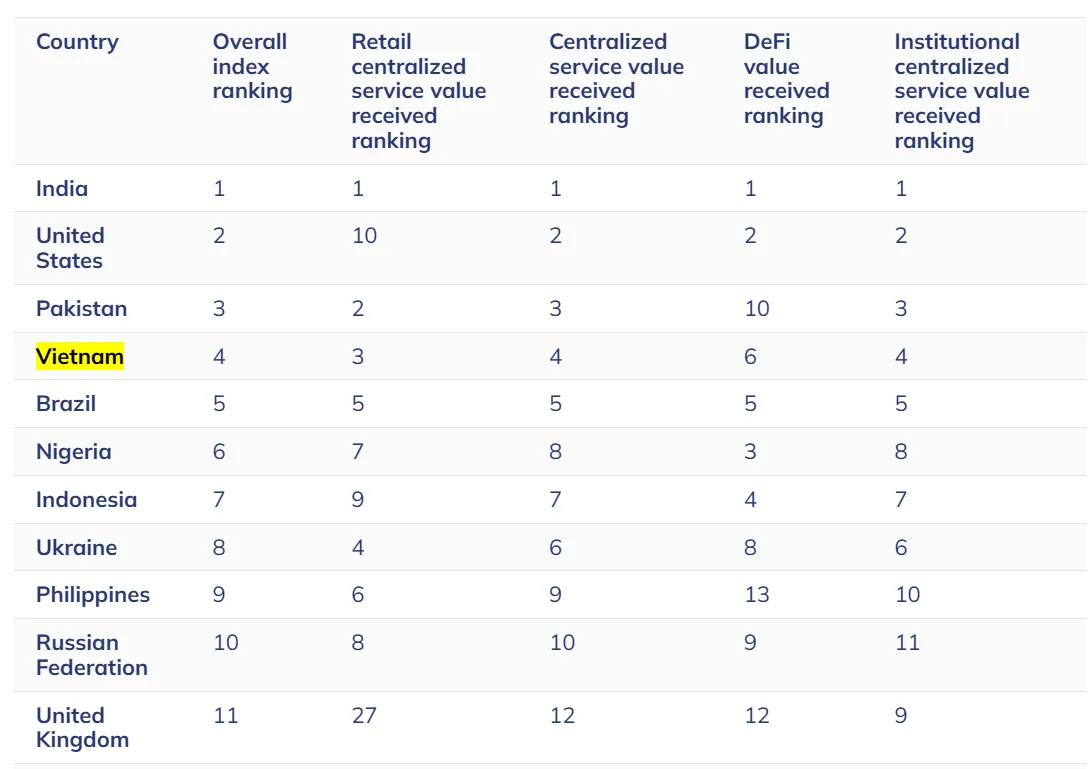
Vietnam has become one of the most active crypto markets in the world, ranking fourth in Chainalysis’ 2025 Global Crypto Adoption Index behind India, the United States and Pakistan.
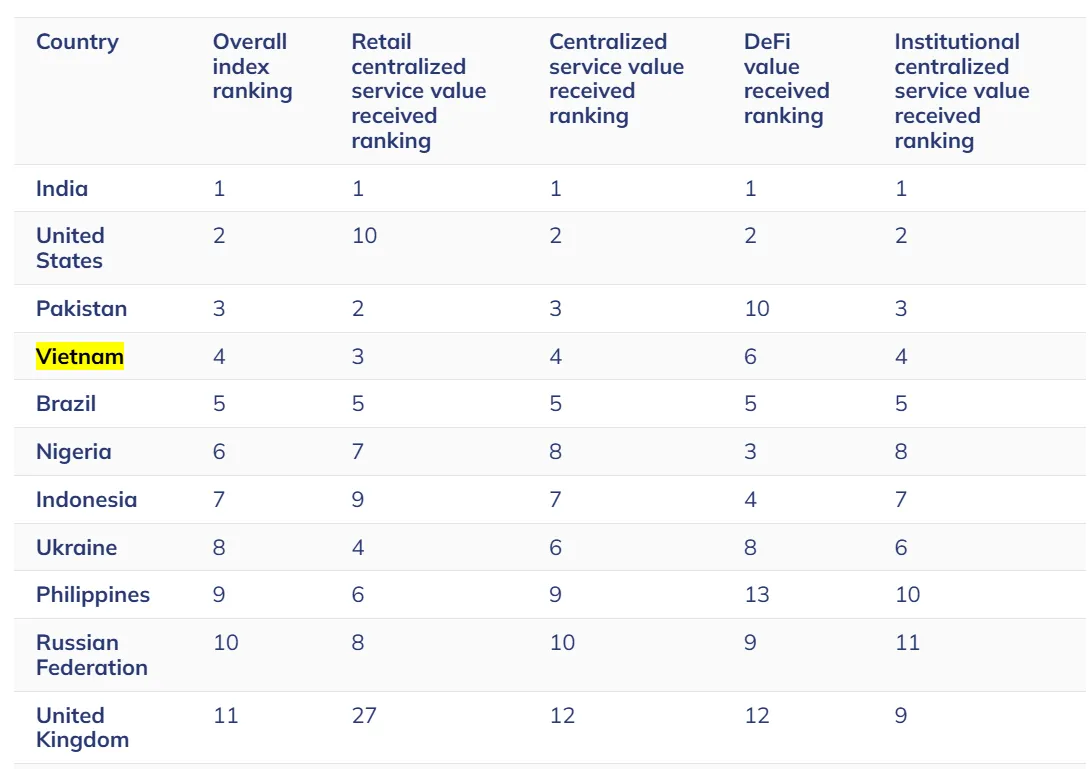
Global cryptocurrency adoption index. Source: Chainalysis
Related: Vietnam arrests ONUS-linked suspects in alleged crypto fraud case
Vietnam eyes Q3 launch of regulated crypto market
As Cointelegraph reported, Vietnam could see its first regulated crypto market activity as early as the third quarter of 2026, Deputy Minister of Finance Nguyen Duc Chi said at the Digital Trust in Finance 2026 forum.
In March, regulators opened a licensing pathway for domestic crypto trading platforms earlier this year, with five companies, including affiliates of Techcombank, VPBank and LPBank, having already passed an initial qualification round to launch the country’s first regulated exchange.
Magazine: Guide to the top and emerging global crypto hubs — Mid-2026


Key Takeaways
- Nvidia and Microsoft are set to introduce Windows PCs featuring Nvidia processors as early as next week.
- The announcement coincides with Taiwan’s Computex trade show and Microsoft’s Build developer conference in San Francisco.
- Dell and Microsoft’s Surface lineup are anticipated to be among the initial manufacturers offering these Nvidia-based systems.
- Microsoft plans to introduce software enabling AI agents to execute tasks locally on Windows platforms.
- NVDA shares finished Friday’s session at $211.14, declining 1.45%.
A partnership between Nvidia and Microsoft is poised to introduce Windows-based PCs utilizing Nvidia processors as the core processing unit as soon as next week, based on reporting from Axios.
The reveal is timed to coincide with two prominent industry gatherings: Taiwan’s Computex technology exhibition and Microsoft’s Build developer summit taking place in San Francisco.
Microsoft’s flagship Surface product range is anticipated to lead the charge in adopting this Nvidia-based technology. Dell has also been identified as an initial manufacturing partner for this initiative.
NVDA concluded Friday’s trading at $211.14, representing a 1.45% decrease.
Nvidia Expands Into Personal Computing Processors
The personal computer processor landscape has traditionally been controlled by Intel and AMD, though Qualcomm has recently gained traction with Arm-architecture chips designed for Windows notebooks.
Nvidia’s entrance into this sector introduces another formidable competitor to an already crowded marketplace. Apple’s M-series silicon has already established impressive benchmarks for battery longevity and on-device AI performance across its MacBook product family.
This reported Nvidia initiative emerges as Microsoft seeks processors capable of delivering enhanced on-device AI functionality combined with superior power efficiency.
Microsoft is simultaneously preparing to launch software that allows AI agents to perform operations directly on Windows devices, eliminating dependence on cloud-based processing.
This development connects the hardware introduction to a larger industry movement toward localized AI computation on portable and desktop computers.
Financial Analysis and Valuation
Nvidia’s present trading price of $211.14 remains significantly beneath its GF Value calculation of $334.32, indicating a possible undervaluation of approximately 36.8%, based on GuruFocus analytics.
The company’s P/E ratio currently registers at 32.33x, considerably lower than its five-year median of 60.92x, demonstrating a reduced valuation compared to historical norms.
GuruFocus assigns NVDA a GF Score of 96 out of 100, with outstanding ratings in profitability, growth trajectory, and market momentum.
The financial strength metric receives a 9 out of 10 rating. The primary weakness appears in valuation, scoring 4 out of 10, with GuruFocus identifying it as a “Possible Value Trap.”
Insider transaction data from the previous three months reveals $163.9 million in stock sales by company insiders, a metric investors should monitor.
Nvidia currently commands a leading market position in data center AI acceleration hardware. Expanding into the Windows PC segment would establish a new revenue channel within its hardware portfolio.
The upcoming Computex and Build conferences are anticipated to provide additional information regarding device specifications and supporting software infrastructure.



Robert Kiyosaki has urged investors to rely on education and careful thinking as Bitcoin faces another price correction.
Summary
- Robert Kiyosaki warned investors not to follow market hype blindly during Bitcoin’s latest correction.
- He said education remains the key asset, even when buying Bitcoin, gold or silver.
- Bitcoin’s weak chart setup keeps traders cautious as support and recovery levels remain under pressure.
Robert Kiyosaki says education comes before assets
The Rich Dad Poor Dad author said investors should not follow market hype without understanding what they are buying. His warning came as Bitcoin continued to trade under pressure after a recent pullback.
Kiyosaki said even assets often viewed as safe can still cost investors money if they buy at the wrong time or without a clear plan. He has long supported Bitcoin, Ethereum, gold and silver, but his latest comments focused more on financial education than price targets.
He told followers not to “drink financial planners’ Kool-Aid” when they describe U.S. government bonds as safe. He also said, “There is nothing safe…from stupidity.”
Kiyosaki added that the most important asset is not Bitcoin, gold or silver. He said, “Always remember your greatest asset lies between your right ear and left ear.”
Bitcoin price correction tests investor discipline
Bitcoin’s latest correction has brought more caution back to the market. The asset recently traded near $73,700 after a three-day slide, with analysts watching whether buyers can hold key support.
Earlier reports showed that Bitcoin stabilized near $73,000 after geopolitical tensions, ETF outflows and leveraged liquidations weighed on market sentiment. The same analysis said bearish chart signals still pointed to risk of further losses.
Kiyosaki’s message fits that backdrop. He has often told investors to buy scarce assets during market fear, but he also warned that buying only because others are excited can create losses.
That makes his latest warning different from his usual bullish Bitcoin posts. He still favors hard assets, but he says investors must understand cash flow, risk and timing before entering the market.
Bonds, gold and silver remain in focus
Kiyosaki also urged investors to watch global cash flows. He pointed to major holders such as Japan and China reducing exposure to U.S. bonds while increasing interest in gold and silver.
He has often criticized U.S. bonds, fiat currency and retirement products tied to traditional markets. In his view, inflation and rising government debt continue to reduce purchasing power.
As previously reported by crypto.news, Kiyosaki recently said Bitcoin and Ethereum may outlast old retirement plans. That report also noted that critics question his timing because some of his past crash calls did not happen within the periods he suggested.
Kiyosaki remains calm during Bitcoin and Ethereum price swings. He has argued that national debt and dollar weakness matter more than short-term market moves.
Alternative asset warning remains balanced
Kiyosaki continues to hold a long-term preference for Bitcoin, Ethereum, gold, silver, oil and cattle. He has also said he does not own a 401k or IRA and avoids publicly traded stocks and bonds.
However, he has also said he is not a financial advisor. He told followers that he shares what he is buying and why, but each person must decide with their own advisers.
That point matters because his forecasts are often aggressive. In March, he predicted Bitcoin could reach $750,000 and Ethereum could reach $95,000 after a major crash.
For now, his latest message is more cautious. It tells investors to avoid blind trust in any asset class, including Bitcoin.
The main message is simple. Bitcoin, gold and silver may attract buyers during inflation fears and market stress, but investors still need knowledge, patience and a clear plan before buying.
Ethereum remains under pressure across higher and lower timeframes after failing to reclaim key resistance levels.
The asset has broken below a multi-month bullish structure on the daily chart while continuing to trade inside a descending channel on the 4-hour timeframe.
Meanwhile, sentiment data suggests that aggressive buyers remain largely absent.
Ethereum Price Analysis: The Daily Chart
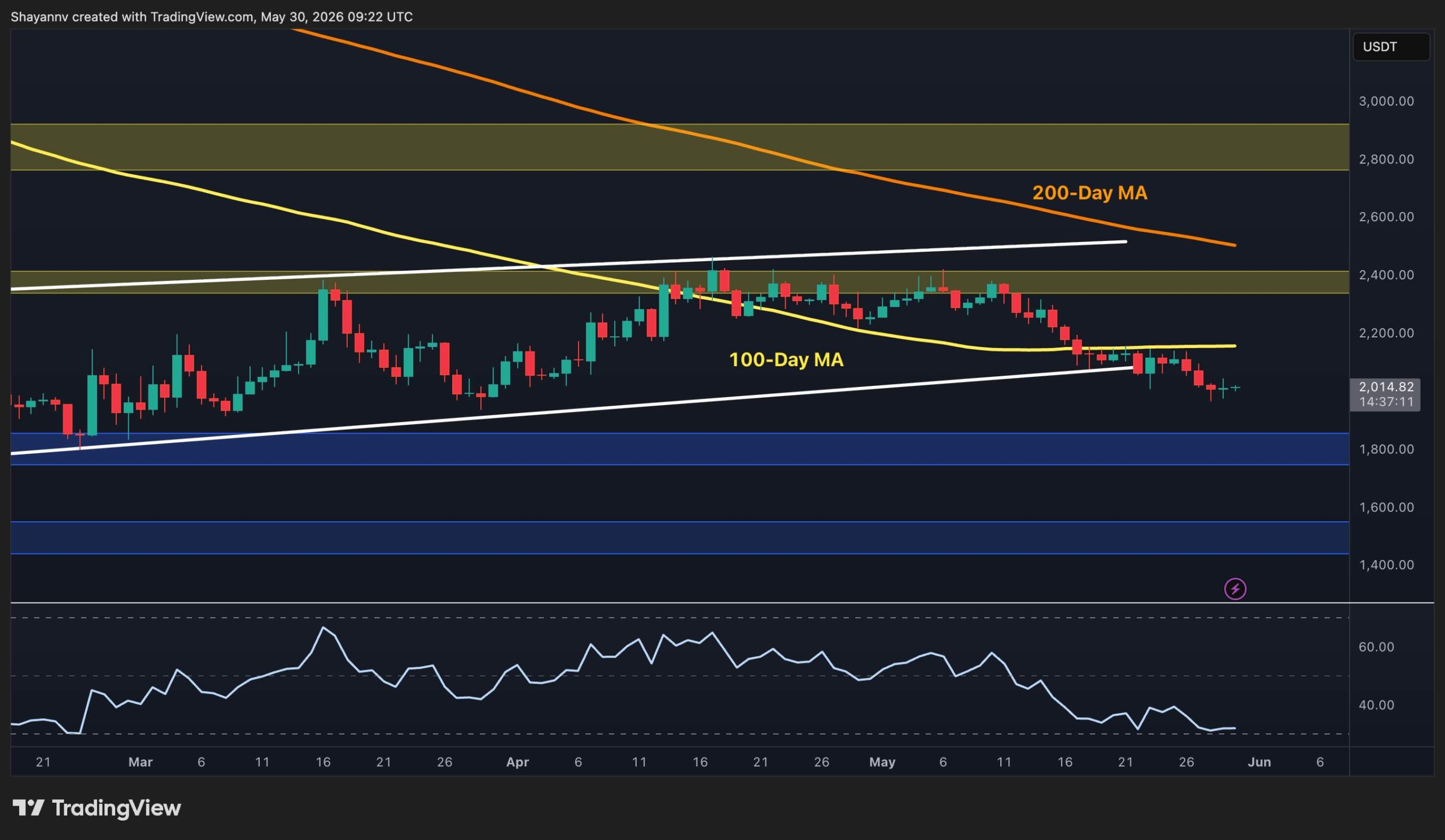
On the daily timeframe, ETH has decisively broken below the large ascending triangle structure that had developed between February and May. The move occurred after multiple rejections from the $2.4K resistance zone, which coincides with a major horizontal supply area and the former breakout region.
The bearish move has also pushed the price below the 100-day moving average, which is currently around $2.2K. More importantly, ETH remains significantly below the declining 200-day moving average near $2.5K. This indicates that the broader trend continues to favor sellers.
The recent rejection from the $2.4K zone confirms it as the primary resistance area. As long as ETH remains below this region, any recovery attempt may be viewed as a corrective bounce rather than a trend reversal.
On the downside, the next major support lies around the $1.8K zone, highlighted by the blue demand area and the February swing low. A daily close below the current $2K psychological support could increase the probability of a move toward that region.
Momentum indicators also remain weak. The RSI is hovering near oversold territory, which reflects persistent bearish momentum despite the recent stabilization around $2K.
ETH/USDT 4-Hour Chart
The 4-hour chart presents a clear descending channel that has guided price action lower throughout May. ETH has been moving toward the lower boundary of the channel again after failing to sustain any meaningful recovery from the mid-range resistance area.
The price is currently trading around $2K, which is a significant demand zone for the market. This area has produced a modest reaction so far, but buyers have yet to generate a convincing reversal signal.
The first resistance level is the descending channel’s upper boundary and the horizontal supply zone, which sits around $2.15K. Above that, the major resistance remains at $2.25K, followed by the upper supply zone near $2.4K.
A breakout above the descending channel could trigger a short-term relief rally toward the $2.15K and $2.25K regions. However, as long as the channel structure remains intact, the path of least resistance appears tilted to the downside.
Conversely, losing the $2K support zone would expose the channel’s lower extension and increase the likelihood of a deeper correction toward the $1.8K area identified on the daily chart.

Sentiment Analysis
The Ethereum Taker Buy Sell Ratio offers additional insight into current market sentiment. This metric measures the balance between aggressive buyers and aggressive sellers across exchanges. Readings above 1 indicate buyer dominance, while values below 1 suggest that market sell orders are outweighing buy orders.
The chart shows a persistent decline in the ratio over recent months, with the metric currently near 0.98 and below the neutral 1.0 threshold. This indicates that sellers continue to dominate order flow despite ETH’s prolonged correction.
For a sustainable recovery to develop, traders would likely need to see the Taker Buy Sell Ratio reclaim and hold above 1. Until that occurs, order flow suggests that bullish momentum remains limited and that rallies may continue to face significant selling pressure.

The post Ethereum Price Analysis: ETH Risks Deeper Drop as $2K Support Comes Under Pressure appeared first on CryptoPotato.
Ripple CTO Emeritus David Schwartz has outlined how the XRP Ledger could respond if a state-level attack targeted validators, node operators or core network infrastructure.
Summary
- David Schwartz said XRPL could adapt if state pressure targeted validators or network operators.
- The plan points to Tor, I2P and reserve nodes as possible tools during extreme attacks.
- The debate follows recent XRPL upgrade, validator and decentralization discussions across the ecosystem.
Schwartz made the comments during a discussion about whether a blockchain can survive pressure from an authoritarian state. The question focused on what would happen if authorities started raiding nodes or forcing operators offline.
He said intelligence services could create short-term disruption. However, he argued that long-term control would be harder because the XRP Ledger software, validator set and network structure can change when needed.
The idea has been described as a “Doomsday” approach for XRPL. It would not be a normal operating mode. Instead, it would act as an emergency path if the network faced direct physical or legal attacks.
Schwartz’s position centers on one point: a public blockchain can change its rules if users, developers and operators agree that survival requires it.
Tor and I2P enter XRPL discussion
The proposed emergency setup would use privacy networks such as Tor and I2P to hide parts of XRPL’s consensus coordination. These tools could make it harder for authorities to identify and target operators.
In that model, high-performance nodes would continue to process transactions. If attackers seized or disabled some nodes, reserve infrastructure could replace them.
A second, lighter layer would help manage trusted validator lists. That layer would operate only when needed and could use anonymous routing to reduce exposure.
The goal would be to keep consensus alive while lowering the chance that one government could identify all key participants at once.
XRPL validator design remains the core issue
XRPL uses a Unique Node List model. Each server follows validators it trusts not to collude. This differs from proof-of-work and proof-of-stake systems, where mining power or token stake often drives network security.
As previously reported by crypto.news, Schwartz recently said XRPL has more events that are “technically hard forks” than many older public blockchains. He linked that pattern to the network’s upgrade model and its use of smart transactors.
Separate coverage also detailed XRPL’s Negative UNL tool. That mechanism allows the network to keep operating when trusted validators go offline or fail to perform properly.
Those features matter in the current debate because Schwartz’s emergency scenario depends on XRPL being able to replace or ignore damaged infrastructure without halting the network.
Governance debate grows around XRP
The comments come as XRPL continues to update its infrastructure. The recent 3.1.3 upgrade included fixes for NFTs, Permissioned Domains, Vaults and the Lending Protocol.
Schwartz has also addressed asset-control questions around Ripple’s RLUSD stablecoin. As reported by crypto.news, he said RLUSD can support settlement use cases but is not neutral because Ripple can freeze and claw back tokens under legal direction.
That contrast adds context to the XRPL discussion. XRP itself does not rely on an issuer that can freeze balances in the same way as a stablecoin. However, XRPL still depends on software, validators and user agreement.
Schwartz’s “Doomsday” comments do not mean XRPL faces an active state attack. They show how one of its key architects thinks the network could react under extreme pressure.
XRP traded near $1.33 on May 31 as traders watched whether fresh exchange outflows, ETF demand and a key chart support area could help the token recover from recent weakness.
Summary
- XRP saw 25.24 million coins leave exchanges after the year’s largest inflow signaled capitulation selling.
- ETF flows added $131.94 million this month, keeping institutional demand in focus despite weakness persisting.
- Analysts watch $1.34 support, with $1.37 and $1.40 as nearby recovery targets if buyers hold.
Santiment data showed that XRP recorded its largest exchange inflow of the year on Thursday, with 22.80 million XRP moving onto trading platforms. Large exchange inflows often draw attention because they can show that holders are preparing to sell.
However, the move quickly reversed. Santiment said another 25.24 million XRP moved back off exchanges after the inflow. That shift suggests some holders withdrew coins again, reducing the amount of XRP available for immediate selling.
Santiment said the large exchange inflow happened near XRP’s local price bottom. The firm said retail traders who sold during the move were left “wishing they hadn’t” after XRP gained about 5% from that capitulation point.
The data does not confirm a full trend change. Still, the reversal in exchange flow gives traders a fresh signal to watch as XRP tries to defend its short-term price structure.
XRP price holds near $1.33
XRP traded at $1.33 at the time of writing. The token was down 0.36% over 24 hours and had slipped 2.06% over the past week.
The 24-hour trading volume stood at about $1.09 billion. XRP moved between $1.33 and $1.35 during the session, showing a narrow trading range as buyers and sellers stayed close to the same price zone.
XRP remains the fifth-largest crypto asset by market capitalization, with a market value of about $82.7 billion. Its fully diluted valuation stood near $133.4 billion, based on a maximum supply of 100 billion tokens.
The wider trend remains weak. XRP is down 3.13% over the past month and 37.47% over the past year. The token is also down more than 44% over the past 200 days.
Ali Martinez said he is watching the bottom of XRP’s rising channel at $1.34 as a possible buying zone. He said that if the level holds, the next targets sit at $1.37 and $1.40.
That setup makes the $1.34 area important for short-term traders. A clean break below it could weaken the rebound case, while a close above $1.40 may show that buyers are regaining control.
ETF demand adds another layer to XRP market
XRP ETFs reportedly recorded $131.94 million in net inflows this month. The figure adds to the view that regulated XRP products are still attracting demand despite the token’s recent price weakness.
As previously reported by crypto.news, Morgan Stanley disclosed holdings in two XRP-focused exchange-traded funds. The bank reported 1,700 shares of the Volatility Shares XRP ETF and 100 shares of the Grayscale XRP ETF in a first-quarter filing.
The positions were small compared with Morgan Stanley’s wider portfolio. Still, the filing placed the bank among institutions gaining XRP exposure through regulated investment products.
Earlier reports also showed that XRP investment products attracted $85.8 million in inflows over three weeks. During the same period, Bitcoin and Ethereum funds recorded large net outflows.
That contrast gives XRP a stronger institutional angle than its weak spot price suggests. However, ETF inflows alone do not guarantee a price rally. XRP still needs stronger demand in the open market and a clean break above resistance.
XRPFi narrative grows around collateral and yield
XRP’s market story is also expanding beyond payments. RippleX recently shared comments on how XRP can be used as collateral for yield strategies.
The example included wrapping XRP as FXRP on Flare, borrowing stablecoins against it, and deploying those assets into protocols. It also pointed to vault-based strategies across XRPL and Flare.
This matters because XRP has long been known mainly for payments and liquidity. A stronger collateral and yield narrative could give holders more ways to use the asset beyond simple transfers.
Flare-related XRPFi products already aim to place XRP into lending, vault and DeFi structures. These tools may help turn idle XRP into productive capital, although they also bring smart contract, liquidity and market risks.
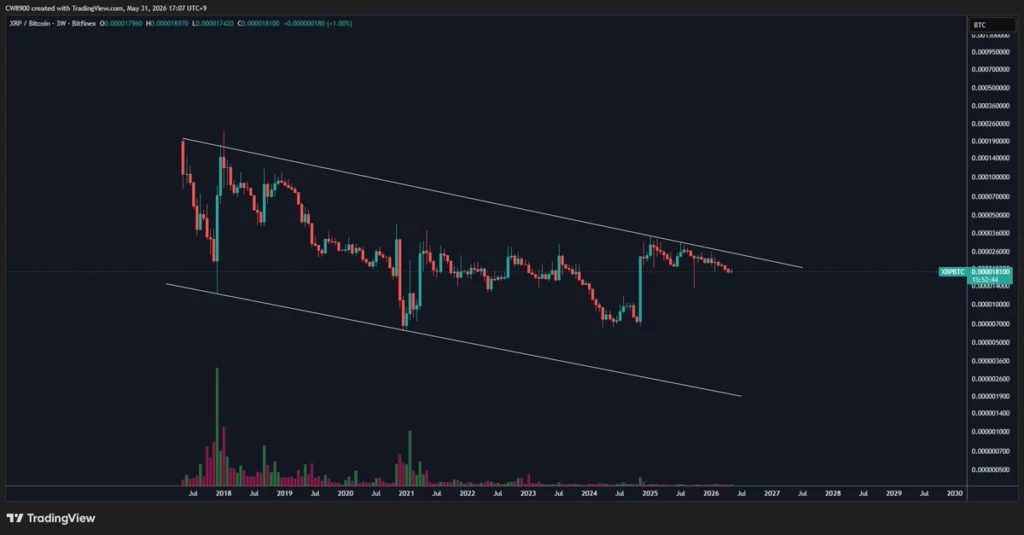
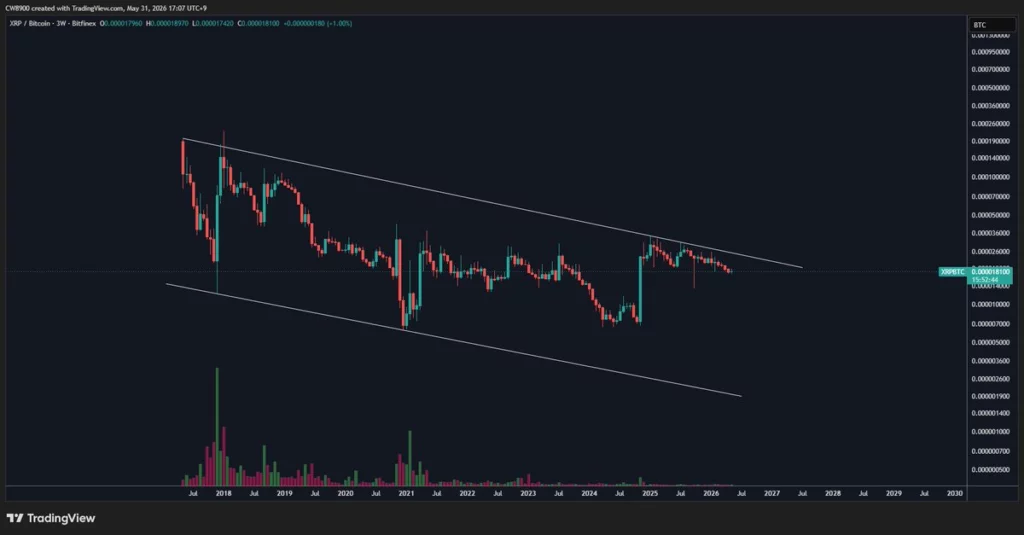
CW said XRP/BTC has stayed inside an eight-year downtrend channel and argued that a break could start a new cycle. That remains a market view, not a confirmed breakout.
For now, XRP’s path is tied to three levels. The $1.34 area remains the support zone to defend. The $1.37 mark is the first recovery target. The $1.40 level is the main near-term test for stronger buyers.
If exchange outflows continue and ETF demand stays positive, XRP may have room for a short rebound. If $1.34 fails, traders may shift focus back to lower support levels.
Disclosure: This article does not represent investment advice. The content and materials featured on this page are for educational purposes only.

Key Takeaways
- Reports indicate Elon Musk is considering combining Tesla with SpaceX, which is moving toward a public offering.
- The potential transaction could involve SpaceX utilizing its elevated IPO valuation as acquisition currency for Tesla, valued at approximately $1.65 trillion.
- The merged company would carry a valuation near $3.4 trillion while operating at a loss, with negative combined GAAP earnings.
- Existing Tesla investors would experience ownership dilution and become subject to SpaceX’s restrictive governance framework that concentrates power.
- Wedbush analyst Dan Ives estimates an 80% likelihood of the merger occurring; prediction market Kalshi indicates 52% probability by May 2027.
Shares of Tesla (TSLA) finished trading at $435.79 on May 29, declining 1.43% as speculation mounted regarding a possible combination of Elon Musk’s two largest ventures.
On May 27, CNBC disclosed that discussions between Tesla and SpaceX regarding a potential merger are underway. According to sources, Tesla personnel anticipate such a transaction will “eventually take place,” with the subject being discussed openly within the organization.
Dan Ives from Wedbush Securities assessed the probability of completion at 80%, suggesting that strategic plans for operational integration already exist. Prediction marketplace Kalshi currently assigns 52% odds to the deal closing before May 2027.
SpaceX is advancing toward an initial public offering anticipated around mid-June, targeting a market capitalization near $1.75 trillion. Tesla’s current market cap stands at roughly $1.65 trillion — remarkably similar figures.
Should SpaceX purchase Tesla at these valuations, the company would require approximately double its existing share count. The resulting combined organization would command a valuation around $3.4 trillion, positioning it as the fifth-largest publicly traded corporation worldwide, trailing only Apple, Alphabet, Nvidia, and Saudi Aramco.
The financial fundamentals present significant challenges. Tesla generated $3.9 billion in GAAP net income during the trailing twelve months, representing a substantial decline from $15 billion in 2023. Meanwhile, SpaceX reported a net loss of $4.94 billion last year. Combined on a pro-forma basis, the merged entity would currently show a GAAP loss approaching $1 billion annually.
Cash Flow Challenges Add Complexity
Cash generation introduces additional complications. SpaceX experienced a free cash flow deficit of $14 billion last year, driven by substantial investments in AI infrastructure. Tesla is simultaneously accelerating its capital expenditure program, with plans calling for at least $22.5 billion in capex throughout the balance of this year.
Both organizations would contribute substantial investment requirements to the combined entity — neither currently produces sufficient operating cash flow to finance growth independently.
Musk’s track record with related-party transactions raises concerns among certain market observers. Tesla previously purchased SolarCity for $2.6 billion in equity in what critics characterized as a rescue transaction. More recently, Musk’s xAI acquired Twitter successor X for $45 billion, followed by SpaceX purchasing xAI at a $250 billion valuation — a series of deals that consistently advantaged Musk while potentially disadvantaging minority stakeholders in the acquired entities.
Columbia Business School professor Michael Ewens informed Yahoo Finance that any Tesla-SpaceX combination would almost certainly utilize stock as consideration, given SpaceX’s financial position. This structure introduces risk: “If it were cash, Tesla shareholders would have much less to worry about.”
Potential Losses for Tesla Investors
SpaceX’s planned IPO governance architecture heavily favors Musk. His Class B shares provide 10 votes apiece, granting him 85% voting control. SpaceX additionally does not mandate independent board members and requires arbitration for shareholder disputes.
Tesla investors would receive voting rights on any merger proposal — Musk controls approximately 20% of Tesla, falling short of absolute control. However, should the transaction proceed, their proportional ownership in the combined company would decrease, and they would become subject to SpaceX’s governance provisions.
University of Colorado law professor Ann Lipton observed that Tesla shareholders might approve a merger if it results in Musk concentrating his focus on a single public entity rather than dividing attention. “They would lose their control, but investors in Musk companies do not seem to value that much,” she stated.
Investors considering an exit should heed Columbia’s Ewens’ caution: Tesla shareholders with reservations may encounter difficulty selling positions post-merger if the transaction closes near the SpaceX IPO, potentially facing lockup restrictions or a declining SpaceX stock price following an initial surge.
David Trainer, CEO of research firm New Constructs, has stated that a combined SpaceX-Tesla entity would need to produce nearly $500 billion in earnings and $2.2 trillion in revenue by 2035 to validate present valuations — approximately double the already aggressive projections SpaceX confronts independently.

Key Takeaways
- Dell (DELL) shares rocketed more than 32% following first quarter FY2027 results showing revenue of $43.8 billion, an 88% year-over-year increase
- Earnings per share reached $4.86, significantly exceeding the Wall Street consensus of $2.96 by $1.90
- AI server revenue skyrocketed 757% to reach $16.1 billion, while the company secured $24.4 billion in AI-related orders during the quarter
- Full-year FY2027 revenue projections increased to $165–$169 billion, a substantial jump from earlier expectations around $140 billion
- Analyst price targets surged across the board, with JPMorgan setting a $500 target and Loop Capital reaching as high as $550
Dell Technologies (DELL) experienced a spectacular rally on Friday, climbing over 32% to close at $420.91, following the release of fiscal 2027 first quarter earnings that significantly exceeded analyst expectations across virtually all metrics.
Quarterly revenue totaled $43.8 billion, representing an 88% year-over-year increase and substantially surpassing the $35.5 billion analyst consensus. Earnings per share of $4.86 demolished the $2.96 estimate by a remarkable $1.90.
The standout performance came from the AI infrastructure segment. Dell recorded $16.1 billion in AI-optimized server sales, marking a staggering 757% year-over-year growth. During the three-month period, the technology giant captured $24.4 billion in new AI server orders and concluded the quarter with an impressive $51.3 billion AI server order backlog.
Executive leadership increased full-year FY2027 revenue projections to between $165 and $169 billion, incorporating approximately $60 billion from AI server sales. This represents a significant upgrade from previous guidance of roughly $140 billion, well above the $142.1 billion analyst consensus.
Analyst Community Delivers Sweeping Price Target Upgrades
The investment research community moved swiftly to adjust their outlooks. Citi upgraded its price objective to $475 from $290 while maintaining its Buy recommendation, emphasizing that “demand continues to exceed supply, supporting visibility into a sustained backlog through year-end.”
Evercore ISI increased its target to $450 from $270, keeping its Outperform rating, describing the results as proof of “a much stronger server cycle than previously expected.” The research firm highlighted that Dell faces supply constraints, suggesting improved component availability could drive estimates higher.
JPMorgan elevated its price target from $280 to $500, pointing to enhanced clarity around sustainably higher earnings growth. The investment bank now assigns a 25x valuation multiple to Dell, up from the high-teens range previously.
Loop Capital delivered the most aggressive upgrade, pushing its target to $550 while characterizing the quarter as “a historic blowout” fueled by AI infrastructure buildout and operational efficiency gains.
Wells Fargo boosted its target to $505 from $270, and Melius Research established a $565 objective. According to MarketBeat data, the consensus analyst target now stands at $421, with the stock carrying 20 Buy ratings, one Strong Buy, eight Hold ratings, and one Sell recommendation.
Massive Order Pipeline Signals Sustained Growth Trajectory
Dell’s $51.3 billion AI server order backlog provides compelling evidence that enterprise demand remains robust. Company management confirmed ongoing supply constraints, suggesting revenue potential could climb even higher as production capacity expands to meet order volumes.
Crake Asset Management expanded its Dell position by 8.2% during the fourth quarter, increasing its holdings to 835,348 shares valued at approximately $105.2 million. Institutional ownership of the company now represents 76.37% of outstanding shares.
DELL began Friday’s trading session at $420.96. The stock’s 52-week low of $106.38 means shares have approximately quadrupled from their bottom. Before Friday’s explosive move, the 50-day moving average registered at $216.82.
Looking ahead to Q2 FY2027, Dell provided earnings per share guidance of $4.80, while full-year EPS expectations stand at $17.90.

Vietnam’s Ministry of Finance is proposing a landmark shift in SME financing by allowing smaller firms to pledge digital assets, virtual assets and intellectual property as collateral for bank loans. The draft revision to the Law on Support for SMEs is now open for public consultation, aiming to broaden the collateral base beyond physical assets and to include intangible value such as software, patents and other IP.
Under the proposed framework, businesses could secure credit using future-formed assets, property rights, intangible assets and digital or virtual assets. The move represents a significant policy shift designed to help a sector that has long struggled to obtain bank credit despite making up the vast majority of Vietnamese enterprises.
Vietnam’s Ministry notes that SMEs and household businesses account for more than 98% of all enterprises in the country, yet outstanding loans to this segment represent roughly 20% of total bank credit. The report points to a lack of eligible collateral, limited financial transparency and the relatively small capital base of many SMEs as the core constraints. Proponents argue that formalizing a framework to accept intangible and digital assets could unlock credit for thousands of startups and technology-driven firms that possess valuable software, IP and other non-physical assets but lack land or plant and equipment to pledge.
The draft emphasizes a broader approach to lending, urging credit institutions to evaluate borrowers based on credit ratings, business plans, cash flows and market potential, in addition to, or instead of, fixed assets alone. In effect, lenders could assess a company’s ability to generate value from its intangible assets and growth prospects, rather than relying solely on collateral-backed security.
Beyond collateral reform, the draft includes incentives aimed at green and sustainable businesses. These would encompass preferential access to credit guarantees, concessional financing and interest-rate support for projects focused on the circular economy and energy efficiency. The package would also feature tax incentives and support for ESG compliance reporting, signaling a broader shift toward sustainable finance within the SME segment.
The public consultation on the draft marks a concrete step in Vietnam’s ongoing push to deepen its crypto and digital asset footprint within the formal financial system. The country has already emerged as one of the most active crypto markets globally, ranking fourth in Chainalysis’ 2025 Global Crypto Adoption Index, behind only India, the United States and Pakistan. The score reflects growing retail and institutional interest in digital assets, remittances, and blockchain-enabled use cases across the economy.
Regulated market on the horizon amid licensing progress
In a related regulatory development, Vietnam could see its first regulated crypto market activity as early as the third quarter of 2026, according to remarks by Deputy Minister of Finance Nguyen Duc Chi at the Digital Trust in Finance 2026 forum. The timing aligns with a broader licensing pathway regulators opened earlier in the year for domestic crypto trading platforms. Five companies, including affiliates of Techcombank, VPBank and LPBank, have reportedly cleared an initial qualification round to operate the country’s first regulated exchange.
The active policy stance comes as Vietnam continues to balance growth in technology and fintech with regulatory guardrails. The government’s approach to collateral, credit assessment and green incentives suggests a framework that could support more dynamic funding for digital-native firms and startups, while also embedding crypto activity within a regulated financial environment.
For market observers, the trajectory is telling: while the legal and regulatory groundwork evolves, the actual impact will hinge on how banks adopt and operationalize the new collateral framework, how robust borrowers’ intangible asset valuations prove to be, and how swiftly and securely the crypto market is licensed and scaled in a country that already ranks highly in crypto adoption.
Key takeaways
- The proposed revision would let SMEs use digital assets, virtual assets, and intellectual property as collateral for bank loans, broadening access to credit for asset-light firms.
- Lending under the draft could be based on credit ratings, business plans, cash flows and market potential, not just fixed physical collateral.
- Incentives for green and sustainable projects include credit guarantees, concessional financing, and ESG reporting support, signaling a broader shift toward sustainable SME finance.
- Vietnam ranks fourth in Chainalysis’ 2025 Global Crypto Adoption Index, underscoring the country’s active crypto market and the growing need for regulated pathways.
- A regulated crypto market in Vietnam could begin activity as early as Q3 2026, with a licensing pathway already in motion and several lenders aiming to launch through qualified platforms.
Regulatory momentum and what investors should watch
The collateral reform proposal, if enacted, could meaningfully alter the risk calculus for SME lending in Vietnam. By recognizing the value of intangible assets and digital profiles, banks might extend more credit to tech-driven startups, fintechs and software firms that historically faced hurdles due to a lack of collateral. The broader lending framework—centered on cash flows, business plans and market potential—could also lead to more risk-based pricing and longer-tenor facilities aligned with the revenue cycles of software and IP-intensive businesses.
Observers will also be watching how green finance incentives interact with lending practices. If tax breaks and financing subsidies are effectively deployed, SMEs investing in energy efficiency and circular economy models could benefit from cheaper capital, potentially accelerating Vietnam’s transition to a more sustainable SME ecosystem.
On the crypto regulation front, the outlined timing suggests a calibrated approach to market access: a regulated venue for domestic trading could emerge within a couple of years, anchored by a handful of qualified institutions and ongoing compliance requirements. The pace of licensing, the robustness of anti-money-laundering controls, and the clarity of consumer protections will shape the credibility and resilience of Vietnam’s nascent regulated market.
As Vietnam advances these reforms, market participants should monitor the public consultation process for the SME law, await final wording on collateral standards, and track how the licensing framework for crypto platforms unfolds. The coming months could reveal not only the fate of the collateral proposals but also the practical steps toward a regulated, increasingly digital financial system in one of Asia’s most dynamic crypto hubs.
Readers should keep an eye on whether the draft gains parliamentary approval, how banks adapt their risk models to accommodate intangible assets, and the timeline for approving the first regulated crypto-trading platforms. Until then, the policy direction signals a broader trend: a willingness to integrate crypto-compatible frameworks into mainstream finance, with a heavy emphasis on transparency, green incentives and sustainable growth.
Crypto World
Hyperliquid (HYPE) Surges to $67 ATH as Grayscale Predicts ‘Financial Services Juggernaut’ Status
Key Highlights
- Hyperliquid’s HYPE token surged to an all-time high of $67 following US regulatory approval for onshore Bitcoin perpetual futures trading.
- Open interest in HYPE futures jumped 30% within seven days, reaching a record $2.9 billion.
- The platform dominates global DApp revenue charts with $55 million generated over the past 30 days.
- Newly launched HYPE exchange-traded funds have accumulated $122 million in combined assets under management since May 12.
- Scheduled monthly unlocks of 309,000 HYPE tokens through late 2027, plus 389 million unreleased tokens, may cap upside potential.
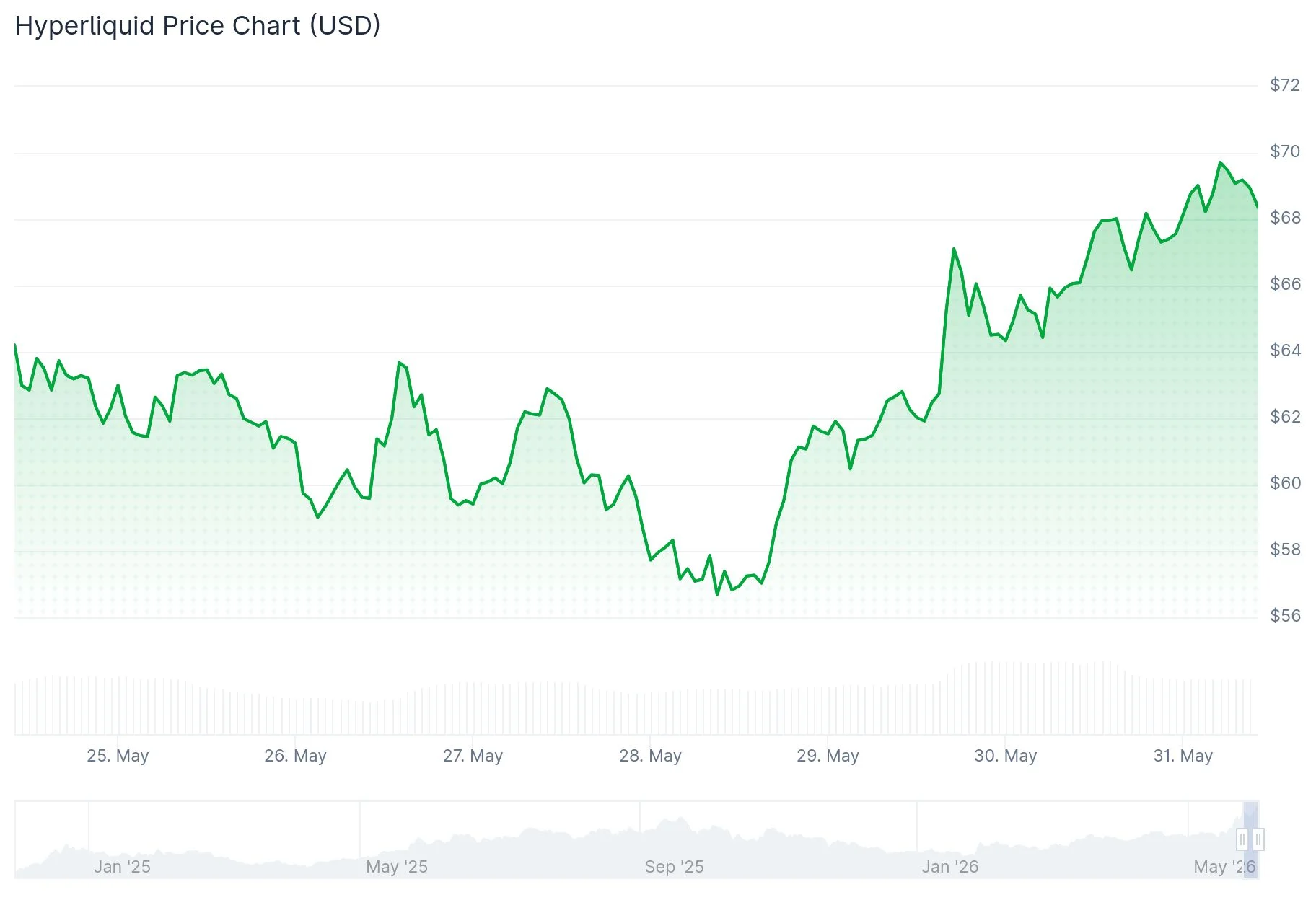
Hyperliquid’s HYPE token climbed to an unprecedented $67 on Friday, May 30, marking a fresh all-time high. The rally followed confirmation from the US Commodity Futures Trading Commission (CFTC) that perpetual futures contracts serve as valid tools for price discovery and hedging strategies.
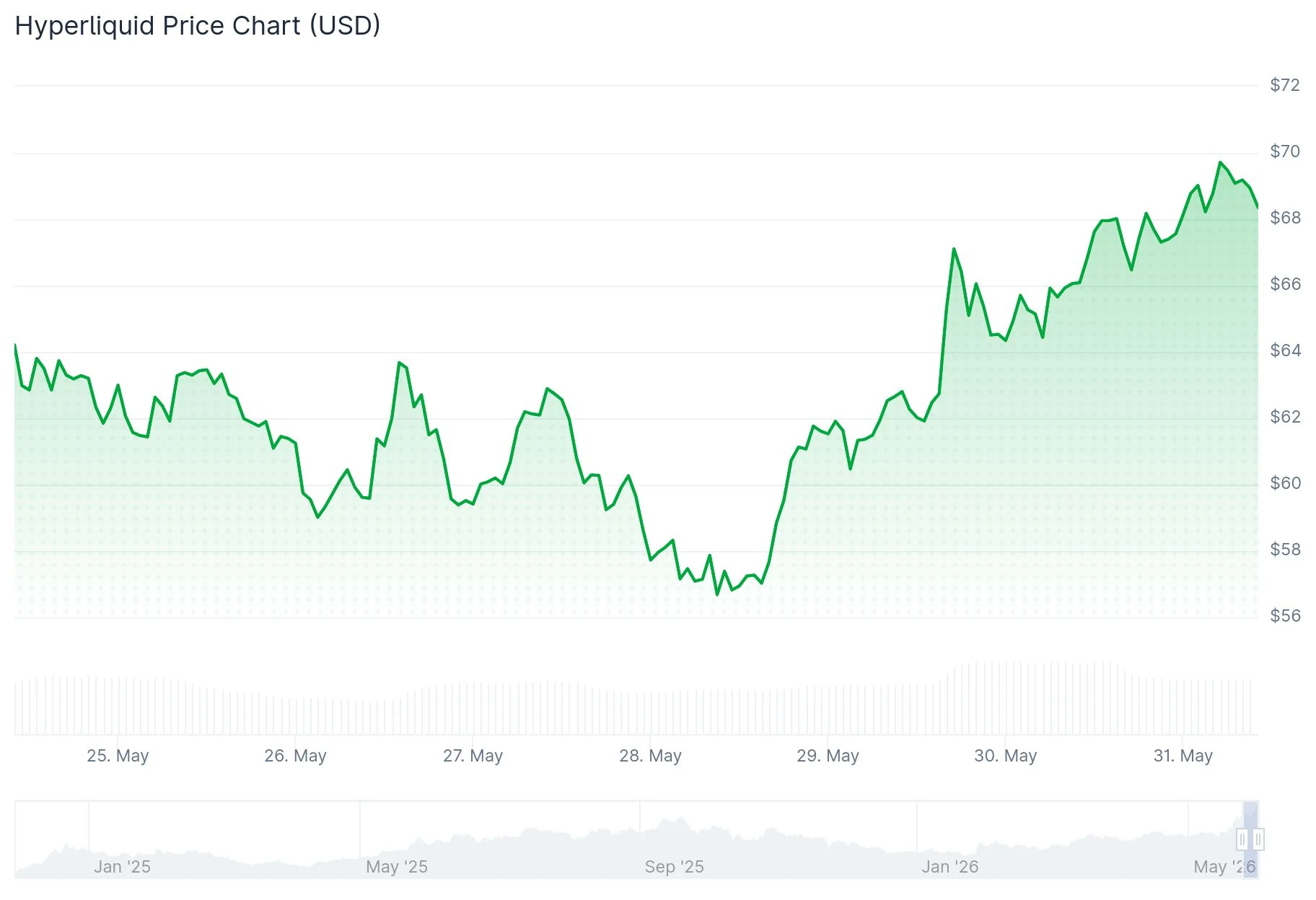
Across leading cryptocurrency exchanges, HYPE futures open interest expanded to $2.9 billion—representing a 30% weekly increase. This surge accompanied a 23% price appreciation during the same timeframe.
The expanding open interest signals robust appetite for leveraged trading exposure. However, it simultaneously elevates the possibility of a short squeeze should upward momentum persist. Notably, the funding rate for HYPE perpetual contracts fell to neutral levels on Friday, suggesting an uptick in bearish positioning.
Prominent crypto analyst Arthur Hayes offered a bullish outlook through commentary highlighted by Coin Bureau on X, projecting that HYPE could eventually reach $150. Hayes attributed this ambitious target to Hyperliquid’s expanding influence within the decentralized finance ecosystem.
Platform Dominates Decentralized Application Revenue Rankings
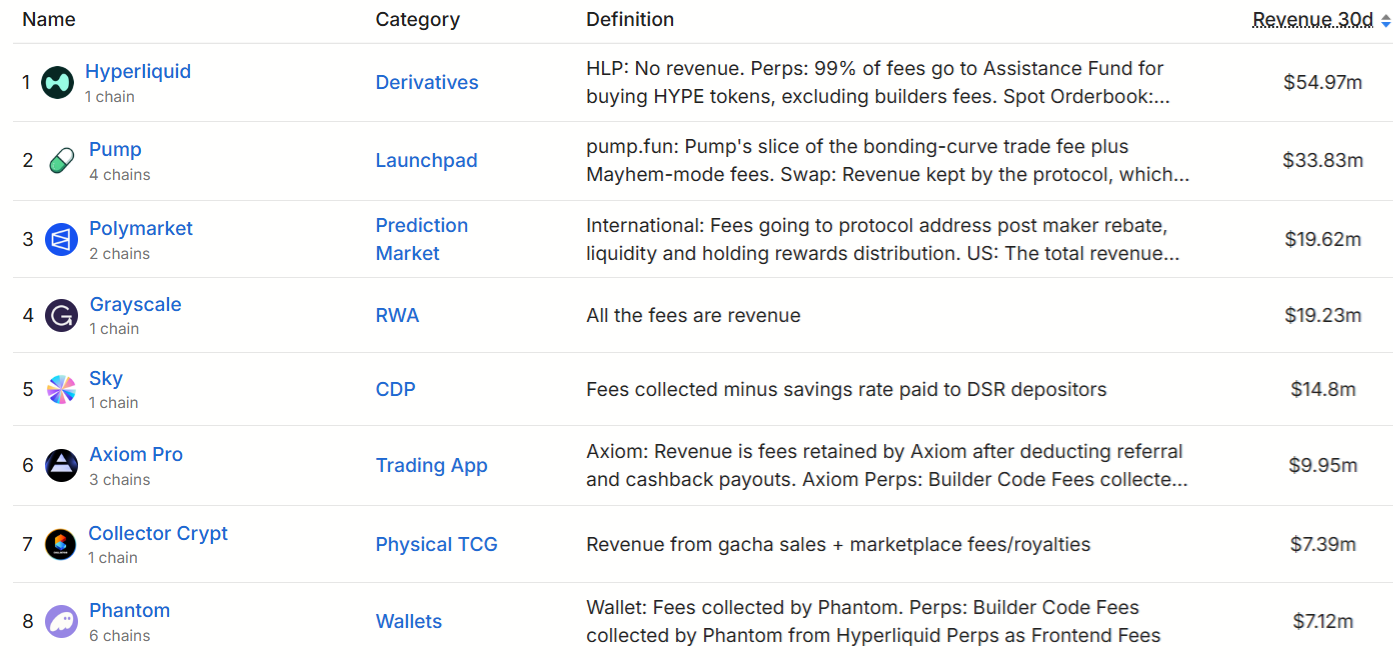
Hyperliquid captured $55 million in revenue during the trailing 30-day period, securing the top position among all decentralized applications worldwide. Token launchpad Pump.fun ranked second with $33.8 million, while prediction platform Polymarket claimed third place at $19.6 million.
According to Grayscale’s analysis, the platform has facilitated approximately $2.9 trillion in perpetual futures trading volume throughout 2025 and currently maintains roughly $7 billion in outstanding open interest. Weekly perpetual contract volumes have consistently exceeded $35 billion for the past two months.
Platform-generated revenue is systematically deployed to purchase HYPE tokens from secondary markets, establishing persistent upward price pressure.
Institutional Recognition Intensifies
Grayscale published research characterizing Hyperliquid as an emerging “financial services juggernaut.” The investment management firm highlighted the platform’s evolution beyond cryptocurrency derivatives into tokenized equities, commodities trading, and prediction markets through its HIP-3 and HIP-4 frameworks.
FalconX echoed this assessment, noting that Hyperliquid has begun positioning itself as a competitor to established entities like CME Group and prediction market platforms such as Kalshi and Polymarket.
ETF products launched May 12 by Bitwise and 21Shares have collectively amassed $122 million in net assets, based on SoSoValue tracking data.
Hyperliquid maintains geographic restrictions preventing US-based users from accessing the platform, as perpetual futures exist within uncertain regulatory territory under American law. While the CFTC’s recent guidance represents progress for the sector, Jake Chervinsky, CEO of Hyperliquid Policy Center, cautioned that achieving comprehensive regulatory approval for DeFi platforms “will likely take longer.”
The tokenomics include monthly releases of 309,000 HYPE tokens extending through November 2027. Furthermore, 389 million tokens await distribution with no predetermined allocation structure currently in place.

TLDR
- Circle executed a court-mandated freeze on $12.6M USDC stored within Zama’s privacy-focused smart contract
- The action originated from a class action lawsuit claiming Overnight Finance’s Maxim Ermilov misappropriated over $15M from treasury wallets
- Zama claims it was unexpectedly caught in the middle without prior notification of the freeze
- The entire contract pool was locked, preventing access to funds belonging to innocent Zama protocol users
- Blockchain investigator ZachXBT described the move as establishing a concerning precedent for freezing protocol contracts containing mixed user deposits
In the early hours of Saturday morning, Circle implemented a freeze on $12.6 million worth of USDC following a federal court directive to blacklist a smart contract operated by Zama, a privacy-focused protocol.
New: According to @zachxbt, @circle has frozen Zama’s confidential $USDC contract on Ethereum, locking 12.6M $USDC.
The move may be related to 12.4M $USDC deposited on May 11 by a wallet apparently linked to Overnight Finance, which recently faced allegations from holders of a… pic.twitter.com/r3uZQWPTBt
— SolanaFloor (@SolanaFloor) May 30, 2026
The action took effect at precisely 1:08 a.m. UTC on May 31, immobilizing 12,606,386 USDC tokens within the smart contract. Zama operates as an open-source cryptography company specializing in developing privacy-enhancing technologies for blockchain ecosystems.
Rand Hindi, CEO of Zama, revealed that his organization received zero advance notice before the freeze was executed. He characterized the contract as being “caught in a crossfire of another case.”
Background on the Overnight Finance Legal Action
At the heart of this matter lies Overnight Finance, a decentralized finance yield protocol responsible for creating the USD+ stablecoin alongside the OVN governance token. On May 28, three investment funds holding OVN tokens initiated a class action lawsuit in the U.S. District Court for the Northern District of California.
According to the legal filing, plaintiffs claim that Overnight Finance’s founder, Maxim Ermilov, transferred more than $15.77 million from shared treasury wallets shortly before a governance proposal achieved majority approval on May 11. Approximately $12.5 million of the transferred amount consisted of USDC, with most being deposited into Zama’s confidential smart contract infrastructure.
Ermilov has rejected these accusations. He maintains that OVN token holders possessed no legitimate authority to demand treasury fund distribution and characterized certain participants in the governance vote as “raiders.” According to his position, the wallets in question contained personal and team assets rather than communal treasury resources.
Ermilov further explained that transferring funds into Zama’s privacy system served to “hide balances from the general public to minimize personal security risks,” referencing recent kidnapping incidents targeting cryptocurrency holders.
On May 29, U.S. District Judge P. Casey Pitts issued a directive instructing Circle to freeze the USDC holdings in the specified wallet. Circle implemented the freeze later that same day.
Unintended Consequences for Zama Protocol Users
Due to the nature of Zama’s confidential USDC as a wrapper-based contract, blacklisting the address resulted in locking the complete pool instead of isolating a single user’s deposit. Consequently, other Zama platform users with no connection to the legal dispute found their assets frozen as well.
Hindi pointed out that more than 99% of the contract’s total value originated from the disputed deposit, as the contract had minimal usage prior to this transaction. In response, Zama has temporarily suspended its cUSDC, cUSDT, and cWETH contracts pending a thorough investigation.
“This is an example of collateral damage affecting a public smart contract due to the centralised architecture of the underlying asset,” Zama stated in an official communication.
Zama’s legal representatives confirmed they are actively working to segregate the flagged wallet address and reinstate access for users who should not be affected.
The plaintiffs informed the court of their willingness to provide funds to compensate innocent parties impacted by the freeze.
Questions Raised About Circle’s Blacklisting Practices
This incident contributes to mounting scrutiny regarding Circle’s wallet blacklisting methodology. Earlier in March, ZachXBT alleged that Circle improperly froze 16 wallets associated with legitimate commercial operations in relation to an unrelated sealed civil proceeding.
ZachXBT additionally claimed that Circle neglected to freeze approximately $420 million across 15 separate fraud and hacking incidents since 2022. This figure encompasses $232 million in assets stolen during the April 2026 Drift Protocol security breach, despite Circle allegedly having a six-hour opportunity to intervene.
A judicial hearing regarding the emergency restraining order has been scheduled for June 1, 2026.
‘Misleading financial statements’: Suzlon to challenge Sebi’s penalty order before SAT
Nvidia (NVDA) and Microsoft Partner on AI-Powered Windows PCs Set for Next Week Debut

#fyp #viralvideo #canada #money #hopecore #financialmindset #wifimoney #mindsetqoutes

Steven Gerrard disagrees with Gary Neville over ‘shock’ Chelsea and Arsenal claim | Football

US brings back mandatory military draft registration

Register Renaming | Hackaday
#fyp #viralvideo #canada #money #hopecore #financialmindset #wifimoney #mindsetqoutes

4 LIFE slips namely Financial, Relationship, Mental, Career. #lifeadvice #lifeadvice #shorts #reels

Joseph Chalom: The Ethereum Bull Thesis in 2026 (Why Now)
-

 Business7 days ago
NYT Strands Answers May 24 2026 Revealed for Puzzle No. 812 Theme Summer Essentials
-

 NewsBeat4 days ago
Israel says it has killed new Hamas military leader in Gaza City airstrikes
-

 Tech4 days ago
NASA taps Blue Origin to deliver lunar rovers for Moon Base initiative
-

 Politics6 days ago
Bridgerton Season 5: Cast, Release Date And Everything We Know So Far
-

 News Videos4 days ago
XRP *JUST* SUCCEEDED!!!! CLARITY ACT EXPOSED!!! (SHE EXPOSED IT)
-

 Sports5 days ago
2026 NBA Finals schedule, odds: Knicks await Thunder or Spurs after winning East
-

 Business4 days ago
Selena Gomez Reportedly Upset Over Benny Blanco’s Comments on Her ‘Terrible’ Diet
-
Crypto World5 days ago
Micron Crosses $1 Trillion Market Cap as AI Demand Reshapes Memory Sector
-
Crypto World7 days ago
Brian Armstrong Outlines Crypto Vision for the Future Financial System
-

 News Videos2 days ago
This is BROKEN! INSANE 5x MONEY CAR WASH WEEK! The NEW GTA Online UPDATE Today! (GTA5 New Update)
-

 Business6 days ago
BTS Sells Out Four Las Vegas Shows at Allegiant Stadium for ARIRANG World Tour
-
 Tech5 days ago
China assigns ID codes to 28,000+ humanoid robots
-
 NewsBeat6 days ago
Hottest May day ever as London hits 34.8C in 2C leap from previous records
-

 Tech6 days ago
Microsoft’s quiet Claude Code retreat and the real cost of enterprise AI
-

 Tech2 days ago
Waymo dominates autonomous vehicle registrations as Tesla trails behind
-

 Business6 days ago
Nikkei 225 Surges Past 65,000 for First Time as Iran Peace Hopes Fuel Record Rally
-
Tech4 days ago
The Samsung pay deal is the moment Korean unions changed register
-
 Entertainment5 days ago
‘Breaking Bad’ Star’s Easy-to-Binge 6-Part Crime Series Spin-Off Is Finally Heading to Free Streaming
-

 Tech6 days ago
Westone Audio and Etymotic Acquired by Fidelity Collective in Major IEM Market Move
-

 NewsBeat6 days ago
Crowds find riverside shade in York as temperatures soar
You must be logged in to post a comment Login