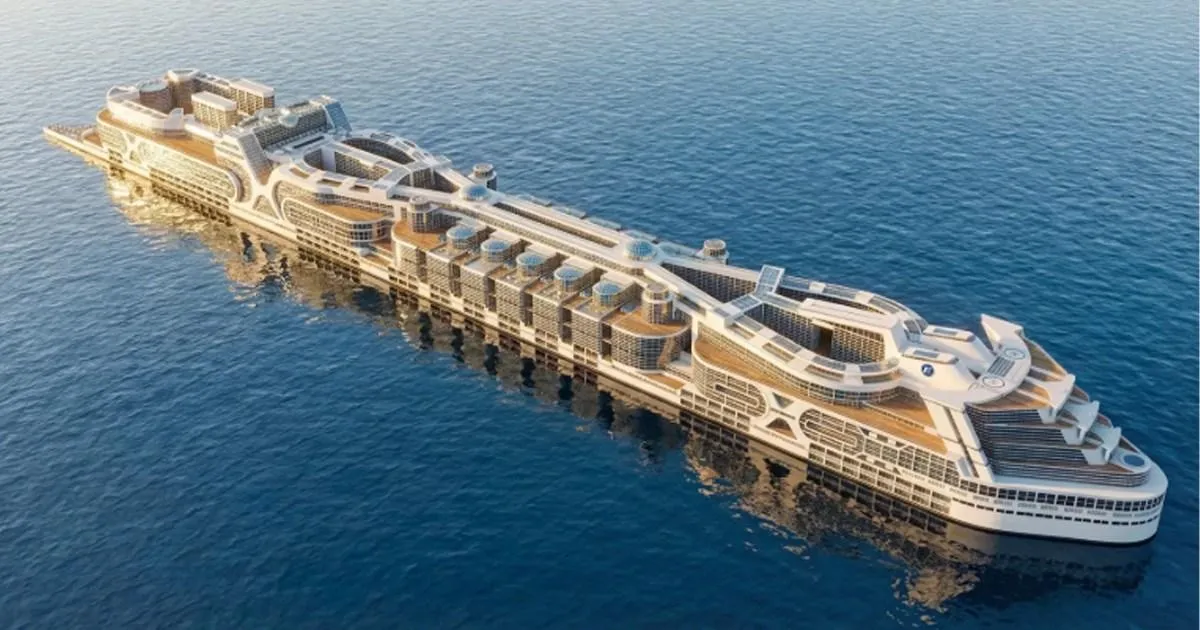
It’s set to be the largest vessel ever built, at over a mile long (Picture: Freedom Cruise International)
Almost 30 years on from the idea first being floated, it looks like the world’s first ‘city at sea’ could finally soon set sail.
Measuring up at over a mile long and 800ft wide, the Freedom Ship is set to be bigger than any vessel ever built, with capacity for 80,000 passengers across 30 decks.
This isn’t just a colossal cruise liner though — proposals envision 50,000 of those on board being permanent residents, circumnavigating the entire globe every two years as part of a mobile ocean colony.
Although the ship will stop for at least a week at a time at various different destinations, its inhabitants should have everything they need to never step foot on land again, from schools and banks to offices and even a research hospital.
Advertisement
The Freedom Ship comprises 30 decks (Picture: Freedom Cruise International)
Beyond essential facilities, blueprints also show a 15,000-seat sports stadium, a convention centre, a two-storey food hall, three acres of parks, a shopping mall, casino and a full-service spa.
Best of Best of Metro Deals
Get exclusive discounts with Metro Deals – save on getaways and spa days. Powered by Wowcher
Bannatyne Spa: Spa day for two with treatments, lunch & prosecco — save up to 57% off.
If that wasn’t enough, there’ll be two museums, eight helipads, a symphony hall, and a nightclub, along with a water park, and an aquarium where divers can swim among tropical fish.
Passengers will have access to all the amenities they expect on land (Picture: Freedom Cruise International)
There’s even on-board schools providing education from early years up to secondary age (Picture: Freedom Cruise International)
Passengers have no shortage of food options to choose from (Picture: Freedom Cruise International)
To get from A to B, passengers have the option of riding the on-board tram system, or exploring the Freedom Ship’s 15 miles of walkways.
And going ashore could prove something of a mission too.
Because of the boat’s sheer size — nearly seven times the length of the Titanic and nine times that of the Villa Vie Odyssey ‘residential cruise ship’ — it can’t actually dock in any port, so will have to stay in international waters, transporting guests to and from terra firma via a fleet of ferries.
Advertisement
The ship has capacity for 50,000 full-time permanent residents (Picture: Freedom Cruise International)
In terms of length, it’d be nearly seven times that of the Titanic (Picture: Freedom Cruise International)
Passengers can travel to dry land via smaller ferries, or explore the ship on its tram system (Picture: Freedom Cruise International)
The concept has been in the works since the 1990s, when US engineer Norman Nixon proposed a community free from the laws of traditional nation states.
However, financing the £12 billion project proved difficult, and following Nixon’s passing in 2012, a number of others have also failed to get it off the ground.
Now in the hands of Freedom Cruise Line International CEO Roger Gooch and a new, 12-strong leadership team, bosses are ‘confident’ it could at last go ahead.
Plans show a whole host of leisure facilities, including a casino and spa (Picture: Freedom Cruise International)
Did we mention the 15,000-seat stadium? (Picture: Freedom Cruise International)
Essential services like offices and banks will also feature (Picture: Freedom Cruise International)
Despite still needing to raise its start-up capital, the company has also forged ahead with hiring architectural firm of Schopfer Associates, in the hopes it will elevate the ship ‘from an unprecedented engineering endeavor to a fully realised, livable global environment.’
According to Gooch, once the Freedom Ship build is funded, construction will begin in Indonesia, and is expected to take three to four years — but people could start moving in once it’s just halfway complete.
‘Maintenance on our hull would actually be done while it’s in the water every day, even while it’s moored off shore,’ he told The Telegraph. ‘The ship will constantly circumnavigate the globe, it never has a home port
Advertisement
The chief executive was also keen to allay any environmental concerns, claiming the vessel would clean oceans as it crosses them, and use nuclear power to reduce the hefty carbon emissions commonly associated with cruise liners.
Apparently, the team have even discussed hosting a Taylor Swift concert in the middle of the ocean — which, if it does come to fruition, would be a surefire way to get people on board.
Police captured a man on CCTV that they would like to speak to about the assault
A man suffered facial injuries after being assaulted. The victim was assaulted in Broad Street, Stamford, near Peterborough, at around 10.50pm on Friday, May 29.
Advertisement
Lincolnshire Police would like to speak to a man captured on CCTV who may be able to help with their enquiries. A police spokesperson said: “The man is described as having a slim build, grey hair and spoke with a soft West Midlands accent.”
Anyone with information should email PC Jamie Flint at jamie.flint@lincs.police.uk and quote crime number 26000316092 in the subject line.
The news came on Monday morning (June 22), just days after Greater Manchester mayor Andy Burnham won the Makerfield by-election, paving the way for an expected leadership challenge in the coming weeks or months.
Calls for Sir Keir to go have been building since Labour took a hammering in May’s local elections, and now marks around a quarter of the party’s 403 MPs.
Click here to get the biggest stories straight to your inbox in our Daily Newsletter
Until now Sir Keir repeatedly vowed to fight any leadership challenge, insisting he will not “walk away”. But as of Saturday, June 20, the number of MPs to call on Sir Keir to quit reached 100 and the Prime Minister said that was why he was now stepping down.
Advertisement
Announcing his resignation on Monday morning, Sir Keir Starmer said: “The question my party is asking now is whether I am best placed to lead us into the next general election.
“I have heard the answer of my parliamentary party to that question, and I accept that answer with good grace. Every decision I have taken has been about putting the country I love first. That is why I will resign as leader of the Labour Party.”
He started his speech by saying: “Walking up this street two years ago was the proudest moment of my life. A new Labour government. The first in 14 years. A page in our country’s history turned after years of disappointment and despair.
Advertisement
“The chance to change the lives of millions of people for the better. That’s what I came into politics for. The journey to that point was not easy. Six years ago, I inherited a Labour Party that was politically, financially and morally bankrupt. I was told, time and time again, that my party was finished.”
Sir Keir continued: “That we were consigned to history, that a majority at the general election, let alone a landslide majority, was impossible. But we proved those people wrong because we changed our party. Ripping out the poison of antisemitism, restoring trust on the economy, defence, and national security.
“And becoming a party that, once again, stood proudly with, not against, our national flag. The hard work of change was with a singular purpose. Not power for power’s sake but to change Britain for the better. To build a fairer country, with dignity and respect, where everyone is seen, everyone is valued. Wealth and opportunity for all, not just the privileged few. And look at what we’ve achieved in just two years.
“An economy that is stronger, growing faster than our peers. Wages rising faster than inflation in every single month since we came to power. Investment secured, infrastructure being built. An end to austerity, with the fastest fall in NHS waiting lists for 17 years.
Advertisement
“The biggest improvement in rights for workers and renters in a generation. The biggest uplift in defence spending since the Cold War. Small boat crossings falling, asylum hotels closing, protecting young people from social media, and half a million children being lifted out of poverty because of the choices that I made.
“Our reputation in the world restored, with Britain once again standing up for decency, respect and the rule of law. Securing trade dues, standing with Ukraine, standing up for our values, and rebuilding our relationship with our allies in Europe.
“Change promised by a Labour government. Change fought for by a Labour government, change delivered by a Labour government. But I know the question being asked now is not who was best placed to change the Labour Party, to take us into power, and to begin the vital work of improving lives for millions of people. Those questions have been answered.
“The question my party is asking now is whether I am best placed to lead us into the next general election. I have heard the answer of my parliamentary party to that question. And I accept that answer with good grace.
Advertisement
“Every decision I’ve taken has been about putting the country I love first. That is why I will resign as leader of the Labour Party. I have spoken to His Majesty the King this morning to inform him of my decision.
“I will ask the National Executive Committee of the Labour Party to set out a timetable with nominations opening on the 9th of July and completed by the summer recess. In the case of a contest, this will ensure a new leader is in place before Parliament returns in September.
“I will remain in post as Prime Minister until the contest is complete. And I will do everything I can to ensure an orderly handover of power.
“I will also give my successor my full and unequivocal support, knowing that they will inherit a Britain that is far stronger and fairer than the one I inherited two years ago, better prepared for the challenges ahead, and better able to ensure the Labour Party secures a second term in office.
Advertisement
“I want to thank all of those friends and colleagues who have been at my side for these past six years or so for their incredible commitment, service and support.
“I want to thank the brilliant Number 10 staff and our country’s extraordinary civil service, who dedicate their lives to public service.
“And when I leave, the biggest job in the country. I shall spend more time on the most important job. Being the best husband I can to my fantastic wife, Vic, who has been a rock by my side, through good times and bad. And being the best dad I can to my beautiful children, who are my pride and my joy.”
The popular ex-mayor of Greater Manchester planned to challenge Starmer for the Labour leadership.
Starmer spent the weekend pondering his future following Burnham’ victory last week in a special election for a seat in Parliament. Burnham ran with the aim of challenging Starmer for leadership of the party and the country.
Burnham is due to be sworn in as a member of Parliament on Monday.
It’s unclear whether Burnham would face a coronation or a challenge, if Starmer steps aside. Wes Streeting, who resigned as health secretary last month to protest Starmer’s leadership, has said that he will run in a contest if there is one.
Arriving to cheers and applause from his team, he said that becoming prime minister was the “proudest moment of my life”.
Click here for the latest on Greater Manchester’s politics in our newsletter
Advertisement
He said his party had changed since he became leader six years ago by “ripping out the poison of antisemitism, restoring trust on the economy, defence, and national security, and becoming a party that once again stood proudly with, not against, our national flag”.
Announcing his resignation, he said: “The question my party is asking now is whether I am best placed to lead us into the next general election. I have heard the answer of my parliamentary party to that question, and I accept that answer with good grace.
“Every decision I have taken has been about putting the country I love first. That is why I will resign as leader of the Labour Party.”
The prime minister said he would do all he can to ensure an “orderly” transition of power take place. But how will the new leader be chosen? Here’s what you need to know.
Advertisement
Who is prime minister now?
Sir Keir will remain as prime minister until a new leader is selected.
Over the coming weeks, MPs will be able to put themselves forward for leadership and a contest will take place to choose who will be the next Labour leader and prime minister.
Sir Keir said in his speech that he has asked Labour’s governing body to set out a timetable to replace him, beginning on July 9, and ending by the summer recess to “ensure a new leader is in place before Parliament returns in September”.
Who can stand in a leadership contest?
Only Labour MPs can stand in a Labour leadership contest. To stand, a candidate needs nominations from 20 per cent of the standing Labour MPs – that’s a total of 81.
Nominations must be in written form and submitted to the general secretary of the party, a position currently held by Hollie Ridley.
Who might stand in a contest?
Andy Burnham is now an MP and has made his intention to stand in a leadership contest clear. His decision to stand in the Makerfield by-election suggests he already has the necessary backing from his fellow MPs.
Advertisement
Former health secretary Wes Streeting has also insisted he has the 81 names required to mount a leadership bid. Former Royal Marines officer Al Carns, who quit as armed forces minister in a row over defence funding and the treatment of Northern Ireland veterans, has also hinted he would seek to enter a leadership race, but whether he has the nominations needed remains unclear.
What happens if only one candidate wants to stand?
If only one candidate gets the required nominations then they will become the new Labour leader and a contest does not need to take place.
A timetable will be set out for a transition of power to take place.
Advertisement
How does the voting work?
Only Labour Party members and affiliated trade union supporters are allowed to vote in a Labour leadership contest.
The party uses a one-person-one-vote system, meaning that the same person cannot vote both as a trade union member and as a Labour Party member.
Eligible voters then cast their votes using a preferential voting system. Each voter ranks the candidates in order of preference by marking their ballot 1, 2, 3 and so on.
The winner is the first candidate to secure over 50 per cent of the vote. If a candidate does not win on the first round, then the candidate in last place is removed, and the votes are redistributed and counted again.
Advertisement
Several rounds can take place until a candidate wins the 50 per cent needed.
Haaland had to wait until the age of 25 not just to make his World Cup debut, but his international tournament bow too.
And the Leeds-born striker is clearly eager to make up for lost time.
“He’s the opposite of Mbappe and Messi,” Williams said. “He’ll beat you without the ball, which makes it even more dangerous.
Advertisement
“You want to help your midfield by squeezing up, so they don’t have to cover too much distance.
“But as soon as you leave the space in behind, he’s going to exploit that straight away.”
One of the keys to limiting Haaland’s influence, Williams says, is to prevent his team mates getting the ball to him.
“You’ve got to stop the balls in behind first and foremost,” Williams said. “Stop the supply going into him.
Advertisement
“If you can play your distances between your midfield and limit his chances, you’ve got half a chance.
“There’s not many times when he actually drops in, gets the ball, beats four players, and scores his own goal, so he does feed off what he’s getting served.”
Haaland is the most clinical of the four, with 57 goals in just 51 caps.
“He’s more lethal,” Williams added. “If he gets a chance, it’s probably going to be a goal.”
Advertisement
What about dealing with Haaland one on one?
“Around the box, you’ve got to get tight and try to get him on his right foot,” Williams said.
“Then you’re just going to have to be as strong as you can, don’t be clever, just get the ball away and buy time.”
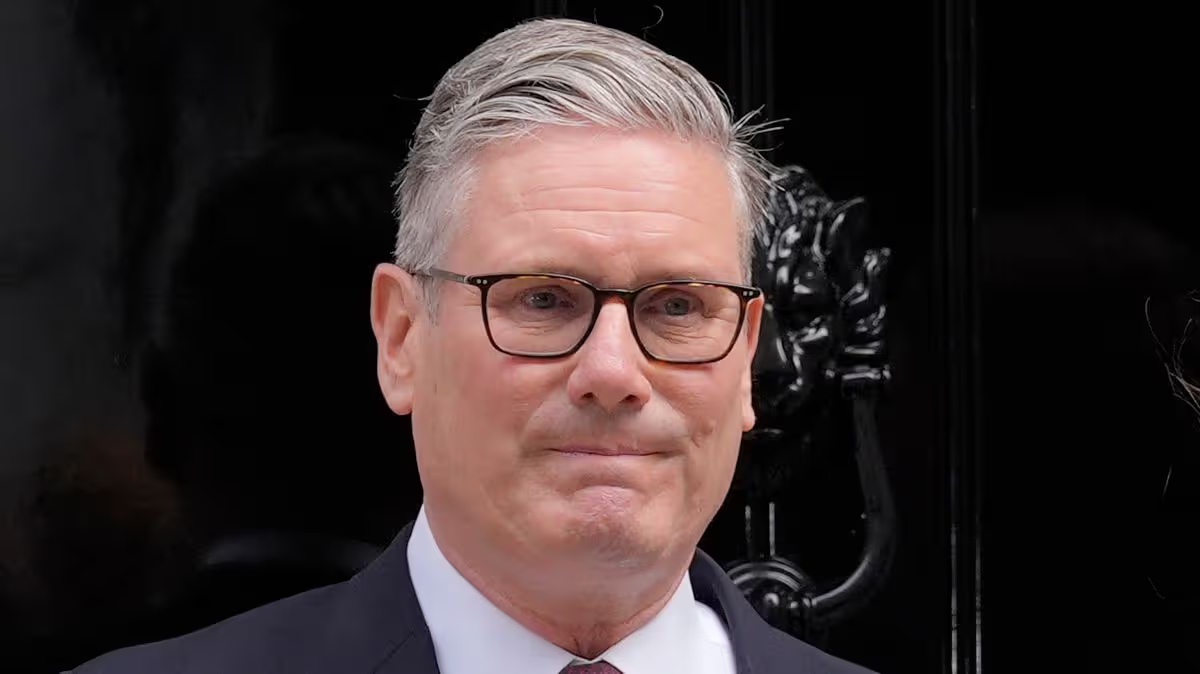
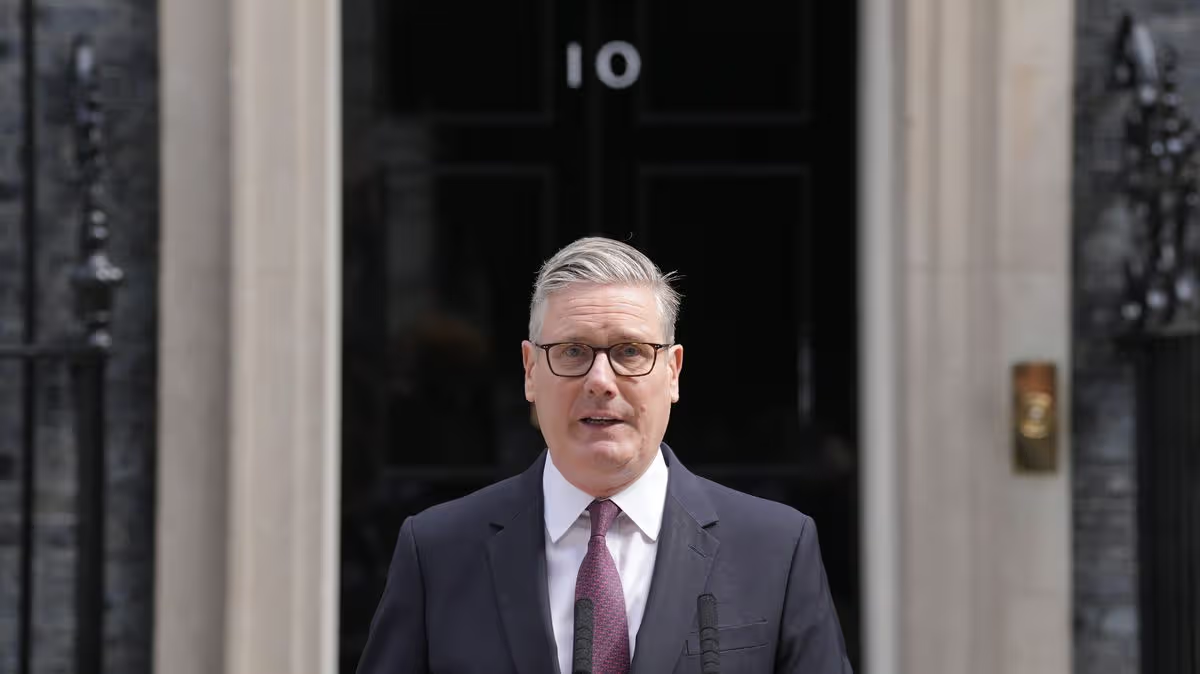
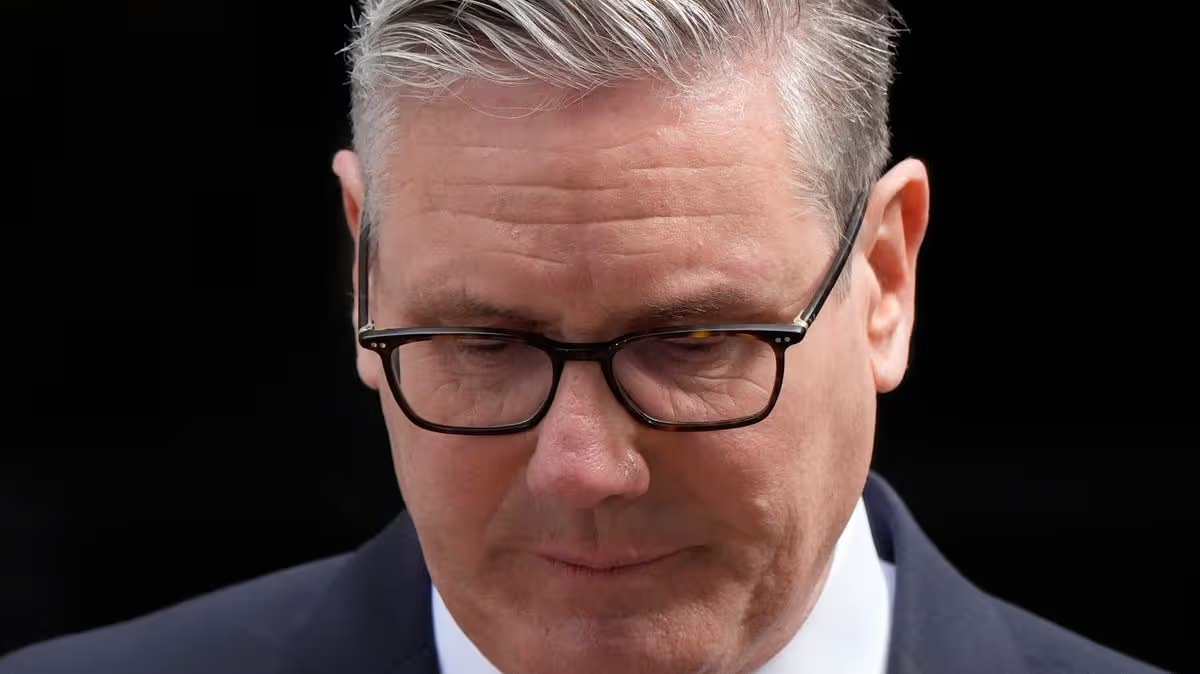
Sir Keir Starmer announced his resignation in an emotional statement outside 10 Downing Street
Prime Minister Keir Starmer has announced his resignation – marking an end to his leadership of the Labour Party after six years and as PM after two years. Speculation has stirred over the last few days that Sir Keir Starmer would leave 10 Downing Street.
Advertisement
The Labour Party leader is the UK’s seventh Prime Minister in the last 10 years. He will remain as Prime Minister until a new leader of the Labour Party is appointed.
Speaking in an emotional statement outside Number 10 this morning (Monday, June 22), Sir Keir Starmer said winning a landslide victory at the 2024 General Election was the “proudest moment of my life”.
He also said that the Labour Party’s victory was a “page turned after years of disappointment and desperation”. He added: “The question my party is asking now is whether I’m best placed to lead us into the next General Election.
“I have heard the answer of my parliamentary party to that question and I accept that answer with good grace. Every decision taken is about putting the country I love first. That’s why I will resign as leader of the Labour Party.”
ALBUQUERQUE, N.M. (AP) — Even as it battled the deadliest drug epidemic in American history, the U.S. Drug Enforcement Administration permitted hundreds of thousands of fentanyl pills to hit the streets of New Mexico between 2023 and 2025, according to three current and former DEA agents and government records reviewed by The Associated Press.
DEA agents repeatedly monitored shipments of fentanyl pills — but did not seize them — as federal prosecutors sought to bring bigger criminal cases against traffickers of a synthetic opioid that the White House last year designated a “ weapon of mass destruction.”
Agents and experts, however, said the tactic amounted to a gamble with public safety that potentially imperiled communities in and around Albuquerque and may have violated U.S. Justice Department rules intended to safeguard the public.
“We poisoned our community to make cases,” DEA Special Agent David Howell told AP in a series of interviews in New Mexico. “Through our own willful blindness, we get to say, ‘We don’t really know what happened to the drugs.’ But we 100% got people killed.”
Advertisement
DEA Special Agent David Howell, who filed a whistleblower complaint, poses for a portrait outside the U.S. district courthouse in Albuquerque, N.M., on Friday, June 12, 2026. (AP Photo/Susan Montoya Bryan)
Advertisement
DEA Special Agent David Howell, who filed a whistleblower complaint, poses for a portrait outside the U.S. district courthouse in Albuquerque, N.M., on Friday, June 12, 2026. (AP Photo/Susan Montoya Bryan)
Advertisement
Advertisement
Advertisement
Advertisement
The DEA has long contended it would not be plausible to seize every shipment of every drug. But the strategy of allowing staggering amounts of counterfeit painkillers to hit the streets shocked several veteran agents who spoke with AP.
Ridding the streets of illicit fentanyl, manufactured mostly in Mexican labs, became DEA’s top priority over the past decade as overdose deaths surged. At the same time, its lethality — a few milligrams can kill the average adult — upended time-tested tactics that had been used to combat drugs like cocaine and heroin. Those methods have included allowing drug transactions to be completed so agents might follow the narcotics through the supply chain. Fentanyl, however, is so dangerous that the U.S. Justice Department developed guidelines for agents in such circumstances, encouraging them to seize the opioid whenever “practicable.”
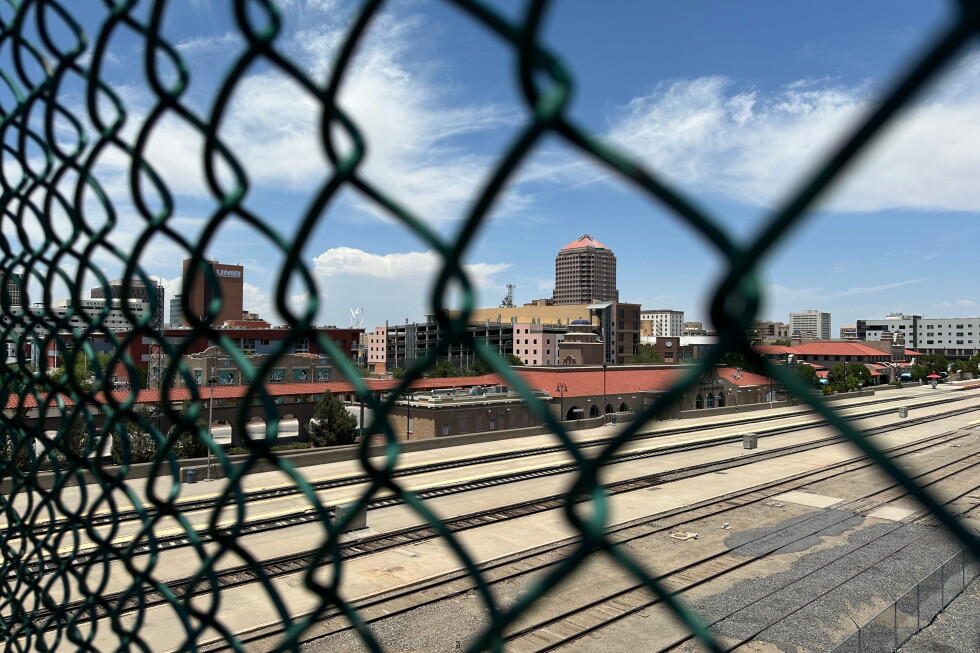
Albuquerque, which has a neighborhood so besieged by drugs it’s known as “War Zone,” and other regions in New Mexico remain at the epicenter of the fentanyl epidemic. While overdose deaths nationwide fell 14% last year, government data show New Mexico tallied a 21% spike.
Alex Uballez, who served as U.S. attorney in New Mexico from 2022 through last year, said authorities at times allowed drug shipments to go unseized as part of a broader effort to gather intelligence and build cases against major drug traffickers. He said the approach reflected his office’s limited resources and his belief that prosecuting larger organizations can have a bigger impact than interdicting every suspected drug transaction.
Advertisement
Sign up for Morning Wire:
Our flagship newsletter breaks down the biggest headlines of the day.
Advertisement
Last year, DEA recorded the largest fentanyl bust in its history in Albuquerque.
“The bigger fish are worth catching,” Uballez said, “and that will save more lives.”
Advertisement
The DEA said in a statement that “the investigative decisions at issue were lawful, reasonable under the circumstances and consistent with Department guidance.”
“Public descriptions suggesting that DEA knowingly permitted fentanyl to reach communities are false and fundamentally mischaracterize the facts,” DEA spokesperson Amanda Wozniak wrote in an email. She said the investigations involved court-authorized wiretaps “in which agents and prosecutors conducted real-time surveillance, intelligence gathering, and operational analysis targeting larger drug trafficking organizations.”
Advertisement
Tell our investigators
AP’s global investigative team accepts tips securely and confidentially. Choose the method that works best for you.
Advertisement
Precise intelligence on drug deliveries
In some cases, the DEA had such detailed intelligence about drug deliveries that agents were able to tally precise pill counts, according to reports reviewed by AP.
Advertisement
Agents, for example, deciphered coded chatter over cellphones and closely surveilled a transaction at a mobile home park in Albuquerque in June 2023, according to a 66-page report reviewed by AP. Agents wrote in the report that traffickers delivered 74,000 pills as part of that deal, a figure federal prosecutors later confirmed in a court filing.
Days earlier, another DEA report showed, investigators watched the same distribution ring deliver a spare tire hiding another suspected fentanyl shipment that similarly went unseized.
“We did nothing, but sit back and watch,” said Howell, who filed an official whistleblower complaint in 2023 to bring attention to what he thought was a tactic that risked public safety.
Advertisement
This June 12, 2026 photo shows a mobile home park where federal agents monitored, but did not seize, a shipment of fentanyl in Albuquerque, N.M. (AP Photo/Susan Montoya Bryan)
This June 12, 2026 photo shows a mobile home park where federal agents monitored, but did not seize, a shipment of fentanyl in Albuquerque, N.M. (AP Photo/Susan Montoya Bryan)
Advertisement
Advertisement
Advertisement
This photo provided by the U.S. Drug Enforcement Administration shows pills containing fentanyl which were seized by the DEA in New Mexico, on April 28, 2025. (DEA via AP)
This photo provided by the U.S. Drug Enforcement Administration shows pills containing fentanyl which were seized by the DEA in New Mexico, on April 28, 2025. (DEA via AP)
Advertisement
Advertisement
Advertisement
Months passed before federal authorities busted the traffickers, and Howell, who participated in the surveillance, said authorities today cannot account for the unseized shipments.
“It’s outrageous to put that many lives at risk in hopes of making a big case,” said Tristan Leavitt, president of Empower Oversight, a whistleblower advocacy group that has asked the Senate Judiciary Committee and Justice Department’s Office of Inspector General to investigate Howell’s claims.
A former DEA supervisor, speaking on condition of anonymity for fear of retaliation, said he and his Albuquerque colleagues allowed “millions” of pills to go unseized during a multi-state investigation last year.
Advertisement
Howell reported in his whistleblower disclosures that agents on that case permitted the delivery of at least 1.8 million fentanyl pills.
That investigation, the former supervisor and Howell told AP, culminated in the largest fentanyl bust in DEA history, a takedown announced in May 2025 by then-Attorney General Pam Bondi that resulted in the seizure of more than 3 million pills.
“The amount we ultimately seized was hitting the streets every month while that case was going on,” the former supervisor said, adding that the DEA could have dismantled the organization six months earlier.
The U.S. Attorney’s Office in Albuquerque did not answer questions about the unseized fentanyl shipments but, in a statement to AP, said the “conduct” Howell brought to light happened during the prior administration.
Advertisement
“The current leadership of this office is focused on aggressively investigating and prosecuting fentanyl trafficking and disrupting the criminal organizations responsible for distributing these drugs,” Tessa DuBerry, a spokesperson for the office, wrote in an email.
Uballez, the former U.S. attorney, said estimated pill counts “based on intercepted phone calls are not reliable.”
“I don’t think I’d contest that drugs are ‘walked,’” he said, referring to the law enforcement tactic of allowing contraband to go unseized to further an investigation. “How much and how frequently — and with what certainty — is incredibly difficult to answer in retrospect.”
To seize or not to seize
As fentanyl overdoses became an epidemic over the last decade, the U.S. Justice Department developed an internal playbook for combatting the deadliest drug ever to cross the Mexican border. The game plan coincided with a publicity campaign that warned Americans that “One Pill Can Kill,” a DEA effort to highlight fentanyl’s unique dangers.
Advertisement
Adopted in 2017, the department’s two-page “Fentanyl Protocols” called on agents to “seize or otherwise prevent the distribution” of fentanyl “as soon as practicable.” The rules, which have not previously been made public, said that “protecting public safety is paramount,” irrespective of whether seizures compromise investigations.
The Justice Department rewrote the rules in 2024 to afford law enforcement more discretion in such cases. The updated protocols say investigators “may exercise discretion in determining whether to take action to prevent the trafficking of fentanyl,” balancing public safety risks against “the benefits to be achieved through preserving the investigation.”
The DEA rarely discusses the tactic of allowing drugs to go unseized. Its agent manual describes taking drugs off the street as “the usual course of action” but adds “there may be instances where the investigative objectives can be better achieved by not doing so.”
The agency has long used “controlled deliveries” in which constant surveillance of the drugs — and often replacing them with fake narcotics — is followed by a takedown to recover them, according to current and former agents.
Advertisement
This photo, provided by the U.S. Drug Enforcement Administration, shows pills containing fentanyl which were seized by the DEA in New Mexico, on April 28, 2025. (DEA via AP)
Advertisement
This photo, provided by the U.S. Drug Enforcement Administration, shows pills containing fentanyl which were seized by the DEA in New Mexico, on April 28, 2025. (DEA via AP)
Advertisement
Advertisement
Advertisement
In interviews, several current and former agents likened the decision to permit fentanyl to hit the streets to the infamous “Operation Fast and Furious,” a 2011 gun-walking scandal in which straw buyers smuggled some 2,000 assault weapons into Mexico with the intent of tracing the firearms to cartel leaders.
Advertisement
The Bureau of Alcohol, Tobacco, Firearms and Explosives was savaged with bipartisan criticism after two of those guns surfaced at the scene of the fatal shooting of a Border Patrol agent, and the Justice Department explicitly forbid agents from allowing firearms to be trafficked.
Blowing the whistle
Howell became so unnerved by his agency’s failure to seize fentanyl that he began flagging overdose deaths that might have been caused by the very pills DEA permitted to flow to dealers. One of those cases included a 15-month-old toddler who died after ingesting burned fentanyl residue last year in Española, a New Mexico town ravaged by grinding poverty and addiction.
Howell, who joined DEA 19 years ago after a decade in the Navy, took his allegations to the U.S. Office of Special Counsel. The agency, tasked with protecting whistleblowers, initially found a “substantial likelihood of wrongdoing” and asked the Justice Department to investigate.
In early 2024, Howell told the Justice Department’s Office of Professional Responsibility that DEA agents had observed — yet not seized — separate deliveries of 150,000 and 50,000 fentanyl pills.
Advertisement
DEA and federal prosecutors, he added, “are placing themselves in a precarious position where they will not be able to prove that the fentanyl they could have stopped did not result in the death of a person.”
DEA Special Agent David Howell, who filed a whistleblower complaint, poses for a portrait outside the U.S. district courthouse in Albuquerque, N.M., on Friday, June 12, 2026. (AP Photo/Susan Montoya Bryan)
Advertisement
DEA Special Agent David Howell, who filed a whistleblower complaint, poses for a portrait outside the U.S. district courthouse in Albuquerque, N.M., on Friday, June 12, 2026. (AP Photo/Susan Montoya Bryan)
Advertisement
Advertisement
Advertisement
Advertisement
The Justice Department’s Office of Professional Responsibility found in 2024 that the DEA and U.S. attorney’s office had made reasonable decisions in deciding to allow drugs to go unseized and that their inaction posed no “specific danger to public health.”
The Office of Special Counsel, which critics say rarely pushes back on agency findings, deemed the Justice Department’s report reasonable.
Howell, meanwhile, paid a price after coming forward. The DEA relegated him to desk duty for more than a year and docked his performance evaluations, according to Howell and DEA records. Internal records also show prosecutors barred him from testifying in federal court, citing his “pattern of refusing to heed” admonitions to allow drugs to go unseized during long-term investigations.
Pointing to DEA’s own “One Pill Can Kill” campaign, current and former agents said they could not understand the watchdog’s finding that the tactics had not put the public in danger. They noted the drug is so dangerous it has to be handled in a specialized laboratory.
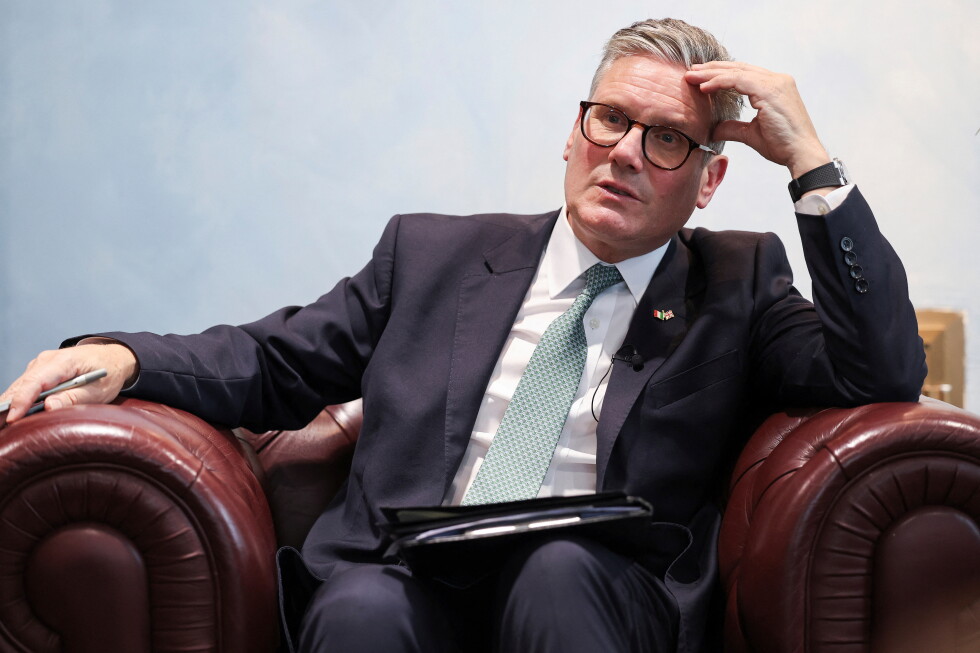
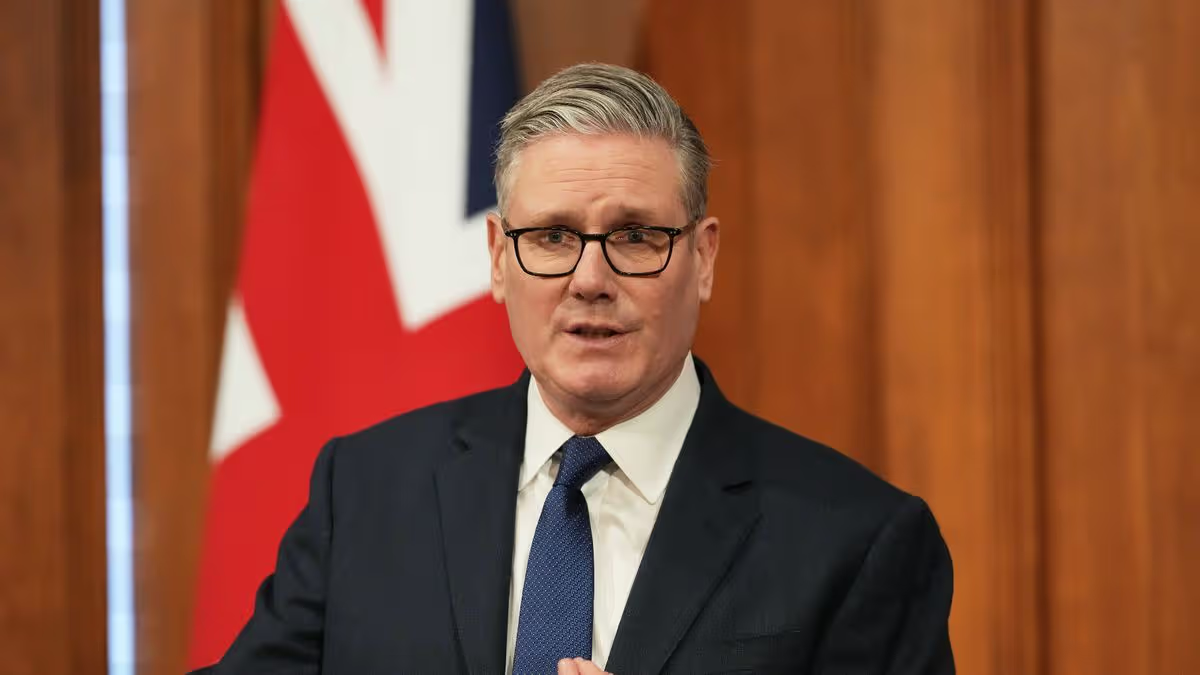
Keir Starmer has announced plans to step down as Prime Minister.
Sir Keir Starmer became Prime Minister in July 2024 after leading Labour to a landslide general election victory, ending 14 years of Conservative government. The former Director of Public Prosecutions entered Downing Street with a large parliamentary majority and a promise to deliver economic stability, rebuild public services and restore trust in politics.
Advertisement
However, his premiership has come under increasing pressure in recent months amid falling poll ratings, internal party unrest and a series of political setbacks. Labour suffered disappointing results in local elections and by-elections, while a growing number of MPs publicly questioned whether Starmer remained the right person to lead the party into the next general election.
One of the most damaging episodes for his government was the fallout from the appointment of former Labour grandee Peter Mandelson as ambassador to the United States. The controversy triggered the resignations of several senior aides and prompted calls from some Labour figures, including Scottish Labour leader Anas Sarwar, for Starmer to step aside.
More recently, tensions within the government deepened over defence spending, culminating in the resignation of senior ministers who accused the Prime Minister of failing to provide adequate funding for the armed forces. The dispute fuelled further speculation about his leadership and highlighted divisions within Labour’s parliamentary ranks.
Pressure intensified following the recent Makerfield by-election, won by Andy Burnham, who returned to Westminster and quickly emerged as the focal point for MPs seeking a change of leadership. Reports suggest dozens of Labour MPs have backed Burnham as a potential successor, with some estimates putting support for him well into three figures.
Advertisement
Over the weekend, multiple reports indicated Starmer had been holding discussions with cabinet ministers, donors and trade union leaders about his future.
Labour now face a leadership contest or an agreed succession process to determine Britain’s next prime minister. Burnham is considered the frontrunner, although figures including Wes Streeting and Yvette Cooper have also been mentioned as potential contenders.
Former Airdrie and Shotts MSP Alex Neil warned voters were furious at politicians on both sides of the border treating the sector – which supports more than 60,000 north east jobs – as a “sacrificial lamb”.
A former Lanarkshire MSP has urged John Swinney to “grow a backbone” and back North Sea drilling after the party’s humiliating by-election defeat in Aberdeen South.
Advertisement
Former Airdrie and Shotts MSP Alex Neil warned voters were furious at politicians on both sides of the border treating the sector – which supports more than 60,000 north east jobs – as a “sacrificial lamb”.
It comes as the Scottish Conservatives swept to a shock victory in Thursday’s by-election after billing the vote “a referendum on the oil and gas industry”.
Former MSP Douglas Lumsden won a thumping majority of more than 6000, defeating the SNP’s Richard Thomson for the Tories’ first Scottish by-election win since 1973.
Mr Neil, who served in SNP Cabinets under both Alex Salmond and Nicola Sturgeon, called on Swinney to renounce the “economic madness” of Sturgeon-era opposition to new oil and gas projects, such as Rosebank oil field and Jackdaw gas field.
Advertisement
He told the Sunday Mail: “It’s about backbone. Swinney needs to stand up to the Greens and to Sturgeon because he’s sitting on the fence and that’s the worst of all possible worlds.
“If you sit on the fence, you don’t please anybody. You’ve got to come off the fence, especially when Scotland’s economy demands it.
“Now the people are demanding it. A clear majority of people in Scotland think that we should continue to develop our oil and gas fields as long as we possibly can, as long as they’re profitable, as long as they’re producing good, high earning jobs.
“There’s public support for this, but I think John’s feart. We are making ourselves the sacrificial lamb when no one else in the world is contemplating such a stupid policy.
Advertisement
“I just think we’ve got it completely wrong on oil and gas and we’re going to pay a much heavier political price in the future if we don’t get it right.”
Meanwhile, the Labour government under Keir Starmer and Energy Secretary Ed Miliband has introduced a controversial ban on oil and gas exploration in the drive for Net Zero. Following Andy Burnham’s seismic by-election win in Makerfield, the former Greater Manchester mayor is strongly tipped to oust Starmer from No 10.
Attention is already turning to his possible Cabinet picks with Miliband, a close Burnham ally, currently the frontrunner with bookies to become Chancellor.
Mr Neil, 74, said: “The worst possible thing Andy Burnham can do is make Ed Miliband the Chancellor of the Exchequer because he’ll then be in an even more powerful position to destroy the oil and gas industry.
Advertisement
“It’s quite clear that is on his agenda and that has huge implications. He couldn’t care less what happens to Scotland, the Scottish economy, or the people in Aberdeen and the northeast of Scotland.
“He just doesn’t care because he’s ideologically obsessed with getting rid of the oil and gas industry. My strong advice to Andy Burnham is not to touch Miliband with a barge pole, don’t let him near the Treasury, because that will be Burnham’s downfall.
“Make him foreign secretary and let him go and travel the world as much as he likes. But don’t give him a say in economic policy because he’s absolutely out of tune with the people.”
*Don’t miss the latest headlines from around Lanarkshire. Sign up to our newsletters here.
Advertisement
And did you know Lanarkshire Live had its own app? Download yours for free here.
The commemorations begin today, June 22, with a flag-raising ceremony outside Bolton Town Hall at 10.55am, followed by a free luncheon for veterans and serving personnel in Festival Hall.
The main Armed Forces Day event will take place in Victoria Square on Saturday, June 27, from 10am until 3.30pm.
A formal service is due to begin at 10.40am, with visitors also able to enjoy military displays, cadet activities, music and family-friendly entertainment throughout the day.
Advertisement
Military vehicles and equipment will be on display, while charities, emergency services and community organisations will also be attending.
Children will be able to take part in free activities and challenges, with stalls and demonstrations planned across the town centre.
The day will begin with a Sea Cadet flag ceremony and conclude with a sunset flag-lowering ceremony at around 3.30pm.
Armed Forces Day is held nationally to recognise the contribution of serving personnel, reservists, veterans, cadets and military families.
Advertisement
Events take place across the UK each year on the final Saturday in June.
Bolton’s event is expected to feature cadet displays, military equipment, community stalls and activities designed to bring residents together in support of the Armed Forces community.














































You must be logged in to post a comment Login