

Crypto World
Dragonfly holds ZEC as Orchard bug debate raises new questions



Zcash (ZEC) has faced fresh scrutiny after a patched Orchard Pool vulnerability sparked a dispute over whether the privacy coin’s users and investors still face hidden risks.
Summary
- Zcash faces fresh scrutiny after developers patched a critical Orchard Pool vulnerability.
- Dragonfly partner Haseeb Qureshi said the market may be overstating the immediate risks.
- Qureshi argued that counterfeit ZEC would likely remain limited to the shielded pool.
Dragonfly partner Haseeb Qureshi said the market may be treating the bug as a larger immediate threat than the available evidence supports. He also said Dragonfly continues to hold ZEC, even as developers, investors, and privacy advocates debate what the flaw could have allowed before it was fixed.
Qureshi says ZEC fears look overstated
According to Qureshi, the critical issue was not whether the vulnerability was serious, but where its impact would likely have stayed. He said the bug could have allowed someone to create counterfeit ZEC inside the Orchard shielded pool, but he argued that those coins would face a major obstacle once an attacker tried to sell them.
In Qureshi’s view, an attacker would eventually need to move counterfeit shielded ZEC into transparent ZEC before using major exchanges. Since transparent ZEC can be checked against the public supply, he said any attempt to move inflated amounts into visible circulation would be easier for the network to catch.
For that reason, Qureshi said regular exchange users and many traders likely had limited direct exposure. He placed the largest risk on users who kept funds inside the shielded pool while the vulnerability existed.
Qureshi also cited recent Zcash network data to support his argument. He said the shielded pool’s share of supply fell from 31% to 30% over 48 hours after the disclosure.
To Qureshi, that small drop did not show a rush by privacy-focused users to leave the pool. He described the move as modest rather than a sign of panic, while still acknowledging that the bug created a serious debate around Zcash’s private transaction system.
Wei Dai warns attack could be harder to trace
Meanwhile, Zcash creator Wei Dai argued that a successful attacker may not have needed to empty the Orchard Pool. Dai said a careful attacker could have kept fake ZEC inside the shielded environment and moved it slowly through private transfers.
Under that scenario, Dai said the pool itself could have helped hide the movement of counterfeit coins. He also raised another possible risk. If someone discovered the flaw early, Dai said that person could have opened a large short position against ZEC before the bug became public.
Because ZEC trades on liquid perpetual futures markets, Dai argued that a trader could have profited from the later price reaction without leaving clear on-chain evidence of the original exploit.

Crypto World
Why quantitative traders are using complex math models to hijack your weekend sports bets


Chicago-based trading giant DRW has spent decades profiting from mismatches between different asset classes, and now it’s building a dedicated prediction market desk targeting platforms such as Polymarket and Kalshi.
The move is one of the clearest signs yet that sophisticated “quantitative trading” firms — traders that use complex math and analysis to set up strategies — are increasingly viewing prediction markets as a legitimate trading venue rather than a niche betting product.
The firm that has been a dominant force in derivatives, fixed income and crypto markets since 1992, recently posted a job listing requiring candidates to monitor prices in real time across both platforms simultaneously, identify gaps where one is mispricing an outcome relative to the other and react quickly to profit before the pricing converges. The strategies listed in these posts — including microstructure arbitrage, cross-platform arbitrage, and news-driven momentum trading at sub-second speeds — are techniques honed in crypto derivatives markets and now being applied to sports and political events.
DRW is not alone. Wintermute, the algorithmic market maker that processes billions in daily crypto volume, is hiring algorithmic traders with experience in prediction markets. IMC, another proprietary trading firm, is also looking for quantitative traders comfortable operating across binary event contracts. Meanwhile, traditional crypto exchanges like OKX and Crypto.com have also recently posted job listings.
The hiring wave suggests institutional trading firms increasingly believe prediction markets have matured into a serious asset class and are ripe for profit.
Exploiting the mismatch
So what’s driving the sudden push? The catalyst is the volume being traded on these platforms.
Polymarket alone processed between $22 billion and $40 billion across political, economic and sports markets in 2025, up from virtually nothing three years ago and a growing share of that is concentrated in sports.
As of last week, Polymarket’s market on the UEFA Champions League Winner has processed $256 million, the 2026 NBA Champion market has done $399 million, and the 2026 NHL Stanley Cup market sits at $79 million after wild swings that saw Carolina Hurricanes rise from sub-10% implied probability to around 50% as they emerged from the Eastern Conference.
Combined, those three markets alone represent over $730 million in volume on sports outcomes, approaching the annual trading volume of some mid-sized European sports betting exchanges.
But the real reason traditional firms are pushing into this industry may not be to predict outcomes better than everyone else, market observers say.
“I don’t expect the institutional capital is contributing meaningfully to the accuracy of these markets, especially in the case of sports,” said Harry Crane, a statistics professor at Rutgers University who studies prediction market calibration.
“The accuracy of the markets is driven by specialized sports betting groups, which are much sharper at pricing sports outcomes.
Instead, Crane argues, firms such as DRW are likely applying trading techniques developed in traditional financial markets to exploit pricing mismatch.
“To the extent they are profitable, the institutions are likely applying techniques on short-term market dynamics and other technical aspects of trading that capitalize on short-term market fluctuations without insight into the event outcome.”
Simply put, DRW is not trying to predict who wins the Champions League. It is trying to profit from the way prices move before that question is answered.
A recent example appeared in the market for Britain’s next prime minister.
On the morning of May 14, Andy Burnham’s odds of becoming the next U.K. leader in the betting of “Next UK Prime Minister” on Polymarket surged from 24 cents to 43 cents as political speculation intensified around a potential Labour leadership challenge. But Betfair, the London-based betting exchange with over a billion pounds in annual volume, had already identified the move, pricing Burnham at the equivalent of 50 cents while Polymarket still showed 24 cents.
It took Polymarket hours to catch up.
For casual bettors, the gap was an interesting anomaly, but to a sophisticated quant trader, it was a textbook cross-market inefficiency waiting to be exploited.
In theory, a trader could have bought $10,000 of Burnham contracts on Polymarket at 24 cents after noticing the mismatch, before locking in $7,900 worth of profit in a matter of hours by selling when it caught up to Betfair, which would have made a profit without the event even needing to take place.
It’s a technique that has been used for decades by traditional trading firms: finding a mispriced asset across exchanges and either simultaneously buying/selling, as in arbitrage, or buying the underpriced asset and waiting for it to catch up.
Prediction markets, however, introduce an additional challenge. Betfair settles in sterling while Polymarket settles in crypto, requiring infrastructure capable of moving capital across currencies, exchanges and settlement systems.
That kind of complexity plays directly into the strengths of large trading firms, such as DRW
What’s driving them?
Beyond outright arbitrage, traders point to two structural features that make prediction markets attractive today.
The first is information lag. Traditional betting exchanges often react more quickly than decentralized prediction platforms, creating windows where prices have not yet fully adjusted.
The second is liquidity fragmentation. Champions League, NBA and Stanley Cup markets can trade simultaneously across Polymarket, Kalshi and traditional sportsbooks, meaning no single venue necessarily reflects the full market consensus.
For traders focused on forecasting outcomes rather than market structure, the toolkit looks increasingly familiar to quantitative finance.
Soccer traders often rely on “Dixon-Coles Poisson” models. The toolkit, developed in a 1997 academic paper, estimates team attack and defense strength and generates probability distributions for potential scorelines. This is something similar to how a weather forecaster assigns precise probabilities to every possible outcome rather than making a single prediction.
Meanwhile, Basketball traders frequently use “Bayesian Hierarchical” models that update assessments of team strength as new information arrives.
The goal for both models is to identify discrepancies between a model’s estimated probability and the probability implied by market prices.
A trader whose model values Arsenal’s Champions League chances at 47% while contracts trade at 43 cents may buy and profit if the market eventually converges toward that estimate.
The concept is known as closing line value, or CLV.
Crane explains why the CLV matters: “It incorporates all known pre-game information, such as injuries and lineup changes, and the sharpest players tend to wait until closer to game time to place bets because that is when the limits tend to be highest.”
Competition is here
Still, Crane remains skeptical that institutional firms will dominate sports prediction markets simply because they have arrived with larger balance sheets.
“Right now, the sharpest players in the sports betting markets are not the institutions,” he said. “The sharpest players have been in these markets for decades, and the prevailing market prices are likely driven by the same groups and the same information sources since long before prediction markets existed.”
Despite the skepticism, the talent migration is already underway.
Crypto market makers are studying sports analytics and expected-goals models, while traditional sports betting specialists are increasingly being recruited by crypto firms seeking expertise that took years to develop.
And it’s not just theoretical.
HyperLiquid, the onchain perpetuals exchange that processed over $10 billion in daily volume at its peak, is already preparing to launch prediction markets ahead of the 2026 World Cup, featuring 64 games over six weeks and generating thousands of correlated binary outcomes.
The infrastructure is being built, and the desks are now being staffed, with models working on potential outcomes.
The main question is whether institutions can outperform veteran sports bettors by finding their edge and applying sophisticated trading models used in traditional finance. But on latency, market structure and cross-platform inefficiencies, the competition has already begun.

For a long time, online gambling in the United States has been ruled by a small group of big brands. Caesars and DraftKings are two of the names that come up the most. Both have huge marketing budgets, strong sports ties, and loyal player bases. But the market is starting to change. Crypto-focused platforms are pulling more players away from the old names every month, and ZunaBet, launched in 2026, is one of the newer brands making waves.
This piece breaks down how Caesars and DraftKings stack up against each other, and where ZunaBet fits as a fresh option built for a different kind of player.
The Two Big Names in Traditional Betting
Caesars has roots that go back decades in physical casinos. The company brought that history online with Caesars Palace Online Casino and the Caesars Sportsbook. It runs on fiat currency, with deposits through cards, bank transfers, and PayPal. Its loyalty program ties online play to real-world rewards like hotel stays and meals at Caesars properties.
DraftKings came from a different starting point. It began with daily fantasy sports and grew into a full betting platform. Now it is one of the most recognized brands in US sports betting, with strong mobile apps and major league partnerships. It works in the same fiat-based, state-licensed system as Caesars.
Both brands are dependable and easy to use if you live in a supported state. But both also share the same downsides. They are limited by state laws, slower on payouts than crypto sites, and their game libraries are small compared to what global platforms offer. Their VIP programs follow the same point-and-tier setup that has been around for years.
ZunaBet Joins the Conversation
ZunaBet is a newer name that has been picking up steam since it launched in 2026. It is run by Strathvale Group Ltd and licensed in Anjouan. Unlike Caesars and DraftKings, which were built for the traditional US system, ZunaBet was designed as a crypto-first platform from day one. That changes a lot about how it feels to use.

The casino has over 11,000 games from more than 60 providers, including big names like Pragmatic Play, Hacksaw Gaming, Yggdrasil, BGaming, and Evolution. That library is far bigger than what most US-licensed sites can run. Players get slots, table games, and live dealer rooms all under one account.
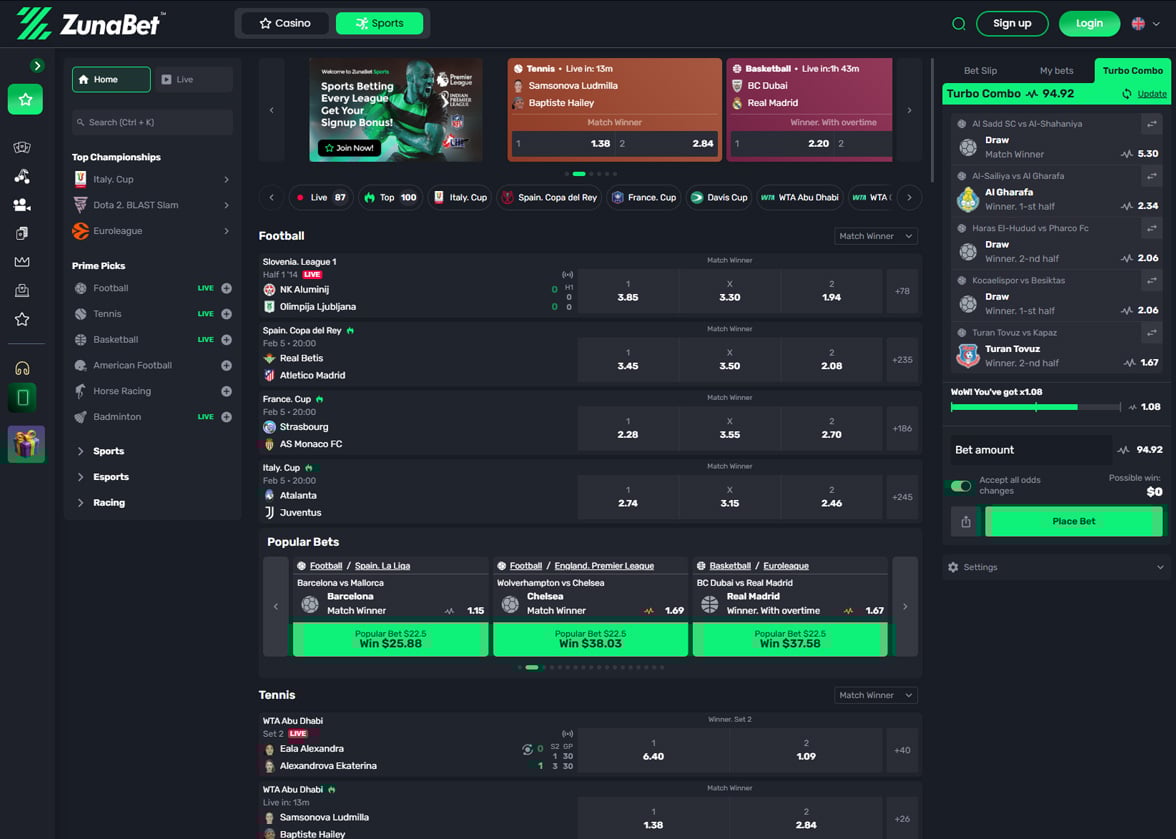
ZunaBet also runs a full sportsbook. It covers football, basketball, tennis, NHL, and other major sports, along with esports like CS2, Dota 2, League of Legends, and Valorant. Virtual sports and combat sports are part of the lineup too, which makes it a hybrid platform similar to DraftKings but with wider coverage.
Crypto Changes the Game
This is where the difference between ZunaBet and the older platforms really shows. Caesars and DraftKings deal in dollars. That means bank processing, possible holds, and slower withdrawals.
ZunaBet works with more than 20 cryptocurrencies, including Bitcoin, Ethereum, USDT across several chains, Solana, Dogecoin, Cardano, and XRP. There are no platform processing fees, and withdrawals move quickly. For players who already use crypto or want faster, cheaper transactions, this is a big upgrade.
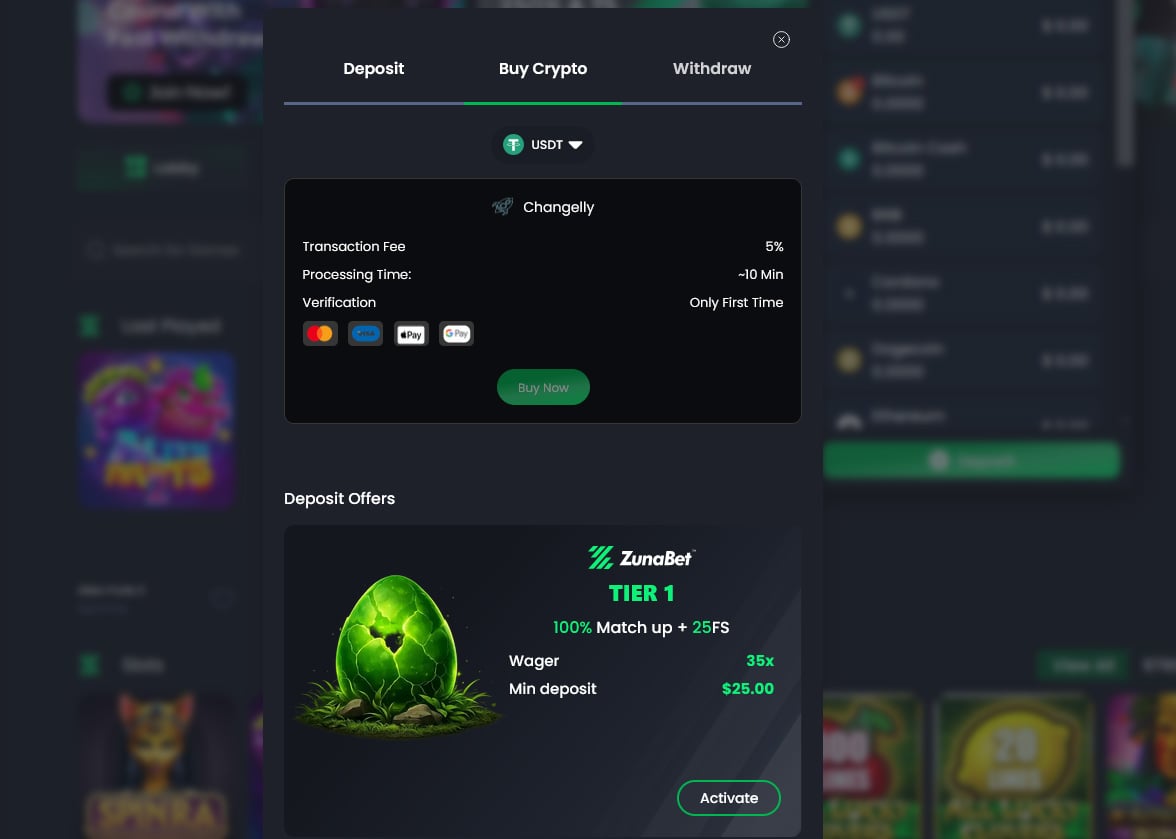
Crypto platforms also tend to operate globally instead of being locked to specific states. Players in many regions can get the full library and sportsbook without the geographic walls that come with US-based brands. For younger players who already live in a digital, crypto-friendly world, this is closer to what they expect from a modern platform.
How the Welcome Offers Compare
Caesars and DraftKings offer welcome bonuses that usually take the form of a deposit match or a risk-free first bet. These promos depend on state rules and often come with tight wagering requirements.
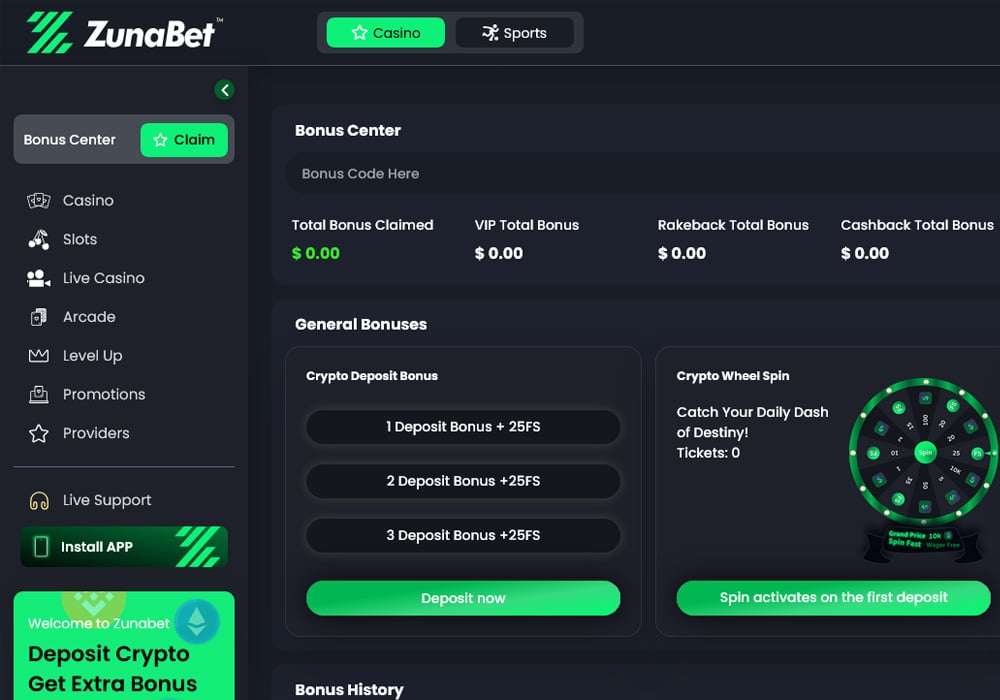
ZunaBet offers a welcome package worth up to $5,000 plus 75 free spins, split across three deposits. The first deposit comes with a 100% match up to $2,000 plus 25 spins. The second adds a 50% match up to $1,500 plus 25 spins. The third gives another 100% match up to $1,500 plus 25 spins. It is marketed as a 250% bonus across three deposits, giving new players more chances to try the platform than a single-deposit offer would.
Loyalty Programs Side by Side
Caesars Rewards is one of the most well-known loyalty programs in gambling. It connects online play to real-world perks at Caesars properties, which is great if you visit Las Vegas or Atlantic City. DraftKings Dynasty Rewards offers points you can swap for bonuses, free bets, and event tickets.
Both work, but both follow the same model that has been used for decades. ZunaBet takes a different approach. Its loyalty program is built around a dragon evolution theme with a mascot called Zuno. There are six tiers: Squire with 1% rakeback, Warden with 2%, Champion with 4%, Divine with 5%, Knight with 10%, and Ultimate with 20% rakeback at the top.
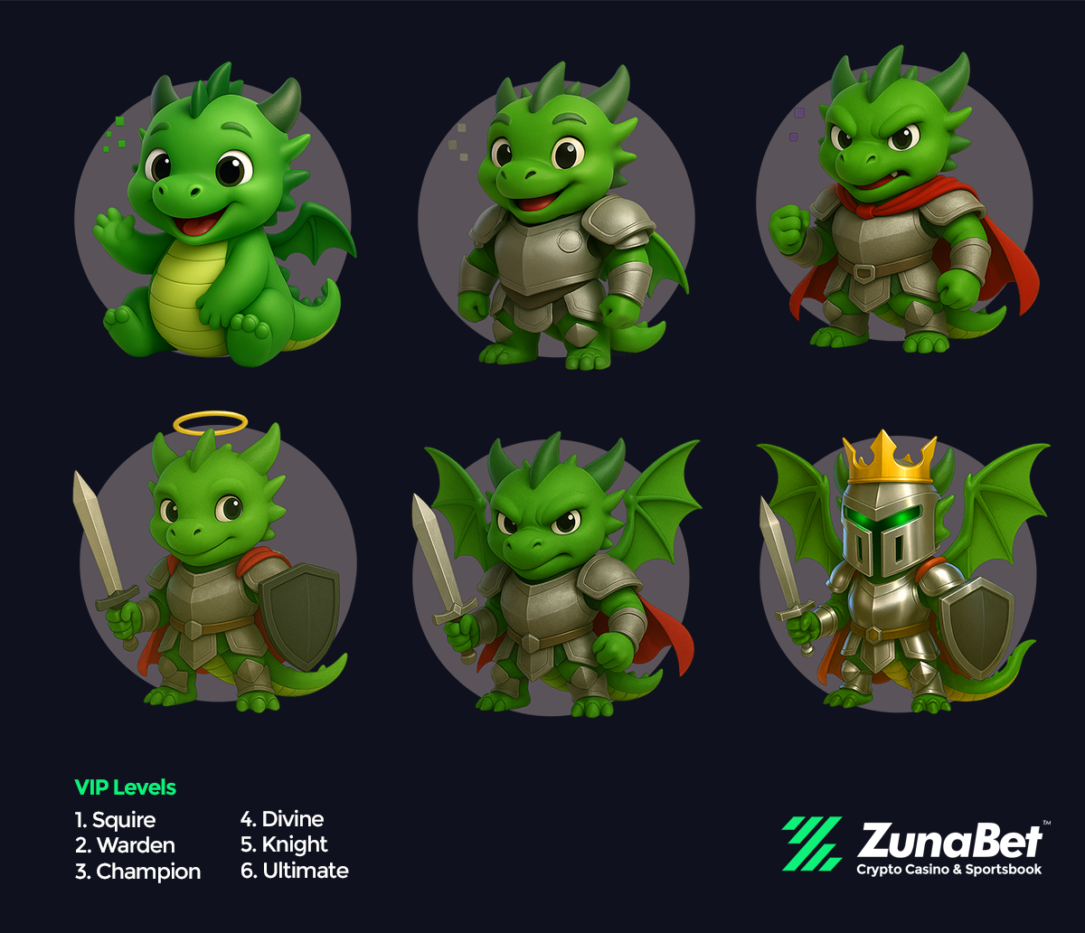
Players also earn tier-based free spins up to 1,000 spins, VIP club access, and double wheel spins as they level up. The whole setup feels more like progressing through a video game than collecting points on a card. For players who grew up with that kind of reward loop, it lands better than a standard VIP system.
Why ZunaBet Is the One to Watch
Caesars and DraftKings are still strong choices if you want a traditional, regulated US betting experience. Neither brand is going anywhere, and both have earned their place in the industry. But the way players pay, play, and stick with a platform is changing fast.
ZunaBet is built around that change. The crypto-first setup means quicker payments and lower fees. The game library is bigger than what the older brands can match. The sportsbook covers traditional sports and esports in one place. The dragon-themed loyalty program turns regular play into something that feels rewarding and fun to chase.
For players who want speed, variety, and a more modern feel, ZunaBet is one of the more exciting options out there right now. It is still an emerging platform, but everything about it points to where online casinos are heading next. A new generation of players expects crypto support, gamified rewards, and global access as standard features, not bonuses.
Caesars and DraftKings built what online betting looks like today. ZunaBet is one of the platforms shaping what it will look like tomorrow.
Disclaimer: This is a Press Release provided by a third party who is responsible for the content. Please conduct your own research before taking any action based on the content.



Following bitcoin’s worst week in two years, Strategy(MSTR) Executive Chairman Michael Saylor published a framework on X, arguing that the Bitcoin community is evolving into four distinct ideological camps.
Rather than viewing these groups as competitors, he presents them as complementary forces that will collectively shape bitcoin’s future.
The first group, Bitcoin Maximalists, sees Bitcoin as the ultimate monetary breakthrough. They believe bitcoin has already solved the problem of digital scarcity and offers superior property rights, protection from inflation, and economic empowerment. Their focus is conviction: bitcoin is not one crypto asset among many, but the dominant digital monetary network.
The second group, Bitcoin Capitalists, views Bitcoin as a form of digital capital that should be integrated into the global economy. They support corporate treasury adoption, institutional custody, bitcoin-backed securities, lending markets, and broader financial infrastructure. Their goal is to expand bitcoin’s reach by embedding it into existing economic systems rather than replacing them.
The third group, Bitcoin Technologists, focuses on improving the protocol. They argue that Bitcoin must continue to evolve to address challenges in scalability, privacy, usability, security, and future threats such as quantum computing. While they support innovation, Saylor notes that changes to bitcoin’s base layer must be approached cautiously to avoid unintended consequences.
The fourth group, Bitcoin Fundamentalists, prioritize protecting bitcoin’s original principles: decentralization, self-custody, immutability, censorship resistance, and individual sovereignty. They are wary of excessive institutional influence, financialization, and protocol changes that could compromise Bitcoin’s core characteristics.
Saylor’s central argument is that Bitcoin needs all four perspectives. Maximalists provide conviction, Capitalists drive adoption, Technologists ensure long-term resilience, and Fundamentalists safeguard the protocol’s integrity. Saylor argues that Bitcoin’s most successful path lies in a balance among these four forces.
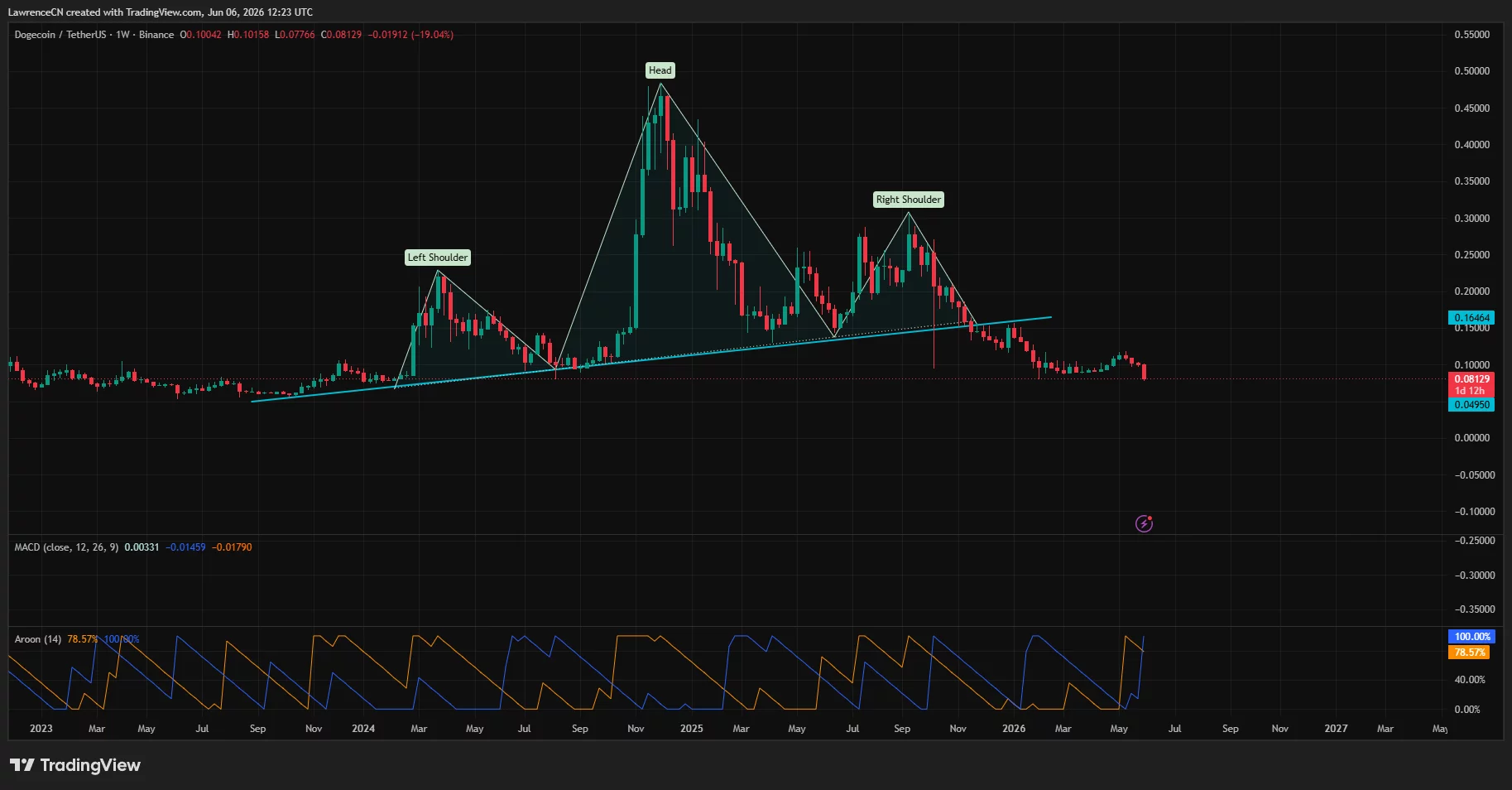
Dogecoin has fallen to its lowest level in years after a decisive breakdown from a multi-year head-and-shoulders pattern added fresh selling pressure during the latest crypto market rout.
Summary
- Dogecoin price has broken below a multi-year head-and-shoulders neckline, putting the meme coin under renewed bearish pressure.
- Crypto analyst Ali Martinez says DOGE is testing key channel support, with $0.1019 and $0.1156 acting as recovery targets if buyers step in.
- A breakdown below the current support zone could expose the next major downside level near $0.067.
According to crypto.news data, Dogecoin (DOGE) price traded near $0.081 on June 6 after losing more than 20% over the past week. The decline came as Bitcoin briefly slipped below the key $60,000 level, triggering heavy liquidations across the digital asset market and pushing the Crypto Fear & Greed Index deeper into Extreme Fear territory.
Additional pressure has emerged from derivatives markets. Recent crypto-wide liquidation events erased billions of dollars in leveraged positions, with long traders accounting for the majority of forced closures.
Open interest across major crypto assets has also contracted sharply as traders reduced risk exposure during the selloff.
On-chain data, however, presents a different picture. As crypto.news reported earlier this week, analytics platform Alphractal said Dogecoin had returned to a historically important accumulation zone between $0.10 and $0.11 before breaking lower. The firm noted that DOGE was trading near the lower boundary of its CVDD Channel, a model designed to identify long-term value areas based on coin age and transaction value.
Alphractal argued that similar zones have appeared before major Dogecoin recoveries in previous market cycles. The firm also described the current structure as a period of quiet absorption rather than aggressive distribution, despite weak sentiment across the meme coin sector.
A multi-year head-and-shoulders breakdown dominates the chart
The weekly chart now shows one of the largest bearish formations in Dogecoin’s history. Price has completed a head-and-shoulders pattern that developed over more than two years, with the left shoulder forming in early 2024, the head near the late-2024 peak around $0.48, and the right shoulder during the second half of 2025.
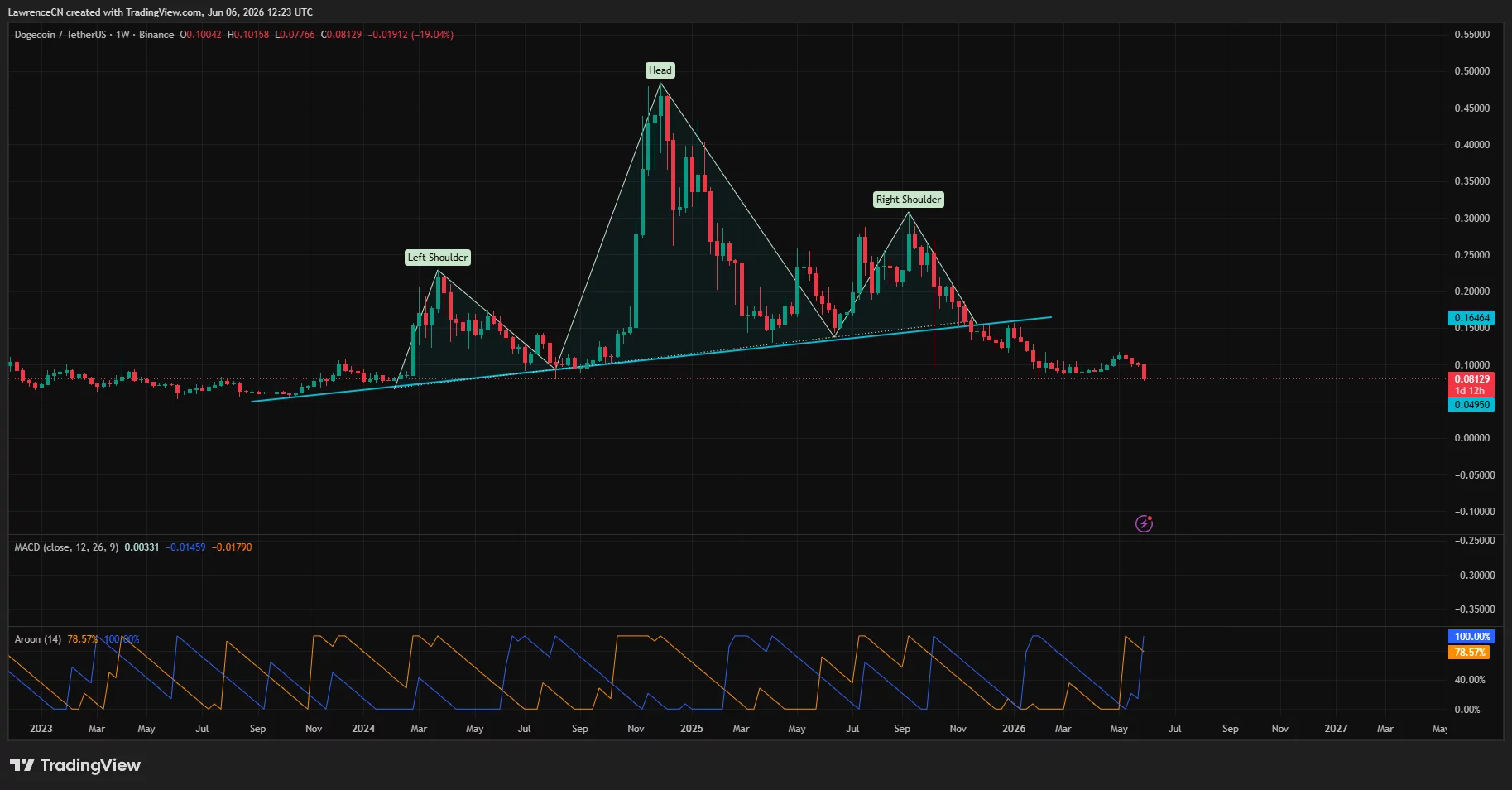
DOGE broke below the ascending neckline earlier this year and has failed to reclaim it during subsequent rallies. The former support line near $0.16 has now turned into resistance, leaving sellers firmly in control of the longer-term trend.
Momentum indicators remain weak. The weekly MACD remains below its signal line, while the price continues to trade far beneath major moving-average clusters that supported previous bull cycles. At the same time, the Aroon structure on the weekly timeframe continues to favor the dominant downtrend.
Commenting on the market structure, crypto analyst Ali Martinez noted that Dogecoin has already reached the $0.0883 target and is now testing the lower boundary of a descending channel.
“As long as this support holds, I think a recovery toward $0.1019 and $0.1156 remains likely,” Ali wrote.
Support near $0.08 becomes the key battleground
The most immediate support now sits around the current $0.08 region. Losing that level would expose the psychological $0.067 area identified by Ali as the next major supply-demand zone below the market.
Failure to hold $0.067 could increase the probability of a move toward the long-term structural support area near $0.05, which aligns with historical consolidation levels seen before Dogecoin’s 2024 breakout.
Bulls still have a path to invalidate the bearish setup. A recovery above $0.10 would place DOGE back inside Ali’s projected rebound zone, while a move above the broken neckline near $0.16 would weaken the head-and-shoulders breakdown thesis and force traders to reassess the long-term trend.
For now, the weekly chart remains tilted toward further downside as Dogecoin trades beneath both the neckline and its former accumulation range.
Disclosure: This article does not represent investment advice. The content and materials featured on this page are for educational purposes only.

Visa is testing privacy-preserving blockchain networks to support institutional stablecoin settlement without exposing sensitive transaction data. The proof-of-concept pairs Brale, the stablecoin infrastructure firm behind SBC, with the Canton Network—a permissioned ledger developed in collaboration with major Wall Street players—to evaluate whether SBC could become a viable settlement option for banks and market infrastructures.
The project, announced this week via Businesswire, centers on simulating institutional payment flows on Canton to assess if SBC can deliver on-chain settlement while keeping counterparty information, flow details, and other sensitive data under strict governance and access controls. The effort expands Visa’s ongoing experimentation with stablecoins for settlement on public blockchains—an initiative that began in 2021 with USDC settlement on Ethereum—but shifts the focus toward networks that preserve privacy for counterparties and assets involved in large-scale financial operations.
“The aim is to see whether a private, permissioned environment can pair the programmability of on-chain settlement with the confidentiality required by institutions,” Visa and Brale said in the release. While the current test is conceptual, the choice of partners and architecture signals a broader push among banks and market infrastructures to explore on-chain efficiency without broadcasting every detail of a transaction onto a public ledger.
The broader context for this push comes as policymakers and analysts consider how payment-focused stablecoins will evolve. S&P Global Ratings, in a report released this week, noted that global stablecoin issuance has surpassed $300 billion across currencies, with most demand still anchored in crypto trading but showing signs of broader use. The report adds that U.S. policy and regulatory developments—such as those anticipated around GENIUS Act-compliant stablecoins—could eventually unlock new use cases in cross-border payments and merchant remittances, though such flows currently account for only a small, growing share of international payment volumes.
Key takeaways
- The PoC tests private, regulator-accessible settlement of a US dollar-backed stablecoin (SBC) on Canton, aiming to preserve transaction confidentiality while enabling atomic settlement across tokenized assets.
- Brale’s SBC sits at the core of the experiment, representing a pathway for stablecoins designed specifically for institutional settlement rather than retail-facing use alone.
- Canton is a permissioned network designed for institutional applications, where only involved parties and authorized regulators can view sensitive deal data, enabling controlled on-chain settlement without public disclosure of counterparty details.
- Industry context suggests growing interest in GENIUS-compliant stablecoins among U.S. institutions, with potential near-term use cases in cross-border payments and merchant remittances, subject to final regulatory clarity.
- Analysts caution that while pilots highlight technical feasibility and privacy advantages, banks could be affected financially in the longer term as stablecoins reshape settlement rails and funding dynamics.
Private settlement in a public-privacy framework
The Canton Network lies at the heart of this investigation. Developed with input from Digital Asset, Canton connects permissioned blockchain applications used by institutions such as JPMorgan, Goldman Sachs, BNP Paribas, and the Depository Trust & Clearing Corporation. Unlike fully public blockchains, Canton is designed so that only transaction participants and authorized regulators can access specific data, while still enabling atomic settlement across tokenized assets, cash-like instruments, and other financial contracts.
Visa and Brale describe the PoC as a way to explore how Canton’s privacy architecture could support faster, programmable settlement with the ability to retain strict visibility controls for sensitive information. In practice, this could allow large financial institutions to leverage on-chain settlement for stability-focused transactions without exposing the details of who is transacting with whom, or the exact flow of funds, to the broader market.
For banks and market infrastructure providers, the potential was underscored by S&P Global Ratings’ assessment of the evolving stablecoin landscape. While a portion of stablecoin activity today remains tied to crypto trading, the emergence of GENIUS-compliant stablecoins opens a path toward regulated, privacy-preserving settlement rails that could integrate with existing payment networks and correspondent banking processes. The report highlights cross-border settlements as one of the most promising near-term use cases, even as these stablecoins currently account for only a minority share of international payment volumes.
What this implies for market infrastructure and policy
Institutional interest in private settlement networks reflects a broader ambition to combine the efficiency of on-chain settlement with the prudence and governance expected of traditional finance. The Canton-based pilot illustrates a practical route for institutions to test whether their own liquidity, collateral workflows, and cash-like instruments can be tokenized and settled in near real time, without exposing strategic details to competitors or the public.
From a regulatory standpoint, the emphasis on privacy is not merely a technical preference but a governance concern. The GENIUS Act and related regulatory trajectories aim to codify how U.S. stablecoins that meet certain standards can be deployed across the payments ecosystem. While final rules are still pending, the industry is watching closely to understand how such stablecoins will interact with existing payment rails, central-bank policies, and the capital markets framework that underpins settlement infrastructure.
Industry observers also note that the technology threading through Canton—privacy-preserving mechanisms, permissioned access, and cross-token interoperability—could influence how banks approach tokenized deposits and other digital assets in a regulated context. As banks experiment with issuing their own stablecoins or tokenized deposits, they may seek architectures that guarantee data confidentiality while enabling efficient on-chain settlement, reconciliation, and liquidity management.
It is important to acknowledge the lines of communication from the involved parties. Cointelegraph reached out to Visa, Brale, and Digital Asset for comment, but no formal responses were available at publication. The consortium-based nature of the project, with ties to large financial institutions and established infrastructure players, signals a measured, collaborative approach to evaluating new settlement workflows rather than a sudden shift in policy or product strategy.
Looking ahead: the path from pilots to practical adoption
What remains uncertain is how quickly privacy-focused, institutional settlement networks can scale in a live environment and what regulatory guardrails will govern their use. The current PoC is a proof of concept designed to illuminate feasibility and governance considerations, not a deployment timeline. Yet the trajectory is clear: if private settlement on permissioned ledgers demonstrates tangible improvements in settlement speed, counterparty risk management, and operational efficiency, it could push financial institutions to accelerate pilots and potentially migrate portions of their settlement flows onto permissioned, privacy-enabled rails.
For investors and builders, the development underscores two key themes shaping the crypto and digital asset space. First, the line between public and private ledgers is becoming increasingly nuanced as institutions demand both transparency and confidentiality. Second, the market is watching regulatory guidance on GENIUS-compliant stablecoins, and how those rules will interact with cross-border payments, merchant remittance, and wholesale financing needs. The outcome of this policy process will likely influence the speed and scope of adoption for private-stablecoin settlement schemes in the coming quarters.
As the ecosystem continues to evolve, observers should monitor how financial institutions balance the benefits of real-time settlement with the governance requirements that come with private, permissioned networks. The Canton-Visa-Brale collaboration represents a concrete step in that direction—one that could shape the next phase of digital-asset-backed settlement infrastructure if pilot results translate into scalable, compliant, and privacy-respecting operations.
Readers should stay tuned for further updates as more details emerge from ongoing discussions, technical evaluations, and potential broader deployments. In a market where data visibility and settlement speed are both crucial, privacy-preserving on-chain rails could become a pivotal element of the institutional fintech toolkit, provided they align with regulatory expectations and sound risk management practices.


A former senior CIA officer allegedly fabricated a top secret intelligence program to siphon government money into gold, according to people familiar with the federal investigation.
David J. Rush, charged with theft of public money, built a sham “special access program” that prosecutors say funneled millions and ended with 303 gold bars stashed in his home.
How the Alleged Scheme Worked
Rush worked in the CIA’s Directorate of Science and Technology and built what is known as a special access program, a black box so restricted that even cleared officers need authorization to see inside.
He allegedly “read in” two colleagues as possibly unwitting accomplices and used a fabricated contract to funnel money into it.
The fake project posed as continuity of government work, the doomsday planning for keeping Washington running after a catastrophe.
Rush reportedly used that cover to persuade a defense contractor to buy large amounts of gold.
Follow us on X to get the latest news as it happens
What the FBI Found
A May 18 raid on Rush’s Virginia home turned up 303 gold bars worth roughly $40 million, $2 million in cash and 35 luxury watches, according to a government affidavit.
The May 20 filing also alleges he lied about a Clemson degree, a Rensselaer master’s and a Navy pilot record, and collected $77,000 in military leave pay after leaving the Navy in 2015.
The FBI found no record he attended either school. CIA Director John Ratcliffe referred the case after an internal review, and several officials are now on leave.
Why a $40 Million Gold Haul Draws Scrutiny
The seizure lands amid record demand for gold as a store of value, with central banks stockpiling gold near record levels.
That run has revived the BTC versus gold debate and fresh claims that Bitcoin is digital gold.
Investors also weigh Bitcoin versus gold as a hedge.
Physical bullion, though, leaves a heavy paper trail, raising questions about how the theft escaped notice.
A Widening Case
At a June 5 detention hearing in Alexandria, Virginia, Magistrate Judge William Fitzpatrick ordered Rush held as a flight risk.
Prosecutor Gavin Tisdale called him a “master manipulator” and said the evidence so far is only a “fraction” of what investigators have gathered.
“Keeping gold bars and wads of cash in your house is not exactly top-notch tradecraft,” said Jim Himes, ranking Democrat on the House Intelligence Committee, in a public statement.
The single charge may be only the opening move. With evidence sealed and officials on leave, coming weeks will show whether this is one man’s fraud or a wider breakdown of CIA controls.
The post CIA Official Allegedly Invented Fake Doomsday Program to Hide $40 Million Gold Scheme appeared first on BeInCrypto.
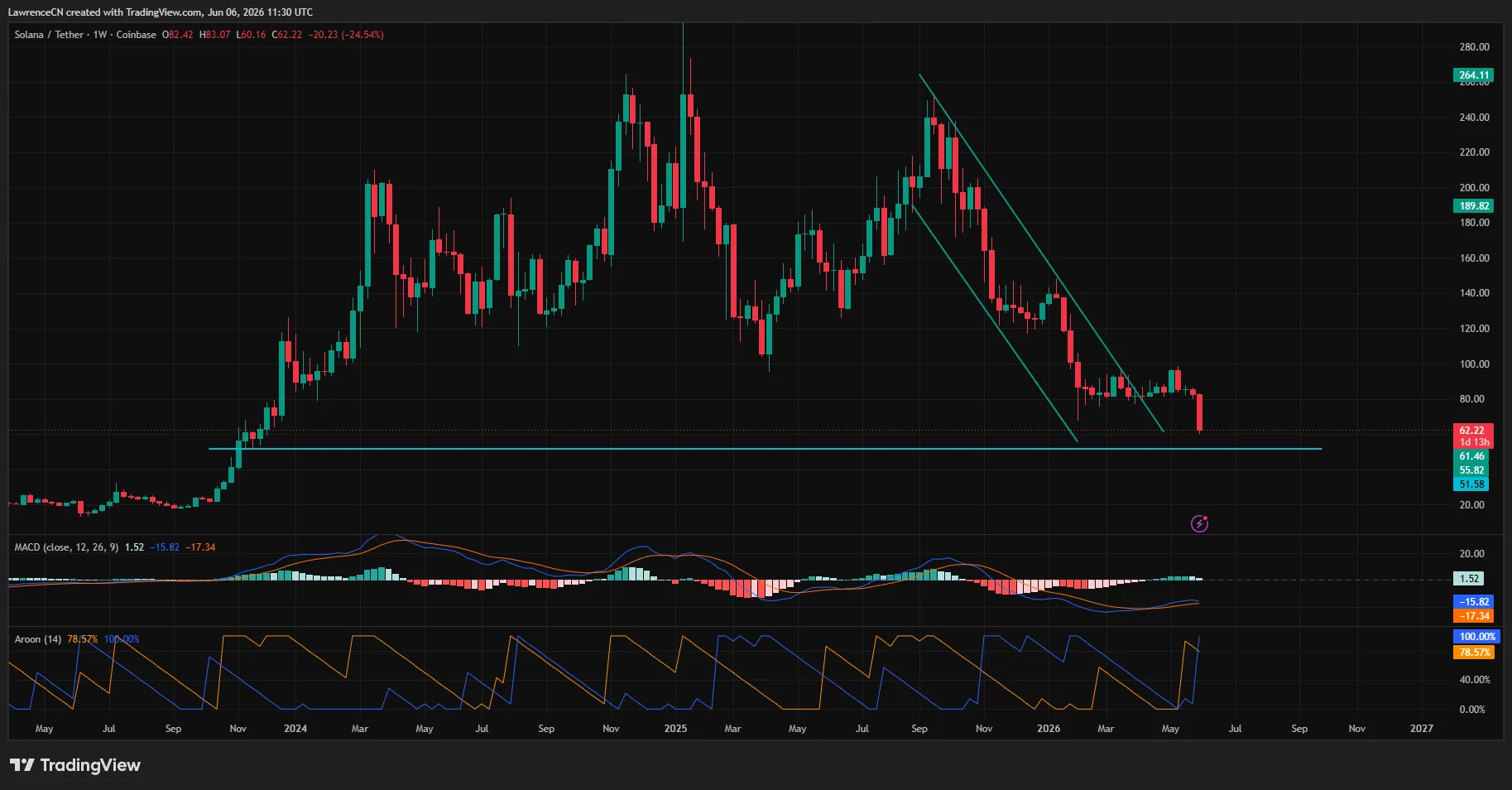
Solana price has fallen to a multi-year low as a major corporate holder moved $31.9 million worth of SOL to Coinbase Prime, adding to fears that whales are reducing exposure during the market selloff.
Summary
- Solana price fell to a multi-year low near $60 as whale transfers, ETF outflows, and market-wide liquidations intensified selling pressure.
- Forward Industries moved $31.9 million worth of SOL to Coinbase Prime, fueling concerns that large holders may be reducing exposure.
- Technical indicators and liquidation data suggest a break below current support could expose SOL to the $55–$50 region.
According to data from crypto.news, Solana (SOL) traded near $62 on June 6 after briefly falling to the $60 area. The token has lost roughly 24% over the past week, more than 30% over the past month, and about 50% since the start of the year as traders continued reducing exposure to risk assets amid a broader crypto market selloff.
Large holders have added to concerns about the market’s outlook. According to blockchain analytics platform Lookonchain, Forward Industries transferred 455,784 SOL worth approximately $31.9 million to Coinbase Prime after a month of inactivity.
Since adopting a Solana treasury strategy in September 2025, the company has spent roughly $1.59 billion acquiring 6.83 million SOL at an average price of $232. Lookonchain estimates those holdings are now worth about $458.6 million.
The transfer does not confirm an outright sale, but traders frequently monitor deposits to institutional trading venues for signs that large investors may be preparing to reduce positions. The transaction arrived as SOL traded near its lowest levels since 2024 and reinforced concerns that other treasury holders could also move to protect capital if market conditions worsen.
Derivatives markets have already undergone a sharp deleveraging event. CoinGlass data shows more than $1.5 billion in crypto positions were liquidated over the past day, with long traders accounting for most of the losses. Solana absorbed a significant share of the damage as leveraged bullish positions were forced to close into a falling market.
Institutional demand has also weakened. SoSoValue data showed that U.S. spot Solana ETFs recorded net outflows after several weeks of inflows. The reversal came as investors reassessed exposure to digital assets following Bitcoin’s decline below the key $60,000 support level.
Outside crypto, financial markets have become increasingly defensive. A stronger-than-expected U.S. jobs report reduced expectations for Federal Reserve rate cuts, while renewed geopolitical tensions in the Middle East pushed oil prices higher and revived inflation concerns.
Rising Treasury yields prompted another rotation away from speculative assets, weighing on altcoins across the market.
Solana approaches a critical long-term support zone
The weekly chart shows Solana testing a major support area near $51.5 after months of persistent selling pressure. The level served as an important breakout zone during late 2023 and now represents the most significant support remaining on the higher-timeframe chart.
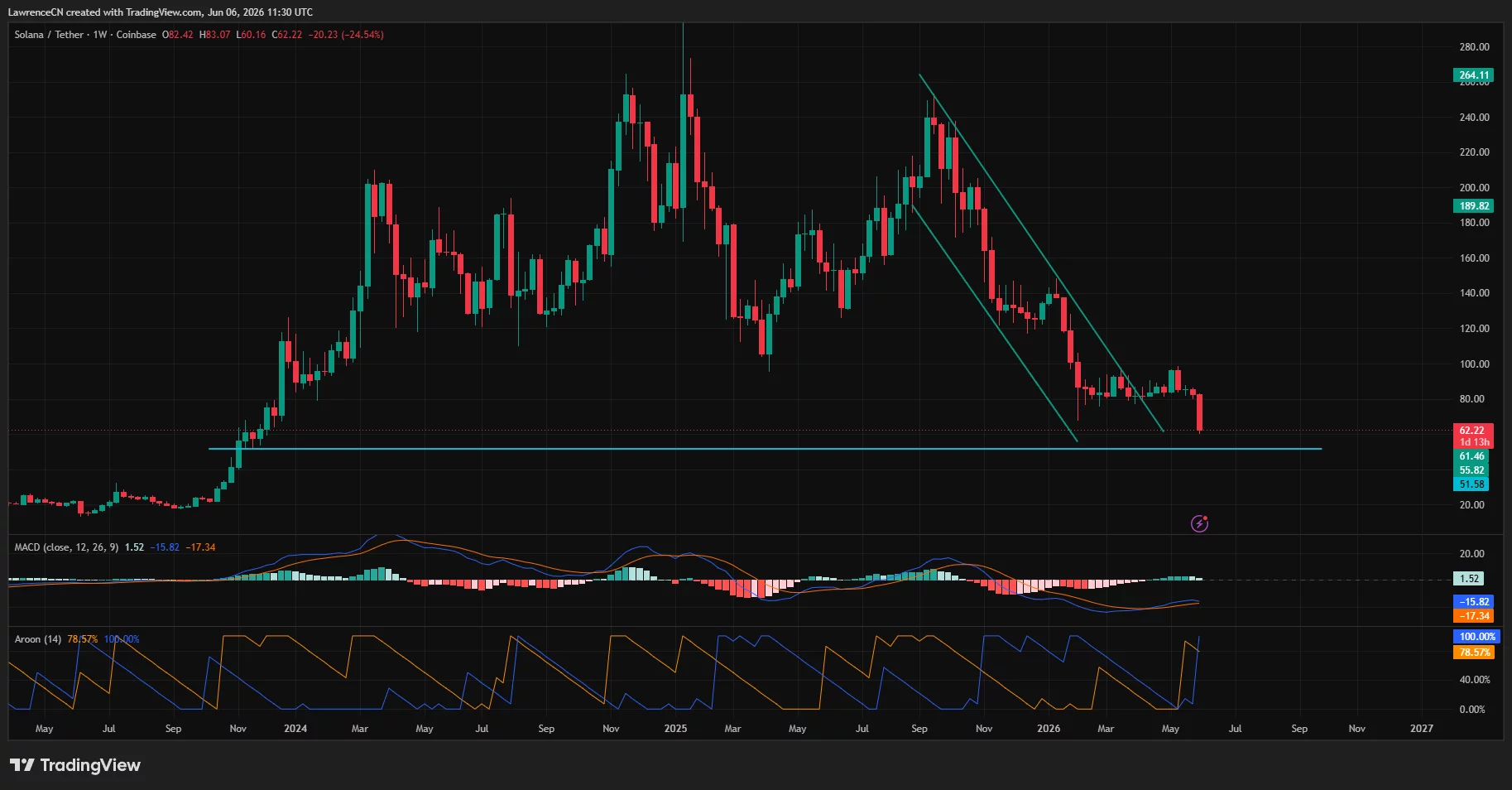
Trend indicators continue to favor sellers. Solana remains well below its major moving averages, while the weekly MACD sits beneath the zero line with both MACD and signal lines still trending lower. Aroon indicators also remain bearish, with the Aroon Down reading returning to 100 and the Aroon Up trailing beneath it.
Commenting on the bearish market setup, crypto analyst Jack Adams argued that Solana may revisit lower levels before finding a durable bottom.
“I am almost certain $SOL is heading back to retest $67-$58 once more before reversing into $120-$175 this year.”
According to the analyst, previous demand zones between $58 and $67 could attract longer-term buyers despite the ongoing market weakness.
Weak support below current levels raises $50 risk
CoinGlass liquidation heatmap data identifies the largest concentration of leveraged positions between $70 and $75, with a particularly dense cluster near $74. Those levels could attract price during any relief rally, although they now represent significant resistance after the recent breakdown.
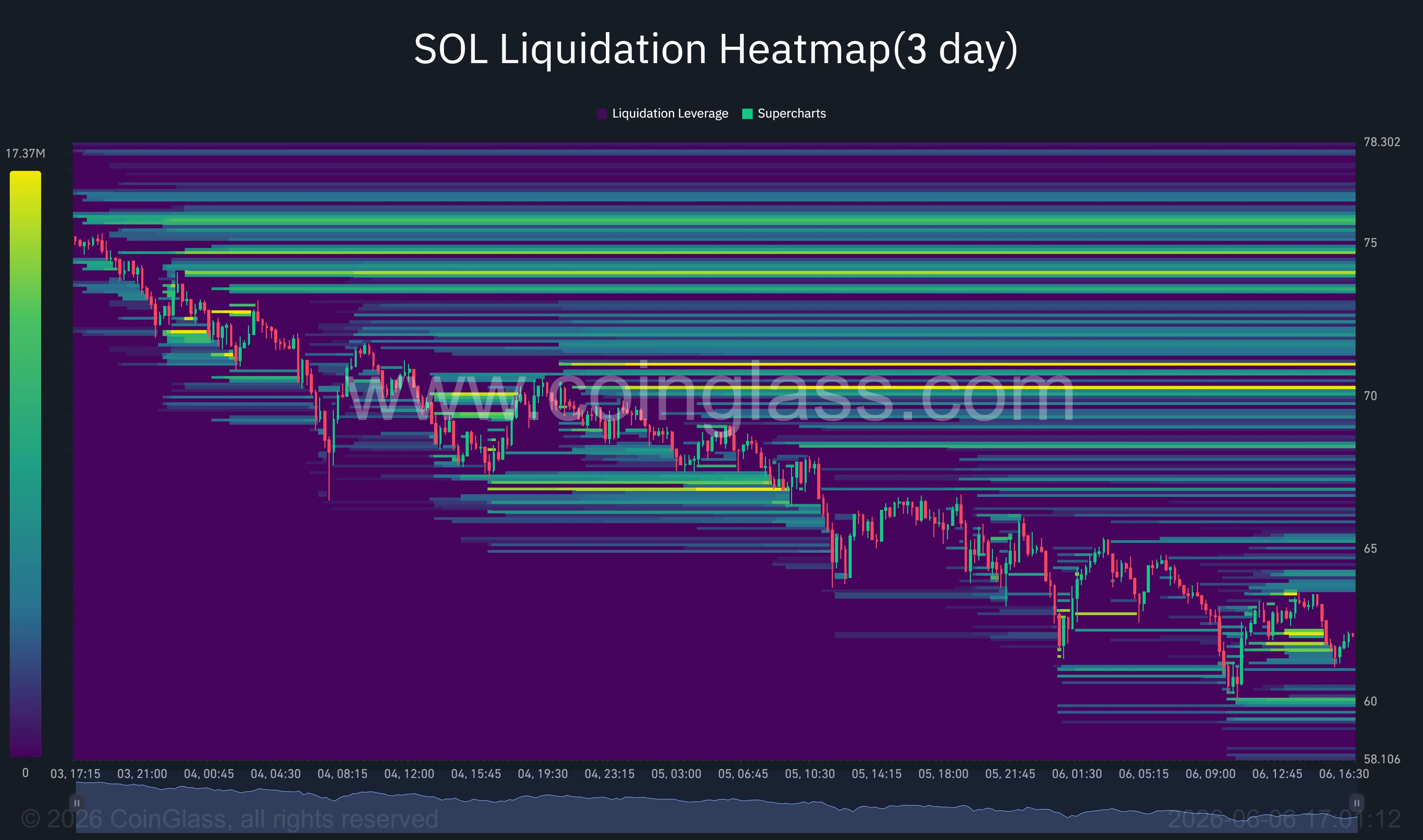
Below the market, liquidity becomes noticeably thinner. The heatmap shows relatively limited support beneath the recent lows compared with the large concentration of positions overhead, increasing the risk of an accelerated move if sellers force another breakdown.
A decisive breakdown below the $51.5 support zone could expose Solana to the psychological $50 level. Since the chart shows limited historical trading activity beneath that area, sellers could attempt to force a deeper move if market conditions remain unfavorable.
Any bullish recovery would likely require SOL to reclaim the former support area near $70 before challenging the heavy liquidation cluster between $74 and $75.
For now, corporate treasury transfers, ETF outflows, aggressive derivatives liquidations, and unfavorable macro conditions continue to keep pressure on the market, leaving the $50 level firmly on traders’ radar.
Disclosure: This article does not represent investment advice. The content and materials featured on this page are for educational purposes only.

In such times of distress, in which the broader crypto market has experienced a sudden and painful decline, Cardano’s co-founder decided to take a break after a short and bitter announcement on X.
Charles Hoskinson’s decision only worsened ADA’s positioning, as the asset tumbled by double digits on Friday and dumped below $0.19 at the time. It kept plunging in the following hours and slumped to under $0.16 later that day, which became its lowest price level since December 2020. The question we asked ChatGPT’s latest version is how low the token can go now.
Consequences for Cardano and ADA
The numbers paint a clear story for ADA. At one point on Friday, it was down by 14% on a 24-hour scale. The weekly losses are up to 30%, while the monthly decline is at 40%. The macro view paints an even more catastrophic picture, with a 75% value reduction in the past year and a whopping 94.7% drop since its all-time high seen in September 2021.
As such, Hoskinson’s move expectedly caused a lot of controversy immediately, with the social media comments exploding. A few praised his decision, others doubted it, and some lashed out.
ChatGPT reassured that Hoskinson has not resigned from Cardano, but the timing matters. His announcement came shortly after the shutdown of major ecosystem participants, the cancellation of Cardano’s flagship summit, and public warnings that additional projects and DeFi applications could disappear before the end of the year.
“The market is treating the move as a vote of no confidence. Whether that interpretation is fair or not is almost irrelevant. Crypto markets are driven by narratives and the current dominant one is that Cardano’s ecosystem is shrinking while competitors continue to attract developers, liquidity, and users,” the AI stated.
So, How Low?
After acknowledging that ADA has already erased years of gains with its drop below $0.17, ChatGPT warned that it could still have room to fall if sentiment continues deteriorating.
Its bearish scenario envisions another leg down, perhaps toward $0.12. If that level cracks, then Cardano’s native asset could be on the way down to even under $0.10. Extreme capitulation sees a decline to $0.08, while the “nuclear scenario” from the AI platform outlined $0.05 as the lowest target.
“For ADA to trade below five cents, Cardano would likely need to enter a prolonged death spiral involving developer departures, collapsing liquidity, and a broader crypto bear market,” it concluded.
The post How Low Could ADA Fall Without Hoskinson? AI Issues Stark Warning appeared first on CryptoPotato.
Ethereum price plunged towards the $1,500 level after a wave of long liquidations, persistent ETF outflows, and worsening macroeconomic conditions triggered one of the sharpest crypto selloffs of 2026.
Summary
- Ethereum price plunged to around $1,500, extending weekly losses to 23% amid a market-wide liquidation event and worsening macro conditions.
- Spot Ethereum ETFs saw $540 million in outflows in May, and another $168 million left the funds in early June, adding pressure on prices.
- Analysts warn a break below $1,400 could expose ETH to a deeper decline toward the $1,000-$1,100 region.
According to data from crypto.news, Ethereum (ETH) price fell over 10% to an intraday low of around $1,505 on June 6 before stabilizing near $1,540 at press time. The decline extended losses to roughly 23% over the past week and pushed ETH to its lowest level since early 2023 as investors fled risk assets across both crypto and traditional markets.
Selling accelerated after Bitcoin briefly slipped below the key $60,000 support level, triggering a market-wide liquidation event. Derivatives data showed nearly 78.7% of liquidations over recent sessions came from long positions, while Ethereum open interest dropped by almost 30%, highlighting a sharp reduction in leveraged bullish bets.
At the same time, institutional demand continued to deteriorate. Per SoSoValue data, U.S. spot Ethereum ETFs recorded approximately $540 million in net outflows during May, with another $168 million leaving the products during the first week of June. The sustained withdrawals removed a major source of demand from the spot market and added pressure on ETH as prices broke below several key technical levels.
Macroeconomic conditions added another layer of stress. A stronger-than-expected U.S. labor report reduced expectations for Federal Reserve rate cuts, while renewed military tensions between the United States and Iran pushed Brent crude toward $97 per barrel.
Rising oil prices revived inflation concerns and prompted investors to move capital into defensive assets and large-cap technology stocks rather than cryptocurrencies.
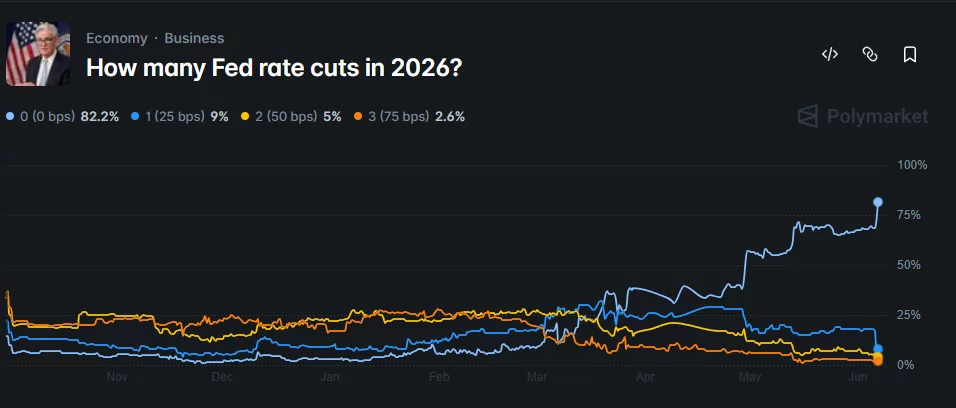
Prediction market participants have also scaled back expectations for Federal Reserve easing. Polymarket data recently showed traders assigning a roughly 82.2% probability that the Federal Reserve will not cut interest rates during the remainder of 2026, a scenario that could keep liquidity conditions tight for risk assets.
Ethereum breakdown opens path toward $1,000 support zone
Technical charts show Ethereum breaking below a rising support trendline that had previously acted as the foundation of several recovery attempts since February. The breakdown completed a bearish continuation structure and sent ETH directly toward the $1,550 support region identified by multiple analysts.
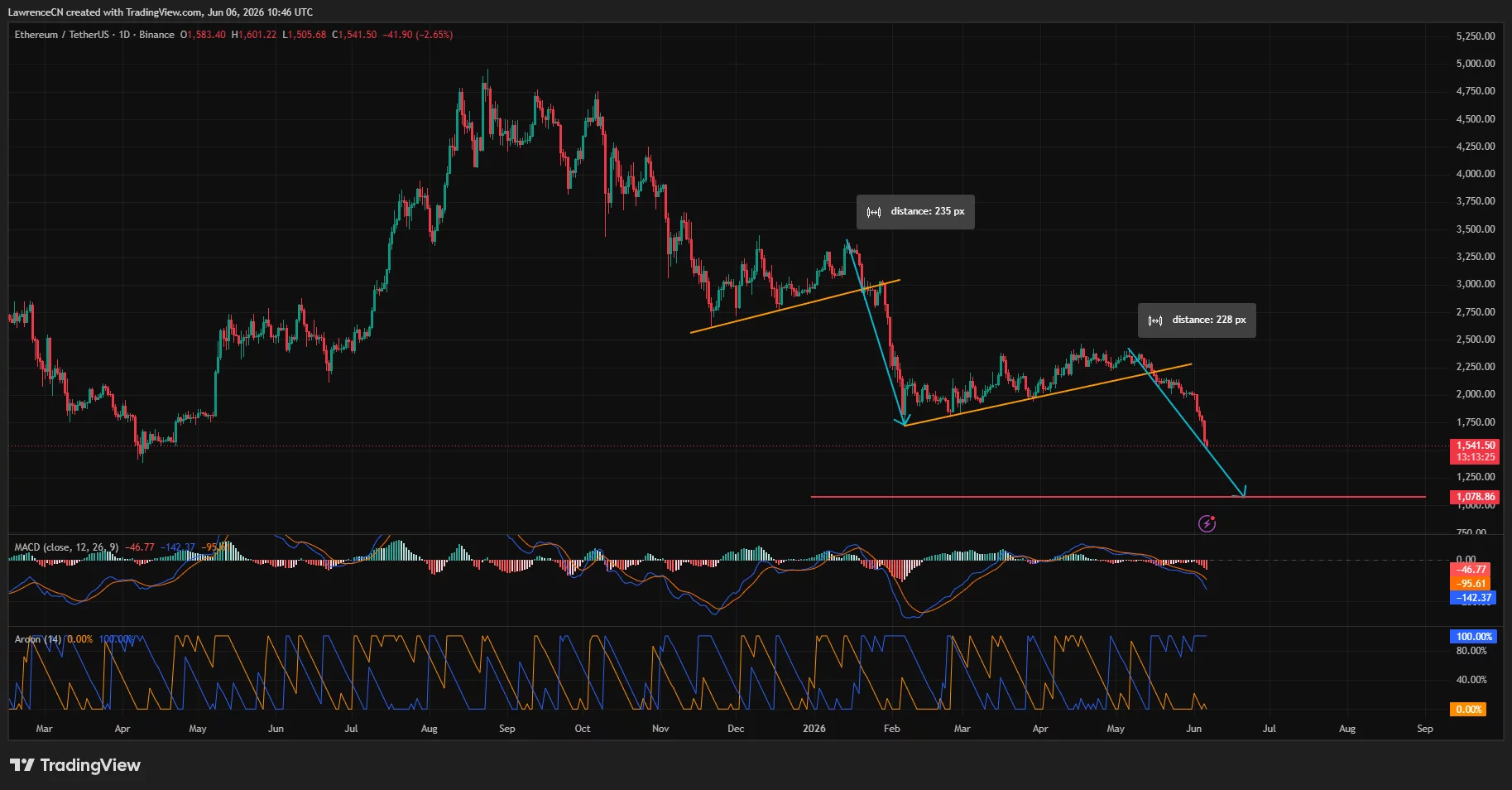
According to crypto analyst Ali Martinez, Ethereum has already reached his first downside objective.
“Ethereum $ETH hit my first target at $1,560. Next target: $1,070.”
A separate analysis from More Crypto Online argues that Ethereum remains in a larger corrective decline. The firm noted that support sits near $1,550 and $1,400, while any recovery attempt is likely to face resistance at the broken trendline that previously supported the market.
Momentum indicators continue to favor sellers. The daily MACD remains deeply negative, while the Aroon indicator shows bears maintaining full control of the prevailing trend. Meanwhile, Ethereum has fallen well below its 200-day moving average after losing the psychologically important $1,800 level earlier this week.
On-chain activity has weakened alongside the price action. Ethereum network fees have fallen roughly 45% from recent highs, while large holders have continued reducing exposure during the latest decline. The drop in network activity coincides with reduced speculative demand across decentralized finance and derivatives markets.
Key risks remain tied to leverage, ETF flows and macro conditions
Liquidation data suggests downside volatility could persist if Ethereum loses the $1,400 support area. Several analysts have identified the $1,000-$1,100 region as the next major historical demand zone should current support levels fail to hold.
Additional pressure could emerge from decentralized finance markets. Estimates suggest roughly $547 million in lending positions may face liquidation if Ethereum extends its decline, creating another potential source of forced selling.
A recovery scenario would require Ethereum to reclaim the broken trendline resistance and recover the $1,800 area, which previously served as a major support level. ETF flows also remain critical. Continued institutional withdrawals would likely limit any rebound attempt, while a return of inflows could help stabilize market conditions.
Crypto sentiment remains firmly bearish for now. The Crypto Fear & Greed Index recently fell to 11, its lowest reading in Extreme Fear territory, underscoring the depth of investor pessimism as Ethereum tests support levels not seen in more than two years.
Disclosure: This article does not represent investment advice. The content and materials featured on this page are for educational purposes only.

TLDR:
- Goldman Sachs projects $7.6 trillion in cumulative AI infrastructure capex between 2026 and 2031.
- Nvidia is forecast to capture 75% of the $5.1 trillion compute layer over the six-year period.
- Power is the smallest budget segment at $358 billion but the critical bottleneck for full deployment.
- Vistra locked in a 20-year, 2,600 MW nuclear deal with Meta to meet surging AI power demand.
Goldman Sachs has released a detailed projection of artificial intelligence infrastructure capital expenditure, forecasting $7.6 trillion in cumulative spending from 2026 to 2031.
The breakdown covers three core layers: compute at $5.1 trillion, data centers at $2.1 trillion, and power at $358 billion.
The report identifies specific companies positioned to absorb capital across each segment. At $765 billion in 2026 alone, annual AI capex is expected to reach $1.6 trillion by 2031.
Compute and Data Center Demands Drive Infrastructure Buildout
Goldman Sachs AI infrastructure projections place Nvidia at the center of the compute layer. The firm assumes Nvidia will capture 75% of all compute spend over the forecast period, translating to roughly $3.8 trillion in cumulative revenue through its products. The baseline unit for this projection is the Rubin VR200 chip, priced at $80,500 per GPU.
Nvidia’s data center GPU gross margins sit at 75%, which is why major hyperscalers are developing custom silicon.
However, performance gaps mean those same companies continue purchasing Nvidia hardware in parallel. No current alternative matches its output at scale.
The data center layer reflects a sharp escalation in physical requirements. Standard cloud infrastructure runs between 5 and 15 kilowatts per rack.
Transitional Blackwell-era AI facilities operate at 130 to 200 kilowatts per rack. Next-generation AI factories running Rubin and Feynman chips require over 500 kilowatts per rack, with liquid cooling as the only viable thermal option.
Construction costs are rising alongside density. Traditional hyperscale data centers cost approximately $10 million per megawatt to build.
Next-generation AI data centers are being planned at $15 to $20 million per megawatt, a sharp increase driven by cooling and power infrastructure requirements.
Power Constraints and Key Companies Shape the Capital Cycle
Goldman Sachs AI infrastructure analysis identifies silicon useful life as the single largest variable in the model. At a three-year replacement cycle, cumulative compute depreciation reaches $3.99 trillion. A seven-year cycle drops that figure to $2.23 trillion, a difference of $1.76 trillion on one assumption.
Vertiv is positioned directly within the data center upgrade cycle. Every rack transitioning from 40 kilowatts to 500-plus kilowatts requires new liquid cooling systems and power distribution equipment. The liquid cooling market is projected to grow from $5.5 billion today to $15.75 billion by 2030.
Power, at $358 billion, is the smallest budget segment but the most operationally critical. Amazon CEO Andy Jassy captured the constraint plainly: “Our single biggest constraint is power.”
Grid connection timelines for large data centers extend into years, making early contracting essential for deployment.
Vistra has responded to that constraint by locking in long-term nuclear power purchase agreements. The company secured a 20-year deal with Meta covering over 2,600 megawatts of nuclear energy, along with a separate agreement with AWS.
Goldman Sachs and Jefferies both upgraded Vistra following the Meta announcement, according to Milk Road AI’s breakdown of the report.

Seaham car boot sale cancelled due to ‘poor weather’

Why quantitative traders are using complex math models to hijack your weekend sports bets

‘Backrooms’ producer Peter Chernin thinks Hollywood needs to change



-

 Business5 days ago
Jade Biosciences, Inc. (JBIO) Discusses Positive Interim Results From JADE101 Phase I Healthy Volunteer Study and Development Plans Transcript
-

 Sports4 days ago
French Open 2026 results: Alexander Zverev beats Rafael Jodar and will play Jakub Mensik in semi-finals
-

 Fashion19 hours ago
Weekend Open Thread: Evereve – Corporette.com
-
 Crypto World24 hours ago
Jensen Huang Approves Samsung, SK Hynix, and Micron for NVIDIA (NVDA) HBM4 Memory Supply
-

 Tech4 days ago
CryZENx Releases Fresh Playable Content Deep Inside Jabu-Jabu for His Ocarina of Time Remake
-

 Business3 days ago
Trump Taps Housing Chief Bill Pulte as Acting Intelligence Director After Gabbard Exit
-
Crypto World1 day ago
LBank Surpasses 25 Million Users Worldwide as AFA Partnership Continues to Drive Global Growth
-
 Crypto World4 days ago
Seagate (STX) Stock Surges to Record High on AI Boom and Legal Settlement
-
 NewsBeat4 days ago
Republicans balk at Trump’s attempt to appoint a MAGA enforcer to lead National Intelligence
-
Crypto World3 days ago
EU AI Data Center Project Faces Delays as Funding Gaps Grow
-

 Entertainment3 days ago
Did The Mandalorian And Grogu Already Ruin The Next Star Wars Movie?
-

 Business3 days ago
Aehr Test Systems Stock Soars 17% Amid Surging AI Demand and Conference Spotlight
-

 Business3 days ago
Relay Therapeutics Shares Surge 20% on ASCO Momentum for Zovegalisib Breast Cancer Program
-
 Business4 days ago
Claude AI Down Today Reason: Why Anthropic’s AI is not working today? What’s the latest quota update
-

 Tech4 days ago
Instagram will stop bombarding teens with the same kind of obsessively unhealthy content
-

 Tech1 day ago
RCS Messages Between iPhone and Android Get End-to-End Encryption With iOS 26.5
-
 Crypto World23 hours ago
Merlin (MRLN) Stock Soars 32% on Major USSOCOM Autonomy Milestone
-
Crypto World5 days ago
Tether Brings Google’s TurboQuant to Production, Unlocking Long-Context AI on Everyday Devices
-

 Business4 days ago
Dow Jones Climbs Near Record Highs as AI Optimism Offsets Geopolitical Risks
-
 Entertainment4 days ago
‘Aliens’ Star Reveals How the US Military Co-Opted James Cameron’s Sci-Fi Tech [Exclusive]
You must be logged in to post a comment Login