


Connect with us
DAPA Banner
DAPA Coin
DAPA
COIN PAYMENT ASSET
PRIVACY · BLOCKDAG · HOMOMORPHIC ENCRYPTION · RUST
ElGamal Encrypted MINE DAPA
🚫 GENESIS SOLD OUT
DAPAPAY COMING

Tech

June Pixel Drop: New camera features, Gemini improvements and more

Published

on

Google has released its June Pixel Drop update for compatible Pixel smartphones, bringing a mix of new Gemini-powered features, multitasking improvements, and communication upgrades. The update focuses heavily on creativity, introducing new tools for video creation, music generation, and screen recording, while also enhancing calling and emergency features.

Screen Reactions Makes Content Creation Easier

Pixel Screen reactions

One of the more interesting additions in the June Pixel Drop is Screen Reactions. The feature lets users record their screen while simultaneously capturing themselves through the front-facing camera. It’s designed for creators who record tutorials, gameplay clips, or social media content.

Users can reposition and resize the camera feed while recording, eliminating the need for separate screen recording and webcam software. Everything can be captured directly from a Pixel device.

New Gemini Capabilities

Personalized Music with Gemini

Google is also expanding Gemini’s creative toolkit with new video-generation features. Users can describe a concept in natural language, and Gemini can generate a video from a combination of text, images, and existing video clips. The feature can also work with content already stored in a user’s camera roll, making it easier to create edited videos without relying on traditional editing software. Google has additionally introduced AI-generated avatars, allowing users to create digital versions of themselves for personalized content.

The June Pixel Drop also adds music-generation tools powered by Gemini. Users can create songs from simple text prompts and customize different elements of the final track. The feature is aimed at creators looking for background music for videos, presentations, or personal projects without needing dedicated music-production software.

Beyond that, Google continues to integrate Gemini into communication tools across the Pixel lineup. One of the newest additions is Voice Translate on the Pixel 10a, which provides live translation during phone calls. The feature currently supports English and Hindi, allowing users to communicate across languages without relying on third-party translation apps. Google has also expanded Quick Share support to additional devices.

Advertisement

Improved Voicemail and Floating Message Bubbles

Quick Access with Bubbles in June pixel drop

Pixel users are also getting several improvements to the calling experience. The update allows users to create personalized voicemail greetings using recorded audio instead of standard templates. Google has also expanded access to call transcription features, making it easier to review messages without having to listen to them. Call screening capabilities have been improved in several regions, including India.

Multitasking is receiving attention as well. Google is expanding support for floating bubbles, allowing supported apps to remain accessible in small floating windows above other applications. The feature should make it easier to switch between tasks without constantly jumping between apps. Activities like messaging, browsing, and following tutorials become more convenient, particularly on larger-screen devices. Foldable Pixel phones also receive additional multitasking optimizations as part of the update.

Emergency Features Become More Connected

New Communication and Calling Upgrades

Safety remains a major focus of the Pixel experience. With this update, emergency sharing now works alongside features such as car crash detection, fall detection, and pulse loss detection. In emergency situations, users can quickly notify both emergency services and selected contacts. The goal is to streamline the process of getting help while ensuring friends and family remain informed when something goes wrong. The June Pixel Drop is rolling out now to eligible Pixel devices and represents one of Google’s larger software updates of the year, particularly for users interested in Gemini’s growing suite of AI-powered tools.

Source link

Continue Reading
Click to comment

You must be logged in to post a comment Login

Leave a Reply

Tech

Generative AI Music Attribution Rethinks Royalties

Published

on

Musicians are accustomed to getting paid each time their creative work is used. Across vinyl/CD sales, streams, radio, cover versions, and those numerous niches like karaoke, there are agreements in place about what “use” means. Underlying this is a simple economic principle: The more something is used, the more money it makes.

Generative AI has complicated the definition of use. On the one hand, you could argue that the use of a piece of musical training data happens just once, at the point of training. On the other hand, creators would be right to complain that the creative essence of their work lives on in the structure of the model, used every time the model produces an output.

Now, companies like Sureel and SoundVerse are working to re-create the essential economic principle that motivates creativity in an era of AI. Such initiatives aim to turn the generative AI industry from one guilty of “the biggest act of copyright theft in history” into one that coexists harmoniously with hardworking artists.

Music Royalties for the AI era

Sureel, a startup Warner Music Group just acquired, has partnered with the Swedish copyright agency STIM to explore the potential for music creators to get paid when their music is used to train generative AI tools. Sureel’s software labels online media, such as a music file, with instructions determined by the owner. The instructions specify whether an AI company may use the media freely in training, limit its influence in any given training set, or avoid it altogether. The software then tracks how the AI company uses the media in training and sets licensing fees accordingly.

Advertisement

Meanwhile, the founders of the AI music company SoundVerse “[reject] one-time royalty buyouts as insufficient and [advocate] for ongoing participation of artists in the AI lifecycle,” they wrote in a 2025 white paper. They argue that each time a generative AI system produces an output, certain pieces of training data play a greater role than others. If the system outputs music resembling jazz, the jazz in the training set has arguably contributed more than, say, the folk music. You can therefore differentially reward each piece of training data for each output.

Sureel’s Co-President Benji Rogers told me, “Attribution isn’t about re-creating the old economics. It’s about measuring, for the first time, the thing the old economics only approximated.”

Such influence attribution needs to do more than superficially measure how similar a training data point is to the AI output. The challenge is to attribute causality, or a relationship between the training data and the trained AI, Sureel CEO Tamay Aykut says.

Even if the AI industry achieved that, however, it might encourage people to create music designed to maximize training-data royalties. While all creative markets lead to new incentives (music streaming, for example, has driven songs to have shorter intros), the industry could do without another economic structure that is easily gamed, in which someone’s reverse-engineered pastiche diverts royalties away from original works of creative expression.

Advertisement

Inferring the influence of a particular piece of music on a generated piece of music, if a well-defined problem at all, may involve more advanced information theoretic principles, or modelling the actual historical role and impact of individual works. Aykut proposes that in carefully designed attribution systems, more unusual and unpolished musical works could even have more inherent value than radio standards.

Simon Gozzi, Head of Business Development at STIM, says the company is in the process of seeing how Sureel’s attribution reports could underlie licensing agreements between musicians and AI companies. Could generative AI attribution strategies not only sustain the economic logic that “popularity pays,” but also motivate musical experimentation and diversity? It’s a compelling concept when public sentiment rightly fears generative AI’s threat to cultural vibrancy, pushing power towards tech companies, deskilling creative workers, shrinking revenue in the creative sector, and filling the internet with slop. “Attribution is one of the few credible tools we have,” Rogers says.

There’s a window of opportunity to debate and establish approaches to paying for AI training data that serve a vibrant and sustainable creative sector.

Advertisement

The technical problem of training data attribution is both complex and ill-defined. Just as a simplistic attribution strategy based on measuring similarity might motivate people to reverse-engineer the canonical works of a genre to capture royalties, a more complex attribution strategy based on some information theory of originality might be easily gamed or fail to reward human cultural production.

For creative workers, there’s good reason to fear that even with the best intentions, AI attribution will only compound the baroque and opaque arms races that they are already weary of navigating. Some voices within the music AI sector are also skeptical. Drew Silverstein, president of SourceAudio, says, “Attribution would seem to be the obvious answer, but it’s flawed in AI, so we have to look at other models.” He advocates simple negotiated agreements with an agreed or annually recurring price at the point of training.

Meanwhile, the copyright lawsuits that have dominated the generative AI revolution are beginning to give way to an increasing number of privately negotiated agreements, such as those between Universal, Warner, and major AI companies to work together on training models with copyright consent. Although little is certain, these agreements may have considerable influence over the industry norms that arise.

Right now, there’s a window of opportunity to debate and establish approaches that pay for AI training data while also sustaining a vibrant creative sector. Sophisticated engineering solutions will have a role to play, but they need to take into account the cultural complexity of the challenge, and enable fairness and transparency through good design.

Advertisement

Making AI training pay off

It remains to be seen whether monolithic generative models such as Suno actually have as much credibility as first touted. In many creative applications of AI, there’s a renewed focus on smaller customized models that are tailored for specific human creative expressive needs such as IRCAM’s RAVE model or Jen’s Style Filters. Meanwhile, more mainstream “end user” creative applications may be shifting towards a focus on fan engagement. OpenAI’s sudden dropping of Sora, despite being in negotiations with Disney and Suno’s recent emphasis on building fan engagement experiences that draw directly on the work of artists, following its deal with Universal, both point to teething troubles in the creative AI sector.

A move to smaller, more targeted models and applications would give more room for creator alliances. For example, collectives of musicians might band together to provide the training data for a smaller custom model, for which revenue splits might be egalitarian or based on other principles of fairness.

The same may possibly be true of hybrid model architectures and structured training regimes where different data sources are used at different points in the training process, as well as retrieval augmented generation, which mixes context-specific information with training data to improve results. An approach that produces worse results but enables fairer or more transparent paths of attribution may be more successful if it brings creators on board with more lucrative royalty flows and even clear credits.

Also, no matter how sophisticated an attribution algorithm is, it will always be grounded in human decisions, ranging from the wise and the fair to the arbitrary and corrupt. Ask a music industry insider to explain how the percentage split between recording and songwriting royalties is determined, and you’re in for a long answer. At best, the machinery of training data attribution will enable open and informed discussion about what makes our creative and cultural sectors fair and vibrant. At worst, it will conceal already opaque private agreements in complex black boxes.

Advertisement

This is where national policies are vital. Attribution must be “multi-layered and auditable, open to expert and regulatory scrutiny,” Rogers says. Crafting such policies will take expertise from computer science, musicology, law, and economics. AI-competitive governments will be able to boost their cultural and creative sectors by supporting institutions that fulfil this purpose.

Even the most neoliberal economies look beyond markets to sustain cultural expression, whether through public arts funding or measures like local music quotas for radio. As the economic impact of generative AI in the creative sector takes form, taxation, redistribution, and active support of cultural infrastructures may still be the most effective way to support positive social outcomes. Taxing big AI and redistributing that revenue back to the creative workers that contributed to the industry’s wealth is, after all, another “AI attribution strategy.”

From Your Site Articles

Related Articles Around the Web

Advertisement

Source link

Continue Reading

Tech

What Happens If Russia Shuts The Door On Their Leaky ISS Module?

Published

on

There was a particularly tense moment aboard the International Space Station earlier this month, with NASA directing their astronauts to secure themselves in the Dragon capsule and prepare for a potential return to Earth while their Russian counterparts engaged in what we now know to have been some impromptu demolition work on their side of the orbiting complex.

Despite objections from their American partners, Roscosmos had given their cosmonauts the go-ahead to drill and cut into the walls of the Zvezda module — one of the core components of the ISS which has been in orbit since 2000 — to try and identify and ultimately repair persistent leaks that have been venting the Station’s atmosphere out into space for several years. We may never know the exact nature of the behind-the-scenes communication that went on between the two space agencies, but in the end the Russians abandoned their plan and NASA’s personnel were told to resume their normal duties.

But where do things go from here? Although it’s true the International Space Station is entering its final years, the mission isn’t over yet, and that means the two countries need to continue to work together if they hope to get any science done in the time they have left.

At this point there hasn’t been any official word from either agency, but sources that wish to remain anonymous have been dropping hints, and that’s got the rumors swirling. With the understanding that anything is still possible, at this point it looks like Russia is going to abandon any further attempts to repair the leak and instead seal off the crippled compartment of the Zvevzda module. This won’t solve all the problems, and in fact will create some new ones. But if that’s what it will take to keep the peace with NASA until Station operations wind down, it’s apparently a bargain they’re willing to make.

Advertisement

A Fortunate Fissure

It probably goes without saying that the best kind of leak on a space station is no leak. Having breathable air is rather important when you’re trying to live and work in space, and while the life support systems on the International Space Station are robust enough to compensate for the steady loss of atmosphere they’ve been experiencing up to this point, there’s always a possibility that the rate of loss could increase and put that balance in jeopardy.

There’s also a chance that the leak is a harbinger for something far more serious — a structural failure of the pressure vessel itself. Even with advanced warning, it would be an existential threat to the entire program if one of the ISS modules literally cracked open. We don’t need to go into details about the potential for tragedy should it occur without warning.

All that is to say, if your orbiting laboratory does have to spring a leak, you couldn’t ask for it to be in a better place than where it is on the ISS. After the Station started losing air back in 2019, the crew was able to narrow it down to the Transfer Chamber at the aft end of the Zvevzda module.

The PrK passes through the equipment bay (tan) to connect the crew compartment (blue) to the docking port.

Known as the PrK by the Russians, this small space is a sort of vestibule that connects the inside of the module to the rear docking port, which in turn allows access to visiting spacecraft. The PrK is unique in that it traverses an unpressurized equipment bay; think of it like a tube within a tube. Cracks in the walls of the PrK have been allowing the atmosphere inside the Station to leak out into this unpressurized space even though the external hull of the module hasn’t actually been breached so far as anyone is aware.

The good news is, the easiest and most immediate way to stem the loss of air is to simply close the hatch leading into the PrK. Of course, that means abandoning the docking port on the other side of it.

Advertisement

Juggling Spacecraft

The Russian section of the Station has multiple docking ports which can be used to transfer crew and cargo, so while having to abandon one of them is hardly ideal, it’s a survivable scenario. It’s fair to say that this would have been a far less palatable solution a decade ago, but now it’s the sort of compromise that you’d expect when working with hardware that’s been in space for more than 20 years.
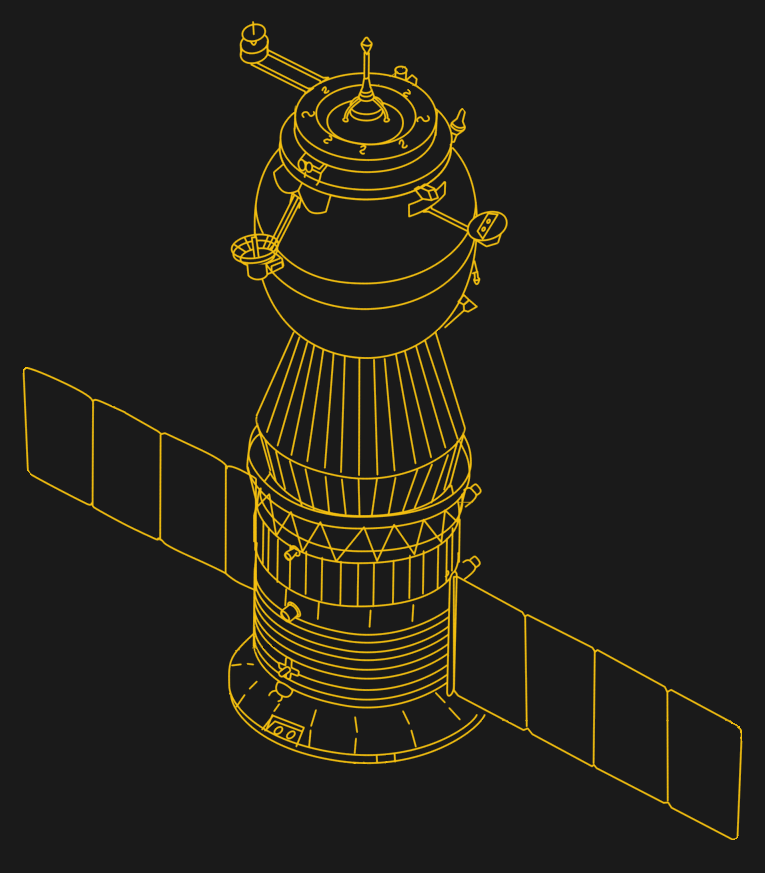
Shuffling spacecraft between the various docking ports on the ISS has become increasingly common as the fleet of vehicles that can visit the orbiting complex has grown over the years. With more cargo-carrying craft set to come online before the end of the decade, things will only get busier. Losing a docking port would add to the logistical challenge, but there’s no question it will be manageable.

Plus, it’s not as if they would have to stop using the port entirely. While sealing off the PrK passage means crew and cargo will no longer be able to pass between a visiting spacecraft and the Zvevzda module, the same isn’t true for deliveries of gasses and liquids. The plumbing that moves water, oxygen, and the propellants for the Station’s thrusters over from the Progress resupply spacecraft is all run on the outside of the structure and is linked up automatically through connectors in the docking port.

Since crew members don’t need to access the inside of the Progress vehicle to transfer these liquids over, the port can still be used for at least some resupply activities.

Advertisement

Get Out and Push

While crew and cargo transfers can be performed on an alternate docking port, and Zvevzda’s rear port can still support transferring water and other fluids with the PrK hatch closed, there’s still the question of reboost maneuvers.

Normally, a Progress spacecraft docked to the rear of Zvevzda would use its own thrusters to change the velocity of the entire complex. This is most commonly used to counteract atmospheric drag and keep the Station in the intended orbit, as it would otherwise slowly fall back down into the atmosphere and eventually burn up. This maneuver must be done from the  rear docking port of Zvevzda as that allows the visiting spacecraft to push along the center line of the Station.

While these reboosts could still be performed without opening the PrK hatch, there’s a question about whether or not it’s safe to continue putting so much stress on the surrounding structure. In fact, though there has been no official determination made, some believe that the repeated stress of performing the reboost maneuvers from that specific docking port could be one of the factors that lead to the cracks forming in the PrK to begin with.

Additional propellant tanks mounted in the trunk of the Cargo Dragon.

If NASA and Roscosmos determine that continuing to push the entire mass of the ISS through this structure is no longer safe, their only alternative is to do it from the US side. The Space Shuttle was used to reboost the Station this way before its retirement in 2011, and more recently, a Cargo Dragon specially modified to carry additional propellant demonstrated it could fill this particular role if need be.

Space Station Déjà Vu

If you’ve been following space news for a bit now, this might all sound a bit familiar to you — that’s because this isn’t the first time Russia decided that the best course of action was to simply close the door on the PrK. Going back to at least 2024, the official procedure was for the crew to keep the hatch closed unless they were actively loading or unloading a docked vehicle.

Advertisement

That greatly reduced how much air was leaking out, but as long as crews were occasionally opening up the PrK and moving through it, there was a risk of something going catastrophically wrong. Should the rumors prove true, the difference this time is that the door would stay shut and the PrK would remain undisturbed for as long as the ISS remained in orbit. It’s not exactly a fix, but it’s good enough for an aging space station that’s only got a few more years on the clock.


Source link

Advertisement
Continue Reading

Tech

AWS enters the context layer race with a graph that learns from agents, not manual curation

Published

on

Building a context layer between enterprise data stores and AI agents is bespoke work, with no standard service to automate or maintain the graphs over time. Amazon is making a direct play to change that.

Amazon on Wednesday entered the space, announcing a series of three products it’s positioning as a context intelligence stack for AI agents. The centerpiece is AWS Context, a new knowledge graph service that gets smarter through agent usage over time. AWS also announced the general availability of Amazon S3 Annotations and a preview of skill assets in AWS Glue Data Catalog.

The context layer is now a contested architectural category with no shortage of options from different vendors. AWS is entering that market with a different architectural premise: that the graph should learn from how agents use it automatically, without human re-curation.

“Your agents now get smarter without you having to rebuild anything from scratch,” said Swami Sivasubramanian, vice president of Agentic AI at AWS, during his AWS Summit NYC keynote.

Advertisement

“This service automatically builds a knowledge graph from all your existing data,” he said. “This service infers relationships across your data sets, business rules, and domain knowledge, and makes all of it available to your agents and your organization at runtime.”  

AWS Context builds a self-learning knowledge graph from existing data

It’s a problem AWS says it has seen repeatedly in customer deployments.

AWS Context maps relationships across existing data automatically: what tables exist, what columns mean, how sources relate and which sources are authoritative. It combines semantic search with graph-level reasoning and infers relationships across datasets, business rules and domain knowledge, making all of it available to agents at runtime.

“The knowledge graph improves itself over time as it learns which sources produce correct results and which parts get used,” Sivasubramanian said. 

Advertisement

Data stewards manage the graph through the AWS Management Console, reviewing inferred relationships, promoting them to production and attaching business definitions and usage rules. Every query inherits the calling user’s IAM and Lake Formation permissions, making agent data access auditable by identity through controls enterprises already rely on.

All metadata is published in Apache Iceberg format to Amazon S3 Tables, queryable via Athena, Redshift, Spark or any Iceberg-compatible engine, with no proprietary APIs. Third-party catalog connections are supported, so context from systems outside AWS can be pulled into the same graph. Agents query through agentic search APIs and MCP tools across Bedrock AgentCore, EKS or any MCP-compatible framework.

Context is more than just a single service

Context is a complicated space and AWS is layering multiple services to help enterprises build context across the data stack.

Amazon S3 Annotations. This service enables users to attach rich business context at the storage layer, directly to individual S3 objects. 

Advertisement

AWS Glue Data Catalog skill assets. Glue skill assets attach domain knowledge at the catalog layer, linking runbooks, query patterns and usage rules to data assets across the estate. 

AWS Context then synthesizes both into the knowledge graph that agents query at runtime, combining semantic search with graph-level reasoning across structured and unstructured sources. Each layer feeds the next.

AWS is entering a highly competitive context space

Snowflake announced its context approach earlier this month with its Horizon Context and Cortex Sense services. Microsoft is providing context via its Fabric IQ platform that provides a semantic ontology for data. Redis has developed a context platform that optimizes data for retrieval. Vector database vendor Pinecone has its Nexus context offering that compiles enterprise data into task-specific artifacts before agents ever query them.

AWS’s structural argument is straightforward: for enterprises already running S3, Glue and Lake Formation, AWS Context extends an existing identity model with no data movement required. The pitch is zero-integration friction — not just cost consolidation.

Advertisement

“Context makes agents more powerful and as the whole world is building agents, every agentic platform vendor needs a context capability,” Holger Mueller, VP and Principal analyst at Constellation Research, told VentureBeat.

Mueller noted that AWS is no exception. “The concern — as with all context offerings — is going to be performance, especially for transactional data,  we will see,” he said.

Source link

Advertisement
Continue Reading

Tech

Communication tools that cannot be monitored pose a corporate risk

Published

on

In the modern workplace, the line between personal convenience and professional obligation hasn’t just blurred, it has effectively vanished.

At the center of this shift is WhatsApp.

Source link

Advertisement
Continue Reading

Tech

Just 16% of Americans think AI will benefit society, despite chatbot use climbing to 49% of US adults

Published

on

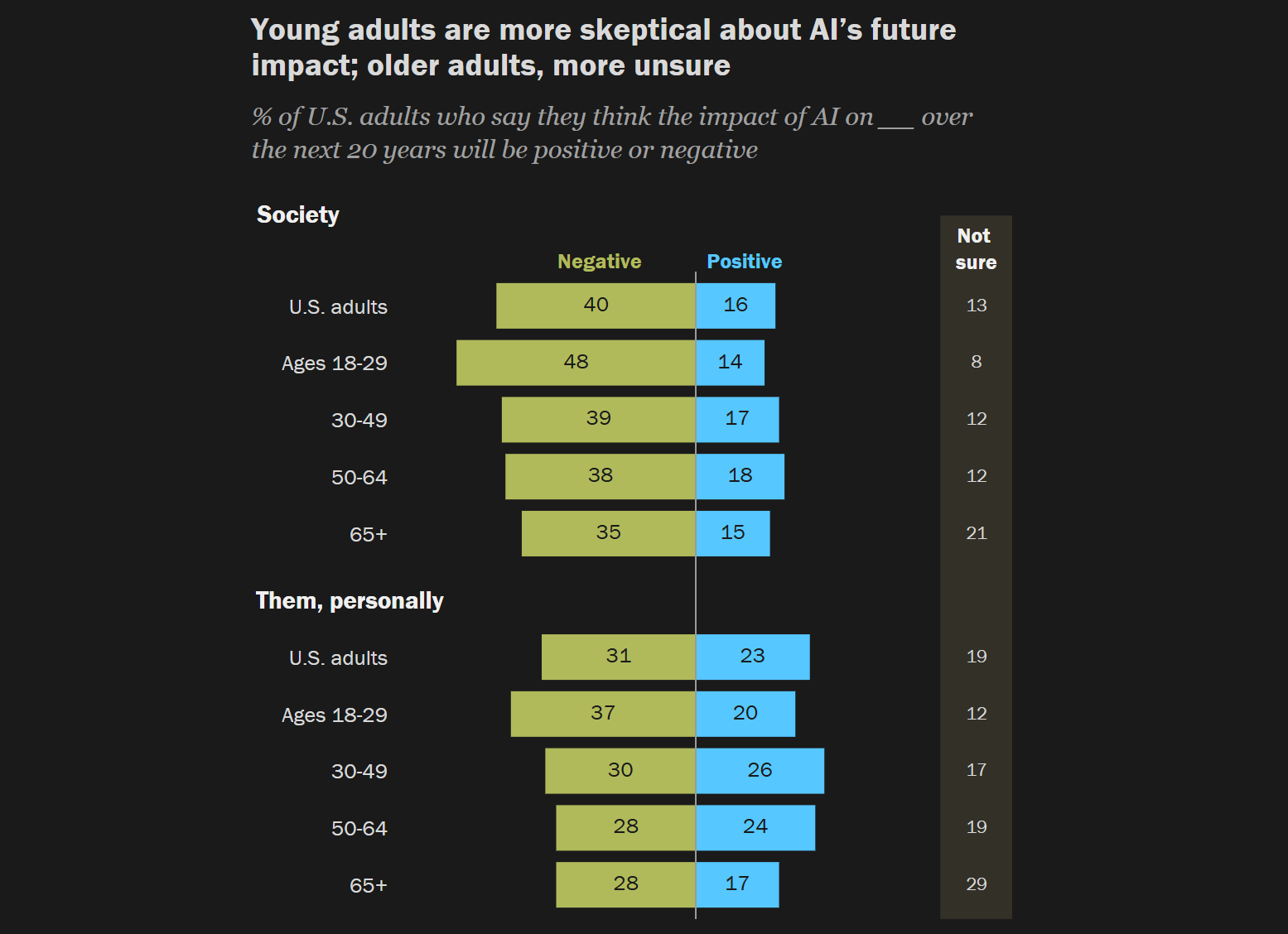
The takeaway: Despite the apparent growth of an anti-generative AI movement, more Americans are using chatbots than ever before, according to a new survey. But somewhat paradoxically, just 16% of participants believe the technology will have a positive impact on society over the next 20 years, while 40% think the impact will be negative.

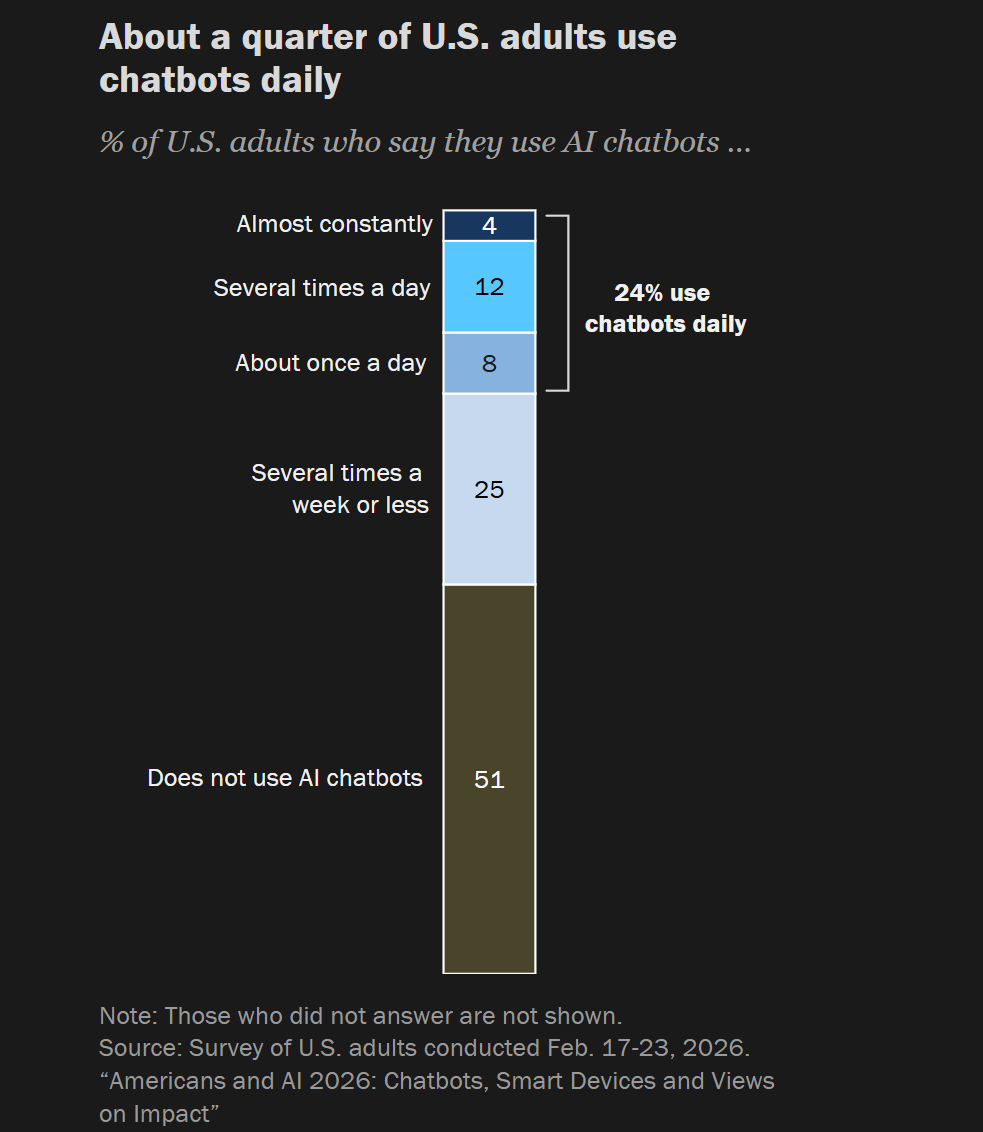
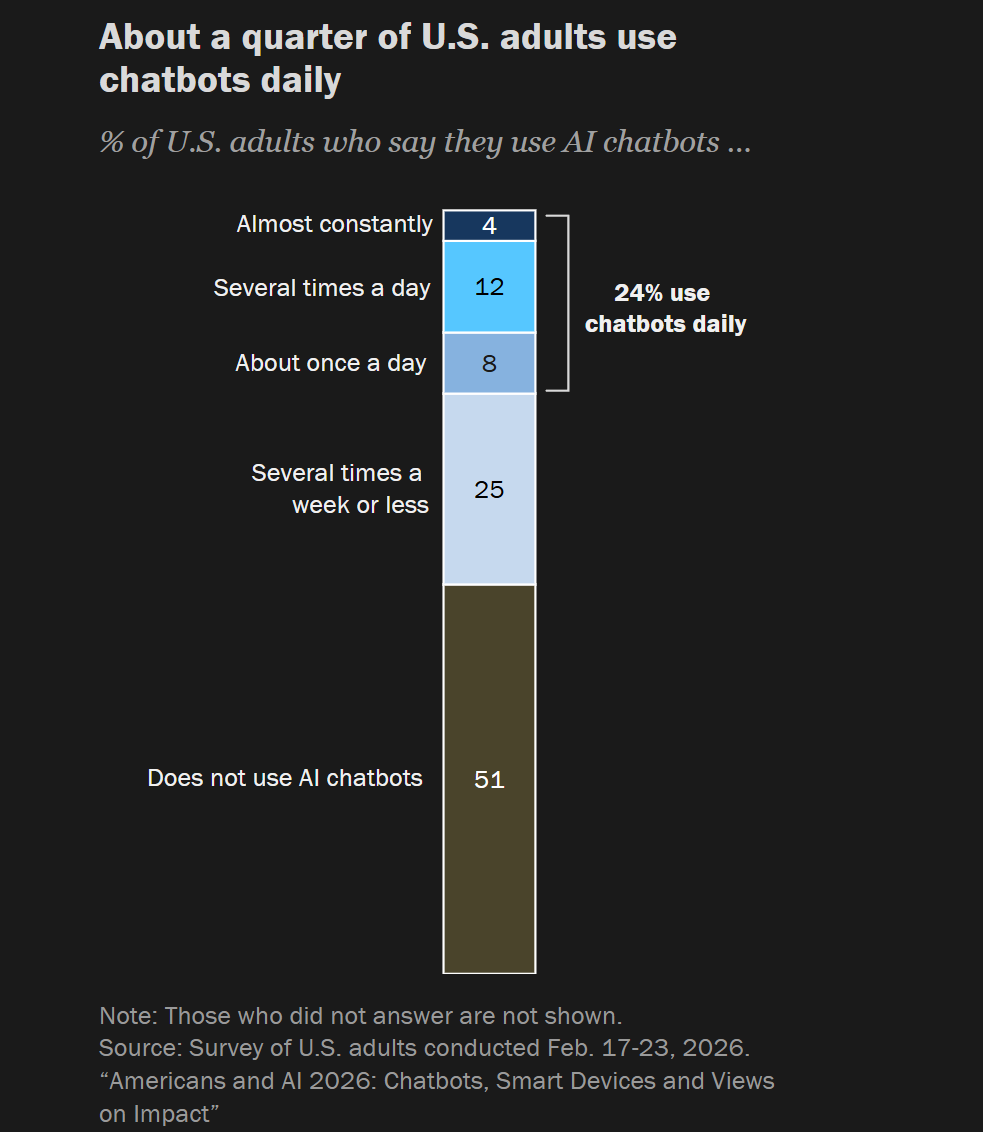
The Pew Research Center found that 49% of US adults now use chatbots, up from 33% two years ago. This includes roughly one in four who use these tools on daily basis. Fifty-one percent say they don’t use chatbots at all, the majority of whom are 50 and older.

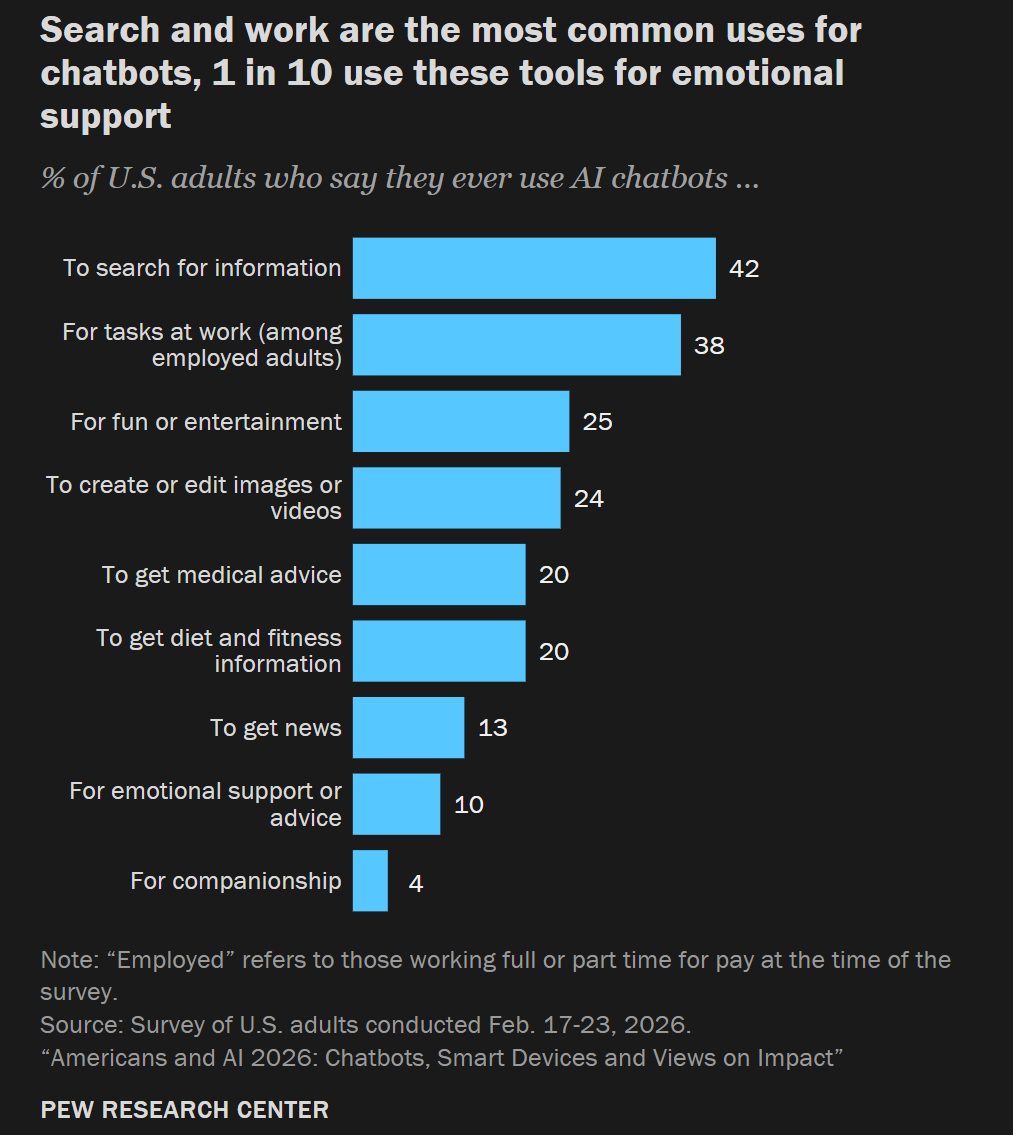
Most people use the bots to search for information, illustrating how many people are now using the likes of ChatGPT instead of visiting websites to find information, eroding the web’s business model.

Work tasks, fun or entertainment, and creating or editing images are the other most popular use cases. Using them for medical and diet/fitness advice is also popular, though even the chatbots’ makers advise users against relying on their tools for medical advice, diagnoses, or treatment recommendations.

Advertisement

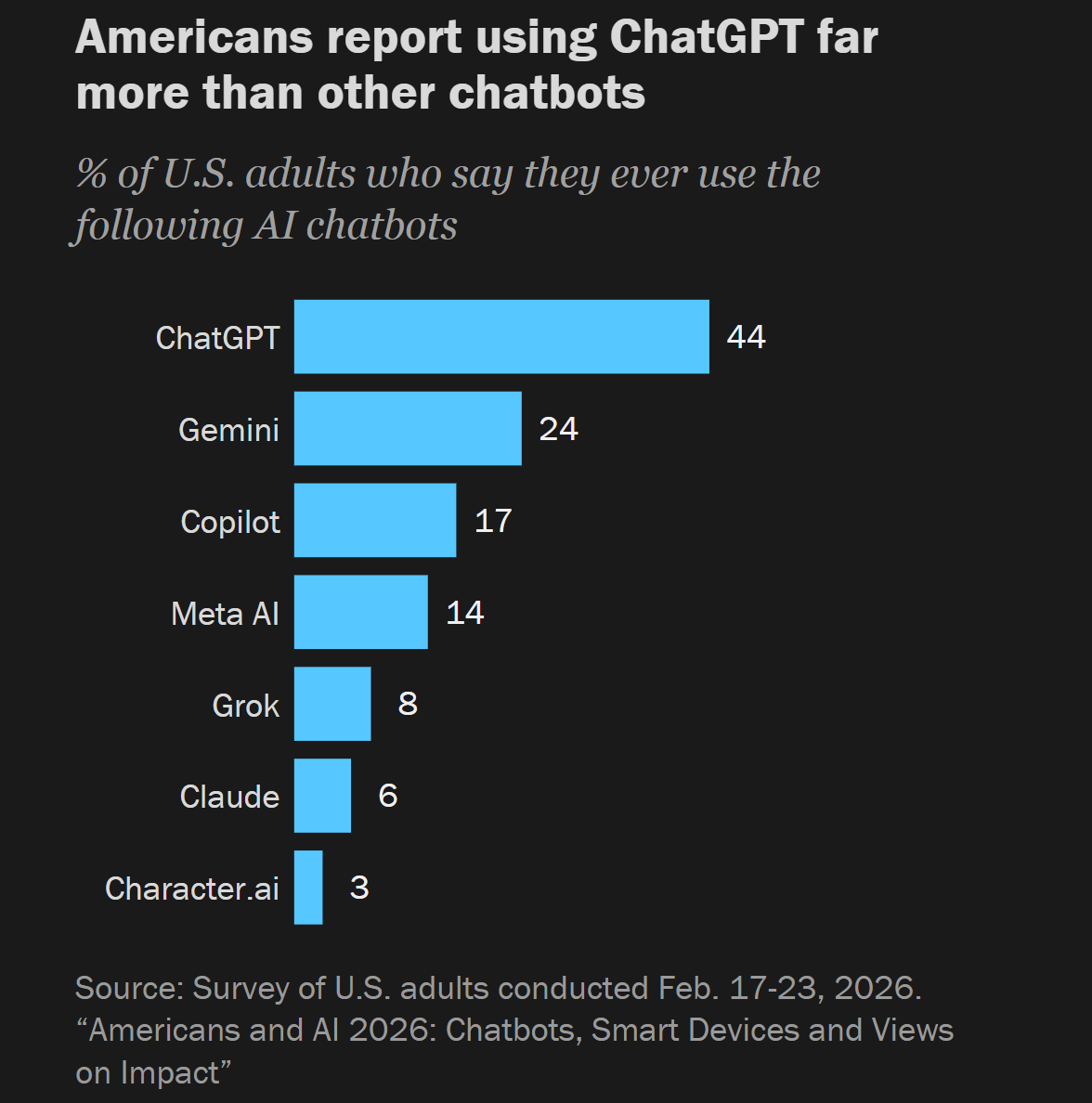
The survey also found that about a quarter of adults use the chatbots daily, while the other quarter use them several times a week or less. And while some of its rivals are catching up, ChatGPT remains the most popular chatbot (44%). It’s followed by Gemini (24%), Copilot (17%), and Meta AI (14%).

Despite the increased usage, most Americans predict AI will be bad rather than good for society (40% vs. 16%), while one in three believes the effect will be equally positive and negative.

More people also expect it will have a negative rather than positive effect on their own lives (31% vs. 23%).

Unsurprisinglye group most concerned about AI’s impact on society and their own lives is adults ages 18 to 29. The technology continues to drive mass job losses, though some execs now argue that it is creating just as many.

Advertisement

Another interesting finding is that around two-thirds of Americans think AI is advancing too quickly. This has been a concern since the generative AI revolution began, and has picked up steam since Anthropic called Mythos too dangerous to release.

Participants expressed other concerns: most think AI will make their personal information less secure, 67% have little to no confidence in the government to regulate AI effectively, and about six in ten adults are not confident in companies to develop and use these tools responsibly.

Another sign that generative AI use is growing in parallel with its dislike came from market intelligence firm Sensor Tower. It reported that ChatGPT has become the fastest app ever to reach one billion monthly app users (MAUs), beating the previous record holder, Google Maps.

Advertisement

Source link

Continue Reading

Tech

Genesis AI’s Eno Takes a Different Route Into the Robot Conversation

Published

on

Genesis AI Eno General Purpose Robot
Genesis AI introduced Eno this month as its first general-purpose robot, and the machine immediately stands apart from nearly everything else in the crowded field. It rolls on a wheeled base rather than walking on legs. A compact tower of articulated panels rises and tilts to set the working height and reach, then folds down tight when the job ends. Two arms carry hands that match human size and proportion almost exactly. There is no head, no face, and no attempt to hide the fact that this machine was never meant to pass for a person.


The team’s design choices began with a simple question: what does this robot need to accomplish its job properly in settings where people already work? The areas it will be working, those flat factory floors, lab benches, hospital halls, and eventually even home, are all very flat, and let’s be honest, they rarely demand climbing up and down stairs or balancing on two feet. So a wheeled foundation makes sense in those circumstances since it requires less energy and is much more sturdy. However, the folding panels tell a different story. When the robot has completed a task, it can fold itself up and roll into a corner or storage area without taking up too much space or calling too much attention to itself.


Unitree R1 Humanoid Robot (White, R1)
  • Three models, one lightweight platform R1 Air (20 DOF, monocular camera), R1 (26 DOF, binocular camera, head+waist joints), and R1 Edu (26 DOF…
  • Easy setup – no coding required for basic use Unbox, power on, and start. Manual teaching feature: physically pose the robot, and it replays the…
  • More DOF = more expressive movement 26‑DOF models (R1 / R1 Edu) add head and waist articulation for smoother dance and running. For safety reasons…

Genesis AI Eno General Purpose Robot
The hands receive the most attention because each has approximately twenty degrees of mobility and fingers of varied lengths that reflect the way real fingers are configured. The joints are back-drivable, so when Eno makes contact with something, they yield slightly rather than locking in place. The robot’s fingertips and palms contain miniature cameras and tactile sensors, allowing it to see and feel what it is touching. In early demos, the hands allowed Eno to accomplish things like tape up wire bundles, catch its own slides, and move liquids between containers without requiring any additional assistance or adjustments to the equipment surrounding it.

Genesis AI Eno General Purpose Robot
It has a payload capacity of three to five kilograms per arm, which is sufficient for most light assembly, stocking, and lab-support duties. Battery life is now between four and six hours under normal workloads, but the team is continuously working to improve it. When Eno desires, the entire upper structure can stretch up to adult height and then fold back down to a much smaller size.


All of this hardware is compatible with GENE, Genesis AI’s own foundation model created exclusively for robotics. The system treats Eno as a single, coherent unit, rather than a collection of distinct elements that require regular human interaction. It may look at a larger goal, break it down into steps, adjust when circumstances change, remember what has previously occurred, and simply carry the work through to completion on its own. This is a significant improvement over the conventional pattern of single, pre-programmed movements, allowing Eno to handle larger sequences of activity that last minutes or hours. Genesis AI created both the robot and the model simultaneously, as evidenced by how well the body and brain work together. The optional screen version has a little display on the upper panel that allows those close to see what Eno is currently thinking or intending, eliminating the need for them to guess or interpret its actions.

Genesis AI Eno General Purpose Robot
Customer deployments are scheduled to begin with industrial sites in manufacturing, logistics, and laboratories by the end of 2026, with service contexts like as hotels and hospitals following later, and, if all goes well, consumer settings. Eno is still in the early stages of development, with work being done on the battery, payload, and overall robustness. A legged version is still viable if there is a demand for it later on, but the company’s first focus is on the wheeled method.
[Source]

Advertisement

Source link

Continue Reading

Tech

AI nose uses ‘Smell Language Model’ to sniff out signs of disease

Published

on

AI AND ML

Sampling patients’ breath may save lives and emergency room resources

Many people worry about what AI knows, but what about an AI Nose that can smell what disease you might have?

Ainos, an AI and biotech company that is developing smell technology, is working with National Taiwan University (NTU) to explore whether its platform can help diagnose patients by analyzing volatile organic compounds (VOCs) in exhaled breath.

Advertisement

The year-long research effort, which starts in July, will examine individuals who present with dyspnea, or shortness of breath, said to be one of the most common symptoms seen in emergency departments.

Dyspnea can be a symptom of many conditions, including acute exacerbation of chronic obstructive pulmonary disease (AECOPD) and acute decompensated heart failure (ADHF), each of which requires different treatments.

Ainos and NTU hope to develop and evaluate a system to analyze VOC-based breathprints to detect AECOPD and/or ADHF in patients.

Ainos’s Smell AI platform relies on an AI Nose module that features multiple micro-electro-mechanical system (MEMS) sensors and an integrated digital processor. Sensor resistance increases in the presence of detectable gases, and this is converted to a digital signal that is interpreted in much the way the human nose interprets scents, according to Ainos.

Advertisement

That interpretation is handled by by a proprietary Smell Language Model that has been developed to learn, classify, and contextualize complex scent patterns.

“AI Nose was originally developed with medical diagnostic applications in mind, where non-invasive sensing, accuracy, and real-world validation are essential,” said Ainos CEO Eddy Tsai.

“This research program brings that experience back into a high-value clinical setting and extends our Smell AI platform into digital breath intelligence.”

Not content with “digital breath intelligence,” a term we must confess to not being too familiar with, the the company frames the research as part of its broader vision of “building Smell ID data and Smell Language Model capabilities across healthcare, industrial, and physical AI environments.”

Advertisement

If successful, the research could help create a breathprint database for dyspnea and support future studies for emergency, outpatient, and even home-monitoring settings.

The research follows a separate program testing the AI Nose in an active emergency department at National Taiwan University Hospital. The system has been deployed to monitor respiratory infections and overcrowding in waiting areas, treatment areas, and observation zones. ®

Source link

Advertisement
Continue Reading

Tech

Roblox Expands Kids and Select Accounts With New Safety Features in India

Published

on

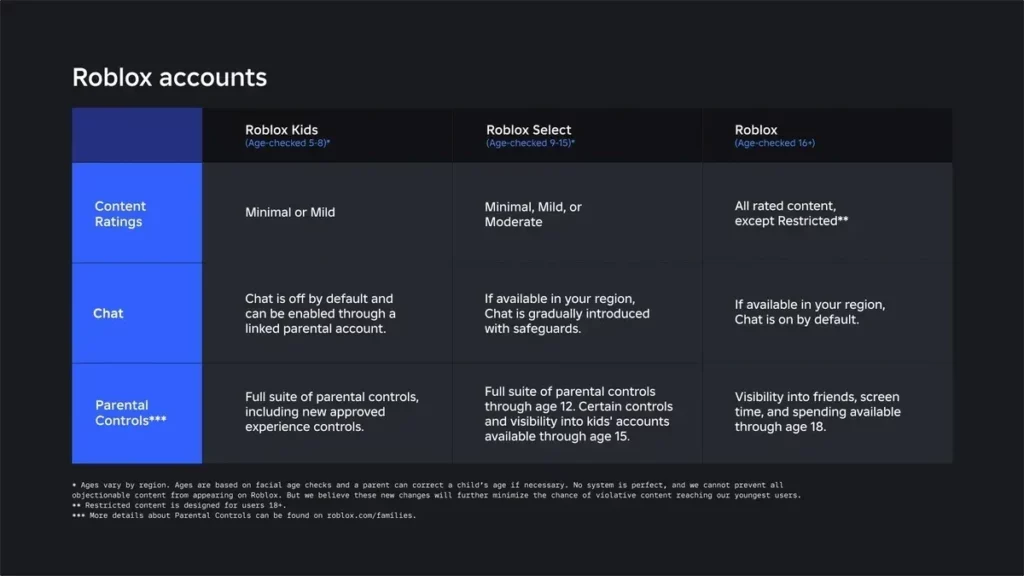
Roblox is expanding its safety features for younger players. The platform has launched Roblox Kids and Roblox Select Accounts in India. The new system is designed for users under 16. The platform uses age checks to place users into either Roblox Kids or Roblox Select Accounts. Each account is provided with security features and restrictions regarding access to certain types of content. Over time, the user’s level of protection changes as they move into a new age group.

Roblox Kids Accounts for Ages 5 to 8

Roblox Kids Accounts are designed for children ages 5 to 8. These accounts include the platform’s highest level of default safety protections. Users can access only selected games that carry Minimal or Mild content ratings. Chat features remain disabled by default to provide a safer experience. The company also reviews and approves eligible games before making them available to these users.

Roblox Select Accounts for Ages 9 to 15

The creators of Roblox have launched a feature called Select Account aimed at older children and teenagers. These accounts allow players ages 9 to 15 to gain wider access to more games at Moderate maturity levels. Chat availability depends on the user’s age and region. Roblox also continues to enforce protections for all users under 16.

As children grow, Roblox automatically adjusts their account experience. Players move from Roblox Kids Accounts to Roblox Select Accounts when they turn 9. Once users turn 16, Roblox automatically places them in a standard account and updates their account settings accordingly. The platform gradually expands access to features while updating safety protections as users get older.

Advertisement

New Parental Controls Coming to Roblox

Parental Controls on roblox kids accounts

The new rollout expands Roblox’s parental control system. The parents can monitor gameplay activity and check the friends’ list from their linked account. They will have control over parameters such as screen time, spending limits, and communication restrictions. The new game-blocking options give them increased control over content. Parents can also grant permission for selected games outside the default account settings.

As part of the latest update, Roblox is adding more protections for users under 16. Facial age verification will play a larger role in accessing some chat features. Users who do not complete the process may lose access to certain communication tools. The platform also blocks links, images, and videos from being shared in chat. New restrictions will also prevent users under 16 from viewing or sharing social media links across the platform.

This year, Roblox will start using the International Age Rating Coalition (IARC) rating system. By using IARC, Roblox hopes to provide better age guidelines for its experiences. The IARC age recommendations will be integrated into Roblox’s age-specific accounts.

Source link

Advertisement
Continue Reading

Tech

Old iPods Are Making A Comeback Thanks To Gen Z

Published

on

Now bring back the Microsoft Zune, I double dare you.

We may receive a commission on purchases made from links.

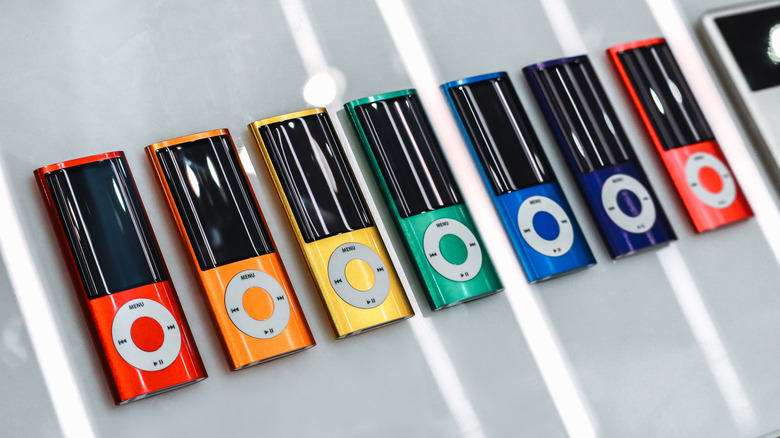
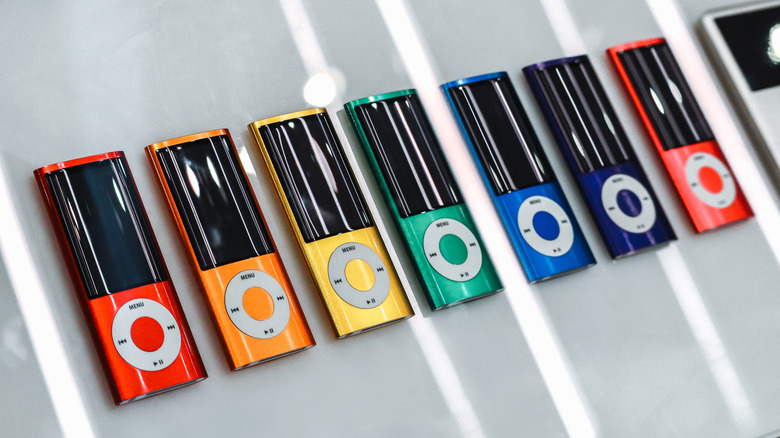
As technology continues to protrude uncomfortably into more of our lives, some younger folks are pretty much over it. It’s not just generative artificial intelligence, which Gen Z is slowly souring on, but current technology as a whole. The younger generation isn’t ditching tech entirely, but they’re rolling things back to the late 2000s. Yes, while those who lived through that period will primarily remember the horrors of the financial crisis, it seems today’s youths have decided we were also living through the era of peak gadgets. Case in point? The iPod is making a comeback.

Apple hasn’t released a new iPod since 2019, when it launched the final version of the iPod Touch. The iPhone had by that point swallowed the iPod along with many other standalone gadgets, obviating the need for what had previously been the company’s largest moneymaker. But now, old iPods are in high demand with the youth. In February, Axios reported that eBay searches were up for the iPod Classic and iPod Nano by 25% and 20%, respectively. While a large portion of iPod buyers are older, 32% of respondents to an informal survey by Emily White, a plurality, were Gen Z.

Advertisement

The iPod was once an object of cultural homogeneity. It was the epitome of cool, so embedded in the public consciousness that its advertisements often showed nothing more than a dancing silhouette with telltale white earbud wires flailing in the air. How ironic, then, that the same gadget which once identified its owners as a part of the dominant zeitgeist now signals the exact opposite, a type of retrograde iconoclasm defined by its rejection of the latest iPhone. Why not buy an old Zune, wayward youths? Now that would be truly countercultural.

Connection fatigue and a desire for more control appear to drive iPod sales

The trend toward tech gadgets from two decades ago appears driven primarily by exhaustion with the current state of technology. That exhaustion cuts across generations, but Gen Z was not able to experience the early days of the PC and Internet. That generation of young people, the oldest of whom are on the cusp of their thirtieth birthday and the youngest of whom are just starting high school, have seen only a precipitous and ongoing decline in digital privacy and the relentless enshittification of once useful products and platforms.

Emily White’s survey found that Gen Z was driving the resurgence in iPod ownership, motivated primarily by a desire to minimize distractions, listen to music more intentionally, and to assert ownership over their music and listening experience. There’s a lot to be said for those desires. Are you truly taking in an album if your phone’s notifications are interrupting it interstitially, distracting you with emails and social media drama? And, as for ownership, we’ve seen music streaming services shuttered before  (RIP Google Play Music). If Spotify were to delete your account tomorrow without giving you your playlist data, how would you even begin to rebuild your music collection?

Advertisement

Those who lived through the iPod’s heyday may remember the holdouts who continued to collect vinyl and CDs while the rest of us loaded our digital media players with more music than they could fit in their entire homes. In many ways, though, those stalwarts had a point. How many among us have managed to lose our old music files, whether due to forgetfulness or to a corrupted hard drive? Today’s iPod nostalgics may well be to the streaming era what those vinyl collectors were to early digital adopters.

iPods aren’t the right choice for every music fan in 2026

What’s clear about iPod adopters, young or old, is that they’re generally not audiophiles. There are plenty of modern devices which cater to Hi-Fi heads with niche features while also supporting Hi-Fi streaming services like Apple Music, Tidal, and Qobuz. An old iPod, however well preserved since the mid-2000s, is less capable than you might think. In addition to lacking support for high-resolution audio formats, it may have experienced internal component degradation over the years which could affect sound quality. Moreover, syncing an iPod is no longer a convenient, plug-and-play affair. With iTunes dead and buried, iPod owners must now turn to independently developed software. There’s a time-consuming DIY element to contemporary iPod ownership.

Advertisement

Unless what you’re after is a dose of blog-era nostalgia you can’t get from any other media player, it’s worth looking outside Apple’s ecosystem. iPod Classic models are selling for up to $300 on eBay at press time, which is a lot of money considering you’ll miss out on modern conveniences like Bluetooth connectivity and support for high-resolution audio. Modern digital audio players (DAPs) from companies like Sony, Fiio and HiBy are built from the ground up for an audiophile-grade listening experience. They bridge the gap between the iPod and iPhone eras by running custom Android versions packed with under-the-hood system tweaks and user-facing software to prioritize and customize sound quality.

Granted, these newer devices can bleed your wallet at the high end, commanding multi-thousand-dollar price tags, but there are plenty of options at every price point. For $320, you can pick up the HiBy Digital M500 X Hatsune Miku, a device themed around the titular virtual pop star and stuffed with enthusiast audio features. It also has an array of physical buttons along the side, reminiscent of an old, Walkman-style cassette player. Speaking of which, those looking to go even cheaper can take a gander at the wonderfully chintzy Fiio SnowKky Echo Mini, which is even more Walkman-inspired and packs a lot of value for $60 despite missing out on some enthusiast features. Splitting the difference are products like the Fiio JadeAudio JM21, which, at $180, impresses even the notoriously hard to please Hi-Fi community by including features like a balanced 4.4mm TRS output alongside the classic 3.5mm headphone jack.

Advertisement

Source link

Continue Reading

Tech

Adobe adds its AI assistant to Premiere, Illustrator and InDesign

Published

on

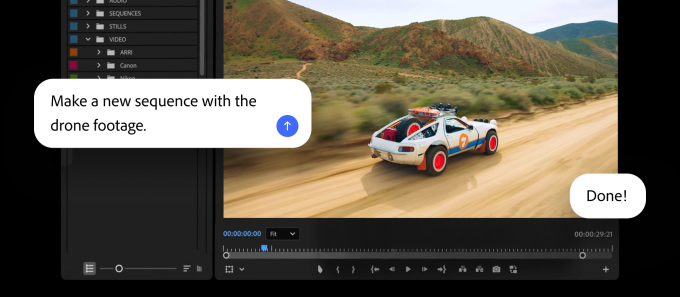
Adobe is updating its Firefly AI assistant with new chops, and adding it to Premiere, Illustrator, InDesign and Frame.io.

The company has given the assistant new abilities to make brand kits, product videos, and storyboards . Plus, the Firefly app now lets users save whatever they’ve created as an element that can be used across projects.

Image Credits:Adobe

In Premiere, users can use the AI assistant to sort assets into bins, batch-rename clips, identify interview questions and add markers. And in Illustrator, the assistant can do things like reorganize layers across a document or check for missing fonts.

Firefly is already usable with Express, Photoshop, and Acrobat, and is supported by ChatGPT, Claude and Copilot. Adobe said that it plans to add support for Google Gemini and Slack soon.

Firefly updates

Adobe is slowly transforming Firefly to increasingly resemble Canva, at least when it comes to AI features, loading up the app with AI tools that can generate images, videos and storyboards. The company is now adding a new feature called Elements that can save AI-generated characters, objects and locations for later use.

Advertisement

Firefly is also getting a Projects feature that can store existing assets in one place, and share context. This could be useful for teams creating a video series or brand campaigns. Both of these features are currently available in a private beta.

Image Credits: AdobeImage Credits:Adobe

The company said users can now describe a brand and its style, or upload existing collateral, in Firefly to have it generate a brand kit, complete with logos, brand identity and color palettes, or even generate product videos from photos. Users can also create storyboards to create videos.

Adobe is hard at work adding AI throughout its apps, and it is also working on an AI assistant that can work across its apps. The idea is to use AI to automate some of the tool usage within its apps that took several steps previously.

When you purchase through links in our articles, we may earn a small commission. This doesn’t affect our editorial independence.

Source link

Advertisement
Continue Reading

Trending

Copyright © 2025