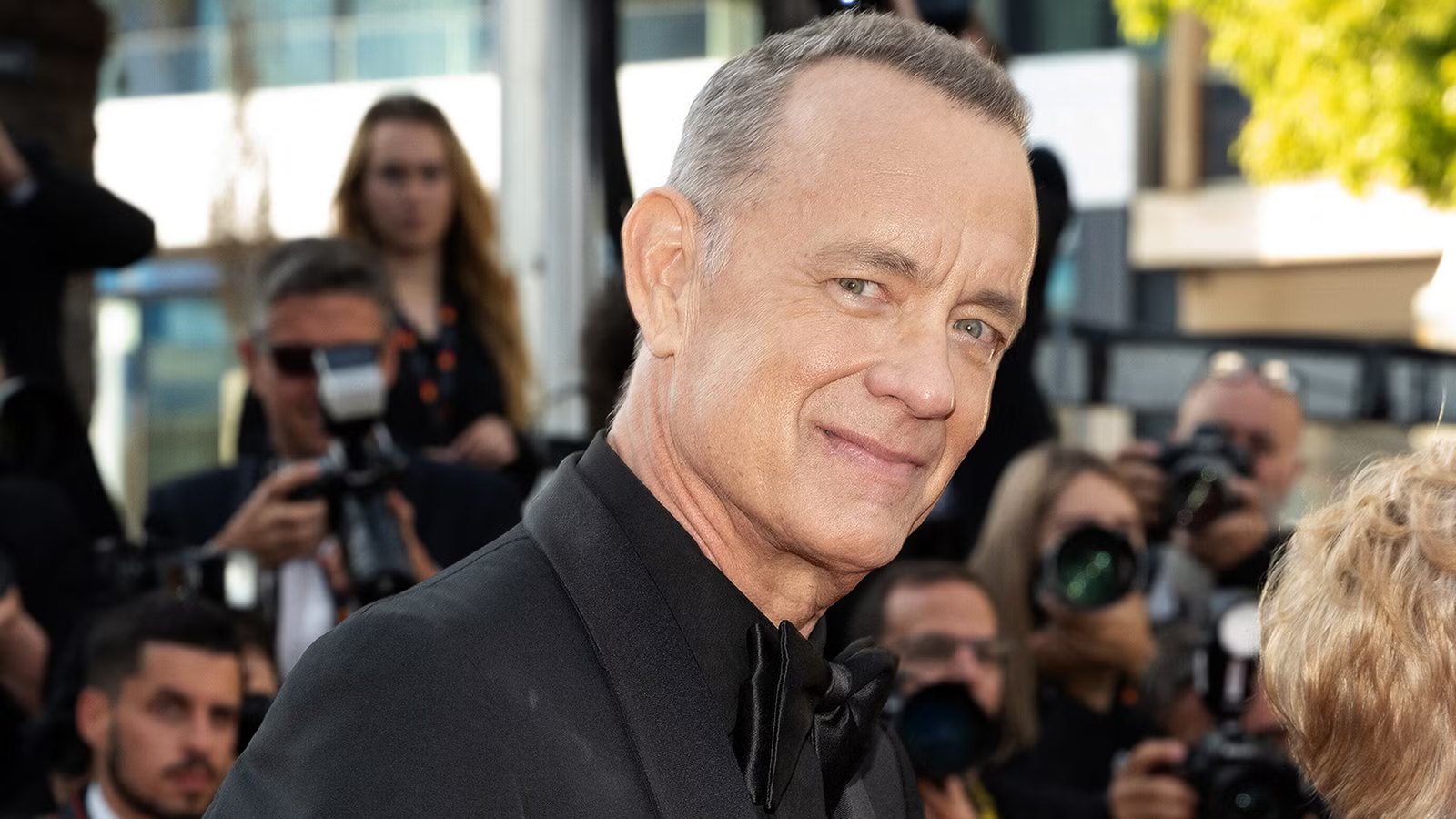
Tom Hanks on the red carpetImage via Abaca/INSTARimages/Cover Images
With the sleeper hit drama-thriller film Pressure debuting on the PVOD market this week, fans of WWII-era storytelling are spoiled for choice. Pressure entered its home video era after having overtaken the 2025 movie Nuremberg at the domestic box office. It will now compete for attention with an epic new documentary series that’s nearing the halfway mark of its 20-episode run. The show is executive-produced by arguably the most popular WWII aficionado in the world, the Oscar-winning movie star Tom Hanks, who has headlined popular WWII movies such as Saving Private Ryan and Greyhound over the course of his career. Along with director Steven Spielberg, Hanks has also executive-produced three landmark narrative series centered on the conflict.
The most recent of these three series, Masters of the Air, had a reported price tag of $250 million and was released on Apple TV in 2024. It was released over a decade after The Pacific, which was released on HBO in 2010. The first, and arguably most acclaimed series that Hanks and Spielberg produced was Band of Brothers, which was also released on HBO. It served as a companion piece to Saving Private Ryan, which had swept the Oscars only a few years prior. Hanks’ latest WWII project is unlike anything he has ever done in the genre. We’re talking, of course, about World War II with Tom Hanks, the documentary series on the History Channel.
Advertisement
Advertisement
Collider Exclusive · Oscar Best Picture Quiz Which Oscar Best Picture Is Your Perfect Movie? Parasite · Everything Everywhere · Oppenheimer · Birdman · No Country
Five Oscar Best Picture winners. Five completely different visions of what cinema can be — and what it can do to you. One of them is the film that was made for the way your mind works. Ten questions will figure out which one.
🪜Parasite
🌀Everything Everywhere
☢️Oppenheimer
Advertisement
🐦Birdman
🪙No Country for Old Men
Advertisement
01
What kind of film experience do you actually want? The best movies don’t just entertain — they leave something behind.
Advertisement
02
Which idea grabs you most in a film? Great films are driven by a central obsession. What’s yours?
Advertisement
03
How do you like your story told? Form is content. The way a story is shaped changes what it means.
Advertisement
04
What makes a truly great antagonist? The opposition defines the protagonist. What kind of opposition fascinates you?
Advertisement
05
What do you want from a film’s ending? The final note is the one that lingers. What do you want it to sound like?
Advertisement
06
Which setting pulls you in most? Where a film takes place shapes everything — mood, stakes, what’s even possible.
Advertisement
07
What cinematic craft impresses you most? Every great film has a signature — a technical or artistic element that makes it unmistakable.
Advertisement
08
What kind of main character do you root for? The protagonist is the lens. Who you choose to follow says something about you.
Advertisement
09
How do you feel about a film that takes its time? Pace is a choice. Some films sprint; others let tension accumulate slowly, deliberately.
Advertisement
10
What do you want to feel walking out of the cinema? The best films leave a mark. What kind of mark do you want?
Advertisement
The Academy Has Decided Your Perfect Film Is…
Your answers have pointed to one Oscar Best Picture winner above all others. This is the film that was made for the way your mind works.
Advertisement
Parasite
You are drawn to films that operate on multiple levels simultaneously — that begin in one genre and quietly, brilliantly migrate into another. Bong Joon-ho’s Parasite is a film about class, desire, and the architecture of inequality that manages to be darkly funny, deeply suspenseful, and genuinely shocking across a single extraordinary running time. Your instinct is for cinema that hides its true intentions until the moment it’s ready to reveal them. Parasite is exactly that — a film that rewards close attention and punishes assumptions, right up to its devastating final image.
Advertisement
Everything Everywhere All at Once
You want it all — and this film gives you all of it. The Daniels’ Everything Everywhere All at Once is one of the most maximalist films ever made: action comedy, multiverse sci-fi, family drama, existential crisis, and a genuinely earned emotional core that sneaks up on you amid the chaos. You are someone who responds to ambition, who doesn’t want cinema to choose between being entertaining and being meaningful. This film refuses that choice entirely. It is overwhelming by design, and its overwhelming nature is precisely the point — because the feeling of being crushed by infinite possibility is exactly what it’s about.
Advertisement
Oppenheimer
You are drawn to cinema on a grand scale — films that understand history not as a backdrop but as a force, and that place their characters inside that force and watch what happens. Christopher Nolan’s Oppenheimer is a film about the terrifying gap between what we can do and what we should do, told with the full weight of one of the most consequential moments in human history behind it. You want your films to feel important without feeling self-important — to earn their ambition through sheer craft and the gravity of their subject. Oppenheimer does exactly that. It is enormous, complicated, and refuses easy comfort.
Advertisement
Birdman
You are drawn to films that foreground their own construction — that make the how of the filmmaking part of the what it’s about. Alejandro González Iñárritu’s Birdman, shot to appear as a single continuous take, is cinema examining itself through the cracked mirror of a fading actor’s ego. You respond to formal daring, to the feeling that a film is doing something that probably shouldn’t be possible. Michael Keaton’s performance and Emmanuel Lubezki’s restless camera create something genuinely unlike anything else — a film that is simultaneously about creativity, relevance, self-destruction, and the impossibility of ever truly knowing if your work means anything at all.
Advertisement
No Country for Old Men
You are drawn to cinema that trusts silence, that refuses to explain itself, and that treats dread as a form of meaning. The Coen Brothers’ No Country for Old Men is a film about the arrival of a new kind of evil — implacable, arbitrary, and utterly indifferent to the moral frameworks we use to make sense of the world. It is one of the most formally controlled films ever made, and its controlled restraint is what makes it so terrifying. You want your films to haunt you, not comfort you. You are not interested in resolution if resolution would be dishonest. No Country for Old Men is honest in a way that most cinema never dares to be.
Advertisement
Advertisement
Here’s What Fans Can Expect from the 9th Episode of Tom Hanks’ Documentary Series
It premiered with three episodes on Memorial Day, and released episodes 7 and 8 on June 15. The show will return with its ninth episode on June 22. The episode will focus on Adolf Hitler‘s continued expansion into Joseph Stalin‘s Soviet territory after Operation Barbarossa, which was documented in the third episode. The official logline for the upcoming episode on the History Channel website reads, “The German Army fights to take Soviet oil fields and the city of Stalingrad.” New episodes of World War II with Tom Hanks are made available on the PVOD market a day after their premiere on the History Channel. According to FlixPatrol, the series is among the most popular titles right now on the domestic iTunes chart. Hanks is also working on the long-awaited sequel to Greyhound, while his son, Colin Hanks, is set to star in the WWII movie Lucky Strike later this month. Stay tuned to Collider for more updates.
Aww, Roomies! Waka Flocka has fans gushing after dropping an adorable flick on social media ahead of his baby boy’s arrival. As The Shade Room previously reported, the rapper is gearing up to welcome his first child.
Recently, Waka Flocka melted hearts after sharing an Instagram photo as he prepares to welcome his baby boy, Juaquin James Jr. The Atlanta emcee posted a flick of a Nuna baby stroller with the caption, “We got you Juaquin James 🥹👼🏾 #MyNunaBaby.” At this time, it’s unclear whether Waka’s baby boy has arrived, but he’s making it clear that he’s ready for daddy duties.
Social Media Can’t Get Enough Of Waka’s Heartwarming Flick
After The Shade Room reposted Waka Flocka’s photo, the Roommates flooded the comment section with reactions. Plenty of fans said they’re happy for him, while others said they know he’ll be a great father because he was a solid bonus dad to Tammy Rivera’s daughter, Charlie Rivera.
Instagram user @carolinetania wrote, “Awe he is going to cherish fatherhood ❤️”
Advertisement
Instagram user @patienceamor wrote, “Congrats to Him He’s Overly Excited About His New Baby Boy 💙”
While Instagram user @queenjah wrote, “Somebody check on Ms. Deb, you know she is through the ROOF. 🫶🏽✨️”
Then Instagram user @lilred_youpretty wrote, “Awww finally got his Baby 👏❤️”
Another Instagram user @thera.p_ wrote, “He’s going to be such a great father , I’m glad God finally blessed him with a child of his own 🥹 he deserves it.”
Advertisement
Instagram user @daughterofkd_ wrote, “YAY!!! I love this for him so much!”
Then another Instagram user @gimmiediamondz wrote, “Aww he always wanted a baby ❤️ so nice.”
While another Instagram user @mickymulan wrote, “i’m happy for him. he’s an amazing stepdad it’s time he has his own! 😍”
Finally, Instagram user @bonitabillionaire wrote, “Awww he’s gonna be a great father 🥹🔥👏”
Advertisement
Waka Previously Broke The Internet With His Baby Announcement
Waka Flocka had fans showing love and congratulating him after he announced that he was expecting his first child on May 31. He shared the big news on his 40th birthday with a photo of a wooden cutout of the letter “J.” The base of the sculpture read “Juaquin Jr.” In his caption, he called his baby boy the best gift. “Just waiting for you to come home Jr. Best gift a man could ever ask for I walked 40yrs on earth!!”
Olandria Carthen is facing criticism from some fans after pushing back against growing curiosity surrounding her relationship with fellow “Love Island USA” star Nic Vansteenberghe. The reality star, who became one of the breakout personalities from Season 7, addressed ongoing speculation about her romance during a recent interview, but her response quickly sparked debate online.
Chad Salvador/Image Press Agency / MEGA
When asked about speculation surrounding her relationship status with Vansteenberghe, Olandria made it clear she doesn’t believe she owes the public an explanation. “Why is it your business? Are your bills getting paid? Are you touch-deprived? Go get a man; go do something with your life,” she told Cosmopolitan.
She continued by questioning why so many fans remain invested in her personal life. “Why does it matter if me and Nic are together?” she asked. “Even when we were at Coachella, people in the comments were like, ‘Oh, I just needed proof that they saw each other this week.’”
“Why are you so invested in people that don’t know you? That part kind of creeps me out, because I’m never that invested in someone’s relationship, and I’m not living for the internet,” she continued. “I don’t always post what people want me to or always do what people want me to do.”
Advertisement
The comments quickly generated backlash across social media, with some viewers arguing that public interest in her relationship comes with the territory of appearing on a dating reality show. And as criticism continued to spread online, Olandria later addressed the situation directly on X. “Some people are dedicated to misunderstanding me on purpose and that’s okay. This is why I push education as much as I do,” she wrote.
Why Olandria And Nic Keep Their Relationship Private
Xavier Collin/Image Press Agency / MEGA
Despite the backlash, Olandria explained that protecting her relationship has become increasingly important since leaving the villa.
“It’s important for our own mental health. These people met you on TV, so they want access to you all the time. You want to post normally, but then you see people overanalyze every little thing, and you shut down,” she said. “When it comes to me and Nic, when you really care about something, you keep it very sacred and close to you.”
The reality star also admitted her perspective on celebrity relationships has changed. “When I was younger, I never understood why people in Hollywood kept their love life private, and now I do,” she said. “When you post too much, they think you’re monetizing and faking it. When you don’t post at all, they can’t tell if y’all are together. There’s no winning.”
Olandria Carthen Says Embracing Her ‘Natural Body’ Became One Of Her Most Important Messages
Xavier Collin/Image Press Agency / MEGA
Amid her growing popularity following “Love Island USA,” Olandria has also become increasingly vocal about body confidence and self-acceptance.
In a recent interview with Rolling Stone Africa, the reality star explained why she feels it’s important to use her platform to challenge unrealistic beauty standards and encourage women to embrace themselves as they are.
Advertisement
“Women are often faced with unrealistic expectations about how they should look, and that pressure can make it difficult to feel comfortable in their own skin,” she said. “Publicly embracing my natural body is a way of showing that confidence doesn’t come from fitting a certain standard, it comes from accepting and valuing yourself as you are.”
The 28-year-old said she hopes her message resonates with fans who may be struggling with their own insecurities. “If sharing that message helps even one person feel more comfortable, worthy or beautiful without changing themselves, then that’s something I’m proud to stand for,” she continued. “I want people to know that authenticity is powerful, and that their natural selves are enough.”
How Olandria Learned To Embrace Herself Through Every Stage Of Life
Xavier Collin/Image Press Agency / MEGA
Olandria also acknowledged that confidence didn’t come naturally to her and was something she developed over time.
“People often see confidence as something you’re either born with or not, but my journey has been a lot more layered than that,” she explained. “Behind the scenes, confidence has come from learning to accept myself at every stage of life not just when things are going well, but also when I’m facing uncertainty, rejection or self-doubt.”
Life After ‘Love Island’
Chad Salvador/Image Press Agency / MEGA
Although Olandria finished Season 7 as a runner-up alongside Vansteenberghe, she has emerged as one of the franchise’s biggest success stories. Following her time on the show, she signed with United Talent Agency and quickly built a successful modeling and influencer career.
The Alabama native has since appeared in publications including Glamour, Rolling Stone Africa, and Harper’s Bazaar Vietnam, while landing partnerships with major brands such as Amazon, Yves Saint Laurent, Visa, Microsoft, and Hyundai.
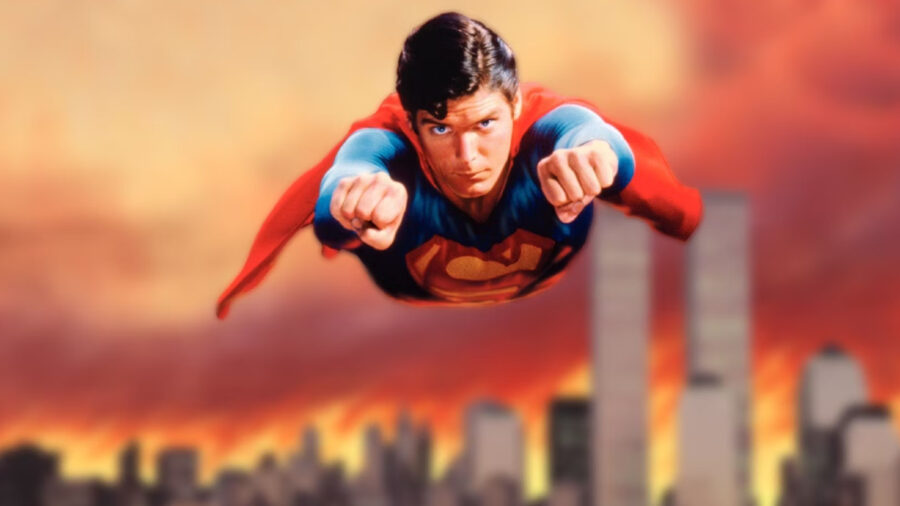
It’s an open secret that superhero movies often represent a major gamble for the studio. Such films command huge budgets that require a correspondingly huge marketing budget. Throw in the creeping effect of superhero fatigue, and there’s no guarantee that the film will make a profit. But superhero fatigue doesn’t exist in a vacuum; it’s just the natural effect of fans comparing newer movies to what came before. It’s tough pretending Batman v. Superman is a good movie after you’ve watched The Dark Knight, for example. It doesn’t help that all of these films will inevitably be compared to the original blockbuster superhero movie: Christopher Reeve’s 1978 Superman.
Now that Supergirl is coming out next week, fans can’t help but wonder whether this cinematic outing will be able to fill the very tall boots left behind by Reeve so many years ago. As it turns out, though, the boots weren’t the part of the actor’s outfit that Supergirl director Craig Gillespie fixated on. Instead, he decided to make a very bespoke good luck charm that would honor the greatest superhero movie ever made. You see, Milly Alcock’s cape in Supergirl is made from literally the same fabric as the cape worn by Reeve in Superman!
Meet The New Cape, Same As The Old Cape
Right now, Supergirl star Milly Alcock is doing quite a bit of promotion for her upcoming movie. Recently, she appeared on Raiders of the Lost Podcast, where she dished on some behind-the-scenes details. The most fascinating thing that she mentioned was that her onscreen cape has some serious superhero pedigree. “My cape in this film was remade using material from the original Superman cape,” she said. “I think that they found there was like 16 meters of that material, so yeah, that’s in the back of my cape now.”
It’s fun to know that at least part of Supergirl’s cape is cut from the same cloth as Christopher Reeve’s cape. It’s also a fun reminder that Warner Bros. tends to hold onto material from old superhero movies for a good, long time. Sometimes, this is for practical reasons rather than sentimental ones. For example, when Christian Bale needed to do his first screen test for Batman Begins, director Christopher Nolan had him wear one of Val Kilmer’s old suits. This ended up being a real Goldilocks situation because Michael Keaton’s suit was too short and George Clooney’s had prominent nipples. Kilmer’s old sonar suit, though, was just right.
You Will Believe A Woman Can Fly
Milly Alcock didn’t really elaborate on the cape story, so this might have been a decision made by any number of costuming experts, producers, and so on. But when I first heard the tale, I couldn’t help but think that director Craig Gillespie had requested this as a kind of cinematic good luck charm. By having his superhero wear something that ties his star actor to the most beloved superhero movie ever made, maybe he can avoid the most dreaded enemy of all tights-and-flights directors: superhero fatigue.
Incidentally, if Gillespie is feeling a bit superstitious, it’s likely because his boss jinxed him. A few months ago, DC Studios co-CEO Peter Safran said that there’s no such thing as superhero fatigue, just “mediocre movie fatigue.” Now, with a projected opening weekend much lower than Superman ($45-$55 million compared to $125 million), it looks like Supergirl may very well be on its way to a mediocre movie box office. But a little luck can go a long way, and Milly Alcock might beat all the haters’ expectations while sharing something powerful in common with Christopher Reeve, who taught us all to believe a man can fly.
To this day, Ronald D. Moore’s Battlestar Galactica reboot is remembered as a peak example of sci-fi storytelling. There are plenty of reasons for this: the cast was full of insanely talented actors, for example, and every single action scene kept fans on the edge of their seats. But the greatest strength of the show was its writing. The entire premise of the show was that humanity was trying to survive a genocidal attack by the Cylons, enemies who could potentially wipe everyone out at any given moment. It’s a very bleak story, and the tight writing of the show ensured that we felt every single heartwrenching decision.
Moore got his start by writing for Star Trek: The Next Generation. While that franchise is all about hope and optimism for humanity’s future, Moore ensured Galactica was the anti-Trek, with dark storylines about paranoia and desperation. This filtered into the design philosophy of the show, which is why Galactica feels like a submarine and the Enterprise-D felt like a flying Holiday Inn. However, what most fans don’t realize is that Moore borrowed one aspect of Star Trek’s design: in the Galactica episode “Tigh Me Up and Tigh Me Down,” he introduced an observation deck that was very clearly inspired by Ten Forward from The Next Generation!
The One Chill Spot On Battlestar Galactica
This story comes to us courtesy of the commentary track for “Tigh Me Up, Tigh Me Down,” just in case you needed a special incentive to bust out your Blu-rays. While this episode had plenty of the show’s signature paranoia (including Adama suspecting that Ellen Tigh is a Cylon and Roslin suspecting Adama was a Cylon), it had plenty of lighthearted moments designed to give audiences a break from the relentless drama of Season 1. It was also an episode that gave its characters a break, as it introduced the Observation Deck, an area where characters could stargaze and generally contemplate the cosmos.
On the commentary track for this episode, Ronald D. Moore said that “It did feel right that, perhaps…there was one area of the ship, which accepted a window or a port to look out and that it would be a fairly confined space for the crew on these very long, deep space missions.” This would be a place “where they can go to and just stargaze. And in this situation, it seemed like there would be a lot of people lining up to try and look out at the stars, you know, a break from the monotony of staring at metal walls.”
If this sounds a bit familiar, it’s because he’s basically describing Ten Forward from Star Trek: The Next Generation!
Advertisement
Make It Slow
Star Trek: The Next Generation was, to put it mildly, a more hopeful and optimistic show than Battlestar Galactica. Nonetheless, the Enterprise-D crew still experienced a fair amount of stress. Any given week, they could be tossed to the Borg by Q, get caught in a Klingon Civil War, or simply killed on an Away Team mission gone wrong. Because of this, the crew liked to relax in Ten Forward, a bar where they could look at the stars. It is located on Deck 10 in the forward section (hence, the name), offering everyone glorious, panoramic views of the cosmos around them.
Now, Ronald D. Moore didn’t explicitly name-drop Ten Forward during the commentary track. However, the idea of a ship section where beleaguered crew members can relax by gazing at the stars through big windows is very clearly inspired by everyone’s favorite spot to hang out on the Enterprise-D. That means that the showrunner never fully escaped his television roots and that his acclaimed anti-Trek show has a powerful echo of Star Trek: The Next Generation hidden deep within the Battlestar Galactica.
Ryan Lochte is making waves again—this time, it’s for his engagement to girlfriend Molly Gillihan. The Olympic swimmer confirmed that he and Gillihan were engaged after a year of dating, telling the media that he was excited to be “moving on” with his life. Lochte’s major life update comes a year after the gold medalist announced that he and his estranged wife, Kayla Reid, were divorcing.
According to several outlets, including PEOPLE and TMZ, Lochte got engaged to Gillihan on June 19, 2026. He confirmed the news with the media, stating that he was looking forward to “bigger and better things” with his soon-to-be wife.
The special occasion happened at Prime & Pearl in Gainesville, Florida, after Gillihan learned of Lochte’s plans to propose to her on her family’s farm in Missouri. Lochte shared that Gillihan was surprised with a table full of roses and a letter with the big question written in it.
“She immediately started crying and said, ‘What took you so long?’” Lochte said.
Advertisement
Ryan Lochte Confirmed His Relationship With Gillihan In July 2025 With An Instagram Post
Lochte made headlines last summer when he went Instagram official with his girlfriend, and several months later, faced heat from social media users for flaunting their decision to move in together online, per The Blast.
Lochte said at the time that deciding to come together under one roof was easy because of their special connection and their kids’ growing friendship. “We needed a bigger home to support our blended family, and we’re focused on creating a loving, stable environment for all of our children,” he said in January 2026.
Some netizens believed the former elite athlete was moving too quickly, given that he had announced his separation from his estranged wife, Reid, months earlier. However, Lochte said that he and Gillihan were unable to hide what they’d formed together.
“Everything happens for a reason,” the 41-year-old said. “And it was God’s way of saying enough is enough between both of you, between me and Kayla, of just being miserable and not happy and not living our best life. So we got separated and now I’m living my best life.”
Inside Ryan Lochte’s Divorce From His Estranged Wife
MEGA
The Blast reported on Lochte and Reid’s separation in the summer of 2025. The latter opened up about her decision to split from the Olympian with a lengthy, emotional Instagram post. While Reid didn’t go into details at the time, she admitted that leaving Lochte was a “challenging” decision.
“Sometimes we face trials we didn’t choose or see coming. And in those moments, we’re forced to make the hardest decisions to protect our peace, our children, and our future. I’ve come to the understanding that staying isn’t always the most loving decision someone can make. For me, leaving was an act of love — for those around me and for myself,” she added.
Advertisement
Lochte also released a statement about his split from Reid, stating that he was “grateful” for what they’d built together over the years—including their three children, Caiden, Liv, and Georgia. “Although this decision hasn’t been easy, I believe it’s the right step toward peace and well-being for us both. I remain committed to healing, growth, and co-parenting with care and respect as we move forward separately,” he continued.
Netizens Are Slamming Lochte After Announcing Engagement To Gillihan
While Lochte is celebrating the news of his engagement to Gillihan, social media users are blasting the “Traitors” alum for appearing to have moved on too quickly.
“Bro is one big red flag,” one user wrote, while another posted, “This will end well.” A third user also chimed in on the conversation, criticizing Lochte for getting engaged before even being divorced. “Went from a diamond to a rock,” they shared.
Lochte And Gillihan Are Swimming Into A New Chapter In Missouri
According to a previous report from The Blast, Lochte and Gillihan are starting a new chapter in Missouri after the swimmer accepted a new job as the assistant swim coach at Missouri State University.
Lochte’s contract is worth a reported $30,000, which works out to $34 an hour over the contract period (August 2026 to June 2027).
Not every movie enjoys the success it deserves. Plenty of films failed when they were first released, either with critics, at the box office, or both, but have gone on to find success as cult films. These are movies that are adored, usually by a small but devoted group of fans. In the age of the internet and now social media, it’s become far easier for these fandoms to maintain their support of these films in a more public fashion, but there are cult classics that still feel far too forgotten, many from the ’70s.
The decade of oil crises, political corruption, and economic instability produced a great many classics which are still loved in this current era of…oil crises, political corruption and economic instability. More now than ever, many audiences can relate to the pessimistic viewpoint that permeated much of ’70s cinema, but there’s even more that the decade had to offer in movies. Cult classics abound from the ’70s, and these are six of the best that should never be forgotten.
Advertisement
6
‘Brewster McCloud’ (1970)
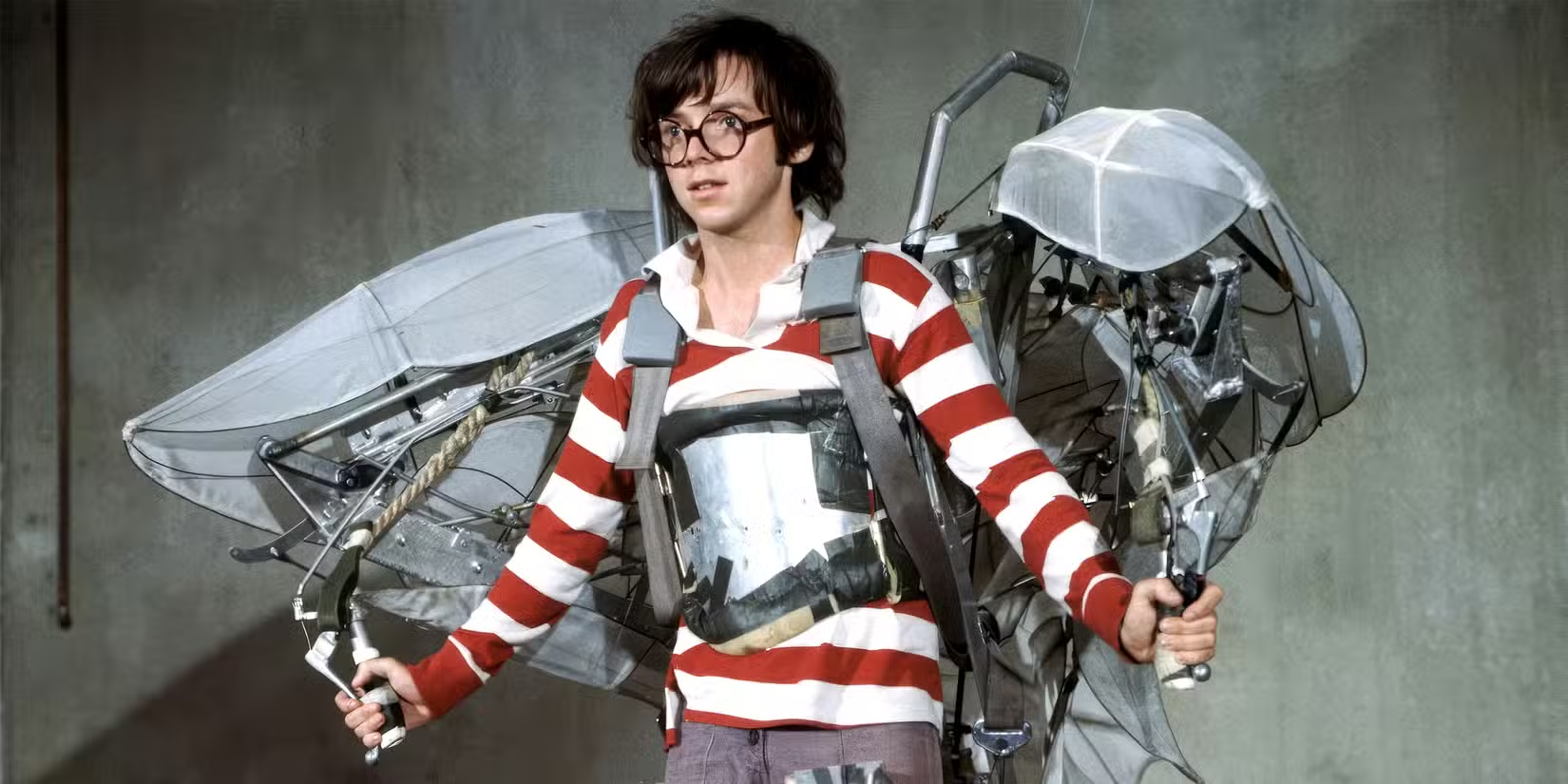
Bud Cort as the titular character in ‘Brewster McCloud’Image via MGM
Idiosyncratic filmmaker Robert Altman’s output in the decade was wild and varied, from masterpieces like Nashville, The Long Goodbye, and McCabe & Mrs. Miller to underrated gems like California Split and 3 Women to debacles like Quintet and Buffalo Bill and the Indians. Altman never stayed stagnant in one genre, and was always making interesting left turns in his career, none more so than the black comedy Brewster McCloud. As his follow-up to M*A*S*H, the film is a strange contemporary fable featuring the enigmatic Bud Cort as a man who dreams of wings.
In Houston, Texas, Brewster McCloud (Cort) lives in a fallout shelter beneath the Astrodome, where he bides his time building a pair of wings that will allow him to fly like the birds he idolizes. His only human contacts are two women, the mysterious Louise (Sally Kellerman), who has distinctive scars on her back, and tour guide Suzanne (Shelley Duvall). There’s so much more freewheeling madness to the film, and we haven’t even mentioned the murders that occur and the hard-boiled detective who believes Brewster might be the cause. There aren’t many films like Brewster McCloud, and fewer still made by filmmakers like Altman, who can maintain a balance in the quirky film that prevents it from folding in on its own affectations.
Advertisement
5
‘Freebie and the Bean’ (1974)
Alan Arkin and James Caan hold guns in Freebie and the Bean.Image via Warner Bros.
There was plenty of action in the ’70s, with the international success of martial arts films and the rise of exploitation filmmakers. It’s the era that gave us cult classics like Vanishing Point, Coffy,and The Gauntlet, and the essential buddy cop movie Freebie and the Bean. Akira Kurosawa’s Stray Dog and the thriller In the Heat of the Night helped establish the mismatched detective archetypes, and Butch Cassidy and the Sundance Kid inspired the comedic banter that would define the buddy action subgenre, but Richard Rush’s Freebie and the Bean is the first true American buddy cop action comedy.
Rush’s film establishes the exact tone between its San Francisco cops Freebie (James Caan) and Bean (Alan Arkin) that would define ’80s movies like 48 Hrs. and Lethal Weapon. The two detectives trade barbs as well as bullets as they strive to protect a crime boss from getting killed before they can arrest him. Their antics practically destroy the entire city, and it’s not hard to see why many critics chided the film for its blasé approach to police violence. It would inspire queasiness if it weren’t amped to such high levels of ridiculousness and if Caan and Arkin didn’t have such scalding chemistry. Freebie and the Bean is to the buddy cop movie what Halloweenis to slashers, and it deserves more recognition.
Advertisement
4
‘Bring Me the Head of Alfredo Garcia’ (1974)
Warren Oates as Bennie with a gun in Bring Me the Head of Alfredo GarciaImage via United Artists
Westerns were still a viable genre in the ’70s. They weren’t being produced nearly as prolifically as they were during the genre’s golden age, but riding the wave of success that Spaghetti Westerns started, many filmmakers were able to put their own revisionist stamp on the genre, and no filmmaker made more cult films for it than Sam Peckinpah. The iconic director started the decade with the comedic Western gem The Ballad of Cable Hogue, brought the genre’s sensibilities to the contemporary thrillers Straw Dogs and The Getaway as well as the gentler drama Junior Bonner. Pat Garrett and Billy the Kid would be his final official statement on the genre, but he’d make an even bolder one with the Neo-Western cult classic Bring Me the Head of Alfredo Garcia.
The film follows consummate loser Bennie (Warren Oates), a former soldier turned alcohol-swilling piano player in Mexico who takes on the task of tracking down the titular character who has had a massive bounty put on his head by a crime lord. Shot entirely in Mexico on a low budget, the film is Peckinpah at his most unfiltered, since he was free from the interference of studios. The result is a wild, violent ride that critics hated at the time and bombed at the box office. Since then, it’s rightfully earned recognition, not only as Peckinpah’s most nihilistic film, but also as a clear influence on filmmakers like Quentin Tarantino and Robert Rodriguez. Bring Me the Head of Alfredo Garcia is a dirty, nasty little Western thriller that belongs on a double bill with No Country for Old Men.
Advertisement
3
‘The Cars That Ate Paris’ (1974)
Image via British Empire Films
The Ozploitation movement came about during the Australian New Wave, where international attention came to films and filmmakers from the land down under thanks to a resurgence of their film economy. This era of Australian filmmaking would stretch through the ’80s and bring audiences cult classics like the Mad Max franchise, the harrowing thriller Wake in Fright, the Jaws-inspired horror film Razorback, and the feature debut of Peter Weir with the outlandish The Cars That Ate Paris. It’s a strange mix of vehicular horror and macabre humor that would propel Weir to future success in Australia and eventually Hollywood, and it remains one of the most iconic Ozploitation movies.
The rural town of Paris has an interesting economy, based on profits earned by causing car wrecks of traveling motorists and stealing their valuables. The wrecked vehicles have also inspired a strange subculture of hoons who turn them into mechanical monstrosities meant for violence and destruction. It’s into this chaos that Arthur (Terry Camilleri) drives with his brother, who is killed in their accident, leaving Arthur to fend for himself in the unstable town. The Cars That Ate Paris is the most unique of all the automotive movies that came out of the car culture of the ’70s, and it’s still a perfect microcosm of the era in Australian cinema that made it possible.
Advertisement
2
‘The Driver’ (1978)
Image via 20th Century Studios
A very different kind of car movie, Walter Hill’s minimalist masterpiece The Driver is a crime classic whose influence is apparent in the careers of filmmakers like Michael Mann and Edgar Wright. Its reappraisal has been slow, and it still hasn’t risen to the cult ranks of Hill’s follow-up The Warriors, but it’s an even better film and among the best cult ’70s crime thrillers, of which there are many. Before digging into Hill’s classic, some honorable mentions should go to The Outfit, The Friends of Eddie Coyle, Blue Collar, and The Harder They Come.
The Driver (Ryan O’Neal) is a criminal who’s made a career as a getaway driver, much to the chagrin of the hard-nosed Detective (Bruce Dern), who will stop at nothing to bring him down. It all leads to a high-stakes game set up by the Detective in the form of a heist that leaves plenty of bodies in its wake. The film has some incredibly kinetic car chases,shot at night in Los Angeles with Hill’s distinctive stripped-down efficiency. Hill is one of the most influential action directors of his era, and while he’s often overlooked, his films like The Driver continue to have an immense influence.
Advertisement
1
‘I Wanna Hold Your Hand’ (1978)
Nancy Allen, Susan Kendall Newman, Theresa Saldna and Wendy Jo Spurber in I Wanna Hold Your HandImage via Universal Pictures
Despite becoming one of the biggest Hollywood directors of the ’80s and ’90s, Robert Zemeckis’ career started inauspiciously. He and his early collaborator Bob Gale were mentored by Steven Spielberg straight out of film school, but their first three collaborations with the filmmaker flopped. They wrote the notorious comedic bomb 1941 for Spielberg, and the filmmaker produced their first two films, I Wanna Hold Your Hand and Used Cars, both of which failed and now have cult followings but are still overshadowed by Zemeckis’ later blockbuster successes. As his directorial debut, I Wanna Hold Your Hand is an incredibly assured comedy that showcases much of what would define Zemeckis’ greatest successes in the ’80s. It’s a madcap movie that charmingly recreates the era of Beatlemania.
Named after the Fab Four’s hit song, the film is structured around the Beatles’ first live appearance on The Ed Sullivan Show in 1964. Trying to get to that show are a group of teens, including super fan Rosie (Wendy Jo Spurber), soon-to-be newlywed Pam (Nancy Allen), aspiring photojournalist Grace (Theresa Saldana), and rebellious Janis (Susan Kendall Newman). Their odyssey to the Ed Sullivan Theater is filled with slapstick, hijinks and hysterics, all of which Zemeckis balances with the same heartfelt tone that made Back to the Future such a similarly nostalgic success. I Wanna Hold Your Hand has all the hallmarks of Zemeckis’ later career and deserves to be mentioned among his best films.
Spoiler Alert: This list contains spoilers for the Widow’s Bay Season 1 finale.Widow’s Bay just wrapped up its first season on Apple TV, and the comedy horror has already been renewed for a second. This is good news because the series, which has earned critical acclaim, has left several unexpected mysteries to be solved as the story continues.
While it seems the curse on the small rural town has been lifted, events in the final episode suggest this may not be the case. Evil may still be lurking, and Mayor Tom Loftis (Matthew Rhys) has a complicated situation to navigate. It seems even more challenging now than ever that he’ll be able to turn this town into the next Martha’s Vineyard, as he was so adamant to do.
Advertisement
Is Evan Really the Last Living Descendent?
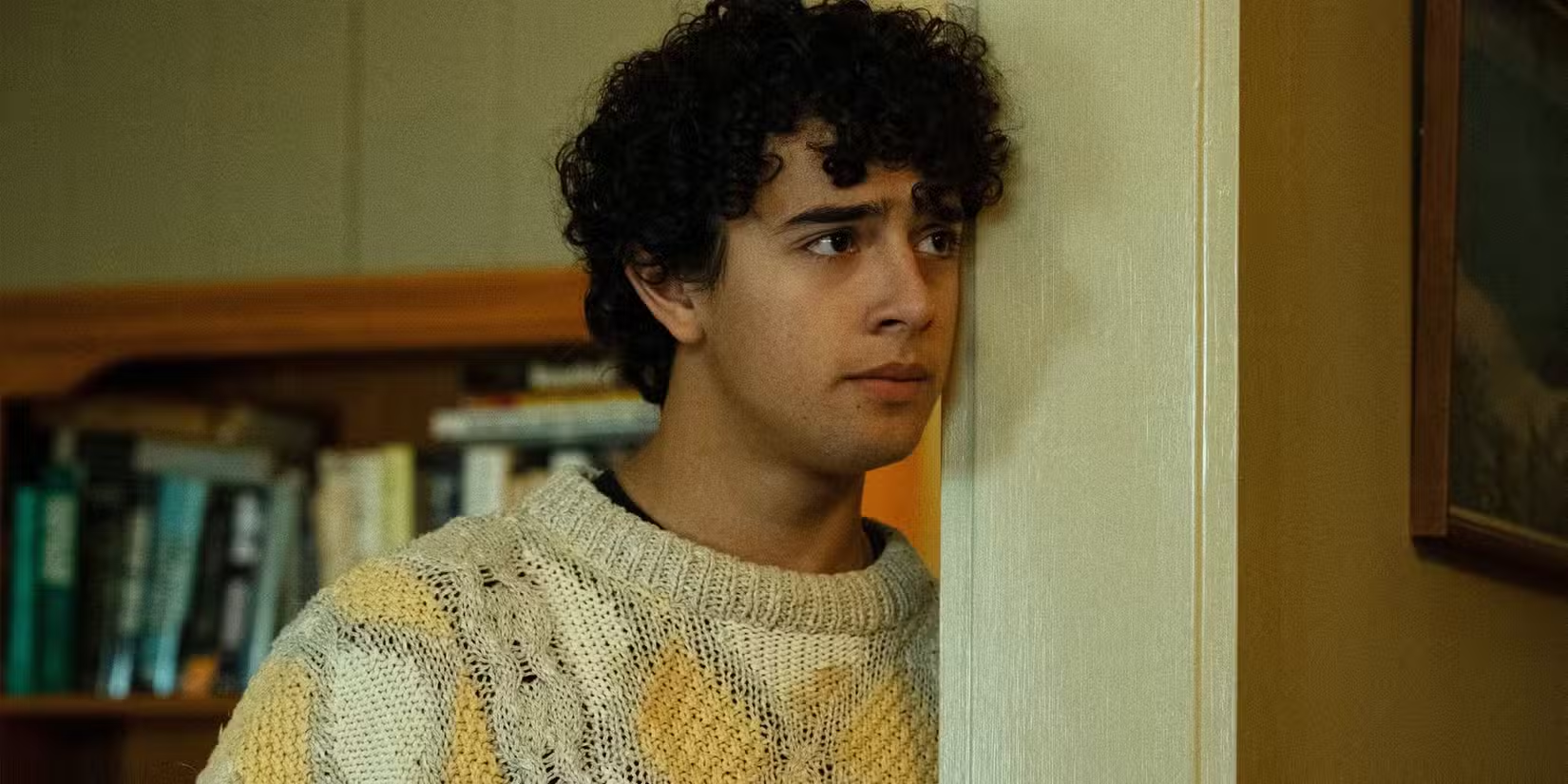
Evan Loftis (Kingston Rumi Southwick) leaning in the doorway in ‘Widow’s Bay’Image via Apple TV
In the final episode of the perfect from start to finish fantasy show, Tom learns that his elderly assistant Ruth (K Callan) is actually the biological mother of his wife Lauren (Meredith Casey). Since Tom had earlier learned that Ruth’s linage could be traced back to the cursed Warren family, he believed Ruth was the last living descendent, the person who needed to die for the curse to be lifted. But with this knowledge, it means his son Evan (Kingston Rumi Southwick) would actually be a descendent as well.
Some theories, however, suspect that Rosemary (Dale Dickey) might have fudged the information for an unknown reason. She is the one who traced the Warren lineage, and it’s suspicious. She would have been around at the time Ruth was pregnant, so she may have known about her connection to Lauren. Whether this is true or not is a mystery that will undoubtedly be explored in the next season.
Advertisement
Is the Curse Really Over?
Kate, Wyck, and Tom meeting together in a dark room in Widow’s Bay.Image via Apple TV
While the end suggests the curse is over, if Evan is indeed a living descendent, this means it probably isn’t. A good indication is when Evan and his friend find tunnels under the shelter where the town had been staying safe due to the storm. They find a sacrificial chamber, and when the custodian is locked inside, he seems to have gotten dragged into the cellar and was killed by some evil entity.
Once the townspeople discover Ken (Michael Malvesti) is missing, and if Evan discloses what he found, Tom and the others may realize that the horror is far from over. The storm may have ended, but there is probably a lot more to come.
Advertisement
Can Evan Leave Widow’s Bay?
Evan, Gil, and PJ sitting together in ‘Widow’s Bay’Image via Apple TV
Tom will have a challenging situation trying to explain to Evan that it might not be safe for him to leave the island. He’ll have to reveal at some point that this is why Evan was never able to leave this entire time: Tom was worried about his son, but now so more than ever. While he bought tickets for them to see a game in Boston, Tom will likely be hesitant to try and leave given what he now knows about his son’s lineage.
The question is not only if Evan is able to leave Widow’s Bay without being sucked into an abyss, but if Tom will even try to take him out. Or will Evan try to go on his own if his father doesn’t tell him the truth? Evan could hold the key to ending a curse. Since the show is unlikely to kill the character, he may play a more integral role in the second season of the best new Apple TV show in 2026.
Advertisement
Did Richard Really Die At Sea?
Hamish Linklater in Widow’s Bay Episode 6Image via Apple TV
Episode 6’s “Our History”, one of the best episodes of the season, explores the backstory of Richard Warren (Hamish Linklater) and his new wife Sarah (Betty Gilpin), and his possession by some devil-like force that resulted in strange illnesses, disappearances, and death in the early 1700s. After digging Richard up to find him still alive in his grave, Tom and Wyck (Stephen Root) set out to release him at sea in a supposed “Dead Zone,” believing this is the only way to end the curse. They succeed, and he appears to have died.
But the question remains if he is really dead. If Evan is one of his descendants and even being buried for centuries didn’t kill Richard, it’s possible Richard could still be alive and return in some form. Before being set out to sea, he changed his mind about dying and Tom had to fight him to get him back in the coffin. So, it’s possible he’s not dead at all.
Advertisement
Collider Exclusive · Horror Survival Quiz Which Horror Villain Do You Have the Best Chance of Surviving? Jason Voorhees · Michael Myers · Freddy Krueger · Pennywise · Chucky
Advertisement
Five killers. Five completely different ways to die — if you’re not smart enough, fast enough, or self-aware enough to avoid it. Only one of them is the villain your particular set of instincts gives you a fighting chance against. Eight questions will figure out which one.
🏕️Jason
🔪Michael
💤Freddy
🎈Pennywise
Advertisement
🪆Chucky
Advertisement
01
Something feels wrong. You can’t explain it — you just know. What do you do? First instincts are the difference between the survivor and the first act casualty.
Advertisement
02
Where are you most likely to find yourself when things go wrong? Setting is everything in horror. Where you are determines which rules apply.
Advertisement
03
What is your most reliable survival asset? Every survivor has a quality the villain didn’t account for. What’s yours?
Advertisement
04
What kind of fear is hardest for you to fight through? Knowing your weakness is the first step to not dying because of it.
Advertisement
05
You’re with a group when things start going wrong. What’s your role? Horror movies are brutally clear about who survives group situations and who doesn’t.
Advertisement
06
What’s the horror movie mistake you’re most likely to make? Honest self-assessment is a survival skill. Denial is not.
Advertisement
07
What’s your best weapon against something that can’t be stopped by conventional means? Every horror villain has a weakness. The survivors are always the ones who find it.
Advertisement
08
It’s the final scene. You’re the last one standing. How did you make it? The final survivor always has a reason. What’s yours?
Advertisement
Your Survival Odds Have Been Calculated Your Best Chance Is Against…
Your instincts, your strengths, and your particular way of thinking under pressure point to one villain you actually have a fighting chance against. Everyone else — good luck.
Advertisement
Camp Crystal Lake · Friday the 13th
Jason Voorhees
Jason is relentless, but he is also predictable — and that is the gap you would exploit.
He moves in straight lines toward his target. He doesn’t strategise, doesn’t adapt, doesn’t outsmart. He simply pursues.
Your ability to keep moving, use the environment, and resist the panic that freezes most victims gives you a genuine edge.
The Crystal Lake survivors were always the ones who stopped running in circles and started thinking about terrain, water, and distance.
You think like that. Which means Jason, for all his indestructibility, would face someone who simply refused to be where he expected.
Advertisement
Haddonfield, Illinois · Halloween
Michael Myers
Michael watches before he moves. He is patient, methodical, and almost impossible to detect — until it’s too late for anyone who isn’t paying close enough attention.
But you are paying attention. You notice the shape in the window, the car parked slightly wrong, the silence where there should be sound.
Michael’s power lies in the invisibility of ordinary suburbia — the fact that nothing ever looks wrong until it already is.
Your spatial awareness and instinct to map every room, every exit, and every shadow before you need them is precisely the quality Laurie Strode had.
You are not a victim waiting to happen. You are someone who already suspects something is wrong — and acts on it.
Advertisement
Elm Street · A Nightmare on Elm Street
Freddy Krueger
Freddy wins by getting inside your head — using your own fears, your own memories, your own subconscious as weapons against you. That strategy requires a target who can be destabilised.
You are harder to destabilise than most. You’ve faced uncomfortable truths about yourself and you haven’t looked away.
The survivors on Elm Street were always the ones who understood what was happening and chose to face it rather than flee from it.
Freddy’s greatest weakness is that his power evaporates in the presence of someone who refuses to give him the fear he feeds on.
Your psychological resilience — the ability to stay grounded when reality itself becomes unreliable — is exactly the quality that keeps you alive here.
Advertisement
Derry, Maine · It
Pennywise
Pennywise is ancient, shapeshifting, and feeds on terror — but it has one critical vulnerability: it cannot function against someone who genuinely stops being afraid of it.
The Losers Club didn’t survive because they were braver than everyone else. They survived because they faced their fears together, and faced them honestly.
You ask the questions others avoid. You look directly at what frightens you rather than turning away.
That directness — the refusal to let fear fester in the dark — is Pennywise’s worst nightmare.
It chose the wrong target when it chose you. You are exactly the kind of person whose fear tastes like nothing at all.
Advertisement
Chicago · Child’s Play
Chucky
Chucky’s greatest advantage is that nobody takes him seriously until it’s already too late. He exploits the gap between how something looks and what it actually is.
You don’t have that gap. You take threats seriously regardless of how they present — and you never make the mistake of underestimating something because of its size or appearance.
Chucky relies on surprise, on the delay between recognition and response. You close that delay faster than almost anyone.
Your instinct to treat every unfamiliar thing with appropriate scepticism — rather than dismissing it because it seems absurd — is the exact quality that keeps you breathing.
Against Chucky, not laughing is already winning. You are very good at not laughing.
Advertisement
What Is Wyck’s Full History?
Stephen Root in Widow’s Bay Episode 9Image via Apple TV
Advertisement
Through the entire series, Wyck was one of the most vocal townspeople about the curse, having witnessed it with his own eyes. He reveals to Tom while they’re out on the boat that decades prior, he went out on a boat trip with his childhood friend. The waters became violent and as his friend was fighting for his life, Wyck let him go to save himself. He has lived with this guilt ever since.
It seems there’s more to Wyck’s story than he is letting on, and that could be revealed in Season 2. He’s a mysterious character who knows a lot about the history of the curse, even having saved Tom from the horrifying Sea Hag. Wyck’s knowledge ould be far greater than we realize.
Is Tom’s Wife Still Alive?
Matthew Rhys sitting in a restaurant in ‘Widow’s Bay’Image via Apple TV
Advertisement
One of the biggest mysteries in Widow’s Bay, one of the best Apple TV originals, centers around Tom’s wife, who is believed to be dead. But after finding photos of her with him as a child, Evan is devastated to learn that his mother was alive for some time after his birth. She didn’t die in childbirth as he was told. Tom explains that while she was there in body, something happened to her, and she was not there in mind. She claimed to have lost her sight after leaving the island, which is what happened to one of Richard Warren’s children as the boat got further away when Sarah tried to escape with them. Lauren was eventually sent to an institution where she sent troubling letters, suggesting she had completely lost her mind.
Given that she’s a descendent of the Warrens, it’s likely that whatever happened to her has something to do with the curse. Tom says she had a stroke that left her mentally unstable, and that she later died of an aneurysm. But it’s possible she didn’t die, and Tom continues to lie to Evan to spare him the pain of seeing his mother in the condition she is in. Could this have something to do with the basement of Tom’s house and why he was on edge when he thought Evan had gone down there?
Who Will Be Sacrificed Next?
In the final episode, after Ken disappears and is presumably killed, the storm is over. But then the church bell rings eight times. Based on the video Dale (Jeff Hiller) watched that claimed “one soul for each bell toll,” this supposedly signals that eight more sacrifices are required to keep the island happy. If Rosemary is right and Evan is the last living descendent, the curse has not been lifted and the deaths will continue. What’s more, if Richard had been buried all this time until Wyck exhumed him, who was fulfilling the pact while he was underground?
Advertisement
How this situation is navigated will be important, since Tom now has to balance the idea that residents will die, and the only way to stop it would be the sacrifice his own son. There’s no way he would do that, which leads back to who will perish and how. Most important is if Tom, Wyck, and the others can find a way to stop the curse without anyone else having to be sacrificed.
How Will They Explain Ruth’s Death?
Ruth flipping through an album on the couch while talking to Tom in Widow’s Bay.Image via Apple TV
Tom was reluctant but willing to kill Ruth, knowing that sacrificing her life would save the rest of the town. In his eyes, she’s old anyway and likely didn’t have much time left. This idea is squashed when he visits her and finds her on the treadmill in her home, very much still spritely and active. Even though he secretly poisons her tea, he backs out at the last minute once he realizes that she’s his mother-in-law, mother of his late wife and thus Evan’s biological grandmother, which explained why she was always so willing to babysit him.
Advertisement
But before Tom can save her, Bechir (Kevin Carroll) arrives and shoots her to end the curse. Bechir, learning the story from Patricia (Kate O’Flynn), understands he has to protect his town, and his pregnant wife. She’s about to give birth, and if she delivers the baby here, they will never be able to leave with the curse still intact. Still, how will Bechir and Tom explain Ruth’s death? She’s old enough for them to suggest that she died of natural causes. But if someone were to find her body and the bullet hole, they would certainly have questions.
What’s Going On With the Inn?
Tom (Matthew Rhys) and Wyck (Stephen Root) in ‘Widow’s Bay’Image via Apple TV
We know from the series, which is on track to be named one of the best horror comedy shows of all time, that when Tom spends the night at the creepy local inn, weird things happen there. He chats with, drinks, even plays a board game with another guest only to be near attacked by this man later in a clown suit, realizing he was never real. When the innkeeper, Kurt (Neil Casey), is told to go into the captain’s suite where Tom is staying and close the door, he is afraid to do it. Once opened, he acts as though much more than 10 seconds have passed. When he is asked to do it again, this time for 30 seconds, he requests food. He clearly knows something weird in that room, like the passage of time is different.
Advertisement
This was never explored further, which opens questions about lapses in time, time travel, or something else to do with space and time. There’s a lot more we need to know about Breakwater Inn and what sorts of things have gone on, and do go on, there. Also, why did none of this happen to Tom while he stayed in that room?
If you like the horror genre and reading, there’s a very good chance Stephen King is a name you’re familiar with. You might not even like horror, nor reading, and you’ve still probably heard of him, since he’s had, on average, a book or two published every year since 1974, and plenty of those books have belonged to the horror genre. You’ve got Carrie, The Shining, ‘Salem’s Lot, The Stand, The Long Walk, and The Dead Zone… and all those are just from the 1970s.
There’s plenty to read when it comes to an author so prolific, but all good things come to an end, including a very prolific author’s body of work. So, if you’re a fan of King’s and lost when it comes to horror books to read, the following ones might be worth checking out. Some of these you do need to stretch a little, to classify them as horror, since they might technically be more horrifying than they are horror books in the classic sense, but if something’s unnerving and likely to get under your skin (and, most importantly, not written by Mr. King), then it qualifies for inclusion here.
Advertisement
8
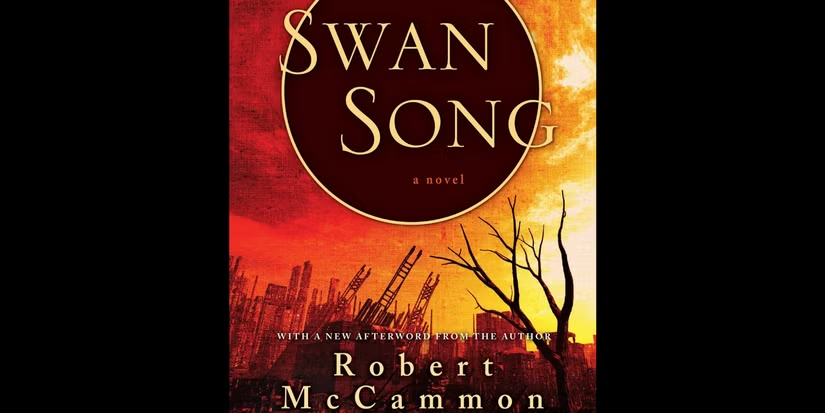
‘Swan Song’ (1987)
Image via Pocket Books
It feels right to mention Swan Song first, since this one is quite easily comparable to one of Stephen King’s best (and most famous) books: The Stand. King’s book is about the world continuing on, in some capacity, after a deadly flu kills off much of humanity, and there’s a struggle between two main groups that’s built to throughout. Swan Song does something similar, being a post-apocalyptic story about the fight for humanity’s future, too.
Then again, it’s nuclear war that brings about the end of the world, with Swan Song, and there are some ways that it feels maybe a tiny bit more optimistic than The Stand (though The Stand isn’t without its idealistic moments, and Swan Song does have undeniably dark passages, too). It’s a long book, so it does more than just try to scare you, as a reader, but there is quite a lot here that is horrific and intense, with it also proving surprisingly readable and compelling for something as long as it is (also, not as long as The Stand’s uncut version, but comparable to the original 1978 version of The Stand, page-wise).
Advertisement
7
‘The Raw Shark Texts’ (2007)
Image via Canongate Books
The Raw Shark Texts is a somewhat difficult book to describe, since it’s a rather distinctive blend of horror, some science fiction, and then other concepts that are more obscure, and not really tied to any particular genre. Maybe even saying it’s a work of horror and/or science fiction isn’t entirely accurate, but what can be said is that it’s about someone with amnesia (or something like it) having to work out where and who he is.
There are notes left seemingly by himself, and from there, The Raw Shark Texts finds a good many ways to get weird and head-spinning in nature. Horror can be derived from confusion, and the sense of not really knowing what’s going on here – or what to trust – goes a long way toward making this a compelling and effectively unnerving read, for much of its duration.
Advertisement
6
‘World War Z’ (2006)
Image via Crown Publishing Group
There is a movie version of World War Z, but it didn’t really capture what made the book special, and it couldn’t really, either, with just a single film’s runtime to play around with. The original World War Z is expansive and also not really a traditional narrative, since it wants to look at how the entire world would react to – and fall apart because of – a genuinely global zombie outbreak.
It came out at a time when zombies were more or less everywhere, so it’s fair to have a bit of fatigue with the whole sub-genre now, but World War Z can still be admired and appreciated for doing something a bit different with familiar horror monsters. Whether it’s genuinely accurate, hopefully no one will ever be able to judge, seeing as that would mean an actual outbreak having to happen and all, basically dooming the world, but for now, this feels about as grounded as a book about zombies could be.
Advertisement
5
‘Dracula’ (1897)
Image via Penguin Classics
Naturally, Dracula has to go here, just as another influential book from the 1800s that helped codify the idea of monster horror will also be featured here. Dracula is more or less the vampire story to which all others are compared, a little like how Night of the Living Dead (1968) is the definitive zombie movie. Dracula didn’t invent the idea of the vampire, and the word zombie did indeed exist before 1968, but both works recontextualized and popularized such monsters.
Dracula is also an interesting read thanks to its structure, with it being one of the best-known – and also one of the best – epistolary novels, made up of letters, newspaper articles, and other documents. You’ll likely know the story, or what to expect, if you’ve seen your fair share of vampire movies or read other vampire books before getting to Dracula, but it’s still a rewarding and maybe even necessary read, if you’re into horror and especially so if you’re interested in the history of horror, as a genre.
Advertisement
4
‘Blonde’ (2000)
Image via HarperCollins
Blonde reimagines and reinterprets the life of Marilyn Monroe, controversially turning it into something like a work of horror. It’s the kind of psychological drama that’s heavy enough to more or less become horrific, certainly at points. The film adaptation was controversial for doing this, while the book didn’t seem to create quite the frenzy, even if both do the same thing, and it would be weird to criticize one while giving the other a pass.
You have to approach it as something other than a biographical book, in any event, even if Monroe and other people in the novel were real people. Blonde takes Monroe’s tragically short life and frames it as one filled with exploitation and an unfathomable amount of pressure, with the plight of Monroe standing in here for various other young women who’ve been chewed up and spit out by the film industry. So, sure, not horror in the typical sense of “Ooh, spooky ghosts” and whatever, but horror in an arguably more visceral and hard-to-sit-with sense. It really gets under your skin, and uncompromisingly explores a life defined by an almost non-stop barrage of genuinely horrible things.
Advertisement
3
‘Blood Meridian’ (1985)
Image via Random House
There’s a stronger argument to be made for Blood Meridian being a work of horror than Blonde, so if you were still with this whole ranking after that pick, then hey, that’s good you stuck around. Blood Meridian, right? What a nightmare. It’s a Western, technically, but a nightmare of a Western, more specifically, being about a teenager who falls in with a group of scalp-hunters who rampage around the United States–Mexico border, killing countless people purportedly for bounties, but maybe for other reasons, too.
Judge Holden is also a big reason for Blood Meridian feeling like a work of horror quite a lot of the time, since he’s one of literature’s best – and most fearsome – antagonists.
Advertisement
The violence is undeniably graphic and also near-constant, which makes things shocking early on, and then it becomes shocking later when you find yourself almost desensitized to all the terrible things happening (which is almost certainly intentional, on the part of Cormac McCarthy). Judge Holden is also a big reason for Blood Meridian feeling like a work of horror quite a lot of the time, since he’s one of literature’s best – and most fearsome – antagonists, and stands out as especially horrible, which is saying something, considering the already-high immorality of so many characters throughout this novel.
2
‘Frankenstein; or, The Modern Prometheus’ (1818)
Image via Oxford University Press USA
Advertisement
You could laugh at the fact that Frankenstein’s full title includes the word “Modern,” if you want, but at the same time, it does feel startlingly timeless for a book that’s more than two centuries old, so the “Modern” kind of earns the right to be there. Also, it’s a defining work of science fiction and horror, helping codify certain conventions regarding the former, and then also working well enough as an example of the latter to still be decently unsettling to read in, like, the 2020s, instead of the 1820s.
Presumably, it would’ve been weird and unsettling in the 1820s, too. It’s just harder to verify that. It comes down to Frankenstein being influential and continually adapted and reinterpreted by who knows how many other creatives at this point. Further, Frankenstein is potentially most compelling as a drama, really, given what it says about human nature and the human condition, so on just about every front, it succeeds and more than endures.
Scratching the same itch horror-wise as the recent Backrooms movie (and all the stuff online related to that movie), House of Leaves was ahead of the curve, in terms of really diving into what’s been popular, not to mention genuinely scary, for people lately. House of Leaves is about an impossible and otherworldly space that’s entered into through a mysterious house, and it’s also about various people trying to grapple with the horrors of it all. And someone grappling with someone else’s grappling of the situation.
It’s a very layered novel, and uses all the confusion and ideas upon ideas to make something that’s particularly effective as a psychological thriller/horror read. House of Leaves has a passionate cult following, so there’s a risk here of just adding to all the love that’s been sent the book’s way, and possibly contributing to it being hyped up too much, but maybe it is also just that good, and genuinely one of the scariest books of the past few decades, too.
Jelly Roll just turned his divorce drama into a punchline.
The country star filmed a phone call with his soon-to-be ex-wife and posted it online for the world to see. Fans were not expecting this level of humor mid-split.
Jelly Roll and Bunnie Xo have made it clear their breakup will not follow a typical script. Their unconventional approach has only added fuel to an already wild news cycle.
ZUMAPRESS.com / MEGA
Jelly Roll’s YouTube channel featured a new vlog titled “The Divorce Vlog” and featured a phone call with Bunnie XO that was played on speaker for fans to listen to. Before turning to the camera, he said, “Mama bear!”
“Yeah, y’all thought we were gonna hate each other, didn’t you? “Plot twist, b-tches,” he said with a smile and held the lens to his face. The clip rapidly grew viral on social media, captivating viewers with its light-hearted tone.
Advertisement
The singer also teased fans with “the piping hot tea about the divorce” before holding up his phone for Bunnie to plug her own podcast episode on the split.
The pair’s playful tone throughout the call stood in sharp contrast to the typical bitterness associated with celebrity breakups. Many viewers praised the couple for showing that a divorce does not always have to end in hostility.
Bunnie Xo Also Dropped Her Own ‘Plot Twist‘
ZUMAPRESS.com / MEGA
Despite their split, the estranged couple is not abandoning plans to start a family. The Blast reported that Bunnie addressed the topic directly on a recent episode of her “Dumb Blonde” podcast.
“We’re still having a baby. We’re still having a baby together,” she said. “So, we have been the most unconventional couple that you guys have ever encountered.”
She also revealed the divorce settlement moved unusually fast, joking that the process took only two or three weeks once both sides reached an agreement. Bunnie attributed the smooth process to how much common ground she and Jelly Roll still shared.
Advertisement
The revelation left fans stunned, with many questioning how the pair could remain so amicable while planning to welcome a child together after their divorce.
Jelly Roll And Bunnie Xo Remain Committed To Co-Parenting
Tammie Arroyo / AFF-USA.com / MEGA
Bunnie made clear that despite the divorce, she still considers her estranged husband her best friend and someone she deeply loves. She described their bond as unshakable, even amid the split, in the same podcast episode.
After years of struggling with fertility, the couple has decided to co-parent. Bunnie has previously shared about the emotional aspect of their IVF journey.
The pair’s decision to move forward with a joint family despite the breakup has caught the eye of their fans, who expected the breakup to mean the end of their joint plans.
Is The Country Singer Already Dating?
Tammie Arroyo / AFF-USA.com / MEGA
Bunnie took a direct hit at rumors of her husband’s love life. On her open-minded podcast, she revealed that he’s been back in the dating scene, according to Us Weekly. “So, has my husband begun dating? Yes, he has, and we’re glad he has,” she said.
The 46-year-old has closed the door on swirling rumors about his relationship with singer Jessie Murph, calling the speculation “disrespectful” because of their age difference.
Advertisement
Bunnie then hailed her estranged husband’s looks and vitality, saying he was in his “finest season” so far. She attributed his recent improvement in health and weight loss to his increased confidence.
She even told her listeners to look into him, and said she’d be a matchmaker to her soon-to-be ex-husband. It was such an unusual setting for their divorce, given the light mood in which it was made official.
Bunnie has expressed that she is not looking to try anything new either and wants to put in the effort to heal her relationship first.
Jelly Roll And Bunnie Xo’s Split Was Reportedly Years In The Making
ZUMAPRESS.com / MEGA
Despite their public displays of affection, insiders claim the cracks in Jelly Roll and Bunnie XO’s marriage ran deeper than fans realized. As reported by The Blast, a source said that their relationship “has always been complicated” since its start.
The insider explained that the pair were in very different places when they first met, and their relationship endured years of personal and financial challenges as they tried to build a life together.
Advertisement
With baby plans intact, playful banter on camera, and new dating chapters already underway, can anyone really predict what comes next for Jelly Roll?



























:max_bytes(150000):strip_icc():format(jpeg)/Mamie-Van-DorenElizabeth-Short088-06172026-4eeb494bbbd74208b73d3c9a180bfa54.jpg)




























You must be logged in to post a comment Login