

Crypto World
Charles Hoskinson defends Cardano’s AI push as Midnight City expands



Cardano founder Charles Hoskinson has defended recent AI content tests after users criticized an AI-generated post shared through Input Output’s X account.
Summary
- Hoskinson said AI agents could help Cardano scale updates, community tasks and Midnight City activity.
- Midnight City uses autonomous agents to test privacy views for users, auditors and regulators alike.
- The debate followed backlash over AI-generated influencer content shared through Input Output’s X account recently.
The discussion followed his June 20 post titled “AI Slop, IOG X, and the Future of Marketing,” where he addressed how the team is testing new tools for communication.
Hoskinson said the AI-generated influencer came from work around Midnight City and was shared in good faith. He said the goal was to show what new systems can do, not to replace people or mislead the community. The response showed that parts of the Cardano audience remain careful about synthetic media.
Midnight City becomes test ground for agents
Midnight City is an interactive simulation tied to the Midnight Network. It uses autonomous AI agents that work, trade and create economic activity inside a digital city. The project lets users watch activity through different views, including public, auditor and regulatory lenses.
The platform also serves as a testing area for privacy tools. Midnight Network uses zero-knowledge technology and selective disclosure to protect data while still allowing approved parties to see needed information. This design supports the project’s wider pitch around private but compliant blockchain activity.
Marketing plans move toward AI agents
Hoskinson said Cardano and Midnight cannot rely only on human teams if the user base grows by millions.
“We’re going to need agents and AI to be able to organize and sort all that out and broadcast on a regular basis what’s going on in Midnight City,” he said.
He also linked the discussion to OpenClaw, an open-source AI agent platform. Hoskinson described AI agents as tools that could support community management, media updates and broadcasting. He said the team is watching “where the future is going with AI CMOs” and lifelike content systems.
Cardano context and next steps
The comments come as Midnight remains one of the main projects connected to Cardano’s next phase. Crypto.news earlier reported that Midnight launched its federated mainnet on March 31, 2026, with a privacy model built around programmable disclosure. The network also uses NIGHT for governance and DUST for transaction costs.
Cardano has faced a harder market backdrop in recent weeks. As previously reported by crypto.news, ADA fell below $0.20 earlier this month, hitting its lowest level in more than five years.
Meanwhile, at press time, the token traded at $0.16, indicating over 2% decline in the past 24 hours (per crypto.news market data). That price pressure has kept attention on whether Midnight can bring more builders, users and activity to the ecosystem.
Hoskinson said the team will keep testing AI standards as Midnight City grows. “It’s why it’s one of our most important projects,” he said, adding that the team plans to explore where the technology goes next. He also said agentic trading and affiliate relationships could help bring more users to Midnight.


Key Takeaways
- Altura has initiated the shutdown of its USDT stablecoin vault following more than $8.5 million in redemptions within a 24-hour period
- The vault’s total value locked had reached $39 million on HyperEVM prior to the mass withdrawal event
- Main Street’s msUSD stablecoin plummeted more than 70% from its peg following Accountable’s termination of verification services
- While Altura utilized Accountable as a verification partner, it maintained no direct financial ties to msUSD
- Altura’s CEO Ranveer Arora attributed the withdrawal spike to market panic and false information spreading online
The weekend of June 20-21 witnessed Main Street’s msUSD stablecoin plunge by over 70% from its dollar peg. The dramatic collapse followed Accountable’s sudden decision to terminate its proof-of-solvency services, citing Main Street’s failure to satisfy its verification requirements.
Accountable functions as a third-party verification mechanism that validates whether a protocol’s asset reserves align with its outstanding obligations. Its withdrawal triggered an immediate loss of investor confidence across connected platforms.
Altura had contracted with Accountable for the same verification services. Despite maintaining no financial exposure to msUSD or any of Main Street’s investment strategies, depositors rushed to withdraw funds without seeking clarification.
22% of Total Value Locked Vanished in 24 Hours
Within a single day, depositors pulled more than $8.5 million in USDT from Altura’s vault. This represented approximately 22% of the platform’s total locked value disappearing virtually overnight.
The vault operated on the ERC-4626 standard architecture. Depositors contributed USDT in exchange for proportional vault shares. Altura then allocated these assets across various strategies including funding-rate arbitrage operations, market-making activities, and real-world asset investments.
Withdrawal mechanisms offered depositors flexibility. They could choose immediate redemption with a 0.1% processing fee, or opt for epoch-based withdrawals without any charges.
On June 21, CEO Ranveer Arora announced via X that Altura would begin shutting down the vault. He emphasized that this proactive measure aimed to safeguard depositor assets and facilitate orderly redemptions, preventing a full-scale bank run situation.
“Our priority remains the protection of user capital and ensuring all redemptions are completed in a fair, transparent, and efficient manner,” Arora wrote.
CEO Challenges Spread of False Information
Arora voiced his disappointment regarding what he characterized as baseless rumors fueling user panic. He maintained that Altura has consistently prioritized transparency in its operations, and that the withdrawal surge resulted from speculation rather than substantiated concerns.
Prior to Arora’s personal statement, Altura’s official channels had already released a clarification confirming the protocol held zero direct exposure to Main Street or its msUSD stablecoin.
“Our HyperEVM lending vault, the associated USDT/AVLT market, and borrowers utilizing our Ethereum vault remain unaffected,” the protocol stated.
Altura notified all counterparties and business partners about the shutdown decision. The platform commenced liquidating positions across centralized exchanges, private credit arrangements, and real-world asset portfolios. According to company communications, certain positions may require extended timeframes for complete redemption.
Altura’s remaining product offerings, including its HyperEVM lending facility and Ethereum vault, continue functioning without disruption and were excluded from the wind-down process.
The Accountable incident highlighted a critical infrastructure weakness. Platforms depending on a single external entity for solvency attestation face concentrated risk exposure that can spark depositor panic even when their financial position remains fundamentally secure.

Key Highlights
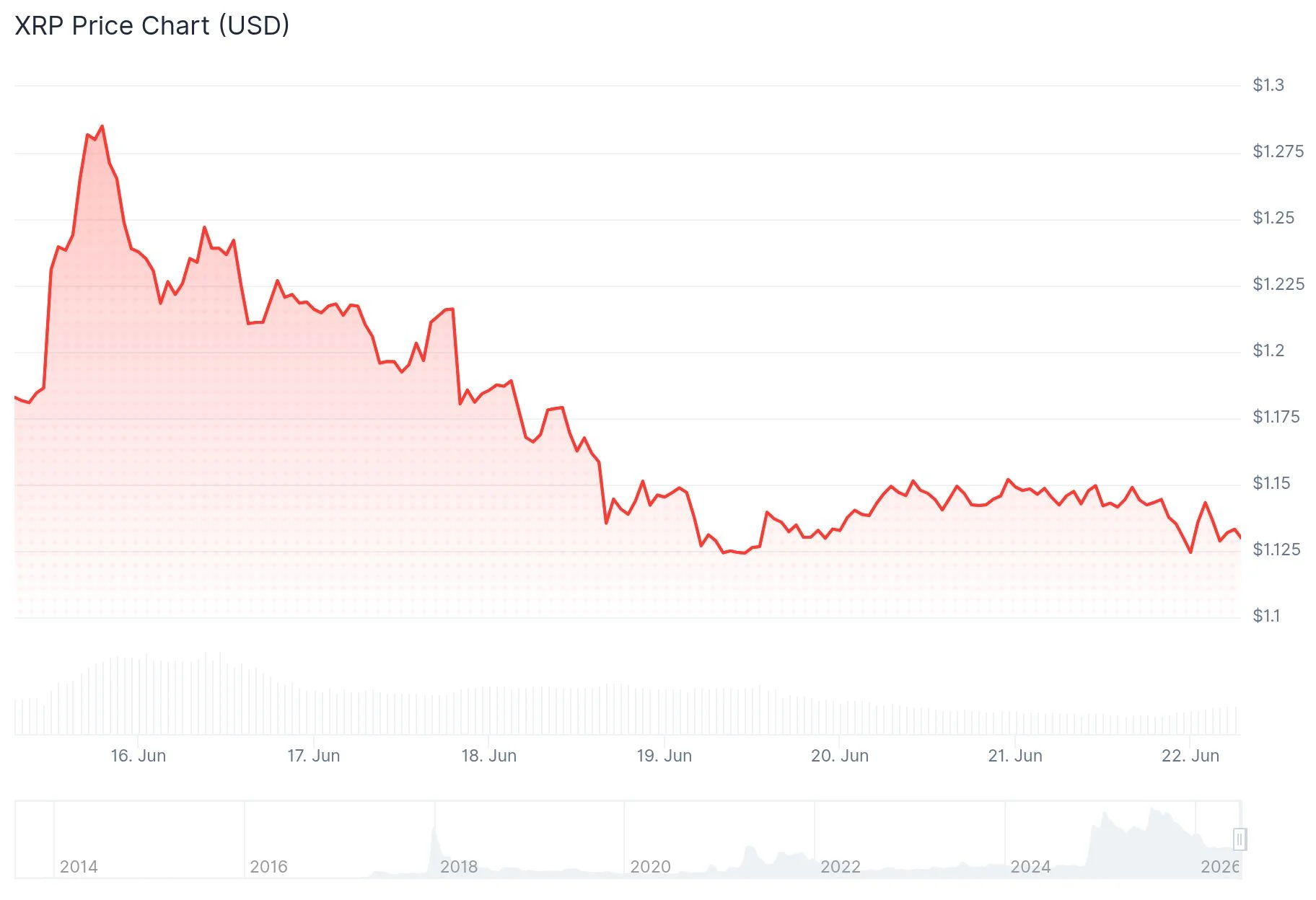
- XRP maintained trading activity around $1.14 during June 21–22, staying within the $1.10–$1.30 corridor
- Support at $1.10 held firm following a temporary decline to $1.12 accompanied by elevated trading volume
- Exchange-held XRP supply dropped to approximately 1.6 billion tokens, marking the lowest level in seven years
- Investment products tied to XRP attracted roughly $10.66 million in net capital during the weekly period
- Ripple advanced RLUSD integration through Mastercard infrastructure, African payment corridors, and AI-powered transaction systems
Throughout much of June 2026, XRP has exhibited constrained price movement, oscillating between $1.10 and $1.30. On June 21, the digital asset was valued at approximately $1.14, reflecting a modest 24-hour decline of -0.34%.
Daily trading volume registered around $872 million, while XRP’s total market capitalization remained near $70.97 billion. This valuation secured its position as the sixth-largest cryptocurrency by market cap.
The monthly perspective reveals more volatility. XRP has declined over 16% across the 30-day timeframe, despite recent evidence of demand at critical price thresholds.
On June 22, XRP experienced a brief downturn to approximately $1.12 during elevated trading activity. Near 21:00 UTC, transaction volume spiked to 85.8 million XRP, driving the asset to an intraday low around $1.1213.
Buyers responded rapidly to the dip. XRP rebounded toward $1.148, recovering nearly 80% of the session’s losses in a matter of hours.
The recovery encountered resistance between $1.147 and $1.149, establishing this zone as a near-term ceiling. The established range of $1.10 to $1.30 continues to define the current market structure.
Cryptocurrency analyst EGRAG CRYPTO shared technical analysis on X, characterizing the two-month price formation as “E is the battlefield.” The commentary emphasized that sustained defense of current levels is necessary before any meaningful upward movement can develop. EGRAG’s long-term cycle projections include targets ranging from $9.50 to $17.23, with $13 highlighted as a key milestone — though these levels remain distant while XRP trades beneath $1.20.
Developments in the Ripple Ecosystem
Ripple has maintained momentum across its product development and strategic partnership initiatives. The company extended RLUSD stablecoin integration into additional payment infrastructure and participated in Flutterwave’s Series E funding round to facilitate stablecoin adoption across African markets.
Ripple collaborated with Bitso on MXNB, a peso-denominated stablecoin operating on the XRP Ledger. Additionally, RLUSD achieved integration with Mastercard’s stablecoin settlement infrastructure.
The XRP Ledger introduced an AI Starter Kit designed to enable AI agents to execute automated transactions using XRP and RLUSD through the x402 protocol framework.
On-Chain Metrics and Investment Flows
XRP tokens held on centralized exchanges declined to approximately 1.6 billion — representing a seven-year low and roughly a 50% reduction from October 2025 levels. Reduced exchange-held supply can amplify price volatility when buying pressure emerges.
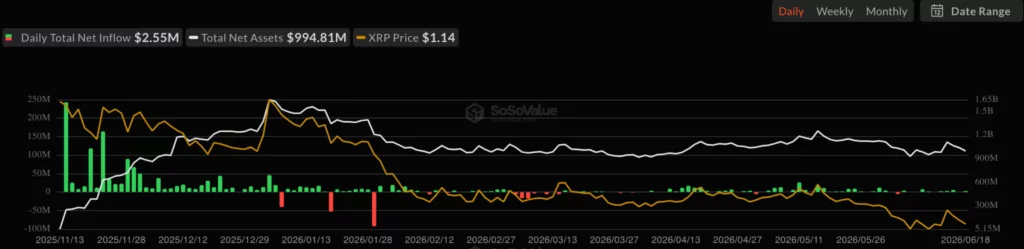
Institutional product flows remained constructive. XRP products generated approximately $10.66 million in net inflows during the week concluded June 18. Total cumulative inflows have now approached $1.45 billion.
Conversely, large holders distributed over 30 million XRP across a five-day window, while on-chain activity metrics softened during the corresponding period.
The CLARITY Act, legislation designed to establish clearer regulatory definitions for digital commodities, has advanced through committee stages and now awaits Senate floor consideration, requiring 60 votes for passage.
Exchange-held XRP reserves registered at approximately 1.6 billion tokens according to the latest available data, marking the lowest level recorded in seven years.
Following a period of heightened volatility in early June, investor attention in Ethereum has once again shifted towards institutional demand and the development of the spot ETF market in the United States. The funds launched last year continue to serve as one of the key channels for capital inflows into digital assets, while their daily flow statistics remain an important indicator of sentiment among major market participants. Expectations regarding the future direction of Federal Reserve monetary policy may also influence Ethereum’s price dynamics. Changes in interest-rate projections traditionally affect investors’ appetite for risk assets, including the cryptocurrency market.
Technical Picture
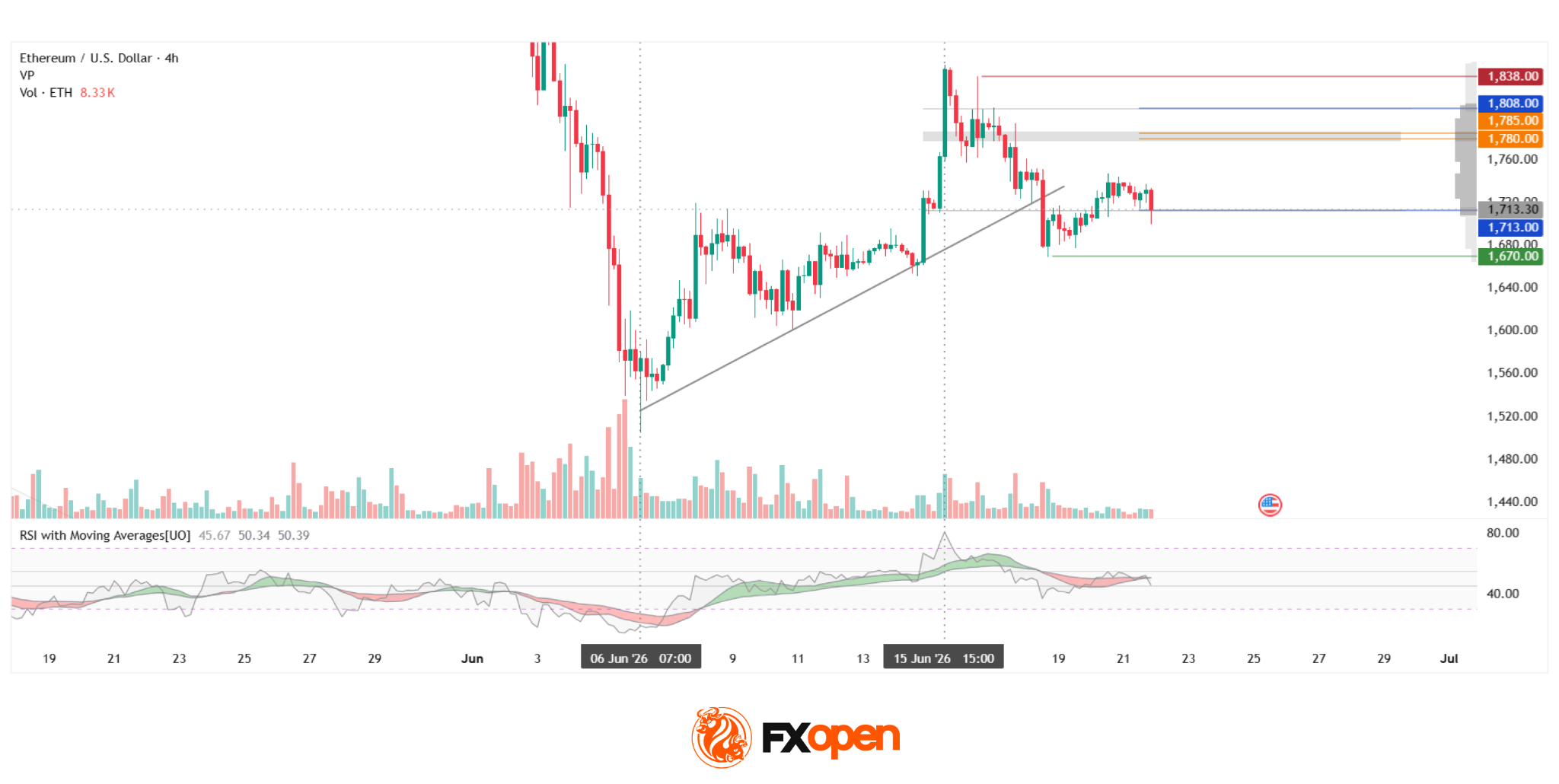
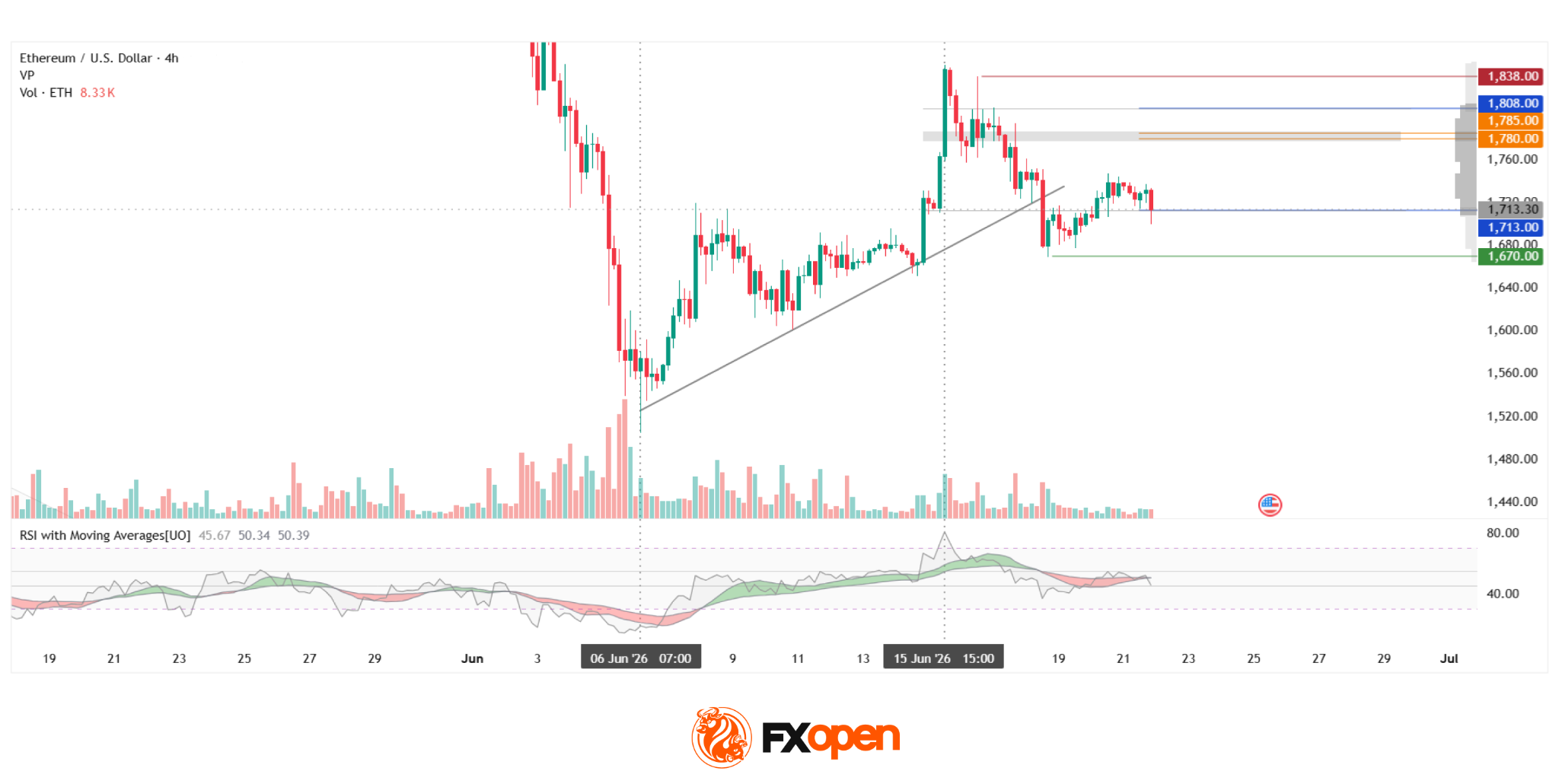
On the four-hour chart of ETH/USD, a corrective recovery can be observed from the June low, followed by the formation of a local high near the $1,838 resistance level. After reaching this area, buyers lost momentum and the price moved below the ascending trendline. The attempted trend break currently appears unconvincing and has so far been limited to a single bearish candle on 18 June, the impact of which was subsequently offset by the following candles.
Should selling pressure persist, the $1,670 area may come into focus for market participants. If the asset manages to establish itself above the lower boundary of the profile at $1,713 and continues its recovery within the current profile, the primary target could be the POC zone at $1,780–$1,785, followed by the upper boundary of the profile at $1,808. If the current profile density is overcome, the red resistance level may gain further significance. The RSI + MAs indicator shows readings of 46, 50 and 50. The main oscillator line and both moving averages remain in the middle of the neutrality zone, suggesting that the instrument currently has no clear directional bias.
Key Takeaways
Ethereum’s technical picture remains neutral, with RSI + MAs showing no signs of a clear directional impulse. In the coming weeks, additional volatility may be driven by capital flows into spot Ethereum ETFs and by changing expectations regarding the Federal Reserve’s next policy moves.
FXOpen offers the world’s most popular cryptocurrency CFDs*, including Bitcoin and Ethereum. Floating spreads, 1:2 leverage — at your service (additional fees may apply). Open your trading account now or learn more about crypto CFD trading with FXOpen.
*Important: At FXOpen UK, Cryptocurrency trading via CFDs is only available to our Professional clients. They are not available for trading by Retail clients. To find out more information about how this may affect you, please get in touch with our team.
This article represents the opinion of the Companies operating under the FXOpen brand only. It is not to be construed as an offer, solicitation, or recommendation with respect to products and services provided by the Companies operating under the FXOpen brand, nor is it to be considered financial advice.
Bitcoin price traded near $64,000 on Monday, even as Asian equities and technology shares rose after fresh progress in U.S.-Iran talks.
Summary
- Bitcoin price stayed near $64,000 despite Asian stock gains and softer oil after U.S.-Iran progress Monday.
- Spot Bitcoin ETFs saw $227 million in weekly outflows, extending the selling streak to six.
- Analysts remain split, with bearish targets near $48,000 and cycle support around $53,000 to $55,000.
According to crypto.news data, Bitcoin traded at $64,188 at press time, with a 24-hour range between $63,232 and $64,543.
The move left Bitcoin down about 2% on the week and still below the levels it held at the start of June. The price action looked stable, but not strong. Buyers defended the lower end of the range, yet BTC failed to match the risk-on move seen across parts of Asia.
Bitcoin fails to rally despite macro relief
The macro backdrop improved after Qatar and Pakistan said the U.S. and Iran had agreed on a roadmap toward a final peace deal within 60 days. Market reports showed Asian stocks rising, with technology names leading gains, while Brent crude fell below $80 as the oil risk premium eased.
That shift would normally help risk assets. Lower oil can reduce inflation pressure and support the case for easier liquidity. Bitcoin, however, stayed soft, showing that traders are still treating crypto as a weaker part of the risk trade.
The broader market was mixed. Solana held firmer near $74, while Tron added modest weekly gains. Ethereum traded near $1,733 and stayed roughly flat. Larger losses showed up in BNB, XRP and Dogecoin, while HYPE cooled after a strong early-June run.
ETF outflows keep demand weak
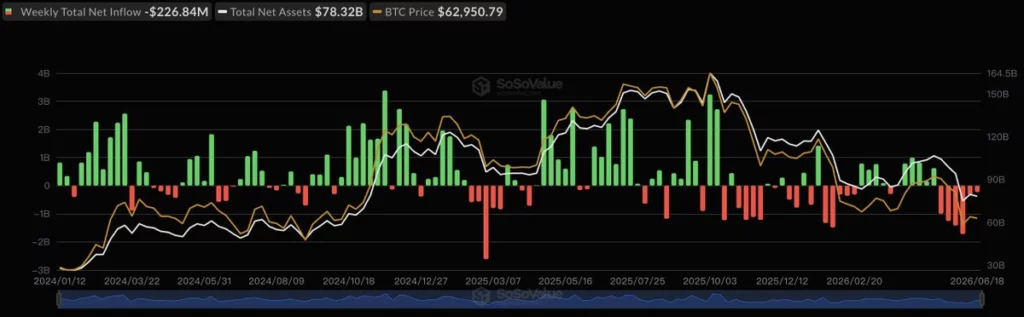
Spot Bitcoin ETF flows remain a key pressure point. SoSoValue data showed U.S. spot Bitcoin ETFs recorded about $227 million in net outflows from June 14 to June 18, marking the sixth straight week of withdrawals.
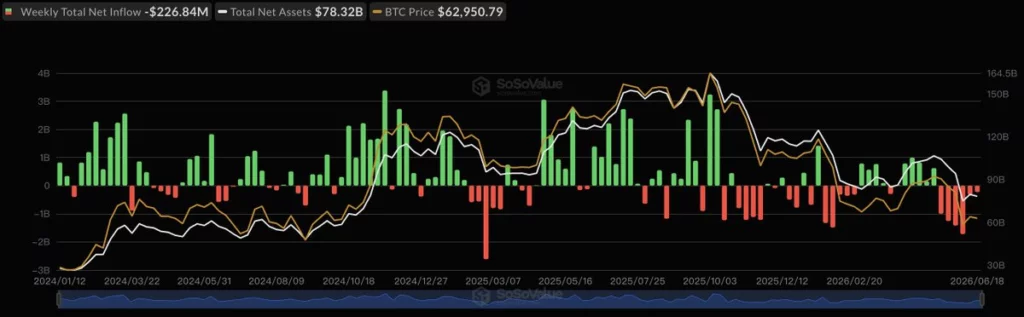
Those outflows do not guarantee a deeper price drop, but they remove a steady source of demand. Earlier parts of the cycle relied heavily on ETF buying and corporate treasury flows. With those flows weaker, BTC needs more spot demand before a move above resistance looks durable.
As crypto.news earlier reported, Bitcoin ETFs also saw a record $6.35 billion net outflow across the latest 30-day window. That keeps attention on whether withdrawals slow enough to let BTC rebuild momentum.
Analysts split on next Bitcoin move
Crypto Lens gave one of the more bearish views, saying Bitcoin is “perfectly mirroring the 2022 Bear Market pattern.” The analyst warned that BTC could move from “$64K → $66K → $53K → $48K” if the current relief bounce fails.
EGRAG Crypto took a longer-cycle view. The analyst said a bearish cross between the 21 EMA and 55 EMA on the two-week chart has historically marked a cycle-bottom window. He placed a possible macro bottom zone near “$53K–$55K” around September to November 2026 if history repeats.
Those calls remain projections, not confirmed outcomes. Bitcoin would first need to lose nearby support before deeper targets become active. The key downside levels remain $62,000, $60,000 and the June low near $59,100. A break below those levels would bring $55,000 and then the $53,000-$55,000 zone into focus.
On the upside, BTC needs to reclaim $64,500 and then $67,000 with stronger volume. A clean close above $67,000 would weaken the bearish case and open room toward $70,000 to $73,000. Until then, the market remains range-bound.
Bitcoin outlook depends on flows and geopolitics
The near-term Bitcoin price analysis remains balanced but cautious. The macro story improved, oil eased and equity markets found support, yet crypto did not fully follow. That gap suggests investors are still waiting for stronger evidence before adding risk.
Meanwhile, the next test is whether the U.S.-Iran roadmap holds and whether energy prices stay below stress levels. If the peace track continues, Bitcoin could benefit from calmer inflation expectations. If talks stumble, oil could rise again and pressure risk assets.
ETF flows may matter even more. A seventh week of outflows would reinforce the view that institutional demand has not returned. Slower withdrawals or fresh inflows would give buyers a better setup.
For now, Bitcoin is holding the range rather than breaking it. The $62,000 area remains the line bulls need to defend. The $67,000 area remains the level they need to reclaim. Until one side wins, BTC may keep drifting near $64,000 while traders wait for a stronger signal. That leaves the market sensitive to daily headlines, fund-flow data and any break of the short-term technical range. Volatility could rise quickly if leverage builds near support or resistance.
Disclosure: This article does not represent investment advice. The content and materials featured on this page are for educational purposes only.


Altura is unwinding its multi-strategy stablecoin vault after processing millions in user withdrawals over 24 hours. CEO Ranveer Arora cited sustained redemption demand and market sentiment as the drivers behind the decision.
The shutdown comes shortly after Altura denied exposure to Main Street USD (msUSD), a stablecoin that recently lost its dollar peg.
Altura CEO Ranveer Arora Cites Withdrawal Pressure in Vault Closure
Arora said that Altura had processed more than 8.5 million in Tether (USDT) redemptions over 24 hours. That figure topped the $5 million cited a day earlier.
The executive noted the firm had notified counterparties and begun unwinding positions across exchanges, private credit, and real-world asset strategies. He mentioned that safeguarding user funds remained the firm’s focus, with each redemption handled in a “fair, transparent, and efficient manner.”
“While some positions can be redeemed immediately, others require standard settlement and redemption periods, and we are working closely with all counterparties to accelerate the process wherever possible,” he stated.
Follow us on X to get the latest news as it happens
Altura Defends Its Record Against Speculation
The CEO also said he is “deeply disappointed” by how quickly unverified claims spread through the sector. He pointed to no particular source. Earlier, Altura had said it cleared more than $5 million in withdrawals.
“Altura has always operated with transparency and integrity, and it is unfortunate to see unfounded narratives contribute to market fear and withdrawal pressure,” he added.
Altura also addressed the msUSD depeg on its official account. It said the event sat entirely outside its operations. The protocol said its HyperEVM lending vault and associated markets remained unaffected.
Subscribe to our YouTube channel to watch leaders and journalists provide expert insights
The post Altura Begins Orderly Vault Wind-Down as Withdrawal Demand Surges appeared first on BeInCrypto.
Key Takeaways
- Andy Burnham secured Makerfield constituency on June 18 with 54.8% of votes, positioning himself for Labour party leadership
- Prime Minister Keir Starmer anticipated to reveal resignation timeline on June 22, 2026
- Burnham has publicly expressed strong support for cryptocurrency, telling Web3 entrepreneurs he is fully committed to digital assets
- Current government implemented prohibition on cryptocurrency political donations in March 2026
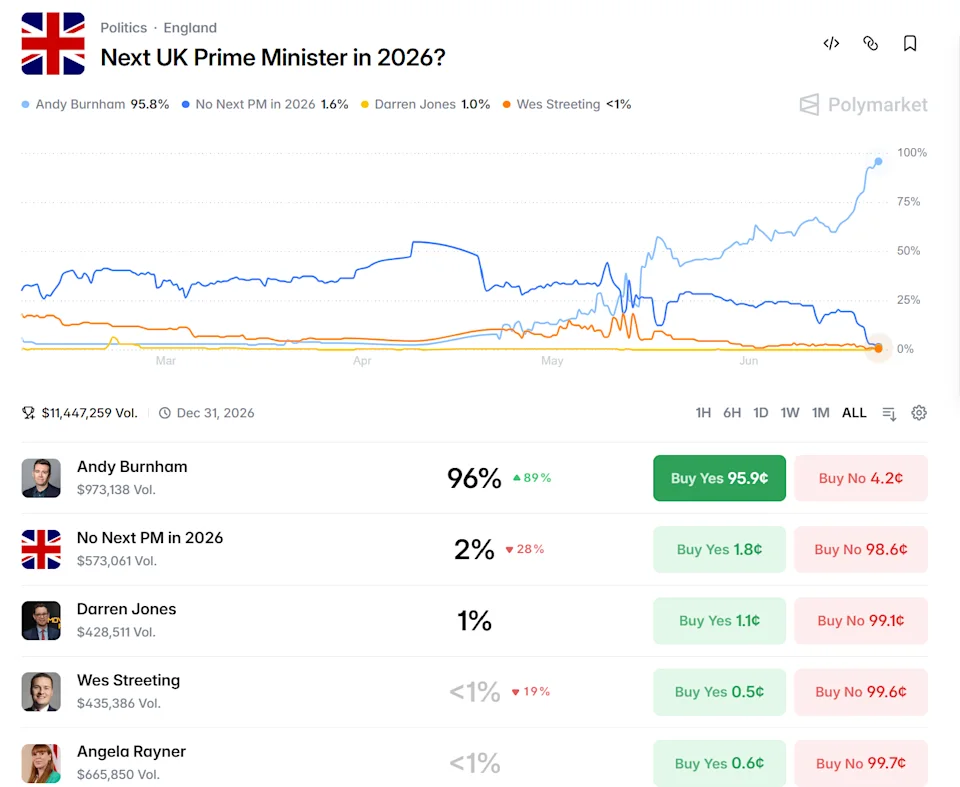
- Over $11 million wagered on Polymarket regarding UK leadership transition, with Burnham leading predictions
By-elections rarely trigger immediate shifts in national governance. This particular contest may prove exceptional.
Andy Burnham, serving as Greater Manchester’s Mayor, captured the Makerfield parliamentary seat on June 18 with a commanding 54.8% majority. His margin over Reform UK exceeded 9,200 votes, with participation reaching nearly 59%—significantly higher than typical by-election engagement levels.
This electoral success eliminated the final procedural obstacle preventing a Labour leadership campaign. Almost immediately, speculation emerged that Prime Minister Keir Starmer was considering his position. While his office dismissed suggestions of an immediate departure, reports indicate cabinet members, union representatives, and party financiers have begun discussing transition arrangements.
Current expectations point toward Starmer announcing a departure schedule on June 22, 2026.
Implications for the Digital Asset Sector
The potential leadership change carries significant ramifications for the digital assets sector.
Starmer’s administration enacted a provisional prohibition on cryptocurrency contributions to political organizations in March 2026. This decision stemmed from recommendations in the independent Rycroft Review, which identified cryptocurrency’s pseudonymous nature as a potential conduit for foreign interference in British electoral politics.
Burnham has articulated a markedly different position. Addressing approximately 100 Web3 entrepreneurs at a Stand With Crypto gathering, he declared himself completely committed to the technology. He has consistently positioned Manchester as an emerging center for Web3 development, connecting this vision to the city’s manufacturing heritage.
Should Burnham assume the Prime Minister role, reconsideration of the cryptocurrency donation restriction appears probable. His tenure as Manchester’s mayor demonstrates consistent support for nascent technologies as economic catalysts.
Financial Markets Respond to Political Developments
Prediction platforms have registered rapid movement. Polymarket, the cryptocurrency-based forecasting platform, has seen over $11 million in positions taken on Britain’s leadership succession, with Burnham dominating as the anticipated successor.
Additionally, more than $2 million entered contracts specifically focused on Starmer’s exit timeline.
Traditional fixed-income markets have also demonstrated sensitivity. Britain’s 10-year government bond yield climbed to approximately 4.8% on Friday. Market participants appear more focused on Burnham’s anticipated fiscal stance than his cryptocurrency positioning.
The pound sterling declined in tandem with government bonds.
Bitcoin hovered around $63,900 during this timeframe, registering less than 1% daily appreciation. The cryptocurrency has declined roughly 17% over the previous month and 38% year-to-date, trading substantially below its October peak near $126,000. The political turbulence has not prompted a defensive rotation into cryptocurrency assets.
Digital asset adoption in the UK has also contracted. Financial Conduct Authority research indicates approximately 8% of British adults currently possess digital assets, declining from 12% in the prior year.
Burnham’s parliamentary induction and potential leadership declaration this week will establish the immediate trajectory for UK cryptocurrency regulation.
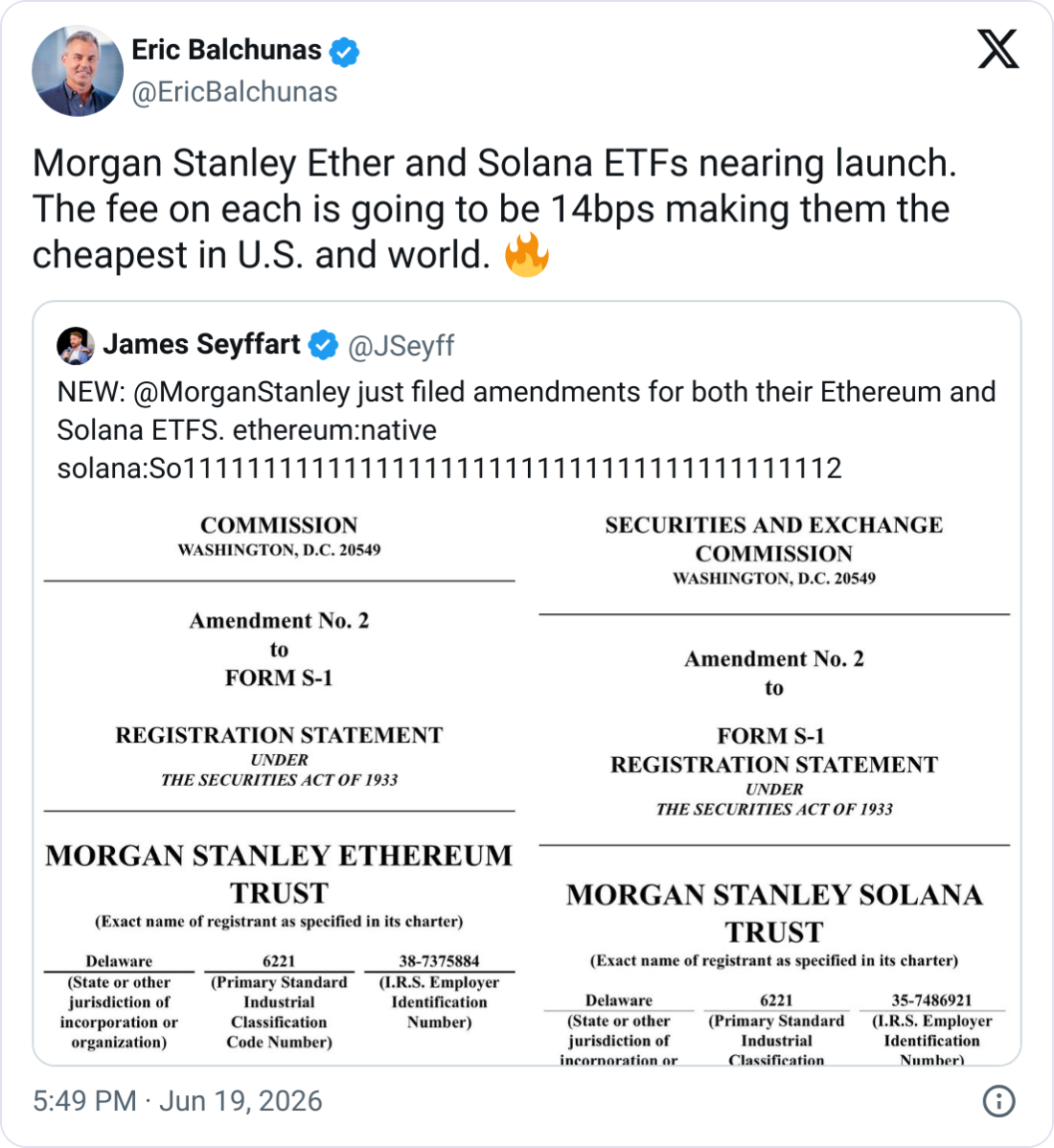
Morgan Stanley has updated its filings for its Ether and Solana exchange-traded funds, revealing that it plans to charge the lowest fees among its rivals.
The company filed amended Form S-1 statements with the Securities and Exchange Commission for each ETF on Thursday, showing it plans to undercut the current market offerings and charge fees of 0.14% for each of its products.
The current lowest-fee spot Ether (ETH) ETF in the US is the Grayscale Ethereum Staking Mini ETF (ETH) at 0.15%, while Franklin Templeton’s spot Solana (SOL) ETF, the Franklin Solana ETF (SOEZ), charges the lowest fee among its competitors at 0.19%, according to Farside Investors.
It is the second time that Morgan Stanley has updated its ETF filings since it first filed for the ETFs in January, with amendments typically a signal that the SEC is close to approving the products for trading, which would make them the 11th spot Ether ETF and seventh spot Solana ETF to launch in the US.
Bloomberg ETF analyst Eric Balchunas posted to X on Friday that the fees make them “the cheapest in [the] US and [the] world.”
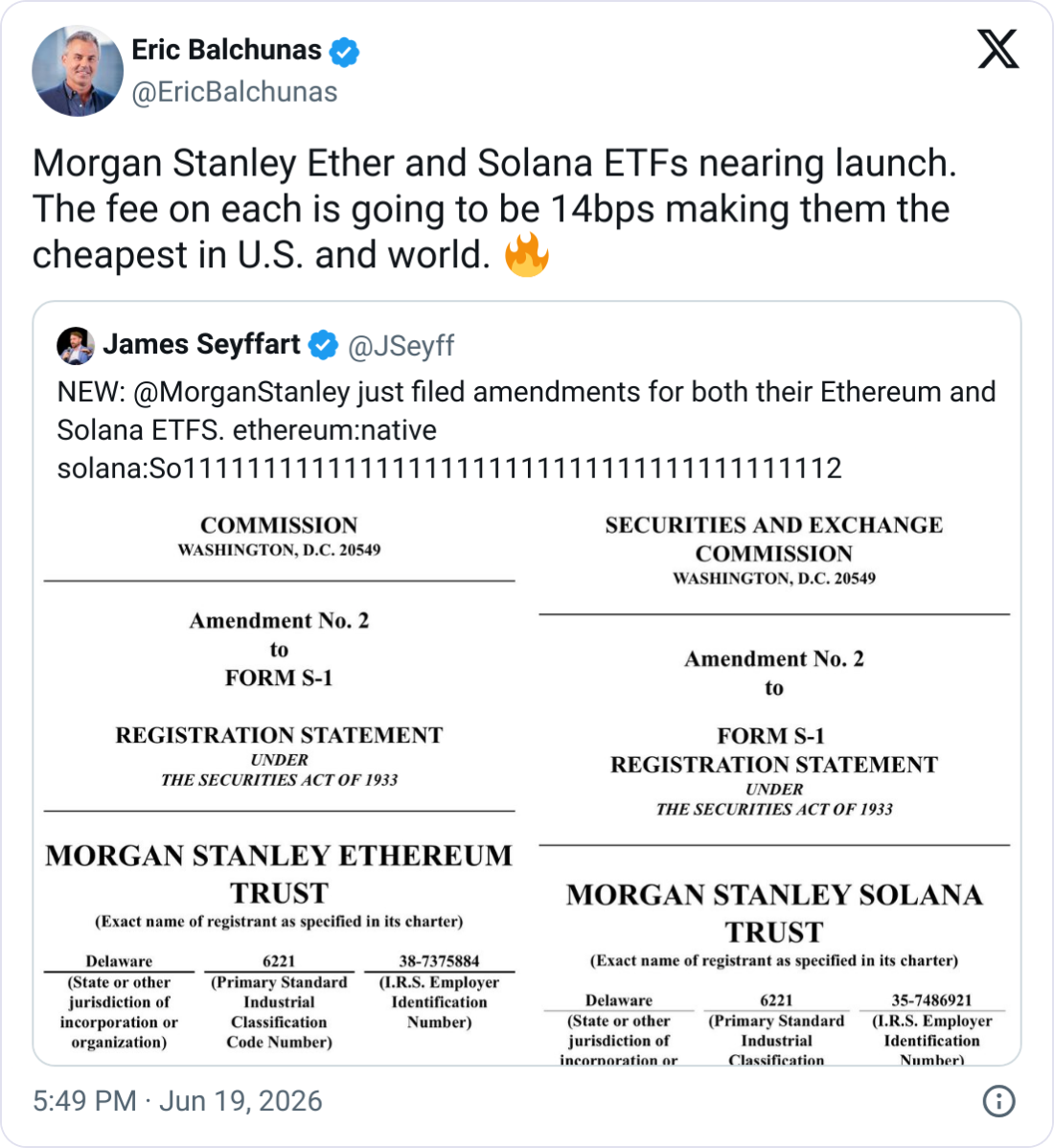
Source: Eric Balchunas
Low fees have been a tactic for Morgan Stanley as it looks to make a late entry into the spot crypto ETF market dominated by issuers such as BlackRock and Fidelity. Its Bitcoin (BTC) ETF, which launched in April, set its fees at 0.14%, below Grayscale’s 0.15% fee on its mini Bitcoin ETF.
Related: Grayscale HYPE ETF ‘likely imminent’ as new update shows competitive fee: Analyst
That fee likely helped Morgan Stanley’s Bitcoin fund to record a respectable first-day inflow of $30.6 million. The ETF has since seen total inflows of $331 million, surpassing ETFs from Invesco, Franklin Templeton and CoinShares, which all launched in January 2024.
Morgan Stanley’s latest filings also show that Figment, Galaxy Blockchain Infrastructure and Coinbase Canada will provide the staking services for each of the ETFs, with each fund having a 5% staking fee for the rewards earned by the product.
The Ethereum ETF, called the Morgan Stanley Ethereum Trust, will feature the ticker “MSSE,” while the Solana ETF, dubbed the Morgan Stanley Solana Trust, will trade under MSOL.
Magazine: Does ‘Paper Bitcoin’ mean there’s an unlimited supply of BTC?
Morgan Stanley has amended its filings for spot Ether and spot Solana exchange-traded funds, setting fees it says are designed to be the lowest available in the US market for comparable products. The updates—made via amended Form S-1 statements—signal the firm is continuing to move toward an SEC decision that would allow the funds to begin trading.
According to the SEC filings lodged Thursday, Morgan Stanley plans to charge a fee of 0.14% for each ETF. If approved, the funds would expand Morgan Stanley’s presence in the fast-growing US spot crypto ETF lineup.
Key takeaways
- Morgan Stanley amended its SEC filings for both a spot Ether and a spot Solana ETF, targeting 0.14% fees.
- Farside Investors data cited in the article indicates existing lowest-fee spot products currently charge 0.15% for Ether and 0.19% for Solana.
- Amendments to Form S-1 have often been interpreted by the market as a sign of advancing SEC review and potential approval.
- Earlier, Morgan Stanley’s spot Bitcoin ETF launched with a 0.14% fee—matching its approach to undercut peers.
- Staking services for the proposed funds are set to involve Figment, Galaxy Blockchain Infrastructure, and Coinbase Canada, with a 5% staking fee on rewards.
Fees take center stage as SEC review advances
The core detail in Morgan Stanley’s latest updates is pricing. In the amended filings for each fund, the company states it intends to charge 0.14% annually. The move is particularly notable because it would place Morgan Stanley’s products at the low end of the fee spectrum for spot crypto ETFs in the US.
As background, Farside Investors data referenced in the article shows the current lowest-fee spot Ether ETF in the US is the Grayscale Ethereum Staking Mini ETF at 0.15%. For Solana, the lowest-fee spot offering cited is Franklin Templeton’s Franklin Solana ETF (SOEZ) at 0.19%, also based on Farside Investors’ figures.
Market watchers typically treat fee positioning as a proxy for how actively an issuer expects to compete for new assets. Lower expense ratios can make a fund more appealing to long-term allocators, especially when multiple spot crypto vehicles aim to track the same underlying assets.
Spot Ether and Solana proposals: what Morgan Stanley filed
The firm submitted amended Form S-1 statements for both proposed products on Thursday, as linked in the filings. The updates are the second set of amendments since Morgan Stanley first filed for the ETFs in January.
In practice, amendments are often read by the market as progress in negotiations and technical review—particularly because they generally appear closer to the moments when an issuer moves from preliminary review toward potential approval.
While the final SEC outcome is not guaranteed, the article notes that approval would add to the already expanding shelf of spot crypto products in the US, potentially bringing Morgan Stanley’s spot Ether ETF count to the 11th and spot Solana ETF count to the 7th among similar offerings, as described in the original coverage.
The specific fund naming and trading targets outlined in the article include:
- Morgan Stanley Ethereum Trust with ticker MSSE
- Morgan Stanley Solana Trust with ticker MSOL
Why “cheap” matters: Morgan Stanley’s Bitcoin playbook
Morgan Stanley has already used low fees as a market entry strategy in spot Bitcoin. Its Bitcoin ETF, launched in April, set its fee level at 0.14%, positioned below Grayscale’s 0.15% fee on its mini Bitcoin product, as noted in the article.
That fee decision appears to have been part of the firm’s early traction. The article references Cointelegraph coverage stating the fund recorded first-day inflows of $30.6 million and that total inflows have since reached $331 million, outpacing ETFs from Invesco, Franklin Templeton, and CoinShares that launched in January 2024.
Importantly, while inflow performance can be affected by many variables beyond fees—such as distribution reach, investor base, and timing—the repetition of a 0.14% expense ratio suggests Morgan Stanley is intentionally carrying forward a “competitive cost” approach across its crypto ETF expansion.
Staking services and the 5% reward fee
Morgan Stanley’s amended filings also address operational details tied to staking. The article says the filings indicate Figment, Galaxy Blockchain Infrastructure, and Coinbase Canada will provide staking services for each of the ETFs.
Under the structure described, each fund would apply a 5% staking fee to rewards earned by the product. This matters for investors because staking-related fees can change the effective return experienced by shareholders, particularly for spot products where staking can influence yield dynamics compared with a simple spot exposure approach.
Even with a low base expense ratio, staking economics can differ from the headline management fee. Investors generally look at both the fund’s stated expense level and any additional costs associated with custody, network participation, and reward allocation.
What to watch next
With Morgan Stanley’s spot Ether and Solana ETFs moving through an active amendment cycle—and with fees positioned at the low end versus currently available rivals—the next steps for investors are to monitor SEC feedback and any further filing updates that often precede approval decisions. The open question remains whether the SEC’s review will conclude in a timeframe that brings these products to market, and how staking-related costs ultimately shape investor outcomes versus existing offerings.
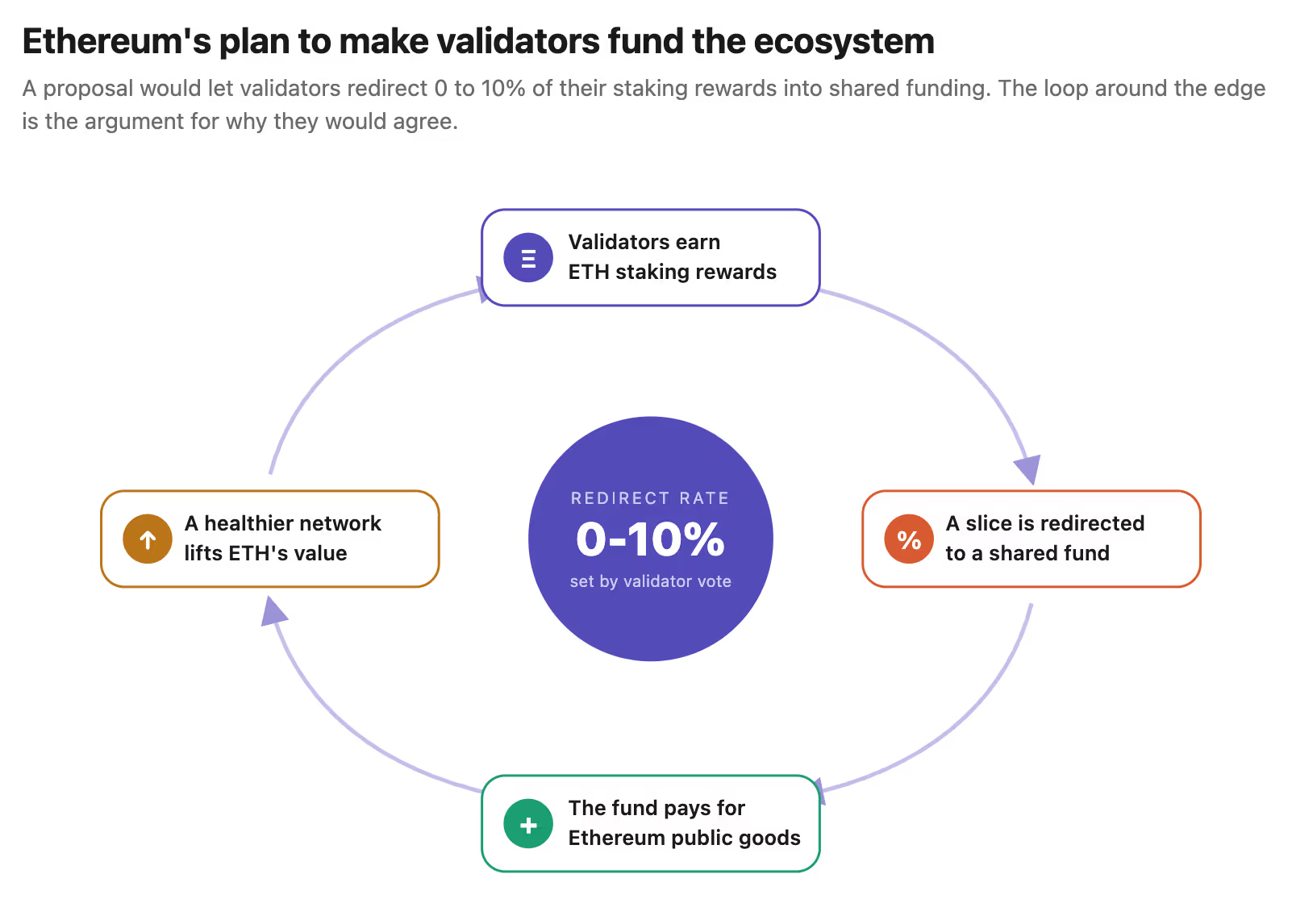
Validators are entities that keep Ethereum running by locking up ether (ETH), checking transactions and earning staking rewards for doing so. Funding, in this context, means paying for the shared work Ethereum relies on, such as developer tools, security research, public infrastructure and other projects that help the network but do not always have a direct business model.
The proposal seeks to shift that burden toward validators, who earn ETH rewards for securing the network and benefit when Ethereum becomes more valuable.
It argued that validators are natural long-term stakeholders because better ecosystem funding can increase network activity, ETH burn and the value of staked ETH.

Validators could also select preferred funding recipients under the proposal. Those preferences would be combined into a ‘splitter’ contract that distributes redirected funds among chosen addresses. The design is meant to let validators “set and forget” their preferences rather than vote on every grant.
At current staking levels, the post estimated that validators receive roughly 700,000 ETH a year in rewards. A 5% to 10% redirect could send about 50,000 to 70,000 ETH a year toward ecosystem funding. That equates to about $120 million at ether’s current market prices.
The idea is likely to be controversial, however.


For years, users looking to speed up their transactions on the Bitcoin blockchain relied on a handy optional feature that essentially says, “I might want to replace this transaction with a higher fee.”
But what started as a helpful tool has become redundant and a small privacy issue, prompting some developers to discuss possible ways to do away with it.
Let’s first take a look at the so-called replace-by-fee (RBF) signaling, then discuss the developers’ proposals.
Replace by fee (RBF) signaling
Imagine sending a paper check through the mail, but the postal system is stretched and congested. To ensure your payment doesn’t get stuck, the check has a small checkbox that says, “I reserve the right to cancel this check and write a new one with a higher rush fee if it gets delayed.” (The higher fee, of course, is an incentive for the postal system to prioritize your transaction.)
Such a feature is called Replace-by-Fee (RBF) in the Bitcoin ecosystem. For years, when you sent bitcoin, your wallet let you flip a switch, signaling to the network that you might want to “fee-bump” to speed up your transaction later.

AirPods Max 2 Drop to Record Low $399 with Amazon Early Prime Day Deal

BBC Silent Witness fans urged to watch ‘perfect’ detective drama

Wiltshire music festival to go ahead despite planning refusal


-
 Crypto World7 days ago
Crude Oil Plunges Over 4% as US-Iran Agreement Reopens Hormuz Strait
-
 Tech6 days ago
The Adder At The Heart Of Intel’s 8087 FPU
-

 Fashion3 days ago
Weekend Open Thread: Miami – Corporette.com
-
 Business2 days ago
Wall Street Week Ahead: Investors see Micron earnings as pulse check of AI rally momentum
-

 Crypto World2 days ago
HIVE shares jump as $220M AI deal speeds Bitcoin mining pivot
-

 Sports3 days ago
FIFA World Cup 2026: Canada beat 9-men Qatar 6-0 to register first ever win | FIFA World Cup 2026
-

 Crypto World2 days ago
Jake Chervinsky accuses CME of protecting derivatives monopoly
-

 Business1 day ago
MHP SE 2026 Q1 – Results – Earnings Call Presentation (OTCMKTS:MHPSY) 2026-06-20
-

 Crypto World4 days ago
Anthropic’s Dario Amodei Urged AI Unity at G7, Even as US Banned His Models
-

 Business3 days ago
Brexit cost 6% of UK economy, Bank of England company data suggests
-
 Crypto World2 days ago
Can Charles Hoskinson Really Rescue Cardano?
-

 Business1 day ago
Soccer-U.S. defends Iran World Cup travel restrictions, says discussions ongoing
-

 Tech4 days ago
Weeks Of In-The-Field Testing And A Verdict
-

 Tech4 days ago
Adobe adds its AI assistant to Premiere, Illustrator and InDesign
-

 Politics2 days ago
Andy Burnham and the meaning of Makerfield
-
 Crypto World4 days ago
Iren (IREN) Stock Surges on Jefferies Buy Rating: AI Infrastructure Play Gains Momentum
-

 Entertainment1 day ago
Renter of Home in Anne Heche Crash Denies Settlement With Son
-

 Tech3 days ago
Instagram Now Lets You Add A Unique Caption To Each Carousel Slide
-

 Politics4 days ago
BBC Reporter Discusses Cross Party Criticism Of Trumps Iran Deal
-

 News Videos3 days ago
Nightcore – MONEY ON THE DASH (Soft Rock Version) (Lyrics)
You must be logged in to post a comment Login