

Crypto World
3 Token Unlocks to Watch in the Final Week of June 2026

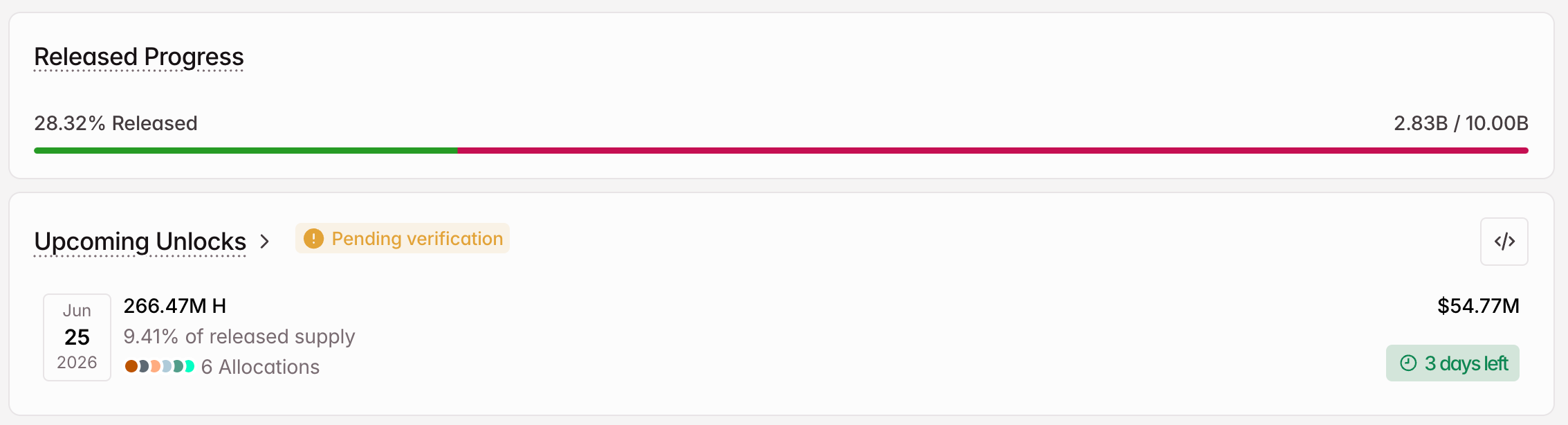
The crypto market will welcome tokens worth more than $735 million in the final week of June 2026. Major projects, including Humanity (H), MegaETH (MEGA), and Sahara AI (SAHARA), will release significant new token supplies.
These unlocks could introduce market volatility and influence short-term price movements. So, here’s a breakdown of what to watch.
1. Humanity (H)
- Unlock Date: June 25
- Number of Tokens to be Unlocked: 266.47 million H
- Released Supply: 2.8 billion H
- Total supply: 10 billion H
Humanity (H) is a decentralized identity protocol that utilizes biometric palm recognition, zero-knowledge proofs, and blockchain to verify the authenticity of real human users without exposing their personal data. It features a native Proof of Humanity (PoH) consensus mechanism.
On June 25, the protocol will unlock 266.47 million tokens. The tokens are worth $54.77 million and account for 9.41% of the released supply.

The unlock comes after the protocol suffered an exploit that resulted in losses exceeding $30 million. The H token plunged sharply following the incident. Although it recorded a notable recovery in the days that followed, the downtrend has since resumed amid growing macroeconomic and geopolitical pressures.
The team will split the released supply six ways. The ecosystem fund will receive 50 million H. Furthermore, Humanity will allocate 42.86 million altcoins to identity verification rewards and 12.50 million to the foundation operations treasury.
Additionally, early contributors will receive 79.17 million H. Investors will gain 55.56 million tokens. Finally, the Human Human Institute Strategic Reserve will receive 26.39 million H.
2. MegaETH (MEGA)
- Unlock Date: June 23
- Number of Tokens to be Unlocked: 250 million MEGA
- Released Supply: 757.5 million MEGA
- Total supply: 10 billion MEGA
MegaETH is an Ethereum Layer 2 network built for high-speed transaction processing. The network uses mini-blocks produced roughly every 10 milliseconds and targets over 100,000 transactions per second.
The network will release 250 million tokens on June 23, worth approximately $13.54 million. The unlock accounts for 32.8% of the released supply.

The team will direct the entire unlocked supply toward the Mainnet Campaign (Terminal).
3. Sahara AI (SAHARA)
- Unlock Date: June 26
- Number of Tokens to be Unlocked: 1.03 billion SAHARA
- Released Supply: 3.41 billion SAHARA
- Total supply: 10 billion SAHARA
Sahara AI is a full-stack, AI-native blockchain platform built to democratize the development and monetization of artificial intelligence. The network combines data services, AI tools, and a marketplace into one ecosystem.
On June 26, Sahara AI will unlock 1.03 billion SAHARA. The supply is worth $14.75 million. The tokens represent 30.10% of the released supply.

Sahara AI will direct 534.9 million tokens to early backers. The core team and contributors will get 406.25 million SAHARA. In addition, the team will allocate 53.02 million altcoins to ecosystem development and 31.25 million tokens for community incentives.
The unlock follows the token’s drop of over 50% earlier this month. The network said a “futures-led liquidation cascade” caused the price volatility.
In addition to these, other prominent unlocks that investors can look out for in the final week of June include Plasma (XPL), Soon (SOON), Newton Protocol (NEWT), and more.
The post 3 Token Unlocks to Watch in the Final Week of June 2026 appeared first on BeInCrypto.



The Bank of Korea and participating banks have discussed operating deposit tokens on a continuous basis with the goal of establishing conditions for a formal rollout, according to briefing materials submitted by the Korea Federation of Banks to the office of People Power Party lawmaker Lee Heon-seung.
Summary
- South Korea’s deposit token project is set to expand with person to person transfers, more merchants, and bank specific services in the next testing phase.
- Participating banks have urged the Bank of Korea to adopt a long term commercialization roadmap as the project requires new compliance systems and technology investments.
The materials noted that a follow-up test would seek to build a foundation for the official introduction and wider adoption of deposit tokens. Participating institutions also reviewed a plan to maintain operations without service interruptions while preparing for eventual commercialization.
Deposit tokens are digital bank deposits issued by commercial banks on top of a wholesale central bank digital currency infrastructure provided by the Bank of Korea. During the first pilot conducted last year, consumers used electronic wallets to complete real-world payments with deposit tokens.
Next phase expands services
The second round of testing would add several new functions. The Bank of Korea and banks plan to increase the number of users and merchants, introduce person-to-person transfers, and allow individual banks to launch their own services tied to deposit tokens.
The project would also include a business-to-business treasury payment program. Under that plan, government subsidies linked to South Korea’s electric vehicle charging infrastructure initiative would be distributed to companies in the form of deposit tokens.
Documents reviewed by the Korea Federation of Banks showed that commercial lenders previously argued the new phase would require substantially more resources than a simple extension of the first pilot. Banks told the central bank that the expanded scope resembled a new project because it included person-to-person transfers and a larger merchant network.
Banks said the additional functions would require anti-money laundering systems, suspicious transaction reporting capabilities, fraud detection infrastructure, further technology development, and dedicated budget allocations. They also called for a long-term roadmap that would cover commercialization plans after testing and urged authorities to adopt a more realistic implementation schedule.
The Bank of Korea later adjusted the project timeline after discussions with participating institutions and provided support for preparations, including consulting work related to commercialization plans, the documents showed.
A financial industry official told local media that the first pilot focused mainly on validating payment functionality, while the next stage would extend to transfers and other financial services. The official said banks face significant technology investment and operational costs as the project expands.
Both projects form part of a wider effort by South Korean financial institutions to evaluate digital payment infrastructure, although the Bank of Korea’s deposit token initiative operates through a CBDC-based banking framework while the Toss Bank project focuses on public blockchain networks and stablecoin applications.
The initiative comes as South Korean financial institutions increase their involvement with tokenized money and blockchain-based payment systems. On June 22, Toss Bank announced a memorandum of understanding with the Solana Foundation to test blockchain infrastructure for cross-border remittances and settlements.
Under that agreement, Toss Bank and the Solana Foundation will study stablecoin-based transfers, payment models, tokenized assets, and other digital asset services. The bank said the work will begin with a proof-of-concept project focused on international remittances and settlement processes.


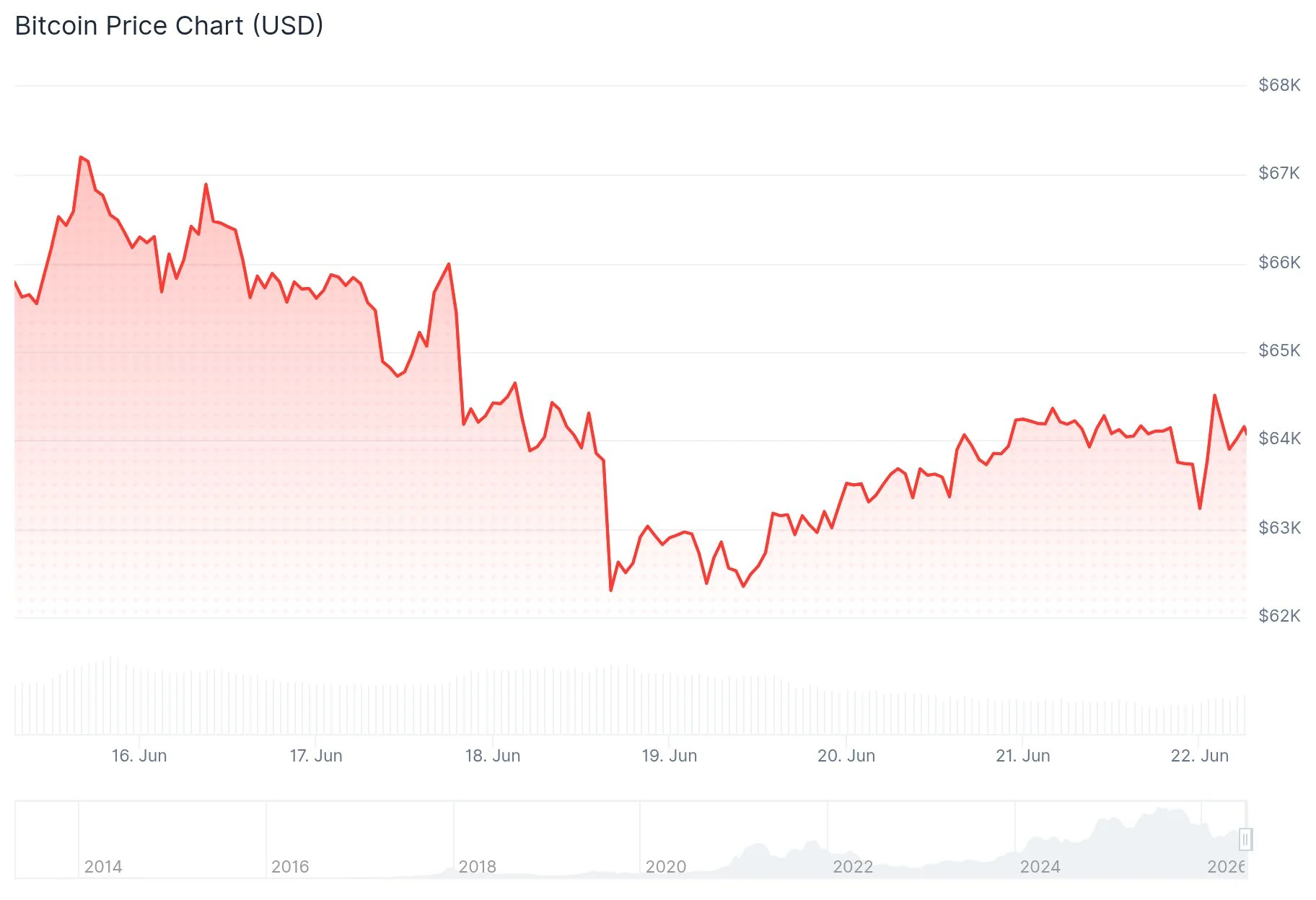
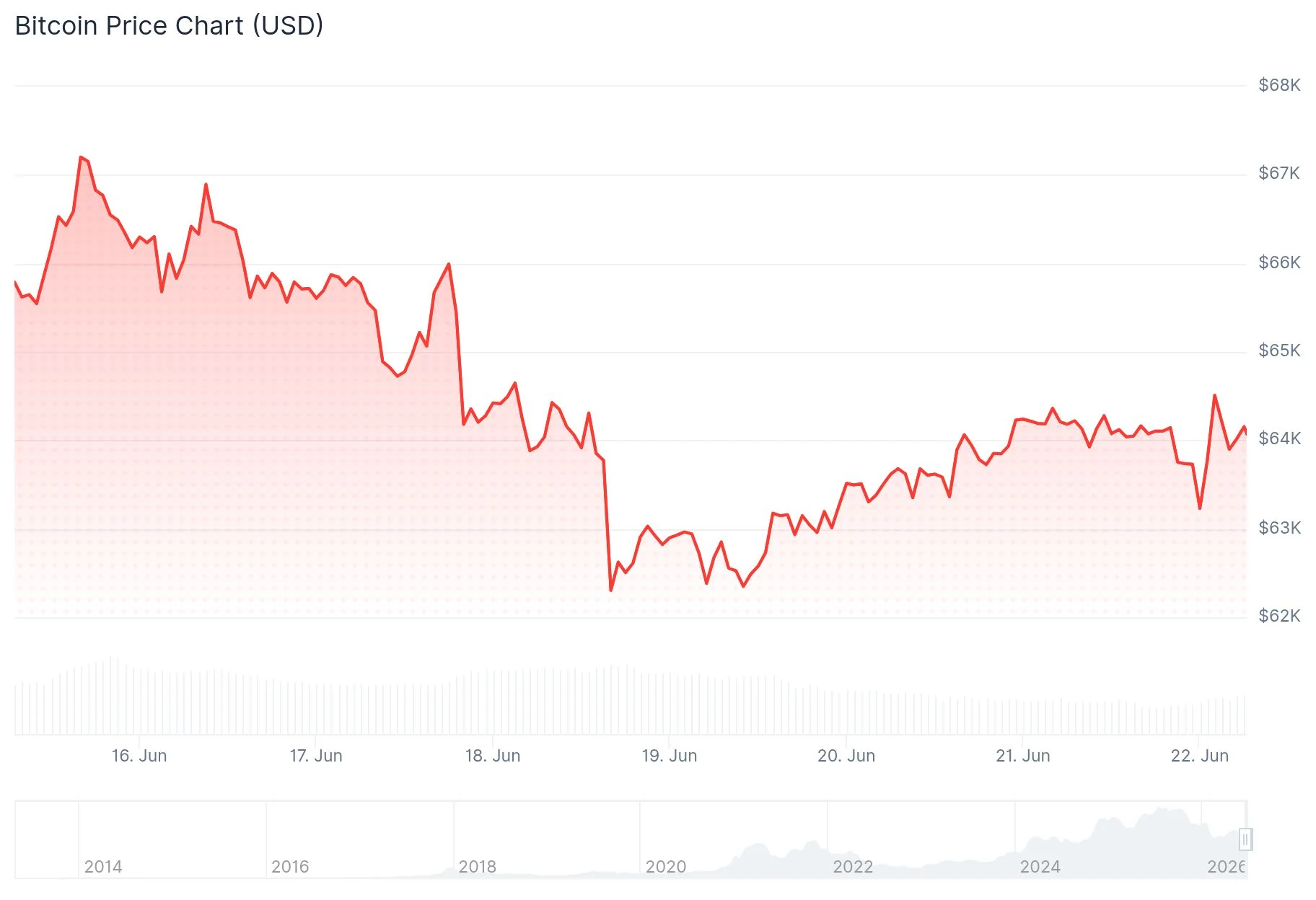
Bitcoin is trading around $64,000, per CoinDesk pricing data, still searching for a catalyst strong enough to break the range it has held for weeks.
Selling from spot bitcoin ETFs has eased from earlier this month, but fresh institutional demand has yet to return.
U.S. spot bitcoin ETFs have now posted a sixth straight week of net outflows, data shows, with only a sparse few days of green. The scale has narrowed, but the absence of any sustained inflow shows institutions remain defensive as markets reassess the Federal Reserve’s interest-rate path.
A bigger weight is the rebounding dollar. After the June meeting, the Fed’s cautious message weakened expectations for near-term rate cuts, lifting the Dollar Index, which measures the greenback against major currencies, to the 100.6-100.8 area while keeping Treasury yields high.
With liquidity still tight, capital favors assets with steadier yields over volatile ones like bitcoin.
Easing geopolitical tension after the U.S.-Iran deal has improved risk appetite, a short-term support. It has not been strong enough to offset the firmer dollar and the cautious flows.
Bitcoin will likely hold a $60,000 to $67,000 range in the near term, said Simon-Peter Massabni, head of business development at XS.com, in emailed comments to CoinDesk. The market is “balanced between supportive and restrictive forces,” he said, with eased ETF selling and better sentiment on one side and an unsupportive Fed and unconfirmed institutional flows on the other.
A sustainable recovery in the second half would need more time to accumulate, a return of ETF inflows and stronger institutional demand. Until then, the current rebounds look technical rather than the start of a new uptrend.
Key Takeaways
- Bitcoin’s fixed supply of 21 million coins positions it as a scarce digital asset attracting institutional capital
- Ethereum serves as the foundation for DeFi, smart contracts, and asset tokenization across diverse applications
- Bitcoin ETFs have opened institutional pathways for investors seeking exposure without direct cryptocurrency custody
- Ethereum’s proof-of-stake transition reduced environmental impact while introducing staking yield opportunities
- Contemporary investors increasingly view both assets as complementary portfolio holdings rather than exclusive choices
Bitcoin and Ethereum command the largest market capitalizations in cryptocurrency. Yet their fundamental purposes diverge significantly, prompting investors in 2026 to evaluate which presents superior opportunities.
Your optimal choice hinges on your specific investment objectives.
Bitcoin: Digital Scarcity as an Investment Thesis
Bitcoin’s architecture prioritizes value preservation. With a hard cap of 21 million coins, it represents one of the most limited assets globally.
This programmed scarcity has magnetized institutional capital, retirement funds, and corporations. Spot Bitcoin ETF approvals have streamlined access for conventional investors seeking exposure without cryptocurrency wallet management.
Numerous financial analysts draw parallels between Bitcoin and precious metals. Should this comparison persist, ongoing institutional demand may provide sustained price support.
Bitcoin maintains unchallenged dominance in its category. No competing cryptocurrency has mounted a credible challenge to its position as the premier digital value store.
For risk-averse investors, this straightforward value proposition combined with institutional adoption represents the more conservative choice.
Ethereum: The Utility-Driven Blockchain Investment
Ethereum derives value from network activity. It powers decentralized financial services, stablecoin infrastructure, tokenized assets, and thousands of decentralized applications.
Each network interaction generates transaction fees. Increased platform usage directly drives network demand.
Ethereum’s transition to proof-of-stake slashed energy consumption. This upgrade simultaneously enabled holders to generate staking yields by contributing to network security.
Traditional financial institutions are actively exploring blockchain-based securities and investment vehicles. Ethereum remains among the preferred platforms for these initiatives.
Advocates position Ethereum as technological infrastructure rather than merely a currency alternative.
Competitive Landscape and Investment Considerations
Ethereum confronts more direct competition than Bitcoin. Platforms including Solana and Avalanche actively compete for developer mindshare and user adoption.
Bitcoin faces minimal competition in its niche. Its digital gold narrative remains fundamentally unchallenged.
Nevertheless, both assets have secured substantial institutional investment. Both now feature prominently in mainstream financial discourse.
Contemporary investors increasingly reject binary thinking. Portfolio strategies commonly incorporate both assets—Bitcoin for stability, Ethereum for growth potential.
Heading into 2026, Bitcoin maintains advantages in institutional acceptance. Ethereum offers superior upside potential linked to blockchain technology adoption.
Current metrics confirm Ethereum’s continued leadership across blockchain platforms in total value locked within decentralized finance protocols.

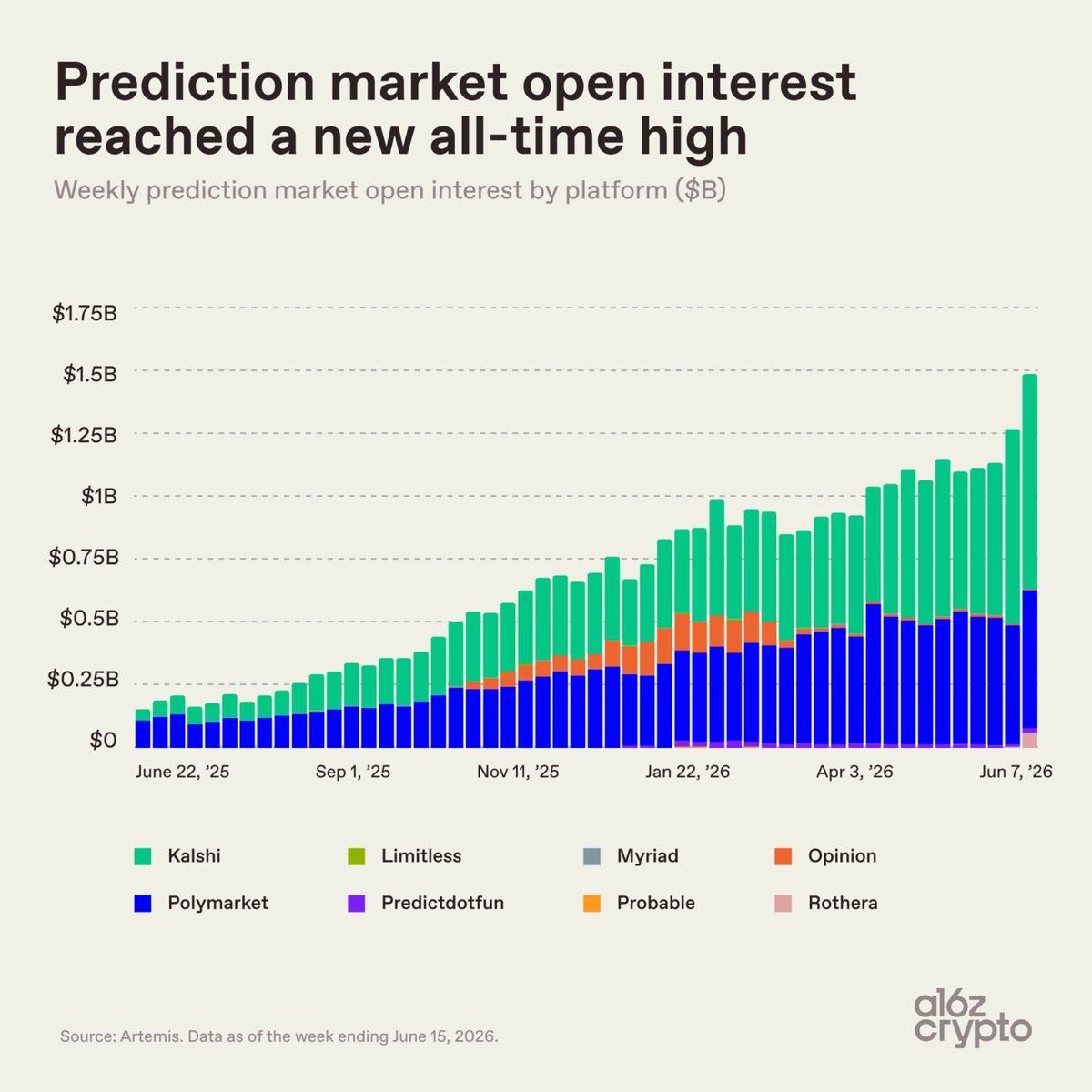
Prediction market open interest climbed to a record $1.48 billion in the week ending June 15, roughly a sixfold increase over the past year.
Open interest was not the only milestone. Notional volume, weekly fees, and active users all hit new highs as the FIFA World Cup pushed sports betting sharply higher.
Prediction Markets Notch All-Time High With Sixfold Open Interest Surge
According to a16z crypto, it was the second consecutive weekly peak. Kalshi and Polymarket account for most of the figure. Smaller venues such as Opinion, Limitless, and Myriad trail well behind.
The post explained that, unlike trading volume, which measures daily churn, open interest tracks the capital that participants keep deployed and at risk. The sustained climb shows traders holding longer-term positions across politics, economics, culture, and crypto.
“The recent surge represents a roughly sixfold increase over the past year, highlighting how users are maintaining longer-term financial positions and how prediction markets are maturing into durable market infrastructure,” a16z wrote.
Follow us on X to get the latest news as it happens

Sports Event Contracts Fuel the Climb
The growth extended beyond open interest. Dune data showed weekly fees reached a record $76.8 million, while active users climbed to an all-time high of 426,975.
Sports became the dominant force behind the latest surge. Total notional volume across prediction markets hit a record $12.2 billion during the week.
Notably, sports-related markets account for $5.8 billion, nearly half of the total. The segment was the largest volume driver on both Polymarket and Kalshi.

The ongoing 2026 FIFA World Cup has played a key role in attracting new participants to these platforms. Betting activity has intensified significantly, with some users placing seven-figure wagers on individual matches. In one notable case, a trader reportedly generated $9.24 million in profits in a single day.
Subscribe to our YouTube channel to watch leaders and journalists provide expert insights
The post Prediction Market Open Interest Hits Record $1.48 Billion as Sports Bets Climb appeared first on BeInCrypto.
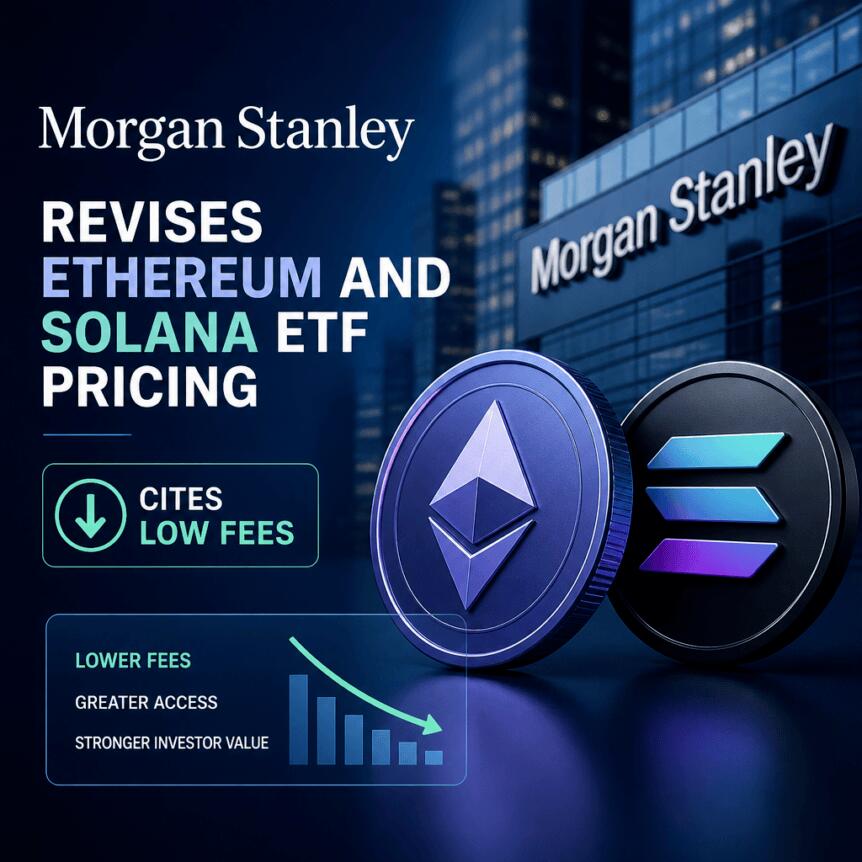
Morgan Stanley has amended its Securities and Exchange Commission filings for spot Ether and spot Solana exchange-traded funds, according to documents lodged on Thursday. The updates indicate the firm intends to compete aggressively on cost—proposing fees of 0.14% for each product.
If approved and listed, the funds would join the growing US lineup of spot crypto ETFs, including a market for staking-enabled products tied to underlying assets. For investors weighing fund expense ratios, Morgan Stanley’s latest fee positioning is notable because it aims to place its Ether and Solana offerings at or near the bottom of the current cost curve.
Key takeaways
- Morgan Stanley amended SEC Form S-1 filings for both spot Ether and spot Solana ETFs, proposing a 0.14% fee for each.
- Current lowest-fee spot Ether and Solana ETFs in the US charge 0.15% (Grayscale Ethereum Staking Mini ETF) and 0.19% (Franklin Solana ETF), respectively, per Farside Investors.
- Amended filings are the second update since January, a pattern often viewed as signaling the approval process is nearing completion.
- Bloomberg ETF analyst Eric Balchunas described Morgan Stanley’s planned fees as the “cheapest” in the US and worldwide.
- The filings name Figment, Galaxy Blockchain Infrastructure, and Coinbase Canada as providers for staking services, with a 5% staking fee applied to rewards.
Proposed fee structure undercuts current ETF leaders
In its updated SEC paperwork, Morgan Stanley’s plans for its spot crypto ETFs center on an expense ratio of 0.14%. The company filed amended Form S-1 statements for each ETF on Thursday, including:
- an Ether product
- a Solana product
The amendments are directly relevant to how much investors pay annually to hold the funds, and they also shape how the ETFs may compete for net inflows—especially as issuers increasingly differentiate themselves through fee levels and operational details.
Based on Farside Investors data, the current lowest-fee spot Ether ETF in the US charges 0.15%—the Grayscale Ethereum Staking Mini ETF. On Solana, Farside Investors shows the lowest current fee is 0.19% for Franklin Solana ETF (SOEZ). Morgan Stanley’s proposed 0.14% would, on its face, push both products below those benchmarks.
Bloomberg ETF analyst Eric Balchunas highlighted the implications of the pricing. In a post on X on Friday, he said the fees make the offerings “the cheapest in [the] US and [the] world.”
Why fee competition matters for a late-to-market issuer
Morgan Stanley is entering the spot crypto ETF market after early movers such as BlackRock and Fidelity established strong positions. According to the filings coverage in the article, this strategy aligns with how Morgan Stanley priced its spot Bitcoin ETF.
Its Bitcoin ETF launched in April with a 0.14% fee—lower than Grayscale’s 0.15% on its mini Bitcoin product. That pricing choice appears designed to reduce friction for investors comparing products with similar market exposure.
Cointelegraph reported that Morgan Stanley’s Bitcoin ETF posted a first-day inflow of $30.6 million, and that the fund has since accumulated total inflows of $331 million. Those figures were described as surpassing ETFs from Invesco, Franklin Templeton and CoinShares, which launched in January 2024.
While those Bitcoin performance figures do not guarantee similar outcomes for Ether or Solana, the pattern reinforces why investors often treat fee levels as more than a line item: lower expense ratios can translate into a more competitive total cost of ownership, which can influence investor allocations in ETF marketplaces.
Second amendment since January and what it can signal
These amendments mark the second time Morgan Stanley has updated its ETF filings since it first submitted for the products in January. In the spot crypto ETF market, additional amendments are commonly interpreted as part of the iterative process of addressing SEC questions and refining disclosures—an activity many observers associate with increased likelihood of eventual approval.
The article notes that amendments frequently serve as a sign that the SEC may be approaching a decision. If approved, the proposed products would bring additional spot Ether and spot Solana ETF launches to the US market—stated in the source as potentially becoming the 11th spot Ether ETF and the seventh spot Solana ETF to launch in the country.
Still, fee proposals and amendment frequency do not confirm approval timing. Investors should expect continued scrutiny of custody, staking mechanics, and disclosure completeness before any trading begins.
Staking service providers and the rewards fee
Morgan Stanley’s latest filings also outline operational arrangements for staking. The documents, as described in the source, indicate that Figment, Galaxy Blockchain Infrastructure, and Coinbase Canada will provide staking services for each of the ETFs.
Importantly, the staking economics in the filings differ from the fund’s standard expense ratio. The article states that each fund will charge a 5% staking fee for rewards earned by the product. That structure means investors may see two layers of costs: the ETF expense ratio (0.14%) and an additional fee applied to staking rewards.
For product identification, the source also specifies ticker names:
- Ether ETF: MSSE (called the Morgan Stanley Ethereum Trust)
- Solana ETF: MSOL (called the Morgan Stanley Solana Trust)
For potential investors, this distinction matters because staking-related fees can affect the net return profile of a staking-enabled ETF, even if the headline expense ratio is low.
With Morgan Stanley aiming to price its Ether and Solana ETFs at 0.14%, the next key question is whether the SEC approves both products on the proposed terms and how the staking fee layer is ultimately reflected in investor disclosures and expected net performance.

In the rapidly evolving world of decentralized finance (DeFi) and blockchain technology, new protocols emerge almost daily, each promising innovation, higher yields, and transformative financial opportunities. Yet while many protocols attract significant attention and capital during their launch phases, only a handful manage to survive market cycles and remain relevant over the long term.
Sustainability is what separates temporary hype from lasting impact. A sustainable protocol is not simply one that survives a bear market—it continues to create value, maintain user trust, and adapt to changing conditions while preserving its core mission. Understanding what makes a protocol sustainable is crucial for builders, investors, and users alike.
Strong and Real Utility
The foundation of any sustainable protocol is genuine utility. A protocol must solve a meaningful problem or provide a valuable service that users need, regardless of market conditions.
Protocols that rely solely on speculation often experience rapid growth followed by equally rapid decline when market sentiment shifts. In contrast, protocols that facilitate lending, payments, trading, asset management, identity verification, or infrastructure services sustain demand by addressing ongoing needs.
Sustainable protocols create value through their functionality rather than through token price appreciation alone.
Sound Tokenomics
Tokenomics play a critical role in long-term sustainability. Many protocols struggle because they distribute rewards aggressively without establishing sustainable revenue streams.
Healthy tokenomics typically include:
- Balanced token issuance and emissions
- Clear utility for the native token
- Incentives aligned with long-term participation
- Mechanisms that encourage value capture
- Controlled inflation rates
When token rewards exceed the protocol’s ability to generate value, inflation eventually erodes participant incentives. Sustainable protocols ensure that rewards are supported by real economic activity.
Revenue Generation and Value Capture
A protocol cannot thrive indefinitely without generating revenue.
Successful protocols often earn fees from services such as:
- Trading activity
- Lending and borrowing
- Asset management
- Infrastructure usage
- Cross-chain transactions
The most sustainable models create a feedback loop where protocol usage generates revenue, revenue strengthens the ecosystem, and a stronger ecosystem attracts more users.
Revenue demonstrates that users are willing to pay for the protocol’s services, validating its market fit and long-term viability.
Security and Reliability
Trust is one of the most valuable assets in decentralized systems.
A sustainable protocol prioritizes:
- Smart contract audits
- Continuous security monitoring
- Bug bounty programs
- Transparent risk management
- Resilient infrastructure
Even a highly innovative protocol can lose credibility overnight if it suffers a major exploit. Long-term sustainability depends on protecting users and maintaining operational reliability.
Community and Governance
Strong communities often become a protocol’s greatest competitive advantage.
Decentralized governance enables stakeholders to contribute to decision-making, propose improvements, and shape the protocol’s future. However, governance must be effective rather than purely symbolic.
Healthy governance systems feature:
- Transparent voting mechanisms
- Active community participation
- Clear accountability
- Balanced distribution of influence
- Long-term strategic planning
Protocols with engaged communities are generally more resilient because they benefit from collective intelligence and shared ownership.
Adaptability and Innovation
Technology evolves rapidly, and protocols that fail to adapt risk becoming obsolete.
Sustainable protocols continuously innovate by:
- Integrating emerging technologies
- Expanding use cases
- Improving user experience
- Responding to market demands
- Addressing ecosystem challenges
Adaptability allows protocols to remain competitive while preserving their core value proposition.
Sustainable Incentive Structures
Short-term incentives can attract users, but sustainable incentives retain them.
Many protocols initially use liquidity mining, staking rewards, or token distributions to bootstrap growth. While effective for early adoption, these mechanisms must eventually transition toward models driven by genuine user demand.
The goal is to create an ecosystem where participants stay because the protocol provides value—not merely because rewards are temporarily attractive.
Regulatory Awareness
As blockchain adoption grows, regulatory frameworks continue to evolve worldwide.
Sustainable protocols monitor regulatory developments and design systems that can adapt to changing legal environments. While decentralization remains a core principle, protocols that proactively consider compliance, transparency, and risk management may be better positioned for long-term growth.
Ignoring regulatory realities can create significant operational and reputational risks.
Network Effects and Ecosystem Growth
The strongest protocols often benefit from network effects.
As more users, developers, liquidity providers, and partners join a protocol, its value increases for everyone involved. Ecosystem growth creates a powerful competitive moat that is difficult for newer entrants to replicate.
Examples of ecosystem-driven sustainability include:
- Developer communities building applications
- Integrations with other protocols
- Expanding liquidity networks
- Growing user adoption
- Strategic partnerships
These interconnected relationships strengthen the protocol’s long-term position.
Conclusion
Protocol sustainability is not determined by token price, hype, or short-term growth metrics. Instead, it emerges from a combination of real utility, sound economics, security, community engagement, revenue generation, adaptability, and effective governance.
REQUEST AN ARTICLE


Bitget has launched Stock+, a new feature under its Stocks 2.0 suite that lets eligible users buy real U.S. stocks using crypto.
Summary
- Bitget Stock+ lets eligible users buy real U.S. stocks using crypto converted into USDC directly.
- Users can receive dividends and split adjustments, while trades follow U.S. market trading sessions.
- Launch fees start at 0.1%, with a 50% discount available through August 31, 2026 initially.
In a Monday press release, the exchange said users can fund trades with digital assets, which are converted into Circle’s USDC stablecoin before stock purchases are completed.
The company said Stock+ is different from synthetic stock products or derivatives because users gain ownership of the underlying shares through regulated brokers. Holders are also eligible for cash dividends and stock split adjustments tied to their positions, while trading hours follow U.S. pre-market, regular market and after-hours sessions.
Crypto payments convert into USDC
Stock+ is designed for users who already hold crypto and want access to U.S.-listed companies without moving funds through separate banking and brokerage systems. Bitget said the product allows users to manage digital assets and equities from one account.
Bitget CEO Gracy Chen said the feature fits the company’s universal exchange strategy.
“Access is important, but ownership matters too,” Chen said. “Giving users access to real ownership of US-listed companies is how we actually bridge financial markets.”
In addition, the launch follows Bitget’s early June upgrade to Stocks 2.0, which introduced Reality, a regulated real-world asset protocol, and its tokenized stocks, known as rTokens. As previously reported by crypto.news, Reality issues 1:1-backed tokenized U.S. stocks and ETFs through regulated broker-linked structures.
Bitget said it has now listed more than 500 leading U.S. stocks and ETFs, including SpaceX, Tesla and Nvidia-linked products. It also said assets under management tied to rToken products have exceeded $50 million. Stock+ adds a direct stock ownership route alongside the existing tokenized asset model.
Transfers and fees expand the offer
Stock+ supports inbound stock transfers from participating brokers through standard transfer processes. That allows users to bring existing U.S. equity holdings into Bitget’s portfolio environment. The company did not say outbound transfers are ready at launch.
Bitget said Stock+ trading fees start from 0.1%. A 50% promotional discount is available through August 31, 2026. The fee campaign gives Bitget a lower-cost entry point as it tries to attract crypto-native investors who are used to fast transfers and app-based trading.
Exchange stock race widens
Bitget is not alone in adding stock products to crypto platforms. Crypto.news recently reported that Binance launched bStocks with tokenized Nvidia, Tesla and Circle shares, while Gate opened access to more than 1,000 Hong Kong-listed stocks using USDT.
The trend shows that major exchanges are moving beyond spot crypto and futures. Their goal is to place stocks, ETFs, commodities, tokenized assets and digital coins inside one trading interface. For users, that can reduce the need to switch between brokers and exchanges.
The main question is whether users prefer direct stock ownership, tokenized exposure or both. Stock+ gives Bitget a product closer to a brokerage model, while rTokens keep the on-chain asset route open.
For Bitget, the launch strengthens its push to become a multi-asset platform. For the wider market, it adds another sign that stablecoins are becoming a bridge between crypto balances and traditional securities. Regulation, regional access and broker arrangements will still decide how far the model can spread.
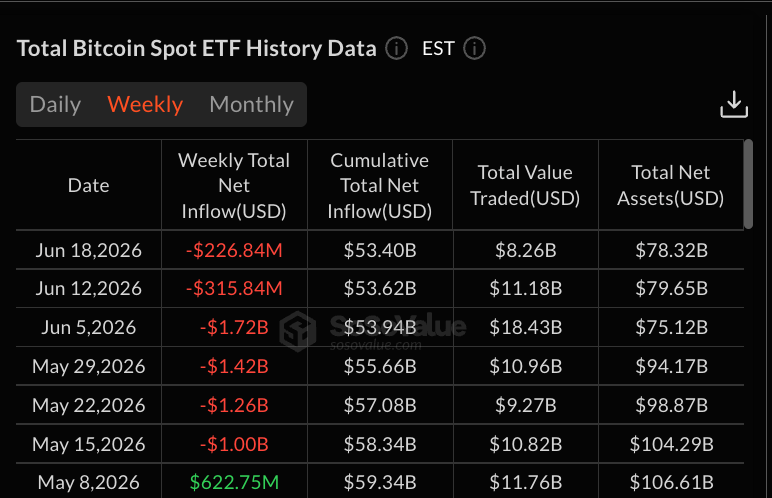
A scary Bitcoin prediction is spreading across socials just as an institutional red flag appears in ETF data. The timing is what makes the pairing look so alarming.
The call comes from analyst Jesse Olson, who ties $23,979 to a stock market crash of more than 50%. Recent data gives that warning just enough teeth to spread.
ETF Outflows Stretch to the Longest Streak
Olson’s call is not pulled from thin air. Bitcoin ETF outflows have run for six straight weeks, from mid-May through June 18. The current week is still in progress.

That is longer than the five-week outflow streaks of early 2026 and early 2025. So institutions have pulled cash longer than at any point, since the ETF inception.


The scary call leans on one more link, the bond between Bitcoin and stocks.
Bitcoin’s correlation with the S&P 500 sits at 0.468 over six months, a moderate positive reading. Correlation measures how closely two assets move, where 1.0 is lockstep. So a deep stock selloff would likely pull Bitcoin down with it.

A six-week streak sounds alarming on its own. But a closer Bitcoin price trend analysis shows the red flag already losing force.
Why a 50% Stock Crash Looks Unlikely for Now
The outflows are already shrinking. Weekly redemptions fell from $1.72 billion on June 5 to about $227 million by June 18. So the institutional exit is losing steam, even as the streak holds.
Want more token insights like this? Sign up for Editor Harsh Notariya’s Daily Crypto Newsletter here.
The crash condition is the bigger hurdle. A 50% drop would be a rare, 2008-scale event, not a routine pullback. Deep crashes usually need a recession or an earnings slump. Analysts still expect S&P 500 earnings to grow this year, which argues against one.
Analyst Benjamin Cowen sees the cycle bottom most likely around October 2026, not an imminent collapse. An early, deeper bottom would need capitulation well beyond past norms. BTC today has held up better than a doom call suggests.
A short-term stock market wobble is still possible, after JPMorgan flagged a $165 billion quarter-end stock market selloff. And BTC’s correlation with equities can lead to a substantial hit. Yet, the market positioning shows limited room for a cascade-like Bitcoin prediction.
Bitcoin Liquidation Map Shows a Deeper Short Bias
A liquidation map shows where leveraged bets would be wiped out at each price. On Binance, long liquidation leverage sits near $2.41 billion. That trails short liquidation leverage near $3.01 billion.

So a fall would still burn longs, but the heavier pile sits on the short side above price. That setup means a rebound could squeeze shorts harder than a dip could squeeze longs. A short squeeze happens when rising prices force shorts to buy back. The bigger forced move points up, not down.
The steadiest holders appear to agree with that calmer read, ensuring spot support.
Why Bitcoin’s Most Patient Holders Are Buying the Fear
The strongest counter comes from the holders with the most to lose. Bitcoin long-term holder net position change tracks whether wallets held at least 155 days are adding or shedding coins. That reading fell to a low near 30,885 BTC on June 11. By June 21 it had more than doubled to about 79,298 BTC.

So the most patient owners are buying into the weakness, not running from it. Therefore, it is hard to square that with a collapse that deep. For anyone asking whether Bitcoin is a good investment after such a scary headline, that behavior is the tell.
This is where the Bitcoin prediction meets its limits. The figure has spread across Bitcoin news this week, yet it needs a 50% stock crash that few expect.
The post Bitcoin’s 6-Week ETF Exodus Fuels a Scary New Prediction appeared first on BeInCrypto.

Key Takeaways
- Michael Saylor shared a suggestive “Looks better with more dots” post on X, signaling a potential new Bitcoin acquisition by Strategy
- The firm just acquired 1,587 BTC valued at approximately $100 million, pushing its total reserves to 846,842 BTC
- A small 32 BTC transaction earlier in the month raised questions, though Blockstream’s Adam Back dismissed bearish interpretations
- JPMorgan analysts project Strategy’s Bitcoin acquisitions could total around $32 billion throughout 2026
- Bitcoin surged past $64,000 amid positive sentiment surrounding scheduled US-Iran diplomatic discussions in Switzerland
Michael Saylor has once again ignited speculation across crypto social media. The Strategy chairman shared a brief post on X featuring the firm’s iconic Bitcoin acquisition tracker, with a simple caption: “Looks better with more dots.”
For those monitoring Strategy’s movements, the pattern is familiar. Saylor has deployed similar messaging before revealing additional Bitcoin acquisitions, and the dot visualization represents each individual purchase the corporation has executed. The crypto community interpreted it as a clear indicator.
This suggestive message emerged mere days following Strategy’s confirmation of acquiring 1,587 BTC for approximately $100 million, elevating their cumulative position to 846,842 BTC. This positions Strategy as overwhelmingly the world’s premier corporate Bitcoin accumulator.
The acquisition came on the heels of an unexpected 32 BTC transaction earlier this month. For an organization fundamentally committed to perpetual Bitcoin holding, even a minimal sale generated considerable attention.
Strategy characterized it as a procedural verification. Blockstream CEO Adam Back dismissed concerns during a Bloomberg appearance, explaining the transaction demonstrated the firm’s capability to leverage Bitcoin within standard treasury operations without indicating any strategic pivot.
JPMorgan’s Perspective on Future Moves
Not all observers share this calm assessment. JPMorgan highlighted that Strategy might need to maintain dollar liquidity to satisfy dividend commitments associated with its preferred equity. The apprehension centers on whether these dividend requirements could necessitate additional Bitcoin liquidations.
Nevertheless, the financial institution maintained its broader forecast regarding Strategy’s acquisition trajectory. JPMorgan estimated Strategy would allocate approximately $32 billion toward Bitcoin purchases throughout 2026.
Saylor directly addressed the company’s financial positioning this week. He emphasized that Strategy’s combined Bitcoin and cash assets now approximately equal its $48 billion debt obligations, and that the firm has secured over $60 billion in fresh capital since 2022, channeling the majority into Bitcoin.
He referenced 2022, when Bitcoin traded around $20,000 and Strategy’s debt burden surpassed its asset values. The company’s equity declined from roughly $24 to $13 that year on a split-adjusted basis. His emphasis was that current circumstances represent a fundamentally different landscape.
Geopolitical Developments Lift Bitcoin
Bitcoin’s price movement has simultaneously captured market attention. The cryptocurrency had retreated and was hovering near $64,000 before reports emerged that Iran confirmed participation in discussions with US representatives in Switzerland. The negotiations, initially scheduled for June 19, faced postponement but are now proceeding, with Qatar and Pakistan facilitating.
Optimism regarding a potential diplomatic resolution propelled Bitcoin back beyond $64,000.
Saylor also leveraged this opportunity to advocate for cohesion within the Bitcoin ecosystem. In another X message he stated, “Bitcoiners agree on the 99% that matters,” contending that internal disagreements regarding technical vulnerabilities or quantum computing concerns shouldn’t eclipse the broader potential.
“The opportunity is bigger than the argument,” he stated.
At publication time, Strategy has not issued an official statement verifying a new acquisition. The corporation routinely submits regulatory filings with the SEC following any purchase, and investors are anticipating such documentation potentially early this week.

Bitcoin peaked at over $126,000 last October, which now appears to be a lifetime ago since it trades below $65,000, representing a near 50% decline.
Although this sounds pretty painful, and it is, especially for those who entered at $120,000+, the reality might be more positive. Here’s why.
Is BTC Doing Better?
While most analysts are still focused on determining whether the cryptocurrency has bottomed yet or there’s another leg down in the cards, Michaël van de Poppe noted that the asset holds the 200-Week Moving Average and “refuses to drop deeper.” Moreover, he believes there’s not enough sell pressure at the moment despite all the negative developments surrounding the broader market (and mostly BTC) ecosystem.
First, he mentioned the war in Iran. The conflict that started on February 28 was supposed to have finished by now following the initial reports and comments by Trump. Progress was seemingly made over the past week as the POTUS announced a deal with Iran, which both sides confirmed. However, they failed to sign it, and the negotiations in Switzerland reportedly broke down on Sunday. The Strait of Hormuz remains closed, and Trump is back to making big threats.
Second, van de Poppe outlined the growing industry fears about STRC – Strategy’s shares used to raise funds and buy more BTC. The shares trade well below their par level, and there are some speculations that Strategy could become this cycle’s FTX or at least would have to sell a significant portion of its bitcoin fortune.
Third, there are the massive net outflows from the spot Bitcoin ETFs. As we have repeatedly reported, investors are on a substantial selling spree, as the funds have ended in the red for six straight weeks, during which the cumulative total has declined by about $5 billion.
Lastly, the popular analyst highlighted the macroeconomic inflationary topic, as US inflation (and in many other regions) is increasing again, and there is a lack of rate cuts from the Fed. Furthermore, the central bank’s new Chairman remained highly hawkish after the most recent FOMC meeting.
We Are Done Already?
Given the aforementioned factors, BTC’s 50% drop from its top might not seem as bad as many think, especially since it has been able to hold above the $60,000 support. Consequently, van de Poppe noted that this is a sign that “we’re done already.” Additionally, he believes many altcoins are “showing resilience for the past month,” which is another “great” signal.
My thesis is:
If #Bitcoin holds the 200-Week MA and refuses to drop deeper, there’s clearly not enough sell pressure despite:
– Iran war
– STRC Michael Saylor doomposting about FTX
– Outflows of the ETF
– Macroeconomic inflationary topics and no rate cutsThat’s the sign that… https://t.co/nVCk9CMIsL
— Michaël van de Poppe (@CryptoMichNL) June 20, 2026
The post Unpopular Opinion: Bitcoin Faces Relentless Headwinds, Yet It Refuses to Break appeared first on CryptoPotato.

Apple Watch Ultra 3 drops to $649 in early Amazon Prime Day deal

Staggering amounts of fentanyl hit streets as the DEA watched and took no action, records show

Record $312m Opening Marks Pixar Comeback


-

 Tech6 days ago
The Adder At The Heart Of Intel’s 8087 FPU
-

 Fashion3 days ago
Weekend Open Thread: Miami – Corporette.com
-
 Business2 days ago
Wall Street Week Ahead: Investors see Micron earnings as pulse check of AI rally momentum
-

 Crypto World2 days ago
HIVE shares jump as $220M AI deal speeds Bitcoin mining pivot
-

 Sports3 days ago
FIFA World Cup 2026: Canada beat 9-men Qatar 6-0 to register first ever win | FIFA World Cup 2026
-

 Crypto World2 days ago
Jake Chervinsky accuses CME of protecting derivatives monopoly
-

 Business1 day ago
MHP SE 2026 Q1 – Results – Earnings Call Presentation (OTCMKTS:MHPSY) 2026-06-20
-

 Crypto World4 days ago
Anthropic’s Dario Amodei Urged AI Unity at G7, Even as US Banned His Models
-

 Business3 days ago
Brexit cost 6% of UK economy, Bank of England company data suggests
-

 Business1 day ago
Soccer-U.S. defends Iran World Cup travel restrictions, says discussions ongoing
-
 Crypto World2 days ago
Can Charles Hoskinson Really Rescue Cardano?
-

 Tech5 days ago
Weeks Of In-The-Field Testing And A Verdict
-

 Politics2 days ago
Andy Burnham and the meaning of Makerfield
-

 Tech4 days ago
Adobe adds its AI assistant to Premiere, Illustrator and InDesign
-

 Entertainment1 day ago
Renter of Home in Anne Heche Crash Denies Settlement With Son
-
 Crypto World4 days ago
Iren (IREN) Stock Surges on Jefferies Buy Rating: AI Infrastructure Play Gains Momentum
-

 Politics4 days ago
BBC Reporter Discusses Cross Party Criticism Of Trumps Iran Deal
-

 Tech3 days ago
Instagram Now Lets You Add A Unique Caption To Each Carousel Slide
-

 Crypto World6 days ago
Robinhood opens AI-powered trading to all users, sending HOOD stock past $100
-

 News Videos3 days ago
Nightcore – MONEY ON THE DASH (Soft Rock Version) (Lyrics)
You must be logged in to post a comment Login