

Crypto World
BitGo Cuts 15% of Workforce to Focus on Stablecoins and AI



BitGo is reducing its workforce by nearly 15% as the digital asset custodian narrows its focus to security, trading, stablecoins, settlement, and AI-powered infrastructure. CEO Mike Belshe described the cuts as a one-time action with no further reductions planned.
The move makes BitGo the latest crypto company to trim staff in 2026, with peers tying similar cuts to AI. The custodian went public in January as the first major crypto listing of the year.
A Sharper Focus After Going Public
BitGo priced its public market debut at $18 a share in January, putting its strategy under fresh shareholder scrutiny. It counted about 565 full-time employees as of mid-2025 in its prospectus, so the cut points to roughly 85 jobs.
The numbers show why. BitGo’s 2025 results listed $16.2 billion in revenue, up more than fourfold, yet most came from low-margin digital asset sales. Adjusted EBITDA reached just $32.4 million, and a drop in its Bitcoin (BTC) treasury left a $14.8 million net loss.
Belshe wants the leaner team on higher-value institutional crypto services. BitGo won a federal trust bank charter from the OCC in December.
In April, it launched a minting tool aimed at the fast-growing stablecoin sector, a higher-margin line it wants to grow.
“To keep winning for our clients, we need to be sharper, more focused, and concentrate our people and energy on the areas that matter most…” Mike Belshe, BitGo CEO, explained.
Follow us on X to get the latest news as it happens
Layoffs Spread Across the Crypto Sector
The cut tracks a broader retrenchment. In May, Coinbase shed about 700 staff, or 14% of its workforce, in a restructuring aimed at optimizing operations for the AI era, according to a securities filing. BitGo is betting its own savings will fund more AI-powered financial infrastructure.
Not everyone credits strategy. Thomas Braziel, founder of distressed-crypto firm 117 Partners, tied the move to the cost of BitGo’s Bitcoin custody.
“I mean – BitGo is the highest cost operator for BTC storage on the planet so I get it,” Braziel said in a post.
Whether a leaner BitGo can turn its scale into real profit should become clearer in its next earnings report.
The post BitGo Cuts 15% of Workforce to Focus on Stablecoins and AI appeared first on BeInCrypto.

Crypto World
Circle and Nomura join forces to target a $440 billion daily foreign exchange market in Japan


Boston-based stablecoin issuer Circle Internet Financial announced a partnership on Thursday with Japanese financial conglomerate Nomura Holdings to launch a digital asset settlement business. The firms plan to deploy a corporate payment service in Japan as early as 2027.
The agreement will let Japanese businesses exchange yen for USDC, Circle’s U.S. dollar-backed stablecoin, according to the announcement first reported by Nikkei. USDC is the world’s second-largest dollar-pegged stablecoin, boasting a market cap of $73.8 billion as of this writing.
The Circle stablecoin token can be used for cross-border supplier payments, transfers between overseas affiliates, and foreign exchange settlements.
The business aims at Japan’s import, export, and corporate currency markets. Bank for International Settlements data shows that Japan’s foreign exchange market handled $440 billion in daily transactions as of 2025. Standard bank wires take two to three business days to clear funds between yen and foreign currencies. This blockchain setup can drastically reduce that transfer time.
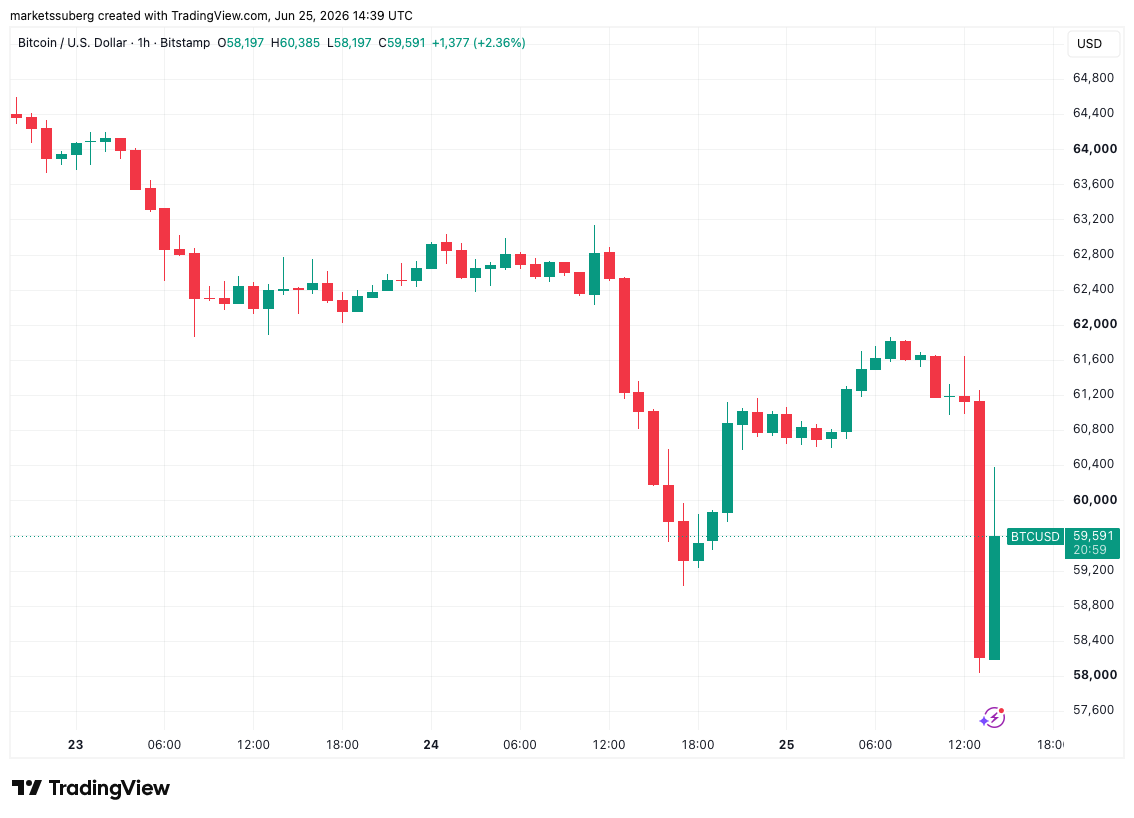
Bitcoin (BTC) hit new 21-month lows at Thursday’s Wall Street open as high US inflation unsettled stock markets.
Key points:
- Bitcoin returns to its lowest level since September 2024, dropping to $58,000.
- US PCE inflation rocks equities, with the Nasdaq 100 shedding 2% in just 30 minutes.
- BTC’s correction mirrors the price action seen throughout the 2022 bear market.
Crypto liquidations pass $600 million in an hour as BTC price drops
Data from TradingView showed BTC/USD dropping to $58,035 on Bitstamp — a level it last traded at in September 2024.
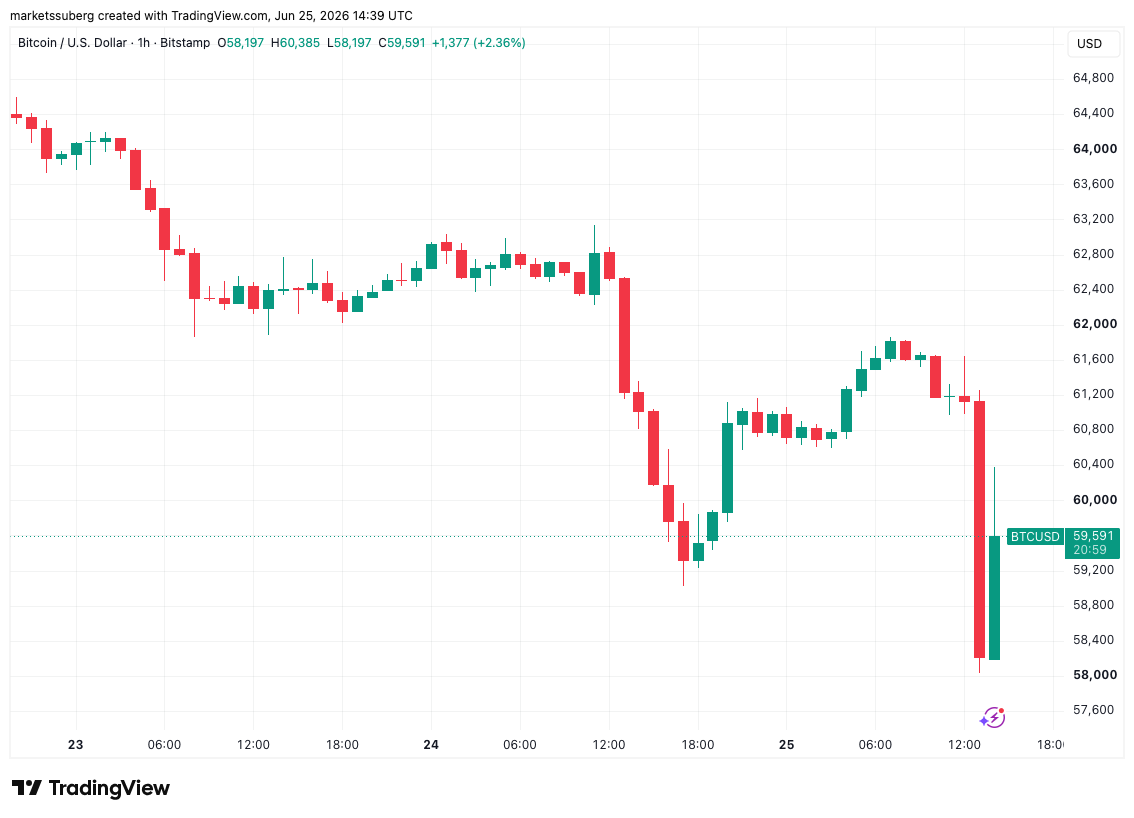
BTC/USD one-hour chart. Source: Cointelegraph/TradingView
The May print of the US Personal Consumption Expenditures (PCE) index came in at 4.1%, setting a new three-year record.
“From the preceding month, the PCE price index for May increased 0.4 percent. Excluding food and energy, the PCE price index increased 0.3 percent,” a data release from the Bureau of Economic Analysis (BEA) stated.
“From the same month one year ago, the PCE price index for May increased 4.1 percent. Excluding food and energy, the PCE price index increased 3.4 percent from one year ago.”
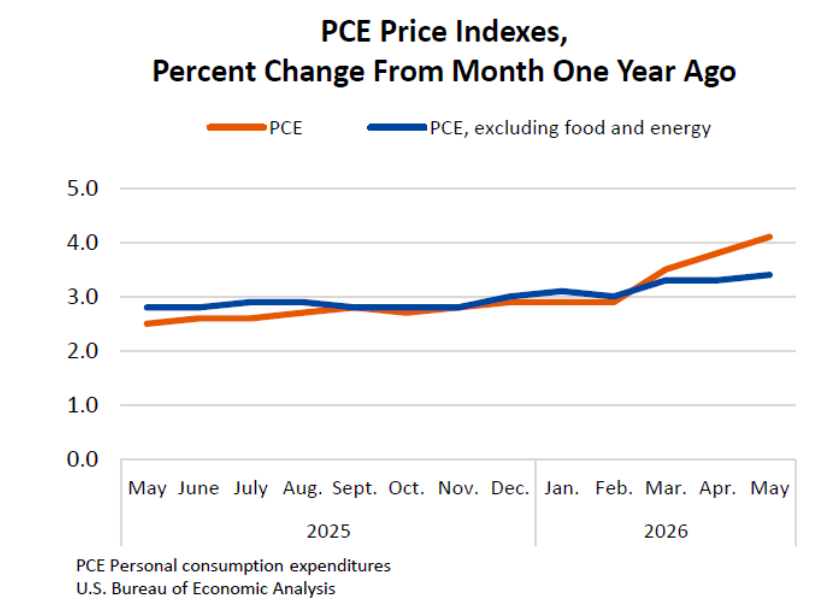
US PCE one-month % change (screenshot). Source: BEA
Stocks reacted with volatility, with the Nasdaq Composite Index down 0.5% at the time of writing, while the S&P 500 managed to eke out a gain.
The Nasdaq 100, meanwhile, saw a larger snap decline of 2% in just 30 minutes at the open.
“What a chart,” trading resource The Kobeissi Letter responded on X.
Bitcoin itself sparked considerable long position liquidations, with CoinGlass putting the cross-crypto liquidation total at $600 million over a single hour.
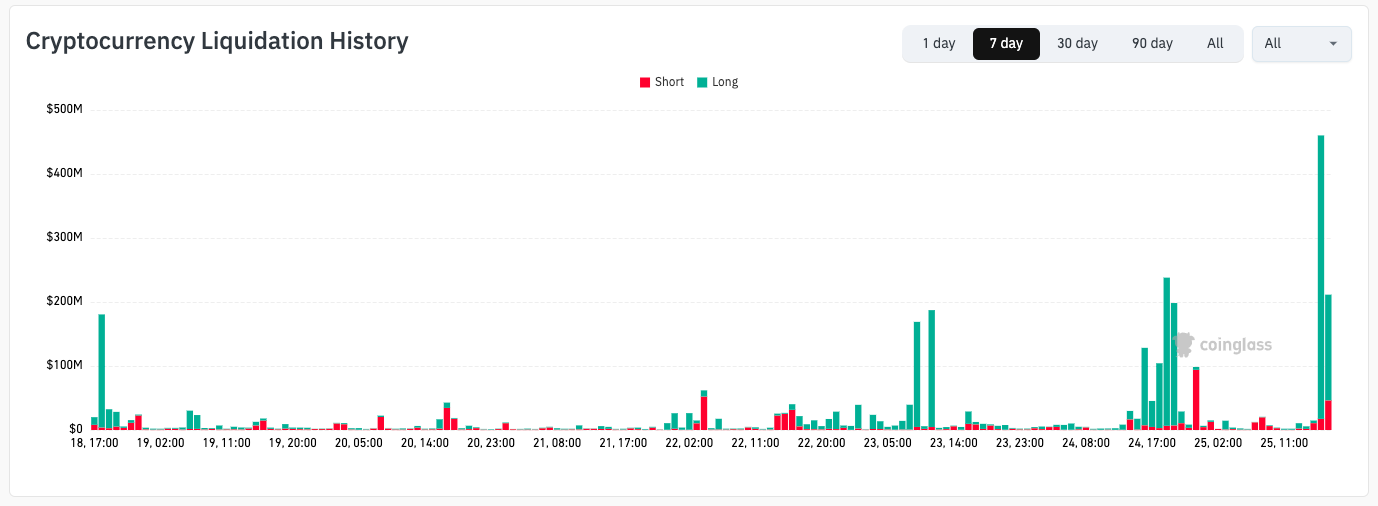
Crypto liquidation history (screenshot). Source: CoinGlass
Commenting, market participants suggested that price moves were being artificially managed to squeeze positions.
“$BTC is in the manipulation phase,” pseudonymous trader Killa told X followers.
“Every time $BTC trades sub-$60K, that is our manipulation beneath the significant $60K swing low on the weekly and quarterly. Precisely the reason why the orderbook is stacked below us.”
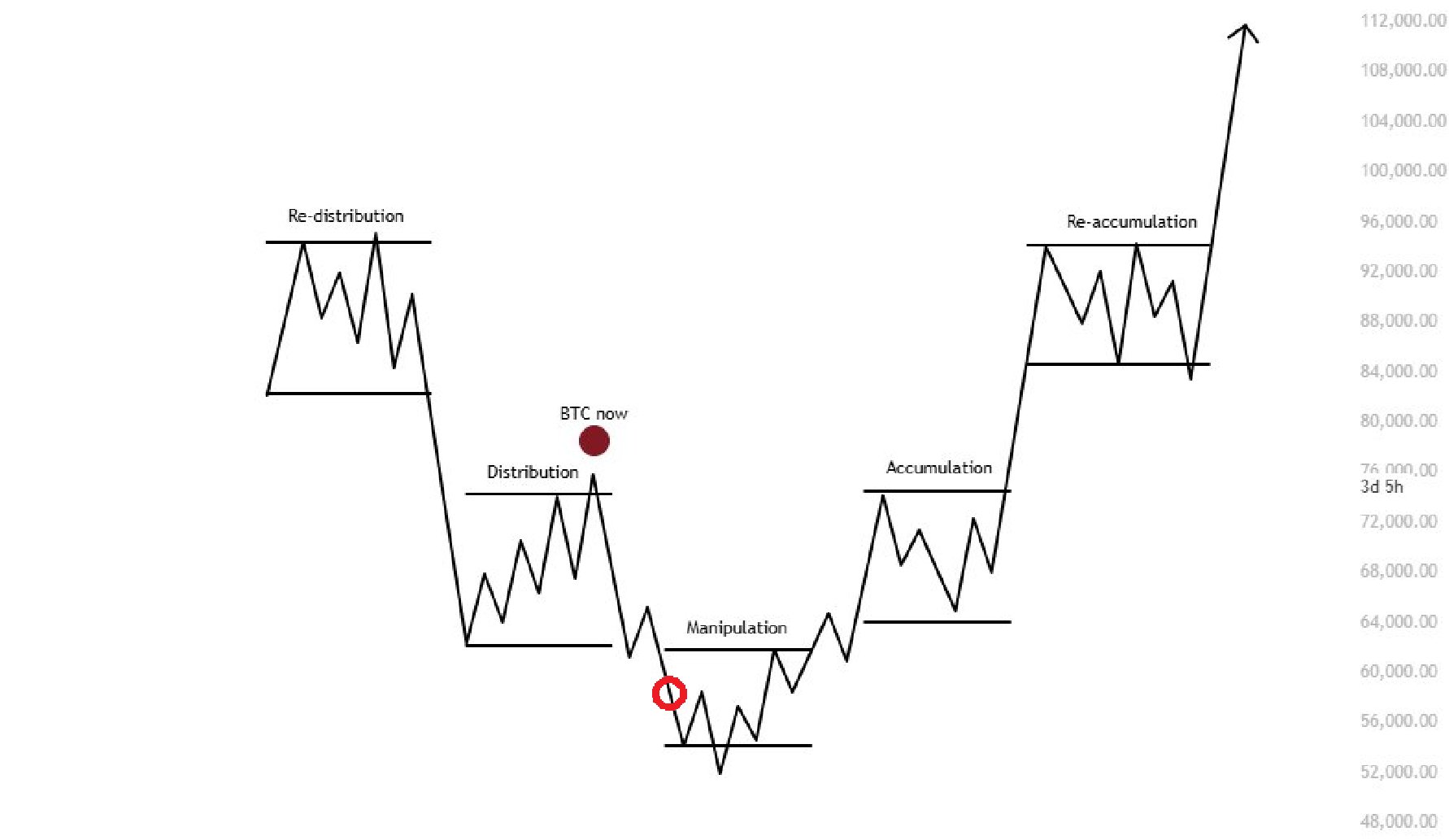
Source: Killa/X
Niels Klaver, cofounder of crypto platform STABL Agency, suggested that BTC/USD “seems to be going for its final leg down of this bear market.”
“$55K remains the target,” he added, referring to an increasingly popular short-term price goal.
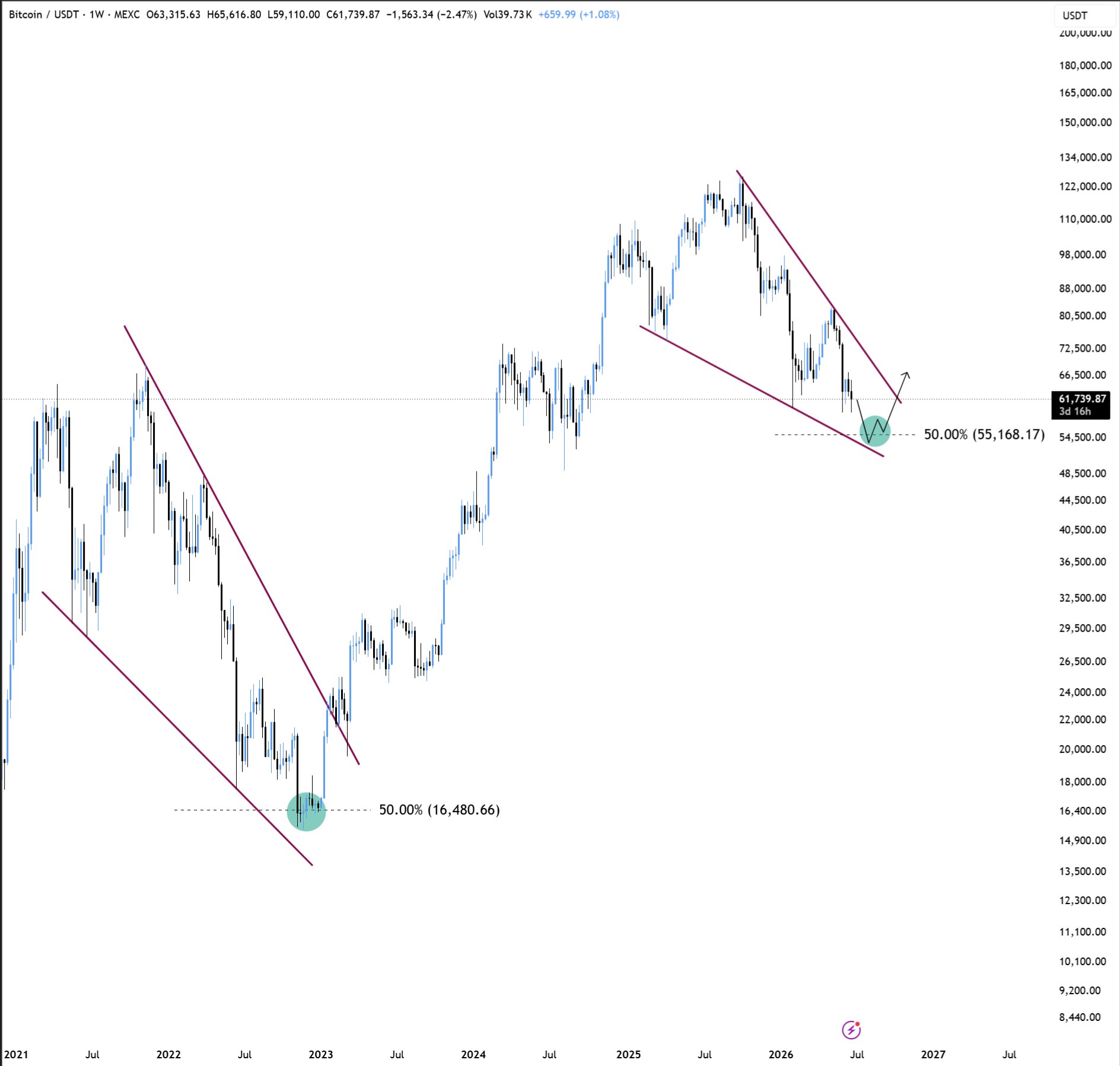
BTC/USDT one-week chart. Source: Niels Klaver/X
Bitcoin analysis sees new resistance near $65,000
As BTC price action attempted a modest rebound, trader and analyst Rekt Capital had already described $60,000 support as “clearly weakening.”
Related: BTC price four-year trend calls for $76K as analysis says Bitcoin ‘not broken’
“Once June Monthly Closes, we’ll know from which price July will be able to potentially spring into a post-breakdown relief rally,” an X post read.
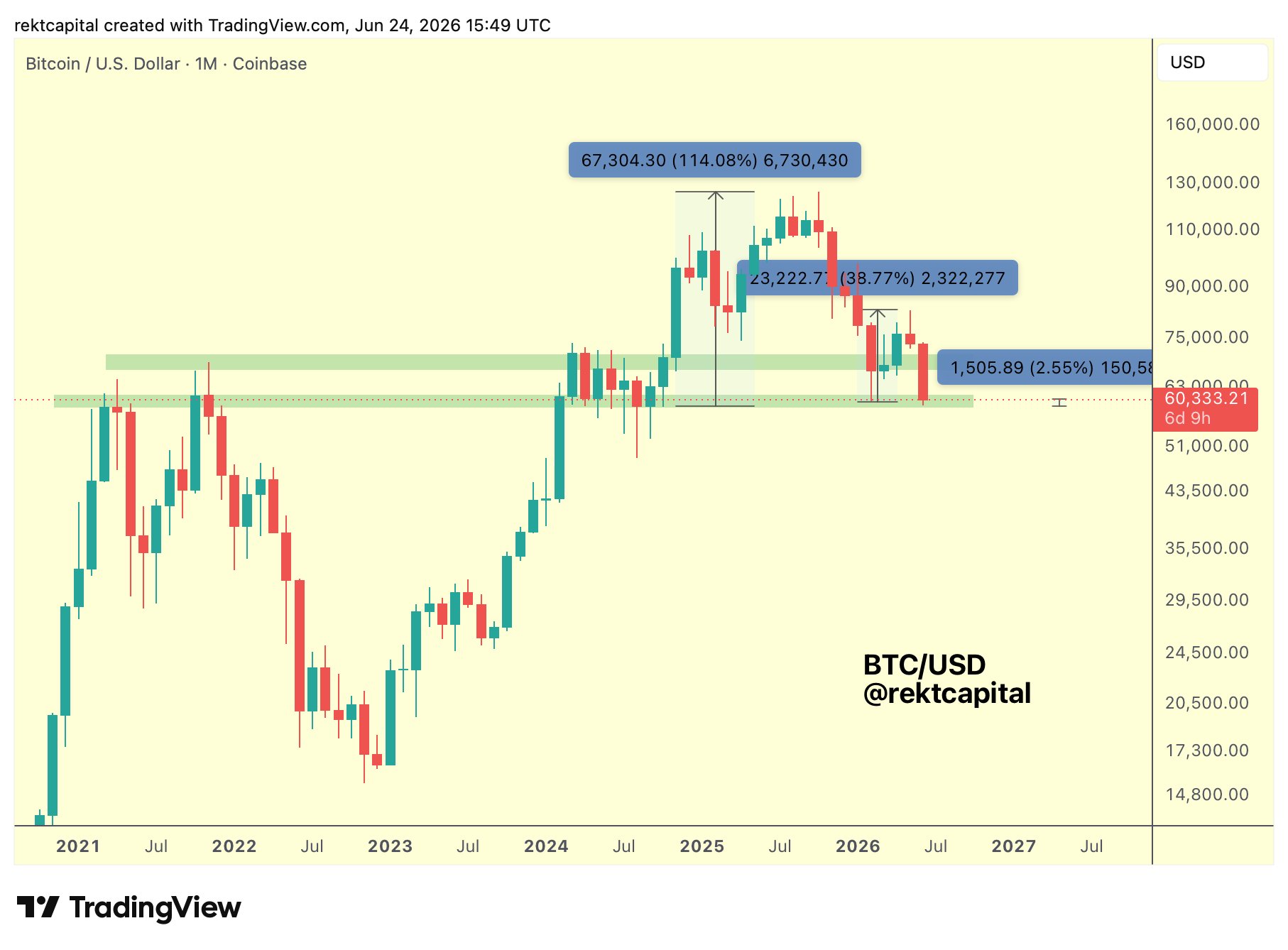
BTC/USD one-month chart. Source: Rekt Capital/X
Rekt Capital maintained that the market was acting similarly to 2022, with the 50-month exponential moving average (EMA) tipped to become new resistance next.
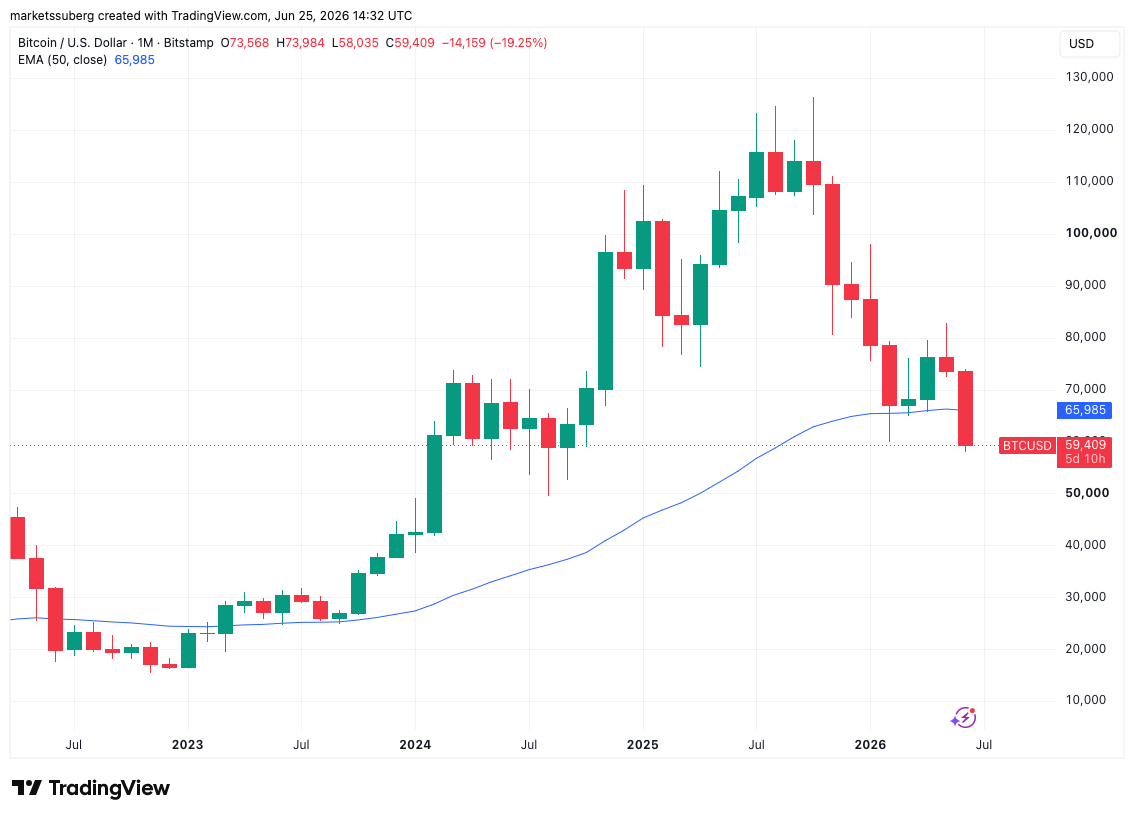
BTC/USD one-month chart. with 50EMA. Source: Cointelegraph/TradingView

South Korean cryptocurrency exchange Bithumb was order to pay a $136,000 fine after it was found to have breached personal information protections rules when it sent user data overseas.
In a Thursday notice, the country’s Personal Information Protection Commission (PIPC) said that its investigation into Bithumb found that the exchange had “transferred personal information overseas without the separate consent of the data subjects during the process of order book sharing and virtual asset transfer with overseas virtual asset exchanges.”
The incident was connected to Bithumb sharing its Tether (USDT) order books between September and November 2025 with BingX, despite obtaining consent to share the data with Stellar, as well as sharing user information with 13 overseas exchanges.
“The Personal Information Protection Commission determined that there is a necessity to provide personal information for anti-money laundering purposes when transferring virtual assets to other exchanges, but regarding the overseas transfer of personal information and the data subject’s right to self-determination, it was determined that, as this is a closely related matter, it is necessary to strictly comply with the requirements and procedures stipulated in the Protection Act,” the notice said, in translation.

Source: PIPC
One of the largest crypto exchanges in South Korea, Bithumb has been subject to intense scrutiny from authorities.
The country’s financial watchdog imposed a six-month suspension of the exchange’s activities in March over alleged violations of South Korea’s Financial Information Act, but a court reversed the decision in April. Earlier this month, police reportedly raided Bithumb’s offices as part of an investigation into alleged nepotism involving South Korean lawmaker Kim Byung-gi.
Related: SBI to acquire Bitbank in $289M deal creating Japan’s biggest crypto exchange
South Korean crypto tax set to take effect in 2027
South Korea’s Finance Ministry confirmed in May that a 22% tax on cryptocurrency gains would be imposed beginning in January 2027. The tax has faced several delays in implementation after initially expected to go into effect in 2025, but will likely affect many South Koreans who hold crypto.
According to the Yonhap news agency, about 16 million South Koreans were invested in digital assets as of March 2025.
Earlier this month, Chainalysis said that it signed a memorandum of understanding with the Korean National Police Agency (KNPA), aimed at building investigative capability within South Korea’s law enforcement.
One of the driving factors behind the pact is to better combat North Korea-linked crypto attacks, with South Korea’s police “at the forefront” of tackling these threats.
Magazine: Japanese pension fund tips 1% in crypto, G7 urges action on NK hackers: Asia Express
Crypto World
Aave Co-Founder Kulechov Dismisses AAVE Discount Sale Reports, Teases Aavenomics 3.0 Buyback Plan

TLDR:
- Kulechov firmly denied reports of selling AAVE at a 70% discount, calling the media framing inaccurate.
- All Aave Protocol, GHO, and product revenue flows entirely to the AAVE token under the Aave Will Win proposal.
- Aave Labs is designing Aavenomics 3.0, featuring a new automated and non-discretionary AAVE buyback mechanism.
- Aave targets the entire financial asset market, including real-world assets, beyond the crypto-native TAM.
Aave co-founder Stani Kulechov has moved to address circulating discussions about AAVE token sales and the protocol’s revenue model.
In a post on X, Kulechov pushed back on what he called inaccurate media framing surrounding Aave Labs and its token allocation.
He confirmed that all protocol and GHO revenue flows to the AAVE token while teasing a new automated buyback mechanism. The protocol currently generates $134 million in annualized revenue.
Kulechov Rejects Discount Sale Reports, Outlines Revenue Framework
Kulechov was direct in dismissing reports suggesting AAVE tokens could be sold at a steep discount. Addressing the claim head-on, he wrote, “There is NO WAY we’d sell AAVE at a 70% discount lol.”
He then moved to clarify the structure governing all revenue flows within the Aave ecosystem. The Aave Will Win (AWW) proposal, already passed by the DAO, forms the backbone of that structure.
Under AWW, 100% of Aave Protocol and GHO revenue is directed to the AAVE token. Kulechov confirmed the framework also covers all product revenue streams. “AWW also applies to all product revenue, including the Aave App, Aave Pro, and Swaps,” he stated. None of that revenue flows to Aave Labs, which operates solely as a service provider to the DAO.
He also addressed Aave Labs’ own AAVE token allocation separately. Kulechov noted that “multiple market participants have discussed purchasing, directly or indirectly, through deeper long-term partnerships.”
That allocation is distinct from the DAO’s revenue framework and does not alter how protocol earnings are distributed to token holders.
On intellectual property, Kulechov was equally clear. He confirmed that “all intellectual property, including the Aave brand and any software built for Aave, belongs to AAVE.” Token holders, not Aave Labs, hold rights over these core assets under the current governance structure.
Aavenomics 3.0 and Aave’s Broader Financial Ambition
Beyond correcting the revenue narrative, Kulechov pointed to a coming upgrade. He revealed that “the Aave team is designing Aavenomics 3.0, which includes a new automated and non-discretionary buyback mechanism.” He noted that further details would follow in a later announcement, keeping the specifics close for now.
The planned buyback builds on a strong revenue foundation. Aave is generating $134 million in annualized revenue, all of which flows to the Aave DAO.
That base positions the DAO to sustain meaningful token buybacks without relying on discretionary decisions from any single party.
Kulechov also broadened the scope of Aave’s stated ambitions. He said Aave is “building not only for the crypto TAM, but for the entire finance asset TAM, including RWAs.” That framing places Aave alongside traditional finance infrastructure rather than solely within the DeFi space.
He closed his remarks with a pointed statement on organizational alignment. “Everyone at Aave Labs and Aave DAO works for AAVE,” he wrote.
That statement was directed at reassuring token holders that commercial and governance structures remain oriented around their interests above all else.



Disclosure: This article does not represent investment advice. The content and materials featured on this page are for educational purposes only.
A new 2026 ranking highlights beginner-friendly trading platforms based on simplicity, reliability, and trustworthiness for first-time investors.
Summary
- SaintQuant tops a 2026 ranking of beginner trading platforms, citing simplicity, stability, and ease of use.
- A new 2026 review names SaintQuant the best platform for beginners seeking hands-off, automated trading.
- Beginner-focused trading platform rankings highlight SaintQuant for automation, accessibility, and risk controls.
For those who are new to investing, the hardest part is not placing a trade — it is choosing where to trade in the first place. Search for the best trading platform for beginners, and dozens of names come up, conflicting reviews, and interfaces that look like an airplane cockpit. For a beginner, that complexity is intimidating, and complexity is exactly what causes costly mistakes.
So we ranked the five best trading platforms for beginners in 2026 using three priorities that actually matter when somoen is starting out: simplicity (how easy it is to begin), stability (how well it holds up when markets fall, not just when they rise), and credibility (whether someone can trust it with their money). Whether someone wants a traditional broker or a hands-off automated option, there is a fit here for everyone.
How these platforms were ranked
Every platform below was measured against the same beginner-focused criteria:
- Simplicity: Can a complete beginner start in minutes without a finance background or coding?
- Stability: Does the platform — or its strategies — hold up during a one-sided market downturn, or does it only work when prices rise?
- Credibility: Is the company transparent about fees, withdrawals, and risk, with a real track record?
- Supported markets: Can assets be accessed whenever the user wants and diversify as they grow?
- Cost to start: Is there a low barrier, free trial, or demo to learn without risking much?
One honest note before the list: no platform removes market risk, and none guarantees profit. The best beginner platform is the one that keeps things simple and protects its users while they learn.
1. SaintQuant — Best overall for hands-off beginners
Best for: Beginners who want automated, stable trading without learning to read charts.
SaintQuant tops the list because it removes the single biggest barrier for newcomers: no need to know how to trade. There is no configuration, no coding, and no chart-watching. Users pick a pre-built, pre-optimized strategy, launch it in a few clicks, and the platform handles execution, strategy management, and 24/7 market monitoring automatically.
On simplicity, it is hard to beat — the entire experience is built for people who want results without complexity. On stability, it stands apart from typical beginner platforms: rather than only profiting when prices rise, SaintQuant runs quantitative strategies designed to pursue steady, rules-based returns across market conditions, with risk controls structured directly into each strategy to help manage volatility and one-sided downturns. On credibility, it is transparent about how it works and supports cryptocurrencies, stocks, and futures from a single account.
New users also get a $99 free starter trial credit to experience live strategies before depositing, plus a $7 instant cash bonus at registration with no hidden conditions — a low-pressure way to see how it performs before committing real money.
Watch a live review of SaintQuant in action:
Pros: Truly no-code, designed for stability in down markets, multi-market support, free trial credit.
Cons: Pre-built strategies favor simplicity, so advanced users may eventually want more granular controls.
2. eToro — Best for social and copy trading
Best for: Beginners who want to learn by following experienced traders.
eToro built its reputation on an approachable interface and copy trading, which lets newcomers mirror the moves of more experienced investors. For a beginner who learns best by watching others, that lowers the intimidation factor considerably.
The trade-off is that copy trading still leaves users exposed to the market’s direction and the choices of whoever they copy. It is simple to start, but results depend heavily on who they follow.
Pros: Beginner-friendly interface, copy trading, broad asset access.
Cons: Copying does not remove risk; outcomes depend on the trader someone follows.
3. Webull — Best free stock trading app
Best for: Beginners who want a clean, commission-free stock app.
Webull offers commission-free trading with a tidy mobile experience and useful learning tools, making it a popular entry point for new stock investors. Paper trading lets beginners practice before risking real funds.
It leans toward self-directed trading, so users still make every decision themselves. That suits people who want to learn actively, but it offers little protection during a downturn beyond personal discipline.
Pros: Commission-free, clean app, paper trading.
Cons: Fully self-directed; no built-in downturn protection.
4. Fidelity — Best for long-term credibility
Best for: Beginners who prioritize a trusted, established institution.
Fidelity is a long-established name with a strong reputation, broad research tools, and excellent customer support. For beginners who value credibility and stability of the institution above all, it is a safe, respected choice.
The platform is more oriented toward long-term investing than active or automated trading, and its depth can feel like a lot for an absolute beginner. But few names inspire more trust.
Pros: Highly credible, strong support, great for long-term investing.
Cons: Less suited to automated or active trading; feature depth can overwhelm.
5. Robinhood — Best for ultra-simple first trades
Best for: Beginners who want the simplest possible first trade.
Robinhood popularized commission-free, frictionless trading with an interface so simple anyone can place a trade in minutes. For sheer ease of starting, it is among the simplest options available.
That same simplicity has drawn criticism for encouraging impulsive trading, and it offers little to protect beginners when markets fall. Simple to start is not the same as stable.
Pros: Extremely simple, commission-free, fast onboarding.
Cons: Minimal downturn protection; simplicity can encourage impulsive trades.
Quick comparison at a glance
| Platform | Best For | Simplicity | Stability in Downturns | Credibility |
| SaintQuant | Hands-off beginners | ★★★★★ | ★★★★★ | ★★★★ |
| eToro | Copy trading | ★★★★ | ★★★ | ★★★★ |
| Webull | Free stock app | ★★★★ | ★★ | ★★★★ |
| Fidelity | Long-term trust | ★★★ | ★★★★ | ★★★★★ |
| Robinhood | First trades | ★★★★★ | ★★ | ★★★ |
How to choose the right platform
The best choice comes down to what kind of beginner someone is:
- Want it fully hands-off and stable in any market? Start with an automated platform like SaintQuant.
- Want to learn by following others? A copy-trading platform like eToro fits.
- Want a trusted institution for the long term? Fidelity is hard to beat on credibility.
- Just want the simplest first trade? Robinhood or Webull get started fast.
Whatever is chosen, apply the same beginner discipline: start small, understand the fees, and never invest money a user cannot afford to lose.
The Bottom line
For most beginners in 2026, the best trading platform is the one that is simple to start, stable when markets turn, and credible with money. That balance is why SaintQuant leads this list — it pairs genuine no-code simplicity with quantitative strategies designed to hold up during downturns, not just rallies.
New users can claim a $99 free trial package plus a $7 instant cash bonus with no deposit and no strings attached, making it easy to experience stable, automated trading before committing personal capital.
Disclosure: This content is provided by a third party. Neither crypto.news nor the author of this article endorses any product mentioned on this page. Users should conduct their own research before taking any action related to the company.
Crypto exchange Kraken and onchain asset manager Maple have launched an onchain warehouse financing facility for crypto-backed loans, applying a lending structure widely used in traditional credit markets to institutional digital asset lending.
According to Thursday’s announcement, the facility will fund Kraken’s OTC lending business using a bankruptcy-remote special purpose vehicle (SPV) and USDC-denominated financing.
Unlike traditional bilateral crypto loans, the facility is structured through the SPV, with Maple providing senior financing and Kraken retaining a stake in the transaction. The arrangement is intended to let Kraken expand its institutional lending business without tying up additional balance-sheet capital.
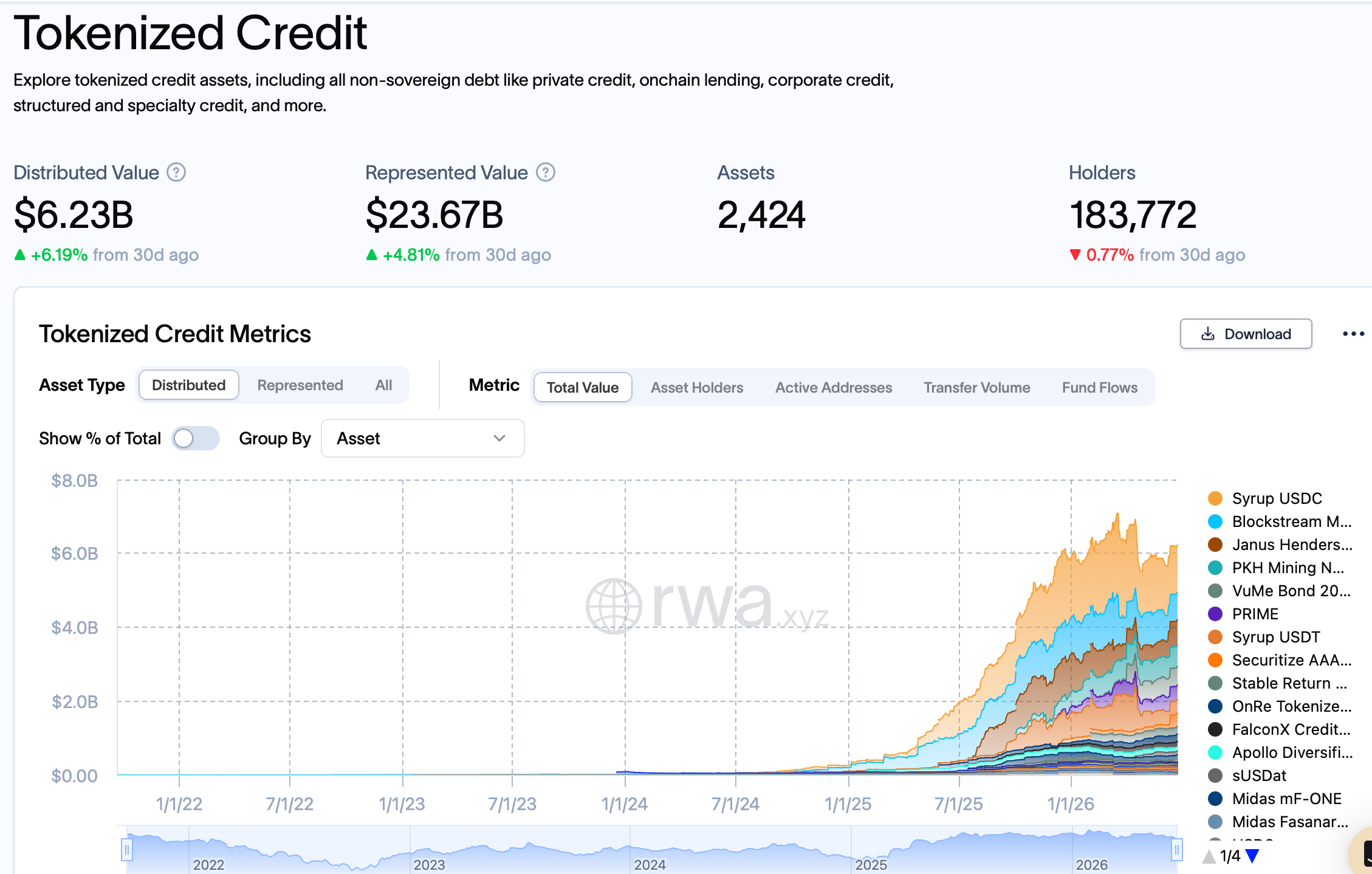
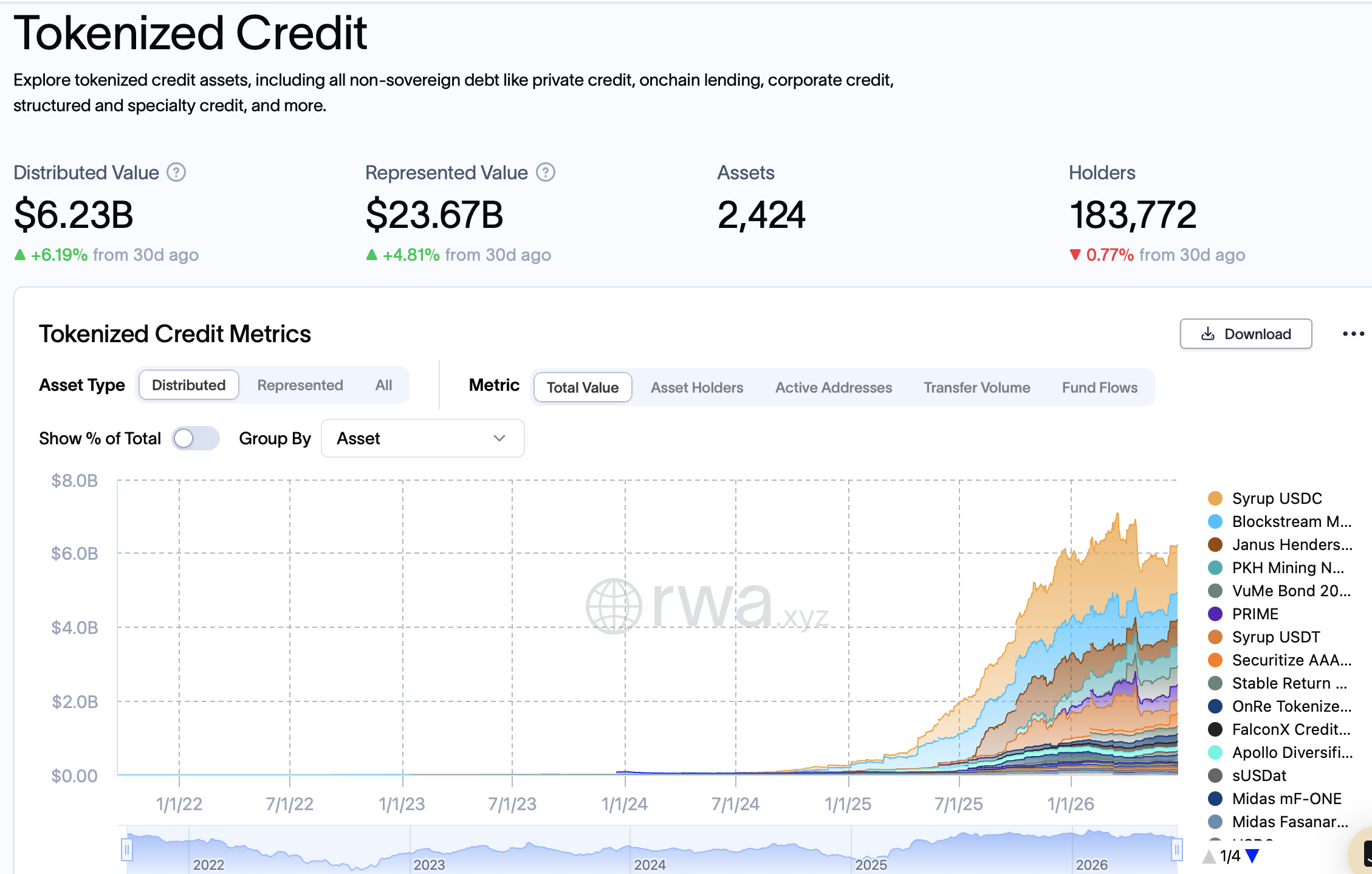
Tokenized credit has grown to more than $6.2 billion in distributed value from roughly $1.87 billion a year ago, according to RWA.xyz data. Maple is the sector’s largest platform, with approximately $1.4 billion in tokenized credit assets.
Maple said the structure gives institutional lenders access to senior, overcollateralized exposure backed by Bitcoin and Ether while allowing collateral and loan performance to be tracked onchain.
Commonly used in large commercial transactions, in particular commercial mortgage-backed securities (CMBS), a bankruptcy-remote SPV removes the borrower’s ability to file for bankruptcy.
Kraken affiliates will originate, sell and service the loans while retaining a position in the transaction. Kraken Financial, a Wyoming-chartered Special Purpose Depository Institution, will hold the underlying collateral, while independent SPV administrator Zaria will oversee administration of the facility. The companies did not disclose the facility’s size or financial terms.
Related: FalconX expands tokenized credit facility to Monad network in lending push
Tokenized credit market continues to expand
The announcement comes as crypto lending continues to rebuild following the 2022 market collapse, with firms expanding institutional lending and blockchain-based credit infrastructure after the failures of lenders such as Celsius and BlockFi.
In May, Ripple secured a $200 million credit facility from investment manager Neuberger Berman to expand the lending capacity of its institutional prime brokerage business. The financing is intended to support margin lending and other credit products for hedge funds, trading firms and other institutional clients.
The same month, analysts at Bernstein said tokenized credit could represent a $4 trillion addressable market as blockchain-based lending expands beyond niche use cases into sectors including mortgages, auto loans and small-business lending.
Source: RWA.xyz
While onchain lending has continued to evolve, some parts of the decentralized finance sector have struggled. Earlier this month, lending protocol Radiant Capital said it would wind down after failing to recover from a $50 million exploit in 2024, citing an inability to replace lost funds or secure new capital.
Magazine: The end of anonymity? AI could unmask crypto’s hidden identities
TLDR:
- Cardano active addresses have spiked for the second time this month as ADA trades near 2020 lows.
- A Cardano-based wallet protocol was exploited for nearly 129 million ADA, worth roughly $20 million.
- Charles Hoskinson’s warnings and governance disputes have fueled FUD while boosting social dominance.
- Analysts flag a TD Sequential buy signal but warn a bull trap may form near the $0.160–$0.176 range.
Cardano active addresses have spiked sharply even as ADA trades near its lowest price since December 2020. On-chain activity is rising for the second time this month alongside social dominance.
The combination of extreme price pressure and growing community debate has pulled Cardano back into the spotlight. Traders and analysts are now watching closely for what comes next.
On-Chain Activity Rises Amid Price Decline
Santiment data shows Cardano active addresses and social dominance have both surged simultaneously. This pattern has appeared twice before this month, each time preceding a mild relief rally.
The current setup mirrors those earlier instances closely, according to the charting data shared by Santiment Intelligence on X.
Much of the attention stems from statements made by Charles Hoskinson, Cardano’s founder. He recently warned that more Cardano-based projects could fail in the current environment. He also announced a step back from public involvement, which added to broader community uncertainty.
Governance disputes over treasury funding have further divided the Cardano ecosystem. These disagreements have fueled bearish sentiment across social platforms. However, they have also driven increased conversation and engagement around ADA at a critical price level.
Despite the FUD, the spike in daily active addresses points to heightened user engagement. Historically, such setups have preceded short-term price recoveries. Santiment noted that the two previous occurrences of this pattern resulted in at least a mild upward move.
Analysts Flag Bull Trap Risk After Security Breach
A security breach affecting a Cardano-based wallet protocol has added further pressure on ADA. The exploit drained nearly 129 million ADA, valued at roughly $20 million at current prices. This incident came at a particularly vulnerable moment for the broader Cardano ecosystem.
Despite that, Ali Charts flagged a TD Sequential buy signal on ADA’s daily chart. This technical signal typically points toward a near-term price bounce. However, the analyst cautioned that the wider market structure does not support a sustained recovery at this time.
Any relief rally is expected to meet resistance between $0.160 and $0.176. Ali Charts noted that a failure to break above that range could trap buyers and push ADA toward new lows. The $0.176 level is the key level traders should watch for signs of rejection.
The convergence of a buy signal with ongoing negative headlines creates a mixed picture for ADA. Traders are advised to proceed with caution in this environment.
The combination of a security breach, governance tension, and Hoskinson’s withdrawal creates significant headwinds for any recovery attempt.

BitGo Holdings said it cut nearly 15% of its workforce on Thursday, a move its CEO framed as a “one-time” restructuring as the company directs more resources toward security, trading, stablecoins and AI-driven infrastructure.
CEO and co-founder Mike Belshe shared the decision on X, writing that the crypto industry’s evolution has changed how financial services should be built and that the firm needs to be “sharper, more focused” in the areas that matter most. BitGo did not immediately respond to a request for comment.
Key takeaways
- BitGo laid off about 15% of staff on Thursday, according to CEO Mike Belshe’s post on X.
- Company focus areas highlighted by Belshe include security, trading, stablecoins, settlement, and AI-powered infrastructure.
- BitGo said the reductions are intended as a one-time action and does not expect further workforce cuts.
- Despite hiring plans—51 open roles listed on its job board—BitGo’s stock fell on the day of the announcement.
CEO outlines “focused” priorities after workforce cut
In his statement, Belshe described the layoffs as a difficult decision and linked the timing to broader changes in the ecosystem. He argued that BitGo’s operating approach must align with how financial services are increasingly delivered, and he tied the restructuring to a need for sharper prioritization.
Belshe specifically pointed to five internal focus areas: security, trading, stablecoins, settlement, and artificial intelligence-powered infrastructure. By emphasizing both core infrastructure services (such as security and settlement) and newer build directions (including AI infrastructure), BitGo is signaling that it wants to consolidate headcount while potentially scaling specific capabilities.
How many roles could be affected
BitGo did not confirm the exact number of employees impacted. However, the firm’s 2025 annual report—published in March—listed 603 full-time employees as of Dec. 31, 2025. If the workforce reduction matches the “nearly 15%” figure, the impact could plausibly be on the order of about 90 employees.
Belshe characterized the cuts as “a one-time action” and said BitGo does not “anticipate further reductions.” That matters for employees and investors alike: it suggests the company intends to reset capacity once rather than continue trimming on an ongoing basis, even as it reallocates resources to the priorities outlined in the announcement.
Hiring continues even as company reduces headcount
While announcing layoffs, BitGo also indicated it is still looking to hire. Its job board lists 51 open roles across multiple regions, according to the posting referenced in reporting. That creates an important tension investors will likely watch: reductions in one part of the organization paired with continued recruitment in others.
For builders and candidates, the implication is that BitGo may be reshaping teams rather than retreating from growth entirely. For market participants, the bigger question is whether the layoffs are mainly operational efficiency in a down cycle—or whether they signal that BitGo sees near-term demand specifically for the capabilities it highlighted, such as AI-enabled infrastructure and stablecoin-related services.
Broader industry backdrop: cuts spread across crypto
The BitGo layoffs arrive amid a wider wave of job reductions across crypto firms in 2026. Reporting cited that companies in the sector have cut more than 5,000 jobs so far this year, with many pointing to a combination of efficiency improvements—often attributed to AI—and a broader market slump.
Examples referenced in the coverage include:
- Block Inc., which cut around 4,000 jobs (about half its workforce) in February, according to earlier reporting.
- Robinhood, which cut 10% of its workforce on June 16, as previously reported.
- Kraken’s parent, Payward, cutting 150 staff in May, according to earlier coverage.
- Dune, which reduced staff by 25% in May.
- Coinbase’s reported reduction of 700 employees (about 14% of its workforce).
- Gemini, which laid off 200 employees earlier in the year, and Crypto.com, which reportedly cut about 180 staff, with both citing rising AI use.
The piece also pointed to broader US technology layoffs, noting that over 121,500 layoffs from more than 200 companies had occurred so far in 2026, according to Layoffs.fyi. This context frames BitGo’s actions as part of a larger labor realignment across the tech sector—not solely a crypto-specific adjustment.
Market reaction and what to watch next
BitGo’s stock fell after the announcement, closing Thursday down 4.67% at $4.80, extending a nearly 73% decline from its public debut at $18 on Jan. 22, according to reporting and market data from Google Finance.
Going forward, the key items for readers are whether BitGo can turn the restructuring into measurable progress in the areas Belshe named—especially security, stablecoins, and AI-driven infrastructure—and whether the “one-time” nature of the layoffs holds. In an environment where many crypto firms are still trimming costs, investors will likely look for signs that the company’s resource shift translates into stronger execution rather than simply further consolidation.
Asset manager 21shares has scaled back several of its bullish forecasts for the crypto industry this year, saying institutional adoption continues to strengthen even as weak market conditions and muted retail participation have slowed the pace of growth.
In its midyear outlook, the asset manager said the industry’s underlying infrastructure has advanced more quickly than prices. Areas such as exchange-traded funds (ETFs), stablecoin regulation, tokenization and prediction markets have continued to mature, but weaker crypto prices, major DeFi exploits and slower-than-expected enterprise adoption have pushed several of its 2026 targets out of reach.
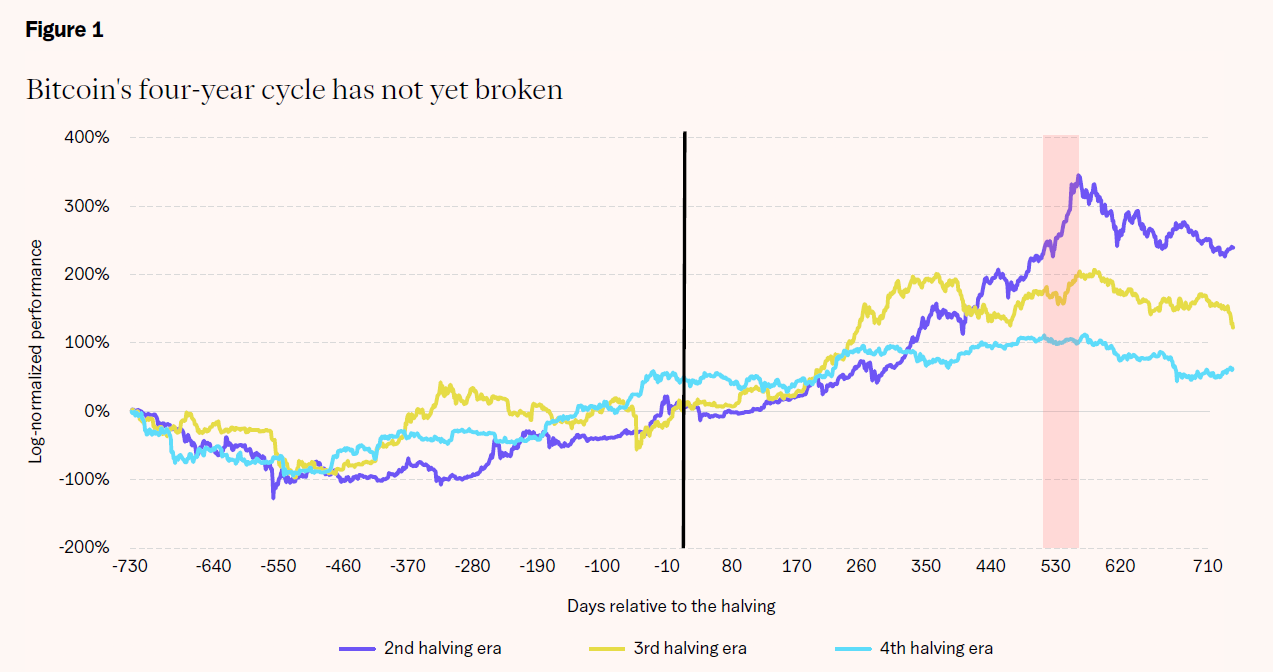
One of the report’s clearest conclusions was that Bitcoin’s (BTC) four-year market cycle remains intact, despite signs the asset class is becoming more institutionally driven.
“After peaking at around $126,000 in October 2025, Bitcoin pulled back sharply and has continued to trade in line with prior post-halving patterns,” the analysts wrote, arguing that institutional ownership has softened market drawdowns but has not fundamentally altered Bitcoin’s cyclical behavior.
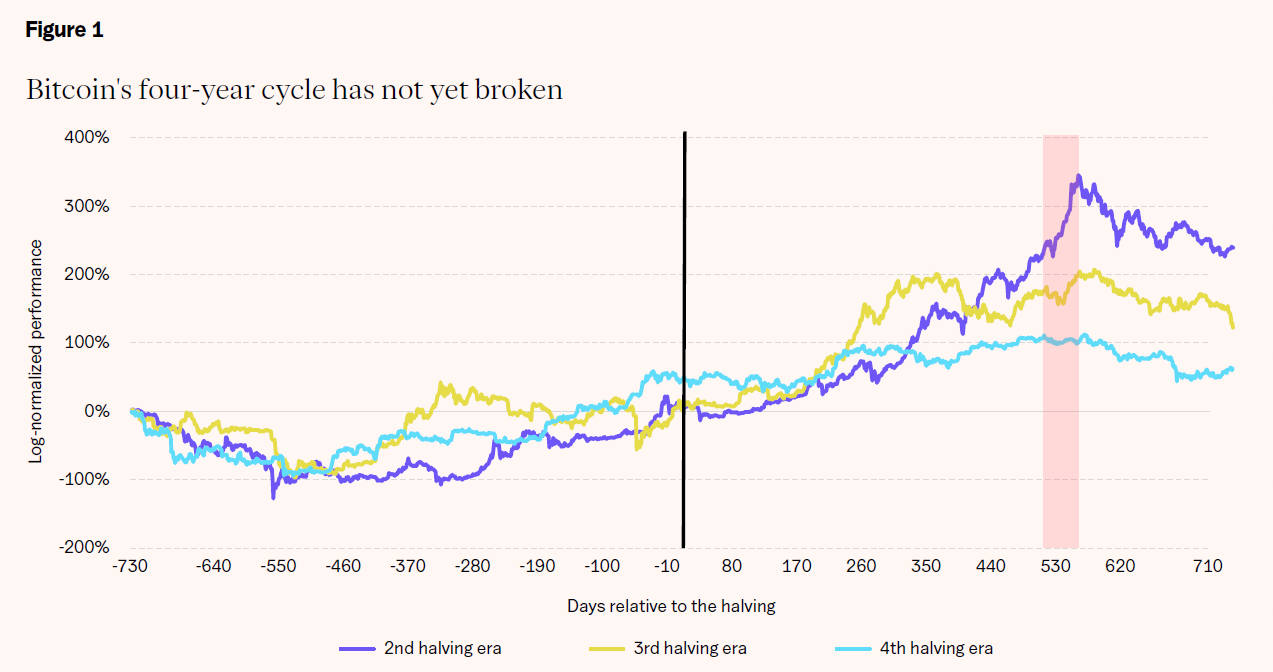
Bitcoin’s predictable four-year cycle continues to be a major driver of market conditions. Source: 21shares
Former 21shares co-founder Ophelia Snyder, who departed the company following its acquisition by FalconX in 2025, recently made a similar observation about how institutional investors have reshaped crypto markets.
“The investor base is larger, more institutional, and more connected to the broader financial system,” Snyder wrote in a recent Substack post. “As a result, competing narratives, geopolitical developments, and macroeconomic shifts all have a much larger impact on crypto pricing than they once did.”
Prediction markets expected to outperform
Among the sectors outperforming expectations, 21shares singled out prediction markets as one of crypto’s strongest growth areas, projecting annual trading volume will surpass $100 billion this year.
The report also highlighted consolidation as a defining trend across the industry. Public companies holding crypto on their balance sheets are beginning to diverge, with many smaller treasury players trading below the value of their digital asset holdings, pointing to further consolidation in the sector.
A similar pattern is emerging across Ethereum’s layer-2 ecosystem, where a handful of dominant rollups continue to gain market share while dozens of smaller networks struggle to attract meaningful users and liquidity.
Related: Bitcoin miners need billions to fund AI ambitions, led by IREN’s $21B gap
Crypto ETFs show resilience despite outflows
That resilience is also evident in crypto exchange-traded products, which have continued attracting long-term institutional investors despite weaker market conditions.
While US spot Bitcoin ETFs have recorded roughly $3 billion in net outflows this year, 21shares said those figures don’t tell the full story. Holdings remain just above 1.25 million BTC, near an all-time high in for the token, suggesting many investors have held onto their positions through the downturn.
“Investors are holding through volatility or quietly building strategic positions, even with Bitcoin trading well below its highs,” the analysts wrote.
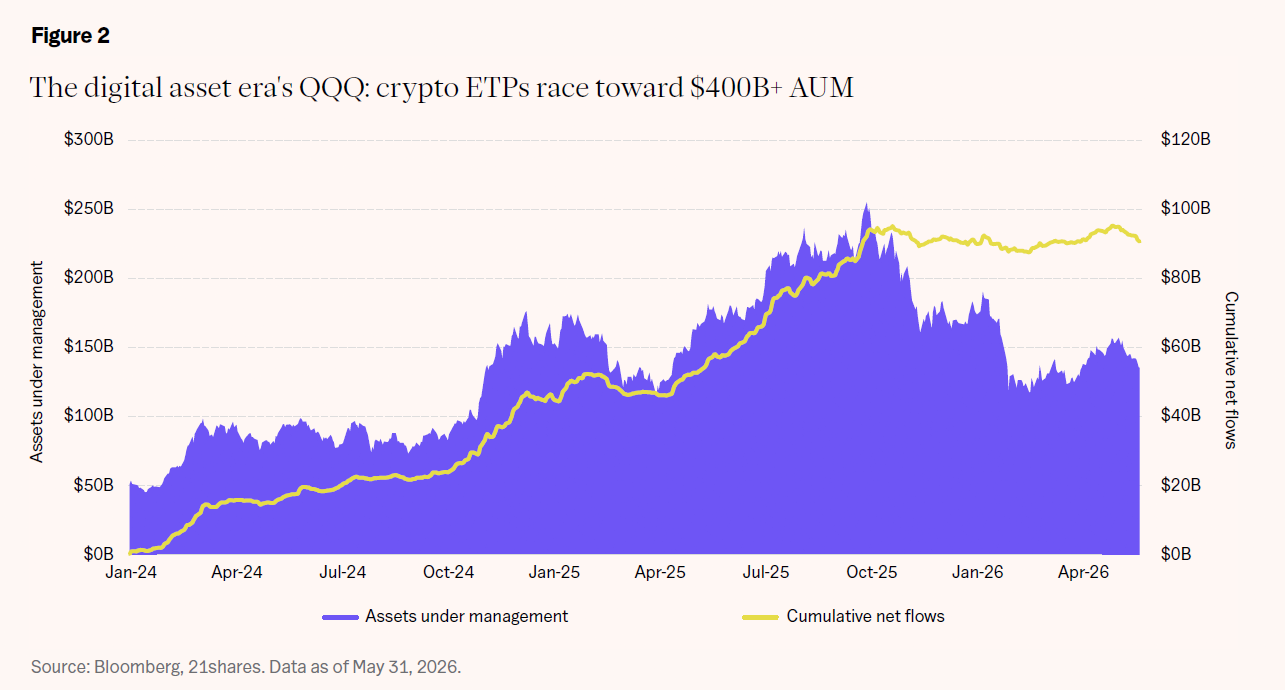
Crypto ETP assets have fallen from their peak, but cumulative investor inflows have remained resilient. Source: 21shares
The analysts also pointed to improving regulatory clarity in the United States, citing the Securities and Exchange Commission’s generic listing standards that have helped convert a backlog of crypto ETF applications into a steady stream of new product launches beyond Bitcoin and Ether.
“Hyperliquid stands out,” the analysts wrote. “US spot ETFs tracking the asset attracted over $150 million in net inflows in under a month, evidence that traditional capital continues to flow toward digital assets.”
Related: CBOE weighs converting BTC, ETH continuous futures into perpetual futures: Report
Bitcoin’s drop below $60,000 has triggered nearly $1.48 billion in crypto liquidations after fresh U.S. inflation data reinforced expectations that interest rates could remain higher for longer.
Summary
- Bitcoin’s drop below $60,000 triggered $1.48 billion in crypto liquidations, with long traders suffering the biggest losses.
- A $9.33 billion Bitcoin options expiry and rising inflation concerns have added to volatility across crypto markets.
- Stronger U.S. inflation, ETF outflows, and Strategy’s stock decline have reinforced expectations of higher interest rates.
According to data from crypto.news, Bitcoin (BTC) fell 3.3% to an intraday low of $58,188 on June 25 before recovering to around $59,200 at press time. Ethereum (ETH) declined 4.7% to $1,567, while XRP dropped 3.7% to $1.03. The total cryptocurrency market capitalization also fell 2.2% to $2.13 trillion.
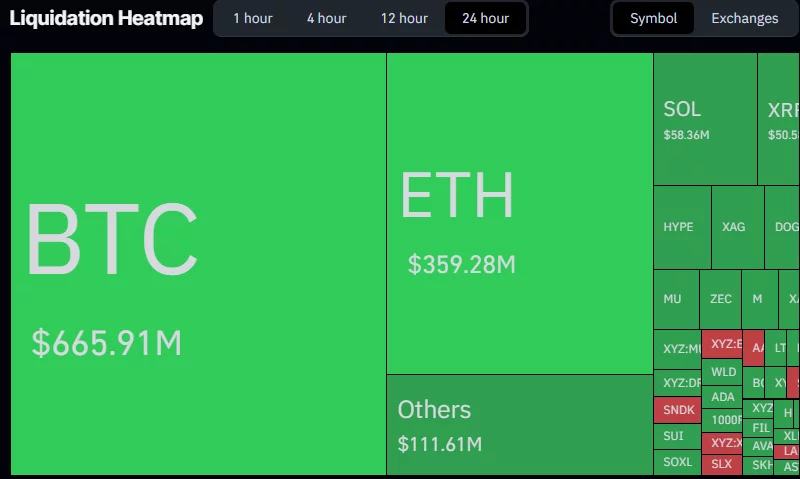
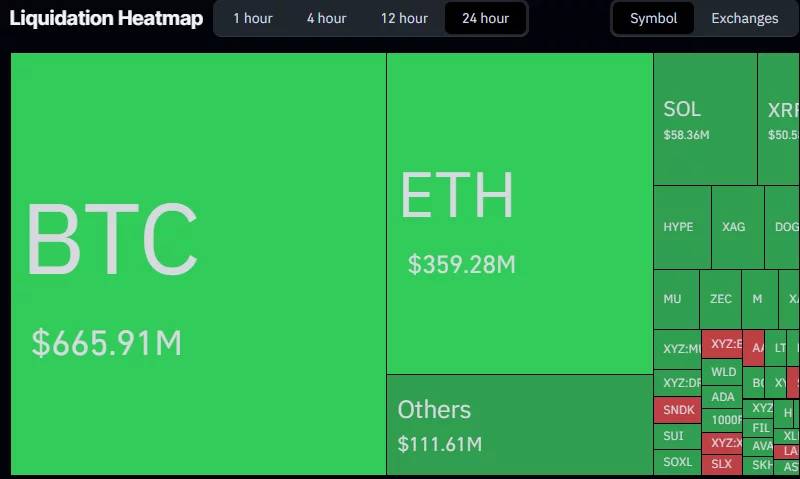
According to CoinGlass, more than 217,700 traders were liquidated over the past 24 hours, with total losses reaching approximately $1.48 billion. Long positions accounted for $1.21 billion of those liquidations, while short traders lost about $270 million. Bitcoin led the selloff with roughly $665 million in liquidations, followed by Ethereum at $359 million and XRP at $50.5 million.
Derivatives positioning keeps volatility elevated
Alongside the spot market decline, traders are preparing for one of the largest Bitcoin options expiries of the year. Data from Deribit shows roughly $9.33 billion in Bitcoin options, representing 157,611 open contracts, are scheduled to expire on Friday.
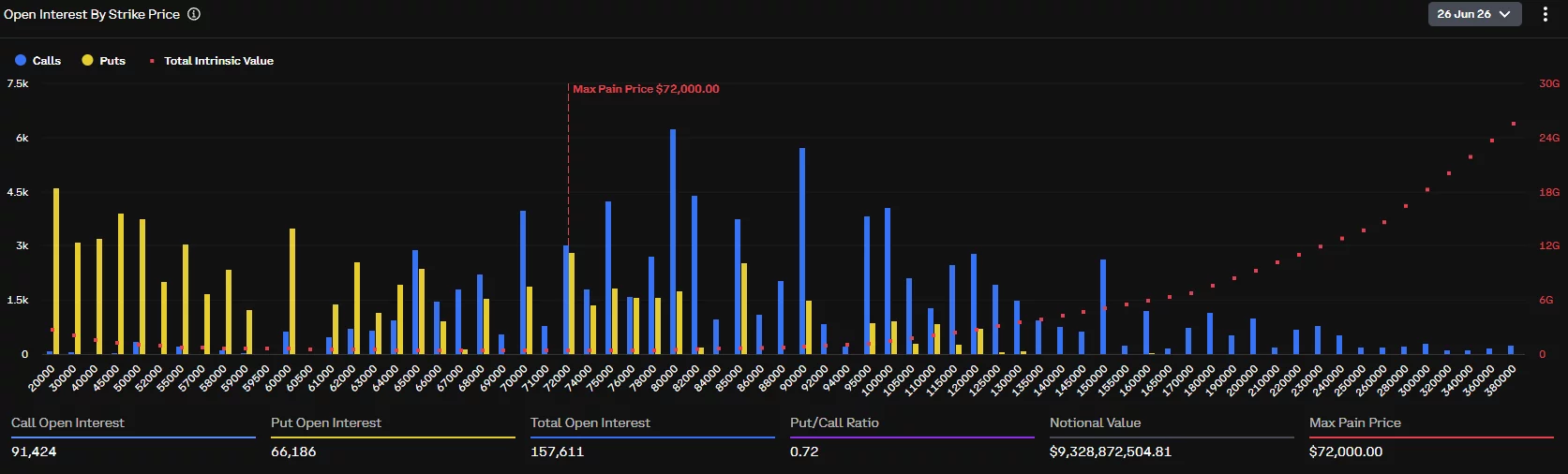
Call open interest is concentrated between the $75,000 and $90,000 strike prices, while put positioning is clustered across the $20,000 to $70,000 range. Deribit’s max pain price stands at $72,000, well above Bitcoin’s current market price. With Bitcoin trading far below the largest call positions, options traders could continue adjusting hedges into expiry, increasing short-term price swings.
Meanwhile, XRP derivatives remain tilted toward bullish positioning despite the broader selloff. CoinGlass data shows Binance XRP traders maintained a 2.53 long-to-short ratio, while OKX traders posted a 2.68 ratio, suggesting many participants are still positioned for a rebound. However, such crowded long positioning can increase liquidation risk if selling pressure persists.
Offering a longer-term perspective, analyst Daan Crypto Trades said he sees the green support zone on his chart as an area to gradually accumulate Bitcoin rather than trying to identify the exact market bottom.
He added that the weekly 200-week moving average has historically provided attractive value and said he remains comfortable accumulating in the $60,000 region, even though he believes lower prices remain possible during 2026.
Meanwhile, fellow analyst Lennaert Snyder said he had already taken profits on most of his Bitcoin short position following the latest breakdown.
“If we’re printing new lows I’m eyeing 55K for a reaction, but even the 40s are fine with me.”
Inflation data reinforces higher-for-longer outlook
According to the U.S. Bureau of Economic Analysis, the Personal Consumption Expenditures (PCE) price index increased 4.1% year over year in May, up from 3.8% in April, while headline PCE rose 0.4% on a monthly basis.
Although both readings came in slightly below economists’ expectations of 4.2% annually and 0.5% monthly, inflation remained more than double the Federal Reserve’s 2% target.
The report also showed core PCE increased 0.3% during the month and 3.4% from a year earlier. At the same time, the BEA reported that personal income rose 0.7%, while real consumer spending increased 0.3%, suggesting the U.S. economy remains resilient despite elevated borrowing costs. First-quarter GDP growth was also revised upward to 2.1%.
The inflation data arrived as institutional demand for Bitcoin continued to soften. U.S. spot Bitcoin exchange-traded funds have recorded roughly $6.4 billion in net outflows over the past 30 days, the largest monthly redemption period since the products launched. Pressure has also spread to equities, with Strategy shares falling more than 12% below $100, coinciding with Bitcoin’s break under $60,000.
Prediction markets have also turned increasingly cautious. According to Polymarket, traders are assigning a 66% probability that Bitcoin falls below $50,000, while the odds of a decline below $45,000 have risen to 46%.
Adding to those concerns, Bank of America recently revised its outlook and now expects three Federal Reserve rate hikes this year, replacing its earlier expectation that policymakers would keep rates unchanged.
Disclosure: This article does not represent investment advice. The content and materials featured on this page are for educational purposes only.

Quant Finance: Career Explained Part 1

Venezuela earthquake is further blow at time of uncertainty

Global-E Online Stock: Growth Runway Just Got A Lot Better (NASDAQ:GLBE)


-

 Fashion6 days ago
Weekend Open Thread: Miami – Corporette.com
-

 Entertainment5 days ago
Renter of Home in Anne Heche Crash Denies Settlement With Son
-
 Sports2 days ago
Two goals and an assist by sheer aura: Cristiano Ronaldo just entered the World Cup chat
-

 Tech4 days ago
Microsoft accidentally kills epic Outlook email threads
-

 Business5 days ago
Soccer-U.S. defends Iran World Cup travel restrictions, says discussions ongoing
-

 Politics6 days ago
Andy Burnham and the meaning of Makerfield
-

 NewsBeat6 days ago
Keir Starmer Allies Question His Chances For No 10
-

 Tech7 hours ago
A Look At A Gaggle Of Transputer Boards
-
Crypto World2 days ago
Bitcoin (BTC) Dips Below $62K, Ethereum (ETH) Plunges 6% Daily: Market Watch
-

 Crypto World2 days ago
Securitize Wraps Roubini's SEC-Registered ETF as Dubai VARA Digital Security
-
Business2 days ago
Entergy settles forward sale agreements, raises $672 million in cash proceeds
-
 Business6 days ago
Wall Street Week Ahead: Investors see Micron earnings as pulse check of AI rally momentum
-
 Crypto World6 days ago
Can Charles Hoskinson Really Rescue Cardano?
-

 Crypto World6 days ago
HIVE shares jump as $220M AI deal speeds Bitcoin mining pivot
-

 Crypto World6 days ago
Jake Chervinsky accuses CME of protecting derivatives monopoly
-

 Entertainment6 days ago
Jose Alvarado Wants Taylor Swift at More Knicks Games
-
 Tech5 days ago
Signal’s Meredith Whittaker says AI chatbots ‘are not your friends’ and calls Copilot agents a backdoor
-

 Sports13 hours ago
India vs Bangladesh LIVE Score, Women’s T20 World Cup: Bangladesh Opt To Bat; India Enter ‘Do-Or-Die’ Stage As Semi-Final Race Heats Up
-

 Tech3 days ago
Nearly 7,000 fake Amazon domains registered ahead of Prime Day 2026, researchers warn
-

 Business5 days ago
MHP SE 2026 Q1 – Results – Earnings Call Presentation (OTCMKTS:MHPSY) 2026-06-20
You must be logged in to post a comment Login