

Crypto World
EU Lawmakers Call for Clear DeFi, Staking, NFT Rules Under MiCA


The European Parliament’s Committee on Economic and Monetary Affairs (ECON) has asked the European Commission to examine whether additional parts of the crypto sector—such as crypto lending and borrowing, staking, non-fungible tokens (NFTs), and decentralized finance (DeFi)—should be brought within the EU’s regulatory perimeter. The request is set out in an own-initiative resolution tabled for the Parliament’s plenary vote, where it is expected to be considered on July 7.
While the measure would not amend the EU’s Markets in Crypto-Assets Regulation (MiCA) or create new legal obligations, it signals how lawmakers may shape subsequent Commission proposals and supervisory priorities. For crypto-asset service providers, banks, and institutional investors, the resolution matters less for immediate enforceable change and more for how it could influence the direction of EU crypto policy—particularly around stablecoins and “tokenization” of traditional financial services.
Key takeaways
- ECON urges the European Commission to assess whether crypto lending/borrowing, staking, NFTs, and DeFi merit additional regulation beyond MiCA.
- The draft resolution supports the development of euro-denominated stablecoins within MiCA and frames them as potentially complementary to tokenized bank deposits and wholesale central bank digital currency models.
- ECON calls for consistent, EU-wide application of MiCA to avoid divergent national rules that could fragment the single market.
- If adopted, the resolution would become the Parliament’s official policy position, but it would not modify MiCA or impose new obligations.
ECON’s resolution: expanding the policy lens beyond MiCA
The recommendations were drafted by Belgian Member of the European Parliament Johan Van Overtveldt and advanced through ECON’s internal negotiations before being tabled for a plenary vote. According to the European Parliament’s procedure documents, the resolution is an own-initiative instrument designed to set out guidance for the Commission regarding the future shape of EU digital asset regulation.
ECON’s central request is forward-looking: the committee asks the Commission to evaluate regulatory coverage for activities that are not uniformly addressed by MiCA’s current scope. The resolution explicitly references crypto lending and borrowing, staking, NFTs, and DeFi—areas that, in practice, span multiple business models and may involve varying degrees of custody, asset pooling, market-making, governance structures, and cross-border service provision.
For compliance teams and regulated intermediaries, the key issue is not simply “whether” these activities should be regulated, but “how” and “under which regime.” MiCA already establishes licensing and authorization requirements for certain crypto-asset service providers, while other frameworks—such as rules on anti-money laundering (AML), consumer protection, and market conduct—may apply depending on structure and distribution. ECON’s call indicates lawmakers want clearer boundaries and regulatory coherence as these products evolve.
Stablecoins and tokenized finance: a more constructive regulatory stance
A major element of the ECON resolution relates to stablecoins, particularly those denominated in euros. The text frames euro stablecoins as potentially supportive of the EU’s payments ecosystem and encourages their development within MiCA’s framework.
That approach reflects a broader policy shift among some European institutions, including a recognition that stablecoins can operate alongside—rather than necessarily replace—existing money and payment rails. ECON links euro-denominated stablecoins to potential integration with tokenized commercial bank deposits and wholesale central bank digital currencies, suggesting that future EU financial infrastructure could incorporate multiple “digital money” channels.
The policy context is particularly sensitive given how stablecoin arrangements interact with banking liquidity and reserve management. In earlier discussions around the banking turbulence in the United States, concerns were tied to reserve custody and banking counterparties. For example, during the collapse of Silicon Valley Bank, USDC issuer Circle reportedly held a material portion of reserves at the bank, and USDC briefly lost its dollar peg. Although those events occurred outside the EU, they continue to influence how European policymakers evaluate reserve quality, redemption arrangements, and systemic risk controls for stablecoins.
ECON’s resolution also aligns with the committee’s parallel work on the euro’s digital future. It references legislative momentum supporting a “coexistence” model for a potential digital euro alongside private digital money solutions—an approach that suggests policymakers may view stablecoins and public digital currency designs as complementary components of a broader digital payments architecture.
MiCA implementation pressure and the question of national divergence
The resolution goes beyond new regulatory topics by focusing on execution and market structure. It urges consistent application of MiCA across member states to preserve a level playing field for crypto firms. This is a crucial compliance concern: when national regulators introduce additional or differing requirements, firms face increased operating cost, legal uncertainty, and fragmentation of distribution strategies within the EU.
ECON’s earlier draft, presented by Van Overtveldt in February, reportedly focused more tightly on MiCA’s existing framework—such as stablecoin classifications and legal certainty for multi-issued stablecoins. Over months of negotiation, the committee incorporated a broader set of policy questions, culminating in the current recommendation set that also calls for reconsideration of regulatory coverage for activities such as DeFi and staking.
At the EU level, the Commission is already working to reassess parts of MiCA’s scope. In May, the European Commission launched a public consultation seeking input on whether the framework should be expanded to cover areas that include DeFi, staking, lending, NFTs, and tokenized financial assets, while also revisiting debates around MiCA’s ban on interest-bearing stablecoins. Although consultations are not binding legislation, they typically shape the Commission’s next steps and can provide a timeline for future legislative proposals.
Implementation is also time-bound. MiCA’s transitional period is set to end on July 1, after which crypto-asset service providers generally need authorization under MiCA to continue operating across the EU. That deadline increases the practical stakes for firms regarding licensing strategy, supervision expectations, and product mapping—especially for services that may fall near the edges between crypto-asset activity and activities that regulators may treat differently under existing financial law.
Institutional implications: compliance, consumer protection, and legal clarity
For banks, payment firms, and institutional investors assessing crypto exposure, the resolution underscores that EU oversight is moving toward a more comprehensive assessment of how crypto activities affect market integrity and risk allocation. Even without immediate amendments to MiCA, the Parliament’s policy position can influence supervisory guidance, regulatory interpretation, and the Commission’s legislative drafting priorities.
Key open questions remain. ECON’s call does not specify a single mechanism for extending regulation, and the outcome of the plenary vote would only establish a non-binding political mandate for the Commission. In practice, the future direction could depend on how the Commission and co-legislators determine which activities are best addressed by MiCA extensions versus other EU regimes (for example, rules tied to financial services licensing, AML/KYC, consumer protection, or market abuse).
Cross-border coordination is also likely to remain a central theme. DeFi and tokenized asset activities often rely on service providers, intermediaries, or infrastructure operating across jurisdictions. As the EU considers regulatory scope expansion, compliance teams will need to monitor how authorization requirements, supervisory expectations, and governance standards may be applied to novel business models—particularly those with decentralized features that complicate “who is responsible” under traditional regulatory frameworks.
Closing perspective
As the July 7 plenary vote approaches, the resolution’s adoption would provide the European Parliament with an explicit mandate on crypto regulatory coverage, reinforcing pressure on the Commission’s ongoing MiCA review process. The central item for observers is how the Commission translates this political direction into concrete legislative options—if any—particularly for stablecoins, DeFi-adjacent services, and staking-related business models.



Whether a token is a security or a commodity decides almost everything about how it can be traded, listed, and held in the U.S. In March 2026 regulators called sixteen major tokens “digital commodities,” but only on interpretive footing a future administration could undo. The CLARITY Act would turn that label into law. Here is what a digital commodity actually is, and how the bill would reclassify crypto.
Summary
- A digital commodity is a crypto asset whose value comes from the workings of a functional blockchain and from supply and demand, not from the expectation of profit from a company’s managerial efforts.
- The distinction matters enormously: a security falls under the securities regulator’s heavy registration and disclosure regime, while a commodity falls under the commodities regulator’s lighter-touch oversight.
- In March 2026 the SEC and CFTC jointly classified sixteen major tokens, including Bitcoin, Ethereum, XRP, and Solana, as digital commodities, but that was an interpretation, not a law, and a future administration could reverse it.
- The CLARITY Act would write the digital-commodity category into federal statute, making the classification durable, and create a maturity test that lets a token move from security to commodity as its network decentralizes.
- Reclassification changes what products can be built, especially exchange-traded funds, how exchanges list assets, how institutions hold them, and how much investor protection applies.
A digital commodity is a crypto asset whose value comes from the workings of its blockchain and from supply and demand, rather than from the promised efforts of a company or team, which is the legal distinction that places it under the lighter-touch oversight of the commodities regulator instead of the heavier hand of the securities regulator. That sentence contains the entire stakes of one of the most consequential questions in crypto: for any given token, is it a security or a commodity. The answer determines which federal agency has authority over it, what financial products can be built around it, how exchanges can list it, whether large institutions can comfortably hold it, and how aggressively the government can act against the people who issue and trade it. For more than a decade, the U.S. had no clear way to answer that question for most tokens, leaving the entire industry in a gray zone, and the fight over how to draw the line, and who gets to draw it, has shaped the regulation of crypto in America more than any other issue.
In 2026 that long-running question reached a turning point on two fronts at once, and understanding both is essential to understanding what a digital commodity is and why it matters. On the regulatory front, the two relevant agencies, the securities regulator and the commodities regulator, took the unprecedented step of jointly declaring sixteen major tokens to be digital commodities, ending years of ambiguity for those specific assets. On the legislative front, Congress has been working on the CLARITY Act, a bill that would take the digital-commodity concept and write it into permanent federal law, with a mechanism for deciding which tokens qualify and how a token can move from one category to another over time. This guide explains what a digital commodity actually is, why the security-versus-commodity distinction decides so much, the test at the heart of classification, what the 2026 regulatory interpretation did and why it was not enough on its own, how the CLARITY Act would reclassify crypto by statute, the clever maturity mechanism that lets a token change categories, what reclassification practically changes, and the real limits and risks that remain.
What a digital commodity actually is
Start with the precise definition, because the legal language is doing specific work. A digital commodity, in the formulation regulators have adopted, is a crypto asset that is intrinsically linked to and derives its value from the programmatic operation of a functional crypto system, as well as from supply and demand dynamics, rather than from the expectation of profits from the essential managerial efforts of others. That is a dense sentence, so it helps to unpack it: the key idea is the source of the asset’s value. A digital commodity is valuable because of how its blockchain works and because of ordinary market forces of supply and demand, not because some company is promising to do work that will make the token go up.
Crucially, regulators have added that a digital commodity does not carry intrinsic economic rights such as generating a passive yield or conveying a claim on the future income, profits, or assets of a business, which is exactly the kind of feature that would make something look like a security. The contrast that makes this concrete is the traditional commodity. Think of oil, wheat, or gold: these are produced by many different parties around the world, not issued by a single company to raise money for itself, and one unit is interchangeable with another, so one barrel of a given grade of oil is worth the same as any other. Their value comes from supply and demand and from their inherent usefulness, not from anyone’s promise of profit.
Regulators have long treated Bitcoin the same way, reasoning that it is produced by many disparate miners around the world, is fungible, and has no central issuer making promises, which makes it commodity-like rather than security-like. The digital-commodity category extends that logic to other tokens whose networks are sufficiently decentralized and functional that no central enterprise is driving their value through promised efforts. A digital commodity, then, is the crypto equivalent of gold or oil instead of the crypto equivalent of a company’s stock. That single distinction is what determines how it is regulated.
Security or commodity: the question that decides everything
To see why this classification carries such weight, you have to understand how differently the two categories are regulated. Securities, which include stocks and bonds, fall under the securities regulator, whose regime is built around investor protection through heavy obligations: companies issuing securities must register their offerings, provide extensive ongoing disclosures, and operate within a tightly controlled system of registered broker-dealers and exchanges, all backed by the threat of enforcement for non-compliance. The logic is that when people invest money expecting profit from someone else’s efforts, they need protection and information, so the law imposes a demanding framework. Commodities, by contrast, fall under the commodities regulator, whose regime is far lighter.
The commodities regulator oversees the derivatives markets for commodities, such as futures and options, and can pursue fraud and manipulation, but it does not impose the same registration-and-disclosure burden on the underlying asset. It also has limited direct authority over spot markets where commodities are bought and sold for immediate delivery, which is why the jurisdictional split codified by the CLARITY Act matters so much. The practical consequences of which bucket a token lands in are enormous, which is why the industry has fought over classification for years. If a token is a security, its issuer faces registration and disclosure requirements, the exchanges listing it face securities-law obligations, and institutions weighing whether to hold it confront the heavier compliance and restrictions that come with securities.
If the same token is a commodity, those burdens largely lift: listing is easier, compliance is lighter, and the path to building products around it, especially exchange-traded funds, becomes far more direct. Classification also determines which regulator writes the rules, who pays which fees, how custody is handled, and how much room institutions have to participate. Calling a token a security or a commodity is not a technicality; it is a decision that shapes whether a project can operate smoothly in the U.S. or faces a wall of regulatory friction. It also influences the token’s accessibility to the institutional capital that can move its price, which is why the definition of a digital commodity, and the process for deciding which tokens qualify, became one of the central battles in crypto policy.
The Howey test and the efforts of others
At the heart of the security-versus-commodity question sits a legal test that has governed it for decades: the Howey test. Derived from a Supreme Court case, the Howey test defines an investment contract, which is a type of security, as an investment of money in a common enterprise with an expectation of profits derived from the efforts of others. That last phrase, the efforts of others, is the crux. If you buy a token primarily because you expect a company or team to do work that will increase its value, the arrangement looks like a security, because your profit depends on their efforts.
If, instead, the token’s value comes from a decentralized network and market forces with no central party whose efforts you are relying on, it looks more like a commodity. The Howey test is why the same token can be treated differently depending on how it is sold and how mature its network is. This is also where one of the most important and confusing features of crypto classification comes from: a token’s status is not necessarily permanent. The Howey analysis depends on facts that can change as a project evolves.
A token might begin its life as a security, sold by a founding team to raise money for a network that does not yet exist, where buyers are clearly relying on the team’s efforts. Over time, if the network becomes genuinely functional and decentralized, with no central team driving its value, the same token can stop looking like a security and start looking like a commodity, because the efforts-of-others element fades away. This transition is the key conceptual move that everything else builds on, and it explains why regulators and lawmakers have struggled to draw clean lines: the line itself moves as a project matures. The 2026 regulatory interpretation adjusted the Howey analysis for crypto by requiring that an issuer affirmatively make representations or promises about its essential managerial efforts for there to be an investment contract, which sharpened the test in a way favorable to treating mature, decentralized tokens as commodities.
The March 2026 interpretation: a label, not a law
In March 2026 the security-versus-commodity question got its most significant answer yet, though an incomplete one. The securities regulator and the commodities regulator, which had spent years disagreeing over jurisdiction, jointly issued a formal interpretation that, for the first time, set out an agreed framework for classifying crypto assets. The interpretation sorted crypto into a taxonomy of categories, most of which are not securities: digital commodities, digital collectibles such as certain non-fungible tokens, digital tools that perform a utility function like membership or access, stablecoins, which sit in their own lane governed by separate stablecoin legislation, and digital securities, the one category that clearly is a security. Within that framework, the agencies named sixteen major tokens as examples of digital commodities, including Bitcoin, Ethereum, Solana, and XRP, alongside others such as Cardano, Litecoin, and even some memecoins, explicitly declaring that these assets are not securities and that their spot trading falls primarily under the commodities regulator.
This was a landmark moment, the first time the two top financial regulators agreed in writing on how to treat these assets, and it brought real clarity to the named tokens. But it carried a critical limitation that defines why the story does not end there. The interpretation is exactly that, an interpretation: a statement of how the agencies read existing law, binding on the agencies themselves in how they administer the law, but not a new statute passed by Congress. That distinction matters enormously, because an interpretation issued by agencies can be modified or reversed by those same agencies under a future administration.
The clarity it provides is real but conditional, resting on the current regulators’ chosen reading instead of on durable law. This is precisely why, even as the industry welcomed the interpretation, many participants, and even one of the regulators involved, called for Congress to act, because only legislation can turn a reversible interpretation into permanent law. Stablecoins sit in their own separate lane, which is why the law governing the stablecoin category matters alongside the CLARITY Act rather than inside the same commodity bucket. Digital securities, meanwhile, remain a separate class, and the rise of the digital-securities category shows why not every on-chain asset belongs under commodity-style treatment.
How the CLARITY Act reclassifies crypto
The CLARITY Act, formally the Digital Asset Market Clarity Act, is the legislative effort to take the digital-commodity concept and write it into federal statute, giving it the permanence the 2026 interpretation lacks. The bill would create a statutory framework that sorts digital assets into categories and assigns them to regulators, with digital commodities placed under the commodities regulator and securities remaining with the securities regulator. In doing so, it would codify the jurisdictional split that the interpretation expressed, so that the division of authority between the two agencies rests on law instead of on an agreement that could be undone. A companion measure moving through the agriculture committee, sometimes called the Digital Commodity Intermediaries Act, would give the commodities regulator formal jurisdiction over the spot markets for digital commodities, addressing the long-standing gap in which that regulator could oversee derivatives but had limited authority over everyday spot trading.
The conceptual heart of how the CLARITY Act reclassifies crypto is a principle of separating the asset from the way it is offered and sold. Under this approach, the act recognizes that a token can be sold in a transaction that is an investment contract, and therefore a security at the point of that sale, while the underlying token itself can be a digital commodity. This separation is what allows the law to handle the awkward reality that the same token can look like a security in one context and a commodity in another. It means the securities regulator retains authority over primary-market fundraising, when a project first sells tokens to raise capital and buyers are relying on the team’s efforts, as well as over assets that truly function as investment contracts, while the commodities regulator takes over the secondary-market trading of digital commodities once a token’s network is mature.
By writing this structure into statute, the CLARITY Act would replace the case-by-case, lawsuit-driven approach of the past, in which classification was fought out one enforcement action at a time, with a predictable framework that issuers and exchanges can read in advance. That shift, from regulation by enforcement to regulation by clear rule, is what the industry treats as the bill’s central promise. It is also why the bill’s contested path matters so much: until the bill becomes law, the digital-commodity framework remains partly dependent on agency interpretation rather than statutory permanence. The category may now be easier to understand, but it still needs Congress to make it durable.
The maturity test: how a token moves from security to commodity
The cleverest and most important mechanism in the CLARITY Act is the one that lets a token change categories as its network matures, because it directly addresses the moving-line problem that Howey created. The bill creates a maturity test, a set of criteria for determining when a blockchain system has become decentralized and functional enough that its token should be treated as a digital commodity instead of as part of a securities offering. The underlying idea follows directly from the efforts-of-others principle: a token sold early in a project’s life, when a central team is building the network and buyers are betting on that team’s success, fits the securities framework. Once the network is truly up and running and no longer dependent on a central group’s managerial efforts, the justification for securities treatment fades, and the token can graduate to commodity status.
This creates what is sometimes called a maturity on-ramp, a path by which a token can begin under securities oversight and, as its network decentralizes and meets the maturity criteria, transition to commodity oversight. The criteria for maturity center on decentralization: roughly, whether the system operates without any single person or affiliated group exercising outsized control over the network or its value, whether it is functional, and whether its governance and operation are truly distributed. A blockchain that meets the test is treated as mature, and its native token is treated as a digital commodity. This mechanism is what makes the CLARITY Act more sophisticated than a simple fixed list of which tokens are commodities.
Instead of freezing classifications in place, it provides a rule for how a token earns commodity status by becoming the kind of decentralized network that commodity treatment is meant for. It is also, as the limits section notes, one of the most contested parts of the bill, because deciding exactly how decentralized is decentralized enough is truly difficult, and the definition the bill uses has been criticized from multiple directions. But the basic design, a test that lets status follow the reality of a network’s maturity instead of being fixed at launch, is the conceptual engine of how the CLARITY Act would reclassify crypto. It gives projects a legal path from fundraising-stage oversight to mature-network treatment, rather than forcing every dispute into the courts.
What reclassification actually changes
For everyday holders and for the market, the abstract question of classification translates into concrete consequences, so it is worth being specific about what changes when a token is treated as a digital commodity. The most immediate effect is on financial products, above all exchange-traded funds. An asset classified as a commodity follows a far more direct regulatory path to a spot ETF than a security does, which is why the digital-commodity designation has been linked to a surge of pending ETF applications across many tokens. For an investor, this matters because spot ETFs are often the most convenient and trusted way for both retail and institutional money to gain exposure to an asset, so commodity status can widen access and bring in new demand.
Reclassification also eases how exchanges list a token, since listing a commodity does not carry the securities-law obligations that listing a security does, and it lowers the compliance burden across the board. The change extends to institutions and to specific crypto activities. Large institutions, including asset managers and pension funds, generally face fewer restrictions holding commodity-classified assets than security-classified ones, so commodity status can unlock institutional participation that securities treatment would discourage. The 2026 interpretation also clarified that certain activities long shadowed by securities-law uncertainty, including protocol staking and the wrapping of tokens, are not in themselves securities transactions when conducted within defined boundaries, which removed legal risk that had pushed some platforms to suspend staking services.
To make the journey concrete, consider a token’s path under this framework: it might launch through a sale that is an investment contract, a security at that moment, with its issuer subject to securities obligations. Then, as its network grows decentralized and functional and meets the maturity test, the token itself comes to be treated as a digital commodity, its spot trading moves under the commodities regulator, exchanges can list it more easily, an ETF becomes feasible, and institutions grow more comfortable holding it. That arc, from security at birth to commodity at maturity, is the practical shape of what the CLARITY Act’s reclassification is designed to enable. It is why the industry views statutory clarity as the gateway to the next phase of adoption.
Limits, risks, and what is still unsettled
For all its significance, the digital-commodity framework comes with real limits and unresolved tensions that an honest account must address. The first and most important is the gap between interpretation and law. The 2026 classification of sixteen tokens as digital commodities is an agency interpretation, binding on the agencies but reversible by a future administration, which means the clarity it provides is conditional instead of permanent until Congress acts. And the legislation meant to make it durable, the CLARITY Act, has not become law; it has advanced through the House and a Senate committee but still faces a contested path, so the statutory permanence the industry wants is not yet secured.
Beyond the interpretation-versus-statute problem, several substantive concerns persist. The definition of decentralization at the core of the maturity test is truly hard to pin down, and critics argue the version in play is too narrow or too vague, which could lead to inconsistent or contestable classifications. There is a meaningful investor-protection tradeoff: moving an asset out of the securities regime and into the commodity regime means lighter disclosure requirements and fewer of the protections securities law provides, which supporters see as appropriate for decentralized assets but critics warn could leave holders more exposed, particularly because crypto can be more susceptible to manipulation than registered securities and direct crypto holdings do not carry the same regulatory safeguards. Classification can also remain context-dependent: even a token treated as a commodity in secondary trading could be part of a securities transaction if it is later sold subject to an investment-contract arrangement promising profits.
The whole area remains politically contested, with the CLARITY Act facing objections over its decentralized-finance provisions, its treatment of stablecoin yield, and ethics questions, any of which could reshape or stall it. The honest summary is that the digital-commodity category represents real and welcome progress toward clarity, but it currently stands on reversible interpretive ground, depends on legislation that has not passed, relies on a maturity test that is hard to define, and carries genuine investor-protection tradeoffs. It is a meaningful step in defining how crypto is regulated, not a finished or settled answer.
Frequently asked questions
What is a digital commodity in simple terms?
A digital commodity is a crypto asset whose value comes from how its blockchain works and from ordinary supply and demand, instead of from a company promising to do work that makes the token go up. That makes it the crypto equivalent of gold or oil instead of a company’s stock. Because no central enterprise is driving its value through promised efforts, it is treated like a commodity under the lighter-touch commodities regulator instead of as a security under the heavier securities regulator. Regulators have long treated Bitcoin this way and, in 2026, extended the label to other sufficiently decentralized tokens such as Ethereum, XRP, and Solana.
Why does it matter whether a token is a security or a commodity?
Because the two are regulated completely differently, and the difference shapes nearly everything. A security falls under the securities regulator’s heavy regime of registration, disclosure, and trading restrictions designed to protect investors. A commodity falls under the commodities regulator’s far lighter regime, which oversees derivatives and pursues fraud but imposes much less burden on the underlying asset. Commodity status makes a token easier to list, lighter to comply with, more accessible to institutions, and far closer to qualifying for a spot exchange-traded fund.
Which cryptocurrencies are digital commodities?
In March 2026 the securities and commodities regulators jointly named sixteen major tokens as examples of digital commodities, including Bitcoin, Ethereum, Solana, and XRP, along with others such as Cardano, Litecoin, Stellar, and some memecoins. The list was described as not closed, meaning other assets could qualify. The common thread is that these tokens derive their value from decentralized, functional networks instead of from a central team’s promised efforts. It is important to note this came from an agency interpretation instead of a law, so while it gave real clarity to those tokens, the classification rests on interpretive footing that could change until Congress passes durable legislation.
How does the CLARITY Act reclassify crypto?
The CLARITY Act would write the digital-commodity category into federal statute, placing digital commodities under the commodities regulator and securities under the securities regulator, codifying the jurisdictional split so it rests on law instead of a reversible interpretation. Its key mechanism is separating the asset from how it is sold: a token can be sold in a securities transaction while the underlying token is a digital commodity. The securities regulator keeps authority over fundraising and genuine investment contracts, while the commodities regulator takes over secondary trading of mature digital commodities. This replaces the old case-by-case enforcement approach with a predictable, statutory framework.
What is the maturity test?
The maturity test is the CLARITY Act’s mechanism for letting a token move from security to commodity as its network matures. The idea follows from the principle that a token sold early, when a central team is building the network and buyers rely on that team’s efforts, fits the securities framework, but once the network is truly decentralized and functional, no longer dependent on a central group, the token can graduate to digital-commodity status. The criteria center on decentralization: whether any single person or group exercises outsized control, whether the system is functional, and whether its operation is truly distributed. It creates a maturity on-ramp instead of freezing a token’s status at launch, though defining decentralization precisely remains contested.
Is a digital commodity safer or less regulated than a security?
It is less heavily regulated, which cuts both ways. Commodity status means lighter compliance, easier listing, and broader access, which the industry views as appropriate for decentralized assets and a driver of adoption. But it also means fewer of the disclosure requirements and investor protections that securities law provides, so holders may be more exposed, particularly because crypto can be more susceptible to manipulation than registered securities and direct crypto holdings lack the same safeguards. Commodity status is also not a permanent, blanket shield, since a token could still be part of a securities transaction if later sold with profit promises.
This article is educational information, not legal, financial, or tax advice. The classification of crypto assets, the status of the 2026 regulatory interpretation, and the progress of the CLARITY Act reflect information available as of June 28, 2026, and can change. Regulatory classifications can be modified, and the legal treatment of any specific token may differ by context and jurisdiction. Verify current details from primary sources and consult a qualified professional before making any decision.


Tether is expanding the use of Tether Gold as crypto lender Ledn adds support for XAU₮.
Summary
- Tether is expanding XAU₮ utility by bringing tokenized gold into Ledn’s lending platform this year.
- XAU₮ holders will be able to borrow against gold without selling the underlying tokenized bullion.
- The move follows Tether’s wider shift toward gold, Bitcoin mining, AI, and infrastructure assets.
The move will let users hold and trade tokenized gold on Ledn, with gold-backed loans expected later this year.
The plan extends Tether’s wider gold strategy at a time when tokenized bullion is gaining more use in crypto markets. Each XAU₮ token represents one fine troy ounce of physical gold stored in Swiss vaults.
XAU₮ joins Ledn’s lending platform
Ledn said it has added support for XAU₮ alongside Bitcoin, USD₮ and USA₮. The platform said users can now hold and trade XAU₮, while borrowing against the tokenized gold product will come later in 2026.
The product follows the same structure Ledn has used for Bitcoin-backed loans. Users can access liquidity while keeping exposure to the underlying asset instead of selling it for cash.
Ledn said client collateral remains held 1:1 and is not lent out or used to generate yield. That point matters after the 2022 crypto lending failures, when weak risk controls and rehypothecation hurt many customers.
The company said demand is growing for services that combine long-term asset ownership with financial flexibility.
“As digital assets become an increasingly important part of the global economy, demand is growing for solutions that combine long-term ownership with financial flexibility,” Tether CEO Paolo Ardoino said.
Tether expands its gold strategy
Tether Gold has grown sharply over the past year as demand for tokenized gold increased. Tether said XAU₮ reserves reached 707,747.139 fine troy ounces by March 31, 2026.
That was up from 520,089.350 fine troy ounces at the end of 2025. Tether said XAU₮’s market value rose from about $2.25 billion to more than $3.3 billion during the first quarter.
The wider $23 billion gold figure refers to Tether’s broader bullion position across its products. Reuters reported that Tether held about 132 metric tons of gold for USDT reserves at the end of March, valued near $19.8 billion, while XAU₮ accounted for about 22 tons.
Tether has also moved to focus more on XAU₮ after closing Alloy and aUSDT. As previously reported, users can redeem aUSDT and recover XAU₮ until Sept. 17 before Alloy support ends.
Gold-backed loans mirror Bitcoin lending
Gold-backed lending is not new in traditional finance. Banks, bullion dealers and large financial firms have long used physical gold as collateral.
Tether and Ledn are trying to bring that model into digital asset markets. Tokenized gold can move on blockchain rails while still tracking ownership of physical bullion held in custody.
This setup may appeal to users who want to keep gold exposure but still need liquidity. A borrower could use XAU₮ as collateral and receive stablecoins without selling the gold-backed asset.
The model also gives Tether another way to add use cases around XAU₮. Instead of acting only as a tokenized gold holding, XAU₮ could become collateral inside crypto lending markets.
Tokenized gold push widens
The Ledn plan follows other recent moves around Tether Gold. Tether and Fasset launched a Visa card with XAU₮ rewards, allowing eligible users to spend through the card and earn up to 6% cashback in tokenized gold.
That product placed XAU₮ closer to everyday payments. It also showed how Tether is testing uses for tokenized gold beyond storage and trading.
The company has also invested beyond stablecoins. Tether has backed Bitcoin mining, renewable energy projects, AI infrastructure, Gold.com and Antalpha as part of a wider technology and infrastructure push.
For Tether, the Ledn deal gives XAU₮ another practical role. Users may soon be able to borrow against tokenized gold in a structure closer to Bitcoin-backed lending, without giving up exposure to the underlying bullion.


Polymarket’s latest security incident has grown larger after blockchain intelligence firm AMLBot updated the estimated losses to about $3.1 million.
Summary
- Polymarket’s frontend phishing attack now shows $3.1 million in losses across 11 user wallets.
- The platform says a compromised third-party vendor injected malicious code into parts of its frontend.
- The refund pledge comes as lawmakers press regulators over alleged deceptive prediction market advertising practices.
The prediction market platform had earlier promised to refund affected users after saying a third-party vendor compromise allowed malicious code to reach some users through its frontend.
Hack losses rise to $3.1M
AMLBot said hackers stole about $3.1 million in PUSD from 11 user wallets. The firm said the funds were taken from Polygon and quickly bridged to Ethereum.
The update raises the loss figure from earlier estimates near $2.94 million. Specter Analyst had first flagged the attack as a phishing campaign that drained funds from at least 11 wallets holding PUSD.
Polymarket said in a June 25 post that it found a third-party vendor had been compromised. The company said the vendor issue allowed attackers to inject a malicious script into the platform’s frontend for some users.
“We’ve contained it & removed the affected dependency.” It also said it was contacting affected users and “refunding them in full,” the platform said.
Frontend attack targeted user wallets
The attack appears to have targeted users through the website interface rather than the core protocol. That type of attack can trick users into approving harmful wallet activity while they believe they are using the normal platform.
PeckShield said the attacker bridged stolen funds from Polygon to Ethereum and swapped them into about 1,893 ETH. Specter also said the funds were consolidated into an Ethereum address after the phishing activity.
A frontend attack can be difficult for users to detect in real time. The site may look normal, but the code loaded in the browser can create unsafe wallet prompts.
The incident also puts focus on third-party dependencies. Even if a platform’s smart contracts remain unchanged, outside code used in a website can create risk for users who connect wallets.
Earlier incidents add pressure
The latest incident follows other Polymarket security issues. In March, blockchain investigator ZachXBT flagged a suspected breach after more than $520,000 was reportedly drained from two Polygon smart contracts.
Polymarket later said funds were safe in that case. In December, the platform also confirmed an incident on its Discord channel after users reported missing funds and suspicious login attempts.
A previous report said the latest attack was recorded by DefiLlama as the 89th crypto security breach of the second quarter. The same report said that count made the quarter the highest on record by number of reported incidents.
The growing incident count shows why platforms now face closer checks across smart contracts, wallets, login systems, frontend code and outside vendors.
Regulatory scrutiny widens
The hack also arrives as Polymarket faces new regulatory attention. A recent report said U.S. Senators Adam Schiff and John Curtis urged the CFTC to review allegations tied to deceptive advertising practices.
The senators asked whether Polymarket promoted markets through simulated trading websites, staged transactions and undisclosed paid influencer campaigns. They also questioned whether the CFTC has enough tools to oversee prediction markets and protect users.
Polymarket and Kalshi are also part of a wider legal fight over sports event contracts. Kentucky has accused prediction market firms of offering unlicensed sports betting, while the CFTC has argued that federally regulated event contracts fall under its authority.
As previously reported, the cases may help decide whether sports-linked prediction markets answer mainly to federal derivatives rules or state gambling laws.


Binance founder Changpeng “CZ” Zhao says the crypto market’s weak 2026 cannot be blamed on one event.
Summary
- CZ says crypto’s 2026 sell-off has no single cause behind Bitcoin’s sharp yearly decline.
- AI funding, global tension and the four-year cycle now sit at the center of debate.
- CZ remains long-term bullish, saying demand for financial technology should keep growing across crypto markets.
He pointed to capital moving into AI, global tension and the usual crypto market cycle as possible reasons for the downturn.
Bitcoin has fallen sharply from its October 2025 peak above $126,000 and now trades near $60,000. The wider market has also struggled as investors reduce risk and move capital into other high-growth sectors.
CZ says there is no single cause
In a CoinDesk interview, CZ said there is no simple answer for why crypto has fallen so much in the first half of 2026. He said geopolitical tension, the AI boom and the four-year crypto cycle may all be weighing on prices.
The comments come after Bitcoin opened 2026 near $89,000, briefly moved above $96,000, and then dropped toward $60,000. That fall has raised new questions about whether the current market is following an old cycle or entering a new structure.
CZ said his long-term view has not changed. He said, “Over the long run, the industry will develop,” pointing to rising demand for financial technology and more digital transactions over time.
His view lines up with earlier comments that blockchain could become part of daily life within five years. As previously reported, CZ has argued that countries that fail to adopt blockchain and AI may face economic disadvantages.
AI draws capital from crypto
CZ said “new industries like AI” are taking some “hot money” away from crypto. He framed that movement as a temporary capital rotation, not a long-term rejection of digital assets.
The AI boom has become one of the strongest competing themes in global markets. Investors have pushed money into AI infrastructure, chips, cloud computing and robotics while crypto prices have weakened.
This shift has also changed market attention. A recent report on crypto search interest found that public interest fell to a one-year low even though Bitcoin remained far above its 2022 bear market bottom.
That weaker attention matters because retail demand often helps drive crypto rallies. When AI stocks attract more attention, crypto may struggle to find the same level of fresh demand.
Four-year cycle debate grows
CZ also pointed to the four-year crypto cycle as one reason for the decline. Bitcoin has often moved through boom-and-bust cycles linked to halving periods, liquidity shifts and investor behavior.
The question now is whether that cycle still works in 2026. A recent Bitcoin price prediction report noted that Bitcoin trades near $60,000, more than 50% below its 2025 peak, while traders debate whether the old cycle remains useful.
Another cycle analysis said Bitcoin’s drawdown from the October peak looked severe but still fit parts of past market behavior. The report also noted that analysts remain split over whether the downturn marks a normal cycle reset or the end of the bull market.
That debate remains open because institutional flows have changed Bitcoin’s market structure. Spot ETFs, corporate treasuries and derivatives now play a larger role than in earlier cycles.
Policy and prediction markets stay in focus
CZ also said U.S. crypto policy remains important, though he described bills such as the CLARITY Act as tactical steps rather than the only driver of long-term growth. A related report said the CLARITY Act could help bring more crypto activity back to the U.S. by giving firms clearer rules.
He also spoke about prediction markets, saying they can help price events and provide liquidity. CZ said prediction markets could be “good for the population,” while also noting that speculation exists in many financial products.
As previously reported, CZ has supported activity in the BNB Chain prediction-market sector. He praised Predict.fun’s acquisition of Probable as a move that could combine liquidity and talent.
For now, CZ’s message is cautious but not bearish on the long term. He sees the 2026 slump as the result of several pressures hitting the market at once, while still expecting the crypto industry to keep growing as financial technology demand expands.


Brad Garlinghouse said one word, “maybe,” and the XRP community heard a promise. Asked whether holders could get a piece of Ripple if it goes public, he nodded toward a “special arrangement.” This is what was actually said, what holders could realistically receive, and the downside almost nobody is talking about.
Summary
- Ripple chief executive Brad Garlinghouse said that “if and when” Ripple goes public, the company might do “something special” for XRP holders, then immediately added it was “not in the immediate term.”
- That hedged “maybe” was offered in response to a direct question, not volunteered as a plan, and he declined to commit to any mechanism such as a token buyback.
- Ripple and XRP are legally and financially separate assets: holding XRP grants no shares, no dividends, and no claim on Ripple’s corporate profits, and no bridge between the two currently exists.
- The mechanisms holders imagine, preferential IPO share access, long-term holding rewards, or tokenized Ripple equity, are all unannounced and face serious securities-law hurdles given XRP’s legal history.
- The overlooked risk is that a Ripple IPO could actually pressure XRP, by drawing institutional capital toward Ripple stock and pushing the company to monetize its escrow holdings to satisfy public-market investors.
One word from Ripple’s chief executive set the XRP community alight, and that word was “maybe.” Speaking on the “Crypto In America” podcast with journalist Eleanor Terrett, Brad Garlinghouse was asked the question XRP holders have wanted answered for years: if Ripple ever goes public, could the people who hold XRP get a piece of it. He did not say no. He gestured first at the indirect benefits Ripple already provides, then, pressed on whether the company would do something specific for holders in an initial public offering, he said, “Maybe, but that is not in the immediate term.”
That was the entire substance of it, a hedged possibility wrapped in a qualification, offered in answer to a direct question rather than announced as a plan. And yet within hours it had been clipped, shared, and reshaped across XRP social media into something close to a corporate commitment, with community members urging one another to “hold accordingly.” The gap between what Garlinghouse actually said and what the community heard is the real story here, because the difference between a hinted-at maybe and a planned reward is the difference between a reasonable hope and a misplaced expectation.
The reason the remark landed so hard is the situation it landed into. XRP holders have spent 2026 watching Ripple collect exactly the kind of institutional wins the community long predicted, settlements with JPMorgan, stablecoin launches with major partners, a steady drumbeat of bank deals, while the token itself has stayed pinned near a dollar and change, beneath every major moving average. That combination, corporate triumph paired with token stagnation, breeds a particular hunger: the sense that the wins are real but are somehow not reaching holders, and that some missing mechanism could finally connect the two. Into that hunger dropped Garlinghouse’s nod, and it did what a catalyst does in a starved market.
This piece separates the hope from the reality. It covers exactly what was said and the precise wording that matters, the crucial distinction between Ripple the company and XRP the token, the mechanisms a holder benefit could theoretically take and why each is harder than it sounds, why Ripple may not even go public soon, the indirect benefit Ripple genuinely does provide, and the downside almost nobody is discussing: that an IPO could actually work against XRP. The goal is the real picture, neither dismissing the possibility nor inflating it into the certainty the hype implied.
What Garlinghouse actually said
Precision matters here, because the entire community reaction rests on a few carefully chosen words, and those words were more conditional than the excitement suggested. Garlinghouse did not volunteer the remark; he was asked directly whether XRP holders could share in Ripple’s success if the company eventually launched an initial public offering. His first instinct was to point to the indirect benefit Ripple already provides, saying he hopes XRP holders feel they benefit from Ripple’s existence through the work the company does to grow the XRP ecosystem. Only when pressed on whether Ripple would do something specific for holders in an IPO scenario did he offer the line that ignited everything: “Maybe, but that is not in the immediate term.”
When pushed further on concrete mechanisms, including a possible token buyback, he declined to commit to any of them, pointing back instead to what Ripple already does for the ecosystem. So the full extent of the supposed promise is a “maybe,” qualified as not near-term, given in response to a direct question rather than offered as a plan, with no program described, no mechanism named, and no action committed to. The community heard “Ripple will do something special for holders.” What Garlinghouse actually said was closer to “maybe someday, if we go public, which is not happening soon.”
Those are not the same statement, and stacking the two conditionals reveals how far the exciting headline sits from anything concrete: a possible benefit, attached to a possible IPO, that he himself describes as not a priority. It is worth adding that days earlier, at an industry conference, Garlinghouse had been cooler still on the idea of going public at all, emphasizing that staying private gives Ripple flexibility. Read in that context, the podcast remark was a hint, not a plan and certainly not a promise. Any honest assessment of what holders would actually get has to begin from that fact rather than from the amplified version that spread online.
Ripple is not XRP: the distinction that decides everything
To understand why this question is so charged, and so easily misunderstood, you have to grasp a distinction that still confuses many people: Ripple and XRP are legally and financially separate assets, and owning one does not mean owning the other. Ripple is a private technology company that builds payment and liquidity products, some of which use the XRP Ledger. XRP is a cryptocurrency, the native asset of the XRP Ledger, which is a decentralized, open-source blockchain that Ripple does not control. Holding XRP gives you ownership of that token and nothing else.
It confers no shares in Ripple, no dividends, no voting rights, and no claim whatsoever on Ripple’s corporate profits or assets. The two are different things with different value drivers, and the price of one does not automatically move the other. That distinction is why the company-versus-token gap keeps resurfacing across Ripple’s 2026 story. Ripple can win institutional business, launch products, and deepen its corporate value without automatically delivering a direct benefit to XRP holders.
This separation is the foundation of the entire holder-payout question, because it means there is no existing structure, no dividend, no buyback mechanism, no holder-equity bridge, that currently connects Ripple’s corporate fortunes to the people who hold XRP. Any such benefit would require a deliberate corporate decision: Ripple choosing to extend something to holders of a token that is legally distinct from its stock. That is precisely what makes Garlinghouse’s “maybe” notable, because it gestures at the possibility of Ripple voluntarily building a connection that does not exist and is not required to exist. The community’s hope is that Ripple might someday decide to construct that bridge.
The reality is that no bridge exists today, none is planned, and the entire question is whether Ripple might ever choose to build one. Everything that follows, every imagined mechanism and every obstacle, flows from this single fact: a Ripple IPO would, by default, do nothing for XRP holders, because the token and the company are separate. Only an affirmative, deliberate choice by Ripple could change that. Until such a choice is announced, a holder payout remains speculation, not entitlement.
The mechanisms holders imagine
Once the “maybe” spread, the community began filling in the blank with specific mechanisms, and it is worth laying them out, because they define the range of what “something special” could plausibly mean. The most discussed idea is preferential access to IPO shares, an arrangement in which verified long-term XRP holders, or users staking on the XRP Ledger, would be granted priority subscription rights to buy into a Ripple offering at favorable terms before the general public. This is the version that most directly answers the community’s wish, because it would let XRP holders transition, at least partly, into Ripple shareholders. It would turn token loyalty into an equity stake.
A second imagined mechanism is a long-term holding reward, a community-based structure that would give some benefit to holders who have kept XRP for a defined period, rewarding loyalty without necessarily handing over equity. A third, more technically ambitious idea is tokenized Ripple equity: a blockchain-based representation of Ripple stock made available to eligible token holders, which would use the very tokenization technology the industry is racing to build in order to bridge the gap between Ripple shares and XRP. Some in the community have also floated the notion of an “equity-token-bound” proof of entitlement, a digital claim linking XRP holding to some future right in Ripple. Each of these would, in its own way, construct the bridge between Ripple equity and XRP holders that currently does not exist.
The crucial thing to hold in mind is that all of them remain imagined, not announced. Garlinghouse named none of them; he declined, in fact, to endorse any specific structure when asked. They represent the community’s wish list of what “something special” might be, not a menu Ripple has offered. The distance between a fan’s plausible idea and a company’s actual program is considerable, especially when the imagined benefit touches securities law, global compliance, investor eligibility, and the legal separation between Ripple equity and XRP.
Why each mechanism is harder than it sounds
The reason Garlinghouse spoke in hints instead of specifics is almost certainly that nearly every concrete version of a holder benefit collides with serious obstacles, and understanding those obstacles is essential to a realistic view. The largest is securities law, and it is a particularly sharp problem for XRP of all tokens. Linking a cryptocurrency’s holding to equity benefits raises exactly the kind of securities-law questions that defined Ripple’s long and costly legal battle, the years-long fight over whether XRP sales amounted to unregistered securities transactions. Building a formal bridge that rewards XRP holders with equity or equity-like rights risks recreating the very entanglement between the token and the company that Ripple spent years and enormous legal resources trying to separate.
The company would have to navigate that terrain with extreme care, because a poorly designed holder-benefit program could reintroduce the argument that XRP is a security tied to Ripple’s enterprise, which is the last thing Ripple wants. That is why the catalyst that matters more than the IPO is still statutory clarity from the CLARITY Act, not an undefined corporate reward. Federal clarity can strengthen XRP’s status without blurring the line between the token and Ripple equity. A holder-equity program, by contrast, could blur that line if designed carelessly.
Beyond securities law, the practical obstacles multiply. A preferential-share program would require verifying who is a genuine long-term holder, drawing cutoff lines that would inevitably be seen as arbitrary or unfair, and managing the identity and compliance machinery to do it at scale across a global, pseudonymous holder base. A holding-reward structure raises questions of how to fund it and how to avoid favoring large holders over small ones. Tokenized equity would face the full weight of securities regulation governing who can own and trade company stock, plus the technical and legal work of making a regulated equity instrument function on a blockchain.
Each mechanism, in other words, is not just a matter of Ripple deciding to be generous; it is a tangle of legal exposure, fairness problems, and operational complexity, any one of which could sink it. This is why the most dramatic interpretations of “special arrangement” are also the least likely. A sober reading has to weight the modest possibilities, a governance gesture, a symbolic recognition, or simply Ripple structuring its business so more value flows through XRP over time, far more heavily than the windfall the community imagined.
Why Ripple may not even go public soon
The entire holder-benefit scenario is downstream of a prior question that often gets lost in the excitement: will Ripple even go public at all, and if so, when. On this, Garlinghouse has been consistent and notably unenthusiastic. He has repeatedly described an IPO as not a priority, and his reasoning is grounded in the current state of the public markets for crypto companies. He has pointed to the underwhelming performance of crypto-related public listings, citing peers whose post-listing stock has struggled, and noted reports that at least one major exchange had delayed its own listing plans.
His view, in short, is that the public markets have not treated Ripple’s peers well, and that there is little reason to rush into that environment. He has also made a positive case for staying private, arguing that it preserves flexibility, including, he joked, the freedom to speak openly without lawyers drafting every word. This is not the posture of a company on the verge of ringing the opening bell. It means the holder-benefit question is built on a foundation that is itself uncertain: a possible reward contingent on an IPO that the chief executive describes as neither planned nor imminent.
That is the sense in which the whole thing is a maybe attached to a maybe. For an XRP holder weighing what they might receive, this is the most important practical point, because even the most generous imaginable holder benefit is irrelevant unless and until Ripple actually decides to go public. By Garlinghouse’s own account, that decision is not on the calendar. The community’s hope therefore rests on two sequential uncertainties: first that Ripple goes public, and second that, having done so, it chooses to extend something to holders it is under no obligation to help.
Either link breaking is enough to make the whole scenario evaporate. That is why the IPO hint should not be treated like a near-term catalyst, even if it tells holders something about how Ripple thinks about its community. The comment matters as a signal of openness, but it does not change the current legal structure, the current IPO timeline, or the current token economics. XRP holders should separate those categories carefully.
The indirect benefit Ripple already provides
Set against the speculation is Garlinghouse’s actual, stated position, which deserves a fair hearing because it is not a trivial argument: that XRP holders already benefit from Ripple’s existence, indirectly but intentionally. The foundation of this argument is a simple fact: Ripple is the largest single holder of XRP. That gives the company a stronger economic incentive than anyone else to increase the token’s value and adoption, because Ripple profits when XRP rises, just as holders do. Its incentives are genuinely aligned with holders, even without any formal program linking the two.
Every commercial partnership Ripple pursues, every payment corridor it opens, every institutional deal it closes, and every regulatory battle it fights is evaluated, at least in part, through the lens of how it drives XRP utility and liquidity. Garlinghouse’s framing is that this alignment is the real benefit, that Ripple’s entire strategy is built around making XRP the most useful, liquid, and trusted digital asset in payments and settlement, and that by growing the ecosystem it makes what holders own more valuable, even without a dividend or an equity link. That is where XRP’s actual utility remains central to the long-term case. The token’s real thesis has to rest on usage, liquidity, and settlement demand, not on implied ownership of Ripple.
Garlinghouse has pointed to concrete examples of this posture, including Ripple’s backing of XRP treasury companies such as Evernorth, which is working to build a large XRP treasury business with Ripple’s support, an effort Garlinghouse frames as helping XRP holders, the XRP community, and Ripple shareholders at the same time. This argument has genuine merit and should not be dismissed as spin. The company’s commercial work plausibly does increase XRP’s utility and demand over time, which is a real, if diffuse, benefit to anyone holding the token. The counterpoint, and the reason the “maybe” resonated, is that many in the community find this indirect alignment insufficient.
They want a concrete share of Ripple’s corporate success, not an incentive structure that may or may not translate into token-price appreciation. That dissatisfaction is precisely the nerve Garlinghouse’s remark touched. His indirect-benefit argument is, in effect, his answer to it: you already benefit, just not in the direct way you want. Whether that answer satisfies holders depends on whether Ripple’s wins eventually become visible in XRP demand rather than simply in Ripple’s corporate valuation.
The downside nobody mentions: an IPO could hurt XRP
Here is the part of the story that the bullish excitement almost entirely skips: a Ripple IPO is not unambiguously good for XRP, and there is a credible case that it could actively work against the token, at least in the near term. The first channel is competition for capital. Today, an institution that wants exposure to Ripple’s success has essentially one liquid way to get it: buy XRP, the token associated with the company’s ecosystem. If Ripple goes public, that changes.
Suddenly there is a direct way to own a piece of Ripple itself, a regulated equity that offers what a token cannot: potential dividends, audited financial transparency, ownership of the company’s actual assets and cash flows, and the compliance comfort of a listed stock. Faced with that choice, institutional capital that might have flowed into XRP as a proxy for Ripple could instead flow into Ripple stock, siphoning off the very institutional demand the XRP bull case depends on. The IPO, in this reading, would give the market a cleaner instrument for the Ripple thesis, and XRP could lose its role as the default vehicle for it. That is the uncomfortable side of where XRP trades while holders wait: the market wants direct token demand, not merely a story about Ripple’s corporate success.
The second channel is selling pressure from Ripple itself. As a private company, Ripple has long been criticized for selling XRP from its large escrow holdings, a persistent source of new supply. After an IPO, that pressure could intensify instead of ease, because a public company answers to Wall Street’s quarterly demands for cash flow and profitability. To satisfy those demands and bolster its financial reports, Ripple’s board could face strong incentives to monetize tens of billions of XRP from its escrow accounts in a more systematic and aggressive way, creating an invisible, long-term overhang on the token’s price.
None of this is certain, and a well-managed IPO could be handled in ways that limit these effects, but the point is that the community’s framing of an IPO as pure upside for holders is incomplete. The honest version acknowledges that going public is a double-edged sword for XRP. It could, in the bullish case, come bundled with a “special arrangement” that rewards holders, or it could, in the bearish case, drain attention and capital away from the token while increasing the supply pressure on it. Holders hoping for the first should at least weigh the second.
What it means for holders today
So what should an XRP holder actually take from all of this, standing in the present with the token trading near a dollar and the “special arrangement” still nothing more than a hedged remark? The disciplined answer is to give the IPO hint the weight it actually carries, which is to say very little, and to keep attention on the catalysts that truly move XRP. A possible IPO reward is a weak basis for any decision, because it is a maybe attached to a maybe: an unplanned, undefined benefit contingent on an IPO that Ripple does not prioritize. It is better regarded as a distant possible upside not to be counted on than as a catalyst to position around.
The things that will actually determine XRP’s path are observable and concrete: whether the CLARITY Act passes and writes XRP’s commodity status into federal law, whether spot ETF flows compound or trickle, whether the network’s settlement usage grows enough to translate into real token demand against the escrow supply, and where Bitcoin drags the broader market. Those are the signals worth watching, and the IPO hint is not among them. This does not mean the remark is meaningless. It reveals something real about Ripple’s posture toward its community, a willingness to at least entertain the idea of connecting corporate success to holders, which is more than many companies would offer.
But revealing a posture is not the same as making a commitment, and the most useful thing a holder can do is to enjoy the signal for what it shows about Ripple’s attitude while declining to build any expectation on top of it. The community heard a promise. What Garlinghouse offered was a maybe, and in investing the difference is everything. An XRP holder is better served by evaluating the token on its actual merits, its use in payments, its regulatory position, its adoption, and its supply dynamics, than by speculating about an IPO reward that exists only as a hedged possibility.
That possibility is attached to an IPO that may never come, and that could, in some scenarios, hurt the token as much as help it. The hope is understandable. The discipline is to keep it in proportion. If Ripple ever announces a real program, holders can judge the terms then; until then, the “special arrangement” is a signal, not a strategy.
Frequently asked questions
Did Ripple promise XRP holders a payout from its IPO?
No. Ripple chief executive Brad Garlinghouse said that “if and when” Ripple goes public, the company might do “something special” for XRP holders, then immediately added that it was “not in the immediate term.” That was a hedged “maybe” offered in response to a direct question, not a plan, a program, or a commitment, and he declined to endorse any specific mechanism such as a token buyback. The community amplified the remark into something close to a promise, but no payout has been announced, no mechanism has been described, and the comment was explicitly conditional on an IPO that Garlinghouse describes as not a priority.
Does holding XRP give me any ownership of Ripple?
No. Ripple and XRP are legally and financially separate assets. Ripple is a private technology company that builds payment and liquidity products, some of which use the XRP Ledger. XRP is the native cryptocurrency of the XRP Ledger, a decentralized blockchain that Ripple does not control. Holding XRP grants no shares in Ripple, no dividends, no voting rights, and no claim on the company’s profits or assets.
What could a “special arrangement” actually look like?
The mechanisms the community imagines include preferential access to Ripple IPO shares for verified long-term XRP holders, long-term holding rewards for those who keep XRP for a defined period, and tokenized Ripple equity made available to eligible holders. All of these are unannounced and remain speculation instead of anything Ripple has offered. Each also faces serious obstacles, especially securities law, because linking token holding to equity benefits raises exactly the questions Ripple fought during its long legal battle over XRP. More modest possibilities, such as a governance gesture or simply structuring the business so more value flows through XRP, are more realistic than a direct equity windfall.
Is Ripple actually going to have an IPO?
It is uncertain, and Garlinghouse has repeatedly described going public as not a priority. He has cited the weak post-listing performance of crypto-company peers and reports of a major exchange delaying its own plans, and he has argued that staying private preserves flexibility. This matters because the entire holder-benefit question is downstream of an IPO happening at all. Even the most generous imaginable reward is irrelevant unless Ripple first decides to go public and then chooses to extend something to holders.
Could a Ripple IPO actually be bad for XRP?
It could, and this is the part the bullish framing tends to skip. An IPO would give institutions a direct way to own Ripple through regulated stock that offers dividends, financial transparency, and ownership of company assets, potentially drawing capital that might otherwise have flowed into XRP as a proxy for Ripple. Separately, as a public company answerable to quarterly earnings expectations, Ripple could face stronger incentives to monetize its large XRP escrow holdings more aggressively, adding long-term selling pressure on the token. Going public is therefore a double-edged sword for XRP, with credible downside as well as the hoped-for upside, and holders should weigh both.
What should XRP holders actually focus on?
On the observable catalysts that truly move the token instead of the IPO hint. Those include whether the CLARITY Act passes and codifies XRP’s commodity status, whether spot XRP ETF flows compound or stall, whether the network’s settlement usage grows into real token demand against the escrow supply, and the direction of Bitcoin and the broader market. The “special arrangement” remark is best treated as a small signal about Ripple’s posture toward its community, given minimal weight in any actual view of XRP’s prospects. Evaluating XRP on its real merits, utility, regulatory position, adoption, and supply, is far sounder than positioning around a hedged maybe.
This article is information, not investment advice. Prices, corporate plans, and statements reflect reporting available as of June 28, 2026, and can change quickly. Brad Garlinghouse’s comments were conditional and did not constitute a commitment or a program. Nothing here is a recommendation to buy or sell XRP or any security. Verify current details from primary sources and consider your own circumstances before making any decision.

Binance logged more than $400 million in net outflows over the week starting June 22, according to exchange-reserve tracking by DefiLlama. The move follows the exchange’s decision to withdraw its application for Markets in Crypto-Assets Regulation (MiCA) licensing in Greece, a setback that comes as the European Union approaches its July 1 MiCA transition deadline.
DefiLlama data reviewed by Cointelegraph shows Binance’s seven-day net outflows totaled roughly 0.3% of its $133.3 billion in tracked assets. When excluding Binance’s native token, BNB, the outflows still account for about 0.35% of Binance’s $113.8 billion in tracked crypto assets—small in percentage terms, but large in absolute value.
Key takeaways
- Binance recorded weekly net outflows of more than $400 million after withdrawing its MiCA license application tied to Greece.
- DefiLlama tracking puts the outflows at about 0.3% of Binance’s tracked assets (or 0.35% excluding BNB), suggesting the effect is limited relative to total holdings.
- Outflows intensified midweek, including a reported $1.96 billion net outflow day linked to Binance’s Greece decision, followed by two more multi‑billion flow days.
- Rival exchanges have been courting users ahead of July 1, but it is not yet clear who will capture the displaced volume.
- Binance says it is still taking MiCA and the EU seriously, while ESMA requires unlicensed providers to wind down and limit services after July 1.
Outflows spike as Greece MiCA application is withdrawn
The outflow period began just before the final week leading into the EU’s MiCA transition deadline. Binance’s latest reported withdrawal in Greece appears to have driven a noticeable acceleration in daily flows: DefiLlama-linked figures show net outflows reached $1.96 billion on Wednesday, the day Binance announced the withdrawal, before continuing with $2.52 billion and $1.46 billion in net outflows over the following two days.
While multi‑billion dollar daily flow swings are not unusual for Binance—something Cointelegraph notes is consistent with its broader historical pattern—the data does show that regulatory uncertainty can coincide with heavy movement out of tracked exchange wallets. The DefiLlama dataset used here also does not indicate where funds end up or which jurisdictions they originate from.
Starting July 1, Binance plans to restrict onboarding and some services for affected EU users, reflecting the compliance timetable under MiCA. In other words, this is not a headline “exit” from Europe, but a narrowing of EU operating routes tied to local authorization status.
Rivals court Binance users—yet ESMA’s register muddies the picture
As the deadline nears, several competing crypto exchanges have tried to position themselves as alternatives for users concerned about service continuity. DefiLlama exchange-reserve tracking—covering reserves disclosed through exchange reserve wallets, including proof-of-reserves disclosures—shows OKX recorded about $285.5 million in net inflows over the same seven-day period.
OKX received MiCA authorization in Malta in January 2025, making it one of the more prominent exchanges signaling readiness for the bloc’s new rules. However, the weekly net inflow ranking was led by other exchanges: Bitget reported approximately $710 million and Bitfinex about $400 million in net inflows, placing OKX third.
At the same time, neither OKX nor the other leading inflow exchanges appear to be listed on the European Securities and Markets Authority’s (ESMA) interim MiCA register, which was last updated on Friday at the time of Cointelegraph’s reporting. That gap can matter for investors and traders trying to determine whether particular venues are actually positioned to operate broadly under MiCA authorization.
Binance insists Europe remains a priority
Despite the Greece licensing setback reflected in the outflow data, Binance’s internal messaging points to continued commitment to the EU. A CryptoQuant analyst, Maartunn, previously told Cointelegraph that euro trading accounts for just 1% of Binance spot volume, suggesting that EU-specific regulatory frictions may not translate into a major proportion of trading activity.
Still, Binance’s public stance is that it intends to keep pursuing MiCA licensing even if the firm is on track to miss the July 1 “buzzer.” Binance co-founder Yi He said in a post on Friday that the company takes the EU market seriously, describing it as a “small part” of its business but an “important one” for customers.
Operationally, Binance has also started telling some EU users to move funds to self-custodial wallets or to other exchanges. In a response to Cointelegraph, a Binance representative said restrictions vary depending on users’ jurisdictions and that no action is required for users not served through a locally registered entity. The practical takeaway for users is that the impact is expected to be uneven—based on jurisdiction and whether a local registered structure applies.
Regulators are tightening the rules regardless of intent
ESMA’s position is direct: in a June 23 statement, the regulator said crypto service providers that are not authorized by July 1 must take “immediate steps” to wind down EU activities. ESMA also emphasized limiting services to actions such as selling, transferring, relocating assets, or closing positions.
This creates a high-stakes compliance window for exchanges that are still in the authorization process. Even if a firm publicly signals commitment to licensing, ESMA’s guidance effectively forces operational narrowing after the deadline. For market participants, the difference between “seeking” authorization and being “authorized” by July 1 can show up quickly—in access changes, user migrations, and shifts in where assets sit.
For traders, this means liquidity and route selection may change as venues adjust to compliance requirements. For investors and analysts, the weekly net outflow numbers—while modest as a percentage of tracked assets—provide a real-time clue that regulatory headlines can coincide with large, fast fund reallocations.
Going forward, the next things to watch are whether Binance clarifies which specific user groups face restrictions after July 1, and how flows redistribute among exchanges that appear ready for MiCA-compliant operations. ESMA’s register updates and the pace of licensing decisions will likely determine whether “winners” emerge—or whether users mostly shift toward temporary alternatives until authorization gaps close.


Michael Saylor has again hinted at a possible Strategy Bitcoin purchase after posting the company’s Bitcoin tracker with the line, “We’re gonna need more charts.”
Summary
- Saylor’s latest Bitcoin tracker post arrived as Strategy’s mNAV fell below 1 this cycle.
- Strategy’s old equity-funded buying model faces pressure because issuing shares below NAV can hurt holders.
- Investors now watch whether Strategy keeps buying BTC or rebuilds its market premium first.
The timing has drawn attention because Strategy’s mNAV has fallen below 1.0 for the first time this cycle. That means the company now trades below the market value of the Bitcoin it holds.
Saylor posts another Bitcoin tracker hint
Saylor’s post followed a familiar pattern. In past cases, similar Bitcoin tracker updates came before Strategy disclosed new BTC purchases through public filings or company updates.
Strategy’s latest disclosed purchase came on June 22. The company bought 520 BTC for about $35 million at an average price of $67,068 per coin, lifting total holdings to 847,363 BTC, according to its official purchase tracker.
The new hint now raises the question of whether another purchase is coming next week. It also puts fresh focus on how Strategy funds new Bitcoin buys while its market valuation weakens.
Saylor has kept a clear public stance in favor of long-term Bitcoin accumulation. Still, the current market setup is different from the one that helped Strategy build its large BTC position.
mNAV drop tests the Bitcoin flywheel
Strategy’s old model worked best when its stock traded above the value of its Bitcoin. The company could issue shares at a premium, buy BTC, and raise Bitcoin per share for existing holders.
That loop becomes harder when mNAV falls below 1. As previously reported, Strategy’s mNAV dropped to about 0.80 as Bitcoin broke below $60,000, weakening the premium-funded engine that supported years of buying.
Management has previously indicated that issuing new equity below roughly 1.22x mNAV can become value-destructive on a per-share basis. That level matters because it separates accretive fundraising from dilution risk.
If Strategy issues common equity below that threshold, existing holders may end up with less Bitcoin per share. That is why some investors now ask whether Strategy should keep buying BTC or focus on restoring the valuation premium first.
STRC pressure adds another challenge
The pressure is not limited to common equity. Strategy has also used preferred shares, including STRC, as part of its funding stack for Bitcoin purchases and dividend obligations.
As related coverage noted, STRC has traded at a record discount while Strategy’s Bitcoin position sits billions below cost. That has made the company’s capital structure a larger part of the Bitcoin market debate.
Preferred stock can help Strategy raise cash without selling common shares. But when STRC trades far below its $100 target level, the cost of issuing more preferred stock rises.
That creates a difficult setup. Strategy can still buy Bitcoin, but each funding route now comes with closer market scrutiny.
Investors weigh buying against valuation repair
The bull case is simple. Supporters argue that Strategy should keep buying Bitcoin while prices are lower because the company’s long-term thesis has not changed.
They also point to Strategy’s large Bitcoin stack and its history of surviving sharp market declines. Saylor has argued before that the company’s reserves and capital access give it room to keep executing.
The bear case focuses on funding quality. Critics say buying more BTC while mNAV is below 1 may not help shareholders if the company uses expensive capital or value-destructive equity issuance.
For now, the market has no confirmed new purchase. Saylor’s post is only a signal, but traders know his signals often come before official disclosures.
The next update will show whether Strategy keeps adding Bitcoin despite the mNAV discount. It will also show whether Saylor’s buying machine can still run when the stock no longer trades at a clear premium to its BTC holdings.
Crypto World
Tokenization is becoming the financing layer for AI and robotics, Framework bets with $400 million fund


Traditional securitization markets struggle to package individual servers or computing equipment into investable products, Anderson said. Stablecoins — with more than $300 billion circulating onchain — create a new source of capital for asset-backed lending.
“We have the capital onchain to finance this industry,” he said.
The same thinking extends to energy. Framework has invested in Daylight, which finances residential solar projects through a distributed energy network, and Uranium Digital, which is building a tokenized marketplace for physical uranium.
A different generation
There’s also a notable shift in the profile of founders building today’s crypto companies, Anderson said.
Rather than anonymous crypto-native developers launching speculative protocols, Anderson said, many founders now come from traditional finance, energy or industrial technology, bringing deep expertise while using blockchain as the underlying financial infrastructure to solve real-world problems.
Framework’s recent investments already reflect that trend. They include TVL Capital, founded by former members of Morgan Stanley’s digital assets team; robotics startup Mecka AI, which supplies training data to frontier AI companies; and Plasma, a blockchain-based banking platform built around stablecoin payments.
The venture firm’s strategy mirrors a broader shift across the digital asset industry. Global banks and asset managers are increasingly using blockchain rails to issue, trade and settle traditional financial assets, while stablecoins are becoming part of cross-border payments and treasury operations as banks and fintechs look to modernize payment rails.

TLDR:
- El Salvador purchased another 8 BTC, increasing its official Bitcoin treasury to 7,696.37 BTC.
- Official treasury data shows the country continues making regular Bitcoin acquisitions each week.
- Bitcoin reserve growth has continued despite reforms affecting Bitcoin’s domestic payment framework.
- El Salvador remains one of the world’s most closely watched sovereign Bitcoin holders.
El Salvador has increased its national Bitcoin treasury once again after adding eight more BTC during the past week. The latest purchase lifted the country’s total holdings to 7,696.37 BTC, extending its steady accumulation strategy.
The update arrives as sovereign Bitcoin reserves remain a closely watched theme across the crypto market. Government-backed digital asset holdings continue attracting attention despite changing market conditions.
El Salvador Bitcoin Treasury Grows to 7,696.37 BTC
Official data from El Salvador’s Ministry of Finance shows the country acquired another eight Bitcoin over the last seven days. The purchase raised the national treasury balance to 7,696.37 BTC.
The latest addition keeps El Salvador’s long-running Bitcoin reserve strategy active. Weekly purchases have become a consistent feature of the country’s treasury approach.
The country’s Bitcoin Office continues tracking the national reserve through official holdings data. That transparency has made El Salvador one of the most closely monitored sovereign Bitcoin holders.
X posts from Whale Factor and That Martini Guy also highlighted the latest treasury increase. Both noted that El Salvador continues expanding its Bitcoin position while many governments still debate broader Bitcoin adoption.
El Salvador Maintains Bitcoin Strategy Despite IMF Reforms
The latest purchase comes after El Salvador revised parts of its Bitcoin legislation following its agreement with the International Monetary Fund. The legal changes focused on Bitcoin’s role in everyday commercial activity.
Private businesses are no longer required to accept Bitcoin as payment under the amended framework. However, Bitcoin remains part of the country’s legal structure.
While the payment policy has evolved, the national treasury strategy has continued without interruption. Official reserve data shows the government’s Bitcoin holdings have continued growing through regular acquisitions.
The reserve policy now operates separately from Bitcoin’s role as a payment option. That distinction has become more visible since the legislative amendments.
Each weekly purchase adds to El Salvador’s sovereign Bitcoin position while reinforcing its long-term reserve strategy. The latest update pushes the country’s holdings to 7,696.37 BTC and keeps its treasury among the world’s most closely followed government Bitcoin reserves.

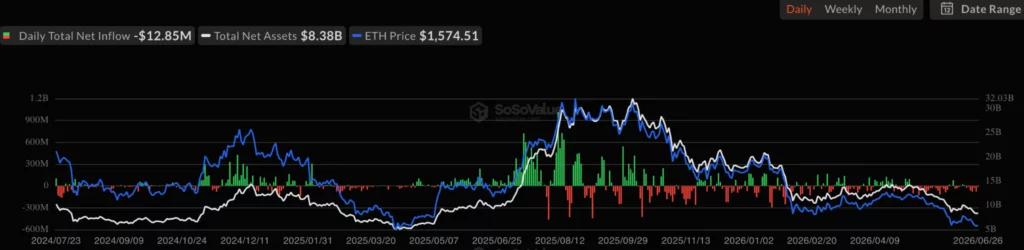
Ethereum is trading near the $1,570 to $1,580 area after a calm weekend that failed to ease the pressure on the second-largest cryptocurrency.
Summary
- Ethereum trades near $1,570 as ETF outflows and whale selling pressure keep buyers cautious.
- Analysts see $1,583 as a key support level after whales sold 550,000 ETH this week.
- A clean move above $1,800 could ease pressure, while losing $1,583 may deepen losses.
The price has stayed mostly range-bound, even as new tension in the Middle East tested risk appetite across global markets.
The calm move does not mean the market has turned strong. ETH remains below the $1,800 level that many traders see as a key recovery zone. The asset is also under pressure from ETF outflows, whale selling, and weak spot demand.
ETF outflows weigh on Ethereum sentiment
U.S. spot Bitcoin and Ethereum ETFs recorded their seventh straight day of outflows on June 26, according to SoSoValue data. Spot Bitcoin ETFs saw about $445 million in net outflows, while spot Ethereum ETFs posted $12.848 million in net outflows.
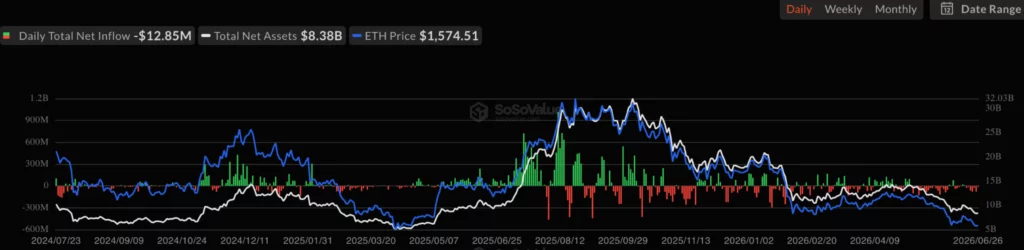
The Ethereum outflow was smaller than Bitcoin’s, but the streak matters because ETFs can act as a source of steady spot demand. When flows stay negative for several days, that support weakens. This can make it harder for ETH to recover when traders are already cautious.
Earlier Ethereum ETF coverage showed that ETH had already been testing major support as fund withdrawals mounted. That pressure has continued into late June, keeping the market focused on whether institutional demand can return.
Another price analysis noted that ETH traded near $1,600 even after BitMine reportedly bought another 75,000 ETH. That showed that large purchases have not been enough to reverse the wider downtrend.
Whales sell into weak support
Analyst Ali Martinez said large holders sold about 550,000 ETH over the past week. At current prices, that sale equals roughly $880 million in fresh supply hitting the market.
The analyst said this selling helped push Ethereum below its immediate $1,633 support level. ETH is now testing volume support near $1,583, a level traders are watching closely because a clean break could open the way for deeper losses.
Ali said if selling continues into next week, the next high-volume demand areas could sit near $1,237 and $1,089. These levels are not guaranteed targets, but they show where past trading activity may attract buyers if ETH breaks lower.
This pressure matches the current chart structure. ETH continues to print lower highs, and buyers have not yet shown enough strength to reclaim the $1,800 area.
Analysts split on ETH’s next move
Money Ape warned that Ethereum could post three straight red quarters for the first time. The analyst said ETH may fall below $1,000 if market confidence keeps weakening.
That view reflects the bearish side of the current setup. Ethereum has failed to recover quickly from its slide, and traders remain worried about ETF outflows, whale activity, and weak momentum.
Michaël van de Poppe offered a different view. He said anything below $1,800 is not attractive for day trading but may be a strong opportunity for longer-term accumulation.
He also said ETH may be forming a bullish divergence across several timeframes. In his view, a clear break above $1,800 would be more useful than trying to catch every small move inside the current downtrend.
Van de Poppe also pointed to lower levels near $1,505 and $1,385 as possible buying zones if ETH sweeps liquidity. He said he doubts the market is eager to move much lower, but he still wants to see a clean recovery above $1,800.
Derivatives data shows sellers still in control
CryptoQuant analyst PelinayPA said Ethereum’s taker buy/sell ratio on Binance remains above 1. That usually points to stronger buying activity, but ETH has not reacted with a strong recovery.
The analyst said this muted response suggests larger sellers may be absorbing buy orders. In simple terms, buyers are active, but they are not strong enough to push the price higher.
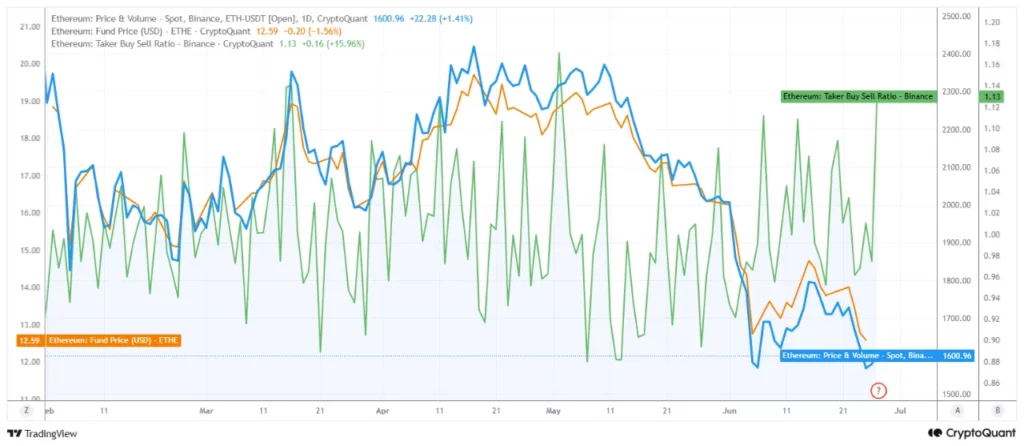
The same report said Ethereum’s fund price has been falling since April. That suggests traders are reducing long exposure in derivatives markets and taking less risk.
This creates a weak setup for ETH. Even when buying activity rises, price action remains soft. That can happen when whales use short rallies to sell into demand.
The analyst said ETH still forms lower highs while fresh lows keep developing. That confirms the broader bearish structure remains in place until Ethereum breaks its current downtrend.
Ethereum price outlook
Ethereum’s near-term outlook now depends on the $1,583 support area. If buyers defend this zone, ETH could attempt another move toward $1,633 and then $1,800.
A clean break above $1,800 would be the first stronger sign that bulls are regaining control. It could also shift attention back toward higher resistance zones after weeks of weak trading.
If ETH loses $1,583, traders may look toward $1,505 and $1,385. A deeper sell-off could bring the $1,237 and $1,089 demand zones into focus if whale selling continues.
For now, Ethereum is stable but not strong. The price is calm near $1,570, yet ETF outflows, whale distribution, and weak derivatives demand keep the risk tilted toward another test of lower support.
Disclosure: This article does not represent investment advice. The content and materials featured on this page are for educational purposes only.

How Personal Injuries Affect Family Caregivers

A$AP Rocky Claps Back At Claims Of Disrespecting Rihanna

Gran banned from every Sainsbury’s in the UK ‘wants to clear her name’


-
 Sports5 days ago
Two goals and an assist by sheer aura: Cristiano Ronaldo just entered the World Cup chat
-

 Tech6 days ago
Microsoft accidentally kills epic Outlook email threads
-

 Fashion2 days ago
Weekend Open Thread: Staud – Corporette.com
-

 Politics2 days ago
The House | Manchesterism won’t survive the painful trade-offs unless it gets citizens on board
-

 Politics3 days ago
Potential 2028er World Cup attendee leaderboard
-

 Business2 days ago
Asia stock markets slide as tech shares slump
-

 Tech3 days ago
A Look At A Gaggle Of Transputer Boards
-
Crypto World4 days ago
Bitcoin (BTC) Dips Below $62K, Ethereum (ETH) Plunges 6% Daily: Market Watch
-
 Crypto World3 days ago
Dell (DELL) Shares Tumble Over 5% Following Analyst Downgrade to Hold
-

 Crypto World4 days ago
Securitize Wraps Roubini's SEC-Registered ETF as Dubai VARA Digital Security
-
Business5 days ago
Entergy settles forward sale agreements, raises $672 million in cash proceeds
-

 Crypto World1 day ago
Kraken's xStocks Opens Bending Spoons IPO Registration to EEA Retail
-

 Sports2 days ago
FIH Pro League: India defeat Pakistan 7-1, register biggest win of campaign | Other Sports News
-

 Crypto World2 days ago
RTX holders must register wallets before token distribution begins
-
Crypto World2 days ago
Hyperliquid Named on Singapore MAS Investor Alert Register
-

 Sports3 days ago
India vs Bangladesh LIVE Score, Women’s T20 World Cup: Bangladesh Opt To Bat; India Enter ‘Do-Or-Die’ Stage As Semi-Final Race Heats Up
-
Crypto World2 days ago
The DATA Foundation Launches to Tackle AI’s Multi-Billion Dollar Training Data Bottleneck
-

 Crypto World3 days ago
Strategy (MSTR) has a 10-month cash runway for dividends, but retail investors are losing faith
-
 Crypto World2 days ago
AAVE price tests 9-month trendline after 17% rebound as breakout hopes build
-

 Crypto World2 days ago
21Shares Cuts 2026 Crypto Forecasts as Institutional Demand Rises
You must be logged in to post a comment Login