


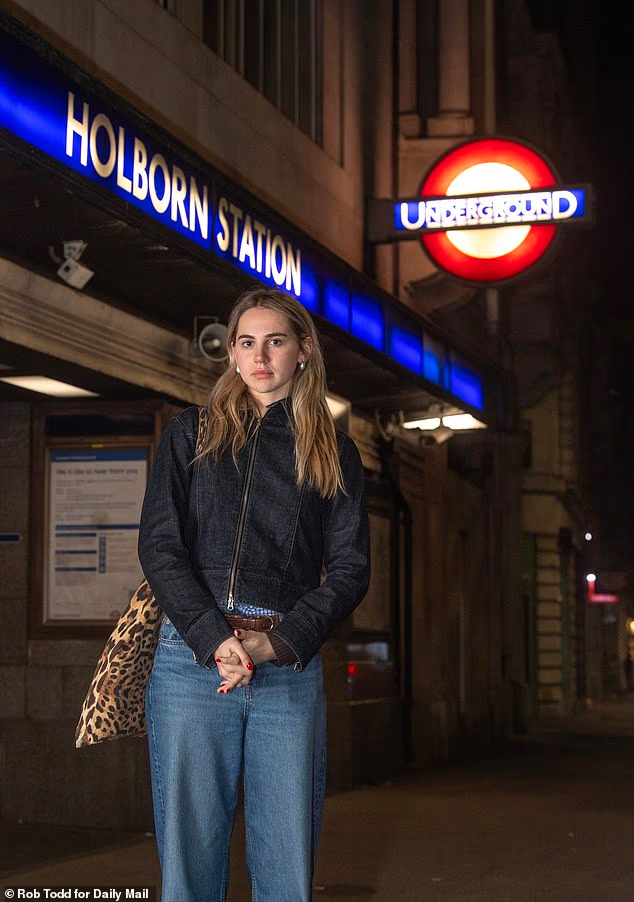
It’s around 2am on the Piccadilly Line and the Tube carriage is empty – apart from me and a man twice my age. His eyes never leave me during the 40-minute journey.
Potbellied and with a menacing grin, he moves suddenly from the seat opposite, plonking himself down next to me. He’s desperate to get my attention, talking at me over the deafening noise of the train.
Unnerved, I get off before my stop. But he follows me and on to another near-empty train – this time the Jubilee Line towards Stratford. Again and again he tries to engage me in chat, staring at me and licking his lips.
I finally manage to lose him somewhere between the platform and the escalators at North Greenwich station.
Half an hour later, I’m on the platform at Green Park when another man starts trying to attract my attention, calling out to me. He’s well dressed in a Barbour-style jacket with fashionable glasses. He beckons me to sit down next to him while we wait for the train.
‘Beauty needs a seat, now. Come sit down,’ he says. I tentatively take up a place with two seats between us. He tells me he has a daughter who is my age.
He keeps asking me where I live, and after failing to get an answer starts to threaten me. ‘I will find the pub or restaurant next door to you. I’m going to come to look for you and I will find you.’
He doesn’t give up, repeatedly demanding my phone number. I tell him politely ‘no’ 20 times – I counted.
Mimi Yates travelled across London’s transport network at all hours of the day and night, secretly filming what happened to her and documenting how it felt to move around the capital as a young woman on her own
I board the train I’ve been waiting for. Laughing, he follows me into the same carriage, sitting down opposite me as he persists asking for my number. It’s around 3am now and the carriage is busy but that doesn’t deter him.
‘You have to give me your number, you have to. I am asking for yours. You have to meet up with me.’
Then he reaches over and strokes my thigh. ‘Please don’t touch me,’ I hear myself say.
A girl and her partner see what’s happening but say and do nothing.
By the time I get home, it’s almost 5am. I am badly shaken and film my reaction on my phone. ‘My heart is still beating quite fast. I just don’t think I expected it to be that bad.’
This wasn’t a normal night out. I had been working undercover for the Daily Mail’s investigative series, Underground UK.
Over two months earlier this year, I travelled across London’s transport network at all hours of the day and night, secretly filming what happened to me and documenting how it felt to move around the capital as a young woman on her own.
What I experienced has changed the way I view the city I love.

I was verbally sexually harassed around eight times and physically assaulted once on four journeys in the course of my undercover investigation, at night and during the day
In March this year, a London Assembly report described ‘unacceptable’ levels of violence against women and girls across the capital’s public transport network.
In 2025, 4,593 sex-based offences against women and girls were recorded yet only a tiny proportion, around 3 per cent, led to a charge or summons. Some 58 per cent of cases identified no suspect at all, despite an extensive network of CCTV and ticketing data that can help trace journeys. Recent cases show why. In May, Salman Yousaf, 46, was jailed for eight sexual assaults and one count of outraging public decency on the Night Tube.
He targeted lone women who’d fallen asleep on the Central and Jubilee Lines, but police only connected him to the attacks when he was already in prison for another crime.
In March, Craig Anderson, 38, was jailed after sexually assaulting four women and stalking another across the railway network. Prosecutors described him as a man who ‘did not take no for an answer’.
I travelled before work, after work, at weekends and on Night Tube routes on seven lines – the Victoria, Piccadilly, District, Circle, Central, Jubilee and the DLR (Docklands Light Railway).
For my safety, a producer accompanied me, close enough that I could signal if I needed help, but far enough away that any man who approached me wouldn’t know I was being monitored.
And I dressed carefully: a buttoned-up checkered shirt, long baggy trousers and a denim jacket, concealing the wires connecting to a hidden camera and sound recording equipment. I wasn’t laying myself out as bait.
I began my first journey at Holborn Tube Station in central London at 1.30am on April 25. Less than 15 minutes into the journey, on an eastbound District Line train, I noticed a group of young men staring in my direction.
I did what women so often do in these situations: looked away, kept my face blank, pretended to be absorbed in my phone. When I got off at Dagenham East, they got off too. They walked ahead of me, deliberately slowly and kept turning back as if to check I was still there. I walked out of the station, hoping they’d disappear, but they lingered.
It was only when I turned back and headed down to the platform again did they finally drift away.
Things got worse later – when I encountered that man in trendy spectacles at Green Park who assaulted me. The audio I recorded is muffled in places but I can hear, and I remember, my intense anxiety as he became ever more angry and insistent.
As one unpleasant interaction ended, another began. It was relentless. Within a minute of me standing up to get away from the man in the glasses, I noticed another group of men. One stocky man with sunken eyes came over and asked for my number. I said ‘no’ nine times. He stood so close to me I could smell the rank odour of the pub he’d been in as his hand ran down the pole near my leg. ‘What are you scared of?’ he asked, rolling his eyes.
There was a girl slumped against the wall of the carriage, clearly intoxicated. At one point he gestured towards her and said: ‘Look at her.’ All I could think was, what might happen to her if nobody was there.

In March this year, a London Assembly report described ‘unacceptable’ levels of violence against women and girls across the capital’s public transport network
With each incident I felt the burden was on me to stay calm, polite enough not to escalate the situation, firm enough not to encourage it and alert enough to work out whether I needed help.
By the time I got home I was exhausted, drained yet still in fight or flight mode.
I was verbally sexually harassed around eight times and physically assaulted once on four journeys in the course of my undercover investigation, at night and during the day.
Esme Rice, 31, didn’t have a hidden camera when she was aggressively sexually assaulted on the Tube recently – but her recollection is crystal clear.
On June 6, at around 11pm, Esme was travelling home on the Elizabeth Line after dinner with friends when two men orchestrated a sexual assault – blocking her exit to the doors as she got off and groping her. ‘They were not remorseful,’ she said. ‘They were happy with themselves that they’d just sexually assaulted me.’
At Stratford, where she exited the train, Esme says she told a member of staff.
There was no police presence at the station, a major Tube and rail interchange, and she was advised to text British Transport Police (BTP) on 61016.
She sent the message within two minutes. Fifteen minutes later, she received an automated response saying her report was ‘urgent’. It took 13 hours for BTP to call her back.
Frustrated, she posted about her experience on TikTok. Hundreds of women flooded her account sharing similar experiences. ‘I stayed up for hours waiting for the phone call,’ she told me. ‘I received nothing. I’ve just been sexually assaulted. How can they not be getting back to me?’
It wasn’t her first experience of policing failures.
In 2024, Esme says that a man masturbated over her on the Jubilee Line during rush hour. She screamed at him in the carriage but no passengers intervened.
The case was closed two weeks later because no positive identification could be made, despite the police having CCTV, according to Esme, and photos she’d taken of the man. Now she avoids travelling on the Tube when she can, scans the faces of passengers around her, always wondering whether she might see any of the men who assaulted her again.
Across the Transport for London (TfL) network, posters urge passengers to call out sexual harassment and encourage women to report incidents and text BTP under the famous, ‘see it, say it, sorted’ slogan.
But does it ever really get ‘sorted’? When I reported the physical assault I experienced to 61016, I was told it was ‘great’ I had photo evidence because the CCTV ‘would have expired about a week ago’. In fact, during a follow-up phone call, the officer told me the line I was on ‘doesn’t really have CCTV on it, anyway’.
A recent BBC investigation found this is far from unusual, and that many sex offenders are escaping justice due to serious issues with CCTV on public transport. Hundreds of women who have been assaulted are then told by police that they could not find their attackers because there was no available footage.
In more than 250 of 560 reports where officers requested CCTV, the incident had not been recorded, there was a system fault, the footage was unusable or it had already been overwritten.

Of course, not all men who use the Tube behave like this. But for many women, all it takes is one to determine if they can ever feel safe again
British Transport Police investigate offences, but CCTV is maintained by TfL and rail operators, which also set their own retention periods. There is no legal requirement for working CCTV on passenger trains, meaning potential evidence doesn’t exist or can be deleted before police request it.
On the Tube specifically, there are three major lines with little to no CCTV camera coverage in carriages. TfL says these lines have some of the oldest trains on the network, so are ‘unable to support on-train CCTV’ that would meet requirements needed for prosecution by the police.
For women, the gap between official advice and the reality of what happens after they have reported an incident is risible.
‘There is a big lack of trust in the reporting process,’ says Susan Leadbetter, a transport design expert at WSP, a global engineering and professional services consultancy. She has spent years researching how public spaces and transport can be made safer for women.
‘A lot of the women that I spoke to who had been assaulted or harassed – 20 per cent said that they would never report it again because of how it was handled.’
When she first began collating women’s experiences for a university undergraduate dissertation, she was shocked by what she discovered. ‘Women were telling me how they’d been groped, ejaculated on while on the Tube, followed home, stared at,’ she told me. ‘It was just so harrowing.’
The very design of the Tube, according to Leadbetter, is part of what makes harassment on public transport feel so frightening.
‘You’re enclosed within that space,’ she said. ‘There’s no staff. There’s not much phone signal or data on some of the lines as well. So if something did happen, there’s a bit of nervousness around: how do I actually report it?’
There is, of course, a limit to how much London’s Underground can be physically transformed. The Tube is the oldest underground railway in the world, its narrow platforms and ageing trains built long before anyone was thinking about women’s safety, phone signal or CCTV coverage.
But there are things TfL could do. London graduate Camille Brown, 22, has made headlines with her petition calling for women-only carriages on the Tube, with a YouGov poll from last year finding a majority in favour.
‘I remember girls arriving at school in tears after incidents on the Tube. It was from about Year 7 [age 11-12] onwards,’ she says, adding that as a schoolgirl and student negative experiences on the Underground felt grimly routine.
Camille looked at the systems used in Tokyo, Mumbai and Mexico City. She suggests a designated carriage, at one end of the train close to the driver, where women who feel vulnerable could choose to travel.
Susan Leadbetter is not convinced. She says we need to work on what we can fix now: visible staff, working cameras, reliable signals and better-lit stations – and designing new routes with that in mind.
‘The Elizabeth line is great. The platforms are really wide, the lighting is really bright and you don’t feel tight and constrained on the platforms.’
She is careful not to suggest that design alone can solve violence against women. ‘You can’t out-design bad behaviour.’
The bigger problem, she explains, is that women are being made to feel unsafe because of people’s – largely men’s – behaviour. ‘These incidents do start at a low level.
‘They do evolve and grow into more severe instances because they get away with these smaller instances of harassment and violence… repeat perpetrators could be doing this to so many other people on the network.’
For all the young women I spoke to, the case of Sarah Everard looms large. The 33-year-old marketing executive was abducted from a street in Clapham, south London, in March 2021 as she walked home.

Mimi Yates is approached by a man on the Victoria Line tube at Tottenham Hale very early in the morning
Her murder, by serving Metropolitan Police officer Wayne Couzens, forced a national reckoning about women’s safety. Couzens had previously been linked to incidents of indecent exposure before he abducted, raped and murdered her.
Things are changing, albeit slowly. On June 9, BTP secured the first sentence in England and Wales under new sex-based harassment legislation on the railways.
David Stroud, 44, pleaded guilty after grabbing a young woman’s hair and trying to kiss her on an overground train, describing it as ‘banter’. For campaigners, it was a landmark moment: an acknowledgement that behaviour that is too often dismissed can, in fact, be criminal.
Stroud was sentenced to a 12-month community order and 150 hours of unpaid work.
For Esme Rice it isn’t enough. ‘Women have been systematically let down… it just feels like I don’t have a voice through the authorities.’
I tell Esme what had happened to me during my investigation and I ask her whether she sees those experiences as sexual harassment.
‘I’ve had people say, ‘oh he just grabbed your bum, it’s hardly rape’. It doesn’t matter, Mimi. Unwanted touching, unwanted interactions… no is, no. It’s that simple.’
Esme is right. As for me, I do move differently about the city I grew up in now. I scan faces on platforms, look twice at men behind me on busy platforms and wonder whether I would recognise the ones who followed me, touched me or would not leave me alone during my investigation.
Of course, not all men who use the Tube behave like this. But for many women, all it takes is one to determine if they can ever feel safe again.
A spokesman for Transport for London told the Daily Mail: ‘We are working closely with the police to make the transport network a hostile place for offenders.
‘The behaviour that Mimi experienced on our network is appalling and totally unacceptable. We encourage anyone who experiences or witnesses this kind of behaviour to report it to the police or a member of staff. We are also committed to improving CCTV coverage, image quality and data retention across the network.’
British Transport Police said: ‘We urge anyone who experiences or witnesses an offence on the railway to immediately report it to 61016 so our officers can make urgent enquiries. That number receives over a quarter of a million texts every year – and this figure continues to rise as confidence grows among passengers in reporting historically underreported crimes, such as sexual offending.’
And in response to Mimi’s assault, it said: ‘On 29 June we received a report of a sexual assault that happened two months prior, in the early hours of 26 April.
‘This report was immediately triaged by staff in our force Contact Centre, before being passed to police officers in London who contacted the victim directly by phone within 90 minutes of the report.’

















































You must be logged in to post a comment Login