

Crypto World
American Bitcoin Hits Low Ahead of 1-For-15 Reverse Split

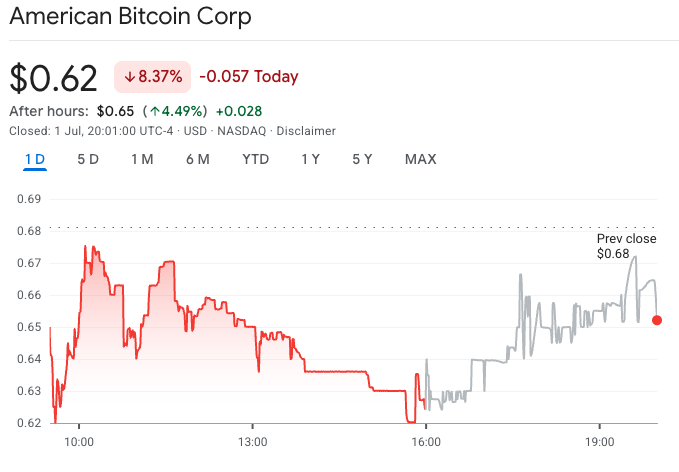
Shares in the Trump family-backed American Bitcoin (ABTC) sank to an all-time low on Wednesday after the crypto miner set a date for a 1-for-15 reverse stock split in a bid to stay listed on the Nasdaq.
American Bitcoin said its reverse stock split will go into effect after the market closes Thursday and will begin trading on a split-adjusted basis when the market opens Monday. It would continue to trade under the ticker ABTC.
It said every 15 shares of the company’s Class A and B common stock will be reclassified as one share. The company expects its common stock to be reduced from more than 1 billion outstanding shares to about 73 million.
American Bitcoin is the only public crypto company tied to the Trump family’s sprawling interests in the sector, and a reverse stock split is typically seen as a negative, as it indicates the company is in distress and is looking to artificially boost its share price.
American Bitcoin said the split aims to prop up its shares to maintain compliance with Nasdaq’s minimum bid requirements, which allow the exchange to delist the company if it trades below a $1 closing price for 30 consecutive trading days.
Shareholders had approved the reverse stock split on June 22.
American Bitcoin shares hit all-time low
Shares in American Bitcoin dropped nearly 8.4% to close trading Wednesday at an all-time low of 62 cents. The stock saw a slight lift after-hours, rising 4.5% to 65 cents.
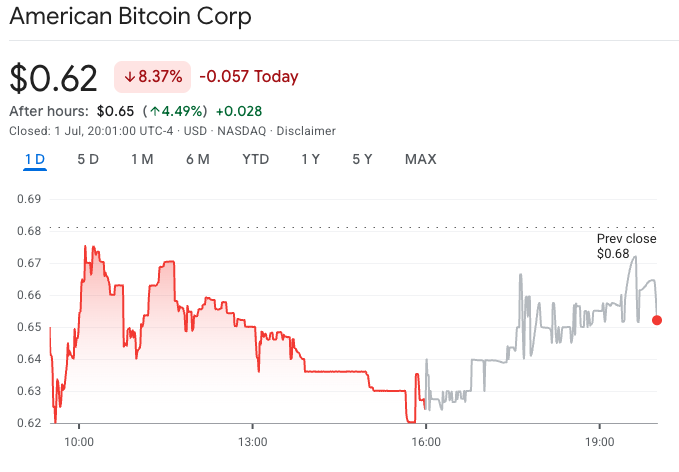
American Bitcoin’s stock tumbled to an all-time closing low of 62 cents on Wednesday. Source: Google Finance
American Bitcoin’s stock is down more than 63% so far this year and has fallen more than 92% since the brand started trading on the Nasdaq on Sept. 3.
The company was co-founded early last year by US President Donald Trump’s sons, Donald Trump Jr. and Eric Trump.
American Bitcoin merged with the Nasdaq-listed Gryphon Digital Mining to go public, with the Trump brothers and crypto miner Hut 8 together owning around 98% of the newly formed company.
Related: Bitcoin miners need billions to fund AI ambitions, led by IREN’s $21B gap
The company’s falling share price comes amid a wider downturn in the crypto market. American Bitcoin reported in May that it lost $81.7 million in the first quarter.
Other crypto companies have also turned to reverse stock splits to prop up their share price. Bitcoin financial services company Nakamoto completed a 1-for-40 reverse stock split in May in a bid to stay listed on the Nasdaq after it reached a low of 16 cents in April.
Bitcoin (BTC) was trading at around $60,000 early Thursday, down 32% so far this year and having more than halved from its peak of more than $126,000 in October, according to CoinGecko.
Magazine: Clarity Act risks repeat of Europe’s mistakes, crypto lawyer warns

Senator Cynthia Lummis defended the Clarity Act against Senator Elizabeth Warren, rejecting claims that the digital-asset bill creates illicit finance loopholes and pointing to more than 16 safeguards written into the legislation.
The Wyoming Republican responded after Warren argued that adversaries exploit crypto to move billions and that the bill would weaken standards. Their clash comes as the Senate races against a narrow legislative calendar.
Follow us on X to get the latest news as it happens
Lummis Points to Built-In Safeguards
Lummis countered that the Clarity Act strengthens illicit finance rules rather than weakening them. She listed specific provisions in a public rebuttal.
Lummis noted that Section 201 applies the Bank Secrecy Act and anti-money laundering (BSA/AML) rules to crypto. Section 303 adds new sanctions aimed at Iran. Section 305 lets exchanges freeze dirty money.
“If you don’t like crypto, then say it, but stop these baseless attacks,” she said.
Illicit finance concerns have become a central sticking point for the legislation. Law enforcement groups and Catholic coalitions pushed back in separate letters last month.
Their objections targeted Section 604, the bill’s developer safe harbor. Critics say broad exemptions could weaken oversight of criminal fund flows.
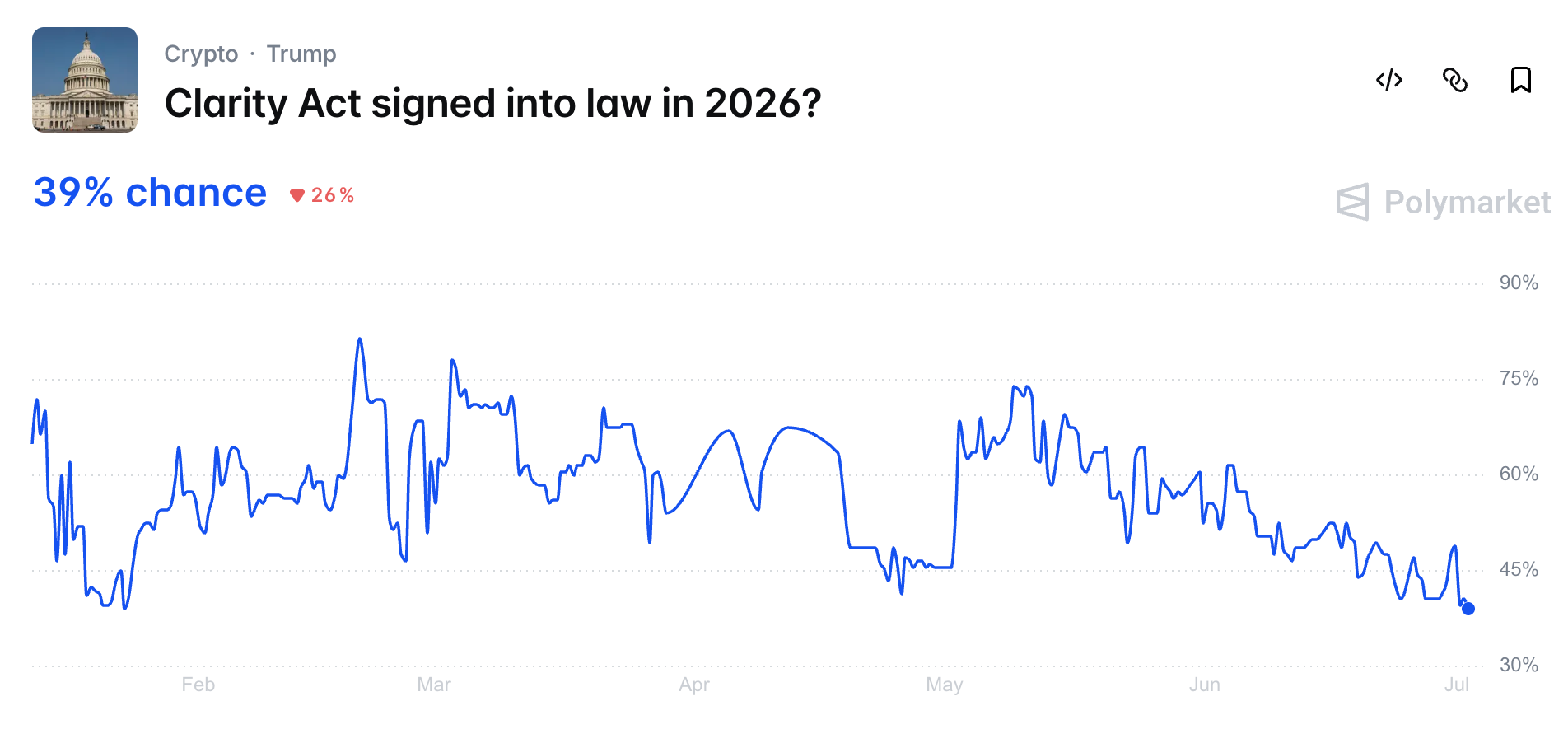
Clarity Act Passage Odds Slide on Polymarket as Deadline Nears
Meanwhile, the timing raises the stakes for the bill. The Senate returns from recess on July 13, leaving a narrow window before the August break.
The bill must clear the Senate by then to stand a chance of becoming law this year. That path requires 60 votes, including at least seven Democrats.
Prediction markets have turned cautious. On Polymarket, the odds of the Clarity Act becoming law in 2026 fell to 39%, down from 64% in early June.

Analysts have shifted, too. Galaxy Research now puts the odds of the CLARITY Act becoming law in 2026 at 50%, down from 60% on June 5, citing the shrinking Senate calendar.
Subscribe to our YouTube channel to watch leaders and journalists provide expert insights
The post Senator Lummis Calls to Stop ‘Baseless Attacks’ on the Clarity Act appeared first on BeInCrypto.


Tether has frozen USDT balances in 131 TRON wallets linked to ISIS-K after U.S. sanctions officials added more than 100 crypto identifiers tied to the group.
Summary
- Tether froze USDT balances across 131 ISIS-K-linked TRON wallets after OFAC updated its sanctions identifiers.
- Chainalysis said the TRON wallets received over $1.4 million and sent over $880,000 since 2023.
- The action adds pressure on VASPs to update sanctions screening for newly listed crypto addresses.
The move places stablecoin issuer controls at the center of a new terrorism-financing action involving TRON and Monero addresses.
Chainalysis said the U.S. Treasury’s Office of Foreign Assets Control updated its ISIS-K designation on July 1. The update added 134 crypto wallet identifiers, including 131 TRON addresses and three Monero addresses.
“Tether has frozen the balances on all 131 TRON addresses,” said Chainalysis.
The official OFAC update lists the wallets under ISIL Khorasan, also known as ISIS-K. The group is the Islamic State’s Afghanistan and Pakistan branch. OFAC had already designated ISIS-K as a terrorist group before adding the new crypto wallet identifiers.
Chainalysis tracks Tether flows across TRON wallets
Chainalysis said the 131 TRON addresses had received more than $1.4 million since 2023. The same wallets sent out more than $880,000 over that period. The blockchain analytics firm said several listed wallets had exposure to mainstream services and also sent funds to Syria-based crypto exchangers.
The report said ISIS-K’s media branch, al-Azaim Media Foundation, has used websites and messaging platforms to seek crypto donations. Chainalysis said it had collected past donation addresses on TRON, Monero, and Bitcoin. The firm also noted that earlier public terrorism-financing campaigns often used smaller donations, rather than a few large transfers.
Stablecoin freeze role keeps growing
The latest freeze follows a wider rise in issuer-level enforcement around USDT. As previously reported, Tether’s T3 Financial Crime Unit passed $450 million in frozen suspected illicit assets since its 2024 launch. The unit is backed by Tether, TRON, and TRM Labs, and focuses on USDT activity on the TRON network.
Moreover, Tether froze more than $514 million across 370 addresses during one 30-day period earlier this year. Most of the frozen funds were on TRON. BlockSec data cited in that report showed Tether blacklisted 4,163 addresses in 2025, freezing $1.26 billion across Ethereum and TRON.
Sanctions pressure reaches compliance teams
The ISIS-K action also comes after other terrorism-linked wallet freezes this year. Victims with U.S. terrorism judgments asked a New York court to order Tether to turn over 344,149,759 USDT held in two OFAC-blocked TRON wallets linked to Iran’s IRGC. That case centers on whether frozen stablecoins can be transferred to judgment creditors.
Chainalysis said the July 1 actions require virtual asset service providers and financial institutions to update sanctions screening and transaction monitoring. The firm also said it labeled the relevant addresses in its products. The step gives compliance teams a way to detect exposure to the newly listed ISIS-K wallets and related networks.


Circle co-founder and CEO Jeremy Allaire published a lengthy rebuttal on X on July 1 to the pitch behind OUSD, the stablecoin launched by the Open Standard consortium, arguing that USDC's advantages in distribution, liquidity and regulatory licensing are not easily replicated. "We've had lots of… Read the full story at The Defiant


K Wave Media has sold its remaining Bitcoin holdings, ending a short-lived treasury push that once aimed to turn the Nasdaq-listed Korean media company into a major corporate BTC holder.
Summary
- K Wave Media sold its remaining 88 BTC to repay $6 million in debt obligations.
- The company once said it wanted to expand Bitcoin holdings toward 10,000 BTC quickly afterward.
- K Wave’s filing shows it halted Bitcoin strategy while shifting focus toward AI infrastructure investments.
The sale came less than a year after the company said it had access to up to $1 billion in financing for its Bitcoin strategy.
K Wave sells 88 BTC to repay debt
In a June 30 SEC filing, K Wave said it liquidated 88 Bitcoin held in its treasury and used the proceeds to repay $6 million of Initial Notes. The transaction was tied to an April 29 amendment to its securities purchase agreement with Anson Funds.
The same filing says K Wave sold all of its Bitcoin holdings on May 6. It also says the company has not abandoned its treasury strategy, but has decided to halt it and focus on AI infrastructure. That shift puts its Bitcoin balance at zero after it once marketed itself as a Korean media company with a Bitcoin-backed treasury model.
Company once aimed for 10,000 BTC
K Wave’s exit marks a sharp turn from its July 2025 announcement. At the time, the company said it had secured $1 billion in total capital capacity through a $500 million convertible note agreement with Anson Funds and a $500 million standby equity purchase deal with Bitcoin Strategic Reserve.
The company said it had completed an initial purchase of 88 BTC and planned to scale its holdings.
“Our objective is clear: to scale our holdings toward 10,000 Bitcoin as soon as possible,” said CEO Ted Kim.
The company also said at least 80% of net proceeds from the first Anson tranche had to be used to buy Bitcoin.
AI strategy replaces Bitcoin plan
K Wave later changed course. As previously reported, K Wave redirected up to $485 million from its Bitcoin treasury plan toward AI infrastructure, including data centers, GPU compute operations, and possible acquisitions. Its shares fell about 25% after that update.
The SEC filing adds more detail to that pivot. K Wave said it has started a strategic transformation toward AI infrastructure and is pursuing data centers, GPU clusters, AI cloud platforms, power systems, cooling systems, and related technology assets. The company also expects shareholders to consider the planned sale of Play Company and the disposal of its Solaire stake.
K Wave is also dealing with Nasdaq compliance issues. The filing says Nasdaq notified the company in January that its shares failed to meet the $1 minimum bid rule. Nasdaq sent another notice in June after the company failed to meet the required $15 million market value of publicly held shares.
Treasury firms face wider pressure
K Wave’s move adds to stress across the digital asset treasury sector. As crypto.news reported, Sequans sold half of its Bitcoin as debt pressure tested its treasury plan. That report also cited K Wave’s earlier Bitcoin-to-AI shift as another case of public firms rethinking BTC reserves.
The wider model has also come under review. Crypto.news explained that Bitcoin treasury companies often depend on investor demand, share premiums, and access to fresh capital. When those conditions weaken, debt and dilution can make the structure harder to maintain.
Previously, crypto.news reported that Strive’s Ben Werkman warned that a long Bitcoin downturn could force some treasury firms to restructure, especially those that relied on convertible debt. K Wave’s sale shows how a company can move from an aggressive BTC target to debt repayment and a new business focus within one year.
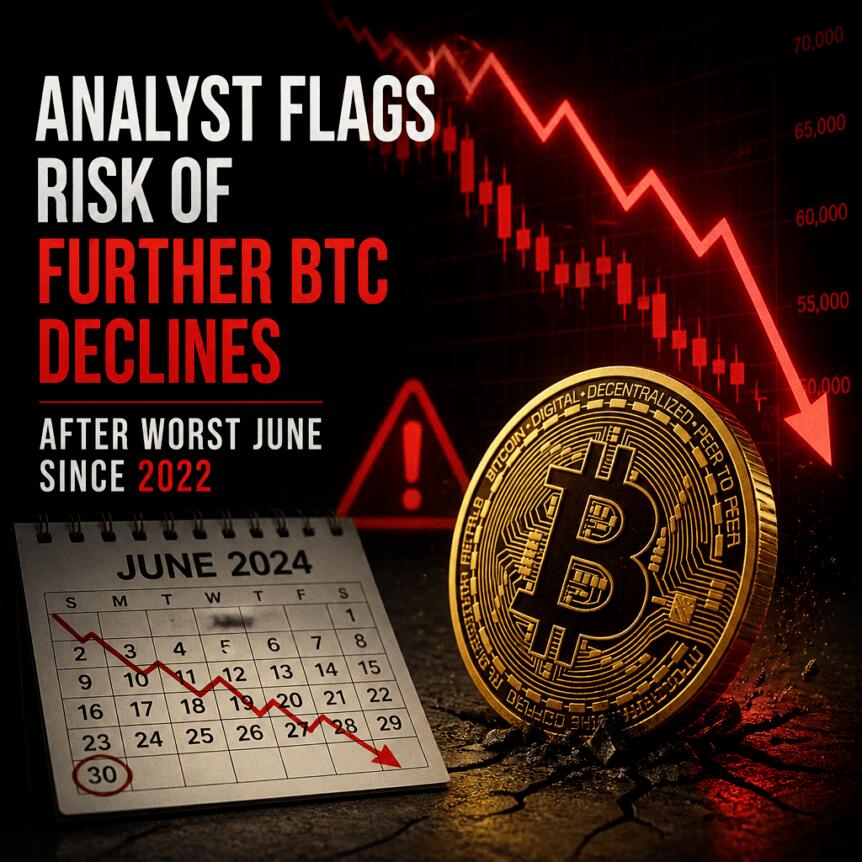
Bitcoin ended June at $58,526, sliding 20.5% over the month and recording its weakest monthly performance since June 2022. The retreat left the flagship cryptocurrency trading below its 200-week moving average near $62,000, but still above a key on-chain valuation metric known as realized price (around $52,000), a configuration that some analysts interpret as a warning that the market may not have reached a full bear-market bottom.
Crypto analyst PlanB, creator of the stock-to-flow pricing model, argued that this price positioning matters because previous bear-market troughs occurred below realized price. In a post shared this week, PlanB said the setup suggests Bitcoin’s downside could continue, potentially revisiting the realized-price area and beyond.
Key takeaways
- Bitcoin’s June close at $58,526 placed it below the 200-week moving average (about $62,000) while remaining above realized price (~$52,000).
- PlanB says earlier bear-market bottoms formed below realized price, implying the market may still be searching for its bottom.
- Analysts at Bitrue Research Institute and Bitget Wallet both described the June-to-$60,000 region as a developing bottom zone, but with risk of further drawdowns.
- Benjamin Cowen suggested Bitcoin may see a cycle-bottom window tied to the US midterm election year, historically aligning with accumulation phases in 2018 and 2022.
Why June’s “in-between” level is drawing attention
PlanB’s argument centers on what he views as the relationship between price and realized price during bear markets. According to the stock-to-flow analyst, Bitcoin’s historical bear-market bottoms have not simply arrived after price fell below major moving averages; they also tended to appear after price moved to levels beneath realized price.
In earlier posts, PlanB highlighted that if Bitcoin breaks down below realized price, it would align with that prior pattern. He referenced the possibility that Bitcoin could fall to $52,000, which would correspond closely with realized price.
From an investor perspective, this distinction can be important because realized price is often used as an on-chain proxy for the average cost basis of coins in circulation. When market price trades above realized price, the market may still be able to bounce; when it slips below, the distribution of holders’ costs versus current valuations tends to become more unfavorable, which can prolong bearish conditions.
Realized price explained—and what it signals
Realized price is calculated by valuing all Bitcoin outputs (typically discussed in terms of unspent transaction output or UTXO cohorts) at the price when each coin last moved on-chain. The result is an aggregate measure of the average acquisition price for the existing supply.
Because realized price reflects holder cost basis, it is frequently used to identify potential support areas during downtrends. The idea is that when price is substantially below realized levels, the market is effectively pricing Bitcoin below what many holders paid when they last moved coins, which can coincide with capitulation phases and supply shakeouts.
Against that backdrop, June’s outcome—still above realized price but no longer above the 200-week moving average—has led analysts to frame the current range as transitional rather than conclusive.
Analysts see a bottom developing, but not confirmed
Andri Fauzan Adziima, research lead at Bitrue Research Institute, told Cointelegraph that Bitcoin’s June close carried a signal consistent with prior cycles. He said the month’s finish above realized price but below the 200-week moving average “signals the bear bottom is still ahead per prior cycles.”
Adziima added that he is watching for a potential capitulation period in late 2026 before a subsequent move higher—while also arguing that the decline could be shallower this cycle due to the role of institutions.
Meanwhile, Lacie Zhang, research analyst at Bitget Wallet, characterized the current consolidation around $60,000 as an area that may be approaching a bottom. She told Cointelegraph that if further downside occurs, the market could build “strong historical and technical support” around $55,000.
Taken together, these views reflect a common tension in market bottoms: technical indicators and on-chain benchmarks can both suggest stabilization, yet neither can confirm capitulation has fully played out. In this case, the “middle” positioning—between the 200-week moving average and realized price—is leaving room for additional volatility before a more durable floor forms.
Cycle-bottom theory tied to US midterms
Beyond on-chain valuation levels, some analysts are also looking at macro calendar effects. ITC Crypto founder Benjamin Cowen speculated that Bitcoin may see a cycle bottom this year, pointing to the fact that it is a US midterm election year.
Cowen argued that the second half of midterm years often marks an accumulation zone and a market cycle bottom, noting that such timing previously coincided with bear market bottoms in 2018 and 2022. The next US midterms are scheduled for Nov. 3, with all House of Representatives seats and about a third of Senate seats up for election.
While this framing is not the same as a realized-price breakdown model, it can influence how traders time risk—particularly when they treat the calendar as a factor that shapes liquidity and positioning. Investors watching this thesis would likely focus on whether Bitcoin’s downtrend stabilizes into accumulation rather than continuing to grind toward or below realized price.
For now, the key takeaway from all perspectives is that June’s close did not neatly resolve the debate. Bitcoin is weak enough to be below its long-term trend proxy, but it has not yet fallen to the on-chain valuation zone that PlanB says has marked prior trough formation.
Traders and long-term holders will likely watch whether Bitcoin can hold above realized price around $52,000 and whether weakness extends toward $55,000 support. The market’s next step—whether it stabilizes into accumulation or breaks below realized valuation—may determine if this is merely consolidation or the start of a more complete bear-market bottom.
Crypto World
ENS Community Member Proposes Dissolving DAO After Founder Blocks Security Council Renewal


Christoph Jentzsch proposed on X that ENS DAO dissolve itself rather than continue operating under what he called a broken governance structure. "As it seems, the ENS DAO is broken," he wrote. "I would propose turning this into a win, by actually dissolving it. Its goals have been accomplished, the… Read the full story at The Defiant


Solana Foundation has introduced Solana Governance Proposals, a new onchain process for validators to move major network questions into stake-weighted votes.
Summary
- Solana validators can now move core governance questions into stake-weighted onchain votes through SGPs directly.
- A proposal needs 15% active stake support before it can enter formal network voting period.
- Validators need at least 100,000 SOL delegated to take an SGP onchain under current rules.
The system gives validators a formal route to submit, support, and decide governance items that may shape Solana’s future protocol direction.
Meanwhile, the Solana Governance Proposals repo says SGPs are documents proposed by Solana validators for stake-weighted, onchain voting through the svmgov program. The process is for high-level questions that ask whether the network should move in a certain direction, rather than detailed technical changes. This keeps SGPs focused on broad network direction only.
A validator vote account needs at least 100,000 SOL staked to take an SGP onchain. The proposal then needs support from at least 15% of active stake before it can enter voting. The Solana Governance documentation says validators create proposals, other validators support them, and voting weight is proven through Merkle proofs against an onchain stake snapshot.
The process separates signals from code
The SGP process sits beside Solana Improvement Documents, which cover detailed protocol design. In simple terms, SGPs ask whether Solana should pursue a direction, while SIMDs explain how a change would be built. The repo says, “A ‘yes’ on an SGP is a mandate to proceed.”
The lifecycle moves from idea to draft, support, voting, acceptance, and activation. Once a proposal reaches the 15% support threshold, it enters a fixed 11-epoch process. That includes seven epochs for discussion, one epoch for a Node Consensus Network snapshot, and three epochs for voting.
There is no quorum rule. A proposal passes only if “For” votes reach at least 66.67% of “For” plus “Against” stake. The repo also says SGPs are not mandatory for every technical change. If validators do not reach support, developers can continue through normal SIMD review.
Governance arrives as upgrades continue
The launch comes as Solana continues to test large infrastructure changes. As previously reported, the Alpenglow upgrade entered community validator testing in May. Alpenglow aims to cut confirmation times to about 150 milliseconds and remove Proof of History and onchain vote transactions from Solana’s core process.
The new SGP route could give validators a clearer way to request network-wide direction before developers prepare technical work. The GitHub repo uses Alpenglow as an example of a proposal that could have first taken a directional vote before later SIMDs defined the build path. That example shows how Solana may use SGPs when validator input is needed before engineering details are complete.
Recent Solana activity adds context
Solana’s validator set has also been tied to other recent network tools. As crypto.news reported, DoubleZero launched Edge in April with 379 validators publishing shreds and about 43% of Solana’s total stake covered at launch. The project aims to deliver Solana block data through private fiber paths.
Solana has also seen renewed market activity around network use. Crypto.news reported that Solana’s tokenized stock activity helped drive an 18% weekly SOL rebound in late June. Earlier, crypto.news reported that Galaxy Digital proposed a voting model for Solana inflation, showing that validator voting design has already been part of the network’s policy debate.


Türkiye-based digital asset platform Paribu has launched DeFi access inside its main app, adding DEX trading, perpetual contracts through Hyperliquid, and Polymarket-linked option markets.
Summary
- Paribu now offers Hyperliquid perpetuals and Polymarket markets through its main self-custodial DeFi app section.
- The platform opened a waitlist for NYSE, Nasdaq, and Borsa Istanbul stock trading access soon.
- Paribu says users can trade DeFi products without separate wallet apps, seed phrases, or transfers.
The company also opened a waitlist for stock trading as it works to combine crypto, DeFi, yield products, and equities in one app.
Paribu said it is the first regulated exchange to offer both Hyperliquid perpetuals and Polymarket option markets through a centralized exchange interface. Users can access the DeFi section with their existing balance, without a separate wallet app, seed phrase, or new account. The company said each DeFi position remains self-custodial, while trades settle onchain through linked protocols.
DeFi access targets Türkiye’s retail market
Paribu framed the launch around Türkiye’s active crypto market. The company cited TRM Labs data showing Türkiye ranked fifth globally in retail crypto activity, with $40 billion in volume in Q1 2026. The figure rose 7% year over year while global retail crypto volume fell 11%.
The company said many local retail users keep their main crypto holdings inside one app and have not used DeFi wallet tools. Paribu’s DeFi access is designed to let these users reach onchain markets without switching platforms. Its blog post on DeFi access says the wallet setup uses passkeys and recovery tools instead of seed phrases.
Hyperliquid and Polymarket enter the app
The Hyperliquid integration lets Paribu users trade perpetual contracts from the DeFi section of the app. Trades route to Hyperliquid’s decentralized blockchain, while positions remain in users’ self-custodial wallets. Paribu said Hyperliquid has processed more than $4 trillion in cumulative trading volume.
The launch follows wider activity around Hyperliquid. As reported by crypto.news, Kalshi launched CFTC-regulated HYPE perpetual futures, lifting HYPE futures open interest to $2.48 billion. Moreover, crypto.news reported thatHyperliquid added validator-settled outcome markets under HIP-4, expanding beyond perpetual futures.
Paribu also added access to Polymarket markets through the same DeFi section. The company said it will list curated markets only, with each contract reviewed for integrity, liquidity, and risk profile before appearing in the app. Paribu serves as the interface, while execution and settlement happen onchain through Polymarket infrastructure.
The rollout comes as prediction markets face closer review in several jurisdictions. As crypto.news reported, the CFTC is preparing new rules that could affect Polymarket and Kalshi. Crypto.news also reported that the CFTC sued Kentucky to block state action against Kalshi, Polymarket, and related partners.
Stock trading remains pending
Paribu is also preparing to offer equities. Its brokerage arm has received establishment authorization from Türkiye’s Capital Markets Board and is waiting for an operating license. The company said NYSE, Nasdaq, and Borsa Istanbul stocks will become tradable after the license process is complete.
For now, users can view real-time market data for U.S. and Turkish stocks inside the app. Paribu said the stock waitlist is open before trading goes live. Founder and CEO Yasin Oral said, “Paribu is becoming a single app for all of finance: crypto, DeFi, equities, and yield.”
The expansion follows other Paribu moves. Previously, crypto.news reported that Paribu’s $240 million CoinMENA acquisition led a weekly crypto funding period in December 2025. The company has also said Clave joined Paribu in 2026 to support passkey-based account abstraction and self-custody tools.

Bitcoin rebounded on Wednesday after tagging a 21-month low, with BTC rising as high as $60,200 and gaining roughly 2.7% over the past 24 hours from earlier losses. The bounce lifted major alternatives as well: Ether (ETH) rose about 3%, while Solana (SOL) climbed roughly 4.85%.
Still, the recovery is happening against a backdrop of persistent caution. According to the Crypto Fear & Greed Index maintained by Alternative.me, sentiment is around 11 out of 100—an “Extreme Fear” reading—suggesting many market participants remain nervous about what comes next. Even with today’s uptick, Bitcoin is still down about a third since the start of the year.
Key takeaways
- Bitcoin’s intraday bounce followed a fresh 21-month low near $57,737, but broader confidence remains weak with the Fear & Greed Index in “Extreme Fear.”
- US spot Bitcoin ETF flows have been net negative recently, including a reported $4.5 billion outflow in June—the largest since the funds launched—indicating cautious institutional positioning.
- On-chain data points to strength from long-term holders, with an estimated addition of roughly 270,000 BTC over the past two weeks.
- Funding rates have stayed positive for three straight days, implying leverage is still leaning toward long exposure even as price remains under pressure.
- Liquidation risk appears heaviest in the $57,000 to $60,500 band, meaning sustained moves beyond roughly $61,000 or below $56,000 could accelerate volatility.
Fear remains elevated even after the rebound
Market pricing today reflects a tug-of-war between dip-buyers and the fear of further downside. The latest sentiment readings underline that many traders are still operating defensively, despite Bitcoin’s recovery attempt from the yearly low area.
This matters because fear can shape how quickly the market absorbs negative news. When sentiment is extremely negative, rebounds often face selling pressure not just from those who missed the decline, but from participants who are using rallies to reduce risk. The result is a market that can rally sharply—then struggle to build follow-through.
ETF outflows versus long-term accumulation
One of the clearest contrasts in the data is between institutional product flows and on-chain holder behavior.
US spot Bitcoin exchange-traded funds (ETFs) have seen more money leaving than entering in recent weeks, including a reported total outflow of $4.5 billion in June, described as the largest since the funds began launching. That pattern typically suggests that, at least for now, some traditional investors are not convinced enough to add exposure during a drawdown.
At the same time, on-chain indicators show long-term holders accumulating. According to the on-chain data referenced in the analysis, long-term wallets added about 270,000 BTC over the past two weeks. In crypto market interpretation, that kind of accumulation is often read as evidence that bigger investors view the recent decline as an opportunity rather than a prompt to sell.
The tension between these two signals—net outflows from ETFs versus accumulation by long-term holders—helps explain why the market can bounce without fully transitioning into a sustained uptrend. Flows may stay cautious while deeper capital continues to build positions more quietly.
Funding rates stay positive as leverage crowds in
Another point to watch is leverage. The analysis highlights that Bitcoin’s funding rate has remained positive for three consecutive days. In practical terms, that means the prevailing derivatives positioning has continued to lean toward bets that prices will rise.
Positive funding while spot prices are weak can be a volatility risk. When one side of the market becomes overcrowded with leveraged longs, a further downside move can force liquidations that amplify the drop—especially if price breaks key support levels. Conversely, if the market stabilizes or turns upward while longs remain funded, the same mechanism can also support rallies through short-covering and stop-trigger effects.
As of now, the key point is that leverage appears active, but price confirmation has not yet clearly followed through in a way that would suggest the market has fully flipped from fear to conviction.
Liquidations cluster around current trading levels
Where liquidation risk sits is often central to understanding how quickly price can move during stressful periods. Using a three-exchange, three-day liquidation heatmap (as cited in the analysis, sourced from Hyblock), the highest concentration of leveraged positioning appears roughly between $57,000 and $60,500. That zone closely overlaps with the trading range Bitcoin has held since late June.
Above that area, the density of liquidation risk thins out noticeably between approximately $61,000 to $62,000. Below, a similar reduction appears around $55,000 to $56,000. This distribution suggests that a move breaking out of the present range could encounter less immediate “magnet” pressure from nearby liquidations—while a move that stays within or slightly beyond the clustered zone could lead to sharper, more abrupt price reactions.
In the near term, the analysis argues that most forced unwind potential sits close to current prices rather than far away. That is why decisive movement beyond roughly $61,000 to the upside—or below about $56,000 on the downside—could create room for accelerated liquidation-driven volatility.
Looking ahead to the next 24 hours, the outlook described here is neutral. A meaningful change would likely require stronger evidence that leveraged positioning is both rising and aligning with a rising spot price—an interaction the analysis notes has not clearly emerged yet.
Traders and investors should monitor whether ETF flow weakness persists alongside continued long-term accumulation, and whether derivatives conditions evolve—particularly funding rate direction and liquidation clustering—as these factors together will determine whether this bounce becomes a trend or fades back into range-bound action.

Venice AI, the privacy-focused AI platform founded by Erik Voorhees, has raised $65 million in Series A funding at a $1 billion valuation, bringing the company to “unicorn” status. The round—led by Dragonfly and backed by Coinbase Ventures, F-Prime, North Island Ventures, Morgan Creek and others—was announced on Wednesday, and represents Venice AI’s first outside capital raise since it launched in 2024.
The funding arrives as privacy concerns around mainstream AI services are drawing renewed attention. Earlier this month, Anthropic cut off foreign access to two of its latest models, and in the broader public debate over AI data handling, a class-action lawsuit recently accused OpenAI of sharing ChatGPT data with third parties. Against that backdrop, Venice AI positions itself as a layer between users and model providers, designed to reduce what third parties can see about user activity.
Key takeaways
- Venice AI reached unicorn status after closing a $65 million Series A round at a $1 billion valuation, led by Dragonfly.
- The platform claims 3.5 million users and routes traffic through a proxy that can obscure IP address and user/account/session data from model providers.
- Venice AI says the new capital will fund more of its own infrastructure, including owning GPUs via data center expansion rather than relying entirely on rental capacity.
- The announcement lands amid heightened scrutiny of AI data privacy, including legal claims involving tracking technologies and alleged sharing of user information.
Unicorn funding for a privacy-first AI delivery layer
Venice AI’s Series A funding was announced by the company in a blog post published Wednesday, with Erik Voorhees describing the company’s mission in constitutional terms in a separate X post. Voorhees said the funding will be used to uphold the First and Fourth Amendments “as they relate to mankind’s interaction with AI.” In the U.S. legal framework, the First Amendment protects core freedoms including speech, while the Fourth Amendment restricts unreasonable government searches and seizures.
While the fundraising headlines focus on valuation and total capital, the more meaningful detail for potential users is the product model: Venice AI’s platform is built to act as an intermediary between a user and over 200 AI models. According to the company, users can choose the level of privacy they want, with different models routed through different privacy protections.
How Venice AI says it protects user data
Venice AI claims it has 3.5 million users. For models associated with OpenAI, Anthropic, xAI and Google, Venice AI says its proxy obscures users’ IP address as well as account and session data. The company also claims “other models offer higher levels of privacy,” indicating that its approach is not one-size-fits-all and may vary depending on which model is being accessed.
The core premise is that owning (or controlling) the “delivery stack” matters: if the intermediary is the part that can see traffic patterns and data flows, then that component can potentially reduce exposure to outside entities that operate the underlying model endpoints. Dragonfly managing partner Haseeb Qureshi framed the strategic stakes in those terms, arguing that whoever runs the AI delivery layer can see more about users’ behavior and ultimately influences the conditions under which users get access to powerful systems.
Where the $65 million will go
Voorhees said the Series A funding will be used to continue building Venice AI’s data center infrastructure. A central element of that plan is ownership of the compute resources—specifically, owning GPUs that power the platform—rather than renting them at higher costs.
Beyond infrastructure, Voorhees said remaining capital will support growth initiatives including expanding the customer base, entering new markets, hiring talent, and acquiring what he described as “additive businesses.” The acquisition language suggests Venice AI may be looking to broaden capabilities around its platform, though no specific targets were named in the materials provided.
Privacy scrutiny pushes privacy-focused AI into focus
Venice AI’s funding timing underscores how quickly privacy questions have become a defining topic for AI adoption. Earlier coverage from Cointelegraph reported that a user who consults an AI for legal matters could face the risk of chat logs being used against them in court. The broader theme is that AI interactions can generate sensitive records—even if users are not providing personal data intentionally.
In parallel, researchers and industry figures have proposed technical approaches to limit exposure. For example, the Ethereum Foundation’s AI lead Davide Crapis and Ethereum co-founder Vitalik Buterin proposed using zero-knowledge proofs and other techniques to help ensure that a user’s interactions with large language models are kept private.
Legal concerns have also intensified. In May, a proposed class action was filed in California federal court accusing OpenAI of disclosing private ChatGPT user data to third parties including Google and Meta. The complaint alleged that Meta Pixel and Google Analytics were embedded into ChatGPT.com, so that when users send queries, duplicate data is allegedly sent to Meta and Google along with advertising cookies and personally identifiable information—information that could then be used for targeted advertising.
These developments highlight a tension for users: modern AI platforms often involve multiple layers of data collection, analytics, and third-party integration, which can be difficult to disentangle from “model inference” itself. Venice AI’s proxy concept is an attempt to restructure that data path by introducing a dedicated intermediary that can obscure certain identifiers from model providers.
The recent industry shifts also reinforce why an intermediary approach is gaining attention. Anthropic’s sudden reduction in foreign access to two of its latest AI models earlier this month served as another reminder that availability and access controls can change quickly—while privacy-focused architectures aim to give users more predictable control over how their data is handled.
What to watch next
With Venice AI scaling its infrastructure and expanding adoption, the key question for investors and users will be how effectively its proxy-based design delivers measurable privacy protections across a wide set of models and real-world integrations. Readers should watch for more transparency around which metadata is obscured under each privacy mode, and whether Venice AI’s compute buildout translates into faster, more consistent performance without sacrificing its stated privacy goals.
Trying Out Viewer Suggestions For Levitation On An Induction Cooker

Watch: People smuggler tracked down and confronted by BBC

Commonwealth Bank Shares Edge Higher as Australia’s Largest Lender Maintains Steady Course Amid Uncertainty


-

 Fashion5 days ago
Weekend Open Thread: Staud – Corporette.com
-

 Politics6 days ago
The House | Manchesterism won’t survive the painful trade-offs unless it gets citizens on board
-

 Crypto World2 days ago
Strategy authorizes up to $1.25B in Bitcoin sales under new capital plan
-

 Politics6 days ago
Potential 2028er World Cup attendee leaderboard
-

 Business6 days ago
Asia stock markets slide as tech shares slump
-

 News Videos3 days ago
MAJOR BITCOIN & MARKET UPDATE!!!! (MUST WATCH ASAP!!!)
-

 Tech6 days ago
A Look At A Gaggle Of Transputer Boards
-
 Crypto World6 days ago
Dell (DELL) Shares Tumble Over 5% Following Analyst Downgrade to Hold
-

 Crypto World5 days ago
Coinbase, Circle Deepen Crypto Stock Losses Despite Resilient S&P 500
-

 Business2 days ago
Australia treasurer says alleged access of prime minister’s bank data ’incredibly concerning’
-

 Crypto World5 days ago
Kraken's xStocks Opens Bending Spoons IPO Registration to EEA Retail
-

 Sports5 days ago
FIH Pro League: India defeat Pakistan 7-1, register biggest win of campaign | Other Sports News
-

 Crypto World6 days ago
Bitcoin Sparks $600M Hourly Liquidations With $65,000 Set To Become Resistance
-

 Tech4 days ago
Bluekit phishing kit adopts browser-in-the-middle for login theft
-

 Tech2 days ago
Anonymous researcher drops 0-day ‘exploitarium’ repo
-

 Tech5 days ago
Russian hackers now target Signal backup recovery keys
-
 Crypto World6 days ago
Hyperliquid Named on Singapore MAS Investor Alert Register
-

 Crypto World6 days ago
RTX holders must register wallets before token distribution begins
-

 Sports16 hours ago
Broncos roster: OL Ben Powers (No. 74) entering final year of contract
-
 Business2 days ago
The AI boom won’t burst all at once. It will pop in ‘rolling bubbles’: Macquarie
You must be logged in to post a comment Login