Connect with us

NewsBeat

Brothers who battered civil servant to death when they were teenagers because they had a ‘hobby’ of attacking men they thought were gay are jailed for life 42 years later

Published

on

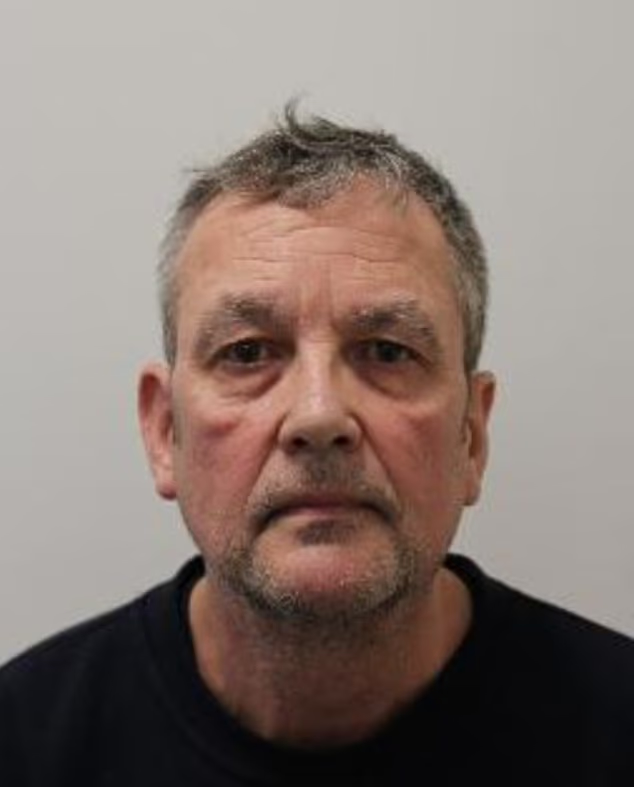
Anthony Stewart, 60, was 18 when he murdered Mr Littler with his brother in 1984. Anthony was a binman at the time and confessed the murder to a girlfriend and his younger brother Daniel who went to police

Two homophobic brothers who had a ‘hobby’ of attacking men they believed were gay have been jailed for life for murdering a civil servant ‘for fun’ in 1984. 

Michael Stewart, 57, and Anthony Stewart, 60, were just 15 and 18 when they set upon Anthony Littler as he walked home in East Finchley, north London.

Mr Littler, a 45-year-old civil servant, was bludgeoned twice over the head with a blunt weapon and was found mortally wounded half an hour later, still with his briefcase, £80 cash and credit cards.

The Stewarts were finally brought to justice after their younger brother reported them 29 years later, saying his siblings had confessed to the killing and boasted about ‘queer bashing’. 

Advertisement

Anthony Stewart, who was likely to have delivered the fatal blow, was handed a minimum term of 15 years in prison and ‘lookout’ Michael Stewart was jailed for at least 10 years. 

In a televised sentencing, senior judge Mrs Justice Cutts said: ‘Anthony Littler was in 1984 aged 45. 

‘He was, according to those who knew him, a quiet, kind and gentle man. He lived a quiet, decent and honest life. He worked as a civil servant and lived alone in East Finchley.’

She told the defendants: “This was not an impulsive attack, I am quite sure your group was lying in wait for a victim, someone to attack and rob.’

Advertisement

Anthony Stewart, 60, was 18 when he murdered Mr Littler with his brother in 1984. Anthony was a binman at the time and confessed the murder to a girlfriend and his younger brother Daniel who went to police

Michael Stewart, 57, was just 15 at the time of the attack. He called an ambulance anonymously after the attack but hung up before emergency services could find Mr Littler who was bleeding to death in the alleyway nearby

Michael Stewart, 57, was just 15 at the time of the attack. He called an ambulance anonymously after the attack but hung up before emergency services could find Mr Littler who was bleeding to death in the alleyway nearby

Anthony Littler (pictured) was beaten to death in an alleyway near East Finchley Tube station on May 1, 1984

Anthony Littler (pictured) was beaten to death in an alleyway near East Finchley Tube station on May 1, 1984

Advertisement

While there was no evidence Mr Littler was gay, the judge noted the defendants had targeted gay men to rob, saying: ‘1984 was a different time and in many respects a different place.’

In a statement, Mr Littler’s cousin Patricia McClure said: ‘I am particularly angry these murderers have had 42 years of freedom and they picked Anthony at random for fun, while I am glad that people have been found accountable.’

On the night of his murder, real ale enthusiast Mr Littler had been to a pub in Carshalton, Surrey, at a meeting of the Ponds Branch of The Society for the Preservation of Beer from the Wood.

He was ambushed and left for dead as he walked home down a narrow alleyway from East Finchley Tube station at 12.18am.

Advertisement

Michael Stewart called for an ambulance anonymously minutes after the attack from a phone box, but did not give enough information for emergency services to find Mr Littler, so the search was called off after Michael hung up.

A couple, Annalieze and James Hainge, found Mr Littler in a pool of his own blood while walking home from work. He was suffering from ‘catastrophic’ brain injuries.

By the spring of 1984 the Stewart siblings and their friends had made a ‘hobby’ of targeting lone men who they believed to be gay, jurors were told.

But they lied to police during house-to-house enquiries and said they were home at the time of the attack on Mr Littler, with binman Anthony Stewart insisting he never used the alley.

Advertisement

But a breakthrough came on the 29th anniversary of Mr Littler’s death when the thugs’ younger brother Daniel, who was 10 at the time, came forward to police after a family falling out.

He told officers his older brothers had confessed to the killing and boasted about being involved in ‘queer bashing’, jurors were told.

Michael had also admitted killing Mr Littler to his girlfriend and even showed her the scene of the crime down the alleyway at East Finchley Tube station, north London, jurors were told.

Anthony was said to be a man of few words but Michael proved to have a ‘loose tongue’ and bragged about what he did in 1984, the court heard.

Advertisement

The jurors deliberated for less than three hours to deliver their guilty verdict last week after the Old Bailey trial.

Today, Michael and Anthony Stewart have been jailed for life with minimum terms of 10 years and 15 years respectively. 

Senior Crown prosecutor Samantha Yelland said investigators had faced ‘challenges’ bringing a case, with the loss of key evidence, including a potential murder weapon.

The ‘unusual’ decision to deploy covert tactics was made in the absence of other evidence to prosecute the historic hate crime, she said.

Advertisement

After sentencing, Ms Yelland said: ‘My deepest condolences go to Anthony’s family and to all those who loved him. 

‘They have carried this loss for decades, and sadly many who waited so long for answers have not lived to see this day. 

‘Nothing can undo what happened to Anthony that night, but I hope today goes some way to honouring him and giving him the justice he deserved.

‘Anthony was walking home alone at night when he was ambushed from behind in what was an unprovoked and cowardly attack. 

Advertisement

‘It is devastating that he was targeted and killed, in part, because of his perceived sexuality. 

‘This was recognised by the court and reflected in the sentences handed down to Michael and Anthony Stewart.

‘This was not a straightforward case. Despite the passage of time and the defendants’ repeated denials, we worked in close collaboration with the Metropolitan Police to piece together decades of admissions, historic evidence, and new material from a reopened investigation, to robustly pursue a prosecution.

‘No matter how much time has passed, the Crown Prosecution Service will always seek to prosecute perpetrators of these horrific crimes and ensure they face the consequences of their actions.’

Advertisement

Detective Chief Inspector Neil John, of Scotland Yard, said: ‘Anthony’s life was suddenly cut short when he was killed in a brutal attack by two teenagers who we now know had a clear propensity for the most sickening kind of violence.

‘They targeted Anthony because he was alone, defenceless and walking down a dark alley in which they knew no one would see them carrying out their horrendous assault.

‘They lay in wait for someone to cross their path, and tragically for Anthony he became their unsuspecting victim.

‘We know Anthony’s murder has continued to cause his family pain all these years later, and we are pleased that they now know who was responsible for his death.’

Advertisement
Mr Littler was murdered by the homophobic Stewart brothers in this alleyway. This is a handout photo issued by the Metropolitan police in 1984

Mr Littler was murdered by the homophobic Stewart brothers in this alleyway. This is a handout photo issued by the Metropolitan police in 1984

During the trial, prosecuting barrister John Price KC described the events leading up to Mr Littler’s death.

He had taken a train to a pub in Carshalton, Surrey, after work to attend a meeting with a real ale group, Ponds Branch of The Society for the Preservation of Beer from the Wood.

He took the train back home and got off at East Finchley Tube station at 12.18am on May 1, then walked down a narrow alleyway towards his house.

Advertisement

It was there the Stewart brothers ‘ambushed’ him.

Mr Price said the assailants lay in wait and attacked Mr Littler, immediately striking him over the head, even though there was no evidence they knew their victim.

He suggested they may have panicked and fled the scene without going through his pockets when it became clear from the amount of blood that they had killed him.

Late resident Edward Dyer had been walking his dog and heard a loud shout which ‘sounded like a cry of pain’, jurors were told.

Advertisement

About half an hour later, Annalieze and James Hainge found Mr Littler lying injured in the alleyway as they walked home from the station.

Mrs Hainge ran to call emergency services from a phone box while her husband stayed with Mr Littler.

But he died at the scene.

Medics found him with two skull fractures and a ‘catastrophic brain injury’ which proved fatal.

Advertisement

Mrs Hainge’s call to emergency services had been the second 999 alert from a public phone kiosk, jurors were told.

At 12.22am, an unknown person had called an operator and asked for an ‘ambulance – quick’.

He told her: ‘I can’t stop, just get an ambulance to East Finchley station, there’s a man hurt outside the station.’

London Ambulance Service recorded the caller saying the casualty was ‘bleeding heavily’ before putting the phone down.

Advertisement

The call handler had noted the male seemed ‘abnormally concerned over the matter’, was ‘well spoken’ and had a ‘young sounding voice’.

Station staff searched the area and found no trace of a bleeding man so the incident was stood down, the court was told.

Mr Price told jurors that given the timing of the call, the unknown person must have been there when Mr Littler was attacked but gave ‘wholly inaccurate information’.

He said: ‘The prosecution submits that 42 years later, the evidence now available shows that it was Michael Stewart who had made that first 999 call at 12.22am and then hung up without giving the operator his name or the information she needed.’

Advertisement
Met Police reopened Mr Littler's case in 2022 and employed covert investigative techniques before arresting the brothers

Met Police reopened Mr Littler’s case in 2022 and employed covert investigative techniques before arresting the brothers

Staff at the station were told to check for signs of a bleeding or injured man in the ‘immediate vicinity’ of the station.

‘Of course, none could be found. That is not where Mr Littler was,’ Mr Price said.

The call was stood down as a false alarm at 00.40am.

Advertisement

‘Then, within about two minutes, an unknown caller using a phone in a public call box was telling Ms Rogers [the telephone operator] something of what had happened to leave him lying bleeding and dead in the alley,’ said Mr Price.

‘Anthony Littler had been alive and well and entering the alley at 00.20 and before 00.22 was dead or dying where he was later found by Mr and Mrs Hainge [who called the ambulance].

‘Given the time of that first call and the distance between where Anthony Littler was found in the alley and the nearest local phone kiosks from which it could have been made, is it not established that the caller could only have been able to report the fate of Mr Littler just seconds after it will have occurred, because he had been there to see it happen for himself?

‘Occurring at that time of night, in this enclosed alley, nobody would have been able to see what had happened to him unless they had been there, in the alley, and nearby.

Advertisement

‘Though asked to do so, he did not give the number of the call box he was using to make the call. 

‘He gave imprecise, if not wholly inaccurate information about where Anthony Littler was, and then he put the phone down rather than giving the operator the detail she needed.’

The prosecutor said, 42 years later, the evidence now available shows it was Michael Stewart who made that first 999 call at 00.22 and then hung up without giving the operator the information she needed.

‘He has confessed to someone that it was he who made a phone call on this occasion, as he put it, “I called the old bill”, and to much more besides. Now 57 years of age, he was then a schoolboy aged just fifteen.

Advertisement

Mr Price explained the difficulties faced by the police in the original investigation: there was no CCTV, no eyewitnesses, no weapons.

The court was shown stills from a BBC Crimewatch episode about the murder on 1 October 1984.

A serving police officer played Mr Littler in the TV programme because he looked like the murder victim.

He reenacted his journey from the Tube carriage, out of the station to where his body was found.

Advertisement

‘No meaningful leads were generated by any of the publicity,’ Mr Price said.

Police went ‘house to house’ in 1984 asking local people where they were on the night of 30 April 1984.

They went to the Stewarts’ home at 1 Prospect Ring, where Michael and Anthony were living with their mother Gloria and brother Daniel.

Both brothers claimed they were at home on the night of the murder.

Advertisement

They were not arrested until Daniel reported them to police in 2013.

He described how Michael had threatened to burn down his home and kill him.

‘He said that Anthony Stewart and the two sons of Anthony Stewart had then become involved in this dispute.

‘He, Daniel, had told them he would go to the police to tell them what he knew about the murder in the alley many years ago, when he was a child living in Prospect Ring. And now, in the spring of 2013, he did so.’

Advertisement

When he was arrested in 2025, Michael Stewart said, referring to where Daniel was living: ‘If you want a murder let me out and I’ll go and kill that little **** in Cheshunt.’

Daniel said his older brothers were always talking about going out and doing what they called ‘queer bashing’.

Their sister, Gaynor Stewart, who was 16 at the time of the murder, said she also remembered them talking about going out ‘gay bashing’.

Daniel told police in May 2013: ‘[Michael] told me that they had robbed a bloke and that he had died. I don’t think they meant to kill him, they just wanted to rob him but he died so it was a robbery gone wrong.

Advertisement

‘He said they bashed his head in with a wooden object, like a rounder’s bat and that Tony was the one who actually had the weapon and that he was the one that hit the bloke.’

Daniel also recalled a conversation with Anthony Stewart in 1992 or 1993, in which Anthony also confessed to him over a drink in a pub.

Daniel said: ‘It wasn’t until several years later that Tony confessed to me that he was involved in the murder. I think I was about 18 or 19 at the time and we were in a pub somewhere in Finchley.

‘I remember we talked about the murder, and he broke down and started crying. Tony admitted to me that he was involved in the chap’s murder and so was Mick.’

Advertisement

‘I never told anyone about it until 2013 when I spoke to the police.’

Daniel Stewart contacted Herefordshire Police and explained that he was coming forward with this information now ‘because recently they had threatened him’.

Jurors had heard how Michael told a girlfriend years later ‘that’s where we killed that bloke!’

But in his police interview he insisted he never took her to East Finchley.

Advertisement

He claimed that Daniel had told him that ‘Tony and his mates hurt someone in an alleyway.’

He said: ‘The story goes Tony got grabbed by this guy and one of the others hit him on the head with a crash helmet.’

He said he did not know the man had died.

Michael said he knew someone had been killed in the alleyway but never made the connection.

Advertisement

He said he was not aware of Anthony going ‘robbing’ or ‘gay bashing’.

Asked why he did not tell police what Daniel had said earlier, Michael said: ‘Because the way I look at it even though I’ve got a f***** up family they’re my brothers and they, you know what I mean, you don’t f****** grass on your own.’

He said he decided to tell police because he did not want to go to prison while his mother was ill.

Referring to Daniel, he said in his police interview: ‘My brother can manipulate people.’

Advertisement

He said his brother had repeatedly got him into trouble with the police for no reason.

‘My brother was jealous of me,’ he said.

‘It’s bad having a s**** family sometimes you want to curl up in corner and cry about it but you can’t pick your family can you.’

Michael said he slept rough and went into care as a teenager before getting a council flat with his brother.

Advertisement

This is a breaking news story. More to follow 

Source link

Continue Reading
Click to comment

You must be logged in to post a comment Login

Leave a Reply

NewsBeat

Princess Diana’s wedding dress designer recreates 40-foot veil after it goes missing

Published

on

Daily Mirror

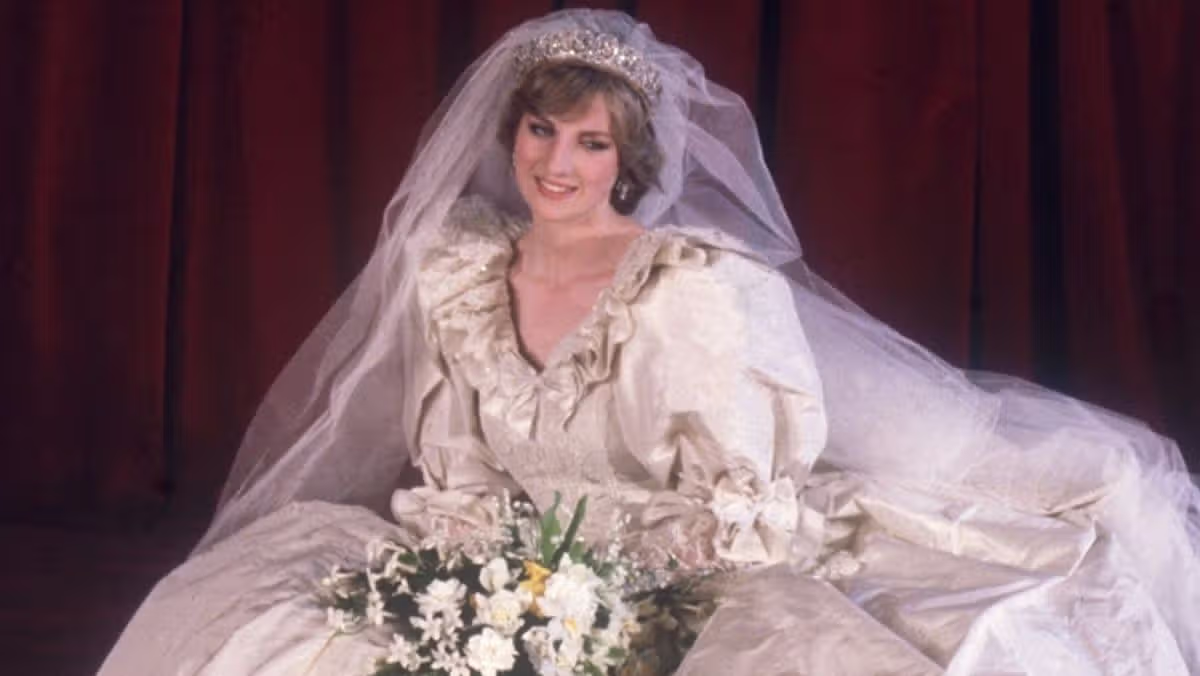
Elizabeth Emanuel, who with her husband, designed the wedding dress worn by Lady Diana Spencer at St Paul’s Cathedral in 1981, has a new challenge

The designer of Princess Diana’s wedding dress has created a replica of the late princess’s 40-foot veil – more than four decades after the original went missing.

Advertisement

Elizabeth Emanuel has recreated the iconic embroidered veil, which she originally designed with her husband David for Diana’s wedding to the then Prince Charles at St Paul’s Cathedral on July 29, 1981.

In the decades after the royal wedding, Diana’s famous wedding gown has been on display for visitors of both Kensington Palace in London and the late princess’s ancestral home of Althorp House in Northamptonshire, however her veil has always been missing from the exhibits.

Now, Ms Emanuel has been commissioned by Renae Plant, the founder of the Princess Diana Museum, to bring the veil back to life on the 45th anniversary of the royal wedding.

Advertisement

Taking to Instagram, Ms Emanuel shared some unseen photographs of seamstresses and embroiderers working on crafting the original bridal gown in her small studio in Mayfair back in 1981.

She wrote: “Hard to believe it’s been 45 years since the royal Wedding! The behind the scenes photos bring back so many memories.”

Speaking to People magazine about the remarkable recreation of the veil, Ms Emanuel explained that adding the accessory to future displays will help ensure the ‘whole magic’ of Diana’s wedding look continues to live on in her memory.

Content cannot be displayed without consent

She told the publication: “’That’s why I call it the Veil of Light. You can see the twinkle, and it radiates. The dress isn’t as complete without the veil.”

Advertisement

The designer added that once the veil is added to the whole look, the wedding dress “looks lighter, and has this airy, delicate feel to it which you don’t necessarily appreciate when you see the dress without all of that. It is an integral part of the design.”

To ensure the new veil is as accurate as possible to the original, Ms Emanuel worked alongside London-based embroidery house Hand & Lock, who produced the first veil in 1981, and has also unearthed the initial measurements they used.

45 years on from the royal wedding, which was watched by 750 million people in 74 countries, Ms Plant is set to take the collection on tour in Autumn, allowing members of the public to catch a rare glimpse of the recreated piece for the first time.

David and Elizabeth Emanuel went to extraordinary lengths to keep the design of Diana’s iconic wedding gown under wraps until the big day. The pair even destroyed their sketches immediately after showing them to Diana, ensuring they could never end up in the wrong hands. And should the design somehow be leaked, they crafted a second backup dress as a precaution.

David previously told People magazine: “At the time we wanted to make absolutely sure that the dress was a surprise. We didn’t try it on Diana. We never even discussed it. We wanted to make sure that we had something there; it was for our own peace of mind, really.”

Diana never actually set eyes on the second dress, which was crafted from identical fabric to the first and also featured ruffles around the neck.

Source link

Advertisement
Continue Reading

NewsBeat

Cambridge Traveller site allowed to keep unapproved mobile homes after winning appeal

Published

on

Cambridgeshire Live

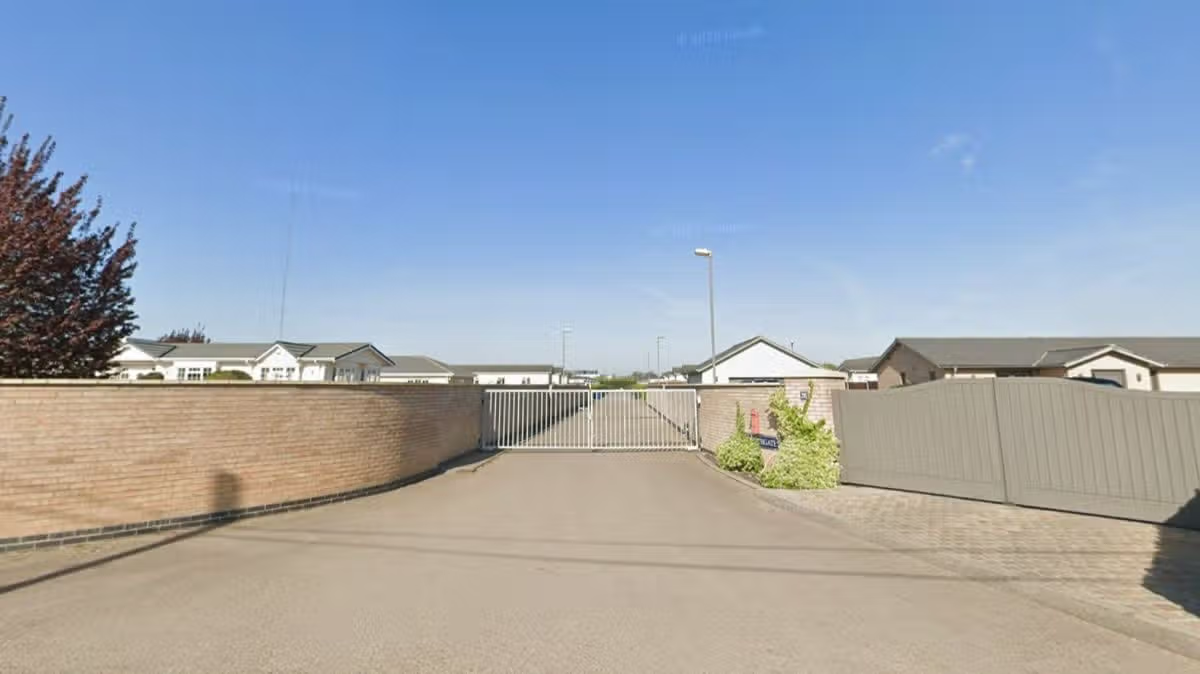
South Cambridgeshire District Council ordered the unapproved mobile homes at Southgate Caravan Park to be removed – but a government inspector sided with the site owner

An inspector has allowed the owner of a Cambridge Traveller site to keep extra mobile homes put up without permission after an appeal against the council.

Advertisement

Planning permission was granted in 2008 for 24 mobile homes and two chalets to be sited at Southgate Caravan Park off Fen Road for use solely by Travellers.

South Cambridgeshire District Council issued an enforcement notice in February alleging that more mobile homes had been added and others subdivided. Amos Webb appealed to the Planning Inspectorate with a hearing held on July 14.

The council also said that nine of the mobile homes were “used by persons of several ethnicities and did not identify as Gypsies or Travellers”.

Mr Webb disputed this and said he had made sure all residents were from the Gypsy or Traveller community by checking they “could speak Roma”.

Advertisement

Inspector M Madge said there was no “substantive evidence” to show that only Gypsies or Travellers have used the site.

Mr Webb also appealed on the grounds that the “time that action could be taken had passed”. This was accepted for two of the mobile buildings as they could be shown to have been there for 10 years or more “without significant interruption”.

A building alleged by the council to be an “additional unit of accommodation” was found by the inspector to instead be used as a garage. It can be seen in aerial photographs dating back as far as April 2015.

Another mobile unit was also in photographs from this period. Mr Webb said it was used to provide “additional sleeping and showering facilities”. The council argued this was used as a separate home as it was fenced off from the surrounding pitches.

Advertisement

Inspector Madge said it was “not clear what purpose this mobile home serves” but “it would not be unreasonable to conclude it contains all the required facilities for day-to-day domestic existence”.

There were multiple mobile homes “substantially larger” than the others which the council alleged were sub-divided. The inspector said Mr Webb did not provide any “substantive evidence” to disprove this.

The inspector said these larger units were only visible in aerial images as far back as May 2017, less than the 10-year cutoff. Three more mobile homes were seen to have been placed on the land somewhere between June 2023 and March 2025.

The inspector said that the extra units do not “significantly reduce” outside space and, “seen against a backdrop of mobile homes”, do not “have any adverse effect on the character and appearance of the countryside”.

Advertisement

Though planning permission was only given for 26 homes, they said each pitch “is of a sufficient size to accommodate a mobile home along with associated vehicles, touring caravans and outside amenity space for residents.”

Inspector Madge accepted Mr Webb’s argument that, “as families grow”, residents on the pitches needed extra accommodation or dayrooms and that these extra units “would make a positive contribution” to “facilitating the traditional lifestyle of the authorised users of the caravan site”.

They granted planning permission for the additional mobile home units – under the condition they cannot be used as independent homes “to prevent overcrowding”.

Source link

Advertisement
Continue Reading

NewsBeat

Court case opens in challenge to South Africa’s land expropriate law

Published

on

Court case opens in challenge to South Africa's land expropriate law

JOHANNESBURG (AP) — A court case opened Monday challenging South Africa’s controversial new law that allows the government to seize private land, which has been at the heart of strained relations with the administration of U.S. President Donald Trump.

The Expropriation Act was signed into law by President Cyril Ramaphosa last year as part of the government’s efforts to address the effects of land dispossession and economic inequality through decades of white minority rule in South Africa that ended in 1994.

Trump has said the law will be used to target white farmers for land seizures and has cited it as a reason why the U.S. has withdrawn all financial aid to South Africa and imposed high trade tariffs on the country. The government denies this, and says the law will be aimed at making unused land productive.

The Democratic Alliance, a political party which is now part of the country’s unity government, has joined with lobby groups to challenge the law in the Western Cape High Court. Lawyers for the groups argued Monday that the law violates the South African Constitution’s protections of private property and prohibitions of expropriation of land without compensation.

Advertisement

Proceedings in the case are scheduled to run through the end of the week, but is unclear how long judges will take to deliver a ruling, which could take weeks or months.

The law allows the South African government to expropriate land from private parties if it’s in the public interest, and it allows for expropriation without compensation if negotiations for a reasonable settlement have failed. The government says the law does not allow land to be taken arbitrarily.

Others parties to the case include the Institute for Race Relations, which argues the law does not adequately protect land owners’ property rights and the Afrikaner lobby group AfriForum.

Afrikaner farmers are descended from Dutch and other European colonial settlers who first came to the country more than 300 years ago. The Trump administration has offered asylum to Afrikaners who claim persecution.

Advertisement

Source link

Advertisement
Continue Reading

NewsBeat

War Machine (2026) Is The Most Watched Netflix Film In 2026

Published

on

War Machine (2026) Is The Most Watched Netflix Film In 2026

Streaming service Netflix has released its data about the biggest TV shows and movies of the year so far – and to be honest, we’ve been pretty surprised by the results.

For instance, mystery thriller His & Hers has taken the top series slot, above massive hitters like Bridgerton and Stranger Things.

It’s had a whopping 104 million hours of view time worldwide between January and June 2026.

As for the film category, the top spot went up against some stiff competition – the indefatigable K-Pop: Demon Hunters stayed strong in fourth place, while rom-com People We Meet On Vacation enjoyed seventh.

Advertisement

But number one went to military thriller War Machine, starring Alan Ritchson, Dennis Quaid, Stephan James, Jai Courtney, and Esai Morales.

Ritchson “plays a combat engineer who enters the elite US Army Ranger selection process, pursuing a long-abandoned goal he once shared with his brother,” its synopsis reads.

“During the last round of the relentless training program, the candidates find themselves fighting to evade the sights of a massive and mysterious killing machine.”

With a respectable 66% on review aggregation site Rotten Tomatoes, Empire said that while the 2026 film isn’t exactly sophisticated, “there’s something inherently satisfying in watching a man who is 80 per cent bicep hit things with varying degrees of extreme force”.

Advertisement

Or, as The Guardian put it, “Netflix bravely asks: what if Predator but Transformers?” (they gave it three out of five stars).

During the first half of the year, Netflix’s Tudum shared that War Machine racked up a dizzying 146.9 million views.

Perhaps unsurprisingly, the publication added: “A sequel is on the way.”

Advertisement

The other titles that made the top 10 include:

  1. War Machine (2026)
  2. The Rip (2026)
  3. Swapped (2026)
  4. K-Pop: Demon Hunters (2025)
  5. Apex (2026)
  6. Thrash (2026)
  7. People We Meet On Vacation (2026)
  8. The Crash (2026)
  9. Peaky Blinders: The Immortal Man (2026)
  10. Office Romance (2026)

Source link

Continue Reading

NewsBeat

A prominent Putin critic and opponent of the war in Ukraine leaves Russia

Published

on

A prominent Putin critic and opponent of the war in Ukraine leaves Russia

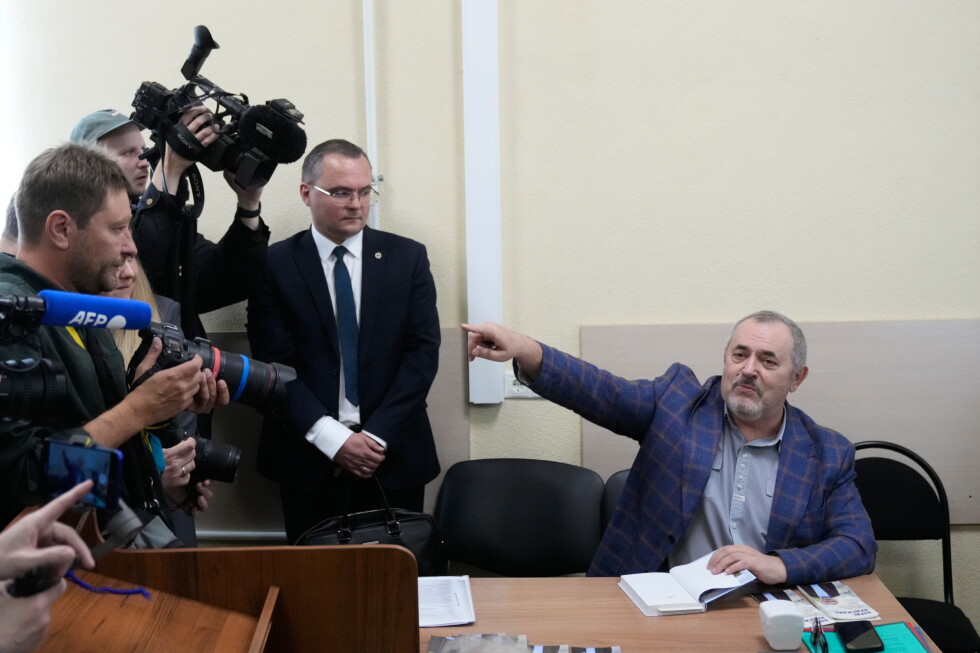
Opposition politician Boris Nadezhdin, who criticized Russia’s war in Ukraine and tried to challenge President Vladimir Putin in the 2024 election, said Monday he has left Russia, a move that follows a crackdown that barred him from a race for parliament this year.

Nadezhdin, 63, shared a video on Telegram, showing him standing in front of the Eiffel Tower in Paris.

“Good news: I’m alive and free. Unfortunately, not in Russia for the time being,” he said, adding that he needs “to look around and figure out life going forward.”

In July, a Russian court fined Nadezhdin about $13 for displaying “extremist symbols,” charges that he rejected as absurd. The accusations stemmed from a 2023 online video that briefly showed a picture of the late opposition leader Alexei Navalny, convicted of extremism in a case widely seen as politically motivated.

Advertisement

Earlier that month, Nadezhdin also was designated a “foreign agent” — a label that brings additional government scrutiny as well as stigmatizing connotations in Russia.

That and a fine on an extremism-related charge barred him from running in September’s parliamentary vote, which is expected to be tightly controlled by the Kremlin.

The ruling United Russia party is seeking to preserve its dominance in the lower house of parliament in a race against the Communist Party and a couple of other parties that vote in sync with the Kremlin on key issues. The campaign comes amid signs of growing public fatigue with the war in Ukraine as fuel shortages and economic pain increase, an environment that reduces the authorities’ tolerance for even token opposition.

In January 2024, Nadezhdin collected thousands of signatures in his run for president as he openly called for an end to the war in Ukraine. But he was kept off the March 2024 ballot after Russia’s Supreme Court ruled that more than 9,000 signatures submitted by his campaign were invalid — enough to disqualify him. Putin faced only token opposition in the election and easily gained a fifth term.

Advertisement

A veteran politician, Nadezhdin worked in the government in the 1990s when he was an adviser to Sergei Kiriyenko, now a top Putin aide. He also served as a lawmaker and more recently became a member of a municipal council. He was one of the few high-profile Putin critics still living in Russia.

Earlier this year, Nadezhdin declared his bid to run for the lower house of parliament, the State Duma, and vowed to continue his symbolic campaign even after the Justice Ministry branded him with the “foreign agent” designation.

Another blow came when police briefly detained Nadezhdin and charged him with displaying “extremist symbols.” The politician said he was considering a move abroad but was barred from leaving Russia. It wasn’t clear from his Monday video statement whether the ban has since been lifted, or if he left the country despite it.

After the Kremlin’s full-scale invasion of Ukraine in 2022, authorities ramped up their crackdown on dissent and free speech, relentlessly targeting rights organizations, independent media, members of civil society organizations and Kremlin critics. Hundreds of people have been jailed and thousands of others fled the country.

Advertisement

Source link

Continue Reading

NewsBeat

The musicians turning bat calls into club music

Published

on

The musicians turning bat calls into club music

A new album made from the echolocation calls of bats is inviting listeners to hear one of the UK’s most misunderstood mammals differently

Echo in the Dark, by artists Hanna Tuulikki and Tommy Perman, transforms the ultrasonic calls of eight bat species into electronic music, blending translated bat recordings with the human voice.

Normally beyond the range of human hearing, the calls have been made audible using heterodyne bat detectors, revealing clicks, buzzes and rhythms that can sound surprisingly close to electronic music.

Advertisement

The project began in 2022, when Hospitalfield, an arts venue in Arbroath, Scotland, commissioned Tuulikki to make work inspired by bats after running community bat walks during the Covid lockdowns. She proposed dance music made from echolocation sounds and invited Perman to collaborate.

Advertisement

“It was an easy yes from me,” said Perman, who has long used electronic music to fuse natural sounds with other instruments. “What you hear is extraordinary – clicks, buzzes, rhythms and warbles that could easily be mistaken for samples from electronic dance music. That realisation felt like an invitation we couldn’t ignore.”

The pair made some recordings themselves, gathered others through an open call, and worked with Tayside Bat Group, eventually collecting sounds from 13 of the UK’s 18 bat species. Eight of those species feature on the finished album, their calls processed into beats, melodies and textures, with Tuulikki’s voice woven through them to create what the artists describe as a human-bat hybrid sound world.

Perman said he had wrongly assumed the species would sound broadly similar, but found the variety “astounding”. “The lesser horseshoe bat produces the most beautiful rippling calls that wouldn’t be out of place on a dub record, while the Daubenton’s bat creates amazing syncopated rhythms that sound like a jazz drummer,” he told Positive News.

Advertisement

The first version of the project became a series of outdoor “silent bat raves”, where audiences danced through headphones at dusk while bats few above them. Now the music has been reworked as a full-length vinyl and digital album, released on 28 August through Glasgow independent label KIN-TU.

The artists hope the record can do more than surprise listeners. Bats are crucial to ecosystems, but remain surrounded by unease and superstition. Perman said he was shocked by a recent Bat Conservation Trust survey which found that 46% of people in the UK hold negative feelings about them.

The lesser horseshoe bat produces calls that wouldn’t sound out of place on a dub record

Echo in the Dark is not trying to change that through a lecture. “Dance music has always been a space where people can come together, lose themselves in the moment, and feel part of something bigger,” said Perman. “We hope the album can use that power to nurture a different kind of relationship with the more-than-human world – one rooted in curiosity and care rather than fear.”

Advertisement

The dream, he said, is simple: for someone who has never given bats much thought to put on the record and come away feeling differently. “If it sends even a handful of listeners out into the night to listen for bats, or to support bat conservation, that feels like a genuinely positive outcome.”

Main image: Lawrence Winram

Be part of the solution

At Positive News, we’re not chasing clicks or profits for media moguls – we’re here to serve you and have a positive social impact. We can’t do this unless enough people like you choose to support our journalism.

Advertisement

Give once from just £1, or join 1,800+ others who contribute an average of £3 or more per month. Together, we can build a healthier form of media – one that focuses on solutions, progress and possibilities, and empowers people to create positive change.

Support Positive News

Source link

Advertisement
Continue Reading

NewsBeat

A172 near Stokesley closed after two-vehicle crash

Published

on

A172 near Stokesley closed after two-vehicle crash

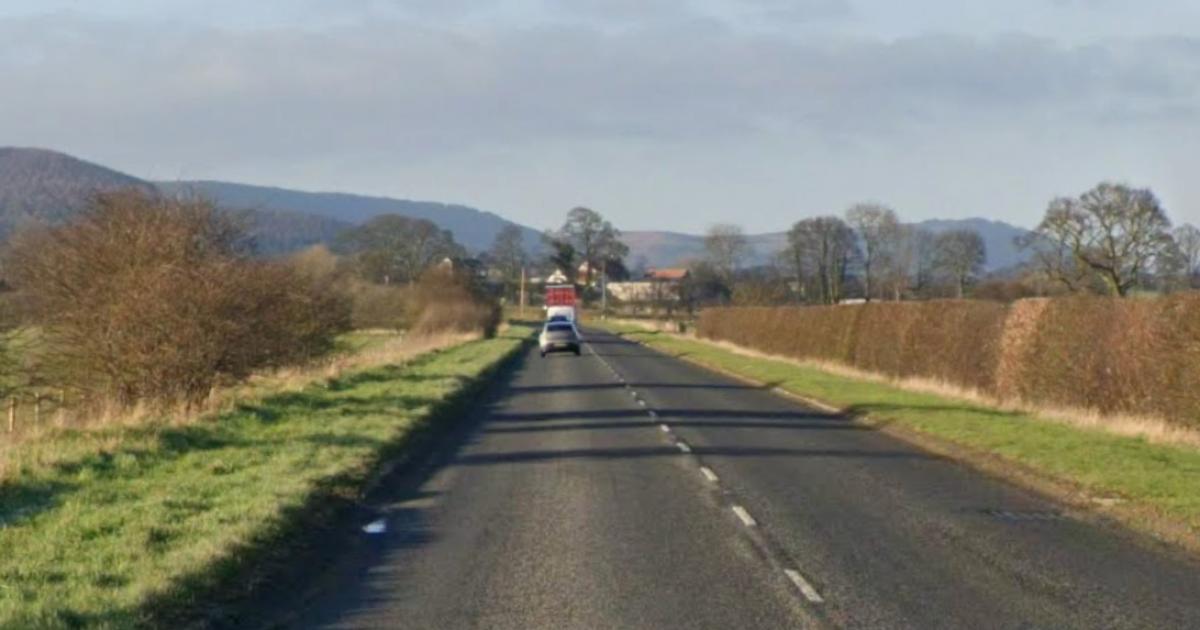
Emergency services were called to the A172, between Thirsk Road and Little Busby, earlier today (August 3) following a crash. 

North Yorkshire Police said the road is expected to be closed for some time – with AA Traffic News now showing slow traffic on either side of the closure. 

It is not yet known whether anyone has been injured in the incident or taken to hospital.

Advertisement

A force spokesperson said: “We are currently dealing with a two-vehicle road traffic collision between Thirsk Road and Little Busby.

“The road is expected to be closed for some time. Motorists are advised to find alternative routes in the meantime. Reference: NYP-03082026-0290.” 

The Yorkshire Ambulance Service has been contacted for more information.

Advertisement

Source link

Continue Reading

NewsBeat

Shipping must stop treating decarbonisation as a ‘future fuel’ problem, says BAR Technologies

Published

on

Shipping must stop treating decarbonisation as a ‘future fuel’ problem, says BAR Technologies

A new study by EY Greece has warned that shipping’s transition to net zero will be uneven and capital intensive, constrained by factors including alternative fuel availability, infrastructure, shipyard capacity, access to finance and fragmented commercial incentives.

Source link

Continue Reading

NewsBeat

Fans discover ‘best detective show’ that’s perfect High Potential replacement

Published

on

Daily Mirror

Fans claim it is one of the best crime dramas on TV right now

High Potential fans have discovered an ideal binge-watch while waiting for the hit crime drama to return.

Advertisement

R.J. Decker has been described as the ‘best detective show‘ by some, as they eagerly anticipate the return of the Kaitlin Olson-starring series.

High Potential is expected to make a comeback with its third season sometime in early 2027. That was after it caused a stir following a double cliffhanger in its final episode.

Production is underway, with new showrunners at the helm promising to deliver more of the crime-solving adventures fans have grown to love. In the meantime, though, the US network has produced another crime drama with a similar vibe, and so far, audiences have given it their mark of approval.

R.J. Decker is aired on the same channel as High Potential, that means that it is also available in the same place for UK based viewers. All episodes of R.J. Decker are accessible via Disney+.

Advertisement

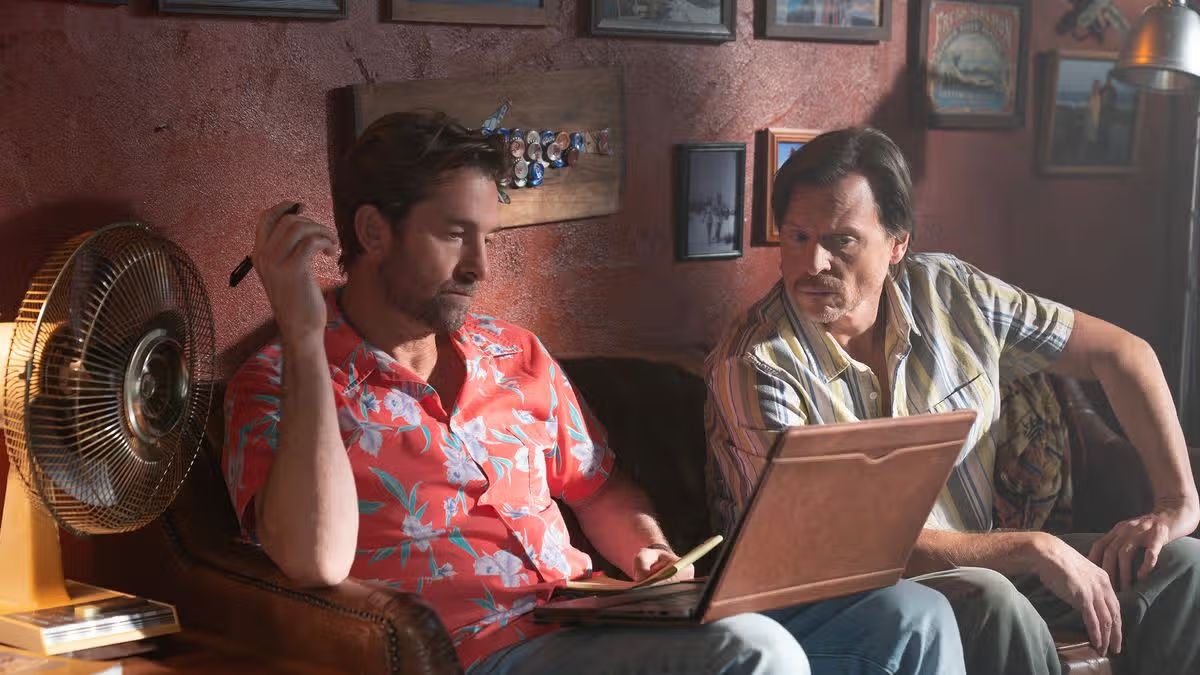
According to its synopsis, the series follows Decker, a former newspaper photographer who is trying to start a new life as a private investigator in South Florida after spending some time behind bars.

Episodes across the first season see him tackling cases that range from slightly odd to outright bizarre, with the help of his journalist ex, her police detective wife, his former cellmate-turned confidant, and a shadowy woman from his past.

The story is based on Carl Hiaasen’s novel Double Whammy and was created for the screen by Rob Doherty. Doherty previously made the Sherlock Holmes-inspired series Elementary.

Advertisement

Get Disney+ from £5.99

This article contains affiliate links, we will receive a commission on any sales we generate from it. Learn more
Content Image

£5.99

Disney+

Get Disney+ here

A Disney+ subscription is now available from £5.99 per month, offering hit shows like Andor, The Bear and Alien: Earth, plus countless titles from Star Wars and Marvel.

Fans of High Potential have been sharing their thoughts on R.J. Decker. One person shared on Reddit: “Has anyone here seen RJ Decker yet. It’s only got one season out so far but has the same feel as High Potential. I don’t want to share too much if you haven’t seen it, but I recommend checking it out.”

Advertisement

One replied with a confession as they said: “I really liked it!! I honestly liked it better than High Potential season 2”

While R.J. Decker has not managed to score as highly on Rotten Tomatoes as High Potential, fans are full of praise for it. One posted: “Best detective show on TV in a long time! I like that there is a mystery that wraps up each week with the underlying story about his conviction. They capture the Florida ambiance well and RJ is believable and you find yourself rooting for him and his family.”

Another added: “There’s nothing to NOT like about RJ Decker. It’s just a fantastic series. Very rewatchable as well. Excellent cast led by Scott Speedman and very well-written. The soundtrack nails it in every episode.”

Advertisement

While someone else commented: “Riveting crime drama that exceeds expectations. RJ Decker is a gripping, brilliantly crafted series that delivers everything you could want in a crime drama, sharp writing, compelling characters, and nonstop intrigue.”

They continued: “The show masterfully blends suspense, mystery, and emotional depth, with RJ Decker standing out as a complex, charismatic lead whose intelligence and determination keep you invested from start to finish.”

R.J. Decker is streaming on Disney+.

Source link

Advertisement
Continue Reading

NewsBeat

Met Office forecasts highs of 28C for York amid heat alert

Published

on

Met Office forecasts highs of 28C for York amid heat alert

The Met Office has forecast highs of 28C for York on Tuesday (August 4).

It comes as the heat health warning has been issued for York by the UK Health Security Agency (UKHSA) from Monday until Wednesday.

UKHSA has warned the latest high temperatures could put extra pressure on the NHS, with more vulnerable people likely to require medical treatment.

Advertisement

Forecasters expect temperatures in York to peak on Tuesday then sit between 19C and 22C throughout the week and into the weekend.

The Met Office has forecast sunny intervals throughout the week with the chance of showers overnight.

It comes after Met Office statistics revealed England and Wales have recorded their driest July on record.

Just Yorkshire and the North East remain in normal status, with all of Wales and half of England officially in drought.

Advertisement

Met Office experts have warned weather conditions in August are not looking favourable for delivering the kind of sustained rain needed to reverse the dry conditions.

The extreme summer has hit Europe-wide, with wildfires raging across France and Spain, in blazes that analysis shows are made more likely by climate change.

The UK is facing the impacts of increasingly extreme weather such as droughts and heatwaves fuelled by human-caused climate change, which is caused mostly by burning fossil fuels.

Polly Ashmore, of the UKHSA, said: “Periods of hot weather can result in serious health outcomes, especially for older adults, and it is therefore important that everyone takes sensible precautions while enjoying the sun.

Advertisement

“We are urging health and social care services in affected regions to ensure they are prepared, and reminding people to look out for elderly relatives, neighbours and those with underlying health conditions, making sure they are aware of the forecast and following the necessary advice.

“Simple steps such as staying hydrated, avoiding the sun during the hottest part of the day, and keeping your home cool are some of the key ways to help keep yourself and others safe during periods of hot weather.”


Read next:


The prime minister’s official spokesman has defended Andy Burnham over questions from journalists that the drought was not a priority for him.

Advertisement

He said Mr Burnham had spoken and made announcements on a number of different issues including the cost of living, devolution, social care, migration and defence “but clearly he’s only been in post briefly”.

He said the government took climate change seriously, and was working with farmers, the Environment Agency and the water sector to manage the impacts of the exceptionally dry weather.

And amid rumours Mr Burnham may relax Labour’s stance against new North Sea drilling, the spokesman added that the prime minister had been clear the government will take “pragmatic approach”, with oil and gas a part of the mix.

But the only way to bring bills down for good is by taking control with “clean homegrown power to deliver energy security”, he said.

Advertisement

Source link

Continue Reading

Trending

Copyright © 2025