Connect with us
DAPA Banner
DAPA Coin
DAPA
COIN PAYMENT ASSET
PRIVACY · BLOCKDAG · HOMOMORPHIC ENCRYPTION · RUST
ElGamal Encrypted MINE DAPA
🚫 GENESIS SOLD OUT
DAPAPAY COMING

Business

Q1 surprise sends jewellery stocks shining 40% in a month. Will the surge last in next quarters?

Published

on

Q1 surprise sends jewellery stocks shining 40% in a month. Will the surge last in next quarters?
The gold jewellery industry entered FY27 facing a four-pronged challenge. Soaring oil prices, rising inflation concerns and renewed expectations of higher interest rates amid the West Asia crisis coincided with the once-in-three-years Adhik Maas period, which typically dampens wedding-related jewellery demand. At the same time, Prime Minister Narendra Modi urged citizens to curb gold purchases to help arrest the freefall in the Indian rupee, while customs duty on gold was raised to 15% from 6%.

Despite these headwinds, India’s listed jewellery stocks have moved in the opposite direction. Backed by stronger-than-expected June quarter business updates, the sector has rallied as much as 40% in just one month.

Data from ACE Equity shows Kalyan Jewellers leading the pack with a 40% gain, followed by Sky Gold at 25%, Thangamayil Jewellery at 24%, Goldiam International at 21%, PC Jeweller at 15%, Titan Company at 14%, and Senco Gold at 9%.

Jewellery stocks Q1 update

Jewellery companies delivered healthy same-store sales growth during the June quarter, signalling resilient demand and an accelerating shift towards organised players. The sector had earlier corrected following adverse government policy measures and advisories. However, analysts believe demand has remained resilient and that the long-term structural tailwinds for organised jewellers remain intact.Titan, India’s largest jewellery retailer, reported a 41% year-on-year rise in its consumer businesses during the June quarter, supported by strong jewellery demand, retail network expansion and robust growth in its international operations. Its domestic business grew 37% year-on-year, taking the total store count to 3,517. Jewellery continued to be the biggest contributor, with the segment growing 39% over the year-ago period. Titan attributed the performance to healthy festive demand and strong sales during Akshaya Tritiya.

Advertisement

Also read:Titan vs Kalyan Jewellers: What Q1 sales indicate about demand and which stock to buy
Other listed players also reported robust business updates. Senco Gold posted 60% revenue growth along with 38% same-store sales growth, Kalyan Jewellers reported 38% growth, while PC Jeweller recorded 21% growth after reducing more than 90% of its settlement debt and guiding for a debt-free balance sheet this quarter.

Fundamental buying or sentiment driven?

“The Q1 FY27 business updates from jewellers point towards demand resilience despite concerns around Adhik Maas, gold prices and macro uncertainty. While the market expected a softer quarter, demand remained strong across wedding, festive and investment-led categories. A key driver was the ~18% correction from peak gold prices and the return of price stability,” Anil R, Senior Research Analyst, Geojit Investments, told ETMarkets.According to him, the recent rally is largely supported by improving fundamentals rather than sentiment alone. Organised jewellers continue to gain market share from the unorganised segment as consumers increasingly prefer branded and trusted players. At the same time, leading companies have consistently expanded their store networks while maintaining healthy return ratios and strong balance sheets, making the organised jewellery business model increasingly attractive to investors.

He added that the industry is also benefiting from premiumisation and higher penetration of studded jewellery, both of which support sustainable revenue growth over the medium term. The recent consolidation in gold prices is also expected to improve customer footfalls.

That said, valuations for some jewellery stocks are no longer inexpensive, and future returns will increasingly depend on earnings delivery.

Will momentum sustain after Q1 results?

The outlook beyond the June quarter also remains constructive as leading players continue to project strong long-term demand.

Advertisement

“The strong start to FY27 by market leaders reinforces confidence in the sector’s demand outlook. Within our coverage universe, we prefer Titan Company (ADD, Fair Value: Rs 4,725) and Bluestone Jewellery (BUY, Target Price: Rs 625) as our preferred picks over the next 12–18 months,” Pankaj Kumar, VP Fundamental Research at Kotak Securities, told ETMarkets.

Anil shares a similar view, saying the growth momentum appears sustainable beyond Q2, although the pace will depend on gold price movements and consumer sentiment. Stable gold prices should support demand, as jewellery purchases are typically influenced more by price volatility than by absolute price levels. He also believes initiatives such as gold exchange and recycling programmes will improve affordability and customer engagement.

Also read:Bought gold and silver at the top? Here’s what experts suggest after prices plunged up to 50% from January

Importantly, the second half of the year is typically stronger for the industry, supported by the festive season and the peak wedding period. If gold prices remain relatively stable, leading organised jewellery retailers should continue delivering healthy growth over the coming quarters.

Advertisement

Should you buy jewellery stocks right now?

International brokerage Nomura said the “strength show continues, all businesses fire up well” for Titan Company and maintained its Buy rating with a target price of Rs 5,000, implying 9% upside. “We view Titan as a key beneficiary of the rising affluent and elite income population in India, with sales growth at 1.5-2x GDP of India over the medium term,” the brokerage said.

Nomura noted that Titan has been among the fastest-growing domestic jewellery players, increasing its market share from 5% in FY19 to 8% in FY24. It expects the company to continue outpacing industry growth and raise its market share to 10% by FY28F, driven by expansion into Tier 2, Tier 3 and Tier 4 towns and the continued migration of consumers from the unorganised sector, which still accounts for 60% of the industry, to organised retailers offering correct carat-age, better designs and an improved shopping experience.

Preeyam Tolia, Research Analyst, Choice Institutional Equities, believes B2B jewellery manufacturers are better placed to outperform over the next 12-18 months. He said these companies can scale without significant investments in store expansion, branding or customer acquisition. With ongoing capacity additions and stronger relationships with organised jewellers, B2B players are well positioned to deliver superior earnings growth. Within this segment, Shanti Gold and Shringar House of Mangalsutra remain the firm’s preferred picks.

Citi remains bullish on Kalyan Jewellers, with a target price of Rs 750, implying 58% upside. The brokerage expects the company’s franchise-led expansion strategy to support future revenue growth and believes its asset-light model will aid deleveraging while improving return on capital employed (ROCE).

Advertisement

ICICI Securities has also maintained a Buy rating on Kalyan Jewellers, with a target price of Rs 670, implying 41% upside. The brokerage said the company’s robust Q1FY27 performance despite multiple headwinds underscores resilient jewellery demand. While continued store expansion and the formalisation of the industry reinforce its positive outlook, it flagged any structural decline in natural diamond prices as a key risk.

Going forward, investors will closely monitor management commentary, festive season demand and the pace of store expansion, all of which are likely to shape the sector’s performance over the coming quarters.

(Disclaimer: Recommendations, suggestions, views and opinions given by the experts are their own. These do not represent the views of The Economic Times)

Advertisement
Continue Reading
Click to comment

You must be logged in to post a comment Login

Leave a Reply

Business

Burnham will not ‘tax the hell out of you’

Published

on

Burnham will not 'tax the hell out of you'

Business owners bracing for a Burnham premiership have been offered a rare note of reassurance from one of the City’s most respected voices. Jim O’Neill, the economist and former Treasury minister, says the probable next prime minister will not arrive in Downing Street with a fresh round of punishing tax rises.

Speaking on The Rest Is Money podcast with Robert Peston and Steph McGovern, O’Neill said the biggest risk to confidence would be a new government talking the country down all over again.

“If something can be done to change the mindset of consumers and businesses, and make them think, ‘Hang on a second, we don’t have to worry as much about the next few years as we have been doing, effectively on and off since the financial crisis,’ then I think the human instincts and the natural juices would start to flow – so long as you don’t have an incoming government repeating what Keir did: ‘Oh, well, it’s actually way worse than we thought. Sorry, we’re going to tax the hell out of you. Life’s going to be miserable.’ That is definitely not the nature of our probable incoming leader.”

It is a message that will land well with the eight in ten SME owners who fear what a Burnham premiership would mean for their business.

But the reassurance comes with a hard edge. O’Neill argues the UK can no longer duck politically toxic “sacred cows”: the pension triple lock, a root-and-branch overhaul of welfare, replacing council tax and stamp duty with a fairer system of land and property taxation, and a credible long-term framework for infrastructure investment.

Advertisement

On the triple lock, whose mounting long-term cost the Office for Budget Responsibility has repeatedly flagged, he was blunt. “I think the triple lock needs to be dealt with. And I suspect, once the right person is bold enough to do it, it’s going to be pretty hard for any major political opposition to disagree. It’s also very unfair from an intergenerational perspective, with all these young people who can’t afford to buy or rent in some parts of the country being expected to pay more and more tax for a lot of people who own their own homes and still get a very nicely protected pension increase all the time.”

He was equally scathing about Sir Keir Starmer’s tinkering with Britain’s welfare bill. “I do think one of the many mistakes that Keir Starmer presided over was effectively trying to play around with small amounts of savings in welfare, purely to meet what one might regard objectively as an arbitrary fiscal rule or fiscal space. Whereas, if you’re really going to do it, you’ve got to have a systematic reform of everything that connects to the various welfare payments that are going on.”

His call to replace council tax and stamp duty echoes the open letter from economists urging Burnham to scrap both in a radical shake-up of the tax system, which O’Neill signed.

The stakes, he warned, are being set daily in the bond markets. “You’ve got, lurking in the background every second of every day, the financial markets. They are not charging the UK a premium on its borrowing for nothing. They are expecting that, at some point, somebody is going to be bold enough to take on some of these so-called sacred cows and put us on a more sustainable path for debt.”

Advertisement

For SMEs, the practical takeaway is focus. O’Neill argues markets could support higher borrowing for growth-enhancing projects, provided decisions are independently assessed, and he wants far greater devolution of skills, education and employment support, though he cautions the Greater Manchester model cannot simply be copied elsewhere.

His advice to the man who has already signalled room for movement on tax and a business rates cut for high street firms is characteristically direct. “Andy needs to figure out exactly what his key priorities are, communicate that to everybody and then actually stick with them. He then needs to choose the people around him who can deliver them.”

O’Neill stresses he holds no formal role with Burnham. The sacred cows, though, now have a very public list of names against them.

Watch or listen to The Rest Is Money wherever you get your podcasts.

Advertisement

Amy Ingham

Amy is a newly qualified journalist specialising in business journalism at Business Matters with responsibility for news content for what is now the UK’s largest print and online source of current business news.

Advertisement
Continue Reading

Business

Turkey stocks lower at close of trade; BIST 100 down 1.60%

Published

on


Turkey stocks lower at close of trade; BIST 100 down 1.60%

Continue Reading

Business

New retail tenants for Cardiff Bus Interchange

Published

on

Business Live

It has signed up Kiwis Bowis and Which Wich

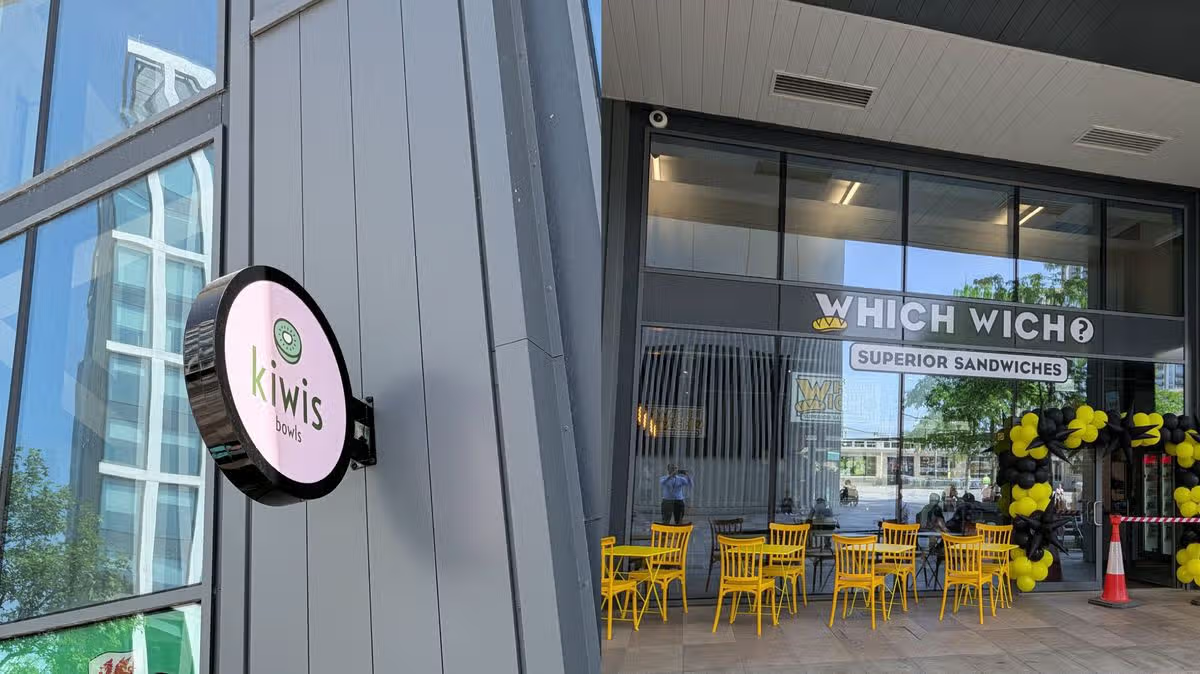
Which Wich and Kiwis Bowls has taken space at the Cardiff Bus Interchange.

Cardiff Bus Interchange has signed up new tenants to its ground floor retail element. The bus station, which is managed by Transport for Wales (TfW), has attracted Kiwis Bowls and the international sandwich specialist Which Wich.

They follow the opening of a Starbucks in April last year.

Advertisement

Alexia Course, chief commercial officer at TfW said: “We’re delighted to welcome these new retailers to Cardiff Bus Interchange.

Following the arrival of Starbucks last year, these new additions now bring even more choice for passengers and strengthen our tenant mix. We’re creating spaces that serve customers and support local businesses.”

The integration of these units was managed by TfW’s recently in-housed commercial property team.

Supporting the interchange’s digital infrastructure, the project highlights a significant digital milestone. TfW subsidiary ffeibr provided both retailers with high-speed business broadband, showcasing a successful internal collaboration between TfW and ffeibr.

Advertisement

Guy Reifer, managing director of ffeibr, added: “This is an exciting milestone for ffeibr, as we continue our expansion into the direct to business sector.”

“Our mission is to provide reliable, high-speed connectivity that helps Welsh businesses, as well as businesses in Wales, thrive, and this partnership is a great example of that in action.

Cycle storage

Moreover, TfW by providing secure storage for cyclists through its cycle hangar project. TfW has installed 40 cycle hangars across seven different housing associations and eight local authority areas as part of phase one of the project.

TfW worked closely alongside specific housing associations who proposed the sites following an initial expression of interest that was issued. TfW then carried out joint site visits to evaluate each location to ensure the best fit for the cycle hangars and the housing associations.

Advertisement

Deputy Minister for Transport Mark Hooper said: “Cycling is one of the most affordable, healthy and sustainable ways people can get around.

“Ensuring everyone has access to secure storage is a vital part of making that a practical option. These new cycle hangars for housing association tenants show what we can achieve when we work together to make it easier for people to cycle.

Nicola Grima, active travel delivery programme lead, said: “We’re so pleased to have completed phase one of our Cycle Hangar project alongside many housing associations within different local authorities across Wales.

“The lack of secure cycle parking is a barrier to people choosing to cycle for everyday journeys, so providing secure cycle parking is a way to overcome this barrier. Wales has great walking and cycling infrastructure and we want as many people as possible to make use of it.”

Advertisement

TfW has confirmed that phase two of the project is already in development which will provide 40 hangars across 10 local authority areas.

Continue Reading

Business

How Phone Culture Is Reshaping Chinese Society

Published

on

How Phone Culture Is Reshaping Chinese Society
  • China’s mobile-first culture has advanced beyond American smartphone adoption, with apps like WeChat integrating communication, payments, and social networking into daily life. This connectivity has bridged geographical distances and reshaped urban routines, potentially setting a new global standard for smartphone integration.
  • The shift has also introduced challenges, including reduced face-to-face interaction, digital addiction, and privacy concerns, particularly among young people. Balancing digital convenience with social well-being is increasingly important as widespread smartphone use continues to reshape cultural norms and behaviors.

This episode explores whether smartphones dominate American culture and suggests that China has advanced the mobile-first lifestyle even further. It highlights China’s innovative approaches to mobile technology, their integration of smartphones into daily life, and how this shift influences social and economic behaviors, possibly setting a global standard beyond what is seen in the United States.


The pervasive use of smartphones has significantly transformed Chinese society, impacting communication, social interactions, and daily routines. In urban areas, smartphones are essential tools for coordinating work, socializing, and accessing information, fostering a more connected and efficient lifestyle. Apps like WeChat facilitate instant messaging, mobile payments, and social networking, integrating various aspects of daily life into one device. This technology-driven shift has bridged geographical gaps, enabling families and friends to stay connected regardless of distance.

However, the rise of phone culture has also brought challenges. Excessive screen time can lead to social withdrawal and reduced face-to-face interactions, altering traditional communal values. Young people, in particular, spend hours immersed in digital worlds, which influences their social skills and real-world relationships. Additionally, concerns about privacy and digital addiction have emerged as society grapples with the implications of widespread smartphone use.

Overall, phone culture is reshaping Chinese society by enhancing connectivity while also posing social and psychological challenges. As technology continues to evolve, balancing digital convenience with social well-being becomes essential. This transformation underscores the importance of adapting cultural norms to navigate the digital age effectively.

Advertisement

source

Continue Reading

Business

Delivery Apps to Make Money in 2026: What Actually Pays (And What’s Just Marketing)
Published

on

Delivery Apps to Make Money in 2026: What Actually Pays (And What's Just Marketing)

Three winters ago, I decided delivery driving was going to be my genius side hustle. I had a car, a phone, and crucially a wildly inflated sense of how much “flexible income” actually means. I pictured myself cruising around town, podcast on, cash rolling in between errands. Two hours and four food deliveries later, I’d made $19. Minus gas, that came out to something like $6.40 an hour, which is less than I would’ve made standing perfectly still and doing nothing. I still, for reasons I cannot defend, kept the app on my phone for another eight months.

So: are delivery apps actually a smart way to make money, or just a well-marketed way to burn a tank of gas for gas-station wages? The honest answer is it depends entirely on which app, which city, which hours, and whether you’re willing to treat it like a numbers game instead of a vibe. Here’s what the data and a lot of driver forums actually say.

The delivery apps worth your time in 2026

  • DoorDash — biggest order volume, most markets
  • Uber Eats — pairs well with rideshare driving
  • Instacart — grocery shopping, higher per-batch pay
  • Shipt — grocery delivery with a loyalty/tipping edge
  • Amazon Flex — scheduled blocks, package delivery
  • Walmart Spark — grocery and general merchandise delivery
  • Grubhub — steadier in dense urban markets
  • Roadie — “on-the-way” deliveries, good for spare vehicle space
  • Apps for trucks/vans (Bungii, GoShare, Curri) — heavy-item hauling, higher hourly ceiling

Below is the real breakdown of what each one pays, who it’s actually good for, and where the marketing outruns reality.

Does DoorDash still pay off in 2026?

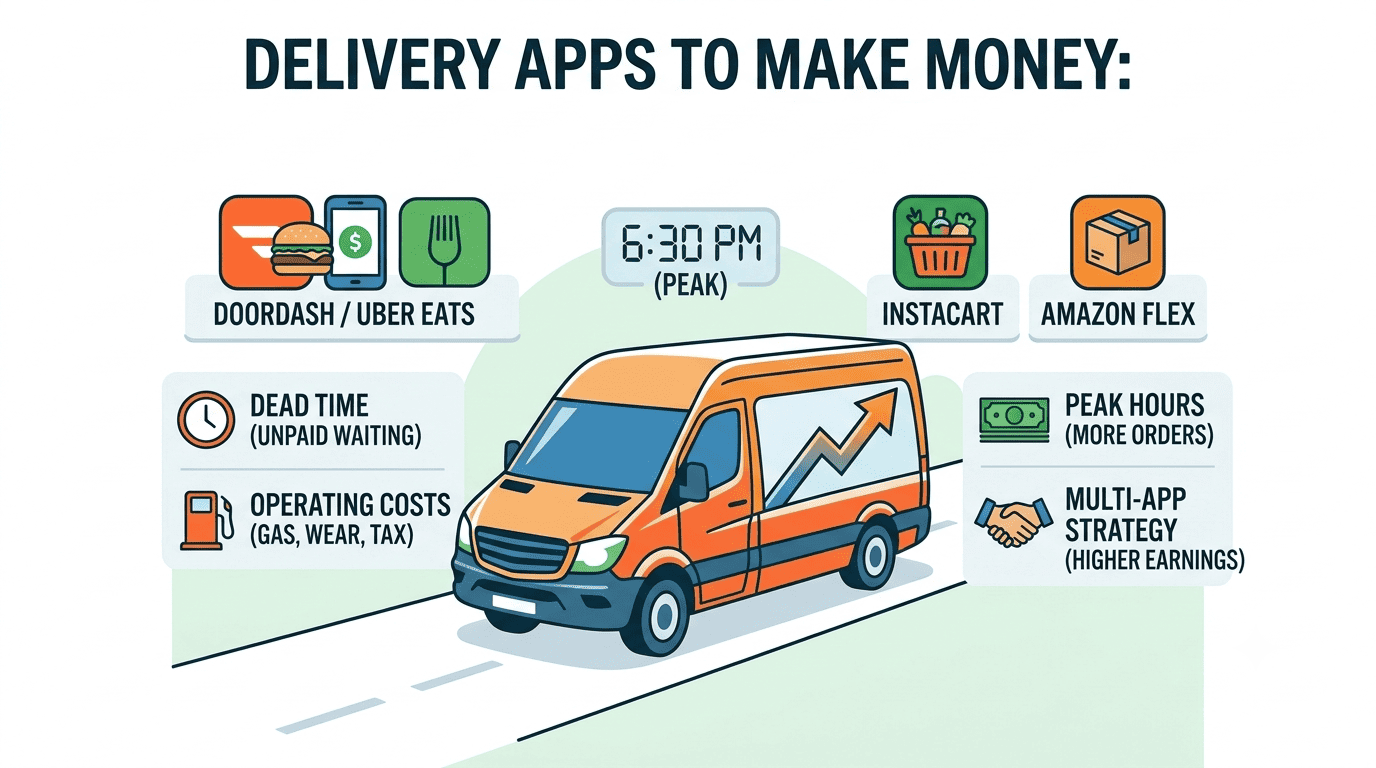
DoorDash remains the biggest name in the game, and for good reason- the order volume is unmatched in most cities, and sign-up takes about five minutes. Average pay lands around $15–$25 an hour before expenses, though that range swings hard depending on your market and whether you’re driving during a genuine rush or just refreshing the app hoping something pings. The tradeoff for that volume is competition: in saturated areas, you’ll spend real time waiting between orders, and that dead time doesn’t pay.

Worth it if you live somewhere with consistent lunch and dinner demand. Less worth it if you’re in a smaller market where three other Dashers are circling the same three restaurants.

Advertisement

Is Uber Eats better if you’re already driving for Uber?

If you’re already signed up to drive passengers, Uber Eats is close to a no-brainer — you can toggle to delivery when rides slow down and keep earning either way. On its own, though, the pay is a touch lower than DoorDash in most markets, generally $12–$20 an hour. The real value here is flexibility: fewer awkward conversations with strangers in your back seat, more control over exactly what kind of driving you’re doing at any given moment.

Is Instacart the better bet if you’d rather shop than drive?

Instacart flips the model: instead of picking up and dropping off, you’re shopping an actual grocery list, which means more time per order but noticeably higher pay — often $15–$30 an hour, with the top end reserved for big batches during peak hours. It’s more physically and mentally involved than food delivery (substitutions, weighing produce, hunting down that one specific brand of oat milk), but the tipping culture tends to reward shoppers who communicate well and get orders right the first time.

This is a strong option if you’d rather be inside a store than behind a wheel for three straight hours.

What makes Shipt different from Instacart?

Shipt runs on a similar model to Instacart — shop, deliver, repeat — but it’s built around Target and a handful of retail partners, and shoppers who build repeat relationships with the same customers often see it pay off in loyalty and better tips. Average pay sits around $16–$22 an hour. The catch: getting approved can take longer than some competitors, and route availability depends heavily on how saturated your zip code already is with other shoppers.

Advertisement

Is Amazon Flex actually the highest-paying option?

Of the mainstream apps, Amazon Flex is frequently cited as one of the better-paying choices — $18–$25 an hour is a common range, and you know your earnings upfront because you’re booking a fixed block (usually two to four hours) rather than gambling on per-order pings. The predictability is the whole appeal. The downside is that popular blocks get snapped up fast, so if you’re not fast on the draw when new slots post, you may find yourself checking the app repeatedly with nothing to show for it.

Does Walmart Spark deserve more attention than it gets?

Spark doesn’t get talked about as much as the bigger names, but it’s worth a look if there’s a Walmart or Sam’s Club nearby — you’ll deliver groceries and general merchandise, and pay tends to land in a similar range to Instacart and Shipt. Availability is the limiting factor here more than pay; it’s simply not as widespread yet.

Where does Grubhub fit into all of this?

Grubhub was one of the original food delivery apps, and while it’s lost significant market share to DoorDash and Uber Eats and changed corporate ownership more than once along the way, it still operates its own driver network in a number of cities. Pay tends to run $10–$17 an hour, generally lower than DoorDash or Uber Eats, but drivers in dense urban markets sometimes report steadier demand and fewer wild swings in order flow.

Is Roadie worth downloading if you’re not trying to drive full-time?

Roadie takes a genuinely different approach: instead of building a schedule around deliveries, it’s designed to monetize trips you’re already taking. Multi-stop gigs pay somewhere in the $25–$50 range, and there’s no requirement that you’re delivering food- it might be a suitcase, a piece of furniture, or a random Craigslist find someone needs moved across town. It’s less a full-time income stream and more a way to make an errand you were running anyway slightly less annoying.

Advertisement

Can you actually make more money hauling instead of delivering food?

This is the piece most “best delivery apps” lists gloss over: apps built around heavy or bulky items — think Bungii, GoShare, and Curri — consistently pay more per hour than food delivery, sometimes two to three times as much. One 2026 industry analysis tracking roughly a billion gig trips found task-based hauling work outearning standard food delivery by a wide margin. The logic checks out: fewer people own a pickup truck or cargo van, so the pool of available drivers is smaller, and platforms pay a premium to fill jobs. The tradeoff is obvious, you need the right vehicle, and you need to be willing to actually lift the couch.

How much should you realistically expect to make?

Here’s where the marketing and the math tend to part ways. Every app’s advertised hourly rate is gross pay- before gas, before the extra wear on your brakes and transmission, before the portion of your car’s depreciation that’s quietly happening every time you drive for money instead of pleasure. A driver technically “earning” $22 an hour on paper might be walking away with closer to $15–$17 once fuel and mileage are accounted for, and that’s before you’ve set aside anything for the self-employment tax bill waiting for you the following spring.

Is it smarter to run multiple apps at once?

Almost every experienced driver will tell you the same thing: don’t marry one app. Running DoorDash, Uber Eats, and Instacart simultaneously and accepting whichever offer pings highest first- is the closest thing to a proven strategy in this space. It fills the dead time that kills your hourly rate on any single platform, and it hedges against the days when one app’s demand mysteriously dries up for no explainable reason (every driver has a story about this).

The tradeoff is mental load. Juggling three notification streams while driving isn’t for everyone, and there’s a real argument for picking one or two apps you can actually manage well rather than spreading yourself across five and doing all of them mediocre.

Advertisement

What don’t the app store descriptions mention?

A few things worth knowing before you sign up for anything:

  • You’re a 1099 contractor, not an employee. No withholding, no benefits, and a tax bill that can catch first-timers off guard.
  • Vehicle wear adds up faster than people expect. Oil changes, brake pads, and higher insurance premiums (some personal auto policies exclude commercial delivery use entirely) are real costs, not hypothetical ones.
  • Age and background-check requirements vary. Most platforms require drivers to be at least 18 or 19, hold a valid license, carry insurance, and pass a background check — Instacart’s shopper-only track is one of the few that doesn’t require a car at all.
  • “Average pay” figures are averages, not guarantees. Your actual market, the time of day you drive, and local tipping culture will move your real number more than any app’s advertised range.

None of this means delivery apps are a bad way to make money for a lot of people, especially those with an already-flexible schedule, they’re a genuinely useful way to turn spare hours into cash without a job interview. But treating it as a strategic, numbers-driven side hustle instead of easy money is what separates the drivers actually building meaningful extra income from the ones burning gas for less than minimum wage- which, if it wasn’t already obvious, is a club I know from firsthand, deeply humbling experience.

Continue Reading

Business

Crude Oil Higher; Earnings Kick Off To Highlight Week

Published

on

Weekly Commentary: Gradually Transitioning To Suddenly

Crude Oil Higher; Earnings Kick Off To Highlight Week

Continue Reading

Business

Conflicting Consumer Sentiment Data

Published

on

Conflicting Consumer Sentiment Data

Conflicting Consumer Sentiment Data

Continue Reading

Business

10 Things to Know About Ana Maria Markovic, Croatia’s Rising Soccer Star Now Playing in New York City

Published

on

Ana Maria Marković
Ana Maria Marković
Ana Maria Marković

Ana Maria Markovic has built a growing public profile that spans professional soccer, entrepreneurship and social media, drawing attention both for her play on the field and her life off it. Here are 10 things to know about the Croatian forward.

  1. She’s a rising star for the Croatia national team. Markovic, born November 9, 1999, in the canton of Zurich, Switzerland, to Croat parents from Split, plays as a forward and has represented Croatia’s women’s national team on the international stage since 2021.
  2. Her soccer journey started later than most. Markovic spent 10 years as a competitive gymnast before transitioning to soccer, a switch she has credited to her younger sister, who was already playing for FC Zurich at the time. She began playing organized football at age 13 with FC Schlieren before joining FC Zurich’s U21 squad at 15.
  3. She rose quickly through Swiss women’s football. After her time in FC Zurich’s youth system, Markovic stepped into the Women’s Super League with GC Women, where she became known as something of a breakout talent in Swiss football circles, drawing coverage from outlets including 20 Minuten, which profiled her as a “GC Shootingstar.”
  4. She overcame a serious knee injury. In a match against her former club FC Zurich on March 4, 2023, Markovic suffered a torn ACL along with additional ligament damage, a significant setback that required an extended recovery before she could return to competitive play.
  5. She’s played professionally across three countries. Markovic’s club career has taken her from Switzerland to Portugal, where she played for Damaiense before her move was officially announced in February 2025, and most recently to the United States, where she has played for Brooklyn FC in New York City since 2025, embracing what she has described as a new chapter of growth on the global stage of women’s soccer.
  6. She plays alongside her sister. Markovic is the sister of Kiki Markovic, who also signed with Brooklyn FC, with the club confirming the signing of both sisters in an August 2025 announcement, giving the pair the opportunity to compete together professionally in the United States.
  7. She’s an entrepreneur as well as an athlete. In 2022, Markovic co-founded Reloadz, a startup focused on developing innovative beverage concepts for active lifestyles, including a vegan protein water product. She continues to promote the venture on her own website and social media channels alongside her soccer career.
  8. She has a significant social media following. Markovic maintains an active online presence across platforms, with roughly 3 million followers on Instagram and around 1.4 million followers and 26.7 million likes on TikTok, where she shares content related to both her soccer career and her life based in New York City.
  9. Her relationship has made headlines during major tournaments. Markovic is dating Portuguese soccer player Tomas Ribeiro, a defender for Cultural y Deportiva Leonesa. The couple drew attention during the 2026 World Cup when Markovic posted a lighthearted wager on Instagram ahead of Portugal’s Round of 16 match against Croatia, writing, “Someone’s sleeping on the couch tonight.” Ribeiro responded to the post, “Guess who’s gonna be?” Croatia went on to lose the match 2-1, meaning Markovic reportedly had the bed to herself that night.
  10. She’s been described among the most recognizable faces in Croatian women’s soccer. Croatian outlets, including Vecernji.hr, have referred to Markovic as one of the more visually striking figures in the sport internationally, while other Croatian media have also highlighted her path from gymnastics and modeling into professional football and the Croatia national team setup, a background she has discussed in interviews tracing her unconventional route into the sport.

Markovic’s combination of on-field ability and off-field visibility has helped her build a following that extends well beyond traditional women’s soccer audiences, particularly following her move to the United States in 2025. As a member of Brooklyn FC, she now competes in one of the sport’s most closely watched emerging American markets, giving her continued exposure both domestically and internationally as women’s professional soccer continues to expand its audience in the U.S.

Her entrepreneurial work with Reloadz has also positioned her among a growing group of professional athletes building business ventures alongside their playing careers, a trend that has become increasingly common among top-tier soccer players looking to diversify their public profiles and income streams beyond traditional sponsorship deals.

Markovic’s injury recovery following her 2023 ACL tear also reflects a broader storyline common among elite women’s soccer players, many of whom have faced high rates of ACL injuries in recent years, a pattern that has drawn increased attention from sports medicine researchers and led to calls for further study into injury prevention specifically within women’s soccer.

As she continues her career with Brooklyn FC and the Croatia national team, Markovic’s profile appears likely to keep growing, both through her performances on the field and her continued visibility across social media platforms, where her personal life, including her relationship with Ribeiro, has increasingly become part of the broader public narrative surrounding her career. With her sister also on the Brooklyn FC roster and her business venture continuing to develop alongside her playing schedule, Markovic has built a multifaceted public presence that extends well beyond the traditional boundaries of a professional athlete’s career, positioning her as one of the more closely followed rising figures in international women’s soccer heading into the sport’s next major competitive cycles.

Advertisement
Continue Reading

Business

Grocery prices push 1 in 4 Americans into credit card debt strain, study finds

Published

on

Grocery prices push 1 in 4 Americans into credit card debt strain, study finds

American families are increasingly being pushed past their financial limits at the grocery checkout counter, turning to credit card debt just to keep food on the table, according to a new study.

Data released Monday from the Urban Institute found that a cumulative 32% increase in food costs over the last five years has pushed more than one in four working-age Americans into credit card debt just to cover their regular grocery bills.

Advertisement

“Groceries are one of the largest household budget items for families. Over the past five years, food costs have increased substantially,” the report said. “This means that families today face persistently higher prices when they go to the grocery store, and food affordability remains a key concern for many.”

The report also found, “Between 2023 and 2025, the share of working-age adults who paid for groceries with a credit card and did not make the minimum payment increased, signaling worsening financial distress among families.”

WHITE HOUSE, GAS STATIONS POINT FINGERS OVER STUBBORN PRICES WHILE LOCATIONS THAT SLASHED PRICES SEE BOOM

While recent relief at the gas pump offered a temporary inflation reprieve, corporate supply chain strains and the lingering effects of global trade and geopolitical shocks are expected to keep prices elevated for the foreseeable future, The Conference Board Chief Economist Dana M. Peterson recently told Fox News Digital. She predicted everyday Americans will continue to feel the squeeze at the grocery store, with the Federal Reserve’s 2% inflation goal remaining out of reach until at least 2028.

Advertisement
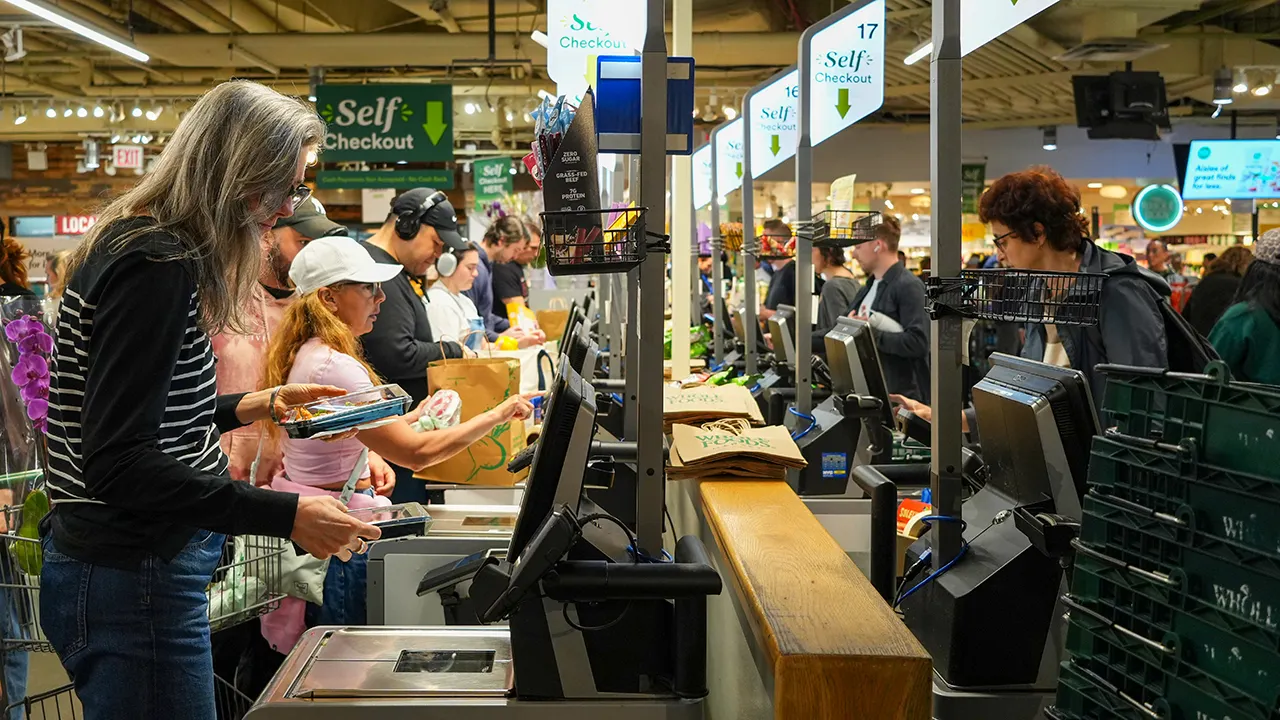
Customers use self checkout at Whole Foods

Customers self-check out at a Whole Foods supermarket in Manhattan on May 13, 2025, in New York City. (Getty Images)

Though June’s inflation data via the consumer price index (CPI) will be released this Tuesday, April’s personal consumption expenditures (PCE) index rose 0.4% on a monthly basis and is up 3.8% from a year ago.

The Urban Institute findings underscore current price pressures, noting 63.2% of working-age Americans ages 18-64 charged their grocery purchases to credit cards last year. More than one-quarter of those individuals then encountered repayment struggles.

Additionally, the share of individuals who failed to make the minimum payment on credit cards used for grocery purchases increased from 7.1% in 2023 to 8.7% in 2025.

Advertisement

“Buy now, pay later” installment plans were used by 8.9% of adults to secure food, but more than a third (34.8%) of those users failed to make an installment payment on time.

GET FOX BUSINESS ON THE GO BY CLICKING HERE

Those hit hardest by the food costs are middle-income earners, the data shows, with middle-class families earning between 200% and 400% of the federal poverty level seeing missed minimum credit card payments on food jump from 9.3% in 2023 to 12.3% in 2025.

Advertisement

“Although access to credit and savings can provide a lifeline for families struggling to meet basic needs,” the Urban Institute wrote, “relying too much on these strategies may lead to financial instability if they have a hard time keeping up with debt or do not recover financially after drawing down savings.”

READ MORE FROM FOX BUSINESS

Continue Reading

Business

Falling cocoa bean prices lead to Barry Callebaut volume increase

Published

on

Falling cocoa bean prices lead to Barry Callebaut volume increase

The 6% jump marked the first quarterly increase in over two years.

Continue Reading

Trending

Copyright © 2025